Surface Residual Stresses Evolution in API 5L X80 Steel with Different Surface Finish under Tensile Monotonic Loads
Abstract
Residual stresses exist intrinsically in any manufactured or processed material, significantly influencing its mechanical properties. Shot peening enhances fatigue life by introducing compressive residual stresses at the surface, however, the beneficial effects may be reduced under external loads. This study investigates the behavior of surface residual stresses induced by shot peening in API 5L X80 steel. Specimens underwent tensile monotonic loading cycles below the yield strength, incrementally increasing the load until reaching the yield limit. Residual stresses were measured using the X-ray diffraction by sin2ψ method, revealing a progressive stress relief of compressive residual stresses field induced by shot peening. The development of tensile residual stresses was observed following the monotonic tests. Loads below yield stress were able to completely reverse compressive stresses to tensile stresses. A correlation was observed between residual stresses and magnetic Barkhausen noise, suggesting it as a potential method for analyzing residual stress behavior qualitatively in shoot peened steel samples.
Keywords:
Residual Stress; Shot Peening; Monotonic Load; API 5L X80 steel; X-ray diffraction
1. Introduction
Residual stresses exist intrinsically in any manufactured or processed material and are self-equilibrating internal forces retained, under uniform temperature conditions, without external loading1,2. They are modified by any undergoing manufacturing processes such as welding, machining, casting, additive manufacturing, and any other processes, due to its thermomechanical interference. These stresses can profoundly influence the mechanical properties, durability, and overall performance of materials where the structural integrity and fatigue life of steel components are critical. Presence of residual stresses in the structure or the component can be either beneficial or detrimental in nature which depends on the stresses whether are compressive residual stresses or tensile residual stress and their integration with applied load3.
Residual stresses can be measured by X-ray diffraction technique, that is a well consolidated technique that provides the crystallographic lattice strain to calculate residual stresses4,5. Another technique that can be applied to assess residual stresses is magnetic Barkhausen noise (MBN). Many studies have demonstrated that MBN can correlate magnetic properties to residual stresses and other microstructural properties, such as grain type and size, hardness, and microstructural gradients6-8. Some studies have focused on analyzing applied stresses and plastic deformation9,10, as well as the effects of surface finishing like shot peening and grinding10-12, and the qualitative determination of residual stresses6,13.
Surface finishing processes directly influence the magnitude and distribution of residual stresses. The residual stresses on surface will redistribute due to removal of material. On surface milling, chip removal can introduce both tensile and compressive residual stresses. Compressive residual stresses are due to the plastic deformation at the surface and tensile stresses are a result of thermal effects and material recovery processes14. For finishing machining, the state and magnitude of residual stresses generated depend on the tool used, grinding conditions and environment chosen. With controlled parameters it is possible to induce high levels of surface and subsurface compressive stresses on grinding15.
Shot peening is a mechanical surface treatment technique for increasing the fatigue life of metals under service loading. It is a cold working process that involves bombarding the surface of a material with small spherical media, such as steel, glass, or ceramic shot. This process creates small indentations on the surface as the impacted area yields under the force, stretching the surface layers into tension. This tensile deformation of the surface layers attempts to return to its original shape, consequently generating a high compressive residual stresses field beneath the indentations.
These effects are induced by shot balls fired at the sample, causing plastic deformation and in-homogeneous dimensional changes on the treated surface. As the residual stresses are to auto equilibrate, it is observed that compressive residual stresses are balanced by tensile residual stresses on the material subsurface16,17. While shot peening is an effective method for enhancing material life by introducing beneficial compressive residual stresses, the exposure of such materials to tensile monotonic loads can lead to the relaxation of these stresses. This relaxation process undermines the improvements gained from shot peening, potentially diminishing the material and equipment performance18. Understanding the mechanisms and effects of residual stress relaxation is crucial for optimizing the design and maintenance strategies of components to ensure their long-term reliability and effectiveness.
Monotonic loads are unidirectional application of stress, which can lead to plastic deformation or failure without the need for stress reversal or cyclic loading. When applied repeatedly, even below yield stress, it has a similar effect as of the fatigue, affecting material structural integrity over time. This similarity is particularly evident in the accumulation of damage and microstructural changes within the material. In fatigue, cyclic loading leads to the initiation and propagation of cracks due to the repeated application of stresses19-22. As well as, in cyclic monotonic loads residual stress are to be modified and particularly compressive residual stresses are relaxed.
This study aims to examine the behavior of residual stresses under monotonic loading in API 5L X80 steel specimens, which are commonly used in the manufacture of oil and gas pipelines. The effects of monotonic loading will be assessed and compared in terms of residual stresses, utilizing X-ray diffraction and magnetic Barkhausen noise in specimens in both machined and shot peened conditions. Additionally, an analysis of variance (ANOVA) test was conducted to confirm the combined effect of surface finishing and tensile loading. There are no studies focused on investigating the effect of monotonic loads on the evolution of residual stresses and comparing their changes to the magnetic Barkhausen noise signal. Therefore, this work aims to fill this gap by comparing different surface finishes of API 5L X80 tensile loaded specimens, constituting its original aspect.
2. Material and Methods
The material studied was a tubular sample of API 5L X80 steel, produced by hot rolling by Usiminas. The chemical composition and material properties are presented in Table 1 and Table 2, respectively.
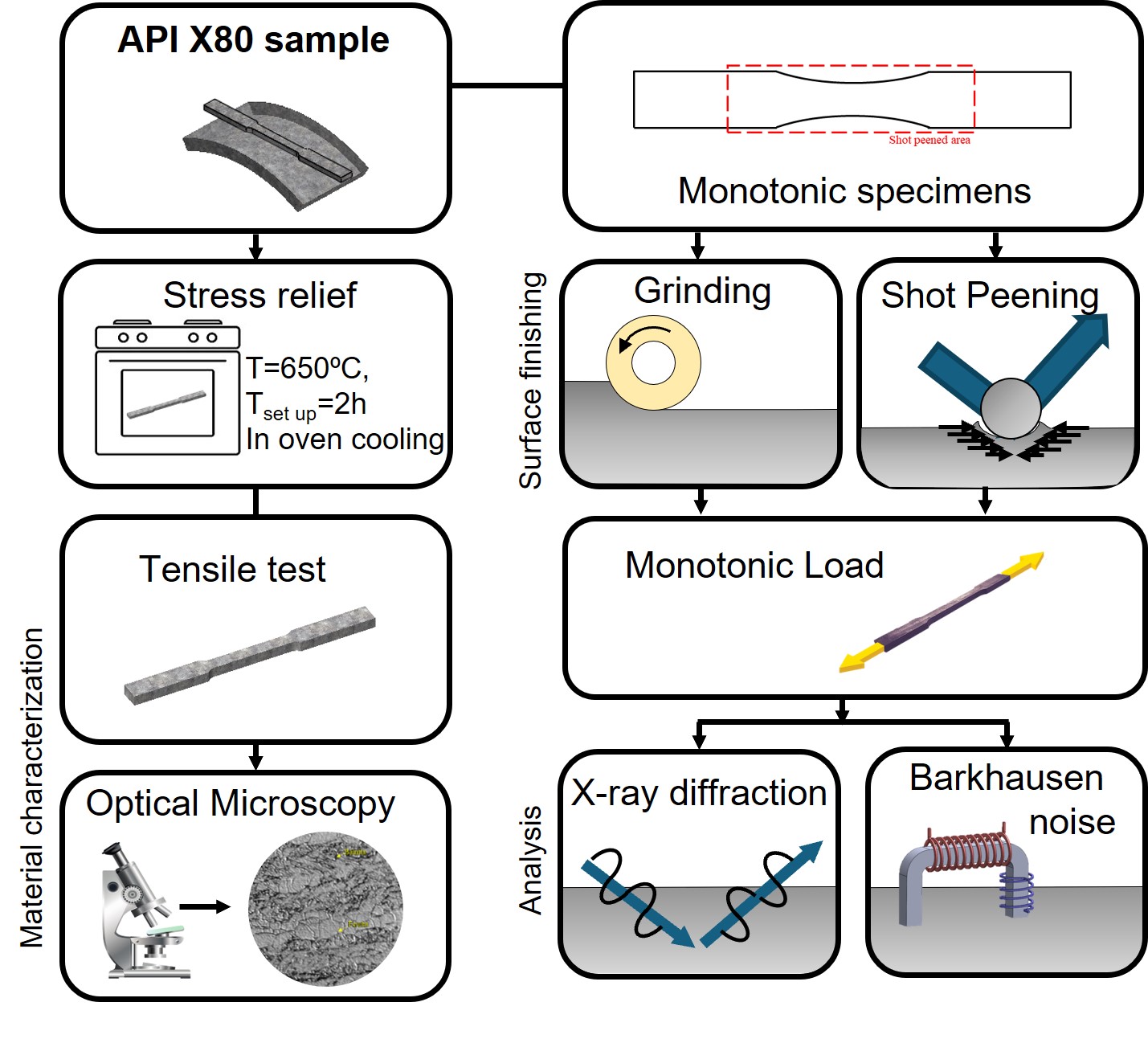
To represent the sequence of experiment conducted, Figure 1 outlines a flowchart of the pathway leading to the analysis.

To analyze API 5L X80 the surface residual stresses behavior under monotonic cycles, the specimens, after grinding or shot peening surface finishing, were cyclic loaded on tensile stresses below the yield limit. The specimens were subjected to tensile stresses below the yield limit and incrementally increasing the load after three loading cycles until it reached the yield limit itself. The residual stresses behavior was measured by X-ray diffraction technique, using sin19ѱ method, before loads and after each monotonic cycle. This way, it was possible to observe the residual stress behavior across different stages of loading. An additional analysis of magnetic Barkhausen noise signals was executed.
2.1. Specimens for tensile and uniaxial monotonic test
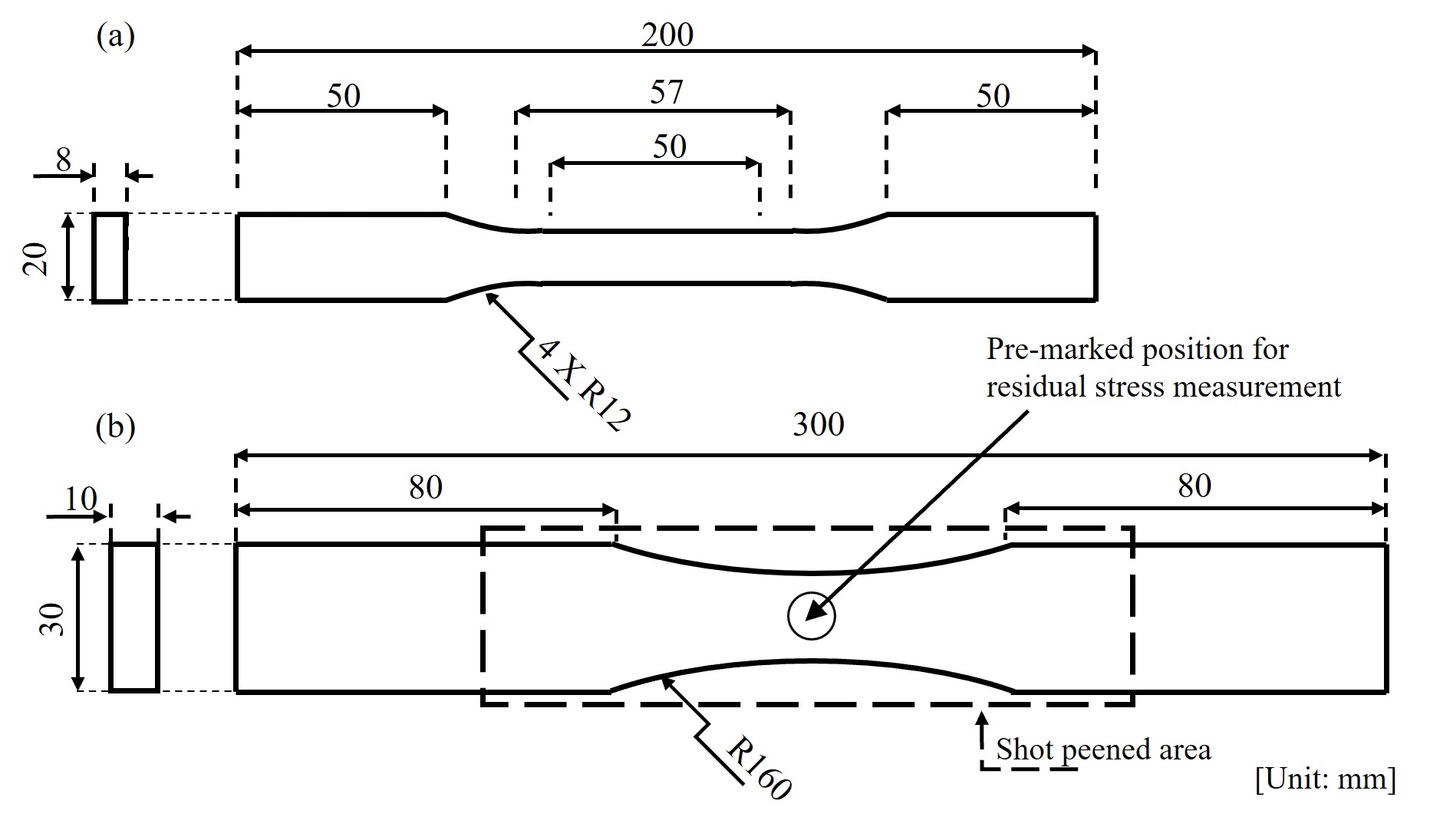
For material characterization six specimens were manufactured, in accordance with ASTM A370 (2005) standard mechanical analysis and other six specimens were produced, in accordance with ASTM E466-15 for monotonic cyclic tests, with the dimensions as observed in Figure 2. The specimens were produced by milling and finished by grinding. For grinding, a conventional white aluminum oxide (Al2O3) grinding wheel was used and the synthetic cutting fluid SyncutBio 600 was applied. To homogenize the internal stresses on the specimens, a stress relief thermal treatment was conducted, with a set up time of 2h followed by slow cooling inside oven.

Specimens: (a) for mechanical strength analysis as ASTM A370 and (b) for monotonic cyclic tests as ASTM E466-15.
2.2. Shot peening mechanical surface treatment
To introduce a compressive residual stresses field on material surface, three of the specimens for uniaxial monotonic tests were mechanically treated with shot peening. To avoid slipping in the grips during the test, it was conducted specifically on the useful section of the specimens, utilizing AGB 35 glass beads, also with 200% coverage and a low Almen intensity of 13N, following SAEJ442a standard, were N grade intensity means that it can deform a standardized 0.013 inch thick Almen strip. This procedure ensure that all samples have the same surface deformation.
2.3. Monotonic tests
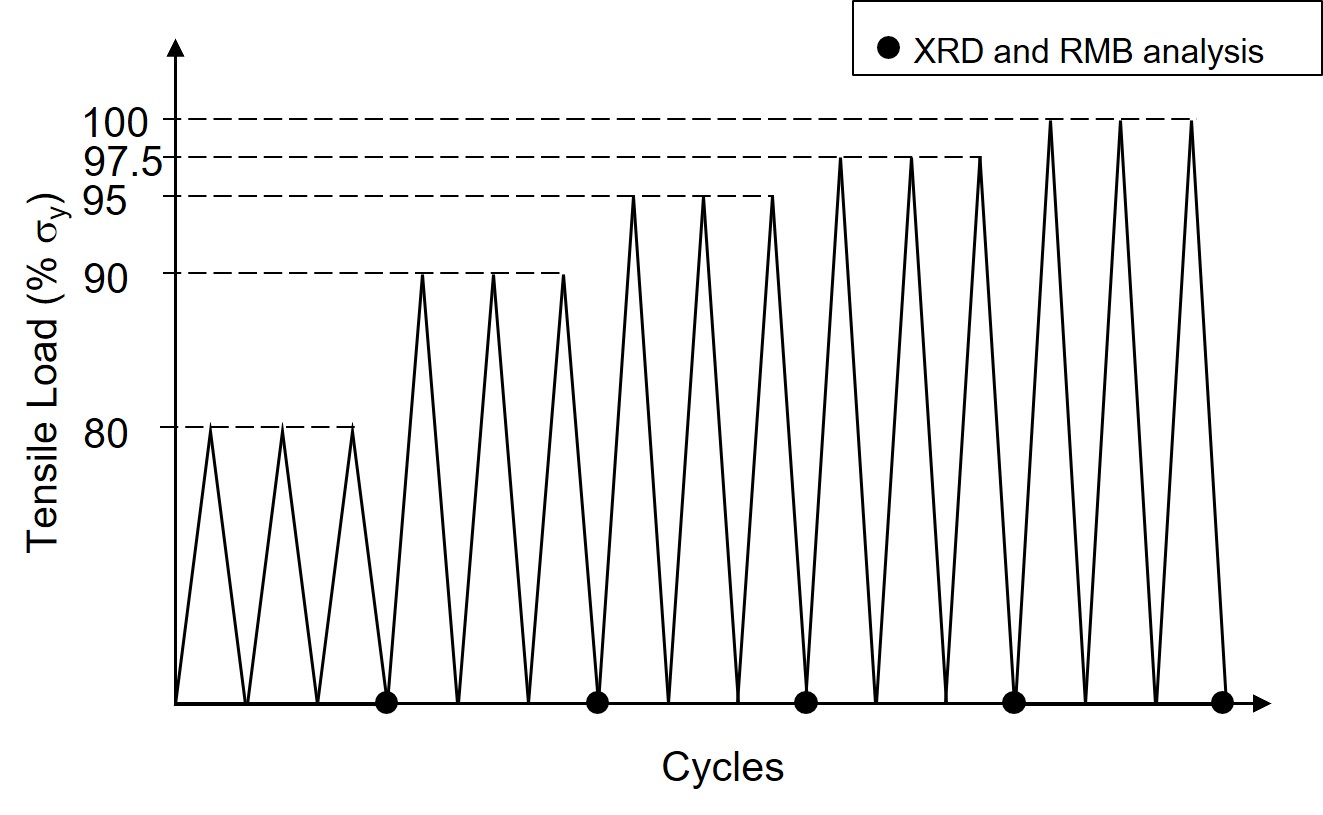
To characterize the residual stresses behavior under cyclic conditions and eliminate initial defects or irregularities in the material or the test setup due to clamping condition, the monotonic tests were conducted in both specimens, either on grinded finishing or on shot peened specimens, with a loading rate of 6 mm/min. Three cycles were performed at each loading stress level below the yield limit of the material (600 MPa), from 80%, followed to 90%, 95%, 97.5% and 100%. Before and after each loading cycle of three loads, the specimens were unclamped, and the residual stresses were measured by X-ray diffraction in the central region of the specimens, as illustrated in Figure3. After that magnetic Barkhausen noise analysis was performed, to compare the results.
2.4. Residual stresses analysis
The residual stresses in both types of specimens were measured by X-ray diffraction technique, using the sin19ψ method, as parameters presented in Table 3, representing the analysis of superficial residual stresses. This analysis was conducted in XStress3000 stress analyzer, at the center, in the longitudinal direction of the specimen, same direction as the axial loading is applied. The parameters employed in the measurement of residual stresses are presented in Table 3.
2.5. Magnetic Barkhausen noise
In order to compare the results of the residual stresses behavior obtained by X-ray diffraction, magnetic Barkhausen noise analysis was carried out to evaluate the root mean square (RMS) level over time, since it showed good agreement with those obtained by XRD measurements in literature6, comparing the signal obtained between all finished specimens. A probe with a cross-sectional area of 80 mm2 comprising an oriented Fe-Si core was utilized, around which a primary excitation coil of 22 AWG was wound with 200 turns around the central core, featuring an electrical impedance of 1 Ω. The secondary coil for analyzing Barkhausen noise used 44 AWG wire wound around one end of the core with 2000 turns, resulting in an electrical impedance of 330 Ω. The magnetic Barkhausen noise probe was placed in the center of the specimen, to analyze the same point of residual stress measurement, and the direction of the detection sensor was aligned in the longitudinal direction of the specimen, as the magnetic Barkhausen noise intensity values measured while applying tensile loads are more accurately compared to applied load when the direction of the detection sensor is the same as the load direction13. The tests were performed by applying voltage of 3.5 V with a sinusoidal excitation frequency of 10 Hz and 50 Hz, considering that the frequency of 50 Hz represents a more superficial signal response and consequently more comparable to the penetration of X-rays. The signal was acquired at a sampling frequency of 350 kHz, applying a 150 kHz anti-aliasing filter and a band-pass filter between 12 and 60 kHz.
3. Results
3.1. Residual stresses
The results of the evolution of surface residual stresses due to monotonic loading, considering the average values found on three specimens of each surface finishing procedure, are presented on Figure 4.

The monotonic loads caused a relaxation effect on the compressive residual stresses on shot peening surface finishing and increase in the magnitude of tensile residual stresses, as presented in Figure 4. In shot peened specimens the compressive residual stresses field initial state started at 470 MPa. The first loading at 80% of the yield limit induces stress relaxation, reflected in a 20.8% increase as residual stress relieves to -370 MPa. The second loading on 90% yield strength, relaxed the stresses to a level of tensile stresses, where the residual stress not only completely reverses to a tensile state but also surges by 140.5% to 150 MPa. A further increase of 35.3% brings the stress to 203 MPa at a 95% load rate, with a minor subsequent reduction to 170 MPa at 97.5% load, before returning to 200 MPa at full yield load.
All specimens of grinding surface finishing, in contrast, presented initial tensile residual stresses (250 MPa average), and exhibited a tendency to increase after the first, second, and third loadings. In the first loading cycle, at 80% of the yield limit, there was a 30% increase where the stress rose to 320 MPa. Subsequently, after the next loading, at 90% of the yield limit, the residual stress increased by 8% to 350 MPa. In the third loading cycle residual stresses increased 8%, reaching the maximum value of 380 MPa. After the fourth loading cycle, it was observed that the residual stresses began to decline in value, reducing by 8.5% after loadings at 97.5% of the yield limit, reaching tensile residual stress of 345 MPa, and a 6% reduction after loadings at 100% of the yield limit, returning to tensile residual stress value of 320 MPa. In this case, the stresses underwent minor variations after each cycle of monotonic loadings, however, it is possible to assess that even below the yield limit (σy) these loadings influenced their behavior.
3.2. Magnetic Barkhausen noise
Examining the behavior of magnetic Barkhausen noise (MBN) signals, compared to residual stresses relief due to monotonic loading, a correlation could be made to verify if there is a trend in behavior, even if only qualitatively. Figures 5 and 6 present the comparisons of residual stresses measured by X-ray diffraction, with Barkhausen magnetic noise for both the specimens with machined finish and with surfaces treated by shot peening, respectively, before and after the loading cycles.

Residual stresses behavior in shot peened specimens in comparison to magnetic Barkhausen noise signal.

Residual Stresses behavior in grinded specimens in comparison to magnetic Barkhausen noise signal.
The residual stresses are compared to magnetic Barkhausen noise in the shot peened specimens, measured at 10 Hz and 50 Hz (Figure 5).
The signal produced by 50Hz excitation frequency presented greater similarity with the residual stresses analysis than in the case of specimens that were only machined. The Barkhausen noise data matches the trends of residual stress behavior on grinded specimen. Initial MBN at 10Hz and 50Hz measured at 0.392 V and 0.780 V, respectively. At the 80% load, MBN shows minimal changes, with a larger response seen at the higher frequency, which eventually shows significant fluctuations in line with the changing stress states. Conversely, for mechanically treated specimens initial MBN readings at 10Hz and 50Hz begin at 0.200 V and 0.498 V, exhibiting more pronounced variations. The MBN increases significantly in response to the transition from compressive to tensile stresses, particularly at 90% load where it nearly doubles at both frequencies, indicating the sensitivity of MBN to underlying stress changes in shot peened specimens.
Figure 6 presents the curves for the average values observed in the machine finished condition.
Literature9,10 indicates that Barkhausen noise at higher frequencies measures more superficial variations, which can be compared to variations in surface residual stress. However, other factors might also influence the noise, so this difference in behavior might be due to some adverse effect on the surface layers. An analytical comparison of residual stresses and magnetic Barkhausen noise (MBN) for specimens with mechanically treated shot peened surfaces (Figure 5) to those after grinding finishing (Figure 6) provides a narrative of how Barkhausen noise, particularly at higher frequencies, has a potential for detecting stress state transformations in materials subjected to incremental mechanical loads. The magnetic noise responsiveness to the relaxation of compressive stresses and the formation of tensile stresses underscores its potential to analyze residual stresses, as it can qualitatively observe a similar behavior of the residual stress and magnetic Barkhausen noise (MBN), mainly in the noise observed in 50Hz.
An analysis of variance (ANOVA) was applied to interpret the impact of various factors on the residual stress measured by X-ray diffraction and on the magnetic Barkhausen noise (MBN) signals (Figure 7).

Effect and interaction of (a) load on residual stresses and (b) amplitude of residual stresses for each surface treatment.
The surface finishing type, represented as grinding or shot peening mechanical treatment exhibits a statistically significant influence on MBN at 10Hz (Figure 8), with a p-value of 0.003752, underscoring the effect of surface treatment on the noise measurements. Correspondingly, the loading condition significantly alters MBN readings at this frequency (p-value of 0.015292), emphasizing the sensitivity of MBN to mechanical loading variations. Although, the interaction term between loading condition and tensile residual does not significantly affect MBN at 10Hz (p-value of 0.633334), indicating the absence of synergistic effects between these factors on the MBN at this lower frequency.

Surface finishing influence on Magnetic Barkhausen noise under 10Hz and 50Hz excitation frequency, as ANOVA.
At the frequency of 50Hz the surface treatment effect continues to be significant (p-value of 0.0003853), reaffirming the surface finishing critical role in influencing MBN. The influence of loading conditions similarly pronounced (p-value of 0.0001580), delineating a strong dependence of MBN on the mechanical load. While the initial residual stress of specimen, significantly affects MBN as a factor at 50Hz (p-value of 0.0025141). This reflects the information that the higher the frequency is, the better is the correlation with MBN and residual stresses23. While initial residual stresses interaction with loading does not have a great influence in Barkhausen noise, as reflected by the p-value of 0.3504104.
The residuals in ANOVA model, indicative of unexplained variance, exhibit minimal sum squares for both frequencies, suggesting a robust fit to the observed data. ANOVA results confirm that both surfaces finishing types and loading conditions profoundly and significantly influence magnetic Barkhausen noise, with the magnitude of these effects being more perceived at 50Hz. No significant effect was found on the combined effect of loading conditions and surface finishing levels on MBN across both frequencies.
3.3. Optical microstructural analysis
The optical microstructure of the material in the as-received condition is shown in Figure9, where the characteristic presence of ferrite and bainite can be observed.

In the Figure 9 the bainitic microstructure is observed in the form of darker grains, interspersed with the ferritic microstructure, identified as the grains of grey color, exhibiting a preferential direction of elongation as the same of rolling of the material during its fabrication.
4. Discussion
The monotonic loads caused a relaxation effect on the compressive residual stresses on shot peening surface finishing and increase in the magnitude of tensile residual stresses. All specimens of grinding surface finishing, in contrast, presented initial tensile residual stresses and presented no variation in its nature. It can be observed that monotonic loads below yield stress were able to modify the residual stresses even in shot peened specimens. The tensile residual stresses observed after grinding reveals that the thermal effects were more significant than the grinding wheel compressive effects24. As all the specimens were subjected to grinding, even before the shot peening surface treatment, these thermal effects might have contributed to the residual stresses evolution on the specimens.
Many studies25-28 asserts that initial residual stresses can fully or partially relax or redistribute, even below the material yield limit, when any part of the component undergoes plastic deformation resulting from the applied axial load. According to Mozafari et al.27, this behavior is due to the redistribution of internal stresses due to the applied load, below σy of the material, resulting in residual plastic deformation that may cause very small changes in the microstructure. These changes can then be responsible for the variation in residual stress in each loading. This may also be related to fatigue failures after many loading cycles. According to Leguinagoicoa et al.26, the residual stress relaxation increases with the magnitude of the applied stress, due to the increase of generated plastic strains, also, an important stress relaxation occurs in the initial cycles, due to the higher stress magnitude (applied stress plus residual stress) with respect to yield point.
The magnetic Barkhausen noise technique was able to qualitatively correlate the evolution of residual stresses in shot peened specimens, with an Almen intensity of 13N, it is consistent with the findings of Sorsa et al.12. In their study, it was found that when the shot peening intensity was high enough, the magnetic Barkhausen noise signal response was dominated by the shot peening coverage density parameter, making it difficult to correlate with residual stress response. Conversely, with a lower Almen intensity parameter, the correlation between residual stress and Barkhausen noise measurements was remarkable. This indicates that surface Barkhausen noise measurements can be effectively used to evaluate the stress gradient in the shot peening process.
Hwang et al.13 demonstrated that higher applied magnetization frequencies resulted in increased magnetic Barkhausen noise intensity values. They also found that the magnetic Barkhausen noise intensity values measured under tensile loads increased linearly with the load when the direction of the detection sensor was aligned with the load direction. This study concluded that it is possible to evaluate whether a material is in a non-stressed state or under inherent residual stress.
In this experiment, excitation frequencies of 10 and 50 Hz were applied using the magnetic Barkhausen technique to assess superficial residual stresses. Although other studies have applied higher excitation frequencies and found more significant correlations, there was a good correlation between residual stress behavior under monotonic loads and the Barkhausen signal. This finding is in line with Avila et al.6, who observed that the peak position and root mean square profiles of the magnetic Barkhausen noise qualitatively correlated with the residual stress profile obtained by X-ray diffraction and the hardness profile.
There is a significant difference in the magnetic Barkhausen noise when surface stress changes behavior, as the stronger influence of surface tensile stresses compared to compressive stresses can explain this behavior8. The Barkhausen signal responds well to variations in tensile stresses in ground specimens, as well as to the relaxation and shifting of initially compressive stresses. However, this response is only qualitative, as the signal variation can only be compared to the initial state of the specimen. When comparing the Barkhausen noise obtained from a ground surface and a shot-peened surface of the same material with similar residual stress, the signals are very divergent. Hwang et al.13 noted that high microhardness and spurious phases, such as austenite, can act as reducers of the magnetic Barkhausen signal. Di9 used magnetic Barkhausen noise to reveal inhomogeneous layering stress/strain levels and elastic/plastic deformation of the specimen distributed along the depth direction, suggesting that the MBN method, under development, might characterize the mechanical properties of the specimen quantitatively or semi-quantitatively. This occurs because magnetic Barkhausen noise is more susceptible to structural integrity than to residual stresses. This analysis underscores how initial surface treatments can fundamentally influence a material's mechanical and magnetic responses to loading.
5. Conclusions
The surface residual stress behavior of API 5L X80 steel with dissimilar surface finishing obtained by grinding and shot peening was investigated under tensile uniaxial monotonic loadings and a comparison to Magnetic Barkhausen noise signal was conducted. The conclusions can be summarized as follows:
-
The high initial values of compressive residual stresses were significantly modified by monotonic loads, exhibiting complete relaxation characterized by a shift to tensile stresses after the second loading (90% σy). The Barkhausen signal responds well to the variation of tensile stresses in grinded specimens and relaxation and shifting of initially compressive stresses. Although it is only a qualitative response, as signal variation can be compared only to the signal of initial state of a specimen.
-
The grinded specimens presented, at first, tensile residual stresses (250MPa average), caused by the thermal influence of the fabrication process, and exhibited a tendency to increase after the first, second, and third loadings. In this case, the stresses underwent minor variations after each cycle of monotonic loadings, observing that even below the yield limit (σy) these loadings influenced the residual stresses behavior.
-
The results of residual stresses measured by X-ray diffraction compared to corresponding magnetic Barkhausen noise signal values vary significantly, especially at higher load rates, close to yield stress limit. The magnetic Barkhausen noise signal responds well to the variation of residual stresses especially with an excitation frequency of 50 Hz, though it is only a qualitative response, as signal variation can be compared only to the signal of initial state of a specimen.
-
Magnetic Barkhausen noise is more susceptible to surface finishing than to the residual stresses, as the initial surface treatments can fundamentally influence a material mechanical and magnetic responses to loading.
-
The analysis of variance (ANOVA) confirmed that the effect of surface finishing and loading have a significant effect on residual stresses and magnetic Barkhausen noise (MBN) response. In Barkhausen noise signal the variation on 50 Hz is more prominent, as in this case MBN has a more similar behavior to that of the residual stresses.
Acknowledgements
This study was financed in part by the Brazilian National Council for Scientific and Technological Development (CAPES) - Finance Code 001. The authors would also like to thank the Brazilian research agencies CNPq (304327/2021-2) and FAPERJ for the financial support.
References
- 1 Macherauch E, Kloos KH. Origin, measurement and evaluation of residual stresses. Residual stresses in science and technology. In: Papers Presented at the International Conference on Residual Stresses. Proceedings. Garmisch-Partenkirschen: DGM VERLAG; 1987. p. 3-26.
- 2 Withers PJ, Bhadeshia HKDH. Residual stress Part 1 – Measurement techniques. Mater Sci Technol. 2001;17:11.
-
3 Ratan V, Shirahatti A. Overview of effect of residual stress, elastic follow-up & stress redistribution using whole structure approach. Mater Today Proc. 2022;65:3846-51. https://doi.org/https://doi.org/10.1016/j.matpr.2022.07.035
» https://doi.org/https://doi.org/10.1016/j.matpr.2022.07.035 -
4 Sarmast A, Schubnell J, Preußner J, Hinterstein M, Carl E. Residual stress analysis in industrial parts: a comprehensive comparison of XRD methods. J Mater Sci. 2023;58:16905-29. http://doi.org/10.1007/s10853-023-09069-z
» http://doi.org/10.1007/s10853-023-09069-z -
5 Wang L, Qian X. Evolution of welding residual stresses during cyclic tests in welded tubular joints. J Construct Steel Res. 2024;216:108598. https://doi.org/10.1016/j.jcsr.2024.108598
» https://doi.org/10.1016/j.jcsr.2024.108598 -
6 Avila JA, Conde FF, Pinto HC, Rodriguez J, Grijalba FAF. Microstructural and residuals stress analysis of friction stir welding of X80 pipeline steel plates using magnetic barkhausen noise. J Nondestr Eval. 2019;38:86. http://doi.org/10.1007/s10921-019-0625-2.
» https://doi.org/ http://doi.org/10.1007/s10921-019-0625-2 -
7 Hang C, Liu W, Dobmann G, Chen W, Wang P, Li K. Feature extraction and evaluation for quantitative prediction of hardness in bearing steel based on magnetic Barkhausen noise. NDT Int. 2023;139:102937. https://doi.org/10.1016/j.ndteint.2023.102937
» https://doi.org/10.1016/j.ndteint.2023.102937 -
8 Oliveira AR, Jovičević-Klug M, de Oliveira VF, Teixeira JC, Del Conte EG. Barkhausen Noise monitoring of microstructure and surface residual stress in maraging steel manufactured by Powder Bed Fusion and aging. Int J Adv Manuf Technol. 2022;119:1835-52. http://doi.org/10.1007/s00170-021-08411-6
» http://doi.org/10.1007/s00170-021-08411-6 -
9 Di J. Multigradient characterization of the strain in low-carbon steel components based on magnetic barkhausen noise method. IEEE Sens J. 2024;24:4334-42. http://doi.org/10.1109/JSEN.2023.3347668
» http://doi.org/10.1109/JSEN.2023.3347668 -
10 Kypris O, Nlebedim IC, Jiles DC. Measuring stress variation with depth using Barkhausen signals. J Magn Magn Mater. 2016;407:377-95. https://doi.org/10.1016/j.jmmm.2016.01.072
» https://doi.org/10.1016/j.jmmm.2016.01.072 -
11 Jedamski R, Kuhlmann G, Rößler M, Karpuschewski B, Dix M, Epp J. Towards developing a control of grinding processes using a combination of grinding power evaluation and Barkhausen noise analysis. Prod Eng. 2024;18:339-51. http://doi.org/10.1007/s11740-023-01247-x
» http://doi.org/10.1007/s11740-023-01247-x -
12 Sorsa A, Santa-aho S, Wartiainen J, Suominen L, Vippola M, Leiviskä K. Effect of shot peening parameters to residual stress profiles and barkhausen noise. J Nondestr Eval. 2018;37:1-11. http://doi.org/10.1007/s10921-018-0463-7
» http://doi.org/10.1007/s10921-018-0463-7 -
13 Hwang Y-I, Kim Y-I, Seo D-C, Seo M-K, Lee W-S, Kwon S, et al. Experimental consideration of conditions for measuring residual stresses of rails using magnetic barkhausen noise method. Materials (Basel). 2021;14. http://doi.org/10.3390/ma14185374
» http://doi.org/10.3390/ma14185374 -
14 Zawada-Michałowska M, Pieśko P, Mrówka-Nowotnik G, Nowotnik A, Legutko S. Effect of the technological parameters of milling on residual stress in the surface layer of thin-walled plates. Materials (Basel). 2024;17. http://doi.org/10.3390/ma17051193
» http://doi.org/10.3390/ma17051193 -
15 Shen S, Li B, Guo W. Experimental study on grinding-induced residual stress in C-250 maraging steel. Int J Adv Manuf Technol. 2020;106:953-67. http://doi.org/10.1007/s00170-019-04655-5
» http://doi.org/10.1007/s00170-019-04655-5 -
16 Kim J-C, Cheong S-K, Noguchi H. Residual stress relaxation and low- and high-cycle fatigue behavior of shot-peened medium-carbon steel. Int J Fatigue. 2013;56:114-22. https://doi.org/10.1016/j.ijfatigue.2013.07.001
» https://doi.org/10.1016/j.ijfatigue.2013.07.001 -
17 Wang C, Fan K, Zhao Q, Abdel Wahab M. Effect of shot peening parameters on fretting fatigue lifetime. Tribol Int. 2024;193:109311. https://doi.org/10.1016/j.triboint.2024.109311
» https://doi.org/10.1016/j.triboint.2024.109311 -
18 Ma M, Zhang J, Yi D, Wang B. Investigation of high-cycle fatigue and fatigue crack propagation characteristic in 5083-O aluminum alloy. Int J Fatigue. 2019;126:357-68. http://doi.org/10.1016/j.ijfatigue.2019.05.020
» http://doi.org/10.1016/j.ijfatigue.2019.05.020 -
19 Coules HE, Horne GCM, Venkata KA, Pirling T. The effects of residual stress on elastic-plastic fracture propagation and stability. Mater Des. 2018;143:131-40. http://doi.org/10.1016/j.matdes.2018.01.064
» http://doi.org/10.1016/j.matdes.2018.01.064 -
20 Mohtadi-Bonab MA, Kucheki HG. Important factors on the failure of pipeline steels with focus on hydrogen induced cracks and improvement of their resistance : review paper. Met Mater Int. 2019;25:1109-34. http://doi.org/10.1007/s12540-019-00266-7
» http://doi.org/10.1007/s12540-019-00266-7 -
21 Pinheiro B, Lesage J, Pasqualino I, Benseddiq N, Bemporad E. X-ray diffraction study of microstructural changes during fatigue damage initiation in steel pipes. Mater Sci Eng A. 2012;532:158-66. http://doi.org/10.1016/j.msea.2011.10.077.
» https://doi.org/10.1016/j.msea.2011.10.077 - 22 Schindler I, Kawulok R, Seillier Y, Kawulok P, Opěla P, Rusz S, et al. Continuous cooling transformation diagrams of HSLA steel for seamless tubes production. JMMB. 2019;55(3):413-26.
-
23 Raja AR, Singh S, Vashista M, Yusufzai MZK. Influence of Friction Stir Welding Speed on Barkhausen Noise Emission from Steel. Phys Met Metallogr 2023;124:1515–23. https://doi.org/10.1134/S0031918X22600816
» https://doi.org/10.1134/S0031918X22600816 -
24 Gong P, Zhang Y, Wang C, Cui X, Li R, Sharma S, et al. Residual stress generation in grinding: mechanism and modeling. J Mater Process Technol. 2024;324:118262. https://doi.org/10.1016/j.jmatprotec.2023.118262
» https://doi.org/ https://doi.org/10.1016/j.jmatprotec.2023.118262 -
25 Gao Z, Gan J, Liu H, Liu X, Wu W. Fatigue crack growth prediction for shot-peened steel considering residual stress relaxation. Mater Des. 2023;234:112301. https://doi.org/10.1016/j.matdes.2023.112301
» https://doi.org/10.1016/j.matdes.2023.112301 -
26 Leguinagoicoa N, Albizuri J, Larrañaga A. Fatigue improvement and residual stress relaxation of shot-peened alloy steel DIN 34CrNiMo6 under axial loading. Int J Fatigue. 2022;162:107006. https://doi.org/10.1016/j.ijfatigue.2022.107006
» https://doi.org/10.1016/j.ijfatigue.2022.107006 -
27 Mozafari F, Thamburaja P, Srinivasa AR, Moslemi N. A rate independent inelasticity model with smooth transition for unifying low-cycle to high-cycle fatigue life prediction. Int J Mech Sci. 2019;159:325-35. http://doi.org/10.1016/j.ijmecsci.2019.05.017
» http://doi.org/10.1016/j.ijmecsci.2019.05.017 -
28 Yin F, Fatemi A. Monotonic and cyclic deformations of case-hardened steels including residual stress effects. Strain. 2011;47:e74-83. https://doi.org/10.1111/j.1475-1305.2008.00504.x
» https://doi.org/10.1111/j.1475-1305.2008.00504.x