
 TEMPORAL TREND IN THE DENSITY OF PHYSICAL EDUCATION PROFESSIONALS IN THE UNIFIED HEALTH SYSTEM IN BRAZIL, 2008-2022
Abstract
The aim of this study was to analyze the temporal trend in the workforce density of Physical Education Professionals in the three levels of healthcare in the Brazilian Unified Health System (SUS) from 2008 to 2022. An ecological time series study was conducted using data from January 2008 to December 2022 from the National Health Establishment Registry. The sample consisted of Physical Education Professionals providing services within SUS. Segmented linear regression analysis was performed using the Joinpoint Regression Program software. It was identified that the density of Physical Education Professionals in the three levels of healthcare increased from 2008 to 2022, with the largest increase observed in Primary Healthcare (13.8%). It was also noted that SUS relies on the workforce of Physical Education Professionals, although with low density across the three levels of healthcare.
Keywords
Healthcare Professional; Human Resources; Physical Activity; Health Promotion
Resumo
O objetivo deste trabalho foi analisar a tendência temporal da densidade da força de trabalho de Profissionais de Educação Física nos três níveis de atenção à saúde do SUS no Brasil, 2008-2022. Estudo de característica ecológica de série temporal, foram utilizados dados de janeiro de 2008 a dezembro de 2022 do Cadastro Nacional de Estabelecimentos de Saúde. A amostra foi composta por Profissionais de Educação Física que realizam atendimentos no SUS. Foi realizada a análise de regressão linear segmentada no software Joinpoint Regression Program. Foi identificado o crescimento da densidade de Profissionais de Educação Física nos três níveis de atenção à saúde de 2008 a 2022, em que o maior aumento foi na Atenção Primária à Saúde (13.8%). Identificou-se que o SUS conta com a força de trabalho do Profissional de Educação Física, porém com baixa densidade nos três níveis de atenção à saúde.
Palavras-chave
Profissional de Saúde; Recursos Humanos em Saúde; Atividade Física; Promoção da Saúde
Resumen
El objetivo de este trabajo fue analizar la tendencia temporal de la densidad de la fuerza laboral de Profesionales de Educación Física en los tres niveles de atención médica del Sistema Único de Salud (SUS) en Brasil, en el período de 2008 a 2022. Se llevó a cabo un estudio ecológico de series temporales utilizando datos del Registro Nacional de Establecimientos de Salud desde enero de 2008 a diciembre de 2022. La muestra estuvo compuesta por Profesionales de Educación Física que prestan servicios en el SUS. Se realizó un análisis de regresión lineal segmentada utilizando el software Joinpoint Regression Program. Se identificó un crecimiento en la densidad de Profesionales de Educación Física en los tres niveles de atención médica de 2008 a 2022, con el mayor aumento ocurriendo en la Atención Primaria de Salud (13.8%). Se observó que el SUS cuenta con la fuerza laboral de Profesionales de Educación Física, aunque con una baja densidad en los tres niveles de atención médica.
Palabras clave
Profesional Sanitario; Recursos Humanos; Actividad Física; Promoción de la Salud
1 INTRODUCTION
Recognition of the importance of promoting physical activity has increased globally, however, a significant portion of the population still does not meet the recommended weekly levels (Guthold et al., 2018), which also occurs in Brazil (Brasil, 2022a). These practices are a crucial factor in preventing major diseases and health issues that affect the population (Ding et al., 2016; Guthold et al., 2018; Lima, 2019; WHO, 2020), with significant economic repercussions for healthcare systems (Ding et al., 2016). Moreover, physical activity has the potential to contribute to the reduction of global warming and is associated with human development (Salvo et al., 2021). This has more recently led to the identification of these practices as a relevant factor in achieving the sustainable development goals in the 2030 agenda, in addition to being regarded as a fundamental right (UNESCO, 2015).
In Brazil, the promotion of physical activity was primarily institutionalized as a federal public health policy in 2006, with its inclusion in the National Health Promotion Policy. Since then, various initiatives have been developed, including the establishment of the Health Academy Program in 2011 (Brasil, 2023a), particularly in Primary Health Care (PHC). Such actions have led to the inclusion of these practices as targets in strategic action plans for addressing non-communicable diseases and health issues in Brazil (Brasil, 2011, 2021a).
Beyond the Health Academy Program and initiatives in PHC, the inclusion of physical activity practice at all three levels of healthcare within the Unified Health System is significant. These levels include, in addition to PHC, Specialized Outpatient Care (SOC) and Hospital Care (HC), and involve professionals from various higher education backgrounds, forming an interprofessional team (Malta et al., 2014), which includes Physical Education Professionals (PEPs). In this context, PEPs could be strategic in facilitating physical activity, as they are responsible for planning, coordinating, programming, organizing, supervising, and preparing technical, pedagogical, and scientific reports, among other activities. PEPs also participate in interdisciplinary and multidisciplinary teams, all within the fields of sports and physical activities (Brasil, 1998). Thus, it is essential to understand and plan the workforce of PEPs with a flexible and integrated approach that aligns with productivity and skill. To achieve this, the recruitment of the health workforce should consider the health characteristics of the country and the facilities, ensuring at least the minimum number of professionals necessary to guarantee adequate healthcare and support for the population (Asamani et al., 2021; Lopes; Almeida; Almada-Lobo, 2015). It is important to note that we do not advocate for the requirement of a PEP as a condition for accessing these practices. However, it is undeniable that the presence of a PEP is closely associated with ensuring access to this right.
Therefore, understanding the availability of PEPs as part of the health workforce within the UHS, considering the density of these professionals and the standard weekly working hours of 40 hours, is crucial for developing health promotion policies through guidance and ensuring access to physical activity. This understanding enhances access, helps reduce inequities, strengthens disease prevention, and improves well-being and quality of life. Additionally, this information could contribute to better management of the UHS. Thus, the current study aimed to analyze the temporal trend in the density of the PEP workforce across the three levels of healthcare within the UHS in Brazil from 2008 to 2022.
2 METHODS
This is an ecological time-series study on the integration of PEPs within the UHS.
Data collection was carried out according to the following steps: 1) The NRHE (National Registry of Health Establishments) database, by occupation, was downloaded (NRHE - Individuals), from January 2008 to December 2022, using the script developed by Saldanha (2019), applied using RStudio version 1.2; 2) Data were filtered using the “CBO” field; 3) Subsequently, using the “PROF_SUS” field, only professionals affiliated with the UHS were selected; 4) Information regarding the unit type “TP_UNID” was aggregated into the categories of PHC, SOC, and HC; and finally 5) The weekly working hours for each type of establishment were summed and the result was divided by 40.
The sample consisted of PEP working within the UHS at least at one of the three levels of healthcare, and who were properly registered in the National Registry of Health Establishments.1 For this study, all Brazilian Classifications of Occupations for PEP were considered. The classifications with available working hours in UHS establishments were: physical evaluator (224105), physical trainer (224120), physical education professional in health (224140), physical education teacher in elementary education (231315), physical education teacher in secondary education (232120), physical education teacher in higher education (224410), athlete trainer (224115), and professional football coach (224135).
To avoid and correct potential biases, analyses were standardized for a 40-hour working week, given that there may be varying work schedules among health professionals. This approach aligns with the World Health Organization’s recommendation to standardize working hours in workforce studies to achieve consistency (WHO, 2023).
The PEP workforce was calculated by summing the total weekly working hours and dividing this by 40 hours per week for each month and year studied. Subsequently, the density of professionals per 10,000 inhabitants was calculated for each month and year analyzed (WHO, 2017), considering the total workforce for this professional classification for each month and year, divided by the Brazilian population; the population estimates were based on the 2010 Census data due to the lack of more recent estimates. Therefore, the source of the estimated population data for the period from January 2008 to December 2022 was the Brazilian Institute of Geography and Statistics (IBGE) (Brasil, 2023b).
The services considered at each level of care were: 1) PHC: health posts, health centers/basic units, mixed units, land mobile units, riverine mobile units, family health support centers, Health Academy, home care, residential care units, basic health units, home care units, disease and illness prevention and health promotion center and health support facilities; 2) SOC: polyclinics, isolated offices, specialty clinics/centers, psychosocial care centers, rehabilitation units, psychosocial care units, special therapies units, outpatient clinics, diagnostic support units, and worker health reference centers; 3) HC: general hospitals, specialized hospitals, day hospitals (isolated), and normal obstetric and neonatal assistance hospitals and centers.
The analysis of temporal trends in the density of PEP was conducted through annual averages of the PEP working 40 hours per week per 10,000 inhabitants in Brazil. Segmented linear regression analysis (joinpoint regression) was performed using the Joinpoint Regression Program, version 5.0.2, where the average annual percentage change was estimated with a 95% confidence interval. The final model selected was the best-fitting model, with the Annual Percentage Change (APC) based on the trend of each segment, to assess whether these values were statistically significant (p<0.05). To quantify the trend over the analyzed years, the Average Annual Percent Change (AAPC) was calculated, which is based on the geometric mean of the APC trends, with equal weights for the lengths of each segment within the fixed interval. Significance tests used were based on the Monte Carlo permutation method and the calculation of the annual percentage change in the ratio, using the logarithm of the ratio (Kim et al., 2004).
To estimate the population per PEP working 40 hours per week per 10,000 inhabitants, the total number of PEPs working 40 hours per week was summed for each year. This sum was then divided by the Brazilian population, using the 2010 Census population estimate. This process was repeated for all years across the three levels of healthcare.
3 RESULTS
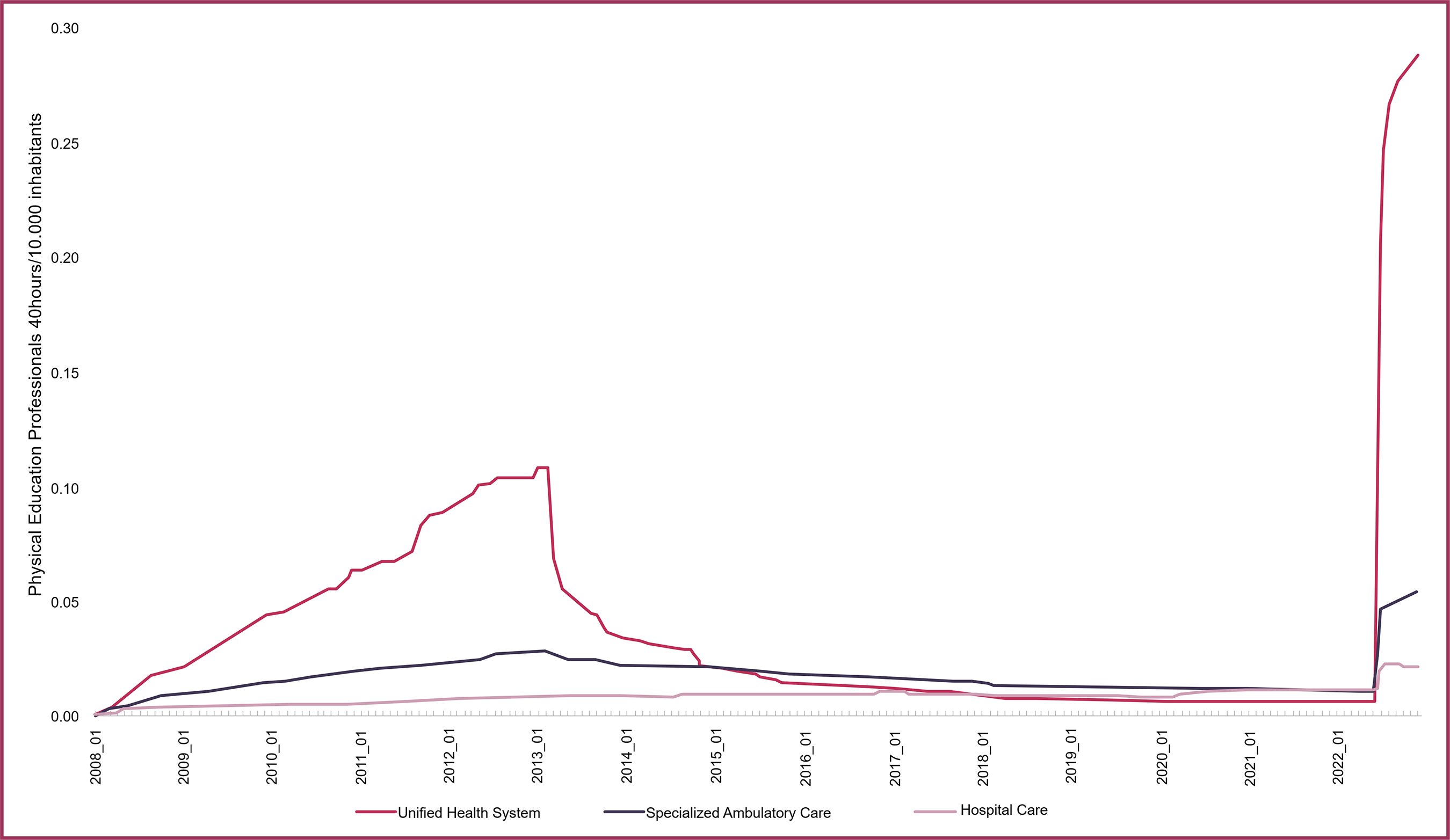
The density of PEPs across the levels of healthcare varied in the country from January 2008 to December 2022. In January 2008, the density per 10,000 inhabitants was 0.0008 in PHC, 0.0016 in SOC, and 0.0017 in HC. By December 2022, these figures had increased to 0.2887 in PHC, 0.0541 in SOC, and 0.0224 in HC (Figure 1).

Temporal trend in the density of Physical Education Professionals per 10,000 inhabitants across the three levels of care in Brazil, 2008 to 2022.
From 2008 to 2022, there was an estimated increase of 10.73% in the Brazilian population. The values related to this increase and the evolution of the average annual rates of PEP can be observed in Table 1.
Estimates of the Brazilian population and average annual rates of Physical Education Professionals per 10,000 inhabitants across the three levels of care, 2008 to 2022.
When observing the temporal trend in the average annual rates of the PEP workforce in Brazil across the three levels of healthcare, a significant non-linear growth was noted from 2008 to 2022. The most substantial increase occurred in PHC (13.8%), followed by HC (11.2%) and SOC (9.2%) (Table 2).
Temporal trend of average annual rates of distribution of Physical Education Professionals across the three levels of UHS per 10,000 inhabitants, Brazil, 2008 to 2022
4 DISCUSSION
All three levels of healthcare involve the work of PE professionals, and changes in the density of these professionals were observed in Brazil over the years studied. One notable pattern is the trend for growth up to approximately 2011, particularly evident in PHC (92.0%), followed by a further increase from 2020 (361.3%), highlighting non-linear growth in the density of PEPs during the studied period.
It is essential that workforce planning is precise and executed in a timely manner, taking into account potential challenges in the implementation of health sector policies (Lopes; Almeida; Almada-Lobo, 2015). The size of the health workforce relative to the population is a significant indicator of the availability of human resources for the population (Karan et al., 2021). In PHC, between 2007 and 2020, there was an increase in the density of several health professionals, including physiotherapists (10.8%), speech therapists (7.6%), psychologists (6.8%), and occupational therapists (28.3%) (Silva et al., 2021). However, for PEPs, there was a decrease in density during a specific time frame within this period, namely from 2011 to 2020.
It is important to note that, as briefly mentioned, although physical activity should be integrated into the work process of any health professional, for example through counseling (Brasil, 2022a), there is a closer association of PEPs with this topic. Thus, the benefits can be maximized through individual or group guidance for users (Carvalho et al., 2023), culminating in the prevention and management of chronic conditions and improving the quality of life of UHS users. However, when considering the 40-hour working week parameter, the current study presents data showing a decrease in the density of PEPs in PHC between 2011 and 2020, followed by a subsequent increase.
Based on the health, social, economic, and environmental benefits of physical activity (Ding et al., 2016; Messing et al., 2021; Salvo et al., 2021; WHO, 2020), the high prevalence of individuals who do not meet the recommended levels of physical activity necessitates comprehensive public health measures in a multi-sectoral and interprofessional manner, in order to expand interventions capable of ensuring access. One such measure is the increased integration of PEPs and, consequently, a higher density of these professionals at various levels of UHS care. This can be strategically transformative, contributing to increased physical activity among the population, thus promoting a right and, subsequently, reducing public health impacts.
Different programs and actions within the UHS, particularly in PHC, are related to the integration of PEPs. At the federal level, notable initiatives included the multiprofessional teams known as the Family Health Support Centers until 2019, and the Health Academy Program, which may have contributed to the increase in the rates of this professional from 2008 to 2012.
Between 2021 and 2022, there was a significant increase in the density of PEPs in PHC, likely due to the resumption of in-person activities following the most acute and complex phase of the COVID-19 pandemic. This resurgence can be attributed to the progress in vaccination and other measures that facilitated the return to activities. Carvalho et al. (2023) observed a reduction in the number of physical activity programs in 2020, followed by increases in 2021 and 2022.
Similarly, the introduction of federal incentives for offering physical activity in health units (Brasil, 2022b) anticipates the hiring of PEPs in PHC, which may have contributed to the increase in PEP density in PHC, starting from mid-2022.
In 2023, there was a return of multiprofessional teams, now called e-Multi (Brasil, 2023c), consisting of health professionals from various fields who work in an integrated and complementary manner with other PHC teams. This represents a promising scenario for the potential increase in the density of PEPs in PHC.
In the context of SOC, where PEPs make significant contributions but remain under-recognized, there are still challenges to address. For example, a study conducted at a Psychosocial Care Center in Goiânia identified that one of the main challenges for PEPs is working in an intersectoral manner. In addition, PEPs face prejudice and limited encouragement from other professionals and users in the facility (Furtado et al., 2017).
The PEP is responsible for individually prescribing the volume and intensity of physical activity based on examination results and assessments. Aiming to enhance the patient’s physical capacity and safely achieve benefits (Vieira, 2013), the PEP can also incorporate other elements of corporal culture into the care process. In HC, the PEP can promote physical activity through workplace gymnastics for hospital staff and physical conditioning exercises for patients, aiming to improve their health outcomes (Vieira et al., 2023). A clear and fundamental example is engaging hospitalized children in activities that promote physical movement, such as using active video games and hospital playrooms. These can be considered strategies to achieve health goals, encompassing physical, mental, and social well-being (Carvalho; Freitas, 2018). In HC, initiatives from university hospitals have gained prominence, such as the physical reconditioning program at the Hospital de Clínicas of the Universidade Federal do Triângulo Mineiro. This program focuses on caring for post-COVID patients with cardiorespiratory complications, patients who have undergone bariatric surgery, as well as patients with other illnesses. The services are provided in individual or group sessions, managed by the PEP at the facility and PEP residents from the multiprofessional residency program (Miranda et al., 2023).
A study conducted by Vieira et al. (2023) identified an increase in the number of residents and PEPs in the UHS from 2007 to 2021. However, despite using the same database as the current study, the authors did not analyze density or consider the standardization of working hours. Bandeira et al. (2022) believe that an insufficient number of PEPs to promote physical activity for the population using health services, along with the possibility of facing vulnerable conditions due to often precarious employment contracts, contributes to this issue. This perspective is supported by Vieira et al. (2023), particularly in PHC, where PEPs face challenges related to salaries, infrastructure, and organizational issues, and constitute only a small segment of the workforce (Bandeira et al., 2022).
Strategically, it is understood that PEPs can help expand access and increase physical activity among the population. According to Vigitel, in 2021, only 36.7% of Brazilian adults met the recommendation of 150 minutes per week of moderate or intense leisure physical activity (Brasil, 2022c). Considering that such practices contribute to the prevention and treatment of various diseases, it is crucial to create and expand public policies at the federal, state, and municipal levels. Although there was an increase in physical activity levels from 2011 to 2022, as outlined in the strategic action plan for addressing chronic diseases and non-communicable conditions in Brazil, the fact that only one third of the adult population is physically active indicates the need to further promote physical activity. This remains a key focus in the ongoing planning of the UHS for the period from 2021 to 2030 (Brasil, 2011, 2021a).
In the context of ensuring qualified access to physical activities for the Brazilian population, the Ministry of Health launched the Guia Brasileiro de Atividade Física para a População Brasileira (Brazilian Physical Activity Guide for the Brazilian Population), which emphasizes the vital role of the health sector in promoting physical activity (Brasil, 2021b). Although this guide does not place the responsibility for promoting physical activity solely on PEPs, it undeniably highlights their prominent role. Therefore, actions that encourage greater integration of PEPs into the UHS are important to ensure that the population has access to these practices with the guidance and supervision of a qualified professional. This approach allows other health professionals to support the initiation or maintenance of a more physically active lifestyle.
Several limitations should be considered in the current study. Secondary data may present potential recording issues, even though official Brazilian data covering all health establishments in Brazil were used. Over the years included in the study, the Brazilian Classification of Occupations was updated from the provisional 2241-E1 to 2241-40. This change may result in potential bias in the data, such as the loss of records for some registered professionals. The estimate of the Brazilian population used in the data analysis was based on the 2010 Census data, due to the absence of an annual or more recent Census at the time of data analysis. The potential of studies like the current work lies in their importance in helping both the population and public agencies to understand the availability of PEPs within the UHS, highlighting the possibility of increasing the density of these professionals across various levels of healthcare, as a strategy to meet goals for increasing physical activity among the Brazilian population, thereby enhancing health benefits.
In addition to the challenge of increasing the number and consequently, the density of PEPs in the three levels of health care in the SUS, despite the fact that their work can be associated with health promotion and the prevention of diseases and illnesses, their practical experience in UHS health services is relatively low, particularly in SOC and HC. This situation presents challenges for professional training and defining the role of PEPs within these services. The PEP role encompasses all levels of healthcare, including prevention, promotion, protection, education, intervention, recovery, rehabilitation, treatment, and palliative care. Thus, the involvement of PEPs in the UHS aligns with public health policies that increasingly recognize physical activity as a public health tool and an interdisciplinary action (CONFEF, 2020; Vieira, 2013). Initiatives and actions that are currently underway (Brasil, 2022b, 2023c; Miranda et al., 2023) suggest a potential increase in policies aimed at integrating these professionals into the UHS and underscore the importance of their role with the population in the coming years.
5 FINAL CONSIDERATIONS
Although there is no parameter for direct comparison, we consider the density of PEPs working 40 hours per week per 10,000 inhabitants to be low in terms of addressing the challenge of expanding access to physical activity for the Brazilian population. Given that the World Health Organization goal, which has been committed to by member countries, is to enhance promotion and engagement in physical activity, the current density of PEPs in the UHS, along with the observed decline over the years, is insufficient to significantly increase access to these practices with professional guidance. The authors believe there is an expectation for an increased PEP presence in PHC due to federal financial incentives for implementing physical activity programs in PHC, which have already shown progress according to the analyzed data, as well as through multiprofessional teams, where PEPs could be included.
-
1
National Registry of Health Establishments. Available at: https://cnes.datasus.gov.br/. Accessed on: Jan. 20, 2024.
-
FUNDING
This work was conducted without the support of funding sources.
-
HOW TO CITE
BERNARDO, Debora; CARVALHO, Fábio Fortunato Brasil de.; MARTINS, Fernanda Maria; ANDRADE, Douglas Roque ; SCHMITT, Ana Carolina Basso. Temporal trend in the density of Physical Education professionals in the Unified Health System in Brazil, 2008-2022. Movimento, v. 30, p. e30030, Jan./Dec. 2024. DOI: https://doi.org/10.22456/1982-8918.135622
References
-
ASAMANI, James Avoka et al. The cost of health workforce gaps and inequitable distribution in the Ghana Health Service: an analysis towards evidence-based health workforce planning and management. Human resources for health, v. 19, n. 1, 2021. DOI: https://doi.org/10.1186/s12960-021-00590-3
» https://doi.org/10.1186/s12960-021-00590-3 -
BANDEIRA, Rodrigo Ossoda Moura et al. Inserção de profissionais de educação física no Sistema Único de Saúde: história, avanços e desafios. Movimento, v. 28, p. e28048, 11 nov. 2022. DOI: https://doi.org/10.22456/1982-8918.122874
» https://doi.org/10.22456/1982-8918.122874 -
BRASIL. Lei No 9.696, de 1 de setembro de 1998. Brasília: Diário Oficial, 1998. Disponível em: https://www.planalto.gov.br/ccivil_03/leis/l9696.htm Acesso em: 15 jan. 2023.
» https://www.planalto.gov.br/ccivil_03/leis/l9696.htm -
BRASIL. Portaria GM/MS No 1.105, de 15 de maio de 2022. Brasília: Diário Oficial, 2022a. Disponível em: https://www.in.gov.br/en/web/dou/-/portaria-gm/ms-n-1.105-de-15-de-maio-de-2022-400410284 Acesso em: 25 jan. 2023.
» https://www.in.gov.br/en/web/dou/-/portaria-gm/ms-n-1.105-de-15-de-maio-de-2022-400410284 -
BRASIL. Portaria GM/MS No 635, de 22 de maio de 2023. Brasília: Diário Oficial, 2023a. Disponível em: https://www.in.gov.br/en/web/dou/-/portaria-gm/ms-n-635-de-22-de-maio-de-2023-484773799 Acesso em: 25 jan. 2023.
» https://www.in.gov.br/en/web/dou/-/portaria-gm/ms-n-635-de-22-de-maio-de-2023-484773799 -
BRASIL. Programa Academia da Saúde Brasília, 2023b. Disponível em: https://www.gov.br/saude/pt-br/composicao/saps/academia-da-saude Acesso em: 25 jan. 2023.
» https://www.gov.br/saude/pt-br/composicao/saps/academia-da-saude -
BRASIL. Ministério da Saúde. Guia de Orientação para o aconselhamento breve sobre atividade física na Atenção Primária à Saúde do Sistema Único de Saúde: versão para Consulta Pública. Brasília, Ministério da Saúde, 2022b. Disponível em: https://www.gov.br/saude/pt-br/acesso-a-informacao/participacao-social/consultas-publicas/2022/consulta-publica-guia-de-oirientacao-para-o-aconselhamento-breve-sobre-atividade-fisica-na-atencao-primaria-a-saude-do-sistema-unico-de-saude/anexo-1-guia-de-orientacao-para-o-aconselhamento-breve-sobre-atividade-fisica-na-aps-do-sus_livro.pdf Acesso em: 18 set. 2023a.
» https://www.gov.br/saude/pt-br/acesso-a-informacao/participacao-social/consultas-publicas/2022/consulta-publica-guia-de-oirientacao-para-o-aconselhamento-breve-sobre-atividade-fisica-na-atencao-primaria-a-saude-do-sistema-unico-de-saude/anexo-1-guia-de-orientacao-para-o-aconselhamento-breve-sobre-atividade-fisica-na-aps-do-sus_livro.pdf -
BRASIL. Ministério da Saúde. Plano de ações estratégicas para o enfrentamento das doenças crônicas não transmissíveis (DCNT) no Brasil 2011-2022 2011. 160 p. Disponível em: https://bvsms.saude.gov.br/bvs/publicacoes/plano_acoes_enfrent_dcnt_2011.pdf Acesso em: 17 jan. 2023.
» https://bvsms.saude.gov.br/bvs/publicacoes/plano_acoes_enfrent_dcnt_2011.pdf -
BRASIL. Ministério da Saúde. Plano de ações estratégicas para o enfrentamento das doenças crônicas e agravos não transmissíveis no Brasil 2021-2030 2021a. 118 p. Disponível em: http://bvsms.saude.gov.br/bvs/publicacoes/plano_enfrentamento_doencas_cronicas_agravos_2021_2030.pdf Acesso em: 20 jan. 2023.
» http://bvsms.saude.gov.br/bvs/publicacoes/plano_enfrentamento_doencas_cronicas_agravos_2021_2030.pdf -
BRASIL, Ministério da Saúde. Secretaria de Atenção Primária à Saúde. Coordenação-Geral de Promoção da Atividade Física e Ações Intersetoriais: gestão da atividade física no Ministério da Saúde do Brasil. Revista Brasileira de Atividade Física & Saúde, v. 27, p. 1–4, 2022c. DOI: https://doi.org/10.12820/rbafs.27e0248
» https://doi.org/10.12820/rbafs.27e0248 -
BRASIL. Ministério da Saúde. Secretaria de Atenção Primária à Saúde. Guia de atividade física para a população brasileira 2021b. 52 p. Disponível em: https://www.gov.br/saude/pt-br/composicao/saps/ecv/publicacoes/guia-de-atividade-fisica-para-populacao-brasileira/view Acesso em: 15 jan. 2023.
» https://www.gov.br/saude/pt-br/composicao/saps/ecv/publicacoes/guia-de-atividade-fisica-para-populacao-brasileira/view -
BRASIL. Ministério da Saúde. Secretaria de Vigilância em Saúde. Vigitel Brasil 2021 Brasília: Ministério da Saúde, 2021c. 131 p. Disponível em: https://bvsms.saude.gov.br/bvs/publicacoes/vigitel_brasil_2021.pdf Acesso em : 25 jan. 2023.
» https://bvsms.saude.gov.br/bvs/publicacoes/vigitel_brasil_2021.pdf -
CARVALHO, Fábio Fortunato Brasil de et al. Offer and participation in corporal practices and physical activities in Primary Health Care: analysis from 2014 to 2022. Ciência & Saúde Coletiva, 2023. DOI: https://doi.org/10.1590/SciELOPreprints.6240
» https://doi.org/10.1590/SciELOPreprints.6240 -
CARVALHO, Talita Pires; FREITAS, Clara Monteiro. O videogame ativo como estratégia do profissional de educação física no auxílio do tratamento de câncer infanto-juvenil. Motricidade, v. 14, n. SI, p. 85–92, 2018. DOI: https://doi.org/10.6063/motricidade.16243
» https://doi.org/10.6063/motricidade.16243 -
CONFEF. Resolução CONFEF no 391/2020. 2020. Disponível em: https://www.confef.org.br/confefv2/resolucoes/473 Acesso em: 18 set. 2023.
» https://www.confef.org.br/confefv2/resolucoes/473 -
DING, Ding et al. The economic burden of physical inactivity: a global analysis of major non-communicable diseases. Lancet, v. 388, n. 10051, p. 1311–1324, 2016. DOI: https://doi.org/10.1016/s0140-6736(16)30383-x
» https://doi.org/10.1016/s0140-6736(16)30383-x -
FURTADO, Roberto Pereira et al. Desinstitucionalizar o cuidado e institucionalizar parcerias: desafios dos profissionais de educação física dos CAPS de Goiânia em intervenções no território. Saúde e Sociedade, v. 26, n. 1, p. 183–195, 1 jan. 2017. DOI: https://doi.org/10.1590/S0104-12902017169101
» https://doi.org/10.1590/S0104-12902017169101 -
GUTHOLD, Regina et al. Worldwide trends in insufficient physical activity from 2001 to 2016: a pooled analysis of 358 population-based surveys with 1·9 million participants. The Lancet Global Health, v. 6, n. 10, p. e1077–e1086, 2018. DOI: https://doi.org/10.1016/S2214-109X(18)30357-7.
» https://doi.org/10.1016/S2214-109X(18)30357-7 -
IBGE. Estimativas da população 2023. Disponível em: https://www.ibge.gov.br/estatisticas/sociais/populacao/9103-estimativas-de-populacao.html#:~:text=IBGE%20estima%20popula%C3%A7%C3%A3o%20do%20pa%C3%ADs%20em%20211%2C8%20milh%C3%B5es%20de%20habitantes Acesso em: 15 jan. 2023.
» https://www.ibge.gov.br/estatisticas/sociais/populacao/9103-estimativas-de-populacao.html#:~:text=IBGE%20estima%20popula%C3%A7%C3%A3o%20do%20pa%C3%ADs%20em%20211%2C8%20milh%C3%B5es%20de%20habitantes -
KARAN, Anup et al. Size, composition and distribution of health workforce in India: why, and where to invest? Human Resources for Health, v. 19, article 30, dez. 2021. DOI: https://doi.org/10.1186/s12960-021-00575-2
» https://doi.org/10.1186/s12960-021-00575-2 -
KIM, Hyune-Ju et al. Comparability of segmented line regression models. Biometrics, v. 60, n. 4, p. 1005–1014, 2004. DOI: https://doi.org/10.1111/j.0006-341x.2004.00256.x
» https://doi.org/10.1111/j.0006-341x.2004.00256.x -
LIMA, Waldecir Paula. Educação Física e Saúde: perspectivas de atuação profissional. Revista Brasileira de Fisiologia do Exercício, v. 18, n. 2, p. 64–69, 2019. DOI: https://doi.org/10.33233/rbfe.v18i2.3240
» https://doi.org/10.33233/rbfe.v18i2.3240 -
LOPES, Mário Amorim; ALMEIDA, Álvaro Santos; ALMADA-LOBO, Bernardo. Handling healthcare workforce planning with care: where do we stand? Human Resources for Health, v. 13, article 38, 2015. DOI: https://doi.org/10.1186/s12960-015-0028-0
» https://doi.org/10.1186/s12960-015-0028-0 -
MALTA, Deborah et al. Política Nacional de Promoção da Saúde, descrição da implementação do eixo atividade física e práticas corporais, 2006 a 2014. Revista Brasileira de Atividade Física & Saúde, v. 19, n. 3, p. 286–286, 2014. DOI: https://doi.org/10.12820/rbafs.v.19n3p286
» https://doi.org/10.12820/rbafs.v.19n3p286 -
MESSING, Sven et al. Physical activity as a human right? Health and Human Rights, v. 23, n. 2, p. 201-211, 2021. Disponível em: http://www.ncbi.nlm.nih.gov/pmc/articles/pmc8694291/ Acesso em: 18 set. 2023.
» http://www.ncbi.nlm.nih.gov/pmc/articles/pmc8694291/ -
MIRANDA, Valter Paulo Neves et al. Atuação da Educação Física em um hospital universitário da rede pública: uso do método AMPARO. Revista Brasileira de Atividade Física & Saúde, v. 28, p. 1–6, 2023. DOI: https://doi.org/10.12820/rbafs.28e0303
» https://doi.org/10.12820/rbafs.28e0303 -
SALDANHA, Raphael de Freitas; BASTOS, Ronaldo Rocha; BARCELLOS, Christovam. Microdatasus: pacote para download e pré-processamento de microdados do Departamento de Informática do SUS (DATASUS). Cadernos de Saúde Pública, v. 35, n. 9, p. e00032419, 2019. DOI: https://doi.org/10.1590/0102-311X00032419
» https://doi.org/10.1590/0102-311X00032419 -
SALVO, Deborah et al. Physical activity promotion and the united nations sustainable development goals: building synergies to maximize impact. Journal of Physical Activity & Health, v. 18, n. 10, p. 1163–1180, 2021. DOI: https://doi.org/10.1123/jpah.2021-0413
» https://doi.org/10.1123/jpah.2021-0413 -
SILVA, Debora Bernardo da et al. The workforce for rehabilitation in primary health care in Brazil. Human Resources for Health, v. 19, n. 1, p. 1–8, 2021. DOI: https://doi.org/10.1186/s12960-021-00669-x
» https://doi.org/10.1186/s12960-021-00669-x -
UNESCO. Carta Internacional da Educação Física, da Atividade Física e do Esporte [s.l: s.n., 2015]. Disponível em: https://unesdoc.unesco.org/ark:/48223/pf0000235409_por Acesso em: 23 jun. 2023.
» https://unesdoc.unesco.org/ark:/48223/pf0000235409_por -
VIEIRA, Leonardo Araújo et al. Análise temporal da inserção de profissionais e residentes de Educação Física no Sistema Único de Saúde de 2009 a 2021. Ciência & Saúde Coletiva, v. 28, n. 3, p. 837–850, 2023. DOI: https://doi.org/10.1590/1413-81232023283.14092022
» https://doi.org/10.1590/1413-81232023283.14092022 -
VIEIRA, Marcelo Carvalho. A atuação do professor de educação física na reabilitação cardíaca: possibilidades e desafios. Arquivos em Movimento, v. 9, n. 2, p. 102-108, 2013. Disponível em: https://revistas.ufrj.br/index.php/am/article/view/9226 Acesso em: 18 set. 2023.
» https://revistas.ufrj.br/index.php/am/article/view/9226 -
WHO. Guide for rehabilitation workforce evaluation Geneve: WHO, 2023. 44 p. Disponível em: https://iris.who.int/bitstream/handle/10665/369346/9789240071674-eng.pdf?sequence=1 Acesso em: 23 jun. 2023.
» https://iris.who.int/bitstream/handle/10665/369346/9789240071674-eng.pdf?sequence=1 -
WHO. Guidelines on physical activity and sedentary behaviour: at a glance. Geneve: WHO, 2020. 24 p. Disponível em: https://www.who.int/europe/publications/i/item/9789240014886 Acesso em: 23 jun. 2023.
» https://www.who.int/europe/publications/i/item/9789240014886 -
WHO. National health workforce accounts: a handbook Geneve: WHO, 2017. 168 p. Disponível em: https://www.who.int/publications/i/item/9789241513111 Acesso em: 23 jun. 2023.
» https://www.who.int/publications/i/item/9789241513111
Edited by
-
EDITORIAL RESPONSIBILITY
Alex Branco Fraga*, Elisandro Schultz Wittizorecki*, Mauro Myskiw*, Raquel da Silveira**Universidade Federal do Rio Grande do Sul, Escola de Educação Física, Fisioterapia e Dança, Porto Alegre, RS, Brasil.

 Source: Author’s work based on data from NRHE and IBGE