
 Football between railways and roads: an analysis of the revenues of Brazilian railway clubs in professional activity in the 2022 season
Abstract
The objective of the article was to identify the main sources of revenue for clubs of railway origin that competed in the 2022 Brazilian Championship in Series A, B, C, and D. To this end, a documentary analysis was conducted based on financial reports. The results highlight managerial weaknesses regarding compliance in some clubs. 14 different sources of revenue were identified, with emphasis on the commercialization of broadcasting rights, which was among the main revenue sources for all the clubs analyzed. Operário Ferroviário Esporte Clube stood out in exploring sponsorships and fan membership programs, Botafogo Futebol Clube and Paraná Clube with revenues on match days, Ituano Futebol Clube and Associação Ferroviária de Esportes in the transfer of players. It is suggested that the revenue sources exploited may vary according to the period in which clubs have scheduled matches during the season.
Keywords
Financial Management; Revenue; Railroads
Resumo
O objetivo do artigo foi identificar quais foram as principais fontes de receitas dos clubes de origem ferroviária que disputaram o Campeonato Brasileiro de 2022 nas séries A, B, C e D. Para tanto, estruturou-se uma análise documental a partir de relatórios financeiros. Os resultados evidenciam fragilidade de gestão em relação ao compliance em alguns clubes. Foram identificadas 14 fontes de receitas distintas, com destaque para a comercialização dos direitos de transmissão que esteve entre as principais finanças de todos os clubes analisados. O Operário Ferroviário Esporte Clube se destacou na exploração de patrocínios e programa de sócios-torcedores, Botafogo Futebol Clube e Paraná Clube com receitas em dias de jogos, Ituano Futebol Clube e Associação Ferroviária de Esportes na comercialização de atletas. Sugere-se que as fontes de receitas exploradas podem variar de acordo com o período que os clubes contam com jogos durante a temporada.
Palavras-chave
Administração Financeira; Renda; Ferrovias
Resumen
El objetivo del artículo fue identificar las principales fuentes de ingresos de los clubes de origen ferroviario que compitieron en el Campeonato Brasileño de 2022 en las series A, B, C y D. Para ello, se estructuró un análisis documental con base en informes. Los resultados ponen de relieve debilidades de gestión en relación al cumplimiento en algunos clubes. Se identificaron 14 fuentes diferentes de ingresos, con énfasis en la comercialización de derechos de transmisión, que se encontraba entre las principales finanzas de todos los clubes analizados. Operario Ferroviario Esporte Clube se destacó en la exploración de patrocinios y programas de afiliación de aficionados, Botafogo Futebol Clube y Parana Clube con ingresos en los días de juego, Ituano Futebol Clube y Associação Ferroviária de Esportes en el marketing de los atletas. Se sugiere que las fuentes de ingresos exploradas pueden variar según el período en el que los clubes juegan durante la temporada.
Palabras clave
Administración Financiera; Renta; Vías Férreas
1 INTRODUCTION1
In recent years, the international sports industry has grown significantly, driven by large-scale financial movements. This dynamism has transformed interconnected sectors, such as advertising and retail, evidencing its transversal influence on the global market (Seifried et al., 2021). Football reflects this economic growth in the world's major leagues (Hinson et al., 2020; Holzmayer; Schmidt, 2020). Thus, clubs have become a profitable business with economic relevance (Zambom-Ferraresi et al., 2017).
Alongside the changes in football management, there is a significant increase in scientific production on the management of sports clubs (Regoliosi, 2018). This increase focuses above all on economic approaches, which is the category with the highest research density in the field. The emerging subcategories address isolated strategies, such as matchday revenues, player transfer fees, and the financial exploration of the relationship between the club and fans-consumers (Luz et al., 2023).
Although the studies acknowledge the relevance of sports management, especially in football clubs, the scientific production that holistically addresses the various revenue sources for these organizations is still limited. This gap is relevant considering the strategic potential of diversification for the efficiency and sustainability of financial management (Minatto; Oliveira; Borba, 2025).
Historically, access to the accounting data of football associations has been a challenge that has long hindered the development of studies on revenue sources. Only recently, with the adoption of compliance-oriented management practices, has this scenario begun to change. Thus, it is a recent and expanding field of investigation, especially promising for researchers of sports management focused on football clubs (Silva; Dias; Ribeiro, 2020).
The sample of associations analyzed reflects a historical context relevant to Brazil and its national football: the clubs that originated from railways. This industry segment played a significant social and economic role in the country's modernization in the transition from the 19th to the 20th century. In that context, territorial integration drove the construction and expansion of the railway network, which expanded from 15 kilometers in 1850 to over 24,000 kilometers in 1913 (Summerhill, 2018).
The national railway development made the railways a guiding thread for the expansion of football, bringing borders closer and making it possible that practices - systematized or not - reach more and more places (Gutierrez; Bettine; García, 2021).
As these practices became systematized, football clubs emerged from the railway sector at the initiative of company directors and railway workers' unions, resulting in more than a hundred clubs in the country (Buchmann, 2002). The expansion of the railways led to the establishment of new population centers, facilitating the foundation of new clubs (Almeida, 2017).
Later government policies, geared towards strengthening the internal market, prioritized the readjustment of the logistics system, especially through greater integration between the country's regions. Thus, investments were directed to road transport (Silva; Araújo; Sousa, 2023), leading to the decline of railways and the partial or total disappearance of railway football clubs (Buchmann, 2002).
Given the lack of support for the railway industry (and affiliated clubs) and considering those that remain, the investigative question posed was: How do Brazilian railway clubs generate revenue to sustain their professional activity? To answer this question, this paper aims to identify the main revenue sources of railway clubs that competed in the Campeonato Brasileiro (the Brazilian football league) Series A, B, C, and D.
In addition to filling the existing gap in the scientific literature on football clubs' revenue sources, this study draws on the historical contextualization of a sample of clubs that have common historical roots linked to railways, a significant social phenomenon in Brazilian history, to better understand their current situation. Thus, this study integrates two research topics: the history of Brazilian railway football and the management of these clubs.
2 METHODOLOGY
This study adopts a documentary analysis structured around financial reports and accountability statements presented by the clubs on their respective online transparency portals. This analytical procedure encompasses materials and data that have not yet been analyzed, as well as information that supports historical contextualization, thereby enriching the discussion of the results (Bowen, 2009).
The research mapped and organized Brazilian football clubs affiliated with railways, drawing on the work When Football Rode the Train: Memories of Brazilian Railway Clubs, by Ernani Buchmann (2002), which represents an important contribution to the literature on railway football.
The analysis included professionally active football clubs that played in any of the four divisions of the men's Campeonato Brasileiro (Series A, B, C, or D). These clubs have a longer competition calendar than those that only play in state championships and therefore play more matches to generate revenue. The temporal scope of the analysis was limited to 2022, as it was the most recent year for which data were available for all the clubs listed at the time of the study.
The study focused on their main revenue sources, that is, the strategies through which the clubs generated financial resources to cover their expenses, allowing their financial stability and the ability to remain in professional activity over time.
Three clubs only partially met the eligibility criteria and were excluded from the study: Agremiação Sportiva Arapiraquense (ASA), Ferroviário Atlético Clube (FAC), and Trem Desportivo Clube (TDC). Although they competed in a national division, they do not publicly provide the data necessary for the analysis.
Other avenues were explored to obtain information on these clubs. In addition to online searches, the researchers contacted club management via email and official social media profiles. FAC's data were also inaccessible, as the club only makes them available to associates.
The established criteria and procedures defined a final sample with five clubs: a) Operário Ferroviário Esporte Clube (OFEC); b) Botafogo Futebol Clube (BFC); c) Ituano Futebol Clube (IFC); d) Associação Ferroviária de Esportes (AFE); e) Paraná Clube (PRC). From the selection of documents and data collection, the analysis conducted a dialogue with other papers from authors who address the topic of financial revenues in football clubs. Table 1 organizes the documents analyzed.
–
3 RESULTS AND DISCUSSION
Table 2 presents the Brazilian railway football clubs that remain professionally active during the 2022 season. It organizes them by name, state, and the main competition they played.
Sixteen Brazilian railway clubs were professionally active in 2022 across four Brazilian regions: South (3), Southeast (9), North (1), and Northeast (3). The state of São Paulo houses 43.75% of the total.
Eight clubs compete only in their respective state championships and therefore have only a few months of competition to mobilize their fans and generate sufficient revenue to sustain their activities and plan for subsequent seasons. In addition to having a shorter calendar, state championships are less appealing to the public than the national league, which negatively affects other revenue sources such as broadcasting rights and marketing, as these factors, combined with sports performance, shape clubs' financial performance.
Therefore, the diversification of these clubs' revenues is limited when compared to those with more time (and participation in national leagues) to develop strategies for generating revenue, given that the latter possess a permanent and more attractive product to offer to their consumer-fans.
Eight other clubs played in the national league during the 2022 season. However, four of them were in the last division, with no guarantee of a national schedule the following year. The five clubs that constituted the final sample stand out for modern management principles, since organizational transparency is an essential criterion in the context of a compliance-based analysis. For the purposes of this study, compliance refers to institutional conduct based on laws, regulations, statutes, and other norms (Hatzidakis; Barros, 2019).
The first club analyzed is OFEC, a club based in the state of Paraná, founded in 1912 by railway workers in the city of Ponta Grossa. It competed in the second division of the Campeonato Brasileiro in the 2022 season. OFEC is a non-profit associative club whose professional football operations are outsourced to a private management group, as allowed by Article 23 of its internal regulations (OFEC, 2024). Therefore, in practice, the management of professional football is separate from the club as a social entity.
According to Freitas Júnior, Oliveira and Luz (2020), the group assumed management responsibilities in 2014 to professionalize the club's operations. It achieved significant competitive successes during this period, with promotions and state and national titles.
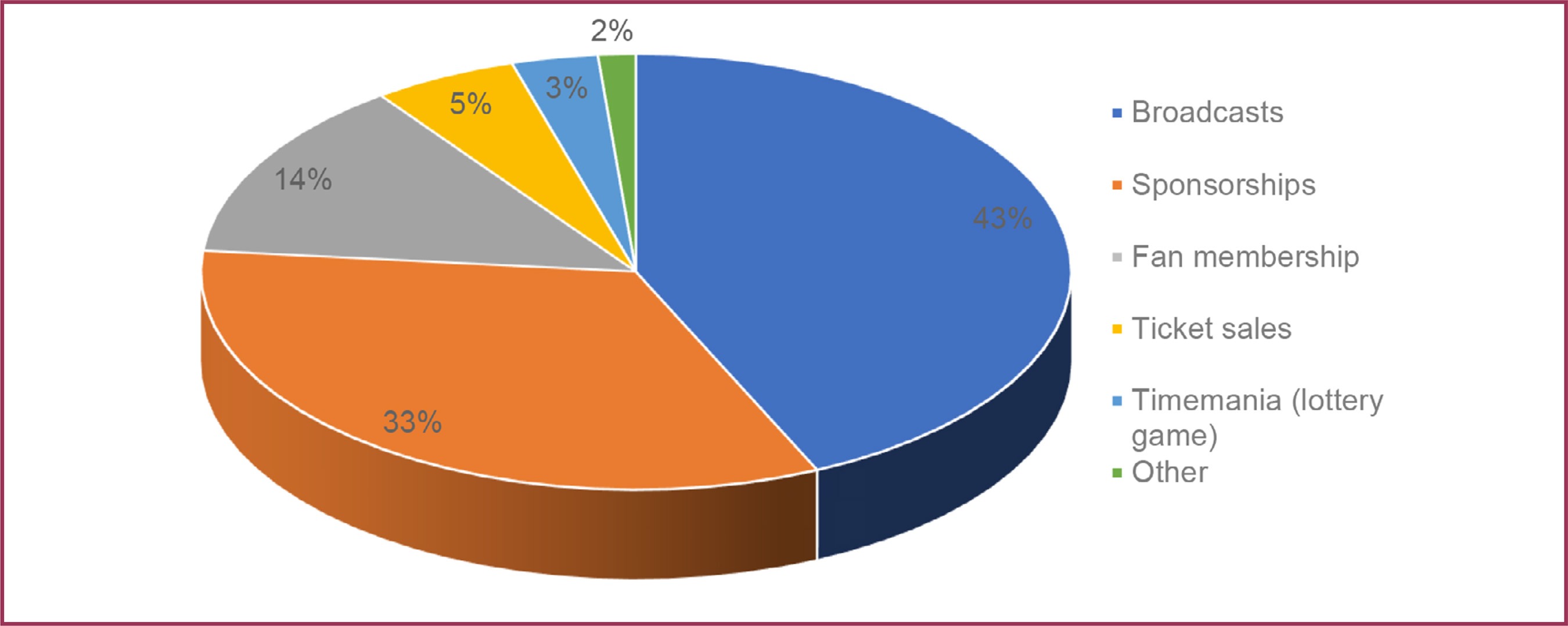
During the 2022 season, it earned R$ 19,730,000.00 distributed into six revenue sources. Figure 1 summarizes the data.

BFC was founded in 1918 to organize football in the city of Ribeirão Preto, with active participation from local railway workers in the process (Buchmann, 2002). In the 2022 season, the club competed in the third division of the Campeonato Brasileiro and secured promotion to the second division the following year.
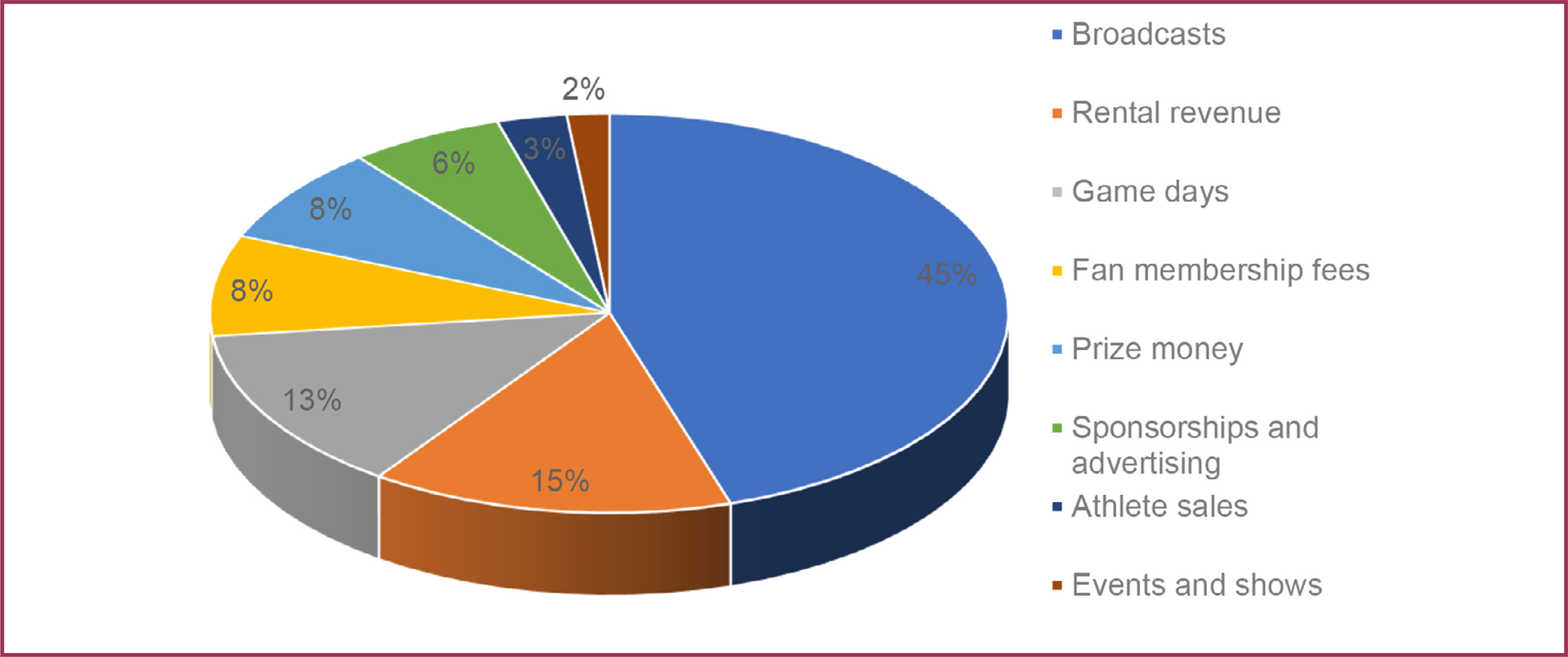
Currently, BFC owns 60% of the shares of Botafogo Futebol S.A., which is a closed-share Football Joint-Stock Company (Sociedade Anônima do Futebol, SAF) founded in 2018. The remaining 40% of shares are held by the company Trexx Sports Participações Ltd (BFC, 2023). The management of Botafogo S.A. comprises a board of directors (seven members: three appointed by BFC, two by Trexx, and two independent) and an executive board appointed by the board of directors. The survey found that the club earned R$ 14,069,526.00 from eight revenue sources, as shown in Figure 2.
IFC, a club from the city of Itu in the state of São Paulo, was founded as Associação Atlética Sorocabana in 1947 by railway workers in the region. For political reasons, it changed its name and predominant colors over the years, until finding its current configuration in 1989 (Buchmann, 2002).
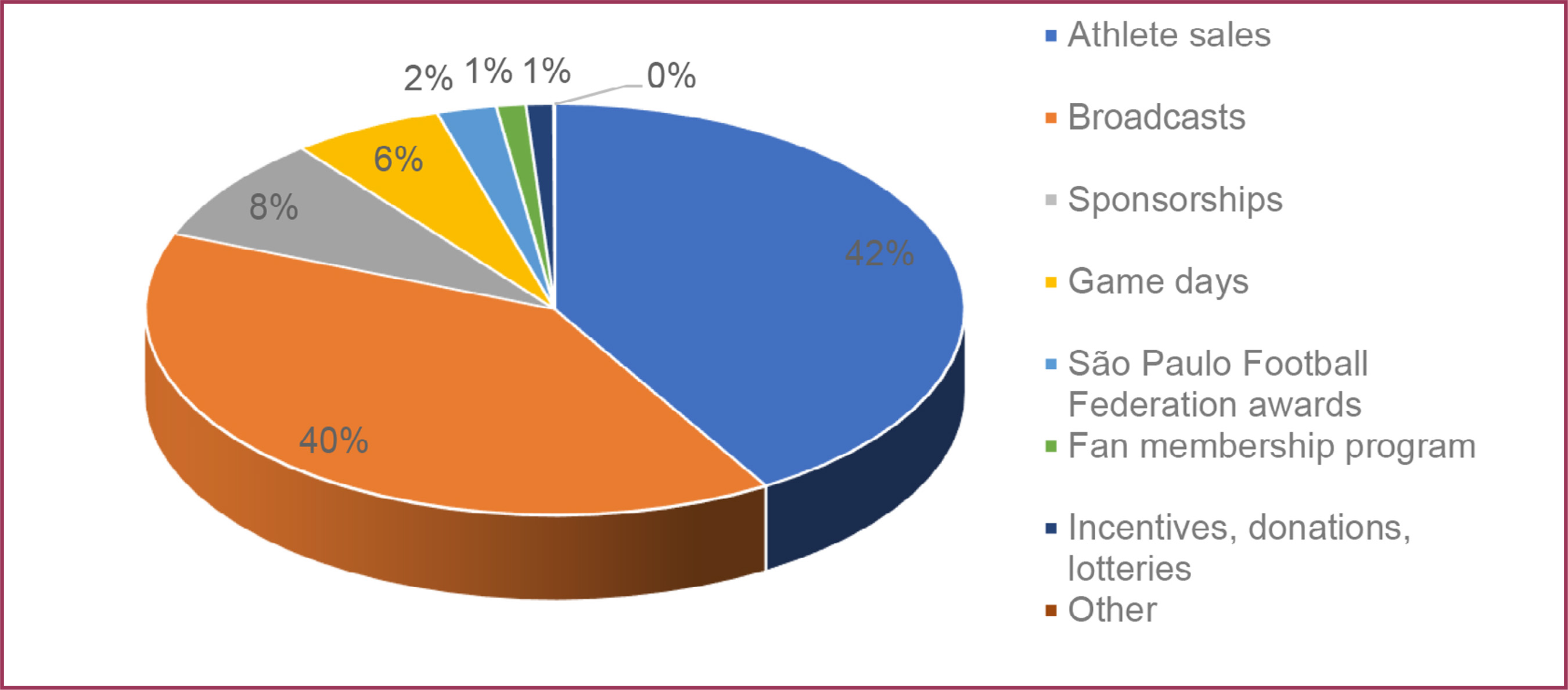
In the 2022 season, like OFEC, IFC figured among the 40 best clubs in Brazil, competing in the second division of the national league. The analyzed report also describes the managerial situation of the club: a non-profit sports association with management outsourced to the company Dimache Participações Esportivas LTD, responsible for the professional football operations. Figure 3 displays the distribution of the total amount earned of R$ 36,474,684.89 into eight revenue sources.
AFE was founded by the workers and engineers of the Araraquara Railway in 1950 (Buchmann, 2002). In 2022, it competed in the fourth national division. During that season, the club underwent a managerial transition, which took effect the following year. As a result, AFE, a non-profit association, under the prerogative of advancing in management aspects, became "Ferroviária SAF".
Thus, the club transferred all its intangible and sporting assets to the SAF, while retaining shares that grant it profit rights and at least one seat on the SAF’s board of directors, as stipulated by the Ferroviária SAF bylaws (2023). In 2022, the club earned R$ 19,190,545.60 from seven revenue sources (Figure 4).

The fifth club analyzed is PRC, connected to the railways by one of its predecessors: Clube Atlético Ferroviário (Buchmann, 2002). In the 2022 season, PRC competed in the last division of the Campeonato Brasileiro and was eliminated in the round of 16, which left it with no national division to play in the following year.
The club follows the associative management model and is undergoing a judicial recovery process after facing administrative problems in recent seasons (PRC, 2022). Figure 5 summarizes its annual earnings of R$ 7,200,000.00.

Notably, no railway club competed in the first national division and, therefore, they did not reach the top tier in terms of potential revenues, as Series A clubs generally achieve higher revenues and market value (Nascimento; Dantas; Azevedo, 2019). Among the clubs analyzed, OFEC and IFC outsource their football management, while BFC and AFE follow the SAF management model. PRC was the only club that followed the associative management model, the standard among most Brazilian clubs (Niedermeyer; Portela, 2024).
The associative management format has several limitations, including limited managerial expertise, unprofessional practices, insufficient transparency, technically unsound decision-making, and more susceptibility to external influences (Niedermeyer; Portela, 2024). In contrast, the SAF model provides clubs with a technical management framework, formalized governance processes, and diverse financing options (Brandão; Araújo; Monteiro, 2024).
The transformation of clubs into Football Joint-Stock Companies (SAFs), as regulated by Law No. 14,193 of 2021, represents a significant structural change in Brazilian sports management, particularly regarding impacts on governance, financial sustainability, and market attractiveness.
One major benefit is the professionalization of management, with more transparent and efficient business operations. The corporate structure provides enhanced accounting control, compliance mechanisms, and accountability to investors and society. Moreover, SAFs facilitate the attraction of private investment, allowing for greater investments in infrastructure, youth academies, and strategic player signings, which can improve the club's performance and competitiveness.
Another benefit is the restructuring of historical liabilities. The current legislation allows separating the social club from the SAF company, which enables debt renegotiation in a more flexible and legally safe manner. This feature stands out as a deciding factor for clubs in critical financial situations.
On the other hand, adopting the SAF model also presents challenges and limitations, as shown by Gomes (2023, p.13):
It is possible to see, in general terms, extremely indebted clubs seeking investors to help them solve their systemic crisis, through the adoption of corporate governance practices and their own debt repayment systems, in addition to increasing revenues through investments, marketing actions, and better sports performance, as long as respecting the club's identity elements.
The transition to SAF requires profound changes in the organizational culture, which can generate internal resistance and conflicts between the social club and the new corporate structure. The entry of investors may reduce decision-making autonomy, especially in cases of shareholder concentration. There is also the risk that market logic overrides the club's historical and social value, compromising its identity and bond with the community.
The analysis shows that four of the five clubs analyzed present a more developed management than the associative model. While BFC and AFE already operated as SAFs in 2022, OFEC and IFC had their professional football department outsourced, which grants them more decision-making autonomy and favors similar governance practices.
The documentary analysis allowed the identification of 14 different revenue sources. Notably, not every club employs all strategies. Table 3 summarizes the possibilities explored.
Individually, the Brazilian railway clubs drew revenue from six to eight sources in 2022, following the national trend, especially among smaller clubs. Minatto, Oliveira and Borba (2025) found that larger clubs tend to present more revenue sources than smaller ones.
In Brazil, the main revenue sources for clubs are broadcasting rights, marketing, gate receipts, and fan membership programs (Marques; Costa, 2016). These categories were also observed among the railway clubs, along with player transfer fees. These revenue sources fall within the category of economic studies, the most recurrent theme in indexed papers on football club management (Luz et al., 2023).
Table 3 shows that broadcasting rights and competition participation fees play a significant role in club management. These earnings represent the largest revenue source for OFEC (43% of total revenue) and BFC (45%), the second-largest for IFC (40%) and AFE (30%), and the third-largest for PRC (15%). Matias and Mascarenhas (2020) indicate that broadcasting-related earnings constitute the main revenue source for Brazilian clubs in general, a pattern that is even more pronounced among smaller clubs (Minatto; Oliveira; Borba, 2025).
The second significant category is sponsorships. This study draws on the discussion of Carvalho and Ribeiro (2019), who consider sponsorships similar to advertising campaigns made by major personalities or sports entities to bring financial returns to both, unifying sponsorship and advertising revenues to create a joint category named "sponsorships/advertising".
Matias and Mascarenhas (2020) argue that, overall, Brazilian clubs do not fully explore the potential of sponsorships compared to European clubs. According to the authors, the average share of club revenues derived from sponsorships is around 15%. The five analyzed clubs also rely on this revenue source, with OFEC standing out with the greatest financial impact (33%, more than double the national average). PRC (10%), IFC (8%), and BFC (6%) remain below the national average, while AFE (23%) exceeds it.
The third relevant category, supporter membership programs, has a greater impact on OFEC (14%), as the third-largest revenue source, and on BFC (8%), the fourth-largest. In contrast, in IFC and AFE, these programs represent only 1% and 0.56% of total revenue, respectively. PRC does not specify this revenue source in its reports.
Supporter membership programs generate revenue through monthly payments made by fans throughout the season, granting them membership status and access to exclusive benefits depending on the program. According to Cardoso and Silveira (2014), Brazilian clubs began investing in these programs following the success achieved by large European clubs. This revenue source has significant potential, especially for smaller clubs aiming to reduce their dependence on broadcasting revenues (Minatto; Oliveira; Borba, 2025).
The category "gate receipts/matchdays" encompasses earnings during matchdays, from ticket sales and other products. These revenues are inconsistent, since competitive performance significantly influences public attendance (Cardoso; Silveira, 2014; Minatto; Oliveira; Borba, 2025).
This category had its greatest impact on PRC (51%), as the club's leading revenue source, and BGC (13%), as the third. It had the least impact on the finances of OFEC (5%) and IFC (6%).
Moreover, AFE did not specify this revenue type in its 2022 financial statements. As this is a traditional revenue stream among Brazilian clubs (Soriano, 2010), the hypothesis emerges that the absolute amount generated was relatively small compared to other revenue sources and may therefore have been incorporated into another category of a similar nature for accounting purposes.
Another prominent revenue source is player transfer fees, that is, the financial compensation for transferring players to other clubs. Although national and international evidence indicates that larger clubs generate more revenue from transfers (Minatto; Oliveira; Borba, 2025), this practice also occurs among the smaller clubs analyzed in this study.
This category is present in four clubs. IFC and AFE have it as their main revenue source, representing more than 40% of the annual total. BFC and PRC generated less revenue from it (3% and 2%, respectively), whereas OFEC did not earn funds by transferring players in 2022.
These teams are located in the so-called Concentrated Region (Southeast and South) of Brazil, a significant hub for concentrating capital. In football, the region stands out as a major source of player exports, led by the state of São Paulo (Almeida, 2023). This region of the country is home to most clubs with the best structures and resources for developing athletes (Berg; Coqueiro; Sganzella, 2019).
Notably, IFC, AFE, and BFC have the Clube Formador Certificate, which consolidates them as clubs specialized in developing young players (CBF, 2022). Therefore, the focus on player development and their favorable geographical position may have contributed to revenue generation in this category.
The other revenue sources identified, which are valid given the importance of diversified financial sources from a managerial perspective (Miragaia; Ferreira; Ratte, 2017; Minatto; Oliveira; Borba, 2025), played a lesser role in the financial management of the analyzed clubs.
The category "Timemania/lotteries" refers to earning from a betting system operated by the Brazilian federal bank Caixa Econômica Federal, which distributes a percentage to participating clubs (Caixa, 2023). It was present in the revenues of OFEC, IFC, and PRC. Three clubs (IFC, AFE, and BFC) had revenues related to the "awards" category. These funds refer to amounts allocated by the Paulista Football Federation (FPF) and the Brazilian Football Confederation (CBF) for competitive achievements.
Among the least represented revenue categories is women’s football revenue, reported by only one club: AFE. In this case, only 3% of AFE’s annual revenue originates from this category, while 97% of its total revenue in 2022 was generated by men’s football.
Overall, women’s football has grown in recent years, particularly since the 2016 Olympic Games in Brazil, the 2019 World Cup, and the introduction of regulations requiring Brazilian clubs to establish women’s teams (Martins; Silva; Vasquez, 2021).
Nevertheless, the scenario found in AFE may be a market characteristic of the sport rather than a management weakness, given that women's football has never been sufficiently promoted to make it profitable (Biram, 2021).
The “merchandise” category was reported only in AFE’s financial statements. Regarding revenue from official merchandise in the other clubs, the hypothesis once again emerges that the amount generated may have been incorporated into another category of a similar nature for accounting purposes.
The categories “events/concerts” and “rent” were reported only in BFC’s revenues. This may reflect a management strategy, given that the club makes its stadium (recently modernized by the joint-stock company) available for events, as indicated in the analyzed document. The category “financial revenues/recovery” appeared only in PRC’s revenues, resulting from interest and/or discounts obtained.
Finally, the category “other” appears in the financial statements of two clubs: OFEC (2%) and IFC (1%). Although BFC’s report includes a category labeled “other revenues,” the amounts recorded under this heading correspond to funds distributed by the FPF and CBF for competitive performance. For analytical purposes, these revenues were therefore classified as “awards,” as presented in Figure 2.
Railway clubs competing in professional competitions can be divided into two groups. The first has a longer competitive calendar, participating in at least two tournaments during the season: the state championship and a national competition. The second competes exclusively in the state championship, which results in a shorter competitive calendar and a reduced number of matches per season.
This structure directly affects clubs’ finances and revenue sources, as participation in multiple competitions influences financial performance (Santos; Dani; Hein, 2016) and highlights that the core product being commercialized is the sports spectacle. Consequently, clubs with a longer competitive calendar have more opportunities to generate revenue from different sources and therefore greater revenue potential than those competing only in state tournaments.
Most clubs with a longer competitive calendar capitalize on revenue streams associated with the commercialization of football as a spectacle, such as tournament awards, matchday revenues, and broadcasting rights (Marotz et al., 2024), a pattern also observed in the economic analysis of the railway clubs.
When assessing the efficiency of Brazilian football clubs, Dantas, Machado, and Macedo (2015) found that smaller clubs may face financial problems and insufficient revenues due to, in addition to poor management, having to compete with larger clubs with more fans, which limits their revenue sources. Thus, they need to develop revenue streams that ensure survival and, eventually, make it possible to join the group of clubs with longer schedules, increasing their financial predictability.
Finally, although this study focuses on railway clubs, this pattern reflects the reality of most Brazilian teams. In 2022, Brazil had 850 active professional clubs (CBF, 2022), of which only 124 (14.59%) had a national competitive calendar in Series A, B, C, or D—20 teams in each of the first three divisions and 64 in the last.
4 FINAL CONSIDERATIONS
The study identified 16 Brazilian railway clubs competing professionally, but only half participate in a division of the Campeonato Brasileiro, the national league. Among these eight, ASA, FAC, and TDC were excluded from the analysis because they did not publicly disclose their financial data, which was the main eligibility criterion. This lack of transparency can be interpreted as a management weakness that contrasts with the literature on modern management practices.
The final sample of clubs analyzed was: OFEC, BFC, IFC, AFE, and PRC. PRC is the only club that follows the traditional associative model. It also faces administrative difficulties, made evident by its request for judicial recovery. OFEC and IFC are associative clubs that outsource the management of professional football to private initiative. On the other hand, AFE and BFC became SAFs while holding ownership shares with appointment rights to managerial positions.
The management principles adopted by the last four clubs may influence their competitive performance, as these administrative models provide organizational conditions that favor more efficient and effective managerial processes. Notably, this was a characteristic observed in the sample analyzed and may represent a potential path for other clubs. However, it is important to note that management practices and competitive performance do not have a direct cause-and-effect relationship, given the inherently unpredictable nature of sport (Luz; Freitas Júnior; Oliveira, 2021).
The methodological design allowed the identification of 14 distinct revenue sources used by the clubs. Individually, the railway clubs generated earnings from six to eight of these sources during the 2022 season, which is consistent with the national pattern observed among smaller Brazilian clubs. In terms of their contribution to total revenue, the following categories stood out: broadcasting and participation revenues, sponsorship and advertising, supporter membership programs, matchday revenues (gate receipts), and player transfer fees.
The revenues from broadcasting rights or participation fees fit into the national scenario as one of the main revenue sources, being the largest one for OFEC and BFC. It was also the second-highest revenue source for IFC and AFE, and third for PRC.
Regarding sponsorships, OFEC's management generates the most revenue among the analyzed teams. The club received more than double the national average, whereas PRC, IFC, and BFC performed below the average. AFE had results above it.
Four clubs generated revenue from supporter membership programs, although the relevance of this source varied considerably. At OFEC, it accounted for 14% of total revenue, making it the club’s third-largest income source, while at BFC it represented 8%, ranking fourth. By contrast, the contribution was marginal for IFC and AFE, at only 1% and 0.56% of total revenue, respectively.
Among the clubs studied, the impact of gate receipts/matchday revenue was greater on the finances of PRC and BFC. However, this revenue source is seen as inconsistent, since it depends more on the results achieved in competitions.
Player transfer fees were the main revenue source for IFC and AFE. PRC and BFC generated significantly less revenue from this category, while OFEC reported no income from player transfers in 2022, suggesting a potential area for managerial attention. The importance of this revenue source for IFC and AFE contrasts with the literature, which typically associates transfer revenues with larger clubs.
The other categories identified by the study are significant for the diversification principle, but their financial impact on the clubs analyzed is smaller. In some cases, they result from particular management strategies, such as the "events/concerts" and "rent" categories, employed only by BFC through a partnership with the company that owns the other part of the shares of the joint-stock company.
Furthermore, the methodological path taken resulted in the categorization of railway clubs into two groups: a) those that compete in a division of the Campeonato Brasileiro and b) those that only compete in the state tournament in their competition calendar. The first group has more time to validate and apply management strategies, enabling them to generate more revenue and maximize their financial gains.
Finally, despite the limited sample of railway clubs, the findings reflect the broader reality of Brazilian football. In the season analyzed, only 14.59% of clubs had a national competitive calendar, while 85.41% competed exclusively in state-level tournaments and therefore had only a few months of competition to generate revenue and sustain their activities for the following season.
Clubs that compete only in state-level competitions face a shorter competitive calendar, which limits both the time available to develop revenue-generation strategies and their overall earning potential. This context highlights the value of future qualitative studies on these organizations, particularly to identify and develop strategies that can help them remain financially viable despite their limited number of matches.
Such studies could identify the periods during which these clubs remain active and examine the hypothesis that revenue-generation strategies vary according to the duration of their competitive calendar, as this is the period when clubs can engage their supporters and generate income.
This paper contributes to the literature on football club management by examining financial data from railway clubs, a topic that remains relatively underexplored. It also provides empirical evidence of how management practices and strategies operate within clubs that emerged from the railway context, a significant social phenomenon in Brazilian history. In doing so, the study connects two areas of inquiry within the social sciences: History and Sports Management.
Finally, the study provides practical insights for researchers, sports managers, and football clubs by highlighting management strategies that have proven effective, while also identifying organizational weaknesses that require further development, particularly in strengthening institutional stability and stakeholder relationships.
-
FUNDING
This study was financed in part by the Coordenação de Aperfeiçoamento de Pessoal de Nível Superior - Brasil (CAPES) - Finance Code 001.
-
HOW TO CITE
LUZ, Thiago Savio Ingles da; CARMO, Gonçalo Cassins Moreira do; FREITAS JÚNIOR, Miguel Archanjo de. O futebol entre trilhos e estradas: análise das receitas dos times ferroviários brasileiros em atividade profissional na temporada 2022. Movimento, v. 32, p. e- …. jan./dez. 2026. DOI: https://doi.org/10.22456/1982-8918.141617.
-
1
The paper is an offshoot of the work by LUZ, Thiago Savio Ingles da. Football clubs after the derailment: an analysis of the management of Brazilian railway clubs in professional activity. 2024. Dissertation (Master's in Applied Social Sciences) – State University of Ponta Grossa, Ponta Grossa, 2024. Available at: http://tede2.uepg.br/jspui/handle/prefix/4132. Accessed on: July 29 2024.
RESEARCH DATA AVAILABILITY
Research data is available in the body of the document.
References
-
ALMEIDA, Marco Antonio Bettine de. Os caminhos da bola pelas estradas de São Paulo São Paulo: Escola de Artes, Ciências e Humanidades, 2017. DOI: https://doi.org/10.11606/9788564842267
» https://doi.org/10.11606/9788564842267 -
ALMEIDA, Rodrigo. Globalização e futebol: o mercado mundial de transferência de jogadores e a questão centro-periferia no Brasil. Boletim Campineiro de Geografia, v. 13, n. 1, 2023. DOI: https://doi.org/10.54446/bcg.v13i1.3020.
» https://doi.org/10.54446/bcg.v13i1.3020 -
ASSOCIAÇÃO FERROVIÁRIA DE ESPORTES (AFE). Demonstração do resultado do exercício 2022 Disponível em: https://ferroviariasaf.com/wp-content/uploads/2023/07/D.-R.-E..pdf Acesso em: 18 out. 2023.
» https://ferroviariasaf.com/wp-content/uploads/2023/07/D.-R.-E..pdf -
BERG, Artur Lemuel Jung; COQUEIRO, Daniel Pereira; SGANZELLA, Paulo Luciano. Formação de jogadores de futebol no Brasil: uma comparação entre clubes tradicionais e clubes empresas. RBFF - Revista Brasileira de Futsal e Futebol, v. 11, n. 46, p. 555-563, 2019. Disponível em: https://www.rbff.com.br/index.php/rbff/article/view/778 Acesso em: 21 nov. 2023.
» https://www.rbff.com.br/index.php/rbff/article/view/778 -
BIRAM, Mark Daniel. As sereias da vila na terra do rei: uma etnografia de Santos FC feminino. Movimento, v. 27, p. 27005, 2021. DOI: https://doi.org/10.22456/1982-8918.109357.
» https://doi.org/10.22456/1982-8918.109357 -
BOTAFOGO FUTEBOL CLUBE (BFC). Demonstrações contábeis em 31 de dezembro de 2022 e de 2021 e Relatório do auditor independente 2023. Disponível em: https://botafogofutebolsa.com.br/wp-content/uploads/2023/09/Relato%CC%81rio-Botafogo-2022-Final.pdf . Acesso em 28 out. 2023.
» https://botafogofutebolsa.com.br/wp-content/uploads/2023/09/Relato%CC%81rio-Botafogo-2022-Final.pdf -
BOWEN, Glenn. Análise de documentos como método de pesquisa qualitativa. Qualitative Research Journal, v. 9, n. 2, p. 27-40, 2009. DOI: https://doi.org/10.3316/QRJ0902027.
» https://doi.org/10.3316/QRJ0902027 -
BRANDÃO, Eliah Oliveira; ARAÚJO, Francisco Kaique Feitosa; MONTEIRO, Vitor Borges. Transição para a Sociedade Anônima do Futebol: contexto internacional e opiniões. Revista Foco, v. 17, n. 1, p. e4170, 2024. DOI: https://doi.org/10.54751/revistafoco.v17n1-085
» https://doi.org/10.54751/revistafoco.v17n1-085 - BUCHMANN, Ernani. Quando o futebol andava de trem: memórias dos times ferroviários brasileiros. 2. ed. Curitiba: Imprensa Oficial do Paraná, 2002.
-
CAIXA ECONÔMICA FEDERAL. Timemania Visão geral: Loterias Caixa, 2023. Disponível em: https://loterias.caixa.gov.br/Paginas/Timemania.aspx . Acesso em: 27 dez. 2023.
» https://loterias.caixa.gov.br/Paginas/Timemania.aspx -
CARDOSO, Marcos Vinicius; SILVEIRA, Marcelo Paciello. A importância da adoção do sócio torcedor como estratégia de inovação para aumentar as receitas dos clubes de futebol no Brasil. PODIUM: Sport, Leisure and Tourism Review, v. 3, n. 3, p. 12-24, 2014. Disponível em: https://periodicos.uninove.br/podium/article/view/9075/3902 Acesso em: 27 dez. 2023.
» https://periodicos.uninove.br/podium/article/view/9075/3902 - CARVALHO, Maria José; RIBEIRO, Tiago. Desporto profissional: das políticas à governance e ao lucro. In: CORREIA, Abel; BISCAIA, Rui. Gestão do desporto: compreender para gerir. Lisboa: Faculdade de Motricidade Humana, 2019. p. 141-160.
-
CONFEDERAÇÃO BRASILEIRA DE FUTEBOL (CBF). Relatório de Gestão Anual 2022. Disponível em: https://conteudo.cbf.com.br/cdn/202306/20230601132734_85.pdf . Acesso em: 20 jun. 2024.
» https://conteudo.cbf.com.br/cdn/202306/20230601132734_85.pdf -
DANTAS, Marke Geisy da Silva; MACHADO, Márcio André Veras; MACEDO, Marcelo Álvaro da Silva. Fatores determinantes da eficiência dos clubes de futebol do Brasil. Advances in Scientific and Applied Accounting, v. 8, n. 1, p. 113-132, 2015. Disponível em: https://asaa.anpcont.org.br/asaa/article/view/177/130 . Acesso em: 7 jun. 2024.
» https://asaa.anpcont.org.br/asaa/article/view/177/130 -
FERROVIÁRIA SAF. Estatuto Social da Ferroviária SAF 2023. Disponível em: https://ferroviariasaf.com/wp-content/uploads/2022/06/Proposta-de-Estatuto-Social-da-Ferrovia%CC%81ria-SAF-01.06.2022.pdf Acesso em: 25 dez. 2023.
» https://ferroviariasaf.com/wp-content/uploads/2022/06/Proposta-de-Estatuto-Social-da-Ferrovia%CC%81ria-SAF-01.06.2022.pdf - FREITAS JÚNIOR, Miguel Archanjo de; OLIVEIRA, Edilson de; LUZ, Thiago Savio Ingles da. Influência da gestão esportiva em uma equipe de médio porte: o caso do Operário Ferroviário Esporte Clube. In: CARNEIRO, Emmanuel Alves; RIBEIRO, Kleber Augusto; ROCCO JUNIOR, Ary José. Gestão do futebol: perspectivas e desafios para o futuro. Curitiba: CRV, 2020. p. 47-57.
-
GOMES, José Eduardo Ribeiro. A sociedade anônima do futebol: seria essa a solução para a melhoria da condição financeira dos clubes de futebol brasileiros? 2023. 31 f. Trabalho de Conclusão de Curso (Graduação em Direito) – Universidade Federal de Uberlândia, Uberlândia, 2023. Disponível em: https://repositorio.ufu.br/handle/123456789/36814 Acesso em: 7 jun. 2024.
» https://repositorio.ufu.br/handle/123456789/36814 -
GUTIERREZ, Diego Monteiro; BETTINE, Marco; GARCÍA, Borja. The railway and the ball, the spread of football in São Paulo State. Sport In History, v. 41, n. 3, p. 309-332, 2021. DOI: https://doi.org/10.1080/17460263.2020.1816565.
» https://doi.org/10.1080/17460263.2020.1816565 -
HATZIDAKIS, Georgios Stylianos; BARROS, José Arthur Fernandes. Gestão, compliance e marketing no esporte São Paulo: CREF4/SP, 2019. Disponível em: https://www.crefsp.gov.br/storage/app/arquivos/f74dd150ecce10777031f088d6b9ff1a.pdf Acesso em: 21 nov. 2023.
» https://www.crefsp.gov.br/storage/app/arquivos/f74dd150ecce10777031f088d6b9ff1a.pdf -
HINSON, Robert E. et al Internationalisation and branding strategy: a case of the English Premier League’s success in an emerging market. Qualitative Market Research, v. 23, n.4, 2020. DOI: https://doi.org/10.1108/QMR-12-2017-0188
» https://doi.org/10.1108/QMR-12-2017-0188 -
HOLZMAYER, Florian; SCHMIDT, Sascha L. Financial performance and corporate diversification strategies in professional football – evidence from the English Premier League. Sport, Business and Management: An International Journal, v. 10, n.3, p. 291-315, 2020. DOI: https://doi-org.ez82.periodicos.capes.gov.br/10.1108/SBM-03-2019-0019
» https://doi.org/10.1108/SBM-03-2019-0019 -
ITUANO FUTEBOL CLUBE (IFC). Relatório dos auditores independentes sobre as demonstrações contábeis São Paulo, 2023. Disponível em: https://ituanofc.com/files/ituano-relatorio-auditoria-2022.pdf Acesso em 18 out. 2023.
» https://ituanofc.com/files/ituano-relatorio-auditoria-2022.pdf -
LUZ, Thiago Savio Ingles da; FREITAS JÚNIOR, Miguel Archanjo de; OLIVEIRA, Edilson de. Das margens das ferrovias para um modelo de gestão vitorioso: o Operário Ferroviário Esporte Clube. Lecturas: Educación Física y Deportes, v. 26, n. 283, p. 31-46, 2021. DOI: https://doi.org/10.46642/efd.v26i283.3073.
» https://doi.org/10.46642/efd.v26i283.3073 -
LUZ, Thiago Savio Ingles da et al Gestão nos clubes de futebol: um olhar sobre a produção científica mundial em uma base de excelência. PODIUM: Sport, Leisure and Tourism Review, v. 12, n. 1, p. 138-164, 2023. DOI: https://doi.org/10.5585/podium.v12i1.21449
» https://doi.org/10.5585/podium.v12i1.21449 -
MAROTZ, Daniela Patrícia et al Desempenho financeiro e esportivo de clubes brasileiros de futebol: efeitos de múltiplas competições e séries. PODIUM: Sport, Leisure and Tourism Review, v. 13, n. 1, p. 188-220, 2024. DOI: https://doi.org/10.5585/podium.v13i1.24092.
» https://doi.org/10.5585/podium.v13i1.24092 -
MARQUES, Daniel Siqueira Pitta; COSTA, André Lucirton. Administração de clubes de futebol profissional: proposta de um modelo específico de governança para o setor. Organizações & Sociedade, v. 23, n. 78, p. 378-405, 2016. DOI: https://doi.org/10.1590/1984-92307823
» https://doi.org/10.1590/1984-92307823 -
MARTINS, Mariana Zuaneti; SILVA, Kerzia Railane Santos; VASQUEZ, Vitor. As mulheres e o país do futebol: intersecções de gênero, classe e raça no Brasil. Movimento, v. 27, p. 27006, 2021. DOI: https://doi.org/10.22456/1982-8918.109328.
» https://doi.org/10.22456/1982-8918.109328 -
MATIAS, Wagner Barbosa; MASCARENHAS, Fernando. “A dona da bola”: as finanças da CBF. Revista Brasileira de Ciência e Movimento, v. 28, n. 3, p. 149-170, 2020. Disponível em: https://portalrevistas.ucb.br/index.php/RBCM/article/view/10694 Acesso em: 17 nov. 2023.
» https://portalrevistas.ucb.br/index.php/RBCM/article/view/10694 -
MINATTO, Fábio; OLIVEIRA, Monique Cristiane de; BORBA, José Alonso. A influência dos desempenhos econômico financeiro e esportivo na diversificação das receitas dos clubes brasileiros de futebol. Brazilian Business Review, n. 22, p. e20231506, 2025. Disponível em: https://www.scielo.br/j/bbr/a/kJ8Yk59HskRVwg9mY5DYq4D/?lang=pt Acesso em: 17 mar. 2025.
» https://www.scielo.br/j/bbr/a/kJ8Yk59HskRVwg9mY5DYq4D/?lang=pt -
MIRAGAIA, Dina Alexandra Marques; FERREIRA, João José de Matos; RATTEN, Vanessa. O envolvimento estratégico de stakeholders na eficiência das organizações desportivas sem fins lucrativos: de uma perspectiva de sobrevivência para a sustentabilidade. Brazilian Business Review, v. 14, n. 1, p. 42-58, 2017. DOI: https://doi.org/10.15728/bbr.2017.14.1.3.
» https://doi.org/10.15728/bbr.2017.14.1.3 -
NASCIMENTO, Christiane Larissa Duarte do; DANTAS, Marke Geisy da Silva; AZEVEDO, Yuri Gomes Paiva. A influência dos fatores financeiros e esportivos sobre o valor dos clubes de futebol brasileiros. Revista Evidenciação Contábil & Finanças, v. 7, n. 1, p. 94-111, 2019. Disponível em: https://periodicos.ufpb.br/index.php/recfin/article/view/37890/22076 Acesso em: 18 out. 2023.
» https://periodicos.ufpb.br/index.php/recfin/article/view/37890/22076 -
NIEDERMEYER, Mateus Henrique; PORTELA, Matheus Behling. Sociedade Anônima de Futebol (SAF): a evolução do novo modelo de gestão dos clubes brasileiros. Revista Contemporânea, v. 4, n. 5, p. e4510, 2024. DOI: https://doi.org/10.56083/RCV4N5-218.
» https://doi.org/10.56083/RCV4N5-218 -
OPERÁRIO FERROVIÁRIO ESPORTE CLUBE (OFEC). Relatório de Gestão Financeira 2022 Ponta Grossa, 2022. Disponível em: https://operarioferroviario.com.br/wp-content/uploads/2024/02/2022-Relatorio-de-Gestao-Financeira.pdf Acesso em: 18 out. 2023.
» https://operarioferroviario.com.br/wp-content/uploads/2024/02/2022-Relatorio-de-Gestao-Financeira.pdf -
OPERÁRIO FERROVIÁRIO ESPORTE CLUBE. (OFEC). Regimento Interno 2024. Disponível em: https://operarioferroviario.com.br/wp-content/uploads/2024/02/2.REGIMENTO-INTERNO.pdf Acesso em: 22 abr. 2024.
» https://operarioferroviario.com.br/wp-content/uploads/2024/02/2.REGIMENTO-INTERNO.pdf -
PARANÁ CLUBE (PRC). Demonstrações financeiras do exercício findo em 31 de dezembro de 2022 Disponível em: https://paranaclube.com.br/wp-content/uploads/2024/10/balanco_2022.pdf . Acesso em: 20 out. 2023.
» https://paranaclube.com.br/wp-content/uploads/2024/10/balanco_2022.pdf -
REGOLIOSI, Carlo. Shedding light on the profitability of Italian professional football clubs where a different business model is performing. International Journal of Sport Management and Marketing, v. 18, n. 1-2, p. 130-154, 2018. DOI: https://doi.org/10.1504/IJSMM.2018.091334
» https://doi.org/10.1504/IJSMM.2018.091334 -
SANTOS, Cleston Alexandre dos; DANI, Andréia Carpes; HEIN, Nelson. Estudo da relação entre os rankings formados pela Confederação Brasileira de Futebol e indicadores econômico-financeiros dos clubes de futebol brasileiros. PODIUM: Sport, Leisure and Tourism Review, v. 5, n. 3, p. 41-60, 2016. Disponível em: https://periodicos.uninove.br/podium/article/view/9528 Acesso em: 18 nov. 2023.
» https://periodicos.uninove.br/podium/article/view/9528 -
SEIFRIED, Chad et al Sport management and business schools: a growing partnership in a changing higher education environment. The International Journal Of Management Education, v. 19, n. 3, 2021. DOI: https://doi.org/10.1016/j.ijme.2021.100529
» https://doi.org/10.1016/j.ijme.2021.100529 -
SILVA, Luis Antonio Gomes da Costa Moura da; ARAÚJO, Maria Clara Muniz; SOUSA, Mayssa Alves da Silva. Ferrovias brasileiras: histórico e processo de estagnação. In: GUIMARÃES, Osvaldo Sena. Engenharia, gestão e inovação Belo Horizonte: Editora Poisson, 2023. Disponível em: https://poisson.com.br/2018/produto/engenharia-gestao-e-inovacao-volume-8/ Acesso em: 18 nov. 2023.
» https://poisson.com.br/2018/produto/engenharia-gestao-e-inovacao-volume-8/ -
SILVA, Raquel Ferreira; DIAS, Sara Maria Barreto; RIBEIRO, Kleber Augusto Gestão financeira no futebol - um estudo das receitas dos principais clubes do estado do Ceará, Brasil. Revista de Gestão e Negócios do Esporte, v. 5, n. 1, p. 44-59, jun. 2020. Disponível em: http://revistagestaodoesporte.com.br/mod/page/view.php?id=127 Acesso em 19 nov. 2023.
» http://revistagestaodoesporte.com.br/mod/page/view.php?id=127 - SORIANO, Ferran. A bola não entra por acaso: estratégias inovadoras de gestão inspiradas pelo mundo do futebol. São Paulo: Larousse, 2010.
- SUMMERHILL, William Roderick. Trilhos do desenvolvimento: as ferrovias no crescimento da economia brasileira 1854-1913. São Paulo: Alfaiatar, 2018.
-
ZAMBOM-FERRARESI, Fabíola et al Performance evaluation in the UEFA champions league. Journal of Sports Economics, v. 18, n. 5, p. 448-470, 2017. DOI: https://doi.org/10.1177/1527002515588135
» https://doi.org/10.1177/1527002515588135
Edited by
-
EDITORIAL RESPONSIBILITY
Alex Branco Fraga*, Elisandro Schultz Wittizorecki*, Janice Zarpellon Mazo*, Mauro Myskiw*, Raquel da Silveira** Universidade Federal do Rio Grande do Sul, Escola de Educação Física, Fisioterapia e Dança, Porto Alegre, RS, Brazil.

 Source: the authors.
 Source: the authors.
 Source: the authors.
 Source: the authors.
 Source: the authors.