
 STRATEGIES FOR THE INCLUSION OF STUDENTS WITH DISABILITIES IN SCHOOL PHYSICAL EDUCATION: A SYSTEMATIC REVIEW
Abstract
The objective of the study was to analyze the production of knowledge at the national and international levels regarding teaching strategies aimed at the inclusion of students with disabilities (SWD) in Physical Education (PE) classes. For this purpose, we used an integrative systematic literature review, based on the electronic search for articles in the CAPES Periodicals Portal and Scielo Scientific Electronic Library, by associating the descriptors: strategy, persons with disabilities, inclusion, and Physical Education. Inclusion criteria were: written in Portuguese or English, published from January 2008 to November 2021, and related to the topic of the study. The analysis of the 11 articles pointed out different teaching strategies aimed at the inclusion of SWD in PE classes, categorized into four themes: support models and collaborative work; forms of communication and types of instruction; adaptations; and teaching materials and resources.
Keywords
Special Education; Physical Education in school; Strategy; Inclusion
Resumo
O objetivo do estudo foi analisar a produção do conhecimento nacional e internacional referente às estratégias de ensino voltadas à inclusão dos estudantes com deficiência (ECD) nas aulas de Educação Física (EF). Para tanto, foi desenvolvida uma revisão sistemática de literatura, do tipo integrativa, com base na busca eletrônica de artigos no Portal de Periódicos da CAPES e na Biblioteca Eletrônica Científica Scielo, pela associação dos descritores: estratégia, pessoa com deficiência, inclusão e Educação Física. Foram adotados como critérios de inclusão: ser escrito em língua portuguesa ou inglesa, ser publicado no período de janeiro de 2008 a novembro de 2021 e estar relacionado à temática do trabalho. A análise dos 11 artigos apontou diferentes estratégias de ensino voltadas à inclusão dos ECD nas aulas de EF, categorizadas em quatro temáticas: modelos de apoio e trabalho colaborativo; formas de comunicação e tipos de instrução; adaptações; e materiais e recursos pedagógicos.
Palavras-chave
Educação Especial; Educação Física escolar; Estratégia; Inclusão
Resumen
El objetivo del estudio fue analizar la producción de conocimiento a nivel nacional e internacional referente a estrategias didácticas dirigidas a la inclusión de alumnos con discapacidad (ACD) en las clases de Educación Física (EF). Para ello, se utilizó una revisión de literatura sistemática integradora, basada en la búsqueda electrónica de artículos en el Portal de Periódicos de la CAPES y en la Biblioteca Científica Electrónica Scielo, asociando los descriptores: estrategia, personas con discapacidad, inclusión y Educación Física. Se adoptaron criterios de inclusión: estar escrito en portugués o inglés, publicado entre enero de 2008 y noviembre de 2021, y relacionado con el tema del estudio. El análisis de los 11 artículos señaló diferentes estrategias didácticas dirigidas a la inclusión de ACD en las clases de EF, categorizadas en cuatro temas: modelos de apoyo y trabajo colaborativo; formas de comunicación y tipos de instrucción; adaptaciones; y materiales y recursos didácticos.
Palabras clave
Educación Especial; Educación Física escolar; Estrategia; Inclusión
1 INTRODUCTION
This paper focuses on teaching strategies for the inclusion of students with disabilities (SWDs) in the context of School Physical Education (SPE).
The Constitution of the Federative Republic of Brazil (1988) guarantees the right to education for all, including people with disabilities, but it was only in January 2008 that the National Policy for Special Education from the Perspective of Inclusive Education (PNEEPEI) was enacted to guarantee the inclusion of SWDs in regular schools (Brasil, 2008). Data from the School Census (Brazil, 2018; 2019) show a significant increase in the number of SWDs enrolled in regular classrooms: from 325,316 students in 2006 to 1,152,875 in 2020, reflecting the positive impact of the PNEEPEI.
However, structural adjustments and training for education professionals are needed to ensure quality education for this population. Despite attending regular classes, many SWDs face difficulties in effectively participating in school activities and interacting socially, which highlights the importance of promoting true inclusion (Glat; Pletsch, 2010). Mendes (2006) points out that social inclusion is a two-way process in which both society and the excluded population collaborate to guarantee equal opportunities for all, building a democratic society that respects diversity and recognizes differences.
It is important that this process also takes place in the school context because, according to Munster and Alves (2018, p. 172), inclusive education consists of:
[…] a process of reorganizing the educational system and teaching and learning environments, collaboratively encompassing all the actors involved in the school community, with the aim of equalizing educational opportunities guided by the principles of respect for diversity, acceptance and political recognition of differences.
Law No. 10.793 established Physical Education (PE) as a compulsory curricular component of basic education and integrated it into the school’s pedagogical proposal (Brasil, 2003), so SWDs enrolled in regular schools should also have their participation and optimal use guaranteed in PE classes.
In the study by Fiorini and Manzini (2014), PE teachers reported various difficulties in dealing with the inclusion of SWDs in their classes. These difficulties included lack of training, administrative issues, individual student characteristics, diagnosis, family involvement, teaching resources, and teaching strategies. When discussing the difficulties pointed out in relation to strategy, teachers questioned how to approach the inclusion of these students and recommended carefully considering teaching strategies to ensure the participation of all students in PE classes.
Fiorini and Manzini (2018, p. 196) understand strategy as:
[…] a teacher’s action, which has an underlying intention, directed at the student, with the purpose of teaching, which is flexible and subject to change depending on the student’s behavior in this process of interaction during teaching.
Manzini (2010) explains that the strategy, since it is a teacher action, takes place at the moment of teaching, but needs to be planned considering the characteristics of the students, the objective of the activity, and the level of complexity that will be required.
To tackle the growing challenge of meeting the individual needs of SWDs in PE classes, teachers must be able to employ teaching strategies that result in inclusive environments (Cervantes et al., 2013). Seabra Junior (2008) mentions that for PE teachers to enable all students to participate in class, they need to use pedagogical resources and teaching strategies that are appropriate and/or adapted to each group of participants. The pedagogical resource has the characteristics of being concrete, manipulable, and having a pedagogical purpose.1
Oliveira, Nunes and Munster (2017), when mapping and analyzing student productions on PE and school inclusion in postgraduate programs in Brazil, from 2002 to 2015, found 73 studies from dissertations and theses. Of these, only five addressed strategies to support the school inclusion process in PE classes.
To verify the teaching strategies and pedagogical resources indicated for PE teachers to use as tools in the inclusion of SWDs in schools, Fiorini, Braccialli and Manzini (2015) carried out a systematic analysis of theses and dissertations produced in postgraduate programs in Education and PE up until 2011. They found five dissertations and three theses that presented teaching strategies and pedagogical resources for the inclusion of SWDs in PE classes, indicating a scarcity of studies focusing on this subject.
Based on the fact that there is little research on this subject and that the previous reviews included studies published up to 2015, we were interested in carrying out a new survey specifying which teaching strategies the articles published in journals bring up as a possibility for PE teachers in regular primary schools (kindergarten to high school) to use in their pedagogical practice, in order to enable the inclusion of SWDs in PE classes.
Thus, the study aimed to analyze the production of national and international knowledge regarding teaching strategies aimed at the inclusion of SWDs in PE classes.
2 METHOD
The study is a systematic literature review of the integrative type, whose purpose is to organize the knowledge and results obtained in research on a topic or issue from different areas (Pompeo; Rossi; Galvão, 2009; Ercole; Melo; Alcoforado, 2014; Gomes; Caminha, 2014).
This review used the recommendations of the PRISMA (Preferred Reporting Items for Systematic reviews and Meta-Analyses) method for preparing systematic reviews (Galvão; Pansani; Harrad, 2015).
2.1 DATA COLLECTION PROCEDURE
The research was conducted in the virtual environments of the electronic databases of the CAPES Journal Portal, accessed via the Federated Academic Community (CAFe), and the Scientific Electronic Library Online (SciELO).2
In order to identify national and international articles relevant to the research, a search was carried out on the selected platforms using the following descriptors: strategy, people with disabilities, inclusion, and physical education.
The information was collected independently by the authors of the study in November 2021, to minimize bias in the search process (Costa; Zoltowski, 2014). At each stage of the study, meetings were held between the researchers to cross-check and discuss the data obtained, to resolve any possible discrepancies.
The search covered articles published in journals between January 2008 to November 2021. The delimitation of the search period is justified by the fact that 2008 was the year of implementation of the National Policy for Special Education from the Perspective of Inclusive Education PNEEPEI (Brasil, 2008), in addition to being a current time frame in which the teaching strategies adopted by teachers to work with SWDs in PE classes can be analyzed.
The following criteria were used to select the articles: (a) written in Portuguese or English; (b) published between January 2008 and November 2021; (c) related to the theme of the work.
2.2 PROCEDURE FOR SEARCHING, IDENTIFYING AND SELECTING WORKS
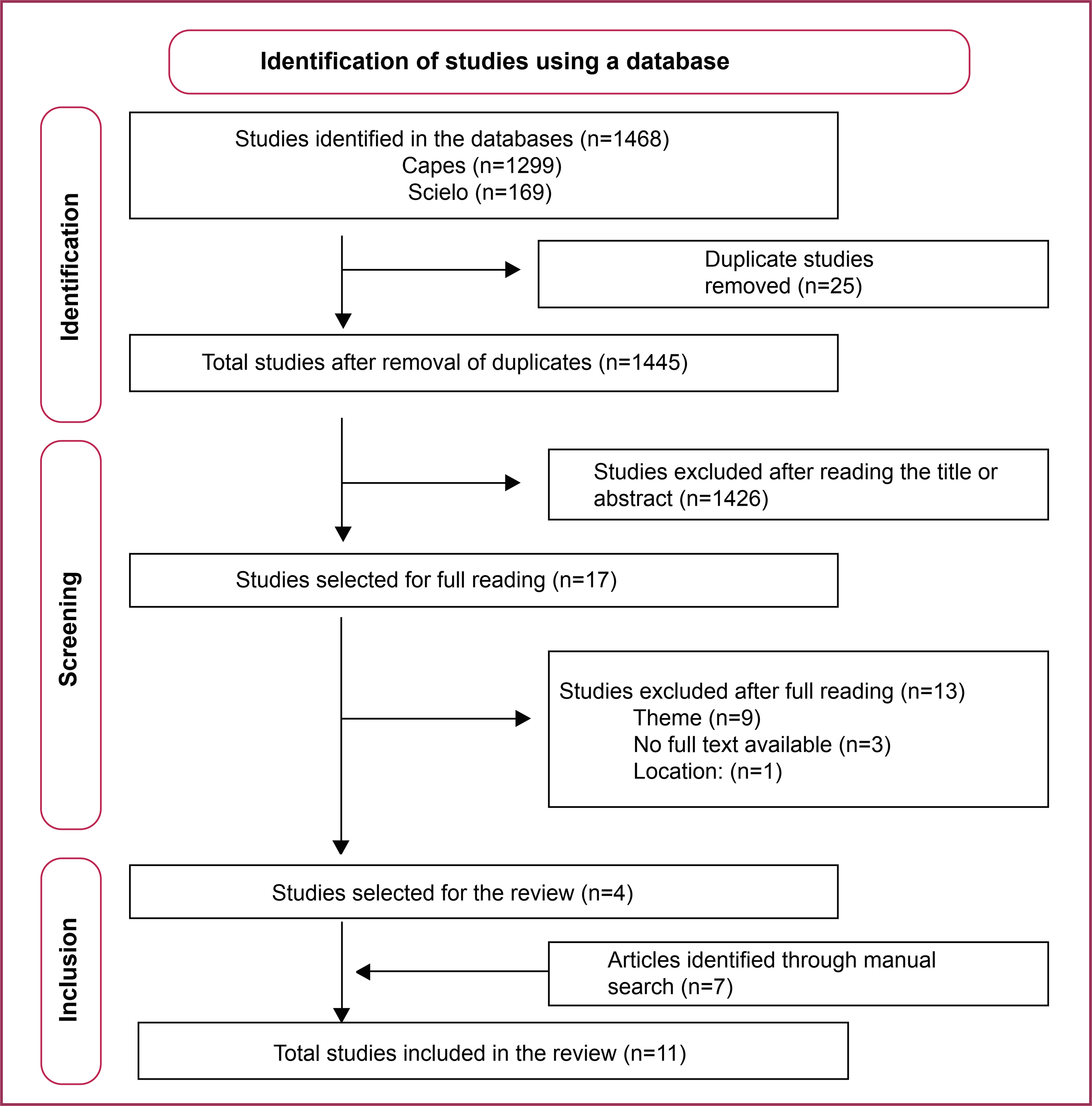
Once 1,468 studies had been identified in the databases searched, they were stored and organized in Endnote Web3 and exported to the Rayyan application for selection.
After cross-referencing all the data, 25 duplicate studies were excluded. In the screening stage, the 1,443 studies were analyzed and 17 articles containing the descriptors in the titles, abstracts, or keywords were selected for full reading.
Of the articles selected, 13 were excluded for the following reasons: not being related to the theme of the work (9), the text not being available to read in full (3), not being carried out in a regular school or being a review article (1).
In addition to the search in the databases, an additional search was carried out in the reference lists of the articles analyzed (manual search), using the same strategy specified above which met the selection criteria for this study, making it possible to identify and add seven relevant articles. As a result, a total of 11 articles were included in this review.
Figure 1 shows the flowchart with information on each stage of the research, including the number of articles selected and excluded.

The 11 studies included in the research were analyzed using the thematic analysis technique proposed by Braun and Clarke (2006), a qualitative analysis method used to identify, analyze, interpret, and report patterns, called themes, from the data.
3 RESULTS AND DISCUSSIONS
3.1 CHARACTERISTICS OF THE STUDIES
The main data from the 11 selected studies were described (Chart 1) and organized in ascending chronological order according to year (from the oldest to the most current). Information was included on the author(s), year of publication, objective(s), method, and main results.
The selected studies were published from 2011 onwards, with 2013 being the most significant in terms of productivity, with three publications. Between 2016 and 2021, there were a maximum of two studies per year on the subject. These data indicates that there is still a small number of studies on teaching strategies aimed at including SWDs in PE classes, corroborating the study by Fiorini, Braccialli, and Manzini (2015).
Regarding the type of research, three were categorized as descriptive and eight as exploratory. Among the types of teaching strategies found in the articles, six studies were aimed at all types of disability, three at visually impaired students, one at students with intellectual disabilities and one at students with hearing disabilities.
The authorship of the studies showed that Fiorini and Manzini (2016, 2018) have addressed the subject of teaching strategies for SWDs more frequently than the others. These authors have been important in building the theoretical framework on the subject.
3.2 TEACHING STRATEGIES FOR THE INCLUSION OF STUDENTS WITH DISABILITIES
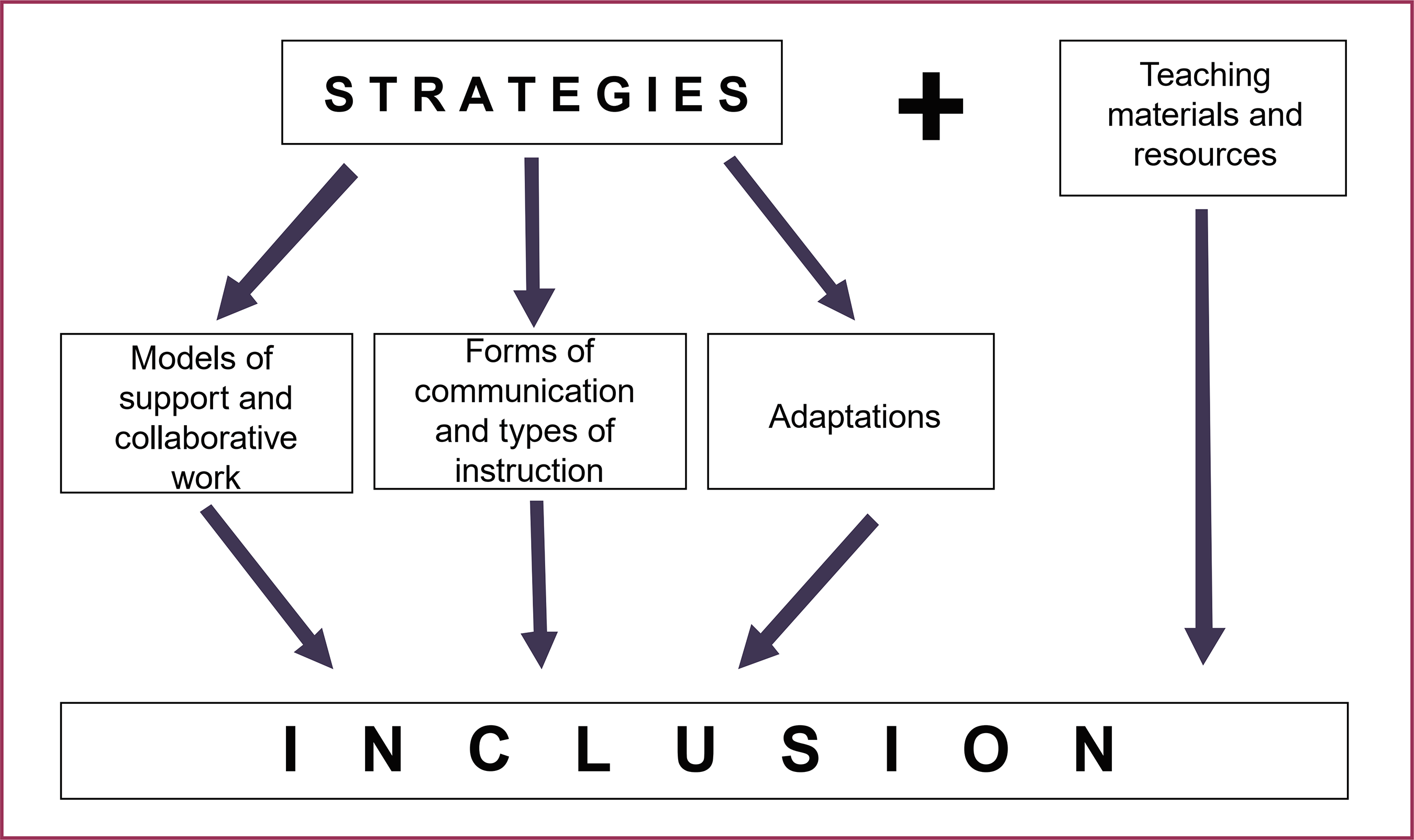
By reading the 11 studies in their entirety, it was possible to verify the similarities between them and organize them into categories, following the thematic analysis. The following themes emerged: models of support and collaborative work; forms of communication and types of instruction; adaptations; and teaching materials and resources. The thematic map (Figure 1) and Chart 2 show the categorization of the research analyzed in this review.
Among the studies, six were allocated to more than one category, as they presented information related to more than one topic (Fiorini; Deliberato; Manzini, 2013; Fiorini; Manzini, 2016; Overton; Wrench; Garrett, 2016; Fiorini; Manzini, 2018; Majoko, 2019; Rufino et al., 2021). And the other five were placed in a single category (Grenier, 2011; Cervantes et al., 2013; Munster, 2013; Alves; Fiorini, 2018; Gatti; Munster, 2021).
3.2.1 Models of support and collaborative work
The models of support and collaborative work found in the selected studies were: peer tutoring; collaborative consultancy; and collaborative teaching, also called co-teaching.
Collaborative work, as well as models of support, belong to the collaborative culture, which is understood as a philosophy of life (Torres; Alcântara; Irala, 2004) in which the members of a group support each other to achieve common objectives negotiated by the collective, establishing relationships that tend towards non-hierarchical structures, shared leadership, mutual trust and co-responsibility for carrying out actions (Costa, 2005). Thus, collaborative work is aimed at joint action by the school community and has the potential to help tackle school challenges, such as inclusion (Damiani, 2008).
Peer tutoring is defined as learning between peers, under the guidance and supervision of the teacher, consisting of a peer tutor and a mentee, establishing a relationship of partnership and mutual learning (Klavina; Liberman, 2018). Consultancy and co-teaching, on the other hand, are understood as a partnership between professionals who will work together, with a common education teacher and a special education teacher or other specialist to promote school access for the student in a common education environment (Friend, 2008; Caetano; Mendes, 2008; Mendes; Vilaronga; Zerbato, 2014; Machado; Almeida, 2014). Consultancy is an indirect service providing assistance to the teacher, while co-teaching involves acting directly alongside the teacher to provide instruction to students.
The studies by Grenier (2011) and Gatti and Munster (2021) analyzed the possibility of different models of support and collaborative work helping to include SWDs in PE classes. By using co-teaching as a strategy for inclusive practice, Grenier (2011) concluded that there was an evolution and involvement of all students in the activities, as well as socialization and inclusion. In this sense, the results obtained by Gatti and Munster (2021) through the application of co-teaching by the protagonists (PE teacher, SWD and their peers), showed that in two cases of the three applied, they were favorable and possible to implement, bringing positive results for all students and the inclusion of SWDs in PE classes.
Corroborating the above, Majoko (2019) cites collaborative cultures among the actions that facilitated the inclusion of children with disabilities in PE classes in regular classrooms, as described by the teachers interviewed. Costa, Seabra Junior and Amparo (2018) consider teamwork and collaboration to be fundamental to the success of school inclusion.
Cervantes et al. (2013), when examining the effects of peer tutoring as a teaching and inclusion strategy for SWDs in PE, highlighted its benefits for both students with and without disabilities in PE classes, as well as providing specific recommendations for the implementation of this support model in these classes. Peer tutoring was also cited as one of the five types of successful strategies listed by the teachers participating in the research by Fiorini and Manzini (2018) to promote the participation of students with Hearing Impairment (HI) in the same activities as other students in the class.
Thus, these collaborative strategies bring benefits to all students (both SWDs and non-disabled), such as promoting progress in social relationships, learning, and the assimilation of instructions, as well as improving the self-esteem of SWDs and promoting a more inclusive teaching environment (Gonçalves; Ribeiro, 2008; Oliveira; Munster, 2023; Gatti; Munster, 2023; Santos; Costa, 2023).
3.2.2 Forms of communication and types of instruction
This thematic category included studies that described forms of communication and types of instruction used by teachers to facilitate the process of including SWDs in PE classes. Communication, understood as a human characteristic, does not only include speaking, listening, reading and writing; non-verbal information, i.e., facial expressions, gestures, excitement and silence, are considered highly significant information (Andrade, 1994). The selected studies pointed to verbal instruction, the use of gestures, body movements,and facial expressions, as well as demonstration.
Except for Majoko (2019), the studies in this category, when presenting research data, reported examples of situations in which participants used forms of communication and types of instruction as strategies for the inclusion of students with visual impairment (VI).
Majoko (2019), when analyzing the pedagogical practices used by PE teachers to include children with disabilities in regular public elementary school classrooms in the Midlands educational province in Zimbabwe, cites that the use of adapted instruction facilitated the inclusion of these students in PE classes.
Fiorini and Manzini (2016) described that, in one of the situations observed in the study, the PE teacher, through verbal instruction, provided the student with VI with precise information about the type of response expected in the specific activity, while at another time, new instruction was used for the student with VI individually, when identifying that verbal instruction and demonstration did not help in carrying out the activity. Overton, Wrench, and Garrett (2016), when observing the teaching of three teachers who taught PE classes in the first year of elementary school to SWDs, found that they used various pedagogical strategies to establish positive relationships with students, including effective communication.
When analyzing the successful strategies used by PE teachers to promote the participation of students with HI in the same activities as the other students in the class, Fiorini and Manzini (2018) described that the teacher explained individually to the student with HI, through gestures and body movements, the activity that had been explained verbally to the other students, using in this case, the most functional form of communication for the student. The teacher also used non-verbal communication, when he communicated with the student with HI using gestures and facial expressions.
All the studies pointed to communication as one of the positive strategies for helping to include students with disabilities. Munster (2023) not only highlights the different approaches that PE teachers can use in lessons to meet the special needs of SWDs, but also outlines the types of instruction that can be used as an option for inclusive practices in PE.
3.2.3 Adaptations
The data relating to this thematic category was analyzed considering the definition given by Rodrigues (2006). According to the author, the process of adapting an activity “consists of intervening on a set of variables influencing its greater or lesser degree of difficulty” (Rodrigues, 2006, p. 41).
Munster (2013) in his essay discussed the role of curricular and methodological adaptations in the process of including SWDs in regular PE programs.
The studies by Fiorini and Manzini (2016, 2018) describe adaptations to the rules of the activities in order to enable the participation of SWDs in PE classes. In the 2016 study, the authors cited a situation in which the PE teacher identified the difficulty of the student with VI and proposed adaptations in the way of moving, throwing the ball up, clapping and holding the ball back, so that the student would throw the ball to the teacher. In the episode reported by Fiorini and Manzini (2018), the PE teacher adapted the rules of the activity, using verbal commands for hearing students and gestures and body movements for the student with HI, which made the activity less restrictive for the student.
In the article by Fiorini, Deliberato and Manzini (2013), as well as adapting the rules, the authors reported adaptations to teaching resources. They mention the use of the guide rope in running activities; the adaptation of the ball, either by wrapping it in cellophane paper and/or plastic bags, or by putting rattles inside; and the cone, which can be colored or covered in vibrant colors.
Overton, Wrench, and Garrett (2016) mentioned that to meet the needs of SWDs the PE teachers participating in the study included modifications to the rules and learning environments. They simplified the rules, allowed extra time to complete the tasks and modified the distances so that students could participate and succeed in the activity.
The studies presented different examples of adaptations used by PE teachers to enable all students, including those with disabilities, to take part in the proposed activities. This understanding is corroborated by Rodrigues’ (2006, p.41) definition that “adapting would be adjusting the demands of the task to the level of performance of the performer”.
Rufino et al. (2021) pointed out in their study that if the PE teacher planned the necessary adaptations in advance, students with VI could feel included in PE classes and would be able to participate more effectively in the activities developed. Thus, Santos, Santos, and Mattos (2022) state that when teachers plan their lessons, they have the chance to critically reflect on their practice, define objectives and strategies, as well as observe whether the objectives have been achieved and, when they haven’t, understand why and what strategies will be adopted.
The studies described adaptations to the rules, spaces, and materials adopted by teachers to help SWDs participate effectively in PE classes, without requiring a huge amount of resources or time. Some authors have highlighted the importance of using adaptations to tailor activities to the needs of SWDs (Block; Klavina; Davis, 2016; Lieberman; Houston-Wilson, 2018; Winnick; Porretta, 2017).
According to Alves and Duarte (2014), these adaptations should enable the SWD to benefit from the teaching-learning process and allow them to participate socially within the group in which they are inserted.
3.2.4 Teaching materials and resources
Pedagogical resources can be used to support an action and thus facilitate and make it possible to achieve an objective (Manzini, 2010). As pedagogical resources were mentioned in four of the 11 studies included in the review, and because it is understood that they can complement the teacher’s action, this category was created due to its relevance.
The study by Fiorini, Deliberato, and Manzini (2013) aimed to plan teaching strategies and resource adaptations with a focus on the educational inclusion of students with VI, based on the activities contained in the São Paulo State Curriculum Proposal. Thus, two adaptations of teaching resources were suggested, and four new resources were indicated for the classes. Among them, the use of some that were not listed in the Curriculum Proposal, such as mats, yellow adhesive tape, rattles, cellophane paper and plastic bags, normally found in materials for PE classes in regular schools.
Rufino et al. (2021) also observed that the teaching materials and resources used by the teachers who took part in the study to help include the two students with low vision in their classes were those normally available in the school for PE and, in most of the classes, there was no need to adapt them.
The studies by Overton, Wrench and Garrett (2016) and Fiorini and Manzini (2016) cited examples of teaching materials and resources used by teachers to help SWDs carry out activities in PE classes. Overton, Wrench and Garrett (2016) describe that one of the teachers participating in the study highlighted the use of brightly colored equipment and balls with rattles to accommodate the needs of students with VI. Fiorini and Manzini (2016) described how the teacher taking part in the research selected, from among the balls available at the school, one with colored panels and rattles, which allowed for contrast with the background and emitted sounds perceived audibly by the student with VI.
All the studies in this category describe examples of teaching materials and resources used to help include visually impaired children in PE classes, the most frequently cited being balls with rattles and colored balls. Seabra Junior (2008) points out that pedagogical resources will provide stimuli for the visually impaired if the teacher programs appropriate colors and contrasts, the distance and size of the object, material, equipment or even the references of the location that needs to be used, according to the visual limitations of each student.
Thus, it was possible to analyze that the thematic categories listed encompass different criteria that cover different strategies presented in various studies, with different ideas and possibilities to contribute to the actions of teachers and help them include SWDs in PE classes.
4 CONCLUSION
The articles analyzed in this review described different teaching strategies aimed at including SWDs in PE classes, divided into four thematic categories: models of support and collaborative work; forms of communication and types of instruction; adaptations; and teaching materials and resources.
The studies found show how these strategies assist teachers in their practice and help to effectively include SWDs in PE classes. It is worth emphasizing the importance of planning them in advance to make them more effective.
When analyzing the production of national and international knowledge regarding teaching strategies for the inclusion of SWDs in Physical Education classes, it was found that although the search resulted in a considerable number of studies, when adopting the selection criteria, few described such strategies, which leads to the conclusion that there is a need for progress in both research and interventions aimed at a positive change in the school inclusion of SWDs, based on the use of teaching strategies that contribute to the teaching performance and expanding the possibilities of effective participation of all students in regular PE classes at all levels of education.
-
1
Manzini; Deliberato, 2007 apud Fiorini; Braccialli; Manzini, 2015.
-
2
Using the same search strategy led to different results between the two databases.
-
3
Endnote Web is a bibliographic reference manager, which is exported to the Rayyan application to carry out the selection, and Rayyan is a web application that helps systematic review authors to carry out the screening efficiently.
-
FUNDING
This study was carried out with the support of the Coordination for the Improvement of Higher Education Personnel - Brazil (CAPES) - Finance Code 001.
HOW TO CITE
-
BASSO-BRAZ, Aline; GATTI, Melina Radaelli; MUNSTER, Mey de Abreu Van; COSTA, Maria da Piedade Resende da. Strategies for the inclusion of students with disabilities in school physical education: a systematic review. Movimento, v. 30, e30021, Jan./Dec. 2024. DOI: https://doi.org/10.22456/1982-8918.124293
References
-
ALVES, Maria Luiza Tanure; DUARTE, Edison. A percepção dos alunos com deficiência sobre a sua inclusão nas aulas de educação física escolar: um estudo de caso. Revista Brasileira de Educação Física e Esporte, v. 28, n. 2, p. 329-388, 2014. DOI: http://dx.doi.org/10.1590/1807-55092014000200329
» https://doi.org/10.1590/1807-55092014000200329 -
ALVES, Maria Luiza Tanure; FIORINI, Maria Luiza Salzani. Como promover a inclusão nas aulas de educação física? A adaptação como caminho. Revista Associação Brasileira de Atividade Motora Adaptada, v. 19, n. 1, p. 3 -16, jan./jun., 2018. DOI: https://doi.org/10.36311/2674-8681.2018.v19n1.01.p3
» https://doi.org/10.36311/2674-8681.2018.v19n1.01.p3 - ANDRADE, Cláudia Regina Furquim. A saúde da comunicação humana. In: KUDO, Aide Mitie; MARCONDES, Eduardo; LINS, Léa; MORIYAMA, Líria Tigusa; GUIMARÃES, Maria Lucila; JULIANI, Regina Célia; SAMIRA Alvares de Pierri (org). Fisioterapia, fonoaudiologia e terapia ocupacional em pediatria 2. ed. São Paulo: Sarvier, 1994. p. 92-98.
- BLOCK, Martin E.; KLAVINA, Aija; DAVIS, Ronald. Instructional modifications. In: BLOCK, Martin E. (ed.). A teacher’s guide to adapted physical education: including students with disabilities in sports and recreation. 4. ed. Baltimore, MD: Brookes, 2016. p. 93 - 115.
-
BRASIL, Congresso Nacional. Lei no 10.793 de 1º de dezembro de 2003 Altera a redação do art. 26, § 3º, e do art. 92 da Lei nº 9.394, de 20 de dezembro de 1996, que "estabelece as diretrizes e bases da educação nacional", e dá outras providências. Brasília, DF, 2003. Disponível em: https://legis.senado.leg.br/norma/552669/publicacao/15716489 Acesso em: 22 mar. 2023.
» https://legis.senado.leg.br/norma/552669/publicacao/15716489 - BRASIL. Ministério da Educação. Censo Escolar 2017: notas estatísticas. Brasília, DF, 2018. 60 p.
-
BRASIL. Ministério da Educação. Censo Escolar da Educação Básica 2020: educação especial. Brasília, DF, 2019. 74 p. Disponível em: https://download.inep.gov.br/publicacoes/institucionais/estatisticas_e_indicadores/resumo_tecnico_censo_escolar_2020.pdf Acesso em: 22 mar. 2023.
» https://download.inep.gov.br/publicacoes/institucionais/estatisticas_e_indicadores/resumo_tecnico_censo_escolar_2020.pdf -
BRASIL. Ministério da Educação. Secretaria de Educação Especial. Política nacional de educação especial na perspectiva da educação inclusiva Brasília, DF: SEESP/MEC, 2008. Disponível em: http://portal.mec.gov.br/arquivos/pdf/politicaeducespecial.pdf Acesso em: 22 mar. 2023.
» http://portal.mec.gov.br/arquivos/pdf/politicaeducespecial.pdf - BRASIL. Senado Federal. Constituição da República Federativa do Brasil Brasília, DF, 1988. 498p.
-
BRAUN, Virginia; CLARKE, Victoria. Using thematic analysis in psychology. Qualitative Research in Psychology, v. 3, n. 2, p. 77-101, 2006. DOI: http://dx.doi.org/10.1191/1478088706qp063oa
» https://doi.org/10.1191/1478088706qp063oa - CAETANO, Nadja Carolina de Sousa Pinheiro; MENDES, Enicéia Gonçalves. Procedimento de ensino em consultoria colaborativa: estratégias propostas pelo psicólogo baseadas em análise do comportamento. In: JORNADA DE ANÁLISE DO COMPORTAMENTO, 7., 2008, São Carlos. Anais [...] São Paulo. 2008.
-
CERVANTES, Carlos M.; LIEBERMAN, Lauren; MAGNESIO, Betsy; WOOD, Julie. Peer tutoring: meeting the demands of inclusion in physical education today. Journal of Physical Education, Recreation & Dance, v. 84, n. 3, p. 43-48, 2013. DOI: https://doi.org/10.1080/07303084.2013.767712
» https://doi.org/10.1080/07303084.2013.767712 - COSTA, Angelo Brandelli; ZOLTOWSKI, Ana Paula Couto. Como escrever um artigo de revisão sistemática. In: KOLLER, Sílvia H.; COUTO, Maria Clara; HOHENDORFF, Jean Von. Manual para produção científica Porto Alegre: Penso, 2014. p. 55-70.
-
COSTA, Camila Rodrigues; SEABRA JUNIOR, Manoel Osmar; AMPARO, Matheus Augusto Mendes. Formação de professores de educação física para uso de tecnologia assistiva: revisão sistemática de literatura. In: CONGRESSO BRASILEIRO DE EDUCAÇÃO ESPECIAL, 8., 2018, São Carlos. Anais eletrônicos [...] Campinas: Galoá, 2018. Disponível em: https://proceedings.science/cbee/cbee-2018/trabalhos/formacao-de-professores-de-educacao-fisica-para-uso-de-tecnologia-assistiva-revi?lang=pt-br Acesso em: 10 dez. 2023.
» https://proceedings.science/cbee/cbee-2018/trabalhos/formacao-de-professores-de-educacao-fisica-para-uso-de-tecnologia-assistiva-revi?lang=pt-br -
COSTA, Rogério. Por um novo conceito de comunidade: redes sociais, comunidades pessoais, inteligência coletiva. Interface - Comunicação, Saúde, Educação, v. 9, n. 17, p.235-48, mar./ago. 2005. DOI: https://doi.org/10.1590/S1414-32832005000200003
» https://doi.org/10.1590/S1414-32832005000200003 -
DAMIANI, Magda Floriana. Entendendo o trabalho colaborativo em educação e revelando seus benefícios. Educar em revista, n. 31, p. 213-230, 2008. DOI: https://doi.org/10.1590/S0104-40602008000100013
» https://doi.org/10.1590/S0104-40602008000100013 -
ERCOLE, Flávia Falci; MELO, Laís Samara; ALCOFORADO, Carla Lúcia Goulart Constant. Integrative review versus systematic review. REME: Revista Mineira de Enfermagem, v. 18, n. 1, p. 9-11, 2014. Disponível em: https://periodicos.ufmg.br/index.php/reme/article/view/50174 Acesso em: 22 mar. 2023.
» https://periodicos.ufmg.br/index.php/reme/article/view/50174 -
FIORINI, Maria Luiza Salzani; BRACCIALLI, Lígia Maria Presumido; MANZINI, Eduardo José. Análise de dissertações e teses em educação e educação física sobre estratégias de ensino e recursos pedagógicos para inclusão do aluno com deficiência. Conexões: revista da Faculdade de Educação Física da UNICAMP, v. 13, n. 2, p. 98-116, abr./jun. 2015. Disponível em: https://periodicos.sbu.unicamp.br/ojs/index.php/conexoes/article/view/8640657/pdf_57 Acesso em 30 de set. 2021.
» https://periodicos.sbu.unicamp.br/ojs/index.php/conexoes/article/view/8640657/pdf_57 -
FIORINI, Maria Luiza Salzani; DELIBERATO, Débora; MANZINI, Eduardo José. Estratégias de ensino para alunos deficientes visuais: a proposta curricular do estado de São Paulo. Motriz, v. 19 n. 1, p. 62-73, jan./mar. 2013. Disponível em: https://www.scielo.br/j/motriz/a/5zJRSH6BKcc3CWsCGg5XzYt/?format=pdf⟨=p Acesso em 9 ago. 2021.
» https://www.scielo.br/j/motriz/a/5zJRSH6BKcc3CWsCGg5XzYt/?format=pdf⟨=p -
FIORINI, Maria Luiza Salzani; MANZINI, Eduardo José. Estratégias de professores de educação física para promover a participação de alunos com deficiência auditiva nas aulas. Revista Brasileira de Educação Especial, v. 24, n. 2, abr./jun. 2018. DOI: https://doi.org/10.1590/S1413-65382418000200003
» https://doi.org/10.1590/S1413-65382418000200003 -
FIORINI, Maria Luiza Salzani; MANZINI, Eduardo José. Estratégias de sucesso para a inclusão escolar de alunos com deficiência visual em aulas de Educação Física. Benjamin Constant, v. 2 n. 59, p. 162-182, jul./dez. 2016. Disponível em: https://revista.ibc.gov.br/index.php/BC/article/view/769 Acesso em: 15 set. 2021.
» https://revista.ibc.gov.br/index.php/BC/article/view/769 -
FIORINI, Maria Luiza Salzani; MANZINI, Eduardo José. Inclusão de alunos com deficiência na aula de educação física: identificando dificuldades, ações e conteúdos para promover a formação do professor. Revista Brasileira de Educação Especial, v. 20, n. 3, p. 387-404, jul./set. 2014. DOI: http://dx.doi.org/10.1590/S1413-65382014000300006
» https://doi.org/10.1590/S1413-65382014000300006 -
FRIEND, Marilyan. Co-teaching: a simple solution that isn`t simple after all. Journal of Curriculum and Instruction (JoCI), v. 2, n. 2, jul. 2008. Disponível em: http://www.joci.ecu.edu/index.php/JoCI/article/view/17/26 Acesso em: 5 abr. 2022.
» http://www.joci.ecu.edu/index.php/JoCI/article/view/17/26 -
GALVÃO, Taís Freire; PANSANI, Thais de Souza Andrade; HARRAD, David. Principais itens para relatar revisões sistemáticas e meta-análises: a recomendação PRISMA. Epidemiologia e Serviços de Saúde, v. 24, n. 2, p. 335-342, 2015. DOI: https://doi.org/10.5123/S1679-49742015000200017
» https://doi.org/10.5123/S1679-49742015000200017 -
GATTI, Melina Radaelli; MUNSTER, Mey de Abreu van. Coensino e educação física escolar: intervenções voltadas à inclusão de estudantes com deficiência. Revista Educação Especial, v. 34, 2021. Disponível em: https://www.redalyc.org/journal/3131/313165836056/html/ Acesso em: 12 nov. 2021.
» https://www.redalyc.org/journal/3131/313165836056/html/ - GATTI, Melina Radaelli; MUNSTER, Mey de Abreu van. Coensino e sua implementação nas aulas de Educação Física. In: MUNSTER, Mey de Abreu. (org.). Educação física e esportes adaptados: programas de ensino e subsídios para a inclusão. Tamboré: Manole, 2023. p. 49-69.
-
GLAT, Rosana; PLETSCH, Márcia Denise. O papel da Universidade no contexto da política de educação inclusiva: reflexões sobre a formação de recursos humanos e a produção de conhecimento. Revista Educação Especial, v. 23, n. 38, p. 345-356, set/dez. 2010. Disponível em: https://www.redalyc.org/pdf/3131/313127410002.pdf Acesso em: 10 ago. 2021.
» https://www.redalyc.org/pdf/3131/313127410002.pdf -
GOMES, Isabelle Sena; CAMINHA, Iraquitan de Oliveira. Guia para estudos de revisão sistemática: uma opção metodológica para as Ciências do Movimento Humano. Movimento, v. 20, n. 1, p. 395-411, jan./mar. 2014. DOI: https://doi.org/10.22456/1982-8918.41542
» https://doi.org/10.22456/1982-8918.41542 -
GONÇALVES, Teresa Maduro; RIBEIRO, Iolanda da Silva. Aprendizagem cooperativa e tutoria de pares entre crianças e adolescentes na escola. Psicologia, Educação e Cultura, v. 12, n. 2, p. 295-314, 2008. Disponível em: https://comum.rcaap.pt/bitstream/10400.26/5267/1/2008_PEC_2.pdf Acesso em: 29 abr. 2024.
» https://comum.rcaap.pt/bitstream/10400.26/5267/1/2008_PEC_2.pdf -
GRENIER, Michelle. Coteaching in physical education: a strategy for inclusive practice. Adapted Physical Activity Quarterly, v. 28, n.2, p. 95-112, 2011. DOI: https://doi.org/10.1123/apaq.28.2.95
» https://doi.org/10.1123/apaq.28.2.95 - KLAVINA, Aija; LIEBERMAN, Lauren. Peer tutoring. In: GRENIER, Michelle; LIEBERMAN, Lauren. Physical education for children with moderate to severe disabilities Champaing: Human Kinetics, 2018. p. 37-46.
- LIEBERMAN, Lauren; HOUSTON-WILSON, Cathy. Strategies for inclusion: a handbook for physical educators. 4. ed. Champaign: Human Kinetics, 2018.
-
MACHADO, Andréa Carla; ALMEIDA, Maria Amélia. Efeitos de uma proposta de consultoria colaborativa na perspectiva dos professores. Meta: Avaliação, v. 6, n. 18, p. 222-239, 2014. Disponível em: https://revistas.cesgranrio.org.br/index.php/metaavaliacao/article/view/160 Acesso em: 29 abr. 2024.
» https://revistas.cesgranrio.org.br/index.php/metaavaliacao/article/view/160 -
MAJOKO, Tawanda. Inclusion of children with disabilities in physical education in Zimbabwean primary schools. SAGE Journals v. 9, n. 1, jan./mar. p. 1-16, 2019. DOI: https://doi.org/10.1177/2158244018820387
» https://doi.org/10.1177/2158244018820387 - MANZINI, Eduardo José. Recurso pedagógico adaptado e estratégias para o ensino de alunos com deficiência física. In: MANZINI, Eduardo José; FUJISAWA, Dirce S. Jogos e recursos para comunicação e ensino na educação especial Marília: ABPEE, 2010. p.117-138.
-
MENDES, Enicéia Gonçalves. A radicalização do debate sobre inclusão escolar no Brasil. Revista Brasileira de Educação, v. 11, n. 33, p. 387-559, set./dez. 2006. Disponível em: http://www.scielo.br/pdf/rbedu/v11n33/a02v1133.pdf Acesso em: 12 ago. 2021.
» http://www.scielo.br/pdf/rbedu/v11n33/a02v1133.pdf - MENDES, Enicéia Gonçalves; VILARONGA, Carla Ariela Rios; ZERBATO, Ana Paula. Ensino colaborativo como apoio à inclusão escolar: unindo esforços entre educação comum e especial. São Carlos: EdUFSCar, 2014.
- MUNSTER, Mey de Abreu van. Abordagens de ensino e práticas inclusivas em Educação Física. In: MUNSTER, Mey de Abreu van (org.). Educação Física e Esportes Adaptados: programas de Ensino e subsídios para a inclusão. Tamboré: Manole, 2023. p. 2-18.
-
MUNSTER, Mey de Abreu van. Inclusão de estudantes com deficiências em programas de educação física: adaptações curriculares e metodológicas. Revista da Associação Brasileira de Atividade Motora Adaptada, v. 14, n. 2, p. 27-34, 2013. DOI: https://doi.org/10.36311/2674-8681.2013.v14n2.3612
» https://doi.org/10.36311/2674-8681.2013.v14n2.3612 -
MUNSTER, Mey de Abreu van; ALVES, Maria Luiza Tanure. Educação física e inclusão de estudantes com deficiência no Brasil: contrapontos entre legislação e produção científica. Revista da Associação Brasileira de Atividade Motora Adaptada, v. 19, n. 2, p. 171-184, jul./dez. 2018. DOI: https://doi.org/10.36311/26748681.2018.v19n2.08.p171.
» https://doi.org/10.36311/26748681.2018.v19n2.08.p171 - OLIVEIRA, Patrícia Santos; MUNSTER, Mey de Abreu van. Consultoria colaborativa em Educação Física: sugestões e estratégias para a implementação. In: MUNSTER, Mey de Abreu van (org.). Educação Física e Esportes Adaptados: programas de Ensino e subsídios para a inclusão. Tamboré: Manole, 2023. p. 34-48.
-
OLIVEIRA, Patrícia Santos; NUNES, João Paulo da Silva; MUNSTER, Mey de Abreu van. Educação física escolar e inclusão: uma revisão sistemática da produção discente na pós-graduação brasileira. Práxis Educativa, v. 12, n. 2, p. 570-590, mai./ago. 2017. DOI: https://doi.org/10.5212/PraxEduc.v.12i2.0016
» https://doi.org/10.5212/PraxEduc.v.12i2.0016 -
OVERTON, Hannah; WRENCH, Alison; GARRETT, Robyne. Pedagogies for inclusion of junior primary students with disabilities in PE. Physical Education and Sport Pedagogy, v. 22, n. 4, p. 414-426, 2016. DOI: https://doi.org/10.1080/17408989.2016.1176134
» https://doi.org/10.1080/17408989.2016.1176134 -
POMPEO, Daniele Alcalá; ROSSI, Lídia Aparecida; GALVÃO, Cristina Maria. Revisão integrativa: etapa inicial do processo de validação de diagnóstico de enfermagem. Acta Paulista de Enfermagem, v. 22, n. 4, 2009. Disponível em: http://www.scielo.br/pdf/ape/v22n4/a14v22n4.pdf Acesso em: 10 ago. 2021.
» http://www.scielo.br/pdf/ape/v22n4/a14v22n4.pdf - RODRIGUES, David. As dimensões de adaptação de atividades motoras. In: RODRIGUES, David (org.). Atividade motora adaptada: a alegria do corpo. São Paulo: Artes Médicas, 2006. p. 39-47.
-
RUFINO, Mariana Batista; OLIVEIRA, Renata Aparecida Rodrigues de Oliveira; LOBATO, Liana do Vale Reis; PEREIRA,Eveline Torres; DINIZ, Elizângela Fernandes Ferreira Santos. Estratégias de ensino e inclusão de alunos com baixa visão nas aulas de Educação Física: um estudo de caso. Revista Associação Brasileira de Atividade Motora Adaptada, v. 22, n. 1, p. 39-56, jan./jun. 2021. DOI: https://doi.org/10.36311/2674-8681.2021.v22n1.p39-56
» https://doi.org/10.36311/2674-8681.2021.v22n1.p39-56 -
SANTOS, Fabricio Viana dos; SANTOS, Werlem Gomes dos; MATTOS, Adenilson Mariotti. Reflexões pedagógicas da inclusão na educação física escolar. Revista Multidisciplinar do Nordeste Mineiro, v. 7, n. 1, 2022. Disponível em: https://revista.unipacto.com.br/index.php/multidisciplinar/article/view/1118 Acesso em: 10 dez. 2023.
» https://revista.unipacto.com.br/index.php/multidisciplinar/article/view/1118 - SANTOS, Tarcísio Bitencourt; COSTA, Maria Piedade Resende. Tutoria por pares nas aulas de Educação Física: um programa de preparação de colegas tutores. In: MUNSTER, Mey de Abreu van (org.). Educação Física e Esportes Adaptados: programas de Ensino e subsídios para a inclusão. Tamboré: Manole, 2023. p. 70-86.
-
SEABRA JÚNIOR, Manoel Osmar. Estratégias de ensino e recursos pedagógicos para o ensino do aluno com deficiência visual na atividade física adaptada 2008. 127 f. Tese (Doutorado em Educação) - Programa de Pós-Graduação em Educação, Faculdade de Filosofia e Ciências, Universidade Júlio de Mesquita Filho, Marília, 2008. Disponível em: https://repositorio.unesp.br/bitstream/handle/11449/102222/seabrajunior_mo_dr_mar.pdf?sequence=1&isAllowed=y. Acesso em: 20 fev. 2022.
» https://repositorio.unesp.br/bitstream/handle/11449/102222/seabrajunior_mo_dr_mar.pdf?sequence=1&isAllowed=y -
TORRES, Patrícia Lupion; ALCANTARA, Paulo Roberto; IRALA, Esrom Adriano Freitas. Grupos de consenso: uma proposta de aprendizagem colaborativa para o processo de ensino-aprendizagem. Revista Diálogo Educacional, v. 4, n. 13, p. 129-145, 2004. DOI: https://doi.org/10.7213/rde.v4i13.7052
» https://doi.org/10.7213/rde.v4i13.7052 - WINNICK, Joseph; PORRETTA, David. Adapted physical education and sports 6. ed. Champaign, IL: Human Kinetics, 2017.
Edited by
-
EDITORIAL RESPONSIBILITY
Alex Branco Fraga *, Elisandro Schultz Wittizorecki *, Mauro Myskiw *, Raquel da Silveira **Universidade Federal do Rio Grande do Sul, Escola de Educação Física, Fisioterapia e Dança, Porto Alegre, RS, Brazil.

 Source: Adapted from Galvão, Pansani, and Harrad (2015), prepared by the authors.
 Source: Prepared by the authors.