
 Aedes aegypti reproductive aspects: constant light significantly affects the embryonic development
Abstract
BACKGROUND The importance of the mosquito Aedes aegypti as a vector of arboviruses like dengue, Zika, and chikungunya justifies the interest in investigating this species’ physiology and reproductive biology. For the maintenance and expansion of Ae. aegypti populations, copulation, oogenesis, female oviposition capacity, embryo development and larval hatching are crucial processes regulated by biological clocks. Many of these parameters have currently been investigated under environmental and laboratory conditions. However, there are specific gaps regarding the effect of light on these critical reproductive aspects. In this study, the influence of light on some aspects of Ae. aegypti biology was evaluated.
OBJECTIVES We investigated, in laboratory conditions, the effects of constant light on Ae. aegypti reproductive features: spermathecal content, embryo morphology, females’ fecundity, and egg viability.
METHODS Morphological and physiological assays were performed using Ae. aegypti females and eggs obtained from forced egg laying. The reproductive aspects were analysed under constant light (LL = light/light) and light/dark cycles (LD12:12 = 12 h of light and 12 h of dark).
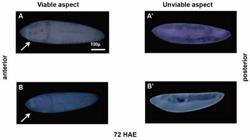
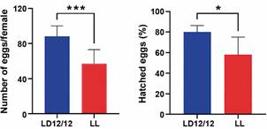
FINDINGS and MAIN CONCLUSIONS Our results proved the negative effect of constant light on egg production (decreasing the fecundity) and embryonic development (causing a drop in egg viability and perceptive damage in the embryos). The results presented here bring new information on the impacts that a source of constant light may have on the reproductive biology of Ae. aegypti.
Key words:
oviposition; arboviruses; fertility;
Aedes aegypti
; biological clocks; embryo development
 Thumbnail
 Thumbnail
 Thumbnail
 Thumbnail


