
 Concepts of racism in O Globo newspaper editorials between 2012 and 2023
Abstract
This article examines the presence of different concepts of racism in the editorials of O Globo newspaper concerning Racial Affirmative Actions (RAA) policies and racism between 2012 and 2023, exploring possible changes over time. The analysis is grounded in the literature addressing racism as ideology, structure and discrimination, seeking to identify which of these perspectives is most prevalent in the newspaper’s editorials and how they relate to its official stance on RAA. The findings reveal a significant shift in O Globo’s editorial position: the paper was predominantly opposed to RAA policies until 2018 but began supporting these policies in 2020. In terms of concepts of racism, the notion of racism as discrimination dominates for most of the period, except between 2015 and 2018, when racism as ideology assumed greater prominence. The analysis did not find any clear connection between the newspaper’s stance on RAA and its approach to racism.
Keywords
racism; racial affirmative action; journalism
Resumo
Este artigo examina a presença de diferentes conceitos de racismo nos editoriais do jornal O Globo sobre Ações Afirmativas Raciais (AAR) e racismo entre 2012 e 2023, explorando possíveis mudanças ao longo do tempo. A análise é fundamentada na literatura sobre racismo como ideologia, estrutura e discriminação, com o objetivo de identificar qual dessas perspectivas é mais prevalente nos editoriais do jornal e como isso se relaciona com suas posições oficiais sobre AAR. Os resultados revelam uma mudança significativa na posição editorial de O Globo, que adota uma postura majoritariamente contrária às AAR até 2018, mas a partir de 2020 passa a apoiar essas políticas. Quanto aos conceitos de racismo, ‘Racismo como discriminação’ domina durante a maior parte do período, exceto entre 2015 e 2018, quando ‘Racismo como ideologia’ assume maior destaque. A análise não identificou conexão evidente entre o posicionamento do jornal em relação às AAR e sua abordagem sobre racismo.
Palavras-chave
racismo; ações afirmativas raciais; jornalismo
Introduction
This study sets out to examine how narratives on racism and Racial Affirmative Action (RAA) policies in Brazil are shaped by the media and, more specifically, by O Globo, one of the country’s leading daily newspapers and media groups. The temporal scope, covering the period from 2012 to 2023, aims to identify possible shifts in editorial approaches to political and social events, paying especially attention to the implementation and consolidation of racial quotas in Brazil.
The implementation of racial quotas, particularly following Law No. 12,711/2012, represents a landmark in the struggle against racism in Brazil. The unanimous decision of the Federal Supreme Court (STF) in 2012 declaring the constitutionality of the quotas not only consolidated the legitimacy of these policies but also bolstered public debate on structural and structuring racial inequalities (Brazil, 2012). In recent years, international movements such as Black Lives Matter have helped increase the visibility of debates on structural racism and its global manifestations. Although significant contextual differences exist, these movements have influenced the expansion of discussions on racial justice in Brazil as well, especially from 2020 onwards, when cases such as the murder of George Floyd mobilized anti-racist demonstrations in various parts of the world, including Brazilian cities.
In this context, the media play an important role in shaping public opinion and in constructing public discourse on pivotal social issues such as racism. By examining the presence of different concepts of racism – ideology, structure and discrimination – in the editorials of O Globo, this article seeks to contribute to an understanding of the dialogue between these perspectives and the newspaper’s own editorial positions on racism and RAA policies. Studies such as those by João Feres Júnior, Luiz Augusto Campos and Verônica Daflon (2011) have demonstrated how media narratives can legitimize or contest public policies, seeking to influence public opinion and, in many cases, to guide the political behaviour of elites and government policymakers.
The proposed analysis is particularly relevant in Brazil where debates on structural racism and RAA policies have gained increasing prominence. According to searches conducted in November 2024, between 2000 and 2020 publications indexed on Google Scholar containing the term racism grew by 55.5 per cent, while use of the expression structural racism increased even more markedly, exceeding 107 per cent. In the Brazilian Digital Library of Theses and Dissertations (BDTD), references to racism rose by 471.5 per cent, while those to structural racism surged by 5,900 per cent. Data on O Globo show a more modest increase of 16.3 per cent for racism, but a significant rise of 715.5 per cent for structural racism. Although references to racism remained more frequent throughout this period, the sharp increase in the use of structural racism indicates a shift from its near absence in Brazilian public debate to a substantial and growing presence.
Beyond its influence on public debate, one of the objectives of journalism – particularly in editorials – is to shape the formulation and promotion of public policies. Examining the dominant narratives in the newspaper can thus provide an insight into how interpretations of racism are mobilized to support or criticize specific narratives and policies (Campos, 2012, 2013; Campos, Feres Júnior and Daflon, 2013; Feres Júnior, Campos and Daflon, 2011).
The article is structured as follows: the first section reviews the existing literature on racism and RAA policies. This is followed by a brief presentation of the methodology employed in the study, after which the results of the analysis are discussed, highlighting the main trends identified. Finally, the conclusion reflects on the implications of these findings for the broader debate on racism and affirmative action policies in Brazil.
1 Three theoretical perspectives on racism: ideology, discrimination and structure
Racism is a complex and multifaceted social phenomenon. It manifests in different forms depending on the historical moment and the geographical context, but always serves to essentialize, hierarchize and justify the domination of human groups. For analytical purposes, debates over its conceptualization can be separated into three interdependent perspectives: racism as ideology, as discrimination and as structure (Blank, Dabady and Citro, 2004; Bonilla-Silva, 1997; Campos, 2017; Guillaumin, 1995; Feagin, 2006; Pager and Shepherd, 2008; Miles and Brown, 2003).
In the Brazilian case, the literature indicates that racism has historically been interpreted by public opinion as an act of discrimination practiced by morally deviant individuals, generally involving explicit physical or verbal violence (Azevedo, 2007; Cavalcante, 2021; Guimarães, 2006, 2007; Nascimento, 1978; Sales Júnior, 2006). By focusing on exceptional situations and adopting an individualist perspective on racism, this conception can be associated with the internalization of the myth of racial democracy, which projects Brazilian race relations as harmonious and egalitarian.
However, there has been a growing recognition of a greater politicization and popular awareness regarding the racial debate, largely attributed to the success of racial affirmative action policies in the country (Delgado, 2016; Hofbauer, 2006; Oliven, 2007). At the end of the twentieth century and the beginning of the twenty-first, with Brazil’s redemocratization and the strengthening of the Black Movement, affirmative action policies entered the public agenda, bringing with them debates on racial discrimination and inequality in Brazil (Feres Júnior and Campos, 2016; Feres Júnior et al., 2018; Hofbauer, 2006). Consequently, with the proven effectiveness of racial quota policies, previously rejected by the mainstream media, it is likely that major newspapers have more recently repositioned themselves in relation to these policies and their interpretations of what constitutes racism (Campos, 2019; Feres Júnior, 2008; Campos, Feres Júnior and Daflon, 2013).
To substantiate the analyses pursued in this study, this section examines the three abovementioned conceptualizations of racism in more depth, beginning with racism as ideology, which chronologically precedes the other formulations. Although the term had been in use since the early twentieth century, its consolidation in an academic context occurred in the 1940s, when it came to be understood as a dogma, doctrine or set of beliefs that divided humanity into superior and inferior groups through the process of racialization (Bonilla-Silva, 1997; Campos, 2017; Miles and Brown, 2003).
Defined as a symbolic system and cultural phenomenon, racism as ideology is distinguished by the crystallization of social actors, fixing their biophysical and cultural characteristics into immutable essences and identifying them through stereotyped representations. In a perspective closer to the Marxist sense of ideology as false consciousness, Miles and Brown (2003, p. 8) argue that racism is characterized by the distorted representation of human beings and their relations, while Guillaumin (1995, pp. 29–30) contends that racist ideology operates in an opaque and unconscious form within a society’s system of power relations. In both formulations, racism is recognized to coexist with exclusionary practices. But to ensure analytical precision and formulate effective strategies of intervention, it is important, they argue, to distinguish racism as ideology from acts of exclusion and discrimination. This is due, in part, to the absence of a direct causality between cognition and action.
Other schools of thought, however, highlight the limits of reducing racial phenomena (or giving priority) to the ideological component of racism. From this perspective, the very fact that ideas and actions are not necessarily causally related points to the problem that discriminatory practices are politically and sociologically more relevant than beliefs. Discriminatory actions do not need to be intentionally racist for them to be challenged, and it is above all these kinds of actions that can be penalized. Moreover, rather than being manifested solely through individuals and their localised institutional practices, racism is one of the elements that shape the way institutions structure social life, something that the ideological conception of racism does not fully capture. Finally, another practical issue that affects the design of research and public policies is the impossibility of measuring racist ideas and their effects, which is more feasible when racism is treated as discrimination.
In the discourses on racism commonly reproduced in Brazil, the focus on discrimination appears to be conception most frequently invoked. As suggested above, a concise explanation is that racism as discrimination is defined as actions and practices that confer unequal treatment on groups based on their race without presuming any underlying cause (like ideology). More specifically, discrimination can be characterized in two ways: 1. Differential treatment: individuals are treated unequally and are disadvantaged due to their race; 2. Differential effect: although individuals receive treatment based on rules and procedures that appear neutral, these mechanisms are designed in ways that favour members of one group to the detriment of another or others (Blank, Dabady & Citro, 2004; Pager and Shepherd, 2008).
Blank et al. (2004) subdivide racism as discrimination into the categories of explicit discrimination, subtle discrimination, statistical discrimination (or racial profiling) and discrimination linked to organisational processes (which I have opted to designate as ‘institutional’). Explicit discrimination, characterized by intentionality, includes verbal antagonism (insults and derogatory comments based on race), avoidance (the choice not to interact with other racial groups), segregation (the active exclusion of members of disadvantaged racial groups from the allocation of resources and access to institutions), physical attacks (generally perpetrated by advocates of segregation and associated with other forms of explicit discrimination) and extermination (mass killings motivated by racial or ethnic animosity).
Subtle discrimination, often fomented by media representations, is described as a set of unconscious beliefs and associations that influence the predispositions and behaviours of members of the “in-group” towards those in the “out-group” (Blank et al., 2004, pp. 58–59). Racial profiling, meanwhile, refers to the use, in contexts of limited information, of commonsense beliefs about a group in order to make decisions concerning an individual belonging to the group in question. An example would be an employer who decides not to hire a black applicant on the presumption that black people are more likely to have a criminal record and are therefore less trustworthy workers. Finally, institutional discrimination, also labelled organizational processes or factors, refers to the ways in which institutions reflect the past and present prejudices of the individuals making up their personnel. In this case, even in the absence of discriminatory intent on the part of specific individuals, the organizational structure, hiring practices, networks of contacts and institutional culture can foster racial inequalities and discrimination.
According to the school of thought that foregrounds the concept of structural racism, although the institutionalist perspective represents progress in recognizing the capacity of the dominant racial group to institutionalize its positions, it fails to sufficiently emphasize the interconnections between different institutions that perpetuate racial inequality (Bonilla-Silva, 1997; Feagin, 2006). Structural racism theorists argue that the institutional approach concentrates on the policies and practices that generate discriminatory outcomes within specific institutions, which limits its ability to comprehend racism as an independent element rooted in the operation of the social system. In a historical context in which racist practices have become increasingly subtle and publicly repudiated, the concept of structural racism seeks to elucidate the ways in which racialization permeates the social order as a whole, producing systemic privileges and disadvantages that precede and encompass ideologies and attitudes.
Two concepts are particularly important for understanding the structural nature of racism: the notion of “racialised social systems” (Bonilla-Silva, 1997) and the idea of a “systemic inertia of racism” (Feagin, 2006). The concept of racialized social systems refers to societies in which racial hierarchization functions as the organizing principle of social relations. In these systems, racial categories shape the social, economic and political positions and opportunities of individuals and groups. Meanwhile, the systemic inertia of racism, as Feagin explains, describes how these racialized social systems, once established, tend to perpetuate themselves over time, even when racist ideologies are no longer openly endorsed and institutional paradigms have changed, as in the case of the abolition of slavery. This dynamic is related to the role of white elites who, under pressure from anti-racist movements, are compelled to implement institutional changes to secure rights but resist dismantling the foundations of the oppressive system that assures them individual and collective advantages. Such advantages extend from interpersonal relations to access to education, healthcare, employment, housing and justice.
In proposing a theoretical framework for analysing the existence of racial structures in different societies, focusing on the United States, Bonilla-Silva (1997, p. 277) argues that “[…] the racial practices that reproduce racial inequality in contemporary America (1) are increasingly covert, (2) are incorporated into the routine operations of institutions, (3) avoid direct racial terminology, and (4) are invisible to most white people.”
This reading undoubtedly helps advance the diagnosis of how racism is transmuted and persists as a structuring element of social life. As Campos (2017) notes, however, the huge range and lack of clarity of the phenomena encompassed by the idea promote conceptual inflation, hinder the identification of cause-and-effect relations and weaken analytical capacity. Moreover, treating racism as a totalizing whole and reducing practices to structures may foster a determinist view that ignores individual agency as well as the capacity for struggle and resistance on the part of groups and individuals.
As can be observed, the three formulations of racism each make substantial contributions but are also susceptible to critique in terms of how they understand the phenomenon. Campos argues that a more precise and effective approach should recognize the ontological interdependence of these three dimensions – ideology, practices and structures – maintaining them distinct only at the analytical level. They should not, therefore, be hierarchized, divided into autonomous spheres or fused into a single unified concept. A three-dimensional perspective allows racism to be understood as a phenomenon shaped by the interaction between culture, agency and structure, in which each dimension may be empirically investigated in specific contexts, whether in isolation or in relation to the others.
2 Analysis of O Globo editorials on racism and Racial Affirmative Action policies
Understanding the different theoretical perspectives on racism – ideology, discrimination and structure – is essential for uncovering how these concepts are manifested in media narratives and influence the construction of institutional and public discourses. The media – newspapers in particular – play a central role in this process, acting both as disseminators of ideas and as arenas of debate that shape public opinion and legitimize or contest public policies, including Racial Affirmative Action policies (Biroli, 2011; Entman and Rojecki, 2000; Hall, 1997; Van Dijk, 1991). In this context, media outlets function as a barometer of race relations but may also act as agents of cultural cohesion or, conversely, of segregation and political conflict (Entman and Rojecki, 2000, p. 23).
In Brazil, the press has a history marked by ambiguities. Though often associated with low diversity, the reinforcement of stereotypical representations and the perpetuation of the myth of racial democracy, it has also performed a key role in denouncing racial inequalities, especially in more recent times. From the 2000s onwards, the debate on Racial Affirmative Action policies brought increased visibility to racial issues. However, studies indicate that traditional outlets such as O Globo privileged narratives opposing racial quotas, even going so far as to question the existence and significance of racism in Brazilian society (Campos, 2019; Feres Júnior, 2008; Feres Júnior et al., 2018; Feres Júnior, Campos and Daflon, 2011; Feres Júnior and Daflon, 2012).
Given this context, investigating how O Globo has articulated theoretical concepts of racism over the past decade and positioned itself in relation to Racial Affirmative Action policies can offer insights into the relationship between media discourse and social dynamics in Brazil. The newspaper’s editorials constitute an important source for understanding how a significant sector of Brazilian journalism reflects, updates and negotiates the public debate on racism and affirmative action policies.
The following analysis seeks to answer three main questions: 1. Which concept of racism (ideology, discrimination or structure) predominated in the editorials of O Globo between 2012 and 2023? 2. During the same period, and considering the literature discussed in the previous section, has the newspaper’s position on Racial Affirmative Action policies changed? 3. Is there any correlation between the concept of racism privileged by the newspaper and its stance on affirmative policies?
To provide responses, I analysed 88 editorials published in O Globo during the period under investigation that mentioned the keywords (in both singular and plural forms) affirmative action, racial quota and racism. After collecting the data from the newspaper’s online archive, the editorials were classified into two groups: those that mentioned the term racism and those that mentioned affirmative action. In total, 21 editorials addressed both racism and affirmative action, 59 dealt exclusively with racism, and 8 discussed affirmative action without reference to racism.
Using the qualitative analysis software Atlas.ti, I classified the editorials according to the following categories, previously defined in line with the reviewed literature: racism as ideology, racism as structure and racism as discrimination (subdivided into explicit, subtle and institutional discrimination). For each editorial, I included the possibility that more than one category might be applied within the same text. In addition, during the course of the analysis, four additional codes emerged: in seven cases, the terms racism or discrimination appeared in the texts in a vague manner, making it impossible to associate their mention with any specific conceptualization. The two other codes created refer to editorials that addressed racism and/or affirmative action in the United States or another foreign country. Accordingly, the categories United States and Foreign were introduced.
To classify the newspaper’s positions on affirmative action and racial quota policies, I used data obtained from a Google form designed for a separate study, also on Racial Affirmative Action policies, which extends beyond the scope of this article. The form lists a series of questions on the newspaper’s positioning, but the only one used in this analysis was: Does the text suggest any position taken in relation to RAA policies? with the following possible responses: Favourable, Opposed, Ambivalent, Neutral and Absent.
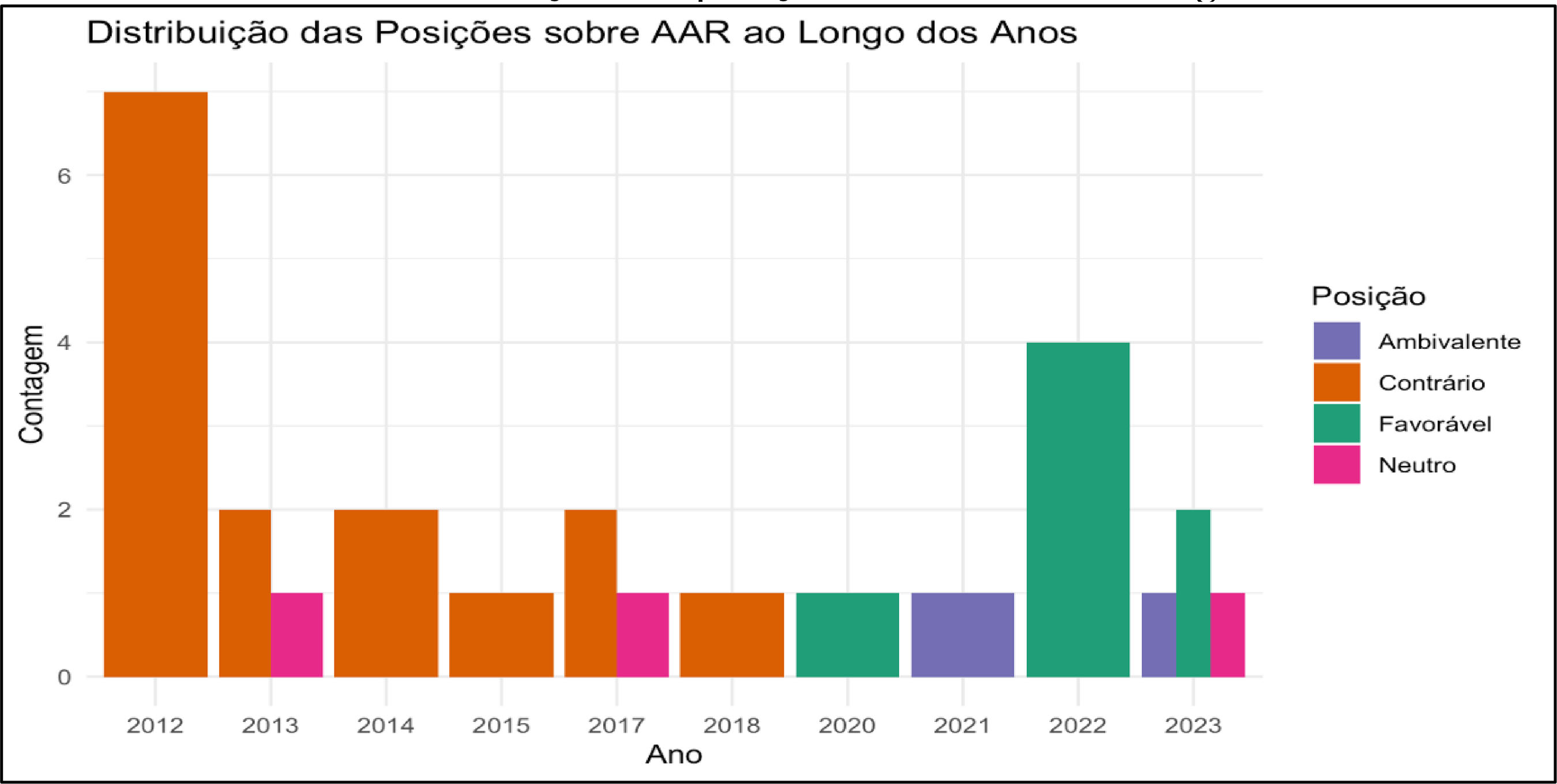
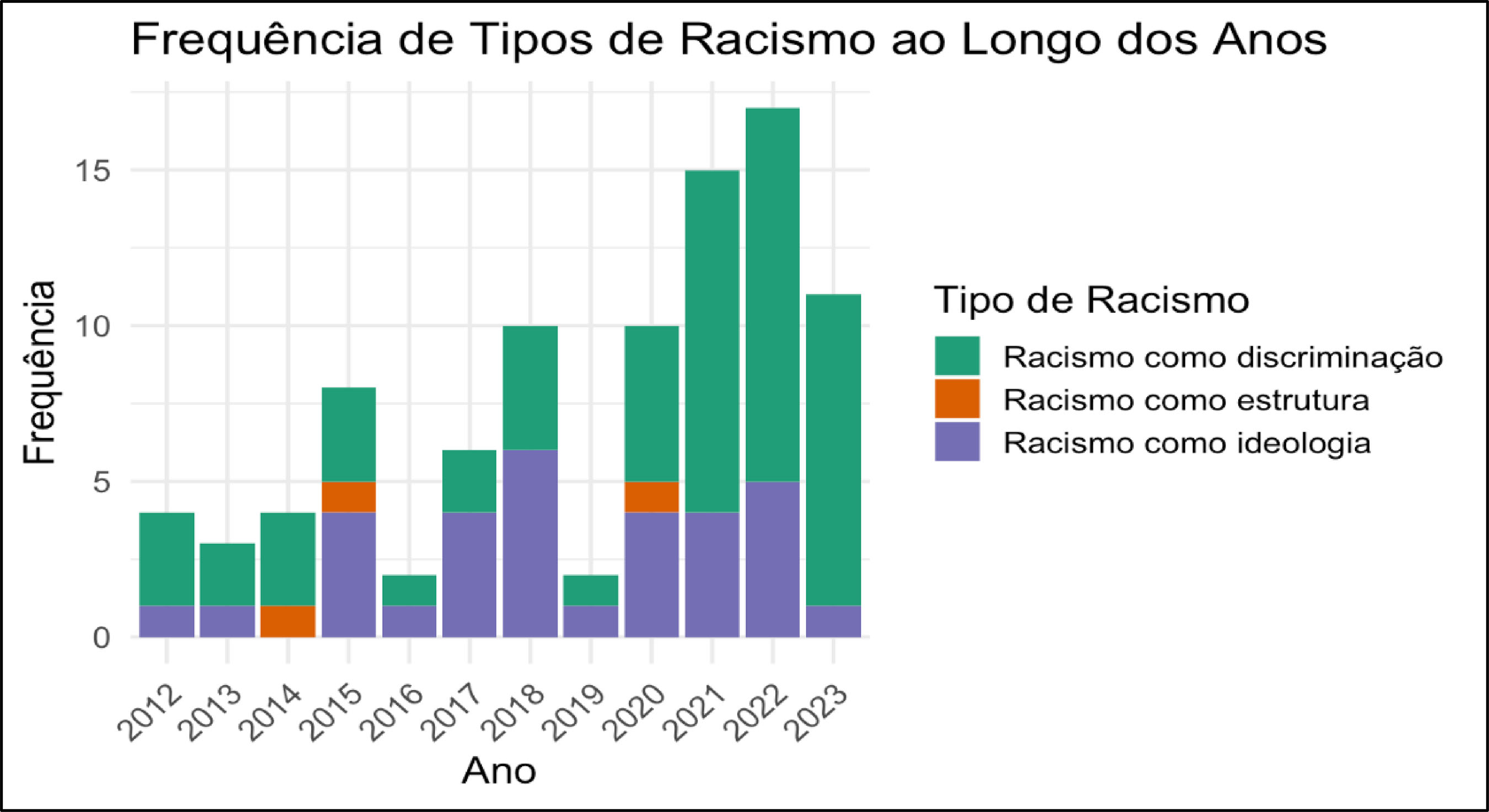
In relation to the two main research questions, it can be observed that while the newspaper’s editorial stance on Racial Affirmative Action policies changed radically over the period under study, the frequency of the different types of racism showed little variation, with the concept of racism as discrimination prevailing for most of the time. This constitutes a first and important indication that there is no correlation between the two categories.
As Graph 1 shows, editorials on Racial Affirmative Action policies are concentrated mainly in 2012, a year marked by the unanimous decision of the Federal Supreme Court recognizing the constitutionality of racial quotas in public universities and, subsequently, by the enactment of Law No. 12.711 – known as the Quotas Law – by then President Dilma Rousseff. Between 2012 and 2018, most of the editorials adopted a stance opposing RAA policies. In 2016 and 2019, no editorials on the topic were published. In 2020, however, the first editorial favourable to the policy appeared. By 2023, the year of the last editorial analysed in the study, no further texts opposing RAA policies were published. In the 2018 editorial opposing quotas, we can note that one of the arguments advanced is the idea of racism as an ideology imported from the United States:
The issue of racial quotas is inevitably tainted by its origin: the United States, a society founded in large part on the unscientific idea of “race” – very different from Brazil and its own historical formation. By importing this policy, the meaning of racism sadly and inevitably came with it. It is impossible to dissociate quotas from the conflicts occurring within the university environment.
(O Mérito [...], 2018).
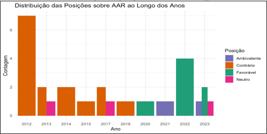
In 2020, although no editorial was devoted entirely to affirmative action in public universities – a topic that would only resurface in 2021 – an editorial was published congratulating former Federal Supreme Court (STF) Justice Celso de Mello on his career on his retirement, highlighting his support for Racial Affirmative Action policies. The same year, the newspaper expressed its support for the retailer Magalu’s initiative to launch a trainee program exclusively for black candidates, explicitly noting its alignment with the STF’s decision on the constitutionality of racial quotas. In this editorial, the defence of the policy is based on an understanding of racism as institutional discrimination: “Not only at Magalu, but similar programs elsewhere have been almost entirely occupied by whites. This is the result of policies that, throughout history, have guaranteed whites privileges in academic training, but also the racism that persists in recruitment processes” (Trainee […], 2020).
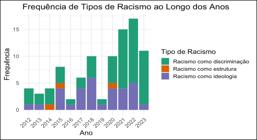
In contrast to the shifts observed in the newspaper’s stances on racial affirmative action, there were no significant changes regarding the concept of racism present in the editorials. As shown in Figure 2, the concept of racism as discrimination predominates across almost the entire sample (62 references). The exceptions occur in the years 2015 to 2018, when the concept of racism as ideology (32 references) stands out, driven above all by the rise of the far right in European countries and the United States. It is worth noting that although a similar phenomenon was taking place in Brazil, this fact was not highlighted in the editorials analysed here.
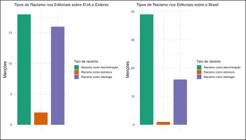
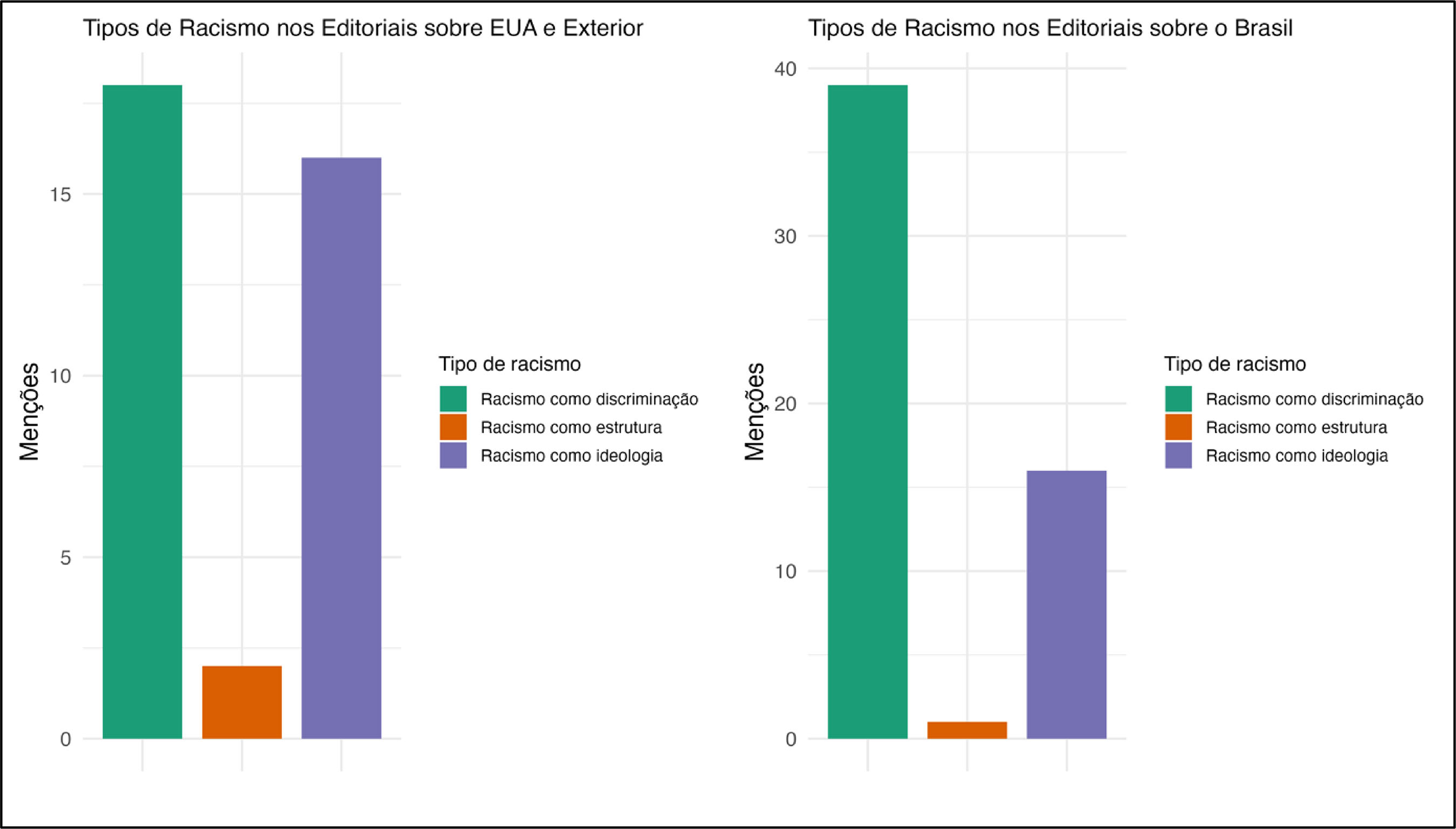
Types of racism mentioned in the editorials on the USA and other foreign countries versus Brazil
If we compare the most frequent concepts of racism mentioned in the editorials classified under the categories United States and Foreign with the remainder (those on Brazil), it is perceptible that while racism as discrimination is the most recurrent in both cases, in the first group racism as ideology stands out far more than in the second. This finding is consistent with the perception, illustrated in the quotation below, that Brazilian journalism understands racism as a founding ideology of United States society (though not necessarily of Brazil), originating in the invention and separation of humankind into races.
The problem of racism in the United States is historically rooted in slavery, but it is culturally sustained by an ideology that, as in Gobineau, divides the world into human races […]. In importing the American model of activism, some segments of the Brazilian black movement have inadvertently brought aspects of this ideology with them.
(Racismo [...], 2015).
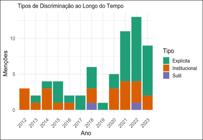
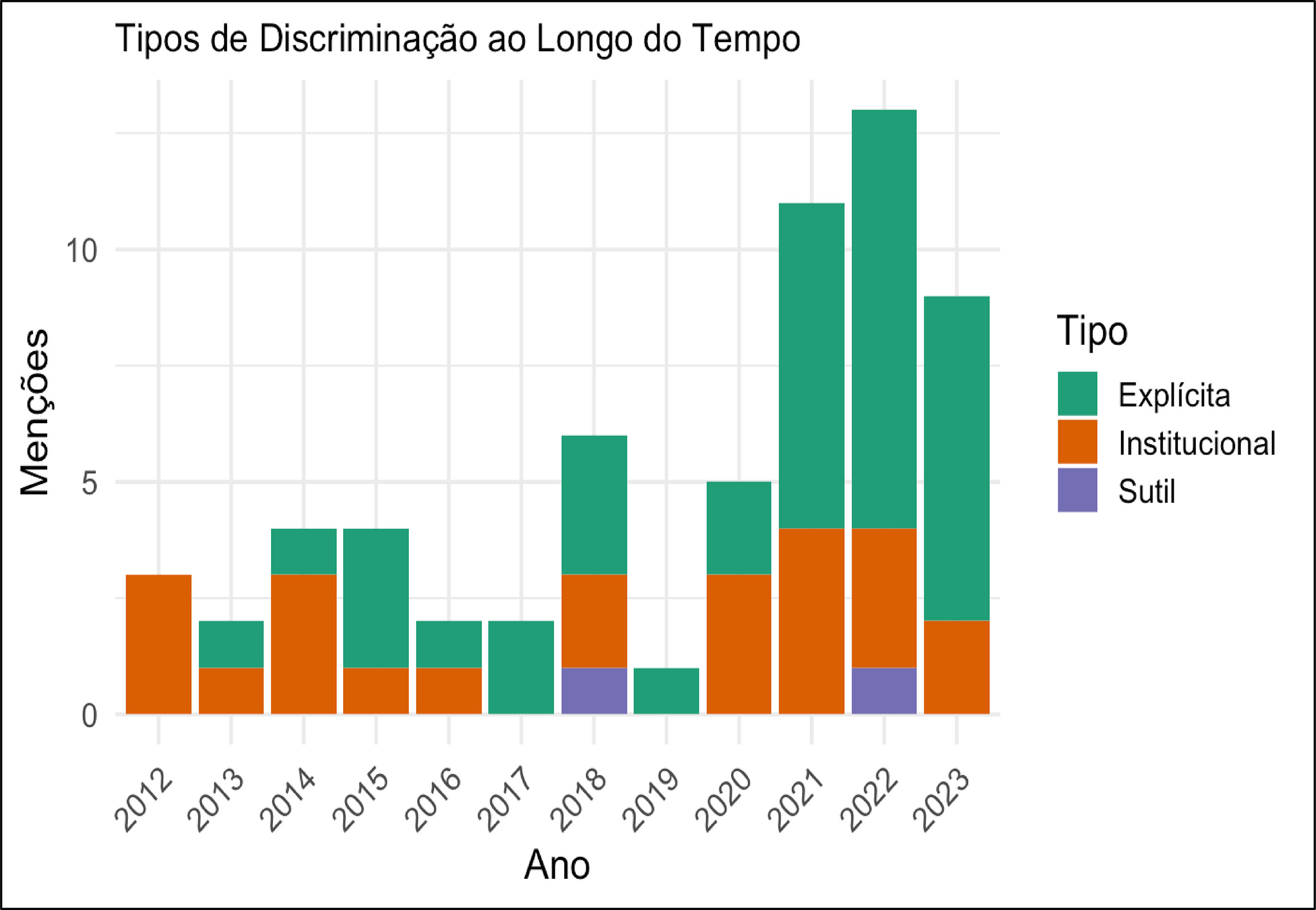
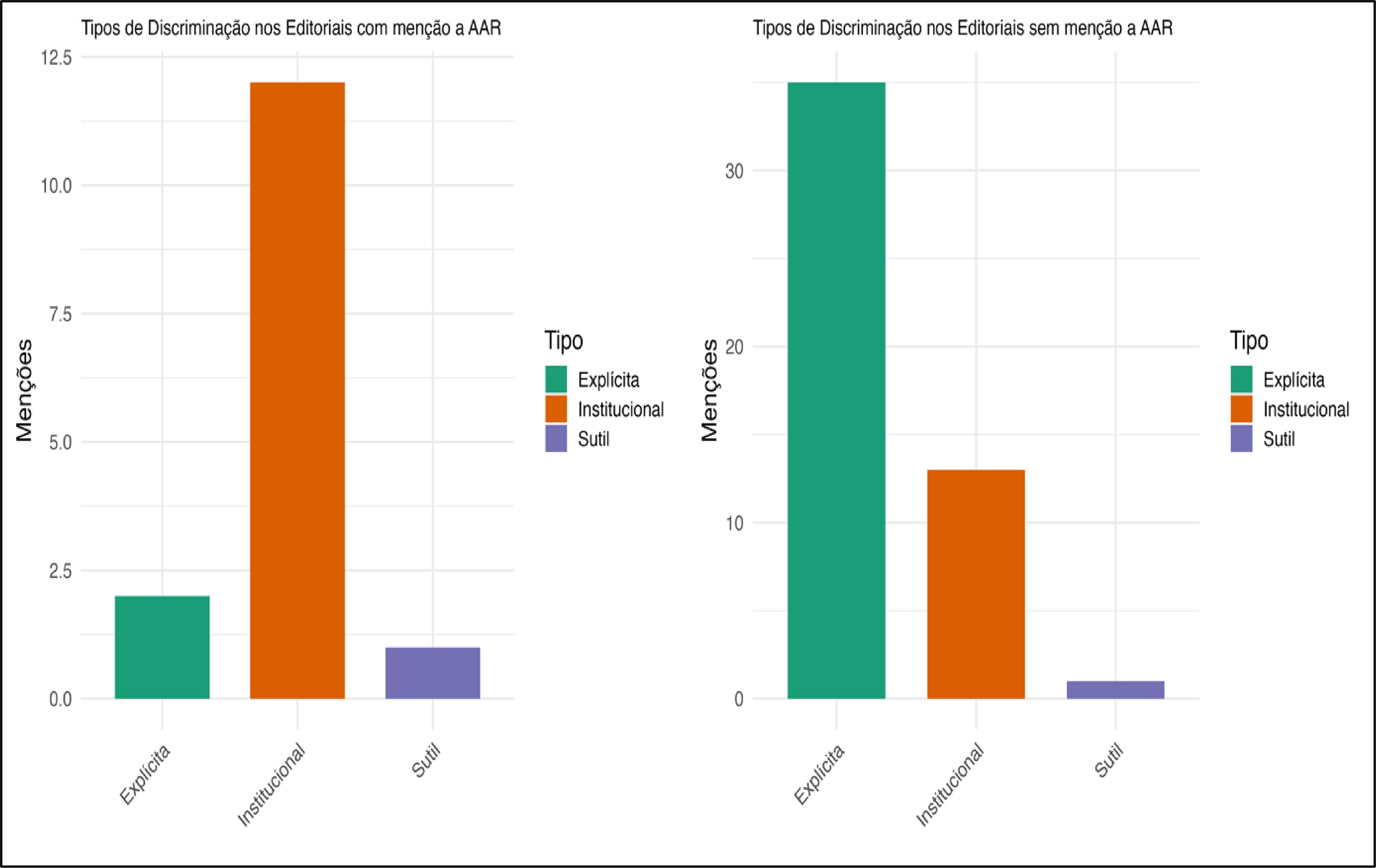
When the sample is separated into editorials that mention affirmative action and those that do not, the proportions among the concepts of racism are similar, with racism as discrimination predominating, followed by racism as ideology. When examining the types of discrimination specifically over time, explicit discrimination is the most frequently mentioned, followed by institutional discrimination.
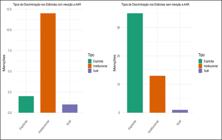
Turning to the different types of discrimination, when the sample is separated into editorials that discuss affirmative action and those that discuss racism exclusively, a stronger association can be seen in the former group with institutional discrimination, while the latter tend to focus more on explicit discrimination. It is important to note that, in the majority of cases, institutional discrimination is associated with positions opposing affirmative action, interpreted either as a form of discrimination against non-black minorities in the United States or against poor whites in Brazil. In the example below, the text addresses a ruling made in 2014 by the United States Supreme Court upholding the constitutionality of a Michigan law banning the use of racial criteria by universities:
The income criterion was cited, the so-called social quota, which exists in Brazil but is subordinated to “race.” This quota does not make the odious discrimination based on skin colour, nor does it segregate the poor white population. The warning comes from the United States at a time when, in Brazil, racialism continues to advance.
(Justiça [...], 2014).
In the case of the predominance of references to explicit discrimination in editorials on racism that make no mention of affirmative action, the discussions usually focus on denouncing episodes of physical violence, such as the murders of George Floyd and the racist attack on a church in Charleston, in the United States. Attention is also given to racist insults uttered or defended by ordinary citizens and public figures, including organized football supporters, the influencer Bruno Aiub (Monark), former Brazilian president Jair Bolsonaro, and the president of the United States, Donald Trump.
Finally, as a complement to the descriptive analyses illustrated by the graphs above, a Pearson correlation test was conducted to ascertain whether a linear relationship exists between the conceptions of racism in the newspaper’s editorials and its stance on RAA policies. In line with the findings shown previously, all correlations involving the position on RAA are weak, suggesting that the way racism is addressed in the editorials is probably not a determining factor in the newspaper’s stance on Racial Affirmative Action policies. Other interests and discussions, not limited to those pertaining to racism, appear to have had more influence in shaping the newspaper’s position and its change over the period under review.
Final remarks
This study analysed different conceptions of racism appearing in the editorials of O Globo, tracking the evolution of the newspaper’s positions on Racial Affirmative Action policies and its treatment of racial issues between 2012 and 2023. The results reveal a significant change in the newspaper’s stance from a position predominantly opposing RAA policies until 2018 to a favourable one from 2020 onwards. Although it is not possible to isolate the reason for this change with any certainty, some possible motivations to be investigated in the future include: the accumulation of evidence on the beneficial effects of the policy; mounting social pressures, driven by the strengthening of anti-racist movements worldwide; and the denialism of the Bolsonaro government, which took office in 2019.
On the other hand, this change has not been accompanied by any shift in the newspaper’s approach to racism, since the concept of racism as discrimination predominates throughout most of the period analysed. The sole exception is between 2015 and 2018, when racism as ideology stands out, levered by reports on the rise of the far right in the United States and European countries. This pattern reveals the persistence of a journalistic discourse that privileges episodic approaches to racism, linked to specific events, at the expense of deeper analyses of the structural inequalities that characterize race relations in Brazil and worldwide.
In this sense, the results indicate no significant correlation between the newspaper’s positioning on RAA policies and its conceptualization of racism. References to racism in the editorials are associated above all with cases of explicit discrimination, whether through physical or verbal violence. Still within the category of racism as discrimination, the subcategory that stands out in the editorials on affirmative action is institutional discrimination. However, this association is not directly reflected in a favourable stance towards the policies in question. Although the aspect of combating discrimination through an institutional policy appears at certain moments, it was also used – particularly in the early years of the sample – to argue that the law (or, in the case of other countries, the internal policy of specific institutions) draws on a history of discrimination to wrongly discriminate against other groups, such as poor white sectors.
Of the 88 editorials analysed, only 29 address racism and/or racial affirmative action policies outside Brazil, particularly in the United States. Even so, the concepts of racism as ideology and racism as structure are more present in this group than in the editorials discussing racial issues in Brazil. Despite entering the Brazilian public sphere in recent years, the idea of structural racism has been virtually absent from the newspaper’s editorials. By contrast, the notion of racism as ideology has a considerable presence in debates on racial issues in other countries, especially the United States. The concept frequently appears anchored in critiques of the discourse of reactionary leaders such as Donald Trump in the United States and Marine Le Pen in France. In the Brazilian context, beyond the lower incidence of references to racist ideology, there is a notable absence of criticism of its mobilization by far-right politicians. On the other hand, the temporal coincidence between the critiques of racism associated with the international far right and the change in position on affirmative action policies in Brazil is a point that merits deeper investigation in future research.
The immediacy of journalism, its need to select prominent themes and its appeal to public emotions are partly consistent with the prioritization of racism as discrimination, given the concept’s emphasis on tangible attitudes and actions, particularly those practiced by individuals. At the same time, editorials are the institutional voice of newspapers and present themselves as spaces for reflection and analysis on important public issues. The choice of the concept of racism as discrimination can be interpreted, therefore, as a way of keeping the focus on episodic practices and on the individual responsibility of racist figures, while disconnecting these from the social structures and the systemic – though not necessarily visible – effects of racism.
-
Research funded by CAPES (Grant No. 88887.601293/2021-00).
Data Availability Statement
No informed use of data; no research data were generated or utilized.
References
-
AZEVEDO, Thales de. A democracia racial: mito e ideologia. Universitas, Ondina, n. 17, p. 5-29, maio 2007. Disponível em: https://periodicos.ufba.br/index.php/universitas/article/view/1134 Acesso em: 20 jun. 2024.
» https://periodicos.ufba.br/index.php/universitas/article/view/1134 -
BIROLI, Flávia. Mídia, tipificação e exercícios de poder: a reprodução dos estereótipos no discurso jornalístico. Revista Brasileira de Ciência Política, Brasília, DF, v. 6, p. 71-98, 2011. DOI: https://doi.org/10.1590/S0103-33522011000200004.
» https://doi.org/10.1590/S0103-33522011000200004 - BLANK, Rebecca M.; DABADY, Marilyn; CITRO, Constance F. Measuring racial discrimination Washington: National Academies Press, 2004.
- BLANK, Rebecca M.; DABADY, Marilyn; CITRO, Constance F. Measuring racial discrimination Washington: National Academies Press, 2004.
-
BONILLA-SILVA, Eduardo. Rethinking racism: toward a structural interpretation. American Sociological Review, Washington, D.C., v. 62, n. 3, p. 465-480, June 1997. Disponível em: https://www.jstor.org/stable/2657316 Acesso em: 20 jun. 2024.
» https://www.jstor.org/stable/2657316 -
BRASIL. Lei n. 12.711, de 29 de agosto de 2012 Dispõe sobre o ingresso nas universidades federais e nas instituições federais de ensino técnico de nível médio e dá outras providências. Brasília, DF: Presidência da República, 2012. Disponível em: https://www.planalto.gov.br/ccivil_03/_ato2011-2014/2012/lei/l12711.htm Acesso em: 20 jun. 2024.
» https://www.planalto.gov.br/ccivil_03/_ato2011-2014/2012/lei/l12711.htm -
CAMPOS, Luiz Augusto. ‘We have a dream’: cientistas sociais e a controvérsia sobre as cotas raciais na imprensa. Revista de Sociologia e Política, Curitiba, v. 20, n. 41, p. 53-73, fev. 2012. DOI: https://doi.org/10.1590/S0104-44782012000100005.
» https://doi.org/10.1590/S0104-44782012000100005 - CAMPOS, Luiz Augusto. Em busca do público: a controvérsia das cotas raciais na imprensa. Rio de Janeiro: EdUERJ, 2019.
-
CAMPOS, Luiz Augusto. Enquadrando a esfera pública: a controvérsia das cotas raciais na imprensa. 2013. Tese (Doutorado em Sociologia) – Universidade do Estado do Rio de Janeiro, Rio de Janeiro, 2013. Disponível em: http://www.bdtd.uerj.br/handle/1/15465 Acesso em: 20 jun. 2024.
» http://www.bdtd.uerj.br/handle/1/15465 -
CAMPOS, Luiz Augusto. Racismo em três dimensões: uma abordagem realista-crítica. Revista Brasileira de Ciências Sociais, São Paulo, v. 32, n. 95, p. 1-19, abr. 2017. DOI: https://doi.org/10.17666/329507/2017.
» https://doi.org/10.17666/329507/2017 -
CAMPOS, Luiz Augusto; FERES JÚNIOR, João; DAFLON, Verônica Toste. Administrando o debate público. Revista Brasileira de Ciência Política, Brasília, DF, n. 11, p. 7-31, maio/ago. 2013. DOI: https://doi.org/10.1590/S0103-33522013000200001.
» https://doi.org/10.1590/S0103-33522013000200001 -
CAVALCANTE, Andaraí Ramos. Invisibilidade do racismo e as lutas antirracistas a partir dos estudos da UNESCO de 1950. Mosaico, Rio de Janeiro, v. 13, n. 21, p. 314-335, dez. 2021. DOI: https://doi.org/10.12660/rm.v13n21.2021.82291.
» https://doi.org/10.12660/rm.v13n21.2021.82291 -
DELGADO, Ignacio José Godinho. Ações afirmativas e o horizonte normativo da democracia racial. Cadernos de História, Belo Horizonte, v. 17, n. 26, p. 182, maio 2016. DOI: http://dx.doi.org/10.5752/p.2237-8871.2016v17n26p182.
» https://doi.org/10.5752/p.2237-8871.2016v17n26p182 - ENTMAN, Robert M.; ROJECKI, Andrew. The black image in the white mind: media and race in America. Chicago: The University of Chicago Press, 2000.
- FEAGIN, Joe R. Systemic racism: a theory of oppression. New York: Routledge, 2006.
-
FERES JÚNIOR, João. Ação afirmativa: política pública e opinião. Sinais Sociais, Rio de Janeiro, v. 3, n. 8, p. 38-77, set./dez. 2008. Disponível em: https://biblioteca.flacso.org.br/files/2012/07/641.pdf
» https://biblioteca.flacso.org.br/files/2012/07/641.pdf -
FERES JÚNIOR, João; CAMPOS, Luiz Augusto. Ação afirmativa no Brasil: multiculturalismo ou justiça social?. Lua Nova, São Paulo, v. 2016, n. 99, p. 257-293, set./dez. 2016. DOI: https://doi.org/10.1590/0102-6445257-293/99.
» https://doi.org/10.1590/0102-6445257-293/99 - FERES JÚNIOR, João; CAMPOS, Luiz Augusto; DAFLON, Verônica Toste. Fora de quadro: a ação afirmativa nas páginas d’O Globo. Contemporânea, São Carlos, v. 1, n. 2, p. 61-83, jul./dez. 2011. Disponível em Acesso em: 20 jun. 2024.
- FERES JÚNIOR, João; CAMPOS, Luiz Augusto; DAFLON, Verônica Toste; VENTURINI, Anna Carolina. Ação afirmativa: conceito, história e debates. Rio de Janeiro: EdUERJ, 2018.
-
FERES JÚNIOR, João; DAFLON, Verônica Toste. Ação afirmativa na revista Veja: estratégias editoriais e o enquadramento do debate público. Compolítica, v. 2, n. 2, p. 66-91, jul./dez. 2012. DOI: https://doi.org/10.21878/compolitica.2012.2.2.31.
» https://doi.org/10.21878/compolitica.2012.2.2.31 - GUILLAUMIN, Colette. Racism, sexism, power and ideology London: Routledge, 1995.
-
GUIMARÃES, Antonio Sérgio Alfredo. Depois da democracia racial. Tempo Social, São Paulo, v. 18, n. 2, p. 269-287, nov. 2006. DOI: http://dx.doi.org/10.1590/s0103-20702006000200014.
» https://doi.org/10.1590/s0103-20702006000200014 - GUIMARÃES, Antônio Sérgio Alfredo. O projeto UNESCO na Bahia. In: PEREIRA, Cláudio Luiz; SANSONE, Livio (org.). Projeto UNESCO no Brasil: textos críticos. Salvador: EDUFBA, 2007. p. 25-37.
- HALL, Stuart. Representation: cultural representations and signifying practices. London: Sage Publications, 1997.
-
HOFBAUER, Andreas. Ações afirmativas e o debate sobre racismo no Brasil. Lua Nova, São Paulo, v. 2006, n. 68, p. 9-56, 2006. DOI: https://doi.org/10.1590/s0102-64452006000300002.
» https://doi.org/10.1590/s0102-64452006000300002 -
JUSTIÇA americana põe cota racial em cheque. O Globo, Rio de Janeiro. 24 abr. 2014. https://oglobo.globo.com/opiniao/justica-americana-poe-cota-racial-em-xeque-12277090 Acesso em: 20 jun. 2024.
» https://oglobo.globo.com/opiniao/justica-americana-poe-cota-racial-em-xeque-12277090 - MILES, Robert; BROWN, Malcolm. Racism London: Routledge, 2003.
- NASCIMENTO, Abdias do. O genocídio do negro brasileiro: processo de um racismo mascarado. Rio de Janeiro: Paz e Terra, 1978.
-
O MÉRITO em questão. O Globo, Rio de Janeiro, 2 jul. 2018. Disponível em: https://oglobo.globo.com/opiniao/o-merito-em-questao-22835491 Acesso em: 20 jun. 2024.
» https://oglobo.globo.com/opiniao/o-merito-em-questao-22835491 -
OLIVEN, Arabela Campos. Ações afirmativas, relações raciais e política de cotas nas universidades: uma comparação entre os Estados Unidos e o Brasil. Educação, Porto Alegre, v. 30, n. 1, p. 29-51, jun. 2007. Disponível em: https://revistaseletronicas.pucrs.br/faced/article/view/539 Acesso em: 20 jun. 2024.
» https://revistaseletronicas.pucrs.br/faced/article/view/539 -
PAGER, Devah; SHEPHERD, Hana. The sociology of discrimination: racial discrimination in employment, housing, credit, and consumer markets. Annual Review of Sociology, San Mateo, v. 34, p. 181-209, Aug. 2008. DOI: https://doi.org/10.1146/annurev.soc.33.040406.131740.
» https://doi.org/10.1146/annurev.soc.33.040406.131740 -
RACISMO ainda permeia a sociedade americana. O Globo, Rio de Janeiro, 24 jun. 2015. Disponível em: https://oglobo.globo.com/opiniao/racismo-ainda-permeia-sociedade- americana-16533195 Acesso em: 20 jun. 2024.
» https://oglobo.globo.com/opiniao/racismo-ainda-permeia-sociedade- americana-16533195 -
SALES JÚNIOR, Ronaldo Laurentino de. Democracia racial: o não-dito racista. Tempo Social, São Paulo, v. 18, n. 2, p. 229-258, nov. 2006. DOI: http://dx.doi.org/10.1590/s0103-20702006000200012.
» https://doi.org/10.1590/s0103-20702006000200012 -
TRAINEE exclusivo para negros não constitui racismo. O Globo, Rio de Janeiro, 22 set. 2020. Disponível em: https://oglobo.globo.com/opiniao/trainee-exclusivo-para-negros-nao-constitui-racismo-24652258 Acesso em: 20 jun. 2024.
» https://oglobo.globo.com/opiniao/trainee-exclusivo-para-negros-nao-constitui-racismo-24652258 -
VAN DIJK, Teun A. Racism and the press London: Routledge, 1991. DOI: https://doi.org/10.4324/9781315682662.
» https://doi.org/10.4324/9781315682662
Edited by
-
Editora de Seção
Sabrina Deise Finamori https://orcid.org/0000-0003-2584-7016.

 Source: Author.
 Source: Author.
 Source: Author.
 Source: Author.
 Source: Author.