Logic beyond completeness: The priority of expressive power
Abstract
In the practice and teaching of logic, incomplete systems are typically not regarded as proper logical systems. Their study is marginal if not absent in most courses. There seems to be a tyranny of completeness. I find this problematic as many systems are being left behind. This article aims to challenge such tyranny, which I find to be a consequence of a traditional view of logic as a discipline that studies content-independent truths. I begin by showing how this view is inherited from Hilbert’s foundational program. As an alternative, I take a pragmatist view of logic from Frege, Brandom, and Frápolli. I then argue that this view implies a Principle of Expressive Power Priority (PEP) for picking out logical systems, and I show that the tyranny is simply a generalization of a singular case of application of PEP that is correct when we are interested in systems to be run exclusively by computers. But I argue that if the systems are to be employed by knowledgeable human beings, incomplete systems are still interesting. Thus, from this pragmatist view of logic we can overcome the tyranny and rekindle interest in incomplete systems without losing sight on the import of completeness.
Keywords:
Inferentialism; Logical Expressivism; Completeness; Hilbert; Frege
1. Introduction
There are basically two traditional ways of constructing a logical system. One more outdated and purely syntactic, the other more contemporary and model-theoretical (cf. Manzano & Alonso, 2013, p. 50-51). Take the following definitions for each of the two ways:
Definition 1.1 (Logical System-Syntactic) We have a logical system when we have a formal language L and a set of axioms and/or deductive rules that allow to select, from the set of all formulas of L, the set of validities.
Definition 1.2 (Logical System-Model-theoretical) We have a logical system when we have a formal language L, a class a of mathematical structures, and a satisfaction relation between them both.
Taking into consideration the traditional definitions found in most logic handbooks, one may say that logic studies content-independent logical truths when approached syntactically, or that it studies logical consequence when approached model-theoretically (cf. Church, 1956; Enderton, 2001; Etchemendy, 1983; Sagüillo, 2007). On the syntactic approach, logical systems (e.g. propositional logic, first-order logic, S5 modal logic, etc.) can be directly defined as sets of logical truths. Though such definition is not common on the more contemporary model-theoretical approach, classifying the set of logical truths of a logical system remains important as it constitutes an exhaustive description of what is common to all structures in the class, i.e. to all interpretations. In either case, logical truths are conceived as sentences and arguments that are true solely in virtue of their logical form, and such form is said to be determined exclusively by the logical vocabulary. In other words, non-logical components of sentences and arguments are not considered to play a role in logical truth.1
Once we have a logical system, we refer to its logical truths as the set of validities. Validities are formulas (i.e. formalized sentences and/or arguments) of a formal language L that are true solely in virtue of the vocabulary that has been defined as belonging to the logical constants of the system. Logical constants take the place of the logical vocabulary. They might be the conjunction [∧], the disjunction [∨], the negation [¬], the conditional [→], quantifiers [∀, ∃], etc. Take for instance: p∧¬p → q. This argument (or sentence) is a validity in propositional logic. It is always true regardless of how we interpret p or q. The only thing that matters is how the logical constants behave according to the construction of the system.
Both in the view of logic as the study of content-independent truths and in the view of it as the study of logical consequence, completeness plays a central role in the introduction of logical systems. In its many formulations and variations, this concept points to a sufficiency of the deductive rules to capture all the logical truths. In particular, the completeness of a logical system guarantees that its formal construction suffices to derive all the validities. That is why, from the view in which logic studies content-independent truths, incomplete systems are often not considered as proper logical systems and their study is marginal if not absent. Though this need not be the case if we conceive logic as the study of logical consequence, the marginalization of incomplete systems appears to be maintained in practice. This may be due to the fact that capturing logical truths and studying logical consequence are quite similar in model-theoretical terms. Once we have a logic introduced as in Definition 1.2, a sentence φ is a logical truth iff it is true in all interpretations (i.e. in all structures) of the language L. Similarly, a sentence φ is a consequence of a set of sentences Γ iff it is true in all interpretations in which every sentence of Γ is true (Etchemendy, 1988, p. 65). Moreover, if one provides a calculus for this logic and proves Strong Completeness for it, this establishes that the deductive rules are sufficient to capture logical consequence.2 Even in non-classical logics this traditional demand of completeness seems to remain present. This is shown in the many efforts that are put to modify non-classical systems in order to give some kind of completeness theorem, or to at least distinguish their complete fragments (cf. e.g. Slaney and Meyer, 1992; Carnielli et al., 2014; Raftery & Świrydowicz, 2016). Though I agree that a completeness theorem is something important and, in some cases, even necessary for a logical system, I find the marginalization of incomplete systems in the practice and teaching of logic to be problematic. Many such systems, that might turn out to be powerful tools for mathematicians, logicians, and philosophers, are being left behind. I call this problematic situation the tyranny of completeness.
However, this tyranny is not simply an unfounded prejudice but a reasonable consequence of the view of logic as a discipline concerned with content-independent truths, which seems to tacitly influence and constrain practice even within the more contemporary consequence-centered view. Thus, to break out of the tyranny we need an alternative view of logic. Accordingly, the aim of this article is to build upon a pragmatist view of logic and show that from such a view we can rekindle interest in studying incomplete systems. I begin by explaining how the traditional view of logic and the tyranny of completeness that comes with it are inherited from Hilbert’s foundational program for mathematics. Secondly, I introduce a pragmatist view of logic taken from the inferential and expressive accounts given by Frege (1879), Brandom (2000), and Frápolli (2021; 2023). On this view, the subject matter of logic is not the systems themselves, but rather the normative relations that govern the inferential practices of rational agents-relations that can nevertheless be made amenable to rigorous scientific study through logical systems. Thirdly, I argue that this pragmatist view of logic entails a Principle of Expressive Power Priority for picking out logical systems. I further contend that what I call the tyranny of completeness arises from an illegitimate generalization of a single case of application of this principle-one that holds when our audience consists solely of computers, but not when we consider broader audiences, such as knowledgeable human beings (e.g., mathematicians, logicians, or philosophers), whether working independently or in collaboration with machines. Thus, I conclude that from this pragmatist view of logic we can overcome the tyranny of completeness and rekindle interest in incomplete logical systems without losing sight on the technical and theoretical (both mathematical and philosophical) import of this concept-which I do not mean to deny.3 In fact, this article is the result of philosophically reflecting on the concept of completeness.
2. From Hilbert’s foundational program to the completeness of logics
To understand how completeness became so central for logical systems one needs to go all the way back to the 19th century foundational crisis of mathematics. This crisis arose after the introduction of non-Euclidean geometries. By that time, mathematicians had concluded that Euclid’s Fifth Postulate (the parallel postulate) could not be deduced from the other four. Moreover, mathematicians realized that alternative geometrical systems that do not entail contradictions could be built by replacing this postulate by other requirements. These new non-Euclidean geometries turned out to be extremely fruitful, ultimately leading to the realization that the apparent ‘self-evident truth’ of the axioms of mathematical theories is not enough to conclude that a theory is well-founded (Nagel and Newman, 1958, p. 8). Consequently, a new way to approach the foundations of axiomatized theories was needed. That is the essence of the crisis.
Since the old belief in ‘self-evident truths’ was buried, mathematicians began to see their discipline as something much more formal and abstract than ever before. For instance, nobody believed anymore that geometry was founded on ‘self-evident intuitions of ordinary space’. Alternatively, the foundations of mathematics became an issue of the internal consistency of theories. This is where David Hilbert’s metamathematics, as the discipline that deals not with mathematical theories but with their formal properties, came onto the scene. The motivation of metamathematics is to study whether axiomatized mathematical theories have the formal properties required to be considered well-founded. The basic formal property that one may desire for an axiomatized mathematical theory is consistency. We say that the set of axioms of a theory is consistent if and only if no contradictions follow from it. Consistency is crucial in classical logic because it is linked to the principle of explosion, which states that from a contradiction like ‘A and ¬A’ anything follows. Therefore, inconsistency and explosion imply that the theory from which a contradiction can be derived is trivial, i.e. non-informative. To tackle this problem, Hilbert developed an ingenious method for proving the consistency of theories. The idea was to prove the consistency of a certain theory ( by finding models for it within some other background theory (. For instance, this is the method that Hilbert applies in Grundlagen der Geometrie (1903) when he shows that Euclid’s Postulates can be transformed into algebraic truths. I find Nagel and Newman’s (1958) illustration of this method to be precise and simple enough to convey Hilbert’s strategy:
For instance, in the axioms of plane geometry, construe the expression ‘point’ to signify a pair of numbers, the expression ‘straight line’ the (linear) relation between numbers expressed by a first-degree equation with two unknowns, the expression ‘circle’ the relation between numbers expressed by a quadratic equation of a certain form and so on (p.19).
Finding models in Hilbert’s method means reinterpreting the axioms of ( as theorems of the theory (. If the axioms of ( were inconsistent they would imply contradictions. Hence, they would not be theorems of (, as we assume that ( is consistent. Therefore, if the background theory ( is consistent, the axioms of ( are consistent too. However, as it can be noticed, this procedure merely offers a relative proof of consistency. It remains necessary to prove the consistency of (. That is why Hilbert also proposed a way of finding an absolute consistency proof as the ultimate foundation for mathematics. Such absolute proof was conceived as a thorough formalization of an axiomatic theory as a deductive system. In such system, these two conditions ought to be met: (1) All the expressions should be regarded as non-meaningful empty signs; and (2) the rules that establish how the signs can be combined and manipulated should be stipulated with utmost precision (Nagel and Newman, 1958, p.25). Hence, this involved draining meaning from all expressions other than the signs whose combination and manipulation was defined by the rules, i.e. making the system content-independent.
Following this strategy, one would get an axiomatized theory written in the formal language L of a logical system, e.g. first-order predicate logic. Thus, such axiomatized theory would be a thoroughly formalized deductive calculus in which all the theorems are finitely long sequences (strings) of meaningless signs to which one arrives by applying the axioms of the theory and the deductive rules of the logical system (Nagel and Newman, 1958, p. 26). In that sense, a thorough formalization implies an epistemological commitment to reducing truth to derivability from predefined deductive rules.4 It manages to reveal the structure and function of a theory as a machine that produces true formulas. Thus, it is expected that evidence that no contradiction can be derived from the axioms and rules of the system can be obtained within the same system, i.e. without appealing to any rules or principles alien to it (Alonso, 2007, p. 29). If that is the case, we would not need to appeal to a background theory and we would get an absolute proof of consistency. At the time, axiomatized Peano Arithmetic (PA) was widely regarded as the most suitable candidate for a foundational theory. Consequently, Hilbert’s foundational program aimed to culminate in an absolute proof of consistency, achieved through the thorough formalization of PA.
To understand how the search for an absolute proof of consistency led to the concern with completeness, one must realize that only after an axiomatic theory has been thoroughly formalized does it make sense to ask whether the theory can deduce (i.e. derive in a finite number of steps) every true statement as a theorem and refute every false statement as a contradiction. If every true statement of the theory can be deduced from the axioms and deductive rules as a theorem, and if every false statement can be refuted as a contradiction, we say that the theory is complete. On the contrary, if there are statements whose truth or falsity cannot be checked by applying the axioms and deductive rules, we say that the theory is incomplete. Thus, without the search for an absolute proof of consistency, and the accompanying strategy of thorough formalization, completeness would not have become part of Hilbert’s foundational program. Moreover, the epistemological commitment implied by such formalization-namely, the reduction of truth to derivability from predefined deductive rules-makes a positive answer to the question of completeness crucial. In short, the link between an absolute proof of consistency and completeness does not lie in their being interdependent concepts-in fact, they are not. Rather, the link lies in the fact that the method of thorough formalization, together with its epistemological commitment to reducing truth to derivability from predefined deductive rules, naturally leads to the centrality of completeness.5 That’s why completeness became the second pillar of Hilbert’s foundational program. If the absolute proof of consistency of PA was to show that no contradiction can be derived, i.e. that the foundation is safe, the completeness proof of PA was to show that the thorough formalization is adequate in the sense of not missing truths. Without completeness there would be sentences S about arithmetic whose truth or falsity cannot be checked, since neither S nor ¬S can be deduced from the axioms and deductive rules. The failure of Hilbert’s foundational program is an important chapter in the history of mathematics that involves Gödel’s famous theorems. A full discussion of that, however, lies beyond the scope of this article. My aim here is merely to highlight the underlying connection between absolute proofs of consistency and the centrality of completeness-a connection that rests not on specific mathematical results, but on the method and the epistemological commitment guiding Hilbert’s program. Hence, I claim that the tyranny of completeness in the practice and teaching of logic finds its origin here.
I am aware that the completeness of a theory should be distinguished from the completeness of a logical system as it is used by contemporary logicians. Thus, let me take the definitions of Manzano & Alonso (2013) to highlight both the differences and the underlying conceptual similarities. I will abbreviate the completeness of a theory as T-Completeness and the completeness of a logic as L-Completeness6.
Definition 2.1 (T-Completeness) “A theory T is complete iff for every sentence φ of its language either φ belongs to T, or ¬φ belongs to T” (Manzano & Alonso, 2013, p.53).
Definition 2.2 (L-Completeness) “A logic is complete iff there exists an algorithm which recursively enumerates the truths (validities) of that logic” (Manzano & Alonso, 2013, p.51).
As it can be seen, the difference between T-Completeness and L-Completeness amounts to a shift on the object of study. T-Completeness studies formalized axiomatic theories. Its concern is the informational scope of such theories. In other words, it is concerned with the amount of true and false statements-about a certain domain of mathematics-that a formalized axiomatic theory can derive as theorems or contradictions, respectively. On the other hand, L-Completeness studies the logical systems that can be used to formalize such theories. It is concerned with the existence of an algorithm that can recursively enumerate the logical truths (i.e. the validities) of a logical system (e.g. propositional logic, first-order predicate logic, etc.). I am aware that many logicians nowadays distinguish between effective procedures (e.g. truth tables) and calculi (e.g. natural deduction and tableaux) to only regard the former ones as algorithmic. However, I am using here a looser sense of ‘algorithmic’ (common among mathematicians) that includes both kinds of methods. I do this since both can be used to prove L-Completeness: “In principle, it would not be necessary to have a deductive calculus for the logic; any recursive procedure able to generate logical truths will do. For instance, sentential logic [propositional logic] is complete because truth tables constitute a decision algorithm for validity” (Manzano & Alonso, 2013, p.51).
No one can argue that L-Completeness and T-Completeness do not differ on the object of study. However, the essence of the problem remains the same. Let’s go back to the syntactic introduction of a logical system as in Definition 1.1. In this case, we follow Hilbert’s condition (1) as we empty our expressions of meaning and we introduce a content-independent formal language L. We also follow Hilbert’s condition (2) but we work exclusively with the axioms/deductive rules that allow for selecting the validities of the logical system. This shows clearly how Hilbert’s foundational program launches the traditional view of logic I introduced at the beginning of this article. Instead of studying truths of mathematics as theorems of formalized mathematical theories, logicians ended up studying the logical truths (i.e. the validities) of logical systems. But the underlying idea is the same. Once we have a logical system introduced as in Definition 1.1, the need to prove L-Completeness arises analogously to how T-Completeness arose in Hilbert’s foundational project. L-Completeness guarantees that the formalization is satisfactory in the sense that it manages to reduce truth to derivability from predefined deductive rules, i.e. it guarantees that the set of deductive rules can derive every validity. This explains why, although Post (1921) had already proven a result equivalent to the L-Completeness of propositional logic using truth tables (cf. Aranda, 2019; Hunter, 1973), it was only in Hilbert and Ackermann’s (1928) Grundzüge der theoretischen Logik that the notion of L-Completeness was explicitly introduced under the name of “completeness” for the first time (cf. Dreben & van Heijenoort, 1986, p. 44). Of course, ideally one would expect to always have a decision algorithm as powerful as truth tables for propositional logic. In that case for every well-formed sentence of L one would be able to tell whether it is a logical truth or a contradiction within the logical system, which amounts to an almost direct translation of T-Completeness (Definition 2.1) to the study of logical systems. This explains why “[t]he relationship between the decidability of a logic and the property of completeness was central to the logical investigations during the twenties and thirties of the last century” (Manzano & Alonso, p.53). However, since we now know that first-order predicate logic is undecidable-and given that this level of expressive power is necessary to translate at least some of our mathematical reasoning-logicians have seemingly settled for the weaker property of L-Completeness (Definition 2.2). With L-Completeness we at least know that if a well-formed sentence is a logical truth, then it can be derived by the algorithm as a theorem. Though there might be some contradictory formulas (i.e. falsities) for which the algorithm does not terminate.
Nonetheless, one may argue that this pertains only to the purely syntactic introduction of logical systems (Definition 1.1), as the development of model theory implies a shift to semantics that I am not considering. One may say that thanks to the new methods of model theory we can introduce a logical system as the result of a satisfaction relation between a formal language L and a class of mathematical structures (Definition 1.2), without explicitly defining deductive rules/axioms. Faced with this counterargument, I would accept that the introduction of a system in a model-theoretical way brings about a semantic dimension in some sense. The concept of ‘truth in a structure’ that lies at the heart of model theory as a formalized definition of satisfaction-introduced for the first time by Tarski & Vaught (1956)-used to study mathematical structures through formal languages, allows to conceive logic under a different light. In fact, as Barwise (1985, p.3) explains, model theory is better understood as the study of logics that embody mathematical concepts, and from this view the fixation on completeness is downplayed. However, oftentimes, when introducing a logical system in a model theoretical way, many practitioners seem to remain trapped by some prejudices inherited from the view of logic as the study of content-independent logical truths captured by axioms and deductive rules. Therefore, the fixation on proving a completeness theorem analogous to that of first-order predicate logic constantly reemerges (ibid, p.7). In this case, the validities can be characterized as the commonalities among all structures. As Manzano & Alonso (2013) have put it:
Whenever you have a class of mathematical structures, a formal language and a satisfaction relation between them both, you have a logic [logical system]. With these basic components we obtain the set of valid formulae [validities] or semantic theorems in this logic which can be seen as an exhaustive description of what is common to all structures in the class. In particular, a description of the pure logical aspects-i.e. the meaning of the logic symbols used in the language (p. 50-51, emphasis added).
Though deductive rules are not mandatory in the initial introduction of a logical system as in Definition 1.2, in this case L-Completeness is usually proven as a “corollary of the completeness of a calculus defined for that logic” (Manzano & Alonso, 2013, p. 51). A calculus is complete if it can derive the whole set of logical truths of the system. And a complete calculus implies a complete logical system, since it can recursively enumerate all the validities (Definition 2.2). The completeness of a calculus from which L-Completeness is a corollary is usually called Weak Completeness. It establishes that a calculus suffices to derive as theorems everything that is true in a class of mathematical structures solely in virtue of the logical constants. Thus, even with the semantics of model theory, L-Completeness is still a variation of T-Completeness as launched by Hilbert’s program. As Manzano & Alonso (2013) claim: “The completeness of a theory [T-Completeness] offers a clear criterion to determine the sufficiency of an axiomatization and this is why we shall argue that it is from this context that the concept of the completeness of a calculus (and the completeness of a logic) emerged” (p.4). Moreover, if you have Weak Completeness and the logical system you are working with has the property of Compactness (i.e. for every set of formulas (, ( has a model iff every finite subset of ( has a model), then you can prove Strong Completeness for the calculus, i.e. you can prove that for any sentence φ and set of formulas (, if φ is a logical consequence of (, then φ can be derived from ( using the calculus. Strong Completeness amounts to establishing the sufficiency of the calculus not only to capture logical truth but also to capture logical consequence (Manzano & Alonso, 2013, p.51). This is how, even after the development of model theory and the shift towards a consequence-centered view of logic, the reductive epistemological commitment of Hilbert’s program can7 keep marking the agenda. For instance, it is common to find that the study that some model theorists give to incomplete systems (e.g. second-order predicate logic) is meant only to show how, by modifying the semantics, completeness can be proven for a somewhat similar system (e.g. Manzano, 1996). Moreover, model theoretical-methods can even help maintain the tyranny of completeness as they allow to prove L-Completeness for a wider class of systems.
In sum, my claim is that the traditional view of logic as a discipline that studies content-independent logical truths, together with the tyranny of completeness that comes with it, is mainly inherited from Hilbert’s foundational program.8 The idea of a thorough formalization of a mathematical theory that meets conditions (1) and (2) in order to provide an absolute consistency proof for PA, naturally leads to the centrality of T-Completeness so that the epistemological commitment of reducing truth to derivability from predefined deductive rules can be met. Therefore, having L-Completeness as a property that ought to be held by proper logical systems is a byproduct of accepting Hilbert’s view on what a well-founded formalization is, as incomplete formalizations are uninteresting from the point of view of Hilbert’s foundational program. In a sense, here I have just made explicit the reasons underlying Susan Haack’s (1987) brilliant claim: “The fact that a theory is incomplete shows that its basic concepts cannot be fully formalized, and this, in view of the essentially formal character of logic9, justifies excluding such theories from its scope” (p.7). In the following section I introduce a pragmatist view of logic as an alternative to the traditional view. Building upon it, I challenge the tyranny of completeness in section 4.
3. The pragmatist view: Inferentialism and logical expressivism
Here I am going to introduce a pragmatist understanding of logic whose major commitments were first presented in Frege’s (1879) Begriffsschrift (cf. Frápolli, 2017; 2023). The key to this alternative view is that it takes the conceptual content of propositions as a substantial aspect of correct inferences. Therefore, it rejects the traditional view of logic as the study of content-independent truths. Though Frege (1879) introduced a logical system composed of an artificial language and a set of deductive rules called concept-script (Begriffsschrift), he never conceived the system in itself as the subject matter of logic. Rather, the concept-script aims to syntactically represent the inferential relations that hold between meaningful (i.e. contentful) statements. In other words, the concept-script is just a tool that brings out logical relations that already hold in rational discourse before the classification of deductive rules or the construction of any logical system (cf. Frápolli, 2017).
According to Frege (1879) logical relations are originally found in judgeable contents, i.e. what we nowadays call propositions. These judgeable contents or propositions have conceptual contents that establish the normative relations that allow us to go correctly from one proposition to another. To see clearly what this means, I believe that Brandom’s (2000) examples are simple and precise enough:
Consider the inference from “Pittsburgh is to the west of Princeton” to “Princeton is to the east of Pittsburgh”, and that from “Lightning is seen now” to “Thunder will be heard soon”. It is the contents of the concepts west and east that make the first a good inference, and the contents of the concepts lightning and thunder, as well as the temporal concepts, that make the second appropriate (p.52).
This way of understanding the logical relations that hold between propositions is called inferentialism.Brandom’s (2000) examples show that making a correct inference requires a mastery of conceptual contents for structuring the argument. This is what inferentialists call a material conception of inference-as opposed to the formal one. The idea of the material conception is that an inference is correct in virtue of the non-logical vocabulary that propositions put into play, e.g. “East”, “West”, “Lightning”, “Thunder”, etc. In other words, a particular propositionp is inserted within an inferential web of propositions in which normative relations hold, allowing us to distinguish between right and wrong inferences. Thus, p follows from some propositions q1...q n and other propositions r 1...r n follow from p in virtue of the conceptual contents involved. On the other hand, the formal conception of inference would claim that an inference is correct exclusively in virtue of an underlying logical form (e.g. modus ponens, modus tollens, etc.) that is defined by the logical vocabulary. Of course, a formal understanding of inference is assumed by the traditional view of logic as a discipline that studies content-independent truths. On the traditional view, logical systems are the subject matter of logic because they are seen as mathematically rigorous formalizations of the logical forms underlying our inferential practices. Since the material conception of inference is based not on logical forms but on conceptual contents, it is a common misconception to assume that inferentialists disregard the study of logical systems. However, from an inferentialist perspective we need not dismiss the value of studying logical systems at all. The inferentialist position requires only that we keep in mind that logical systems are tools for representing logical relations that originally depend on judgeable contents, i.e. on contentful propositions. In other words, the subject matter of logic is the normative relations that hold between contentful propositions during the inferential practices of rational agents, and logical systems are means to represent them in a rigorous mathematical way.
In fact, one may say that inferentialism provides the advantage of explaining where the great variety of deductive rules and logical systems comes from. As Brandom (2000) explains, we can regard the deductive rules of a certain system as the result of selecting a certain subset of the vocabulary we use in ordinary inferences. Giving privilege to this subset achieves to distinguish between logical and non-logical vocabulary. Then, the privileged logical vocabulary becomes the set of logical constants of our system. Once this is done, we can classify the inferential aspects that remain invariant between the logical constants (i.e. the inferential aspects that remain invariant when only the meaning of the constants is defined), namely, the deductive rules and the validities. This path for explaining the origin of logical systems can be applied to the whole variety of systems we find today. And since ordinary inferences take place in real life situations that involve a variety of tasks, a variety of logical systems is expected. Hence, the non-classical reinterpretation of logical constants is supported by inferentialism. Think for instance of Relevant Logics. The Relevance logician’s basic claim is that material and strict implication only work if we ‘stay on topic’, which is something we intuitively accept when we argue in real life. Another good example are paraconsistent logics. This family of systems is based on the claim that the principle of explosion is not to be held. Such claim comes from the fact that in real life reasoning we are not likely to accept that from a contradiction anything follows. Rather, in science and in everyday reasoning we often come across contradictions in our theories (understood in a loose sense) but we can still discriminate between what follows and what doesn’t, i.e. our theories do not explode but remain informative.
Furthermore, inferentialism goes hand in hand with logical expressivism. Within the pragmatist view I am embracing here the role of logical systems is expressive. Nonetheless, I should make it clear that by expressivism I do not mean an internalist semantic view for non-observable entities, as Ayer (1936) used the term. The intuition of logical expressivism is that logical terms do not represent, i.e. they do not have reference nor are descriptions. Rather, logical terms serve to express-i.e. to make explicit-the normative relations that hold between propositions.10 The idea is that logical terms make explicit the inferential commitments and the steps that a speaker takes in a certain argument. Following Frápolli (2023), I claim that Frege (1879) embraces logical expressivism as his interest in the construction of the concept-script comes from the idea that the system introduced is a powerful representational tool for codifying and making explicit inferential relations that otherwise would be too difficult to follow. Of course, his long-term interest was to use this system to show that arithmetic is conceptual. But, in principle, logic as introduced in the Begriffsschrift (1879) is not restricted this task. Rather, we should understand that: “Logical terms mark the boundaries of propositions, their role being transversal to any discursive enterprise” (Frápolli, 2023, p.16).
From an inferentialist and expressivist view the concept-script provides a syntactical representation of the commitments we acquire in the speech act of judgement. When this is taken in consideration, many features of Frege’s system start making a lot more sense (cf. Frápolli, 2023). For instance, from this expressivist interpretation it is easily explained why Frege distinguished between the judgeable content stroke [-] and the judgement stroke [⊢], and why he treats the conditional and the negation the way he does. Let’s take a look at Frege’s (1879) basic notation to grasp the idea better:
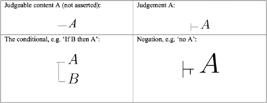
These operators are used by Frege (1879) to make explicit the inferential commitments taken by speakers. The judgeable content stroke expresses the nominalization of singular terms as sentences. The judgement stroke expresses that a sentence has been asserted by a speaker, it represents the predicate common to all judgements (Frege, 1879, §3): ‘It is true that…’, ‘It is the case that…’, etc. Thus, it expresses that the speaker supports a certain judgeable content -A as a premise ⊢A that can be used to make further inferences according to the placement of this proposition within its inferential web (Frápolli, 2017). Moreover, the conditional expresses that some judgeable content -A is implied by the assertion of the content ⊢B . On the other hand, negation expresses that some judgeable contents are incompatible once we have made a certain judgement, e.g. given that I have asserted -B then I negate -A because -A and -B are incompatible (Frápolli, 2023, p.83). This strongly suggests that Frege’s (1879) proposal gives an expressive role to logical systems, which is significant given that the general consensus among logicians is that the concept-script is the first system fully in the modern post-syllogistic paradigm (cf. Frápolli, 2017). Moreover, this expressive role of logical systems implies that we cannot remove agents and their practices from the overall picture of logic (Frápolli, 2023, p. xiv). That is why the inferentialist and expressivist view of logic I have presented here is said to be pragmatist.11
A reasonable worry about this view is that if we pursue the goal of making logic capable of expressing all concepts of natural language in order to capture material inferences, then the formality of logic would have to be abandoned along with its topic neutrality-a high price to pay for the discipline. To answer this worry, I would like to employ van Heijenoort (1979) distinction “between logica magna, a universal system with a fixed domain, and a logica utens, consisting of systems that are being introduced according to needs and different domains are successively considered for interpretations” (Legris, 2008, p.211). From the pragmatist view presented here, indeed logica magna cannot be formal nor topic neutral, as it would amount to a logical system that captures the whole of normative relations that hold between contentful propositions during the inferential practices of the universal community of rational agents. Of course, no such system can be construed nor is it possible to study this whole scientifically without some abstraction and compartmentalization. Therefore, any logical system is actually a logica utens, understood as a mathematical abstraction of some aspects of this whole that is particularly fit for some domains, in order to make them available for rigorous scientific study. These can be more or less formal going from the decidable propositional logic to incomplete higher order logics, depending on what is needed to study the intended domain. Like most mathematical theories, logical systems are topic neutral in the sense that they can be applied to domains other than those they were originally designed for, provided that there is homomorphism. Logica magna is the subject matter of logic in the same sense that the natural world is the subject matter of physics. But just as physicists work with mathematical abstractions of particular natural phenomena and apply their theories approximately where appropriate, logicians work with mathematical abstractions of restricted domains of inferential practice (e.g., arithmetic, set theory, deontology, etc.) and apply their logica utens (i.e. their logical systems) in contexts where doing so is appropriate. Of course, the view of the practitioner about her discipline affects when deciding which logical systems are to be learnt, taught, or applied. By keeping a traditional view incomplete systems can be reasonably ruled out. But from the pragmatist view presented here one can challenge the tyranny of completeness as I do in the next section.
4. Overcoming the tyranny of completeness
In this section I explain why this pragmatist view of logic implies a Principle of Expressive Power Priority for picking out systems in the practice and teaching of logic. I define such principle the following way:
Principle of Expressive Power Priority (PEP): When picking out systems to learn, teach, or apply, priority should be given to systems with greater expressive power, provided this enhances the audience’s ability to follow inferential moves, even at the expense of computational efficiency.
As mentioned before, to explain the origin of the deductive rules of logical systems one may follow the pragmatist approach introduced in the previous section. Thus, one could say that the deductive rules of any given system are the result of the following steps: (i) We select a certain subset of the vocabulary we use in everyday inferences, (ii) we give logical privilege to this subset in order to distinguish between logical and non-logical vocabulary, (iii) the privileged logical vocabulary becomes the set of logical constants, and (iv) we proceed to study the inferential aspects that remain invariant between these logical constants to classify deductive rules and validities. It should be kept in mind that within this pragmatist view logical systems perform an expressive role, i.e. they codify and make explicit inferential moves that might otherwise be too complex to follow. Therefore, from this expressivist take we cannot get rid of the audience as a key factor to take in consideration when picking out systems to learn, teach, or apply. Since logical systems aim to make explicit inferential moves taken in arguments, when picking out a system one should make sure that it enhances the audience’s ability to follow such moves. If a logical system does not enhance an audience’s ability to follow inferential moves, one may just stick to natural language. In fact, Frege (1879) claimed that he developed the concept-script in order to build and communicate his arguments around the foundations of arithmetic in a way that would have been almost impossible using natural language. In his own words:
I had to bend every effort to keep the chain of inferences free of gaps. In attempting to comply with this requirement in the strictest possible way I found the inadequacy of language to be an obstacle (…) This deficiency led me to the idea of the present ideography [concept-script]. (Frege, 1879, pp.5-6)
Without the concept-script the chains of arguments would have been not only too hard to evaluate but too hard to build in the first place. Let’s not forget that the arguer is the first member of the audience. In any inference that we may call rational there is at least one member in the audience that ought to keep score12, namely, the agent making the inferences herself. That is probably one of the reasons why good reasoners are said to be ‘reflexive’. Thus, when I talk about enhancing the audience’s ability to follow inferential moves, I refer both to the ability to build arguments as to the ability to evaluate them. Of course, the enhancement that a logical system should provide cannot be captured by any universally applicable set of necessary and sufficient conditions. Alternatively, and since I am embracing a pragmatist view of logic that does not remove agents and its inferential practices from the overall picture, we should understand that this enhancement will depend on each target audience. For instance, professional mathematicians can be expected to handle complex representational tools that a philosophy student taking a basic logic course can’t deal with. Moreover, depending on the subject matter of interest, some systems will be more suitable than others. For instance, first and second-order predicate logic are well-suited for set theory because their language allows sets to be represented as predicates (typically denoted by capital letters) and individuals to be represented as variables or constants (commonly denoted by lowercase letters).
Hence, in the practice and teaching of logic, one should have some sense about the target audience’s background knowledge, skills, and aims. I refer to background knowledge here because, for a logical system to enhance an audience’s ability to follow inferential moves, not only is skill in using a calculus required, but also a certain mastery of conceptual contents, e.g. natural numbers, infinite sets, cardinality, order relations, functions, equivalence classes, etc. However, this is precisely the point in which this pragmatist take on logic might seem problematic. From a traditional perspective, most likely inherited from early modern philosophy, requiring trained skills and mastery of concepts to follow arguments appears problematic, as it suggests that recognizing the correctness of an argument depends on an agent’s background knowledge and abilities. Hence, the so-called ‘human subjective condition’ would be involved. This was problematic for early modern philosophers as one of their main concerns was to study nature from a strictly ‘non-human point of view’. A central ideal of modern philosophy was the disenchantment of nature understood as erasing humanly ‘subjective’ projections from science (cf. Taylor, 1985). Consequently, modern philosophers envisaged a unitary concept of method to avoid bringing ‘subjectivity’ into the picture. As Gadamer (1986) explains, modern philosophy understood method as a path of steps that could be travelled by anybody independently of their background knowledge and abilities. Thus, projects like mathesis universalis and calculus ratiocinator were envisaged by Descartes and Leibniz13 as universal methods of calculation that would solve all the problems of science. These ideas are clear conceptual ancestors of the traditional view of logic, they explicitly put forward the view of content-independent symbolic calculation as the ideal model of reasoning (cf. Hintikka, 1997).
The conceptual connection between this prejudice of modern philosophy and the traditional view of logic will allow me to show that the tyranny of completeness is just a generalization of a single case of application of PEP. If we follow the modern ideal of leaving out as much ‘subjectivity’ as possible, we can push this requirement to the limit and restrict the logical systems we study to those that can be handled by an audience that is only able to compare strings of symbols according to a finite set of predefined rules, i.e. an audience of mindless computers (McAudience). Once we focus on a McAudience (which theoretically may include not only computer machines but also humans that restrict themselves to merely compute) the logical systems to be employed by this type of audience should ideally be decidable. However, since this requirement can only be met by systems that are expressively too limited (e.g. propositional logic), we settle for L-Completeness as a threshold property that captures the bare minimum computational efficiency a logical system should have. Therefore, a proper logical system is one in which you have a completeness theorem and first-order predicate logic is conceived as the paradigmatic case example of the perfect balance between computability and expressive power. This situation reflects the traditional view of logic and the reasoning behind the tyranny of completeness. Whenever a new logical system is developed, the traditional view prompts us to ask: “(I)s there a completeness theorem associated with this logic [logical system], analogous to the completeness theorem for first-order logic?” (Barwise, 2016, p.6).
Let me explain how this demand is actually a singular case of application of PEP. Given a logical system L n , if this system is L-Complete, for every sentence written in the language of L n that is true solely in virtue of its logical form, a mindless computer can apply the algorithm and eventually prove it. In other words, for every valid formula, given enough time, a mindless calculator can apply an algorithmic procedure to follow the chain of inferences that leads to it. On the contrary, if L n was incomplete, there would be valid formulas for which the algorithmic procedure does not terminate. A mindless computer would not be able to tell whether some valid formulas are provable. Hence, given a McAudience and an incomplete L n , if we apply PEP we would say that the expressive power gained by L n , in comparison to first-order predicate logic, isn’t enhancing the audience’s ability to follow inferential moves. Thus, an incomplete L n isn’t the right choice for this type of audience. Rather, from PEP it would follow that L-completeness is indeed the minimum computational efficiency needed to enhance the ability to follow inferential moves for this audience. The success of first-order automated theorem provers and the many applications of first-order predicate logic to computer science (cf. e.g. Ben-Ari, 2012, pp.131-154), confirm that this application of PEP is correct. Of course, how much a logical system can enhance a McAudience’s ability to follow inferential moves will vary depending on the computing power and the task intended. Here, of course, some L-Complete systems will be preferable than others depending on this contextual factor. For instance, if the task doesn’t require much expressive power a system that is not only L-Complete but also decidable would be the right choice.
But what happens when the audience is not restricted to mindless computers? As Hintikka (2000, p. 491) rightly points out (in a paper in honor of Gadamer), in actual human reasoning the set of historical and cultural conditions of thought is always involved. Here we should understand ‘historical and cultural’ in a wide sense that includes both our developmental histories in which we acquire practical and theoretical knowledge (which may go from drawing triangles to learning differential calculus) through social interaction, as well as the history of science in which a variety of concepts and methods are developed within intersubjective contexts. As Brandom (2000) would put it: “Even concepts such as electron and aromatic compound are the sort of thing that has a history” (p. 27). And the same could be said of mathematical concepts like those of number, set, function, structure, model, category, etc. Thus, no anti-scientific stance is implied here. That some background knowledge and abilities, other than being able to compare strings of symbols according to a finite set of predefined rules, are required to follow inferential moves does not mean that we cannot benefit from using a logical system as a tool to study a variety of subjects. We ought not to hold the fears of modern philosophers. From the pragmatist view embraced here, objectivity can be distinguished from subjectivity without ruling out our backgrounds. Objectivity is met when we are rational in the sense of involving the perspective of others so that we find reasons that go beyond our will (Frápolli, 2023, p. 11-15). Our understanding of the concepts involved in some subject is what allows us to make objective claims. The reader may want to go back to Brandom’s (2000, p. 52) examples quoted in section 3 to see this. No one could say that those inferences depend on one’s subjective motives. If one really understands what ‘east’, ‘west’, ‘lightning’ and ‘thunder’ mean in those examples, one gets that those inferences are correct. Especially in mathematics it is the abstract nature of the concepts involved that allows us to infer new propositions beyond doubt. For instance, if one really understands what a countable set is and what a finite set is, one can infer without any doubt that every finite set is also countable. That is the objective foundation of rational discourse upon which logic rests, as humans do not require ‘algorithmic checkability’ to identify correct inferences.
As Frege (1879) saw it, logical systems are tools used to represent reasoning. Thus, they ought not to be restricted to L-Complete systems since humans can do so much more than compute-even though in computing machines are superior to us. Hence, my claim is that once we take this pragmatist view of logic and consider PEP, the interest in incomplete logical systems is rekindled as they remain powerful tools for philosophers and mathematicians. Thus, I believe that from this view we can overcome the tyranny of completeness without losing sight on the theoretical import (both mathematical and philosophical) of this concept.14 Moreover, the tyranny remains partially correct as a singular case of application of PEP, namely, the one case in which we consider a McAudience. But even if we consider a mixed audience composed of both mindless computers and knowledgeable trained human beings, we do not need to restrict our interest to L-Complete systems anymore. Think for instance on how proof assistants like Agda, Isabelle, and Lean allow customization to handle incomplete logics (cf. e. g. Nipkow et al., 2002; Bove et al., 2009). When incomplete logics are employed in proof assistants the computers are not used for automatic proof generation but for proof verification. Instead of automatization there is a user-driven construction of proofs in which the user must intervene to guide the proof process. On these cases, we are dealing with mixed audiences composed of both mindless computers and trained mathematicians. Here, the computing power of a machine and the background knowledge and skill of the trained mathematician collaborate, thus, more expressively powerful systems can be handled. Another good example can be found in how Extended model theory has developed since it has departed from the traditional view of logic and from the idea that ‘logic is first-order predicate logic’. By breaking out of these presuppositions, extended model theorists have exploited the possibilities of more expressive systems to study mathematical structures. As Barwise (1985) brilliantly puts it:
If one thinks of logic as limited to the study of axioms and rules of inference, then logics without an abstract completeness theorem will not seem part of logic. If you think of logic as the mathematician in the street, then the logic in a given concept is what it is, and if there is no set of rules which generate all the valid sentences, well, that is just a fact about the complexity of the concept that has to be lived with. It is this latter point of view that is implicit in the study of model-theoretic logics. (p.7)
Moreover, by breaking free from the tyranny of completeness, we can encourage the revival of historically overlooked systems, such as Frege’s concept-script and the system outlined in Grundgesetze der Arithmetik (Frege, 1893; 1903). From the traditional view of logic, the issue with Frege’s systems lies in their use of a second-order language, which inherently renders them incomplete. Thus, Frege’s merit would be the subsystem of first-order logic contained in the concept-script, which is indeed complete (cf. Liu, 2017). However, if we look at Frege’s systems, not from the traditional point of view but from this pragmatist view that implies PEP, there is no inherent issue in using a second-order language, as Frege’s work is not directed towards an audience of mindless computers but to a human audience with a considerable philosophical and mathematical background. In fact, Frápolli (2023, pp. 151-174) has even shown how, from a pragmatist view of logic, the paradoxical issues of self-reference that emerge as a consequence of the expressive power of Frege’s systems can be avoided-even if Frege didn’t realize it. Thus, I believe it is reasonable to encourage the rekindling of these systems and other incomplete systems15 in the practice and teaching of logic.
5. A few final remarks
The pragmatist view of logic I have taken here from Frege (1879),Brandom (2000) and Frápolli (2017; 2023) is a fruitful and promising approach with implications to the traditional topics of the discipline that are yet to be explored. In this article I aimed to contribute to this agenda by explaining how by shifting to an inferential and expressive view of logic, the interest that incomplete logical systems have in logical practice and teaching is rekindled. I hope that the argument I have made here can be encouraging for logic practitioners to study, teach, and apply a broader range of systems that may turn out to be great tools for exploring mathematical concepts and the reasoning behind them. Introducing more expressively powerful systems into the classroom, even in introductory courses, could ignite the curiosity of young students who often struggle to see the relevance of learning logic, as the systems they are typically taught capture only a very small fraction of the reasoning they employ as mathematicians or philosophers. In sum, I hope to have helped bury a little bit more the prejudices that hold us from studying logic beyond completeness in virtue of the possible applications of logical systems as tools for studying the logical relations that hold between conceptual contents.
Research Data Availability:
All research data are available within the main text of the article.
References
- ALONSO, E. Sócrates en Viena. Una biografía intelectual de Kurt Gödel. Madrid: Montesinos, 2007.
- AYER, A. Language, truth, and logic. London: Penguin Group, 1936.
- BARWISE, J. “Model-theoretic logics: Background and aims”. In J. Barwise & S. Feferman (eds.), Model-theoretic logics, pp. 3-23. New York: Springer-Verlag, 1985.
- BEN-ARI, M. Mathematical logic for computer science. London: Springer, 2012.
- BOVE, A., DYBJER, P., NORELL, U. “A brief overview of Agda - A functional language with dependent types”. In S. Berghofer, T. Nipkow, C. Urban & M. Wenzel (eds.), Theorem proving in higher order logics (TPHOLs 2009). Lecture Notes in Computer Science, vol. 5674, pp. 73-78. Berlin/Heidelberg: Springer, 2009.
- BRANDOM, R. Articulating reasons. Cambridge, Mass.: Harvard University Press, 2000.
- CARNIELLI, W., CONIGLIO, M. E., PODIACKI, R., RODRIGUES, T. “On the way to a wider model theory: Completeness theorems for first-order logics of formal inconsistency”. The Review of Symbolic Logic, VII, 3, pp. 548-578, 2014.
- CHURCH, A. Introduction to mathematical logic. Princeton, N.J.: Princeton University Press, 1956.
- CRUZ, G. N. “Gödel y el círculo de Viena: la divergencia epistemológica.” Ágora: Papeles de Filosofía, 44(1), pp. 203-215, 2025.
- DREBEN, B., VAN HEIJENOORT, J. “Introductory note to 1929, 1930 and 1930a”. In S. Feferman, J. W. Dawson et al. (eds.), Kurt Gödel collected works, Vols. I-II, pp. 44-59. Oxford: Oxford University Press, 1986.
- ENDERTON, H. B. A mathematical introduction to logic. San Diego, CA: Harcourt/Academic Press, 2001.
- ETCHEMENDY, J. “The doctrine of logic as form”. Linguistics and Philosophy, VI, pp. 319-334, 1983.
- ETCHEMENDY, J. “Tarski on truth and logical consequence”. The Journal of Symbolic Logic, LIII, 1, pp. 51-79, 1988.
- FRÁPOLLI, M. J. “Reivindicando el proyecto de Frege”. Disputatio. Philosophical Research Bulletin, VI, 7, pp. 1-42, 2021.
- FRÁPOLLI, M. J. The priority of propositions: A pragmatist philosophy of logic. Cham: Springer Nature, 2023.
- FREGE, G. Begriffsschrift, a formula language, modeled upon that of arithmetic, for pure thought. In J. van Heijenoort (ed.), From Frege to Gödel: A sourcebook in mathematical logic, pp. 1-82. Cambridge, Mass.: Harvard University Press , 1879.
- FREGE, G. Grundgesetze der Arithmetik: Begriffsschriftlich abgeleitet, Vol. 1. Jena: Hermann Pohle, 1893.
- FREGE, G. Grundgesetze der Arithmetik: Begriffsschriftlich abgeleitet, Vol. 2. Jena: Hermann Pohle , 1903.
- GADAMER, H.-G. Verdad y método II (Wahrheit und Methode: Ergänzungen). Salamanca: Sígueme, 1986.
- HAACK, S. Philosophy of logics. Cambridge: Cambridge University Press, 1987.
- HILBERT, D. Grundlagen der Geometrie. Leipzig: B. G. Teubner, 1903.
- HINTIKKA, J. Lingua universalis vs. calculus ratiocinator: An ultimate presupposition of twentieth-century philosophy. Dordrecht: Springer, 1997.
- HINTIKKA, J. “Gadamer: Squaring the hermeneutic circle”. Revue Internationale de Philosophie, XXXIV, pp. 487-497, 2000.
- KREISEL, G. “Informal rigour and completeness proofs”. In I. Lakatos (ed.), Problems in the philosophy of mathematics, pp. 138-186. Amsterdam: Elsevier, 1967.
- LAKATOS, I. “What does a mathematical proof prove?”. In J. Worrall & G. Currie (eds.), Mathematics, science and epistemology, pp. 61-69. Cambridge: Cambridge University Press , 1978.
- LEGRIS, J. “Chateaubriand on symbolism and logical form”. Manuscrito - Revista Internacional de Filosofia, XXXI, 1, pp. 203-215, 2008. (Special issue: Logical Forms).
- LIU, Y. “Frege’s Begriffsschrift is indeed first-order complete”. History and Philosophy of Logic, XXXVIII, 4, pp. 342-344, 2017.
- MANZANO, M. Extensions of first-order logic. New York: Cambridge University Press, 1996.
- MANZANO, M., ALONSO, E. “Completeness: From Gödel to Henkin”. History and Philosophy of Logic , XXXV, 1, pp. 50-75, 2013.
- NAGEL, E., NEWMAN, J. Gödel’s proof. New York: New York University Press, 1958.
- NIPKOW, T., PAULSON, L. C., WENZEL, M. Isabelle/HOL: A proof assistant for higher-order logic. Berlin: Springer, 2002.
- RAFTERY, J. G., ŚWIRYDOWNICZ, K. “Structural completeness in relevance logics”. Studia Logica: An International Journal for Symbolic Logic, CIV, 3, pp. 381-387, 2016.
- SAGÜILLO, J. M. “Validez y consecuencia lógica”. In M. J. Frápolli (ed.), La filosofía de la lógica, pp. 55-81. Granada: Comares, 2007.
- TARSKI, A., VAUGHT, R. “Arithmetical extensions of relational systems”. Compositio Mathematica, XIII, pp. 81-102, 1956.
- TAYLOR, C. “Theories of meaning”. In Philosophical papers, Vol. 1, pp. 248-292. Cambridge: Cambridge University Press , 1985.
- VAN HEIJENOORT, J. “Absolutism and relativism in logic”. In Selected essays, pp. 75-83. Naples: Bibliopolis, 1985.
-
1
Nonetheless, in Sections 2 and 4 I draw on comments by Barwise (1985) to suggest how the model-theoretical approach can be interpreted in a way consistent with the pragmatist view I defend here.
-
2
I discuss this in greater detail in Section 2.
-
3
Many thanks to an anonymous reviewer for pushing me to be clear on this point.
-
4
It should be clear that, although the pragmatist view I adopt here is non-reductionistic, I regard this epistemological commitment as evidence of the rigor of Hilbert’s program, which sets it apart from other, less developed foundational programs of the time like Russell and Whitehead’s logicism (cf. Alonso, 2007; Cruz, 2025).
-
5
I want to thank an anonymous reviewer for pushing me to sharpen this argument.
-
6
Analogously, I use the term L-Complete as a predicate of logical systems that meet L-Completeness.
-
7
Notice that I use the word ‘can’, as it need not be the case, just as I argued previously following Barwise (1985).
-
8
Of course, one could look for earlier proponents of this view. But I believe it is fair to claim that Hilbert, due to his mathematical rigor, is the one that gave this program its strength.
-
9
What Haack (1987) calls the ‘essential formal character of logic’ is the traditional view of logic as content-independent.
-
10
Wittgenstein also argued for this in the Tractatus (4.0312).
-
11
In a broader mathematical context, Imre Lakatos has also argued against viewing mathematics as content-independent (cf. e.g. Lakatos, 2001). While exploring connections between his view and the pragmatist stance developed here lies beyond the scope of this work, I thank the anonymous reviewer for drawing my attention to it.
-
12
To borrow Robert Brandom’s terminology here.
-
13
I’m aware that Frege (1879) also has Leibniz as one of his references. However, as Hintikka (1997, pp. IX-X) points out, there are two distinct programs of logic in Leibniz. One is the calculus ratiocinator, which is a method of symbolic calculation conceived as content-independent reasoning, and the other is characteristica universalis (or lingua characteristica), which is a language that represents the conceptual structure of human thought. Frege’s Begriffsschrift is placed within this second program, it was not inherently intended to be a calculus.
-
14
In fact, this article is itself the result of a philosophical reflection on the concept of completeness and on completeness theorems. More generally, completeness draws attention to the limits of formalization. As Kreisel (1967) argues, the theorem highlights the existence of an informal notion of validity that cannot be reduced to either model-theoretical or proof-theoretical apparatus. I am grateful to an anonymous reviewer for bringing this work to my attention.
-
15
C. S. Peirce’s logic, which incorporates second-order existential graphs, is another compelling example of a system worthy of revival (Oostra, 2023).
-
Article info
CDD: 160
-
Funding:
This work was partially funded by the University of Salamanca through the International Doctoral Fellowship (Beca Internacional de Doctorado)