Strategy for Resource Allocation in Elastic Optical Networks Considering Physical Layer Impairments and Spectrum Fragmentation
Abstract
Resource allocation strategies in optical networks are fundamental due to bandwidth limitations, increasing data demand, and the consequent need for spectral efficiency. They allow for improving optical spectrum usage and ensure flexibility in the face of the dynamic nature of traffic and the coexistence of different services, reducing costs and contributing to the system’s reliability. In this context, this work proposes a resource allocation strategy that combines power assignment with spectrum allocation. Power assignment is done by launching the minimum required power plus a margin according to the route’s state. Meanwhile, spectrum allocation is performed through a modified version of the Min Slot Continuity Capacity Loss (MSCL) heuristic, capable of finding a set of frequency slots in a route, which results in minor allocation capacity loss. The choice of the MSCL algorithm was motivated by the possibility of increasing spectral efficiency through the reduction of physical layer penalties and the reduction of spectrum fragmentation by combining freedom degrees: launch power of light, modulation, route, and spectrum. The developed heuristic was tested on two networks with distinct characteristics and compared with two reference approaches. The results demonstrated a significant superiority in terms of reducing the blocking probability.
Index Terms
Elastic Optical Networks; Physical Layer Impairments; Power Assignment; Spectrum Assignment.
I. INTRODUCTION
The rapid growth in data traffic and the demand for high-speed communication have necessitated the development of advanced techniques for efficient resource allocation in Elastic Optical Networks (EONs). While most proposals in the literature focus on routing, modulation format, and spectrum assignment (RMSA), there is a critical need to address the penalties associated with the physical layer. A notable example is the Min Slot Continuity Capacity Loss (MSCL) technique, which was introduced to allocate spectrum efficiently and reduce allocation capacity loss by minimizing spectral fragmentation. However, following the findings presented in [1], research has increasingly incorporated considerations of physical layer penalties, mainly launch power, as seen in studies such as [2] -[9].
In this context, we propose an innovative heuristic that strategically integrates power assignment and spectrum allocation in EONs. Our methodology’s power assignment component is based on applying the minimum necessary power to achieve a sufficient optical signal-to-noise ratio (OSNR) plus an OSNR margin. Specifically, this involves determining the minimum power required to meet the lowest acceptable OSNR threshold for a given modulation level. We then adjust this power level by adding a fraction of the difference between the maximum and minimum OSNR values observed for a given route. This adjustment is tailored according to the specific conditions of the route, such as link length, attenuation, and existing channels. By fine-tuning the power levels in this manner, we ensure that the transmitted signal maintains adequate quality while reducing the impact of nonlinearities and improving overall network performance. Concurrently, the spectrum allocation is managed through an enhanced version of the MSCL heuristic, termed MSCL Ordered (MSCL-O). This refined heuristic evaluates multiple routes and determines the best frequency slots for each route, considering a specific modulation level. The routes are then prioritized based on their capacity to minimize loss.
The combined approach of the MSCL-O heuristic with a power assignment heuristic is designed to enhance spectral efficiency by reducing physical layer penalties and spectral fragmentation. This is achieved by jointly adjusting emission power, modulation type, route selection, and spectrum distribution. The heuristic accounts for the fact that variations in modulation level influence the number of slots required and the quality of transmission (QoT) requirements. Additionally, the QoT of a channel is affected by the existing state of the route, including the number and position of current connections, which justifies the integration of these variables into a unified heuristic approach for better spectral resource utilization.
The effectiveness of the proposed heuristic was validated through simulations on NSFNET and DT14 networks, which feature different numbers of nodes, links, and link lengths. Compared with two benchmark studies, namely: [6], [10], the new heuristic demonstrated a significant reduction in blocking probability (BP), especially under high-demand conditions. These findings underscore the potential of the proposed strategy to contribute to the advancement of optical communication technologies.
This paper is structured as follows: Section II describes the network used for validation, detailing its architecture, channel model, and routing and spectrum allocation processes. Section III elaborates on the proposed methodology, comprehensively explaining its components and processes. Section IV presents the simulation scenarios and the results obtained. Finally, Section V offers conclusions and discusses the implications of the research conducted.
II. DESCRIPTION OF THE USED EON
This section provides a comprehensive analysis of the characteristics of the studied EON, considering physical layer penalties such as self-channel interference (SCI), cross-channel interference (XCI), and noise from amplified spontaneous emission (ASE). The objective is to demonstrate how the OSNR of a channel on a route can be determined based on the parameters of the existing connections and power adjustments. Additionally, it discusses the spectral allocation technique, which aims to reduce spectral fragmentation, comprising the set of tools for solving the proposed problem.
A. Architecture
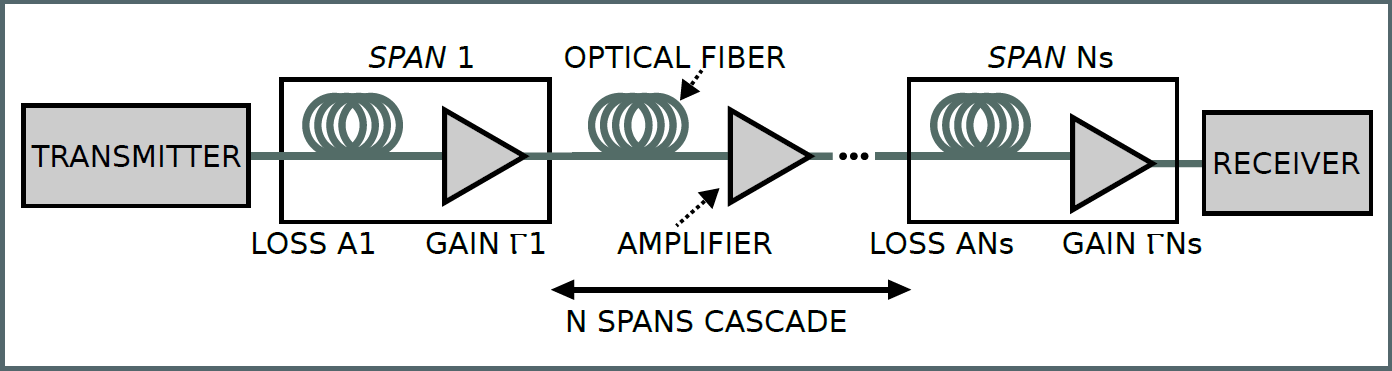
Transparent elastic optical networks constitute an infrastructure composed of interconnected nodes through spans of optical fiber, which are segments extending between two nodes forming an optical link. As illustrated in Fig. 1, each span is equipped with an optical amplifier to ensure the light signal’s robustness, preventing its degradation as it travels the distance between network nodes. The length of these spans may vary depending on the specific topology of the network. Thus, spans are considered fundamental units in the construction of optical networks.
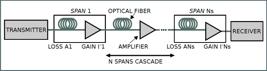
Each optical link carries a spectrum subdivided into various frequency slots, allowing the allocation of simultaneous connections with different bandwidths defined by the number of slots.
In the scope of this study, the following assumptions have been adopted:
-
There is no spectrum conversion between the links;
-
Spans within a link are uniform, consisting of fibers with identical characteristics and lengths (80 Km), as well as amplifiers with similar gain (A) and noise figure (Fn = 5 dB);
-
In each link, all fiber losses (Γ) are compensated for by the gains of the amplifiers (A);
-
In the case of bidirectional connections, distinct optical fibers are used for each direction;
-
Bandwidth Variable Transceivers (BVTs) introduce a constant input noise, resulting in an input OSNR of 30 dB;
-
For each node, a fixed loss of 18 dB is considered, which is compensated for by a booster amplifier;
B. Physical layer model
The advancement of coherent detection systems, supported by digital signal processing (DSP), enables the electronic compensation of fiber chromatic dispersion (CD), eliminating the need for optical dispersion compensation. This development allows for using perturbative models for nonlinear fiber propagation and leads to the formalization of the Gaussian Noise (GN) model. To explore the GN model, it is assumed that fiber nonlinearity is minimal within the considered power range, facilitating approximate analytical solutions for the nonlinear Schrödinger equation. This study considers a coherent lightwave system with dual polarization, where chromatic and polarization mode dispersions are ideally compensated using DSP, and SCI and XCI are the main nonlinear effects. Therefore, in this work, the received OSNR is used as one of the performance metrics calculated by Eq. 1.
where Pch, PASE and PNLI are the powers of the channel, the ASE noise and the nonlinear interference (NLIs), respectively. Thus, having the value of OSNR and according to the receiver specifications, a threshold OSNRth is defined for each modulation format and desired bit error rate (BER). Values below this threshold do not meet the QoT. For more comprehensive information on the ASE noise power calculations and nonlinearities in a route with RNs spans mentioned above, refer to the following references: [1], [6], [8], [11], [12].
Finally, the OSNR expression for a signal with launch power Pm inserted into a route with RNs spans, and u active channels in the link of the respective span is given by Eq. 2 [6], [8], [11]:
where the coefficients a, b and c, are defined by Eq. 3, Eq. 4, and Eq. 5 [6], [8], [11].
It is observed that ASE noise (coefficient c) depends exclusively on the signal path, including the number of spans and links, losses in the spans and switches, and the noise figure of the amplifiers. On the other hand, NLIs (SCI - coefficient a and XCI - coefficient b) depend on some route elements as well as the characteristics of the optical fiber and the characteristics of the signal itself and other signals present in the link, such as power, bandwidth, and position in the spectrum. Thus, it can be noted through Eq. 3, Eq. 4 and Eq. 5 that the state of each link affects only XCI. Any change in the state of the connections adjacent to the analyzed connection, whether by an increase in number or power, increases the NLIs, thereby reducing the OSNR. The parameters mentioned in the referred equations are summarized in Table I [6], [8].
Eq. 6 is used to calculate the power that results in the maximum possible OSNR depending on the state of the link. As noted, this equation does not depend on the term b; therefore, the launch power that maximizes the OSNR is not influenced by the state of the network (characteristics of the allocated channels). Thus, it does not depend on the quantity and positions of active connections but rather on the number and power of the interfering channels. Consequently, adding or removing connections does not change the power that produces the maximum OSNR but shifts the OSNR curve downward or upward, respectively [6].
According to Vale et al. (2021) [11], the range of transmission power assignment should be between the power that reaches the minimum OSNR limit and the power that results in the maximum OSNR. This interval can influence route selection and be used in optical network management and design considerations.
C. Routing and Spectrum Assignment (RSA)
In this work, routing is carried out through the Yen algorithm [13], which generates k shortest paths between each source-destination pair of nodes.
The spectrum allocation is performed using the Min Slot Continuity Capacity Loss - Ordered (MSCLO) algorithm, an adaptation of the algorithm presented in [10], [14], which will be further explained later. According to [14], MSCL assumes the selection of the best set of frequency slots, which, when allocated in the network, will result in the most negligible impact in terms of capacity loss. For each request, the capacity loss is calculated considering the requested route to be allocated, along with all routes that share at least one link. The capacity loss value for a demand of n slots on a route r is given by Eq. 7.
where C<r>(n) is the capacity loss for a request of size n slots after its establishment on route r; Ir is the set of routes that interfere with route r; p is the current interfering route; ψ represents the current state of the network (the set of all paths and allocated slots); ψ′ represents the network state after the request is established; S<p>(ψ,n) represents the total number of allocation possibilities that a request with a size of n slots has on path p before the establishment of r. In other words, it is the number of ways that a request of size n can be allocated on a specific path p before r is established.
The Eq. 7 calculates the impact that a request of size n has on route r and all routes that share at least one link. It is necessary to consider all possible demands for route r through Eq. 8 to obtain the total capacity loss in the network.
where N is the set of all possible demand classes that can be allocated on r, and C<r> represents the total capacity loss for the entire set N. The spectral position that achieves the lowest value of C<r> obtained by Eq. 8 will be the allocation position for the request. Therefore, the capacity loss value can be obtained by knowing the sizes and quantities of the gaps. Thus, the number of ways a request can be allocated is given by Eq. 9:
where s(hl,n) is the number of ways a request of size n can be allocated in a gap of size hl; L is the set of all gaps. The capacity loss is obtained by comparing this value before and after a potential allocation through Eq. 7.
For a more detailed understanding of the MSCL algorithm, please refer to the references [10], [14].
III. PROPOSAL
In this work, we propose a resource allocation technique for EONs that utilizes a modification of the MSCL heuristic, called MSCL-O, in conjunction with power assignment, termed P-MSCL (Power and MSCL-O Assignment). The MSCL-O technique aims to identify the frequency slots that offer the minor capacity loss for spectrum allocation within a set of k routes. Each route and its respective slots are classified according to the least capacity loss. This approach differs from the original technique by identifying the slots that result in the least capacity loss across k routes, forming a pair (route, set of slots), and ordering each pair according to the least capacity loss.
The proposal is based on the premise that integrating the MSCL-O technique with power assignment can increase network efficiency. Thus, for a pair (route, set of slots) classified according to the least capacity loss for spectral allocation, the power assignment algorithm aims to establish a predetermined margin between the minimum and maximum OSNR for the channel, aiming to reduce penalties imposed by the physical layer. If the desired OSNR is not achieved, the strategy resorts to the next set of routes and slots. If this is still not feasible, the modulation level is reduced, and the procedure is repeated. If the modulation level is the last available, it is observed whether achieving an OSNR greater than the minimum required OSNR is possible.
In this section, we will delve into the central proposal of this work, detailing the developed heuristic. Initially, we will present its fundamental components, including routing and spectrum allocation, followed by power assignment. Finally, we will discuss the integration of the heuristic into the Call Admission Control (CAC) algorithm.
A. Description of the stages
Firstly, Fig. 2 outlines the routing and spectrum allocation procedure proposed in this study. Initially, k routes are generated between all pairs of source and destination nodes using Yen’s algorithm offline (step 1). When a connection request is received (step 3), the k routes corresponding to the sourcedestination pair of that connection are prepared (step 2).
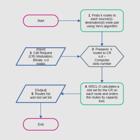
Subsequently, the number of slots needed is calculated based on the modulation level established for the connection request and the requested bit rate. For this, first, the symbol rate is determined by Eq. 10:
where Rs is symbol rate, M modulation format, P is the number of polarization.
Next, the required bandwidth (B) is calculated by multiplying the symbol rate by the roll-off factor (α), according to the Eq. 11
Finally, the number of frequency slots (Ns) is obtained through Eq. 12:
where ∆f represents the bandwidth of each frequency slot.
In the next step (step 4), the MSCL-O algorithm is employed to search the set of slots for each route that results in the minimum capacity loss in spectrum allocation, and the associated loss value is calculated. This process is repeated for all k routes, and the results are then sorted in ascending order of capacity loss. The result of this step consists of a set of k routes, each accompanied by the corresponding sets of slots that result in the minimum capacity loss on each route (step 5).
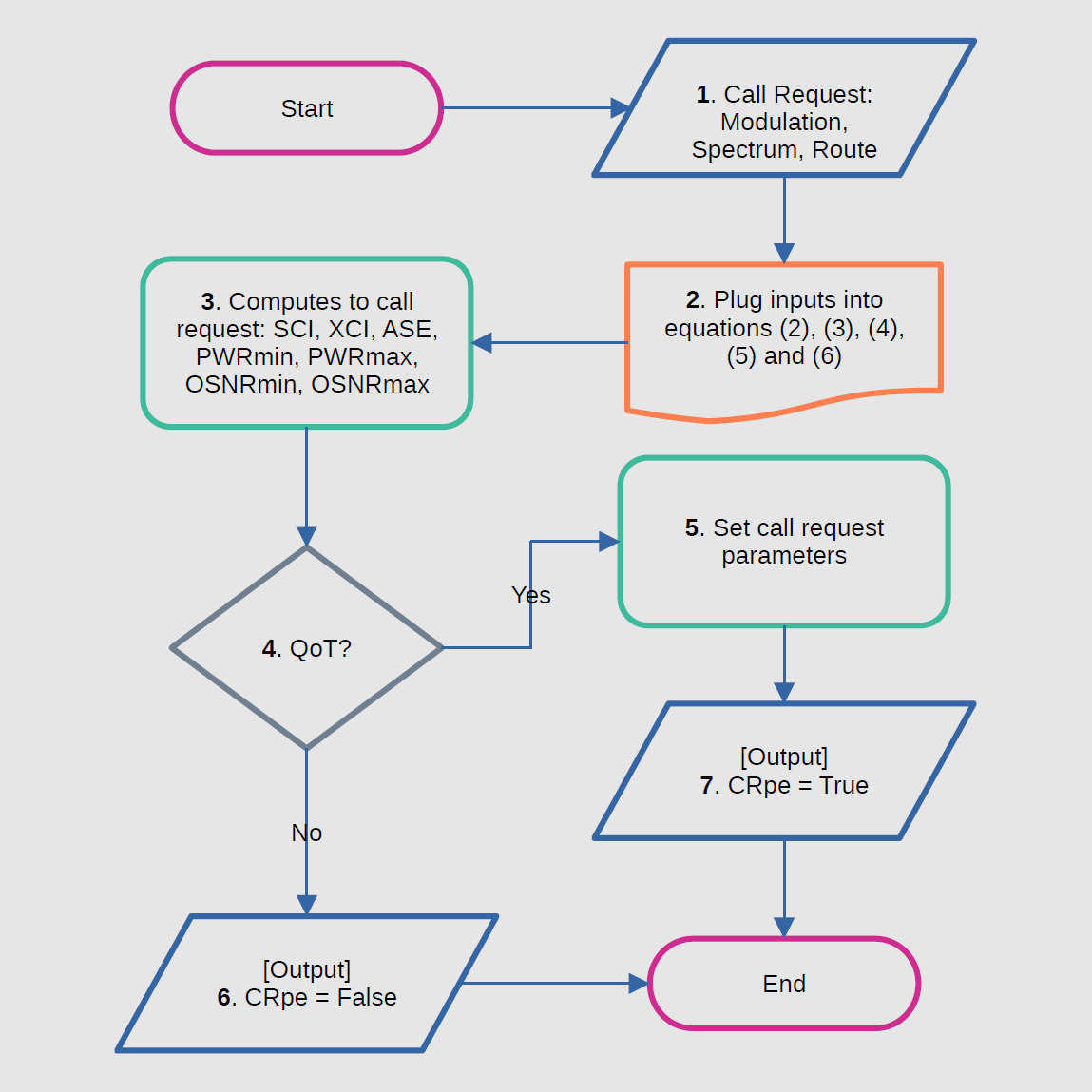
The subsequent stage is the power allocation (PA), which commences immediately following the RSA. Fig. 31 illustrates the power assignment algorithm activated upon receiving the connection request, the designated route, and the corresponding modulation level (step 1). This algorithm employs specific route parameters, such as the fiber attenuation coefficient, amplifier noise figure, and spectrum, among others, to calculate the SCI, XCI, and ASE noise using Eq. 3, Eq. 4, and Eq. 5 (step 3).

Based on these calculated quantities, the maximum power is estimated using Eq. 6, while the maximum OSNR is determined through Eq. 2. These values are then utilized to assign channel power, setting it as the minimum required power plus a safety margin (steps 3 to 7). Theoretically, this approach aims to enhance spectral efficiency and ensure transmission quality by accounting for specific route characteristics and adverse effects, such as noise and interference, which can impact system performance.
In this version, the algorithm incorporates a fixed OSNR margin factor set to 60% of the difference between the minimum and maximum achievable OSNR based on the current state of the route. This value was chosen to balance spectrum and QoT blocking.
B. Resource Allocation Strategy
This stage, visualized in Fig. 4, operates within the context of CAC. When a call request is received, the goal is to select the most efficient modulation level. This determination takes into account the associated bit rate of the call, which, in turn, allows for the calculation of the required number of slots. Next, the k pre-generated routes for the source and destination node pair related to the call are chosen, and subsequently, the RSA process is applied.
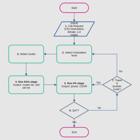
Following this step, each k route and its corresponding slots are sequentially forwarded to the PA stage. The process is considered complete if the required QoT, augmented by a safety margin, is achieved. However, if this condition is not met, the modulation level is reduced, and the entire procedure is repeated.
Thus, the Fig. 4 illustrates the P-MSCL heuristic. This heuristic seeks to improve the utilization of the available spectrum and ensure reliable transmission, thereby enhancing system efficiency. Ultimately, this approach improves network performance by reducing call-blocking probability.
IV. METHODOLOGY AND RESULTS
A. Methodology
We employed a methodology that integrates power adjustment with spectrum allocation to investigate the impact of physical layer impairments on network performance, particularly concerning BP. This approach mitigates physical layer impairments and reduces spectrum allocation capacity loss. The study utilized network topologies, as illustrated in Fig. 5 and Fig. 6, each characterized by distinct attributes such as varying numbers of nodes and link lengths. These factors significantly influence the adjustment of power and the spectrum allocation due to length and the number of links, respectively.
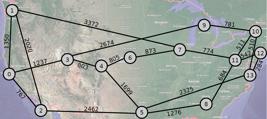

Table II shows the relationship of parameters of the networks used for the simulation. As can be seen, the length of each span was established at 80 km, which, for a fiber attenuation factor of α = 0.2 dB/km, results in losses in the fibers and gains in the amplifiers of at least 16 dB.
Regarding the routes, the k shortest paths were used. It means that the routing strategy was chosen to direct the traffic by k shortest paths based on reducing the distance traveled. This strategic decision aimed to minimize the network’s physical layer impairments.
Each simulation performed at least 100,000 call requests to ensure the reliability of the results. In the context of call generation, the routine developed assumes that the connections to the network occur dynamically, that is, randomly, without predicting future requests. This randomness covers several aspects, such as (i) the origin node, (ii) the destination node, (iii) the bit rate, (iv) the instant of the call request, and (v) the duration.
In this model, the arrival of connection requests is modeled as a Poisson process to reflect the dynamic nature of communication traffic. The time interval between incoming calls follows an exponential distribution with a mean of 1/µ, where µ represents the average rate at which call requests are generated. The duration of each call is also modeled by an exponential distribution, with a mean of H.
B. Results
For our numerical comparison, we utilized two distinct network topologies: NSFNET (Fig. 5) and DT14 (Fig. 6). Longer link lengths characterize the NSFNET topology, while the DT14 topology features shorter link lengths. The focus of this study is to evaluate the effectiveness of the proposed heuristic in enhancing spectrum usage and connection-specific power spectral density (PSD), reducing physical layer penalties, and minimizing allocation capacity loss. The results presented in this section are derived from the average of four simulation runs, with the network load incrementally varied from 100 to 200 Erlangs in steps of 20 Erlangs.
The performance evaluation was based on the BP, defined as the ratio of blocked requests to the total number of requests, plotted against the offered network load. Additionally, we varied the number of candidate routes (k) to assess its impact on the BP.
The proposed heuristic, P-MSCL, was meticulously designed and implemented to tackle the inherent spectrum and power allocation challenges in optical networks. For comparative purposes, we selected the methodologies proposed in [6], [8], [10], using the call BP as the primary metric for performance evaluation.
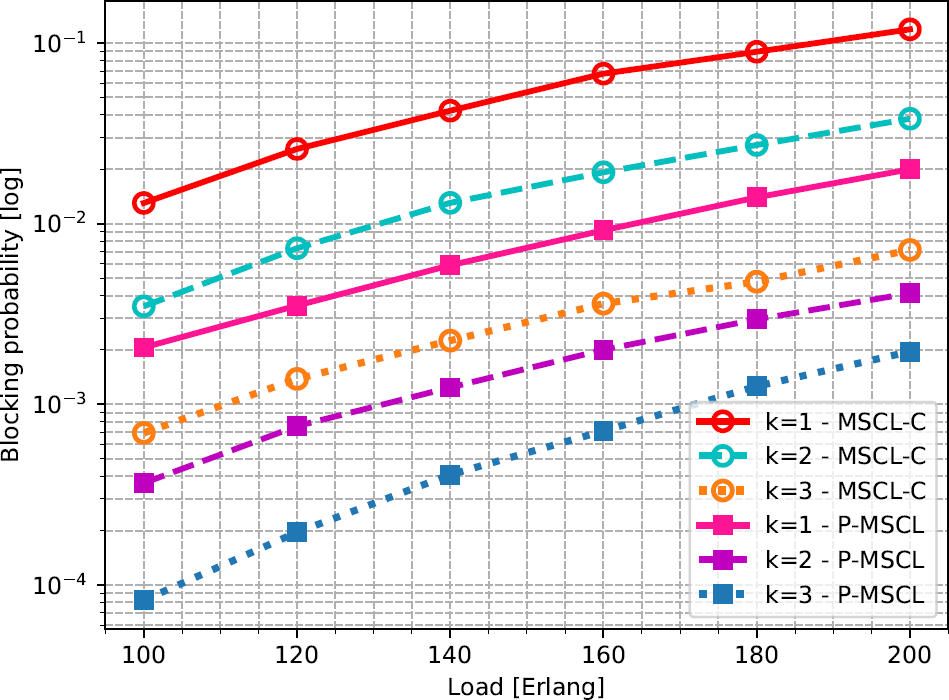
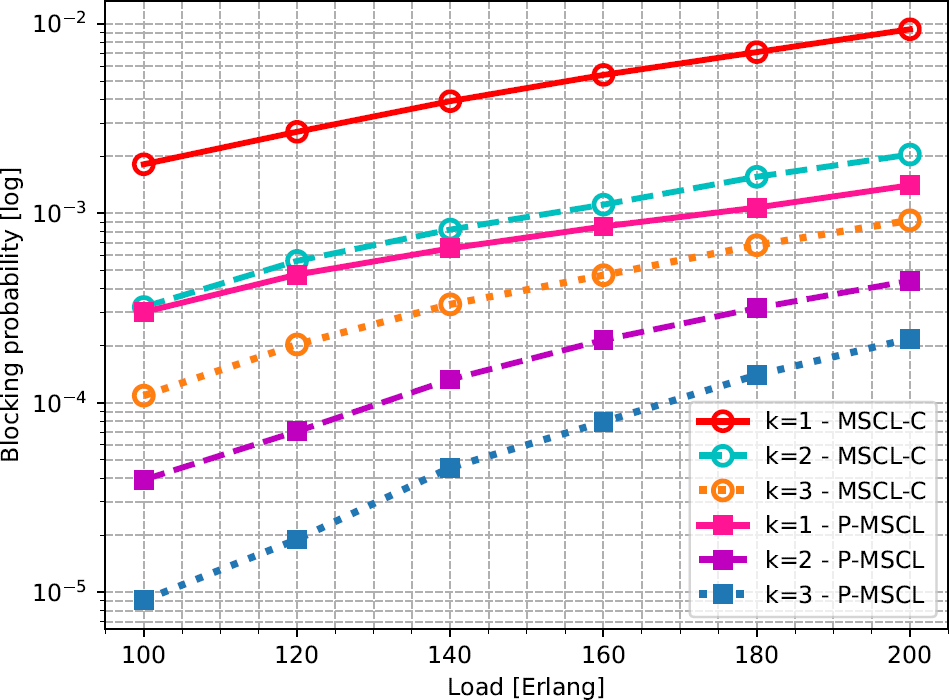
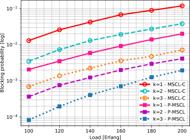
Fig. 7, Fig. 8, Fig. 9, and Fig. 10 demonstrate the superiority of the P-MSCL heuristic compared to two alternative strategies. Adaptive Power Assignment (APA), proposed in [6], integrates power allocation with a first-fit spectrum assignment technique, where channel power is assigned with a margin determined by the network load. The second strategy, MSCL-C (MSCL Combined), proposed in [10], does not consider physical layer penalties and solely bases connection acceptance on a distance criterion. For this reason, it uses a fixed modulation level.

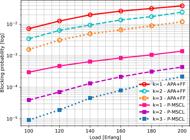
Call blocking probability in the NSFNET network with the P-MSCL and MSCL-C adapted algorithms.

Call blocking probability in the DT14 network with the P-MSCL and MSCL-C adapted algorithms.
The simulation results indicate a substantially reduced call BP when utilizing the P-MSCL heuristic compared to the other approaches. This improvement is attributed to the synergistic operation of the PA and MSCL-O algorithms. This is due to the variation in the number of slots required for a connection with a determined bit rate according to the most efficient modulation level accepted, which is related to the QoT of each route. Thus, by testing routes and their corresponding spectra in an order that prioritizes minimal capacity loss, the PA algorithm increases the likelihood of achieving a satisfactory QoT margin. Furthermore, increasing the number of candidate routes (k ≥ 1) enhances the probability of finding available spectrum, thereby reducing the overall BP.
The observed superiority of the P-MSCL heuristic in the DT14 topology can likely be attributed to the reduced impact of nonlinearities resulting from the lower launch power of channels due to shorter link lengths. This setup allows for the achievement of more efficient modulation levels. Therefore, this reduces the number of required slots and consequently decreases allocation capacity loss. This combination of factors minimizes physical layer penalties and enhances overall network performance by allowing better utilization of available spectrum resources and improving the QoT.
As a result, the P-MSCL heuristic demonstrates greater effectiveness in the DT14 network, showcasing its ability to adapt to varying network conditions and enhance spectrum and power allocation. This capability is crucial for maximizing network capacity and minimizing BP, whether in networks with shorter links, where lower launch powers and higher OSNR can be leveraged for more efficient data transmission, or in networks with longer links, where nonlinear effects make power and spectrum allocation more challenging.
This comprehensive analysis highlights the effectiveness of the P-MSCL heuristic in enhancing resource allocation in optical networks, offering a significant improvement over existing methods. The observed performance gains underscore the importance of considering both physical layer penalties and spectrum availability in designing power and spectrum allocation algorithms.
Finally, the Fig. 11 shows the execution time corresponding to the curves in Fig. 7 for the PMSCL heuristic. We can observe that as k increases, the complexity also increases, resulting in longer execution times. Additionally, it is noted that the simulation time curve decreases as the load increases. This occurs because, in systems where communication traffic is modeled as a Poisson process and call duration follows an exponential distribution, an increase in load translates into an increase in the arrival rate of calls (µ), which, in turn, leads to a reduction in simulation time.

V. CONCLUSION
In this study, we have proposed and evaluated the P-MSCL heuristic, an innovative approach for resource allocation in EONs. The heuristic integrates spectrum usage strategy and connection-specific PSD adjustment to reduce physical layer penalties and minimize allocation capacity loss. The effectiveness of the P-MSCL was tested using two distinct network topologies, NSFNET and DT14, characterized by varying link lengths, number of nodes, and network conditions.
The P-MSCL technique offers a robust approach to efficient resource allocation in elastic optical networks. By integrating power assignment, which dynamically adjusts the transmission power level according to the specific conditions of each route, with the MSCL-O strategy, which aims to reduce spectral fragmentation and allocation capacity loss, a more efficient utilization of the available spectrum can be achieved. This synergy allows the system to adjust power levels to reduce physical layer penalties, such as nonlinear effects, while allocating each channel and organizing spectral allocations to enhance spectrum slot continuity. Thus, the combination of these techniques not only improves the overall quality of transmission, increases spectral efficiency, reduces the probability of call blocking, and enhances the overall network performance.
The results from our simulations, which varied network load from 100 to 200 Erlangs, demonstrated a substantial reduction in BP when utilizing the P-MSCL heuristic compared to two other strategies: APA [6] and MSCL-C [10]. The superior performance of the P-MSCL can be attributed to its sophisticated combination of power and spectrum allocation, which considers the QoT requirements and the specific conditions of each route. This approach enables more efficient modulation levels and improves utilization of the available spectrum, thus reducing the number of required slots and spectrum fragmentation, improving overall network performance.
In particular, the DT14 topology, characterized by shorter link lengths, showed a notable advantage in using the P-MSCL heuristic. The ability to adapt to these specific network conditions by leveraging lower launch powers and achieving higher OSNRs resulted in more efficient data transmission and reduced capacity loss.
The comprehensive analysis conducted in this work highlights the significant improvements offered by the P-MSCL heuristic over existing methods. By effectively managing physical layer penalties and enhancing QoT, the proposed heuristic decreases BP and promotes more reliable and efficient network operations. These findings underscore the critical importance of innovative strategies in addressing the challenges of spectrum and power allocation in EONs.
In conclusion, the P-MSCL heuristic emerges as a highly efficient solution for the complex resource allocation challenges in EONs. The demonstrated reduction in BP and enhancement of QoT confirm the potential of this heuristic. As the field of optical communications continues to evolve, the insights gained from this research provide a foundation for future developments and applications.
REFERENCES
- [1] P. Poggiolini, G. Bosco, A. Carena, V. Curri, Y. Jiang, and F. Forghieri, “The gn-model of fiber non-linear propagation and its applications,” Journal of Lightwave Technology, vol. 32, pp. 694-721, 2014.
- [2] L. Yan, E. Agrell, H. Wymeersch, and M. Brandt-Pearce, “Resource allocation for flexible-grid optical networks with nonlinear channel model,” Journal of Optical Communications and Networking, vol. 7, pp. B101-B108, 2015.
- [3] L. Yan, E. Agrell, M. N. Dharmaweera, and H. Wymeersch, “Joint assignment of power, routing, and spectrum in static flexible-grid networks,” Journal of Lightwave Technology, vol. 35, pp. 1766-1774, 2017.
- [4] M. Hadi and M. R. Pakravan, “Resource allocation for elastic optical networks using geometric optimization,” Journal of Optical Communications and Networking, vol. 9, pp. 889-899, 2017.
- [5] S. Behera, A. Deb, G. Das, and B. Mukherjee, “Impairment aware routing, bit loading, and spectrum allocation in elastic optical networks,” Journal of Lightwave Technology, vol. 37, pp. 3009-3020, 2019.
- [6] V. A. C. Vale and R. C. Almeida-Junior, “Power, routing, modulation level and spectrum assignment in all-optical and elastic networks,” Optical Switching and Networking, vol. 32, pp. 14-24, 2019.
- [7] L. R. R. dos Santos and T. Abrão, “Adaptive chaotic hurricane-aided efficient power assignment for elastic optical networks,” IEEE Access, vol. 39, pp. 83359-83374, 2020.
- [8] V. A. C. Vale, R. C. Almeida-Junior, and K. D. R. Assis, “Network-state-dependent routing and route-dependent spectrum assignment for prmlsa problem in all-optical elastic networks,” Optical Switching and Networking, vol. 43, pp. 100646- 100660, 2022.
- [9] L. R. R. dos Santos and T. Abrão, “Low-margin efficient power and spectrum assignment in elastic optical networks,” Optical Switching and Networking, vol. 43, pp. 100649-100666, 2022.
- [10] M. L. Santos, R. C. Almeida-Junior, and D. R. B. Araújo, “Heurísticas para atribuição de espectro em redes ópticas elásticas baseadas em perda de capacidade sob múltiplas rotas,” in XXXIX Simpósio Brasileiro de Telecomunicações e Processamento de Sinais, pp. 14-14, 2021.
- [11] V. A. C. do Vale, “Proposição de estratégias de atribuição de potência de lançamento considerando penalidades físicas em redes Ópticas elásticas transparentes,” Ph.D. dissertation, Recife, Brasil, 2021.
- [12] P. Johannisson and E. Agrell, “Modeling of nonlinear signal distortion in fiber-optic networks,” Journal of Lightwave Technology, vol. 32, pp. 4544-4552, 2014.
- [13] J. Y. Yen, “Finding the k shortest loopless paths in a network,” Management Science, vol. 17, pp. 712-716, 1971.
- [14] R. C. Almeida-Junior, A. F. Santos, K. D. R. Assis, H. Waldman, and J. F. Martins-Filho, “Slot assignment strategy to reduce loss of capacity of contiguous-slot path requests in flexible grid optical networks,” Electronics Letters, vol. 49, pp. 359-361, 2013.