 AN IN-SERVICE TEACHER TRAINING MODEL AS A BASIS FOR AN EFFECTIVE INTEGRATION OF ICT IN EDUCATION IN MOROCCO
ABSTRACT
This article presents a descriptive study of the in-service Teacher training program that aims at integrating ICT in the Moroccan education system, which is one of the missions of the GENIE program - Generalization of Information and Communication Technologies in Education, led by the Moroccan Ministry of National Education, Preschool and Sports. The main objective of this work is to assess the in-service teachers training and highlight its contribution in the process of integrating ICT in the Moroccan education system, as well as the limitations and challenges of its implementation in the absence of any reliable and outstanding benchmarks.The study is conducted within a mixed approach for the data collection based on a survey, a focus group and a documents analysis.
Index terms
In-service Teacher training; ICT; Education; GENIE; ICT integration; Morocco
INTRODUCTION
Education and ICT
The extent to which new information and communication technologies are integrated into education worldwide is still a moot point. And, failing the existence of a well-defined and commonly agreed upon set of indicators, measuring the integration level is as yet a challenging task. In fact, a good chunk of the existing indicators is based on some conceptual framework and is subject to open debate.
The generalization of new information and communication technologies in all areas of life in the 21st century has arguably become a functional imperative for the support of a rapidly developing and interconnected global economy. And education is no exception to the rule! The new generations are greatly influenced by technology and are increasingly turning digital. The generalization of ICT in the education system is one of UNESCO's recommendations for a successful educational reform, given its accessibility and transformational impact in the long run.
«…UNESCO, as the leading United Nations in education, is leading international efforts to help countries understand the role of these technologies in accelerating progress towards achieving Sustainable Development Goal » Pelgrum, Willem J. Law,Nancy. (2003). Les TIC et l'éducation dans le monde : tendances, enjeux et perspectives (UNESCO)
The generalization of ICT in an education system requires a fundamental educational reform which directly involves teachers as the pedagogical actors and stakeholders in the teaching activity. In fact, investing in teacher education is of paramount importance to ensure teacher assertiveness in the process of ICT integration in the classrooms.
“…The effective integration of ICT in the schools and classrooms can transform pedagogy and empower students. In this context, it is essential that teachers have the competencies to integrate ICT in their professional practice to ensure the equity and quality of learning (…), relevant professional development for teachers are essential if benefits from investments in ICTs are to be realized.” UNESCO. (2018). ICT Competency Framework for Teachers. Version 3.
Pre-service and In-service teacher training are crucial in every educational reform, it enables teachers to adapt to new classroom situations and the continuous change of modern education and technologies. Integrating ICT in an education systemrequires sustainable teacher training, as it is a fundamental step to assure a successful integration (Becuwe, Pareja Roblin, Tondeur, Thys, Castelein and Voogt, 2017), teachers competence in ICT is not only related to the use of technology resources inside classrooms, but also to the improvement of teachers’ pedagogical abilities and content development.
Studies have shown that the design of the in-service teacher training can affect the outcomes of the implementation of any reform in education (Kivirand, Leijen, Lepp and Tammemäe 2021) The UNESCO teacher training framework has determined three teacher prerequisite skills in ICT which are articulated in harmony with the six aspects of teachers professional practice. These three skills are: technological literacy, knowledge deepening and knowledge creation.
The term “generalization” is general and refers to many concepts that diverge in terms of procedures and purposes, however, at the teacher education level, it is based on three essential competencies which are: use, integration, and development.
In Morocco, the generalization of ICT in education has gone through several stages under several programs starting with the recommendations of the 1999 National Charter until the launch of the GENIE Program in 2005-2006 by His Majesty King Mohammed VI.
The GENIE program is a long term operational policy of the national strategy for the integration of information and communication technologies in the Moroccan educational system. The program is based on four key elements: infrastructure, teacher training, the development of digital resources and the transformation of teaching and learning practices.
The integration of new information and communication technologies in education in Morocco aims no more at equipping schools with computers, the true challenge being the more advanced stages of ICT. It consists of ensuring the management of pedagogical innovation and designing an adaptive and inclusive curriculum as well as training pre-service and in-service teachers not only to help them master the digital tools in the classroom, but also to help them design and develop digitized educational content.
In accordance with Moroccan law, The Higher Council for Education, Training and Scientific Research published in December 2014 an evaluation report on the implementation of the " National Charter for Education and Training 2000 - 2013”. This evaluation showed that, despite the progress made, particularly with regard to new information technologies and the stepped-up efforts to provide all schools in the country with computer hardware and software, the use of ICT in classrooms and its appropriation by the educational actors is still lagging behind:
“...However, the use of ICT in the classroom and their appropriation by educational stakeholders seems to constitute, even today, a major challenge in our country... The first phase of the project, GENIE I, experienced difficulties due, in particular, to the lack of technical support at the level of delegations and schools and weak appropriation of digital culture by educational actors...For phase II, a governance system was established to transport the material, digital content and training from central level to schools via academies and Delegations…”Conseil Supérieur de l'Éducation, de la Formation Professionnelle et de la Recherche Scientifique. (2014). La mise en œuvre de la charte nationale d’éducation et de formation 2000-2013 Acquis, déficits et défis.
The report referred to the delay caused by the complexity of the teacher training component. Despite the urgency of the Charter principles, training has remained a difficult element to monitor in the reform process initiated since 2000, which has delayed the implementation of the reform principles that were still in progress at the time of the launch of the Emergency Plan (PU) of the reform of the Moroccan education system for the period 2013-2015.
Methodological
Methodological framework: the in-service training of teachers carried out by the GENIE program:
The GENIE Program has so far offered periodic roadmaps for the development of ICT uses. In the beginning, these roadmaps were all articulated around three main axes:
Infrastructure Training Digital Resources.
Another axis was added to this list in 2007/2008 i.e., the development of uses, then a fifth related to piloting. The training axis is the objective of our research. In this exploratory study we will analyze the strategies and practices of the continuing education of the educational body, mainly teachers.
Each of these trainings reveals specific issues that are responsible for the current results of the level of integration of ICT in education since the Training axis is one of the pillar axes of the GENIE program. In this study we will focus our analysis on the in-service training of teachers in Information and Communication Technologies which is part of the professional development of teachers in service.
Hypotheses:
The In-service training of teachers follows a waterfall model, which doesn’t respond to the strategic vision since it involves training levels at several speeds.
MOOCs in ICT are a relevant solution, but since the degree of commitment of each teacher is voluntary and uncontrolled, their results are very relative and uncertain.
Methodological Process
The study is descriptive and aims at describing the current system of in-service teacher training in ICT enforced by the Ministry of Education through the GENIE program and practiced by in-service teachers at different scales and different levels, with regard to the generalization of information and communication technologies as a formative component. The realization of this study involves the deployment of a set of specific objectives, namely:
• Know the scope of the in-service training program for teachers in ICT and the typology of the training programs as well as their objectives.
• Know the educational body responsible for the training component in ICT and the targeted teaching population.
• Study the evolution and achievements of the in-service education program in ICT and its effectiveness
Study plan:
Document analysis was the selected method because of its suitability for the intended objectives and the type of data to be collected. This concerns the initial strategies, the new strategies as well as their assessments of achievements which cover the period 2006-2017.
After characterizing the target population (the policy of the continuing education program for teachers in Morocco), the study plans of the continuing education syllabi as well as the reports of the achievements made available to us were collected and analyzed.
To this end, we conducted interviews with several managers of the program for the generalization of information and communication technologies in education in Morocco as well as a survey and a focus group for in-service teachers from several domains of specialization.
Methodological framework:
The in-service training of teachers carried out by the GENIE program:
Since its launch in 2006, and for 12 years, the GENIE program has gone through several phases which have been characterized by multiple strategic changes.
For the training axis, the program went from 25,000 teachers receiving introductory computer training based on two modules in 2006-2007, to 250,000 individuals from the Moroccan educational body trained face-to-face in ICT, in a period of 12 years since the launch of this program. A third training module was added after the reform of the training modules in 2007-2008 which gave birth to the new ICT competency framework in line with that recommended by UNESCO and designed by a team of ICT specialists from the same organization as well as the Ministry of National Education, Preschool and Sports with the support of partners, in particular ALEF/USAID, and MICROSOFT.
Face-to-face training
The face-to-face continuing education modules are of three types, and the target population of the educational body varies according to these modules:
• Common core module (specific modules: this module targets separately the three educational actors: the inspectors, the heads of institutions, and the teachers. And it spans over a period of 12 hours, divided into 4 workshops whose objective is to mobilize key educational players and encourage them to get involved in the implementation of the GENIE program as a system for the methodological integration of ICT (teacher's kit 2009)
• Module on the use of the Interactive White Board (IWB): this module is intended for inspectors and teachers who have IWBs in their institutions, to gradually discover the educational purposes of this innovative tool. The duration of this training is 18 hours in four workshops, namely, two first workshops around the theoretical aspect, and the third workshop aims to list the uses of the IWB by discipline to develop a charter of use. The fourth includes scripting a lesson using the IWB.
• PDP TICE module: This module is divided into two workshops, in which teachers are invited to reuse the knowledge acquired in the previous modules, to integrate the notion of a community of practice and its importance in professional development and then create a virtual community. (PDPTICE,2013)
For this last objective, we did not find any content in the detailed plan of activities in the training class or in the set of results obtained.
The common core module is received by teachers in the form of cascade training, from the trainers appointed by the AREFs who have undergone training within the CMCF . The 250,000 individuals from the trained educational body have only benefited from the first basic module. These include teachers, inspectors, and heads of institutions, these pieces of training generally take place at the AREF s or CRMEF close to the workplaces of in-service teachers.
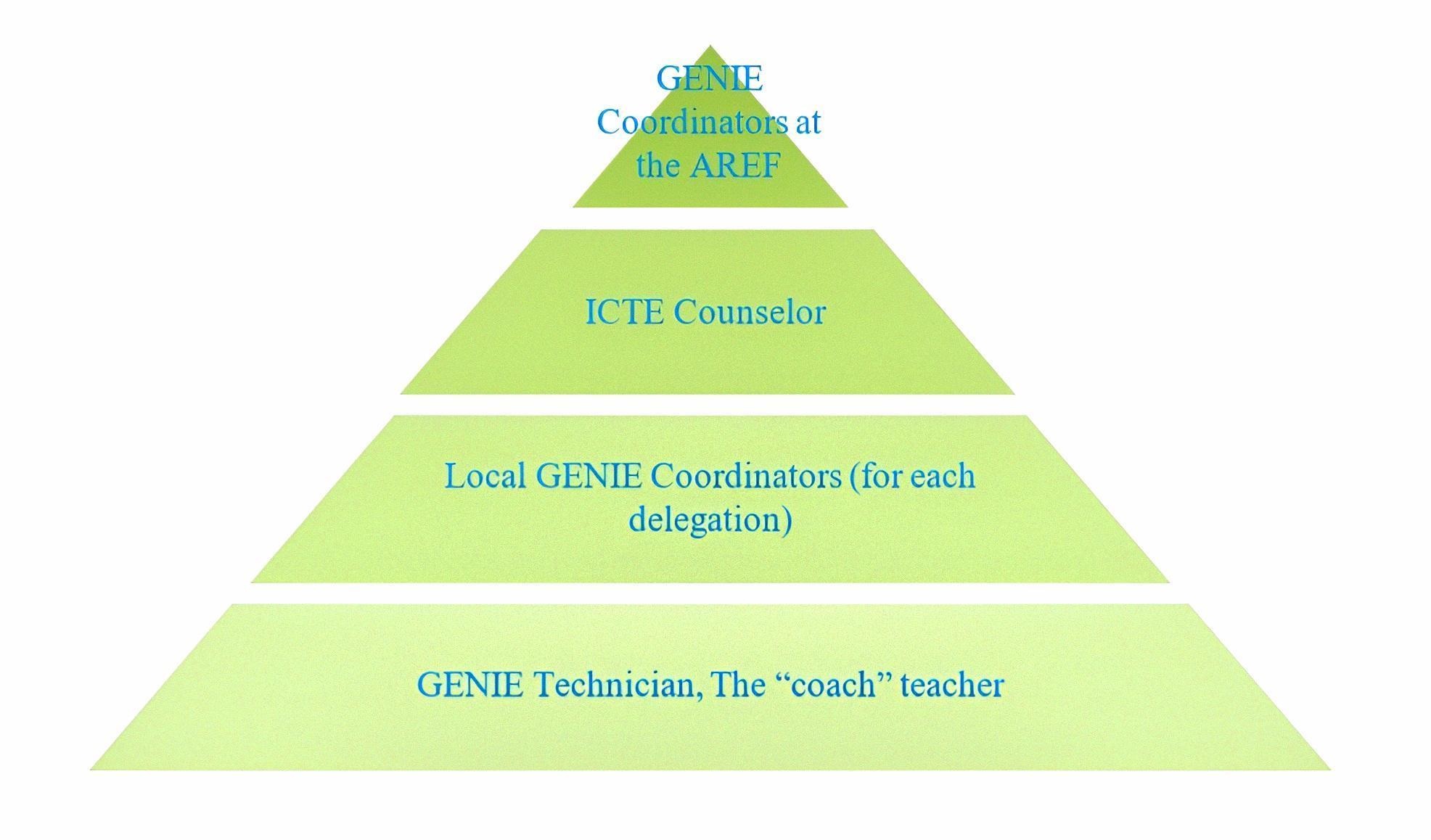
The continuity of this training program is ensured by a group of managers distributed hierarchically according to their respective missions as shown in figure 1:

Each of these human resources have the common mission of implementing the actions of the regional, provincial and local plan of the GENIE program.
Training follow-up: ICTE meeting
To support the beneficiaries of the CMCF-TICE, which is a training course for trainers, discussion workshops are organized monthly to discuss best practices relating to the field of ICT integration.
Online learning: MOOC GENIE TICE
The program has designed an online training open to all educational actors and a test to obtain certification. The content of this training is identical to the basic common core module, This hybrid method came to accompany face-to-face cascade training and give the opportunity to teachers who couldn’t participate in it to take advantage of an introduction to ICT with a view to generalizing basic knowledge in this area.
This platform was created in 2012, the activity report on the MOOC TICE which was made available to us indicates a cumulative number of educational actors who have completed their training that reached 35,125 beneficiaries since the year 2012 so far (last consulted: November 11, 2019). For this current academic year, only 2051 are active on the platform and 4367 are registered.
Results
Report and critical analysis:
These achievements made by the teacher training program in ICT are punctuated by real constraints, as indicated in the MESRSI report and the assessment of the GENIE program. These constraints are multiple, starting from the most specific to the most general. For starters, the educational body’s resistance and lack of commitment is the first constraint to be underlined. Then comes the lack of technical skills among the beneficiaries in the more in-depth training projects, as well as the logistical problems such as the hosting of teachers, inspectors, and heads of institutions in face-to-face training (Bilan du programme GENIE,2008 et perspectives 2018-2030).
Regarding distance learning, the assessment revealed the cognitive impact due to the timid use of digital tools in the classroom until they sink into oblivion. This is explained by the lack of follow-up and the adopted approach which favors theory and neglects the personal experiences of each teacher.
1. The quality and efficiency of teacher training in ICT:
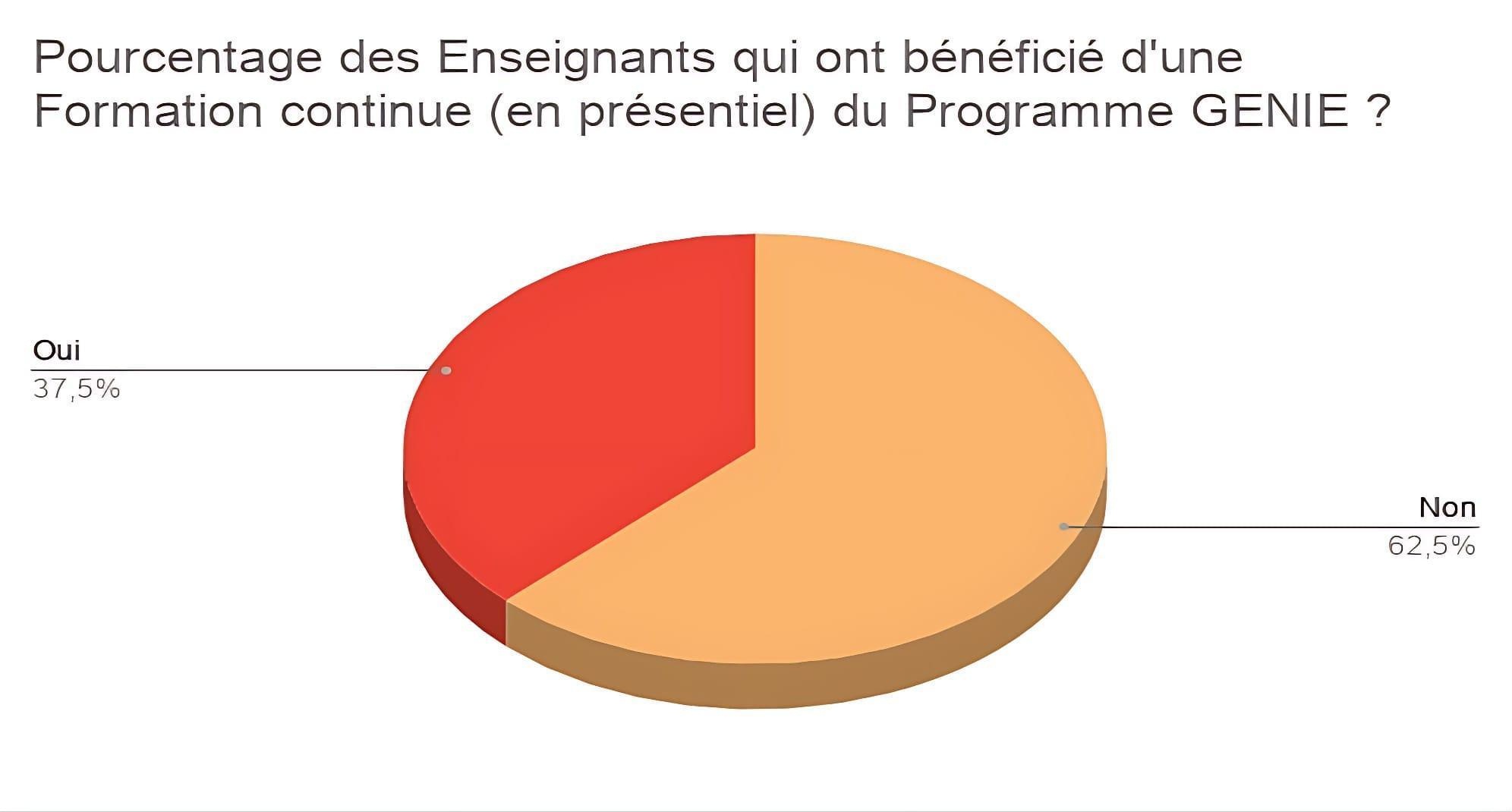
Among the target population that responded to our survey, only 37,5% have benefited from face-to-face ICT training organized by the GENIE Program. They state that the training did not respond to their needs, referring to the heterogeneity of trainees who showed different knowledge levels in the use of technologies in the classroom. They also underlined the limitations of its efficiency as a short-term training that was not to be replicated. Teachers insist on the development of a sequential and decentralized training that allows a practical follow-up and continuity in the development of competences. Finally, the existence of such a training was totally unbeknownst to some teachers.
With regard to distance training in ICT organized by the ministry, opinions were different. The vast majority never benefited from distance training in ICT for various reasons, namely, the lack of effective communication between the Ministry of Education and Educators and Teachers. Some teachers who participated in the MOOC GENIE TICE training appreciated it because of accessibility. Other teachers estimated that their ICT knowledge goes beyond the content offered by this training.
2. ICT skills that teachers should acquire:
The ICT trainers and the representatives of the training centers stressed that the existing in-service training develops the skills recommended by UNESCO, i.e., ICT literacy should be generalized. This means acquiring the basics of using technologies in the classroom, especially that field studies showed that this was the first need in terms of skills. The development of the basic in-service training course was articulated between UNESCO competences and others defined by the CRMF.
The trainers admit that 30 hours of continuous training dedicated to the integration of ICT in education are not enough but are complementary to the more specific initial training.
Representatives of training centers made a distinction between ICT competences for teachers and ICT competences for trainers and coordinators. The latter, according to our interviewees, are already mastering the basic competences. In the respective centers of competence, this involves training specialists whose needs are not the same as those of teachers.
As for teachers, they presented a range of skills according to the needs of each one of them. In the discussion, everyone mentioned the programming component and specialized resources in their respective areas of expertise, assuming everyone can handle computer equipment. Teachers highlighted the importance of hands-on training.
Questionnaire: results
Teachers who have attended GENIE face to face training(Figure 2).
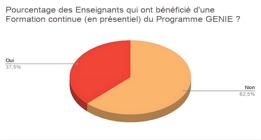
According to responses, 62,5% of teachers have never benefited from an in-service ICT training organized by the GENIE program (Figure 3)
Teachers’ feedback on the content of the training:
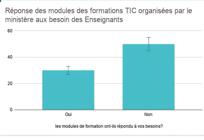
Figure 4 shows that, among the teachers who benefited from face-to-face training, only 37% are satisfied with the content of the training workshops.
MOOC GENIE TICE:

As shown in Figure 4, for Distance Training, only 12% of our target population is enrolled or benefited from the GENIE TICE MOOCS, the rest explain their answers by:
Temporal restriction – Lack of communication – uselessness of contents
Discussion
Limitations of the study:
The main empirical constraint we faced in this study was the representativeness of the population we chose for the focus groups, as opposed to the questionnaire, during the data collection. This kind of research requires a very diverse group of teachers to provide strong data through discussing and comparing based on the case of each teacher according to their specialty, generation and personal experience, which was difficult to achieve due to the limited availability of most of the teachers we’ve tried to interview.
The limits of the waterfall training (Waterfall method):
Waterfall training follows a classical training model known among Anglo-Saxons by the "waterfall model". It was invented by the American computer scientist Winston Royce and is part of the field of project management. It is characterized by sequential activities which consist of the predetermination of the needs, then the definition and the production of the product and then the delivery of the final product. This method is the preferred model for mass training and is generally accompanied by a hybrid method, which represents exactly the strategic training model adopted by the GENIE Program. In 2009, a list of teacher needs was drawn up before the start of the second phase of face-to-face teacher training. By analyzing the constraints highlighted in the evaluative assessments of the ministry, and the results obtained, we automatically direct the gaze towards the training model as well as the other technical and pedagogical variables that accompany this training.
Before moving on to the critical analysis of training models, let us recall the nature of the teaching staff of basic and secondary education in Morocco:
The teachers who arrive at the service of the ministry in question are generally from the CRMEF, ENS and the various faculties of the Kingdom. Teachers from CRMEFs from 2008 normally received literacy training in TICE from a 30-hour module designed by the GENIE management. It is not the case for high school teachers trained within ENS or teachers who have obtained graduation in teaching professions, given that the GENIE Program has no supervision over these institutions which, from 2006, began to be part of the higher education cycle. For this, the program has dictated recommendations through training syllabi whose adoption is up to the respective institutions. We, therefore, point out that the needs of teachers are not identical and are not of the same nature. For a heterogeneous mass population like that of the Moroccan teaching body (nearly 300,000), cascade training seems the most effective approach. But this approach alone cannot lead to effective continuing education results under existing political, technical, and educational conditions.
Before validating or invalidating this hypothesis, we interviewed 9 heads of institutions (3 colleges, 4 primary schools and 2 high schools) and 58 teachers, all cycles combined. Some of the reasons for reluctance most of this population provided are:
• Lack of monitoring and control of the use of ICT in class
• The absence of specifications that require the integration of digital tools in class
• The course hour’s load compared to the skill acquisition objectives dictated by the ministry
• Sometimes the lack of classroom infrastructure requires individual efforts from teachers
• Absence of sharing workshop activities
Theoretically speaking, face-to-face in-service education has many limitations in terms of the end results. The first limit is that of information or training content, which goes through several scales, and which depends on the individual knowledge and skills of each trainer, which leads to the loss of some information in the process. In the same framework of content, the training courses are designed and validated beforehand and are not all aligned with the needs of each teacher.
By combining this condition with the mass of hours dedicated to this training, the teacher and the trainer move away from an interactive participatory approach considering the difficulty of being creative in the face of such a predictive approach which leaves no room for maneuver to the trained teachers to specify or change their expectations.
For distance learning, the very timid participation of teachers is relatively explained by several logistical and pedagogical constraints. Moreover, the fact that the training is voluntary makes it rather hinge upon the motivation and interest of each teacher.
Towards Agile methods:
To use an iterative approach in this kind of training project implementation, many methodologies are to be considered. In general, an Agile approach is based on 4 principles:
1. Placing people and their interactions before tools and processes.
2. Operational features before documentation.
3. Collaboration with the client rather than contractual relations.
4. Acceptance of change rather than compliance with plans.
The main purpose of this method is the iterative development of projects by dividing them into several stages which are spread over a fixed period. If we apply this principle to a training project, for example, the training content would be determined through an inventory of the needs of the target population. The target population is divided into subcategories according to the type of needs, with the aim of producing bespoke content called intermediate so that they are validated by the trained population and then adapted to any modifications reported by the latter to give rise to a prototype content sanctioned by possible future corrections. This modern approach to training is based on the principle that one can never anticipate everything and thus implies a cautious and conditioned advancement.
The concretization of this model can be done through a decentralization of training under the supervision of the AREFs. The objective is to create practical training workshops designed by the various actors, including teachers, and adapted to the needs of each region. This training can be an innovative training complementary to the classic training of control.
References
-
Becuwe, H., Pareja Roblin, N., Tondeur, J., Thys, J., Castelein, E., Voogt, J. (2017). Conditions of the successful implementation of teacher education design teams for ICT integration: A Delphy study. Australian Journal of Educational Technology, 33(2). doi: https://doi.org/10.14742/ajet.2789
» https://doi.org/10.14742/ajet.2789 -
Conseil Supérieur de l’Education, de la Formation Professionnelle et de la Recherche Scientifique. (Edition 2014). La mise en œuvre de la charte nationale d’éducation et de formation 2000-2013 Acquis, déficits et défis https://www.csefrs.ma/publications/charte-nationale-deducation-et-de-formation/?lang=fr
» https://www.csefrs.ma/publications/charte-nationale-deducation-et-de-formation/?lang=fr -
Kivirand, T., Leijen, A., Lepp, T., Tammemäe, T. (2021) Designing and Implementing an In-Service Training Course for School Teams on Inclusive Education: Reflections from Participants, Educ. Sci. 2021, 11(4), 166; https://doi.org/10.3390/educsci11040166
» https://doi.org/10.3390/educsci11040166 -
Pelgrum, W.J., Law, N. (2003). Les TIC et l'éducation dans le monde : tendances, enjeux et perspectives (UNESCO). https://unesdoc.unesco.org/ark:/48223/pf0000136281_fre/PDF/136281fre.pdf.multiRetrieved January15th, 2023.
» https://unesdoc.unesco.org/ark:/48223/pf0000136281_fre/PDF/136281fre.pdf.multi -
PDP TICE. Guide du formateur. (2013). http://www.taalimtice.maRetrieved January15th, 2023.
» http://www.taalimtice.ma -
Programme GENIE. (Juin 2008). Rapport sur l’Analyse des besoins et des priorités en matière de ressources pédagogiques numériques http://www.taalimtice.maRetrieved January15th, 2023.
» http://www.taalimtice.ma -
UNESCO. (2018). ICT Competency Framework for Teachers. Version 3. https://unesdoc.unesco.org/ark:/48223/pf0000265721Retrieved January15th, 2023.
» https://unesdoc.unesco.org/ark:/48223/pf0000265721
Data citations
Pelgrum, W.J., Law, N. (2003). Les TIC et l'éducation dans le monde : tendances, enjeux et perspectives (UNESCO). https://unesdoc.unesco.org/ark:/48223/pf0000136281_fre/PDF/136281fre.pdf.multiRetrieved January15th, 2023.
UNESCO. (2018). ICT Competency Framework for Teachers. Version 3. https://unesdoc.unesco.org/ark:/48223/pf0000265721Retrieved January15th, 2023.