 Mechanochemistry Metal-Free Synthesis and Molecular Modeling Study of 4-Arylamino-1,2-naphthoquinones by Csp2-Csp2 Bond Formation
Abstract
The present work explores the mechanochemical synthesis and computational study of C-C bond formation at the C-4 position of sodium 1,2-naphthoquinone-4-sulfonate (1, β-NQSNa) with dialkylanilines (2a-2f). This is the first example of using mechanochemistry without transition metal catalysts and solvents to produce 4-(4-(dialkylamino)phenyl)naphthalene-1,2-dione (3a-3f) from symmetric and non-symmetric N,N’-dialkylanilines in good to moderate yields. Preliminary, computational studies were conducted to explain the use of sterically hindered and less hindered anilines, which caused variations in the yields of the analogous products, suggesting the formation of π-π interactions between the anilines and the B ring of the naphthoquinone. Molecular modeling was performed using density functional theory (DFT), employing the hybrid functional M06-2X and the polarized valence triple-zeta basis set augmented for improved correlation (aug-cc-pVTZ).
Keywords:
quinones; anilines; cross-coupling; solvent-free; π-π; interactions
Introduction
Naphthoquinones belong to the quinone family and are found in both synthetic and natural substances. With such unique chemical properties and bioactivities, naphthoquinones have garnered considerable interest, especially in the pharmaceutical field, where they have been widely used in the development of new and more efficient drugs.1-8 As a structural platform, this commercially available organic compound has multiple possibilities for chemical modification in the quest for a successful new compound that could become a new drug.9
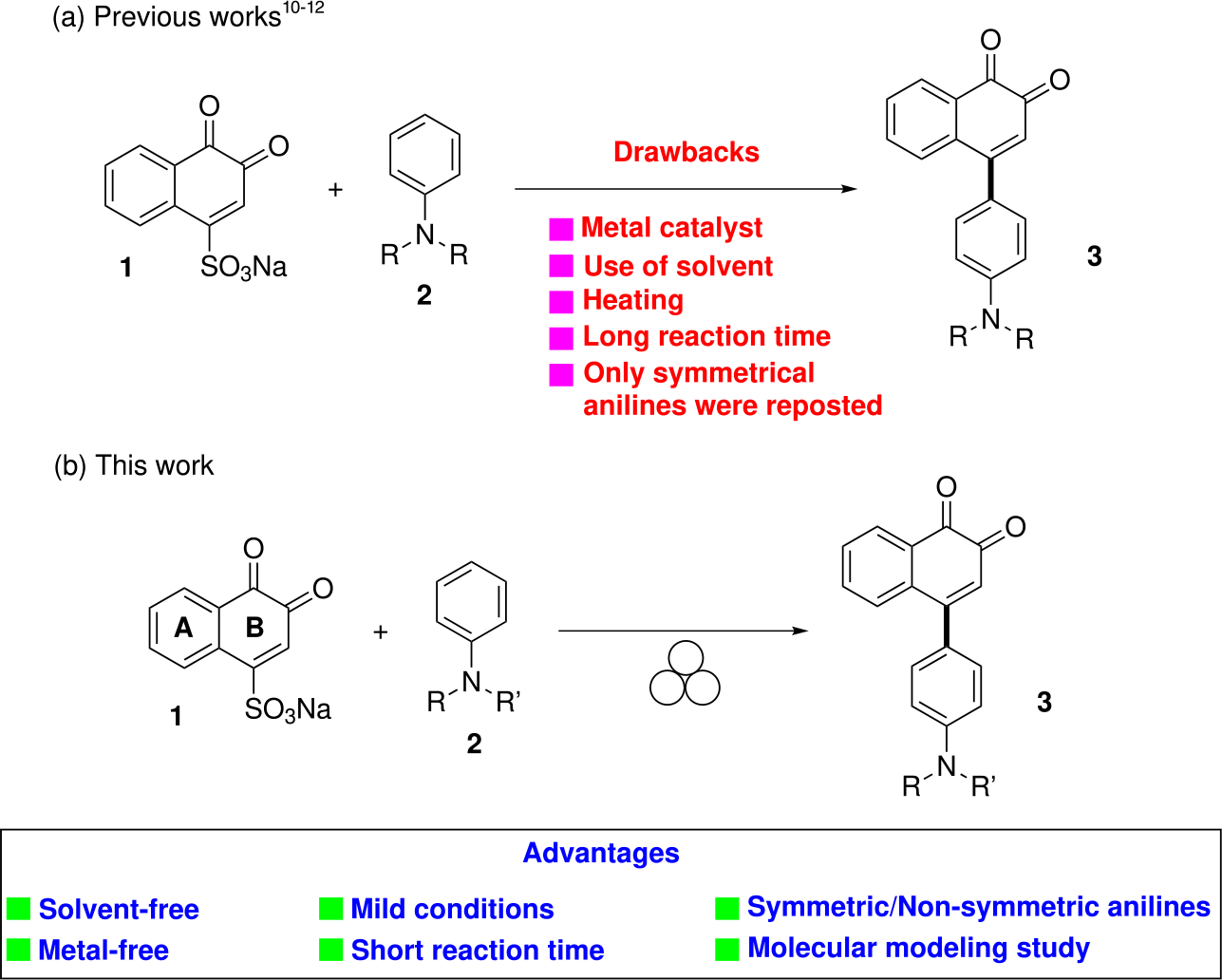
Amino-naphthoquinones, specifically N,N disubstituted anilines through C-C bond formation in 1,2-naphthoquinones at the C-4 position has been reported as the building block for imidazo[4,5-a]naphthalene derivatives,10 and the synthesis of 6’-arylamino spirooxazines.11 Also, exhibiting application in the materials science, such as solid-state organic fluorescent dyes.10 Despite the importance, few synthetic routes are described for 4-arylamino-1,2 naphthoquinones synthesis under carbon-carbon bond formation. Starting from sodium 1,2-naphthoquinone-4 sulfonate (1, β-NQSNa), known as Folin’s reagent, a very effective colorimetric indicator of blood amino acids and drugs containing free primary and secondary amino groups, seems to be even less explored, which is notable given the limited number of citations in the literature.10-16 The previous works reported on the utilization of Folin’s reagent have several drawbacks, such as the use of organic solvents, with or without NiII, long reaction times (ranging from hours to days), low yields (less than 60%), and a limited scope, often containing only two or three examples in each study, always involving symmetrical N,N-disubstituted anilines (Scheme 1a).1012 Notably, the yield is even lower when sterically hindered anilines are used.17 Therefore, developing a new methodology for adding arylamines to the C-4 position of sodium 1,2-naphthoquinone-4-sulfonate (1, β-NQSNa) is crucial for efficient carbon-carbon bond formation. The mechanochemical method could be an auxiliary approach to address this challenge, as the reaction occurs in the neat form, which does not require a solvent. Furthermore, parameters such as liquid assisted grinding (LAG) or the use of grinding auxiliaries (inert materials mixed with the reagents for better homogenization) may be explored to improve the process.18

Methods to formation Csp2-Csp2 bond to obtain 4-arylamino-1,2-naphthoquinones from β-NQSNa (1) and tertiary anilines.
Beyond demonstrating greater effectiveness than conventional reactions,19 mechanochemical methods offer the advantage of optimized parameters that reduce reaction time and increase yield.20 In the present work (Scheme 1b), a new method was developed for a Csp2-Csp2 bond formation at the C-4 position of sodium 1,2-naphthoquinone- 4-sulfonate (1, β-NQSNa) using both symmetric and non-symmetric N,N’-dialkylanilines (2a-2f), affording the desired 4-amino-1,4-naphthoquinones (3a-3f) in a short reaction time, without the use of metal or solvent, via mechanochemistry (Scheme 1). Additionally, a computational study was carried out to investigate the low yield observed when bulky groups are used in N,N’ dialkylanilines (2a-2f).
Experimental
Materials and methods
All mechanochemical reactions were conducted using 15 mL BMT-20-S tubes with an IKA Ultra-Turrax Tube Drive. Melting points of the substances were determined using a Thermo Scientific 9100 apparatus or a Fischer-Jones apparatus (Melting Point Apparatus) series 50200082. Infrared spectra were obtained using a Bruker FT IR ATR spectrometer, model Alpha 2. Absorption values are expressed in wavenumbers (cm-1). Nuclear magnetic resonance (NMR) spectra were acquired on a Bruker Avance Neo spectrometer operating at 500.00 MHz (for 1H NMR) and 125.0 MHz (for 13C NMR), using CDCl3 as the solvent NMR spectra were typically obtained at room temperature. Chemical shift values (d) are reported in parts per million (ppm) relative to the solvent CDCl3, and coupling constants (J) are reported in hertz (Hz). Signal areas were obtained by electronic integration. The multiplicities of absorption bands in the 1H NMR spectrum are described as follows: s (singlet), d (doublet), t (triplet), q (quartet), qt (quintet), st (sextet), m (multiplet), sl (broad singlet), tl (broad triplet), dd (double doublet), td (double doublet), and ddd (double doublet). High-resolution mass spectra were obtained on a MICROMASS Q-TOF mass spectrometer (Waters) with electrospray ionization (ESI). All solvents and reagents used were purchased from commercial sources such as Sigma-Aldrich Brazil (São Paulo, Brazil). When necessary, solvents were treated, distilled, and dried according to literature procedures. Reaction monitoring was performed by thin-layer chromatography (TLC) using silica gel 60 F254 chromatosheets (0.2 mm thickness, Merck 5554). Most substances were purified by column chromatography using silica gel 60 (70-230 mesh) supplied by Merck. The arylamines 2a-2f were synthesized according to a classic alkylation protocol reported in the literature.21-23
General procedure for the preparation of 4-(4-(dialkylamino)phenyl)naphthalene-1,2-dione (3a-3f)
In a 15 mL BMT-20-S tube (IKA Ultra-Turrax Tube Drive) charged with six stainless-steel balls (5 mm diameter, 0.52 g), sodium 1,2-naphthoquinone-4-sulfonate (1, 0.4 mmol, 0.1041 g) and dialkylaniline (2a-2f, 1.0 equiv., 0.4 mmol) were milled for 5 min at 300-4000 oscillations per min. After this time, 0.80 g of SiO2 (230-400 mesh) was added to the mixture. Then, the mixture was milled for an additional 1.0 h at 300 4000 oscillations per min. After milling, the crude mixture was subjected to column chromatography for purification and isolation of the product 3a-3f.
4-(4-(Dimethylamino)phenyl)naphthalene-1,2-dione (3a)4
Dark purple solid: yield 46% (51.1 mg); mp 175 177 °C; IR νmax / cm-1 2848, 1693, 1643, 1601, 1583, 1518, 1480, 1448, 1342, 1286, 1194, 1120, 1051, 966, 870, 822, 784, 734, 714, 625; 1H NMR (500.00 MHz, CDCl3) d 8.18 (d, J 8.3 Hz, 1H), 7.62-7.55 (m, 1H), 7.52 (dd, J 16.6 and 8.3 Hz, 2H), 7.38 (d, J 8.5 Hz, 2H), 6.78 (d, J 8.5 Hz, 2H), 6.42 (s, 1H), 3.07 (s, 6H); 13C NMR (125.0 MHz, CDCl3) d 180.4, 180.3, 157.5, 151.7, 135.4, 134.7, 132.0, 130.5, 130.3, 130.0, 129.8, 125.9, 123.5, 111.7, 40.2.
4-(4-(Diethylamino)phenyl)naphthalene-1,2-dione (3b)2,4
Dark purple solid, yield 41% (49.4 mg); mp 118-120 °C; IR νmax / cm-1 3193, 2961, 2924, 1696, 1643, 1599, 1580, 1550, 1519, 1402, 1343, 1260, 1195, 1144, 1079, 1003, 967, 882, 819, 769, 733, 713, 626; 1H NMR (500.00 MHz, CDCl3) d 8.11 (d, J 7.5 Hz, 1H), 7.52 (d, J 4.0 Hz, 2H), 7.48-7.41 (m, 1H), 7.30 (t, J 8.8 Hz, 2H), 6.68 (d, J 8.8 Hz, 2H), 6.37 (s, 1H), 3.38 (q, J 7.5 Hz, 4H), 1.17 (t, J 7.5 Hz, 6H); 13C NMR (125.0 MHz, CDCl3) d 180.5, 180.3, 157.4, 149.4, 135.4, 134.6, 132.1, 130.4, 130.3, 129.9, 125.5, 122.6, 111.1, 44.5, 12.6.
4-(4-(Diisopropylamino)phenyl)naphthalene-1,2-dione (3c)
Dark purple solid: yield 8% (10.0 mg); mp 156-158 °C; IR νmax / cm-1 3070, 2971, 2922, 2850, 1698, 1646, 1601, 1582, 1548, 1515, 1450, 1414, 1326, 1292, 1280, 1257, 1202, 1142, 1121, 1021, 965, 867, 829, 773, 734, 715, 666, 627; 1H NMR (500.00 MHz, CDCl3) d 7.61-7.50 (m, 4H), 7.34 (d, J 8.7 Hz, 2H), 6.91 (d, J 8.7 Hz, 2H), 6.45 (s, 1H), 3.97 (dq, J 13.6 and 6.8 Hz, 2H), 1.35 (d, J 6.9 Hz, 12H); 13C NMR (125.0 MHz, CDCl3) d 179.5, 179.2, 156.3, 148.9, 134.3, 133.6, 131.0, 129.4, 129.3, 128.9, 128.6, 124.5, 122.3, 114.0, 46.5, 20.0; HRESIMS m/z, calcd. for C22H23NO2Na+ [M + Na]+: 356.1621, found: 356.1616.
4-(4-(Ethyl(methyl)amino)phenyl)naphthalene-1,2-dione (3d)
Dark purple solid: yield 36% (42.0 mg); mp 120 122 °C; IR νmax / cm-1 2965, 2923, 1691, 1643, 1581, 1552, 1518, 1433, 1342, 1289, 1218, 1085, 984, 965, 874, 818, 778, 733, 715, 666, 613; 1H NMR (500.00 MHz, CDCl3) d 8.17 (d, J 7.4 Hz, 1H), 7.58-7.55 (m, 2H), 7.52-7.49 (m, 1H), 7.37 (d, J 8.8 Hz, 2H), 6.76 (t, J 9.6 Hz, 2 H), 6.42 (s, 1H), 3.49 (q, J 7.1 Hz, 2H), 3.02 (s, 3H), 1.20 (t, J 7.1 Hz, 3H); 13C NMR (125.0 MHz, CDCl3) d 180.5, 180.3, 157.4, 150.5, 135.4, 134.7, 132.0, 130.4, 130.3, 130.1, 129.9, 125.7, 123.1, 111.5, 46.7, 37.5, 11.5; HRESIMS m/z, calcd. for C19H17NO2Na+ [M + Na]+: 314.1135, found: 314.1151.
4-(4-(Methyl(propyl)amino)phenyl)naphthalene-1,2-dione (3e)
Dark purple solid: yield 25% (31.0 mg); mp 80-82 °C; IR νmax / cm-1 2958, 2928, 2872, 1694, 1642, 1597, 1579, 1549, 1517, 1448, 1377, 1342, 1286, 1244, 1194, 1142, 1096, 965, 873, 819, 772, 734, 715, 667, 621, 508, 448, 421; 1H NMR (500.00 MHz, CDCl3) d 8.17 (d, J 7.2 Hz, 1H), 7.60-7.49 (m, 3H), 7.37 (d, J 8.8 Hz, 2H), 6.75 (d, J 8.8 Hz, 2H), 6.43 (s, 1H), 3.39-3.36 (t, J 7.5 Hz, 2H), 3.04 (s, 3H), 1.67 (st, J 7.5 Hz, 2H), 0.97 (t, J 7.5 Hz, 3H); 13C NMR (125.0 MHz, CDCl3) d 180.5, 180.3, 157.5, 150.7, 135.4, 134.7, 132.0, 130.4, 130.3, 130.1, 129.9, 125.6, 123.0, 111.4, 54.2, 38.5, 20.2, 11.5; HRESIMS m/z, calcd. for C20H19NO2Na+ [M + Na]+: 328.1315, found: 328.1308.
4-(4-(Ethyl(propyl)amino)phenyl)naphthalene-1,2-dione (3f)
Dark purple solid: yield 27% (34.0 mg); mp 122 124 °C; IR νmax / cm-1 2956, 2925, 2868, 1688, 1637, 1596, 1577, 1516, 1402, 1341, 1292, 1198, 1140, 1093, 996, 967, 874, 817, 777, 733, 719, 627; 1H NMR (500.00 MHz, CDCl3) d 8.17 (d, J 7.4 Hz, 1H), 7.59-7.52 (m, 2H), 7.51-7.49 (m, 1H), 7.37 (d, J 8.9 Hz, 2H), 6.73 (d, J 8.9 Hz, 2H), 6.43 (s, 1H), 3.46 (q, J 7.1 Hz, 2H), 3.31 (t, J 7.5 Hz, 2H), 1.68 (q, J 7.5 Hz, 2H), 1.23 (t, J 7.5 Hz, 3H), 0.98 (t, J 7.4 Hz, 3H); 13C NMR (125.0 MHz, CDCl3) d 180.6, 180.2, 157.4, 149.6, 135.4, 134.6, 132.1, 130.4, 130.3, 129.9, 125.5, 122.5, 52.2, 45.1, 20.7, 12.3, 11.5; HRESIMS m/z, calcd. for [M + Na]+ C21H21NO2Na+: 342.1471, found: 342.1464.
Results and Discussion
The literature protocols describe a carbon-carbon reaction between N,N-dialkylanilines and β-NQSNa (1), producing the adduct with yields around 60%.10-16 However, reproducing these reactions with the reported yields (< 20%) proved challenging. A previous study10-12 explored yield improvement under conventional methods by performing the reaction with or without a metal catalyst (0.5 equiv. of NiII), varying the reaction temperature, or using blue light emitting diode (LED) irradiation (457 nm). The reaction employed a typical solvent combination for this synthesis (H2O:MeOH, 9:1) at a 10 mL volume for a 0.4 mmol scale of the reactant. However, in all cases, the yields remained around 20%. Nonetheless, evaluating alternative methods, such as microwave irradiation (90 ºC, 100 W), failed to yield higher results.
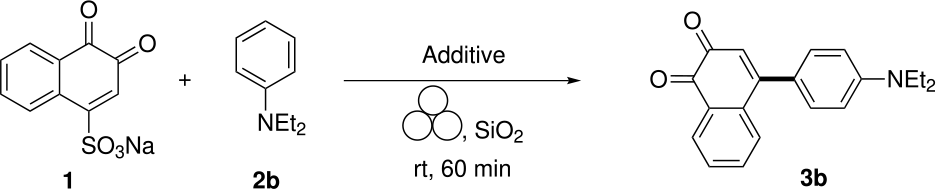
When the mechanochemical method was tested, the yield nearly doubled compared to the commonly obtained value (41%, entry 1, Table 1). The reaction between β-NQSNa (1) and N,N-diethylaniline (2b) was performed using a pre-grinding step involving the reactants, without the use of a base or metal catalyst, for 5 min, followed by the addition of silica (230-400 mesh) as a grinding auxiliary. The reaction was then run for an additional hour. Changing the standard condition to a one-pot approach afforded 3b in only 26% yield (entry 2, Table 1), demonstrating the necessity of the pre-grinding step. The reaction with excess 2b was also evaluated, but no improvement in yield was observed (entry 3). The NiII catalyst was tested both with and without acetic acid, yielding lower results in both cases (entries 4 and 5). Acetic acid was also tested as a liquid-assisted grinding (LAG) agent, but the yield did not increase (entry 6). No reaction was observed when using AlCl3 as an additive (entry 7, Table 1).
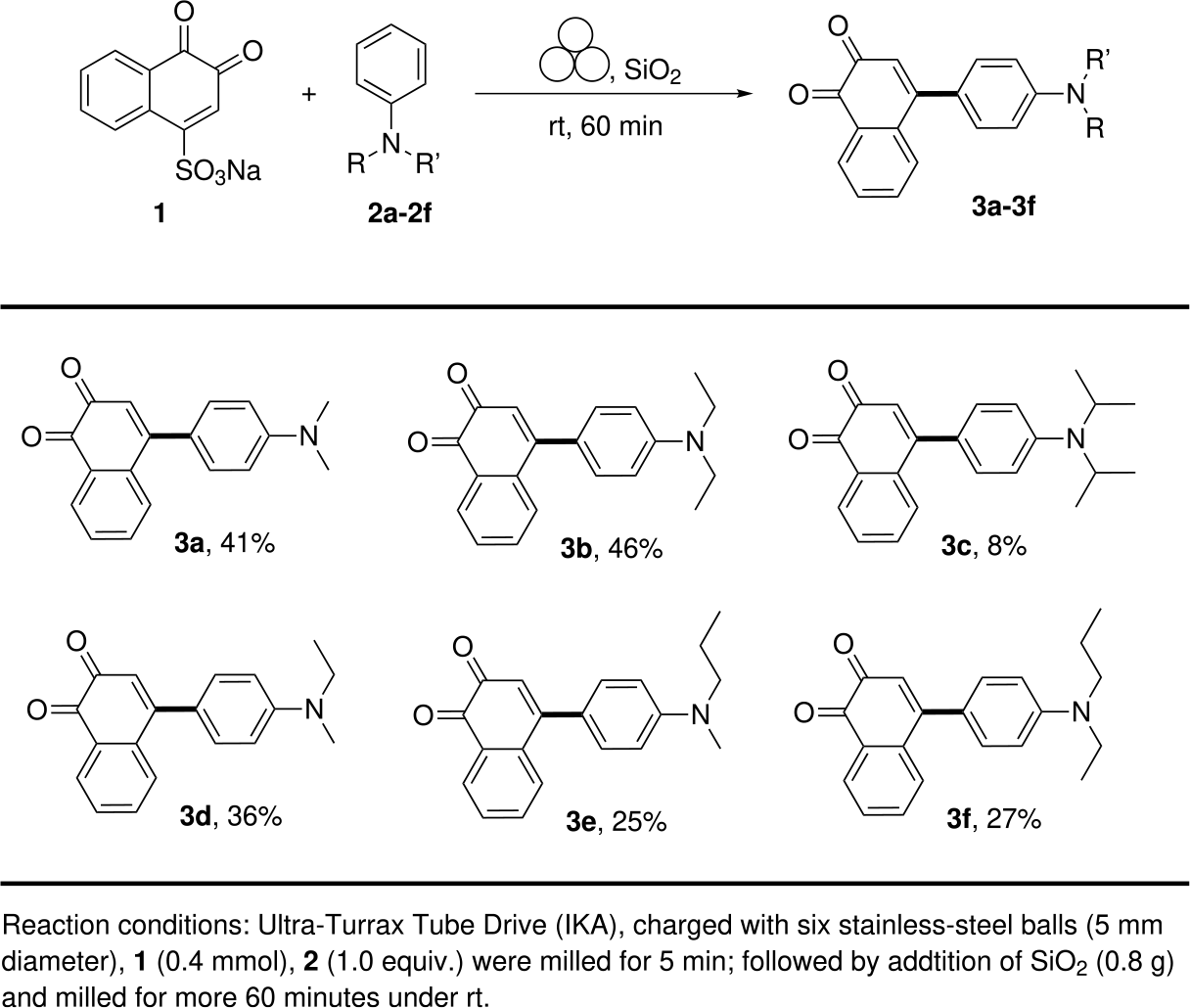
It is important to note that in the neat mixture, the reaction does not occur due to particle sticking, inhibiting their mobility. With the optimized conditions in hand (41% yield), we obtained 3b using the stoichiometric amount of 2b and SiO2 as a grinding auxiliary (entry 1, Table 1). Thus, we began to explore the scope with symmetric and non-symmetric tertiary anilines (3a-3f, Scheme 2).

In Scheme 2, the best results were obtained for products 3a, 3b, and 3d (41, 46 and 36%, respectively) when using the corresponding dialkylanilines with minimal steric hindrance at the amino substituent. However, when dialkylanilines containing more than two carbons in the chain of the nitrogen substituent (2c, 2e and 2f) were introduced to sodium 1,2-naphthoquinone-4-sulfonate (1), a significant decrease in the yield of the desired products 3c, 3e and 3f was observed (Scheme 2; 8, 25 and 27%, respectively). Consequently, the lowest yield was obtained using N,N-diisopropylaniline (8% for 2c, Scheme 2). Under mechanochemical conditions, it was not possible to improve the yield for this C-C bond reaction with sterically hindered dialkylanilines, as observed in the literature.17
Quantum mechanical calculations were carried out using density functional theory (DFT)24,25 as implemented in the Gaussian 06 software package.26 All calculations employed the hybrid functional M06-2X and the augmented correlation-consistent polarized valence triple-zeta basis set (aug-cc-pVTZ). Frequency calculations were also carried out to confirm that the evaluated structures were in the ground state.
To construct input files, the structures of 1, 2a-2f and 3a-3f were drawn in the GaussView 6.0 program.26 To encompass the understanding of the importance of R groups as substituents in aniline derivatives, we constructed the structures as presented in Table 2.
Chemical reactivity indices for substituted anilines obtained at the M06-2X/6-311++G(d,p) level of theory
Molecular orbital isosurfaces are represented in Figure 1. The energies of the frontier molecular orbitals, the highest occupied molecular orbital (HOMO) and the lowest unoccupied molecular orbital (LUMO), were obtained, as well as the energy gap. This provides the chemical reactivity descriptors: ionization energy (I), electron affinity (A) and chemical potential (µ):27

Isosurfaces of the frontier molecular orbitals of substituted anilines (2a-2f), obtained at the M06-2X/6-311++G(d,p) level of theory in the gas phase (isovalue: 0.04). HOMO is below, and LUMO is above and at the center of the energy gap. Values are not to scale.
a property that is related to the charge transfer from a species with a higher chemical potential (µlarge) to another with a lower chemical potential (µsmall), chemical hardness (η):
which means a measure of resistance to deformation of the electron cloud during chemical processes, and global electrophilicity index (ω):
a measure of energy stabilization when the system acquires electronic charge from the environment. In equations 1 and 2, E is the energy of the system, N is the number of particles, υ is the external potential, χ is the electronegativity, I ≅ -EHOMO is the ionization potential, and A ≅ -ELUMO is the electron affinity. To this end, we studied the symmetric increase of the amine substituent groups, making R and R’ equal to C2H5 (2b), CH3 (2a) and i-C3H7 (2c) for symmetrical anilines; and non-symmetric anilines, as CH3 and C2H5 (2d), CH3 and n-C3H7 (2e), C2H5 and n-C3H7 (2f).
Preliminary calculations helped explain the yield discrepancy between the less substituted N,N-dimethylaniline (2a) and the more sterically hindered N,N-diisopropylaniline (2c). The frontier molecular orbitals (FMOs),28 HOMO and LUMO, of the neutral compound β-NQSNa (1) revealed that both orbitals in this compound are π orbitals, with the HOMO located on the oxygen atoms of the sulfonate group and the LUMO located at the C-4 position of the naphthoquinone. The molecular electrostatic potential (MEP) map for β-NQSNa (1) shows that the sulfonate group has a high charge density, indicated by its low V(r) value (-40.511 kcal mol-1), which increases the electron density on the C-4 atom of the naphthoquinone (V(r) = -7.153 kcal mol-1). This is attributed to the large volume of the leaving group (SO3-). Consequently, the B ring of naphthoquinone becomes an electrophilic region in the molecule, with a V(r) value of +21.626 kcal mol-1.
In aniline-derived compounds, the HOMO is a π orbital, while the LUMO is a Rydberg orbital. For this reason, the values are high in these compounds. The energy gap values for these compounds indicate that symmetric substituents in the N,N’-dialkylanilines (2a-2f) tend to increase reactivity as the alkyl chain (-R) lengthens, which is in contrast to the isolated yield values for the desired products (3a-3c). On the other hand, the branching of the N,N-dialkyl group in 2c leads to an increase in the kinetic stability of the compound, which may explain the low reaction yield when reacting with β-NQSNa (1).
Similarly, by comparing non-symmetric anilines 2d (N-methyl,N’-ethylaniline) and 2f (N-ethyl,N’ propylaniline), the gap values predict that replacing the ethyl group by propyl substituent causes an increase in chemical reactivity. Thus, it was possible to observe that the stability of the compounds does not directly impact the reaction yields. Once the increase in alkyl chains (-R) in anilines indicates a steric effect with naphthoquinone, decreasing the reaction yields.
The mechanism for C-C bond formation of the target product 3 was proposed. Initially, the amine acts as the directing group to mediate nucleophilic attack in the para position of aniline derivative for addition in the C-4 site of naphthoquinone to form an enolate. Next the negative charge returns to expel the sulfonate ion, and, finally, the deprotonation of hydrogen occurs at para-position from aniline restores aromaticity, yielding the product 3 (Scheme 3).

Proposed mechanism by π-π stacking approach between N,N’-disubstituted anilines (2a) and β-NQSNa (1) to afford the product 3a.
Theoretical calculations indicated that the anilines approach the naphthoquinone in a sandwich-like form (Scheme 3), forming a π-π interaction with the B ring. They then rotate to bring their para-substituted tertiary anilines closer to the C-4 atom of β-NQSNa (1) until bond formation occurs, producing the intermediate structure. Topological analysis of the sandwich systems, carried out using quantum theory of atoms in molecules (QTAIM),29,30 showed that the π-π interactions have low charge density, as expected, indicating a very weak interaction between the reacting species. The topological parameters were ρ = 0.008 a.u., ∇2ρ > 0, and h = 0.0010 a.u. (ρ is the electron density measured in atomic units, a.u.; ∇2ρ is the Laplacian of electron density, which quantifies the curvature of the electron density at a specific point; and h is the interaction energy, also expressed in atomic units, a.u.), indicating van der Waals interactions with energies of approximately -1.0 kcal mol-1. These values were similar across all systems analyzed. However, as both molecules align to form the π-π interaction, the substituent groups of the anilines create steric hindrance with the ketone groups of β-NQSNa (1), leading to a decrease in reaction yield as substituents at nitrogen (-R) increases. Calculations revealed that the interatomic distances between the interacting carbon atoms (C-4) of the substituted anilines (2) and β-NQSNa (1) are very similar. For the shortest chain N,N-dimethylaniline (2a), the largest distance was observed (3.594 Å), while for N,N-diisopropylaniline (2c), the distance decreased by approximately 4.7%. However, in the latter, steric effects caused a distortion of the π-π interaction (Figure 2). In aniline 2e, the C-C distance was reduced even further by 11.3%. Finally, no conformations indicated an effective π-π interaction between aniline 2f and β-NQSNa.

π-π interactions observed by theoretical calculations and interatomic distances between the interacting carbon atoms (C-4 of N,N-disubstituted anilines, 2a-2f) and β-NQSNa (1).
Conclusions
This work describes a new, simple, and green solventand metal-free method for the C-C bond formation reaction between sodium 1,2-naphthoquinone-4-sulfonate (1) and tertiary anilines via mechanochemistry. Six N,N’ dialkylanilines (2a-2f), including symmetric and non-symmetric anilines, were explored, with the latter being an novel example. The discrepancy between less and more bulky substituents attached to the nitrogen atom of anilines was investigated through molecular modeling, explaining the variations in the yield of the analogous products and suggesting the formation of π-π interactions between the anilines and the B ring of the 1,2-naphthoquinone.
Supplementary Information
Supplementary information is available free of charge at http://jbcs.sbq.org.br as PDF file.
Acknowledgments
The authors thank the CNPq (Conselho Nacional de Desenvolvimento Científico e Tecnológico) - 404587/2021-6, 307736/2023-7; CAPES (Coordenação de Aperfeiçoamento de Pessoal de Nível Superior) - Finantial Code 001; FAPERJ (Fundação Carlos Chagas Filho de Amparo a Pesquisa do Estado do Rio de Janeiro) - E-26/200.870/2021, E-26/204.023/2024, E-26/211.343/2021.
References
-
1 Angulo-Elizari, E.; Henriquez-Figuereo, A.; Morán-Serradilla, C.; Plano, D.; Sanmartín, C.; Eur. J. Med. Chem. 2024, 268, 116249. [Crossref]
» Crossref -
2 Loredo-Carrillo, S. E.; Leyva, E.; López-Lopez, L. I.; Navarro-Tovar, G.; De Loera, D.; Vega-Rodriguez, S.; Curr. Org. Chem. 2024, 28, 1118. [Crossref]
» Crossref -
3 de Carvalho, N. K. G.; Mendes, J. W. S.; da Costa, J. G. M.; Chem. Biodiversity 2024, 20, e202301365. [Crossref]
» Crossref -
4 Khan, J.; Rani, A.; Aslam, M.; Pandey, G.; Pant, B. N.; Results Chem. 2024, 6, 101138. [Crossref]
» Crossref -
5 Rahman, M. M.; Islam, M. R.; Akash, S.; Shohag, S.; Ahmed, L.; Supti, F. A.; Rauf, A.; Aljohani, A. S. M.; Al Abdulmonem, W.; Khalil, A. A.; Sharma, R.; Thiruvengadam, M.; Chem.- Biol. Interact. 2024, 368, 110198. [Crossref]
» Crossref -
6 Ortiz-Pérez, E.; Rivera, G.; Salas, C. O.; Zarate-Ramos, J. J.; Trofymchuk, O. S.; Hernandez-Soberanis, L.; Perales-Flores, J. D.; Vázquez, K.; Curr. Top. Med. Chem. 2024, 21, 2046. [Crossref]
» Crossref -
7 Mone, N. S.; Bhagwat, A. S.; Sharma, D.; Chaskar, M.; Patil, R. H.; Zamboni, P.; Nawani, N. N.; Satpute, S. K.; Coatings 2024, 11, 434. [Crossref]
» Crossref -
8 Gong, Q.; Hu, J.; Wang, P.; Li, X.; Zhang, X.; Eur. J. Med. Chem. 2024, 210, 112962. [Crossref]
» Crossref -
9 da Silva, F. C.; Ferreira, V. F.; Curr. Org. Synth. 2016, 13, 334. [Crossref]
» Crossref -
10 Ooyama, Y.; Nagano, S.; Yoshida, K.; Tetrahedron 2009, 65, 1467. [Crossref]
» Crossref -
11 York, M.; Evans, R. A.; Synth. Commun. 2010, 40, 3618. [Crossref]
» Crossref -
12 Yoshida, K.; Koujiri, T.; Oga, N.; Ishiguro, M.; Kubo, Y.; J. Chem. Soc., Chem. Commun. 1989, 11, 708. [Crossref]
» Crossref -
13 Ribeiro, R. C. B.; Ferreira, P. G.; Borges, A. A.; Forezi, L. S. M.; da Silva, F. C.; Ferreira, V. F.; Beilstein J. Org. Chem. 2022, 18, 53. [Crossref]
» Crossref -
14 Folin, O.; Wu, H.; J. Biol. Chem. 1922, 51, 377. [Crossref]
» Crossref -
15 Gummadi, S.; Kommoju, M.; Am. J. PharmTech Res. 2019, 9, 14. [Crossref]
» Crossref -
16 Adegoke, O. A.; Int. J. Pharm. Sci. Rev. Res. 2012, 14, 6. [Crossref]
» Crossref -
17 York, M.; Edenharter, A.; Aust. J. Chem. 2013, 66, 172. [Crossref]
» Crossref -
18 Vaghi, L.; Palomba, E.; Papagni, A.; RSC Mechanochem. 2024, 1, 342. [Crossref]
» Crossref -
19 Li, S.; Liu, J.; Wang, Z. L.; Wei, D.; Green Energy Environ. 2024 [Crossref]
» Crossref -
20 Fantozzi, N.; Volle, J.-N.; Porcheddu, A.; Virieux, D.; García, F.; Colacino, E.; Chem. Soc. Rev. 2023, 52, 6680. [Crossref]
» Crossref -
21 Runemark, A.; Zacharias, S. C.; Sundén, H.; J. Org. Chem. 2021, 86, 1901. [Crossref]
» Crossref -
22 Zhang, Y.; Ji, J.; Gao, F.; Huang, H.; Zeng, F.; Wang, W.; ACS Catal. 2021, 11, 998. [Crossref]
» Crossref -
23 Baxter, E. W.; Reitz, A. B.; Organic Reaction; Wiley: New York, 2002, p. 1. [Crossref]
» Crossref -
24 Hohenberg, P.; Kohn, W.; Phys. Rev. 1964, 136, B864. [Crossref]
» Crossref -
25 Kohn, W.; Sham, L. J.; Phys. Rev. 1965, 140, A1133. [Crossref]
» Crossref -
26 Frisch, M. J.; Trucks, G. W.; Schlegel, H. B.; Scuseria, G. E.; Robb, M. A.; Cheeseman, J. R.; Scalmani, G.; Barone, V.; Petersson, G. A.; Nakatsuji, H.; Li, X.; Caricato, M.; Marenich, A. V.; Bloino, J.; Janesko, B. G.; Gomperts, R.; Mennucci, B.; Hratchian, H. P.; Ortiz, J. V.; Izmaylov, A. F.; Sonnenberg, J. L.; Williams-Young, D.; Ding, F.; Lipparini, F.; Egidi, F.; Goings, J.; Peng, B.; Petrone, A.; Henderson, T.; Ranasinghe, D.; Zakrzewski, V. G.; Gao, J.; Rega, N.; Zheng, G.; Liang, W.; Hada, M.; Ehara, M.; Toyota, K.; Fukuda, R.; Hasegawa, J.; Ishida, M.; Nakajima, T.; Honda, Y.; Kitao, O.; Nakai, H.; Vreven, T.; Throssell, K.; Montgomery Jr., J. A.; Peralta, J. E.; Ogliaro, F.; Bearpark, M. J.; Heyd, J. J.; Brothers, E. N.; Kudin, K. N.; Staroverov, V. N.; Keith, T. A.; Kobayashi, R.; Normand, J.; Raghavachari, K.; Rendell, A. P.; Burant, J. C.; Iyengar, S. S.; Tomasi, J.; Cossi, M.; Millam, J. M.; Klene, M.; Adamo, C.; Cammi, R.; Ochterski, J. W.; Martin, R. L.; Morokuma, K.; Farkas, O.; Foresman, J. B.; Fox, D. J.; Gaussian 16, Revision C.01, Inc., Wallingford CT, 2016. [Crossref]
» Crossref -
27 Pearson, R. G.; J. Chem. Sci. 2005, 117, 369. [Crossref]
» Crossref -
28 Zhang, G.; Musgrave, C. B.; J. Phys. Chem. A 2007, 111, 1554. [Crossref]
» Crossref -
29 Bader, R. F. W.; Nguyen-Dang, T. T.; Tal, Y.; Rep. Prog. Phys. 1981, 44, 893. [Crossref]
» Crossref -
30 Bader, R. F. W.; Essén, H.; J. Chem. Phys. 1984, 80, 1943. [Crossref]
» Crossref
Edited by
-
Editor handled this article:
Brenno A. D. Neto