 Valorization of Rice Husk Waste for CO2 Capture and Utilization
Abstract
Global challenges such as health crises, rising sea levels, deforestation and biodiversity loss are linked to climate change, which is primarily caused by carbon dioxide (CO2) emissions. To address these issues, research into CO2 capture and reuse has gained prominence. Abundant, non-toxic to humans and inexpensive, CO2 is a promising raw material for energy and material production. However, converting CO2 into value-added products requires innovative approaches, such as the development of synthetic materials and catalytic processes. This study focuses on the use of silica extracted from rice husk ash, an agricultural residue comprising 20% of raw rice mass, as a support for metals such as cobalt (Co) and iron (Fe). The supported materials were evaluated for CO2 sorption and their catalytic performance in the direct synthesis of dimethyl carbonate (DMC) from methanol and CO2. Comprehensive characterization techniques, including field emission scanning electron microscopy (FE-SEM), surface area analysis (Brunauer Emmett Teller (BET) method), Fourier transform infrared spectroscopy with universal attenuated total reflectance (FTIR UATR), solid-state nuclear magnetic resonance (NMR-MAS), temperature-programmed oxidation-reduction (TPO), and temperature-programmed desorption (TPD), were employed. Catalytic performance was assessed using a Shimadzu GC 2014 gas chromatograph. The best CO2 sorption capacity was achieved with the sample Si-Co 10% (100 mg CO2 g-1) at 30 bar and 25 °C. The best conversion to DMC was for the sample Si-Fe 10% (22.91%), at 80 °C and 40 bar of CO2. This study demonstrates the potential of repurposing agricultural waste to extract silica and utilize it as a metal catalyst support, offering a promising solution for both CO2 capture and conversion.
Keywords:
silicate; CO2 adsorbent; conversion; DMC
Introduction
The primary cause of climate change and ecological decline is elevated carbon dioxide (CO2) emissions, which contribute to severe global changes.1,2 The 2023 Intergovernmental Panel on Climate Change (IPCC) report highlighted that the impacts of climate change on ecosystems and human populations are broader and more severe than previously anticipated, with increasing risks for every fraction of a degree in global warming. Some effects are already irreversible. Under pathways aligned with a 1.5 °C limit, greenhouse gas emissions must peak before the end of 2025.2,3
Chemical absorption, primarily using aqueous amine solutions, is a leading technology for CO2 capture but has drawbacks such as equipment corrosion, high energy costs, solvent losses, and oxidation. Alternatives, including mesoporous silica and alumina with high porosity, have been explored to enhance CO2 capture, with further potential realized through functionalizing ionic liquids on supports. Other approaches, such as membrane permeation, carbon nanotubes, and functionalized silica, have also been investigated.4-6
Carbon dioxide, being abundant, non-toxic, and cost-effective, is an attractive feedstock for energy production. However, its transformation into value-added products, such as fuels, remains challenging and demands novel synthetic pathways involving catalysts.7
Dimethyl carbonate (DMC), a fuel additive and versatile intermediate in organic synthesis, is a key target in this context. DMC is a highly valued chemical compound due to its biodegradability, non-corrosive nature, ability to replace more toxic substances, and molecular properties that enable its use in a wide range of applications, including battery electrolytes, fuel additives, polar solvents, polycarbonate production, and as an intermediate in the synthesis of pharmaceuticals.8-10
Existing synthesis routes for DMC include the phosgene method, oxidative carbonylation of methanol, transesterification, and the direct synthesis of DMC, which is currently the most utilized.7,9
Homogeneous and heterogeneous catalysts have been reported for DMC synthesis, with cerium oxide (CeO2) being the most studied. Other catalysts, including ionic liquids, alkali carbonates, transition metal oxides, heteropolyacids, and supported catalysts (e.g., Cu-Ni/VSiO, CeO2-ZrO2/graphene, Cu-Ni/CNTs), have also shown potential.7,11
Heterogeneous catalysts are particularly advantageous due to their ease of separation from reaction products. Supported catalysts on materials such as alumina,12 activated carbon,13 silica14 and biochar,15 have demonstrated comparable activity to homogeneous catalysts with simpler recovery processes.16
Finding an efficient catalyst remains a challenge; those with high catalytic activity are often expensive or unstable, while those with stable efficiency and low production costs typically exhibit low conversion rates.7 Ionic liquid catalysts are environmentally friendly and display distinct catalytic activities. For example, while the [CnCmlm][HCO3] catalyst achieves a methanol conversion of 74%, choline hydroxide exhibits a conversion of only 0.6%.17,18 This difference arises because the formation pathway of CO3 in the DMC molecule varies, leading to different energy barriers that must be overcome. Consequently, the most efficient catalyst is the one requiring the least energy to generate CO3.7
Transition metal oxides are widely studied in academia due to their stable performance, despite generally low catalytic activity. For instance, Ce0.5Zr0.5O2 achieves a conversion of 1.71% with 100% selectivity19 while Ti0.04Ce0.96O2 exhibits a conversion of 5.38 and 83.1% selectivity.20 In general, catalytic activity is governed by the presence of oxygen vacancies in the catalyst.7
The oxygen vacancy theory is also applicable to heteropolyacid catalysts. This theory suggests that due to defects in the crystalline structure, oxygen vacancies exist in the catalyst. When CO2 molecules interact with these vacancies, one oxygen atom from CO2 fills a vacancy, while another is subsequently filled by a hydrogen atom from a methanol molecule. A second methanol molecule is adsorbed in an adjacent oxygen vacancy, forming an unstable intermediate that decomposes into DMC and H2O. These molecules desorb from the catalyst, completing the catalytic cycle.21
Supported catalysts, another category of high-efficiency catalysts, owe their enhanced catalytic performance to the support material, which increases the utilization rate of active components. The use of a support can improve catalytic efficiency by up to tenfold. For example, CeO2 ZrO2/graphene achieves a conversion of 58% with 56.9% selectivity.22 Additionally, effective supports can absorb water, shifting the chemical equilibrium and improving catalytic efficiency. A comprehensive approach integrating these methods can enhance catalyst performance. Today, CexZr1-xO2 catalysts are the most popular for direct DMC synthesis, though only surface particles participate in the reaction. Therefore, they are often immobilized on various supports designed to maximize surface area and catalytic performance.7
Rice husk (RH), the focus of this study, is a by-product of rice milling, accounting for 20% of the raw rice mass. Brazil, among the top 10 global rice producers, produced approximately 10.29 million tons of rice in 2023, with the state of Rio Grande do Sul contributing 70% of this total. This translates to over 2 million tons of rice husk nationwide and 1.43 million tons in Rio Grande do Sul alone.21-25
Rice husk ash (RHA), predominantly composed of silica (87-97%), also contains smaller amounts of K2O, Al2O3, CaO, MgO, Na2O, and Fe2O3. Its high porosity, low density, and large surface area make it attractive for industrial applications.26,27 Open burning of rice husk, a common disposal method, releases hazardous pollutants, emphasizing the need for sustainable reuse pathways.28
Rice husk residues are renewable and sustainable resources with untapped potential as precursors for value-added commodities, such as fuels, packaging materials,26 construction materials,27,29,30 and industrial fillers.27,30
This study aims to produce silica from rice husk ash, functionalized with metals such as cobalt and iron, to evaluate its CO2 absorption capacity and catalytic performance in the direct synthesis of dimethyl carbonate from methanol and CO2.
Experimental
Materials
The following materials were used in this study: rice husk (Engenho Viamonense Indústria e Comércio de Cereais Ltda), hydrochloric acid (HCl) (> 36%, Neon), sodium hydroxide (NaOH) (> 95%, Nuclear), iron chloride (FeCl3) (> 97%, Vetec Química Fina), cobalt chloride (CoCl2) (> 98%, Nuclear), sodium bicarbonate (NaHCO3) (> 99%, Vetec Química Fina), ascorbic acid (C6H8O6) (> 99%, Êxodo Científica), methanol (CH3OH) (> 99%, Emsure), iodomethane (CH3I) (> 99%, Aldrich).
Extraction of silica
The first step involved preparing rice husk (RH) following an adapted method from Supiyani et al.31 The RH was washed, dried at 60 °C for 5 h, and then subjected to calcination at 700 °C to produce rice husk ash (RHA). The RHA was treated with hydrochloric acid (HCl) for 3 h to remove impurities, then dried at 80 °C for 24 h, resulting in silica derived from RHA (Si).
Silica modification with metals
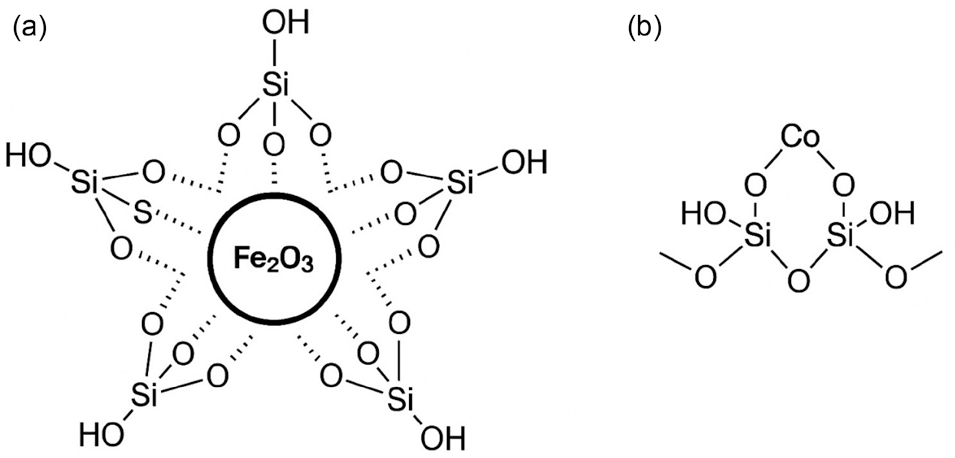
The silica modification process was adapted from the synthesis described by Campbell et al.32 The selected metal chlorides (FeCl3 and CoCl2) were dissolved in deionized water at concentrations of 5 and 10%. A 6 M sodium bicarbonate solution was added dropwise until precipitation occurred. Ascorbic acid was then added, and the solution was stirred under a nitrogen atmosphere for 15 min, followed by the addition of deionized water. Silica samples were introduced into the solution, stirred continuously under nitrogen flow for 24 h. The resulting products were washed with deionized water and dried to obtain the final materials (Figure 1).
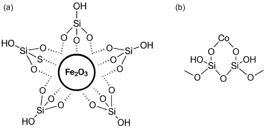
Structure obtained in the reaction with: (a) ferric chloride supported on silica (Si-Fe) and (b) cobalt chloride supported on silica (Si-Co).
It was observed that the addition of the metal load to the silica support induced a color variation depending on the type of metal and its concentration.
In the samples containing 5 and 10% iron, the characteristic coloration of ferric chloride (FeCl3) was observed, displaying a yellow-brown hue due to its hydrated form (FeCl3.6H2O). In samples containing cobalt, the characteristic pink coloration of cobalt chloride hexahydrate (CoCl2.6H2O) was noted, with an intensification of the color in the sample with the higher metal concentration (see Figure S1 presented in the Supplementary Information (SI) section).33
Synthesis of dimethyl carbonate
The conversion of methanol into dimethyl carbonate (DMC) was conducted as described in the literature.34 A 120 mL titanium reactor equipped with magnetic stirring, a temperature controller, and a resistive heating mantle was used. For a typical reaction, 213 mmol of methanol, 0.7 g of the synthesized catalyst, 20 mmol of iodomethane, 2.0 g of molecular sieves, and 40 bar of CO2 were added. The system was heated to 80 °C and maintained for 24 h. After the reaction, the reactor was cooled to room temperature and depressurized slowly.
Material characterization
Fourier transform infrared spectroscopy with universal attenuated total reflectance (UATR-FTIR)
Infrared spectra were recorded using a PerkinElmer Spectrum Three FTIR spectrometer equipped with a universal attenuated total reflectance (UATR) accessory. The UATR top plate featured a single-reflection diamond/ZnSe crystal. Measurements were collected with 16 scans over the range of 4000-650 cm-1.
X-ray diffraction (XRD)
The XRD analysis was performed using a Bruker Siemens D5000 with Cu Kα radiation (λ = 1.542 Å), operated at 40 kV and 30 mA, scanning from 2θ = 2 to 80° at a speed of 0.02° min-1.
Solid-state nuclear magnetic resonance (NMR-MAS)
Solid-state NMR spectra were acquired using a Bruker AVANCE III spectrometer operating at 60 MHz for 29Si in the solid state. Samples were spun at 5 kHz at room temperature in 4 mm rotors.
Thermogravimetric analysis (TGA)
The TGA was conducted using a TA Instruments Q600 under a nitrogen atmosphere, between 80 to 1000 °C at a heating rate of 20 °C min-1, an isotherm was performed at 80 °C for 1 h to remove moisture.
Field emission scanning electron microscopy (FE-SEM)
Surface morphology was examined using a FEI Inspect F50 equipment in secondary electron mode (SE), and the samples were metallized with a layer of gold (Au).
Transmission electron microscopy (TEM)
The size and morphology of the particles were analyzed using a Tecnai G2 T20 FEI operating at 200 kV.
Particle size distribution analysis
The particle size distribution was determined using a CILAS 1180 instrument with a range of 0.04 to 2500 μm.
Surface area analysis (BET)
Surface area was calculated using the Brunauer-Emmett-Teller (BET) method at 77 K with a Quantachrome NOVA 4200e. Samples were degassed for 21 h at 110 °C before analysis.
Density
Bulk and skeletal densities were measured using a helium pycnometer Ultrafoam™ 1200e, Quantachrome Instruments.
Optical analysis
Physical appearance was evaluated using a 50-megapixel camera.
Temperature-programmed oxidation-reduction (TPO)
The oxidation of the synthesized catalysts was determined using temperature-programmed oxygen desorption (O2 TPO) with a Nanos ORD Chemisorption analyzer (Sensiran Co., Iran). The catalyst sample (0.1 g) was placed in the measurement cell and degassed at 100 °C at a heating rate of 10 °C min-1 for 30 min under a helium flow of 10 cm3 min-1. Subsequently, the catalyst was cooled to 50 °C. To initiate the process, a flow of 7 wt.% O2 balanced with high-purity helium was introduced for 30 min at a flow rate of 10 mL min-1. To remove physically adsorbed O2, the carrier gas was switched to helium and maintained for 1 h. The temperature was programmed up to 800 °C at a heating rate of 10 °C min-1 for the desorption process.
Temperature-programmed desorption (TPD)
The distribution of acidic sites in the synthesized catalysts was determined using temperature-programmed ammonia desorption (NH3-TPD) with a Nanos ORD Chemisorption analyzer (Sensiran Co., Iran). The catalyst sample (0.1 g) was placed in the measurement cell and degassed at 300 °C at a heating rate of 10 °C min-1 for 30 min under a helium flow of 10 cm3 min-1. Subsequently, the catalyst was cooled to 50 °C and stabilized for 10 min. For the desorption process, a flow of 5 wt.% NH3 with high purity helium as the carrier gas at a flow rate of 10 mL min-1 was introduced for 30 min. To remove physically adsorbed NH3, the carrier gas was switched to helium and maintained for 1 h. The temperature was programmed up to 800 °C at a heating rate of 10 °C min-1 for the desorption process.
Material efficiency evaluation
Sorption
The CO2 sorption capacity was determined using a dual-chamber gas sorption cell with the pressure decay technique.35 Experiments were conducted in triplicate. Samples (ca. 1 g) were degassed under vacuum (10-3 mbar) at 298.15 K for 1 h prior to measurement. CO2 sorption measurements were performed at 25 °C (298.15 K) under equilibrium pressures of 1, 4, 10, 20, and 30 bar. The recyclability of the material was evaluated by repeating ten sorption / desorption cycles at 30 bar.36
Conversion
Conversion analysis was performed using a Shimadzu GC-2014 gas chromatograph equipped with an SH-Rtx-5 column. The temperature program was as follows: 31 °C for 0.5 min; 10 °C min-1 up to 50 °C for 1 min; 20 °C min-1 up to 100 °C for 2 min; 50 °C min-1 up to 220 °C for 2 min. The samples were diluted to a concentration of 4% (v/v) in diethyl ether and injected into the gas chromatograph. The peak area for DMC was identified between 2.2 and 2.7 min. Conversion calculations were based on the method described in the literature.34,37,38
Methanol conversion was calculated using equation 1:
Dimethyl carbonate (DMC) selectivity was calculated using equation 2:
Results
Characterization of metal-supported silica
FTIR
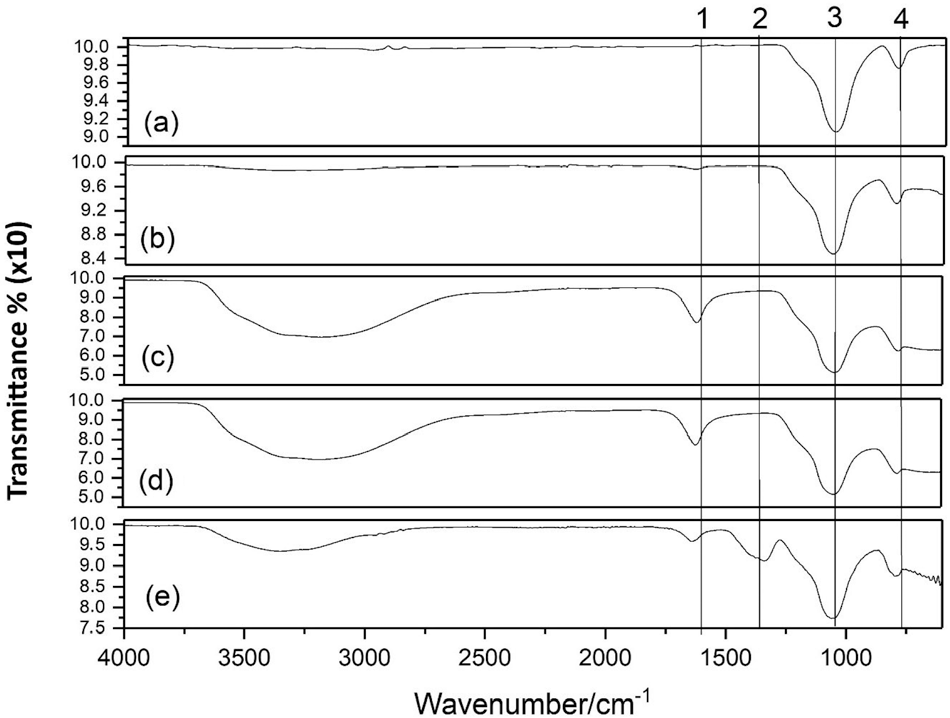
The FTIR spectra of the synthesized silica are presented in Figure 2, with bands labeled from 1 to 4. Across some samples, bands between 3400-3500 cm-1 correspond to O-H stretching vibrations attributed to silanol groups and surface-adsorbed water. The bands at 1639 and 1350 cm-1 (1 and 2) are assigned to bending vibrations of water molecules and Si-O vibrations. Bands at 1080 and 800 cm-1 (3 and 4) are related to Si-O, Si-O-Si vibrations.
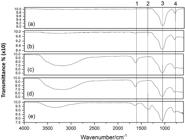
Attenuated total reflectance infrared spectra from the samples (a) Si, (b) Si-Fe 5%, (c) Si-Fe 10%, (d) Si-Co 5% and (e) Si-Co 10%.
Meanwhile, the bands from 1 to 4 confirm the successful synthesis of silica derived from rice husk and the incorporation of metals into the silica support. This conclusion is supported by the more intense bands observed in the metal-incorporated samples, which align with findings reported in the literature.31,39-42
XRD
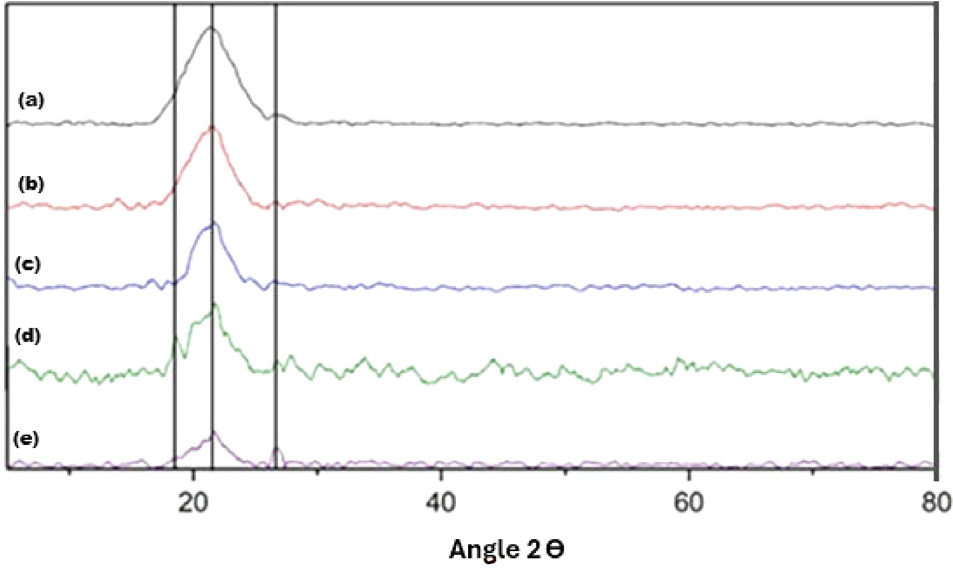
The XRD diffractogram of silica samples and silica with varying amounts of synthesized metal are shown in Figure 3. The diffractogram of the silica sample (Si) exhibits a typical characteristic of silica, including a broad peak between 2θ = 15-30° (International Centre for Diffraction Data (ICDD, formerly JCPDS) 39-1425), which is indicative of amorphous silica. This observation is consistent with the findings of Shirini et al.41 and Villota-Enríquez et al.,24 who reported similar patterns in their studies on silica extracted from rice husks.
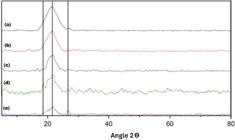
Diffractograms of the samples (a) Si, (b) Si-Fe 5%, (c) Si-Fe 10%, (d) Si-Co 5%, and (e) Si-Co 10%.
The intensity of the characteristic peak of amorphous silica slightly decreases as Fe2O3 is incorporated into the silica structure, indicating that Fe2O3 particles are embedded within the support matrix. Additionally, no crystalline phase of Fe2O3 is observed in any of the synthesized catalysts, suggesting that Fe2O3 is highly dispersed and immobilized on the SiO2 surface. These findings align with the results of Shirini et al.41 and Zhou et al.,43 who used mesoporous silica as a support for FeCl3.
For cobalt-supported silica samples, the characteristic amorphous SiO2 peak at 2θ = 15-30° (JCPDS 00-029-0507) remains present. Additionally, a “shoulder” at 2θ = 18.6° is observed, which may indicate the formation of Si-O-Co bonds. Other characteristic peaks may overlap due to the structural similarity of silica and cobalt, as both exhibit spinel structures, as described by Zola et al.,44 resulting in closely positioned peaks. It is also noted that the peak intensity decreases with increasing metal content, attributed to the shielding effect of the porous silica matrix on X-ray detection. This phenomenon was similarly reported by Xie et al.45 and Zola et al.44 in their studies on cobalt immobilization in mesoporous silica supports.
Solid-state NMR (SSNMR)
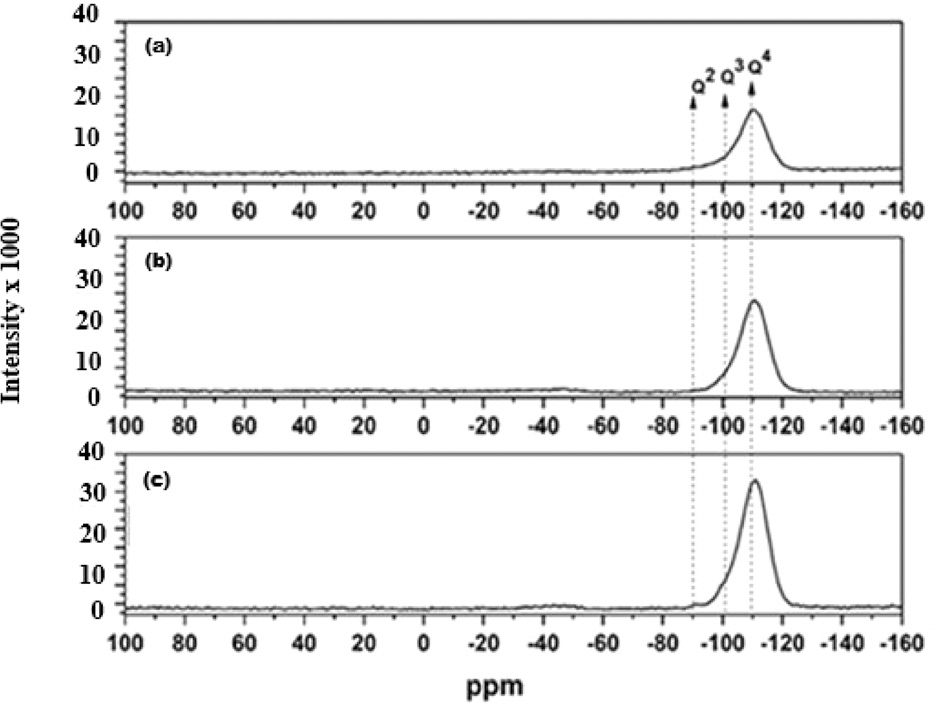
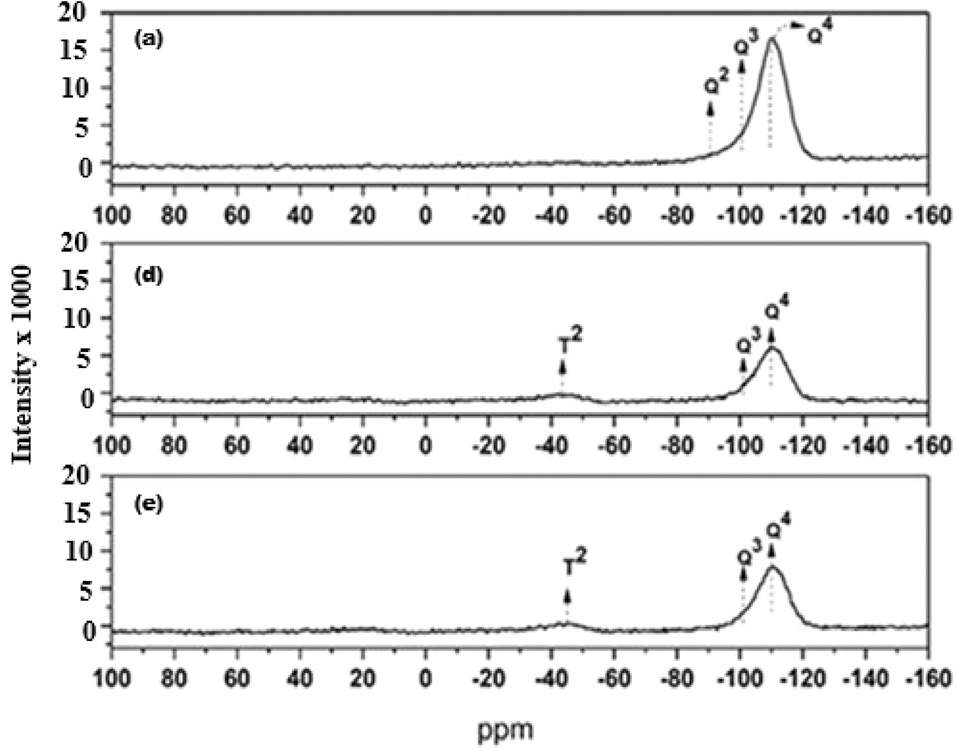
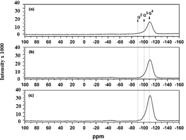
The synthesized materials were analyzed using solid-state nuclear magnetic resonance (SSNMR), and the results are shown in Figure 4. In the silica sample extracted from rice husks, a resonance at -110 ppm was observed, attributed to [Si(OSi)4] (Q4), which is characteristic of silica samples.46,47 For the samples containing iron supported on silica, three overlapping resonances ranging from -90 to -120 ppm were identified. These resonances are associated with [Si-(OSi)2(OH)2] (Q2), [Si-(OSi)3(OH)] (Q3), and [Si-(OSi)4] (Q4) from the iron and silica structures, which are overlapping. Notably, an enhancement of the Q2 peak is observed in the sample containing 10% iron, which is absent in the sample with 5% iron. This difference is attributed to the higher amount of supported metal. Furthermore, in the silica samples with iron, it was noted that as the concentration of this element increased, the intensity of the silica signals also increased. This can be explained by the magnetic effect generated by the iron cation, which causes an interaction between the nuclear spin of 29Si and the unpaired electrons of the d orbital of the iron itself.48-50
In the samples containing cobalt, shown in Figure 5, three characteristic overlapping resonances between -90 and -120 ppm were observed, corresponding to geminal silanols (Q2), isolated silanols (Q3), and siloxane bridges (Q4). A decrease in resonance intensity was noted with the addition of cobalt, indicating the successful formation of the Si-O-Co bond.51-54
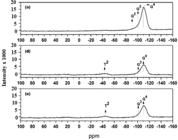
The metals interact with the surface of the silica structure, mainly with the hydroxyl molecules. In the material containing cobalt, it is possible to observe the presence of T2 peaks in the region between -48 and -50 ppm (Figure 5), which indicates a bond between cobalt(II) oxide and the surface of the silica structure, as shown in Figure 2.55,56
All the resonances identified in the MAS NMR analysis are consistent with the bands observed in the FTIR-UATR analysis, confirming the incorporation of the metallic materials into the silica supports.
Thermogravimetric analysis (TGA)
The thermal analysis results are summarized in Table 1, which evaluates the thermal stability of the silica support before and after its interaction with the metals. The isotherms of the TG analysis are shown in Figure S2 (SI section).
Pure silica exhibits a mass loss stage between 137 °C, attributed to the loss of physically adsorbed water, and a mass loss at 680.16 °C probably attributed to the release of water formed by the condensation of silanols.46,57,58 For the sample containing 5% of iron, two distinct mass loss stages were observed. The first, at 140 °C, is associated with the removal of strongly bound water molecules. The second stage, observed at 548 °C, is related to the decomposition of anhydrous ferric chloride, resulting in the formation of iron oxide.59,60
For the sample containing 10% iron, three stages of mass loss were observed. The first, at 447 °C, is associated with a phase change in iron and the formation of iron oxide. The second mass loss, at 562 °C, is attributed to the decomposition of anhydrous ferric chloride, and the third mass loss, at 645 °C, is probably related to the release of water formed by the condensation of silanols.58-61
In samples containing 5% cobalt, two distinct mass losses were observed, while samples containing 10% cobalt exhibited three mass losses. The three subsequent mass losses, beginning around 260 °C and extending to approximately 600-800 °C, are associated with interactions between the cobalt particle colloid and the silanol groups of the support structure, delaying their condensation.44,58
Scanning electron microscopy (SEM)
SEM was performed to evaluate the surface topography of the samples, as shown in Figure S3 (SI section). The samples exhibit grains of various sizes, with lighter-colored areas corresponding to amorphous silica, while darker-pigmented regions indicate porous cavities. These observations align with the findings of Supiyani et al.,31 who synthesized silica nanoparticles via the sol-gel method using rice husk for water adsorption in methamphetamine analysis.31,62
Transmission electron microscopy (TEM)
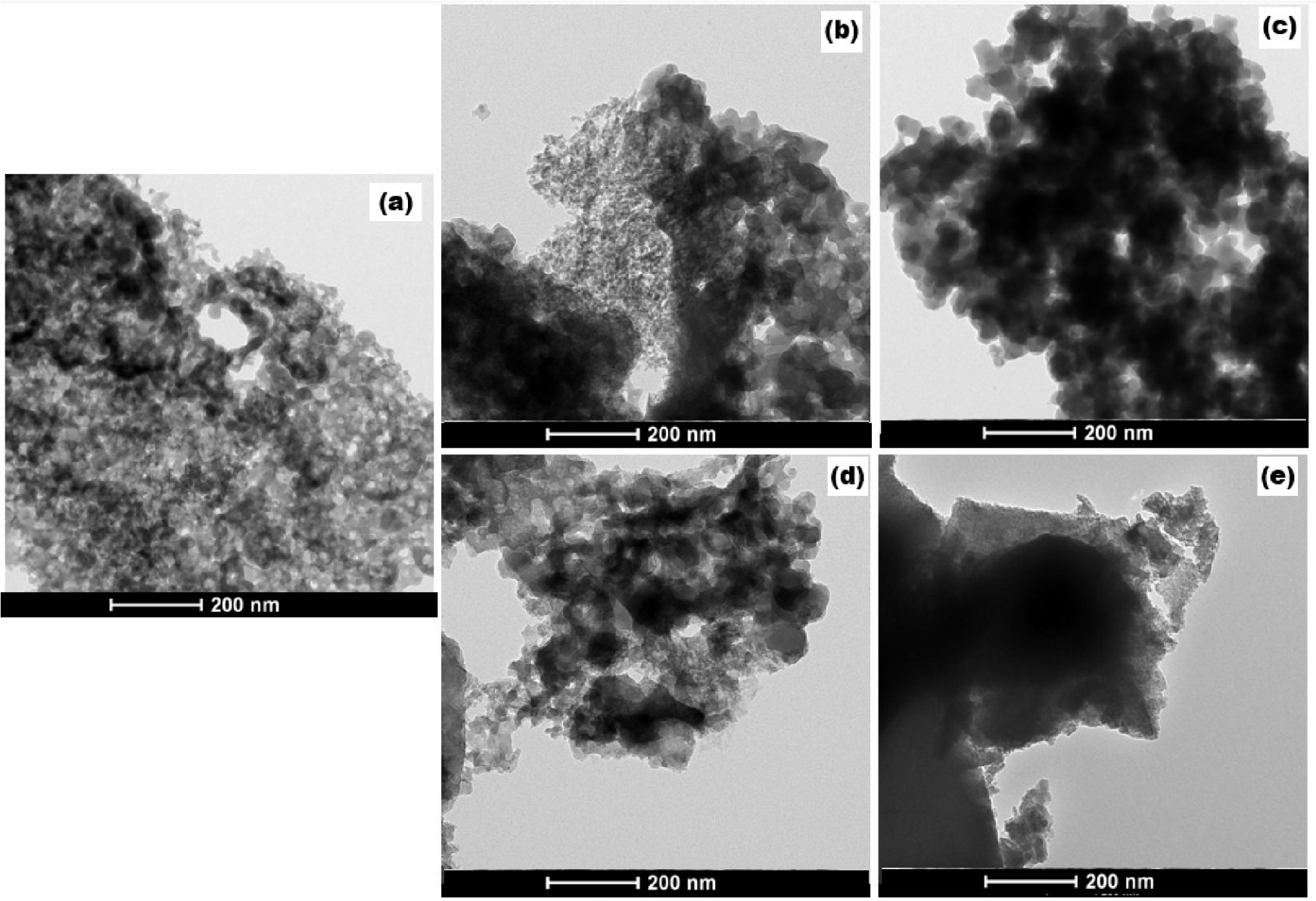
The TEM images, shown in Figure 6 reveal a highly porous structure for the silica sample. In the samples containing metals (5% iron and 5% cobalt), the porous structure of the support (lighter regions) and the incorporation of metals (darker regions) can be observed.
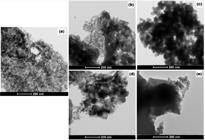
In samples containing 10% iron and 10% cobalt, it becomes more difficult to visualize the porous structure of the support due to the higher metal content. This higher metal content enhances the visibility of the metallic load, as described by Akti et al.,63,64 in their studies synthesizing silica supports with cobalt and iron.
Particle size distribution analysis
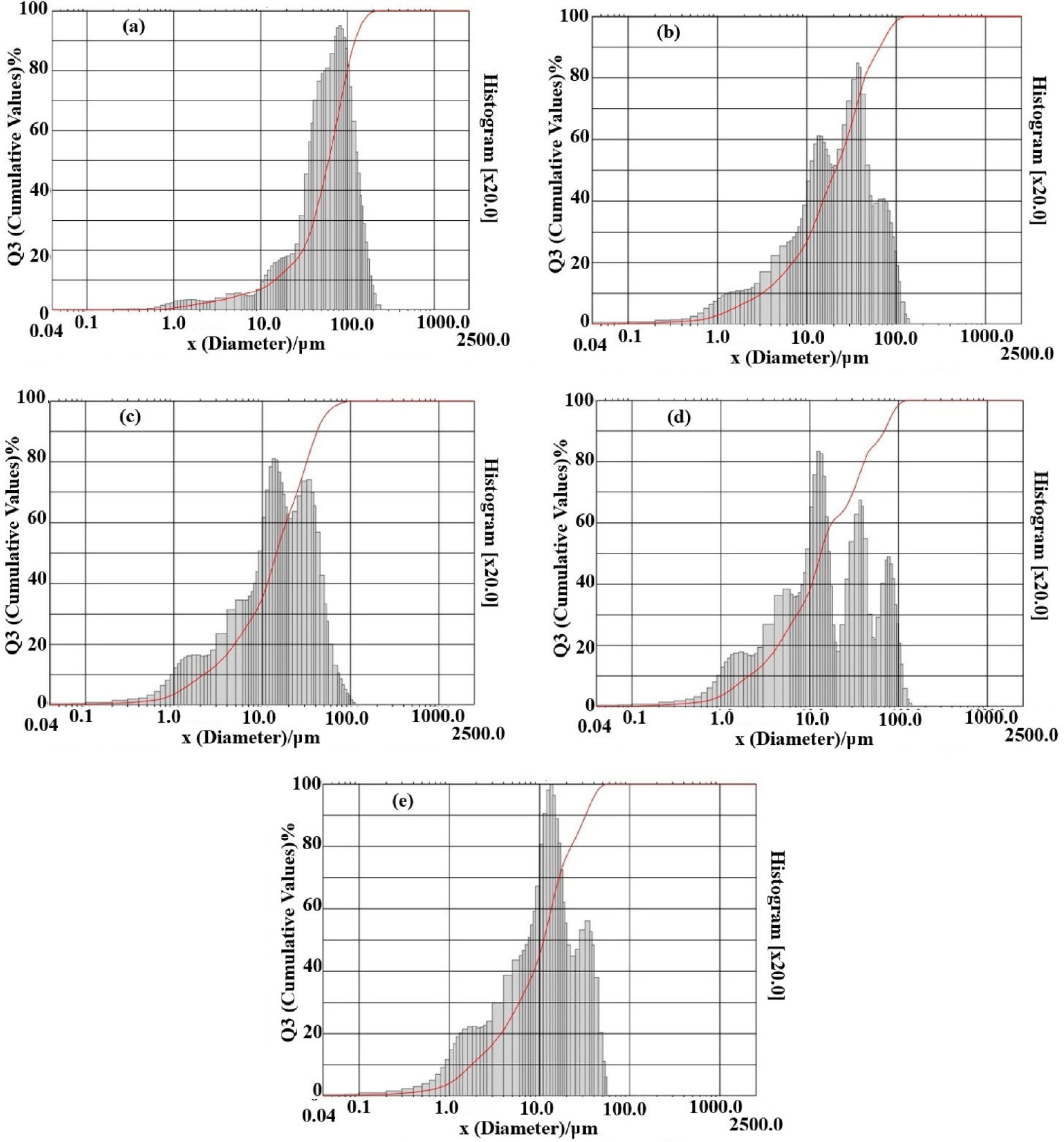
The particle size distribution results, shown in Figure 7 and detailed in Table 2, indicate a decrease in grain size upon the impregnation of 5% metallic loading. The grain size reduced from 66.29 µm (Si) to 28.16 µm (Si-Fe 5%) and 24.67 µm (Si-Co 5%). When the metallic loading increased to 10%, the grain size decreased further, reaching 19.20 µm (Si-Fe 10%) and 13.95 µm (Si-Co 10%).
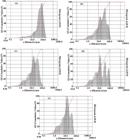
Particle size distribution images of (a) Si, (b) Si-Fe 5%, (c) Si-Fe 10%, (d) Si-Co 5%, and (e) Si-Co 10%.
This reduction in particle size with the addition of metallic loadings suggests that the particles were not subjected to agglomeration, being homogeneously dispersed. Similar behavior was reported by Mudrinić et al.,65 who synthesized cobalt supported on alumina via a mechanochemical method for cellulose detection.
BET and density analysis
The BET surface area and density values are summarized in Table 3. For the silica sample (Si), a surface area of 64 m2 g-1 was obtained. This value is lower than those reported in the literature,43 which can be directly attributed to the specific extraction method used for silica. As demonstrated by Steven et al.,66 different preparation steps for silica extraction from rice husk significantly influence the final surface area.
In the samples containing 5% iron, a decrease in surface area was observed compared to pure silica, consistent with literature49,67 findings. However, in the sample with 10% iron, an increase in surface area was noted compared to the 5% sample. This behavior could be due to the creation of additional pores as a result of Fe species diffusion into the SiO2 support. Alternatively, during the iron impregnation process, some organosilane groups, which are larger than iron species, may have been removed, leading to a slight unblocking of the pores.49,67
For the samples containing cobalt, an increase in the surface area was observed as the concentration of cobalt increased. This phenomenon can be attributed to the formation of interstitial pores, which are caused by the particle stacking channels present in the sample. The formation of these channels is a consequence of the incorporation of cobalt into the sample.68
Temperature-programmed oxidation-reduction (TPO) / temperature-programmed desorption (TPD-NH3)
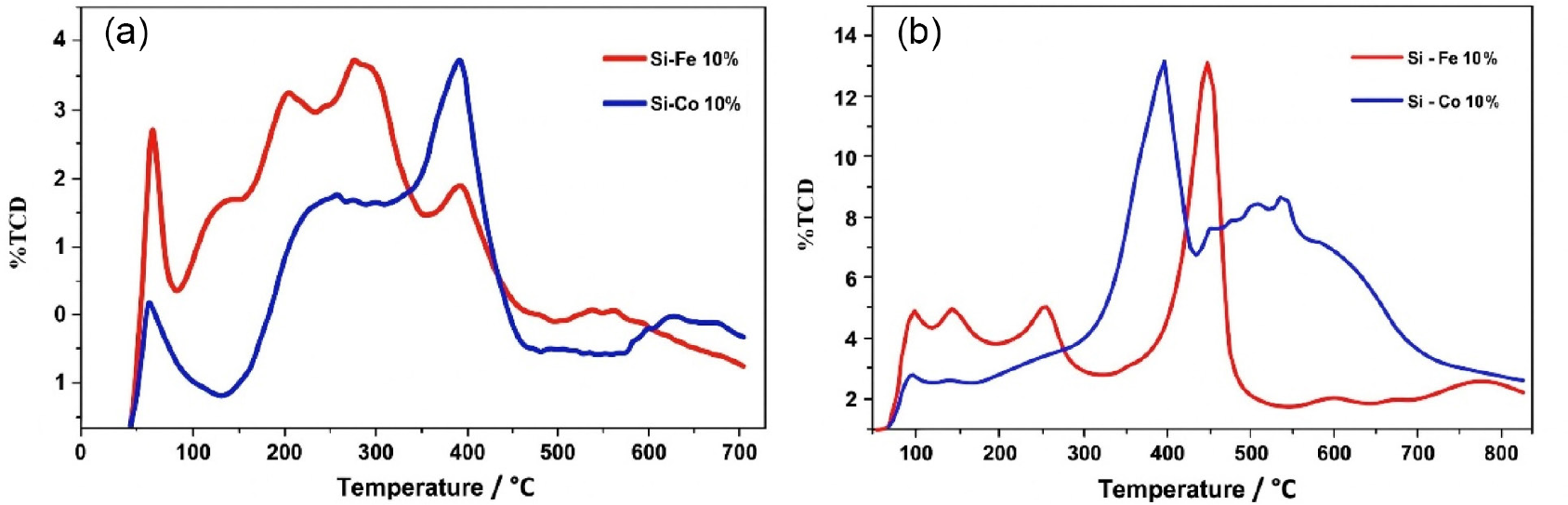
To evaluate the reducibility of the silica and metal-modified silica samples, the TPO method was employed. The analysis focused on the samples with the highest metal content to assess their reduction behavior. The results, presented in Figure 8a, indicate that the sample containing iron showed a maximum peak around 400-500 °C which indicates the oxidation of Fe3O4 to Fe2O3.69,70
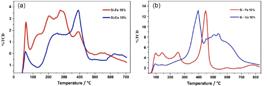
(a) Results of TPO analysis of the Si-Fe 10% and Si-Co 10% samples, (b) TPD-NH3 results of Si-Fe 10% and Si-Co 10% samples.
The silica sample modified with 10% cobalt was also analyzed to assess its reducibility. The presence of multiple peaks is directly related to the oxidation state, dispersion, and interaction of Co species with the SiO2 support. The peak observed around 200-300 °C is attributed to the oxidation of CoO to CO3O4, which occurs above 100 °C and below 950 °C.69
According to Chernyak et al.,71 metals in oxidation states such as Co3+ and Fe3+ exhibit improved conversion efficiency when used as catalysts. The samples synthesized in this study maintain these oxidation states up to 200 and 405 °C, respectively, indicating their stability under the conditions relevant for catalytic conversion tests.71
The TPD-NH3 analysis enables the identification of acidic sites present in the structure of the material. The results presented in Figure 8b indicate that the number of acidic sites on the catalyst surface is proportional to the amount of NH3 adsorbed during the analysis.
In both samples, Si-Fe 10% and Si-Co 10%, a desorption band of NH3 is observed in the range of 50 300 °C, indicating the presence of intermediate-strength acid sites. In the range of 300-450 °C, characteristic bands of weak acid sites are detected, while at temperatures above 500 °C, bands corresponding to strong acid sites are observed.38,72,73 The presence of both acidic and basic sites enhances the catalytic activity of the materials, and the formation of dimethyl carbonate (DMC) is more efficient in catalysts that contain both acidic and basic sites in their structure.72-76
When used as a catalyst for converting methanol into DMC, the iron-containing material (Table S1, SI section) is more promising, due to the use of higher temperature and pressure. According to the TPD-NH3 analyses, we can see that a sample containing iron requires a higher activation energy (226.51 kJ mol-1) than cobalt (206.34 kJ mol-1), due to lower desorption energies, indicating that less energy is required to desorb NH3 molecules absorbed on the surface of the cobalt-containing catalyst, suggesting weaker metal-support interactions in the samples, unlike the iron-containing samples, that show higher activation energy, suggesting stronger metal-support interactions. This makes them better for catalyzed reactions, which require higher pressure and temperatures.77,78
Application of metal nanoparticles
Sorption
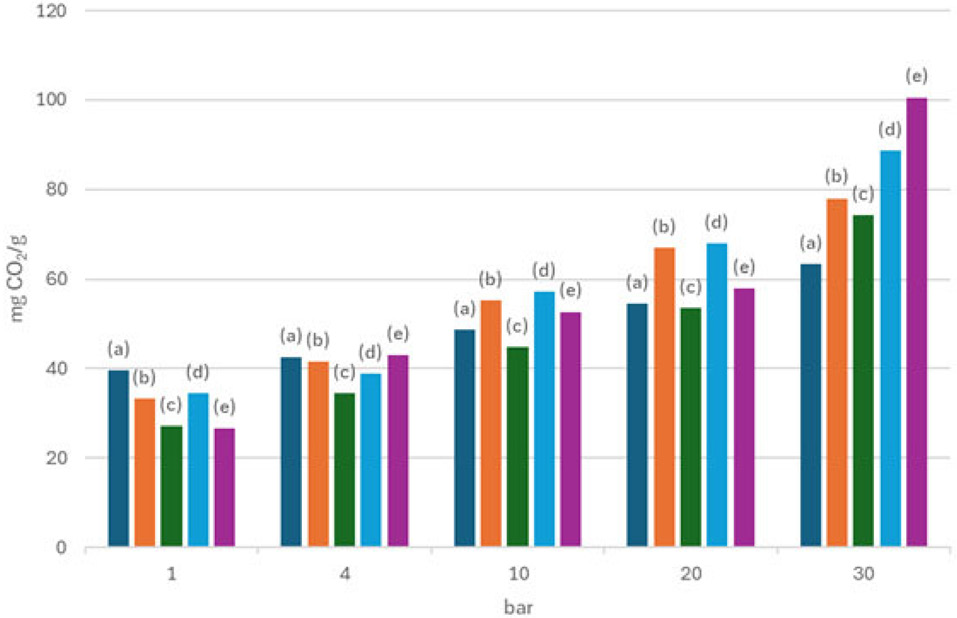
Figure 9 presents the CO2 capture performance of the different samples in comparison with pure silica.
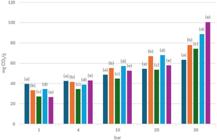
Sorption capacity of samples: (a) Si, (b) Si-Fe 5%, (c) Si Fe 10%, (d) Si-Co 5%, and (e) Si-Co 10%.
The Si-O-H functionalities (silanols) present in the silica interact with CO2 molecules, promoting their physical adsorption.79 CO2 capture by physisorption is driven by van der Waals interactions between CO2 molecules and the adsorbent surface, which makes the process reversible. The adsorption capacity of physical adsorbents is directly influenced by parameters such as specific surface area, pore structure and distribution, surface functionalization, and operational conditions (temperature and pressure). In general, increasing pressure enhances CO2 adsorption capacity by promoting greater molecular penetration into the adsorbent structure.80
The results indicate that, under low-pressure conditions (up to 4 bar), metal impregnation on the silica surface reduced the CO2 capture capacity of the support. This behavior seems unrelated to the textural properties shown in Table 3, but is likely caused by oxides blocking silanol groups, which reduces CO2 adsorption capacity. The impregnation of metal on the silica surface can provide additional active sites for interaction with CO2. However, these sites appear to exhibit greater activity only under high-pressure conditions. Similar behavior was observed when cellulose was functionalized with TiO2 and Fe2O3.32
Simulation studies conducted with metal oxides (TiO2, CuO, Fe2O3) in our previous work81 demonstrated that the interaction energies with CO2 are directly proportional to the polarities of the metal particles. Since these metal oxides exhibit similar electronegativity (1.63 for Ti, 1.88 for Fe, and 1.90 for Cu), no significant differences in CO2 binding affinities were observed. Therefore, the variations in CO2 sorption capacities can be attributed to the degree of dispersion of the metal particles.
Iron and cobalt also exhibit similar electronegativity, suggesting that factors such as dispersion, pore size, surface area, and partial pressure may have a greater influence on CO2 adsorption performance than the identity of the metal species.
CO2 adsorption on inorganic oxides occurs via Lewis acid-base interactions. At elevated temperatures, the interaction between acidic and basic oxides results in the formation of carbonate salts.81 Herein, the adsorption mechanism is exclusively physical, due to the low temperature used in the sorption test. It is well documented that CO2 sorption capacity increases with increasing partial pressure when the adsorption is physical.
At pressures of 10 and 20 bar, concentrations of up to 5% iron and cobalt appear beneficial for CO2 capture. This effect may be attributed to the improved dispersion of metal particles in the silica (see Figure 6), which also facilitates interaction between silanol groups and CO2.
At a pressure of 30 bar, both 5 and 10% metal loadings promoted an increase in CO2 capture capacity. However, the highest performance was observed for the 10% cobalt sample. This behavior may be attributed to the increased surface area and average pore radius (see Table 3), likely resulting from the formation of channels generated by the stacking of cobalt particles.
Table 4 presents a comparison of the CO2 capture results obtained in this study with those reported in the literature82-85 for different materials. The silica samples containing Co and Fe demonstrated superior performance compared to biochar derived from straw and peel under comparable temperatures and slightly elevated pressures. At 4 bar, the Si-Co 10% sample presented superior CO2 sorption capacity than the imidazolium-based ionic liquids (ILs) supported on commercial MCM-41 mesoporous silica (ILBF4M50 and ILTf2NM50). At higher pressure (30 bar), the same sample (Si-Co 10%) also outperformed Li-functionalized cellulose derived from rice husk. These findings highlight the considerable potential of metal-functionalized rice husk-derived silica as sustainable materials for CO2 capture.
Recycling tests
To evaluate the stability of the sample after successive sorption/desorption cycles, recycling tests were performed on the sample that exhibited the highest CO2 sorption capacity at its respective equilibrium pressure: Si-Co 10% (100.56 mg CO2 g-1) at 30 bar. The sample remained stable for up to 10 cycles, demonstrating good stability and reusability, see Figure S4 (SI section).
Direct synthesis of dimethyl carbonate
Table S1 (SI section) presents the conversion values obtained in the direct synthesis of DMC from CO2 and methanol, along with the reaction conditions. The highest conversions were achieved with the supported catalysts containing higher metal content, specifically Si Fe 10% (22.91%) and Si-Co 10% (20.05%) in the presence of sieve and iodide. These results indicate that catalysts with 10% metal content exhibited superior conversion capacity. The values obtained surpass those reported in the literature for direct DMC synthesis using catalysts derived from agro-industrial waste, such as eggshell-derived catalysts impregnated with various metals under similar reaction conditions, as described by Faria et al.38
It is noteworthy that conversion values close to those reported by Chen et al.37 were achieved in this study. In their work utilizing zinc and cerium complexes, they observed improved results by increasing the Zn content in the complexes. However, their process required a temperature of 160 °C for 48 h, rendering it more costly and time-consuming, without even considering the synthesis costs of the complexes. In contrast, the metal-modified catalyst supported on silica derived from agricultural waste demonstrated a promising capacity for dimethyl carbonate (DMC) conversion. This was achieved under optimized parameters such as catalyst quantity, temperature, pressure, and reaction time, as previously reported in studies.34,38,86-88
Chaban et al.86 synthesized dimethyl carbonate using NaCl and investigated the removal of molecular sieves from the reaction. They reported conversion rates of 14 to 18% using approximately 0.7 to 1.0 g of NaCl as the catalyst. In the present study, under similar conditions, superior conversion rates were achieved: entry 6, 19.60% (Si Fe 10%) and entry 7, 17.20% (Si-Co 10%) using 0.7 g of the synthesized catalyst. These values are comparable to those obtained with reactions involving molecular sieves.86 However, when CH3I was removed from the reaction, entries 8 and 9, either with or without the molecular sieve, entries 10 and 11, the conversion rates were lower compared to the complete reaction system without the sieve. Computer simulation and experimental studies38,88 have shown that, even in the presence of catalysts, the process is thermodynamically more favorable when CH3I is used as a promoter and molecular sieves are employed to remove moisture from the system.
Recycling tests were conducted on the materials exhibiting the highest conversion capacities, namely Si Fe 10% (22.91%) and Si-Co 10% (20.05%), to evaluate their stability and recyclability as catalysts. The materials demonstrated stability for up to four cycles under the same synthesis conditions. After the fourth cycle, a decrease in catalytic performance was observed. The Si-Fe sample exhibited decreases of approximately 8.7 and 13.1% in the fifth and sixth cycles, respectively, while the Si-Co sample showed reductions of 9.7 and 22.7% under the same conditions, as shown in Figure S5 (SI section). For up to four cycles the materials demonstrated stability indicating their potential for sustainable and efficient catalytic applications, especially considering the use of waste materials to obtain the support and low-cost precursors in the synthesis of the catalysts. Furthermore, the catalysts developed in this study exhibited superior catalytic stability compared to previous works,38,88 in which low-cost catalysts were produced for the synthesis and conversion of DMC.
Conclusions
Metallic materials supported on silica extracted from rice husk ash were successfully synthesized and characterized for their properties and applications in CO2 sorption and conversion. Through FTIR, XRD, and MAS NMR analyses, it was concluded that the silica extraction was successful and the metals were effectively bonded to the support material. TEM, SEM, and particle size analysis confirmed that the metallic materials were homogeneously dispersed on the support without signs of agglomeration.
The supported materials exhibited good sorption capacity at higher equilibrium pressures (above 10 bar) and demonstrated stability and recyclability in recycling tests. At 10-20 bar, up to 5% Fe and Co enhance CO2 capture due to improved metal dispersion in silica, while at 30 bar, both 5% and 10% loads increase capacity. However, the Co-containing silica samples showed the best performance, likely due to their higher surface area and pore size resulting from channel formation.
Finally, the supported materials were evaluated as catalysts for the direct synthesis of dimethyl carbonate (DMC) using methanol and CO2 as starting materials. Conversion rates of 22.91 and 20.05% were achieved for the samples containing 10% iron (Si-Fe 10%) and 10% cobalt (Si-Co 10%), respectively. The materials demonstrated stability and good recyclability for up to four cycles in conversion tests. Additionally, the possibility of eliminating molecular sieves and iodide from the reactions was investigated. It was concluded that the absence of molecular sieves resulted in a conversion variation of approximately 3%.
In summary, silica extracted from rice husk ash, when used as a support for metallic materials, proved to be a promising material for CO2 capture at 30 bar equilibrium pressure and 25 °C, as well as for the conversion of CO2 into value-added products such as dimethyl carbonate at 80 °C and 40 bar CO2 pressure. The sample containing 10% cobalt supported on silica showed the highest CO2 sorption capacity at high pressure, possibly due to its larger surface area and increased pore size resulting from channel formation. In contrast, the Si-Fe 10% sample exhibited the best catalytic performance, probably due to the metal-support interaction and an appropriate balance between acidic and basic sites. These findings highlight the potential of this sustainable and cost-effective approach for CO2 utilization and catalysis.
Supplementary Information
Supplementary information is available free of charge at http://jbcs.sbq.org.br as PDF file.
Acknowledgments
Sandra Einloft thanks CNPq for the research scholarship.
Data Availability Statement
All data obtained in this research is available in the text.
References
-
1 Huo, C.; Hameed, J.; Sharif, A.; Albasher, G.; Alamri, O.; Alsultan, N.; Baig, N.; Environ. Res. 2022, 212, 113067. [Crossref]
» Crossref -
2 Calvin, K.; Dasgupta, D.; Krinner, G.; Mukherji, A.; Thorne, P. W.; Trisos, C.; Romero, J.; Aldunce, P.; Barret, K.; Blanco, G.; Cheung, W. W. L.; Connors, S. L.; Denton, F.; Diongue Niang, A.; Dodman, D.; Garschagen, M.; Geden, O.; Hayward, B.; Jones, C.; Jotzo, F.; Krug, T.; Lasco, R.; Lee, Y. Y.; Masson Delmotte, V.; Meinshausen, M.; Mintenbeck, K.; Mokssit, A.; Otto, F. E. L.; Pathak, M.; Pirani, A.; Poloczanska, E.; Pörtner, H. O.; Revi, A.; Roberts, D. C.; Roy, J.; Ruane, A. C.; Skea, J.; Shukla, P. R.; Slade, R.; Slangen, A.; Sokona, Y.; Sörensson, A. A.; Tignor, M.; van Vuuren, D.; Wei, Y. M.; Winkler, H.; Zhai, P.; Zommers, Z.; Hourcade, J. C.; Johnson, F. X.; Pachauri, S.; Simpson, N. P.; Singh, C.; Thomas, A.; Totin, E.; Alegría, A.; Armour, K.; Bednar-Friedl, B.; Blok, K.; Cissé, G.; Dentener, F.; Eriksen, S.; Fischer, E.; Garner, G.; Guivarch, C.; Haasnoot, M.; Hansen, G.; Hauser, M.; Hawkins, E.; Hermans, T.; Kopp, R.; Leprince-Ringuet, N.; Lewis, J.; Ley, D.; Ludden, C.; Niamir, L.; Nicholls, Z.; Some, S.; Szopa, S.; Trewin, B.; van der Wijst, K. I.; Winter, G.; Witting, M.; Birt, A.; Ha, M.; IPCC, 2023: Climate Change 2023: Synthesis Report. Contribution of Working Groups I, II and III to the Sixth Assessment Report of the Intergovernmental, Switzerland, 2023. [Crossref]
» Crossref -
3 Global Monitoring Laboratory (GML); Carbon Cycle Greenhouse Gases, Trends in CO2, 2023. [Link] accessed in February 2026
» Link -
4 Duczinski, R.; Bernard, F.; Rojas, M.; Duarte, E.; Chaban, V.; Vecchia, F. D.; Menezes, S.; Einloft, S.; J. Nat. Gas Sci. Eng. 2018, 54, 54. [Crossref]
» Crossref -
5 Moya, C.; Alonso-Morales, N.; Gilarranz, M. A.; Rodriguez, J. J.; Palomar, J.; ChemPhysChem 2016, 17, 3891. [Crossref]
» Crossref -
6 Polesso, B. B.; Bernard, F. L.; Ferrari, H. Z.; Duarte, E. A.; Vecchia, F. D.; Einloft, S.; Heliyon 2019, 5, e02183. [Crossref]
» Crossref -
7 Zhang, M.; Xu, Y.; Williams, B. L.; Xiao, M.; Wang, S.; Han, D.; Sun, L.; Meng, Y.; J. Cleaner Prod. 2021, 279, 123344. [Crossref]
» Crossref -
8 Custodio, R. F.; Valarini Jr., O. V.; Vieira, A. L.; de Souza, T. L.; Bezerra, F. L. A.; Bonfim-Rocha, L.; Processes 2025, 13, 573. [Crossref]
» Crossref -
9 Medrano-García, J. D.; Javaloyes-Antón, J.; Vázquez, D.; Ruiz-Femenia, R.; Caballero, J. A.; J. CO2 Util. 2021, 45, 101436. [Crossref]
» Crossref -
10 Xiao, Y.; Lei, B.; Jiang, H.; Xie, Y.; Du, J.; Xu, W.; Ma, D.; Zhong, M.; J. Environ. Sci. 2025, 155, 613. [Crossref]
» Crossref -
11 O’Neill, M. F.; Sankar, M.; Hintermair, U.; ACS Sustainable Chem. Eng. 2022, 10, 5243. [Crossref]
» Crossref -
12 Gac, W.; Zawadzki, W.; Kuśmierz, M.; Słowik, G.; Grudziński, W.; Appl. Surf. Sci. 2023, 631, 157542. [Crossref]
» Crossref -
13 Kaewtrakulchai, N.; Chanpee, S.; Jadsadajerm, S.; Wongrerkdee, S.; Manatura, K.; Eiad-Ua, A.; Carbon Resour. Convers. 2024, 7, 100231. [Crossref]
» Crossref -
14 Bian, Q.; Li, S.; Shen, R.; Shen, S.; Wen, Z.; Jiang, X.; Gou, F.; J. Solid State Chem. 2024, 332, 124560. [Crossref]
» Crossref -
15 Kharrazi, A.; Babatabar, M. A.; Ibrahim, H.; Tavasoli, A.; J. Energy Inst. 2024, 112, 101453. [Crossref]
» Crossref -
16 Zhao, C.; Yang, L.; Xing, S.; Luo, W.; Wang, Z.; Lv, P.; J. Cleaner Prod. 2018, 199, 772. [Crossref]
» Crossref -
17 Sun, J.; Lu, B.; Wang, X.; Li, X.; Zhao, J.; Cai, Q.; Fuel Process. Technol. 2013, 115, 233. [Crossref]
» Crossref -
18 Zhao, T.; Hu, X.; Wu, D.; Li, R.; Yang, G.; Wu, Y.; ChemSusChem 2017, 10, 2046. [Crossref]
» Crossref -
19 Kumar, P.; With, P.; Srivastava, V. C.; Gläser, R.; Mishra, I. M.; J. Alloys Compd. 2017, 696, 718. [Crossref]
» Crossref -
20 Fu, Z.; Zhong, Y.; Yu, Y.; Long, L.; Xiao, M.; Han, D.; Wang, S.; Meng, Y.; ACS Omega 2018, 3, 198. [Crossref]
» Crossref -
21 Chiang, C. L.; Lin, K. S.; Yu, S. H.; Lin, Y. G.; Int. J. Hydrogen Energy 2017, 42, 22108. [Crossref]
» Crossref -
22 Saada, R.; Kellici, S.; Heil, T.; Morgan, D.; Saha, B.; Appl. Catal., B 2015, 168-169, 353. [Crossref]
» Crossref -
23 da Silva, O. F.; Wander, A. E.; Estatística de Produção; Embrapa, 2025. [Link] accessed in February 2026
» Link -
24 Villota-Enríquez, M. D.; Rodríguez-Páez, J. E.; Mater. Chem. Phys. 2023, 301, 127671. [Crossref]
» Crossref -
25 IBGE; Produção de Arroz. [Link] accessed in February 2026
» Link -
26 Asadullah, M.; Renewable Sustainable Energy Rev. 2014, 29, 201. [Crossref]
» Crossref -
27 Nzereogu, P. U.; Omah, A. D.; Ezema, F. I.; Iwuoha, E. I.; Nwanya, A. C.; Hybrid Adv. 2023, 4, 100111. [Crossref]
» Crossref -
28 Abaide, E. R.; Tres, M. V.; Zabot, G. L.; Mazutti, M. A.; Biomass and Bioenergy 2019, 120, 240. [Crossref]
» Crossref -
29 Akhter, F.; Soomro, S. A.; Jamali, A. R.; Chandio, Z. A.; Siddique, M.; Ahmed, M.; Biomass Convers. Biorefin. 2023, 13, 4639. [Crossref]
» Crossref -
30 Tanveer, M.; Khan, S. A. R.; Umar, M.; Yu, Z.; Sajid, M. J.; Haq, I. U.; Environ. Sci. Pollut. Res. 2022, 29, 80161. [Crossref]
» Crossref -
31 Supiyani; Agusnar, H.; Sugita, P.; Nainggolan, I.; S. Afr. J. Chem. Eng. 2022, 40, 80. [Crossref]
» Crossref -
32 Campbell, S.; Bernard, F. L.; Rodrigues, D. M.; Rojas, M. F.; Carreño, L. A.; Chaban, V. V.; Einloft, S.; Fuel 2019, 239, 737. [Crossref]
» Crossref - 33 Toma, H.; Lee, J.; Araki, K.; Rocha, R.; Lee, J. D.; Química Inorgânica Não tão Concisa, vol. 1, 1st ed.; Blucher: São Paulo, Brazil, 1999.
-
34 Faria, D. J.; dos Santos, L. M.; Bernard, F. L.; Pinto, I. S.; Resende, M. A. C. M.; Einloft, S.; RSC Adv. 2020, 10, 34895. [Crossref]
» Crossref -
35 Koros, W. J.; Paul, D. R.; J. Polym. Sci., Polym. Phys. Ed. 1976, 14, 1903. [Crossref]
» Crossref -
36 Bernard, F. L.; Duczinski, R. B.; Rojas, M. F.; Fialho, M. C. C.; Carreño, L. A.; Chaban, V. V.; Vecchia, F. D.; Einloft, S.; Fuel 2018, 211, 76. [Crossref]
» Crossref -
37 Chen, H.; Wang, S.; Xiao, M.; Han, D.; Lu, Y.; Meng, Y.; Chin. J. Chem. Eng. 2012, 20, 906. [Crossref]
» Crossref -
38 Faria, D. J.; dos Santos, L. M.; Bernard, F. L.; Pinto, I. S.; Chaban, V. V.; Romero, I. P.; Einloft, S.; J. Mol. Struct. 2023, 1292, 136110. [Crossref]
» Crossref -
39 Dias, G.; Prado, M.; Le Roux, C.; Poirier, M.; Micoud, P.; Ligabue, R.; Martin, F.; Einloft, S.; Polym. Bull. 2020, 77, 975. [Crossref]
» Crossref -
40 Faria, L. L.; Morales, S. A. V.; Prado, J. P. Z.; Dias, G. S.; de Almeida, A. F.; Xavier, M. C. A.; da Silva, E. S.; Maiorano, A. E.; Perna, R. F.; Biotechnol. Lett. 2021, 43, 43. [Crossref]
» Crossref -
41 Shirini, F.; Akbari-Dadamahaleh, S.; Mohammad-Khah, A.; J. Mol. Catal. A: Chem. 2012, 363-364, 10. [Crossref]
» Crossref - 42 Silvestein, R. M.; Webster, F. X.; Kiemle, D. J.; Bryce, D. L.; Spectrometric Identification of Organic Compounds, vol. 1, 7th ed.; John Wiley & Sons: New York, USA, 2005.
-
43 Zhou, S.; You, K.; Gao, H.; Deng, R.; Zhao, F.; Liu, P.; Ai, Q.; Luo, H.; Mol. Catal. 2017, 433, 91. [Crossref]
» Crossref -
44 Zola, A. S.: Síntese de Nanopartículas de Cobalto Suportadas em Peneiras Moleculares Mesoporosas para a Síntese de Fischer_Tropsch; PhD Thesis, State University of Maringá, Paraná, Brazil, 2011. [Link] accessed in February 2025
» Link -
45 Xie, R.; Wang, C.; Xia, L.; Wang, H.; Zhao, T.; Sun, Y.; Catal. Lett. 2014, 144, 516. [Crossref]
» Crossref -
46 Duczinski, R.; Polesso, B. B.; Bernard, F. L.; Ferrari, H. Z.; Almeida, P. L.; Corvo, M. C.; Cabrita, E. J.; Menezes, S.; Einloft, S.; J. Environ. Chem. Eng. 2020, 8, 103740. [Crossref]
» Crossref -
47 Kim, H. N.; Lee, S. K.; Geochim. Cosmochim. Acta 2013, 120, 39. [Crossref]
» Crossref -
48 Berro, Y.; Gueddida, S.; Bouizi, Y.; Bellouard, C.; Bendeif, E. E.; Gansmuller, A.; Celzard, A.; Fierro, V.; Ihiawakrim, D.; Ersen, O.; Kassir, M.; Hassan, F. H.; Lebegue, S.; Badawi, M.; Canilho, N.; Pasc, A.; J. Colloid Interface Sci. 2020, 573, 193. [Crossref]
» Crossref -
49 Okoye-Chine, C. G.; Moyo, M.; Hildebrandt, D.; J. Ind. Eng. Chem. 2021, 97, 426. [Crossref]
» Crossref -
50 Kim, H. I.; Lee, S. K.; Geochim. Cosmochim. Acta 2019, 250, 268. [Crossref]
» Crossref -
51 Andas, J.; Adam, F.; Rahman, I. A.; Appl. Surf. Sci. 2014, 315, 154. [Crossref]
» Crossref -
52 Grosshans-Vièles, S.; Tihay-Schweyer, F.; Rabu, P.; Paillaud, J. L.; Braunstein, P.; Lebeau, B.; Estournès, C.; Guille, J. L.; Rueff, J. M.; Microporous Mesoporous Mater. 2007, 106, 17. [Crossref]
» Crossref -
53 Liu, L.; Wang, D. K.; Martens, D. L.; Smart, S.; da Costa, J. C. D.; J. Membr. Sci. 2015, 475, 425. [Crossref]
» Crossref -
54 Soares, S. F.; da Silva, A. L. D.; Trindade, T.; J. Sol-Gel Sci. Technol. 2023, 107, 201. [Crossref]
» Crossref -
55 Cui, J.; Chatterjee, P.; Slowing, I. I.; Kobayashi, T.; Microporous Mesoporous Mater. 2022, 339, 112019. [Crossref]
» Crossref -
56 Yamada, K.; Kanai, N.; Kawamura, I.; Waste Biomass Valorization 2024, 15, 1541. [Crossref]
» Crossref -
57 Rodrigues, D.; Wolf, J.; Polesso, B.; Micoud, P.; Le Roux, C.; Bernard, F.; Martin, F.; Einloft, S.; Fuel 2023, 346, 128304. [Crossref]
» Crossref -
58 Xiao, L.; Li, J.; Jin, H.; Xu, R.; Microporous Mesoporous Mater. 2006, 96, 413. [Crossref]
» Crossref -
59 Ramirez, P. D.; Lee, C.; Fedderwitz, R.; Clavijo, A. R.; Barbosa, D. P. P.; Julliot, M.; Vaz-Ramos, J.; Begin, D.; Le Calvé, S.; Zaloszyc, A.; Choquet, P.; Soler, M. A. G.; Mertz, D.; Kofinas, P.; Piao, Y.; Begin-Colin, S.; Nanomaterials 2023, 13, 587. [Crossref]
» Crossref -
60 Müller, M.; Villalba, J. C.; Anaissi, F. J.; Semina: Exact Technol. Sci. 2014, 35, 9. [Crossref]
» Crossref -
61 Lemos, M. Z.; Jaerger, S.; Balaba, N.; Horsth, D. F. L.; Villalba, J. C.; Stefenon, F. L.; González-Borrero, P. P.; Anaissi, F. J.; Color. Technol. 2024, 140, 769. [Crossref]
» Crossref -
62 Jyoti, A.; Singh, R. K.; Kumar, N.; Aman, A. K.; Kar, M.; Mater. Sci. Eng., B 2021, 263, 114871. [Crossref]
» Crossref -
63 Akti, F.; Fuel 2021, 303, 121326. [Crossref]
» Crossref -
64 Akti, F.; Balci, S.; Mater. Chem. Phys. 2023, 297, 127347. [Crossref]
» Crossref -
65 Mudrinić, T.; Petrović, S.; Krstić, J.; Milovanović, B.; Pavlović, S.; Banković, P.; Milutinović-Nikolić, A.; Surf. Interfaces 2022, 34, 102356. [Crossref]
» Crossref -
66 Steven, S.; Restiawaty, E.; Pasymi, P.; Bindar, Y.; J. Taiwan Inst. Chem. Eng. 2021, 122, 51. [Crossref]
» Crossref -
67 Pu, X.; Su, Y.; Chem. Eng. Sci. 2018, 184, 200. [Crossref]
» Crossref -
68 Di, Y.; Li, M.; Zhao, A.; Wang, Y.; Chen, Y.; Li, Z.; Fujishige, M.; Endo, M.; Zhang, Z.; Wang, F.; Carbon 2025, 238, 120208. [Crossref]
» Crossref -
69 Mekhemer, G. A. H.; Rabee, A. I. M.; Gaid, C. B. A.; Zaki, M. I.; Colloids Surf., A 2023, 663, 130992. [Crossref]
» Crossref -
70 Basińska, A.; Jóźwiak, W. K.; Góralski, J.; Domka, F.; Appl. Catal., A 2000, 190, 107. [Crossref]
» Crossref -
71 Chernyak, S. A.; Ivanov, A. S.; Maksimov, S. V.; Maslakov, K. I.; Isaikina, O. Y.; Chernavskii, P. A.; Kazantsev, R. V.; Eliseev, O. L.; Savilov, S. S.; J. Catal. 2020, 389, 270. [Crossref]
» Crossref -
72 Kulthananat, T.; Lohsoontorn, P. K.; Seeharaj, P.; Ultrason. Sonochem. 2022, 90, 106164. [Crossref]
» Crossref -
73 Wang, Y.; Liu, Z.; Tan, C.; Sun, H.; Li, Z.; Russ. J. Phys. Chem. A 2021, 95, 705. [Crossref]
» Crossref -
74 Farooq, M.; Ramli, A.; Gul, M.; Naeem, A.; Perveen, F.; Khan, I. W.; Saeed, S.; Sahar, J.; Abid, G.; Chem. Eng. Res. Des. 2022, 183, 67. [Crossref]
» Crossref -
75 Hatefirad, P.; Hosseini, M.; Tavasoli, A.; Fuel 2022, 312, 122870. [Crossref]
» Crossref -
76 Méndez, F. J.; Alves, J. A.; Rojas-Challa, Y.; Corona, O.; Villasana, Y.; Guerra, J.; García-Colli, G.; Martínez, O. M.; Brito, J. L.; J. Rare Earths 2021, 39, 1382. [Crossref]
» Crossref -
77 Stanciulescu, M.; Bulsink, P.; Caravaggio, G.; Nossova, L.; Burich, R.; Appl. Surf. Sci. 2014, 300, 201. [Crossref]
» Crossref -
78 AlAmoudi, O. M.; Ullah Khan, W.; Hantoko, D.; Bakare, I. A.; Ali, S. A.; Hossain, M. M.; Fuel 2024, 372, 132230. [Crossref]
» Crossref -
79 Li, X.; Li, X.; Feng, R.; Tan, M.; Feng, Y.; Wu, M.; Bao, W.; Chang, L.; Wang, J.; Chem. Eng. J. 2025, 516, 163983. [Crossref]
» Crossref -
80 Zentou, H.; Hoque, B.; Abdalla, M. A.; Saber, A. F.; Abdelaziz, O. Y.; Aliyu, M.; Alkhedhair, A. M.; Alabduly, A. J.; Abdelnaby, M. M.; Carbon Capture Sci. Technol. 2025, 15, 100386. [Crossref]
» Crossref -
81 Nisar, M.; Bernard, F. L.; Duarte, E.; Chaban, V. V.; Einloft, S.; J. Environ. Chem. Eng. 2021, 9, 104781. [Crossref]
» Crossref -
82 Cao, L.; Zhang, X.; Xu, Y.; Xiang, W.; Wang, R.; Ding, F.; Hong, P.; Gao, B.; Sep. Purif. Technol. 2022, 287, 120592. [Crossref]
» Crossref -
83 Zhang, X.; Cao, L.; Xiang, W.; Xu, Y.; Gao, B.; Sep. Purif. Technol. 2022, 295, 121295. [Crossref]
» Crossref -
84 Aquino, A. S.; Bernard, F. L.; Borges, J. V.; Mafra, L.; Vecchia, F. D.; Vieira, M. O.; Ligabue, R.; Seferin, M.; Chaban, V. V.; Cabrita, E. J.; Einloft, S.; RSC Adv. 2015, 5, 64220. [Crossref]
» Crossref -
85 Bernard, F. L.; Rodrigues, D. M.; Polesso, B. B.; Donato, A. J.; Seferin, M.; Chaban, V. V.; Vecchia, F. D.; Einloft, S.; Fuel Process. Technol. 2016, 149, 131. [Crossref]
» Crossref -
86 Chaban, V. V.; Andreeva, N. A.; dos Santos, L. M.; Einloft, S.; J. Mol. Liq. 2024, 394, 123743. [Crossref]
» Crossref -
87 Chen, Y.; Tang, Q.; Ye, Z.; Li, Y.; Yang, Y.; Pu, H.; Li, G.; New J. Chem. 2020, 44, 12522. [Crossref]
» Crossref -
88 Faria, D. J.; dos Santos, L. M.; Bernard, F. L.; Pinto, I. S.; Romero, I. P.; Chaban, V. V.; Einloft, S.; J. CO2 Util. 2021, 53, 101721. [Crossref]
» Crossref