
 Science communication in the Brazilian context from the Linguistics perspective
ABSTRACT
Science communication (SC) is a recent field of study in the Brazilian context. Therefore, SC is defined by researchers through different interpretations. To understand such differences in the concept of SC, we carried out exploratory qualitative research, through a narrative review, about the terms used by authors to express the act of communicating science. We supported our analysis on Linguistics, which allowed us to understand the uses of the term SC and others associated with it within the Brazilian context. We identified that science communication is hyperonymous with the expressions Science Dissemination, Diffusion, and Popularization, while the last three establish a synonymous relationship with each other – a result not replicated when observing the definitions in the Anglophone and French context. The results also point to divergences regarding meanings depending on the context in which the terms are used. Therefore, we consider that the debate proposed by this research can contribute to the field of science communication in Brazil.
Key words
Science communication; Scientific dialogue; Science Dissemination; Science Popularization; Linguistic studies
RESUMO
Por sua recente construção no contexto brasileiro enquanto campo de conhecimento, a Divulgação Científica (DC) é definida pelos pesquisadores deste campo por meio de diferentes interpretações. Buscando compreender tais diferenças para o conceito de DC, realizamos uma pesquisa qualitativa exploratória, por meio de uma revisão narrativa, acerca dos termos utilizados por autores para expressar o ato de comunicar Ciência. Apoiamos nossa análise na Linguística, que possibilitou compreender os usos dos termos DC e outros a ele associados, dentro do contexto brasileiro. Identificamos que Difusão Científica é hiperônima às expressões Disseminação, Divulgação e Popularização Científica, enquanto as três últimas estabelecem uma relação de sinonímia entre si – resultado não replicado quando observadas as definições no contexto de língua inglesa e francesa. Os resultados indicam, ainda, que pode haver divergências quanto aos significados dependendo do contexto em que os termos são utilizados.
Palavras-chave
Comunicação da Ciência; Diálogo científico; Disseminação científica; Popularização científica; Estudos linguísticos
RESUMEN
Debido a su reciente construcción en el contexto brasileño como campo de conocimiento, la Divulgación Científica (DC) es definida por investigadores de ese campo a través de diferentes interpretaciones. Buscando comprender tales diferencias en el concepto de DC, realizamos una investigación cualitativa exploratoria, a través de una revisión narrativa, sobre los términos utilizados por los autores para expresar el acto de comunicar la Ciencia. Apoyamos nuestro análisis en Lingüística, que permitió comprender los usos de los términos DC y otros asociados a ellos, en el contexto brasileño. Identificamos que Difusión Científica es hiperónima con las expresiones Divulgación, Divulgación y Popularización Científica, mientras que las tres últimas establecen una relación sinónima entre sí, resultado que no se replica al observar las definiciones en el contexto del inglés y el francés. Los resultados también indican que puede haber divergencias en cuanto a los significados según el contexto en el que se utilizan los términos. Por lo tanto, consideramos que el debate propuesto por esta investigación puede contribuir al campo de la Divulgación Científica en Brasil.
Palabras clave
Comunicación Científica; Diálogo científico; Popularización científica; Divulgación científica; Estudios lingüísticos
Introduction
In 2020, we experienced one of the most striking moments in the recent history of the world population: the Coronavirus pandemic (SARS-Cov-2), which causes COVID-19. The world turned its eyes to science, mainly to the Health Sciences, seeking preventive and curative treatments and the need to know and understand the disease and its carrier. We could see in the media interviews with health professionals, researchers, and journalists specialized in the area who aimed to deliver information clearly and objectively to the population that demanded information and a better understanding of the virus, which was then unknown.
In this scenario, we have seen a panorama in which the dissemination of scientific knowledge stood out, with an increase in scientific publications for non-specialists in the health area, channels of science communication (SC) in social media, and greater participation of experienced science communicators, such as researchers Átila Iamarino and Natália Pasternak, who stood out in mass-media communication. Though the situation related to the pandemic might mean a “revolution in the field of science communication” (Potter, 2020), knowing the fundamental concepts of the field as a whole can lead to a behavioral change and the implementation of communication activities based on good practices. A mistaken understanding of what is and/or how to make a science communication can distance the public from science themes, as well as turn the field into a fertile ground for speculations, scientific denialism, and dissemination of fake news, among other consequences that may lead to a science crisis (Souza, 2021).
Additionally, Bensaude-Vincent (2010), when questioning the reader on the importance of vocabulary choices, defends that the choice of words in a scientific discourse can interfere with the changes regarding the relationship between science and society because “some historical studies about the evolution of science mediation forms indicate that this lexical development is a symptom of quite radical changes in the relations between sciences and society” (Bensaude-Vincent, 2010, p. 2).
According to Cançado (2020), the meaning of the words is associated to a mental representations, citing that “certain words refer to certain objects, and learning what these words mean is to know their reference in the world” (Cançado, 2020, p. 27). Therefore, for SC researchers and science disseminators (communicators, journalists, and others), it is essential to understand the meaning of the term SC to reach the public effectively.
However, there are disagreements between the authors on the term that expresses the act of communicating science. There is no consensus about the meanings of different terms, their similarities, or differences (Massarani et al., 2023). In this context, a question emerged: How can we contribute to the debate on the definitions of science communication and, consequently, contribute to increasing this recent under-construction field in Brazil?
Thus, we seek to analyze the different terms used for the act of communicating science (disseminating, publicizing, communicating, popularizing). Through exploratory qualitative research (Ludke; André, 2013), we conducted a narrative review (Rother, 2007) of the terms science diffusion, dissemination, communication, and popularization. The analysis was conducted under an interdisciplinary perspective, relating the studies found in the literature of the field with an analysis of studies in the field of Linguistics (Barroso, 2020) – more specifically, in Semantics and Pragmatics, which allowed us to understand its distinctive and meaningful traces and workings.
We opted for the linguistic approach due to our wish to understand the meaning of the expression SC and the analogous use of other expressions by several authors (Bueno, 1984; Mendes, 2006; Vogt, 2012; Massarani; Moreira, 2016), such as dissemination, diffusion, vulgarization, popularization, among others. We perceived that these expressions are often used as synonyms or even as belonging to the same semantic field and, therefore, demand an analysis grounded on Linguistics. This approach to the meaning of SC has brought to light the different concepts and representations because the investigation of meaning was based on the semantic study– which focuses on the meaning of words and sentences – and the study of pragmatics – which studies how words and sentences are actually used (Cançado, 2020).
The fields of Linguistics and science communication
Semantics is the Linguistic field that investigates and focuses on the meaning of words (Cançado, 2020). It focuses on understanding the literal meaning of words and/or sentences, excluding the use of metaphors at the lexical and syntactical level. Regarding the conceptualizations and definitions of the literal meaning of the expression SC, semantics allow a broader understanding because it allows us to understand scientific communication without its social or metaphorical use, regardless of the interlocutors – senders and receivers – associated with the discourse.
According to Cançado (2020, p. 19), “Semantics can be thought of as an explanation of interpretation aspects that depend exclusively on the language system, and not how people use them”. Hence, besides the Semantic studies, we also used the studies of Pragmatics, which allowed us to understand the meanings in a contextualized way considering the social use of the expression, not restricted to the literal meaning of the lexical item because “the study of Pragmatics relates to the situated uses of the language and to certain intentional effects” (Cançado, p. 20).
Several authors define Pragmatics as a study of the language in use, the language in context, the relationship between the language structure and its use (Brandão, 2001; Fiorin, 2022). According to Fiorin (2001, p. 166), “the study of the use is essential because there are words and sentences whose interpretation can only happen in the concrete situation of speech”. That is, Pragmatics is concerned with the meaning given to a certain word and/or expression, considering the context in which the discourse was uttered.
Therefore, the Semantic and Pragmatic approaches are essential to study the expression science communication because SC and other similar expressions can have different meanings depending on the context. For instance, the expression science vulgarization has been used in the French context with a given meaning, differently from the Brazilian and North American context, where this term is no longer used.
Given the above, the dialectics of this article will be presented without distinguishing Semantics and Pragmatics, supported by Maingueneau (1996, p. 5), who defends the adoption of a “pragmatic semantics” considering the linguistic study of semantics associated with the enunciation context.
Linguistic concepts applied to science communication
The linguistic properties we approach in this study, and over which we ground ourselves to understand the concepts associated with science communication, were hyponymy and hyperonymy, synonym, connotation, and metaphor.
According to Cançado, “hyponymy can be defined as a relationship established between words, when the meaning of one will be included in the meaning of the other” (Cançado, 2020, p. 32). We can extend this definition to compare expressions or keywords. A word or expression will be considered a hypernym to another when its meaning is broader, representing a more general term than the other word or expression belonging to the same chain of meanings – the hyponym is contained within the hypernym.
Regarding the synonym, a relationship between lexical items, contrary to what might be superficially understood, does not mean only saying that the words or expressions are merely synonymous. For this relationship to be established, the words or expressions must express the same meaning and have the same reference. Moreover, for comparison, the words or expressions need to be and be analyzed within the same context. According to Cançado (2020, p. 48),
We can say that two words are synonymous when they can be substituted in the context of any phrase without the phrase going from false to true or vice versa. (...) we perceived that it is impossible to think of words synonymous outside the context in which they are used. When considering the field of science communication, the synonymy can be seen when referring to the terms diffusion, dissemination, and popularization, when used as synonymous with SC. In given contexts, the synonym relationship is true, however, in others, though similar, the meanings differ, as we will show in this article.
We use the resource of connotation when using language in a figurative, non-literal sense, in which words, phrases, or expressions start to have a new meaning in certain use situations. The sender can use metaphorical resources to express an idea to the message’s receptor, using the language’s subjective use (Claro, 2020).
We can identify the use of this resource, which is quite present in the science communication texts, in the meaning of the expression SC and similar expressions. Drawing a comparison between an analogous expression in English, for example, Public Awareness of Science, we have perceived that, when used in a context that intends to disseminate science, the isolated word awareness earns a new meaning, used in its figurative sense, as Burns et al. (2003, p. 185):
The simple dictionary definition of awareness as being “conscious, not ignorant” of ... something is sufficient for the moment. It is only when the word “awareness” is used to describe people’s relationship to science that it develops much broader connotations.
At the same time, a semantic resource broadly used by scientific communicators is the use of metaphors to help understand the scientific concepts they want to communicate to the non-specialized public. Considered one of the most important forms of figurative language, the metaphor is an implicit comparison between ideas, phrases, and words that seeks the similarity between concepts and the transfer of these similarities so that others can understand what is intended (Cançado, 2020).
Beyond its use within the language field, it is very common to find metaphors in scientific, journalistic, and publicity texts and, as Cançado (2020, p. 111) points out, in “our everyday language”. Corroborating this author, Lima states that:
In any theoretical line, one can no longer consider the metaphor exclusive to poetry and rhetoric. The evidence that language is impregnated with metaphors is displayed in any discursive form – in everyday language, in poetic and literary language, in journalistic and advertisement language, in the language of science communication and science itself, etc.
(Lima, 2003, p. 23).
The metaphor can also be used to explain the change in the concept of science communication. The expression itself (SC) emerged as a metaphor, and its use in the context of a field of knowledge influenced a semantic change of these words when used together, creating the expression “science communication”.
The historical semantic changes are not random but influenced by metaphors, such as those of the mind/body type. Therefore, the metaphor, which is a cognitive structure, is seen as conductive of lexical changes and provides a key to understanding the creation of a polysemy and the phenomenon of semantic exchanges. (...) The metaphor underlies historical changes
(Cançado, 2020, p. 117).
When frequently used by the stakeholders, the expression SC started to have a new meaning. As shown by Sweetser (1990), the action properties (the act of diffusing, disseminating) are transferred to the mind properties (the mental appropriation of scientific knowledge with which the interlocutor should have contact). This metaphorical perspective has relevantly influenced the development of words and expressions. “Metaphor is a major structuring force in semantic change” (Sweetser, 1990, p. 19). Therefore, based on how SC stakeholders use it, the expression science communication has a non-metaphorical sense nowadays.
The concept of science communication
The concept of science communication in the Brazilian context has been discussed by several authors, such as Bueno (1984), Mendes (2006), Vogt (2012), and Massarani and Moreira (2016), among others. The authors discuss the different expressions used to indicate the action of disseminating scientific knowledge, connecting their definitions to the intention of the sender, who the sender is, who will receive the message, the communication means used, and other factors. Among the most used expressions, we highlight here dissemination, diffusion, popularization, and scientific culture.
Mendes, in her thesis developed in 2006, maps the meaning of scientific communication, discussing several authors in the field, including Bueno, who is well known for being one of the first theses about science communication in Brazil (Massarani; Massarani, 2021). In general, Bueno defines that:
Science communication encompasses the use of resources, techniques, and processes to broadcast scientific and technological information to the public in general. (...) We can see that science communication presupposes a recoding process, that is, the transposition of a specialized language for a non-specialized one, aiming to make the content accessible to a broad audience
(Bueno, 1985, p. 1421-1422).
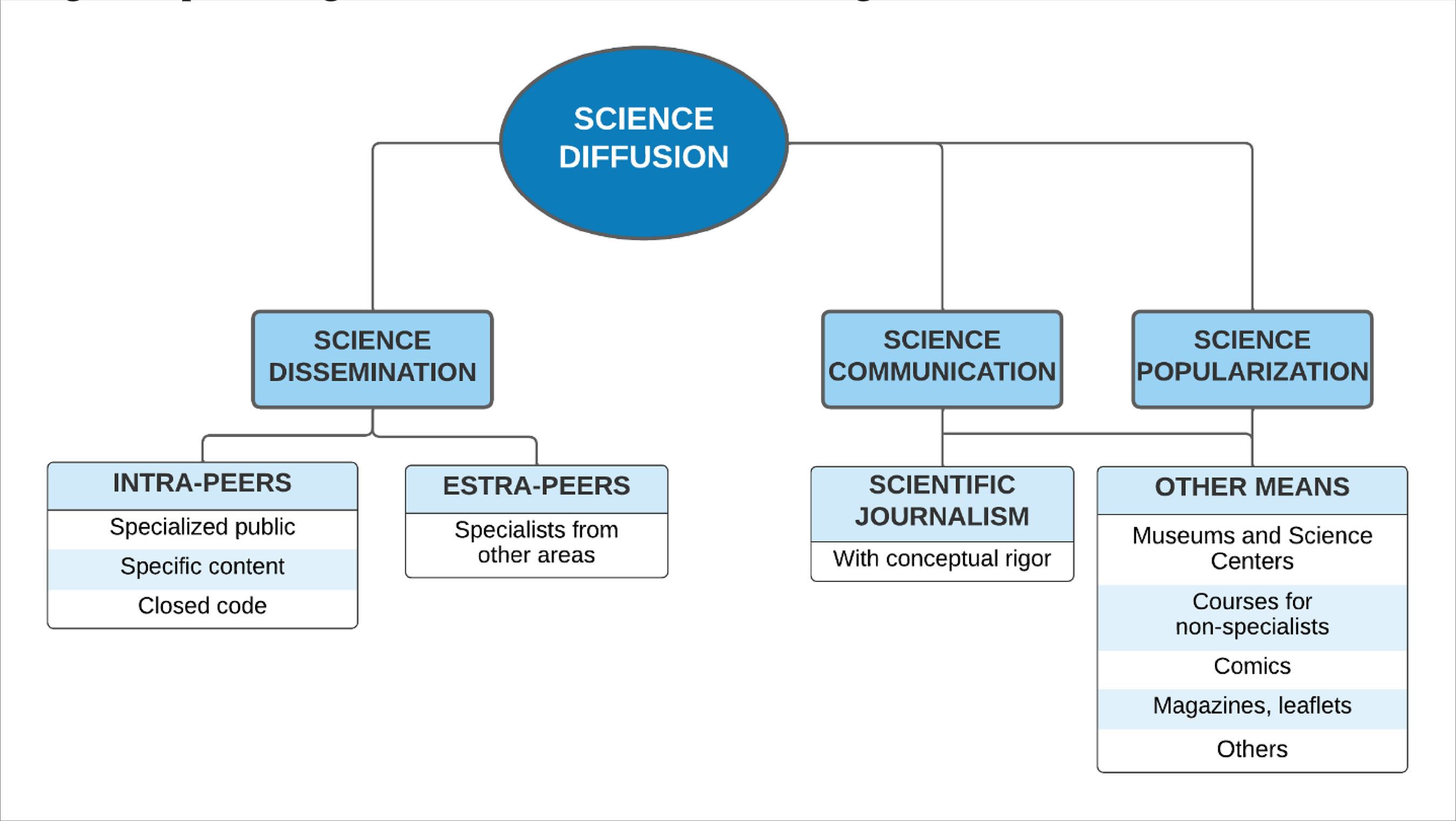
Analyzing the concepts from the Linguistic perspective, we can observe that Bueno (1984) established a hyponymy position of the expressions science communication and science dissemination with its hyperonym: science diffusion. To this author, science diffusion has a broader meaning, a wide “umbrella” that will unfold itself into two expressions: science dissemination (intra and extra-peers) and science communication and science popularization (journalism and other means), as highlighted in Figure 1:
From Figure 1, we can perceive subdivisions established by Bueno when differentiating scientific dissemination conducted intra and extra peers. The first – intra peers – refers to the circulation of scientific and technological information between specialists of a specific area or correlated areas; its main characteristics are the specialized public, the specific content (toward this public), and a closed code, representing the discourse in journals from the area or scientific meetings “guided by the limited universe of those interested” (Bueno, 1985, p. 1421). The second type of science dissemination, extra peers, focuses on specialists outside the “area-object of dissemination”, they can be published in journals or through courses that interest different specialists, for instance, “a specialization course in homoeopathy for allopathic doctors” or “a journal of Political Economy that interests economists, political scientists, or sociologists” (Bueno, 1985, 1421).
We identified the same division between the terms related to the target public when analyzing definitions and concepts about scientific communication in English and French, which are the most used languages in scientific production worldwide, mainly in the area of science communication (Oliveira, 2019).
As in Brazil, where the use of the expression “science communication” gets mixed with other similar expressions by several authors, sometimes establishing a synonym relation, and sometimes a hyperonymy among the terms, we perceive an analogous scenario when analyzing the literature in other languages, for example in English, as Burns and collaborators highlight:
Science communication (SciCom) is not simply encouraging scientists to talk more about their work, nor is it an offshoot of the discipline of communications. Although people may use the term “science communication” as a synonym for public awareness of science (PAS), public understanding of science (PUS), scientific culture (SC), or scientific literacy (SL)—in fact many of these terms are often used interchangeably—it should not be confused with these important and closely related terms
(Burns et al., 2003, p. 183).
Similar to Bueno, to Burns and collaborators, the public can be divided between people who are not specialists in the topic approached – they can be scientists from other areas of knowledge or not scientists at all– and the science community or science practitioners, composed by people directly related to the theme presented.
When analyzing the French context, we find similarities regarding the scientific language in Jurdant (1969). The author indicates that the scientific discourse is a closed one, which can only be understood by peers and research institutions, and, therefore, the knowledge does not reach everyone equally– or does not reach at all.
As observed in the Anglophone context, in French, several terms also refer to disseminating scientific knowledge to the non-specialized public, as Jacobi and collaborators (1990) point out. Nonetheless, the authors highlight that, though these terms might have the same goal, vulgarisation scientifique (science vulgarization) is the expression that best represents the practice of science popularization, being more encompassing and can be, in a semantic relationship, hypernym to other expressions mentioned:
Vulgarisation scientifique [science vulgarization], communication scientifique publique [public science communication] (Fayard, 1988), école parallèle [parallel school] (Rovan, 1973; Giard, 1979; Schaeffer, 1986), sociodiffusion des sciences [sociodiffision of science], divulgation des science [science communication] (Guédon, 1980, 1981), popularisation [popularization] (Jacobi, 1983), … so many ways of naming a set of diffusion practices that probably have something in common. Despite the criticisms that might be addressed to this name, we opted to keep the term vulgarisation scientifique. The label vulgarisation scientifique (from now on VS) has an advantage: it perfectly specifies its object in our language, that is, the attempt to disseminate the scientific and technical culture outside the specialist circles. Thus, choosing to name all the assemble of diffusion practices is in no way reductive: studying VS means questioning the principle of diversity of a practice that resists, regardless of the angle we approach it, against any type of simplification
(Jacobi et al.,1990, p. 81, our translation from the French).
Vulgarisation Scientifique (VC), as well as the synonymous expressions Public Awareness of Science – PAS, and Public Understanding of Science - PUS aims to disseminate science to every audience, especially among those from less privileged backgrounds who have less or almost no access to scientific knowledge when compared to the more affluent layers of the population. VC seeks knowledge democratization and the idea that this democratization can lead to political and social changes using different means of communication (Reboul-Toure, 2004).
In Brazil, in the mid-1970s, the term vulgarização científica (VC- science vulgarization) was used by some scientists and scientific communicators to express the act of popularizing science, as, for example, the communicator José Reis (Mendes, 2006). The use of the literal translation of the term in the Brazilian context can be justified by the fact that many scientists at the time were influenced by French scientists, as well as the arrival of French communicators in Brazil (Massarani, 1998).
However, following the North American tendency, as Bueno (1985) referred, the term VC started to be considered pejorative, semantically compared to the use of the word vulgarization or vulgar. In Brazil, what is vulgar is, semantically, considered bad, “from a bad origin; of a low nature; rough, rude; using vulgar language” (Dicio, 2024). Therefore, other terms started to be used in Brazil to refer to the act of disseminating science, mainly based on Anglophone terms (Massarani, 1998). In the Brazilian context, we identify, through a narrative review combined with Linguistic analyses, that the expression that better represents the same semantic relationship of science vulgarization is popularização científica (PC- science popularization).
Historically conceptualizing the use of this term in Brazil, Massarani and Moreira (2016) tell us that scientific communication emerged in the country among the more privileged social and economic classes, restricting the diffusion of scientific knowledge to this group. Because of this, since the 20th century, some scientists have tried to distance themselves from the hegemonic concept of scientific communication and seek to popularize science to reach less privileged social groups. In Brazil, we highlight in this movement the scientific communicators José Reis (Brazilian) and Maurice Bazin (French), who advocated for a science for the people (Porfiro, Baldino, 2018).
In a text published in 1974, Maurice Bazin warned that: “Scientists have many things to do instead of letting themselves be enclosed in a bourgeois and selfish life of the pure researchers”; later on, he concludes that “scientists need to do something concrete regarding the masses; they have to choose which side they want to be because, in a way, this option will be automatically done by the system” (Aguiar, 1998, p. 89).
Maurice Bazin brought to Brazil his ideas on access to scientific knowledge and that this would not be restricted to social elites. Based on the movement Science for the People (SFTP), which originated on the emerging need to change science teaching in the 1960s and advocated a more humanistic school curriculum focused on real social issues (Layton, 1975), a group of scientists started to reflect on how to make science popular and, more importantly, how the access to scientific knowledge could lead to political-social changes in the community.
Thus, scientific popularization (SP) started to be used, instead of science communication, to express the action of disseminating scientific knowledge in a more accessible language and guided by social issues, as Motta-Roth and Scherer (2016, p. 172) state:
The “contemporary view” of SP sees popularization as the mobilization of debates around science and democratization of access to this debate, suggesting a horizontal organization between the spheres of scientific activity and the rest of society, in which journalism plays the role of a recontextualization field (Moirand, 2003; Beacco et al., 2002). In these terms, as in the scientific article, the SP article participates in the same sociosemiotic system in the scope of science (Oliveira, 2005, p.222). Both are interconnected in complex intertextual nets of reference to the same scientific fact but with specific forms of enacting the meaning in different discursive genres.
Resuming Figure 1, in which the expression science communication is hypernym to scientific journalism (SJ) and other means, we can include the expression science popularization to the same semantic level as SC, being equally considered as a hyperonym of SJ and other means. The objectives of SC and SP are similar regarding the dissemination of scientific knowledge to a non-specialist audience, though they are pragmatically different in their uses and contexts when we analyze the discourses.
The code used in the message makes scientific journalism hyponym to science communication and science popularization. To Bueno (1985), the code used in SJ should be specific to the press communication outlets, having its own conceptual rigour based on journalism fundaments, in disagreement with Salles (1981), who affirms that the difference between scientific journalism and science communication lies on the objectives of the message sender.
Nonetheless, science communication also has its own language, establishing itself as a discursive genre different from the scientific one – the science communication discourse (SCD) (Zamboni, 2001). According to Bakhtin (2002, p. 91), in the discourse
The speaker seeks to orient his discourse with its own determining horizon within the alien horizon of the understander and enters into dialogic relations with moments of that horizon. The speaker penetrates the alien horizon of the listener, constructs his utterance on alien territory, against his, the listener’s, apperceptive background.
Additionally, Zamboni (2001) affirms that the intention behind every SC action, guided toward a specific public, differentiates the scientific discourse from the science communication discourse.
From a Linguistic perspective, the author also affirms that the science communication discourse goes beyond translating scientific knowledge produced by scientists to a non-specialist public through the simple reformulation of language. According to her, SCD means a “real formulation work” (Zamboni, 2001, p. 10, author’s highlight), with specific texts and, therefore, specific language.
Through discourse, uses, and means, we can infer that science communication is the action of disseminating knowledge about different sciences, techniques, and technologies for audiences that are not specialists in specific themes (Albagli, 1996; Silva, 2006). It seeks to make this audience understand the scientific themes better and, thus, achieve greater scientific engagement among the population. However, according to what was presented, corroborating several authors (Vogt, 2012; Oliveira et al., 2018), the term science communication, in the Brazilian context, can represent a unilateral communication, from the scientist to the audience with no dialogical interaction. Thus, we understand that we are referring to the term science popularization, when the aim is to approximate citizens to science, making them appropriate scientific knowledge in an engaging way, establishing a dialogical and bilateral relationship between science and the audience and, mainly, allowing the population to practice science.
Final remarks
Authors use several expressions to indicate the action of communicating science and, through an analysis grounded in Linguistics, it was possible to establish how these expressions are related. We can say that science diffusion is a hypernym term to all others, as it is an expression that encompasses the different meanings, objectives, and publics – the interest of disseminating science. As hyponyms for science diffusion, we have science dissemination, targeting the scientific community (intra or extra peers), science communication and popularization.
From the analysis of the construction of different terms to express the action of diffusing science for the nonspecialized public, we cannot say that science communication and popularization are synonymous, but that they can establish a synonym relationship depending on the pragmatic analysis.
Semantically, we find a parallelism in the discourse of science population in French, called scientific vulgarization (SC) – VC (Vulgarisation Scientifique – VS). Despite different social contexts (compared to Brazil), both keep the premise focused on the use of scientific language in a way that is accessible to the non-specialist audience, not only translating the scientific knowledge but using a new type of language and writing, so that this knowledge reaches different audiences.
Besides the specific language for science communication, the communicator also needs to be concerned with the ways of mediating content, the discourse used, to make communication understandable for the audience. To do so, communicators should know who the receivers of the discourse are, as well as their intention in doing so. The expression science popularization becomes evident in this context that emerges aiming to adequate language, communication objectives, and science communication to all, not distinguishing economic and/or social class, focusing on the democratization of scientific knowledge.
Considering this semantic relationship of synonym, in which two expressions can have similar meanings, and what we have seen in the literature of the area in the Brazilian context – where the term science communication is more commonly used in studies and publications – we consider the expression science communication represents and names the knowledge field that supports this research.
Therefore, through this theoretical interdisciplinary study, which consisted of bringing to the field of qualitative research in science communication a methodological approach already established in the Linguistic field, we hope to contribute to both fields. This research can also guide future studies aiming to analyze science communication as a scientific and/or knowledge field and approach SC as a discursive genre, which directly and indirectly affects the practice of science communicators.
-
Funding
This article received resources and financial support from grants provided by the Carlos Chagas Filho Foundation for Research Support of the State of Rio de Janeiro (FAPERJ), through the projects submitted and awarded under the “Our State Scientist Program,” coordinated by the authors Robson Coutinho-Silva (Process E-26/202.774/2018) and Eleonora Kurtenbach (SEI-260003/004315/2021).
References
- 1 AGUIAR, L. E. V. A pesquisa e a experimentação como instrumentos de motivação no ensino e aprendizagem de ciências 1998. 151f. Tese (Doutorado em Biologia Celular e Molecular) - Instituto Oswaldo Cruz, Fundação Oswaldo Cruz, Rio de Janeiro, 1998.
-
2 ALBAGLI, S. Divulgação científica: informação científica para a cidadania? Ciência da Informação, [S.l.], v. 25, n. 3, p. 396–404, set./dez. 1996. DOI: 10.18225/ci.inf.v25i3.639. Disponível em: https://revista.ibict.br/ciinf/article/view/639 Acesso em: 18 abr. 2024.
» https://doi.org/10.18225/ci.inf.v25i3.639» https://revista.ibict.br/ciinf/article/view/639 - 3 BAKHTIN, M. Questões de Literatura e Estética: A Teoria do Romance. 5 ed. São Paulo: Ed. Hucitec Annablume, 5 ed., 2002. 440p.
-
4 BARROSO, A. Sobre análise linguística Youtube, 28 jul. 2020. Disponível em: https://www.youtube.com/watch?v=SVaNlOl7Sv0 Acesso em: 03. Set. 2023.
» https://www.youtube.com/watch?v=SVaNlOl7Sv0 -
5 BENSAUDE-VINCENT, B. Splendeur et décadence de la vulgarisation Scientifique. Questions de communication, [S.l], n. 17, p. 19-32, 2010. DOI: 10.4000/questionsdecommunication.368. Disponível em: http://journals.openedition.org/questionsdecommunication/368 Acesso em: 03 Out. 2023.
» https://doi.org/10.4000/questionsdecommunication.368» http://journals.openedition.org/questionsdecommunication/368 - 6 BRANDÃO, H. H. N. Pragmática lingûística: delimitações e objetivos. In: MOSCA, L. L. S. Retóricas de ontem e de hoje 2 ed. São Paulo: Humanitas (FFLCH/USP), 2001, p. 161-182.
- 7 BUENO, W. da C. Jornalismo científico no Brasil: os compromissos de uma prática dependente 1984. 364f. Tese (Doutorado em Comunicação) – Escola de Comunicação e Artes, Universidade de São Paulo, São Paulo, 1984.
- 8 BUENO, W. da C. Jornalismo científico: conceitos e funções. Ciência e Cultura, São Paulo, v. 37, n. 9 , p. 1420-1427, 1985.
-
9 BURNS, T. W.; O’CONNOR, D. J.; STOCKLMAYER, S. M. Science Communication: A Contemporary Definition. Public Understanding of Science, [S.l], v. 12, n. 2, p. 183-202, abr. 2003. DOI: 10.1177/09636625030122004. Disponível em: https://journals.sagepub.com/doi/abs/10.1177/09636625030122004 Acesso em: 18 abr. 2024.
» https://doi.org/10.1177/09636625030122004» https://journals.sagepub.com/doi/abs/10.1177/09636625030122004 - 10 CANÇADO, M. Manual da Semântica: noções básicas e exercícios. 2 ed. São Paulo: Contexto, 2020. 190 p.
- 11 CLARO, V. Denotação e Conotação: A Teoria da Ressignificação aplicada aos Tropos de Linguagem. In: Seminário Nacional de História da Ciência e da Tecnologia, 17., 2020, Rio de Janeiro. Anais [...] Rio de Janeiro: Sociedade Brasileira de História das Ciências, 2020. p. 1-14.
-
12 DICIO. Dicionário Online de Português, definições e significados de mais de 400 mil palavras [Online]: Dicionário Online de Português, [s.d.]. Disponível em: https://www.dicio.com.br Acesso em: 26 de fev. de 2024.
» https://www.dicio.com.br - 13 FIORIN, J. L. A linguagem em uso. In: FIORIN, J. L (org.). Introdução à Linguística São Paulo: Editora Contexto, 2001. p. 165-186.
- 14 JACOBI, D.; SCHIELE, B. ; CYR, M. F. La vulgarisation scientifique et l'éducation non formelle. Revue française de pédagogie, [S.l], n. 91, p. 81-111, abr./jun. 1990.
- 15 JURDANT, B. Vulgarisation scientifique et idéologie. Communications, [S.l], n. 14, p. 150-161, 1969.
- 16 LAYTON, D. Science for the People: The Origins of the School Science Curriculum in England. London: George Allen and Unwin. 226 p.
- 17 LIMA, P. L. C. Metáfora e linguagem. In: FELTES, H.P.M. (Org.) Produção de Sentido: Estudos Transdisciplinas S.Paulo, P.Alegre, Caxias Sul: Annablume, Nova Prova, Educs, 2003. p. 155-180.
- 18 LÜDKE, M., ANDRÉ, M. E. D. A. Pesquisa em educação: abordagens qualitativas 2 ed. São Paulo: EPU, 2013. 112 p.
- 19 MAINGUENEAU, D. Pragmática para o discurso literário Tradução: Marina Appenzeller. São Paulo: Martins Fontes, 1996. 224 p.
- 20 MASSARANI, L. A divulgação cientifica no Rio de Janeiro: algumas reflexões sobre a década de 20 1998. 127p. Dissertação (Mestrado em Ciência da Informação) - Instituto Brasileiro de Informação em C&T (IBICT) e Escola de Comunicação, Universidade Federal do Rio de Janeiro, Rio de Janeiro, 1998.
-
21 MASSARANI, L. et al Pesquisa em divulgação científica: um estudo dos artigos científicos na América Latina. Revista Iberoamericana de Ciencia, Tecnología y Sociedad - CTS, [S.l], 2023. Disponível em: https://ojs.revistacts.net/index.php/CTS/article/view/377 Acesso em: 18 abr. 2024.
» https://ojs.revistacts.net/index.php/CTS/article/view/377 -
22 MASSARANI, L.; MOREIRA, I. de C. Science communication in Brazil: A historical review and considerations about the current situation. Anais da Academia Brasileira de Ciências, Rio de Janeiro, v. 88, n. 3, p. 1577-1595, 2016. DOI: https://doi.org/10.1590/0001-3765201620150338. Acesso em: 18 abr. 2024.
» https://doi.org/10.1590/0001-3765201620150338 -
23 MASSARANI, D.; MASSARANI, L. A primeira tese em divulgação científica do Brasil, de Wilson Bueno [Rio de Janeiro]: INCT-CPCT/ Casa de Oswaldo Cruz/ Fiocruz, 2021. 1 vídeo (7 min). Disponível em: https://www.youtube.com/watch?v=rqbyzta1L_U Acesso em: 25 fev. 2023.
» https://www.youtube.com/watch?v=rqbyzta1L_U - 24 MENDES, M. F. A. Uma perspectiva histórica da divulgação científica: a atuação do cientista-divulgador José Reis (1948-1958) 2006. 256f. Tese (Doutorado em História das Ciências e da Saúde) – Casa de Oswaldo Cruz, Fundação Oswaldo Cruz, Rio de Janeiro, 2006.
-
25 MOTTA-ROTH, D.; SCHERER, A. S. Popularização da ciência: a interdiscursividade entre ciência, pedagogia e jornalismo. Bakhtiniana - Revista de Estudos do Discurso, São Paulo, v. 11, p. 164-189,mai./ago. 2016. DOI: http://dx.doi.org/10.1590/2176-457323671. Acesso em: 18 abr. 2024.
» https://doi.org/10.1590/2176-457323671 -
26 OLIVEIRA, J. M. P. DE; STRIEDER, D. M.; GIANOTTO, D. E. P. Cultura científica/divulgação científica e formação de professores: desafios e possibilidades. Revista Valore, v. 3, n. Edição Especial, p. 489–497, 2018. DOI: https://doi.org/10.22408/reva302018195489-497. Acesso em: 18 abr. 2024.
» https://doi.org/10.22408/reva302018195489-497 -
27 OLIVEIRA, S. S. de. A língua da ciência. Revista Pesquisa FAPESP, ed. 282, ago. 2019. Disponível em: https://revistapesquisa.fapesp.br/a-lingua-da-ciencia/ Acesso em: 24. jul. 2023.
» https://revistapesquisa.fapesp.br/a-lingua-da-ciencia/ -
28 PORFIRO, L. D.; BALDINO, J. M. Perspectivas teórico-conceituais de popularização da ciência: vulgarização, alfabetização e divulgação. Revista Científica de Educação, [S.l], v. 3, e019005, 2018. Disponível em: https://seer.facmais.edu.br/rc/index.php/RCE/article/view/25 Acesso em: 5 out. 2023.
» https://seer.facmais.edu.br/rc/index.php/RCE/article/view/25 -
29 POTTER, H. Pandemia de coronavírus pode revolucionar divulgação científica UOL notícias, 2020. Disponível em: https://noticias.uol.com.br/ultimas-noticias/deutschewelle/2020/03/23/pandemia-de-coronavirus-pode-revolucionar-divulgacao-cientifica.htm Acesso em: 10 mar. 2024.
» https://noticias.uol.com.br/ultimas-noticias/deutschewelle/2020/03/23/pandemia-de-coronavirus-pode-revolucionar-divulgacao-cientifica.htm -
30 REBOUL-TOURÉ, S. Écrire la vulgarisation scientifique aujourd’hui. In: BABOU, I.; LE MAREC, J.; Sciences, médias, société Lyon: HAL open science, 2004. p. 195-212. Disponível em : https://univ-sorbonne-nouvelle.hal.science/hal-01387603 Acesso em: 18 abr. 2024.
» https://univ-sorbonne-nouvelle.hal.science/hal-01387603 - 31 ROTHER, E. T. Revisão Sistemática x Revisão Narrativa. Acta Paul. Enferm, [S.l], v. 20, n. 2. 2007.
- 32 SALLES, V. L. R. João Ribeiro como jornalista científico no Brasil (1895-1934) 1981. 185 p. Dissertação (Mestrado em Ciências da Comunicação) - Escola de Comunicações e Artes, Universidade de São Paulo, São Paulo, 1981.
-
33 SILVA, H. C. da. O que é divulgação científica? Ciência & Ensino [S.l], v. 1, n. 1, p. 53-59, dez. 2006. Disponível em: http://200.133.218.118:3537/ojs/index.php/cienciaeensino/article/view/39/98 Acesso em: 18 abr. 2024.
» http://200.133.218.118:3537/ojs/index.php/cienciaeensino/article/view/39/98 - 34 SOUZA, B. T. de. Os embates discursivos entre divulgação científica e fake news 2021. 50p. Trabalho de conclusão de curso (Licenciatura em Química) – Instituto de Química, Universidade Federal do Rio Grande do Sul, Porto Alegre, 2021.
- 35 SWEETSER, E. From etymology to pragmatics: Metaphorical and Cultural Aspects of Semantic Structure. Cambridge: Cambridge University Press, 1990. 188 p.
-
36 VOGT, C. The spiral of scientific culture and cultural well-being: Brazil and Ibero-America. Public Understanding of Science, [S.l], v. 21, n. 1, p. 4-16, jan. 2012. DOI: DOI: 10.1177/0963662511420410. Disponível em: https://neuromat.numec.prp.usp.br/sites/default/files/the_spiral_of_scientific_culture_and_cultural_well_being_brazil_and_ibero-america.pdf Acesso em: 18 abr. 2024.
» https://doi.org/10.1177/0963662511420410» https://neuromat.numec.prp.usp.br/sites/default/files/the_spiral_of_scientific_culture_and_cultural_well_being_brazil_and_ibero-america.pdf - 37 ZAMBONI, L. M. S. Cientistas, jornalistas e a divulgação científica: subjetividade e heterogeneidade no discurso da divulgação científica. Campinas: Autores associados, 2001. 167 p.
Edited by
-
Responsible editors:
Marialva Barbosa and Sonia Virgínia Moreira

 Source: Created by the authors, based on