
 Educators’ Experiences Teaching Literary Journalism in Brazil: A Comparative Study with International Community
Abstract
Beginning in 2011, the teaching of literary journalism around the world has been investigated annually by surveying educators of the field (LEWIS; HANC, 2018). From 2018 on, this long-term study has highlighted Brazilian scholarship differences, similarities, contributions, and challenges. The purpose of this article is to compare Brazilian findings in contrast with ones of an international community that includes twenty countries across five continents. These results may help understanding how the teaching of literary journalism contributes to students learning and further developing transferable skills (e.g., NEELY; LEWIS, 2020), and to future lines of inquiry, so that the discipline of literary journalism may continue on its path of coalescence and achieving its potential.
Key-words
Teaching of literary journalism; Educators; Research in Literary Journalism; Brazil; Transferable skills
Resumo
Desde 2011, o ensino do jornalismo literário em todo o mundo tem sido investigado anualmente por meio de pesquisas com educadores da área (LEWIS; HANC, 2018). A partir de 2018, este estudo de longo prazo destacou as diferenças, semelhanças, contribuições e desafios deste campo de estudos no Brasil. O objetivo deste artigo é comparar os achados brasileiros em contraste com os de uma comunidade internacional que inclui vinte países em cinco continentes. Esses resultados podem ajudar a entender como o ensino do jornalismo literário contribui para que os alunos aprendam e desenvolvam habilidades transferíveis (NEELY; LEWIS, 2020), e para futuras linhas de investigação, de forma que a disciplina de jornalismo literário continue seu caminho de coalescência e alcance seu potencial.
Palavras-chave
Ensino do jornalismo literário; Educadores; Pesquisa em Jornalismo Literário; Brasil; Habilidades transferíveis
Resumen
A partir de 2011, la enseñanza del periodismo literario en todo el mundo ha sido investigada anualmente mediante encuestas a educadores del campo (LEWIS; HANC, 2018). A partir de 2018, este estudio a largo plazo ha destacado las diferencias, similitudes, contribuciones y desafíos de las becas brasileñas. El propósito de este artículo es comparar los hallazgos brasileños con los de una comunidad internacional que incluye veinte países de los cinco continentes. Estos resultados pueden ayudar a comprender cómo la enseñanza del periodismo literario contribuye a que los estudiantes aprendan y desarrollen aún más habilidades transferibles (NEELY; LEWIS, 2020), y a futuras líneas de investigación, para que la disciplina del periodismo literario pueda continuar en su camino de coalescencia y alcanzando su potencial.
Palabras clave
Enseñanza del periodismo literario; Educadores; Investigación en Periodismo Literario; Brasil; Habilidades transferibles
Introduction
To support international literary journalism as a discipline, and for the discipline to reach its full potential, it has been helpful to understand how literary journalism is being taught across the globe. While the exploration of literary journalism pedagogy described in this chapter reflects studies from the twenty-first century, it is important to note that literary journalism has a long and complex international history going back to the nineteenth century—a history “built on a combination of journalistic traditions and transnational influences” (BAK, 2017, p. 217).
To start with, the International Association for Literary Journalism Studies (IALJS) was founded in 2006 at the then University of Nancy (today University of Lorraine, France), to provide an international arena for debating the field of literary journalism, “also known around the world as literary reportage, narrative journalism, creative non-fiction, the New Journalism, Jornalismo Literário, el periodismo literario, Bao Gao Wen Xue, literary non-fiction, and narrative non-fiction” (INTERNATIONAL ASSOCIATION FOR LITERARY JOURNALISM STUDIES, [s.d.]) The group was formed with 14 members from seven countries: Australia, Canada, England, France, Portugal, Scotland, and the United States. Within a year, membership included colleagues from nine additional countries: Belgium, China, Finland, Holland, Ireland, New Zealand, Slovenia, Spain, and Sweden (Bak, 2007). The organization’s most recent membership report (May 19, 2021) included 141 people from 24 countries and six continents: Africa, Asia, Australia, Europe, North and South America.
The international scope of the organization and of literary journalism studies has been specifically addressed in various ways, including in an essay in the first issue of the new organization’s new scholarly journal, Literary Journalism Studies. In this essay, Norman Sims suggested approaches for addressing important issues in the field: international study, a broad historical framework, learning from writers, the promise and peril of online, and the reality boundary (2009). Sims quotes James Carey when noting that literary journalism in different countries and cultures appears with variations in form, reflecting the culture’s “particular constellation of attitudes, emotions, motive and expectations” (SIMS, 2009, p. 9). As an example, Sims shares from a 2008 conference presentation by Chen Peiqin of Shanghai International Studies University:
Chinese Literary Reportage, Bao Gao Wen Xue, designated as a literary genre in the 1930s during the Chinese anti-Japanese war, has been considered by most Chinese literary critics as the best genre to expose social evils, and to call for people to take actions against social evils. Chinese literary reportage has been closely related with social movements since its emergence
(SIMS, 2009, p. 9).
Sims points out the importance and value of learning from each other and that the “strictly English speaking among us are impoverished by our lack of access to works of literary journalism from China, Russia, Portugal, Brazil and other parts of Latin America, Africa, and Eastern Europe” (SIMS, 2009, p. 10).
More recently, in 2019, IALJS formed a Global Engagement Committee to “expand and enrich the international aspects of its approach to literary journalism” (ALEXANDER, 2019).
During this time of re-focusing efforts on internationalization and welcoming members from around the world and, specifically, Global South regions, a panel of American researchers welcomed Monica Martinez (University of Sorocaba, São Paulo, Brazil), who has been an integral part of the team since 2018, and Marcela Aguilar (Universidad Diego Portales, Santiago, Chile), who accepted joining the team in 2021 and will be responsible for collecting her country data for the 2022 IALJS conference presentation, when the IALJS annual meeting will be held in her country.
This international approach of the IALJS has helped the field to move forward in the production of strong criticism, theoretical, methodological and technical approaches in the soon to be half century of investigations if we take Wolfe´s seminal New Journalism (WOLFE; JOHNSON, 1973) as a cornerstone for the field’s research. As literary journalism educator survey results suggest, many IALJS researchers are also instructors, lecturers, and professors of literary journalism to some degree. Therefore, the advancement has also occurred in the pedagogical field, through teaching of the discipline in its theoretical and practical aspects. Previous studies have allowed field researchers to advance in their theoretical concepts, conceiving it from a genre (CONNERY, 1992), form (HARTSOCK, 2000; SIMS, 2007), modality (LIMA, 2009) and discipline (BAK, 2011), to finally be understood presently as an academic field (BAK; MARTINEZ, 2018).
Since 20111, a group of American researchers led by John Hanc (New York Institute of Technology) and Mitzi Lewis (Midwestern State University) have investigated literary journalism pedagogy and presented results in panels at the annual conference of the International Association for Literary Journalism Studies, the IALJS (LEWIS; HANC, 2018), of the Association for Education in Journalism and Mass Communication (AEJMC), and of the Southwest Popular/American Culture Association Conference; published in scholarly journals, including Literary Journalism Studies, Brazilian Journalism Research, and Teaching Journalism and Mass Communication; and shared as pedagogy chapters for The Routledge Companion to American Literary Journalism and for the forthcoming Social Justice and Literary Journalism. These annual studies have used a mixed-methods inquiry, including web-based survey data (qualitative and quantitative) and interviews via email, phone, Skype, and Zoom (NEELY; LEWIS; HANC; REID, 2018, p. 141) to examine questions including 1) educator profiles: how long they have been delivering teaching, including in what countries, universities, departments, and classes they teach; 2) how they teach; 3) what methods and texts are used; 4) what challenges educators face; and 5) how they meet those challenges. Over time, the researchers’ calls have attracted the attention of other of literary journalism researchers who have become collaborators, such as Jeffrey C. Neely (University of Tampa), Lisa Phillips (State University of New York at New Paltz), and, more recently, Monica Martinez (University of Sorocaba, São Paulo, Brazil) and Marcela Aguilar (Universidad Diego Portales, Santiago, Chile), among others.
Thus, the aim of this chapter is to focus on the convergences and dissonances of the pedagogy of teaching literary journalism across the world, particularly discussing the Brazilian results of the surveys of 2018, 2019, and 2020 in contrast with the other countries.
Method
For each annual study, a web-survey was developed to explore a theme that has often been identified from the previous year’s open discussion that follows panel presentations. An e-mail call to participate and two reminders are sent to invite participation. Until 2017, the calls were sent to an IALJS email list, the AEJMC Magazine Division listserv, and the AEJMC Small Programs Interest Group (SPIG) listserv. For the years 2015 through 2017, announcements for the survey were also posted on Facebook and for 2016 and 2017 they were posted on Twitter. However, when survey response sources were analyzed in 2017, only 3% of respondents were directed from social media links. The majority of participants, therefore, came from email and listerv links (NEELY et al., 2018, p. 143) and the social media calls were discontinued. Responses to close-ended questions were analyzed using the Microsoft Excel spreadsheet program and responses with to open-ended questions were analyzed either by hand or with QSR NVivo. The researchers have chosen to keep all interviewees confidential in these studies. For the sake of consistency, responses in Brazilian Portuguese have been translated to English to make them understandable to foreign audiences.
The data presented in this chapter compares three survey results, according to the year of delivery:
-
2018: Survey results were presented on May 19th as part of the panel Essentials of the Craft: Providing Effective Feedback, delivered at the Thirteenth International Conference for Literary Journalism Studies (IALJS-13), themed “Literary Journalism: Theory, Practice, Pedagogy,” and held at the Austrian Academy of Sciences, Vienna. The survey focus was guided by the question: How are literary journalism educators providing feedback to students? Survey development and testing were conducted by United States researchers David Abrahamson (Northwestern University), Leo Gonzalez (Midwestern State University), John Hanc (New York Institute of Technology), Mitzi Lewis (Midwestern State University), Jeffrey Neely (The University of Tampa), Robin Reid (Midwestern State University), and, for the first time, a representative of Global South, Monica Martinez (Universidade de Sorocaba, Brazil). Panel participants were Calvin Hall, (North Carolina Central University), who joined the panel with his presentation of “Helping Circles,” John Hanc, Mitzi Lewis, Monica Martinez, and Jeffrey Neely.
-
2019: Survey results were presented on May 10th as part of the panel Literary Journalism 101: Teaching Toolkit, delivered at the Fourteenth International Conference for Literary Journalism Studies (IALJS-14), themed “Literary Journalist as Naturalist: Science, Ecology and the Environment,” and hosted by Stony Brook University (Long Island, New York). Survey development and testing were conducted by David Abrahamson (Northwestern University), John Capouya (The University of Tampa), John Hanc (New York Institute of Technology), Mitzi Lewis (Midwestern State University), Monica Martinez (Universidade de Sorocaba, Brazil), Jeffrey Neely (The University of Tampa), and Lisa Phillips (State University of New York at New Paltz). Panel participants were John Hanc, Mitzi Lewis, Monica Martinez, Jeffrey Neely, and Lisa Phillips.
-
2020/2021: due to the COVID-19 pandemic, the Fifteenth International Conference for Literary Journalism Studies (IALJS-15), themed “Literary Journalism Across Media,” scheduled to be held at the University of Copenhagen, Denmark in 2020, was postponed to May 20-22, 2021. Therefore, data collected in 2020 were presented on May 20, 2021, at the panel Teaching Sourcing, Interviewing, and Observation of Literary Journalism Subjects, delivered online. Survey development and testing were conducted by Clarissa Alvarado (Midwestern State University), John Capouya (The University of Tampa), John Hanc (New York Institute of Technology), Mitzi Lewis (Midwestern State University), Monica Martinez (Universidade de Sorocaba), Jeffrey Neely (The University of Tampa), and Lisa Phillips (State University of New York at New Paltz). Participants of the panel included John Hanc, Mitzi Lewis, Monica Martinez, Jeffrey Neely, and Lisa Phillips.
Findings
Literary journalism scholarship has expressed increasing concern over the importance of acknowledging the varieties of the discipline in a worldwide basis, as we will see below.
2018 Findings
Beginning in 2018, the research team has included greater participation from Brazilian educators in their surveys of literary journalism educators around the world. The increased participation has been made possible due to a Brazilian educator joining the research team and sending out calls for participation to three major Brazilian communication researcher listservs. Specifically, calls for participation were sent to an IALJS email list and listservs for the Magazine Division of The Association for Education in Journalism and Mass Communication (AEJMC), the Small Programs Interest Group of AEJMC, the Brazilian Journalism Researchers Association (SBPJor), the Brazilian Society for the Interdisciplinary Studies in Communication (Intercom), and the Brazilian National Association of Graduate Programs in Communication (Compós).
The 86 survey respondents who stated that they teach or have taught a course that incorporates literary journalism hailed from 17 countries: Australia, Belgium, Brazil, Canada, Chile, Denmark, Italy, Japan, New Zealand, Norway, Poland, Romania, South Africa, Spain, United Arab Emirates (UAE), United Kingdom, and United States. Twenty-four of the respondents (28%) were from Brazil. This total of 28% was considered surprising, given the survey call had been released in English (and the country’s official language is Portuguese). A separate, ongoing research project shows that 42 Brazilian universities offer literary journalism courses (MARTINEZ et al., in print).
1. Educator Profile
The international respondents were an experienced group in comparison with the Brazilian group: almost 50% had been teaching twenty or more years (Figure 1). The small percent in the 0-4 years range suggests a possible decline in newer educators joining the field. Alternatively, the lower percentage could be a reflection of interest and time in completing the survey. The Brazilian data suggests a stability of instructors from 0 to 20 or more years, representing a broad diversity of educators in the field in relation to years of teaching.

The international and Brazilian respondents shared in common the fact that both delivered classes in undergraduate and graduate levels (Figure 2).

2. How Literary Journalism Is Being Taught
Figure 3 addresses the heart of the research: how literary journalism educators were providing feedback to students in the educators’ classes. Both communities attributed a higher value to written journalistic assignments and class participation. This result makes sense at the undergraduate level, since it is a central pivot in the training provided by journalism courses.

How Are Literary Journalism Educators Providing Feedback to Students in the Educators’ Classes?
3. What Methods and Texts Are Used
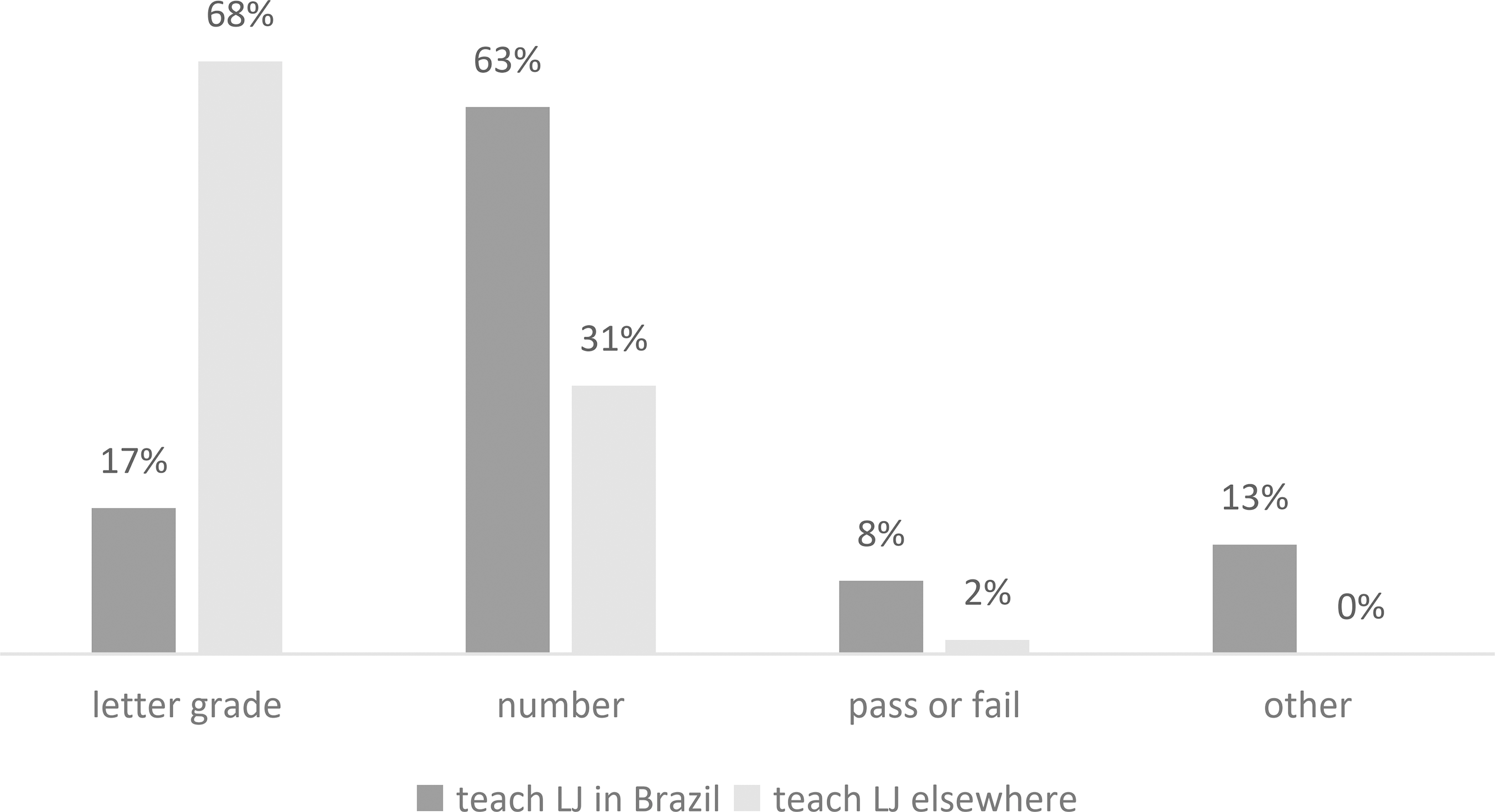
The 2018 survey focused on grading, feedback and formats. Figure 4 brings an interesting difference, possibly due to cultural traces of the educational system. While in Brazil numerical grades were most common, the rest of the respondents indicated a predominance of letter grades.

Figure 5 addresses the following question: “If you assign group team/group project(s), do you incorporate peer feedback?”. Even in times when public exposure can cause personal embarrassment, results suggest that the educational aspect overrides legal fears since both professional segments included peer feedback.

Regarding educator feedback, we observe that traditional written feedback on returned assignments was a common practice in both groups. However, international educators of literary journalism tended to be more likely have a 1 to 1 conference schedule outside of class as their second most chosen option, while Brazilian respondents did not (Figure 6).

4. Challenges Educators Face and How They Meet Those Challenges
The 2018 survey addressed the question “What are the greatest challenges in grading student journalistic writing?”. The top 3 answers of the educators who teach literary journalism were related to:
-
Offering Focused Feedback: Educators expressed the importance of focus when giving feedback. “Focusing feedback on the things that will make the biggest difference, immediately and in the long run. If you give too much feedback on too many things, it’s ineffective. This took me awhile to learn.”
-
Grading Subjectivity:This topic addressed the illusion of objectivity, although elements of cleanness, clarity, and evidence were to be marked. Let’s face it, writing is subjective to begin with. But beyond that, it’s difficult to find a set of grading metrics that really seems to capture it. Obviously, ‘clean’ (e.g., error/typo free) text has to count. So does clarity, and evidence that there was solid reporting about the piece. But some qualities of writing are difficult to quantify. For this reason, I have a standing rule that if any piece of student journalistic writing really grabs me the way a good story should; makes me say ‘wow’ or causes me to laugh out loud at least once (and that laughter is not provoked by some knuckle-headed error in the text) then I automatically give them an A. Because if the piece has done that, it has done its job. It has transported me beyond the role of critical grader to that of interested reader.
-
Time: In this context, the challenge was the amount of worked hours to produce feedback. “Fact-checking some dubious information can take a lot of work. Also, grading writing by nature is extremely time consuming”. It also included the perception of time restrictions on the part of the student: “Time constraints of 10-wk term; fact that most students now have to work to afford tuition and have much less time to report” and “You can put a lot of time in but it is not clear how much time the students put in to reading through the comments.”
2019 Findings
The 83 survey respondents who stated that they teach or have taught a course that incorporates literary journalism hailed from 13 countries: Australia, Belgium, Brazil, Canada, Chile, Egypt, Finland, Lebanon, Poland, South Africa, The Bahamas, United Kingdom, and United States. Sixteen of the respondents (19%) were from Brazil. Calls for participation were sent to an IALJS email list and listservs for the Magazine Division of The Association for Education in Journalism and Mass Communication (AEJMC), the Small Programs Interest Group of AEJMC, the Brazilian Journalism Researchers Association (SBPJor), the Brazilian Society for the Interdisciplinary Studies in Communication (Intercom), and the Brazilian National Association of Graduate Programs in Communication (Compós).
1. Educator Profile
Figure 10 reflects teaching experience in years. We can observe that international respondents were an experienced group: over one third had been teaching twenty or more years. However, only 4% consisted of fresh instructors (0-4 years) or 11% if we include the next level (5-9 years). In consonance, among the 16 Brazilian respondents, 31% of the educators had 20 or more years of experience. None of the respondents had up to 4 years of practice, however 31% were part of the 5-9 years of experience group.

The following question addressed the level of the students each instructor teaches. Results suggest a different level on the Brazilian experience in comparison with the overall data. Only 6% of the respondents elsewhere, for instance, operated only in the post-graduate level in comparison with 44% of the Brazilian respondents (Figure 8). While many Brazilian instructors were less experienced in delivering literary journalism courses, they represented a higher percent of those teaching at the graduate level. As we know, graduate courses objectives are not only to train young researchers in epistemological, theoretical, and methodological approaches, but also to develop skills to train new higher education professionals.

2. How Literary Journalism Is Being Taught
Here the question asked was “What does the literary/long form/narrative journalism you teach primarily involve?” We note that there is a balance in the distribution of practice and study in both groups, and the majority of educators delivered both contents in their classes. There were no notable differences when we analyzed the Brazilian respondents, suggesting that both groups of educators of this discipline perceived theoretical and practical contents as important elements of their courses (Figure 9).

3. Methods and Texts Used
Print books and online magazines were the two most popular platforms used to teach literary journalism (Figure 10). Brazilian instructors embraced electronic sources more often than instructors from other countries.
Results from the next question, “What have been your most successful classroom teaching tactics?”, indicate how creative these respondents were to accomplish their tasks (Figure 11). We highlight the difference in responses for the peer-review/edit teaching tactic. One international respondent stated, “We go over student texts that are projected on a screen in class, capturing both structure/content/ emotion of the story as well as specific writing techniques.” Although a very effective and engaging method, this is not popular among Brazilian instructors because it may be considered a personal overexposure by a considerable part of Brazilian undergraduate and graduate students. University guidelines regarding this practice may exist partially due to fear of lawsuits arising from students who may feel humiliated by the exposure of their performance.

What Platforms Do You Use with Your Class in the Teaching of Literary/Long Form/Narrative Journalism?

Theoretical material is a top issue in literary journalism scholarship. Among all respondents, the answer to the question “What three texts have been your most successful in teaching literary/long form/narrative journalism?” produced 110 texts. The top seven text were the following.
-
Story Craft: The Complete Guide to Narrative Non-Fiction (Jack Hart) (7 respondents)
-
Telling True Stories: A Nonfiction Writers’ Guide from the Nieman Foundation at Harvard University (Mark Kramer and Wendy Call) (6)
-
The Art of Fact: A Historical Anthology of Literary Journalism (Kevin Kerrane and Ben Yagoda, eds.) (6)
-
Hiroshima (John Hersey) (5)
-
In Cold Blood (Truman Capote) (5)
-
Literary Journalism: A New Collection of the Best American Nonfiction (Norman Sims and Mark Kramer, eds.) (3)
-
The Literary Journalists (Norman Sims, ed.) (3)
According to the Brazilian respondents, this theoretical approach comprises the following references of the top four texts:
-
Amplified Pages: the reportage-book as an extension of journalism and literature / Literary Journalism / Páginas ampliadas: o livro-reportagem como extensão do jornalismo e da literatura / Jornalismo Literário; (Edvaldo Pereira Lima) (5 respondents)
-
In Cold Blood / A sangue frio (Truman Capote) (3)
-
Literary Journalism / Jornalismo Literário (Felipe Pena) (2)
-
Magazine Style / Estilo Magazine (Sérgio Vilas-Boas) (2)
After these first four texts, we have a list of 26 different texts cited in a unique way by the Brazilian respondents.
4. What Challenges Do Educators Face, and How Do They Meet Those Challenges?
Brazilian respondents seem to be more optimistic when asked “Do you see literary/long form/narrative journalism as a catalyst for promoting conversations with and among students about social change?”. As we can see in Figure 12, 82% of elsewhere respondents said yes to that question yet 100% of Brazilian respondents answered affirmatively. We highlight three answers addressing this issue: “A piece of literary journalism will inevitably enlighten minds and readers to things happening around them…but...The primary goal is telling powerful stories happening in the world around us.”; “[S]omething radical happens when you listen to the stories of others.”; and “Many people of student age feel disconnected from journalism because so much journalism is formulaic, formal, or generic. This kind of writing, they see over and over, has the ability to genuinely connect with readers.” In any case, it would be important to further investigate this issue, since probably both groups of educators conceive social equality as a highly relevant topic. These new investigations might contribute to ongoing lines of inquiry, such as investigating literary journalism as a teaching tool for change (e.g., LEWIS; NEELY, in press).

Do You See Literary Journalism as a Catalyst for Promoting Conversations about Social Change?
2020 Findings
Calls for participation were sent to an IALJS email list and listservs for the Magazine Division of The Association for Education in Journalism and Mass Communication (AEJMC), the Small Programs Interest Group of AEJMC, the Brazilian Journalism Researchers Association (SBPJor), the Brazilian Society for the Interdisciplinary Studies in Communication (Intercom), and the Brazilian National Association of Graduate Programs in Communication (Compós). Eighty-three survey respondents stated that they teach or have taught a course that incorporates literary journalism. However, only 36 respondents continued the survey after the next question, “How do you teach your students to identify and develop sources for long-form journalistic pieces?” This means that 57% of literary journalism educators who started the survey dropped out after this question. An in-depth interview might help understand this phenomenon. Perhaps teaching sourcing, interviewing, and/or observation of literary journalism subjects are not part of the educator syllabus or it could be the overlapping of online tasks – including saturation to digital environments or even syndromes such as burnout – when the professional is connected to their electronic connection devices, such as computers or smartphones, is playing a role. Additionally, we may also attribute, to some extent, the phenomenon to the Covid-19 pandemic. The survey was released March 2, 2020, when there were already signs of the coronavirus spread in the world, especially in Europe. Before the survey closed on March 19, 2020, Covid -19 was officially declared a pandemic by the World Health Organization (FLECK et al., 2000). In all, educators from eight countries completed the survey: Algeria, Bahrain, Brazil, Canada, New Zealand, South Africa, Spain, and United States. Nine Brazilian educators fully completed the survey (25%), representing an increase in contrast with the previous year (respectively 16% – 2019 – and 31% – 2018 – of respondents).
1. Educator Profile
Over 70% of international respondents were senior instructors, with 20 years or more of experience (Figure 13). Brazilian respondents were an experienced group too with almost six out of ten having taught 20 or more years. No respondents had been teaching fewer than five years.

Three quarters of Brazilian educators indicated teaching both graduate and undergraduate students whereas fewer than one third of the international respondents reported teaching both groups (Figure 14). Nearly one quarter of the international group taught only graduate students and none of the Brazilian group taught solely graduate students. The percentage of educators who taught only undergraduate students for the international group was almost double the percentage for the Brazilian group.

2. How Literary Journalism Is Being Taught
Figure 15 presents a variety of interesting answers the question “What modes do you find effective for teaching interview skills?” The most notable contrast between Brazilian educator responses and international educator responses were for “Watch videos to see well-known TV interviewers.” Only three percent of the international group used this strategy whereas two thirds of the Brazilian group used it. “Reading works of long-form journalism to analyze the interviewing, sourcing, and observational techniques” was the first choice of both groups and “practice by going out and doing interview assignments” was the second top answer in both groups.

Though long, the following international response is insightful:
I talk to students about their summers or summer jobs or part-time jobs or trips. When I find something that sounds like it’s worth a scene-writing exercise I say to the student, okay, stop right there. That student becomes to interviewee. Then I ask another student to be the interviewer. They I ask another student to be the stenographer, which, these days means typing a transcript into a shared Google.doc file in the course folder. So the student interviewer does her job and then I ask the other students if there are other questions. Students usually respond. Then we all start writing the scene based on the information. During this writing process other detail questions arise and students (or I) will just ask the interviewee. What this shows is that the first pass is probably the best pass, but in order to reconstruct scenes to full effect, additional Q’s will need to be asked. Once these 200- to 300-word scenes are built, the interviewee gets to decide the order in which the various scenes are read out loud. The only stipulation I’ve made as the instructor is the penultimate reader and the interviewee, coming from first-person PoV, is the final reader. So I think this helps students understand what to look for in terms of interviewing—looking for scene material, with specific details vis-a-vis time and place.
Brazilian comments included: “I recommend professionals in Brazil who are known to do interviews, such as journalists Pedro Bial and William Waack.”
3. Methods and Texts Used
Brazilian respondents were more likely to teach interviewing techniques across platforms than the international educators. This may be related to findings from the previous year that Brazilian instructors utilized electronic sources more often than instructors from other countries.

Three international educator comments on this question help elucidate:
Biggest canard in journalism education. Every interview is shaped by the amount of time you have to interview, and the amount of time/space you are given for the story. A good question is a good question, whatever the platform. You either learn how to ask smart questions, or you don’t. This is much more a matter of a student’s intelligence and personality. Every interview is both a research project and a performance;
We spend a lot of time on this in my literary journalism and longform reporting classes. The main thing I tell them to do is spend time pre-interviewing people to see if they have strong stories and are willing to share them -- not just a relevant situation or point of view, or ability to toss of a quote; and
We read a variety of examples of literary journalism, identify the characteristics that make for a good story (e.g., helps if there is a protagonist-subject, if the journalist is able to witness events as they unfold, if the story lends itself to scenes, etc.) and then we have “pitching sessions”, during which the students pitch their ideas and address the question of why their topic/story is suited to the genre.
An insightful Brazilian educator comment suggests a more investigative approach: “Because the interviewee usually tries to circumvent the topic that bothers him. The interviewee must be attentive so that the question is [not] left without an adequate answer.”
A wide variety of practical experiences were shared by international educators to the open-ended question “How do you teach your students to identify and develop sources for long-form journalistic pieces?”: “Readings”; “Read literary works and write term paper”; and
Look for experts in the subject area that are willing to have an extended “conversation” on the subject. Read, read, read before you call anyone. Try to find someone with both insight and a poetic sensibility -- this after several years practice. You have to interview many, many sources to get the kind of detail and deep understanding you need for LJ.
Brazilian responses included “Calling the students’ attention to the importance of observing and listening. Making them write about “invisible” stories, that are not often found in the traditional media”; “I show examples”; and
There is reading of basic texts, lectures on the characteristics of the journalistic-literary text, plus reading of great reports in various formats. Then, we move on to the drafting of the agenda, with an important discussion on the importance of building this agenda, so that the students can then go on to practice reporting. The last stage is writing, so we deal with narrative techniques, as well as correcting texts and discussing the best way to write.
Finally, on the topic, “What works or theoretical books of literary journalism do you use to help illustrate to your students the product of good sourcing, interviewing, and observation?”, international educator comments included “my own”; “A combination of the classics (Capote, Didion, Orwell, etc.) and more local examples (Jonny Steinberg)”; “The Good Soldier by David Finkel, In Cold Blood by Capote, and everything in Tom Wolf’s The New Journalism”; and “Telling True Stories; Reading Critically, Writing Well: A Reader and a Guide; and Creating Nonfiction: A Guide and Anthology.”
Brazilian respondents report the use of theoretical authors such Edvaldo Pereira Lima, Monica Martínez, and Cremilda Medina, as well as examples of narratives by Eliane Brum, Caco Barcelos, Svetlana Aleksievitch, Truman Capote, Gay Talese, Tom Wolfe, and Normam Mailer, among others.
Beyond Brazil on the Global South Perspective
Table 1 summarizes response origin by country for 2018, 2019, and 2020. Three Global South countries – Brazil, New Zealand, and South Africa – participated for each of these years.
When we consider this data as a whole, we can clearly see opportunity to strengthen survey participation from other Global South countries as we have realized with Brazil. In this way, researchers and educators could learn more from each other, broaden their understandings, and deepen their experience of the rich field of literary journalism and how it can impact society.
References
-
ALEXANDER, R. IALJS launches Global Engagement Committee. Literary Journalism, v. 13, n. 2, p. 11, 2019. Disponível em: <https://ialjs.org/ialjs-newsletter>. Accesso: 13 jan. 2022.
» https://ialjs.org/ialjs-newsletter -
BAK, J. S. President’s letter. Literary Journalism, v. 1, n. 1, p. 4, 2007. Disponível em: <https://ialjs.org/ialjs-newsletter>. Accesso: 13 jan. 2022.
» https://ialjs.org/ialjs-newsletter -
BAK, J. S. Toward a definition of international literary journalism. Brazilian Journalism Research, v. 13, n. 3, pp. 214–239, 2017. Disponível: https://doi.org/10.25200/BJR.v13n3.2017.1007 Acesso: 20 ago. 2024.
» https://doi.org/10.25200/BJR.v13n3.2017.1007 - BAK, J. S. Introduction. In: BAK, J. S.; REYNOLDS, B. (Eds.). Literary journalism across the globe: journalistic traditions and transnational influences. Amherst, Boston: University of Massachusetts Press, 2011. p. 1–20.
-
BAK, J. S.; MARTINEZ, M. Literary Journalism as a Discipline, an introduction. Brazilian Journalism Research, v. 14, n. 3, p. 620–627, 2018. Disponível: https://doi.org/10.25200/BJR.v14n3.2018.1163 Acesso: 20 ago. 2024.
» https://doi.org/10.25200/BJR.v14n3.2018.1163 - CONNERY, T. B. A sourcebook of American literary journalism: representative writers in an emerging genre. New York: Greenwood, 1992.
-
FLECK, M. P. et al. Aplicação da versão em português do instrumento abreviado de avaliação da qualidade de vida “WHOQOL-bref”. Revista de Saúde Pública, v. 34, n. 2, p. 178–183, abr. 2000. Disponível em: https://www.scielo.br/j/rsp/a/JVdm5QNjj4xHsRzMFbF7trN/?lang=pt Acesso: 20 ago. 2024.
» https://www.scielo.br/j/rsp/a/JVdm5QNjj4xHsRzMFbF7trN/?lang=pt - HARTSOCK, J. C. A history of American Literary Journalism: the emergence of a modern narrative form. Amherst: University of Massachusetts Press, 2000.
- INTERNATIONAL ASSOCIATION FOR LITERARY JOURNALISM STUDIES. Disponível em: <International Association for Literary Journalism (IALJS)>. Acesso em: 17 jan. 2022.
-
LEWIS, M.; HANC, J. Educators’ Experiences Teaching Literary Journalis: Insights Gained from Five Years of Web-Based Surveys. Brazilian Journalism Research, v. 14, n. 3, p. 740–773, 28 dez. 2018. Disponivel em: https://doi.org/10.25200/BJR.v14n3.2018.1128 Acesso: 20 ago. 2024.
» https://doi.org/10.25200/BJR.v14n3.2018.1128 - ______; NEELY, J. C. Stories, Students, and Social Justice: Literary Journalism as a Teaching Tool for Change. In: ALEXANDER, R.; MCDONALD, W. (Eds.). . Literary Journalism and Social Justice. Cham: Springer International Publishing, 2022. p. 293–309.
- LIMA, E. P. Páginas ampliadas: o livro-reportagem como extensão do jornalismo e da literatura. 4. ed. São Paul: Manole, 2009.
-
MARTINEZ, M. et al. Mapeamento do jornalismo literário como disciplina: regiões do Brasil. Iniciacom, v. 2, n. 4, p. 59–69, 2023. Disponível em: https://revistas.intercom.org.br/index.php/iniciacom/article/view/4378/3079 Acesso 15 ago 2024.
» https://revistas.intercom.org.br/index.php/iniciacom/article/view/4378/3079 - NEELY, J. C. et al. Teaching LJ - The write stuff: opportunities and obstacles in the classroom. Literary Journalism Studies, v. 10, n. 1, p. 140–158, 2017.
- SIMS, N. True stories: a century of literary journalism. 1. ed. Evanston, Illinois: Northwestern University Press, 2007.
- WOLFE, T.; JOHNSON, E. W. The new journalism New York: Harper & Row, 1973.
-
Responsible editors:
Marialva Barbosa e Sonia Virgínia Moreira

 Source - authors
 Source - authors
 Source - authors
 Source - authors
 Source - authors
 Source - authors
 Source - authors
 Source - authors
 Source - authors
 Source - authors
 source - authors
 Source - authors
 Source - authors
 Source - authors
 Source - authors
 Source - authors