 Effects of the National School Meals program on the GDP of the municipalities of the Brazilian state of Ceará in the period from 2011 to 2021
The Brazilian National School Meals Program (PNAE, acronym in Portuguese) is to one of the main Brazilian programs aimed at strengthening family farming and food security. In addition to strengthening the family segment, favors local economic, social and cultural development. Given the productive interdependence that exists within the economy, the PNAE generates positive effects on the Gross Domestic Product (GDP) of the locations under study, being able to influence the agricultural & animal farming, industrial and services sectors. Thus, this study evaluates the effects of the PNAE on the total GDP and on sectoral GDPs of the municipalities of Ceará and considers the effects of municipalities that invested more than 30% of the resources transferred to the PNAE, through the estimation of simple linear regression and quantile regression. To this end, secondary data were used, collected on the website of the National Fund for Development of Education (FNDE, acronym in Portuguese) and on the IBGE Automatic Recovery System (SIDRA), of the Brazilian Institute of Geography and Statistics (IBGE), for the period from 2011 to 2021. The results indicate positive and significant effects of the PNAE on total GDP and on sectoral GDPs for all estimated coefficients, with the greatest effect of PNAE transfers to family farming occurring on the industrial GDP of the municipalities of Ceará. Therefore, it is concluded that the program is important for the economy of the state of Ceará.
Keywords
PNAE; GDP; simple linear and quantile regression; Ceará
 Thumbnail
 Thumbnail
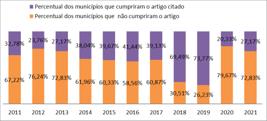
 Fonte: Elaborado pelos autores, com dados do
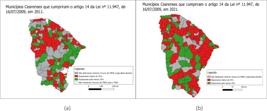
  Fonte: Elaborada com suporte em dados do