 Artificial Intelligence as a Tool to Support Decision-Making in the Management of Intraoperative Hypotension
Abstract
Introduction Intraoperative hypotension (IOH) is a frequent complication associated with adverse cardiovascular, cerebral, and renal outcomes, with increased mortality. Recent evidence indicates that cumulative exposure time to hypotension is a significant factor, related to both the duration and severity of hypotensive episodes. The Hypotension Prediction Index (HPI) algorithm, with active alerts, showed that hypotension periods can be significantly reduced.
Objectives To describe an artificial intelligence (AI) algorithm for hypotension prediction integrated into real-time anesthesia record-keeping software and Clinical Decision Support Systems (CDSS) that can warn anesthesiologists about the possibility of the onset of hypotension up to 20 minutes in advance.
Methods This prediction tool incorporates four machine learning classifier models developed using the XGBoost, a supervised learning library that works with decision trees with gradient boosting. These models were trained, validated, and tested based on a database of approximately 0.5 million anesthesia records, using real world data.
Results Accuracy ranged from 84.92% to 89.07%, and sensitivity ranged from 82.15% to 90.86%, with the best results found in five-minute predictions and the worst in twenty minute predictions. The algorithm was tested in all types of surgical procedures but only using adult data. Separate analyses were performed on small, medium, and large procedures of different surgical specialties with similar results.
Conclusions The present study demonstrated the use of an AI algorithm integrated into anesthesia record-keeping software, showing a high accuracy for hypotension prediction. This algorithm is available for all types of anesthesia care in adult procedures.
Hypotension; Anesthesia; Patient Outcome Assessment; Clinical Decision Support Systems; Artificial Intelligence

Introduction
Intraoperative hypotension (IOH) is widely acknowledged as a significant risk factor for surgical patients, as it is independently associated with severe adverse outcomes, including renal, cerebral, and cardiac injuries, and even mortality.1 Studies have shown that the severity of outcomes increases proportionally to the intensity and duration of hypotensive episodes.1,2 Recently, research has introduced the concept that the cumulative duration of hypotension during the perioperative period exerts a significant impact on patient outcomes, a finding corroborated by multiple studies.2
In the intraoperative context, it is challenging for the anesthesiologist to monitor the cumulative duration of hypotensive periods throughout extended surgeries, highlighting the need for technological solutions. Recent studies indicate that the use of predictive software can significantly reduce both the frequency and duration of hypotensive episodes, demonstrating its efficacy in supporting anesthesiologists.3 Although systems based on invasive arterial lines offer greater precision, their use is constrained by their invasive nature, high cost, and restricted availability to institutions equipped with these resources.
An alternative to facilitate the widespread adoption of these technologies is the development of software integrated with anesthesia records, providing the anesthesiologist with real-time support for any procedure. Decision Support Systems (DSS) have proven to be an effective solution to this problem, and advancements in Artificial Intelligence (AI) have enhanced these systems' interactions with clinicians through natural language, further increasing their precision and applicability. DSSs have also been associated with reduced task execution time, increased efficiency, and improved quality of patient care.4
Currently, there is a continuous effort to establish a less strenuous work routine, with healthcare professionals avoiding altered states of mental health, such as burnout. AI support in predicting critical patient conditions not only provides a direct gain in patient outcomes, but it also contributes in the quality of the anesthesiologist's routine and reduces their cognitive load.
The integration of multiple technologies in mobile devices readily available to the anesthesiologist represents an important advance in patient care, promoting greater adherence to protocols and best clinical practices. In this context, AxReg — the electronic anesthesiology record developed by Anestech — incorporates a DSS powered by AI that can alert physicians up to 20 minutes in advance about the probable occurrence of IOH, with adjustments based on individual patient and treatment characteristics. Through the refinement of machine learning models, the AI has achieved high accuracy in various clinical scenarios for patients over 12 years of age.
The predictive capability of Anestech's algorithm, combined with its integration into real-time anesthesia records, enables the anesthesiologist to act preventively, thereby reducing the intensity and duration of hypotensive episodes and preventing severe perioperative complications. The application of integrated technologies not only enhances clinical outcomes, but also contributes to cost reduction, an increasingly prioritized objective for healthcare institutions.
Outcomes related to hypotension
Each year, millions of surgeries are performed worldwide, and IOH is one of the most frequent complications, potentially causing target organ damage and increased morbidity and mortality. The etiologies of IOH are multifactorial and interrelated, encompassing patient characteristics, type of surgical procedures, anesthesia techniques, drugs used, and anesthetic-surgical complications.
A systematic review evaluating 42 studies seeking an association between IOH and worse outcomes in non-cardiac surgeries found that injuries occur when mean arterial pressure (MAP) drops below 80 mmHg for periods longer than 10 minutes or below 70 mmHg for shorter periods. However, high-quality studies identifying specific organ injuries at MAP levels below 65 mmHg remain limited.1
A wide range of literature suggests that lower MAP levels are related to a higher risk of organ damage. In the study by Walsh et al, an MAP of below 55 mmHg for even one minute was associated with myocardial injury, cardiac complications, and renal damage in non-cardiac surgeries.5
Similarly, a multicenter retrospective cohort study, conducted by Gregory et al., observed that IOH during non-cardiac surgery was prevalent and associated with a heightened risk of cardiac and cerebrovascular events within thirty days post-surgery. The greater the severity of hypotension, the more significant were the findings, which occurred in all of the age groups evaluated in this study. Given that IOH is preventable, frequent, and related to important outcomes, the authors define IOH as a serious public health concern that should not be ignored in any age group.1
A systematic review, conducted by Wesselink et al., highlights that, despite the lack of conformity in IOH definitions, its association with worse cardiac and renal outcomes is repeatedly demonstrated in several articles. The authors raise the question that most data are retrospective and with observational design in most studies, reflected by great variability in patient characteristics, definitions of hypotension, and results. This variability contributes to an ongoing debate concerning which blood pressure thresholds are low enough to induce injury and under what specific clinical conditions.6
The importance of cumulative time of IOH
Although the relationship between IOH and adverse outcomes has been studied extensively, a new concept has been introduced in recent years: the cumulative time of hypotension or time weighted average hypotension. According to this concept, not only is the MAP value relevant, but the cumulative time during which the patient remains hypotensive is crucial. Mascha et al. demonstrated that cumulative periods of IOH lasting 10 minutes — even when occurring intermittently throughout the intraoperative period — are linked to poorer outcomes.2
While the concept contains a simple logic, it carries great operational complexity: how to evaluate and make this information available to the anesthesiologist? In daily practice, anesthesiologists manage hypotensive episodes with available vasopressors, with rare cases where the patient remains hypotensive without any intervention. When tracking MAP trends over time, patient data often reveals "peaks and valleys". Valleys represent the moments when MAP first falls, prompting medical intervention, while peaks occur as vasopressors exert their pharmacological effects, stabilizing the patient’s blood pressure. In this common scenario in operating rooms, it is challenging to assess how long the patient remained hypotensive during the surgery, and a retrospective analysis would likely reveal a reactive approach to blood pressure management, characterized by sharp fluctuations.
This cycle — hypotension followed by treatment, resulting in an overshoot effect and subsequent hypotension requiring further treatment — constitutes the standard care for the patient, despite being associated with worse outcomes. The solution to prevent this cycle from happening is the prediction of hypotension, as anesthesiologists will be able to anticipate treatment and prevent the patient from becoming hypotensive in a more organic way and, with this extra time, using non-pharmacological maneuvers, minimizing unwanted side effects. In this way, there will be not only less IOH, but also less cumulative time of hypotension, a more uniform curve, and a more respected physiology.
Additionally, integrating anesthesia record-keeping software with features that track cumulative hypotension duration can warn clinicians when patients are already at a high risk. Ongoing education focused on the adoption of new technology and increased awareness concerning reducing IOH tolerance are essential steps toward improving outcomes on a global scale.
Hypotension prediction technologies
Hypotension prediction was initially implemented in hemodynamic monitors analyzing pulse wave contours, as additional information associated with a decision-making algorithm for hypotension treatment. To develop the prediction, machine learning techniques were used, retrospectively analyzing thousands of hypotensive events through hemodynamic data measured by the monitor. The refinement of these algorithms led to the creation of a hypotension probability indicator that alerts the physicians up to 20 minutes in advance about the increased risk of hypotension occurrence. These devices have been available for clinical use for several years in specific monitors with dedicated sensors and with higher operational costs.
Using these advanced monitoring systems, protocols for the early treatment of hypotension were formulated, demonstrating expressive results. In the prospective, observational, multicenter study by Kouz et al., which involved 749 patients, a monitoring protocol was applied from the start to the end of anesthesia. This protocol utilized the Acumen™IQ sensor (Edwards Lifesciences) and the HemoSphere platform (Edwards Lifesciences), which continuously calculates and displays the Hypotension Prediction Index (HPI) and hemodynamic variables, including blood pressure. No specific treatment protocol; instead, patients were managed according to each center's clinical routine. The study was conducted in medical centers that routinely use HPI software, the Acumen™IQ sensor, and the HemoSphere platform.
The results from this protocol were expressive. The median time-weighted average for MAP <65mmHg was minimal (0.03mmHg). Approximately 40% of all patients had no episodes of MAP <65 mm Hg lasting 1 minute. Patients had a median MAP <65 mm Hg for only 2 min or 1% of surgical time. These results are substantially lower than those reported in similar studies. The low occurrence of IOH in this study can be attributed to several factors: the use of hypotension prediction software that alerts to the risk of hypotensive events up to 20 minutes in advance, the hypotension treatment algorithm provided by the monitor, which indicates the most common causes of hypotension in a contextualized manner, which in turn facilitates correct decision-making, and the centers that participated in this study are all trained and experienced in the use of hemodynamic monitors with hypotension prediction. The authors reinforce that IOH is a modifiable risk factor for organ injury, both in terms of duration and severity.3
A subsequent study by Keijzer et al. demonstrated a similar effect in reducing hypotensive events with the use of HPI software.7 The systematic review by Depaskouale et al., published in 2024, confirmed that the combination of HPI software with personalized treatment protocols can effectively prevent IOH, despite significant heterogeneity across the studies.8
The evolution of these types of machine learning software for hypotension prediction is leading to the development of more comprehensive platforms with the possibility of greater scale and lower costs. This is a common path for technologies, and new software and devices incorporating these predictive capabilities will likely become more widely available.
Following the confirmation of the accuracy of hypotension prediction through machine learning techniques, other studies have sought correlations with other simpler and more readily available forms to avoid IOH. The prospective and observational study by Mulder et al. shows that MAP limits of 72–73 mmHg with active alarms treat the results of hypotension prediction through algorithms. Due to the great influence of MAP on IOH algorithms, the isolated use of MAP with alarm definition for intervention cut-off points obtained comparable results.9 A r etrospective study conducted by Jacquet-Lagrèze et al. suggested that simple linear extrapolation of MAP can be used to predict hypotension 1 to 2 minutes in advance.10
Clinical decision support systems (CDSS)
CDSS are tools that assist healthcare professionals in selecting appropriate courses of action, treatments, interventions, prescriptions, and other clinical activities. The methodologies employed in CDSS are highly varied, ranging from checklists, scores, ratings, and reminders to active alerts, blocks, prohibitions, and recommendations. These systems integrate various data sources through machine learning, neural networks, and AI. CDSS are applied in numerous clinical scenarios to achieve multiple objectives, including reducing cognitive load on healthcare professionals, enhancing diagnostic accuracy, improving documentation quality, facilitating billing processes, minimizing care variability, promoting adherence to protocols, and reducing time spent on record-keeping.
In a narrative review by Freundlich and Ehrenfeld (2017), the authors cite a continuous evolution of CDSS, emphasizing the integration between Anesthesia Information Management Systems (AIMS) and electronic health records (EHRs) as the critical point for results. Ideally, CDSS should be available in real-time, throughout the perioperative period and adjusted to specific patient subgroups. CDSS applications have shown significant results, particularly in such areas as maintaining normoglycemia, ensuring the proper use of prophylactic antibiotics, administering perioperative beta-blockers, warning clinicians of abnormal test results, optimizing mechanical ventilation, reducing unnecessary anesthetic gas expenditure, reducing postoperative nausea and vomiting, and facilitating the implementation of pre-anesthesia induction checklists. Associated with the mentioned care benefits, operational gains have been observed, such as a better management of the surgical center’s schedule, a reduction in overall anesthesia costs, and a better billing performance. Despite limited literature regarding impacts on important outcomes, CDSS show several advantages and are a clear trend in technological evolution.11
Emerging AI technologies, particularly those involving natural language (e.g., large language models (LLMs)), will greatly enhance decision support, contextualizing patient needs, procedure characteristics, and institutional standards. In a retrospective study by Kheterpal et al., the use of a clinical decision support system for more than 75% of the anesthesia duration was associated with reduced incidences of hypotension, lower fluid administration, better tidal volume management, reduced costs, and a shorter average hospital stay.12
The patient's clinical context and the characteristics of the anesthetic-surgical procedure need to be the starting point of a modern CDSS, with widespread use, as presented in the central figure scheme. CDSS for focal actions that work in parallel with EHRs have low engagement, despite their good results. Ideally, CDSS should identify each patient's unique needs and procedural requirements, providing professionals the appropriate recommendations for each case, scaling the mandatory items, risks, points of attention, and desirable items.
The analysis of all perioperative variables is complex, and simple technologies will not be sufficient. In these cases, the application of more advanced data analysis technologies, such as machine learning, is necessary. These systems can dynamically learn, recommend, and guide decision-making, adapting to individual professional needs, patient variability, and institutional protocols. As machine learning systems are dynamic, if care protocols change, the system itself will learn the new format and will begin to recommend the new protocols.
For these learning systems to be effective, the database must be accurate, complete, retrievable, and available in real-time. This is one of the major current difficulties, as old EHRs can be a barrier to the advancement of these new technologies. Furthermore, healthcare institutions that still rely on paper-based records are excluded from the full benefits of modern digital tools, leading to suboptimal outcomes due to digital exclusion. Taking care of the entire journey of perioperative data for the evolution of medical systems is essential and must be performed with the same dedication applied when caring for patients.
When high-quality data is available for modern CDSS, automated monitoring and analysis of indicators is also possible, a basic condition for proper management. Through the integration of AIMS with EHRs, the anesthesia record becomes a large repository of information taken minute-by-minute in real-time, rendering CDSS a reality. The anesthesiologist continues to be indispensable as a source of clinical judgment and intervention. The AIMS is the main core of AI and CDSS, as represented by the Central Illustration.
The effective implementation of CDSS are challenges for AI and behavioral science. Several factors contribute to these challenges. First, the quality of an algorithm's output is directly affected by the quality of data input (e.g., identification of main patient information and monitoring artifact filters). Second, CDSS typically provide various notifications and warnings that require the physician's attention for the conduct to be carried out. In this aspect, alarm fatigue and documentation requirements are a great challenge for the CDSS to be useful and accurate without becoming burdensome in practice. Finally, implementing an effective CDSS requires processing enormous amounts of clinical data in near real-time, a task that currently exceeds the capabilities of local anesthesia machines or hospital networks, requiring connectivity with cloud-based servers.13
Since the famous article by Berwick, Nolan, and Whittington (2008), the three objectives of healthcare are: care, health, and cost.14 Parallel to the search for better results at a lower cost, technology presents several advantages over the traditional flow of medical innovation. Behavioral science and the economic direction of healthcare businesses will guide the implementation of CDSS, with the main objectives of reducing professional fatigue, improving documentation, enhancing outcomes, and minimizing errors. Technology alone will not provide the solution, but rather be the tool. Social engineering and the construction of efficient business models will help multiply the quality and value of anesthetic care.13
Protocol engagement and results auditing
In recent years, healthcare services have focused on reducing variability in care as a part of efforts to standardize evidence-based practices. These initiatives aim to enhance clinical outcomes, increase predictability, and improve control over operational processes, which, in turn, will indirectly result in financial forecasting.
The development of care protocols and Standard Operating Procedures (SOPs) are among the most commonly employed strategies to achieve these objectives. However, merely establishing a protocol or process is insufficient; it is necessary to engage teams for adoption and execution in daily practice. While it may seem simple, the reality is more complex. Multifactorial and multicentric action is needed to achieve engagement with protocols, and for this, technology plays a key role.
A variety of methods have been proposed to improve engagement, from continuing education to software automation, integration between medical records, indicator control, DSS, closed-loop mechanisms (without human intervention), financial incentives, and various penalties. However, no single method has shown sustainable long-term results on its own.
In an observational cohort study by Parks et al., a combination of four methods was used to increase adherence to the protective ventilation protocol during general anesthesia. The first phase was educational, followed by a near real-time feedback screen. Participants then gained access to a dashboard where it was possible to analyze their adherence to the global protocol on a case-by-case basis. Finally, a multidimensional decision support system was introduced. Adherence to the protocol before the study was 42.4% and rose to 88.9% after the complete implementation of all phases.15
Similarly, Joosten et al. evaluated a real-time decision support system for adherence to the goal-directed fluid therapy protocol in the intraoperative period. The study demonstrated that patients were hypotensive for less time and used less volume as fluid therapy in total, showcasing the efficacy of DSS in improving protocol compliance.16
Numerous studies have demonstrated that adherence to protocols improves significantly when intelligent alerts, automation, and DSS are employed. However, these initiatives should always be associated with the creation of protocols, as only a high adherence to protocols can truly fulfill their functions.
Closed-loop anesthesia is an innovative technique, in which human interference is eliminated, and the monitor is directly connected to the infusion of a medication or control. The human function is to define the target of action and presence of the drug in the receptor and, from there, the closed loop maintains the original target. This technique has already been successfully used for volume infusion X blood pressure/fluid responsiveness, hypnotic infusion X consciousness monitors, opioid infusion X analgesia monitors, expired carbon dioxide analysis X ventilatory tidal volume, insulin infusion X glycemia monitor, intraoperative normothermia maintenance, among others.
In the editorial by Coeckelenbergh et al. on closed-loop anesthesia, the authors highlight that automation to reduce repetitive processes and adherence to protocols are the key advantages of these systems. The major challenges are data interoperability and the need for an additional control device. The future evolution of these systems will likely involve multiple data inputs and outputs to enable the control of several closed loops within the same software.17
To achieve multiple DSS, automations, and closed loops, digital adoption through systems and modern databases, as well as the creation of data lakes, is crucial. In anesthesiology, such systems are known as AIMS. These systems enable the effective application of machine learning and AI in a precise, useful, and contextualized way that can manage multiple systems.
The evolution of medicine and the broad application of AI inevitably passes through the creation of large, high-quality databases that are tabulated, organized, retrievable, analyzable, and available in real-time.
AI as a tool for better outcomes
To initiate a discussion on AI in healthcare, it is essential to first outline the sequence of technologies involved to make AI possible. The primary condition for AI integration in healthcare is the digital adoption of AIMS, which serves as a central hub for perioperative information, integrated with EHRs, monitoring devices, and anesthesia machines. From the care of the perioperative data journey captured and organized by AIMS, large data lakes are built, where machine learning techniques, deep learning, and neural networks are applied to construct CDSS, as shown in the Central Illustration.
Once these stages are implemented and refined by a data science team, the next step is to design user interfaces for healthcare professionals. At this point, it is important to apply user experience methodologies and design thinking to build intuitive software that facilitates usability and incorporation into service routines. The final stage is an AI development that manages multiple CDSS working in real-time and with temporal memory to contextualize recommendations and actions taken over time. Additionally, continuous education and individualized, automated feedback systems are necessary to achieve precise and effective AI use. This will foster greater professional engagement, leading to better clinical outcomes and enhanced operational performance.
The construction of AIs for healthcare requires high-quality, high-quantity, high-variety, high-speed access and response, and high-value databases.18 In recent years, the popularization of LLMs has transformed the way we interact with AI, as it is now possible to ask questions and receive answers in our own natural language, without the need to know software programming languages. This advance marks a significant milestone in the digital transformation, as it is within everyone's reach.
Applications of LLM’s are growing exponentially in all sectors, and healthcare is no different. However, patient care presents unique challenges, many of which still have not been resolved by current technology. Key challenges for AI in healthcare include low digital maturity of institutions, outdated software systems, inadequate databases, limited explainability of some machine learning models, hallucinations (i.e., wrong and/or out-of-context responses), insufficient precision, and implementation costs. Furthermore, data interoperability and a lack of transparency in AI algorithms likely represent the most significant and complex obstacles.
The core advantage of AIs is the ability to manage and organize large amounts of information and select what is most relevant at the moment. In patient care, where multiple variables and rare situations arise, such as rare diseases and rarely used medications that need to be contextualized, AI can be particularly valuable. It will be possible to standardize and audit care in common situations, thereby reducing variability in care and increasing the number of patients who receive the right treatment at the right time. By associating standard treatments with prediction alerts in a coordinated manner, it is likely to improve treatment delivery and patient outcomes. For less common or rare conditions, AI offers real-time access to a wealth of medical literature and clinical guidelines, enabling healthcare teams to make more informed, evidence-based decisions. In these cases, AI acts as a vital support tool, contextualizing available knowledge to guide clinical practice.
A third application is in monitoring the journey of critical, severe, and chronic patients, who together constitute a large portion of the health costs. In this group of patients, AI monitoring becomes scalable and universal, monitoring patients for treatment adherence, the prediction of decompensation situations, active alerts for care teams, as well as feedback for patients, caregivers, healthcare professionals, and payers.
The review by Bellini et al. suggests that AI can have a significant impact throughout the perioperative period, including surgical and anesthetic planning. As AI implementation continues to grow, it holds promise for improving the quality of patient care.18
The study of King et al. analyzed the implementation of multiple real-time CDSS with support through telemedicine on quality measures in the intraoperative period of a single center. The authors found no significant difference in the quality indicators after the implementation of the system. It is important to note that quality indicators were already high before system implementation, which makes it more difficult to demonstrate results.19
It is still the beginning of the AI era, and we still cannot demonstrate differences in important outcomes. Currently, the reduction of repetitive work and construction of documentation are the major applications of AI in healthcare. There will certainly be many new applications with more expressive results in the near future.
Case study of the axreg/anestech hypotension prediction system
Anestech has developed AxReg, the most widely used AIMS in Latin America, and through it generated more than 4 million anesthesia records in its data lake.
Anestech's hypotension prediction system is a feature of AxReg. It informs the probability of IOH occurrence, continuously and automatically, as the grids of the intraoperative anesthesia record are filled. Each grid column corresponds to 5-minute intervals of the intraoperative period.
The prediction tool incorporates four machine learning classifier models developed using the XGBoost (eXtreme Gradient Boosting) library. These models were trained, validated, and tested with approximately 0.5 million anesthesia records from Anestech's database at the time (2021). XGBoost is a supervised learning library that works with decision trees with gradient boosting, in a scalable and distributed manner,20 which demonstrated efficiency in dataset manipulation and adequate application in anesthesiology.
The training and validation process used data from high-volume anesthetic procedures recorded in the database, and the model’s refinement was done through gradient adjustments, achieving final models with high accuracy and sensitivity. After this process, the algorithm was generally tested across all types of surgical procedures. Separate analyses were performed on small, medium, and large procedures of different surgical specialties. The metrics of the final classifier models are presented in the table below.
– Sensitivity and accuracy of the models in percentage of Anestech's hypotension prediction system.
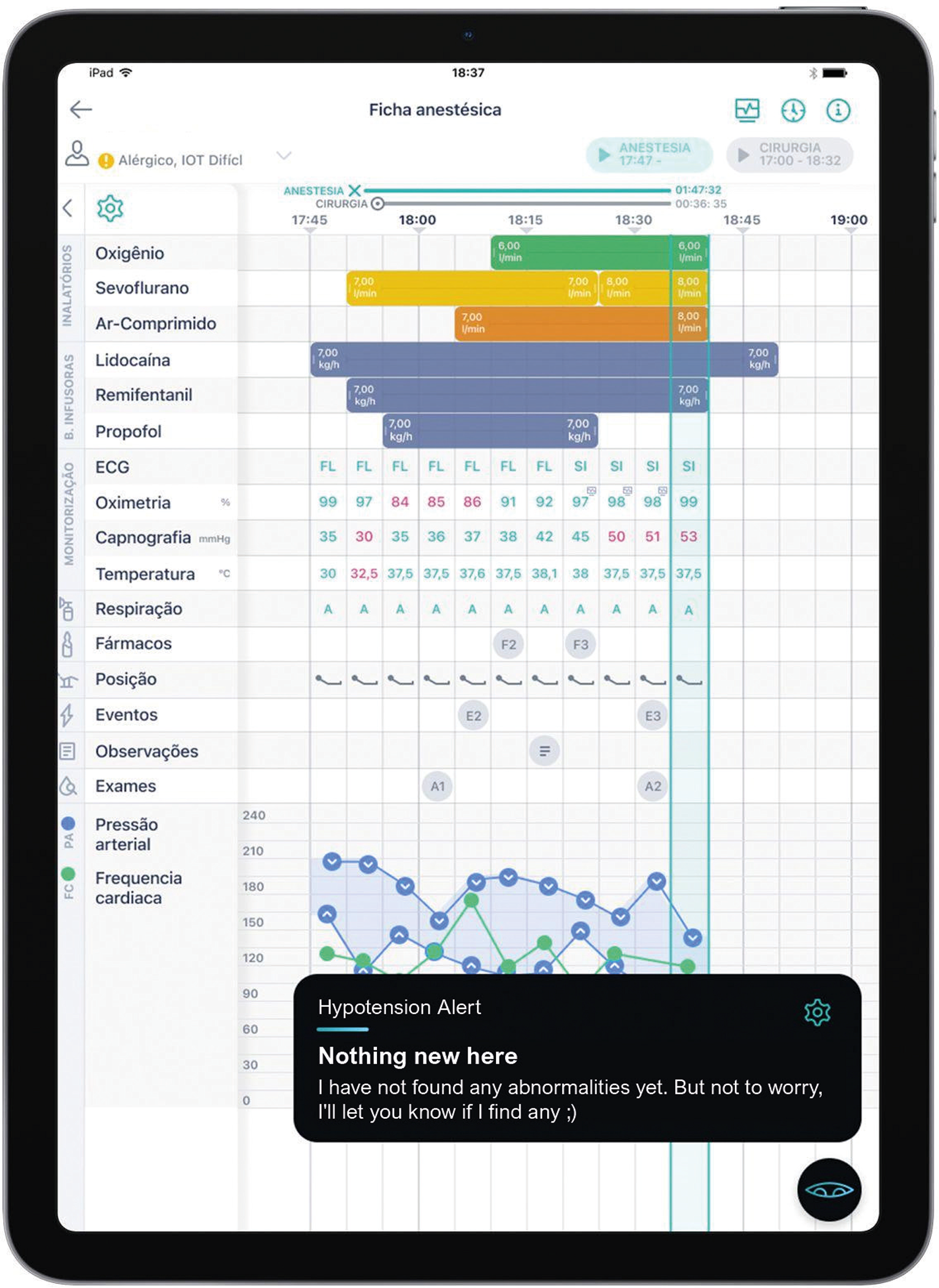
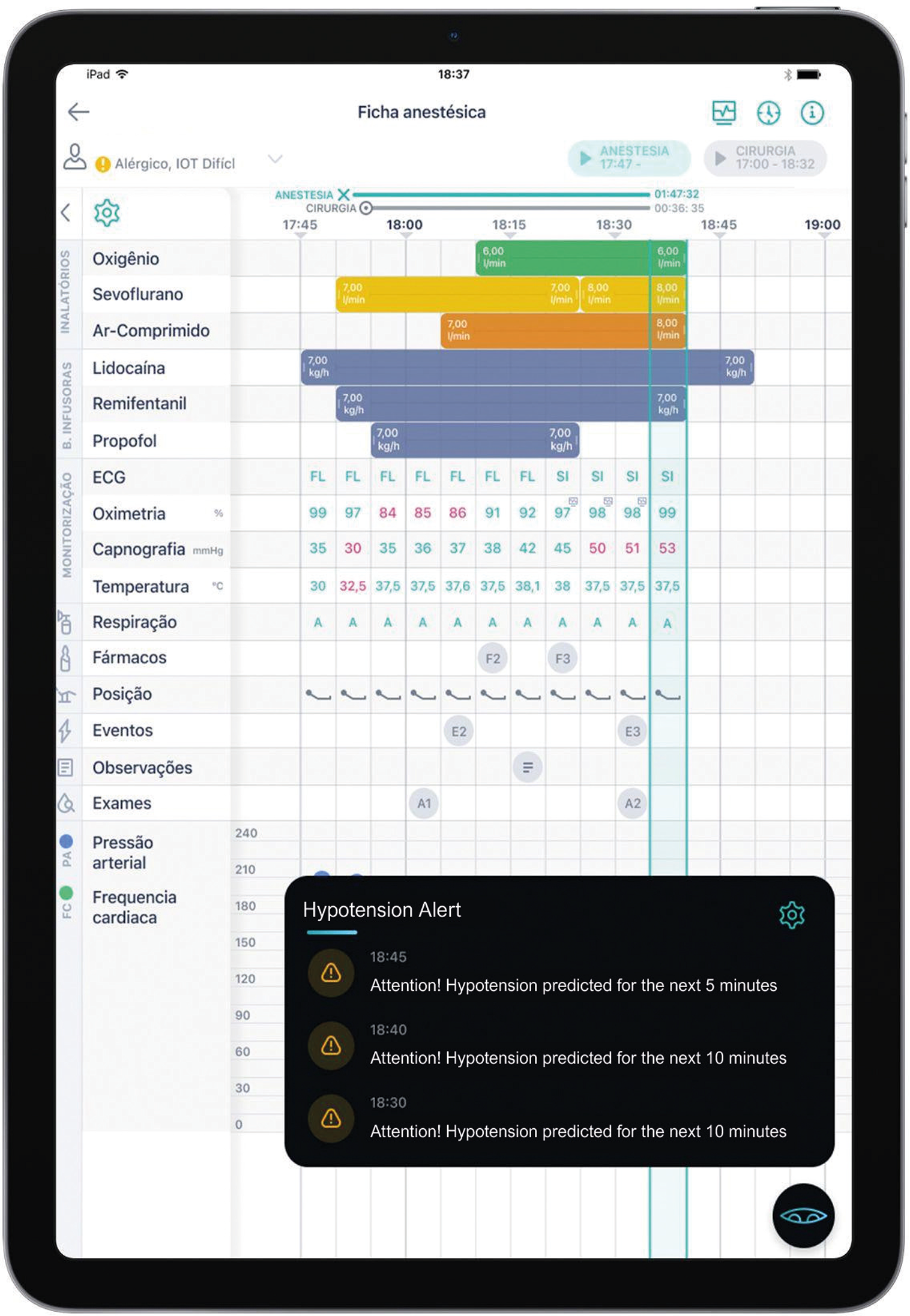
The system works with a moving window of three grids, combined with the patient's baseline information collected in the first grid of the anesthesia record. The system uses key parameters, such as heart rate (HR), systolic blood pressure (SBP), diastolic blood pressure (DBP), and patient age. Each classifier model receives both the baseline data and continuous HR, SBP, and DBP time-series measurements throughout the intraoperative period. The system then calculates the projected blood pressure values for the next four grids (+05 min, +10 min, +15 min, and +20 min). If any of these predictions suggest hypotension, an audible and visual alert is triggered to notify the anesthesiologist (Figure 1, 2 and 3).

– AxReg with Axel (AI) informing that there is no hypotension alert. Source: AxReg software images provided by Anestech.

– AxReg with Axel (AI) informing hypotension alerts in 5 and 10 minutes Source: AxReg software images provided by Anestech.

– AxReg with Axel (AI) informing that there is a hypotension alert in 10 minutes. Source: AxReg software images provided by Anestech.
The prediction system was developed to operate online, and begins to calculate the probability of IOH from the fourth grid, i.e., after the 20th minute of anesthesia, due to the moving window of three grids in addition to the baseline grid.
AxReg is a Brazilian-developed software, and as such, its interface is in Portuguese. On the system's user interface, located in the lower right corner, is Axel, the system's AI responsible for informing alerts to anesthesiologists. Below each figure, there is the translation of the text box with information about hypotension prediction (Figure 1, 2 and 3).
Conclusions
AI has a growing range of applications in healthcare, with predictions standing out as some of the most studied and promising. In particular, the prediction of IOH has been extensively studied due to its high frequency and its strong relationship with important clinical outcomes.
AI-driven hypotension prediction systems enable contextualization with the patient's clinical data, refinement of results to achieve greater accuracy, more effective interaction with the anesthesiologist, and more effective management for patients. The literature has already proven that the existence of prediction-based alerts is very effective in reducing the total time a patient remains hypotensive. As an extrapolation of these data based on the literature about hypotension complications, it is clear that reducing the number of patients experiencing hypotension, as well as minimizing the total duration of hypotension episodes, will likely lead to improved clinical outcomes.
This conclusion effectively summarizes the key points of the article, highlighting the importance of AI in predicting IOH and its potential impact on patient outcomes. It emphasizes the value of contextualized predictions, improved accuracy, and better interaction with anesthesiologists, all of which contribute to more effective patient management. The conclusion also draws a logical connection between reduced hypotension time and improved clinical outcomes, based on existing literature.
References
-
1 Gregory A, Stapelfeldt WH, Khanna AK, Smischney NJ, Boero IJ, Chen Q, et al. Intraoperative Hypotension is Associated with Adverse Clinical Outcomes after Noncardiac Surgery. Anesth Analg. 2021;132(6):1654-65. doi: 10.1213/ANE.0000000000005250.
» https://doi.org/10.1213/ANE.0000000000005250 -
2 Mascha EJ, Yang D, Weiss S, Sessler DI. Intraoperative Mean Arterial Pressure Variability and 30-Day Mortality in Patients Having Noncardiac Surgery. Anesthesiology. 2015;123(1):79-91. doi: 10.1097/ALN.0000000000000686.
» https://doi.org/10.1097/ALN.0000000000000686 -
3 Kouz K, García MIM, Cerutti E, Lisanti I, Draisci G, Frassanito L, et al. Intraoperative Hypotension when Using Hypotension Prediction Index Software During Major Noncardiac Surgery: A European Multicentre Prospective Observational Registry (EU HYPROTECT). BJA Open. 2023;6:1-8. doi: 10.1016/j.bjao.2023.100140.
» https://doi.org/10.1016/j.bjao.2023.100140 -
4 Nanji KC, Garabedian PM, Langlieb ME, Rui A, Tabayoyong LL, Sampson M, et al. Usability of a Perioperative Medication-Related Clinical Decision Support Software Application: A Randomized Controlled Trial. J Am Med Inform Assoc. 2022;29(8):1416-24. doi: 10.1093/jamia/ocac035.
» https://doi.org/10.1093/jamia/ocac035 -
5 Walsh M, Devereaux PJ, Garg AX, Kurz A, Turan A, Rodseth RN, et al. Relationship between Intraoperative Mean Arterial Pressure and Clinical Outcomes after Noncardiac Surgery: Toward an Empirical Definition of Hypotension. Anesthesiology. 2013;119(3):507-15. doi: 10.1097/ALN.0b013e3182a10e26.
» https://doi.org/10.1097/ALN.0b013e3182a10e26 -
6 Wesselink EM, Kappen TH, Torn HM, Slooter AJC, van Klei WA. Intraoperative Hypotension and the Risk of Postoperative Adverse Outcomes: A Systematic Review. Br J Anaesth. 2018;121(4):706-21. doi: 10.1016/j.bja.2018.04.036.
» https://doi.org/10.1016/j.bja.2018.04.036 -
7 Keijzer IN, Vos JJ, Yates D, Reynolds C, Moore S, Lawton RJ, et al. Impact of Clinicians' Behavior, an Educational Intervention with Mandated Blood Pressure and the Hypotension Prediction Index Software on Intraoperative Hypotension: A Mixed Methods Study. J Clin Monit Comput. 2024;38(2):325-35. doi: 10.1007/s10877-023-01097-z.
» https://doi.org/10.1007/s10877-023-01097-z -
8 Depaskouale MAP, Archonta SA, Katsaros DM, Paidakakos NA, Dimakopoulou AN, Matsota PK. Beyond the Debut: Unpacking Six Years of Hypotension Prediction Index Software in Intraoperative Hypotension Prevention - A Systematic Review and Meta-Analysis. J Clin Monit Comput. 2024;38(6):1367-77. doi: 10.1007/s10877-024-01202-w.
» https://doi.org/10.1007/s10877-024-01202-w -
9 Mulder MP, Harmannij-Markusse M, Fresiello L, Donker DW, Potters JW. Hypotension Prediction Index is Equally Effective in Predicting Intraoperative Hypotension During Noncardiac Surgery Compared to a Mean Arterial Pressure Threshold: A Prospective Observational Study. Anesthesiology. 2024;141(3):453-62. doi: 10.1097/ALN.0000000000004990.
» https://doi.org/10.1097/ALN.0000000000004990 -
10 Jacquet-Lagrèze M, Larue A, Guilherme E, Schweizer R, Portran P, Ruste M, et al. Prediction of Intraoperative Hypotension from the Linear Extrapolation of Mean Arterial Pressure. Eur J Anaesthesiol. 2022;39(7):574-81. doi: 10.1097/EJA.0000000000001693.
» https://doi.org/10.1097/EJA.0000000000001693 -
11 Freundlich RE, Ehrenfeld JM. Anesthesia Information Management: Clinical Decision Support. Curr Opin Anaesthesiol. 2017;30(6):705-9. doi: 10.1097/ACO.0000000000000526.
» https://doi.org/10.1097/ACO.0000000000000526 -
12 Kheterpal S, Shanks A, Tremper KK. Impact of a Novel Multiparameter Decision Support System on Intraoperative Processes of Care and Postoperative Outcomes. Anesthesiology. 2018;128(2):272-82. doi: 10.1097/ALN.0000000000002023.
» https://doi.org/10.1097/ALN.0000000000002023 -
13 Seger C, Cannesson M. Recent Advances in the Technology of Anesthesia. F1000Res. 2020;9:1-7. doi: 10.12688/f1000research.24059.1.
» https://doi.org/10.12688/f1000research.24059.1 -
14 Berwick DM, Nolan TW, Whittington J. The Triple Aim: Care, Health, and Cost. Health Aff (Millwood). 2008;27(3):759-69. doi: 10.1377/hlthaff.27.3.759.
» https://doi.org/10.1377/hlthaff.27.3.759 -
15 Parks DA, Short RT, McArdle PJ, Liwo A, Hagood JM, Crump SJ, et al. Improving Adherence to Intraoperative Lung-Protective Ventilation Strategies Using Near Real-Time Feedback and Individualized Electronic Reporting. Anesth Analg. 2021;132(5):1438-49. doi: 10.1213/ANE.0000000000005481.
» https://doi.org/10.1213/ANE.0000000000005481 -
16 Joosten A, Hafiane R, Pustetto M, van Obbergh L, Quackels T, Buggenhout A, et al. Practical Impact of a Decision Support for Goal-Directed Fluid Therapy on Protocol Adherence: A Clinical Implementation Study in Patients Undergoing Major Abdominal Surgery. J Clin Monit Comput. 2019;33(1):15-24. doi: 10.1007/s10877-018-0156-x.
» https://doi.org/10.1007/s10877-018-0156-x -
17 Coeckelenbergh S, Joosten A, Cannesson M, Rinehart J. Closing the Loop: Automation in Anesthesiology is Coming. J Clin Monit Comput. 2024;38(1):1-4. doi: 10.1007/s10877-023-01077-3.
» https://doi.org/10.1007/s10877-023-01077-3 -
18 Bellini V, Valente M, Gaddi AV, Pelosi P, Bignami E. Artificial Intelligence and Telemedicine in Anesthesia: Potential and Problems. Minerva Anestesiol. 2022;88(9):729-34. doi: 10.23736/S0375-9393.21.16241-8.
» https://doi.org/10.23736/S0375-9393.21.16241-8 -
19 King CR, Gregory S, Fritz BA, Budelier TP, Abdallah AB, Kronzer A, et al. An Intraoperative Telemedicine Program to Improve Perioperative Quality Measures: The ACTFAST-3 Randomized Clinical Trial. JAMA Netw Open. 2023;6(9):e2332517. doi: 10.1001/jamanetworkopen.2023.32517.
» https://doi.org/10.1001/jamanetworkopen.2023.32517 -
20 XGBoost Developers. XGBoost Documentation [Internet]. Pittsburgh: XGBoost; 2022 [cited 2024 Sep 10]. Available from: https://xgboost.readthedocs.io
» https://xgboost.readthedocs.io
-
Study Association
This study is not associated with any thesis or dissertation work.
-
Ethics Approval and Consent to Participate
This article does not contain any studies with human participants or animals performed by any of the authors.
-
Sources of Funding
There were no external funding sources for this study.
Edited by
-
Editor responsible for the review
Claudio Mesquita