 Right Ventricle Infarction in Current Practice: Insights from a Contemporary Registry at a High-Volume Tertiary Center in Brazil
Abstract
Background: Right ventricular (RV) involvement in acute ST-segment elevation myocardial infarction (STEMI) has scarcely been studied in contemporary cardiology practice.
Objective: To evaluate the clinical, angiographic, procedural characteristics and outcomes of patients with STEMI and RV involvement undergoing primary percutaneous coronary intervention (pPCI).
Methods: This prospective cohort included consecutive patients with STEMI presenting within 12 hours of symptom onset and undergoing pPCI between 2009 and 2023 at a high-volume tertiary cardiology center in Brazil. Clinical characteristics and outcomes of patients with RV infarction were compared to those without RV involvement. Continuous and categorical variables were analyzed using appropriate statistical tests, with a significance level of 5% (p < 0.05). Logistic regression models were used to identify independent predictors.
Results: Among 5,611 patients, 13% had RV involvement. These individuals were more frequently female, had right coronary artery as the culprit vessel, had greater thrombotic burden, and more often presented with total atrioventricular block (TAVB). Acute kidney injury (5.8% versus 4.1%, p = 0.03) and stroke (1.6% versus 0.8%, p = 0.04) were more common in the RV group. Thirty-day (10.5% versus 8.7%, p = 0.16) and 2-year mortality (19.5% versus 18.5%, p = 0.11) were higher among patients with RV infarction, although not statistically significant. In multivariable analysis, TAVB and female sex were independently associated with RV involvement. RV infarction was not an independent predictor of 30-day mortality.
Conclusion: In current practice, approximately 1 in 7 STEMI patients present with RV involvement. These patients have a higher-risk profile, though RV infarction was not independently associated with short-term mortality.
Keywords:
Right Ventricular; ST-Segment Elevation Myocardial Infarction; Acute Coronary Syndrome; Myocardial Infarction
Introduction
Modern reperfusion therapies have significantly altered the overall prognosis of patients with ST-segment elevation acute myocardial infarction (STEMI), providing a substantial reduction in the rate of severe complications, morbidity, and mortality of these patients.1-4 Multivessel coronary disease, prolonged time to presentation, severe left ventricular dysfunction, and ventricular arrhythmias are among the factors associated with less favorable prognosis.5,6
Involvement of the right ventricle (RV) in STEMI has also been traditionally linked to worse clinical outcomes and higher mortality.7-10 However, recent studies have suggested that the higher frequency of adverse clinical events in patients with RV infarction could be explained by a higher-risk patient profile that was observed in several studies.11-13 Since comprehensive contemporary studies addressing this important clinical topic are scarce, we sought to evaluate characteristics, clinical outcomes, and independent predictors of adverse events in patients with STEMI and RV involvement in modern daily clinical practice.
Methods
Design
This prospective cohort study included consecutive patients with STEMI treated at a high-volume tertiary cardiology center in Brazil from December 2009 to February 2023. STEMI was defined according to the diagnosis made by the cardiologist responsible for the patient's hospital admission in the emergency department. The criteria were as follows: ischemic symptoms associated with new ST-segment elevations in 2 contiguous leads or new bundle branch blocks with ischemic repolarization patterns; new, or presumed new, J-point elevation ≥ 1 mm is required in all leads other than V2 and V3 as an ischemic response (taking into account aspects that can change the reference of this parameter, such as age and sex, which have different cutoff points); ST-segment elevation (> 1 mm) isolated in lead aVR may accompany anterior or inferior STEMI.14,15 All defined criteria taken in consideration were in accordance with the Fourth Universal Definition of Myocardial Infarction.16

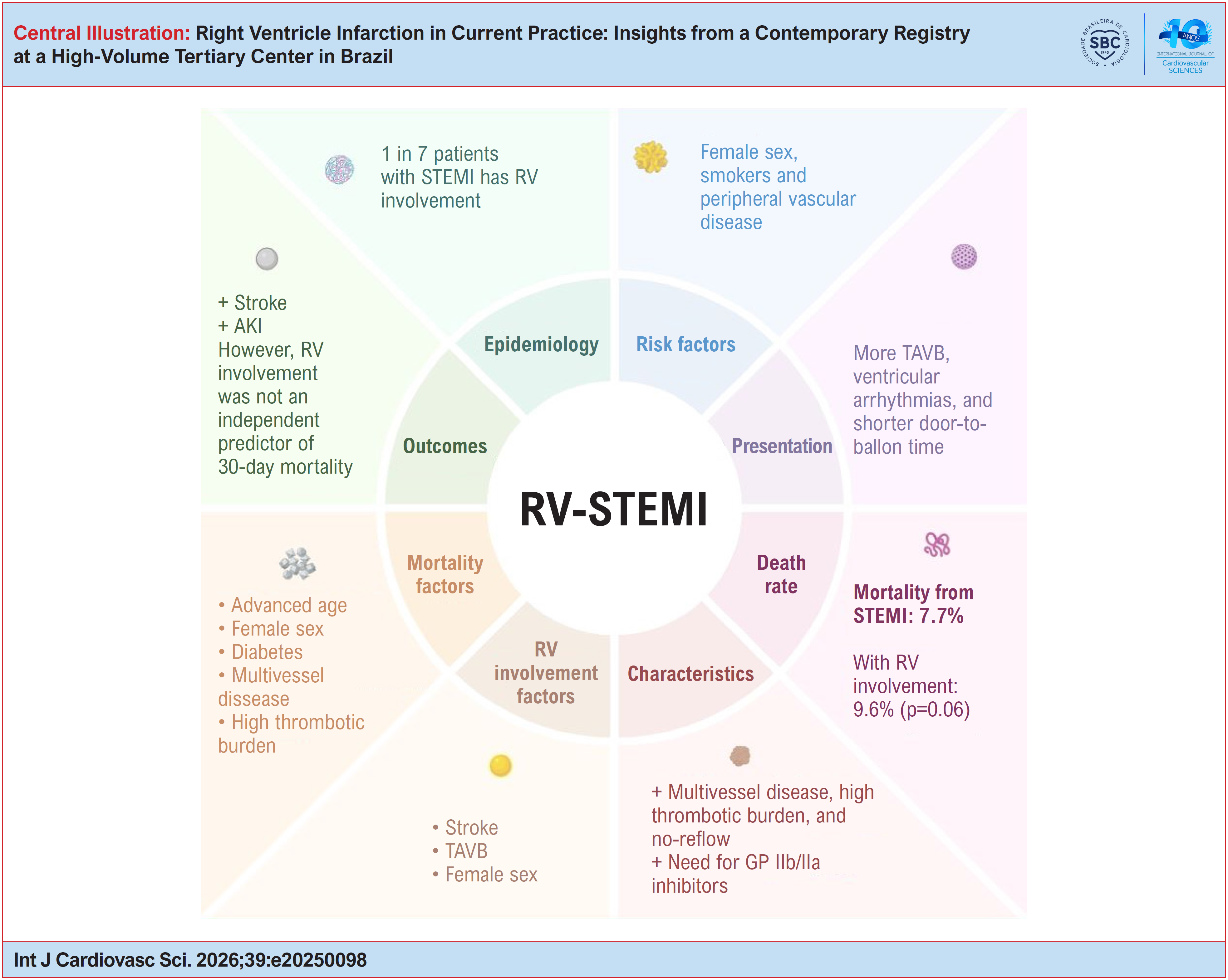
Characteristics of RV involvement in STEMI. Figure created with BioRender.com. AKI: acute kidney injury; GP: glycoprotein; RV: right ventricular; STEMI: ST-segment elevation myocardial infarction; TAVB: total atrioventricular block.
Patients
Patients presenting within 12 hours of symptom onset and undergoing primary percutaneous coronary intervention (pPCI) were considered eligible. RV infarction was defined by the presence of ST-segment elevation (≥ 0.5 mm, or ≥ 1 mm in men < 30 years) in at least one of the right precordial leads (V3R to V6R), which were routinely acquired in cases of inferior STEMI or when RV involvement was clinically suspected. Although electrocardiographic criteria were the primary tool for identifying RV infarction, additional clinical and hemodynamic features (such as hypotension, reduced cardiac output, or the requirement for vasoactive agents) were also documented to provide a more comprehensive characterization of RV involvement. Exclusion criteria included age under 18 years, initial revascularization with coronary artery bypass grafting, or refusal to provide informed consent.
Clinical characteristics
Patients were interviewed during the index hospitalization, and medical records were reviewed. The following definitions were used:
-
Smoking: regular cigarette smoking or cessation within the last year;
-
Hypertension: previous diagnosis of hypertension and/or use of antihypertensive drugs;
-
Diabetes mellitus: previous diagnosis of diabetes mellitus and/or use of medications for diabetes treatment;
-
Dyslipidemia: fasting serum cholesterol greater than 240 mg/dL, previous diagnosis of dyslipidemia, and/or use of lipid-lowering medication;
-
Family history: myocardial infarction or sudden death of father (< 55 years old) or mother (< 65 years old).
-
Angina: discomfort in the chest or in the neck, shoulders, jaw or arms, precipitated by physical activity, relieved by rest or administration of nitrate, in the past 3 months.
-
Heart failure: defined as a prior clinical diagnosis or imaging evidence of left ventricular dysfunction with reduced ejection fraction. Severe heart failure was characterized as heart failure with reduced ejection fraction accompanied by hemodynamic compromise requiring inotropic agents or mechanical circulatory support during the hospital stay.
-
Chronic kidney disease: previous diagnosis of chronic kidney disease.
-
Peripheral vascular disease: symptoms of intermittent claudication or previous limb revascularization procedure.
-
Severe chronic obstructive pulmonary disease: previous diagnosis of emphysema or chronic obstructive bronchitis with at least one exacerbation and/or use of home oxygen and/or severe or very severe airflow obstruction (described as GOLD grade 3 or 4) in previous spirometry.
-
Depression: previous diagnosis and/or use of medications for depression treatment.
Angiographic evaluation
Angiographic evaluations were performed using a previously validated digital electronic system. Angiographic measurements included target vessel diameter, defined as the average of diameters proximal and distal to the lesion; luminal diameter measured before and after stent implantation; severity of stenosis assessed in two orthogonal projections, considering the most severe; lesion length measured "shoulder to shoulder," with long lesions considered single if there was a normal arterial segment less than 10 mm between them. High thrombus burden was defined angiographically as TIMI thrombus grade ≥ 4, which includes thrombus size greater than twice the vessel diameter or total vessel occlusion presumed to be caused by thrombus. Technical aspects related to stent implantation followed routines established in the literature.17
Outcomes
Investigators assessed in-hospital events during index hospitalization. Events reported by patients after hospital discharge were confirmed through medical records, diagnostic tests, or contact with the healthcare facility. A new myocardial infarction was defined as elevation of cardiac biomarkers and evidence of acute myocardial ischemia. A new revascularization procedure was any PCI or surgical revascularization performed during follow-up. Stroke was defined as a new focal neurological event lasting at least 24 hours. Stent thrombosis was defined as definite or probable stent thrombosis according to the Academic Research Consortium Definition. Major adverse cardiovascular events were defined as the occurrence of death, new myocardial infarction, stroke, stent thrombosis, or any new revascularization procedure during the follow-up period.
Patient follow-up
Participants were followed up at 30 days, 1 year, and 2 years after the initial event, either by telephone or by reviewing medical records for event recording.
Statistical analysis
All statistical analyses were conducted using SPSS version 28.0 for Windows (IBM Corp., Armonk, NY). The distribution of continuous variables was verified with the Shapiro-Wilk test. Data with normal distribution were expressed as mean ± standard deviation, while non-normally distributed variables were reported as median and interquartile range. Categorical variables were summarized as counts and percentages.
Group comparisons were made using the independent samples t test for normally distributed continuous variables and the Mann-Whitney U test for those with non-normal distribution. The chi-square test or Fisher's exact test was employed for categorical variables.
Univariate analyses were initially performed to explore associations between baseline variables and 30-day mortality. Depending on the type and distribution of each variable, independent samples t tests, chi-square tests, or Fisher's exact tests were applied. Variables with p values < 0.10 in the univariate analyses (for example, age, sex, diabetes mellitus, multivessel disease, and thrombotic burden) were subsequently included in a multivariate logistic regression model to identify independent predictors of 30-day mortality. In addition, a separate logistic regression analysis was performed to identify independent predictors of RV involvement. Odds ratios and 95% confidence intervals were reported. A two-sided p value < 0.05 was considered statistically significant.
Results
During the study period, 5,611 patients with STEMI were included, and 705 patients (13%) presented with RV involvement (Table 1). A significantly higher proportion of women was observed in the RV group, but there were no statistically significant differences in age, race, family history, or other risk factors between the groups. Patients with STEMI and RV involvement were more likely to develop total atrioventricular block (TAVB) and had a shorter time from hospital arrival to balloon inflation compared to those without RV infarction.
Regarding angiographic and procedural characteristics, the right coronary artery was responsible for the great majority of RV STEMI, with a small proportion of cases involving the left anterior descending or circumflex artery (Table 2). Patients with RV infarction more often had three-vessel disease and a greater thrombus burden than those in the control group, with significantly higher use of glycoprotein IIb/IIIa inhibitors. The group of patients with RV involvement had a higher rate of no reflow, lower pre-procedure rates of TIMI flow grade 3 and Blush grade 3, but similar rates of post-procedural TIMI and blush grade 3. Rates of complete revascularization and intra-aortic balloon pump use were similar between groups. However, patients with RV involvement had a higher incidence of TAVB during the procedure and more frequent need for temporary transvenous pacing.
Radial artery access was preferred in both groups, although it was used less frequently in the RV infarction group. Stent size was larger in patients with RV involvement.
Regarding procedural pPCI results, the patients with RV involvement exhibited a higher rate of complications, TAVB, and malign arrhythmias, whereas other aspects were similar, as shown in Table 3.
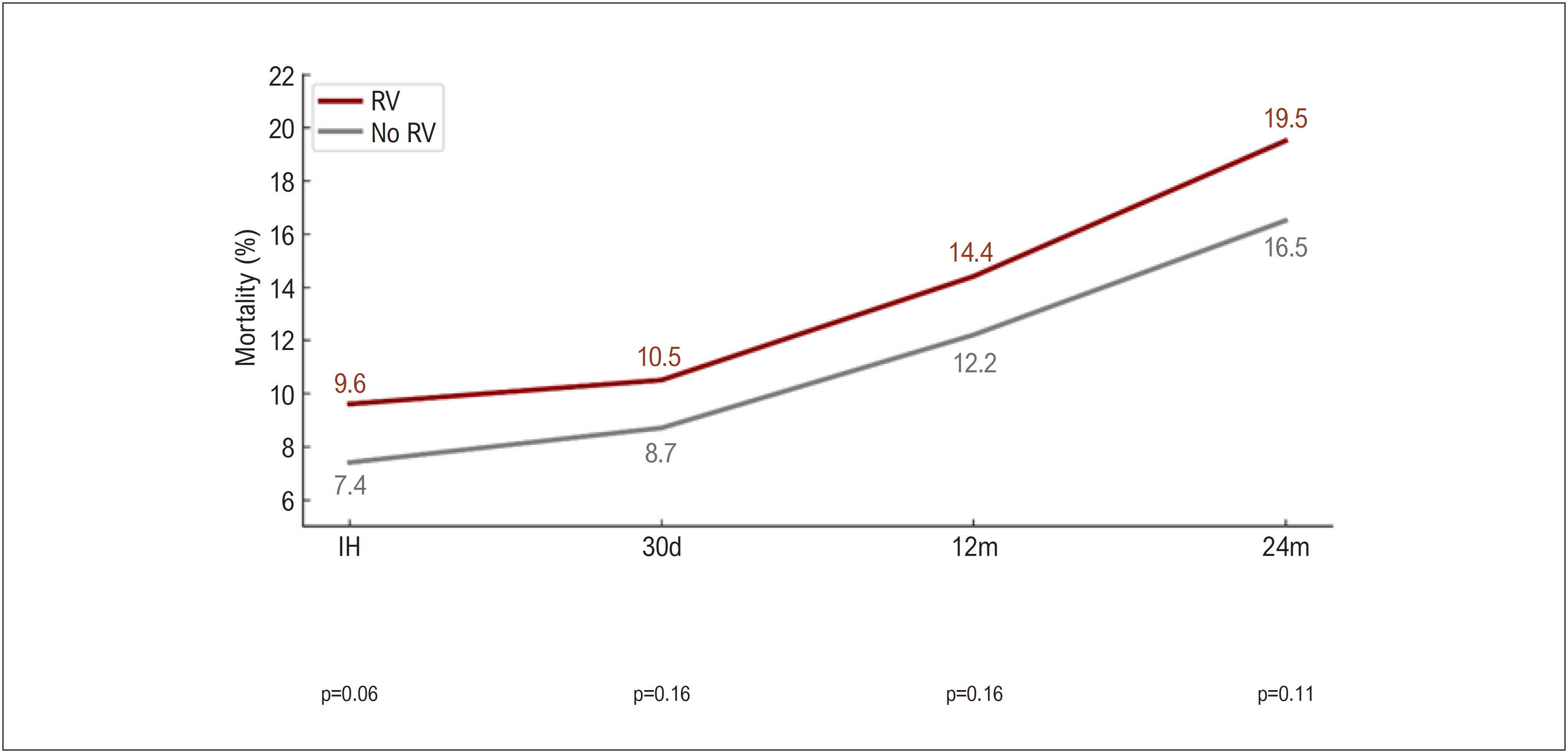
When considering in-hospital outcomes, there was a higher frequency of stroke and acute kidney injury in the RV STEMI group. Regarding in-hospital mortality and follow-up at 30 days, 1 year, and 2 years, no statistical difference was observed between the groups, as described in Table 4 and illustrated in Figure 1.
Mortality trends in follow-up. IH: in-hospital; RV: right ventricular involvement; 30d: 30 days; 12m: 12 months; 24m: 24 months.
A logistic regression analysis was performed to evaluate variables associated with RV STEMI. We identified that independent factors related to this condition were female sex, TAVB, and stroke, as described in Table 5.
A logistic regression addressing independent factors associated with 30-day mortality is shown in Table 6. Several baseline characteristics, such as advanced age, female sex, diabetes mellitus, extent of coronary artery disease, and high thrombotic burden were independently associated with higher death rates in our sample, but RV involvement was not. When considering the overall population, the weighted average incidence of mortality was 7.7%, as shown in the Central illustration.
Discussion
In this study, we comprehensively evaluated a consecutive cohort of 5,611 patients with STEMI treated at a high-volume tertiary cardiology center in Brazil with contemporary medical and interventional therapy. RV involvement was identified in approximately 1 in 7 patients and was associated with higher clinical and angiographic risk profiles, as well as more frequent adverse clinical events. However, short- and long-term mortality rates were not statistically different compared to those without RV involvement, and RV infarction was not an independent predictor of mortality in the multivariate analysis. These findings suggest that the increased mortality observed in patients presenting with RV infarction is more likely related to their higher overall risk profile and associated conditions rather than the RV involvement itself. Nevertheless, the higher incidence of adverse events such as AKI, stroke, and TAVB, along with numerically higher mortality rates, suggests that these patients may still be at increased risk for worse outcomes. Strategies to mitigate these complications during hospitalization may include ensuring adequate preload, avoiding vasodilators, and actively monitoring and managing rhythm disturbances.
Patients with RV involvement were more frequently women, as shown in previous studies.18 They also exhibited higher rates of multivessel coronary disease and peripheral vascular disease, the latter possibly reflecting an increased prevalence of microvascular dysfunction, which was associated with coronary artery disease in previous studies.19,20 Multivessel atherosclerosis has been associated with unfavorable outcomes in STEMI, lower pPCI success rates, and more periprocedural complications.21-24 The higher thrombotic burden and consequent greater need for glycoprotein IIb/IIIa inhibitors in the RV group has also been described as an independent predictor of adverse clinical outcomes.25-27
As expected, in patients with RV infarction, the right coronary artery was most frequently identified as the culprit vessel, whereas involvement of the left anterior descending and circumflex arteries was less common. In patients without RV involvement the left anterior descending artery was the culprit vessel in 51% of the cases, which is in agreement with previous studies.28,29 Proximal right coronary artery involvement is associated with hypotension, cardiogenic shock, and bradycardia, which may need inotropic support and ventricular assist devices.10,30,31 Ischemia of the RV, consequently leading to a decrease in RV output, has been described as the physiopathological mechanism responsible for these situations.32-34
Regarding clinical outcomes, there was a higher rate of malignant arrhythmias (ventricular tachycardia or ventricular fibrillation), as well as bradyarrhythmias like TAVB in the group of patients with RV involvement. In the Collaborative Organization for RheothRx Evaluation (CORE) trial analysis, the authors demonstrated that, among patients with inferior STEMI, ventricular arrhythmias were significantly more common in patients with RV involvement, who also showed a trend toward higher mechanical complications and mortality.9 Sustained hypotension was associated with failed reperfusion in the setting of RV STEMI, as reported in a recent study by Goldstein and colleagues.35 The success rate of revascularization was 95% in the present study, with no significant differences observed between groups. However, the RV group exhibited a higher incidence of no reflow during the procedure, as well as an increased use of GP IIb/IIIa inhibitors.
According to a recent report, advanced conduction disturbances in patients with RV infarctions may further impact clinical outcomes. In this study, TAVB increased mortality only in patients with STEMI and RV involvement, but not in those without RV involvement. The authors suggest this could be a consequence of either the larger infarct size or associated conditions (RV STEMI and TAVB) acting synergistically.36,37 The strength of the association between TAVB and RV infarction was also shown in the multivariate analysis performed in the present study.
Patients with RV infarction also experienced more cerebrovascular and renal events, along with a non-significant but consistently higher mortality rate throughout follow-up, more evident from hospital admission but persisting at the 30-day to 2-year follow-up. Stroke was also to be shown independently associated with RV infarction in our multivariate analysis. Zehender et al. were among the first to study the impact of RV involvement in STEMI. They observed that ST-segment elevation in V4R leads (≥ 0.1 mV) upon hospital admission identifies a subgroup of patients with a more unfavorable outcome, being an independent predictor of early mortality (together with cardiogenic shock, ventricular fibrillation, TAVB, and the need for temporary pacemaker).38
We also sought to evaluate factors associated with RV involvement in patients with STEMI, since this has scarcely been explored in previous analysis. A multivariate analysis found that TAVB on admission, female sex, and stroke were associated with development of RV infarction, whereas acute kidney injury and advanced heart failure were not. A logistic regression model was built to assess independent predictors of death, but RV involvement was not independently associated with this outcome, contrary to the general belief. It is possible that the increased mortality observed in patients with RV infarctions in previous studies were due to a higher prevalence of comorbidities and unfavorable angiographic features, as well as the performance of higher-risk procedures, rather than being directly attributable to the anatomical location of the affected area itself.
Limitations
This study has some limitations. First, as a single-center study, it carries an inherent risk of selection bias, since the patient population may not reflect broader clinical settings. This factor also limits the generalizability of the findings and may affect the applicability of the results to other institutions. Additionally, the long study period, spanning over a decade, may have encompassed significant changes in STEMI management, potentially introducing heterogeneity in treatment approaches and outcomes. Second, adverse events were not adjudicated by an independent clinical events committee, which may introduce interpretation bias and affect the consistency and objectivity of event classification. The exclusive reliance on the primary research team for outcome assessment could also contribute to variability in reporting. Although the large sample size provides statistical power, no effect size calculations were conducted, which may increase the risk of type II error and reduce the ability to detect clinically meaningful differences.
Nonetheless, several strengths should be noted. The large sample size and minimal loss to follow-up (less than 1%) support the robustness of the data. In addition, the 2-year follow-up provides meaningful information on long-term outcomes, enhancing the statistical power of the analyses and supporting broader extrapolation of the results. Despite its limitations, this study provides relevant insights that may help guide future research and inform clinical decision-making.
Conclusion
In this large cohort of consecutive patients with STEMI treated at a tertiary referral center in Brazil, RV involvement was identified in approximately 1 in 7 patients. These individuals were more frequently female and presented with a higher burden of comorbidities and adverse clinical outcomes. However, RV infarction was not an independent predictor of mortality. Further prospective studies are warranted to confirm these associations and to better understand the prognostic implications of RV involvement in the context of STEMI.
Sources of Funding
Study Association
Ethics approval and consent to participate
Use of Artificial Intelligence
Data Availability Statement
All datasets supporting the results of this study are available upon request from the corresponding author: Alexandre Schaan de Quadros.
References
-
1 ReferencesAriss RW, Minhas AMK, Issa R, Ahuja KR, Patel MM, Eltahawy EA, et al. Demographic and Regional Trends of Mortality in Patients with Acute Myocardial Infarction in the United States, 1999 to 2019. Am J Cardiol. 2022;164:7-13. doi: 10.1016/j.amjcard.2021.10.023.
» https://doi.org/10.1016/j.amjcard.2021.10.023 -
2 Elbadawi A, Elgendy IY, Mahmoud K, Barakat AF, Mentias A, Mohamed AH, et al. Temporal Trends and Outcomes of Mechanical Complications in Patients with Acute Myocardial Infarction. JACC Cardiovasc Interv. 2019;12(18):1825-36. doi: 10.1016/j.jcin.2019.04.039.
» https://doi.org/10.1016/j.jcin.2019.04.039 -
3 Dani SS, Lone AN, Javed Z, Khan MS, Khan MZ, Kaluski E, et al. Trends in Premature Mortality from Acute Myocardial Infarction in the United States, 1999 to 2019. J Am Heart Assoc. 2022;11(1):e021682. doi: 10.1161/JAHA.121.021682.
» https://doi.org/10.1161/JAHA.121.021682 -
4 Zuin M, Rigatelli G, Temporelli P, Di Fusco SA, Colivicchi F, Pasquetto G, et al. Trends in Acute Myocardial Infarction Mortality in the European Union, 2012-2020. Eur J Prev Cardiol. 2023;30(16):1758-71. doi: 10.1093/eurjpc/zwad214.
» https://doi.org/10.1093/eurjpc/zwad214 -
5 Gao N, Qi X, Dang Y, Li Y, Wang G, Liu X, et al. Establishment and Validation of a Risk Model for Prediction of in-Hospital Mortality in Patients with Acute ST-Elevation Myocardial Infarction after Primary PCI. BMC Cardiovasc Disord. 2020;20(1):513. doi: 10.1186/s12872-020-01804-7.
» https://doi.org/10.1186/s12872-020-01804-7 -
6 Castro-Dominguez Y, Dharmarajan K, McNamara RL. Predicting Death after Acute Myocardial Infarction. Trends Cardiovasc Med. 2018;28(2):102-9. doi: 10.1016/j.tcm.2017.07.011.
» https://doi.org/10.1016/j.tcm.2017.07.011 -
7 Liao H, Chen Q, Liu L, Zhong S, Deng H, Xiao C. Impact of Concurrent Right Ventricular Myocardial Infarction on Outcomes among Patients with Left Ventricular Myocardial Infarction. Sci Rep. 2020;10(1):1736. doi: 10.1038/s41598-020-58713-0.
» https://doi.org/10.1038/s41598-020-58713-0 -
8 Juul AS, Kyhl K, Ekström K, Madsen JM, Sabbah M, Ahtarovskiet KA, et al. The Incidence and Impact of Permanent Right Ventricular Infarction on Left Ventricular Infarct Size in Patients with Inferior ST-Segment Elevation Myocardial Infarction. Am J Cardiol. 2023;186:43-9. doi:10.1016/j.amjcard.2022.10.022.
» https://doi.org/10.1016/j.amjcard.2022.10.022 -
9 Mehta SR, Eikelboom JW, Natarajan MK, Diaz R, Yi C, Gibbons RJ, et al. Impact of Right Ventricular Involvement on Mortality and Morbidity in Patients with Inferior Myocardial Infarction. J Am Coll Cardiol. 2001;37(1):37-43. doi: 10.1016/s0735-1097(00)01089-5.
» https://doi.org/10.1016/s0735-1097(00)01089-5 -
10 Femia G, Faour A, Assad J, Sharma L, Idris H, Gibbs O, et al. Comparing the Clinical and Prognostic Impact of Proximal versus Nonproximal Lesions in Dominant Right Coronary Artery ST-Elevation Myocardial Infarction. Catheter Cardiovasc Interv. 2021;97(5):E646-E652. doi: 10.1002/ccd.29245.
» https://doi.org/10.1002/ccd.29245 -
11 Hu M, Lu Y, Wan S, Li B, Gao X, Yang J, et al. Long-Term Outcomes in Inferior ST-Segment Elevation Myocardial Infarction Patients with Right Ventricular Myocardial Infarction. Int J Cardiol. 2022;351:1-7. doi: 10.1016/j.ijcard.2022.01.003.
» https://doi.org/10.1016/j.ijcard.2022.01.003 -
12 Stiermaier T, Backhaus SJ, Matz J, Koschalka A, Kowallick J, de Waha-Thiele S, et al. Frequency and Prognostic Impact of Right Ventricular Involvement in Acute Myocardial Infarction. Heart. 2020:heartjnl-2020-317184. doi: 10.1136/heartjnl-2020-317184.
» https://doi.org/10.1136/heartjnl-2020-317184 -
13 Noguchi M, Sakakura K, Akashi N, Adachi Y, Watanabe Y, Taniguchi Y, et al. The Comparison of Clinical Outcomes Between Inferior ST-Elevation Myocardial Infarction with Right Ventricular Infarction versus Without Right Ventricular Infarction. Int Heart J. 2019;60(3):560-8. doi: 10.1536/ihj.18-515.
» https://doi.org/10.1536/ihj.18-515 - 14 Zipes DP, Libby P, Bonow RO, Mann DL, Tomaselli GF, editors. Braunwald's Heart Disease: A Textbook of Cardiovascular Medicine. 11th ed. Philadelphia: Elsevier; 2019.
-
15 Inohara T, Kohsaka S, Fukuda K, Menon V. The Challenges in the Management of Right Ventricular Infarction. Eur Heart J Acute Cardiovasc Care. 2013;2(3):226-34. doi: 10.1177/2048872613490122.
» https://doi.org/10.1177/2048872613490122 -
16 Thygesen K, Alpert JS, Jaffe AS, Chaitman BR, Bax JJ, Morrow DA, et al. Fourth Universal Definition of Myocardial Infarction (2018). J Am Coll Cardiol. 2018;72(18):2231-64. doi: 10.1016/j.jacc.2018.08.1038.
» https://doi.org/10.1016/j.jacc.2018.08.1038 -
17 Garcia-Garcia HM, McFadden EP, Farb A, Mehran R, Stone GW, Spertus J, et al. Standardized End Point Definitions for Coronary Intervention Trials: The Academic Research Consortium-2 Consensus Document. Circulation. 2018;137(24):2635-50. doi: 10.1161/CIRCULATIONAHA.117.029289.
» https://doi.org/10.1161/CIRCULATIONAHA.117.029289 -
18 Obradovic S, Dzudovic B, Djuric I, Jovic Z, Djenic N. Women Have Right Ventricular Infarction More Frequently than Men. Acta Cardiol. 2015;70(3):343-9. doi: 10.1080/ac.70.3.3080639.
» https://doi.org/10.1080/ac.70.3.3080639 -
19 Polonsky TS, McDermott MM. Lower Extremity Peripheral Artery Disease without Chronic Limb-Threatening Ischemia: A Review. JAMA. 2021;325(21):2188-98. doi: 10.1001/jama.2021.2126.
» https://doi.org/10.1001/jama.2021.2126 -
20 Mihatov N, Mosarla RC, Kirtane AJ, Parikh SA, Rosenfield K, Chen S, et al. Outcomes Associated with Peripheral Artery Disease in Myocardial Infarction with Cardiogenic Shock. J Am Coll Cardiol. 2022;79(13):1223-35. doi: 10.1016/j.jacc.2022.01.037.
» https://doi.org/10.1016/j.jacc.2022.01.037 -
21 Jaski BE, Cohen JD, Trausch J, Marsh DG, Bail GR, Overlie PA, et al. Outcome of Urgent Percutaneous Transluminal Coronary Angioplasty in Acute Myocardial Infarction: Comparison of Single-Vessel versus Multivessel Coronary Artery Disease. Am Heart J. 1992;124(6):1427-33. doi: 10.1016/0002-8703(92)90053-x.
» https://doi.org/10.1016/0002-8703(92)90053-x -
22 Lee JH, Park HS, Chae SC, Cho Y, Yang DH, Jeong MH, et al. Predictors of Six-Month Major Adverse Cardiac Events in 30-Day Survivors after Acute Myocardial Infarction (from the Korea Acute Myocardial Infarction Registry). Am J Cardiol. 2009;104(2):182-9. doi: 10.1016/j.amjcard.2009.03.010.
» https://doi.org/10.1016/j.amjcard.2009.03.010 -
23 Sorajja P, Gersh BJ, Cox DA, McLaughlin MG, Zimetbaum P, Costantini C, et al. Impact of Multivessel Disease on Reperfusion Success and Clinical Outcomes in Patients Undergoing Primary Percutaneous Coronary Intervention for Acute Myocardial Infarction. Eur Heart J. 2007;28(14):1709-16. doi: 10.1093/eurheartj/ehm184.
» https://doi.org/10.1093/eurheartj/ehm184 -
24 Zimbardo G, Cialdella P, Di Fusco P, Donahue ME, D’Aquino UML, Paolucci L, et al. Acute Coronary Syndromes and Multivessel Coronary Artery Disease. Eur Heart J Suppl. 2023;25(Suppl C):C74-C78. doi: 10.1093/eurheartjsupp/suad010.
» https://doi.org/10.1093/eurheartjsupp/suad010 -
25 Emlek N, Duman H, Ögütveren MM, Ergül E, Koç H, Durak H, et al. The Relationship between Intracoronary Thrombus Burden and Atherogenic Index in Patients with ST-Elevation Myocardial Infarction. Eur Rev Med Pharmacol Sci. 2022;26(19):7229-35. doi: 10.26355/eurrev_202210_29915.
» https://doi.org/10.26355/eurrev_202210_29915 -
26 Birdal O, Topçu S, Tanboğa İH, Koza Y, Aksakal E, Gülcü O, et al. The Relationship between Clinical Outcomes and Calculated Thrombus Burden Before and after Initial Flow in Patients with ST-Segment Elevation Myocardial Infarction. Eurasian J Med. 2022;54(2):145-9. doi: 10.5152/eurasianjmed.2022.21021.
» https://doi.org/10.5152/eurasianjmed.2022.21021 -
27 Köktürk U, Somuncu MU, Uygur B, Akgül Ö, Püşüroğlu H. Prognostic Significance of Thrombus burden on Short- and Long-Term Clinical Outcomes in Patients with ST-Elevation Myocardial Infarction Undergoing Primary Percutaneous Coronary Intervention. Coron Artery Dis. 2022;33(7):559-65. doi: 10.1097/MCA.0000000000001178.
» https://doi.org/10.1097/MCA.0000000000001178 -
28 Bowers TR, O’Neill WW, Pica M, Goldstein JA. Patterns of Coronary Compromise Resulting in Acute Right Ventricular Ischemic Dysfunction. Circulation. 2002;106(9):1104-9. doi: 10.1161/01.cir.0000027566.51212.3f.
» https://doi.org/10.1161/01.cir.0000027566.51212.3f -
29 Hochman JS, Buller CE, Sleeper LA, Boland J, Dzavik V, Sanborn TA, et al. Cardiogenic Shock Complicating Acute Myocardial Infarction--Etiologies, Management and Outcome: A Report from the SHOCK Trial Registry. J Am Coll Cardiol. 2000;36(3 Suppl A):1063-70. doi: 10.1016/s0735-1097(00)00879-2.
» https://doi.org/10.1016/s0735-1097(00)00879-2 -
30 Goldstein JA, Lee DT, Pica MC, Dixon SR, O’Neill WW. Patterns of Coronary Compromise Leading to Bradyarrhythmias and Hypotension in Inferior Myocardial Infarction. Coron Artery Dis. 2005;16(5):265-74. doi: 10.1097/00019501-200508000-00002.
» https://doi.org/10.1097/00019501-200508000-00002 -
31 Harjai KJ, Mehta RH, Stone GW, Boura JA, Grines L, Brodie BR, et al. Does Proximal Location of Culprit Lesion Confer Worse Prognosis in Patients Undergoing Primary Percutaneous Coronary Intervention for ST Elevation Myocardial Infarction? J Interv Cardiol. 2006;19(4):285-94. doi: 10.1111/j.1540-8183.2006.00146.x.
» https://doi.org/10.1111/j.1540-8183.2006.00146.x -
32 Goldstein JA. Pathophysiology and Management of Right Heart Ischemia. J Am Coll Cardiol. 2002;40(5):841-53. doi: 10.1016/s0735-1097(02)02048-x.
» https://doi.org/10.1016/s0735-1097(02)02048-x -
33 Goldstein JA, Barzilai B, Rosamond TL, Eisenberg PR, Jaffe AS. Determinants of Hemodynamic Compromise with Severe Right Ventricular Infarction. Circulation. 1990;82(2):359-68. doi: 10.1161/01.cir.82.2.359.
» https://doi.org/10.1161/01.cir.82.2.359 -
34 Harjai KJ, Boura J, Grines L, Goldstein J, Stone GW, Brodie B, et al. Comparison of Effectiveness of Primary Angioplasty for Proximal versus Distal Right Coronary Artery Culprit Lesion during Acute Myocardial Infarction. Am J Cardiol. 2002;90(11):1193-7. doi: 10.1016/s0002-9149(02)02833-3.
» https://doi.org/10.1016/s0002-9149(02)02833-3 -
35 Goldstein JA, Lerakis S, Moreno PR. Right Ventricular Myocardial Infarction-A Tale of Two Ventricles: JACC Focus Seminar 1/5. J Am Coll Cardiol. 2024;83(18):1779-98. doi: 10.1016/j.jacc.2023.09.839.
» https://doi.org/10.1016/j.jacc.2023.09.839 -
36 Mavrić Z, Zaputović L, Matana A, Kucić J, Roje J, Marinović D, et al. Prognostic Significance of Complete Atrioventricular Block in Patients with Acute Inferior Myocardial Infarction with and without Right Ventricular Involvement. Am Heart J. 1990;119(4):823-8. doi: 10.1016/s0002-8703(05)80318-7.
» https://doi.org/10.1016/s0002-8703(05)80318-7 -
37 Tans AC, Lie KI, Durrer D. Clinical Setting and Prognostic Significance of High Degree Atrioventricular Block in Acute Inferior Myocardial Infarction: A Study of 144 Patients. Am Heart J. 1980;99(1):4-8. doi: 10.1016/0002-8703(80)90308-7.
» https://doi.org/10.1016/0002-8703(80)90308-7 -
38 Zehender M, Kasper W, Kauder E, Schönthaler M, Geibel A, Olschewski M, et al. Right Ventricular Infarction as an Independent Predictor of Prognosis after Acute Inferior Myocardial Infarction. N Engl J Med. 1993;328(14):981-8. doi: 10.1056/NEJM199304083281401.
» https://doi.org/10.1056/NEJM199304083281401