 Six-Month Remote Monitoring of Patients With Chronic Heart Failure Using Messaging Applications on Smartphones
Abstract
Background: Patients with chronic heart failure (HF) require outpatient monitoring after hospital discharge. The ability to use a smartphone with a personal messaging application may help.
Objectives: Tis study aimed to investigate the feasibility of remote monitoring and evaluate its impact on treatment adherence and prognosis in patients with HF.
Methods: A total of 100 patients were enrolled in the study: 57 patients in the mHealth group and 43 in the control group. The observation period lasted six months. Remote monitoring included a daily survey sent to patients via a personal messaging application. This was an open, randomized trial. A p-value < 0.05 was considered statistically significant.
Results: After six months, 46 patients (mean age 61.52 ± 13.05 years, 34 men) in the mHealth group and 43 patients (mean age 60.07 ± 10.19 years, 27 men) in the control group completed the study. A total of 11 patients were lost to follow-up. In the mHealth group, two patients (4%) reached the primary endpoint, compared to seven patients (7%) in the control group.
Conclusion: The effectiveness of remote monitoring for patients with HF using self-reporting via a smartphone messaging application was demonstrated. Patient adherence to self-reporting was found to be 76%. Those in the mHealth group who reported regularly and consistently demonstrated greater engagement in self-monitoring of vital signs and higher adherence to prescribed therapy.
Keywords:
Heart Failure; Remote Patient Monitoring; Telemedicine
Introductiona
Currently, the incidence of heart failure (HF) in Europe is approximately 3 per 1,000 person-years across all age groups, and about 5 per 1,000 person-years in adults. The prevalence of HF is estimated at 1–2% among adults, increasing with age: from around 1% in individuals aged < 55 years to > 10% in those aged 70 years or older. Therefore, the search for modern approaches to long-term, personalized monitoring of HF patients is most relevant in older populations.1 Patient-centered mHealth technologies have already shown promising results in improving a self-care quality in various chronic diseases, including diabetes, hypertension, and depression.2
Previous studies have shown that effective monitoring components to reduce hospitalizations in HF patients include dynamic indicators that reflect the physiology of decompensation, such as heart rate (HR), blood pressure (BP), presence of edema, and changes in body weight. Algorithms that determine signal thresholds for these indicators and link them to therapeutic interventions are important for successful follow-up, as well as the involvement of a multidisciplinary team to communicate with patients and respond to alerts generated by remote monitoring systems.3,4 Heart disease and stroke are among the most prevalent and costly health problems worldwide.5 Attempts to decrease HF social and economic burden have become a major global public health priority.6 The topic of remote patient monitoring in modern healthcare remains relevant. The RELEASE-HF study, a large international observational study, is currently being conducted, aimed at better understanding the heterogeneity of clinical efficacy among HF patients using telemedicine technologies.7,8
Evaluation of the effectiveness, prospects, practical benefits, and implementation of remote monitoring in HF patients remains a multifactorial issue that requires further, in-depth investigation.
This study aimed to investigate the feasibility of remote monitoring and assess its impact on treatment adherence and prognosis in patients with HF.
Materials and Methods
An open, randomized trial (with random allocation assignments sealed in opaque envelopes) was conducted to assess the impact of remote monitoring using a mobile platform for outpatients with chronic HF. The study included 100 HF patients with NYHA (New York Heart Association) functional class I-IV. The sample size was determined for ease of calculation and based on the number of patients eligible for inclusion. Prior to enrollment, all HF patients underwent examination and inpatient treatment in a cardiology department, where their clinical and functional status was assessed using the six-minute walk test (6MWT), along with standard laboratory tests and instrumental examinations, including measurements of BP and HR. During hospitalization, all patients underwent electrocardiography (ECG), Holter continuous ECG monitoring, and echocardiography (EchoCG), and were prescribed optimal drug therapy for HF. Upon discharge, patients were randomized into two groups: the mHealth group and the standard observation (control) group. Patients in the mHealth group had a messaging application (messenger) installed on their smartphones for remote monitoring, while those in the standard observation group received the usual outpatient follow-up for HF.
The study was conducted with the aid of a custom-developed computer program, TeleMedBot ("Information system for remote monitoring of the self-reported health condition of patients using personal messengers). TeleMedBot is designed to collect self-reported health condition data from patients discharged from the hospital and receiving periodic outpatient care. The program gathers information through message exchanges via personal messaging applications installed on the patients’ smartphones. It then processes this data and assists in clinical decision-making. From the technical point of view, TeleMedBot operates as an orchestrated cluster of Docker containers on a dedicated virtual server. The backend includes a Python-based application with REST API, PostgreSQL, and Redis databases for long- and short-term storage. Separate frontend interfaces are available for patients and medical professionals performing remote monitoring.9 No personal health information was entered or stored in the program, since each patient was coded by a randomly generated string known only to the attending physician.
The messaging application was either newly installed or properly configured on patients’ smartphones prior to the study. All patients received instruction and training on how to use the messaging application, through which the TeleMedBot patient interface was introduced. Remote monitoring included a daily prompt sent via the aforementioned interface, asking patients to report information on their BP, HR, and symptoms related to HF decompensation. The prompt was sent at midday, and patients were allowed up to 24 hours to start, pause, or complete their responses before the next prompt was issued. Once a week (on the seventh day from the starting date, then weekly) an extra question was included regarding per-weekly changes in body weight. The responses were collected, analyzed, and stored in the TeleMedBot's long-term storage database.
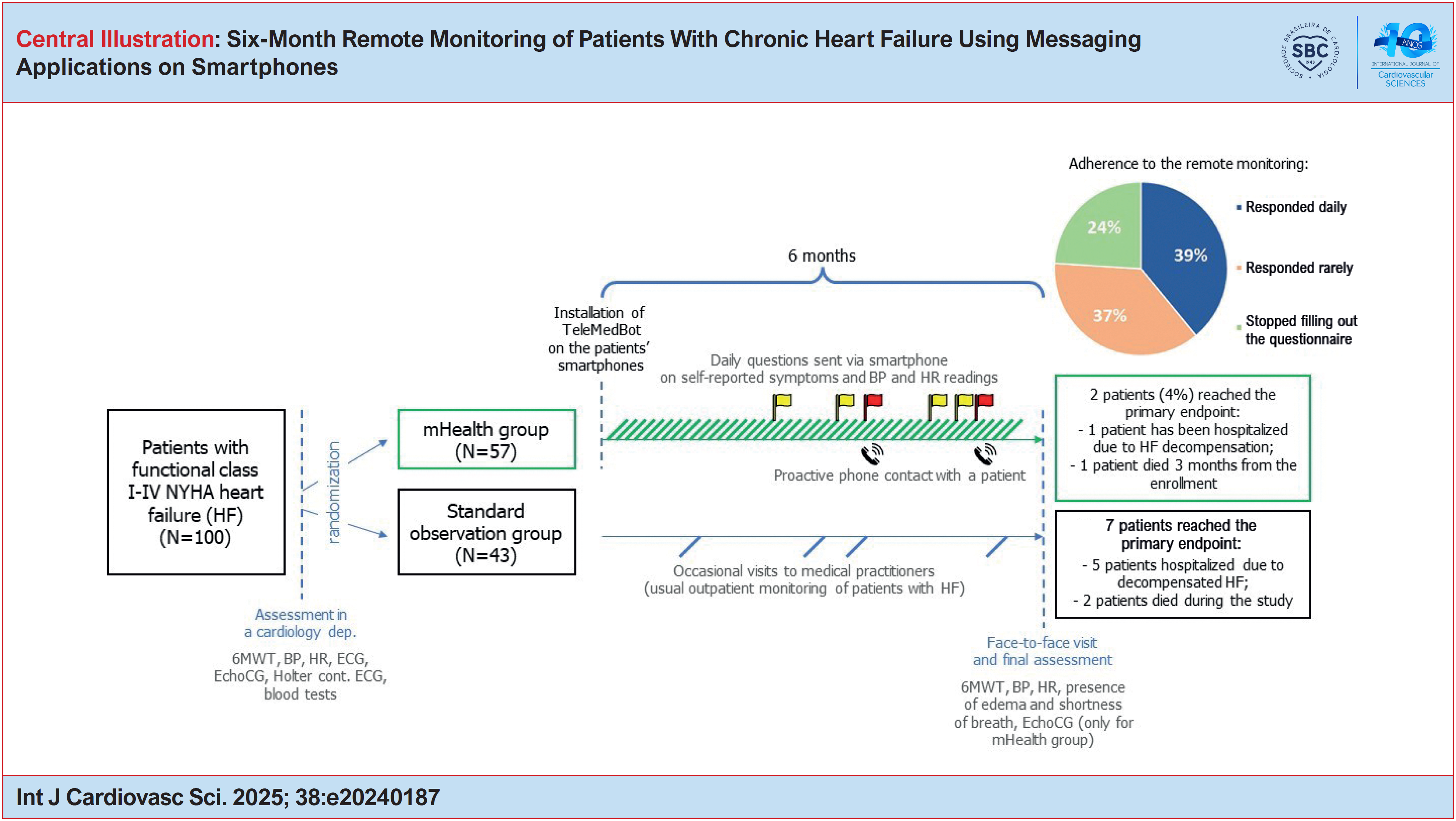
The questions were specifically developed to assess symptoms and detect signs of HF decompensation through daily remote monitoring via TeleMedBot. The options provided with each question were assigned to one of the flags: green, yellow, or red, indicating a normal, warning, or alarming condition, respectively. Once the responses for all provided questions were received, an overall flag was assigned to the patient: red, if at least one response was marked as red; yellow, if at least one response was marked as yellow, and green if all responses were marked as green. The patients’ responses and corresponding flags were reported daily to the monitoring doctor-researcher through the web-based interface. For each patient flagged red, active follow-up was initiated within 48 hours — typically a phone call — to gather more details about the patient's condition or to adjust therapy as needed (e.g., dosage changes). In severe cases, an outpatient visit or hospitalization could be arranged (Figure 1).

A more detailed description of the technical support and workflow of TeleMedBot was previously published by our colleagues in the article titled ‘Influence of Remote Monitoring Digital Observations on Quality of Life, Compliance, and Clinical Outcomes in Patients with Chronic Heart Failure.’9
At the end of the 6-month follow-up, patients were invited for a face-to-face visit to undergo a reassessment of the 6MWT, BP, HR, and evaluation for edema or shortness of breath. EchoCG was also repeated for patients in the mHealth group.
Artificial Intelligence-Assisted Technologies Statement
We did not use artificial intelligence (AI)-assisted technologies, such as large language models (LLMs) or image generators, in the creation of the submitted work.
Statistical Analysis
Data were processed and analyzed using IBM SPSS Statistics for Windows, version 21.0. Data were submitted to descriptive statistical analysis and presented in tables in the form of absolute and percentage frequencies. The data were normally distributed. Quantitative indicators were assessed for compliance with normal distribution using the Kolmogorov-Smirnov test. For quantitative indicators, the sampling distribution of which corresponded to normal, were described using arithmetic means and standard deviations. Confidence intervals (CI) for percentages were calculated using the Clopper-Pearson method. Comparison of two groups for quantitative indicators with normal distribution was performed using the Student's t-test for independent samples (Table 1) and the paired Student's t-test (Table 2). The odds ratio with a 95% CIAs was used as a quantitative measure of the effect when comparing relative indicators. A p-value < 0.05 was considered statistically significant.
Results of remote monitoring of the mHealth group at baseline and after six months of follow-up (35 patients)
Results
To date, 100 patients have been enrolled in the study. Eleven patients in the mHealth group were lost to follow-up and did not complete the study. A total of 89 patients were analyzed: 46 in the mHealth group (mean age 61.52 ± 13.05 years, 34 men) and 43 in the control group (mean age 60.07 ± 10.19 years, 27 men). Patients in both groups were overweight (mean BMI 28.08 ± 7.21 kg/m2 in the mHealth group and 30.7 ± 9.39 kg/m2 in the control group). The control group had a higher proportion of patients in NYHA functional class III-IV compared to the mHealth group: 25 patients (58%) compared to 20 (43%). Overall cardiac contractility was comparable in both groups. Detailed characteristics of the groups are presented in Table 1.
All patients continued to receive prescribed drug therapy for the underlying disease according to Russian clinical recommendations, including ACE inhibitors/ARBs, -blockers, mineralocorticoid receptor antagonists (MRAs) such as spironolactone or eplerenone, angiotensin-neprilysin receptor inhibitors (ARNIs) such as sacubitril or valsartan, and selective inhibitors of sodium-glucose cotransporter type 2 (SGLT2) such as dapagliflozin.
After six months, 46 patients in the mHealth group and 43 patients in the standard observation group completed the study.
The primary endpoint was defined as HF decompensation leading to hospitalization, death from all causes, or the administration of parenteral loop diuretics. In the mHealth group, two patients (4%) reached the endpoint: one was hospitalized due to HF decompensation against the background of paroxysmal atrial fibrillation, and one died three months after enrollment (this patient had very low adherence to TeleMedBot). In the standard observation group, seven patients (16%) reached the primary endpoint: five were hospitalized due to decompensated HF, and two died during the study.
In the mHealth group, two patients required intervention due to red flags (increased BP and increased shortness of breath). The physician contacted them shortly via phone call after the red flag appearance, and adjustments were made to their prescribed drugs, including an increase in the dosage of optimal medical therapy (OMT).
When assessing adherence to remote monitoring in the mHealth group, we found that 35 patients (76%) consistently responded to the prompts over the six-month period. Of these, 18 patients (39%) responded regularly (daily), 17 (37%) responded irregularly (2-3 times per week), while 11 (24%) stopped filling out the questionnaire during the six-month period and were excluded from the analysis. All patients in the mHealth group continued their prescribed therapy, while five patients in the standard observation group discontinued SGLT2 or ARNIs during the six-month follow-up.
Based on the self-reported data via TeleMedBot, in the mHealth group, three patients (16%) had an average BP of less than 100/70 mm Hg, 11 (62%) had BP in the range of 100-120/70-80 mm Hg, and four (22%) had BP in the range of 120-130/80-90 mm Hg. The average HR over the six-month monitoring period was found to be 50-70 bpm in 11 patients (61%), while seven (39%) reported an HR of 70-90 bpm.
Patients in the mHealth group were also re-evaluated for EchoCG values after the six-month period, with a finding of an increase in left ventricular ejection fraction (LVEF) from 43.83 ± 12.04% to 47.61 ± 9.59% (p > 0.05). However, these results should be treated with caution given the permissible error in measuring the LVEF. The clinical significance of this finding remains unclear (Table 2).
Discussion
This study aimed to confirm the possibility of using remote monitoring via messaging applications for the prevention and management of decompensation in patients with chronic HF.
An integrated approach based on continuous, indirect interaction between patients and doctors via custom-developed software (TeleMedBot) enabled daily outpatient monitoring of HF. TeleMedBot proved to be intuitive for both parties, providing effective feedback and personalized treatment for chronic HF, with necessary therapy adjustments provided in a relatively short time (compared to the standard observation approach) after the onset of worsening symptoms. By actively involving patients in the remote monitoring process by daily health status reports, self-awareness is boosted, allowing for early detection of HF symptoms. As a result, and due to the feedback provided, patient adherence to pharmacological HF treatment also improves.
The results of our study show that regular remote monitoring in HF patients over a six-month period leads to a reduction in both the total number of hospitalizations and mortality from all causes. However, it should be noted that patients in the control group had a higher FC compared to those in the remote monitoring group. Although the groups did not differ statistically in NYHA class, this could have been the reason for more frequent decompensations in the control group. The effectiveness of remote monitoring post-discharge for hospitalized HF patients was also investigated in the BEAT-HF clinical randomized trial, conducted at six sites in California, USA.10 The observation period averaged 180 days. Telemonitoring used electronic equipment to collect daily data on BP, HR, symptoms, and body weight. The primary endpoint was re-hospitalization for any reason within 180 days of discharge, while secondary endpoints included re-admission for all causes within 30 days, mortality from all causes after 30 and 180 days, and quality of life at 30 and 180 days. The results indicated that there was no reduction in the frequency of 180-day readmissions among patients hospitalized for HF who were remotely monitored. Patient adherence was a major limitation in this study, given that only about 60% of them followed the recommendations more than half the time during the first 30 days. In our study, adherence was significantly higher at 76%, which is comparable to most studies in the field of remote monitoring. For example, in a similar study, BEAT-HF, 82.7% of intervention participants used telemonitoring equipment.10 Another randomized controlled multicenter trial, TIM-HF2, showed promising results. HF patients of NYHA functional class II-III were randomized 1:1 to either remote monitoring and routine care, or routine care alone.11 Patients were followed for 12 months. The primary endpoint was the percentage of days lost due to unplanned hospitalizations for cardiovascular disease or all-cause mortality per 100 person-years, while the main secondary endpoints included all-cause mortality and cardiovascular mortality. The study found that patients in the remote monitoring group had fewer days lost compared to those receiving standard follow-up. However, cardiovascular mortality did not differ significantly between the two groups.6,7
In our study, only one patient in the mHealth group was hospitalized due to HF decompensation during the six-month follow-up, compared to five hospitalized patients in the control group. Our hypothesis is that prevention of HF hospitalizations may result from high treatment adherence of patients in the mHealth group and timely medical intervention to optimize drug doses. We conclude that the remote monitoring of HF patients should not only include the assessment of signs of hypervolemia (such as edema and shortness of breath), but also the management of concomitant somatic pathology.
Increased patient self-awareness, facilitated by daily health questionnaires, had a beneficial effect on adherence to current therapy. All patients in the mHealth group continued their prescribed pharmacological treatment for HF throughout the six- month follow-up.
Eleven patients (24%) abandoned the prompts and did not submit any responses to the questions provided by TeleMedBot. This suggests that a continuous daily follow-up period may be uncomfortable for some patients. Those who stopped the observation did not differ in terms of gender, age, or functional class of HF. According to telephone contact, the main reasons for discontinuation were the patients’ unwillingness to communicate with the subjective stabilization of the condition, as well as technical inconvenience. At the same time, patients in the mHealth group who were most adherent to daily reporting showed some improvement in structural and functional cardiac parameters as assessed by EchoCG. However, these data were not statistically significant (p > 0.05) and their clinical significance remains unclear, as well as a higher level of adherence. It is likely that patients who are highly motivated to actively participate in remote monitoring tend to have a higher level of self-control, stronger adherence to therapy, increased attention to their health, and more consistent compliance with the recommendations of the attending physician (Central illustration).
Limitations of the study: First, this was a single-center study with a small sample size, which may affect the result. Additionally, the control group consisted of patients with a higher NYHA functional class of HF (although no statistically significant differences between subgroups by NYHA functional class were found). A second limitation is that patients in the mHealth group had a statistically significantly lower BMI compared to those in the standard observation group.
Further studies with larger samples sizes and more complete patient data collection are needed to more accurately assess the impact of remote monitoring on patient adherence and prognosis.
Conclusion
The emerging number of patients hospitalized for decompensated HF requires new approaches to their management during the outpatient care. Remote monitoring of HF patients based on the self-reporting via smartphone messaging applications does not require specialized monitoring devices, is user-friendly, and shows high patient adherence. Such method may help detect early signs and symptoms of HF decompensation, allowing treatment to be quickly adjusted to prevent worsening. Patients who responded daily and adhered to remote monitoring maintained good self-monitoring of vital signs, were adherent to drug therapy. In the future, a more in-depth, extensive and larger study is needed to evaluate the impact of remote monitoring on the prognosis and survival of HF patients.
-
Sources of Funding
This study was funded by Scientific School of Sechenov University as a part of the priority 2030.
-
Study Association
This article is part of the thesis of Doctoral submitted by Aleksei Emelianov, from Sechenov University.
-
Ethics Approval and Consent to Participate
This study was approved by the Ethics Committee of the Sechenov University under the protocol number 02-23. All the procedures in this study were in accordance with the 1975 Helsinki Declaration, updated in 2013. Informed consent was obtained from all participants included in the study.
-
Use of Artificial Intelligence
The authors did not use any artificial intelligence tools in the development of this work.
Availability of Research Data and Other Materials
All datasets supporting the results of this study are available upon request from the corresponding author.
References
-
1 McDonagh TA, Metra M, Adamo M, Gardner RS, Baumbach A, Böhm M, et al. 2021 ESC Guidelines for the Diagnosis and Treatment of Acute and Chronic Heart Failure. Eur Heart J. 2021;42(36):3599-726. doi: 10.1093/eurheartj/ehab368.
» https://doi.org/10.1093/eurheartj/ehab368 -
2 Bakogiannis C, Tsarouchas A, Mouselimis D, Lazaridis C, Theofillogianakos EK, Billis A, et al. A Patient-Oriented App (ThessHF) to Improve Self-Care Quality in Heart Failure: From Evidence-Based Design to Pilot Study. JMIR Mhealth Uhealth. 2021;9(4):e24271. doi: 10.2196/24271.
» https://doi.org/10.2196/24271 -
3 Stevenson LW, Ross HJ, Rathman LD, Boehmer JP. Remote Monitoring for Heart Failure Management at Home. J Am Coll Cardiol. 2023;81(23):2272-91. doi: 10.1016/j.jacc.2023.04.010.
» https://doi.org/10.1016/j.jacc.2023.04.010 -
4 Kennel PJ, Rosenblum H, Axsom KM, Alishetti S, Brener M, Horn E, et al. Remote Cardiac Monitoring in Patients with Heart Failure: A Review. JAMA Cardiol. 2022;7(5):556-64. doi: 10.1001/jamacardio.2021.5090.
» https://doi.org/10.1001/jamacardio.2021.5090 -
5 Whelton PK, Carey RM, Aronow WS, Casey DE Jr, Collins KJ, Himmelfarb CD, et al. 2017 ACC/AHA/AAPA/ABC/ACPM/AGS/APhA/ASH/ASPC/NMA/PCNA Guideline for the Prevention, Detection, Evaluation, and Management of High Blood Pressure in Adults: Executive Summary: A Report of the American College of Cardiology/American Heart Association Task Force on Clinical Practice Guidelines. Hypertension. 2018;71(6):1269-324. doi: 10.1161/HYP.0000000000000066.
» https://doi.org/10.1161/HYP.0000000000000066 -
6 Savarese G, Becher PM, Lund LH, Seferovic P, Rosano GMC, Coats AJS. Global Burden of Heart Failure: A Comprehensive and Updated Review of Epidemiology. Cardiovasc Res. 2023;118(17):3272-87. doi: 10.1093/cvr/cvac013.
» https://doi.org/10.1093/cvr/cvac013 -
7 van Eijk J, Luijken K, Jaarsma T, Reitsma JB, Schuit E, Frederix GWJ, et al. RELEASE-HF Study: A Protocol for an Observational, Registry-Based Study on the Effectiveness of Telemedicine in Heart Failure in the Netherlands. BMJ Open. 2024;14(1):e078021. doi: 10.1136/bmjopen-2023-078021.
» https://doi.org/10.1136/bmjopen-2023-078021 -
8 Allida S, Du H, Xu X, Prichard R, Chang S, Hickman LD, et al. mHealth Education Interventions in Heart Failure. Cochrane Database Syst Rev. 2020;7(7):CD011845. doi: 10.1002/14651858.CD011845.pub2.
» https://doi.org/10.1002/14651858.CD011845.pub2 -
9 Emel'yanov AV, Zheleznykh EA, Kozhevnikova MV, Zektser VY, Kamalova AE, Privalova EV, et al. Influence of Remote Digital Observations on Quality of Life, Compliance, and Clinical Outcomes in Patients with Chronic Heart Failure. Biomed Eng. 2024;57:311-5. doi: 10.1007/s10527-023-10322-7.
» https://doi.org/10.1007/s10527-023-10322-7 -
10 Ong MK, Romano PS, Edgington S, Aronow HU, Auerbach AD, Black JT, et al. Effectiveness of Remote Patient Monitoring after Discharge of Hospitalized Patients with Heart Failure: The Better Effectiveness after Transition -- Heart Failure (BEAT-HF) Randomized Clinical Trial. JAMA Intern Med. 2016;176(3):310-8. doi: 10.1001/jamainternmed.2015.7712.
» https://doi.org/10.1001/jamainternmed.2015.7712 -
11 Koehler F, Koehler K, Deckwart O, Prescher S, Wegscheider K, Kirwan BA, et al. Efficacy of Telemedical Interventional Management in Patients with Heart Failure (TIM-HF2): A Randomised, Controlled, Parallel-Group, Unmasked Trial. Lancet. 2018;392(10152):1047-57. doi: 10.1016/S0140-6736(18)31880-4.
» https://doi.org/10.1016/S0140-6736(18)31880-4
Edited by
-
Editor responsible for the review:
Erito Marques