 Reflective web-portfolio and the development of skills related to learning to learn and learning to do
Abstract
This study analyzes the use of the Web Reflective Portfolio (WRP) as a teaching-learning method in developing the skills of ‘learning to learn’ and ‘learning to do’. It is a qualitative study, employing focus group and document analysis, conducted with students of the Health Policies discipline (2021–2023). The WRP construction process proved relevant to learning, fostering lifelong self-training, adaptation to new knowledge, and acquisition of strategies to overcome difficulties. In addition to promoting skills related to ‘learning to learn’ and ‘learning to do’, the WRP emerged as an active method that goes beyond the mere organization of materials selected by students, encouraging critical and reflective thinking.
Keywords
Reflective web-portfolio; Active method; Competence-based education
Resumo
Este estudo analisa a utilização do Web-Portfólio Reflexivo (WPR) como método de ensino e aprendizagem no desenvolvimento das competências de “aprender a aprender” e “aprender a fazer”. Trata-se de pesquisa qualitativa, com grupo focal e análise documental, realizada com estudantes da disciplina Políticas de Saúde (2021–2023). O processo de construção do WPR mostrou-se relevante para a aprendizagem, promovendo autoformação permanente, adaptação a novos conhecimentos e aquisição de mecanismos para enfrentar dificuldades. Além de estimular competências ligadas ao “aprender a aprender” e ao “aprender a fazer”, o WPR revelou-se um método ativo que transcende a simples organização de materiais selecionados pelos estudantes, favorecendo o pensamento crítico e reflexivo.
Palavras-chave
Web-portfólio reflexivo; Método ativo; Educação baseada em competências
Resumen
Este estudio analiza la utilización del Web-Portafolio Reflexivo (WPR) como método de enseñanza y aprendizaje en el desarrollo de las competencias de “aprender a aprender” y “aprender a hacer”. Se trata de una investigación cualitativa con grupo focal y análisis documental, realizada con estudiantes de la asignatura de Políticas de Salud (2021–2023). El proceso de construcción del WPR mostró ser relevante para el aprendizaje, promoviendo autoformación permanente, adaptación a nuevos conocimientos y adquisición de mecanismos para enfrentar dificultades. Además de incentivar competencias vinculadas al “aprender a aprender” y al “aprender a hacer”, el WPR reveló ser un método activo que transciende la simple organización de materiales seleccionados por los estudiantes, favoreciendo el pensamiento crítico y reflexivo.
Palabras clave
Web-portafolio reflexivo; Método activo; Educación basada en competencias
Introduction
In order to keep pace with the changes taking place in the contemporary world, it is necessary to train professionals who are able to respond assertively to the different challenges generated by these transformations. These changes include valuing interdisciplinarity, strengthening competency-based education, incorporating digital technologies into the educational process, placing students at the center of their own learning, and emphasizing the development of social-emotional skills.
In this context, international guidelines stand out, such as those outlined in the UNESCO Report of the International Commission on Education for the 21st Century, aimed at training professionals capable of ‘learning to learn’, ‘learning to do’, ‘learning to live together’, and ‘learning to be’1, and national guidelines, such as the National Curriculum Guidelines (DCN), which in Article 3, item VII, reinforce the need to use teaching methodologies that promote collaborative and meaningful learning, emphasizing the need to use diversified methodologies for the teaching-learning process that privilege student participation and autonomy2.
According to Cotta, et al.3:
[...] From this perspective, the DCN challenges traditional crystallized forms of teaching and learning aimed at training professionals and citizens engaged in the struggle to recover the essential dimension of health work: the provision of care in response to social demands. Thus, using active and innovative methodologies means investing in an education that develops critical teaching-learning processes, that awakens creativit y and is based on it, that presents situations as problems to be solved; that is, an education that is as close as possible to real life. (p. 1848)
Thus, active teaching and learning methodologies, based on competency-based education, encompassing skills, knowledge, and attitudes, promote intuitive, creative, logical, and practical thinking. These skills are essential for task execution and decision-making, preparing students to face real-world challenges4.
In this same vein, it is important to emphasize the importance of focusing on Delors1 concepts of ‘learning to learn’ and ‘learning to do’ during the student training process. Learning to learn is related to the development of autonomy, enabling students to self-regulate their learning, transfer it to different contexts, and develop metacognitive skills. Professionals who ‘learn to learn’ invest in their own learning, developing skills and attitudes to face new challenges. ‘Learning to do’ refers to the acquisition of practical procedures that assist in the application of theoretical knowledge in real situations, promoting practical, technical, and social skills that are essential for collaboration, innovation, and adaptation to new contexts4-6.
Among the active methodologies, the Reflective Portfolio (RP) stands out as a teaching, learning, and assessment method that encourages reflection through documentation and recording of the learning process. This method promotes skills related to autonomy, creativity, critical and reflective thinking, as well as involving discussion and identification of problems with a view to solutions and decision-making, research, and selection of reliable information from trustworthy sources, promoting continuous and investigative learning4. The use of Information and Communication Technologies (ICTs) facilitates the creation of Reflective Portfolios in virtual form, known as Web Reflective Portfolios (RWP). This innovative format allows for easy creation, access, and sharing, expanding the possibilities for documentation and continuous reflection4.
According to Cotta, et al.3:
[...] From this perspective, the portfolio is a useful tool not only as a performance assessment instrument, but also as a strategy to stimulate competency-based learning – learning by doing. It is about looking at education from a different perspective – ‘you learn what you do and what you do you learn. I forget what I hear, I remember what I see, and I learn what I do.’ (p. 1848)
Given the need to develop skills related to ‘learning to learn’ and ‘learning to do’, it is necessary to highlight how RWP can facilitate self-assessment, self-knowledge, and the application of acquired knowledge to train critical and flexible professionals during their training process, where students become protagonists in the construction of their learning process.
Thus, the objective of this study was to analyze the use of the Reflective Web Portfolio as a teaching and learning method in the development of skills related to ‘learning to learn’ and ‘learning to do’ in the study of Health Policies by undergraduate students.
Methodology
Study design
This is a qualitative study in which data was collected using two techniques: (1) Focus Group (FG), which allows for in-depth exploration of respondents’ perceptions on a given topic, in this case the use of RWP, delving deeper into their reflections, feelings, perceptions, experiences, and points of view7 e (2) and (2) Document Analysis (DA), which is a technique that consists of analyzing documents, collecting, reviewing, and interpreting them to obtain data that meets the research objectives8.
Study population
The study involved 262 undergraduate students from nutrition, nursing, and medicine courses who took the Health Policy course at the Federal University of Viçosa (UFV), a public university in the state of Minas Gerais, between 2021 and 2023, representing six academic semesters. The RWPs were constructed collectively by groups of approximately six students.
Conceptual and Operational Definition of the Pillars: ‘Learning to Learn’ and ‘Learning to Do’
In this study, the categories ‘learning to learn’ and ‘learning to do’ were adopted, in accordance with the pillars of education proposed by Delors1. ‘Learning to learn’ was defined as the development of metacognitive and reflective skills, involving autonomy, self-regulation, and critical thinking about the educational process itself9,10. Operationally, this dimension was identified through manifestations of planning, monitoring, and evaluating learning, as well as the ability to recognize difficulties, devise strategies, and critically reflect on learning paths.
‘Learning to do’ was characterized as the practical application of acquired knowledge, encompassing the development of technical, interpersonal, and organizational skills1,11. To identify this, reports of practical experiences, problem solving, articulation between theory and practice, and performance in collaborative or professional contexts were considered.
Categories of analysis: Selection and theoretical basis
Active teaching and learning methodologies have been widely discussed in contemporary literature as pedagogical strategies centered on student protagonism, in which learning occurs through active participation in the construction of knowledge, as opposed to the traditional transmissive model4.
The choice of the pillars ‘learning to learn’ and ‘learning to do’ among the four pillars of education is based on their close relationship with the pedagogical objectives of training health professionals using the principles of active learning methodologies. Current literature highlights that ‘learning to learn’ is essential for the development of students’ intellectual autonomy and self-regulation skills, which are fundamental skills for continuing education in constantly changing professional contexts1,12.
In turn, the ‘learning to do’ guideline covers the practical application of knowledge, the resolution of real problems, and the development of technical and interpersonal skills, which are central aspects for the qualification of health practices13,14. Thus, the selection of these analytical categories reflects the need to investigate dimensions of learning that articulate theory and practice, promote student leadership, and favor the training of professionals capable of acting critically in complex realities.
Development of the Reflective Web Portfolio
The Reflective Web Portfolio (RWP) used in this proposal is an interactive digital pedagogical tool that allows students to record their experiences, reflections, and theoretical-practical connections throughout their educational journey. The RWP follows the same criteria as a Reflective Portfolio, with the difference that it is developed digitally rather than manually. The digital format enables the inclusion of texts, images, videos, documents, and other multimodal resources, fostering personalized learning and the development of autonomy and creativity. Its step-by-step construction throughout the semester allows for the visualization of progress, with each stage promoting the deepening of knowledge and strengthening self-reflection. The portfolio can be created on different online platforms at the student’s discretion, with the final version attached to the Calaméo platform.
To facilitate and support its development, a Student Guide was created to orient the RWP construction process throughout the academic semester. This Guide specifies that the RWP will be developed in four Academic Modules, each with a defined theme and divided into six sub-themes (one for each group member), to be completed over the course of one month, totaling the four-month academic semester. In this way, the formative assessment process, with timely feedback to support students’ active learning and recovery, takes place at the end of each RWP module, totaling four feedback sessions. This approach allows students to learn both while developing the RWP and while receiving feedback and being assessed4.
Following the guidelines for teaching, learning, and assessment of active methodologies, which also focus on students’ individual commitment to teamwork, although RWPs are constructed collectively, the Student Guide emphasizes that the reflective narratives for each module should be constructed individually, followed by a reflective synthesis that will be developed collectively, integrating all individual narratives.
Another important aspect that should be highlighted in the RWP construction process is the division of roles within the group (coordinator, rapporteur, and time manager) as a facilitator for the smooth functioning of the work teams, aiming at the fulfillment of activities that must be carried out inside and outside the classroom, with responsibility, commitment, and time management.
According to Cotta4:
[...] The division of roles within the group is fundamental to its proper functioning, facilitating the organization and execution of activities within the specified time frame. These roles should rotate so that everyone can experience and try out all of the functions of each participant at various times. Thus, all students will be able to practice the talents they already possess, as well as develop and exercise those with which they have more difficulty. (p. 97)
Data collection
The FGs were conducted by a moderator who, as stated by Backes15, played a key role in guiding the debate and could create tools related to the issues to be addressed in order to explore the perceptions and experiences of the participants, in this case undergraduate students undergoing the teaching and learning process through RWP. Twenty-four FGs were held (four FGs per academic semester), always at the end of the course (Frame 1). Frame 1 shows the relationship between the number of students, the RWPs, and the FGs for each semester.
An open script with five questions was used to guide the discussion in the FGs (Frame 2).
In turn, the AD was carried out through the review and detailed analysis of the RWPs collectively constructed throughout the course to identify evidence of the development of skills related to ‘learning to learn’ and ‘learning to do’. In this study, one RWP per academic period was analyzed, totaling six RWPs. For the collective construction of the RWPs, groups were formed at the beginning of each semester. Aiming to foster group formation and a sense of belonging and empowerment among each student, the groups remained the same throughout the construction of the RWP.
According to Cotta4:
[...] when working with active methods, the composition of the group must be fixed, and a group is formed at the beginning of the academic cycle and will work in the same composition until the end. This is justified because in active methods, teaching, learning, and assessment are formative and occur over time. Thus, it is necessary for the group to form as a team, establish bonds, and become a team, creating a sense of belonging among its members, without losing autonomy, but rather strengthening it continuously. They need to establish ethical commitments and coexistence, and this is achieved through coexistence and continuous, longitudinal work. (p. 67)
The documents analyzed, the RWPs, are available in the digital collection ‘Calaméo’, created by Professor Rosangela Minardi Mitre Cotta, coordinator of the discipline, and presented at the end of the document in data availability.
Data analysis and pro cessing
To identify the skills ‘learning to learn’ and ‘learning to do’ in the qualitative data obtained through focus groups and document analysis, specific analytical criteria were established based on previously defined indicators. The ‘learning to learn’ competency was recognized through evidence of self-reflection, planning, and monitoring of the learning process itself, as well as through the demonstration of critical thinking and the ability to adapt study strategies. The ‘learning to do’ competency was identified based on evidence of practical application of knowledge, problem-solving skills, collaborative work, and the development of technical and interpersonal abilities.
Thematic analysis was used to examine the FG transcripts, which, as emphasized by Braun and Clarke16, is divided into six phases: familiarization with the data, code generation, theme search, theme review, theme definition and naming, and finally, report production. After this process, it was possible to identify the key concepts and identify the relevant meaning nuclei17. The meaning nuclei that were worked on in this study were: development of critical and reflective thinking, identification of errors and weaknesses for correction, personal recognition, concretization of the teaching-learning process, new knowledge acquired, motivation, self-assessment, guide for carrying out work, development of self-confidence, learning to research reliable sources, knowledge of new sources of information, proper referencing and citation, and vocabulary expansion.
After a comprehensive and exhaustive reading of the RWPs, content analysis was performed in three stages: 1) Pre-analysis; 2) Exploration of the material; and 3) Treatment of results, inference, and interpretation, aiming to identify the development of skills related to ‘learning to learn’ and ‘learning to do’18. The RWPs were dated and numbered chronologically (WPR2021-1, WPR2021-2, WPR2022-1, WPR2022-2, WPR2023-1, and WPR2023-2) according to the year and semester in which they were developed in order to organize them for analysis and data presentation.
Ethical aspects
The research project was approved by the Research Ethics Committee on Human Beings of the Federal University of Viçosa (UFV), under Opinion No. 4,932,419/2021, in accordance with Resolution No. 466/2012 of the National Health Council, which regulates research involving human participants. Free and informed consent was obtained from all participants, ensuring confidentiality of the information and anonymity of the individuals.
Results
The analysis of the statements collected through the FGs allowed the identification of meaning nuclei based on the skills developed during the construction of the RWPs, related to ‘learning to learn’ and ‘learning to do.’ The guiding questions addressing these skills were: ‘Did you feel committed and engaged with the process of developing the Reflective Web Portfolio? Please provide examples,’ and ‘What did you learn from the Reflective Web Portfolio regarding your ability to search for reliable and appropriate sources?’
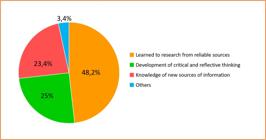
In this regard, regarding the ‘learning to learn’ competency, the meaning nuclei elaborated by the students in the FG interviews are presented in Figure 1.

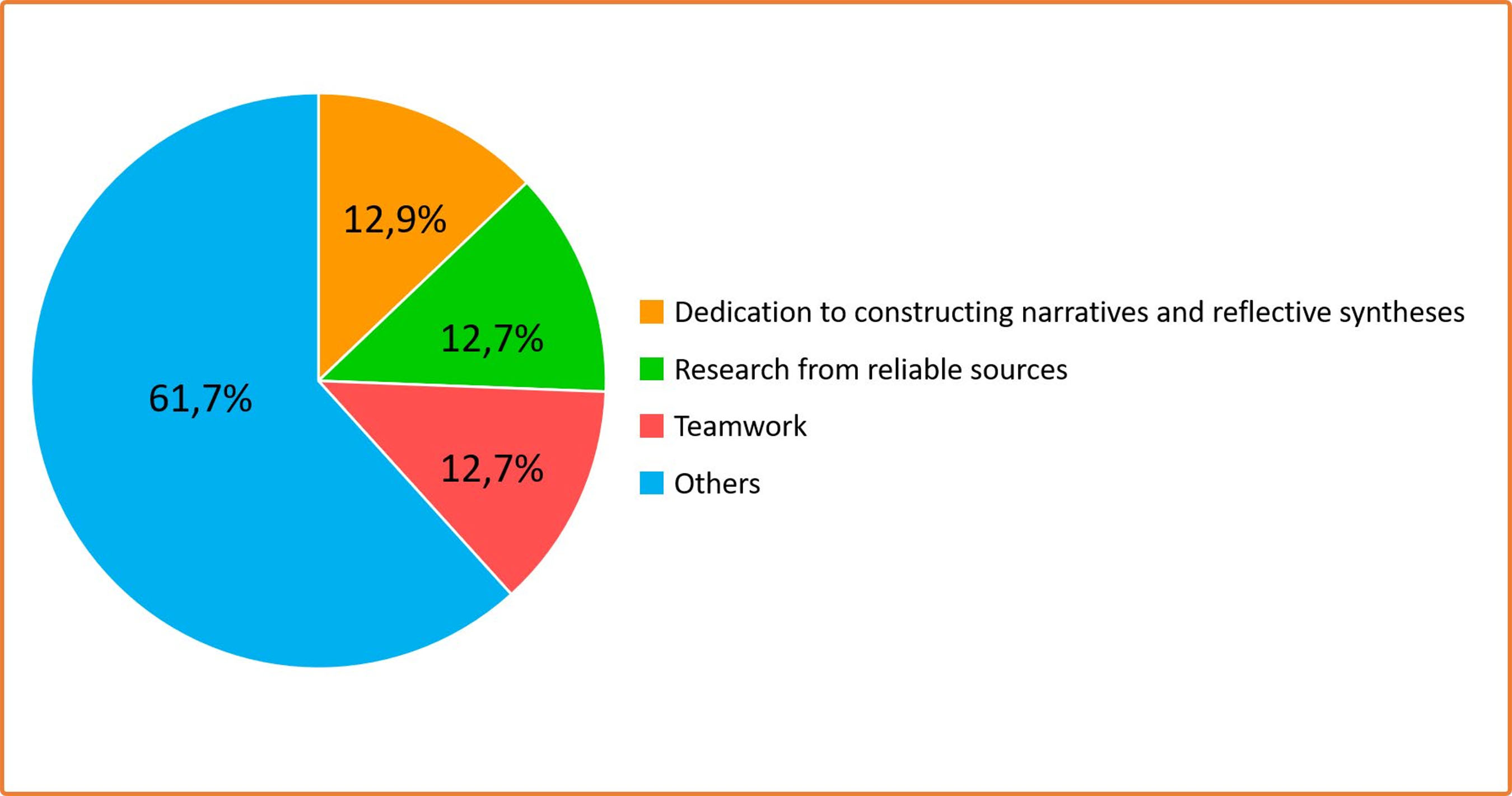
In turn, as shown in Figure 2, the skills most exercised in the 24 FGs conducted were: (1) dedication in developing narratives and syntheses; (2) researching reliable sources; and (3) teamwork.

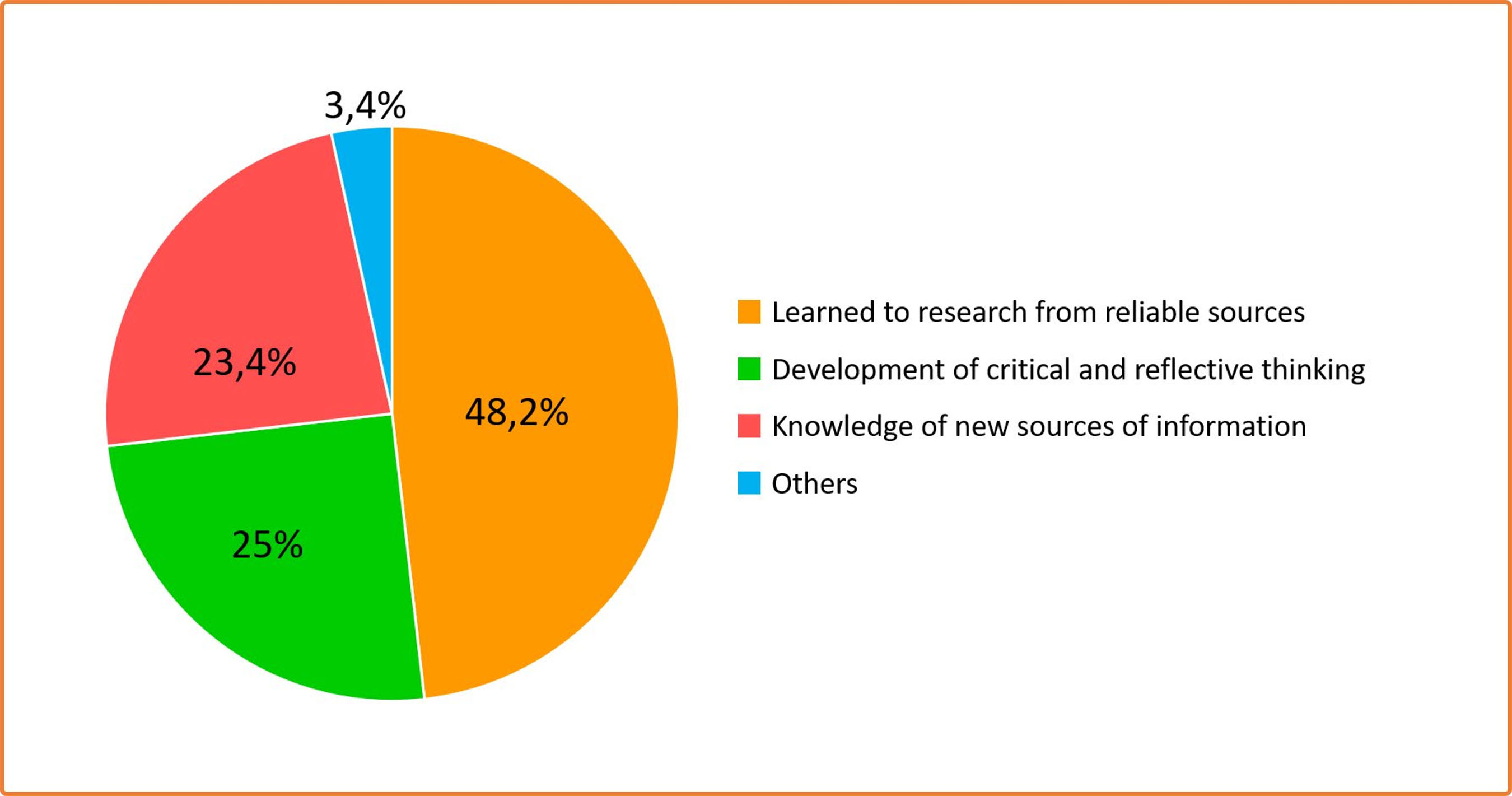
Regarding the ability to search for reliable and appropriate sources, which relates to the development of ‘learning to do,’ Figure 3 illustrates the students’ perception of research-based learning.

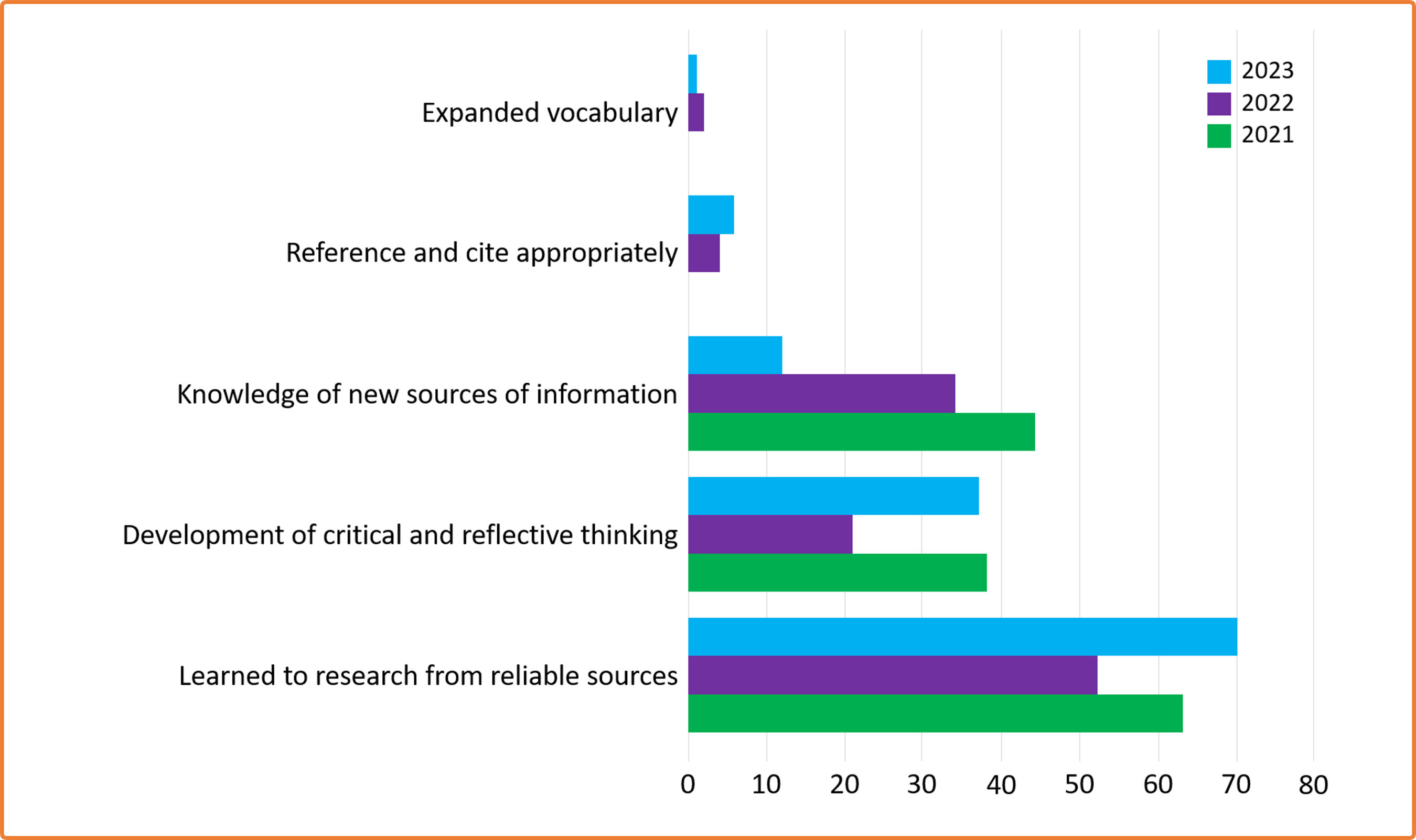
According to Figure 4, regarding the competency related to ‘learning to do,’ the students also demonstrated predominance of (1) practicing how to research reliable sources, (2) the development of critical and reflective thinking, and (3) knowledge of new sources of information.
Based on the findings of this study, it is possible to affirm that, according to the perception of students who took the Health Policy course from 2021 to 2023, the process of constructing RWPs was important in stimulating engagement and motivation as an active teaching and learning method. The importance of this method in exercising skills that are so important for training citizens prepared to face the challenges of the 21st century, such as the ability to seek information from reliable sources, work in teams, address interesting and current topics, and develop creativity, is noteworthy.
In Table 1, we present the students’ perceptions regarding the development of skills related to ‘learning to learn’ during the process of constructing the RWPs, as extracted from the document analyses. The importance of actively seeking knowledge and the development of autonomy resulting from the stimulation of critical and reflective thinking is highlighted, along with the concrete possibility of practical application of the acquired knowledge. Gradually, the students appropriated the RWP as an active and participatory method, recognizing its importance in exercising decision-making and problem-solving skills.
Students’ perceptions of the development of skills related to ‘learning to learn’ during the construction of the Reflective Web Portfolio.
In turn, with regard to the ‘learning to do’ competency (Table 2), it can be observed that students recognize that they have acquired new collaborative work skills, in addition to feeling more able to adapt to new contexts that demand flexibility, critical thinking, and effective problem solving, highlighting the exercise of their ability to put the knowledge they have acquired into practice.
Students' perceptions of the development of skills related to ‘learning to do’ during the process of building the Reflective Web Portfolio.
According to student reflections and RWP records, this method proved to be innovative, both in documenting teaching and learning progress and in fostering deep reflection on lived experiences. Furthermore, the RWP was effective in ‘learning to learn’, by stimulating the construction of reflective narratives, research based on reliable sources, teamwork, and time management. This leads to a deeper understanding of the subjects and greater student engagement, integrating theory and practice. Continuous formative assessment and feedback enable dynamic and interactive learning. In ‘learning to do’, the RWP develops practical and applicable skills such as innovation, adaptation to new contexts, problem-solving, and collaboration. The practice of conducting research based on reliable sources and working in teams strengthens these skills, which are essential in the professional sphere.
Discussion
Active methodologies are based on the process of developing skills that stimulate intuitive, creative, logical, and practical thinking19, aiming at the acquisition of skills, that is, the ability to act in a given situation by mobilizing resources to accomplish a task20. According to Cotta4, the development of skills (knowledge, skills, and attitudes) during undergraduate studies is important for supporting decision-making, problem-solving, and task execution.
In this sense, the results of this study allow us to infer that RWP, as an active method, proved to be effective in developing skills that aid in the learning process, such as the construction of reflective narratives (individual) and reflective syntheses (collective), allowing students to deepen their understanding of the topics studied and develop the ability to synthesize information in a coherent and critical manner. The dedication required strengthens students’ commitment to their learning and promotes deep reflection on the content covered, which is in line with Pelizzari’s21 study, which suggests that the more students investigate and discover about a given topic, the more receptive learning becomes and the content is assimilated and absorbed.
The National Education Guidelines and Framework Law (LDB) and the DCN2 stipulate that professionals entering the job market should be active and dynamic, with the ability to think critically and reflectively, with an aptitude for understanding the demands of society and ‘learning to learn’. Professionals capable of ‘learning to learn’ invest in their own learning, self-training, skills, and attitudes, always committed to the learning process and accepting new challenges1,4. In this sense, the findings of these studies point to the potential of WPR for the development of these skills.
According to Cyrino and Toralles22, an effective educational process depends on student autonomy, self-management, and self-assessment for their learning and training, which can be observed in the exercise of skills related to ‘learning to learn’ by the students in this study. In this study, it was found that the process of constructing the RWP was important for the exercise of skills that promote student dedication, encouraging them to research reliable sources, work actively and autonomously in teams, and learn to manage their time. In addition, the proposal developed in this study affirms the potential of RWP to encourage students to study interesting and current topics, which increases engagement and facilitates the connection between theory and practice.
Another important finding that contributes to the successful applicability of RWP as an active method is the provision of immediate, assertive, and longitudinal feedback throughout the academic semester, that is, at the right time for students to actively catch up, as pointed out by Cotta4.
The results also showed that research-based training led students to learn how research based on reliable sources, enabling them to think critically, understand the topics covered, and encouraging them to research different sources of information, learn about key authors, and learn how to reference and cite properly, thereby expanding their vocabulary and written communication skills. Both in the document analysis and in the focus groups, the findings showed that students effectively practice ‘learning by doing’, identifying the acquisition of new skills that will help them to be more collaborative, innovative, and adapt to new contexts that demand flexibility, critical thinking, and effective problem solving, putting the knowledge they have acquired into practice. This is in line with the studies by Lotes and Toni23, who highlight the importance of students becoming protagonists in the construction of their learning, able to seek knowledge, reflect, and make decisions. The constant practice of researching reliable sources and the need to work as a team observed in this study also strengthen problem-solving skills and the ability to adapt to new contexts, which are fundamental skills in the professional environment.
The main characteristics that should be developed through the use of Reflective Portfolios for the training process are: reflective practice, metacognition, inquiry-based learning, originality and creativity, and self-assessment and self-regulation6. In the present study, through the students’ testimonials, we identified that in practice, RWP proved to be much more than a simple document selection binder, promoting deep reflection on lived experiences. This practice facilitated the process of ‘learning to learn’, developing self-assessment and self-awareness skills, and supported ‘learning to do’, providing a space for the practical application of acquired knowledge, stimulating continuous growth and progressive improvement in various areas of learning and personal and professional development.
Finally, it can be inferred that RWP, as it was constructed as a continuous teaching and learning process, with formative assessment through timely feedback for active recovery, proved to be an active method that not only documents students’ progress but also promotes deep reflection on their learning experiences. Thus, as can be seen in the document analyses and focus groups conducted, RWP may represent a good option for teachers who wish to work on the essential skills that enable students to face the challenges of the contemporary world in a critical, reflective, and practical way.
As strengths of this study, we emphasize that it involves a target audience from three undergraduate health courses (Nursing, Medicine, and Nutrition) who developed the RWP throughout the academic semester. In addition, the entire process of constructing (forming) the RWP was analyzed through document analysis and focus groups, which allowed for a detailed consideration of each aspect of the students’ construction and evolution. Another strength is that the study took place over three academic years (six semesters), with a total of 262 students and analysis of 24 focus groups and six RWPs (documents), demonstrating a diversity of analysis techniques and study populations.
A limitation of the study is the fact that it deals with the use of an active method in the context of a subject included in a traditional curriculum. Perhaps the students’ use of this process of self-regulation, autonomy, and reflection would be more beneficial if the training were more integrated through a more innovative curriculum. In any case, the experience of training in RWP construction in teams, in a Health Policy course, contextualized by the opportunity to develop the work in an interprofessional manner (students from different courses, sharing experiences and studies in a reflective way), was important for the development of important and essential aspects for 21st-century citizenship training, which cannot do without reflective, critical, supportive young people who are capable of working collaboratively.
Conclusion
The use of RWP, as constructed in this study, proved effective as an active teaching and learning method, promoting the development of fundamental skills in both ‘learning to learn’ and ‘learning to do’. The results showed that the application of RWP by trained teachers, with adequate planning and support from a Student Guide, transcends the simple documentation of student progress through the compilation of articles, reports, and other materials, stimulating deep reflection on their life experiences and academic learning.
In any case, it is also essential to point out that the curriculum of undergraduate courses should clearly state which skills should be exercised in each academic module and learning cycle, and it is a fundamental requirement that teachers and students are aware of them. Skills must be defined in an integrative manner between the proposed activities and content, always with an eye on specific demands. During the training process, these skills should be developed and exercised by students in a continuous and increasingly complex manner, aiming at the integral training of individuals, both as professionals and for life. In view of these obstacles, it is necessary to establish guidelines that promote the effective integration of skills into academic curricula, ensuring that teachers and students clearly understand the skills to be developed at each stage of the training process.
Finally, a tip for success highlighted by Cotta4 refers to the importance of continuous training for teachers in the assertive and effective use of RWP, given that it is a method that requires a significant investment of time, energy, dedication, and commitment from both students and teachers in order to be developed.
Although the results of this research demonstrate the potential of the Reflective Web Portfolio (RWP) as an active strategy for developing skills in higher education, it is necessary to recognize some weaknesses and limitations in the investigative process. The main limitation refers to the application of the RWP in a single curricular component, inserted in a traditional curriculum, which may restrict the consolidation of skills throughout the training. The predominance of a qualitative approach and the sampling limitation to health courses at a single institution also limit the generalization of the findings. Future perspectives highlight the need for studies that evaluate the impact of RWP in different academic contexts, with an emphasis on innovative and integrative curricula, as well as longitudinal investigations that track the evolution of skills over time. Challenges such as the articulation between theory and practice, the sustainability of RWP use, and the continuing education of teachers should also be the focus of future research in order to strengthen the applicability and reach of this pedagogical tool.
Acknowledgments
This study was developed as part of the University Teaching Innovation Program (PRODUS) and received support from the Minas Gerais State Research Support Foundation (FAPEMIG) and the Coordination for the Improvement of Higher Education Personnel (CAPES).
-
Molica VKR, Ferreira ES, Cotta RMM. Reflective web-portfolio and the development of skills related to learning to learn and learning to do. Interface (Botucatu). 2025; 29: e250641 https://doi.org/10.1590/interface.250641
-
Funding
The research was not funded, however, the author ESF was funded by a PhD scholarship from the National Council for Scientific and Technological Development (CNPq).
Data Availability
The dataset supporting the results of this study was made available in ‘Calaméo’ digital collection and can be accessed at: https://en.calameo.com/accounts/6535846
References
- 1 Delors J. Los cuatro pilares de la educación. In: Delors J. La educación encierra un tesoro, informe a la UNESCO de la Comissão Internacional sobre a Educação para o Século XXI. Madrid: Santillana/UNESCO; 1996. p. 91-103.
- 2 Brasil. Ministério da Saúde. Resolução nº 569 de 8 de Dezembro de 2017. Dispõe sobre os cursos da modalidade educação a distância na área da saúde. Brasília, DF: Conselho Nacional de Saúde; 2017.
-
3 Cotta RMM, Costa GD, Mendonça ÉT. Portfólio reflexivo: uma proposta de ensino e aprendizagem orientada por competências. Cienc Saude Colet. 2013; 18(6):1847-56. doi: 10.1590/S1413-81232013000600035.
» https://doi.org/10.1590/S1413-81232013000600035 - 4 Cotta RMM. Métodos ativos de ensino, aprendizagem e avaliação: da teoria à prática. Viçosa: Editora UFV; 2023.
-
5 Osses Bustingorry S, Jaramillo Mora S. Metacognición: un camino para aprender a aprender. Estud Pedagog (Valdivia). 2008; 34(1):p.187-97. doi: 10.4067/S0718-07052008000100011.
» https://doi.org/10.4067/S0718-07052008000100011 -
6 Cotta RMM, Costa GD. Instrumento de avaliação e autoavaliação do portfólio reflexivo: uma construção teórico-conceitual. Interface (Botucatu). 2016; 20(56):171-83. doi: 10.1590/1807-57622014.1303.
» https://doi.org/10.1590/1807-57622014.1303 - 7 Ressel LB, Beck CL, Gualda DM, Hoffmann IC, Silva RM, Sehnem GD. O uso do grupo focal em pesquisa qualitativa. Texto Contexto Enferm. 2008; 17(4):779-86.
-
8 Silva PS, Figueiredo NM. Pesquisa cartográfica: reflexões teóricas e metodológicas para enfermagem. Texto Contexto Enferm. 2018; 27(4):e5610016. doi: 10.1590/0104-07072018005610016.
» https://doi.org/10.1590/0104-07072018005610016 -
9 Zimmerman BJ. Becoming a self-regulated learner: an overview. Theory Into Pract. 2002; 41(2):64-70. doi: 10.1207/s15430421tip4102_2.
» https://doi.org/10.1207/s15430421tip4102_2 - 10 European Commission. Key competences for lifelong learning: European Reference Framework. Luxembourg: Office for Official Publications of the European Communities; 2007.
-
11 Paulino LMO, Silva MGL. O webportfólio reflexivo e a formação por competências no ensino superior. Rev Ibe Estud Edu. 2021; 16(1):45-64. doi: 10.1590/S1413-81232013000600035.
» https://doi.org/10.1590/S1413-81232013000600035 - 12 Morin E. Os sete saberes necessários à educação do futuro. 5a ed. São Paulo: Cortez; 2002.
-
13 Ceccim RB, Feuerwerker LCM. O quadrilátero da formação para a área da saúde: ensino, gestão, atenção e controle social. Physis. 2004; 14(1):41-65. doi: 10.1590/S0103-73312004000100004.
» https://doi.org/10.1590/S0103-73312004000100004 - 14 World Health Organization. Transforming and scaling up health professionals’ education and training: WHO Education Guidelines 2013. Geneva: WHO; 2013.
- 15 Backes DS, Colomé JS, Erdmann RH, Lunardi VL. Grupo focal como técnica de coleta e análise de dados em pesquisas qualitativas. Mundo Saude. 2011; 35(4):438-42.
-
16 Braun V, Clarke V. Using thematic analysis in psychology. Qual Res Psychol. 2006; 3(2):77-101. doi: 10.1191/1478088706qp063oa.
» https://doi.org/10.1191/1478088706qp063oa -
17 Aguiar WM, Ozella S. Núcleos de significação como instrumento para a apreensão da constituição dos sentidos. Psicologia. 2006; 26(2):222-45. doi: 10.1590/S1414-98932006000200006.
» https://doi.org/10.1590/S1414-98932006000200006 -
18 Cotta RMM, Silva LS, Lopes LL, Gomes KD, Cotta FM, Lugarinho R, et al. Construção de portfólios coletivos em currículos tradicionais: uma proposta inovadora de ensino-aprendizagem. Cienc Saude Colet. 2012; 17(3):787-96. doi: 10.1590/S1413-81232012000300026.
» https://doi.org/10.1590/S1413-81232012000300026 -
19 Cotta RMM, Costa GD, Mendonça ET. Portfólios crítico-reflexivos: uma proposta pedagógica centrada nas competências cognitivas e metacognitivas. Interface (Botucatu). 2015; 19(54):573-88. doi: 10.1590/1807-57622014.0399.
» https://doi.org/10.1590/1807-57622014.0399 -
20 Fernandes MAM, Durão JBF, Fonseca A. Educação em enfermagem baseada em competências: revisão da literatura. Rev Enferm UFPE. 2011; 5(2):472-80. doi: 10.5205/reuol.1718-11976-1-LE.05spe201121.
» https://doi.org/10.5205/reuol.1718-11976-1-LE.05spe201121 - 21 Pelizzari A, Kriegl ML, Baron MP, Finck NTL, Dorocinski SI. Teoria da aprendizagem significativa de David Ausubel. Rev Pedagog. 2002; 2(1):37-42.
-
22 Cyrino EG, Toralles-Pereira ML. Trabalhando com estratégias de ensino-aprendizado por descoberta na área da saúde: a problematização e a aprendizagem baseada em problemas. Cad Saude Publica. 2004; 20(3):780-8. doi: 10.1590/S0102-311X2004000300015.
» https://doi.org/10.1590/S0102-311X2004000300015 -
23 Lotes D, Toni MD. Metodologia ativa de ensino. Rev Competencia. 2017; 10(2):1-8. doi: 10.24936/2177-4986.v10n2.2017.465.
» https://doi.org/10.24936/2177-4986.v10n2.2017.465
Edited by
-
Editor
Pedro José Santos Carneiro Cruz https://orcid.org/0000-0003-0610-3273
-
Associated editor
Volmir José Brutscher https://orcid.org/0000-0001-5448-0941

 Source: Own elaboration.
 Source: Own elaboration.
 Source: Own elaboration.
 Source: Own elaboration.