 Effect of applying different irrigation frequencies on the productivity and post-harvest of sugar beet under water and saline stress
ABSTRACT
The adoption of irrigation frequencies combined with the use of brackish water in semi-arid regions can reduce the deleterious effects of salt and water stress. Thus, the objective of this study was to evaluate the effect of irrigation frequencies using water with higher and lower salinity on the agronomic performance, productivity, and quality of sugar beet roots. The experiment was conducted at the experimental station of the Universidade da Integração Internacional da Lusofonia Afro-Brasileira, Redenção, Ceará, Brazil. A completely randomized design was used in a 5x2 factorial layout, referring to five irrigation frequencies (F1 = daily irrigation; F2 = irrigation every two days; F3 = irrigation every three days; F4 = irrigated every four days; and F5 = irrigated every five days) and two electrical conductivities of the irrigation water (0.8 and 6.0 dS/m), with 6 replicates. Irrigation frequency every five days negatively affected beet crop performance in terms of plant height, root length, and root diameter. Increasing the irrigation frequency to every four days reduced leaf area, dry matter of the aboveground and root parts, and yield, although to a lesser extent in the treatment with water of lower salinity. Irrigation every five days, combined with salt stress, was more efficient than the control treatment in terms of yield and soluble solids.
Keywords:
Beta vulgaris L.; salinity; water scarcity
RESUMO
A adoção de frequências de irrigação juntamente ao uso de águas salobras em regiões semiáridas pode reduzir os efeitos deletérios do estresse salino e hídrico. Deste modo, objetivou-se avaliar o efeito de frequências de irrigação com água de maior e menor salinidade no desempenho agronômico, produtividade e qualidade da raiz tuberosa da beterraba. O experimento foi realizado na área experimental da Universidade da Integração Internacional da Lusofonia Afro-Brasileira, Redenção, Ceará. O delineamento experimental utilizado foi inteiramente casualizado, em esquema fatorial 5x2, referentes a cinco frequências de irrigação (F1=irrigação diária; F2= irrigado a cada dois dias; F3= irrigado a cada três dias; F4= irrigado a cada quatro dias e F5= irrigado a cada cinco dias) e duas condutividade elétrica da água de irrigação (0,8 e 6,0 dS/m), com 6 repetições. A frequência de irrigação a cada cinco dias afetou negativamente o desempenho da cultura da beterraba em termos de altura da planta, comprimento e diâmetro da raiz tuberosa. O aumento da frequência de irrigação até a cada quatro dias reduziu a área foliar, massa seca da parte aérea e raiz e a produtividade, porém com menor intensidade no tratamento com água de menor salinidade. A frequência de irrigação a cada cinco dias associado ao estresse salino, foi mais eficiente em relação ao tratamento controle para a produtividade e sólidos solúveis.
Palavras-chave:
Beta vulgaris L.; salinidade; escassez hídrica
Salinity and dryness are among the main abiotic stresses that limit crop growth and yield (Ma et al., 2020), especially in arid and semiarid regions, where rainfall is irregularly distributed in time and space and evapotranspiration rates exceed precipitation rates; therefore, the use of irrigated agriculture becomes essential for reliable production (Barbosa et al., 2024; Léllis et al., 2022; Lacerda et al., 2020). However, the water used for irrigation in these regions often has high salt concentrations, particularly water from tube wells (Silva et al., 2007; Cavalcante et al., 2022).
Proper planning of when, how much, and how to irrigate is essential for maintaining sustainable irrigated agriculture and can prevent the process of secondary salinization (Costa et al., 2024; Melo et al., 2022). In this regard, increasing the frequency of irrigation or the interval in days between successive irrigations with brackish water can result in lower salt concentrations due to the dilution effect (Costa et al., 2024; Melo et al., 2022).
Numerous horticultural crops are produced in Brazil, among which is table beet (Beta vulgaris L.), with yields ranging from 20 to 35 t/ha (IBGE, 2018). Among the main Brazilian municipalities producing table beets that are part of the semi-arid region are Candaraí in the state of Minas Gerais, Latão in Bahia, and Brejo da Madre de Deus in Pernambuco (IBGE, 2018). Thus, the cultivation of this vegetable emerges as an alternative for commercial production in areas affected by salinity issues, as it is considered tolerant and adaptable (Zhang et al., 2021; Barbosa et al., 2024).
Beet cultivation is also affected by soil water availability, making it vital to understand and control irrigation management practices to maximize yield and the production of high-quality roots (Azevedo et al., 2025). However, understanding the effect of water stress associated with salinity is a challenge for achieving satisfactory yields (Costa et al., 2024). A study by Ribeiro et al. (2024), which evaluated the use of brackish water in beetroot cultivation under water stress, found reduced gas exchange and productivity, though with less severity in the control treatment (0.8 dS/m).
In this context, the objective was to evaluate the effect of different irrigation frequencies using water with higher and lower salinity on the productivity and quality of the beetroot tubers.
MATERIAL AND METHODS
The experiment was conducted in a greenhouse at the Universidade da Integração Internacional da Lusofonia Afro-Brasileira, Auroras Campus, Redenção-CE, Brazil (04°13'33“S, 38°43'50”W, altitude of 88 m). According to Alvares et al. (2013), the region’s climate is Aw’ type, classified as tropical rainy with a dry season. The environmental conditions during the experiment, conducted from July to October 2020, are shown in Figure 1.
The experimental design used was completely randomized with a 5×2 factorial layout, comprising five irrigation frequencies (F1 = daily irrigation; F2 = irrigation every two days; F3 = irrigation every three days; F4 = irrigated every four days; and F5 = irrigated every five days) and two electrical conductivities of the irrigation water (CEa) (0.8 and 6.0 dS/m), with 6 replicates.
The cultivar used was ‘Early Wonder Tall Top’. Seeding took place in polystyrene trays with 200 cells of 40 cm³ volume, where each cell received one seed planted 2 cm deep. Twenty days after planting in the trays, the most vigorous seedlings were transplanted into polyethylene plastic pots, with each pot containing three plants. The pots had a volume of 12 liters and measured 23 cm in height and 24 cm in diameter, and were kept in a greenhouse. They were filled with a substrate obtained by mixing soil, sand, and cattle manure in a 5:3:2 ratio, corresponding to 5 parts of the red-yellow Argissol present in the area, 3 parts of sand, and 2 parts of cattle manure, respectively. The substrate used had the chemical properties shown in Table 1.
Irrigation was performed manually, with the saline treatment beginning at 8 days after sowing (DAS), following the irrigation frequency specified for the treatments mentioned above. The brackish water used was prepared according to the methodology suggested by Rhoades et al. (2000), using NaCl, CaCl2·2H2O, and MgCl2·6H2O in a 7:2:1 ratio.
The irrigation rate was measured using a water balance (Bernardo et al., 2019), based on the drainage lysimeter principle, with reference evapotranspiration estimated daily according to Equation 1:
Where:
VI = Volume of water to be applied (mL);
Vp = Volume of water applied in the previous irrigation (mL);
Vd = Volume of drained water (mL);
LF = Leaching fraction of 0.15.

At 30 days after planting (DAT), the following variables were analyzed: plant height (AP, cm), measured with a tape measure to the tip of the uppermost leaves; leaf area (AF, cm²), following the methodology of Simões et al. (2016), dry mass of the aerial part (MSPA) and root (MSR, g), where the plants were placed in kraft paper bags and subsequently in a forced-air circulation oven for a period of 72 hours until constant mass. Afterward, the dry biomass was weighed using a precision scale.
At 80 DAT, productivity variables (Yield, kg/plant) were analyzed based on tuberous root mass and soluble solids (°Brix) using a portable refractometer (Minolta) using juice extracted by compressing a slice approximately 3 mm thick taken from the equatorial portion of the tuberous root, diameter (cm) and length of the tuberous root (cm) using a digital caliper, and the pH of the aqueous extract of the tuberous root using a pH meter.
The data obtained were subjected to a normality test (Shapiro-Wilk test) and analysis of variance at a 5% significance level. When significant by the F-test, the means were compared using Tukey’s test with p<0.05 using ASSISTAT, version 7.7 Beta (Silva & Azevedo, 2016).
RESULTS AND DISCUSSION
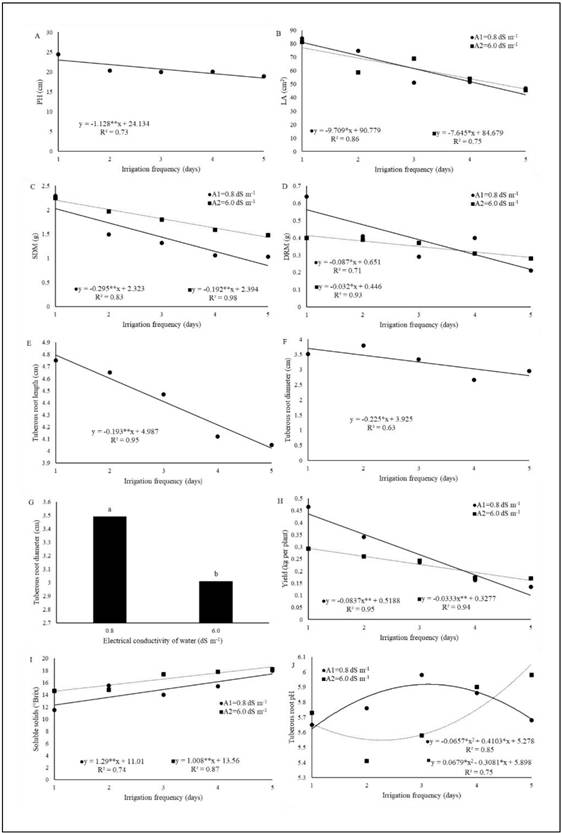
According to the analysis of variance (Table 2), there was a significant interaction between water electrical conductivity and irrigation frequency for leaf area, yield, soluble solids, and tuber root pH (p<0.05), as well as for aboveground dry weight and root dry weight (p<0.01). A main effect of different CEa values was observed on plant height (p<0.01) and of irrigation frequency (p<0.05) on tuber root length, and a main effect of CEa and irrigation frequency on tuber root diameter (p>0.01).
Summary of the analysis of variance for plant height (PH), leaf area (LA), aboveground dry matter (SDM), root dry matter (DRM), tuber root length (TRL), tuber root diameter (TRD), yield (Y), soluble solids (SS), tuber root pH (PH) of beets grown under different irrigation water electrical conductivities (CEa) and irrigation frequencies (FI). Redenção, UNILAB, 2020.
As shown in Figure 2A, the beet plants had a shorter plant height (18.89 cm) under the every-five-day irrigation frequency, representing a 22.55% reduction compared to the height observed under the daily irrigation frequency (24.39 cm). The reduction in beet plant height is a direct response to combined stress (saline and water stress), which was accentuated in the treatment with lower irrigation frequency. Low soil moisture content during critical stages of development can be detrimental to beet growth (Yolcu et al., 2021). On the other hand, Ribeiro et al. (2024) found no negative effect of water stress on beet crops irrigated with 50% of crop evapotranspiration.
For leaf area, daily irrigation combined with water of 0.8 and 6.0 dS/m resulted in increases of 44.10% and 43.99% in this variable, respectively, compared to the values observed with irrigation every five days using the respective water sources (Figure 2B). Daily irrigation with brackish water did not cause deleterious effects on the expansion of beet leaf area, as demonstrated by the similarity in the percentages for good- and poor-quality water (approximately 44%), indicating that continuous water availability was essential to mitigate the potential inhibitory effect of salinity on the growth of this moderately salt-tolerant crop.
Taiz et al. (2024) report that plants subjected to stresses, such as salinity and water stress, tend to reduce their leaf area as a defense mechanism to minimize water loss through transpiration. Results similar to those found in this study were reported by Costa et al. (2024), where the authors observed increases in the leaf area of the millet crop irrigated daily with water of 0.8 dS/m and every other day with water of 5.0 dS/m.
The decreasing linear model was the best fit for aboveground dry matter (Figure 2C), where daily irrigation favored greater accumulation of aboveground dry matter in the beet crop with water of lower (2.29 g) and higher salinity (2.25 g), with increases of 55.02% and 34.22% compared to those observed with irrigation every five days (1.03 g in 0.8 dS/m water and 1.48 g in 6.0 dS/m water), respectively.
It should be noted that the use of water with a salinity of 6.0 dS/m at a daily irrigation frequency did not adversely affect dry biomass accumulation in sugar beets, as it was similar to the value obtained using water with a salinity of 0.8 dS/m under the same irrigation management. However, the water stress caused by the longer interval between irrigations reduced the crop’s biomass production. The low SDM observed at the five-day frequency is a direct indicator of acute water stress, which causes osmotic stress and toxicity, leading to a reduction in carbon fixation through photosynthesis. It is worth noting that dry biomass production is a direct response to the plant’s ability to assimilate carbon (Taiz et al., 2024).
Hussein et al. (2019) describe that the occurrence of water stress during the vegetative phase can decrease the fresh mass of the root and aerial parts of sugar beet. Similar results were observed by Silva et al. (2017) in fig crops irrigated with water of lower salinity at irrigation intervals ranging from two to ten days.
The highest values of root dry mass were observed in treatments with daily irrigation, both when using water with a salinity of 0.8 (0.64 g) and 6.0 dS/m (0.40 g), showing an increase of 67.18% and 30.00%, respectively, compared to plants irrigated every five days with these waters (Figure 2D). The lower value observed in the saline treatment demonstrates that for the plant to adapt to brackish irrigation, there is an energetic cost, as part of the assimilates that would be used for biomass growth are instead utilized in defense processes against salt stress, such as the production of organic osmolytes and the compartmentalization of salts in the cell cytosol (Taiz et al., 2024).

Plant height (A), leaf area (B), dry weight of the aboveground biomass (C) and root (D) Tuber root length (E), tuber root diameter (F,G), yield (H), soluble solids (I), and tuber root pH (J) of sugar beet plants grown under two irrigation water electrical conductivities and five irrigation frequencies. Means followed by the same lowercase letter did not differ from each other according to Tukey’s test (p<0.05). Redenção, UNILAB, 2020.
This decrease in root dry weight indicates that under water and salt stress conditions throughout the crop cycle, photoassimilates are used less for the formation of the photosynthetic apparatus and, consequently, fewer photoassimilates are translocated to the roots, which directly affects plant biomass (Bhattarai et al., 2020; Costa et al., 2024),
For tuber root length, the model that provided the best fit was the linear model, showing shorter tuber root lengths in treatments with longer intervals between irrigations, with reductions ranging from 14.73% for irrigation every five days (4.05 cm) to daily irrigation (4.75 cm) (Figure 2E). Similarly, the longer interval between irrigations negatively affected tuber root diameter, with a 29.81% decrease in this variable from the irrigation frequency of every two days (3.79 cm) to the irrigation frequency of every four days (2.66 cm) (Figure 2F).
Tuber root growth in beets is primarily driven by cell expansion and filling with solutes such as sugars and water. Like leaf expansion, this process depends on cell turgor and a continuous supply of water, with turgor pressure serving as the driving force for cell elongation (Taiz et al., 2024). Therefore, daily irrigation provided a higher continuous water potential to the soil and also to the plant, which promoted turgidity of the tuber cells and allowed for greater growth in length and diameter, an essential factor for beet productivity and final quality (Melo Filho et al., 2020).
The salinity of the irrigation water negatively affected the diameter of the beetroot tuber, with a 13.75% decrease in CEa at 0.8 compared to 6.0 dS/m (Figure 2G). According to Maas & Hoffman (1977), table beet is considered a crop moderately tolerant to salt stress with a salinity threshold of 5.8 dS/m. Although beets are a salt-tolerant crop, when grown in pots, there may be an increase in excess salts in the soil near their roots, which can reduce water and nutrient uptake, affecting cell division and expansion as well as the biochemical processes responsible for tuber root development (Silva et al., 2015; Melo Filho et al., 2020). Gadelha et al. (2021) found that the diameter of the beetroot tuber was smaller under brackish water (CEa = 5.8 dS/m), approximately 45% smaller compared to that observed in water with lower salinity (CEa = 0.3 dS/m).
According to Figure 2H, increasing the interval between irrigation events had a linearly decreasing effect on the yield of sugar beet plants irrigated with water at 0.8 and 6.0 dS/m, with a decrease of 70.89% (0.8 dS/m1) and 41.95% (6.0 dS/m), respectively, from daily irrigation (1394.40 and 876.60 g/plant, respectively) to irrigation every five days (405.88 and 508.88 g/plant), respectively.
The use of water with lower salinity combined with daily irrigation frequency resulted in higher sugar beet yield (0.46 kg/plant); however, the decrease was more pronounced (70.89%) when using this water as irrigation frequency was reduced, with productivity dropping by an average of 0.0837 kg/plant for each additional day without irrigation. In contrast, when brackish water was used, the reduction between the lowest and highest irrigation frequencies was only 41.95%. Water stress proved to be the predominant limiting factor, being more detrimental to beet production than salt stress. According to Yolcu et al. (2021), prolonged and persistent exposure to salt and water stress results in a significant drop in beet productivity and yield.
Gadelha et al. (2021) and Ribeiro et al. (2024) found in their studies that beet production, when irrigated with high-salinity water (5.8 and 6.0 dS/m) at a daily irrigation frequency, is negatively affected by the salts in the irrigation water. Similarly, Salih et al. (2018) found that daily irrigation using water with lower salinity resulted in higher potato tuber yields.
Lower irrigation frequencies resulted in an increase in the soluble solids content of sugar beet plants irrigated with water of lower and higher salinity, yielding increases of 36.11% and 19.45% compared to daily irrigation (11.5°Brix at CEa 0.8 dS/m and 14.6°Brix at CEa 0.8 dS/m and 18.2°Brix at CEa 6.0 dS/m), respectively (Figure 2I).
The increase in soluble solids content with reduced irrigation frequency is explained by the accumulation of soluble sugars (sucrose, fructose, and glucose) for osmotic maintenance of cells under salt and water stress in beet genotypes (Naguib et al., 2021; Wedeking et al., 2017). The accumulation of organic solutes, such as proline, flavonoids, anthocyanins, and betalains in plants, is responsible for inhibiting the deleterious effects caused by biotic and abiotic stresses, such as the presence of reactive oxygen species and the maintenance of ionic homeostasis under saline stress conditions (Taiz et al., 2024). Costa et al. (2025), when evaluating the irrigation suppression interval in sugar beet crops under salt stress, observed that daily irrigation reduced the soluble solids content in this crop.
The quadratic polynomial model best fit the pH of the tuberous root aqueous extract (Figure 2F), showing a maximum hydrogen ion potential of 5.91 for an electrical conductivity (CEa) of 0.8 dS/m at a three-day irrigation frequency; whereas for an EC of 6.0 dS/m, a minimum hydrogen ion potential of 5.5 was observed at a two-day irrigation frequency (Figure 2J). Water stress leads to a reduction in water and nutrient uptake by the roots, which can alter ionic homeostasis, causing an accumulation of ions such as H⁺ in the tuberous root. This accumulation can result in acidification of the root environment, lowering the pH of the tuberous root (Taiz et al., 2024).
The values observed in this study fall within the range considered excellent (pH 4 and 5 in the absence of oxygen, and pH between 5 and 6 in the presence of oxygen) for the stability of betalains, the substance responsible for the color and antioxidant function of beets (Santos et al., 2020). Costa et al. (2025), when analyzing the effect of water deprivation and salt stress on beet plants, obtained a higher hydrogen ion concentration (5.8 and 6.0 for water at 0.8 and 6.2 dS/m, respectively) under daily irrigation.
CONCLUSIONS
Irrigation every five days had a negative impact on beet development, resulting in shorter plants, as well as reduced root length and diameter. Increasing the irrigation frequency to every four days also negatively affected the crop, reducing leaf area, dry matter of the aboveground and root parts, as well as yield, although the effects were less severe when water with lower salinity was used.
However, irrigation every five days, when combined with salt stress, demonstrated greater efficiency compared to the control treatment in terms of yield and soluble solids accumulation. These results highlight the importance of considering the interaction between irrigation frequency and water quality in optimizing crop performance.
ACKNOWLEDGMENTS
To the National Council for Scientific and Technological Development (CNPq).
REFERENCES
- ALVARES, CA; STAPE, JL; SENTELHAS, PC; GONÇALVES, JDM; SPAROVEK, G. 2013. Mapa de classificação climática de Köppen para o Brasil. Meteorologische Zeitschrift 22: 711-728.
- AZEVEDO, AT; COELHO, RD; BARROS, THDS. 2025. Productivity and quality of beet (Beta vulgaris L.) under different drip irrigation management methodologies.Irrigation Science1-14.
- BARBOSA, AS; SILVA, AO; SOUSA, GG; SOUZA, MVP; FREIRE, MHC; GOES, GF; PEREIRA, APA; VIANA, TVA; COSTA, RNT; LACERDA, CF; SILVA, GF; ROLIM, MM. 2024. Brackish water, phosphate fertilization and trichoderma in the agronomic performance of beet crops.Agronomy14: 1306.
- BERNARDO, S; MANTOVANI, EC; SILVA, DD; SOARES, AA. 2019. Manual de irrigação. 9.ed.Viçosa: Editora UFV. 545p.
- BHATTARAI, B; SINGH, S; WEST, CP; RITCHIE, GL; TROSTLE, CL. 2020. Effect of deficit irrigation on physiology and forage yield of forage sorghum, pearl millet, and corn.Crop Science60: 2167-2179.
- CAVALCANTE, ES, LACERDA, CF, MESQUITA, RO, MELO, AS, FERREIRA, JFS; TEIXEIRA, AS; GHEYI, HR. 2022. A irrigação suplementar com água salobra melhora a assimilação de carbono e a eficiência do uso da água no milho em condições de terras secas tropicais. Agriculture 12: 544.
- COSTA, FH; AZEVEDO, BMD; SOUSA, GGD; SOUSA, LVD; FERNANDES, CN; PINTO, ORDO; FRAZÃO, DS. 2025. Interval of irrigation suppression in beet cultivation under salt stress. Revista Brasileira de Engenharia Agrícola e Ambiental, 29: e289926.
- COSTA, FH; SOUSA, GG; LIMA, JMP; ALMEIDA, MS; SOUSA, HC; GOMES, SP; CRUZ FILHO, EM; AZEVEDO, BM. 2024. Frequencies of irrigation in millet crop under salt stress.Revista Brasileira de Engenharia Agrícola e Ambiental28: e272197.
- GADELHA, BB; FREIRE, MHC; SOUSA, HC; COSTA, FHR; LESSA, CIN; SOUSA, GG. 2021. Growth and yield of beet irrigated with saline water in different types of vegetable mulching.Revista Brasileira de Engenharia Agrícola e Ambiental25: 847-852.
- HUSSEIN, HAA; MEKKI, BB; EL-SADEK, MEA; LATEEF, EEE. 2019. Effect of L-Ornithine application on improving drought tolerance in sugar beet plants.Heliyon5: e02631.
-
INSTITUTO BRASILEIRO DE GEOGRAFIA E ESTATÍSTICA - IBGE. 2018. Censo agropecuário 2017: resultados definitivos. Available at:Available at:https://censoagro2017.ibge.gov.br/templates/censo_agro/resultadosagro/index.html Accessed: July18, 2024.
» https://censoagro2017.ibge.gov.br/templates/censo_agro/resultadosagro/index.html - LACERDA, CF; OLIVEIRA, EV; NEVES, ALR; GHEYI, HR; BEZERRA, MA; COSTA, CAG. 2020. Morphophysiological responses and mechanisms of salt tolerance in four ornamental perennial species under tropical climate.Revista Brasileira de Engenharia Agrícola e Ambiental24: 656-663.
- LÉLLIS, BC; MARTÍNEZ-ROMERO, A; SCHWARTZ, RC; PARDO, JJ; TARJUELO, JM; DOMÍNGUEZ, A. 2022. Effect of the optimized regulated deficit irrigation methodology on water use in garlic.Agricultural Water Management260: 107280.
- MA, Y; DIAS, MC; FREITAS, H. 2020. Drought and salinity stress responses and microbe-induced tolerance in plants.Frontiers in plant Science11: 591911.
- MAAS, EV; HOFFMAN, GJ. 1977. Crop salt tolerance current assessment. Journal of the Irrigation Drainage Division 103: 115-134.
- MELO FILHO, JS; SILVA, TI; GONÇALVES, ACM; SOUSA, LV; VÉRAS, MLM; DIAS, TJ. 2020. Physiological responses of beet plants irrigated with saline water and silicon application.Comunicata Scientiae11: e3113.
- MELO, GL; PETRY, MT; SILVA, CM; F NETTO, JF; MARTINS, JD; VILLA, B; TONETTO, F; MOURA, MB; MENDONÇA, MT; TOKURA, LK. 2022. Ocorrências e controle de salinidade no uso de um sistema de irrigação localizada.Revista de Ciências Ambientais16: 01-11.
- NAGUIB, WB; DIVTE, PR; CHANDRA, A; SATHEE, L; SINGH, B; MANDAL, PK; ANAND, A. 2021. Raffinose accumulation and preferential allocation of carbon (14C) to developing leaves impart salinity tolerance in sugar beet.Physiologia Plantarum173: 1421-1433.
- RHOADES, JD; KANDIAH, A. MASHALI, AM. 2000. Uso de águas salinas para produção agrícola. Campina Grande: UFPB, 117 p.
- RIBEIRO, RMR; SOUSA, GG; BARBOSA, AS; MATOS, EC; VIANA, TVA; LEITE, KN; COSTA, FHR; CAMBISSA, PBC; SALES, JRS; SANTOS, SO. 2024. The impact of saline and water stress on the agronomic performance of beet crops.Brazilian Journal of Biology84: e276278.
- SALIH, SA; ABDULRAHMAN, FA; MAHMOOD, YA. 2018. The effect of different irrigation interval on tuber yield and quality of potato (Solanum tuberosum L.).Kurdistan Journal of Applied Research3: 27-31.
- SANTOS, FL; COSTA, ES; LIMA, CSM. 2020. Diferentes substratos no desenvolvimento e na pós-colheita de microverdes de beterraba (Beta vulgaris L.).Revista Iberoamericana de Tecnología Postcosecha21: 1-11.
- SILVA, AO; SILVA, ÊFF; KLAR, AE. 2015. Manejo da fertirrigação e salinidade do solo no crescimento da cultura da beterraba.Engenharia Agrícola35: 230-241.
- SILVA, FAS; AZEVEDO, CAV. 2016. The Assistat software version 7.7 and its use in the analysis of experimental data. African Journal of Agricultural Research11: 3733-3740.
- SILVA, FJAD; ARAÚJO, ALD: SOUZA, ROD. 2007. Águas subterrâneas no Ceará-poços instalados e salinidade. Revista Tecnologia 28: 136-159.
- SILVA, MSM; CARNEIRO, MSS; EDVAN, RL; SANTIAGO, FEM; NÓBREGA, JCA; SANTIAGO, FLA. 2017. Diferentes turnos de rega sobre o crescimento e produção de Macroptilium lathyroides (L.) Urb. Revista de Ciências Agrárias 40: 430-435.
- SIMÕES, WL; SOUZA, MA; YURI, JE; GUIMARÃES, MJM; GOMES, VHF. 2016. Desempenho de cultivares de beterrabas submetidas a diferentes lâminas de irrigação no Submédio São Francisco. Water Resources and Irrigation Management5: 51-57.
- TAIZ, L; ZEIGER, E; MOLLER, IM; MURPHY, A. 2024. Fundamentos de Fisiologia Vegetal. Porto Alegre, BR: Artmed. 864p.
- WEDEKING, R; MAHLEIN, AK; STEINER, U; OERKE, EC; GOLDBACH, HE; WIMMER, MA. 2017. Osmotic adjustment of young sugar beets (Beta vulgaris) under progressive drought stress and subsequent rewatering assessed by metabolite analysis and infrared thermography.Functional Plant Biology44: 119-133.
- YOLCU, S; ALAVILLI, H; GANESH, P; PANIGRAHY, M; SONG, K. 2021. Salt and drought stress responses in cultivated beets (Beta vulgaris L.) and wild beet (Beta maritima L.).Plants10: 1843.
- ZHANG, P; LIU, L; WANG, X; WANG, Z; ZHANG, H; CHEN, J; LIU, X; WANG, Y; LI, C. 2021. Beneficial effects of exogenous melatonin on overcoming salt stress in sugar beets (Beta vulgaris L.).Plants10: 886.
-
Consent for publication:
All authors allow Horticultura Brasileira to publish the manuscript
-
Data availability:
Data will be made available upon request to the corresponding author.
-
Declaration of generative AI and AI-assisted technologies in the writing process:
The authors state that they did not use artificial intelligence tools.
Data will be made available upon request to the corresponding author.