
 Selection for durable resistance to late blight in potatoes
ABSTRACT
Commercial potato cultivars may contain several qualitative (major) resistance genes (R genes) which can protect plants against late blight, but they are not always effective because they can be defeated by new races of Phytophthora infestans. Quantitative resistance is controlled by many minor genes with additive effects and thus is more durable. This study aimed to characterize late blight resistance in Brazilian potato genotypes and evaluate a strategy to select for durable resistance. We generated potato progenies from crosses between parents with different quantitative resistance levels. The detached leaflet method was applied to test the resistance in the seedling generation with a complex race of P. infestans. Assays utilizing whole plants with inoculations of P. infestans (race 0) were performed to detect the parents’ R genes. The results allowed to identify the presence of R genes, as well as to distinguish the qualitative resistance from the quantitative resistance in the evaluated genotypes. The use of a complex race of P. infestans, compatible with R genes present in the progenies, allowed the selection for durable resistance to late blight.
Keywords:
Solanum tuberosum; oomycete; Phytophthora infestans; R genes; horizontal resistance; progeny test
RESUMO
Cultivares comerciais de batata podem conter vários genes qualitativos de resistência à requeima (genes R), que nem sempre são eficazes porque podem ser superados por novas raças de Phytophthora infestans. A resistência quantitativa é controlada por genes com efeitos aditivos e, portanto, é mais durável. Este estudo teve como objetivo caracterizar a resistência à requeima em genótipos de batata e avaliar estratégia de seleção para resistência durável. Foram geradas progênies a partir de cruzamentos entre genitores da batata com diferentes níveis de resistência quantitativa. O método de folíolo destacado foi utilizado para avaliar a resistência na geração de plântulas com uma raça complexa de P. infestans. Ensaios utilizando plantas inteiras com inoculações de P. infestans (raça 0) foram realizados para detectar genes R (resistência qualitativa) nos genitores. Os resultados permitiram identificar a presença de genes R, bem como distinguir a resistência qualitativa da resistência quantitativa nos genótipos avaliados. A utilização de uma raça complexa de P. infestans, compatível com os genes R presentes nas progênies, permitiu a seleção para resistência durável à requeima.
Palavras-chave:
Solanum tuberosum; oomyceto; Phytophthora infestans; genes R; resistência horizontal; teste de progênie
The late blight disease, caused by the oomycete Phytophthora infestans, is a major problem for potato (Solanum tuberosum) production worldwide (Ivanov et al., 2021). This disease had its first impact outside of its center of origin, Mexico, between the years 1845 and 1846, when epidemics spread across Europe, resulting in the Irish Potato Famine (Fry, 2020). Epidemics of late blight were caused by asexual reproduction of isolates of P. infestans belonging to A1 mating type group of the pathogen (Fry & Goodwin, 1997).
The spraying of chemical fungicides is the primary measure of control of late blight on cultivars commonly planted in Brazil, which are generally highly susceptible to the disease (Oxley et al., 2023). Continuous spraying with fungicides increases the production cost, and they are not always effective, as new populations of P. infestans are often resistant to products widely used for disease control (Abuley et al., 2023). As in the past, the need to use resistant cultivars continues to be of great importance for managing this important potato disease (Witek et al., 2021). The challenge for potato breeders is the development of new potato cultivars with a combination of durable late blight resistance, high yield, early maturity, and good tuber quality required for commercial success (Lozoya-Saldana, 2011; Hirsch et al., 2013).
The potato breeding strategy during the first half of the 20th century was the use of dominant major genes (R genes) that were discovered in the wild species Solanum demissum, in Mexico (Malcolmson & Black, 1966). But these R genes would not provide durable resistance, individually or in combination, due to the emergence of new races of P. infestans (Fry, 2008). Consequently, many breeding programs started to select for quantitative resistance, using artificial inoculation of P. infestans races compatible with the R genes present in the local germplasm, or through the formation of an R free-gene germplasm, thus allowing that quantitative resistance evaluation could be done using any pathogen race (Stewart et al., 2003).
The best strategy is to combine the use of qualitative resistance with quantitative resistance so that the protection conferred by the R gene is used until they are defeated, then high levels of quantitative resistance come into operation together with any residual resistance contributed by R genes (Stewart & Bradshaw, 2001). In the breeding program, it is important to establish an evaluation process that makes it possible to distinguish qualitative from quantitative resistance and create the best selection strategy for high levels of quantitative resistance.
The breeding program of Embrapa made efforts to develop potato cultivars adapted to Brazilian growing conditions combined with durable resistance to late blight (Pereira et al., 2013). BRS Clara is a cultivar resistant to late blight, probably having R gene, but no studies have been conducted to confirm and characterize its resistance, as well as their parents and other genotypes commonly used in crossing blocks at Embrapa breeding program. The hypothesis is that these genotypes carry combinations of genes with major effects and genes of additive effect, and the selection for quantitative resistance can be done in early stages of the breeding programs by using a complex race of P. infestans.
This study aimed to characterize the resistance to late blight of Brazilian potato genotypes for the presence of R genes, and to evaluate the use of a complex race of P. infestans for the selection of durable resistance.
MATERIAL AND METHODS
Development of progenies
The parental genotypes used in crosses to generate progenies for this study have been previously characterized as presenting, in general, moderate to high quantitative resistance to late blight (Casa-Coila et al., 2019). Susceptible genotypes having important agronomic traits were included in the crosses (Table 1). The cultivar Agata and the clone CIP392.617.54 were used as susceptible and resistant checks, respectively. Progenies resulting from these crosses were expected to segregate for quantitative resistance.
Parents used in this study represent potato genotypes of the Embrapa Breeding Program with different levels of quantitative resistance to late blight. Susceptible parents with an absence of R genes and a low level of quantitative resistance were included to observe the segregation of their progeny when crossed with resistant parents. Such susceptible genotypes as ‘BRSIPR Bel’, ‘Asterix’, and ‘Atlantic’, have important agronomic traits, such as high dry matter content and low sugar content, which are decisive factors for market acceptance of a potato cultivar, especially for the potato processing industry.
C2550-04-06 and C2553-01-06 were chosen because it is believed they possess high levels of quantitative resistance and absence of R genes since these clones were generated in Embrapa from crosses with clones from the B3 population, which was developed specifically for horizontal resistance to late blight without the presence of R genes (Landeo, 2002).
‘BRS Clara’ and ‘BRS Eliza’ were developed by the Potato Breeding Program at Embrapa (Pereira et al., 2013) and have high levels of quantitative resistance to late blight. ‘White Lady’ and ‘Catucha’ were chosen because they are parents of the 'BRS Clara'.
True potato seeds (TPS) were obtained through controlled pollination conducted in Embrapa Clima Temperado, Pelotas-RS, Brazil (31°40’43”S, 52°26’23”W, 58 m altitude). TPS were put to germinate in wooden seed boxes, and later the seedlings were transplanted to pots in a greenhouse, for tuber production.
Bioassay with detached leaflets
An assay testing the progenies' resistance on detached leaflets was conducted in May and June in 2012. The assessment of progeny segregation for late blight quantitative resistance was held in leaflet tests according to the methodology described by Dorrance & Inglis (1997). The Pi151 isolate of P. infestans was used for artificial inoculation. The Pi151 isolate is a complex race (1,3,4,7,8,10,11) (Santana et al., 2013).
Inoculation
For inoculation, a P. infestans sporangia suspension was obtained by dilution of oomycete growing in water for 1½ - 3 h.
Progeny seeds were sown in styrofoam trays and later the seedlings were transplanted into pots in a greenhouse. Young fully expanded leaflets of thirty-day old seedlings (from sowing) were collected from about 100 individuals of each progeny. In addition, three leaflets of five to six old plants (forty-five days after tuber planting) of the checks were collected. The leaflets were carefully washed and deposited on germitest paper moistened with sterile water and placed in a plastic tray (46 x 30 x 10 cm). After, the Pi151 isolate of P. infestans was inoculated on the abaxial side of the leaflets of different genotypes with a 50 µL suspension of inoculum containing 15,000 sporangia/mL of P. infestans. Subsequently, the trays were sealed with transparent plastic film and incubated in BOD at 17°C and a photoperiod of 16 h for seven days.
Data collecting
Each leaflet was visually assessed seven days after inoculation for visible reactions. The evaluations were performed by quantifying the leaf area affected by the pathogen, given in percentage: 0.1% = small isolated necrotic lesions; 1.0% = just inoculated necrotic area; 2% = 100% necrotic leaflet (Colon et al., 2004).
Parental cultivar assessment for the presence of R genes
The test with inoculations of P. infestans (race 0) was conducted in May and June 2014, Embrapa Clima Temperado, Pelotas-RS, Brazil. The whole plant test was used for the detection of qualitative resistance to late blight conferred by major gene effect using six replications of one potato plant per genotype maintained in pots with sterilized soil. The Pi0 isolate of P. infestans, which had been previously characterized and classified as race 0, was used. Potato plants, 40 days after planting, were sprayed with 50,000 sporangia/mL. The plants were attenuated from stress, keeping them in a humid chamber one day before inoculation. Then, they were inoculated and incubated for 24 h in a humid chamber with 95-100% relative humidity, in a greenhouse. After this, the humid chamber was removed and the plants were kept on a bench outside the greenhouse. Weather conditions during the experiment were favorable for the development of late blight (average temperature = 15°C, rainfall = 155 mm; average relative humidity = 88.4%).
Seven days after inoculation, the reaction in each plant was assessed as immune (no macroscopically visible symptoms), hypersensitivity necrosis (hypersensitivity reaction, HR), expressed in minute necrotic spots not exceeding the size of the inoculum droplets; and leaf area affected by the pathogen. The evaluation of the affected leaf area was assessed as the percentage of the necrotic area of the leaf (Stewart & Bradshaw, 2001).
Statistical analysis
The variance analysis of the progenies for the disease severity of late blight was performed using the R software (R Core Team, 2015), adopting the following model:
where, y is the vector of observations, μ is the overall mean of the experiment, s is the vector of progeny effect, and W is the incidence matrix. The distribution of disease severity values for each progeny was evaluated by analysis of histograms and quantile-quantile plot graphs (qq plot).
The genotypes used as parents were also subjected to analysis of variance and the mean comparison test (Tukey, 5% probability of the error). The resistance levels were classified according to the disease severity as: 0 = 10% of disease severity, resistant; >10 = 35% of disease severity, moderately resistant; >35 = 60% of disease severity, moderately susceptible; and >60% of disease severity, susceptible.
RESULTS AND DISCUSSION
Ten potato progenies (full sibs) varied from 60 to 75 clones per progeny, a total of 724 clones (Table 2).
The analysis of variance showed significant differences among progenies (data not shown).
Bioassay with detached leaflets
The disease severity levels on parental genotypes inoculated with a complex race of P. infestans on detached leaflets ranged from 0 - 83% (Figure 1). Based on average differences, ‘Catucha’, C2553-01-06, C2550-04-06, and ‘BRS Clara’ did not differ from the resistant check CIP392.617.54, and were classified as resistant; ‘BRSIPR Bel’, ‘Asterix’ and ‘Atlantic’ did not differ statistically from the susceptible check. ‘Agata’ and ‘BRS Eliza’ showed intermediate reaction or moderately resistant, while ‘White Lady’ showed a moderately susceptible reaction.
The disease severity values of the progenies, in general, approached normal distribution with disease index ranging from 0% to 100% (Figure 2). The progeny had the following reaction: 89 clones were classified as resistant, 237 clones moderately resistant, 119 clones moderately susceptible, and 279 clones susceptible.
The detached leaflet test was efficient, allowing the evaluation of a large number of genotypes in a short period, what makes this technique useful to evaluate the reaction of clones to late blight in the initial stages of breeding programs (Vleeshouwers et al., 1999), as well as in studies of plant-pathogen interaction (Dorrance & Inglis, 1997).
A great challenge of a breeding program for the development of cultivars with durable late blight resistance is due to the fact that a genotype having quantitative resistance does not exclude the possibility

Disease severity means of potato parents inoculated on detached leaflets with a complex race (Pi151 isolate) of Phytophthora infestans. Genotypes with the same letters do not differ from each other (Tukey >5%). Pelotas, Embrapa Clima Temperado, 2024.
of having R genes conferring qualitative resistance (Ewing et al., 2000). Therefore, different combinations are possible, which are lack of qualitative and quantitative resistance, qualitative resistance with a low level of quantitative resistance, qualitative resistance with a high level of quantitative resistance, and only quantitative resistance without the presence of R genes.
In general, most of the progenies evaluated in the present study segregated for quantitative resistance to late blight. However, progenies from some crosses seem to have dominant R genes. Historically, the resistance conferred only by R genes proved to be non-durable. Then, the best strategy would be to combine R genes (qualitative) with minor genes (quantitative resistance), so that the immunity conferred by the first would be used until they are defeated, and then the high levels of quantitative resistance would confer protection against late blight, together with any residual resistance contributed by the defeated R genes (Stewart et al., 2003).
The Pi151 isolate of P. infestans used in the present work was suitable for quantitative resistance discrimination since this isolate was compatible with most of the R genes present in the evaluated genotypes. According to Santana et al. (2013), this isolate is a complex race, able to overcome seven resistance genes (1, 3, 4, 7, 8, 10, 11). The use of artificial inoculation of P. infestans races compatible with the R genes present in Embrapa germplasm differs from the strategy adopted by CIP that aimed the development of R gene-free germplasm (Landeo, 2002). Both strategies are used in breeding programs for durable resistance to late blight; however, the first strategy has the advantage of allowing the capture of benefits of qualitative resistance in combination with high levels of quantitative resistance (Stewart & Bradshaw, 2001).
‘BRSIPR Bel’ presented a high degree of susceptibility when inoculated with both isolates of P. infestans, i.e., race 0 and Pi151 isolate, evidencing the absence of qualitative and quantitative resistance. On the other hand, ‘Catucha’ presented a high level of quantitative resistance and a compatibility reaction with race 0, which suggests an absence of R gene from S. demissum. Therefore, segregation for quantitative resistance from this cross would be expected (Figure 4 a-b). Although some studies (Colon et al., 1995; Oberhagemann et al., 1999) suggest crossbreeding between two resistant parents to increase levels of resistance, the use of one of the susceptible parents, such as ‘BRSIPR Bel’, with good agronomic traits, increases the chances of selecting a resistant genotype in combination with other traits that meet market requirements.
The progeny from ‘Catucha’/‘BRS Eliza’ cross has a very interesting characteristic since the two parents have a good level of quantitative resistance and apparent absence of R gene. This progeny showed a high frequency of clones with a high level of resistance (Figure 2 c-d). This cross is satisfactorily adjusted in a recurrent selection scheme for increasing levels of quantitative durable resistance to late blight. In addition, the progeny of this cross increases the chances of selecting genotypes adapted to Brazil, since the two parents are well adapted to the Brazilian conditions (Pereira et al., 2013).
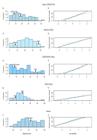
Disease severity of progenies from crosses between resistant and susceptible potato parents inoculated with a complex race (Pi151 isolate) of Phytophthora infestans. Frequency distribution for severity values (a, c, e, g, i) and quantile-quantile plot of deviation from normality for severity values (b, d, f, h, j). Pelotas, Embrapa Clima Temperado, 2024.
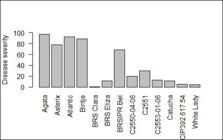
Means of disease severity of the potato parents used in crosses when inoculated with race 0 of Phytophthora infestans for the detection of R gene from Solanum demissum. Pelotas, Embrapa Clima Temperado, 2024.
Although both parents of the ‘BRS Eliza’/C2550-04-06 cross had high levels of quantitative resistance, their progeny showed a distribution of the disease severity values with a deviation from the normal distribution expected for a quantitative trait (Figure 2 e-f). This may be attributed to the reduced number of individuals evaluated (73 individuals), associated to the complex inheritance and tetrasomic segregation in the potato (Li et al., 1998; Luo et al., 2000). Since the classification of P. infestans races is based on the differential series of genotypes with introgression of R genes (genes 1 to 11) from S. demissum (Malcolmson & Black, 1966), it is possible that other R genes, from sources other than S. demissum, may be present in the genotypes evaluated in this study.
The ‘BRSIPR Bel’/‘White Lady’ cross has little contribution to quantitative resistance, generating progeny with a high percentage of susceptible individuals. The distribution deviated from the expected normal distribution of a quantitative trait (Figure 4 c-d). In addition, ‘White Lady’, when inoculated with P. infestans race 0, presented a reaction difficult to distinguish between extreme hypersensitivity or a compatibility reaction with very little disease development, thus not excluding the possibility of ‘White Lady’ having an R gene from S. demissum or even from another source of resistance.
The progeny of ‘White Lady’/C2550-04-06 cross showed segregation for quantitative resistance (Figure 4 e-f), even though ‘White Lady’ can possess a major qualitative (R) resistance gene. Such distribution can only be observed with the use of a P. infestans isolate compatible with the R genes present in this genotype, as the Pi151 isolate, which is a complex race capable of overcoming seven resistance genes.
‘BRS Clara’ and ‘BRS Eliza’ were developed by the Embrapa breeding program and have high levels of resistance. The progeny of this cross showed low levels of disease (Figure 2 g-h), indicating a good choice when searching for high resistance levels in genotypes adapted to Brazil's growing conditions (Pereira et al., 2013).
Although ‘Atlantic' has excellent characteristics for the potato chip processing industry, crosses with ‘BRS Eliza’ have generated progeny with a low frequency of resistant individuals. In addition, a deviation from the expected normal distribution was observed. A fact that can be attributed to the reduced number of individuals evaluated since both parents do not appear to have any R gene. However, this cross has the potential to establish a recurrent selection scheme that aims to raise the levels of quantitative resistance associated with the quality required for the chipping industry.
The 'BRS Eliza'/'White Lady' cross was similar to other crosses involving these genotypes. As in the cross involving ‘White Lady’ and 'BRSIPR Bel', it showed a distribution that deviates from the expected normal distribution for quantitative resistance (Figure 4 i-j). This confirms the susceptibility of ‘White Lady’ to late blight.
‘Asterix’ possesses good traits for the potato French fry industry, and the cross with ‘BRS Eliza’ has generated progeny with a high frequency of individuals exhibiting quantitative resistance. In addition, the distribution of severity values of progeny is close to the expected normal distribution (Figure 2 i-j). Although ‘Asterix’ has shown a low level of resistance, ‘BRS Eliza’ generally appears to have a good combining ability for quantitative resistance, while ‘Asterix’ has shown a good combining ability for traits required by the processing industry (Streck et al., 2006).

Disease severity of progenies from crosses between resistant and susceptible potato parents inoculated with a complex race (Pi151 isolate) of Phytophthora infestans. Frequency distribution for severity values (a, c, e, g, i) and quantile-quantile plot of deviation from normality for severity values (b, d, f, h, j). Pelotas, Embrapa Clima Temperado, 2024.
The use of race 0 isolate of P. infestans allowed the identification of genotypes having R genes (‘BRS Clara’, and possibly ‘White Lady’). In the past, eleven R genes from the wild potato species S. demissum formed the basis of potato breeding for resistance to late blight (Malcolmson & Black, 1966). As in other crops, the resistance conferred by genes of major effect was not durable (Fry, 2008). Despite the use of a known P. infestans isolate to assist in the identification of the present gene, molecular marker studies are necessary to confirm which R genes are present in these genotypes (Lee et al., 2020).
An interesting feature in relation to ‘BRS Clara’ is that it has a high level of quantitative resistance together with qualitative resistance. Although the R gene(s) present in ‘BRS Clara’ does not confer complete protection against the complex isolate of P. infestans used in this study, depending on the composition of races in the region where it will be planted, the R gene(s) may confer immunity to some strains. In addition, if the qualitative resistance is overcome in the field by more aggressive isolates, such as the one used in this study, this cultivar will have a low disease rate due to the high level of quantitative resistance, and residual resistance effect of R gene(s) (Stewart et al., 2003).
‘Catucha’, C2550-01-06 and C2553-04-06, besides having quantitative resistance, showed compatibility reaction with race 0 of P. infestans, which suggests that these genotypes do not have R genes from S. demissum. The development of germplasm R free-genes has been a strategy used by CIP in the attempt to develop cultivars with durable resistance (Landeo, 2002). However, the strategy adopted by CIP only guarantees the absence of R genes from S. demissum, since other wild potato species were part of the composition of the B3 population (Landeo et al., 1995).
Since the development of the B3 population, new resistance genes with a broad spectrum of resistance to P. infestans isolates have been identified in other Solanum species. For example, the Rpi-blb1 and Rpi-blb2 genes identified in S. bulbocastanum have been reported to confer stable resistance over several years and have promoted less development of lesion and sporulation of P. infestans (Rakosy-Tican et al., 2020).
Different strategies have been adopted in the attempt to develop durable resistance to late blight, such as the exploration of new sources of resistance in wild species of potato, R gene pyramiding (Tan et al., 2010), transgenic or cisgenic (Kessel et al., 2018), when genes from related species are transferred, and development of quantitative resistance in the absence of R genes, and genome editing (Kieu et al., 2021). In any case, it is important to know the germplasm that is being used, and the potential of each genotype to contribute to the rise in the levels of resistance.
Test cross has been used for a long time in plant breeding to study the phenotypic segregation of traits of interest. However, genomic studies are becoming available in breeding programs and may help better understand the sources of resistance available, as well as assisted selection through molecular markers or genomic selection (Enciso-Rodriguez et al., 2018). In conclusion, we demonstrated that progenies from crossings between parents with different levels of quantitative resistance displayed varying resistance levels. The detached leaflet method using a complex race of P. infestans successfully distinguished quantitative resistance from R genes in most genotypes. 'BRS Clara' possessed an R gene and high quantitative resistance, potentially offering good initial protection followed by sustained resistance. Genotypes C2550-04-06, C2553-01-06, and 'Catucha' likely lack R genes from S. demissum but exhibited moderate to high quantitative resistance. Crossing 'BRS Eliza' with C2550-04-06, 'White Lady', or 'Asterix' showed promise for selecting potato cultivars with high quantitative resistance combined with desirable agronomic traits. The study demonstrates the effectiveness of using a complex race of P. infestans for identifying quantitative resistance and selecting potato genotypes with potentially durable resistance to late blight. This information can guide potato breeding programs in developing cultivars with improved resistance and sustainable disease management.
ACKNOWLEDGMENTS
We thank Brenovaldo Cruz and Sergio Luiz Silva for their valuable contributions with fieldwork, and Fernanda, Anderson, Candida, and Emerson for helping with the logistics of the experiments. This paper is part of the thesis submitted by Dediel JA Rocha in partial fulfillment of the requirements for the degree of Doctor of Agronomy in Faculdade de Agronomia Eliseu Maciel, Universidade Federal de Pelotas (Brazil). This study was funded by Conselho Nacional de Desenvolvimento Científico e Tecnológico (CNPq), Empresa Brasileira de Pesquisa Agropecuária (EMBRAPA), and Universidade Federal de Pelotas (Brazil).
REFERENCES
- ABULEY, IK; LYNOTT, JS; HANSEN, JG; COOKE, DEL; LEES, AK. 2023. The EU43 genotype of Phytophthora infestans displays resistance to mandipropamid. Plant Pathology72: 1305-313.
- CASA-COILA, VH; GOMES, CB; LIMA-MEDINA, I; ROCHA, DJA; PEREIRA, AS; REIS, A. 2019. Reaction of potato cultivars and clones to Phytophthora infestans Revista Caatinga32: 390-398.
- COLON, L; NIELSEN, B; DARSOW, U. 2004. Detached leaf test for foliage blight resistance. EUROBLIGHT Protocol- Version 1.2 - 4 October 2004.
- COLON, LT; TURKENSTEEN, LJ; PRUMMEL, W; BUDDING, DJ; HOOGENDOORN, J. 1995. Durable resistance to late blight (Phytophthora infestans) in old potato cultivars. European Journal of Plant Pathology101: 387-397.
- DORRANCE, AE; INGLIS, DA. 1997. Assessment of greenhouse and laboratory screening methods for evaluating potato foliage for resistance to late blight. Plant Disease81: 1206-1213.
- ENCISO-RODRIGUEZ, F; DOUCHES, D; LOPEZ-CRUZ, M; COOMBS, JC, G. 2018. Genomic selection for late blight and common scab resistance in tetraploid potato (Solanum tuberosum). G3: Genes - Genomes - Genetics8: 2471-481.
- EWING, E; SIMKO, I; SMART, C; BONIERBALE, M; MIZUBUTI, E; MAY, G; FRY, W. 2000. Genetic mapping from field tests of qualitative and quantitative resistance to Phytophthora infestans in a population derived from Solanum tuberosum and Solanum berthaultii Molecular Breeding6: 25-36.
- FRY, W. 2008. Phytophthora infestans: the plant (and R gene) destroyer. Molecular Plant Pathology9: 385-402.
- FRY, WE. 2020. Phytophthora infestans: the itinerant invader; “late blight”: the persistent disease. Phytoparasitica 48: 87-94.
- FRY, WE; GOODWIN, SB. 1997. Re-emergence of potato and tomato late blight in the United States. Plant Disease81: 1349-1357.
- HIRSCH, CN; HIRSCH, CD; FELCHER, K; COOMBS, J; ZARKA, D; DEYNZE, A; JONG, W; VEILLEUX, RE; JANSKY, S; BETHKE, P; DOUCHES, DS; BUELL. CR. 2013. Retrospective view of north American potato (Solanum tuberosum L.) breeding in the 20th and 21st centuries. G3-Genes Genomes Genetics3: 1003-1013.
- IVANOV, AA; UKLADOV, OU; GOLUBEVA, TS. 2021. Phytophthora infestans: an overview of methods and attempts to combat late blight. Journal of Fungi7: 1071.
- KESSEL, GJT; MULLINS, E; EVENHUIS, A; STELLINGWERF, J; CORTES, VO; PHELAN, S; BOSCH, T; FÖRCH, MG; GOEDHART, P; VOET, H; LOTZ, LAP. 2018. Development and validation of IPM strategies for the cultivation of cisgenically modified late blight resistant potato. European Journal of Agronomy96: 146-55.
- KIEU, NP; LENMAN, M; WANG, ES; PETERSEN, BL; ANDREASSON, E. 2021. Mutations introduced in susceptibility genes through CRISPR/Cas9 genome editing confer increased late blight resistance in potatoes. Scientific Reports 11: 4487.
- LANDEO, JA. 2002. Breeding for host resistance Durable resistance: quantitative/qualitative resistance. Lima: International Potato Center.
- LANDEO, JA; GASTELO, M; PINEDO, H; FLORES, F. 1995. Breeding for horizontal resistance to late blight in potato free of R genes. In: DOWLEY, LJ; BANNON, E; COOKE, LR; KEANE, T; O’SULLIVAN, E (eds). Phytophthora infestans 150. Dublin: Boole Press, p.268-74.
- LEE, Y; KWANG-SOO, C; JIN-HEE, S; KEEHOON, S; PROKCHORCHIK, M. 2020. Improved genome sequence and gene annotation resource for the potato late blight pathogen Phytophthora infestans Molecular Plant-Microbe Interactions33: 1025-028.
- LI, X; ECK, HJ; VOORT, J; HUIGEN, DJ; STAM, P; JACOBSEN, E. 1998. Autotetraploids and genetic mapping using common AFLP markers: the R2 allele conferring resistance to Phytophthora infestans mapped on potato chromosome 4. Theoretical and Applied Genetics96: 1121-1128.
- LOZOYA-SALDANA, H. 2011. Evolution of vertical and horizontal resistance and its application in breeding resistance to potato late blight. Potato Journal38: 1-8.
- LUO, ZW; HACKETT, CA; BRADSHAW, JE; MCNICOL, JW; MILBOURNE. D. 2000. Predicting parental genotypes and gene segregation for tetrasomic inheritance. Theoretical and Applied Genetics100: 1067-1073.
- MALCOLMSON, IF; BLACK, W. 1966. New R-genes in Solanum demissum Lindl. and their complementary races of Phytophthora infestans (Mont.) de Bary. Euphytica15: 199-203.
- OBERHAGEMANN, P; CHATOT-BALANDRAS, C; SCHAFER-PREGL, R; WEGENER, D; PALOMINO, C; SALAMINI, F; BONNEL, E; GEBHARDT, C. 1999. A genetic analysis of quantitative resistance to late blight in potato: towards marker-assisted selection. Molecular Breeding5: 399-415.
- OXLEY, HN; GOMES, CB; PEREIRA, AS.; AZEVEDO, FQ. 2023. Resistance of potato genotypes to late blight. Revista Caatinga36: 585-589.
- PEREIRA, AS; BERTONCINI, O; SILVA GO; CASTRO, CM; GOMES, CB; HIRANO, E; BORTOLETTO, AC; MELO. PE; MEDEIROS, CAM; TREPTOW, RO; DUTRA, LF; LOPES, CA; NAZARENO, NRX; LIMA, MF; CASTRO, LAS; KROLOW, ACR; SUINAGA, FA; REISSER, CJ. 2013. ‘BRS Clara’: A late blight resistant fresh market potato cultivar. Horticultura Brasileira31: 664-668.
- R Core Team. 2015. A language and environment for statistical computing. R foundation for statistical computing. Vienna, Austria.
- RAKOSY-TICAN, E; RAMONA, T; KÖNIG, J; NACHTIGALL, M; HAMMANN, T; DENES, TE; KRUPPA, K; MOLNÁR-LÁNG, M. 2020. Introgression of two broad-spectrum late blight resistance genes, Rpi-Blb1 and Rpi-Blb3, from Solanum bulbocastanum Dun Plus race-specific R genes into potato pre-breeding lines. Frontiers in Plant Science11: 699.
- SANTANA, FM; GOMES, CB; ROMBALDI, C; BIANCHI, VJ; REIS, A. 2013. Characterization of Phytophthora infestans populations of southern Brazil in 2004 and 2005. Phytoparasitica 41: 557-568.
- STEWART, HE; BRADSHAW, JE. 2001. Assessment of the field resistance of potato genotypes with major gene resistance to late blight (Phytophthora infestans (Mont.) de Bary) using inoculum comprised of two complementary races of the fungus. Potato Research44: 41-52.
- STEWART, HE; BRADSHAW, JE; PANDE B. 2003. The effect of the presence of R‐genes for resistance to late blight (Phytophthora infestans) of potato (Solanum tuberosum) on the underlying level of field resistance. Plant Pathology52: 193-198.
- STRECK, NA; LAGO, I; ALBERTO, CM; BISOGNIN. DA. 2006. Simulation of potato cultivar Asterix development under five climate change scenarios in Santa Maria. Bragantia65: 693-702.
- TAN, MYA; HUTTEN, RCB; VISSER, RGF; ECK. HJ. 2010. The effect of pyramiding Phytophthora infestans resistance genes R (Pi-mcd1) and R (Pi-ber) in potato. Theoretical and Applied Genetics121: 117-125.
- VLEESHOUWERS, V; DOOIJEWEERT, W; KEIZER, LCP; SIJPKES, L; GOVERS, F; COLON, LT. 1999. A laboratory assay for Phytophthora infestans resistance in various Solanum species reflects the field situation. European Journal of Plant Pathology105: 241-250.
- WITEK, K; LIN, X; KARKI, HS; JUPE, F; WITEK, AI; STEUERNAGEL, B; STAM, R; OOSTERHOUT, C; FAIRHEAD, S; HEAL, R; COCKER, JM; BHANVADIA, S; BARRETT, W; WU, CH; ADACHI, H; SONG, T; KAMOUN, S; VLEESHOUWERS, VGAA; TOMLINSON, L; WULFF, BBH; JONES, JDG. 2021. A complex resistance locus in Solanum americanum recognizes a conserved Phytophthora effector. Nature Plants 7: 198-208.


