
 Vengeance and territoriality Tikmũ,ũn
Resumo
Neste artigo, retomo a aproximação feita por Carneiro da Cunha e Viveiros de Castro entre vingança e temporalidade para introduzir um terceiro elemento nessa díade que é a territorialidade. Isso será feito a partir da etnografia dedicada aos povos tikmũ,ũn-Maxakali buscando analisar três perspectivas diferentes. Em primeiro lugar, observo as dinâmicas vindicativas no interior da socialidade tikmũ,ũn. Em segundo lugar, analiso como a vingança memoria relação com lugares específicos por meio de cantos e narrativas. Por fim, mostro como pessoas tikmũ,ũn respondem ao contexto de práticas de violência interétnica acionando o idioma da vingança. Nesse ínterim, argumento que a vingança funciona como um dispositivo que freia a possibilidade de se ter direito sobre a vida e a morte de outrem. Tal dinâmica possibilita a socialidade tikmũ,ũn a não entrar no território da necropolítica, buscando viver um outro território existencial.
Palavras-chave:
vingança; territorialidade; tikmũ,ũn; Maxakali
Abstract
In this article, I return to the approach made by Carneiro da Cunha and Viveiros de Castro between revenge and temporality to introduce a third element in this dyad, which is territoriality. This will be done based on ethnography dedicated to the Tikmũ,ũn-Maxakali people, seeking to analyze three different perspectives. Firstly, I observe the vindictive dynamics within Tikmũ,ũn sociality. Secondly, I analyze how revenge memories relate to specific places through songs and narratives. Finally, I show how people respond to the context of practices of interethnic violence by activating the language of revenge. In the meantime, I argue that revenge works as a device that stops the possibility of having the right to the life and death of others. Such dynamics enable sociality not to enter the territory of necropolitics seeking to live in another existential territory.
Keywords:
vengeance; territoriality; tikmũ,ũn; Maxakali
Introduction
The Tikmũ,ũn indigenous people, more widely known by the ethnonym Maxakali, inhabit some villages in the northeastern portion of the Brazilian state of Minas Gerais, not far from the border with southern Bahia. There, some pajés tell the following story:
The mother of the putuxop [collective parrot spirit] always cried when they arrived at a new place. Kû kû kûm… kû kû kûm…, she would cry, saying that someone had killed one of her relatives there. The children always told their mother to stop crying and just tell them who had filled their bellies by eating the father. First, they found the anaconda that had killed their father. Despite that, even though their mother warned them about the dangers, the putuxop brothers went where it was and were surrounded by it. The elder managed, by tickling its belly with the teeth of his arrow, to cause the anaconda to rise so that everyone could leave the circle made by her. Then, they shot it with their arrows, cut it into pieces, and took it to their mother to cook. While the mother cooked they sang:
we are killing the anaconda, day will rise…
me and my brother killing the anaconda,
we are killing the anaconda…
When they moved again, their mother cried and told them that the blind snake had killed her relatives. The putuxop went after the blind snake. It came out of the earth, from under a large yam plant. It quickly killed one of the putuxop brothers. The most knowledgeable of the brothers cast several spells, and his brother was healed. They swiftly shot their arrows at the blind snake and killed it. It was a blind snake person, who looked like an Indigenous person. They took it to their mother, who cooked it; but first, they showed their mother the little earthworm, and the mother said that it was not the one who had killed the father. Then they gave her the “true beast”, and while the mother cooked, the putuxop sang:
the earthworm comes out of the earth and kills, oh day to day oh…
They left again, and the mother cried. She said it was the centipede that killed her relatives. The putuxop went looking for the centipede and saw it running after the coatis and tapirs. The putuxop killed the tapir and hid from the centipede. When it got to them, it asked for the parts. One of the putuxop threw the tapir head too hard onto the head of the centipede and killed it. They took it to their mother, who cooked it while they sang:
Female-tapir whelp, cooked paws all ripped up
The epic tale continues with the parrot people brothers moving to different places, where they find “peoples” trying to avenge the death of their father. The affections and intuition of the putuxop mother guided them.1
I start the article with this tale because it sums up the two main points I intend to address. On the one hand, I intend to look at the place occupied by revenge in the intricacies of Tikmũ,ũn sociality; on the other, I seek to analyze the Tikmũ,ũn territoriality through revenge. Starting from these two places, the tale above outlines some of the elements around the notion of revenge and territoriality from the perspective of the Tikmũ,ũn. I try to expand on the hypothesis raised by other researchers who have focused on the myth presented above that there is an intrinsic relationship between uprooting, revenge, and war in the Tikmũ,ũn sociality (Ribeiro, 2008; Romero, 2015a; Tugny, 2011a). The proximity between the themes clearly evokes the article “Vingança e temporalidade: os Tupinambás” (Revenge and temporality: The Tupinambas) by Manuela Carneiro da Cunha and Eduardo Viveiros de Castro (1986). My bet is that Carneiro da Cunha and Viveiros de Castro when speaking of the Tupinamba revenge, evoke a temporality that emanates from the affections that go through the Tupinamba warrior bodies. This temporality permeates the movements between different enemy groups, and it is through the images that emanate from the relationship between these groups that it is possible to support the notion of memory. An experience that is memorized through the relationship between enemy groups, through which we find in the tupinambá sociality a subordination of “spatiality to temporality in morphogenesis [where] memory will emerge as the medium and place by the excellence of social affection” (Carneiro da Cunha; Viveiros de Castro, 1986, p. 75). Similarly, Anne-Christine Taylor (1997, p. 10) suggests that the
Jivaro history is written […] between the elimination of lives and the memory of homicides, between forgetting the relatives killed through the memory of the close relatives killed by non-relatives, between the obliteration of the destiny of great men and their posterity through the image of the enemy, through the recitations of the enemies.2
Making an imaginative effort beyond the material mentioned, I wonder what kind of relationship with the places and the land existed between the different Tupinambá groups between misfortunes faced with the subordination of spatiality to temporality. What kind of affection emanates between one war and another? The attempt to approach this speculative effort in this article will be made through ethnography dedicated to the Tikmũ,ũn peoples, who, although not a Tupi people but classified within the Macro-Jê linguistic branch, have always been halfway between the coast and the countryside of Minas Gerais (cf. Campelo, 2009, p. 14-26; Pires Rosse, 2007, p. 29). Between the proximity of wars with Tupi peoples and a continuous uprooting across the Buffer Zone located on the borders between the states of Minas Gerais, Espírito Santo, and Bahia (Mattos, 2002; Paraíso, 2014). It is noteworthy, as Campos (2009, p. 30) points out that some words in the songs come from Tupi words. For that reason and others, I decided to start this article with the above narrative that speaks of revenge and anthropophagy. If, as Manuela Carneiro da Cunha and Eduardo Viveiros de Castro (1986, p. 66) revenge emerges as something that has no end but also no beginning, having its starting point at a completely virtual place, our starting point, as we have seen, is the acts of revenge carried out by the parrot-spirit people at different places in time and space. Thus, although we cannot find any rituals for enemy deaths in the traditional Tupinamba village courtyard (cf. Carneiro da Cunha; Viveiros de Castro, 1986; Calavia Sáez, 2020, 2024; Sztutman, 2005), the narrative above evokes the speech of revenge upon enemies and their ingestion (Ribeiro, 2008, p. 106; Tugny, 2011a, p. 38).
But the point I would like to stress is that if putuxop moves toward different villages of “enemies”, that shows a process of relationship and memory regarding the land. As Ribeiro (2008, p. 106) suggests in the putuxop narrative “revenge, alongside hunting, is pointed out as the triggering element of uprooting”. In such a way the desire and affection permeated by revenge motivate the characters to uproot to different places. Each place holds a relationship with a different being, and in each place where the putuxop move, a different perspective is experienced in relation to that people (cf. Tugny, 2011a, p. 36, 37). In this way, revenge motivates movement, and at the same time, memory emanates from each chanting when the enemies are eaten. Seen in this way, revenge writes into memory a relationship with others through chanting as well as triggers the relationship of the characters with specific places. It is in that dimension that I intend to approach the
The article thus faces two challenges. One, to expand on the concept of revenge to shed light on its place in the Tikmũ,ũn sociality; and two, to highlight the Tikmũ,ũn ways of producing territoriality through revenge. I understand that in this way, revenge creates memories through specific relationships (Carsten, 2011) with the land, giving form and aesthetics (Strathern, 2015, p. 267-268) to the knots that different Tikmũ,ũn persons weaved with the different places. If, as Ingold (2015, p. 227) suggests, every place is “like a set of things, it is a knot of stories”, the relationship that emanates from certain places inhabited by Tikmũ,ũn persons suggest a density of stories.
Having said this, in this article, I propose to deal with three arguments around the concept of revenge in the Tikmũ,ũn existential territory (Glowczewski, 2015, p. 25; Guattari, 1992, p. 26). In the first argument, I defend that revenge within the relational perspective emerges as a device capable of preventing the outbreak of a war, something I will explain in detail later. The second argument I present is that revenge emerges as a device capable of writing into memory a specific Tikmũ,ũn territoriality. As Ingold (2015, p. 219) suggests, the density of a place’s fabric is defined by history knots, and the higher the historical density, the more intertwined is the entanglement of the fabric made up by the knots. To explain this, I will bring as examples narratives of acts through which revenge emerges as the language of wars written into memory through stories, chants, and rituals. The third argument that I intend to explore in the article is that revenge seems to suggest another political ethic for life and death, pointing to a different path from the necropolitics described by Mbembe (2018) and practiced by the state capture machine (Deleuze; Guattari, 1997). Revenge seems precisely to remind the Tikmũ,ũn bodies of the problem of having a right over the life and death of others, which is present in state sovereignty (Foucault, 2004).
Methodology of empirical research
To structure these three arguments, the ethnographic path that I intend to follow in this article starts from three recent events in the Tikmũ,ũn history. In almost all of these events, I was on the field living them closely with the Tikmũ,ũn groups. In some of them, I will use the description of colleagues. The empirical material to be presented herein is based on fieldwork carried out for my doctorate during the years 2014, 2015, and 2016, which add up to around 14 months of work. Throughout this period, I tried to visit different Tikmũ,ũn villages, intending to carry out an exhaustive genealogical survey of as many Tikmũ,ũn villages as possible. The objective was to seek to know the memory of uprooting of the groups through the circulation of yãmĩyxop (collective-spirit) chants in their bodies since chants are very important elements for the manufacture of a Tikmũ,ũn person’s body (Álvares, 1992). Therefore, it was sought to understand the history of the Tikmũ,ũn groups through their chants to answer the question: “How do the groups take shape (Calavia Sáez, 2013; Wagner, 1974) and become visible through chants and the relationship with the yãmĩyxop?” Methodologically, it was sought to cross the relational points of the family network with the lifelines of persons and groups (Ingold, 2007, p. 117-119, 2015, p. 219). This led me to the narratives of Tikmũ,ũn uprooting across the states of Minas Gerais and Bahia and to narratives about places where the Tikmũ,ũn groups lived, which were not included in their land demarcation process. With this, while traveling through several of the Tikmũ,ũn villages, I carried out, along with different Tikmũ,ũn players, participative mappings of the places where their ancestors lived. These maps were delivered to FUNAI in 2015, during the national conference of Indigenist politics, when it was held at the Tikmũ,ũn villages.3 Thus, most of the narratives presented herein were either carried out in the scope of this search or are interesting to the issue of the Tikmũ,ũn territoriality. All the material was narrated in the Tikmũ,ũn language and then translated into Portuguese always in the presence of a pajé or a bilingual teacher. We will not explore all narratives and chants on the subject, only those that concern and deal with the subject of revenge that appeared in some of the narratives. We will include recent stories of revenge within the group that culminated in wars and reflections of Tikmũ,ũn persons on the place of death when Tikmũ,ũn persons are murdered by non-indigenous people. Narratives collected by this researcher and other researchers will also be mixed in, and duly referenced, throughout the text to develop this approach. Thus, we can separate the article into three parts: the first seeks to observe the place of revenge from the perspective of the Tikmũ,ũn ethics and morality, observed within the scope of interpersonal relationships. The second observes the place occupied by revenge as a device to create bonds and relationships with specific places. The third brings examples of the Tikmũ,ũn experience amid the violence imposed by the colonial process. Through this dynamic, I try to observe the type of territoriality emanated and how revenge can be triggered as an ethical device for the Tikmũ,ũn person to question their existence in the face of the violence imposed on their bodies.
Development: Part I - Revenge in the Tikmũ,ũn sociality
In July 2005, I traveled to the Maxakali indigenous land, accompanying the team of the UFMG Laboratory of Ethnomusicology. At the time, an important indigenous teacher spent much of his time drunk. Understanding that this was an individual process and that the drinking would soon cease, we carried on with our activities following the proposed schedule. However, one day we were in our house when we heard a lonely cry that stood out from the usual sounds of the village. It was the lament of a woman faced a dead Tikmũ,ũn person. Other female voices started joining the initial cry, making it more intense. We decided to head to the outside of the house to understand what was going on and saw many women going to the professor’s house. A few minutes later, the chief went to us and said: “Don’t worry, a group went after him and he will be killed.” A few hours later, a group of men returned with bags carrying the dismembered parts of the professor’s body. At the time, I did not understand exactly what was behind this statement. A second event might give us clues about what could be behind it.
A few months later, a conflict erupted involving almost all the Tikmũ,ũn groups (cf. Álvares, 2018, p. 132-136; Nacif, 2005; Vieira, 2006, p. 67-79). The episode was thus summarized to me by an interlocutor. The names of the persons involved were omitted:
A few years ago there was a problem in Pradinho, in that place known as Mĩkax kaka. An Indigenous man killed someone there. They lived in the village known as Vila Nova. Then the group of the dead person wanted the killer to be killed, but his group moved to Água Boa and lived for a while in the same village as my sister-in-law. After that, the head of FUNAI came and said that the land would be demarcated. There was also a CIMI priest who lived here and told my sister-in-law to go to live in the lands of the Valdomiro farm, in an area that used to be inhabited by her relatives. In fact, that place was where my sister-in-law’s parents lived. They wanted FUNAI to get them some land there. Father Lucimar bought some white canvas to make a tent, which they called a Toyota, and took the Indigenous people there. They stayed there for a while. They would occasionally return to check on the vegetable garden and the houses left behind. However, there was a group that would drink and call my sister-in-law’s group names, as well as the group that ran from Pradinho. One day, several Tikmũ,ũn went to Santa Helena de Minas and returned in a truck. There was one person who came alone and was from another village in Água Boa. I don’t know why, an person from my sister-in-law’s group killed him and fled. The group of the deceased came to try to kill him, but he was not there and fled. Angry, they killed my sister-in-law’s brother, who was right there on the road. My sister-in-law’s brother, Jupi, tried to talk to them, to tell them that everything was at peace and that they would catch the boy who killed the person from the other group. But they did not want to listen. They killed my sister-in-law’s brother and soon killed another member of her group. They cut several pieces off the bodies and left them on the road. My sister-in-law’s group knew that the others still wanted to go after them, so they fled to Valdomiro’s farm. One day, they all went to the Santa Helena de Minas market near here. There, they caused trouble, drank a lot of cachaça and some said to others: “I’ll kill you.” My brother was there. A member of the Pradinho group, who was a refugee in my sister-in-law’s village, killed his wife after drinking a lot of cachaça. The daughter of that brother of mine and he were very angry. The other day, that same brother went to Santa Helena de Minas and, there, he killed the father of his wife’s murderer. In Santa Helena de Minas, he took a car and returned, but got off before arriving at the village. Someone was coming and he said: “Let’s take a shortcut through a non-indigenous farm. But the group caught him and found a way to kill this brother of mine. After that, they warned the people in Pradinho. They came to settle the score with those who caused trouble there. They came armed with arrows and shotguns, but before the war took larger proportions, the police arrived and took the indigenous people who were in Valdomiro to the municipality of Santa Helena de Minas. They spent a while on a football pitch near Machacalis. Then FUNAI bought a bus and took them to Campanário. The land was bad, so they went to their current land near Ladainha, almost in Teófilo Otoni (MG). Then they got some land near Topazio, also near Teófilo Otoni, for the group who fled Pradinho.
Both stories presented above point to the importance of revenge in the Tikmũ,ũn sociality. While the first story seems to point to a sort of conclusion in a possible sequence of revenge cycles, in the second one what we see is precisely the opposite. The escape of the group of murderers to another village triggered a long sequence of murders that remain alive in the memory of almost all Tikmũ,ũn groups. In such a way, perhaps, the “don’t worry” meant that with the death of the murderer, there would be no major conflict between the groups, as occurred in the second story. Killing someone in the Tikmũ,ũn context, therefore, points to a potential war, to the opening of a cycle of revenge between different groups. The testimonial presented above is full of these episodes. Álvares (1992, p. 51-52) reminds us that “conflicts generate a chain of revenge among the members of the groups involved, which carry on for several years until they separate spatially in a radical way”.
The statement of some leaders at the time of the conflict seems to follow that logic: “I want FUNAI to take these people to Rio de Janeiro”. This response is in line with the Tikmũ,ũn way of living their relations with the land and their internal relations. Confined in an area of approximately 6000 hectares, the Maxakali Indigenous Land poses a limitation to the different Tikmũ,ũn groups regarding this dynamic of remoteness in the face of serious conflicts. This perspective is at the heart of the dynamics of the Tikmũ,ũn existential territory; war and revenge are triggers for groups to spread across the territory. The centrifugal movement that occurred in the past, which enabled the different Tikmũ,ũn groups to develop a spread territoriality across the valleys of the Jequitinhonha, Mucuri, and Doce rivers and the states of Bahia, Minas Gerais, and Espírito Santo (Paraíso, 2014), still takes place within a small demarcated area. The multiplication of villages within the Indigenous Land occurs due to internal conflicts within the groups. However, when the conflict takes on more serious dimensions, as in the above case, it presents itself as a way for the group to force the State to act to solve an internal problem, but that points to the end of a problem that is territorial.4
It is worth noting that in many of the narratives I have gathered throughout my fieldwork on the past uprootings of Tikmũ,ũn persons, and groups, it was common to start the narrative by saying that in a certain place, a certain group of people did “something bad” (hãm kummuk mĩy) and began to move. Revenge and territoriality are, therefore, at the heart of the memory and time of the Tikmũ,ũn history. But if it is in the memory of the Tikmũ,ũn groups, what are the ways to write into memory the relationship with places, persons, and groups? Referring back to the initial narrative, we saw that, as they ate their enemies, the putuxop spirits chanted. The chants, therefore, seem to hold a central place in the ways of writing events into memory and updating relationships with places and events.
Development: Part II - Revenge, memory, and territoriality
In a dense and sophisticated ethnography about affections and memory that permeates kinship relations, the processes of fragmentation and multiplication of names, groups, and subgroups among the Yaminahua de Raya in Peru, Naveira (2007, p. 230) suggests that “the memory of conflicts (who killed who) is also the memory of kinship[…] The vindictive nexus and the kinship nexus are provided with a force that calls, in addition to its memory, its updating”. The author, brings as evidence to give body to the affections and memory of the yama yama chants performed in daily yaminahua (Naveira, 2007, p. 233). Similarly, Tikmũ,ũn people have chants that support dense narratives that write into memory the relationship of their ancestors with specific places as well as stories of revenge.
My bet here is that these sung places are not only “spaces” (Casey, 1996; Ingold, 2015). The places, from the Tikmũ,ũn perspective, present a temporality that crosses their bodies through what we commonly call rituals. The chants, then, when sung in the villages through rituals with the yãmĩyxop (cf. Campelo, 2009, 2018; Pires Rosse, 2013) make denser the relationship knots between Tikmũ,ũn persons and places, connecting humans and other-than-humans, past and present, and all those who might or might not be there. Thus, territoriality (Amoroso; Viegas; Vieira, 2015), through the yãmĩyxop, suggests both the possibility of the living-construction of a place and the construction of people through the circulation of chants (Álvares, 1992; Tugny, 2011a). If we understand that Tikmũ,ũn persons, throughout their lives, acquire chants and that these chants are passed through kinship relations (Álvares, 1992; Campelo, 2018), their relationship with places is connected with the Tikmũ,ũn body and kinship in a way close to what Coelho de Sousa (2018) defends for the kisêdjê. In this sense, the landscape (Cardoso, 2016, p. 40) created by the Tikmũ,ũn through the yãmĩyxop chants creates bonds with the spirits and makes denser the relations with the places through their own kinship and circulation of chants. Thus, in line with Ingold (2007), different types of practice transform abstract space into a practiced, inhabited, and lived place. From the Tikmũ,ũn perspective, living and inhabiting these places is to make visible the memory of stories of revenge of the past updated through rituals, chants, narratives, dreams, and through the present day moves across the territory, demarcated or not (cf. Campelo, 2018; Estrela da Costa, 2022; Tugny, 2011a).
Thus, referring back to the intricacies of the war that occurred in 2005, it was mentioned above the existence of a place that one of the groups attempted to take back, known as Tehakohit. That is an example in which we find the intrinsic relationship between place, chants, and narratives of revenge. The land diagnosis by Rodrigo Thurler Nacif (2005, p. 20), requested by FUNAI at that time, brings the following testimonial:
Noêmia Maxakali and Sueli Maxakali told me that Dona Isabel wanted to be buried in the place where her ancestors lived so that she could stay there; however, in the face of a series of conflicts with other Tikmũ,ũn groups, and local farmers, this was not possible. The toponym of this place is Tehakohit (Terra Corrida) and several chants write into memory past Tikmũ,ũn relations with it. Noêmia Maxakali, reports that, in addition to the internal conflicts reported by Nacif above, some Tikmũ,ũn were also driven away by local farmers:
There is the kokex [dog] chant that came out in Tehakohit; it is sung by the po’op [monkey-spirit-people-spirit-macaco]. And there’s an older pajé who was there and gave this chant to my Uncle Dominguinho. And there’s another chant that also came from there […]where today is the Valdomiro farm. In the chant, our uncles cry because they miss their dog [explains the content of the chant]. It was from right there, where our land was, that was where the chant came from, it was my mother’s. The white people killed some of our relatives. And they shot my uncle with a shotgun. And they killed and set fire, and lit and burned. Then my relatives left Tehakohit. They stayed there in the past. There is another chant, there was a snake that whistled and whistled, and he thought it was something else to catch, kill, and eat. When he got there, it was a surucucu. They went away […] And it was from there that things came, from the land of Valdomiro, do you see? My mother did not forget, I cannot forget what happened there.
Two other locations are written into memory and bring at its core the theme of uprooting and revenge. One of these stories speaks of a series of internal conflicts that occurred in the vicinity of Umburaninha which is 15 kilometers away from the TI Maxakali, in a place where there used to be a Tikmũ,ũn village but was also left outside the boundaries of the Indigenous Land marked by the Brazilian government. Where today there is a farm, near Batinga, and a story is told through a sequence of chants of the bat-spirit-people (xunim). The narrative speaks of an ancestor who was an exceptional fisherman and had gone to the Umburanas River to fish. Another character followed him and stayed upstream with envy, as he could not catch fish with the same mastery as the first. In anger, he ends up murdering the exceptional fisherman to take his fish. A third person witnesses the murder and decides to tell the relatives of the deceased so that they can take revenge. The witness goes to the river and sees the dead body in the bottom. The bat-spirits chant as follows:
nũy tu mĩy
How could you?
You killed him.
I saw and I will tell
ĩmã kahĩy hũ ãmũnnux
I saw and I will tell
I will tell them
I will tell his relatives
The witness tells the relatives of the deceased, and his son decides to go with a paternal uncle and the rest of the village in search of a sapucaia stick search in the heart of the forest. There, while searching, he finds the murderer and avenges his father’s death. The boy’s uncle tells him: “This is how it’s supposed to be” after the death of my brother’s murderer. In the chant, the murderer asks the avenger son to stay calm:
max mũn hã
Hãm ãpah mãm
Many sapucaias
Listened to me
You listened and came
Tak te xe,e
Tak te xe
Tak te xe,e
For the father
True father
For the father
True father
Hĩy te õm nũ
Hĩy te õm nũ
Hĩy te õm nũ
Ãxop kup nox
Ãxop kup nox
Where they fell!
Where they fell!
The two tall sapucaias!
The two tall sapucaias!
The allies of the avenged dead Indian among the sapucaia’s roots wage war against the dead fisherman’s group and begin to shoot arrows at his son’s house. The uncle tells him to dance in the courtyard with his arms open to divert from the arrows until they are finished. Their house was protected with tree bark so that the arrows could not pierce it. The boy goes to the courtyard and shoots arrows at the enemy group and ends up killing some, dispersing them. This is how the chant that structures this narrative goes.
Xatix yã max xa yã ũ ka,ok gã
Closed with very strong tree bark
Closed with very strong tree bark
hõm ĩta kuxax mũyĩy
Up the arrow went
To hit the killer’s head
hax hax
Hiii, hiii
The narrator comments:
This is a xoxtupnãng chant. It was the bat-people-spirit (xunimxop) who had it. This story about the sapucaia roots is true. My father showed me when I was little. I saw it, and he taught me this chant. He passed it on to me. This chant is mine. All this happened where today there is a farm, very close to Batinga and Umburaninha, before arriving in Bertópolis, in the state of Minas Gerais almost at the border with Bahia.
As we follow the maps created of these places, we notice the movement of confinement of the Tikmũ,ũn groups. The territory, as described through chants and narratives, is different, much larger. In general, the narratives speak of places occupied by Tikmũ,ũn people and of how the white people acted with violence toward this population, running them out of their localities. This is a reflection of the fact that the Tikmũ,ũn lands were, over time, treated as a place of negotiation and bargaining by local farmers and posseiros (people who occupy a piece of land and start living off it) who arrived from different parts of the country. The municipalities of the region emerged from negotiations between “Indian tamers” and posseiros (cf. Nimuendaju, 1958; Paraíso, 1992).
We note, from the map created, that practically all places of traditional Tikmũ,ũn occupation are in the vicinity of the current municipalities that are now around the TI. The vicinity of the Umburanas margin and the Água Boa stream were still inhabited by indigenous villages of Botocudos. Different Tikmũ,ũn researchers have told me stories of conflicts and battles with these peoples in the vicinity of the municipality of Maxakalis, which is only 35 kilometers away from Bertópolis. Here, once more, the cycles of revenge and war are remembered by the group. At the time, the place where today is the municipality of Machacalis was known as the village of Sebastião do Norte, or North Stream. For Maxakali, the region is called Puxap Hep (Duck Pond).
The doctor Péricles dos Santos, who lived and acted in Machacalis, wrote in his book a long narrative about the wars between the Botocudos and Tikmũ,ũn groups. According to him, the indigenous person known as José Cardoso (Papá) told him the story.
The fact occurred at the end of the last century [19th century] when the final settlement of the Maxakalis in the Umburanas took place. Captain Ariary’s descendants walked uneasily through the Jitirana’s woods, fleeing the white people and malaria, toward Umburanas, looking for a safe place for the group, a place good for hunting and fishing. But, without being sensed, the Botocudos […] were already settled on the banks of the North Stream. Based on the tracks, they discovered the approach of the Maxakalis. They were quiet! They moved the children and the dogs away and closer to the forest and patiently waited for their rivals to finish their huts and settle in. The plan of attack was well made. As always, the savages preferred ambush fights or cruel clashes at the heart of the woods. Approaching surreptitiously, late at night, the Botocudos completed the siege of the Maxakali group. Large bonfires were suddenly lit, which, with their crackling golden flames, illuminated the sleeping faces of those who settled unsafely inside the huts they had just finished building the previous day. All ready! The warlike attack call was sounded by a Botocudo athlete, who blew with herculean force on the tail of a giant armadillo, making a martial sound that echoed somberly across the mazes of the forest. Not one enemy would be spared! And, from among the victims, many would be chosen for the festive feast of the infamous Botocudos. The aggression was barbaric and fulminant. Through the transparent walls of the defenseless huts, the arrows crossed easily and found the exact direction of the bodies still drowsy with sleep and stunned by the sudden aggression. Not even an attempt of defense could be expected from the victims! But, as one of these providential resources in delicate situations, three warriors of the Maxakalis group managed to pierce the blockade at different places, fearlessly overcoming the weapons and unperceived by the cruel enemy. They placed themselves in the rear of the Botocudos and in the distance, hidden by the thin silhouette of the shadows of the trees, watching under the reflection of the strong lights of the bonfires the precise target of their arrows - the Botocudos. From the offensive, they, stunned, moved to the defensive, without knowing who they fought, just like each warrior Maxakali did not know who helped them in the attack because each of the three who escaped the siege had no knowledge of their comrades. From time to time, the armadillo trumpet sounded between the flashes of flames and the dense darkness, calling for new Botocudos contingents to join the fight. Stunned at the defense quickly articulated by Ariary’s brave men, in the early hours the aggressors fled resenting their defeat, while two of the Maxakalis who remained from the victims and 7 more women who had hidden inside a pile of straw cried copiously for the treacherous death of their group mates. Then they moved away to the Jitirana stream, where they joined another Maxakali settlement. The consternation was general and everyone was supportive, swearing a cruel vengeance for the tribe at another opportunity. Only a few years passed, and the Botocudos returned to the same place as before, on the banks of the North Stream, in the Municipality of Machacalis. Ten of them were lost in the woods, hunting, when they came upon a group of Maxakalis. Their eyes must have been shot by hatred, due to the slaughter at the northern stream. Quickly, in the vindictive mind of the Indians, all the details for the revenge were planned minutely. They decided that the whole village of Machacalis would go to the Botocudos cordially to make peace, sing, dance, and hunt. When heading to the Botocudos village, each Maxakali took a club, which was hidden in the vicinity of the village, and, in each Botocudo hut stayed a large family of visitors. For 10 days the festivities continued. During the day, they hunted and, during the night, they danced and sang. The enemies were allowed no rest until they were beaten by physical exhaustion and psychological despair. Before they had agreed to hide their weapons, a condition that alarmed the Botocudos. They seemed to sense the catastrophe. The slaughter could no longer be delayed. In addition, the enemy depression had reached its peak. On this fateful night, the dances did not last long, and when the tired bodies of the enemies threw themselves onto the rough beds, they were betrayed by deep sleep. Upon sounding a conventional signal, the Maxakalis quickly removed their weapons from their hiding places, and their clubs, held strongly, exterminated almost all the Botocudos; only 5 women were left alive, who they took with them. […] [one of them] joined a young Maxakali and produced mixed-race children… (Santos, 1970, p. 101-103).
If the chant mentioned above from Hãm Yĩn Yũm, near Umburaninha brings the perspective of war and cycles of internal revenge, in Puxap Hep we find some Tikmũ,ũn narratives structured by chants sung by putuxop - parrot-spirit-people - the same mentioned in the opening narrative of this article. As presented at the beginning, through their uprootings, the putuxop sang their dead enemies. Here, the putuxop sing chants that write into memory the places where they found their Botocudo enemies. Delcida Maxakali, an important Tikmũ,ũn pajé, describes that:
The ancestors saw what the Botocudos were like. They studied well and saw that they wore tiaras, white tiaras. The Botocudos killed the Tikmũ,ũn first. The Tikmũ,ũn ancestors wanted to understand them, so they used tiaras to recognize each other. The Tikmũ,ũn ancestor joined forces. As some were killed, they had to join forces again. The one who hid in the woods thought: “Let us tie our heads too so we can look like them, infiltrate them, and kill them.” The ancestor took some embira fiber to make a tiara because when it is young its fiber is very white. The ancestors wanted to look like the Botocudo and infiltrate them. So he went there and stood on a lump of dirt, like a slope. There they waited, near the path, “We will wait here”, because we will look like them. They stayed there waiting. They saw a Tikmũ,ũn woman, the Botocudos took her, cut up her whole body, and then threw salt. She screamed a lot, and a Botocudo said: “I shoot my arrows at hummingbirds.” They approached the village, and everyone could hear the cries of the woman. A Tikmũ,ũn person shot an arrow that hit right in the head of the chief. They said, “We are going to kill these pests.” They took the embira and tied it. They waited, made a strong bow to carry, and at night followed the Botocudos. They said, “Let’s go”, they saw it was night, and the Botocudos left. Then they waited, and they fled, the Tikmũ,ũn all fled. They came, went, and went home. But the Tikmũ,ũn stood waiting and, then, tãim, tãim, tãim, they shot arrows everywhere to kill. The hawk, cassava, and parrot-spirit-peoples shouted and shot arrows. The hawks screamed “aop, aop, aop”, the parrots, “prr, prr, prr”, the cassava-spirit, “aaaaaahhhh”. The allied spirits killed the Botocudos; they were very strong, the yãmĩyxop. They did not let them leave; they followed and killed the Botocudos. The yãmĩyxop killed all the Botocudos in that place. Because they made the tiara and looked like the Botocudos. There was a Botocudo lying in the water, with his face inside the water, dead. The ancestor stepped on him and crossed the river, and there the spirits took the speech of the Botocudos. When the Parrot Spirit comes to make a ritual in the village, at dawn, he speaks the language of the Botocudos, the language he stole. When the afternoon comes, he begins chanting and leaves, and the woman throws and pushes; it’s the Botocudos. The yãmĩyxop took their ritual, pushed him, and caused him to fall; and everyone came to fight, and the women fought more, imitating them, the Botocudos took down the women and said they killed the Tikmũ,ũn. Along with the spirits, the Tikmũ,ũn killed the Botocudos, killed them along with the spirits; they were very strong, and the yãmĩyxop did not let them go; and they followed and killed them. The Tikmũ,ũn, along with the yãmĩyxop, killed all the people of that place. Because they made the tiara and looked like the Botocudos and killed the Botocudos. There was one lying, in the water, lying in the water, with his face inside the water, dead. The ancestor stepped on him and crossed the river, and there the yãmĩyxop took the speech of the Botocudos. The parrots [putuxop], when dawn comes, will speak the language of the Botocudos. They sing like this:
kukxeka xenex nẽ
crossing the river stomping
kukxeka xenex nẽ
crossing the river stomping
tapu’ux xop
on the enemies
kukxeka xenex nẽ
crossing the river stomping
ax i i ia
tapu’ux xop õm
on that enemy
tapu’ux xop õm
on that enemy
kukxeka xenex nãmi
crossing the river stomping
kukxeka xenex nãmi
crossing the river stomping
kukxeka xenex nẽ
crossing the river they came
yak hax hi hia
tapu’ux xop õm
on that enemy
tapu’ux xop õm
on that enemy
kukxeka xenex nãmi
crossing the river stomping
kukxeka xenex nãmi
crossing the river stomping
kukxeka xenex nẽ
crossing the river they came
kukxeka xenex nẽ
tapu’ux xop
on the enemies
kukxeka xenex nẽ
crossing the river they came
kukxeka xenex nẽ
crossing the river they came
yak hax hia
tapu’ux xop
on the enemies
tapu’ux xop
on the enemies
kukxeka xenex nãmi
crossing the river stomping
kukxeka xenex nãmi
crossing the river stomping
kukxeka hahi
the river…
haaaai i i i i
nãm tut max nã
repairing the bow and arrows
nãm tut max nã
repairing the bow and arrows
tapu’ux ãpot hã
preparing for the enemy
nãm tut max nã
repairing the bow and arrows
punux xeka nãg
the leader of the parrots
punux xeka nãg
the leader of the parrots
tapu’ux ãpot hã
preparing for the enemy
tapu’ux ãpot hã
preparing for the enemy
nãm tut max nã
repairing the bow and arrows
yak ha ha hax hax hi hia
punux xeka nãg
the leader of the parrots
punux xeka nãg
the leader of the parrots
tapu’ux ãpot hã
preparing for the enemy
nãm tut hahi
the bow and arrows
haaaaai i i i i5
These narratives seem to suggest proximity to those endless cycles of tupinambá revenge, as discussed by Carneiro da Cunha and Viveiros de Castro in revenge and temporality. It does not seem to me that here the structure of revenge follows only the model proposed by the authors of that article, that “for the Tupinambás, revenge itself is endless, the relations with the enemies, among various groups of the Jê language, are, on the contrary, thought of as something that calls for a conclusion.” The examples we have brought so far point to an intermediate zone between one dimension and the other. There is a call for the machine of revenge not to intervene, as it is hoped that the murderer’s group will kill him as a form of justice for the death caused by him. However, if this does not occur, it leads to endless cycles of revenge, as can be noted in the various narratives that have been presented so far. Up until now, we have dealt with places occupied by revenge within the Tikmũ,ũn sociality. As Carneiro da Cunha and Viveiros de Castro (1986, p. 71) suggest, “revenge is the thread that unites the past and the future, and, in this sense, revenge, memory, and time are intertwined.” We saw the importance of the chants as stitches in the Tikmũ,ũn memory that unites the relationship with certain people and groups of the past. If, so far, it has been possible to demonstrate that revenge has a pressing place in Tikmũ,ũn relations and history, I intend now to demonstrate how it also appears in the Tikmũ,ũn discourse in the face of colonial necropolitics. I move to a more direct ethnographic description, extracted from my field diaries.

Development: Part III - Revenge and necropolitics
In the last days of January 2015, on a hot afternoon of the Brazilian summer, the smell and yellow of mangoes permeate the space near Aldeia Verde. We went out to hunt. When we returned, we heard the news that Daldina Maxakali had been run over when she was going toward the municipality of Ladainha. She is known in the village as a great yãmĩixop tut (mother of spirits), owner of many chants. With the death of Daldina, I could feel how the intensity of a person’s death pervades the bodies through pain, laments, journeys to the cemetery, the presence of the dead person’s soul, the longing that goes through those alive and dead, the affective transformations of the village, the relationship with the chants and with the spirits, and the intensity of the transformations of the body of a deceased person. A few days before this fatality, the village lived moments of intense joy. Hunting, fishing, and mango and honey collection expeditions were frequent, and sequences of festive cycles were carried out uninterrupted.
It was around 8 pm on the night of January 30, 2015, when we received a call from a person from the municipality of Ladainha informing us that Daldina had been run over right at the entrance of the city. Despite the accident, the SESAI driver had driven her to Teófilo Otoni and said she was fine. In the middle of the afternoon of the following day, the phone rang, and the village received the news that Daldina had died.
Gradually, the lamentations of the women increased in intensity. Along with this intensity of lamentations, many people begin to leave their homes to stay with close relatives. Isael Maxakali, my host, told me that people can’t sleep in their homes. Daldina’s soul would begin to wander in the vicinity of the village, missing her living relatives. Her sons and daughters, who live in houses near hers, moved to their father’s house, along with their spouses, daughters, and sons. The house was full. The next day, Daldina was buried. The village lives the mourning by not bringing the yãmĩyxop to the kuxex and to the village. Sports activities are avoided. People avoid paintings that show beauty in respect of people’s mourning (cf. Álvares, 1992; Campelo, 2018).
Days after the death of Daldina, leaders of the Aldeia Verde decide to hold a demonstration-occupation in Ladainha, in the face of the silence of the residents, realizing that nothing would be done to the murderer of Daldina. The demonstration was announced on social media and was attended by representatives of FUNAI, CIMI, and the Church, as well as Tikmũ,ũn people from various other villages. When we arrived in Ladainha, we saw written in Maxakali on the floor right in front of the bar where everything happened: “ũn ka,ok yãmĩy”, which was translated to me as “strong woman spirit”. Right in front of the words, someone drew a mimanãm, a pole used to amplify and echo in time and space the voices of the yãmĩyxop. When we passed by the place, women who were inside the bus began to cry, and when we got off the bus, the men who carried their arrows and bows on their bodies went to the site of the accident. Sequences of chants were sung on the way to the scriptures drawn on the ground. There, they took turns with the women in sequences of chanting. After the chants, the leaders, almost all women asked to speak. Sueli Maxakali says:
It is like this because, when you kill a person, their spirit, the yãmĩy, stays in the same place. We women receive the yãmĩy and, when a child dies, we retrieve their yãmĩy to us. When we die, our yãmĩy is left behind, then we have to [hear the chants] to be able to go on and live together with the yãmĩyxop. What happened is that we took Daldina to the cemetery. [Now we need to] chant for those people who have been hit by the non-indigenous. We always just bury and nothing else happens. There is no investigation. This saddens us. I want to make this very clear because they killed a Tikmũ,ũn, then, the place where they killed is left without chants. Then someone goes by and says “Oh! We saw a person there in the same place where they were killed”. But it is the person’s yãmĩy, they need to hear the chant. Then they just think about doing this, so we are showing them that all we need to chant for them in all the places where this happens. They have to stay with the yãmĩy because we know there are yãmĩy of ours that are very strong. Around midnight, they came here and made this drawing. We know that yãmĩy came to do that. Because, in the past, when there was a murder, the ancestors did this with their own hand, now the law says that this cannot happen. We are waiting for the way of justice to act. And we also did this, she was a pajé, knew many chants… they killed her like a dog, left her here and fled, that’s what got us upset, that’s what I wanted to talk about.
After the speech of Sueli Maxakali, Noêmia Maxakali takes the floor:
Yeah, because I kept thinking… People kill our relatives, and nothing happens, FUNAI does not solve this problem… we need to separate things, fix things, but we could not stand [the pain], I could not stand, if not we would have brought the body to bury here [in this street, in front of this bar], we have to do these things, but we have to do it calmly because, in the same way, we will put things here. But I also want the mayor to help get these people who are here and put them somewhere else. On the road here, I want to expand the path for us and for the community. We need to expand because [the Ladainha residents] saw what happened here. This people saw, it’s all full, the people here saw, saw the bike, saw the plate number, and don’t want to tell. Now the mayor needs to do whatever it takes, get some of this land and give it to Tikmũ,ũn, and leave this piece here to the woman who died. It is for her to walk and sing here. Then, someone else will walk here and hear her chants. My son walked by here at night and heard her chants. He was at the bus station and heard her singing here, but he was not afraid, because it was a ritual she was doing. When a person gets sick and is bedridden, we go there and pray to them. The person stays there and listens until they die and then they go on with the yãmĩy. But now she was killed and she took nothing. No one sang. If we sing we die on top, no one even made the chant for her. This little piece here is hers. Now I want you to take this little piece here and put it somewhere else, that is my answer. The person who killed her has to take at least me, Isael’s cousin, his aunt, Delcida, and we want to look at the person eye to eye, just like that, inside the jail. After that, we’ll rest; the people bury Tikmũ,ũn and nothing else happens. Indigenous people never killed white people; there are a lot of white people, and we have to teach and start killing too. Because there are a lot, and we have to start killing the whites too, there are few Indigenous people, and they are killing us now. What we need is for us to kill them. The police need to go after those people and arrest them. They can’t let them free, They can’t let them free in any way. If we hear they haven’t been arrested yet, starting today there are no secrets. We will look for them, if we don’t know who they are, we will work to find out. The spirit will go at midnight and will kill, to pay too. There is no justice for that, there is no lawyer, there is nothing for that. We are quiet, to pay for the death of my niece, these people here hid the bike. They need to tell the plate of the bike, which model, to remove what is eating away inside us. And I will do a ritual to stay here chanting.
Final considerations
From the Tikmũ,ũn perspective, dying means moving to two post-mortem destinations. On the one hand, depending on the paths taken throughout life, one can turn into ĩnmõxa - a cannibal zombie who has cutting knives instead of hands and impenetrable skin. Missing their consanguine relatives, ĩnmõxa returns to devour their bodies. Moreover, as told by different Tikmũ,ũn interlocutors, these beings emerged from the ashes of white people (cf. Álvares, 1992; Campelo, 2018; Romero, 2015b). On the other hand, another destiny of a Tikmũ,ũn person in the post-mortem is to become yãmĩyxop. From this perspective, the body of the person becomes the chant-word yĩy, which will go on to hãmnõy “another land”, where they meet with countless yãmĩy (Álvares, 1992; Romero, 2021). As a long bibliographical production has already shown, the Tikmũ,ũn groups spend a considerable part of their time in daily relation to the yãmĩyxop (Campelo, 2009; Pires Rosse, 2013; Romero, 2021; Tugny, 2011a). The yãmĩyxop come to the Tikmũ,ũn villages in dreams, festivals, chants, hunts, and banquets to enable one to live here on the “other land” - the land of the yãmyĩxop. Through the chants that the yãmĩyxop bring in their bodies, poetic images are evoked bringing the perspective of countless beings, as well as writing into memory and landscaping places. From this point of view, the chants are permeated by the poetic images emanating from themselves and, at the same time, reveal long narratives that write into memory places of Tikmũ,ũn occupation that remained outside the demarcation of their lands (cf. Campelo, 2018). So, it is through the relationship with the yãmĩyxop that the Tikmũ,ũn groups update their relationship with specific places they occupied in the past. I emphasized throughout the article the narratives of revenge, but I am far from exhausting what this sung Tikmũ,ũn territory is. My goal was to demonstrate the importance of revenge as a device to weave the Tikmũ,ũn memory, and history as well as to establish a bond with the territory through an ethics of revenge.
Throughout the article, I have shown, therefore, that revenge exacted upon the body of another prevents a greater war between different Tikmũ,ũn groups from emerging in the face of murder. At the same time, we have seen that some places are written into memory through revenge narratives, which are structured by chants. The relationship with these places is updated through the rituals performed in the villages, where the yãmĩyxop will sing the chants of these places. The chants, we could say, make the Tikmũ,ũn people inhabit these places, impregnating them with relationships. The event described above shows the importance of the place where Daldina was run over for her Tikmũ,ũn relatives. “It is for her to walk and sing here”. “Now the mayor needs to do whatever it takes, get some of this land and give it to Tikmũ,ũn, and leave this piece here to the woman who died.” “Around midnight, the yãmĩyxop came here and made this drawing.” We know that yãmĩy came to do this [referring to the writing on the ground of Ladainha at the place where the accident occurred, see Figure 1]. That place now has an owner and is far from being an empty space as it was argued at the beginning of the article. The place where Daldina was run over will always be a place full of experience and memory. As suggested (Tugny, 2011a, p. 38) and postulated the chants produce a memory about the entities that no longer inhabit the present territory, while “always keeping a portion of potential enemies and impending war as a way to resist the force of attraction and unification of the State” (Tugny, 2011a, p. 54).
Departing from this statement by Tugny, the excerpt presented above reveals a desire in the Tikmũ,ũn statements that the violence imprinted on Daldina’s body is avenged. Indignant, Noêmia Maxakali cannot remember any occasion when the Tikmũ,ũn people killed someone white. “Tikmũ,ũn never killed white people; there are a lot of white people, we have to […] start killing too. What we need is for us to kill them.” In some passages before this, she also comments that “If we hear they haven’t been arrested yet […] we will look for them; if we don’t know who they are… The spirit will go at midnight and will kill, to pay too. There is no justice for that, there is no lawyer, there is nothing for that.” Here Noêmia uses the discourse of revenge as a response to the limits of the Brazilian Justice bureaucracy in the face of the genocidal practices of white people. The fact that they never any killed white people may be explained by their refusal to operate in the same terms of the right to life and death promoted by colonial necropolitics (cf. Berbert; Campelo, 2018). In some way, what is at stake from the Tikmũ,ũn perspective is another policy related to life and death. In the meantime, revenge appears not only within Tikmũ,ũn relations but also as discourse and narrative in the face of an episode of inter-ethnic violence.
Manuela Carneiro da Cunha and Eduardo Viveiros de Castro (1986, p. 70) suggest that “instead of asking ourselves the role of revenge in society, it would be necessary to look for what is a society founded on revenge.” In view of what has been exposed, it does not seem to be a stretch to say that revenge holds an important place in Tikmũ,ũn affections. Far from wanting to relativize and minimize the violence inherent to revenge, however, the message that the episodes above reinforce is the fact that no one, from the Tikmũ,ũn perspective, has the right to the life and death of others. Ĩnmoxa is a cannibal zombie that leaves a trail of death and carnage wherever it goes. It is not surprising that it is associated with white people. It is a widespread narrative in the Tikmũ,ũn villages; Tupã offers the white people firearms - a symbol of colonial violence - and the Tikmũ,ũn are offered the bow and arrow (cf. Campelo, 2018; Romero, 2015b; Tugny, 2011b). From this perspective, the Tikmũ,ũn sociality, when faced with revenge, “cuts the net” (Strathern, 2011) so that it does not cross the territory of necropolitics (Mbembe, 2018). What it seems so far is that living on “another land” (hãm nõy) through the yãmĩyxop seems more interesting to the Tikmũ,ũn groups than inhabiting the territory of necropolitics. Perhaps that is precisely why they never kill white people because, as their own philosophy teaches, ĩnmõxa skin is impenetrable and all that emerges from any relationship with it is carnage and genocide.
References
- ÁLVARES, M. M. Yãmĩy, os espíritos do canto: a construção da pessoa na sociedade maxakali. 1992. Dissertação (Mestrado em Antropologia Social) - Instituto de Filosofia e Ciências Humanas, Universidade Federal de Campinas, Campinas, 1992.
- ÁLVARES, M. M. Alteridade e história entre os Maxakali 2018. Tese (Doutorado em Antropologia Social) - Centro de Filosofia e Ciências Humanas, Universidade Federal de Santa Catarina, Florianópolis, 2018.
- AMOROSO, M.; VIEGAS, S. M.; VIEIRA, J. G. Dossiê: Transformações das territorialidades ameríndias nas Terras Baixas (Brasil). Revista de Antropologia, [s. l.], v. 58, n. 1, p. 11-29, 2015.
- BERBERT, P.; CAMPELO, D. F. G. Embranquecer as terras, disciplinar os corpos: notas sobre a política indigenista junto aos tikmũ,ũn/maxakali entre 1940 e 1988. Espaço Ameríndio, Porto Alegre, ano 12, n. 2, p. 129-177, 2018.
- CALAVIA SÁEZ, O. Nomes, pronomes e categorias: repensando os subgrupos. Antropologia em Primeira Mão, Florianópolis, v. 138, p. 5-17, 2013.
- CALAVIA SÁEZ, O. El giro sacrificial. Reflexiones sobre el eje tupi-mexica. Journal de la Société des Américanistes, Paris, ano 106, n. 1, p. 65-104, 2020.
- CALAVIA SÁEZ, O. Invitado a un banquete: la noción de sacrificio en la antropología. Madrid: Nola Editores, 2024.
- CAMPELO, D. F. G. Ritual e cosmologia maxakali: uma etnografia da relação entre os espíritos-gaviões e os humanos. 2009. Dissertação (Mestrado em Antropologia Social) - Faculdade de Filosofia e Ciências Humanas, Universidade Federal de Minas Gerais, Belo Horizonte, 2009.
- CAMPELO, D. F. G. Das partes da mulher de barro: a circulação de povos, cantos e lugares na pessoa tikmũ,ũn 2018. Tese (Doutorado em Antropologia Social) - Centro de Filosofia e Humanidades, Universidade Federal de Santa Catarina, Florianópolis, 2018.
- CAMPOS, C. S. de O. Morfofonêmica e morfossintaxe do Maxakalí 2009. Tese (Doutorado em Linguística) - Faculdade de Letras, Universidade Federal de Minas Gerais, Belo Horizonte, 2009.
- CARDOSO, T. M. Paisagens em transe: uma etnografia sobre a poética e cosmopolítica dos lugares habitados pelos Pataxó no Monte Pascoal. 2016. Tese (Doutorado em Antropologia Social) - Centro de Filosofia e Humanidades, Universidade Federal de Santa Catarina, Florianópolis, 2016.
- CARNEIRO DA CUNHA, M. L.; VIVEIROS DE CASTRO, E. B. Vingança e temporalidade: os Tupinambás. Anuário Antropológico, Brasília, ano 10, n. 1, p. 57-78, 1986.
- CARSTEN, J. Substance and relationality: blood in contexts. Annual Review of Anthropology, [s. l.], v. 40, n. 1, p. 19-35, 2011.
- CASEY, E. How to get from space to place in a fairly short stretch of time: phenomenological prolegomena. In: FELD, S.; BASSO, K. (ed.). Senses of place Santa Fé: School of American Research Press, 1996. p. 13-62.
- COELHO DE SOUSA, M. A vida dos lugares entre os Kisêdjê: toponímia como terminologia de relação. Espaço Ameríndio, Porto Alegre, v. 12, p. 9-49, 2018.
- DELEUZE, G.; GUATTARI, F. Mil platôs: capitalismo e esquizofrenia: vol. 5. São Paulo: Editora 34, 1997.
- ESTRELA DA COSTA, A. C. Do barro ao céu: uma etnografia das viagens entre os tikmũ,ũn 2022. Tese (Doutorado em Antropologia Social) - Faculdade de Filosofia, Letras e Ciências Humanas, Universidade de São Paulo, São Paulo, 2022.
- FOUCAULT, M. Microfísica do poder São Paulo: Paz e Terra, 2004.
- GLOWCZEWSKI, B. Devires totêmicos São Paulo: n-1, 2015.
- GUATTARI, F. Caosmose: um novo paradigma estético. São Paulo: Editora 34, 1992.
- INGOLD, T. Lines: a brief history. London: Routledge, 2007.
- INGOLD, T. Estar vivo: ensaios sobre movimento, conhecimento e descrição. Petrópolis: Vozes, 2015.
- MATTOS, I. M. de. “Civilização” e “revolta”: povos botocudo e indigenismo missionário na Província de Minas. 2002. Tese (Doutorado em Ciências Sociais) - Instituto de Filosofia e Ciências Humanas, Universidade Estadual de Campinas, Campinas, 2002.
- MBEMBE, A. Necropolítica São Paulo: n-1, 2018.
- NACIF, R. T. Diagnóstico fundiário da etnia Maxakali Brasília: Funai, 2005. Relatório.
- NAVEIRA, M. C. Yama yama: os sons da memória. Afetos e parentesco entre os Yaminawa. 2007. Tese (Doutorado em Antropologia Social) - Centro de Filosofia e Ciências Humanas, Universidade Federal de Santa Catarina, Florianópolis, 2007.
- NŨHŨ yãgmũ yõg hãm: essa terra é nossa. Direção: Isael Maxakali, Sueli Maxakali, Carolina Canguçu e Roberto Romero. Produção: Carolina Canguçu e Roberto Romero. [S. l.: s. n.], 2020. Documentário (70min).
- NIMUENDAJU, C. The Serente. Índios Machacari. Revista de Antropologia, São Paulo, ano 6, n. 1, p. 53-61, jun. 1958.
- PARAÍSO, M. H. B. Relatório antropológico sobre os índios Maxakali Brasília: Funai, 1992.
- PARAÍSO, M. H. B. O tempo da dor e do trabalho: a conquista dos territórios indígenas nos sertões do leste. Salvador: Edufba, 2014.
- PIRES ROSSE, E. A explosão de Xunim 2006/2007. Dissertação (Mestrado em Etnomusicologia) − Université Paris 8, Vincennes-Saint-Denis, 2007.
- PIRES ROSSE, E. Kõmãyxop: étude d’une fête en Amazonie (Mashakali/Tikmuún, MG - Brésil). 2013. Tese (Doutorado em Antropologia) - Université de Paris-Ouest Nanterre La Défence, Nanterre, 2013.
-
POVO Tĩkmũ’ũn/Maxakali - ritual de entrega dos mapas/documentos I CNPI. Imagem e edição: Edgar Corrêa Kanaykõ. Tradução e legenda: Isael Maxakali. [S. l.: s. n.], 2016. 1 vídeo (19min53s). Publicado no canal Etnovisão - Edgar Kanaykõ Xacriabá. Disponível em: Disponível em: https://www.youtube.com/watch?v=-DL-QrP08yY Acesso em: 25 fev. 2025.
» https://www.youtube.com/watch?v=-DL-QrP08yY - RIBEIRO, R. B. Guerra e paz entre os Maxakali: devir histórico e violência como substrato da pertença. 2008. Tese (Doutorado em Ciências Sociais - Antropologia) - Pontifícia Universidade Católica de São Paulo, São Paulo, 2008.
- ROMERO, R. A errática tikmũ’ũn_maxakali: imagens da Guerra contra o Estado. 2015. Dissertação (Mestrado em Antropologia) - Museu Nacional, Universidade Federal do Rio de Janeiro, Rio de Janeiro, 2015a.
- ROMERO, R. Quase extintos. Piseagrama, Belo Horizonte, n. 8, p. 18-23, set. 2015b.
- ROMERO, R. O rastro do outro: sonho, diferença e alteração entre os Tikmũ,ũn/Maxakali. 2021. Tese (Doutorado em Antropologia Social) - Museu Nacional, Universidade Federal do Rio de Janeiro, Rio de Janeiro, 2021.
- SANTOS, P. R. dos. Pioneiros de Águas Formosas: relato histórico do desbravamento das selvas do Pampã. Belo Horizonte: Imprensa Oficial, 1970.
- STRATHERN, M. Cortando a rede. Ponto Urbe, São Paulo, v. 8, p. 1-20, 2011.
- STRATHERN, M. Perdendo (a vantagem em relação a) os recursos intelectuais. In: STRATHERN, M. Parentesco, direito e o inesperado: parentes são sempre uma surpresa. São Paulo: Editora Unesp, 2015. p. 245 -296
- SZTUTMAN, R. O profeta e o principal: a ação política ameríndia e seus personagens. 2005. Tese (Doutorado em Antropologia Social) - Faculdade de Filosofia, Letras e Ciências Humanas, Universidade de São Paulo, São Paulo, 2005.
-
TAYLOR, A. C. L’oubli des morts et la mémoire des meurtres. Terrain, Paris, n. 29, p. 83-96, 1997. Disponível em: Disponível em: https://journals.openedition.org/terrain/3234 Acesso em: 5 fev. 2025.
» https://journals.openedition.org/terrain/3234 - TUGNY, R. P. de. Escuta e poder na estética Tikmũ,ũn Rio de Janeiro: Museu do Índio: Funai, 2011a.
- TUGNY, R. P. de. Trem do progresso. Piseagrama, Belo Horizonte, n. 2, p. 7-9, abr. 2011b.
- VIEIRA, M. G. Guerra ritual e parentesco entre os Maxakali: um esboço etnográfico. 2006. Dissertação (Mestrado em Antropologia Social) - Museu Nacional, Universidade Federal do Rio de Janeiro, Rio de Janeiro, 2006.
- WAGNER, R. Are there social groups in the New Guinea Highlands? In: LEAF, M. J.; CAMPBELL, B. G. (ed.). Frontiers of anthropology: an introduction to anthropological thinking. London: D. Van Nostrand Company, 1974. p. 95-122.
- ZANATTO, V. G.; ROSA, P. C. Estratégias de regulação territorial e uso de recursos comuns: desafios à gestão compartilhada na Reserva de Desenvolvimento Sustentável Amanã. Desenvolvimento e Meio Ambiente, [s. l.], v. 62, p. 1161-1180, 2023.
-
1
For those interested in the full original version of the tale, Tugny (2011a, p. 33-36).
-
2
In the original: “L’histoire jivaro se tisse ainsi entre l’effacement des vies et le souvenir des homicides, entre l’oubli des paretués par des parents et la mémoire des proches tués par des non-parents, entre l’oblitération de la destinée des grands hommes et leur postérité, sous la figure de l’ennemi, dans les récits des adversaires.”
-
3
To those interested in this topic, I suggest watching the video prepared by the filmaker and anthropologist xacriaba Edgar Kanaykõ (Povo […], 2016), as well as the film Nũhũ yãgmũ yõg hãm: essa terra é nossa, directed by Isael Maxakali, Sueli Maxakali, Carolina Canguçu and Roberto Romero (Nũhũ […], 2020).
-
4
Zanatto and Rosa (2023) show that in the context of overlap between Indigenous Lands and the Sustainable Development Reserve, the conflict between riverine and indigenous peoples is a way of forcing the State to act in this context; in an analogous way, that was what occurred here in the context of the Tikmũ,ũn.
-
5
Excerpt from Romero (2015a, p. 47-49).

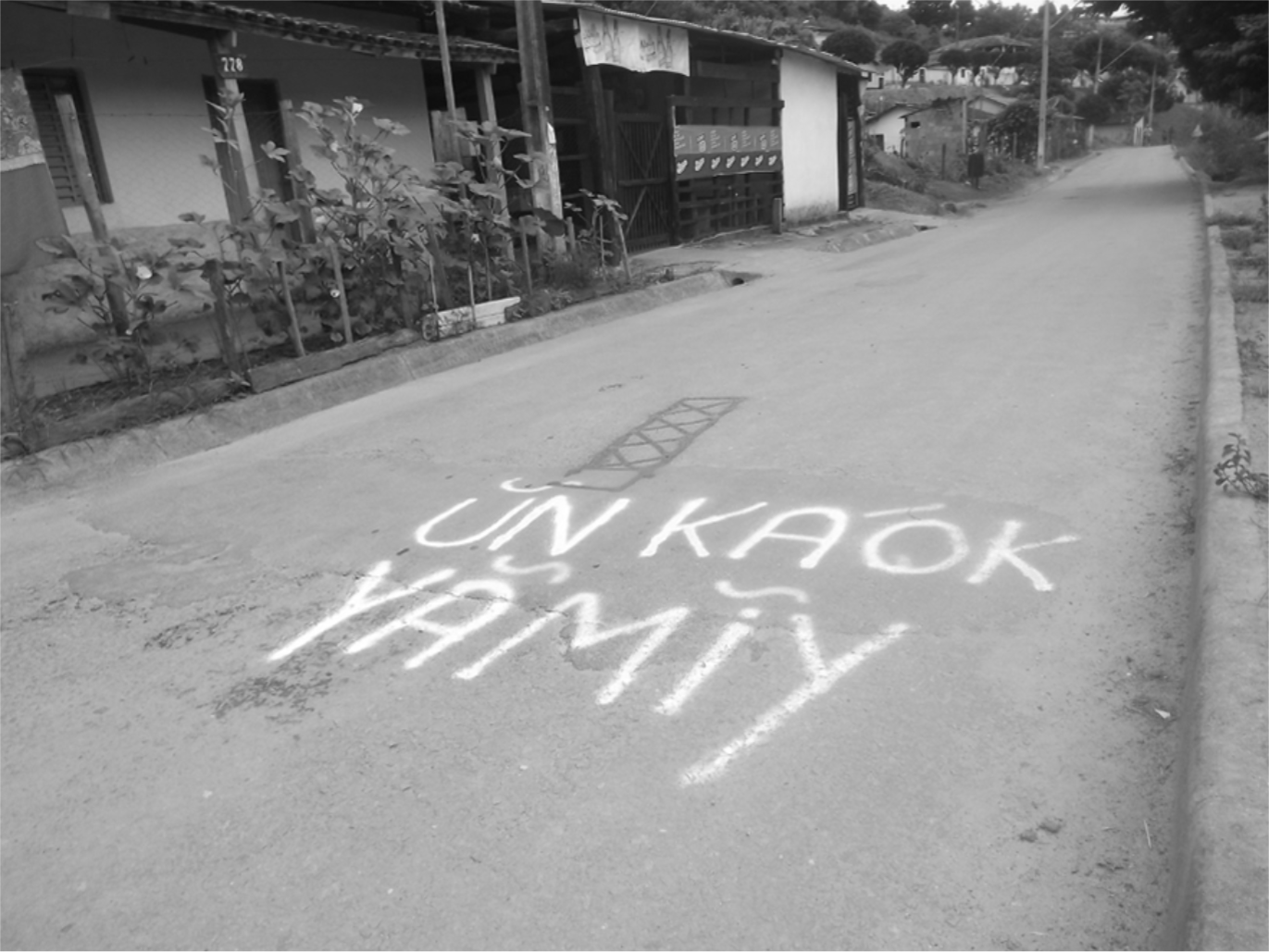 Photo: Douglas Ferreira Gadelha Campelo