
 Partial least squares structural equation modeling usage in production engineering research: a systematic literature review
Abstract
Abstract Despite the increasing usage of Partial Least Squares Structural Equation Modeling (PLS-SEM) by the scientific community, there is a series of misconceptions and incorrect usage of the technique reported in the literature. This study conducted a critical review of PLS-SEM usage on Production Engineering Research in Brazil and provided guidelines for its correct usage. A systematic literature review approach was adopted, focusing on papers published in the main Production Engineering Research outlets in Brazil. In total, 49 papers were carefully analyzed by the authors. The main issues identified while reviewing the selected papers can be categorized into four main groups: conceptual design; model operationalization; data analysis; and presentation of results. The study also suggests that realizing the full potential provided by PLS-SEM depends on a series of proper decisions made at the early stages of the research process. The paper concludes with guidelines for researchers to avoid the most common issues associated with using this technique in Production Engineering research.
Keywords:
Structural equation modeling; Partial least square; Production engineering research; Systematic literature review
Resumo
Resumo Apesar do uso crescente da Modelagem de Equações Estruturais de Mínimos Quadrados Parciais (PLS-SEM) pela comunidade científica, há uma série de equívocos e uso incorreto da técnica sendo relatados na literatura. Este estudo conduziu uma revisão crítica do uso do PLS-SEM na pesquisa em Engenharia de Produção no Brasil e fornece orientações para seu uso correto. Adotou-se uma abordagem de revisão sistemática da literatura com foco em artigos publicados nos principais veículos de pesquisa em Engenharia de Produção no Brasil. No total, 49 artigos foram cuidadosamente analisados pelos autores. As principais questões identificadas durante a revisão dos artigos selecionados podem ser categorizadas em quatro grupos principais: desenho conceitual, operacionalização do modelo, análise de dados e apresentação de resultados. O estudo também sugere que a realização de todo o potencial fornecido pelo PLS-SEM depende de uma série de decisões adequadas tomadas nas fases iniciais do processo de pesquisa. O artigo conclui com orientações para que os pesquisadores evitem os problemas mais comuns associados à implantação desta técnica nas pesquisas em Engenharia de Produção.
Palavras-chave:
Modelagem de equações estruturais; Mínimos quadrados parciais; Pesquisa em engenharia de produção; Revisão sistemática da literatura
1 Introduction
Structural Equation Modelling (SEM) has emerged as one of the most significant advancements in multivariate data analysis techniques for quantitative research over the past decade. Despite the fact that the first papers using SEM were reported toward the end of the 20th century (Wold et al., 1984), user-friendly software packages released by the early 2000s were fundamental for its widespread use among quantitative researchers, notably supporting the assessment of data collected using surveys and experiments. In the Brazilian scientific community, researchers from different knowledge areas have increasingly reported using SEM in their work, including Production Engineering (PE) researchers. Figure 1 illustrates this trend by highlighting the evolution of SEM usage in papers published in the main PE Brazilian outlets since the first publications adopting SEM were identified around 2011.

Evolution of the number of papers using SEM in Production Engineering research in Brazil (*until May).
Although SEM is a topic still under development, its foundational elements are already relatively well consolidated. Nonetheless, despite the increasing usage of SEM by PE researchers in Brazil, a considerable number of papers published at main PE conferences and journals in Brazil still seem to be making an incorrect or incomplete usage of the technique. This scenario is potentially dangerous as it can lead to incorrect conclusions and limit the contribution and impact of the research conducted by PE researchers in Brazil. Similar to what has been observed in other knowledge areas (Iacobucci, 2009; Jarvis et al., 2003; Sosik et al., 2009; Hair et al., 2019), a potential explanation for this phenomenon could be associated with the high expectations created by the technique in the scientific community, which motivates researchers to take shortcuts and try to use it without properly understanding the technique´s fundamental concepts.
In order to address this potentially detrimental scenario, stimulate the appropriate usage of SEM and contribute to improving the methodological rigor of the academic research on PE in Brazil, this paper aims to conduct a critical review of SEM application on PE research in Brazil and to provide guidelines for the correct usage. A systematic literature review approach was adopted, focusing on papers published in the main outlets for PE research in Brazil.
2 What is PLS SEM and what is it good for?
SEM is a multivariate data analysis technique that supports the assessment of multiple causal relations among the constructs of a theoretical model (Henseler, 2021; Hair et al., 2019, 2022). SEM is also an example of a second-generation multivariate data analysis technique because it combines elements from factor analysis and linear regression (Hair et al., 2022). However, the term SEM represents a family of techniques instead of a specific data analysis technique. There are two main approaches to SEM: covariance-based and variance-based. The difference between them lies in the way they approach the model analysis. In the first case, covariance-based (CB) SEM tries to maximize the covariance among the model’s constructs and is implemented in very popular software such as Lisrel®, Amos®, and R via the lavaan package (Rosseel, 2012). The variance-based approach, which is the focus of this paper, is also known as Partial Least Squares (PLS) SEM and aims to maximize the explained variance of the model’s endogenous constructs. SmartPLS® and Adanco® are examples of software that implement this approach.
The variance-based approach was selected to be the focus of this study as it presents key advantages over the covariance-based approach that are especially attractive at initial stages of confirmatory research, such as model convergence with smaller samples, lower sensitiveness to non-normally distributed data, and support for formative constructs. These elements, especially the last one, were key to increasing interest in SEM.
It is important to highlight that there are still ongoing comparisons in the literature between CB and PLS-SEM (Rönkkö & Evermann, 2013; Henseler et al., 2014; Rönkkö et al., 2016; Hair et al., 2019), which have ultimately generated a debate about the relevance of each approach and every round of this debate must be interpreted in light of the moment in which it takes place. This debate, which is often heated, may not have made clear the particularities and specificities of each approach, which may have contributed to the inadequate application of PLS-SEM in many studies, as discussed in this paper.
For instance, Rönkö et al. criticize the use of PLS-SEM (Rönkkö & Evermann, 2013; Rönkkö et al., 2016, 2023a, b), which was and still is a technique under development. Their criticisms highlighted shortcomings in the technique but lacked any commitment to propose possible solutions. Their remarks were also accompanied by some inaccuracy, for instance, when a comment was made regarding the decision of certain journals to immediately reject (desk reject) articles based on PLS-SEM (Rönkkö et al., 2016). In fact, the editorial (Guide & Ketokivi, 2015) emphasized that submitted papers leveraging PLS-SEM should clearly justify the choice of the technique because, at the time, there was a perception that PLS-SEM could be a silver bullet even when it was inappropriate to use for research objectives.
Cook & Forzani (2023) describe the evolution of the debate around the criticisms made by Rönkkö et al. and recognize that a single journal’s position represents an isolated case and does not reflect the position of journals in every area of knowledge.
Sharma et al. (2023) discuss what they identify as the main objections raised by Rönkkö et al. The first criticism is that PLS-SEM generates biased estimators. However, a more recent algorithm (Consistent PLS or PLSc) has already been developed to address this and is currently available in most software. Furthermore, there is a tradeoff between constructing coefficient estimation and maximizing predictive power, which is a fundamental difference between CB-SEM and PLS-SEM.
Another criticism is that PLS-SEM occupies a position between two equally challenging choices: explanation and prediction. However, research objectives are not divided into explanation or prediction. The typology of Information System theories presented by Gregor (2006), for instance, recognizes the existence of explanatory-predictive theories and that no dispute prevents the search for a balance between these objectives. As an example, neural networks are usually very good at predicting, but do not work so well for explanations, which can be required in certain situations, thus justifying the need and convenience for prediction-explanation models.
The third criticism is that research attempts to modernize PLS with a solution that is clumsy or inefficient and that it would be better to work with a more original and elegant mathematical solution, such as CB-SEM. However, the concept of mathematical elegance usually refers to individual perceptions, and objections should not be made when pursuing improvements to a model, whatever it may be, including PLS-SEM.
A fourth criticism is that PLS-SEM is unreliable in correcting measurement errors and testing inference. However, this conclusion was based on simulations whose nature did not allow generalizations and which used a type of simplified non-realistic model of two constructs that represent limit conditions for PLS-SEM, and not on models with characteristics closer to those that have used this technique.
Finally, the last criticism is that adopting PLS-SEM in the discipline was premature and casts significant doubt on the validity of the seminal studies, although Rönkö et al. did not present any example of these seminal studies containing misleading results. Following this idea, if studies carried out using PLS-SEM were reassessed with CB-SEM or PLSc, different results would be obtained. However, a Unified Theory of Acceptance and Use of Technology (UTAUT) model, whose data were analyzed using different SEM techniques (CB, PLS and PLSc), presented qualitatively equivalent results, also disqualifying this criticism (Sharma et al., 2023).
Therefore, the more contemporary view is that CB and PLS-SEM are not competing approaches, but distinct and, at times, complementary.
Some operational aspects of PLS-SEM are usually seen as advantages over CB-SEM: greater ease of working with formative constructs, fewer requirements regarding the size of data samples and less sensitivity to data that move away from normality. However, overall adjustment measures are more developed in CB-SEM, which would make it more suitable for a general assessment of a theory (concepts and relationships between them). Perhaps this is the reason why some claim that PLS-SEM is more suitable for exploratory studies whereas CB-SEM is better suited to the validation of models and, therefore, a more consolidated conceptual framework. The exploratory nature mentioned here does not refer to the degree of knowledge or consolidation of the hypotheses used in the construction of the structural model, but rather to the degree of knowledge of the nature of the measurement model used.
CB-SEM uses a factorial measurement model, whereas PLS-SEM uses a composition model. In the first, the covariances between the indicators and the constructs are used to generate a measure (score) of the construct. In the second, the linear combinations of indicators that generate the measure of the construct. Thus, the choice of an SEM model – either PLS or CB – would be subject to a discussion prior to the data collection and it is more related to the nature of the data and constructs used in the model. As Rigdon et al. (2017) explain, for an empiricist, it is not possible to define a concept irrespective of the data and, therefore, a construct must be derived from the data. This leads to the choice of CB-SEM, which, through a factorial model, generates a measure of the construct. On the other hand, a realistic approach presupposes the existence of concepts beyond the available or collected data, and that science helps to understand these concepts. Thus, construct indicators can be intentionally chosen (in a formative or reflective way) to measure the constructs, which would lead to the choice of a composition model such as the one used in PLS-SEM.
However, in real life, it is common that the researcher might not yet be fully certain about which measurement model would be the most appropriate for their research. The PLSc algorithm, now understood as an extension of PLS-SEM, can better accommodate this uncertainty using two calculation modes (Mode A and Mode B) that help the researcher understand the impact of this issue on the results of their model.
3 Foundational aspects of PLS-SEM
Least squares models aim to minimize the difference between observed and predicted values, as in the case of linear regression. Thus, the model estimators are defined to minimize the prediction error, and not the correlation between the dependent variable and the independent variables. This, however, does not mean that the coefficients will never be good estimates of the correlations, merely that the model's main objective is to maximize the predictive power (Henseler, 2021; Hair et al., 2019, 2022).
To exemplify the PLS-SEM usage, let us consider the Technology Acceptance Model (TAM) in Figure 2 proposed by Davis et al. (1989). It is a very well-known model in information systems and technology management. In this model, the construct “intention to use” both causes “actual system use” and is simultaneously influenced by “perceived usefulness” and “perceived ease of use”. Lastly, “perceived usefulness” is also caused by “perceived ease of use”. In total, the model has four causal relationships that PLS-SEM can estimate simultaneously.

This example also illustrates the importance of a strong theoretical framework to support the usage of PLS-SEM. As association and causality are related but are different concepts, this can cause some confusion about the limits of PLS-SEM applications. The path diagram that represents the model under analysis has directed arcs, i.e., the arc leaves one construct towards the other, visually suggesting a causal relationship. The PLS-SEM algorithm assigns a numerical value to this arc, which may or may not have statistical significance, which is a measure of correlation/association between the constructs and not of causality (Henseler, 2021; Hair et al., 2022).
The causal relationships hypothesized in the model are based on the literature review, and not on sample data. Although the causal relationship between two constructs also implies some level of association between them, the association per se is not a sufficient condition for the causal relationship (they may be effects of a common cause). Having said that, if the relationships present in the model do not show evidence of association, then an inference can be made that there is no evidence of causality either. On the other hand, when evidence of association is found, then it corroborates the causal hypothesis constructed based on a theory or literature review, but the association itself does not confirm the existence of causality.
PLS-SEM is not an exploratory data technique, such as Factor Analysis or Cluster Analysis. Despite the proximity that the Confirmatory Factor Analysis has with PLS-SEM, its application must be based on hypotheses with strong conceptual support derived from a robust and high-quality literature review. Even in the case where one wishes to compare competing conceptual structures – distinct structural models – each model should have strong conceptual support to not incur in the severe risk of adjusting the model to the data, i.e., the scenario where the model would be adjusted to the characteristics of the sample observed in the study. Thus, unlike the use of Factor Analysis in which data analysis suggests an underlying structure that emerges from the sample under study, the use of PLS-SEM must be subordinated to hypotheses previously derived from the literature (Iacobucci, 2009; Ringle et al., 2014; Henseler, 2021; Hair et al., 2022).
Furthermore, the constructs proposed in the TAM model are latent and cannot be directly observed. Therefore, for each construct, indirectly measurable data from indicators are combined to create a construct measure or score. Each set of indicators associated with a construct is a scale to indirectly measure the construct level. The process of identifying or developing indicators for a specific construct is called operationalization.
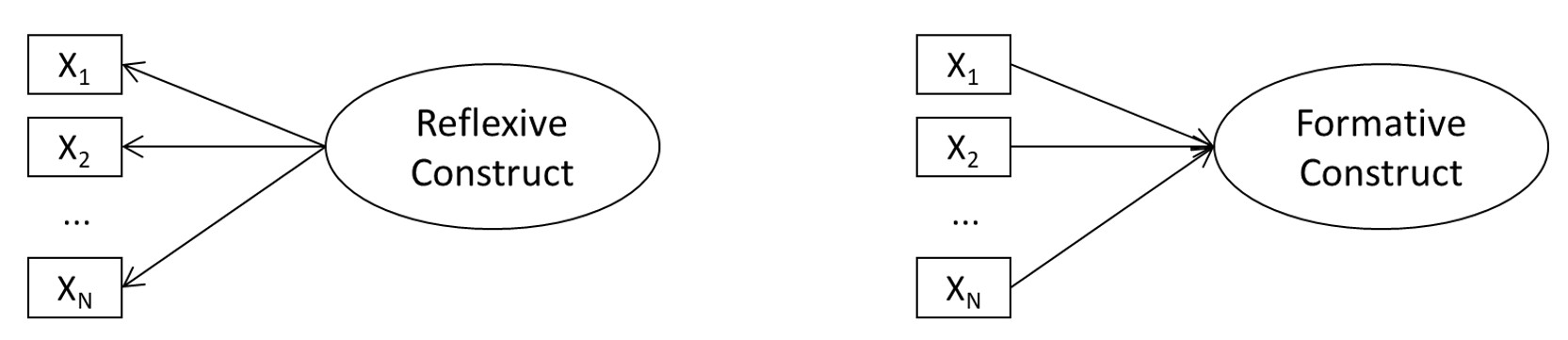
There are two types of construct scales: reflexive and formative (Figure 3). Theoretically, any construct may be operationalized by a reflexive or a formative scale. In a reflexive scale, the behavior of the indicators manifests or reflects the construct behavior, i.e., the construct “causes” the indicators. It is the same underlying idea behind factor analysis and principal component analysis: there is something that I cannot see that determines the behavior of things that I can see. In this case, as all indicators have a common cause, they are highly correlated with each other. Hence, an indicator may be replaced, included or excluded without major problems to the construct validity and reliability, because just the common variance among the indicators is computed to determine the construct level. Historically, the first initial SEM models deployed were strongly based on this type of scale, and it is very well supported by both covariance and variance-based SEM software (Henseler, 2021; Hair et al., 2022).

On the other hand, formative constructs use indicators that measure their different constituent parts or dimensions. For instance, the Human Development Index (HDI) is a formative construct consisting of literacy rate, life expectancy at birth, and gross national income. The HDI construct was defined as such, which means that if one indicator is replaced, included or excluded the original conceptual definition of the construct may change. Formative constructs are usually conceptual constructions or intellectual manifestations created to summarize a particular aspect of society, such as the HDI, and they are essential for science and knowledge development. An important practical aspect of the different types of scales is that reflexive indicators and formative indicators must be assessed by adopting different approaches. Whereas PLS-SEM easily manages reflexive and formative scales, CB-SEM does not (Henseler, 2021; Hair et al., 2019, 2022). Therefore, researchers should pay special care when operationalizing their models and selecting their analysis software. Treating a formative scale as reflexive only because the software of choice does not handle a formative scale can be considered a critical conceptual flaw (Jarvis et al., 2003).
The considerations and choices made about the scales utilized to measure the model´s constructs constitute the measurement model of a PLS-SEM analysis. The structural model is concerned with the causal relationships among the constructs and is irrespective of the type of measurement scale used. However, the structural model is only assessed if the measure model displays appropriate quality in terms of the validity and reliability of the constructs.
The structural model also has different types of constructs and perhaps the main distinction between them is the one made according to their relative position in the model. Exogenous constructs explain other constructs but are not explained by any other construct in the model, whereas endogenous constructs are explained by at least one construct (Henseler, 2021; Hair et al., 2022). It is important to note that this definition does not preclude endogenous constructs from also explaining other constructs, as what characterizes a construct as endogenous is its being explained by other variables. Therefore, on the TAM model displayed in Figure 2, there is one exogenous construct (perceived ease of use) and three endogenous constructs (perceived usefulness, intention to use causes and actual system use).
The structural model can also incorporate intervening constructs. A mediator construct, as illustrated in Figure 4a, represents an indirect relationship between two constructs, i.e., construct A impacts the mediator construct, which in turn impacts construct B (Carrión et al., 2017). In the TAM model displayed in Figure 2, perceived usefulness mediates the relationship between perceived ease of use and intention to use. Therefore, in the TAM model, perceived ease of use has a direct and indirect impact on the intention to use. Mediator constructs can be considered one of the most frequent intervening effects in SEM.

A moderator construct, as illustrated by Figure 4b modifies the relationship between two constructs (i.e., constructs A and B) by increasing or decreasing the magnitude of the effect between the constructs or even inverting the direction of the relationship (Hair et al., 2022).
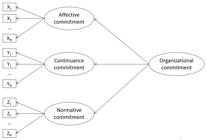
High-order constructs (HoC) can also be included in PLS-SEM, which represent constructs whose dimensions are also constructs (Hair et al., 2017, 2022). For instance, Meyer & Allen (1991) defined organizational commitment as the employee's identification with an organization, comprising three dimensions: affective commitment; normative commitment; and continuance commitment (Figure 5). In this case, organizational commitment is a second-order construct (higher order), and affective, normative and continuance commitment are first-order constructs (lower order).
The richness of the types of constructs, scales and relations that PLS-SEM supports is the main reason for the growing interest of the scientific community in using this data analysis technique. Although powerful, researchers must know how to use it properly to realize its full potential.
4 Review of PLS-SEM usage in PE Research in Brazil
This study focuses on PE publications in Brazil that deployed PLS-SEM. To achieve this, a systematic literature review approach was adopted. The data sources for the publications include the top five Brazilian PE journals and the proceedings of the two largest PE conferences in Brazil. The five journals selected are Production, Produção Online, Brazilian Journal of Operations & Production Management, Gestão e Produção (G&P) and Gestão da Produção, Operações e Sistemas (Gepros). The conference proceedings selected are from the ENEGEP (Encontro Nacional de Engenharia de Produção) and the SIMPEP (Simpósio de Engenharia de Produção).
The selection criteria for the journals were mainly the following: recognition of the journal by the ABEPRO (Associação Brasileira de Engenharia de Produção) and the indexing of the journal in one of the main scientific databases, namely Web of Science, Scopus and Scielo. ABEPRO is a traditional institution, and since the 1980s, it has worked to strengthen and develop PE in Brazil. On their website, ABEPRO lists the main PE journals published in Brazil (Associação Brasileira de Engenharia de Produção, 2024).
The first three journals are supported by ABEPRO, G&P is supported by the Federal University of São Carlos (UFSCar), and Gepros is supported by the Bauru School of Engineering at the São Paulo State University (UNESP/Bauru). ENEGEP is the first, largest and main Brazilian conference on PE and is organized by ABEPRO. The second main national event is the SIMPEP organized by UNESP/Bauru.
The steps to select the papers were:
-
Accessing each journal and conference website and search for the papers by using the following expressions: “structural equation modeling”, “structural equations modeling”, “SEM”, “structural equation”, “structural equations”, “SmartPLS”, “Adanco”; “Lisrel” and “AMOS”;
-
Reading the paper abstracts to eliminate publications that did not deploy PLS-SEM and/or the papers that deployed a covariance-based approach;
-
Each one of the remaining publications was carefully read by the authors according to a previously developed protocol of analysis whose goal was to identify the main flaws during the deployment of PLS-SEM as a technique of data analysis (Table 1).
In total, 49 papers were subject to this screening process and are listed in Appendix 1. The distribution of papers per year and journal or conference are presented in Table 2.
The main issues found while reviewing the papers can be classified into four main categories:
-
Conceptual design: deals with the proper alignment between the method conceptualization and the objective of the study, the theoretical framework and the development of hypotheses;
-
Model operationalization: refers to the proper alignment between the method features and the operational and methodological decisions made to support the empirical assessment of the model;
-
Data Analysis: focuses on the correctness and up to date usage of evaluation techniques for the model assessment;
-
Presentation of results: deals with aspects related to the appropriateness and sound presentation of the research results.
Starting with issues classified under category 1 (Conceptual design), approximately 83% of the publications analyzed have correctly defined a research objective that focuses on the exploration of a cause-effect relationship which can be considered a fundamental aspect for studies that deploy PLS-SEM. However, there were still eight papers that have failed to do so. Among these, the most common issue was attempting to deploy the method to merely assess levels of certain constructs in a population, but without focusing on a potential cause-effect relationship among the constructs.
A common issue identified within category 1 (Conceptual design) was the lack of a theoretical framework to support the cause-effect relationships specified in the theoretical model. It was observed that 29 out of 49 papers (or approximately 69% of the papers) have failed to do so and have leveraged the literature review mainly to define the model concepts or to loosely list studies that have researched the same topic. This usually represents a serious misconception for studies deploying PLS-SEM, as without the support of a proper theoretical framework, there is an increased risk that the cause-effect relationships the researchers expect to exist do not find statistical support when the empirical data is assessed. The lack of a theoretical framework usually also prevents the development of formal hypotheses for the cause-effect relationships of the theoretical model, and the absence or incorrect definition of hypotheses was indeed noticed on approximately 49% of the papers.
The issues identified in category 1 (Conceptual design) may indicate a lack of proper conceptual understanding of the PLS-SEM approach, including its application and purpose. This can be a risky scenario as the researchers may be deploying the technique on scenarios where other statistical analyses, such as correlation analysis or exploratory factor analysis would be more appropriate.
Regarding category 2 (Model operationalization), the most common issues were the lack of multiple cause-effect relationships on the theoretical models specified (49% of the papers) and the absence of a formal sampling assessment process (72% of the papers). Although a theoretical model assessed via PLS-SEM does not need to present multiple dependency relationships, this is a very powerful and unique capability provided by the method. Moreover, the absence of multiple cause-effect relationships in the model could be an indication that other simpler statistical methods, such as multiple linear regression, could be deployed instead. The absence of a sampling assessment process, either a priori or posteriori, can be considered a more critical issue. Without assessing the minimal sample size required for the theoretical model, the researchers are prone to the risk of stopping the data collection too soon without collecting enough data for the statistical analysis being targeted, thus potentially leading to inconclusive results, mainly type II error.
Another relatively common issue found in category 2 (Model operationalization) was the selection of the incorrect measurement model. Although most of the publications assessed have either formally declared or suggested utilizing a reflexive measurement model, in at least four publications, a formative measurement model should have been selected instead. This is a critical issue as the incorrect operationalization of the constructs might not only represent a limited conceptual understanding of the phenomenon but also lead the researchers to imprecise or incorrect findings.
Regarding the operationalization of the constructs, one interesting finding is that the studies leveraging more sophisticated analysis made possible by PLS-SEM are relatively rare: only three papers have conducted moderation analysis, four studies have included control variables in their models, nine have leveraged second-order constructs and none have deployed a formal mediation analysis.
A positive trend was noticed regarding the studies that have operationalized constructs by leveraging measurement scales that were previously validated in prior studies (approximately 78% of the publications), but only 43% of the papers have declared to perform a pre-test to ensure that any adaptations or translations made regarding the original measurement scales have not interfered in the precision of the measurements.
The issues identified in category 2 (Model operationalization) can be considered critical as the inadequate methodological decisions made in regard to PLS-SEM can hinder the empirical analysis of the theoretical models being assessed. They may also indicate a lack of proper understanding of the fundamental aspects of PLS-SEM, such as the different measurement models, as well as the assumptions and prerequisites of the method, such as the minimal sampling requirements. Lastly, the issues identified in category 2 can also indicate that the studies may not be extracting the maximum potential that the PLS-SEM technique has to offer, such as mediation and moderation analysis, high-order constructs and control variables.
Next, the issues classified under category 3 (Data analysis) suggest that not all the applicable criteria to assess the measurement and structural models are being properly or fully utilized. Among all the publications assessed, only six papers have properly and fully deployed the minimum set of criteria to assess a reflective measurement model and no study using a formative measurement model was found to be fully leveraging the assessment criteria required by PLS-SEM. Therefore, irrespective of the measurement model adopted, failures to completely assess either the reliability or the validity of the measurement models were common.
Moreover, in category 3 (Data analysis), a similar finding was noticed regarding the assessment of the structural models. The most relevant criteria to assess the structural model, namely R2, path coefficients and their associated statistical significance were correctly reported in only 61% of the publications. Among the papers that did not completely report all the structural model assessment criteria, the most common issue was the sole reporting of the R2 value, which tended to be only a marginal assessment criterion provided by PLS-SEM.
Furthermore, no publications seemed to correctly adopt more advanced techniques to explore the potential effect of observed/non-observed heterogeneity on their phenomenon of interest, such as multigroup analysis, even when their sample sizes suggest that they could do so.
The issues found in category 3 (Data analysis) are especially critical as they reveal that not all the publications properly evaluate their theoretical models, thus potentially leading to incorrect or misleading results. This can also indicate a lack of proper knowledge of the more abstract statistical concepts behind the PLS-SEM technique, which is critical for its correct application and full realization of its benefits.
Lastly, for the issues classified under category 4 (Presentation of results), the most common fault was related to the hypothesis testing. In approximately 29% of the papers, the the hypothesis test was carried out without taking into consideration whether or not the path coefficient of the cause-effect relationships demonstrates statistical significance at levels considered adequate by the literature. In six publications, only the path coefficient value was used, whereas in 13 other publications, the lack of statistical significance was not considered an inconclusive result.
In addition, after testing the hypothesis, only 67% of the publications compared their results with previous research, an important aspect in positivist research where the hypothesis tends to reflect the current knowledge available about the phenomenon being investigated. This finding is related to another prevalent issue identified under category 1 (Conceptual design), i.e., the lack of a theoretical framework to support the cause-effect relationships included in the theoretical model. As no theoretical framework was selected a priori, it is challenging to compare the results obtained with previous research.
The issues classified under category 4 (Presentation of results) are important because they can hinder the contribution of the studies deploying PLS-SEM. These issues can also potentially indicate that PE researchers are deploying PLS-SEM without properly considering the research approach and mindset that best fits the technique’s characteristics. The next section will provide insights as to how PE researchers can address these four categories of issues identified so far.
5 Guidelines for PLS-SEM usage
Ideally, the application of PLS-SEM in research needs to be considered as early as possible in the research process as some initial decisions made in early stages of the study, such as the research question or its methodological approach, can make the deployment of the PLS-SEM technique impractical at later stages of the research. Figure 6 presents a suggested sequence of steps that can be considered a guideline for PE researchers when deploying PLS-SEM in their research. These steps are detailed next.

5.1 Selecting the right tool for the right job
The first important aspect of deploying PLS-SEM refers to the research goal. PLS-SEM is an analysis method targeted at exploring cause-effect relationships from a quantitative perspective (Henseler, 2021; Hair et al., 2019, 2022). Therefore, the researchers interested in deploying PLS-SEM need to fully ensure that their research goal is set toward this type of relationship. More importantly, the objective is not to precisely predict the magnitude value of an endogenous construct, but instead to assess the practical and statistical significance of the cause-effect relationships contained in a structural model. To accomplish this goal, the method relaxes traditional assumptions about the normality of the data and accepts non-parametric statistical tests that might not be suitable for other quantitative research. Therefore, when researchers define that PLS-SEM is the technique to be deployed in their research it is important to make sure that all these characteristics are in place, so the potential benefits of the method are maximized and its limitations become neglectable. In other words, it is important to select PLS-SEM only when the research contexts are favorable to its application as the technique is definitely not a silver bullet to be deployed in all quantitative research.
Moreover, in this first stage of the research, it is important to highlight that PLS-SEM is usually applicable to contexts where the researcher is adopting a positivist and deductive research paradigm (Henseler, 2021; Henseler et al., 2009; Hair et al., 2022). Therefore, the researcher must adopt such a position when developing the structural model investigated. Thus, it is expected that the researchers willing to deploy PLS-SEM review the pertinent literature and obtain adequate theoretical evidence, usually via an established framework, to support the cause-effect relationships. This is a critical consideration as the method is not expected to identify the significance of cause-effect relationships that do not exist in the population targeted. Consequently, if the researchers want to increase their chances of obtaining meaningful conclusions from the PLS-SEM analysis, it is important to obtain adequate theoretical support for the structural model, as the relationships of this model constitute the hypothesis of the research.
Before concluding this first step in the research planning, there is one last important aspect that needs to be highlighted about the structural model: each cause-effect relationship represents a single hypothesis of the research and vice-versa (Hair et al., 2022). Therefore, it is not recommended to develop a single hypothesis that simultaneously covers two or more relationships of the model, as this can make the hypothesis testing cumbersome.
5.2 Taking wise methodological decisions
Once the researchers have defined their structural model, it is time to start thinking about the measurement model. One fundamental concern is regarding the selection of the indicators that will be utilized to either reflect or compose the constructs contained in the structural model. As the quality of the results is directly related to the quality of the measurements, it is important to adopt indicators that have either already been validated by previous research or to develop and validate a new set of indicators before conducting the data collection. It is also important to adopt the proper reflexive or formative measurement models according to the conceptual definitions of the constructs contained in the structural model. The proper choices made at this stage will be crucial for the increased validity and reliability of the measurement model to be assessed further.
At this point, it might also be interesting to consider the pertinent inclusion of additional variables in the structural model that might help better explain the cause-effect relationships investigated. PLS-SEM, for instance, supports not only the assessment of control variables that directly affect a target construct but also mediating and moderating variables that potentially affect the magnitude of a cause-effect relationship (Hair et al., 2022). Extrapolating the concept of control variables to refer to the presence of observed heterogeneity in the population, PLS-SEM also supports multigroup comparisons, i.e., analysis of the same model for different categorical segments of the population (Hair et al., 2016). These are all auxiliary resources that are available to the researcher deploying PLS-SEM as long as the proper methodological decisions are taken at this stage.
One of these important methodological decisions refers to the definition of the appropriate sample size (Iacobucci, 2010; Hair et al., 2019). Even though the method is claimed to accept smaller sample sizes compared with other traditional statistical analysis methods, it is still important to carefully determine the appropriate sample size by taking into consideration elements such as the effect size of the cause-effect relationships, the level of significance and power of test being targeted, and also the number of predictors of the model (Ringle et al., 2014). To this end, the researcher can leverage free tools such as G*Power (Faul et al., 2009) to support this process. This step can be considered crucial for the deployment of PLS-SEM, as the inadequate sample size can lead to inconclusive results or even undermine the deployment of complementary analyses, such as multigroup analysis.
5.3 Carefully assessing the model
After the data collection is complete, the model should be empirically assessed. In PLS-SEM, this assessment is divided into two main stages: evaluation of the measurement model and evaluation of the structural model (Henseler, 2021; Hair et al., 2019, 2022). The structural model is only evaluated if the measurement model satisfies the minimum validity and reliability criteria specified by the specialized literature. This means that the measurement model needs to be assessed not only by its accuracy (i.e., validity) but also by its consistency or stability (i.e., reliability). Furthermore, by carefully selecting indicators for the constructs, it may be possible to adapt the measurement model to some extent to address potential reliability and validity issues before assessing the structural model, thereby enhancing the overall quality of the analysis.
As can be inferred, the assessment criteria differ depending on whether the measurement model is reflexive or formative. Table 3 illustrates the most common criteria for assessing a measurement model depending on its reflexive or formative nature.
Once the measurement model has satisfied the applicable criteria, the structural model should be assessed. The first global result provided by PLS-SEM is the coefficient of determination of the model (R2) that represents an overall measurement of the predictive power of the model, more specifically, the percentage of the variance of the endogenous constructs that are explained by the exogenous constructs (Henseler, 2021; Hair et al., 2019, 2022). This is an important result to communicate the overall quality of the model, but it is usually not the main concern of a researcher deploying PLS-SEM. As the main motivation to deploy PLS-SEM should be to explore the significance of the cause-effect relationships contained in a model, a more important element to be assessed in the structural model is the magnitude of the path coefficient and its associated statistical significance. These two results combined allow the researcher to understand whether or not the cause-effect relationships are expected to exist in the target population within a certain significance level and therefore, allow the validation of the hypothesis of the research.
Beyond the core analysis, it is important to highlight that PLS-SEM provides several complementary analyses to support the researchers in a more comprehensive understanding of the phenomenon at hand, such as the effect size of relationships contained in the model (f2 indicator) and the predictive power of endogenous constructs (Q2 and q2 indicators) (Henseler, 2021; Hair et al., 2019, 2022).
Finally, in case the structural model contains intervenient constructs, such as mediating or moderating constructs, the reference literature also provides guidelines on how to deploy their analyses (Hair et al., 2016, 2017, 2022).
5.4 Communicating results with precision
After completely assessing all pertinent criteria relative to the measurement and structural models, the next step should be to properly communicate the PLS-SEM analysis results.
The main recommended approach is to utilize the magnitude or signal (i.e., positive or negative) value and the statistical significance of each path coefficient from the structural model as this is the core information to decide whether a certain hypothesis of the research has been supported or not (Henseler, 2021; Hair et al., 2022). In case the magnitude or signal value of the path coefficient is consistent with the hypothesized relationship and statistical significance is found, then the hypothesis is supported. In case the magnitude or signal value of the path coefficient is not consistent with the hypothesized relationship and statistical significance is found, then the hypothesis is rejected. Otherwise, in case statistical significance is not found then the hypothesis is not supported or referred to as inconclusive as there is no statistical evidence to reject the null hypothesis.
Lastly, once all the hypotheses are tested, it is also important to discuss how each hypothesis, either supported, rejected or inconclusive contributes to the advancement of knowledge in the area of research. A rejected hypothesis is not always a negative result from a knowledge creation perspective as it could reveal that the phenomenon has a different behavior for a certain group of the target population. Regarding the inconclusive hypothesis, it can be associated with inadequate theoretical support when developing the model or even a suboptimal methodological decision, but it can also contribute to researchers by illustrating paths that must be avoided in a future replication or extension of the original study.
6 Final remarks
PLS-SEM is a powerful data analysis tool and researchers must use it properly to explore all its potential. Despite the growing use of PLS-SEM within the scientific community, numerous misconceptions and instances of improper application have been reported in the literature (Iacobucci, 2009; Jarvis et al., 2003; Sosik et al., 2009; Hair et al., 2019). This study presents a critical review of PLS SEM usage on PE research in Brazil and offers guidelines for its appropriate use. To achieve this, a systematic literature review was conducted, focusing on articles published in the leading journals for PE research in Brazil.
The review of these papers suggests that the foundational aspects of PLS-SEM have not yet been completely understood and grasped by the PE academic production in Brazil. In addition to the obvious and immediate impact on the quality of applications using PLS-SEM, this shows a serious limitation for the more sophisticated use of the technique and analysis of more complex research questions that include, for example, nonlinear effects or conditional mediating effects. Thus, an assessment of scientific production, from the perspective of the foundational elements of PLS-SEM, such as the one presented here, aims to contribute to a better understanding and encouragement of the correct use of multivariate statistical analysis methods in the Brazilian academic community.
The paper contributes to the existing literature by identifying the main issues associated with the usage of PLS-SEM in PE research. These issues can be categorized into four main groups: conceptual design, model operationalization, data analysis, and presentation of results. The paper also provides a methodological contribution to researchers by presenting guidelines to avoid the most common issues associated with the deployment of this technique in PE research.
The main limitation of the study lies in the fact that only a sample of all PE papers published in Brazil has been reviewed. However, the methodological choices made by the authors in selecting the most impactful PE journals and conferences in Brazil have contributed to a high-quality analysis. In addition, it is important to highlight that the guidelines provided in this study should not be taken as definitive and static guidelines for researchers. Given that PLS-SEM is a field under development, improvements to the underlying algorithm, new assessment criteria and analysis capabilities are expected to be continuously suggested in the literature. Researchers interested in using PLS-SEM should therefore be continuously updated on these new developments.
Appendix 1 Publications analyzed.
Abdulrab, M., Al-Mamary, Y. H. S., Alwaheeb, M. A., Alshammari, N. G. M., Balhareth, H., & Al-Shammari, S. A. (2021). Mediating role of strategic orientations in the relationship between entrepreneurial orientation and performance of Saudi SMEs. Brazilian Journal of Operations & Production Management, 18(4), 1-15.
Ali, E., & Gossaye, W. (2023). The effects of supply chain viability on supply chain performance and marketing performance in case of large manufacturing firm in Ethiopia. Brazilian Journal of Operations & Production Management, 20(2), 1535.
Basso, L. M., Freitas, W. R. S., Teixeira, A. A., Oliveira, J. H. C., & Girardi, J. M. E. (2019). Gestão do conhecimento no setor público brasileiro: fatores críticos de sucesso à luz da modelagem das equações estruturais. In Anais do XXVI Simpósio de Engenharia de Produção. Bauru: UNESP.
Bastos, A. L. A., Luna, M. M. M., & Frega, J. R. (2014). Compartilhamento de conhecimentos em cadeias de suprimentos e o desempenho de entrega dos fornecedores: uma aplicação da modelagem de equações estruturais. In Anais do XXI Simpósio de Engenharia de Produção. Bauru: UNESP.
Bittencourt, E. S. B., Fontes, C. H. O., & Avila, S., Fo., Ferreira, A. M. S., & Rodriguez, J. L. M. (2018). Metabolismo socioeconômico urbano: Especificação de modelos estruturados de pneus em fim de vida. In Anais do XXXVIII Encontro Nacional de Engenharia de Produção. Maceió: ABEPRO.
Borges, K. K., Souza, L., Queiroz, J., Queiroz, F. C., & Lima, N. C. (2018). Barreiras de expansão da energia solar fotovoltaica no Brasil. In Anais do XXXVIII Encontro Nacional de Engenharia de Produção. Maceió: ABEPRO.
Camilo, D. G. G., Cabral, E. L. S., Pereira, F. C. B., & Souza, R. P. (2018). Avaliação da intenção da continuação do uso do Facebook. In Anais do XXV Simpósio de Engenharia de Produção. Bauru: UNESP.
Cardozo, E. A. A., & Rocha, K. M. (2017). Avaliação do grau de maturidade dos processos organizacionais com enfoque nos habilitadores. In Anais do XXXVII Encontro Nacional de Engenharia de Produção. Joinville: ABEPRO.
Cleto, V. T. V., Plá, A. B. P., Lelis, A. B. M., Santos, M. R., & Mariano, A. M. (2017). Marketing boca a boca digital (EWOM) no Instagram Stories: uma pesquisa descritiva através das equações estruturais. In Anais do XXIV Simpósio de Engenharia de Produção. Bauru: UNESP.
Espechitt, M. L. N., Vieira, D. G., Silva, R. B., Santos, M. R., & Mariano, A. M. (2017). Fatores de influência a satisfação do usuário do metrô brasileiro: um estudo por meio de equações estruturais. In Anais do XXIV Simpósio de Engenharia de Produção. Bauru: UNESP.
Freitas, W. R. S., Oliveira, J. H. C., Teixeira, A. A., & Girardi, J. M. E. (2019). Green Human Resource Management, Corporate Social Responsibility e Customer Relationship Management: análise do relacionamento em organizações brasileiras. In Anais do XXVI Simpósio de Engenharia de Produção. Bauru: UNESP.
Gonçalves, L. A., Kruger, G. N., & Queiroz, J. V. (2017). Avaliação da satisfação dos colaboradores de uma multinacional brasileira do setor de petróleo utilizando a modelagem de equações estruturais. In Anais do XXXVII Encontro Nacional de Engenharia de Produção. Joinville: ABEPRO.
Gonzalez, R. V. D. (2018). Dynamic capability: an analysis in multi-unit service providers. Production, 28. https://doi.org/10.1590/0103-6513.20180046.
Jabbour, A. B. L. D. S., & Alves, A. G., Fo., Viana, A. B. N., & Jabbour, C. J. C. (2013). Práticas de gestão da cadeia de suprimentos e seus eventuais relacionamentos com as prioridades competitivas da produção: evidências empíricas do setor eletroeletrônico à luz de modelagem de equações estruturais. Production, 23(2), 241-256. http://dx.doi.org/10.1590/S0103-65132012005000069.
Jabbour, C. J. C., Freitas, W. R. D. S., Teixeira, A. A., & Jabbour, A. B. L. D. S. (2012). Gestão de recursos humanos e desempenho operacional: evidências empíricas. Gestão & Produção, 19(2), 347-360. http://doi.org/10.1590/S0104-530X2012000200009.
Ladeira, M. B., Resende, P. T. V. D., Oliveira, M. P. V. D., McCormack, K., Sousa, P. R. D., & Ferreira, R. L. (2012). Gestão de processos, indicadores analíticos e impactos sobre o desempenho competitivo em grandes e médias empresas brasileiras dos setores da indústria e de serviços. Gestão & Produção, 19(2), 389-404. http://doi.org/10.1590/S0104-530X2012000200012.
Ladeira, M. B., Resende, P. T. V. D., Oliveira, M. P. V. D., McCormack, K., Sousa, P. R. D., & Ferreira, R. L. (2016). Os efeitos da abordagem analítica e da gestão orientada para processos sobre o desempenho organizacional de micro e pequenas empresas brasileiras dos setores da indústria e de serviços. Gestão & Produção, 23(3), 486-502. http://doi.org/10.1590/0104-530X1531-14.
Marcato, J. G., Silva, H. M. R. D., Luiz, O. R., Mariano, E. B., & Paro, C. E. (2023). Modeling quality, satisfaction and perceived crowding in public healthcare: a study with low-income Brazilian patients. Gestão & Produção, 30, e10722. http://doi.org/10.1590/1806-9649-2022v30e10722.
Mariano, A. M., dos Anjos, F. B., Moreira, L. L., & Simão, S. B. (2018). Comportamento de compra do consumidor online no Distrito Federal: uma pesquisa descritiva por meio das equações estruturais. Revista Produção Online, 18(1), 350-376. http://doi.org/10.14488/1676-1901.v18i1.2812.
Mariano, A. M., Tiusi, P., Santos, M. R., Dantas, A. S., & Panoso, A. A. (2017). Fatores determinantes para a satisfação do consumidor on-line: uma pesquisa descritiva por meio das equações estruturais. In Anais do XXXVII Encontro Nacional de Engenharia de Produção. Joinville: ABEPRO.
Mohammed, A. S., Ayambila, S. N., & Lukman, S. (2023). An empirical investigation of the impact of social media tool usage on employees work performance among Ghana Commercial Bank Workers: the moderating role of social media usage experience. Brazilian Journal of Operations & Production Management, 20(1), 1382-1382.
Monteiro, I., Valverde, L., Mascarenhas, M., Santos, M. R., & Mariano, A. M. (2017). Fatores antecedentes da intenção empreendedora: um estudo por meio das equações estruturais. In Anais do XXIV Simpósio de Engenharia de Produção. Bauru: UNESP.
Moraes, E. R., Barbosa, J. C., Bernardes, V. S. L., & Nunes, D. M. (2020). Fatores que influenciam na qualidade dos serviços de saúde: um estudo de caso em uma cidade do sudoeste goiano. In Anais do XXXIII Encontro Nacional de Engenharia de Produção. Salvador: ABEPRO.
Moraes, M. M. M., & Tuma, A. A. No., Ramos, F. B. A., Souza, A. A., Jr., & Santiago, S. B. (2021). Interoperabilidade logística como fator e impulso da indústria 4.0: estudo de caso em um fabricante de motocicletas. In Anais do XL Encontro Nacional de Engenharia de Produção. Foz do Iguaçu: ABEPRO.
Moraes, T. E. C., Teixeira, A. A., Teixeira, T. B., Araújo, E. G., & Freitas, W. R. S. (2020). Contribuições da green supply chain management para o desempenho ambiental: survey com organizações brasileiras. In Anais do XXVII Simpósio de Engenharia de Produção. Bauru: UNESP.
Moura, R. L. D., Carneiro, T. C. J., & Dias, T. L. (2021). Effects of standardization-based coordination mechanisms in project performance. Gestão & Produção, 28(3), e5257. http://doi.org/10.1590/1806-9649-2021v28e5257.
Neves, M. E., Parreiras, F. S., de Paula Ferreira, E., & Corrêa, F. (2021). Maturity Business Process Management at Companhia Energética de Minas Gerais. Gepros: Gestão da Produção, Operações e Sistemas, 16(4), 115-136. http://doi.org/10.15675/gepros.v16i4.2852.
Neto, A. L. L. R., Mesquita, J. M. C., & Muylder, C. F. (2013). Fatores de influência na adoção do internet banking por clientes bancários da melhor idade. In Anais do XXXIII Encontro Nacional de Engenharia de Produção. Salvador: ABEPRO.
Oliveira, I. N., Brito, M. H. A., Ishihara, S. E. M. P., Teixeira, V. P. F., & Mariano, A. M. (2018). Fatores influenciadores do comportamento de moda masculino: um estudo exploratório no Distrito Federal. In Anais do XXV Simpósio de Engenharia de Produção. Bauru: UNESP.
Oliveira, R. R., & Martins, H. C. (2017). Estratégia, Pessoas e Operações como agentes influenciadores do desempenho do Escritório de Gerenciamento de Projetos: uma análise por meio da Modelagem de Equações Estruturais. Gestão & Produção, 25(2), 410-429. http://doi.org/10.1590/0104-530X2294-16.
Pereira, L. M., & Freires, F. G. M. (2022). Uso de equações estruturais na melhoria da gestão de resíduos plásticos através da economia circular. In Anais do XLII Encontro Nacional de Engenharia de Produção. Foz do Iguaçu: ABEPRO.
Pinto, R. L., Gouvêa, M. A., & Oliveira, B. (2014). Avaliação da qualidade de serviço terceirizado de manutenção em edifício comercial: o caso de uma organização pública. Gestão & Produção, 21(2), 389-403. http://doi.org/10.1590/0104-530X1215.
Queiroz, F. C. B., Dantas, A. V. S., Marques, E. L., Queiroz, J. V., & Furukawa, M. (2021). Aspectos determinantes da lealdade dos clientes das empresas de serviços de assinatura de vídeo sob demanda (SVOD). In Anais do XLI Encontro Nacional de Engenharia de Produção. Foz do Iguaçu: ABEPRO.
Rays, I. F. O., Ortiz, C. R., & Silva, H. M. R. (2022). A influência de fatores comportamentais no consumo de alimentos orgânicos. In Anais do XXIX Simpósio de Engenharia de Produção. Bauru: UNESP.
Rodrigues, H. S., Alves, W., & Silva, Â. (2020). The impact of lean and green practices on logistics performance: a structural equation modelling. Production, 30, e20190072. http://doi.org/10.1590/0103-6513.20190072.
Romano, A. L., Ferreira, L. M. D. F., & Caeiro, S. (2021). A sustentabilidade nas cadeias de suprimentos: uma modelagem de equações estruturadas. In Anais do XXVIII Simpósio de Engenharia de Produção. Bauru: UNESP.
Romano, A. L., Ferreira, L. M. D. F., & Caeiro, S. (2021). Um estudo sobre os motivadores para a adoção das práticas de sustentabilidade nas cadeias de suprimentos em empresas brasileiras. In Anais do XLI Encontro Nacional de Engenharia de Produção. Foz do Iguaçu: ABEPRO.
Santos, A. S., Dantas, M. J. P., & Machado, R. L. (2017). Structural equation modeling applied to assess industrial engineering students’ satisfaction according to ENADE 2011. Production, 27, e20162191. http://doi.org/10.1590/0103-6513.219116.
Santos, L., Bittencourt, E., & Freires, G. (2022). Waste to energy: Soluções teóricas adotando modelagem de equações estruturais. In Anais do XLII Encontro Nacional de Engenharia de Produção. Foz do Iguaçu: ABEPRO.
Saraiva, A. C. C., Dantas, L. P., Queiroz, F. C., & Silva, A. C. L. (2017). Avaliação da satisfação dos usuários num sistema de informação acadêmico: Estudo de caso na Universidade Federal do Piauí. In Anais do XXXVII Encontro Nacional de Engenharia de Produção. Joinville: ABEPRO.
Silva, E. M. D., Santos, F. C. A., & Castro, M. D. (2012). Análise das relações entre estratégia de produção, práticas e desempenho operacional. Production, 22(3), 502-516. http://doi.org/10.1590/S0103-65132012005000009.
Silva, W. A. C. S., Silva, M. N., Lara, J. E., & Oliveira, S. L. (2011). Análise dos determinantes da lealdade às lojas temáticas de torcedores do Atlético e Cruzeiro. In Anais do XXXI Encontro Nacional de Engenharia de Produção. Belo Horizonte: ABEPRO.
Soares, G. S., Roriz, M. P. Jr, & Bevilacqua, S. (2019). Prontidão e validação inicial de uma escala para economia compartilhada. In Anais do XXXIX Encontro Nacional de Engenharia de Produção. Santos: ABEPRO.
Soriano, F. R., Oprime, P. C., & Lizarelli, F. L. (2017). Impact analysis of critical success factors on the benefits from statistical process control implementation. Production, 27, e20162040. http://doi.org/10.1590/0103-6513.204016.
Souza, P. O. (2018). Fatores que influenciam no endividamento com o cartão de créditos: uma análise multivariada. In Anais do XXV Simpósio de Engenharia de Produção. Bauru: UNESP.
Szerman, A. S., Sampaio, J. P. F., Garcia Pinto, F. A. F., Monteiro, S. B. S., & Amoras, R. C. (2019). Análise da satisfação do cliente sobre a qualidade de um restaurante de comidas rápidas. In Anais do XXVI Simpósio de Engenharia de Produção. Bauru: UNESP.
Teixeira, A. A. (2016). A importância da gestão da qualidade para a efetividade da gestão ambiental: evidências de empresas instaladas no Brasil. In Anais do XXIII Simpósio de Engenharia de Produção. Bauru: UNESP.
Vafaei, S., Bazrkar, A., & Hajimohammadi, M. (2019). The investigation of the relationship between sustainable supply chain management and sustainable competitive advantage according to the mediating role of innovation and sustainable process management. Brazilian Journal of Operations & Production Management, 16(4), 572-580. http://doi.org/10.14488/BJOPM.2019.v16.n4.a3.
Zand, H., & Rezaei, B. (2020). Investigating the impact of process and product innovation strategies on business performance due to the mediating role of environmental dynamism using structural equations modeling. Brazilian Journal of Operations & Production Management, 17(2), e2020921. http://doi.org/10.14488/10.14488/BJOPM.2020.022.
Statement on Data Availability
The data supporting the findings of this study are included within the manuscript.
-
Financial support:
None.
-
How to cite:
Moraes, R. O., & Watanuki, H. M. (2025). Partial least squares structural equation modeling usage in production engineering research: a systematic literature review. Gestão & Produção, 32, e7424. https://doi.org/10.1590/1806-9649-2025v32e7424
References
-
Associação Brasileira de Engenharia de Produção – ABEPRO. (2024). Periódicos de Engenharia de Produção. Retrieved in 2023, May 1, from https://abepro.org.br/internasub.asp?m=676&ss=18&c=997
» https://abepro.org.br/internasub.asp?m=676&ss=18&c=997 -
Carrión, G. C., Nitzl, C., & Roldán, J. L. (2017). Mediation analyses in partial least squares structural equation modeling: guidelines and empirical examples. In H. Latan & R. Noonan (Eds.), Partial least squares path modeling (pp. 173-195). Cham: Springer. http://doi.org/10.1007/978-3-319-64069-3_8
» http://doi.org/10.1007/978-3-319-64069-3_8 - Cook, R. D., & Forzani, L. (2023). On the role of partial least squares in path analysis for the social sciences. Journal of Business Research, 167, 114-132.
-
Davis, F. D., Bagozzi, R. P., & Warshaw, P. R. (1989). User acceptance of computer technology: a comparison of two theoretical models. Management Science, 35(8), 982-1003. http://doi.org/10.1287/mnsc.35.8.982
» http://doi.org/10.1287/mnsc.35.8.982 -
Faul, F., Erdfelder, E., Buchner, A., & Lang, A. (2009). Statistical power analyses using G* Power 3.1: tests for correlation and regression analyses. Behavior Research Methods, 41(4), 1149-1160. http://doi.org/10.3758/BRM.41.4.1149 PMid:19897823.
» http://doi.org/10.3758/BRM.41.4.1149 -
Gregor, S. (2006). The nature of theory in information systems. Management Information Systems Quarterly, 30(3), 611-642. http://doi.org/10.2307/25148742
» http://doi.org/10.2307/25148742 - Guide, V. D. R., & Ketokivi, M. (2015). Notes from the editors: restructuring the Journal of Operations Management. Journal of Operations Management, 38, 5-10.
-
Hair, J. F., Jr., Sarstedt, M., Matthews, L. M., & Ringle, C. M. (2016). Identifying and treating unobserved heterogeneity with FIMIX-PLS: part I–method. European Business Review, 28(1), 63-76. http://doi.org/10.1108/EBR-09-2015-0094
» http://doi.org/10.1108/EBR-09-2015-0094 - Hair, J. F., Sarstedt, M., Ringle, C. M., & Gudergan, S. P. (2017). Advanced issues in partial least squares structural equation modeling. Thousand Oaks: Sage.
-
Hair, J. F., Risher, J. J., Sarstedt, M., & Ringle, C. M. (2019). When to use and how to report the results of PLS-SEM. European Business Review, 31(1), 2-24. http://doi.org/10.1108/EBR-11-2018-0203
» http://doi.org/10.1108/EBR-11-2018-0203 - Hair, J. F., Hult, G. T. M., Ringle, C. M., & Sarstedt, M. (2022). A primer on partial least squares structural equation modeling (PLS-SEM). Thousand Oaks: Sage.
-
Henseler, J., Ringle, C. M., & Sinkovics, R. R. (2009). The use of partial least squares path modeling in international marketing. Advances in International Marketing, 20, 277-319. http://doi.org/10.1108/S1474-7979(2009)0000020014
» http://doi.org/10.1108/S1474-7979(2009)0000020014 -
Henseler, J., Dijkstra, T. K., Sarstedt, M., Ringle, C. M., Diamantopoulos, A., Straub, D. W., Ketchen, D. J., Jr., Hair, J. F., Hult, G. T. M., & Calantone, R. (2014). Common beliefs and reality about PLS: Comments on Ronko & Everman. Organizational Research Methods, 17(2), 182-209. http://doi.org/10.1177/1094428114526928
» http://doi.org/10.1177/1094428114526928 - Henseler, J. (2021). Composite-based structural equation modeling: analyzing latent and emergent variables. New York: Guilford Publications.
-
Iacobucci, D. (2009). Everything you always wanted to know about SEM (structural equations modeling) but were afraid to ask. Journal of Consumer Psychology, 19(4), 673-680. http://doi.org/10.1016/j.jcps.2009.09.002
» http://doi.org/10.1016/j.jcps.2009.09.002 -
Iacobucci, D. (2010). Structural equations modeling: fit indices, sample size, and advanced topics. Journal of Consumer Psychology, 20(1), 90-98. http://doi.org/10.1016/j.jcps.2009.09.003
» http://doi.org/10.1016/j.jcps.2009.09.003 -
Jarvis, C. B., MacKenzie, S. B., & Podsakoff, P. M. (2003). A critical review of construct indicators and measurement model misspecification in marketing and consumer research. The Journal of Consumer Research, 30(2), 199-218. http://doi.org/10.1086/376806
» http://doi.org/10.1086/376806 -
Meyer, J. P., & Allen, N. J. (1991). A three-component conceptualization of organizational commitment. Human Resource Management Review, 1(1), 61-89. http://doi.org/10.1016/1053-4822(91)90011-Z
» http://doi.org/10.1016/1053-4822(91)90011-Z -
Rigdon, E. E., Sarstedt, M., & Ringle, C. M. (2017). On comparing results from CB-SEM and PLS-SEM: five perspectives and five recommendations, Marketing. ZFP–Journal of Research and Management, 39(3), 4-16. http://doi.org/10.15358/0344-1369-2017-3-4
» http://doi.org/10.15358/0344-1369-2017-3-4 - Ringle, C., Silva, D., & Bido, D. (2014). Structural equation modeling with the SmartPLS. Brazilian Journal of Marketing, 13(2), 56-73.
-
Rönkkö, M., & Evermann, J. (2013). A critical examination of common beliefs about partial least squares path modeling. Organizational Research Methods, 16(3), 425-448. http://doi.org/10.1177/1094428112474693
» http://doi.org/10.1177/1094428112474693 -
Rönkkö, M., McIntosh, J., Antonakis, J., & Edwards, J. R. (2016). Partial least squares path modeling: time for some serious second thoughts. Journal of Operations Management, 47(1), 9-27. http://doi.org/10.1016/j.jom.2016.05.002
» http://doi.org/10.1016/j.jom.2016.05.002 -
Rönkkö, M., Lee, N., Evermann, J., McIntosh, C., & Antonakis, J. (2023a). Marketing or methodology? Exposing the fallacies of PLS with simple demonstrations. European Journal of Marketing, 57(6), 1597-1617. http://doi.org/10.1108/EJM-02-2021-0099
» http://doi.org/10.1108/EJM-02-2021-0099 -
Rönkkö, M., Lee, N., Evermann, J., McIntosh, C., & Antonakis, J. (2023b). Rejoinder: fractures in the edifice of PLS. European Journal of Marketing, 57(6), 1626-1640. http://doi.org/10.1108/EJM-07-2022-0508
» http://doi.org/10.1108/EJM-07-2022-0508 -
Rosseel, Y. (2012). lavaan: an R package for structural equation modeling. Journal of Statistical Software, 48(2), 1-36. http://doi.org/10.18637/jss.v048.i02
» http://doi.org/10.18637/jss.v048.i02 -
Sharma, P. N., Liengaard, B. D., Sarstedt, M., Hair, J. F., & Ringle, C. M. (2023). Extraordinary Claims Require Extraordinary Evidence: A Comment on ‘Recent Developments in PLS’. Communications of the Association for Information Systems, 52(1), 739-742. http://doi.org/10.17705/1CAIS.05234
» http://doi.org/10.17705/1CAIS.05234 -
Sosik, J. J., Kahai, S. S., & Piovoso, M. J. (2009). Silver bullet or voodoo statistics? A primer for using the partial least squares data analytic technique in group and organization research. Group & Organization Management, 34(1), 5-36. http://doi.org/10.1177/1059601108329198
» http://doi.org/10.1177/1059601108329198 -
Wold, S., Ruhe, A., Wold, H., & Dunn, W. J., 3rd. (1984). The collinearity problem in linear regression. The partial least squares (PLS) approach to generalized inverses. SIAM Journal on Scientific and Statistical Computing, 5(3), 735-743. http://doi.org/10.1137/0905052
» http://doi.org/10.1137/0905052
-
Editor-in-Chief
Pedro Munari

 Source: The authors.
 Source:
  Source: The authors.
 Source: The authors.
 Source:
  Source: The authors.