
 Soil Sensitivity Index as an Indicator for Climate-Smart Urban Forestry
Abstract
Concept of climate-smart forestry, designed for mountain forests, was modified and applied to urban forest areas which are under high anthropogenic and climate change pressures. Accordingly, main objective of the UrbanFoS project is to define soil degradation indicators in urban forests under the umbrella of climate-smart forestry concept. It will be done through three steps: 1. determination of key sensitive properties of soil to degradation processes; 2. field and laboratory climate simulations; 3. definition of ecosystem services of urban forests. As the indicators that define the susceptibility of soil to degradation processes are of key importance for urban forest sustainability, the knowledge gained will be used to develop soil degradation index applicable to urban forest soils under climate change conditions.
Keywords:
urban forests; soil degradation; climate change; climate simulation experiments; ecosysted services
Resumo
O conceito de silvicultura climaticamente inteligente, projetado para florestas de montanha, foi modificado e aplicado a áreas de florestas urbanas que estão sob altas pressões antropogênicas e de mudanças climáticas. Consequentemente, o objetivo principal do projeto UrbanFoS é definir indicadores de degradação do solo em florestas urbanas sob o guarda-chuva do conceito de silvicultura climaticamente inteligente. Isso será feito por meio de três etapas: 1. determinação das principais propriedades sensíveis do solo aos processos de degradação; 2. simulações climáticas de campo e laboratório; 3. definição de serviços ecossistêmicos de florestas urbanas. Como os indicadores que definem a suscetibilidade do solo aos processos de degradação são de fundamental importância para a sustentabilidade da floresta urbana, o conhecimento adquirido será usado para desenvolver o índice de degradação do solo aplicável aos solos de florestas urbanas sob condições de mudanças climáticas.
Palavras-chave:
florestas urbanas; degradação do solo; mudanças climáticas; experimentos de simulação climática; serviços ecossistêmicos
Resumen
El concepto de silvicultura climáticamente inteligente diseñado para los bosques de montaña se ha modificado y aplicado a áreas forestales urbanas que están sometidas a altas presiones antropogénicas y del cambio climático. En consecuencia, el principal objetivo del proyecto UrbanFoS es definir indicadores de degradación del suelo en bosques urbanos basados en el concepto de silvicultura climáticamente inteligente. Este proceso tiene tres etapas: 1- determinación de las principales propiedades del suelo sensibles a procesos de degradación; 2- simulaciones climáticas de campo y laboratorio; 3. definición de servicios ecosistémicos forestales urbanos. Como los indicadores que definen la susceptibilidad del suelo a los procesos de degradación son esenciales para la sostenibilidad de los bosques urbanos, los conocimientos adquiridos se utilizarán para desarrollar el índice de degradación del suelo aplicable a los suelos forestales urbanos en condiciones de cambio climático.
Palabras clave:
bosques urbanos; degradación del suelo; cambio climático; experimentos de simulación climática; servicios ecosistémicos
Introduction
Soil, as a basic natural resource, is expressed in forestry through productivity, i.e. the ability to provide plants with the necessary nutrients. Considering the expected climate changes, Climate Smartness was introduced as a new concept that supports sustainable forest management. This diffusion resulted in Climate-Smart Forestry, which is defined as “sustainable adaptive management of forests to protect and enhance the potential of forests to adapt to and mitigate climate change”.
The concept of climate-smart forestry, designed for mountain forests, can be applied but not completely replicated for urban forest areas, precisely because of the high intensity of anthropogenic pressures to which they are subject. For this reason, there is a need to develop a new climate-smart concept, but this time for urban forestry.
Consequently, the main objective of the UrbanFoS project is to define indicators of soil degradation in urban forests, under the umbrella of the concept of climate-smart forestry. The definition of indicators will be done through three steps:
-
By determining the main sensitive soil properties to degradation processes in urban forests;
-
By conducting field and laboratory climate simulations;
-
By defining ecosystem services of urban forests.
Since indicators that define soil susceptibility to degradation processes are of fundamental importance for understanding the mechanisms of these processes, the knowledge obtained through UrbanFoS will be used to develop a soil degradation index applicable to urban forest soils under climate change conditions.
In view of projected climate change (CC), Climate Smartness has been introduced as a new concept for sustainable forest management (SFM). Climate-Smart Forestry (CSF) is defined as "sustainable adaptive forest management and governance to protect and enhance the potential of forests to adapt to and mitigate CC". The goal of CFS is to sustain ecosystem integrity and functions and ensure the continued delivery of ecosystem goods and services while minimizing the impact of climate-induced changes on forests, well-being and the contribution of nature to people. Soil condition has been recognized as one of the important indicators for assessing CSF management. Soil, as an essential resource, is the basis for meeting human, social and ecological needs. Urban forestry represents a strategic approach to planning and managing tree resources for their economic, environmental and socio-cultural benefits. In cities, urban forests (UF) contribute to green infrastructure, i.e. natural or engineered ecological systems that conserve ecosystem values and functions. However, UF face significant pressures, including difficult growing conditions, insufficient resources for proper care, pollution, encroachment from development and often incomplete public understanding of the benefits provided by UF. The direct negative impact between CC and anthropogenic pressure on UF is particularly reflected in soil degradation, and this issue requires special attention. The main objective of the project “Urban Forest Soil Indicators as a Tool for Climate-Smart Forestry” (UrbanFoS) funded by the Scientific Fund of the Republic of Serbia #7043 is to define soil degradation indicators in UF under the CSF concept to adapt to and mitigate CC and anthropogenic pressure in urban areas. In recently published research, knowledge of soil properties is gaining an increasing role in understanding the mechanism of creation and evolution of areas with intense degradation processes (Kašanin-Grubin et al., 2018). The definition of indicators will be done through three steps: 1. Determination of key soil sensitivity properties to degradation processes in UF; 2. Field-based and laboratory climate simulation experiments; 3. Definition of ecosystem services (ES) of UF. Defined indicators will be used to test existing soil degradation indices applicable to forest soils and a soil degradation index suitable for UF under CC conditions will be proposed. Finally, based on the previous steps, UbranFoS will define restoration measures based on the principle of ecological engineering and Nature-Based Solutions (NBS).
Materials and methods
Within UrbanFoS, physicochemical and mechanical properties of soil from 5 FU that are differentiated by size, age, bedrock type, proximity to pollution sources including infrastructure, age and type of stands, and type of recreational facilities (trails, exercise equipment, designated picnic areas, etc.) will be analyzed. The following analyses will be conducted: pH and electrical conductivity (EC); CaCO3 content, organic matter (OM), organic carbon, readily available N, total N, readily available P and K; and concentrations of macro and microelements; grain size distribution, soil volume weight (mass), porosity, current soil moisture, Atterberg consistency limits, soil shear strength. Soil degradation, depending on its intensity, has been shown to impede plant growth and development (Amaranthus et al., 1996). The Plant Canopy Imager will be used to capture wide-angle images of the plant canopy while instantly estimating the Leaf Area Index (LAI) and measuring Photosynthetically Active Radiation (PAR) levels (Norman and Campbell, 1989). The self-leveling digital camera, updated touchscreen, and included filters work together to collect, calculate, and save data in any daylight conditions. A new unit with a delayed trigger release capture and amplified antenna connected to four satellite constellations provides precise, instantaneous location data throughout the LAI measurements.
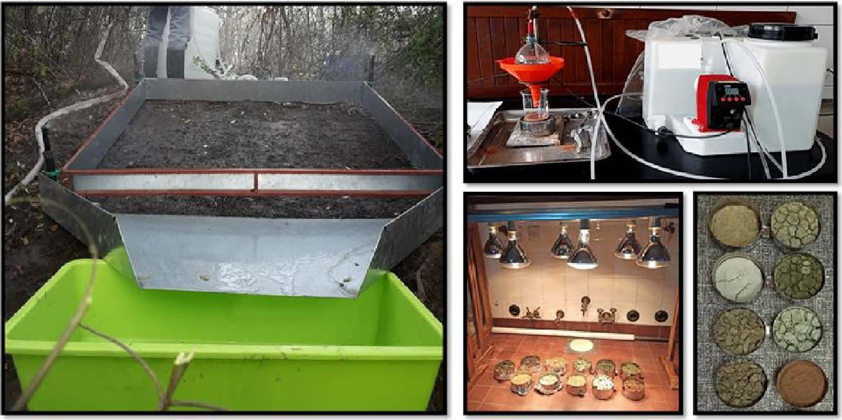
A novelty in the research will be a laboratory and field simulation of potential climate scenarios (panel 1) that will help understand the possibility of UF adapting to soil degradation processes and nutrient losses due to CC. The simulation of different climate scenarios is based on analysis of existing data. Information on precipitation frequency and intensity will be the basis for experimental simulations of precipitation and temperature intensity in the laboratory and in the field. Field simulation of different climate scenarios will be conducted with a modified portable field rainfall simulator presented in the paper by Živanović et al. (2022). The modifications will concern obtaining the rainfall intensity of the selected scenarios. The simulations will be carried out according to the established procedure for each area with a sufficient number of repetitions. During the simulation, changes in soil shear strength will be monitored with portable devices. Soil erosion and surface runoff will also be measured. In the laboratory, simulations of different climate scenarios will be conducted. During these simulations, the properties of the leached soil will be monitored

Defining ES as useful for monitoring and assessing CSUF will contribute to planning for the adaptation of UF to CC conditions and to improving the existing UF management planning system. The assessment of ES in UF will be done using the Protected Areas Benefits Assessment Tool (PA-BAT+). The objective of using PA-BAT+ is to: generate knowledge, encourage changes, use and develop ecological, cultural, social and economic services that selected UF areas provide, informing national and regional decision makers who support UF in order to encourage sustainable development and wise use of natural resources.
The proposal of restoration measures to plan for the adaptation of UF to CC conditions and to mitigate the effects of soil degradation processes will be made based on the principle of ecological engineering and NBS. The principles of ecological engineering are based on the planting of appropriate species and the development of environmentally desirable technical solutions and measures to prevent soil degradation. NBS are activities aimed at the protection, sustainable management and restoration of natural and altered ecosystems that address societal challenges in an effective and adaptive manner, while ensuring human and biodiversity benefits. They offer a real opportunity to significantly address a range of sustainability crises, including CC, freshwater and food security, soil degradation and biodiversity loss. Within UrbanFoS, biochar will be explored as an NBS to improve soil productivity. The use of biochar can improve soil structure, soil aggregate stability and porosity, water retention capacity and nutrient cycling, tensile and penetration resistance and soil infiltration, as well as reduce runoff and decrease erosion. The proposed measures determined will significantly reduce or completely neutralize the negative impacts on soil quality and therefore on the entire forest ecosystem. The proposed NBS will be in line with the Global Standard for Nature-Based Solutions.
Theoretical conceptualization
The CSF is an evolving concept and its definition marks the current stage in the development of the concept, not an end point. Therefore, the CSF concept is only meaningful if appropriate criteria and indicators to monitor whether the principles outlined in the definition are being adopted over time. One of the highest-ranking indicators on the CSF list is linked to soil degradation. UrbanFoS addresses gaps in knowledge about soil conditions, pressures and UF degradation processes and aims to define key information to support decision-making towards climate and sustainability goals. UrbanFoS also tests soil behavior in various climates with the aim of mitigating UF degradation and sustaining the supply of several ES essential to sustain biodiversity and human livelihoods and well-being.
Results and discussion
UrbanFoS will address issues of thematic importance through a bottom-up approach, which will be developed towards top-down requests for network partners to provide expertise on CSUF topics considered strategically relevant by stakeholders.
UrbanFoS is expected to have an impact on the scientific community, society, economy, industry, health, education and the environment through several aspects:
-
- The results obtained from this project will significantly expand the existing database on UF and thus enable the scientific community as well as stakeholders to inform the public in more detail about the current state of UF.
-
- The presentation of technical information and publications will show that UF management should be based on the results of scientific research on various aspects of the forest ecosystem.
-
- The project introduces a new framework for the valorization of the current and future state of soil and vegetation in UF.
-
- The results of UrbanFoS will provide a realistic basis for reducing soil degradation, which is inevitably caused by the implementation of cultivation or sanitary management activities.
-
- With the implementation of proposals for preventive and corrective anti-erosion measures and works based on the principle of ecological engineering and SBN, soil conditions will be improved.
Final Considerations
UrbanFoS addresses gaps in knowledge about soil conditions, pressures and UF degradation processes and aims to define key information to support decision-making towards climate and sustainability goals. UrbanFoS also tests soil behavior in various climates with the aim of mitigating UF degradation and sustaining the supply of several ES essential to sustain biodiversity and human livelihoods and well-being. Furthermore, determining soil sensitivity properties to CC, together with ES, will pave the way to create a soil degradation index that will focus on the dynamics of soil properties identified as valuable indicators.
UrbanFoS incorporates new methodologies and expertise from analytical techniques, soil properties, climate simulation experiments, ES, ecological engineering and NBS. It develops tools for soil monitoring and predictions of soil behavior under CC and improves prediction of soil-based mitigation, adaptation and ES. The project will use an integrated transdisciplinary approach to its research, which allows it to gain a thorough understanding of the socio-economic drivers and enabling environment, audiences and adoption processes that will influence the uptake of solutions. Including stakeholders ensures that relevant, tailored and timely messages are produced. This increases the chances that the project’s outcomes will actually find their way into the daily practice of stakeholders. The intended end-users will be targeted by the growing evidence base on the project’s technological outcomes and the value of NBS as a CC mitigation and adaptation solution, and its impact on reducing land degradation in the UF. The strategy will identify clear knowledge exchange and impact objectives and intended outcomes through discussion with key stakeholders.
Agradecimentos
This research was supported by the Scientific Fund of the Republic of Serbia, No. 7043, Urban Forest Soil Indicators as a Tool for Climate-Smart Forestry – UrbanFoS.
References
- AMARANTHUS, M. P., PAGE-DUMROESE, D., HARVEY, AL., CAZARES, E.,BEDNAR, L F. Soil compaction and organic matter affect conifer seedling nonmycorrhizal and ectomycorrhizal root tip abundance and diversity. Res. Pap. PNW-RP-494. Portland, OR: U.S. Department of Agriculture, Forest Service, Pacific Northwest Research Station. 12 p, 1996.
- KAŠANIN-GRUBIN, M., VERGARI, F., TROIANI, F., DELA SETA, M. The Role of Lithology: Parent Material Controls on Badland Development. In Badland Dynamicsin the Context of Global Change; Edited by Nadal-Romero, E., Martínez-Murillo, J.F., Kuhn, N.J.; P. 61-109, Elsevier Inc; ISBN: 978-0-12-813054-4, 2018.
- NORMAN, J.M., CAMPBELL, G.S. Canopy structure. In: Pearcy, R.W., Ehleringer, J.R., Mooney, H.A., Rundel, P.W. (eds) Plant Physiological Ecology. Springer, Dordrecht. 1989.
- ŽIVANOVIĆ N., RONČEVIĆ V., SPASIĆ M., ĆORLUKA S., POLOVINA S. Construction and calibration of a portable rain simulator designed for the in situ research of soil resistance to erosion. Soil & Water Res., V17, P. 158–169. 2022.
-
Editor:
Altemar A. Rocha

 Source: Milica (2024)