Ponkan mandarin grafted onto ‘Flying Dragon’ rootstock in ultra-high density planting
Abstract:
Harvesting is a laborious and expensive operation in citrus cultivation. The use of small-size trees induced by dwarfing rootstocks requires adjustments in the planting density in order to rapidly occupy the space in the orchard. The objective of this work was to evaluate plant growth and productive performance of ‘Ponkan’ mandarin grafted onto ‘Flying Dragon’ rootstock in different spacings up to ten years after planting. An experiment was carried out in the municipality of Chapecó, SC, with the following planting spacings: 1.0; 1.25; 1.5; 1.75;2.0 and 2.5 m between trees in the row, keeping 5.0 m between rows. Tree growth, fruit production, and economic viability of each planting spacing were evaluated up to the tenth year. Narrower spacings resulted in taller, wider and lessproductive trees. However, with narrower spacings, canopy volume, fruit production, and internal return rate were higher. In addition, the payback period was shorter. The results of this study showed that the planting spacing of 1.0 m x 5.0 m maximizes productivity with economic advantage over wider spacings in a 10-year-old orchard.
Index terms
Citrus reticulata;; Poncirus trifoliata;; dwarf plant;; cash flow
Resumo:
A colheita é uma operação trabalhosa e custosa no cultivo de citros, geralmente feita de forma manual. Quanto mais altas as árvores, mais difícil será a colheita. O uso de árvores de pequeno porte, mediado por porta-enxertos anões, exige um ajuste na densidade de plantio para ocupar rapidamente a área no pomar. O objetivo deste trabalho foi avaliar o crescimento e o desempenho produtivo de tangerineiras ‘Ponkan’ enxertadas sobre ‘Flying Dragon’ em diferentes espaçamentos, até dez anos em condições de campo. Um experimento foi realizado em Chapecó-SC, testando espaçamento de 1,0; 1,25; 1,5; 1,75; 2,0 e 2,5 m entre plantas na linha, mantendo 5.0 m entre linhas. Até o décimo ano, foram avaliados o crescimento, a produção de frutos e a viabilidade econômica de cada espaçamento. Espaços menores resultaram em árvores mais altas, mais largas e menos produtivas.Porém, com espaçamento menor, o volume da copa, a produção de frutos e a taxa interna de retorno foram maiores, e o tempo de retorno diminuiu. Os resultados mostram que o espaçamento de 1.0 m x 5.0 m maximiza a produtividade com vantagem econômica em relação a espaçamentos maiores, em pomar com 10 anos pós-plantio.
Termos para indexação
Citrus reticulata;; Poncirus trifoliata;; planta-anã;; fluxo de caixa
Introduction
‘Ponkan’ (Citrus reticulata Blanco) is the main mandarin variety grown in Brazil, due to its large size, easiness of peeling and sweetness.
Trees grow vertically, higher than other mandarin cultivars, reaching more than 4.0 m in less than 10 years after planting (PIO et al., 2006). The very tall trees hinder harvesting practices whereas workers need more time per tree and per fruit volume, implying in lower harvest efficiency (GIRARDI et al., 2021).
Very tall trees make harvesting difficult, as workers need more time per tree and per amount of fruits, resulting in lower harvest efficiency.
The best technology available for reducing the size of citrus trees is the use of semidwarf or dwarfing rootstocks (COSTA et al., 2021; HAYAT et al., 2022). ‘Flying Dragon’ trifoliate orange [Poncirus trifoliata (L.) Raf. var.monstrosa] is the main example of dwarfing rootstock. In addition to severely reducing plant size, they also induce early maturation, greater production efficiency and better fruit quality compared to standard rootstocks, although individual tree production is lower than that of standard rootstocks.
(CANTUARIAS-AVILES et al., 2012; BOWMAN; JOUBERT, 2020). The yield per area unit is the product of the fruit yield per plant and the number of plants per area unit (HAQUE; SAKIMIN, 2022). Reducing tree space can overcome the lower production per tree.
High-density planting is a relatively new concept in orchards worldwide, which begun to be applied in temperate crops of Europe. It consists of accommodating higher number of trees per area unit to maximize production and fruit quality. It differs from traditional systems by presenting smaller trees, earlier bearing, higher yields, less labor, lower production cost, easier harvesting and high-quality fruits (SINGH; SINGH, 2018).
In the state of Santa Catarina, tree spacing of at least 5.0 x 2.0 m is recommended for mandarin orchards. However, scientific studies on mandarin tree spacing using dwarfing rootstocks are scarce. Brugnara and Sabião (2021) reported some promising results, but with data from a seven-yearold orchard. In this study, the authors show results of ‘Ponkan’ mandarin grafted onto ‘Flying Dragon’ rootstock using different tree spacings for tree growth and productive performance in a 10-year-old orchard.
Material and Methods
An experiment was carried out in the municipality of Chapecó, state of Santa Catarina, Brazil (Cfb climate; 450m a.s.l.). The local soil is a Cambisol, which was previously sampled up to the depth of 20 cm for chemical characterization, resulting in ph = 5.5, and (per dm3) P = 9.1 mg, K = 93,6 mg, Ca = 6.6 cmolc, Mg = 6.6 cmolc, CEC pH7.0 = 11.0 cmolc.
‘Ponkan’ trees grafted onto ‘Flying Dragon’ rootstock were planted in November, 2014 with the following treatments: 1.0, 1.25, 1.5, 1.75, 2.0 and 2.5 m between trees in the row, and 5.0 m between rows (for all treatments). The experiment was designed in random blocks with four replicates (four trees per plot). The experimental orchard management followed standard practices for the region (weed and pest control, training and pruning, fertilization, hand thinning). The NPK fertilization guidelines provided by the Sociedade Brasileira de Ciência do Solo (SOCIEDADE…, 2016) were adopted. In the first three growth seasons, all trees received the same fertilization.
From then on, fertilizer doses were adjusted for each experimental treatment according to the expected equivalent fruit production per hectare. Manual thinning was performed, maintaining one fruit per terminal branch shorter than 10 cm, or two on larger branches.
All harvested fruits were counted and weighed. Plant size was assessed by measuring height (H) and canopy diameter, transverse diameter (TD), and longitudinal diameter (LD) along the row. However, when LD was greater than the spacing between plants in the row, spacing was assumed to be LD. Thus, the volume occupied by the canopies or row of canopies (V) was calculated as
where Vis the canopy volume, LD and TD are the canopy diameters (transversal and longitudinal to the row), and H is the canopy height (CODER, 2000).
After measuring, plants were pruned.
For the first six years, one or two vertical branches were removed each year to open the canopy. Subsequently, skirts were also pruned, and all pruned branches were weighed while still fresh.
The response variables were submitted to analysis of variance. If the effect of treatment was significant, nonlinear exponential and logarithmic models, and first-grade linear models were adjusted to the response.
The logistic model was
whereas y is the response value, x is the spacing between trees in the row, Assym is the asymptote, xmid is the x value corresponding to half of the asymptote, and scal is a scale parameter. The exponential model was
y= b1 X e b2 x x
whereas b1 is the y value when x is zero and b2 is growth rate . The linear first-grade model was
whereas a is the y value when x is zero, and b is the growth rate. The best-fit model was chosen by the smallest AIC (Akaike’s Information Criterion). All analyses were performed using the R 4.3.0 software with the MASS package (VENABLES; RIPLEY, 2002; R CORE TEAM, 2021).
The cash flow was calculated based on data collected in the experiment. The costs involving taxes, nursery trees, fertilizers, pesticides, harvest, pruning and thinning labor were considered space dependent, while tools, boxes, machine hours, administration labor, land rental, and windbreaks were uniform among treatments. Technical coefficients from literature (ROCKEMBACH; KOLLER, 2013) were also used. All values (R$) were collected from the region of Chapecó during September, 2024. Revenue was R$1.50 per kilogram of fruit. Costs and incomes were corrected to present value at a rate of 3% per year. The internal return rate (IRR) and the investment payback time were also calculated.
Results and Discussion
Results
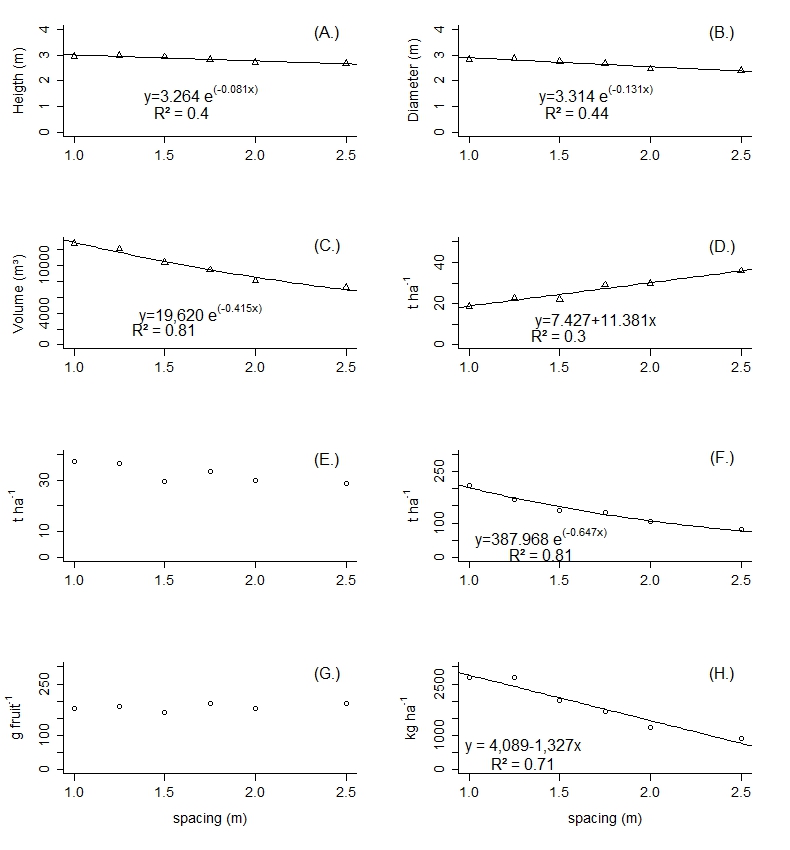
Tree height measured after ten years was significantly affected by tree density (Anova, p=0.03). Trees spaced 5.0 m x 2.5 m reached 2.68 m in height. A non-linear exponential model fit to data (Table 1). The estimated height reached 3.01 m in the 5.0 m x 1.0 m spacing, 0.34 m more than in the largest tree spacing (Figure 1A). The canopy transversal diameter was affected by tree spacing (p<0.01). The exponential model fitted to data (Figure 1B), estimating trees with 2.91 m in width in the 5.0 m x 1.0 m spacing, 52 cm more than with the 5.0 m x 2.5 m spacing. The volume of row or tree canopy by hectare was bigger in the narrower spacing (Anova, p<0.01) (Figure 2). A non-linear exponential model was adjusted to the data. The estimated volume with 2.5 m x 5.0 m was 6,947 m³, which was increased to 12,952 m³ in the narrowest spacing (Figure 1C). The canopy volume per hectare of trees or rows was greater at narrower spacings (ANOVA, p>0.01) (Figure 2). An exponential nonlinear model was fitted to data.
Linear and nonlinear models with best adjust to response variables with significant effect of spacings and the statistical significance of their parameters.
Average individual tree yield in the last three harvests was affected by tree spacing (p<0.01). The adjusted model (Table 1; Figure 1D) estimated yield of 35.88 kg for the largest tree spacing (5.0 m x 2.5 m). Each meter of reduction in tree spacing decreased the yield by 11.381 kg, reaching 18.81 kg in the 5.0 m x 1.0 m spacing, a 48% loss. Conversely, the hectare-equivalent yield showed no significant difference among treatments (p = 0.21).
The global yield was 32.51 t ha-1 on average (Figure 1E). Over the entire orchard lifespan, the cumulative fruit mass suffered significant effect of tree spacing. An exponential non-linear model was fitted to data (Figure 1F). The model estimated higher cumulative harvest of 203 t in the 5.0 m x 1.0 m spacing, which decreased to 77 t in the 5.0 m x 2.5 m tree spacing. Fruits harvested during the last three years (8th, 9th and 10th) (Figure 1G) had a similar average mass of 182 g (Anova,p = 0.1).
Likewise, the mass of pruned branches did not vary significantly among treatments (p = 0.06). An average of 1.4 kg of fresh branches per tree was yearly pruned. On a hectare basis, higher density with more trees per hectare demanded more pruning (Anova, p < 0.01), which was best explained by the first-grade linear model (Table 1; Figure 1H). Planting 1.0 m closer in the row resulted in 1,327 kg of branches additionally pruned.
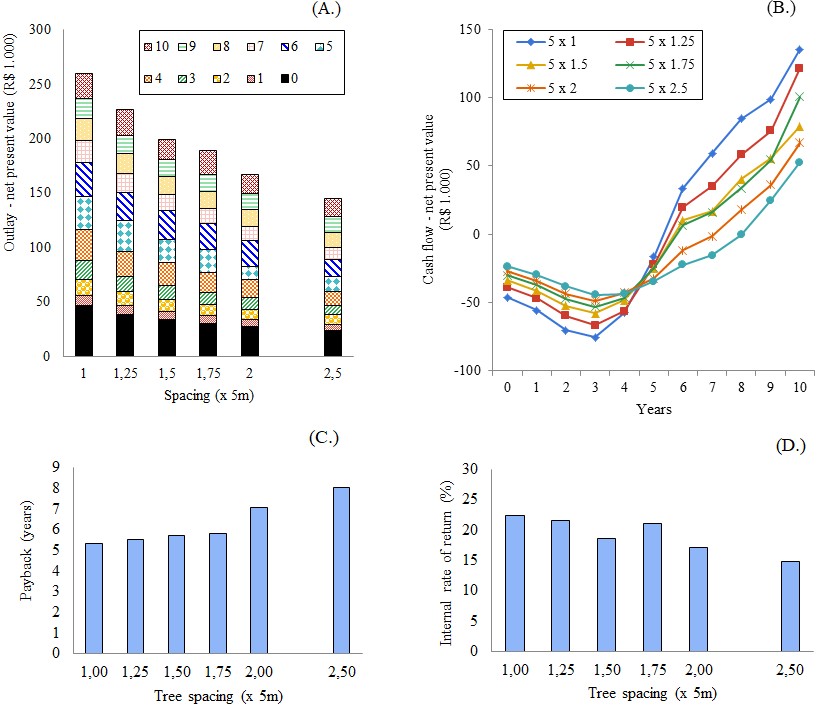
As previously mentioned, higher planting densities increased the orchard establishment cost (up to the planting time) (Figure 2A). For spacing of 5.0 m x 1.0 m, establishment costs amounted to R$ 46.371,92, which is R$ 22.830,28 more compared to the 5.0 m x 2.5 m spacing.
The overall cost up to 10 years with 5.0 m x 1.0 m spacing was 79% higher. Despite the high cost, the smaller spacings produced fruits with lower operating costs per mass unit in the initial years (Figure 2B). In the first harvest, unitary operational cost was R$ 1,89 in the narrowest spacing, while in the largest spacing, the cost was R$ 5,41.
The overall cash flow reached its minimum value in the third year across all spacings (Figure 2C). However, narrower spacing resulted in earlier investment recovery. In the 5.0 m x 1.0 m and the 5.0 m x 1.25 m spacings, the return time on invested capital occurred in 5.33 and 5.53 years (Figure 2D), in contrast to the 8.02 years with the 5.0 m x 2.5 m spacing. The IRR was positive, but higher in the 5 m x 1 m spacing (22.39%, while in the 5 m x 2.5 m spacing, it was 15%) (Figure 2D).
Plant height (A), canopy diameter transverse to the row (B), canopy volume per hectare of plants or rows (C), annual fruit harvest per plant (D) and per hectare (E) in the last three har-vests, total mass of fruit harvested per hectare in ten years (F), average fruit mass in the last three harvests (G) and average fresh mass of pruned branches in five years (H) in ‘Ponkan’ mandarin trees grafted onto ‘Flying Dragon’ rootstock, according to different plant spacing (m) in the row (x-axis), ten years after planting. Chapecó, Brazil, 2014-2024. The significance of the parameters is given in Table 1.
(A) Costs during installation (black) and in subsequent years (1 to 10); (B) Cash flow at different tree spacings over 10 years; (C) Investment payback time and (D) internal return rate atdifferent spacings.
Discussion
The present article reports the results of a long term (10 years) experiment on the performance of ‘Ponkan’ trees grafted onto ‘Flying Dragon’ rootstock, planted in different spacings in the row, which is equivalent to changing plant density. Densities varied from 800 to 2,000 trees ha-1, which can be considered high to ultra-high densities (LADANIYA et al., 2021).
A previous report was published by the authors of this experiment, containing the results up to the seventh growth season. Until then, tree height (2.4 m) and transversal diameter (1.97 m) had not been affected by tree density (BRUGNARA; SABIÃO, 2021).
However, three years later, the plants grew to over 3.18 m at the 5.0 x 1.0 m spacing (Figure 1), despite the vertical branches having been partially pruned. Even at the largest distance between plants (5.0 x 2.5 m), an increase in canopy size was observed, showing that plants had not yet reached adult size.
In nine-year-old orange trees grafted onto dwarfing and super-standard rootstocks, no effect of tree density until 1,000 trees per hectare was reported (GIRARDI et al., 2021).
However, another experiment with Citrus reticulata ‘Nagpur’ resulted in taller trees in higher densities (LADANIYA et al., 2021). The effect observed in this experiment and in ‘Nagpur’ mandarin can be explained by the ultra-high density tested or by the fertilizer doses per plant, since the orange trees received a fixed dose per area.
Canopy diameter measured transversally to the row also increased up to 2.9 m in the narrower tree space. Opposite results on orange trees were reported by Girardi et al. (2021): higher density resulted in narrower canopies. The significant response on tree height and diameter shows that the canopy of ‘Ponkan’ mandarin grafted onto ‘Flying Dragon’ has its morphology modified by the reduction in tree density.
Interspecific competition by light may have caused trees to grow in height, and towards the inter-row area, where light availability is higher. Another hypothesis to explain the wider canopies is that some branches grew vertically, and more in shorter tree spacings or in higher densities, leaning due to the weight of fruits, invading the space between rows proportionally to the height they reached, that is, the higher the growth, the wider the canopy.
Trees spaced 2.5 m in the row reached, on average, 2.4 m in both longitudinal and transversal diameters (data not shown), which suggests that there was no interspecific competition for light among trees, or it was null or insignificant. In the other tree spacings, the 10-year-old tree canopies overlapped, forming a continuous canopy, where branches from one tree invaded the canopies of neighboring trees. This fact makes the longitudinal diameter an inappropriate metric for quantifying the volume of each tree canopy individually. Therefore, measuring the row volume seems to be a more suitable approach.
Taller and wider trees in the shortest spacing with higher tree density resulted in higher equivalent tree/row volume by hectare (Figure 1C). Similar results were reported by Girardi et al. (2021) for ‘Valência’ orange [Citrus sinensis (L.) Osb]: the canopy volume per hectare increased when tree density increased from 513 to 1,000 trees per hectare.
Additionally, within the same density, the use of a super-standard rootstock resulted in greater volume compared to a dwarfing rootstock. The canopy volume is associated with the capacity of trees to intercept and use the photosynthetically active radiation incident on the soil (LADANIYA et al., 2021).
This is why a large number of fruit were harvested by hectare in the shorter spacings despite its smaller yield per tree. Therefore, a large number of fruits were harvested per hectare in the smaller spacings despite their lower productivity per plant. A comparison of the canopy volume of ‘Ponkan’ mandarin grafted onto ‘Flying Dragon’ rootstock with other mandarins can be made using data from Brugnara and Sabião (2020). The authors evaluated ‘Mexirica do Rio’ (Citrus deliciosa Ten.) and ‘Clemenules’ (Citrus clementina Hort. ex Tan.) varieties grafted onto ‘Swingle’ standard rootstock, with spacing of 7.0 m x 3.0 m. The nine-year-old tangerine trees reached nearly 18 m³, which is double the canopy volume of ‘Ponkan’ mandarin grafted onto ‘Flying Dragon’ rootstock.
This significant difference highlights the necessity of using smaller spacing with ‘Flying Dragon’ rootstock to ensure adequate canopy volume per hectare, which is crucial for achieving high fruit yield.
As demonstrated in (Figure 1A and B), denser orchards lead to taller and wider trees, which makes managing and harvesting difficult.
‘Valência’ sweet orange trees grafted onto a super-standard rootstock increases harvest operation time and the need of ladders, requiring approximately three times more time to be harvested compared to dwarf rootstocks (GIRARDI et al., 2021).
Furthermore, wider plant rows, as in treatments with closer plants, reduce the space between rows, which limits the width of machines that can enter the orchard for spraying or mowing, or requires greater distance between rows to allow free movement.
Trees planted at 5.0 m x 1.0 m spacing averaged 38.5 t ha-1 in the last three harvests, which is similar to results obtained by Brugnara and Sabião (2020) with ‘Mexirica do Rio’ and ‘Clemenules’ mandarins grafted onto ‘Swingle’ rootstock (38 t ha-1) (mean of sixth to ninth season) in a similar environment.
In the state of Minas Gerais, Brazil, another experiment with 12-year-old ‘Ponkan’ mandarin grafted onto a standard rootstock, with and without pruning, resulted in average yield up to around 40 t ha-1 (MENDONÇA et al., 2008). It means that until the present moment, even with the spacing tested for obtaining ultra-high density orchard, there was no limit to the orchard’s productive performance. In contrast, if the tested spacings produce equally on average over three years, the cumulative amount of fruit harvested up to the eighth harvest was much higher in the smaller spacings (Figure 1H), mainly due to the greater number of trees per hectare, which is very important in the initial years when the individual plants do not yet occupy the area efficiently (HAQUE; SAKIMIN, 2022).
Average fruit mass is important in mandarin since its consumption is mostly in the fresh form. In this experiment, there was no effect of tree spacing (Figure 1).
Even in ultra-high density planting of the vigorous Citrus aurantifolia, no effect on fruit size was observed (LADANIYA et al., 2020), which is in agreement with the results obtained in Chapecó. However, in India, Salik et al.(2023) observed reduction in fruit size of C.reticulata ‘Kinnow’ cultivar when planted at 3.05 m x 3.05 m instead of 4.3 m x 4.3 m or more, which was associated with reduction in the number of seeds.
In the years prior to the present experiment, (four initial harvests), fruit mass averaged 161g, with no effect of spacing (BRUGNARA; SABIÃO, 2021). Silva (2024) observed that ‘Ponkan’ mandarins grafted onto ‘Flying Dragon’ rootstock weighed 151g on average, less than those grafted onto other rootstocks. Trees grafted onto ‘Flying Dragon’ have low hydraulic conductance in its roots and bud union, which, in high atmospheric evaporative demand, leads to stomatal closing, avoiding gas exchanges, and limiting photosynthesis (MARTÍNEZ-ALCÁNTARA et al., 2013), which can explain the size of fruits produced.
On average, trees were pruned uniformly in terms of mass of removed branches, although the decision was partially dependent on subjective criteria. The mass of pruned branches can be considered small compared to the results of Chueca et al. (2021) with ‘Navel Foyos’ oranges (on 'Carrizo' citrange), where 11 kg were pruned per tree. Even with the few intense pruning in Chapecó, trees continued to be shorter, because the ‘Flying Dragon’ rootstock effectively limits canopy expansion.
High-density planting systems without adequate rootstock to control tree size leads to intense pruning, which causes trees to flush more intensely (AL-SAIF et al., 2023), favoring the occurrence of diseases and pests associated to young tissues like Phyllocnistis citrella Stainton and citrus canker (LADANIYA et al, 2020). Therefore, using a high-density planting system for ‘Ponkan’ mandarin with adequate dwarfing rootstocks such as ‘Flying Dragon’ would be important in case huanglongbing (HLB) becomes an endemic disease, since lower HLB incidences have been observed in trees grafted onto ‘Flying Dragon’ compared do standard rootstocks (RODRIGUES et al., 2020; SILVA et al., 2024; VITÓRIA et al., 2024).
Initial costs for orchard installation and the cost of annual operation tend to be higher in orchards planted in narrower spacings (Figure 2A). Costs up to the second season were 1.85 times higher. However, when fruit production started in the third season, denser plantings resulted in higher incomes and faster investment returns (shorter payback time) (Figure 1C).
From a capital allocation point of view, narrower spacings are more interesting due to the faster payback and the higher internal return rate (Figure 1C), which represents how much money the investor will recover for each money unit invested. Faster payback and higher profitability in denser orchards are in agreement with observations applying spacings of 6.0 m x 2.0 m and 8.0 m x 6.0 m for ‘Valência’ sweet orange grafted onto ‘Cravo’ rangpur lime (standard rootstock) (KOLLER et al., 1999).
The largest spacing resulted in profit equivalent to 14% the profit of the smallest spacing after the 14th year of orchard implementation.
On the other hand, also with more vigorous trees (C. aurantifolia), high density and ultra-high density were similar in profitability, but higher, compared to the conventional density (7-year-old orchard) (LADANIYA et al., 2021).
In contrast, with‘Hamlin’ and ‘Valencia’ sweet oranges, and ‘Murcott’ tangor, on 15 different rootstocks, Wheaton et al. (1991) found little advantage of 2,020 trees ha-1 over less than 1,000 trees ha-1 under Florida conditions. They also observed that ‘Murcott’ performed well under high densities due to its upright growth habit, analogous to ‘Ponkan’, and smaller trees. Unlike the present results, Wheaton et al. (1991) also concluded that dwarfing rootstocks like ‘Flying Dragon’ performed worse than the standard ‘Swingle’ rootstock, which encourages testing more vigorous rootstocks under high-density systems in Santa Catarina.
Data Availability
The data that support the findings of this study are available from the corresponding author, Brugnara, E.C., upon reasonable request.
Acknowledgement
Dr. Osvino Leonardo Koller by helping with the experimental design, funding, project administration and production of nursery trees. Mr. Paulo Cesar De Quadros Barreto and family, for providing the land where the experiment was installed.
References
-
AL-SAIF, A.M.; ABDEL-AZIZ, H.F.; KHALIFA, S.M.; ELNAGGAR, I.A.; ABD EL-WAHED, A.E.-W.N.; FAROUK, M.H.; HAMDY, A.E. Pruning boosts growth, yield, and fruit quality of old valencia orange trees: a field study.Agriculture, Basel, v.13, n.9, p.1-14, 2023. https://doi.org/10.3390/agriculture13091720
» https://doi.org/10.3390/agriculture13091720 - BOWMAN, K.D.; JOUBERT, J. Citrus rootstocks. In: TALON, M.; CARUSO, M.; GMITTER, F.G. (ed.) The genus citrus Cambridge: Woodhead Publishing, 2020, p.105-27. https://doi.org/10.1016/b978-0-12-812163-4.00006-1
-
BRUGNARA, E.C.; SABIÃO, R.R. Desempenho de tangerinas precoces enxertadas em citrange Carrizo e citrumelo Swingle. Citrus Research and Technology, Cordeirópolis, v.41, n.e1058, p.1-8, 2020. https://doi.org/10.4322/crt.20619
» https://doi.org/10.4322/crt.20619 -
BRUGNARA, E. C.; SABIÃO, R. R. Viabilidade de redução do espaçamento de plantio da tangerineira Ponkan enxertada em trifoliateiro Flying Dragon. Citrus Research and Technology, Cordeirópolis, v. 42, n.e1070, p.1-8, 2021. https://doi.org/10.4322/crt.24421
» https://doi.org/10.4322/crt.24421 -
CANTUARIAS-AVILÉS, T.; MOURÃO FILHO, F.A.A.; STUCHI, E.S.; SILVA, S.R.; ESPINOZA-NUNEZ, E.; BREMER NETO, H. Rootstocks for high fruit yield and quality of 'Tahiti' lime under rain-fed conditions. Scientia Horticulturae, New York, v.142, p.105-11, 2012. https://doi.org/10.1016/j.scienta.2012.05.008
» https://doi.org/10.1016/j.scienta.2012.05.008 -
CHUECA, P.; MATEU, G.; GARCERÁ, C.; FONTE, A.; ORTIZ, C.; TORREGROSA, A. Yield and economic results of different mechanical pruning strategies on “Navel Foyos” oranges in the mediterranean area. Agriculture, Basel, v.11, n.1, p.2-12, 2021. https://doi.org/10.3390/agriculture11010082
» https://doi.org/10.3390/agriculture11010082 - CODER, K. D. Crown shape factors and volumes Athens: University of Georgia Cooperative Extension Service Forest Resources, 2000. 5p.
-
COSTA, D.P.; STUCHI, E.S.; GIRARDI, E.A.; MOREIRA, A.S.; GESTEIRA, A.S.; COELHO FILHO, M.A.; LEDO, C.A.S.; SILVA, A.L.V.; LEÃO, H.C.; PASSOS, O.S.; SOARES FILHO, W.S. Less Is More: a hard way to get potential dwarfing hybrid rootstocks for Valencia sweet orange. Agriculture, Basel, v.11, n.4, p.2-21, 2021. https://doi.org/10.3390/agriculture11040354
» https://doi.org/10.3390/agriculture11040354 -
GIRARDI, E.A.; SOLA, J.G.P.; SCAPIN, M.D.S.; MOREIRA, A.S.; BASSANEZI, R.B.; AYRES, A.J.; PEÑA, L. The perfect match: adjusting high tree density to rootstock vigor for improving cropping and land use efficiency of sweet orange. Agronomy, Madison, v.11, n.12, 2569, 2021. https://doi.org/10.3390/agronomy11122569
» https://doi.org/10.3390/agronomy11122569 -
HAQUE, M. A.; SAKIMIN, S. Z. Planting arrangement and effects of planting density on tropical fruit crops - a review. Horticulturae, Basel, v.8, n.6, 485, p.1-17, 2022. https://doi.org/10.3390/horticulturae8060485
» https://doi.org/10.3390/horticulturae8060485 -
HAYAT, F. L.I.J.; IQBAL, S., PENG, Y.; HONG, L.; BALAL, R.M.; KHAN, M.N.; NAWAZ, M.A.; KHAN, U.; FARHAN, M.A.; LI, C.; SONG, W.; TU, P.; CHEN, J. A mini review of citrus rootstocks and their role in high-density orchards. Plants, Basel, v.11, n.21, p.2876, 2022. https://doi.org/10.3390/plants11212876
» https://doi.org/10.3390/plants11212876 - KOLLER,. O. C.; SCHWARZ, S . F.; PANZENHAGEN, N. V. Espaçamentos de plantio para a laranjeira ‘Valência’ enxertada em três porta-enxertos. Revista da Agronomia, v.12, n.1, p.1-325, 1999.
-
LADANIYA, M.S.; MARATHE, R.A.; DAS, A.K.; RAO, C.N.; HUCHCHE, A.D.; SHIRGURE, P.S.; MURKUTE, A.A. High density planting studies in acid lime (Citrus aurantifolia Swingle). Scientia Horticulturae, New York, v.261, n.5, p.108935, 2020. https://doi.org/10.1016/j.scienta.2019.108935
» https://doi.org/10.1016/j.scienta.2019.108935 -
LADANIYA, M.S.; MARATHE, R.A.; MURKUTE, A.A.; HUCHCHE, A.D.; DAS, A.K.; GEORGE, A.; KOLWADKAR, J. Response of Nagpur mandarin (Citrus reticulata Blanco) to high density planting systems. Scientific Reports, London, v.11, n.10845, p.1-11, 2021. https://doi.org/10.1038/s41598-021-89221-4
» https://doi.org/10.1038/s41598-021-89221-4 -
MARTÍNEZ-ALCÁNTARA, B.; RODRIGUEZ-GAMIR, J.; MARTÍNEZ-CUENCA, M. R.; IGLESIAS, D. J.; PRIMO-MILLO, E.; FORNER-GINER, M. A. Relationship between hydraulic conductance and citrus dwarfing by the Flying Dragon rootstock (Poncirus trifoliata L. Raft var. monstruosa). Trees, v.27, n. 629, 2013. https://doi.org/10.1007/s00468-012-0817-1
» https://doi.org/10.1007/s00468-012-0817-1 -
MENDONÇA, V.; RAMOS, J.D.; ARAÚJO NETO, S.E.; RUFINI, J.C.M. Produção da tangerineira 'ponkan' após poda de recuperação. Ciência e Agrotecnologia, Lavras, v.32, n.1, p.103-9, 2008. https://doi.org/10.1590/S1413-70542008000100015
» https://doi.org/10.1590/S1413-70542008000100015 -
PIO, R.M.; AZEVEDO, F.A.; NEGRI, J. D.; FIGUEIREDO, J.O.; CASTRO, J.L. Características da variedade Fremont quando comparadas com as das tangerinas Ponkan e ‘Clementina Nules’. Revista Brasileira de Fruticultura, Jaboticabal, v.28, n.2, p.222-6, 2006. https://doi.org/10.1590/S0100-29452006000200015
» https://doi.org/10.1590/S0100-29452006000200015 -
R CORE TEAM. R: A language and environment for statistical computing. Vienna: R Foundation for Statistical Computing, 2021. Disponível em: https://www.R- project.org/
» https://www.R- project.org/ - ROCKEMBACK, I.H.; KOLLER, O.L. Custo de produção e fluxo de caixa. In: KOLLER, O.L. (prg.). Citricultura catarinense Florianópolis: Epagri, 2013. p.311-9.
-
RODRIGUES, J.D.B.; MOREIRA, A.S.; STUCHI, E.S.; BASSANEZI, R.B.; LARANJEIRA, F.F.; GIRARDI, E.A. Huanglongbing incidence, canopy volume, and sprouting dynamics of ‘Valencia’ sweet orange grafted onto 16 rootstocks. Tropical Plant Pathology, Brasília, DF, v.45, n.5, p.611–19, 2020. https://doi.org/10.1007/s40858-020-00385-2
» https://doi.org/10.1007/s40858-020-00385-2 -
SALIK, M.R.; AFZAL, M.B.S.; KOMAL, A.; KHAN, M.N.; ULLAH, M.I.; ALTAF, F.; HAYAT, A.; TARIQ, H. Effect of different plant spacing on growth, yield and fruit quality of Kinnow mandarin Citrus reticulata in Sargodha, Punjab, Pakistan. Pakistan Journal of Agricultural Research, Islamabad, v.36, n.3, p.230-8, 2023. https://doi.org/10.17582/journal.pjar/2023/36.3.230.238
» https://doi.org/10.17582/journal.pjar/2023/36.3.230.238 - SILVA, G. S. Desempenho horticultural, incidência e severidade de Huanglongbing em tangerineira Ponkan enxertada em diferentes porta-enxertos. 2024. 80 f. Dissertação (Mestrado em Agronomia) – Faculdade de Ciências Agrárias e Veterinárias, Universidade Estadual Paulista, Jaboticabal, 2024.
- SINGH, S.; SINGH, R.K. Density concept of orcharding. International Journal of Advanced Scientific Research and Management, Mandsaur, nesp.1, p.56-61, 2018.
- SBCS - Sociedade Brasileira de Ciência do Solo. Manual de calagem e adubação para os Estados do Rio Grande do Sul e de Santa Catarina Passo Fundo: Comissão de Química e Fertilidade do Solo - RS/SC, 2016. 376 p.
- VENABLES, W. N.; RIPLEY, B. D. Modern Applied Statistics with S 4.ed. New York: Springer, 2002. 498p.
-
VITÓRIA, M.F.; SILVA, L.N.; MOREIRA, A.S.; STUCHI, E.S.; GIRARDI, EA. Horticultural performance and huanglongbing impact on rainfed Valencia sweet orange grafted onto 16 rootstock genotypes. Bragantia, Campinas, v.83, n.e20230153, 2024. https://doi.org/10.1590/1678-4499.20230153
» https://doi.org/10.1590/1678-4499.20230153 -
WHEATON, T.A.; CASTLE, W.S.; WHITNEY, J.D.; TUCKER, D.P.H. Performance of citrus scion cultivars and rootstocks in a high density planting. Hort Science, Alexandria, v.26, n.7, p.837-40, 1991. https://doi.org/10.21273/HORTSCI.26.7.837
» https://doi.org/10.21273/HORTSCI.26.7.837
Edited by
-
Scientific Editor
Alexandre Pio Viana
-
Associate Editor
Luis Eduardo Correa Antunes