Timing of first benzyladenine spray and tree height influence feathering, growth and quality of apple nursery trees
Abstract:
Planting feathered nursery trees enhances precocity and profitability in apple orchards. In the present investigation, an effort was made to develop an efficient technique for feather induction in apple nursery trees of ‘Gala Mast’ and ‘Oregon Spur’ using repeated benzyladenine sprays. The present investigation aimed to determine the timing of the first benzyladenine spray in relation to new terminal growth and the ideal height of one-year-old nursery trees for producing high-quality feathered nursery trees. The timing of the first benzyladenine spray, relative to new terminal growth greatly affected feather numbers and other quality determinants. The results indicate that at least 10 cm of terminal growth is required to initiate feathering. However, the optimal growth stage for the initial spray varies depending on the cultivar. For ‘Gala Mast,’ the first spray applied at 10–15 cm of terminal growth yielded the best results (9.5 feathers), whereas for ‘Oregon Spur,’ 15–20 cm of new growth proved most effective (7.5 feathers). The height of the one-year-old nursery tree used for feather induction through benzyladenine application also significantly influences the feathering response and overall growth. One-year-old nursery trees with 70–80 cm in height were found to be most appropriate for feathering (10.33 feathers).
Index terms
cytokinin; lateral branching; nursery tree quality; phytohormone; sylleptic shoot
Resumo:
O plantio de mudas de viveiro com ramos laterais (mudas pré-formadas) aumenta a precocidade e a rentabilidade em pomares de macieira. Na presente investigação, buscou-se desenvolver uma técnica eficiente para a indução de ramos laterais em mudas de macieira das cultivares ‘Gala Mast’ e ‘Oregon Spur’, utilizando pulverizações repetidas de benziladenina. O objetivo deste estudo foi determinar o momento da primeira pulverização de benziladenina em relação ao novo crescimento terminal e a altura ideal de mudas de um ano para a produção de mudas ramificadas de alta qualidade. O momento da primeira pulverização, em relação ao novo crescimento terminal, afetou significativamente o número de ramos laterais e outrosdeterminantes de qualidade. Os resultados indicam que são necessários pelo menos 10 cm de crescimento terminal para iniciar a ramificação. No entanto, o estágio de crescimento ideal para a pulverização inicial varia conforme a cultivar. Para a ‘Gala Mast’, a primeira pulverização aplicada entre 10–15 cm de crescimento terminal apresentou os melhores resultados(9,5 ramos), enquanto para a ‘Oregon Spur’, 15–20 cm de novo crescimento mostrou-se mais eficaz (7,5 ramos). A altura da muda de um ano utilizada para a indução de ramos via aplicação de benziladenina também influencia significativamente a resposta de ramificação e o crescimento global. Mudas com 70–80 cm de altura foram consideradas as mais adequadas para a ramificação (10,33 ramos).
Termos para indexação
citocinina; ramificação lateral; qualidade de mudas de viveiro; fitormônio; ramos silépticos
Introduction
Planting well-feathered apple nursery trees significantly enhances early orchard productivity by increasing the fruit-bearing area (KUMAWAT et al., 2024).
Therefore, the use of high-quality feathered nursery trees is crucial for achieving early returns on the significant investment required for establishing high-density apple orchards. In apple nursery trees, lateral shoots can develop after a period of rest (proleptic shoots) or immediately at the same time as the extension of the parent shoot (sylleptic shoots, referred to as feathers henceforth in the present study).
The tendency for spontaneous proleptic branching in apple nursery trees is very low, and physical intervention like notching successfully induce proleptic shoots in apple nursery trees (MCARTNEY; OBERMILLER, 2015). Similarly, most apple cultivars exhibit poor spontaneous feather formation in nurseries due to strong apical dominance (SAZO; ROBINSON, 2011; RADIVOJEVIĆ et al., 2016; KUMAWAT et al., 2020), and leaf pinching (LAŇAR et al., 2018) and plant growth regulators with cytokinin- like activity or which interact with auxin- mediated effects are capable of inducing feathering in apple nursery trees (LORDAN et al., 2017; RUFATO et al., 2019; NEČAS et al., 2020; LAŇAR et al., 2020; KUMAWAT et al., 2020, 2023; KAPLAN et al., 2023).
Inducing feathers in apple nursery trees is preferred over proleptic shoots because they develop quickly without dormancy, allowing faster, and evenly distributed shoots (feathers) of desirable vigor (length and diameter) at appropriate heights by utilizing current season growth, which ensures high-quality nursery trees. Thus, the induction of feathers aligns with the goals of producing well-branched, high-quality nursery trees in a time-efficient manner.
The application of benzyladenine (BA) temporarily interrupts apical dominance and successfully induces desirable feathering in one-year-old apple nursery trees (LORDAN et al., 2017; KUMAWAT et al., 2020, 2023). However, the response of nursery trees to BA spray for feathering can vary due to several factors and to increase the uniformity of the feathering response to BA application, the effects of many factors such as concentration (KUMAWAT et al., 2020, 2023; CARRA et al., 2023), frequency (LORDAN et al., 2017), genotype (LORDAN et al., 2017; LAŇAR et al., 2018; NEČAS et al., 2020; KAPLAN et al., 2023), rootstock (RUFATO et al., 2019), ecological conditions (LORDAN et al., 2017), etc. have been studied.
Nevertheless, nonuniformity in the feathering response of nursery trees to BA applications poses a significant challenge for nurseries producing well-feathered apple nursery trees.
In our previous work, visual observations indicated that the timing of the first benzyladenine (BA) spray in relation to new terminal growth and the initial height of oneyear- old nursery trees can influence both feathering and overall nursery tree quality.
Given these insights, the present study aimed to determine the optimal timing of the first BA spray in relation to new terminal growth and identify the ideal initial height of one-year-old nursery trees to achieve desirable feathering through repeated BA spray without compromising tree quality.
This investigation focused on the apple cultivars ‘Gala Mast’ and ‘Oregon Spur’ grafted onto MM.106 rootstock, addressing the key questions of how timing and height impact feathering and nursery tree quality.
Materials and Methods
Experiments were conducted in 2018 at the ICAR-Central Institute of Temperate Horticulture, located at Srinagar in Jammu and Kashmir, Union territory of India, with geographical coordinates of 33.58’ N, 74°48’ E, and an elevation of 1644 m above mean sea level.
The rootstocks harvested from the stool beds were transplanted in February 2017 at a spacing of 20 × 30 cm in the nursery plot. In March 2017, scions of ‘Gala Mast’ and ‘Oregon Spur’ with 3–4 buds were grafted via the wedge grafting technique.
The resulting one-year-old grafted apple nursery trees were lifted in the last week of February 2018 and planted in the experimental block at a spacing of 90 × 60 cm, following the technical program.
The first and second experiments were separately conducted on the ‘Gala Mast’ and ‘Oregon Spur’ apple cultivars in 2018 to determine the appropriate terminal growth for the first spray of benzyladenine (BA) to one-year-old apple nursery trees for feathering.
The treatments included the time of the first spray of BA (600 ppm, extrapure AR, 99%; Sisco Research Laboratories Pvt.Ltd., India) at different stages of new terminal growth, i.e., zero (at terminal bud break), 1–5 cm, 5–10 cm, 10–15 cm, 15–20 cm, and 20–25 cm. In ‘Gala Mast’, the first spray was applied on 27th April; 1st May; 4th May; 10th May; 16th May, and 23rd May 2018 respectively in the different treatments. Whereas, in ‘Oregon Spur’, the first spray was respectively applied on 27th April; 1st May; 5th May; 12th May; 18th May, and 26th May 2018.
Following the initial application, three additional BA sprays were applied at weekly intervals in all the treatments. The experiments were set up in a randomized complete block design with three replications of four trees per replicate.
The third experiment was conducted in 2018 on the ‘Gala Mast’ apple cultivar to determine the ideal height of one-year-old apple nursery trees for feathering through the repeated BA spray. The treatment included one-year-old nursery trees of different heights, i.e., 40–50 cm, 50–60 cm, 60–70 cm, 70–80 cm, 80–90 cm, 90–100 cm, and 100–110 cm. Four sprays of 600 ppm BA (extrapure AR, 99%; Sisco Research Laboratories Pvt. Ltd., India) were sprayed at one-week intervals on 19th May, 26th May, 2nd June, and 9th June 2018. The experiment was set up in a randomized complete block design with three replications of four trees per replicate.
During the fall, the following observations were recorded: tree height, trunk diameter (measured 10 cm above the bud union), number of laterals (lateral shoots longer than 5 cm, recorded only in experiment 3), number of feathers (lateral shoots longer than 10 cm and located above 70 cm from the soil), height from the ground to each induced feather, and the length, diameter, and crotch angle of each feather.
Additionally, the feathering zone, defined as the distance between the highest and lowest feathers, was measured. The feathers were classified into three groups on the basis of length: short (10–20 cm), medium (21–40 cm), and long (>40 cm). The number of feathers of optimal length (10–40 cm) was computed by adding the short and medium feathers on each tree. The total feather length was estimated by adding the lengths of all feathers on each tree, whereas the average feather length was obtained by dividing the total feather length by the total number of feathers per tree. Similarly, the average feather diameter and crotch angle were calculated as the mean values of these parameters across all feathers on each tree.
The trunk-to-mean feather diameter ratio was calculated by dividing the trunk diameter by the average feather diameter.
The experimental data collected were analyzed statistically using analysis of variance (ANOVA) in SAS 9.3. Significant differences were determined at the p ≤ 0.05 level using Duncan’s multiple range test (DMRT).
Results
Experiments 1 and 2: In both cultivars, the height of new terminal growth at the time of the first BA spray significantly influenced all studied variables, except for the trunkto- mean feather diameter ratio (Figure 1; Tables 1–4).
The ‘Gala Mast’ nursery trees presented the best feathering performance when the first benzyladenine (BA) spray was applied at 10–15 cm of new terminal growth (10th May). These trees produced a significantly (p ≤ 0.0001) greater number of feathers (9.5), with 87% (8.25; p ≤ 0.0001) falling within the optimal length of 10–40 cm.
They also presented a greater total feather length (244.5 cm), feathering zone (28.08 cm), trunk diameter (12.83 cm), and trunk-to-mean feather diameter ratio (2.94). Additionally, these trees produced feathers with optimal vigor, attaining an average length of 25.86 cm and a diameter of 4.37 mm, positioned at an ideal height, with an average feather height of 92.01 cm. Trees sprayed after terminal growth exceeded 5 cm (after 4th May) consistently produced more than three feathers (Figure 1A–C; Tables 1 and 2).
A significantly (p ≤ 0.0001) greater number of feathers (7.5) were observed on ‘Oregon Spur’ nursery trees, where the first spray was performed at 15–20 cm of new terminal growth (18th May). In addition, these trees produced maximum (p ≤ 0.0001) feathers with optimum lengths, i.e., 10–40 cm (6.67 feathers; 89% of total feathers), and the highest total feather length (183.1 cm). Moreover, these trees produced feathers at desirable heights (average feather height of 90.8 cm).
The average feather length, feathering zone, tree height, and trunk diameter increased with increasing height of new terminal growth at the first spray, and the maximum values for these variables were obtained when trees were first sprayed at 20–25 cm of new terminal growth (26th May); however, for all these variables, these trees remained statistically at par with trees sprayed at 15–20 cm of new terminal growth. All of the trees that were sprayed for the first time after gaining more than 10 cm of new terminal growth (after 12th May) produced more than three feathers (Figure 1 D–F; Tables 3 and 4).
Conversely, trees sprayed at bud break (27th May) or up to 5 cm of new terminal growth (1st May) remained stunted and presented only 10–25 cm gain in tree height and 3–4 mm gain in trunk diameter at the end of the season and produced an average of 0–0.5 useful feathers (Figure 1).

Feather count, number of feathers with optimum length, and feathering zone in ‘Gala Mast’ (A–C) and ‘Oregon Spur’ (D–F) nursery trees as a function of varying new apical growth at the time of first BA spray (600 ppm) and subsequent 3 spray at weekly interval. Vertical bars represent ±standard error. Means within subfigure in each treatment with different letters are significantly different according to the DMRT p ≤ 0.05).
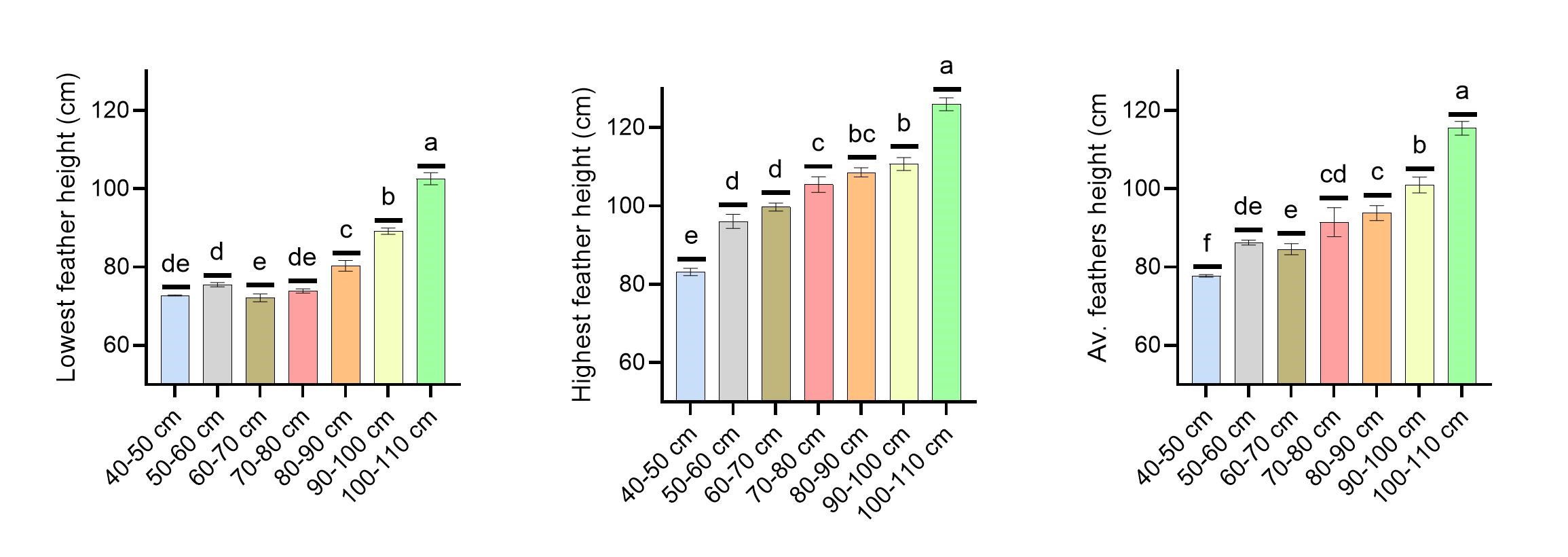
Experiment 3: The experimental results revealed that the height of one-year-old nursery trees treated with BA spray for feather induction significantly influenced almost all the variables studied (Figures 2 and 3; Tables 5 and 6).
The one-year-old nursery trees 70 to 80 cm in height had the greatest positive effect on most of the studied variables and produced the significantly (p ≤ 0.0001) greatest number of feathers (10.33). Furthermore, most of the feathers produced by these trees (88.71%) had an optimum length of 10–40 cm (9.17; p ≤ 0.0001) and moderate vigor in terms of average diameter (4.16 mm) and trunkto- mean feather diameter ratio (3.07) with an acceptable crotch angle (48.63°).
Additionally, these trees produced feathers at the optimum height (73.9–105.5 cm), with the highest feathering zone (31.6 cm).

Feather count, number of feathers with optimum length, and feathering zone as a function of varying heights of one-year-old ‘Gala Mast’/MM-106 nursery trees treated with benzyladenine (600 ppm; 4X). Vertical bars represent ±standard error. Means within subfigure in each treatment with different letters are significantly different according to the DMRT (p ≤ 0.05).

Feather positions as a function of varying heights of one-year-old ‘Gala Mast’/MM-106 nursery trees treated with benzyladenine (600 ppm; 4X). Vertical bars represent ±standard error. Means within subfigure in each treatment with different letters are significantly different according to the DMRT (p≤0.05).
The final tree height increased with increasing height of the one-year-old nursery trees, and the maximum height (184.9 cm) was recorded for the 100–110 cm one-yearold trees (Table 6). Nevertheless, the maximum gain in tree height (90.17 cm) in the season was observed with the use of trees with 70–80 cm initial height (Table 1).
Additionally, trees with 70-80 cm in height produced the second-highest trunk diameter (12.77 mm), which remained statistically at par with the highest trunk diameter (12.86 mm; p ≤ 0.0001) obtained with the use of trees with 100–110 cm initial height(Table 6).
Discussion
The results of the present study revealed that the timing of the first spray of BA and the height of one-year-old nursery trees used for feathering affected not only the feathering potential but also the overall quality of the apple nursery trees.
Experiments 1 and 2: Rapid central leader growth throughout the season is vital for feather induction in one-year-old apple nursery trees via repeated BA sprays (WERTHEIM; WEBSTER, 2003). However, the findings from the present experiment highlight that optimal new terminal growth at the time of the first spray is equally crucial.
The new growth of the central leader at the initial BA spray considerably affects the number of feathers, the position of the first feather, and the overall growth and quality of the nursery trees.
The first BA spray, applied either immediately after bud break (with no visible terminal growth; 27th April) or at 1–5 cm of new terminal growth (1st May), had no positive effect on feathering in ‘Oregon Spur’ but instead adversely affected the final tree height and trunk diameter. In contrast, ‘Gala Mast’ trees produced some feathers under these treatments.
Visual observations revealed significant lateral bud breakage in both cultivars, leading to the initiation of some proleptic and sylleptic shoots. However, in ‘Oregon Spur,’ shoot growth ceased after 2–3 weeks, resulting in malformed tops and stunted trees, with no resumption of growth even after the completion of the BA application period.
In ‘Gala Mast,’ growth resumed in some trees either before or after the BA application period but remained slow throughout the season (Figure 1). Additionally, the first BA spray at 0–5 cm of new terminal growth, or in some cases at 6–10 cm, caused leaf injury and terminal dieback after the second spray in both cultivars.
BA promotes lateral bud break by disrupting apical dominance, but this process may depend on the availability of assimilates and the hormonal balance. Early sprays, applied at 0–5 of new growth (before 1st May), likely coincide with lower carbohydrate reserves, and further, BA application at this stage may disrupt the balance of endogenous auxins and cytokinins, which are critical for coordinated shoot growth.
The observed stunted growth and malformed top following early BA spraying could result from excessive hormonal imbalances that inhibit normal cell division and elongation processes. BA’s action at this stage may lead to excessive cytokinin activity, inducing cell stress and necrosis in vulnerable tissues, leading to leaf injury and terminal dieback.
At this stage, nursery trees showed a positive response to BA application; however, the limited availability of assimilates and hormonal imbalances could lead to adverse effects, such as malformed tops, stunted growth, and terminal dieback. Conversely, sprays applied during a period of active growth (10–15 cm) provide sufficient assimilates and hormonal conditions for successful feather and apical shoot elongation.
Furthermore, the ability to resume growth after BA-induced stress at an early stage may depend on the cultivar’s inherent vigor and hormonal dynamics, as evidenced by the faster recovery of ‘Gala Mast’ than of ‘Oregon Spur’.
In ‘Gala Mast’, increasing the height of terminal growth at the time of the first spray from zero (27th April) to 10–15 cm (10th May) positively affected most of the studied variables.
This suggests that a greater active growth phase at the time of the first spray enables trees to better withstand the temporary suppression of growth caused by BA and facilitates the resumption of growth before the subsequent spray. While active growth is critical, excessive delay in the first spray, as observed in the 15–20 cm (16th May) and 20–25 cm (23rd May) treatments, negatively affected most of the studied variables.
This delay, which was approximately 6 (15–20 cm) and 13 (20–25 cm) days more than that in the 10–15 cm treatment, reduced the active growth period following the initial BA application. Consequently, the trees had less time for feather induction, elongation, and recovery.
For ‘Oregon Spur,’ the optimal growth for the first spray was found to be 15–20 cm.
The observed differences between ‘Oregon Spur’ and ‘Gala Mast’ can be attributed to their varying degrees of apical dominance, which is evident from the number of feathers induced by them in response to BA spray across the various treatments (Figure 1A, D). The ‘Oregon Spur’ cultivar exhibited greater apical dominance, which may have suppressed lateral bud break and shoot development when terminal growth was minimal during the first spray.
Experiment 3: The findings of this study highlight the critical role of initial tree height in determining the success of feather induction in one-year-old apple nursery trees via repeated BA sprays.
The results of this study suggest that one-year-old nursery trees with heights of 60–80 cm are most suitable for feather induction through repeated sprays of benzyladenine (BA). Trees shorter than 60 cm were unable to produce the desired number of feathers, probably due to insufficient assimilate reserves and smaller trunk diameters, which resulted in slower central leader growth during BA application (Figure 4).
Whereas,the rapid growth of the central leader is crucial for feather production (WERTHEIM; WEBSTER, 2003). Similarly, trees taller than 80 cm produced fewer feathers, possibly because of stronger apical dominance.
Additionally, the percentage of undesirable laterals (below 70 cm) increased as the tree height decreased, reaching a maximum of 28.72% with 40–50 cm trees. These undesirable laterals reduce the structural uniformity and commercial value of nursery trees, making them less suitable for high-density planting systems. Conversely, the average feather height increased with increasing tree height, from 77.77 cm in 40–50 cm trees to 115.47 cm in 100–110 cm trees. The height of the lowest induced lateral/feather on the sprayed tree was approximately the same as the height of the one-year-old tree at the time of planting.
Thus, one-year-old nursery trees taller than 90 cm in height presented feathers predominantly in the upper part of the trees, deviating from the desired shape for nursery trees. This also reduces the functional canopy in the lower region, which is essential for early fruiting in high-density orchards. Almost all the tree height treatments produced feathers longer than the optimum length of 40 cm, but the highest proportion (39.42%) was observed with the use of 100–110 cm one-year-old nursery trees. This could be attributed to three reasons: first, greater assimilate reserves in these trees at the time of planting; second, the greater diameter of the trunk of these trees; and third, less competition among the feathers for resources during the growth stage because of the presence of a comparatively lower number of feathers (8.67) on these trees.

Gain in tree height (cm) by varying heights of one-year-old ‘Gala Mast’/MM-106 nursery trees treated with benzyladenine (600 ppm; 4X). Abbreviation: G1WBS: Gain in tree height 1 week before 1st spray; G1-2S: Gain in tree height between 1st and 2nd Spray; G2-3S: Gain in tree height between 2nd and 3rd Spray; G3-4S: Gain in tree height between 3rd and 4th spray; G10DA4S: Gain in tree height up to10 days after 4th spray.
The superior performance of one-yearold trees with 70–80 cm height for various nursery tree quality criteria can be attributed to their sufficient assimilate reserves at the time of planting, which support substantial growth during spring.
By the time of the first spray, the central shoot tip reaches 85–95 cm and starts producing feathers from 70–80 cm height. These trees sustain continuous, optimal apical shoot growth throughout the spray period (Figure 4), resulting in the induction of a greater number of feathers. Additionally, because of the greater number of feathers, which possibly increases intershoot competition for resources, these trees produce most feathers of optimum length and vigor.
Conclusion
The findings of this investigation highlight the critical role of the timing of the first benzyladenine spray in influencing not only feather formation but also the overall quality of apple nursery trees. The study results suggest that nursery trees should achieve a minimum of 10 cm of active terminal growth before the first BA spray to balance feather induction with tree recovery.
Terminal growth below this threshold, particularly in the 0–5 cm range, not only fails to promote feathering but also negatively affects tree height and trunk diameter.
However, the optimal growth stage for the first spray varies by cultivar. In ‘Gala Mast,’ 10–15 cm of new growth proved ideal, whereas in ‘Oregon Spur,’ 15–20 cm was most effective for producing high-quality well feathered two-year-old nursery trees.
These findings suggest that feathering strategies must be tailored to the inherent growth characteristics of each cultivar to optimize nursery tree quality. Furthermore, the height of the one-year-old nursery tree used for feathering plays a significant role in determining both feathering success and the overall quality of the tree.
The results indicate that one-year-old nursery trees with heights of 70–80 cm are best suited for feathering in response to repeated benzyladenine sprays. Future research could explore the interaction of environmental factors, such as temperature and humidity, with hormonal treatments to refine feathering techniques further.
References
-
CARRA, B.; CABRERA, D.; RODRIGUEZ, P.; DINI, M. Improving feathering in different nursery apple trees by plant growth regulators. Revista Brasileira de Fruticultura, Jaboticabal, v.45, p.1-11, 2023. https://doi.org/10.1590/0100-29452023965
» https://doi.org/10.1590/0100-29452023965 -
KAPLAN, M.; KLIMEK, K.E.; BORKOWSKA, A.; BUCZYNSKI, K. Effect of growth regulators on the quality of apple tree whorls. Applied Sciences, Basel, v.13, n.11472, p.1-13, 2023. https://doi.org/10.3390/app132011472
» https://doi.org/10.3390/app132011472 -
KUMAWAT, K.L.; RAJA, W.H.; CHAND, L.; RAI, K.M.; LAL, S. Influence of plant growth regulators on growth and formation of sylleptic shoots in one-year-old apple cv. Gala Mast. Journal of Environmental Biology, Lucknow, v.44, n.1, p.122-33, 2023. http://doi.org/10.22438/jeb/44/1/MRN-3050
» http://doi.org/10.22438/jeb/44/1/MRN-3050 -
KUMAWAT, K.L.; RAJA, W.H.; NABI, S.U. Quality of nursery trees is critical for optimal growth and inducing precocity in apple. Applied Fruit Science, Heidelberg, v.66, p.2135-43, 2024. https://doi.org/10.1007/s10341-024-01202-9
» https://doi.org/10.1007/s10341-024-01202-9 -
KUMAWAT, K.L.; RAJA, W.H.; SINGH, D.B.; CHAND, L.; MIR, J.I.; RAI, K.M.; KIRMANI, S.N. Effects of plant growth regulators applications on in inductions of laterals branching in ‘Oregon Spur’ apple nursery trees. Indian Journal of Horticulture, Madras, v.77, p.72–9, 2020. https://doi.org/10.5958/0974-0112.2020.00030.4
» https://doi.org/10.5958/0974-0112.2020.00030.4 -
LANAR, L.; MÉSZÁROS, M.; KYSELOVÁ, K.; NÁMESTEK, J.; SUS, J.; BELÍKOVÁ, H.; CONKA, P. Branching of nursery apples and plums using various branching inducing methods. Journal of Central European Agriculture, Zagreb, v.21, n.1, p.113-23, 2020. https://doi.org/10.5513/JCEA01/21.1.2459
» https://doi.org/10.5513/JCEA01/21.1.2459 -
LANAR, L.; MÉSZÁROS, M.; NÁMESTEK, J.; SUS, J. Feathering ability of apple, pear and cherry nursery trees treated with different branch-inducing methods. Acta Horticulturae, The Hague, v.1206, p.189-96, 2018. https://doi.org/10.17660/ActaHortic.2018.1206.26p
» https://doi.org/10.17660/ActaHortic.2018.1206.26p -
LORDAN, J., ROBINSON, T.L.; SAZO, M.M.; BLACK, B.L.; HUFFMAN, L.; GRIGG-MCGUFFIN, K.; FRANCESCATTO, P.; MCARTNEY, S. Use of plant growth regulators for feathering and flower suppression of apple nursery trees. HortScience, Alexandria, v.52, p.1080-91, 2017. https://doi.org/10.21273/HORTSCI11918-17
» https://doi.org/10.21273/HORTSCI11918-17 -
MCARTNEY, S.; OBERMILLER, J.D. Effect of notching, 6-Benzyladenine, and 6-Benzyladenine plus gibberellin A4 + A7 on budbreak and shoot development from paradormant buds on the leader of young apple trees. Horttechnology, Alexandria, v.25, n.2, p.233-7, 2015. https://doi.org/10.21273/HORTTECH.25.2.233
» https://doi.org/10.21273/HORTTECH.25.2.233 -
NECAS, T.; WOLF, J.; KISS, T.; GÖTTINGEROVÁ, M.; ONDRÁŠEK, I.; VENUTA, R.; LANAR, L.; LETOCHA, T. Improving the quality of nursery apple and pear trees with the use of different plant growth regulators. European Journal of Horticultural Science, Stuttgart, v.85, n.6, p.430-8, 2020. https://doi.org/10.17660/eJHS.2020/85.6.7
» https://doi.org/10.17660/eJHS.2020/85.6.7 -
RADIVOJEVIC, D.; ZIVIC, M.; MILIVOJEVIC, J.; OPARNICA, C.; VELICKOVIC, M. Effect of 6-BA+GA(4+7) and nitrogen fertigation on feathering of 'Golden Reinders' apple nine-month-old nursery trees. Acta Horticulturae, The Hague, v.1139, p.497-502, 2016. https://doi.org/10.17660/ActaHortic.2016.1139.85
» https://doi.org/10.17660/ActaHortic.2016.1139.85 -
RUFATO, L.; MARCHIORETTO, L.R.; ORLANDI, J.C.; MICHELON, M.F.; ROSSI, A.; SANDER, F.; MACEDO, T.A. Lateral branch induction at nursery with growth regulators in ‘Maxi Gala’ apple trees grafted on four rootstocks. Scientia Horticulturae, New York, v.253, p.349-57, 2019. https://doi.org/10.1016/j.scienta.2019.04.045
» https://doi.org/10.1016/j.scienta.2019.04.045 - SAZO, M.M.; ROBINSON, T.L. The use of plant growth regulators for branching of nursery trees in NY State. New York Fruit Quarterly, New York, v.19, n.2, p.5–9, 2011.
- WERTHEIM, S.J.; WEBSTER, A.D. Propagation and nursery tree quality. In: FERREE, D.C.; WARRINGTON, I.J. (ed.). Apples: botany, production and uses. London: CABI Publishing, 2003. p.125-51. https:// doi.org/10.1079/9780851995922.0000