
 Effects of dual-task training on gait and balance in post-stroke individuals: a systematic review with meta-analysis
ABSTRACT
This article aims to investigate the effects of dual-task training in the gait and balance of post-stroke individuals via a systematic review with meta-analysis of clinical trials with adequate methodological quality. Searches in the electronic databases PubMed, Lilacs, SciELO, PEDro, up to September 2024, by two independent researchers. We included randomized clinical trials, with dual-task training in post-stroke individuals, with an average PEDro scale score of six or higher. The outcome measures of interest were any related to gait and/or balance, which could be assessed using tests or questionnaires. Study methodological quality was assessed using the PEDro scale. Eight studies were included. Overall, dual-task training showed to be effective in improving gait speed by 0.11 m/s (95%CI 0.02–0.21; I2=11%; p=0.02), cadence by 7.30 steps/minute (95%CI 2.46–12.14; I2=0%; p=0.003), and balance (SMD 0.45; 95%CI 0.08–0.81; I2=36%; p=0.02). No significant results were found for stride length (SD 1.72; 95%CI −9.15–12.59; I2=22%; p=0.76) and mobility (95%CI −5.64–1.88; I2=0%; p=0.33). This systematic review showed, via meta-analysis, that dual-task training can significantly improve gait speed, cadence, and balance in post-stroke individuals. However, we recommend new clinical trials, with higher methodological quality, especially studying the effects on mobility and balance.
Keywords
Stroke; Dual Task; Gait; Balance; Systematic Review; Meta-analysis
RESUMO
Este artigo objetiva investigar os efeitos do treino de dupla tarefa na marcha e equilíbrio de pacientes pós-acidente vascular encefálico (AVE), por meio de uma revisão sistemática com metanálise de ensaios clínicos de adequada qualidade metodológica. Foram feitas buscas nas bases de dados eletrônicas PubMed, LILACS, SciELO e PEDro, até setembro de 2024, por dois avaliadores independentes. Incluiu-se ensaios clínicos aleatorizados que realizaram o treino baseado em dupla tarefa em indivíduos pós-AVE, com nota média na escala PEDro igual ou superior a seis. As medidas de desfecho de interesse foram aquelas relacionadas à marcha e/ou equilíbrio, podendo ser avaliadas através de testes ou questionários. A qualidade metodológica dos estudos foi avaliada através da escala PEDro. Oito estudos foram incluídos. De maneira geral, o treino de dupla tarefa se mostrou eficaz para melhora da velocidade da marcha em 0,11m/s (IC95% 0,02 a 0,21; I2=11%; p=0,02), cadência em 7,30 passos/minuto (IC95% 2,46 a 12,14; I2=0%; p=0,003), e equilíbrio (SMD 0,45; IC95% 0,08 a 0,81; I2=36%; p=0,02). Não foram encontrados resultados significativos para comprimento da passada (MD 1,72; IC95% –9,15 a 12,59; I2=22%; p=0,76), e mobilidade (IC95% –5,64 a 1,88; I2=0%; p=0,33). Esta revisão sistemática evidenciou, por meio de uma metanálise, que o treino de dupla tarefa é capaz de melhorar de forma significativa a velocidade de marcha, cadência e equilíbrio em pacientes pós-AVE. Porém, é recomendado que novos ensaios clínicos de qualidade metodológica superior sejam realizados, em especial investigando os efeitos para mobilidade e equilíbrio.
Descritores
Acidente Vascular Encefálico; Dupla Tarefa; Marcha; Equilíbrio; Revisão Sistemática; Metanálise
RESUMEN
Este artículo tiene como objetivo evaluar los efectos del entrenamiento de doble tarea sobre la marcha y el equilibrio en pacientes después de un accidente cerebrovascular (ACV), a partir de una revisión sistemática con metaanálisis de ensayos clínicos de calidad metodológica adecuada. Las búsquedas fueron realizadas por dos evaluadores independientes en las bases de datos electrónicas PubMed, LILACS, SciELO y PEDro hasta septiembre de 2024. Se incluyeron ensayos clínicos aleatorizados que realizaron entrenamiento basado en doble tarea en individuos posaccidente cerebrovascular, con una puntuación promedio en la escala PEDro igual o superior a 6. Las medidas de resultado de interés fueron las relacionadas con la marcha y/o el equilibrio, que pueden evaluarse mediante pruebas o cuestionarios. La calidad metodológica de los estudios se evaluó mediante la escala PEDro. Se incluyeron ocho estudios. En general, el entrenamiento de doble tarea fue efectivo para mejorar la velocidad de la marcha en 0,11 m/s (IC 95%: 0,02 a 0,21; I2=11%; p=0,02), la cadencia en 7,30 pasos/minuto (IC 95%: 2,46 a 12,14; I2=0%; p=0,003) y el equilibrio (SMD 0,45; IC 95%: 0,08 a 0,81; I2=36%; p=0,02). No se encontraron resultados significativos para la longitud del paso (MD 1,72; IC 95%: -9,15 a 12,59; I2=22%; p=0,76) y la movilidad (IC 95%: -5,64 a 1,88; I2=0%; p=0,33). A partir de un metaanálisis, esta revisión sistemática reveló que el entrenamiento de doble tarea es capaz de mejorar significativamente la velocidad de la marcha, la cadencia y el equilibrio en pacientes posaccidente cerebrovascular. Sin embargo, se recomienda que se realicen nuevos ensayos clínicos de calidad metodológica superior, especialmente en torno a los efectos sobre la movilidad y el equilibrio.
Palabras clave
Accidente Cerebrovascular; Doble Tarea; Marcha; Equilibrio; Revisión Sistemática
INTRODUCTION
Stroke is defined as an injury to the central nervous system caused by blood flow changes that lead to acute brain lesions1. This condition affects about 33 million people worldwide, being the third leading cause of mortality in high-income countries and the seventh in middle- and low-income countries1. In addition, there has been a 25% increase in the incidence of cases in adults aged 20–64 years (1990 to 2013)2. However, despite the high mortality and significant prevalence, survival rates have also been increasing worldwide2. These high rates may be mainly associated with advances in health-related technology and health care, leading to increased demand for rehabilitation services, which are crucial components for resumption of the patients’ activities of daily living (ADL) poststroke3. In the United States alone, 20% of patients who survive stroke are dependent on institutional care for a period above three months and 75% are discharged from the hospital and half of these will receive constant care in several ADLs3.
Post-stroke complications can be diverse and result in disabilities, such as reduced muscle strength and altered sensitivity in different body parts, depending on injury type and location1. There may also occur facial disorders, such as changes in speech and swallowing, or lower limb disorders, such as changes in balance and gait4. In gait, individuals not affected by stroke use muscle groups in an organized way to support the body, control balance and progress in walking5. Thus, post-stroke muscle weakness is an important contributor to the reduction of gait acuity, as it causes motor adaptations, such as using the healthy hemibody as body support and for balance control, possibly driven by muscle weakness, which can cause postural asymmetry5. Changes in gait are important findings in post-stroke patients, since they interfere with the performance of ADLs and increase the risk of falls. Around 80% of individuals affected by stroke show gait complications after three months, and most falls occur due to imbalances during walk5.
In order to treat the consequences of stroke and prevent secondary complications, there are several possible interventions during the rehabilitation of this population, such as stretching exercises, strengthening exercises and gait training6. Dual-task training can also be adopted, consisting of simultaneous cognitive-motor tasks, such as, while walking, holding a tray, performing mathematical calculations with serial subtractions, saying something specific, etc.7 - 9 In comparison with healthy individuals, post-stroke patients present reduced performance in cognitive tasks, mobility tasks or even both, in addition to an observed correlation between mobility deficit in dual-task activities and post-stroke falls7. Thus, dual-task activities can contribute to the rehabilitation of these patients, with possible improvement in motor control and balance, increasing safety in locomotion, since walking and ADLs generally require multitasking8.
Studies on neural bases have shown increased brain activity during the dual task, especially in the prefrontal cortex. This occurs by accelerating central neural transduction, activating the upper cortex of the brain, optimizing the allocation of attentional resources, and facilitating neurological remodeling, which simulates a real rehabilitation setting in the motor and cognitive domains9. While motor training promotes synaptic plasticity and cell proliferation, cognitive training directs these newborn neurons to connections to pre-existing neuronal networks, which can increase the speed of information processing. Thus, with dual-task training, it is possible to reinforce the functional connections of the network between the cognitive and motor regions, activating the cerebral cortex and facilitating the remodeling of the functional networks of the brain9.
Recently, there was the publication of four systematic reviews with the purpose of studying the effects of dual-task training on gait and balance in post-stroke patients10 - 13. However, the database searches of all these previous studies were performed at least three years ago. As this issue has major importance in current physical therapy research, new related clinical trials have been published in this relatively short period, which may impact the results of a meta-analysis. In addition, one of the previous reviews did not include a meta-analysis10, and all reviews included clinical trials with poor methodological quality, which may have compromised their results, reducing the level of evidence10 - 13.
Therefore, the objective of the present study was to study the effects of dual-task training on gait and balance in post-stroke individuals through a systematic review with meta-analysis only of randomized clinical trials with adequate methodological quality.
METHODOLOGY
Design
This is a systematic review, with meta-analysis and inclusion only of randomized clinical trials with adequate methodological quality, previously registered in Prospero (CRD42023481090).
Study selection
The searches were carried out in the electronic databases Medical Literature Analysis and Retrieval System Online (MEDLINE), through the website PubMed, Latin American and Caribbean Literature in Health Sciences (LILACS), Scientific Electronic Library Online (SciELO) and Physiotherapy Evidence Database (PEDro), until September 2024. The descriptors used for the searches were specific to words related to stroke, dual-task training and randomized clinical trials, as well as their respective terms in English. The searches were not restricted as to language and year of publication. The entire article search and selection process was carried out by two independent evaluators and, to resolve possible disagreements found, a third evaluator was requested. Finally, there was also a manual search in the reference lists of all included articles, as a means to trace other possible relevant studies.
Inclusion and exclusion criteria
We included randomized clinical trials that adopted dual-task-based training in post-stroke subjects of any age, sex, and time after injury. We excluded studies with incomplete data, that included post-stroke patients with another condition, pilot studies and feasibility studies without previous results. The outcome measures of interest were those related to gait and/or balance, which can be evaluated through tests or questionnaires. In addition, we only included clinical trials that achieved an average score equal to or greater than six on the PEDro scale. Although a score of six is considered moderate, we note that, in physical therapy, specifically in dual-task training, it is impossible to blind the therapist and the participants, conditioning all clinical trials to a maximum score of eight.
Data extraction
We extracted from the selected studies the following data: sample characteristics (size, age, post-stroke time), study objective, training protocol (tasks performed during training, comparison performed, duration, frequency, intensity of training), outcome measures used to assess gait and balance and the results found.
Methodological quality
Study methodological quality was assessed using the PEDro scale, which supports the identification of the characteristics of bias risk, internal validity and whether the statistical information presented in the study is sufficient to make it interpretable. The scale has 11 items; however, the first item related to external validity is not scored. The scale has a final score ranging from 0 to 10, and the higher the score, the better the methodological quality of the study14. The scores provided for each study, based on PEDro, were used in the study. For studies not scored based on the PEDro, methodological quality was assessed by two researchers, independently.
Data analysis
All information about the studies was extracted by two evaluators and verified by a third party. The meta-analysis used the Comprehensive Meta-Analysis program, Version 3.0. Post-intervention measures (mean and standard deviation) were used, due to the availability of only these values in most studies, preferably using the fixed effects model. In the case of statistically significant heterogeneity (I2>40%), effect size was analyzed using the random effects model. The pooled data for all results were reported as mean difference (MD) for gait speed, stride length, cadence and mobility, since all studies reported results with the same units for these measures, and standardized mean difference (SMD) for balance, since the studies evaluated this variable through different questionnaires, together with their respective 95% confidence intervals (95% CI). An SMD of 0.10 was considered small, 0.30 was considered medium, and 0.50 was considered large. The critical value for rejecting H0 was set at a significance level of 5% (two-tailed test).
RESULTS
Database searches retrieved 759 articles. Of these, 717 were excluded after reading the titles, 23 after reading the abstracts and 3 after reading the full text, according to the previously established exclusion criteria, leaving 16 studies. Manual search resulted in other 7 studies that were also included. Thus, 23 studies met the previously determined inclusion criteria. The main reasons for excluding studies were: non-randomized trials, no focus on dual-task, comparison of two dual-task modes, and duplicate studies. However, after evaluating the methodological quality of each study, through the PEDro scale, 15 studies did not reach the minimum score of six. Thus, a total of 8 articles were included and described in the present review8 , 9 , 15 - 20. Figure 1 represents the study selection flowchart, with each step. Table 1 shows the study characterization.

The studies had 25 to 84 participants, with a mean age of 18 to 83 years, and a mean methodological quality of 7 (Table 2). Seven articles included chronic patients (>6 months of injury), and only one study had acute patients (<6 months). Regarding the interventions, all studies had some form of dual-task training, with three studies adopting dual-task training in the experimental group and conventional physical therapy in the control group8 , 9 , 20; one article adopted dual-task training in virtual reality in the experimental group and conventional physical therapy in both groups17; three articles adopted dual-task treadmill training in the experimental group, and only treadmill walk in the control group16 , 18 , 19; and one article adopted dual-task training in the experimental group and no treatment in the control group15. Regarding outcome measures, three studies evaluated balance using the Berg balance scale9 and the Activities-specific balance confidence (ABC) scale8 , 20; four studies evaluated gait aspects (speed, stride length and cadence) using movement analysis systems, such as OptoGait16 and GAITRite system15 , 17 , 18; two studies evaluated mobility using the Timed Up and Go (TUG) test9 , 20; and four studies evaluated the gait speed of individuals using the 10-meter gait speed test9 , 18 , 20 and the Two-minute walk test19.
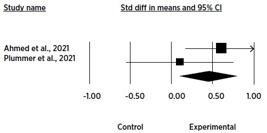
The meta-analysis included six studies on the effects of dual-task training on gait speed, which found a significant improvement of 0.11 m/s (95% CI 0.02 to 0.21; I2=11%; p=0.02; random effects model) (Figure 2) in favor of the experimental group. It included four studies on the effects of dual-task training on stride length, showing no significant effects (MD 1.72; 95% CI -9.15 to 12.59; I2=22%; p=0.76); random effects model) (Figure 3), while the same studies reported a significant improvement in cadence of 7.30 steps/minute (95% CI 2.46 to 12.14; I2=0%; p=0.003; fixed effects model) (Figure 4) in favor of the experimental group. Finally, it included two studies on the effects of dual-task training on mobility, evaluated by TUG, finding no significant difference between groups (MD -1.88; 95% CI -5.64 to 1.88; I2=0%; p=0.33; random effects model) (Figure 5), while the same studies found a significant improvement in balance (SMD 0.45; 95% CI 0.08 to 0.81; I2=36%; p=0.02; fixed effects model) (Figure 6) in favor of the experimental group.


DISCUSSION
This review aimed to study the effects of dual-task training on gait and balance in post-stroke individuals through a systematic review of clinical trials with adequate methodological quality. The results of the meta-analyses demonstrated that dual-task training was effective in improving gait speed, cadence, and balance. However, no significant improvements were observed in relation to mobility and stride length.
The present meta-analysis showed that dual-task training improved gait speed in stroke patients by 0.11 m/s. These results can be considered relevant, since previous data showed that improvements above 0.10 m/s can be considered clinically significant in this population21. Comparing with previous results in the literature, Zhang et al.12, in a systematic review, found no significant effect of this intervention on the gait speed of post-stroke individuals. This difference in results may possibly be explained by the inclusion of studies with very low methodological quality. On the other hand, two other previous systematic reviews also found significant results for dual-task training on gait speed in this population, compared to the control group11 , 13. Thus, based on the results presented in the present study and other previous data that corroborated these findings, dual-task training seems to be an important option for gait rehabilitation in post-stroke patients. Regarding the effects of dual-task training on cadence, an improvement of 7.30 steps/minute was also found. All three previous systematic reviews also reported significant improvement in cadence by dual-task training in post-stroke individuals, ranging from 5 to 9 steps/minute12. A possible hypothesis for dual-task training having the potential to improve these gait parameters may be related to an increase in neuroplasticity and brain remodeling, promoting a strengthening of the nervous system’s control over movement11. In addition, in dual-task training, it is also possible to optimize the strategic allocation of cognitive resources, reasonably allocate attention to primary and secondary tasks, and increase the coordination of actions11. Thus, it is speculated that this training could have a remodeling effect on motor functional areas of the brain to promote rehabilitation of motor function in post-stroke individuals.
Dual-task training also significantly improved the balance of post-stroke subjects, with an SMD considered average. Two previous systematic reviews found significant effects for this variable, corroborating the present findings12 , 13, while other previous review reported no significance between groups11. Thus, based on previous data and on the present study, it is observed that dual-task training has the potential to improve balance in this population. The mechanism by which the dual task affects balance is related to neuroplasticity, changes in neurotransmission and changes in brain activity patterns after stroke. Previously published data in animals concluded that the addition of cognitive loads to motor training may result in the effective stimulation of common cortical areas in the medial and prefrontal dorsal frontal cortex, particularly the premotor areas and supplementary motor areas, which are involved in the regulation of balance and cognitive functions22. In addition, dual-task training induces neuroplasticity through perceptual activation of brain regions involved in central executive functions, such as the dorsolateral prefrontal cortex. This promotes endogenous neural repair mechanisms, increases the number of neuronal synapses in the cerebral cortex, and facilitates axonal and dendritic transmission, thereby improving the body’s neurological control and the individual’s balance function23 , 24.
As main limitation of the present study, we can mention the reduced number of studies for mobility and balance variables (two in each). However, since this review aimed to include only studies with moderate to high methodological quality, more studies are needed in order to study the effect of dual-task training on both variables. In addition, it was not possible to calculate the MD for the balance variable; however, the SMD was calculated. Unfortunately, the SMD does not provide palpable results that objectively indicate the magnitude of improvement in this variable. However, it was the only possible analysis, considering that the studies used different outcome measures for their evaluation.
CONCLUSION
This systematic review showed, through a meta-analysis of clinical trials with adequate methodological quality, that dual-task training can significantly improve gait speed, cadence and balance in post-stroke patients. However, we recommend the publication of new clinical trials with higher methodological quality, mainly studying the effects on mobility and balance.
REFERENCES
-
1. Santos M, Guerreiro C, Neto M. Correlação entre pico de fluxo de tosse e controle postural em indivíduos após AVE na fase subaguda hospitalar. Rev Ciên Méd Biol. 2022;21(3):624-8. doi: 10.9771/cmbio.v21i3.52001
» https://doi.org/10.9771/cmbio.v21i3.52001 -
2. Katan M, Luft A. Global burden of stroke. Semin Neurol. 2018;38(2):208-11. doi: 10.1055/s-0038-1649503
» https://doi.org/10.1055/s-0038-1649503 -
3. Thorpe ER, Garrett KB, Smith AM, Reneker JC, Phillips RS. Outcome measure scores predict discharge destination in patients with acute and subacute stroke: a systematic review and series of meta-analyses. J Neurol Phys Ther. 2018;42(1):2-11. doi: 10.1097/NPT.0000000000000211
» https://doi.org/10.1097/NPT.0000000000000211 -
4. Belagaje SR. Stroke rehabilitation. Continuum (Minneap Minn). 2017;23(1, Cerebrovascular Disease):238-53. doi: 10.1212/CON.0000000000000423
» https://doi.org/10.1212/CON.0000000000000423 -
5. Beyaert C, Vasa R, Frykberg GE. Gait post-stroke: pathophysiology and rehabilitation strategies. Neurophysiol Clin. 2015;45(4-5):335-55. doi: 10.1016/j.neucli.2015.09.005
» https://doi.org/10.1016/j.neucli.2015.09.005 -
6. Iqbal M, Arsh A, Hammad SM, Haq IU, Darain H. Comparison of dual task specific training and conventional physical therapy in ambulation of hemiplegic stroke patients: a randomized controlled trial. J Pak Med Assoc. 2020;70(1):7-10. doi: 10.47391/JPMA.10443
» https://doi.org/10.47391/JPMA.10443 -
7. Pang MYC, Yang L, Ouyang H, Lam FMH, Huang M, et al. Dual-task exercise reduces cognitive-motor interference in walking and falls after stroke. Stroke. 2018;49(12):2990-8. doi: 10.1161/STROKEAHA.118.022157
» https://doi.org/10.1161/STROKEAHA.118.022157 -
8. Ahmed U, Karimi H, Amir S, Ahmed A. Effects of intensive multiplanar trunk training coupled with dual-task exercises on balance, mobility, and fall risk in patients with stroke: a randomized controlled trial. J Int Med Res. 2021;49(11):3000605211059413. doi: 10.1177/03000605211059413
» https://doi.org/10.1177/03000605211059413 -
9. Zhang L, Ma J, Liu X, Jin A, Wang K, et al. Cognitive-motor dual-task training on gait and balance in stroke patients: meta-analytic report and trial sequential analysis of randomized clinical trials. J Neuroeng Rehabil. 2024;21(1):227. doi: 10.1186/s12984-024-01507-6
» https://doi.org/10.1186/s12984-024-01507-6 -
10. He Y, Yang L, Zhou J, Yao L, Pang MYC. Dual-task training effects on motor and cognitive functional abilities in individuals with stroke: a systematic review. Clin Rehabil. 2018;32(7):865-77. doi: 10.1177/0269215518758482
» https://doi.org/10.1177/0269215518758482 -
11. Shu Y, Bi MM, Zhou TT, Liu L, Zhang C. Effect of dual-task training on gait and balance in stroke patients: an updated meta-analysis. Am J Phys Med Rehabil. 2022;101(12):1148-55. doi: 10.1097/PHM.0000000000002016
» https://doi.org/10.1097/PHM.0000000000002016 -
12. Zhang X, Xu F, Shi H, Liu R, Wan X. Effects of dual-task training on gait and balance in stroke patients: a meta-analysis. Clin Rehabil. 2022;36(9):1186-98. doi: 10.1177/02692155221097033
» https://doi.org/10.1177/02692155221097033 -
13. Zhou Q, Yang H, Zhou Q, Pan H. Effects of cognitive motor dual-task training on stroke patients: a RCT-based meta-analysis. J Clin Neurosci. 2021;92:175-82. doi: 10.1016/j.jocn.2021.08.009
» https://doi.org/10.1016/j.jocn.2021.08.009 -
14. Shiwa SR, Costa LO, Costa Lda C, Moseley A, Hespanhol Junior LC, et al. Reproducibility of the Portuguese version of the PEDro Scale. Cad Saúde Pública. 2011;27(10):2063-8. doi: 10.1590/s0102-311x2011001000019
» https://doi.org/10.1590/s0102-311x2011001000019 -
15. Yang YR, Wang RY, Chen YC, Kao MJ. Dual-task exercise improves walking ability in chronic stroke: a randomized controlled trial. Arch Phys Med Rehabil. 2007;88(10):1236-40. doi: 10.1016/j.apmr.2007.06.762
» https://doi.org/10.1016/j.apmr.2007.06.762 -
16. Baek CY, Chang WN, Park BY, Lee KB, Kang KY, et al. Effects of dual-task gait treadmill training on gait ability, dual-task interference, and fall efficacy in people with stroke: a randomized controlled trial. Phys Ther. 2021;101(6):pzab067. doi: 10.1093/ptj/pzab067
» https://doi.org/10.1093/ptj/pzab067 -
17. Cho KH, Kim MK, Lee HJ, Lee WH. Virtual reality training with cognitive load improves walking function in chronic stroke patients. Tohoku J Exp Med. 2015;236(4):273-80. doi: 10.1620/tjem.236.273
» https://doi.org/10.1620/tjem.236.273 -
18. Kim KJ, Kim KH. Progressive treadmill cognitive dual-task gait training on the gait ability in patients with chronic stroke. J Exerc Rehabil. 2018;14(5):821-8. doi: 10.12965/jer.1836370.185
» https://doi.org/10.12965/jer.1836370.185 -
19. Meester D, Al-Yahya E, Dennis A, Collett J, Wade DT, et al. A randomized controlled trial of a walking training with simultaneous cognitive demand (dual-task) in chronic stroke. Eur J Neurol. 2019;26(3):435-41. doi: 10.1111/ene.13833
» https://doi.org/10.1111/ene.13833 -
20. Plummer PT, Zukowski LA, Feld JA, Najafi B. Cognitive-motor dual-task gait training within 3 years after stroke: a randomized controlled trial. Physiother Theory Pract. 2022;38(10):1329-44. doi: 10.1080/09593985.2021.1872129
» https://doi.org/10.1080/09593985.2021.1872129 -
21. Salbach NM, OʼBrien KK, Brooks D, Irvin E, Martino R, et al. Considerations for the selection of time-limited walk tests poststroke. J Neurol Phys Ther. 2017;41(1):3-17. doi: 10.1097/NPT.0000000000000159
» https://doi.org/10.1097/NPT.0000000000000159 -
22. Lu MT, Preston JB, Strick PL. Interconnections between the prefrontal cortex and the premotor areas in the frontal lobe. J Comp Neurol. 1994;341(3):375-92. doi: 10.1002/cne.903410308
» https://doi.org/10.1002/cne.903410308 -
23. Overman JJ, Carmichael ST. Plasticity in the injured brain: more than molecules matter. Neuroscientist. 2014;20(1):15-28. doi: 10.1177/1073858413491146
» https://doi.org/10.1177/1073858413491146 -
24. Wittenberg E, Thompson J, Nam CS, Franz JR. Neuroimaging of human balance control: a systematic review. Front Hum Neurosci. 2017;11:170. doi: 10.3389/fnhum.2017.00170
» https://doi.org/10.3389/fnhum.2017.00170
-
Financing source:
nothing to declare
-
Registered in Prospero under No. CRD42023481090.
-
Study conducted at the Centro Universitário FUNCESI – Itabira (MG), Brazil.
Edited by
-
Responsible editor:
Sônia LP Pacheco de Toledo


