 Selective Logging Changes Ecological Strategies in Mixed Ombrophilous Forest: A Functional Approach
Abstract
Every forest carries in its structure traces of exploitation and resilience, but how interpret this narrative? This study investigated whether different disturbance histories lead to distinct functional strategies in fragments of Mixed Ombrophilous Forest. We analyzed specific leaf area, leaf dry matter content, wood density, diameter at breast height, biomass, and carbon using community-weighted means, multivariate and statistical analyses. Conserved fragments showed significantly higher diameter, biomass, and carbon stocks (t-test, p < 0.05), indicating conservative strategies, whereas selectively logged fragments exhibited higher wood density and leaf dry matter content (t-test, p < 0.05), revealing unexpected patterns. Pearson correlations were stronger and more homogeneous in conserved fragments, while selectively logged forests displayed more variable association patterns among functional attributes. These findings suggest that selectively logged forests may follow distinct functional trajectories shaped by logging legacies and regeneration processes, highlighting the value of functional traits for understanding forest recovery and ecosystem dynamics.
Keywords:
Functional attributes; Forest management; Ecological strategies; Ecological succession; Forest resilience
1. INTRODUCTION
If forests could reveal their history, what records of exploitation and resilience would we find? These records are inscribed in the very biology of the species: leaves, stems, and roots express functional attributes that reflect ecological strategies of resource use, succession, and resilience (Wright et al., 2004; Poorter et al., 2021). This hidden language is particularly important in one of the most threatened ecosystems on the planet: tropical forests (Poorter et al., 2021). Globally, these environments have undergone extensive loss of vegetation cover due to land-use and land-cover changes (Brancalion et al., 2019; Roberts et al., 2021). It is estimated that more than half of these forests have already been impacted by human activities, including deforestation, selective logging, hunting, and biological invasion (Wright, 2004). The Mixed Ombrophilous Forest, also known as the Araucaria Forest, is a type of forest that, due to past human impacts (Varela Silva et al., 2024), exhibits, in its remaining areas, significant changes from its original conditions and a high degree of fragmentation (Vibrans et al., 2021).
Given this history of exploitation, often characterized by unplanned and technically inadequate interventions, the management of both the forest and its characteristic species has been restricted by specific legislation (Brasil, 1992; 2001). However, the implementation of these legal protections has not fully prevented deforestation and degradation (Varela Silva et al., 2023). These ecosystems play essential roles in maintaining ecosystem services of global importance for environmental stability and human well-being (Bonan, 2008). In addition, forest remnants contribute to climate regulation by acting as carbon sinks and supporting climate-change mitigation, reinforcing the urgency of their conservation and sustainable use (Brancalion et al., 2019; Poorter et al., 2016; Roberts et al., 2021; Varela Silva et al., 2023).
For management and conservation strategies to be effective, a comprehensive understanding of successional dynamics and responses to environmental conditions is required, including aspects such as diversity, spatial distribution, and ecological functions. In this context, plant adaptive strategies can be quantified through functional traits that regulate ecological responses (Missio et al., 2017). These attributes enable the assessment of plant community composition and functioning (Soboleski et al., 2017), integrating ecological and functional dimensions by relating species resource use to their effects on ecosystem processes (Wright et al., 2004). Traits such as specific leaf area, leaf dry matter content, and wood density reflect are key indicators of successional trajectories and trade-offs between resource acquisition and conservation (Cornelissen et al., 2003; Poorter et al., 2012). However, studies applying this functional approach in Mixed Ombrophilous Forest areas are still scarce (Missio et al., 2017; Soboleski et al., 2019; Schlickmann et al., 2019) and there is still a lack of studies comparing fragments with a documented history of selective logged to conserved areas. This gap limits our understanding of how different disturbance histories influence ecological strategies and the resilience of these ecosystems.
In this study, we compared functional attributes and ecological strategies of forests with distinct disturbance histories: (i) conserved areas, which contain centennial trees and show no evidence of disturbance over the last 120 years; and (ii) areas subjected to selective logging, which experienced past exploitation followed by approximately four decades of unmanaged natural regeneration. We aimed to evaluate how selective logging, conducted without technical management criteria, is associated with changes in functional traits and, consequently, in community-level ecological strategies. For selectively logged areas, we expected lower values of traits associated with conservative strategies and higher specific leaf area, indicating a more acquisitive trait syndrome compared to conserved forests.
2. MATERIALS AND METHODS
2.1. Study area
We conducted the study in Campo Belo do Sul, Santa Catarina State, Brazil (27º53’57” S, 50º45’39” W), at an average elevation of 862 m. According to the Köppen classification, the regional climate is humid subtropical (Cfb), characterized by well-distributed rainfall throughout the year, the absence of a defined dry season, and mild summers (Dubreuil et al., 2018). Annual precipitation ranges from 1,300 to 2,400 mm, with a mean of 1,562 mm, and exhibits low seasonality. Mean annual temperatures range between 12 and 19 °C, and during winter, the absolute minimum temperatures frequently reach 0 °C or below. The region experiences severe frosts for up to 30 days per year, and snowfall occurs occasionally (Dubreuil et al., 2018). The landscape surrounding the study areas is dominated by extensive forest plantations, primarily of Pinus taeda L., as well as grassland areas (Florestal Gateados, 2026).
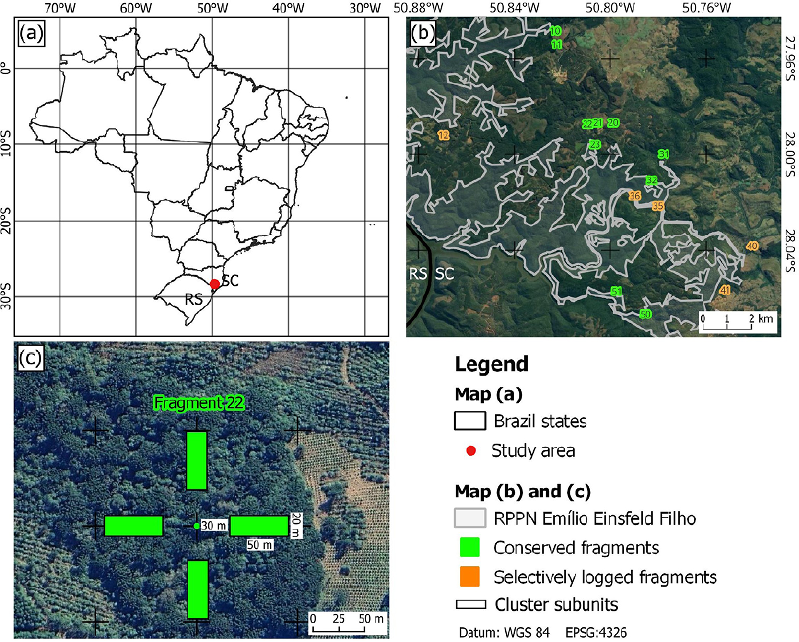
Furthermore, forest fragments were classified according to disturbance history, based on information provided by landowners (Florestal Gateados, 2026), into two categories: conserved areas, defined as those without evidence or records of recent disturbances, and areas subjected to selective logging (Figure 1). Conserved fragments are located mostly within the Emílio Einsfeld Filho Private Natural Heritage Reserve (RPPN) and closer conserved locals, where the forest remained protected during the 20th-century “timber cycle” and has not experienced anthropogenic disturbance since approximately 1890 (Florestal Gateados, 2026).

Location of the study area and sampling design in Mixed Ombrophilous Forest fragments. (a) Geographic location of the study area in Brazil; (b) distribution of conserved and selectively logged forest fragments (numbers 10-51) near the border between the states of Santa Catarina and Rio Grande do Sul; and (c) schematic representation of the sampling design, illustrating the forest fragments, the surrounding landscape context, and the location of the sampling clusters within the UTM grid. Each cluster was composed of four 20 × 50 m subunits, with each subplot located 30 m from the center in the north, south, east, and west directions.
In contrast, selectively logged fragments, which are not included within the RPPN but correspond to native forest areas belonging to the same landowner (Florestal Gateados, 2026), underwent logging interventions between the 1930s and 1980s (Goularti Filho, 2002). These interventions primarily targeted Araucaria angustifolia (Bertol.) Kuntze and some Lauraceae species, with trees presenting diameter at breast height (d) ≥ 40 cm being preferentially harvested. These areas currently exhibit approximately 40 years of natural regeneration, with no further interventions since the 1990s. Detailed information on the study areas, including fragment and cluster identification, forest type, altitude, and fragment size, is provided in Table 1.
2.2. Sampling and analyses
We measured the traits used to characterize the functional composition of tree communities following the standardized protocols proposed by Pérez-Harguindeguy et al. (2013), focusing on four variables: specific leaf area, leaf dry matter content, wood density, and height. Functional shoots were collected by removing live branches approximately 1 m in length, wrapping the base of each branch in moistened paper towels, and storing the material in plastic bags to preserve moisture until analysis. Leaf area was measured using ImageJ software, and wood density was determined according to the methodology and equation proposed by Smith (1954) (Equation 1), using branch samples with a diameter ≥ 1 cm.
Where: Db is basic wood density; Pf is saturated fresh mass; Ps is oven-dry mass at constant weight; and Gs is a constant representing the average density of wood equivalent to 1.53 g cm-3.
Additionally, tree volume was estimated using species-specific volume equations, applying Equation 2 for A. angustifolia (Netto, 1984) and Equation 3 for the remaining species (Vibrans et al., 2015). Biomass was subsequently calculated based on these volume estimates using volumetric methods. Aboveground biomass was converted into carbon stock using a fixed carbon fraction of 0.5 (50%), following the guidelines of the Intergovernmental Panel on Climate Change (IPCC, 2006, 2019).
Where: V = total volume; exp = exponential; ln = natural logarithm; CAP = circumference at breast height (1.30 m); h = total height; d = diameter at breast height (1.30 m).
To analyze the forest functional attributes, we used the total height and diameter at breast height (d) of the species that together accounted for 80% of the relative abundance and corresponded to species with an Importance Value Index of 10% or higher, as studied in the works of Vaz et al. (2022) and Biolchi (2023). For each selected species, samples were collected from five individuals across twenty-two plots that had been previously inventoried and botanically identified (Vaz et al., 2022; Vaz, 2022; Biolchi, 2023), with 12 plots representing conserved forests and 10 plots representing selectively logged forests. Sampling followed a cluster design based on a UTM grid, in which each cluster covered a total area of 4,000 m2, subdivided into four subunits of 1,000 m2 each (20 m × 50 m). These subunits were oriented toward the four cardinal directions and positioned 30 m from a central point. Detailed information on the sampling units is provided in Table 1, and their spatial arrangement is illustrated in Figure 1.
Furthermore, functional composition was assessed using the Community Weighted Mean (CWM), which estimates the mean value of each trait weighted by species dominance based on abundance (Funk et al., 2023). CWM values were calculated at the plot level using a species trait matrix and a plot-by-species abundance matrix, where each CWM represents the abundance-weighted mean of the trait within each plot. Thus, each plot was considered an independent statistical unit in subsequent analyses.
The normality of CWM values was evaluated using the Shapiro-Wilk test. Differences between forest types (conserved and selectively logged) were assessed using two-sample Student’s t-tests with Welch’s correction for unequal variances (α = 0.05), based on plot-level CWM values. Plots were assumed to be independent according to the sampling design, although spatial autocorrelation was not explicitly tested. Forest diversity was compared using rarefaction curves to assess sampling adequacy and species richness, based on abundance values measured at the plot level. To explore multivariate patterns and the relative contribution of each attribute to differences between forest types, we performed Principal Component Analysis (PCA). In addition, correlations among attributes were quantified using Pearson’s correlation coefficient, and their significance was tested at α = 0.05.
All analyses were conducted in R (R Core Team, 2022) using the packages FD (Laliberté, Legendre & Shipley, 2023), dplyr (Wickham et al., 2023), devtools (Wickham, Hester & Chang, 2025), factoextra (Kassambara & Mundt, 2020), and iNEXT (Hsieh, Ma & Chao, 2025).
3. RESULTS
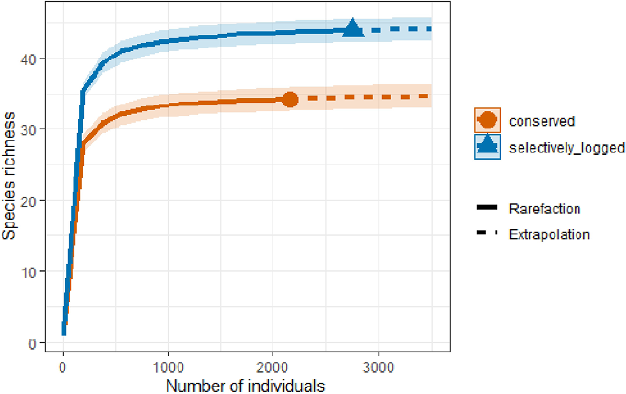
Results showed that the selectively logged forest exhibited higher species richness than the conserved forest. Rarefaction curves for both areas reached an asymptote, suggesting that sampling effort was sufficient to adequately capture species diversity and reliably represent local richness (Figure 2). Stem density was also higher in selectively logged forest containing 3,052 individuals, whereas the conserved forest contained 2,241 individuals.
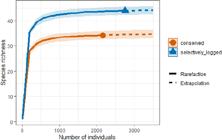
Species richness in conserved and selectively logged Mixed Ombrophilous Forests in Campo Belo do Sul, Santa Catarina State, Brazil.
Principal Component Analysis (PCA) clearly separated the forest types, with the first two axes explaining approximately 97% of the total variance in the data (Figure 3). The first axis (Dim1), which accounted for most of the variance, was primarily associated with structural attributes derived from forest inventory data, including diameter at breast height, height, biomass, and carbon. The second axis (Dim2) was mainly associated with leaf and structural traits, particularly specific leaf area, in contrast to wood density and leaf dry matter content. The resulting pattern shows that samples from the conserved forest cluster on the positive side of Dim1, reflecting a stronger influence of dendrometric attributes, whereas samples from the selectively logged forest are distributed on the negative side and vary predominantly along Dim2, indicating a greater influence of leaf-related traits.

Principal Component Analysis (PCA) of conserved and selectively logged Mixed Ombrophilous Forests. SLA - specific leaf area; WD - wood density; LDMC - leaf dry matter content; H - height; d - diameter at breast height.
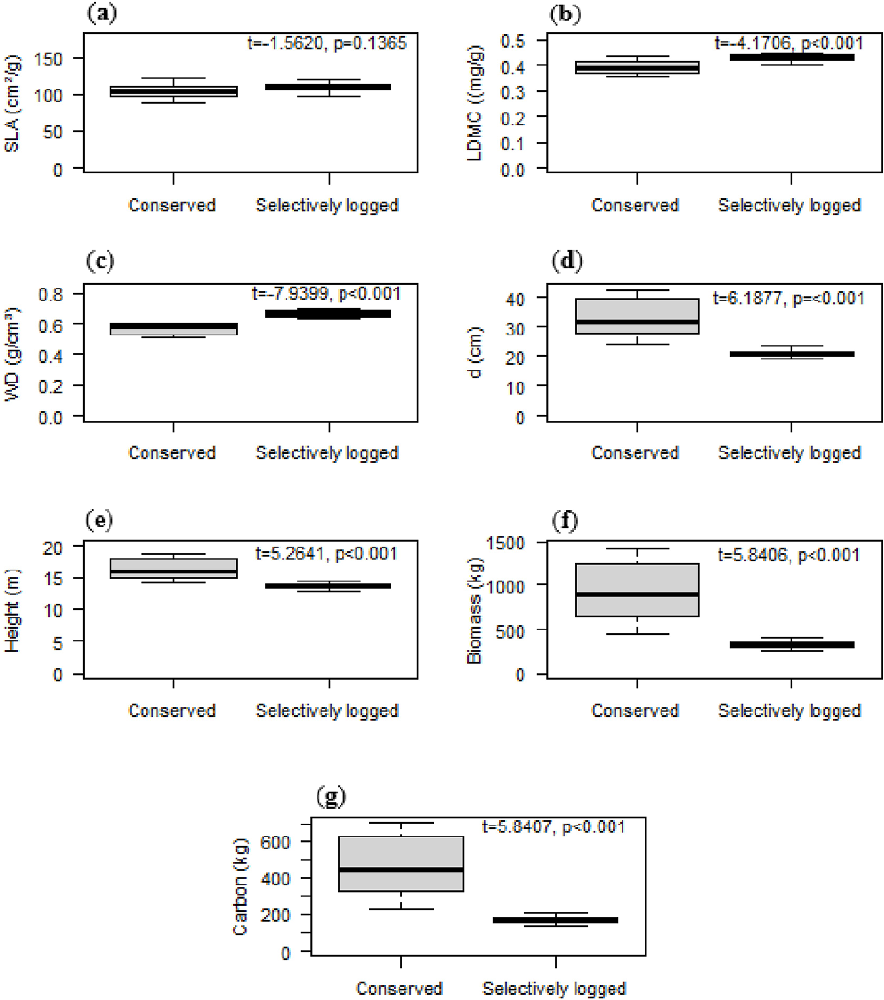
Descriptive statistics (Figure 4) show that the conserved forest exhibited greater variability and dispersion across all analyzed variables. Boxplots complement the PCA by visually illustrating these patterns and reinforcing the distinction between forest areas. Median values show higher wood density and leaf dry matter content in the selectively logged forest, whereas diameter at breast height, biomass, and carbon were higher in the conserved forest. Two-sample Student’s t-tests confirmed statistically significant differences for most functional attributes, while specific leaf area did not differ significantly between forest.

Boxplots of functional attributes: (a) specific leaf area (SLA), (b) leaf dry matter content (LDMC), (c) wood density (WD), (d) diameter at breast height (d), (e) height, (f) biomass, and (g) carbon for conserved and selectively logged Mixed Ombrophilous Forests.
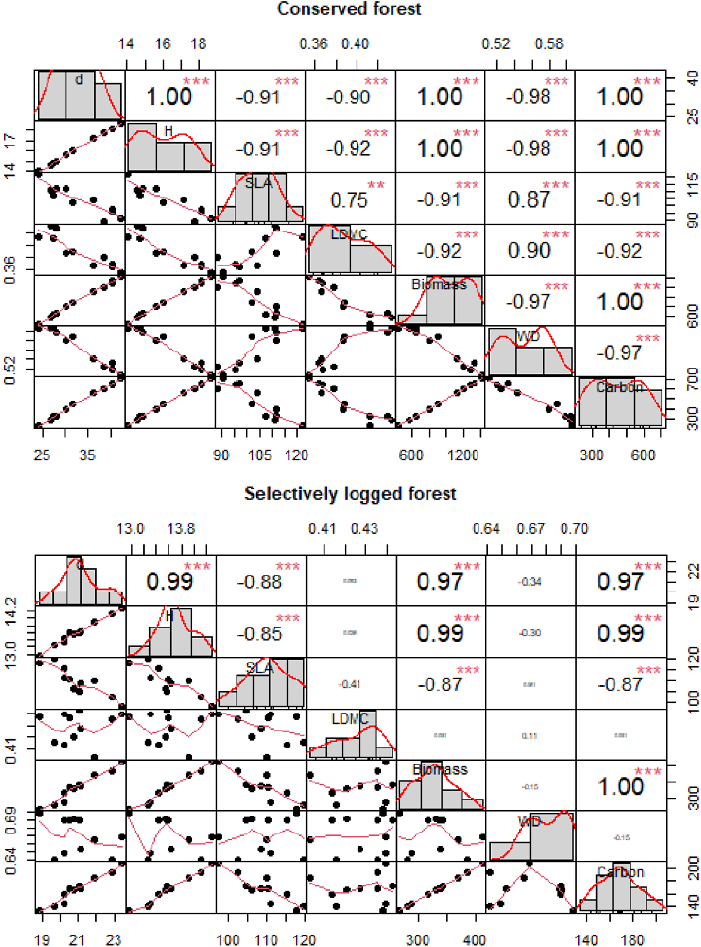
In the conserved forest, most variables exhibited strong to very strong and statistically significant correlations (r > 0.70) (Figure 5). In contrast, the selectively logged forest showed greater variability in both correlation strength and statistical significance. In this forest, only strong or very strong associations were significant, primarily among diameter at breast height, height, specific leaf area, biomass, and carbon. These patterns suggest that selective logging could be associated with changes in the relationships among functional traits, potentially influencing how these attributes jointly contribute to forest structure and functioning.
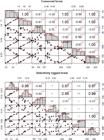
Correlation matrix among functional attributes in conserved and selectively logged Mixed Ombrophilous Forests. Diagonal - histograms with the distribution of each attribute; scatterplots (below the diagonal) - bivariate relationships with patterns and trends; Pearson correlation coefficients and significance levels (above the diagonal) - strength and direction of associations, where positive values indicate traits that increase together and negative values indicate inverse relationships.
4. DISCUSSION
According to the results, this study observed the impact of selective logging on functional attributes and ecological strategies in Mixed Ombrophilous Forest fragments in comparison with conserved fragments. Conserved fragments exhibited significantly higher diameter at breast height, height, biomass, and carbon content (t-test, p < 0.05), but with more variability, suggesting a wider range of strategies among species (Lohbeck et al., 2013). In contrast, selectively logged areas showed significantly higher leaf dry matter content and wood density (t-test, p < 0.05), with less amplitude, resulting in an unexpected pattern in which both leaf and structural traits are associated with more conservative strategies even in selectively logged environments. Conserved fragments also exhibited stronger correlations among attributes, showing a more cohesive system (Sun et al., 2025). On the other hand, selectively logged fragments showed greater variability in correlation patterns, and suggested that selective logging may be associated with shifts in the relationships among functional traits.
In general, conserved forests are expected to exhibit higher leaf dry matter content and wood density, as both traits are associated with conservative strategies such as slow growth, longer tissue lifespan, and greater resistance to environmental stress (Cornelissen et al., 2003; Chave et al., 2009; Poorter et al., 2012). However, the opposite pattern was observed. In this case, selectively logged forests may exhibit more conservative functional strategies, with the positive association between wood density and leaf dry matter content, also identified in the principal component analysis (PCA). This inversion may reflect floristic composition shaped by past exploitation, which tends to selectively remove fast-growing species with less dense wood, such as A. angustifolia and some Lauraceae species, while favoring species with denser wood, slower growth, and greater structural investment, such as those in the Myrtaceae family, as may have occurred in the present context. Similar patterns have been reported in Andean montane forests, where higher wood density has been observed in early successional stages due to the composition of dominant species (Castillo-Figueroa et al., 2023).
Regarding specific leaf area, both forests showed statistically similar values. Given that this trait responds rapidly to environmental changes, comparable values may indicate that both forests share intermediate strategies of resource acquisition and conservation (Wright et al., 2004). Alternatively, this pattern may suggest that selective logging did not significantly alter the functioning of this trait. In some cases, specific leaf area may stabilize within a few years after disturbance and thus become a less sensitive indicator during intermediate successional stages. In contrast, structural attributes followed the pattern predicted in the literature: the conserved forest contained larger trees, with greater diameter, height, biomass, and carbon. These attributes recover more slowly during succession and may require decades to reach levels comparable to those of mature forests (Poorter et al., 2016; Rozendaal et al., 2019; Poorter et al., 2021). After approximately 40 years of natural regeneration, the selectively logged forest appears to remain on a trajectory of structural recovery, suggesting that the re-establishment of processes such as biomass accumulation and carbon storage may require longer time periods.
Moreover, the selectively logged forest exhibited higher species richness and stem density than the conserved forest. This pattern is consistent with studies indicating that recent anthropogenic disturbances increase environmental heterogeneity and create favorable conditions for the establishment of species from different successional stages, particularly due to increased light availability in the understory (Poorter et al., 2016). For example, pioneer species may be recruited under these conditions and subsequently decline over time, potentially leading to reductions in species diversity as succession progresses.
This pattern may reflect forest regeneration strategies following disturbance. However, higher species richness does not necessarily indicate a more favorable environment, particularly when considering variation in functional attributes, which may suggest that, despite the greater number of species, some perform similar ecological roles. The predominance of smaller trees in these fragments may also contribute to higher stem density, as smaller individuals occupy less space and allow more trees per unit area. In contrast, the conserved forest, composed of larger and more robust individuals, tends to exhibit lower stem density, likely due to increased competition for resources such as light and space (Osazuwa-Peters et al., 2015; Poorter et al., 2016).
Our results suggest that forest responses to selective logging depend on environmental context and land-use legacy, as further reflected in the observed correlation patterns. Even when functional attributes diverged from expected patterns, they remained indicative of adaptation to local conditions, highlighting the interaction among species, environment, and land-use history (Poorter et al., 2012; Kang et al., 2021). Because functional traits respond sensitively to environmental changes, they provide valuable tools for understanding how plants readjust following disturbances (Aleixo et al., 2019; Moser et al., 2019).
Comparisons among fragments at different successional stages provide important insights into vegetation resilience and vulnerability. This is particularly relevant in Mixed Ombrophilous Forests, which support socio-economic activities such as seed extraction of A. angustifolia (Hess et al., 2014). Our findings further suggest that the legacy of selective logging may result in atypical combinations of ecological strategies, with leaf and structural traits responding differently among fragments. This dynamic suggests that disturbances can give rise to alternative functional configurations that do not necessarily follow linear successional trajectories. Therefore, understanding how selectively logged areas recover under the context of climate change is essential to inform management practices that reconcile conservation and sustainability. Continuous monitoring is also necessary to ensure that exploited areas do not become net carbon sources but instead contribute effectively to climate-change mitigation (Chazdon et al., 2020).
Additionally, we acknowledge some limitations of this study. We analyzed forests subjected to different management regimes and disturbance histories; however, sampling was restricted to a single location comprising a limited number of small fragments of Montane Mixed Ombrophilous Forest, a specific formation within the Atlantic Forest biome. Due to the reduced size of the sampled fragments, edge effects may also have influenced forest microenvironmental conditions and, consequently, species growth responses and functional trait patterns. Comparative studies across different regions, larger fragments, and diverse forest types are therefore necessary to strengthen inferences and support broader generalizations on how disturbances influence functional traits and plant growth strategies. Furthermore, our analyses were based on a subset of species with available functional trait data, which may have led to an underestimation of functional diversity and the introduction of potential biases. Although a sensitivity analysis including all species would be desirable to assess the robustness of the results, this was not feasible due to data limitations. In addition, we evaluated a limited set of functional attributes. The inclusion of other traits, such as xylem anatomical characteristics and stomatal density, could provide further insights into the mechanisms underlying forest adaptation and recovery.
5. CONCLUSIONS
This study suggests that selective logging is associated with changes in forest functional strategies, although responses were different than initially expected. In this case study, the conserved forest exhibited significantly higher diameter at breast height, height, biomass, and carbon content (t-test, p < 0.05), whereas the selectively logged forest showed higher wood density and leaf dry matter content (t-test, p < 0.05), traits commonly linked to conservative strategies. Boxplots show lower variability in functional traits in the selectively logged forest, despite its higher species richness. In contrast, correlation analyses revealed more variable relationships among attributes in the selectively logged forest, while the conserved forest showed stronger associations.
Overall, our results suggest that recovery following selective logging does not necessarily follow a single trajectory and may involve different functional configurations. These trajectories are likely influenced by multiple interacting factors, including the species targeted for harvesting, management history, pre-disturbance species composition, local environmental conditions, among others. Furthermore, some of the observed patterns may represent transitional post-disturbance states rather than long-term stable ecological conditions, highlighting the importance of continuous monitoring of the attributes. Therefore, recovery trajectories are shaped not only by ecological processes but also by management decisions and broader socioeconomic factors associated with forest use.
However, the results should be interpreted with caution, as this study was conducted at a single location, with a limited number of small fragments and a restricted set of functional traits. Future studies encompassing different regions, forest types, disturbance histories, and broader sets of functional traits are needed to support more general conclusions regarding the mechanisms driving functional strategies and forest recovery following selective logging.
DATA AVAILABILITY
The entire dataset supporting the results of this study has been made available on Mendeley Data and can be accessed at DOI: 10.17632/3zw36ydgnv.1.
REFERENCES
-
Aleixo I, Norte F, Costa FRC, Almeida DRA, Feldpausch TR, Jardim B e outros. Amazonian rainforest tree mortality driven by climate and functional traits. Nat Clim Change 2019; 9: 384-388. https://doi.org/10.1038/s41558-019-0458-0
» https://doi.org/10.1038/s41558-019-0458-0 - Biolchi G. Estrutura e classificação de florestas de Araucaria angustifolia [dissertação]. Lages: Universidade do Estado de Santa Catarina; 2023.
-
Bonan GB. Forests and climate change: forcings, feedbacks, and the climate benefits of forests. Science 2008; 320: 1444-1449. https://doi.org/10.1126/science.1155121
» https://doi.org/10.1126/science.1155121 -
Brancalion PHS, Noss RF, Raupp J, Ballerini J, Young KR, Fonseca CR e outros. Global restoration opportunities in tropical rainforest landscapes. Sci Adv 2019; 5: eaav3223. https://doi.org/10.1126/sciadv.aav3223
» https://doi.org/10.1126/sciadv.aav3223 - Brasil. Conselho Nacional do Meio Ambiente (CONAMA). Resolução nº 278, de 24 de maio de 2001. Dispõe sobre o corte e exploração de espécies da flora ameaçadas de extinção. Diário Oficial da União, Brasília, DF, 18 jun. 2001.
- Brasil. Instituto Brasileiro do Meio Ambiente e dos Recursos Naturais Renováveis (IBAMA). Portaria nº 37, de 3 de abril de 1992. Reconhece como lista oficial das espécies da flora brasileira ameaçadas de extinção. Diário Oficial da União , Brasília, DF, 7 abr. 1992.
-
Castillo-Figueroa D, Lasso E, Álvarez-Dávila E, Cabrera M, Jiménez-Casillas M, Rivera G e outros. Wood density is related to aboveground biomass and productivity along a successional gradient in Andean tropical forests. For Ecol Manage 2023; 547: 121291. https://doi.org/10.1016/j.foreco.2023.121291
» https://doi.org/10.1016/j.foreco.2023.121291 -
Chave J, Coomes D, Jansen S, Lewis SL, Swenson NG, Zanne AE. Towards a worldwide wood economics spectrum. Ecol Lett 2009; 12(4): 351-366. https://doi.org/10.1111/j.1461-0248.2009.01285.x
» https://doi.org/10.1111/j.1461-0248.2009.01285.x -
Chazdon RL, Brancalion PHS, Laestadius L, et al. When is a forest a forest? Forest concepts and definitions in the era of forest and landscape restoration. Ambio 2016; 45: 538-550. https://doi.org/10.1007/s13280-016-0772-y
» https://doi.org/10.1007/s13280-016-0772-y -
Cornelissen JHC, Lavorel S, Garnier E, Díaz S, Buchmann N, Gurvich DE e outros. A handbook of protocols for standardised and easy measurement of plant functional traits worldwide. Aust J Bot 2003; 51: 335-380. https://doi.org/10.1071/BT02124
» https://doi.org/10.1071/BT02124 - Dubreuil V, Fante KP, Planchon O, Sant’Anna Neto JL. Os tipos de climas anuais no Brasil: uma aplicação da classificação de Köppen de 1961 a 2015. Confins 2018; 37. https://doi.org/10.4000/confins.15738.
-
Florestal Gateados. Resumo público do Plano de Manejo Florestal 2026 Florestal Gateados S.A., v. 17, 2026. https://gateados.com.br/assets/uploads/public-summaries/990dc48cfc12d561daf117062cf33f3d.pdf
» https://gateados.com.br/assets/uploads/public-summaries/990dc48cfc12d561daf117062cf33f3d.pdf -
Funk JL, Kimball S, Nguyen MA, Lulow M, Vose GE. Interacting ecological filters influence success and functional composition in restored plant communities over time. Ecol Appl 2023; 33: e2899. https://doi.org/10.1002/eap.2899
» https://doi.org/10.1002/eap.2899 -
Garnier E, Cortez J, Billès G, Navas ML, Roumet C, Debussche M e outros. Plant functional markers capture ecosystem properties during secondary succession. Ecology 2004; 85: 2630-2637. https://doi.org/10.1890/03-0799
» https://doi.org/10.1890/03-0799 - Goularti Filho, A. A formação econômica de Santa Catarina. Ensaios FEE, v. 23, n. 2, p. 977-1007, 2002.
-
Hess AF, Minatti M, Ferrari L, Pintro BA. Manejo de Floresta Ombrófila Mista pelo método de Liocourt, Município de Painel, SC. Cerne 2014; 20(4): 575-580. https://doi.org/10.1590/01047760201420041230
» https://doi.org/10.1590/01047760201420041230 -
Hsieh TC, Ma KH, Chao A. iNEXT: Interpolation and extrapolation for species diversity. R package version 3.0.0; 2025. Available in: https://cran.r-project.org/package=iNEXT
» https://cran.r-project.org/package=iNEXT - Intergovernmental Panel on Climate Change. 2006. IPCC Guidelines for National Greenhouse Gas Inventories. Hayama: Institute for Global Environmental Strategies.
- Intergovernmental Panel on Climate Change. 2019. Refinement to the 2006 IPCC Guidelines for National Greenhouse Gas Inventories. Calvo Buendia E, Tanabe K, Kranjc A, Baasansuren J, Fukuda M, Ngarize S, et al., editores. Geneva: IPCC.
-
Kang D, Yin C, Zhu D, Zou S. Altitude and landslide scale regulate the assembly of grassland communities on landslides during the recovery process after the magnitude 8.0 Wenchuan earthquake, China. Ecol Eng 2021; 172: 106413. https://doi.org/10.1016/j.ecoleng.2021.106413
» https://doi.org/10.1016/j.ecoleng.2021.106413 -
Kassambara A, Mundt F. factoextra: Extract and visualize the results of multivariate data analyses. R package version 1.0.7; 2020. Available in: https://cran.r-project.org/package=factoextra
» https://cran.r-project.org/package=factoextra -
Laliberté E, Legendre P, Shipley B. FD: Measuring functional diversity. R package version 1.0-12; 2023. Available in: https://cran.r-project.org/package=FD
» https://cran.r-project.org/package=FD -
Lohbeck M, Poorter L, Martínez-Ramos M, Rodriguez Velázquez J, van Breugel M, Bongers F. Changing drivers of species dominance during tropical forest succession. Funct Ecol 2014; 28: 1052-1062. https://doi.org/10.1111/1365-2435.12240
» https://doi.org/10.1111/1365-2435.12240 -
Missio FF, Silva AC, Higuchi P, Longhi SJ, Brand MA, Rios PD e outros. Atributos funcionais de espécies arbóreas em um fragmento de Floresta Ombrófila Mista em Lages, SC. Cienc Florest 2017; 27(1): 215-224. https://doi.org/10.5902/1980509826460
» https://doi.org/10.5902/1980509826460 -
Moser P, Moura NMB, Silva VV, Nicoletti MF, Wolff IS, Mafra DA e outros. Selective logging changes ecological strategies in Mixed Ombrophilous Forest: a functional approach [conjunto de dados]. Mendeley Data 2025; V1. https://doi.org/10.17632/3zw36ydgnv.1
» https://doi.org/10.17632/3zw36ydgnv.1 -
Moser P, Silva CVJ, Feldpausch TR, Chave J, Mádua EP, Bakker MR e outros. Interaction between extreme weather events and mega-dams increases tree mortality and alters functional status of Amazonian forests. J Appl Ecol 2019; 56(12): 2641-2651. https://doi.org/10.1111/1365-2664.13404
» https://doi.org/10.1111/1365-2664.13404 - Netto SP. Inventário Florestal Nacional, Florestas nativas: Paraná e Santa Catarina Instituto Brasileiro de Desenvolvimento Florestal, Brasília, DF 1984.
-
Osazuwa-Peters OL, Malhi Y, Phillips OL, Vasquez RM, Baker TR. Selective logging: do rates of forest turnover in stems, species composition and functional traits decrease with time since disturbance? A 45-year perspective. For Ecol Manage 2015; 357: 10-21. https://doi.org/10.1016/j.foreco.2015.08.002
» https://doi.org/10.1016/j.foreco.2015.08.002 -
Phillips OL, Sullivan MJP, Baker TR, et al. Wood density influences biomass across tropical forests. Surv Geophys 2019; 40: 913-935. https://doi.org/10.1007/s10712-019-09540-0
» https://doi.org/10.1007/s10712-019-09540-0 -
Poorter H, Poot P, Niklas PB, Mommer L. Biomass allocation to leaves, stems and roots: meta-analyses of interspecific variation and environmental control. New Phytol 2012; 193: 30-50. https://doi.org/10.1111/j.1469-8137.2011.03952.x
» https://doi.org/10.1111/j.1469-8137.2011.03952.x -
Poorter L, Bongers F, Aide TM, Zambrano AMA, Balvanera P, Becknell JM e outros. Biomass resilience of Neotropical secondary forests. Nature 2016; 530: 211-214. https://doi.org/10.1038/nature16512
» https://doi.org/10.1038/nature16512 -
Poorter L, Rozendaal DMA, Bongers F, Aide TM, Brancalion PHS, Chazdon RL e outros. Multidimensional tropical forest recovery. Science 2021; 374(6573): 1370-1376. https://doi.org/10.1126/science.abh3629
» https://doi.org/10.1126/science.abh3629 -
Roberts P, Hamilton R, Piperno D. Tropical forests as key sites of the “Anthropocene”: past and present perspectives. Proc Natl Acad Sci USA 2021; 118(40): e2109243118. https://doi.org/10.1073/pnas.2109243118
» https://doi.org/10.1073/pnas.2109243118 -
Rozendaal DMA, Bongers F, Aide TM, Alvarez-Dávila E, Ascarrunz N, Balvanera P e outros. Biodiversity recovery of Neotropical secondary forests. Sci Adv 2019; 5: eaau3114. https://doi.org/10.1126/sciadv.aau3114
» https://doi.org/10.1126/sciadv.aau3114 -
Schlickmann MB, Sandi BA, Rech LF, et al. Traços funcionais em Floresta Ombrófila Mista. Cienc Florest 2019; 29(4): 1592-1600. https://doi.org/10.5902/1980509834818
» https://doi.org/10.5902/1980509834818 - Sevegnani L, Vibrans AC, Gasper AL, Lingner DV. Considerações finais sobre a Floresta Ombrófila Mista. In: Vibrans AC, editor. Inventário Florístico Florestal de Santa Catarina. Blumenau: Edifurb; 2013.
- Smith DM. Maximum moisture content method for determining specific gravity of small samples. Madison, Forest Products Laboratory 1954, 8p.
-
Soboleski VF, Higuchi P, Silva AC, Loebens R, Souza K, Buzzi F et al. Variação de atributos funcionais do componente arbóreo em função de gradientes edáficos em uma floresta nebular no sul do Brasil. Rodriguésia 2017; 68(2): 291-300. https://doi.org/10.1590/2175-7860201768201
» https://doi.org/10.1590/2175-7860201768201 -
Sun C, Yao J, Huang Y, Zang R. Variation in functional traits of woody plants across successional stages in subtropical forests. Forests 2025; 16: 868. https://doi.org/10.3390/f16050868
» https://doi.org/10.3390/f16050868 -
Varela Silva V, Nicoletti M, Dobner Jr M, Vaz D, Oliveira G. Fragmentos de Floresta Ombrófila Mista em diferentes estágios sucessionais: caracterização dendrométrica e determinação da biomassa e carbono. Rev Cienc Agroveterinarias 2023; 22(4): 695-704. https://doi.org/10.5965/223811712242023695
» https://doi.org/10.5965/223811712242023695 -
Varela Silva V, Nicoletti MF, da Silva Wolff I, Stepka TF, Mafra DA, Schons Junior E. Volumetry and trunk shape of Araucaria angustifolia in Mixed Ombrophilous Forest fragments at different anthropization levels. Floresta 2024; 54(1). https://doi.org/10.5380/rf.v54i1.95965
» https://doi.org/10.5380/rf.v54i1.95965 -
Vaz DR, Dobner Jr M, Scipioni M, Nicoletti MF, Arce J. Old-growth and secondary Araucaria Forest characterization. Trees For People 2022; 9. https://doi.org/10.2139/ssrn.4151548
» https://doi.org/10.2139/ssrn.4151548 - Vaz DR. Caracterização dendrométrica e estudos dendrocronológicos de remanescentes primários e antropizados de Floresta de Araucária, em Santa Catarina [dissertação]. Lages: Universidade do Estado de Santa Catarina; 2022.
-
Vibrans AC, Moser P, Oliveira LZ, Maçaneiro JP. Modelos genéricos e específicos de volume de caule para três tipos de florestas subtropicais no sul do Brasil. Ann. Para. Sci. 2015, 72 (6), 865-874.https://doi.org/10.1007/s13595-015-0481-x
» https://doi.org/10.1007/s13595-015-0481-x -
Vibrans AC, Nicoletti AL, Liesenberg V, Refosco JC, Kohler LPA, Bizon AR, Lingner DV, Bosco FD, Boeno MM, Silva MS, Pessatti TB. MonitoraSC: Um Novo Mapa De Cobertura Florestal E Uso Da Terra De Santa Catarina. RAC 2021, 34 (2), 42-48. https://doi.org/10.52945/rac.v34i2.1086
» https://doi.org/10.52945/rac.v34i2.1086 -
Wickham H, François R, Henry L, Müller K, Vaughan D. dplyr: A grammar of data manipulation. R package version 1.1.4; 2023. Available in: https://cran.r-project.org/package=dplyr
» https://cran.r-project.org/package=dplyr -
Wickham H, Hester J, Chang W. devtools: Tools to make developing R packages easier. R package version 2.4.5; 2025. Available in: https://cran.r-project.org/package=devtools
» https://cran.r-project.org/package=devtools -
Wright IJ, Reich PB, Westoby M, Ackerly DD, Baruch Z, Bongers F e outros. The worldwide leaf economics spectrum. Nature 2004; 428: 821-827. https://doi.org/10.1038/nature02403
» https://doi.org/10.1038/nature02403