 Rural and urban adolescents environmental attitudes
Abstract
Objective The worldwide intensification of environmental problems has increased political debates and educational concerns about behaviors and citizens’ responsibilities. Studying the factors and dynamics of environmental attitudes is critical for environmental behaviors. However, studies regarding environmental attitudes throughout adolescence and considering rural and urban regions are lacking. This study investigated the environmental attitudes of early and middle adolescents, comparing rural and urban regions.
Method The sample consisted of 1,262 students (53.6% women) who completed two environmental attitude inventories: one measuring ecocentrism (sustaining environmental preservation) and another measuring anthropocentrism (sustaining environmental utilization).
Results Urban students presented higher anthropocentric attitudes than rural students. Early adolescents scored higher on ecocentric attitudes, whereas middle adolescents scored higher on anthropocentric attitudes. Urban students increased anthropocentric attitudes from early to middle adolescence, while rural students decreased ecocentric attitudes.
Conclusion The findings highlight developmental and contextual differences in environmental attitudes, which have implications for education and policy. We discuss recommendations for future research.
Keywords
Adolescence; Environmental attitudes; Environmental education; Rural and urban regions
Resumo
Objetivo A intensificação mundial dos problemas ambientais tem aumentado os debates políticos e as preocupações educacionais sobre comportamentos e responsabilidades dos cidadãos. Estudar os fatores e a dinâmica das atitudes ambientais é fundamental para os comportamentos ambientais. No entanto, faltam estudos sobre atitudes ambientais ao longo da adolescência e considerando regiões rurais e urbanas. Este estudo investigou as atitudes ambientais na adolescência inicial e média, comparando regiões rurais e urbanas.
Método A amostra foi composta por 1.262 alunos (53,6% mulheres), os quais responderam a dois questionários, um que avalia o ecocentrismo (defesa da preservação do ambiente) e outro que mede o antropocentrismo (defesa da utilização do ambiente).
Resultados Os alunos da zona urbana apresentaram atitudes antropocêntricas mais elevadas do que os alunos da zona rural. Na pré-adolescência, os alunos pontuaram em geral mais alto em atitudes ecocêntricas, enquanto na adolescência média pontuaram mais alto em atitudes antropocêntricas. Da pré-adolescência à adolescência média, os alunos urbanos aumentaram em geral as atitudes antropocêntricas e os alunos rurais diminuíram as atitudes ecocêntricas.
Conclusão Os resultados destacam diferenças no desenvolvimento e no contexto das atitudes ambientais, com implicações para a educação e a formulação de políticas. Recomendações para pesquisas futuras são apresentadas.
Palavras-chave
Adolescência; Atitudes ambientais; Educação ambiental; Ambientes rurais e urbanos
Environmental attitudes rely on one’s experiences with nature and consist of the beliefs, affects, and behavioral intentions regarding the quality and sustainability of the physical environment (American Psychological Association [APA], 2021; Hawcroft & Milfont, 2010; Musitu-Ferrer et al., 2019; Pessoa et al., 2016; Sparks et al., 2014). With the relevance of the environment for humanity acknowledged the attention to environmental attitudes has increased. During the initial phase of the Coronavirus Disease 2019 (Covid-19) pandemic, there was also increased attention to the benefits for the planet resulting from the reduction in pollution levels observed. Although it lasted shortly, a lesson was learned: the reduction of the greenhouse effect, with benefits to the Earth and the people worldwide, is urgent and possible (United Nations, 2022).
The need to preserve the environment and the biodiversity has accentuated the distinction between two main approaches regarding the human-nature relationship: the “ecocentrism” and the “anthropocentrism” (Amérigo et al., 2012; Casey & Scott, 2006; Jama et al., 2022; Kopnina, 2013). Ecocentrism is an ecological conception that relies on a system of values and attitudes centered on the physical world. According to this approach, what is good for nature is good for humankind, whereby the natural environment needs to be preserved to conserve humans as well. In turn, the anthropocentric approach views humans as the center of the universe. Individuals following an anthropocentric approach express concern about protecting the environment, but only when perceiving it as needed to assure their own survival and prosperity. Both ecocentric and anthropocentric individuals can express great concern with environmental issues but for different reasons. Ecocentric individuals are more likely than anthropocentric individuals to express pro-environmental attitudes when it comes to defending species, ecosystems or natural resources that are not of immediate and direct interest to humanity (Amérigo et al., 2012; Moreira et al., 2004). Anthropocentric individuals defend the environment for personal reasons, thus justifying their behaviors (Kortenkamp & Moore, 2009).
Environmental attitudes are conceived as a multidimensional construct (Bogner & Wiseman, 2006; Milfont & Duckitt, 2010), although the number of its dimensions remains controversial. Milfont and Duckitt (2010) proposed 12 perceptions or beliefs about the natural environment as specific environmental attitude dimensions. Other studies suggested a bi-dimensional structure, including preservation and utilization (Bogner & Wiseman, 2006; Manoli et al., 2019). Preservation is aligned with the ecocentric approach, as it expresses the protection of nature and biodiversity due to their natural state and sustainability. Contrarily, utilization is aligned with the anthropocentric approach by claiming that nature is at the service of humans, whereby economic benefits justify its exploitation (Manoli et al., 2019).
Variations for Rural and Urban Regions
Regional differences can be considered the most used expression when comparing individuals whose attributes primarily differ due to their geographical background (APA, 2021). Variations in students’ environmental attitudes according to their geographical region have been explored (Dunlap et al., 2000; Martins & Veiga, 2001; Oliveira et al., 2019). The literature has compared students from rural versus urban contexts (Xiao et al., 2018; Yu, 2014), although findings are sometimes controversial. In Portugal, rural regions are assigned to the interior of the country and have been facing a strong population decline. Such a demographic decrease has elicited management problems due to the aggravation of the economic situation in those territories and the ongoing need to maintain the natural features of rural regions. Oppositely, the high concentration of people in urban regions, especially on the coast, has led to a demographic increase and to a high demand for natural resources (air, water, soil, biodiversity). Studies focused on the effects of the region of residence (rural versus urban) in environmental attitudes have offered three main sets of results: favorable to urban, favorable to rural, and showing no differentiation.
Regarding the first set of results, there are evidences suggesting that individuals from urban regions present more favorable environmental anthropocentric attitudes than individuals from rural regions (Martins, 2020; Xiao et al., 2018). Urban regions often face excessive traffic, noise, and air pollution, which may justify their residents’ appreciation of environmental quality, but their simultaneous dependence on means of movement, production, and transportation required for urban life. It seems reasonable that people living in urban regions present favorable anthropocentric attitudes, valuing the use of nature’s resources for human benefit (Casey & Scott, 2006; Dunlap et al., 2000). By being exposed to lower environmental quality, people living in urban regions also tend to consider that the natural quality featuring rural regions should not be degraded (Atik et al., 2022; Musitu-Ferrer et al., 2019; Yu, 2014). Residents in urban regions tend to defend the maintenance of protected regions and the restriction of activities that can cause environmental degradation since such natural resources are essential for social welfare. As for the second set of results, there are studies suggesting that students living in rural regions present more favorable environmental ecocentric attitudes than students living in urban regions (Braun et al., 2018; Dunlap et al., 2000). Findings indicate that residents in rural regions face lower educational conditions, both in family and school contexts (Veiga et al., 2016; Xiao et al., 2018), which can impact their environmental attitudes (Martins & Veiga, 2001; YU, 2014). Finally, considering the third set of results, some researchers found no differences between individuals from rural and urban areas in ecocentric environmental attitudes (Moreno et al., 2016; Thompson & Barton, 1994; Yu, 2014). Improved accessibility in terms of physical travel, communications, and technologies has transformed contexts, creating increasingly homogeneous environments. It might be the case that some studies find similar results among people from urban and rural regions due to choices that citizens are called to make in similar circumstances (Yu, 2014).
Variations for Early and Middle Adolescence
Understanding if and how environmental attitudes change with age has evoked interest from researchers (Dunlap et al., 2000; Milfont & Schultz, 2018). The study of environmental attitudes in adolescence is particularly important, as this constitutes a critical period for the construction of personality, during which parents, teachers, colleagues, and other significant people are especially valued by the individual (Piaget & Inhelder, 1979; Woolfolk, 2019). Adolescence can be described as a period of increased vulnerability to disruptive behaviors (Veiga, 2019), coupled with a progressive search for independence from parents (Veiga et al., 2016). It can also be conceived as a period of increased potential (Levy et al., 2004; Tirrel et al., 2022), which makes it important to address environmental attitudes.
Adolescence can be divided into three developmental stages (Veiga, 2019): early adolescence, from 11 to 14 years old; middle adolescence, from 15 to 17 years old; and late adolescence, from 18 to 21 years old. The transition from early to middle adolescence is characterized by a shift from self-centered reasoning to abstract thinking (Veiga, 2019). According to the Piagetian perspective of cognitive development, middle adolescents are better able to reason about concrete objects or actions but also about hypothetical or abstract scenarios than early adolescents (Veiga, 2019).
Evidence suggests a decrease in environmental ecocentric attitudes from early to middle adolescence (Hawcroft & Milfont, 2010; Martins, 2020). As middle adolescents advance in cognitive skills, their reasoning processes include “perspective taking” (Levy et al., 2004), which enables them to understand other’s points of view. This helps middle adolescents shift from an absolutist perspective to preserve nature toward a conciliatory perspective to balance nature with human needs, thus becoming aware of various perspectives (Piaget & Inhelder, 1979; Veiga, 2019) and decreasing ecocentrism. On the other hand, middle adolescents are more frequently in contact with the consumer society and the “conveniences” it can provide (Binngiesser & Randler, 2015; Milfont & Schultz, 2018; Moreno et al., 2016), which might sustain a reduced concern for the conservation of the environment. An increase in environmental anthropocentric attitudes from early to middle adolescence has, therefore, been suggested (Casey & Scott, 2006; Moreno et al., 2016; Olsson & Gericke, 2016).
Studies employing the Two-factor Model of Environmental Values Scale (2-MEV) − developed by Bogner and Wiseman (2006) to assess the preservation and utilization dimensions − found that younger adolescents scored higher than older ones in preservation but did not differ in the utilization dimension (Binngiesser & Randler, 2015; Milfont & Schultz, 2018; Moreno et al., 2016; Oerke & Bogner, 2013). The age-related decrease of preservation might be due to younger adolescents’ desire to be socially accepted by adults (Bogner et al., 2015; Lieflander & Bogner, 2014; Oerke & Bogner, 2013). On the other hand, as middle adolescents look for greater independence from adults, they may genuinely affirm what they think and feel, even if different from others (Oerke & Bogner, 2013). However, other studies using the 2-MEV scale found no differences between early and middle adolescents in environmental attitudes (Bogner, 2018). As the utilization dimension captures concerns about nature for its human advantages, it might be the case that social desirability does not play a role among early adolescents and no differences between early and middle adolescents are found (Ajdukovic et al., 2019; Lieflander & Bogner, 2014; Oerke & Bogner, 2013; Pessoa et al., 2016).
The Present Study
The literature has suggested variations in environmental attitudes for geographic regions (Xiao et al., 2018; Yu, 2014) and adolescence stages (Fransson & Gärling, 1999; Milfont & Schultz, 2018). However, these variations have been separately considered, whereby integrative research on the topic is still needed. Although environmental attitudes seem to be positively related to school adjustment, they may vary for the rural-urban students’ residence (Xiao et al., 2018; Yu, 2014) and may decrease during adolescence due to the challenges of the age as teenagers (Dunlap et al., 2000; Milfont & Schultz, 2018). Moreover, inconsistent findings have been previously reported, which may be due to prevailing debates regarding the dimensions of environmental attitudes. Hence, besides acknowledging the multidimensionality of environmental attitudes, the ecocentric-anthropocentric (preservation-utilization) duality currently offers the potential to sustain more parsimonious research (Bogner et al., 2015; Braun et al., 2018; Collado & Corraliza, 2017; Milfont et al., 2010). Despite what is already known about environmental attitudes, there is still a lack of knowledge about what underpins the differences between rural and urban students during early and middle adolescence (Dunlap et al., 2000; Milfont & Schultz, 2018; Xiao et al., 2018).
Looking for integrative research and moving from the ecocentric-anthropocentric duality, the main goal of this study was to investigate differences in students’ environmental attitudes according to the geographic regions (rural and urban), during early and middle adolescence. This major goal was divided in three specific goals, each one linked to research hypotheses. The first specific goal consists of examining differences between students from rural and urban regions regarding environmental anthropocentric and ecocentric attitudes. This specific goal is linked to two research hypotheses: hypothesis 1 stated that students living in urban regions will present higher anthropocentric attitudes than students living in rural regions; hypothesis 2 predicted that students living in urban and rural regions will present similar ecocentric attitudes. The second goal consists of testing differences between early and middle adolescents in ecocentric and anthropocentric attitudes. This specific goal is linked to additional hypotheses: hypothesis 3 stated that early adolescents will present higher ecocentric attitudes than middle adolescents; hypothesis 4 predicted that middle adolescents will present higher anthropocentric attitudes than early adolescents. The third specific goal was to investigate whether students’ region and age, simultaneously considered, play an effect on student environmental attitudes. Aligned with this specific goal, the following research hypotheses were considered: hypothesis 5 predicted that a statistically significant region and adolescence stage interaction effect will be found in anthropocentric dimensions, with higher results in urban middle students; hypothesis 6 predicted that no significant interaction effect will be found in ecocentric dimensions.
Given that there are several geographic regions in Portugal, the study described here focused only on students from two regions, one typically considered rural and the other typically considered urban. For this reason, the sample of the present study included students from these two types of regions.
Method
Participants
This study was conducted in public middle schools located in Bragança and Caldas da Rainha. Given that there are several geographic regions, the study focused only on students from these two regions, the first typically considered rural and the other typically urban. For this reason, the sample of the study included students from these two types of regions. Schools in the rural region were attended by students from villages at the periphery, where agricultural and animal breeding were the primary sources of family income. Students from the urban region attended schools in the central parts of the city. Schools were randomly selected from the rural and urban regions; within each school, classes were also randomly selected. Students attending 7th, 9th, and 11th grades in the selected six schools were surveyed. A total of 1,262 students aged 12 to 17 years old (M = 14.56, SD = 1.83) participated in this study. The sample included 629 (49.7%) early adolescents aged 12 to 14 years old, and 633 (50.3%) middle adolescents aged 15 to 17 years old. There were 728 (57.7%) students attending schools in the rural region, and 534 (42.3%) students attending schools in the urban region.
Measures
Aligned with the multidimensional conception (Bogner, 2018; Milfont et al., 2010), the Environmental Attitudes Inventory was used, as it is one of the most comprehensive measures of environmental attitudes. The Adolescents Environmental Attitude Scale was also used because it contains semantic contents complementary to the Environmental Attitudes Inventory (EAI), and has been considered in previous studies with Portuguese adolescents.
The EAI was elaborated by Milfont and Duckitt (2010), and assesses 12 dimensions of environmental attitudes, each composed by two items. The 24 items are answered in six response levels, from 1 totally disagree to 6 totally agree. An initial exploratory factor analysis enabled the selection of 12 items with acceptable factor loadings. Based on this selection, another factor analysis was carried out, using a minimum factor loading of 0.60, and extracting six dimensions, each with two items. The final EAI version preserved the assessment of six dimensions, with two items each, explaining 68.6% of the variance. The dimensions were: “Attitudes towards Nature Degradation” (AtND) that assesses the concern with the degradation of natural ecosystems (e.g., “It saddens me to see the destruction of natural environments”); “Engagement in Nature Preservation” (ENP) that assesses the willingness to implement actions that contribute to the maintenance of natural resources (e.g., “I try to preserve natural resources”); “Attraction to Nature” (ATN) that assesses one’s pleasure of contacting with nature (e.g., “I like traveling in the countryside, walking through forests or taking a walk in the fields”); “Anthropocentric concern with Natural Resources” (ANR), which assesses concern about the effects of environmental degradation on human activities (e.g., “Being able to enjoy water sports is more important than keeping rivers and sea clean”); “Policies for Nature Preservation” (PNP) that assesses support of measures that sustain the proper functioning of natural systems (e.g., “Industries should be forced to use recycled materials, even if it costs more”); and “Population Growth Policies” (PCP) that assesses concern with measures that promote sustainable population growth (e.g., “A couple should have as many children as they want, provided that there are conditions for it in the world”). To examine the measure’s internal consistency, McDonald’s Omega values were calculated for the general sample (ω = 0.72) and geographic regions (rural ω = 0.73; urban ω = 0.71), suggesting reasonable internal consistency. Hence, the EAI assesses four ecocentric dimensions – AtND, ENP, PNP, and PGP – and two anthropocentric dimensions – ANR and ATN. Some authors (Bogner, 2018) consider the latter dimension hybrid, i.e., with both ecocentric and anthropocentric elements.
The Adolescents Environmental Attitude Scale (AEAS) was adapted from Martins and Veiga (2001) and includes 12 items answered in a six-level response scale from 1 totally disagree to 6 totally agree. It assesses three dimensions with four items each, with a minimum factor loading of 0.40 in the expected dimension and 43.9% of explained variance. The dimensions are: “Attitudes Towards Pollution” (ATP) that assesses the concern with the pollution levels (e.g., “Factories that pollute air and water should pay heavy fines”); “The Concern about human action on the environment” (CHE) that assesses the concern about the consequences of changing lifestyles and investment (e.g., “The disappearance of the Indian tribes is not serious, as they are outdated by today’s society”); and “The Environmental Preservation Behaviors” (EPB) that assesses the predisposition to minimize the consumption of natural resources (e.g., “At night, people should keep most lights off to save energy”). The internal consistency was examined by computing McDonald’s Omega values for the general sample (ω = 0.76) and geographic regions (rural ω = 0.74; urban ω = 0.77), which suggested reasonable internal consistency. The AEAS enables the assessment of one ecocentric dimension – EPB – and two anthropocentric dimensions – ATP and CHE (Martins, 2020).
Procedures
The ethical guidelines recommended by the Ministry of Education’s School Survey Monitoring Team and the Ethics Committee of the Institute of Education of the University of Lisbon were followed. Permissions from the Boards of the participating schools and students’ parents were obtained. The purpose of the study was explained to the students, who also consented to their participation. Anonymity and confidentiality were guaranteed. Using a univariate F-test with four groups of interaction effects (Evans et al., 2000), a previous power analysis was performed to determine the expected approximate sample dimension needed to attain a medium-small effect size with high power (α = 0.05, 1 – β = 0.95; f = 0.17); as this study covered students from rural and urban regions and two adolescence stages (early and middle), a minimum sample of 600 students was needed. Since this research focused on a sample of 1,262 students, the sample size was guaranteed. Data was collected online when computer rooms were available for the students (61%), and the rest were filled on paper. Some respondents were excluded due to inconsistent responses (1.2%) and others because they were more than 17 years old (0.28%).
Results
Multivariate analyses of variance (MANOVA) were performed to test the research hypotheses. The MANOVA results assuming the dimensions assessed by the EAI as dependent variables are firstly presented, followed by the results with the dimensions assessed by the AEAS as dependent variables.
In the EAI, the two-way MANOVA suggested that the main effect of the geographical region, Λ = 0.98, F (6, 1216) = 4.98, p < 0.001, η2 = 0.02, the main effect of the adolescence stage, Λ = 0.95, F (6, 1216) = 10.69, p < 0.001, η2 = 0.05, and the region by adolescence stage interaction effect, Λ = 0.99, F (6, 1216) = 3.17, p = 0.004, η2 = 0.02, were statistically significant (Table 1).
Two-Way MANOVA Results for the Environmental Attitudes Inventory and Adolescents Environmental Attitude Scale
In the AEAS, results suggested that the main effect of the geographical region, Λ = 0.96, F (3, 1218) = 17.81, p < 0.001, η2 = 0.04, the adolescence stage, Λ = 0.99, F (3, 1218) = 3.12, p = 0.025, η2 = 0.01, and the region by adolescence stage interaction effect, Λ = 0.99, F (3, 1218) = 3.10, p = 0.026, η2 = 0.01, were statistically significant (Table 1).
In the EAI, univariate tests evidenced a statistically significant main effect of the geographical region in the Anthropocentric concern with natural resources (ANR) dimension, F (1, 1221) = 20.97, p < 0.001, η2 = 0.02. Participants studying in an urban region showed more favorable ANR scores (M = 5.10, SD = 1.08) than participants studying in a rural region (M = 4.79, SD = 1.23), 95% CI [-0.43, -0.17]. These results partially support H1, since rural and urban students seemed to differ in one dimension of environmental anthropocentric attitudes. These results additionally support H2, as no differences between students from rural and urban regions were found in ecocentric attitudes (Table 2).
In the AEAS, univariate tests results showed a statistically significant main effect of the geographical region (Table 2) in the anthropocentric Attitudes towards pollution (ATP), F (1, 1220) = 8.51, p = 0.004, η2 = 0.01, and Concern about human action on the environment (CHE) dimensions, F (1, 1220) = 45.16, p < 0.001, η2 = 0.04. Adolescents studying in an urban region presented more favorable ATP (M = 4.95, SD = 0.77) and CHE scores (M = 4.40, SD = 0.93) than adolescents studying in a rural region (M = 4.82, SD = 0.80 and M = 4.03, SD = 1.01, respectively), with 95% CI [-0.22, -0.04] for the first comparison and 95% CI [-0.48, -0.26] for the second comparison. These results supported H1. No differences were found between adolescents studying in rural and urban regions in the ecocentric dimension EPB, whereby H2 was supported.
In the EAI, univariate tests found a statistically significant main effect of the adolescence stage in the engagement in nature preservation dimension, F (1, 1221) = 36.46, p < 0.001, η2 = 0.03, and the Population Growth Policies (PGP) dimension, F (1, 1221) = 7.75, p = 0.005, η2 = 0.01 (Table 3). Early adolescents presented more favorable ENP (M = 5.00, SD = 0.87) and PGP scores (M = 4.72, SD = 1.10) than middle adolescents (M = 4.69, SD = 0.94; M = 4.55, SD = 1.07, respectively), with 95% CI [0.21, 0.42] for the first comparison and 95% CI [0.06, 0.31] for the second. These results offer partial support to H3 by considering effects in two dimensions of ecocentric attitudes. Univariate tests observed a statistically significant main effect of the adolescence stage in the Anthropocentric concern with natural resources (ANR), F (1, 1221) = 8.48, p = 0.004, η2 = 0.01 (Table 3). Middle adolescents showed more favorable ANR scores (M = 5.08, SD = 1.07) than early adolescents (M = 4.86, SD = 1.23), 95% CI [-0.32, -0.06]. These results, by showing an effect in one anthropocentric dimension, partially supported H4.
In the AEAS, no differences were found between middle and early adolescents in the ecocentric dimension EPB (Table 3), so H3 was not supported. Still, a statistically significant adolescence stage effect was found in the anthropocentric dimension Concern about human action on the environment (CHE), F (1, 1220) = 6.35, p = 0.012, η2 = 0.01. Middle adolescents evidenced more favorable CHE scores (M = 4.32, SD = 0.97) than early adolescents (M = 4.16, SD = 0.99), 95% CI [-0.25, -0.03]. These results reveal an effect in one anthropocentric dimension, which partially supported H4.
Results in the EAI
Statistically significant region by adolescence stage interaction effects were found in two anthropocentric dimensions, the Attraction to nature (ATN), F (1, 1221) = 10.29, p = 0.001, η2 = 0.01, and the Anthropocentric concern with natural resources (ANR), F (1, 1221) = 6.13, p = 0.013, η2 = 0.01.
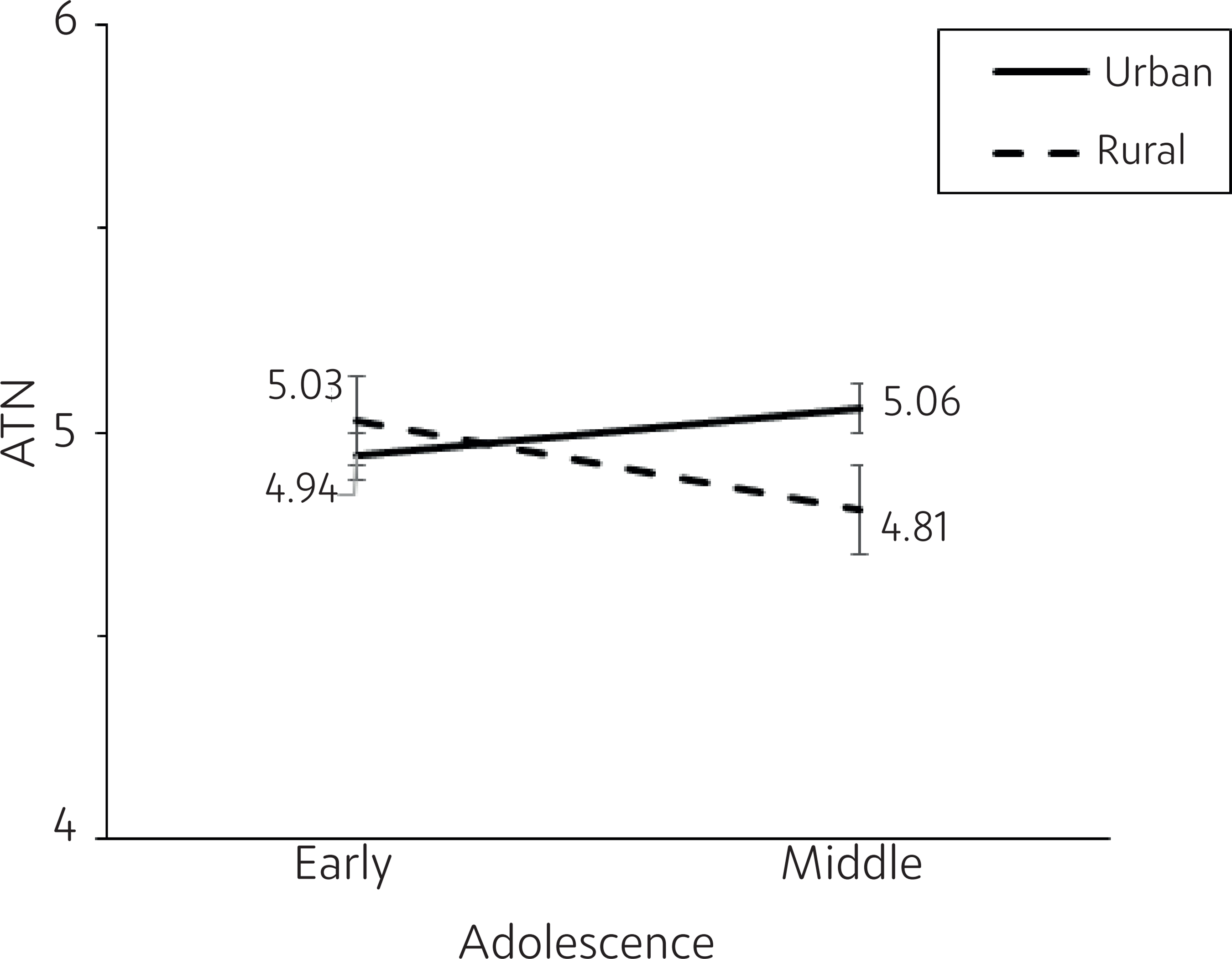
Regarding the interaction effect in the ATN dimension, the comparison of the four groups (Bonferroni post-hoc test; Figure 1) showed that among adolescents studying in a rural region, early adolescents significantly presented more favorable ATN scores (M = 5.03, SD = 1.03) than middle adolescents (M = 4.81, SD = 1.10; p = 0.008, 95% CI [0.04, 0.41]). Additionally, among middle adolescents, those studying in an urban region presented significantly higher ATN scores (M = 5.06, SD = 0.83) than those studying in a rural region (M = 4.81, SD = 1.10; p < 0.001, 95% CI [0.09, 0.42]).
Attraction to Nature Means of Early and Middle Adolescents Studying in Rural and Urban Regions
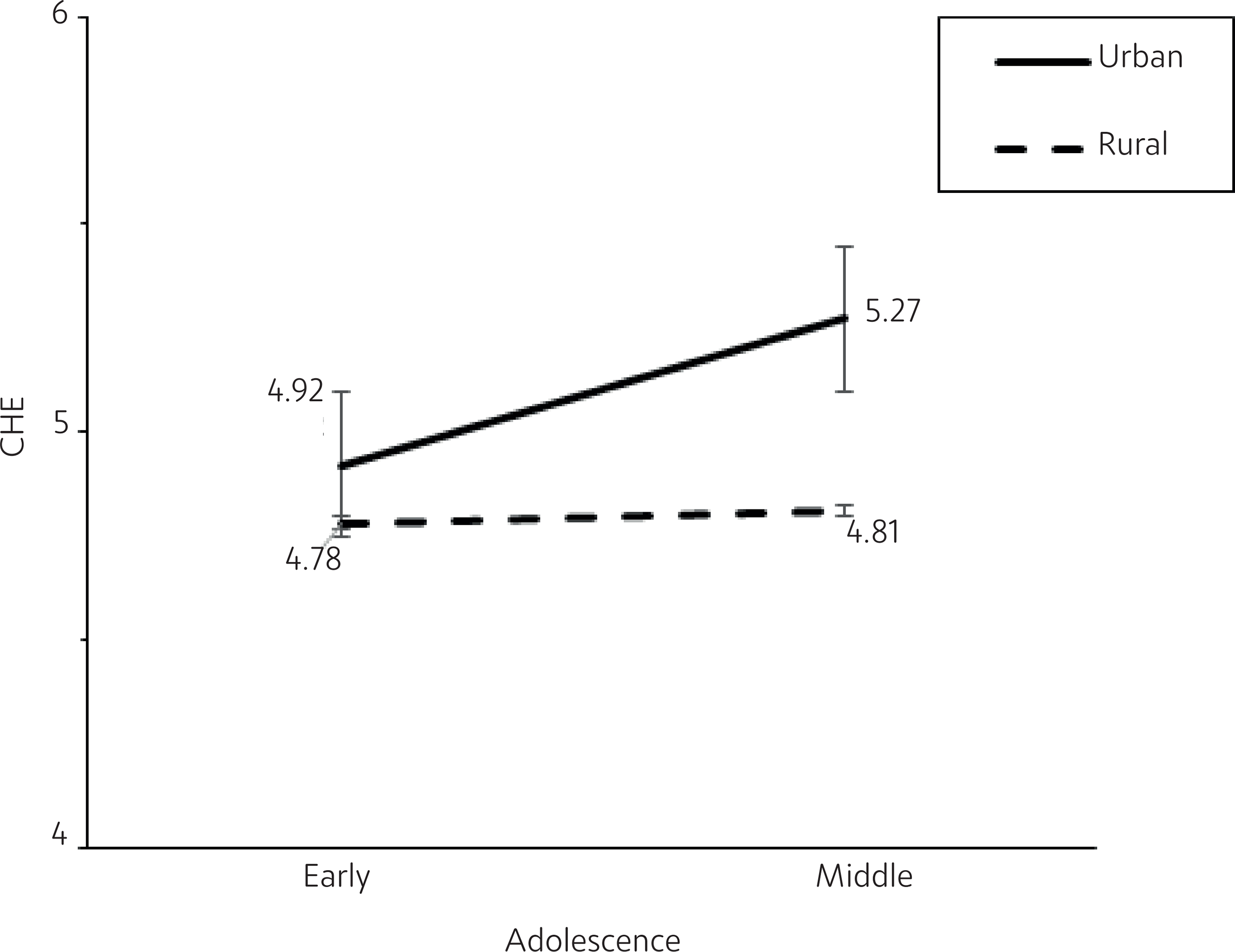
Regarding the ANR dimension, results from the comparison of the four groups (Bonferroni post-hoc test; Figure 2) showed that middle adolescents studying in an urban region presented significantly more favorable ANR scores (M = 5.27, SD = 0.95) than all the other groups (all p < 0.001; early adolescents studying in an urban region, M = 4.92, SD = 1.18, 95% CI [0.19, 0.51]; early adolescents studying in a rural region, M = 4.78, SD = 1.28, 95% CI [0.31, 0.67]; middle adolescents studying in a rural region, M = 4.81, SD = 1.18, 95% CI [0.28, 0.63]). There were higher scores for middle than early adolescents studying in an urban region, but equivalent ANR scores among early and middle adolescents studying in a rural region.

Means in Anthropocentric Concern with Natural Resources of Early and Middle Adolescents Studying in Rural and Urban Regions
As statistically significant interaction effects were found in two anthropocentric dimensions (ATN and ANR), H5 was partially supported. No significant interaction effects were found in the ecocentric dimensions, so H6 was supported.
Results in the AEAS
A statistically significant interaction effect was found in the anthropocentric Concern about human action on the environment (CHE) dimension, F (1, 1220) = 7.73, p = 0.006, η2 = 0.01. Comparison of the four groups (Bonferroni post-hoc test; Figure 3) showed that early adolescents studying in an urban region present significantly more favorable CHE scores (M = 4.25, SD = 0.94) than early and middle adolescents studying in a rural region (M = 4.03, SD = 1.04, 95% CI [0.06, 0.38]; M = 4.02, SD = 0.98, 95% CI [0.08, 0.39] respectively). Moreover, middle adolescents studying in an urban region presented significantly higher CHE scores (M = 4.54, SD = 0.90) than early adolescents studying in urban or rural regions (M = 4.25, SD = 0.94, 95% CI [0.16, 0.43]; M = 4.03, SD = 1.04, 95% CI [0.36, 0.67], respectively) or than middle adolescents from a rural region (M = 4.02, SD = 0.98, 95% CI [0.38, 0.68]). Among students from rural regions, no differences were found between early (M = 4.03, SD = 1.04) and middle adolescents (M = 4.02, SD = 0.98). These results reveal an interaction effect in one anthropocentric dimension, which offers partial support to H5. No interaction effects were found in the ecocentric dimension of the AEAS, which supported H6.

Concern about Human Action on the Environment Means of Early and Middle Adolescents Studying in Rural and Urban Regions
Discussion
All hypotheses were either supported (H2, H6) or partially supported (H1, H3, H4, H5) regarding the effects on the dimensions assessed by the EAI. The same occurred when effects on the dimensions assessed by the AEAS were considered, except for H3, which was not confirmed. Considering the reviewed literature and each of the research hypotheses, the results are discussed next.
Variations for Rural and Urban Regions
Differences between adolescents studying in rural and urban regions were herein found in the Anthropocentric concern with natural resources (ANR), the Attitudes towards pollution, and the Concern about human action on the environment (CHE) dimensions. H1 was, therefore, partially supported. Four main considerations may help explain these findings, suggesting that students from urban regions present higher anthropocentric attitudes than students from rural regions. First, there seem to exist more successful schools in urban than rural regions (Organization for Economic Co-operation and Development [OECD], 2019). Students attending urban schools can more often discuss contents that advocate the need to balance nature with human needs, which is aligned with an anthropocentric approach. Second, environmental degradation (such as excessive traffic, noise, and air pollution) is higher in urban than rural regions, which may sustain people’s greater appreciation of the environment, but a simultaneous greater dependence on the means of production and transportation required for living in urban areas (Atik et al., 2022; Dunlap et al., 2000; Fransson & Gärling, 1999; Xiao et al., 2018). Third, cultural pressure for consumption seems to be greater in urban than rural regions, whereby people living in urban regions may value nature’s resources in aspects that can be advantageous for them. Fourth, the sociocultural level of families tends to be higher in urban than rural regions. In urban regions, families’ sociocultural levels may more easily support the access to cultural events that prompt youths’ perspective taking, which is a cognitive facilitator of anthropocentric environmental attitudes.
On the other hand, ecocentric attitudes are related to adolescents’ predisposition to actively contribute to the environmental preservation and the minimization of natural resources’ degradation. These attitudes were expected to be similar among adolescents from rural and urban regions, although for different reasons: while adolescents studying in rural regions could perceive the economic advantages of using natural resources, adolescents studying in urban regions could perceive the need to save the environment to preserve their quality of life (Jama et al., 2022; Moreno et al., 2016; Thompson & Barton, 1994). H2 was herein supported, thus corroborating results from other studies (Collado & Corraliza, 2017; Yu, 2014). Two reasons may help us understand the similarity of ecocentric attitudes among adolescents from rural and urban regions. First, investments in the development of rural regions have been socially noticeable and may impact aspects such as the access to higher education institutions, aerial means of transportation and the creation of highways. Such investments have attempted to decrease regional asymmetries and may be related to these findings. Second, the generalization of technologies has helped overcome communication barriers and transformed contexts, creating increasingly more homogeneous situations between rural and urban settings. The choices that residents make regarding their lives may occur in similar circumstances, thus sustaining these results.
Variations for Early and Middle Adolescents
In this study, early adolescents showed more favorable environmental ecocentric attitudes than middle adolescents in two dimensions, Engagement in nature preservation and Population Growth Policies (PGP). Considering the results in the dimensions assessed by the EAI, H3 was partially supported, aligned with literature indicating a decrease in ecocentric environmental attitudes with age (Hawcroft & Milfont, 2010; Martins & Veiga, 2001; Szagun & Mesenholl, 1993). Results suggesting that early adolescents presented higher ecocentric attitudes than middle adolescents may be explained by developmental features. From a developmental-cognitivist view, early adolescents advance in the comparison between the ideal and the real world (Veiga, 2019; Woolfolf, 2019). Perceived discrepancies between these two worlds can trigger contestation and indignation (Levy et al., 2004; Moreira et al., 2004; Tirrel et al., 2022), even regarding the need to preserve nature, believing that what is good for nature is also good for mankind. Additionally, moved by the willingness to be socially accepted by adults (Szagun & Mesenholl, 1993), younger adolescents might overvalue attitudes towards nature preservation, as they find them consistent with what adults claim and consider appropriate (Collado et al., 2015; Lieflander & Bogner, 2014; Oerke & Bogner, 2013). In turn, middle adolescents struggle to conquer independence from adults (Veiga et al., 2021) and simultaneously acknowledge both people’s and nature’s interests, which can sustain a decrease in ecocentric attitudes (Binngiesser & Randler, 2015; Bogner et al., 2015; Milfont & Schultz, 2018; Moreno et al., 2016; Oerke & Bogner, 2013). This study found variations in the ecocentric Engagement in nature preservation and Population growth policies (PGP) dimensions, which are linked to the preservation of nature. While social desirability may impact early adolescents’ attitudes (Pessoa et al., 2016; Szagun & Mesenholl, 1993), the increased attraction towards the allurements of the consumer society and the empathy with various perspectives may impact the ecocentric attitudes of middle adolescents (Milfont & Schultz, 2018; Moreno et al., 2016). However, the results in the dimensions assessed by the AEAS did not support H3. This might be due to the limitation that the AEAS only assesses the EPB ecocentric dimension. As this dimension considers one’s predisposition to adopt behaviors that preserve the environment, it might be the case that both early and middle adolescents are in favor of such behaviors, but their potentially different reasons for so might not be totally captured by this measure.
Findings partially supported H4, with middle adolescents showing higher scores than early adolescents in the anthropocentric dimensions, Concern about human action on the environment (CHE) and Anthropocentric concern with natural resources (ANR), respectively assessed by the AEAS and the EAI. These findings are consistent with those from other studies (Amérigo et al., 2012; Casey & Scott, 2006; Olsson & Gericke, 2016) and might be due to adolescents’ advances in cognitive development and perspective taking (Kortenkamp & Moore, 2009; Veiga, 2019; Woolfolk, 2019). The simultaneous acknowledgement of various points of view enables adolescents to jointly consider people’s and nature’s problems, thus following an anthropocentric perspective. Moreover, it is worth noticing that the anthropocentric dimensions in which variations were found for the adolescence stages (CHE, ANR) are primarily focused on the preservation of nature for its benefits to humanity. As middle adolescents are influenced by the consumer society, this might also help explain their higher anthropocentric attitudes compared to early adolescents (Milfont & Schultz, 2018; Moreno et al., 2016).
Variations for Region and Adolescence Stage Interaction
Results suggested statistically significant interaction effects in the anthropocentric dimensions ANR, ATN (from EAI) and CHE (from AEAS), thus partially supporting H5. Middle adolescents from urban regions presented significantly higher ANR and CHE scores than all other groups (early adolescents from urban regions, early and middle adolescents from rural regions) probably because they value the quality of life and natural resources that are useful for them (Casey & Scott, 2006; Lieflander & Bogner, 2014). The higher results in these attitudes may also be linked to the highest quality of urban schools (Atik et al., 2022; OECD, 2019), which might impact students’ learning and support the increase of anthropocentric attitudes. On the other hand, students from rural areas presented similar results across adolescence stages (ANR, CHE) or even decreased them from early to middle adolescence (ATN). A lower quality of teaching and schools (OECD, 2019; Veiga et al., 2016; Washington et al., 2020) may help explain the lower results registered by adolescents from rural areas; moreover, maintaining such lower quality over time might lead to no differentiation in environmental attitudes during adolescence. Results indicating that adolescents from rural areas score lower than peers from urban areas in anthropocentric attitudes (ANR, ATN and CHE dimensions) may also be linked to their greater proximity to nature and use of its resources through hunting or fishing for living (Dunlap et al., 2000; Fransson & Gärling, 1999; Sparks et al., 2014). The similar anthropocentric attitudes found in early and middle adolescents from rural regions are also aligned with other studies (Binngiesser & Randler, 2015; Bogner et al., 2015; Milfont & Schultz, 2018; Moreno et al., 2016; Oerke & Bogner, 2013).
Regarding the interaction effect in ATN, among students living in urban areas, middle adolescents presented significantly higher ATN scores than early adolescents, which is consistent with the discussion of the ANR and CHE results. Among students from rural areas, middle adolescents showed lower ATN scores than early adolescents, which is aligned with other studies (Braun et al., 2018; Dunlap et al., 2000). School retentions may play a role in these findings, as students’ retentions tend to be higher in rural than urban regions (Veiga, 2019; Woolfolk, 2019), mainly due to the previously mentioned differences in schools’ quality and families’ sociocultural levels (Washington et al., 2020). While middle adolescents in rural areas may increase the number of retentions along the school path (which can contribute to reducing their environmental attitudes), this is less likely to happen to adolescents in urban areas. Probably some decrease in the quality of schools or teaching could even contribute to a reduction in environmental anthropocentric attitudes. Finally, H6 was herein supported, as no interaction effects were found in ecocentric environmental attitudes. This suggests a similarity between students from urban and rural areas in ecocentric dimensions (PGP, ENP), such as also postulated by H2 and suggested by the literature (Moreno et al., 2016; Thompson & Barton, 1994; Yu, 2014).
Conclusion
The results are generally aligned with those of previous studies that separately addressed variations in environmental attitudes for the geographic region (Amérigo et al., 2012; Dunlap et al., 2000; Xiao et al., 2018; Yu, 2014) and the adolescent stage (Bogner et al., 2015; Hawcroft & Milfont, 2010; Martins & Veiga, 2001; Moreno et al., 2016), as well as with previous studies covering environmental attitudes linked to environment preservation (ecocentric) and utilization (anthropocentric) (Binngiesser & Randler, 2015; Bogner, 2018; Kopnina, 2013; Kortenkamp & Moore, 2009; Lieflander & Bogner, 2014; Milfont & Schultz, 2018).
Still, this study added that in rural environments, middle adolescents present lower ecocentric attitudes than early adolescents but do not differ in anthropocentric attitudes. Future additional studies covering late adolescence could help deepen our understanding of how environmental attitudes change throughout adolescence. The combined effects of various personal and contextual factors on environmental attitudes related to the preservation and utilization of nature also need to be addressed in future research. Quasi-experimental studies could also be useful to help adolescents acknowledge the importance of natural spaces and evaluate the impact of educational practices on their environmental attitudes. The findings from this study may call attention from entities responsible for both formal and non-formal education. Objectives of school learnings, specially biology and geography, should more emphasize the understanding of sustainable development and improving positive attitudes towards the environment (Yu, 2014). Regional asymmetries corroborated in this study demand concern, particularly taking the preservation of rural regions into account, such as protecting the Iberian wolf and other species, the mountain oak trees or dam-free rivers and other ecosystems. The attitudinal justifications that lead to the preservation or aversion to some living beings reflect educational influences, as well as a diversity of cultural aspects, often anthropocentric. Thus, since one primary function of education is the formation of reflective and critical citizens about their ways of being and relating to existential conditions, including dialoguing with cultural tradition, it becomes necessary to minimize the distance between philosophical orientations -official curricula and practice in the classroom to better enable the reconstruction of knowledge about human-nature interactions with a view to conservation (Oliveira et al., 2019).
The sustainable development discourse, still strongly influenced by anthropocentrism, has led people to think that humanity controls nature and, therefore, that the problems arising from modern life can be solved through technological development. Therefore, the distinction between ecocentric and anthropocentric values highlights the need for a more adequate approach to education for sustainable development (Kopnina, 2013). Relying on the SDG (United Nations, 2022), results from this study might sustain practices in several fields, such as the Environmental Psychology, which may adequate practices that promote environment-friendly attitudes according to cognitive and developmental features of adolescence; the Differential Psychology, which may adjust practices to the geographic backgrounds of students; the School and Family Education, which may address the impact of families’ social-cultural levels and the quality of schools on pupils’ environmental attitudes; and Public Policies, which may strengthen evidence-based structural decisions to reduce inequalities between geographic regions and age groups. Changes focused on factors at the social (regional asymmetries, cultural pressure for consumption, sociocultural level of families), school (quality of schools, retentions, value assigned to the school), and personal levels (psychosocial development) may also positively impact students’ environmental attitudes (Corral-Verdugo et al., 2008; Kopnina, 2013; Levy et al., 2004; Lieflander & Bogner, 2014). Considering one of the most important and current environmental problems, young people’s climate action is mainly shaped by climate change knowledge and ecocentric value orientation (Jama et al., 2022). Especially in rural regions, a greater investment in the training of teachers is recommended for them to be able to promote more effective Environmental Education practices with their students (Braun et al., 2018; OECD, 2019; Olsson & Gericke, 2016).
In conclusion, climate change has already had devastating consequences on the planet. The environment claims like Eliot “We need a new beginning”, the planet exudes a scream like the one created by Munch. The abrupt reduction of air and land traffic registered in the first phase of the coronavirus pandemic showed that we can defeat pollution and help the environment. But, like a famous philosopher, Simone Weil, said when predicting Hitler’s defeat, this is not enough − changing people’s minds is also required for a new beginning. Likewise, reducing traffic will not be enough to save the planet. We also need to change people’s attitudes. Planet Earth has been complacent, but there have been signs of its irritation that may turn into revolt. Unless people’s environmental attitudes change. Until that happens, we can imagine how science and art can lead to a vision of the whole and clean Earth, green and full of its original diversity.
-
Support
Fundação para a Ciência e a Tecnologia, IP no âmbito da Unidade de Investigação e Desenvolvimento em Educação e Formação (Process nº UIDB/04107/2020).
-
How to cite this article: Martins, M. C., Veiga, F. H., Oliveira, Í. M., Veiga, C. M., Carvalho, N. A., Martínez I., & Festas, I. (2025). Rural and urban adolescents environmental attitudes. Estudos de Psicologia (Campinas), 42, e230033. https://doi.org/10.1590/1982-0275202542e230033
References
-
Ajdukovic, I., Gilibert, D., & Fointiat, V. (2019). Structural confirmation of the 24-item Environmental Attitude Inventory. Psyecology, 10(2), 184-216. https://doi.org/10.1080/21711976.2019.1586140
» https://doi.org/10.1080/21711976.2019.1586140 -
American Psychological Association. (2021). Thesaurus of Psychological Index Terms https://www.apa.org/pubs/databases/training/thesaurus
» https://www.apa.org/pubs/databases/training/thesaurus -
Amérigo, M., Aragonés, J. I., & García, J. A. (2012). Exploring the dimensions of environmental concern: an integrative proposal. Psyecology, 3(2), 353-365. https://doi.org/10.1174/217119712802845723
» https://doi.org/10.1174/217119712802845723 -
Atik, A. D., Isildar, G. Y., & Erkoç, F. (2022). Prediction of secondary school students’ environmental attitudes by a logistic regression model. Environment, Development and Sustainability, 24(2), 4355-4370. doi.org/10.1007/s10668-021-01618-3
» https://doi.org/10.1007/s10668-021-01618-3 -
Binngiesser, J., & Randler, C. (2015). Association of the environmental attitudes “preservation” and “utilization” with pro-animal attitudes. International Journal of Environment & Science Education, 10(3), 477-492. http://www.ijese.net/makale_indir/ijese.2015.255a.pdf
» http://www.ijese.net/makale_indir/ijese.2015.255a.pdf -
Bogner, F. X. (2018). Environmental values (2-MEV) and appreciation of nature. Sustainability, 10(2), 350. https://doi.org/10.3390/su10020350
» https://doi.org/10.3390/su10020350 -
Bogner, F. X., & Wiseman, M. (2006). Adolescents’ attitudes towards nature and environment: quantifying the 2-MEV model. Environmentalist, 26(4), 247-254. https://doi.org/10.1007/s10669-006-8660-9
» https://doi.org/10.1007/s10669-006-8660-9 -
Bogner, F. X., Johnson, B., Buxner, S., & Felix, L. (2015). The 2-MEV model: constancy of adolescent environmental values within an 8-year time frame. International Journal of Science Education, 37(12), 1938-1952. https://doi.org/10.1080/09500693.2015.1058988
» https://doi.org/10.1080/09500693.2015.1058988 -
Braun, T., Cottrell, R., & Dierkes, P. (2018). Fostering changes in attitude, knowledge and behavior: demographic variation in environmental education effects. Environmental Education Research, 24(6), 899-920. https://doi.org/10.1080/13504622.2017.1343279
» https://doi.org/10.1080/13504622.2017.1343279 -
Casey, P. J., & Scott, K. (2006). Environmental concern and behaviour in an Australian sample within an ecocentric–anthropocentric framework. Australian Journal of Psychology, 58(2), 57-67. http://dx.doi.org/10.1080/00049530600730419
» https://doi.org/10.1080/00049530600730419 -
Collado, S., & Corraliza, J. A. (2017). Children’s perceived restoration and pro-environmental beliefs. Journal of ASIAN Behavioural Studies, 2(2), 1-12. https://doi.org/10.21834/jabs.v2i2.176
» https://doi.org/10.21834/jabs.v2i2.176 -
Collado, S., Evans, G. W., Corraliza, J. A., & Sorrel, M. A. (2015). The role played by age on children’s pro-ecological behaviours: an exploratory analysis. Journal of Environmental Psychology, 44, 85-94. https://doi.org/10.1016/j.jenvp.2015.09.006
» https://doi.org/10.1016/j.jenvp.2015.09.006 -
Corral-Verdugo, V., Carrus, G., Bonnes, M., Moser, G., & Sinha, J. B. P. (2008). Environmental beliefs and endorsement of sustainable development principles in water conservation: toward a new human interdependence paradigm scale. Environment and Behavior, 40(5), 703-725. https://doi.org/10.1177/0013916507308786
» https://doi.org/10.1177/0013916507308786 -
Dunlap, R. E., Van Liere, K. D., Merting, A. G., & Jones, R. E. (2000). Measuring endorsement of the New Ecological Paradigm: a revised NEP scale. Journal of Social Issues, 56(3), 425-442. http://dx.doi.org/10.1111/0022-4537.00176
» https://doi.org/10.1111/0022-4537.00176 - Evans, M., Hastings, N., & Peacock, B. (2000). Statistical distributions (3rd ed.). Wiley.
-
Fransson N., & Gärling T. (1999). Environmental concern: conceptual definitions, measurement methods, and research findings. Journal of Environmental Psychology, 19(4), 369-382. https://doi.org/10.1006/jevp.1999.0141
» https://doi.org/10.1006/jevp.1999.0141 -
Hawcroft, L. J., & Milfont, T. L. (2010). The use (and abuse) of the New Environmental Paradigm scale over the last 30 years: a meta-analysis. Journal of Environmental Psychology, 30(2), 143-158. http://dx.doi.org/10.1016/j.jenvp.2009.10.003
» https://doi.org/10.1016/j.jenvp.2009.10.003 -
Jama, O. M., Diriye, A. W., & Abdi, A. M. (2022). Understanding young people’s perception toward forestation as a strategy to mitigate climate change in a post-conflict developing country. Environment, Development and Sustainability, 25, 1-25. https://doi.org/10.1007/s10668-022-02242-5.
» https://doi.org/10.1007/s10668-022-02242-5 -
Kopnina, H. (2013). Evaluating education for sustainable development (ESD): using ecocentric and anthropocentric attitudes toward the sustainable development (EAATSD) scale. Environment, Development and Sustainability, 15(3), 607-623. https://doi.org/10.1007/s10668-012-9395-z
» https://doi.org/10.1007/s10668-012-9395-z -
Kortenkamp, K. V., & Moore, C. F. (2009). Children’s moral evaluations of ecological damage: the effect of biocentric and anthropocentric Intentions. Journal of Applied Social Psychology, 39(8), 1785-1806. https://doi.org/10.1111/j.1559-1816.2009.00504.x
» https://doi.org/10.1111/j.1559-1816.2009.00504.x -
Levy, I., Kaplan, A., & Patrick, H. (2004). Early adolescents’ achievement goals, social status, and attitudes towards cooperation with peers. Social Psychology of Education, 7(2), 127-159. https://doi.org/10.1023/B:SPOE.0000018547.08294.b6
» https://doi.org/10.1023/B:SPOE.0000018547.08294.b6 -
Lieflander, A. K., & Bogner, F. X. (2014). The effects of children’s age and sex on acquiring pro-environmental attitudes through environmental education. Journal of Environmental Education, 45(2), 105-117. https://doi.org/10.1080/00958964.2013.875511
» https://doi.org/10.1080/00958964.2013.875511 -
Manoli, C. C., Johnson, B., Buxner, S., & Bogner, F. (2019). Measuring environmental perceptions grounded on different theoretical models: the 2-Major Environmental Values (2-MEV) Model in comparison with the New Ecological Paradigm (NEP) scale. Sustainability, 11(5), 1286. http://dx.doi.org/10.3390/su11051286
» https://doi.org/10.3390/su11051286 -
Martins, M. C. (2020). Attitudes of young students towards themselves and the environment [Doctoral dissertation, Universidade de Lisboa]. Repositório da Universidade de Lisboa. http://hdl.handle.net/10451/45276
» http://hdl.handle.net/10451/45276 - Martins, M. C., & Veiga, F. H. (2001). Atitudes face ao ambiente: elaboração de uma escala de atitudes dos jovens face ao ambiente. In B. Silva & L. Almeida (Orgs.), Atas do VI Congresso Galaico-Português de Psicopedagogia Universidade do Minho.
-
Milfont, T. L., & Duckitt, J. (2010). The environmental attitudes inventory: a valid and reliable measure to assess the structure of environmental attitudes. Journal of Environmental Psychology, 30, 80-94. https://doi.org/10.1016/j.jenvp.2009.09.001
» https://doi.org/10.1016/j.jenvp.2009.09.001 -
Milfont, T. L., Duckitt, J., & Wagner, C. (2010). A cross-cultural test of the value-attitude-behavior hierarchy. Journal of Applied Social Psychology, 40(11), 2791-2813. https://doi.org/10.1111/j.1559-1816.2010.00681.x
» https://doi.org/10.1111/j.1559-1816.2010.00681.x - Milfont, T. L., & Schultz, P. W. (2018). The role of attitudes in environmental issues. In D. Albarracin & B. T. Johnson. The handbook of attitudes: applications (2nd ed., Vol. 2, pp. 337-365). Routledge.
-
Moreira, E. F., Costa, J. B., Raymundo, J. S., & Araújo, L. F. (2004). Estereótipos sociais de universitários em relação aos ambientalistas / Social stereotypes of college students in relation to the environmental defenders. Estudos de Psicologia (Campinas), 21(2), 117-127. https://doi.org/10.1590/S0103-166X2004000200009
» https://doi.org/10.1590/S0103-166X2004000200009 -
Moreno, I., Amérigo, M., & García, J. A. (2016). Design and application of an environmental attitudes scale in primary education. Psyecology, 7(1), 64-88. https://doi.org/10.1080/21711976.2015.1114217
» https://doi.org/10.1080/21711976.2015.1114217 -
Musitu-Ferrer, D., Esteban-Ibáñez, M., León-Moreno, C., & García, O. F. (2019). Is school adjustment related to environmental empathy and connectedness to nature? Psychosocial Intervention, 28(2), 101-110. https://doi.org/10.5093/pi2019a8
» https://doi.org/10.5093/pi2019a8 -
Oerke, B., & Bogner, F. X. (2013). Social desirability, environmental attitudes, and general ecological behaviour in children. International Journal of Science Education, 35(5), 713-730. https://doi.org/10.1080/09500693.2011.566897
» https://doi.org/10.1080/09500693.2011.566897 -
Oliveira, J. V., Lopes, S. F., Barboza, R. R. D., & Alves, R. R. N. (2019). To preserve, or not to preserve, that is the question: urban and rural student attitudes towards wild vertebrates. Environment, Development and Sustainability, 21, 1271-1289. https://doi.org/10.1007/s10668-018-0083-5
» https://doi.org/10.1007/s10668-018-0083-5 -
Olsson, D., & Gericke, N. (2016). The adolescent dip in students’ sustainability consciousness: implications for education for sustainable development. Journal of Environmental Education, 47(1), 35-51. https://doi.org/10.1080/00958964.2015.1075464
» https://doi.org/10.1080/00958964.2015.1075464 -
Organization for Economic Co-operation and Development. (2019). Rural-urban differences in students’ performance (PISA 2015). In Organisation for Economic Co-operation and Development (Org.), Skills Outlook 2019: Thriving in a Digital World (pp. 247-248). OECD Publishing. https://doi.org/10.1787/90dbffc3-en
» https://doi.org/10.1787/90dbffc3-en -
Pessoa, V., Gouveia, V., Soares, A., Vilar, R., & Alves, L. (2016). Escala de conexão com a natureza: evidências psicométricas no contexto brasileiro. Estudos de Psicologia (Campinas), 33(2), 271-282. http://dx.doi.org/10.1590/1982-02752016000200009
» https://doi.org/10.1590/1982-02752016000200009 - Piaget J., & Inhelder, B. (1979). Memória e inteligência Artenova.
-
Sparks, P., Hinds, J., Curnock, S., & Pavey, L. (2014). Connectedness and its consequences: a study of relationships with the natural environment. Journal of Applied Social Psychology, 44(3), 166-174. https://doi.org/10.1111/jasp.12206
» https://doi.org/10.1111/jasp.12206 -
Szagun, G., & Mesenholl, E. (1993). Environmental ethics: an empirical study of West German adolescents. The Journal of Environmental Education, 25(1), 37-44. https://doi.org/10.1080/00958964.1993.9941943
» https://doi.org/10.1080/00958964.1993.9941943 -
Thompson, S. C. G., & Barton, M. A. (1994). Ecocentric and anthropocentric attitudes toward the environment. Journal of Environmental Psychology, 14(2), 149-157. https://doi.org/10.1016/S0272-4944(05)80168-9
» https://doi.org/10.1016/S0272-4944(05)80168-9 -
Tirrell, J. M., Dowling, E. M., Kibbedi, P., Namurinda, E., Iraheta, G., Dennis, J., Malvese, K., Abbasi-Asl, R., Williams, K., Lerner, J. V., Ebstyne King, P., Sim, A. T. R., & Lerner, R. M. (2022). Measuring youth perceptions of being known and loved and positive youth development: cross-national findings from Rwanda and El Salvador. Child Youth Care Forum, 52, 1093-1119. https://doi.org/10.1007/s10566-022-09725-6
» https://doi.org/10.1007/s10566-022-09725-6 -
United Nations. (2022). Transforming our World: the 2030 Agenda for Sustainable Development https://sdgs.un.org/partnerships
» https://sdgs.un.org/partnerships - Veiga, F. H. (2019). Psicologia da Educação: temas de aprofundamento científico para a Educação XXI Climepsi Editores.
-
Veiga, F. H., Festas, I., García, O. F., Oliveira, I. M., Veiga, C. M., Martins, C., Covas, F., & Carvalho, N. A. (2021). Do students with immigrant and native parents perceive themselves as equally engaged in school during adolescence? Current Psychology, 42, 1-15. https://doi.org/10.1007/s12144-021-02480-2
» https://doi.org/10.1007/s12144-021-02480-2 -
Veiga, F. H., Robu, V., Conboy, J., Ortiz, A., Carvalho, C., & Galvão, D. (2016). Students’ engagement in school and family variables: A literature review. Estudos de Psicologia (Campinas), 33(2), 187-197. https://doi.org/10.1590/1982-02752016000200002
» https://doi.org/10.1590/1982-02752016000200002 -
Washington, T., Calkins, S. D., Labban, J. D., Dollar, J. M., & Keane, S. P. (2020). Family-level factors affecting social and academic competence of African American children. Child Youth Care Forum, 49, 383-407. https://doi.org/10.1007/s10566-019-09533-5
» https://doi.org/10.1007/s10566-019-09533-5 - Woolfolk, A. (2019). Educational psychology (14th ed.). The Ohio State University, Pearson.
-
Xiao, C., Dunlap, R. E., & Hong, D. (2018). Ecological worldview as the central component of environmental concern: Clarifying the role of the NEP. Society & Natural Resources, 32(1), 53-72. https://doi.org/10.1080/08941920.2018.1501529
» https://doi.org/10.1080/08941920.2018.1501529 -
Yu, X. (2014). Is environment ‘a city thing’ in China? Rural-urban differences in environmental attitudes. Journal of Environmental Psychology, 38, 39-48. https://doi.org/10.1016/j.jenvp.2013.12.009
» https://doi.org/10.1016/j.jenvp.2013.12.009
Edited by
-
Editor
Raquel Souza Lobo Guzzo