 Mental health of religious/spiritual lesbians, gays and bisexuals: a scoping review
Abstract
Objective The effects of religiosity and spirituality on the mental health of Lesbians, Gays and Bisexuals are not clear, especially when there is an incongruity between religious/spiritual beliefs and sexual orientation. Based on this ground, a scoping review was performed to map the evidence reported in the literature on the relationship between religiosity/spirituality and mental health in religious/spiritual lesbians, gays and bisexuals.
Method The search was performed using the PubMed, PsycINFO, Web of Science, Scientific Electronic Library Online and Literatura Latino-Americana e do Caribe em Ciências da Saúde databases and a total of 36 studies were selected for review.
Results It was found that religiosity and spirituality can be both beneficial and harmful to the individuals assessed, as there was no consensus regarding their effect on mental health.
Conclusion In general, this review offers contributions to the scientific knowledge, pointing out the complexity of the phenomenon and the existing gaps in studies already carried out, allowing the establishment of directions for future research.
Keywords
Bisexuality; Health; Homosexuality; Spirituality
Resumo
Objetivo Os efeitos da religiosidade e espiritualidade na saúde mental de lésbicas, gays e bissexuais não são claros, principalmente quando há uma incongruência entre as crenças religiosas/espirituais e a orientação sexual. Com base nisso, este estudo configura-se como uma scoping review cujo objetivo é mapear as evidências existentes na literatura sobre a relação entre religiosidade/espiritualidade e saúde mental em lésbicas, gays e bissexuais religiosos/espirituais.
Método A busca ocorreu nas bases de dados PubMed, PsycINFO, Web of Science, Scientific Electronic Library Online e Literatura Latino-Americana do Caribe em Ciências da Saúde, totalizando 36 estudos para análise.
Resultados Os resultados indicaram que a religiosidade e espiritualidade podem ser benéficas e prejudiciais para o público analisado, não havendo consenso a respeito do seu efeito sobre a saúde mental.
Conclusão De modo geral, a presente revisão trouxe relevantes contribuições para a literatura científica, apontando a complexidade do fenômeno e as lacunas existentes nos estudos já realizados, possibilitando direcionamentos para a construção de pesquisas futuras.
Palavras-chave
Bissexualidade; Saúde; Homossexualidade; Espiritualidade
Religiosity and Spirituality (R/S) are different but overlapping constructs. There is no consensus among scholars about the exact definition of each construct which is supported by a multiplicity of concepts, theories, methods and measurements (Hill et al., 2000; Pargament et al., 2013). In this study, spirituality is understood as the search for the sacred, in which the sacred can be perceived and experienced in different ways on an everyday basis, and which can be interpreted as a divine manifestation. Thus, spirituality does not involve a particular context and does not necessarily relate to God or higher powers.
Religiosity, in turn, is associated with the concept of religion, and involves the search for meaning within the context of established institutions, where the main objective is to facilitate spirituality (Pargament et al., 2013). In this sense, it involves a ritualized commitment to a supernatural power and participation in institutionalized acts performed on behalf of such power. Furthermore, religiosity also encompasses non-spiritual social concerns such as politics and economics (Foster et al., 2017).
There is a substantial body of research showing positive associations between R/S and mental health. AbdAleati et al. (2014), in a systematic review on the topic, found associations between religiosity and reduced rates of anxiety, depression, substance use and suicidal behavior. Such benefits may be related to the development of social support networks, which increase the sense of stability and security, not only through the support of other group members, but also by the very nature of this group, which is based on a shared trust in faith in a superior power (Ysseldyk et al., 2010). Furthermore, religiosity and spirituality can provide comfort in times of uncertainty and resources for coping with psychic suffering; they reduce existential anxiety (Ysseldyk et al., 2010) and promote pro-social values such as love, hope, forgiveness and acceptance (Pucket et al., 2018).
However, these positive effects are not as clear for people who belong to sexual minorities such as Lesbians, Gays and Bisexuals (LGB), especially when there is an incongruity between religious/spiritual beliefs and sexual orientation. This incongruence is due to many religious people’s unfavorable vision of homosexuality, which reflects in a strong association found in the literature between prejudice against LGB and certain religious affiliations, specially non-affirmative religions, that is, those that do not endorse relationships between people of the same sex (Doebler, 2015; Droogenbroeck et al., 2016; Gomes & Souza, 2021).
In this regard, the minority stress model (Meyer, 2003) postulates that the prejudice and discrimination that LGB experience lead to an accumulation of stressors that develop a hostile social environment, characterized by a high prevalence of negative mental health outcomes in LGB compared to the heterosexual population. These outcomes include depression, anxiety, substance use, suicide attempts and suicidal ideation (World Health Organization, 2018). Studies with specific samples of religious/spiritual LGB have reported a positive association between R/S and depressive symptoms; feelings of inadequacy and guilt (Dahl & Galliher, 2012); greater degree of Internalized Homonegativity (IH) (Barnes & Meyer, 2012); more suicide attempts compared to religious heterosexuals (Gattis et al., 2014); and greater risk of suicide, for those who experience a conflict between religion and sexual orientation (Gibbs & Goldbach, 2015).
Other studies, however, show that this relationship is not that clear, with some religious/spiritual variables being associated with some beneficial factors. Meanley et al. (2016) for example, found that although participation and religious commitment were negatively associated with well-being in LGB individuals, spiritual coping presented positive results. Lassiter et al. (2019) found that spirituality was negatively associated to depressive symptoms and sensitivity to rejection, and positively associated with resilience and social support. Religiosity, however, was positively associated with sensitivity to rejection and negatively associated with resilience.
Given this lack of more precise evidence on the relationship between religiosity and spirituality and mental health in LGB, we have to review the scientific evidence on the subject. Despite the existence of a systematic review of recent papers on the relationship between spirituality, religion and mental health in LGB (McCann et al., 2020), it appears that this systematic review differs from our work with regard to some topics. The first is the sample of the study, which aims at young people and adolescents, as specified by the search descriptors. However, our investigation does not delimit the sample audience. It is important to highlight that, as the authors of the review have stated, adolescence is characterized as a phase of identity development, including LGB identity and religious identity. Therefore, a search for studies without sample delimitation expands the possibility of new findings, since, throughout the development phase, people can change their perception and identifications in regard to their sexual orientation, as well as in regard to their religious perspective (Escher et al., 2019).
Furthermore, the above study has a time frame until 2018. It is important to mention that, since then, there was a pandemic outbreak which brought meaningful implications to the mental health of the general population, especially to LGB individuals (Fish et al., 2021). Thus, it is possible that recent articles could bring different results, typical of the pandemic period, in which there was an increase in the vulnerability of the sample audience. In addition, the present review also utilizes descriptors in Portuguese and Spanish – not included in the aforementioned study – which aims to expand the results beyond the papers written in the English language. Therefore, our study aims to conduct a scoping review to map the evidence found in the literature on the relationship between religiosity/spirituality and mental health in religious/spiritual lesbians, gays and bisexuals.
Method
Literature Selection
A scoping review is a type of literature review that aims to map the relevant literature in a field of interest, summarizing the main results found and identifying possible gaps (Arksey & O’Malley, 2005). The procedures of our review used the instrument of the Preferred Reporting Items for Systematic Reviews and Meta-Analysis for scoping reviews (PRISMA-ScR) (Tricco et al., 2018).
The guiding question of this review was based on the PCC model (Population/Participants, Concept, Context) (The Joanna Briggs Institute, 2015), considered the most suitable for scoping reviews (Munn et al., 2018). The acronym indicates: P – Population: the population of lesbians, gays and bisexuals; C – Concept: the relationship between religiosity/spirituality and mental health; C – Context: the religious/spiritual identification of the LGB assessed. In this connection, the following investigation question ensues: What are the main evidences in regard to the relationship between religiosity/spirituality and mental health in religious/spiritual lesbians, gays and bisexuals?
The search was conducted from April to May 2021 in PubMed, PsycINFO, Web of Science, Scientific Electronic Library Online (SciELO) and Literatura Latino-Americana e do Caribe em Ciências da Saúde (Lilacs) databases. The publications interval was set at the last ten years (2012-2021), with a view to mapping the most recent papers, since this period was marked by important socio-legal changes in relation to the LBG audience in several countries where there were restrictions of rights for these individuals, including the criminalization of homophobia, the legalization of civil marriage/common law marriage, and children adoption by homoparental families.
The descriptors used were based on the Thesaurus of Psychological Terms issued by American Phychological Association (APA), as well as the Descritores em Ciências da Saúde (DeCS, Terminologies in Health Sciences). However, in order to expand the search, other descriptors were added that correspond to constructs frequently used to refer to the phenomenon, in addition to the denomination of the main religions, with a large number of followers worldwide. Thus, the following search combinations were used, with the relevant Boolean operators: (religiosity OR religion OR spirituality OR spiritual OR religious OR catholic OR evangelical OR catholicism OR protestantism OR judaism OR islam OR muslim) AND (homosexuality OR homosexual OR bisexuality OR bisexual OR lesbianism OR lesbian OR gay OR lgb OR “sexual orientation” OR “sexual minority”) AND (“mental health” OR “well-being” OR depression OR suicide OR anxiety). The same descriptors were also used in Portuguese and Spanish. In addition, in order to better filter the results, in the PubMed database, it was decided that the descriptors should be contained in the title or abstract; in the PsycINFO and SciELO databases, in the abstract; in the Web of Science database, in the title; and in Lilacs, in the subject; according to the existing fields in each base.
Inclusion/Exclusion Criteria
The following inclusion criteria were considered, (a) published scientific papers; (b) an indexed article, peer-reviewed; (c) empirical; (d) quantitative; and (e) having lesbians, gays or bisexuals as participants in the study. The following papers were excluded: (a) duplicates; (b) those which did not have some quantitative measure of religiosity/spirituality and mental health; and (c) those that did not perform any analysis to measure the relationship between LGB religiosity/spirituality and mental health.
Procedure
Initially, a search was performed according to the databases and combinations of selected descriptors. Additionally, two independent investigators reviewed the abstracts; the studies that met the inclusion/exclusion criteria were selected. The final sample of articles was blind-reviewed by two judges, who read the full articles. When there was disagreement on inclusion/exclusion, a third independent judge was consulted. Finally, an Excel spreadsheet was created containing the following information about the studies included: (a) authors; (b) year of publication; (c) country of research; (d) sample population; (e) religiosity/spirituality measurement(s); (f) mental health measurement(s); and (g) main results.
The synthesis and interpretation of the findings took place from the content analysis of Bardin (2016), taking into account the following steps: (a) exhaustive reading of the selected articles; (b) assessing in detail the characteristics of the studies; and (c) analysis by the judges.
Results
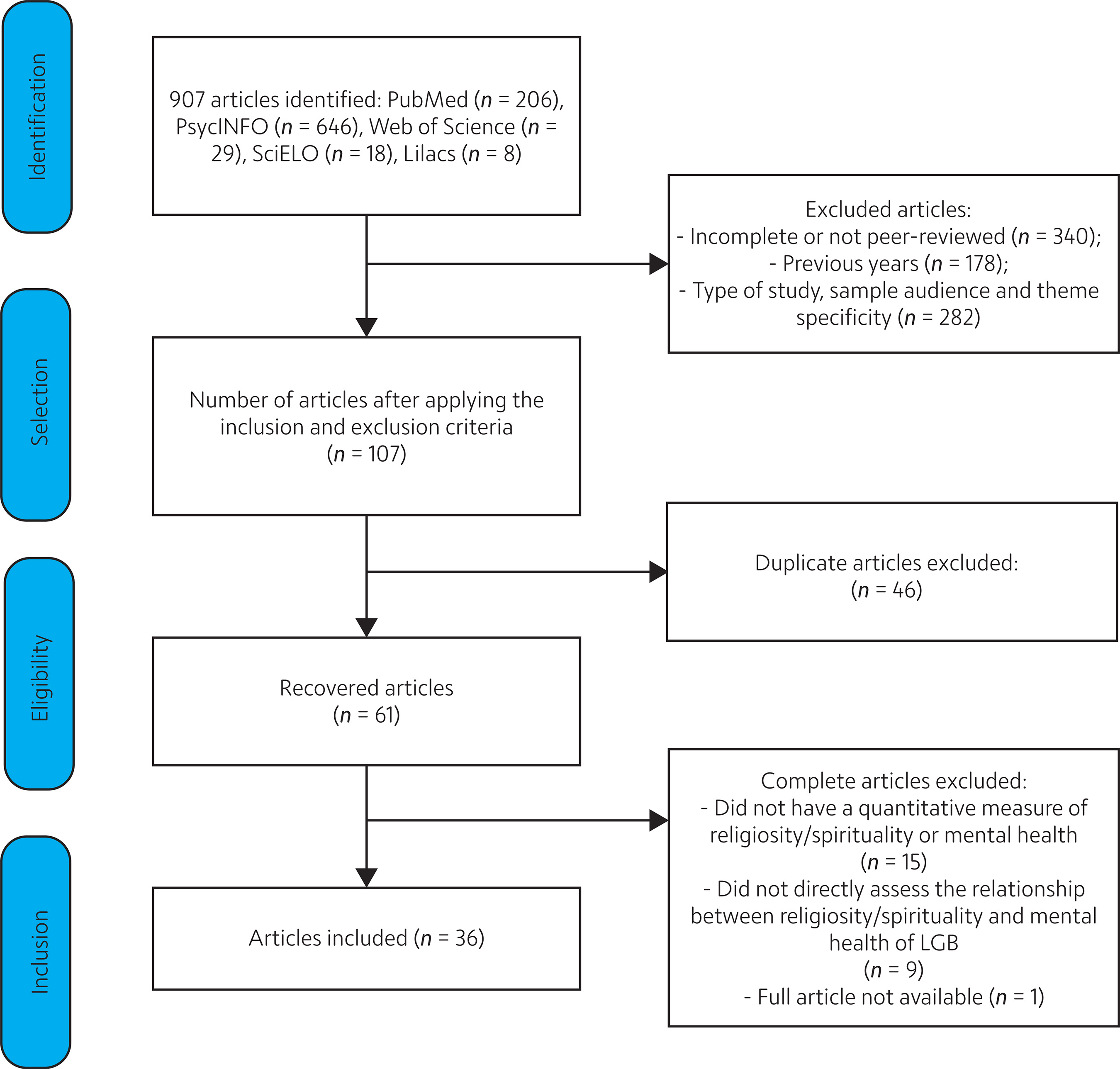
Based on the initial search, 907 articles were retrieved. From the screening of the identified articles, 340 articles were excluded because they were incomplete or had not been peer-reviewed; 178 corresponded to past years; and 282 did not meet the inclusion criteria in relation to the sample population, type of study and theme. Subsequently, duplicate articles were removed (n = 46), yielding 61 articles for full reading. After reading, 24 studies were excluded by consensus because 15 did not meet the inclusion criteria of having a quantitative measurement of religiosity or mental health and 9 did not directly assess the relationship between religiosity and LGB mental health. Finally, 1 (one) article was excluded because we could not find the full article. The authors were contacted via e-mail, but no response was received. Thus, the final sample comprised 36 studies, as can be seen in the flowchart in Figure 1.
Study Profile
As can be seen in Table 1, the articles reviewed were published during the period between 2012 and 2021; articles were published in each of the years of that period. The great majority of articles were sourced in the United States (n = 30; 83.3%), and there were also, to a lesser extent, articles from Israel (n = 2; 5.5%), Austria (n = 2; 5.5 %), Poland (n = 1; 2.7%) and Australia (n = 1; 2.7%).
As for the outcome variables related to mental health, 44.4% (n = 16) of the articles reviewed addressed the depression construct, 30.5% (n = 11) anxiety and 25% (n = 9) suffering. To a lesser extent, other similar variables were addressed, such as life satisfaction (n = 6; 16.6%), suicide attempts or suicide ideation (n = 5; 13.8%).
Relationship Between Religiosity/Spirituality and Mental Health Outcomes Depression
Out of the 36 studies reviewed, 16 used a variety of depression measurements the most commonly used being the Center for Epidemiologic Studies-Depression Scale (CES-D) and the Patient Health Questionnaire (PHQ-9). Five studies did not find a significant association between R/S and depression (Drabble et al., 2018; Escher et al., 2019; Hamblin & Gross, 2013; Heiden-Rootes et al., 2020; Kralovec et al., 2014; Walker & Longmire-Avital, 2013). Among the significant effects, a more severe form of depression was associated with religious engagement (Barnes & Meyer, 2012), religious coping (Lasiter et al., 2019), affiliation with a non-affirming religion (Gattis et al., 2014), confused religious point of view (Lefevor et al., 2020), and activity within the church (Crowell et al., 2015). Less depression, in turn, was associated with greater spirituality (Lasiter et al., 2019) and an existing relationship with a higher power, compared to groups with a fractured or insecure relationship (Puckett et al., 2018), and better resolution of the conflict between religious and sexual identities (Lefevor et al., 2020).
Other relevant findings indicated a positive association between depression and internalized homonegativity (Barnes & Meyer, 2012; Heiden-Rootes et al., 2020; Puckett et al., 2018) and outness, that is, openness about sexual orientation (Heiden-Rootes et al., 2020; Puckett et al., 2018). Gattis et al. (2014), in a study with 393 young American sexual minorities found that religious affiliation moderated the discrimination-depression relationship; in fact, sexual minorities youth affiliated with non-affirmative and secular religions had more depressive symptoms compared to those affiliated with an affirmative denomination. From a similar perspective, Barnes and Meyer (2012), with a sample of 396 LGB Americans, found that, although exposure to non-affirmative religious environments was not a predictor of more depressive symptoms, when the internalized homonegativity was included in the model, the results tended to move more strongly towards that expected direction.
Suicide
Five studies used some measurement of suicidal ideation or suicide attempt. Lower suicide rates were associated with greater religiosity (Klundt et al., 2021; Plöderl et al., 2020) and spirituality (Plöderl et al., 2020). Furthermore, the feeling of belonging to a religious community was significantly associated with less suicidal ideation in the previous 12 months (Kralovec et al., 2014).
Some studies, however, go in the opposite direction, identifying a positive association between religiosity and suicide attempts in young people belonging to sexual minorities (Lytle et al., 2018; Shearer et al., 2018). The studies by Shearer et al. (2018) indicated that, for heterosexual American adolescents, being more religious or having a more religious father was associated with fewer suicide attempts. However, for youths belonging to a sexual minority, being more religious or having a more religious father was associated with an increase in suicide attempts. These results can be explained by homophobic messages that permeate some religious institutions, which can lead to more experiences of rejection by family members, as well as the internalization of such messages by the adolescents themselves.
Furthermore, Lytle et al. (2018) found that a lesbian/gay part of a sample was associated with recent suicidal ideation and recent suicide attempts among those with high religiosity, while this relationship was not significant for those of low to moderate religiosity. Overall, these results suggest that, among people who considered religion very important, sexual minority status was more strongly associated with suicide ideation and attempted suicide than among those who considered religion unimportant.
The study by Kralovec et al. (2014) highlights the importance of internalized homonegativity in this relationship. In a sample of Austrian LGB, the authors found that religious affiliation and the feeling of belonging to a religious community were significantly associated with increased internalized homonegativity and this, in turn, was associated with higher levels of recent suicidal ideation and suicidal ideation in the last 12 months. It is noteworthy, however, that when this relationship was not mediated by IH, there was a beneficial association between the feeling of belonging and suicide.
Anxiety
Eleven studies used a measurement of anxiety. Among the significant relationships, Klundt et al. (2021) found that religiosity had a direct negative effect on social anxiety. Zarzycka et al. (2017) found positive correlations between anxiety and all types of religious struggle, that is, negative emotions towards God; feelings of fear and guilt and negative social interactions in regard to religion.
Furthermore, higher levels of anxiety were observed: in LGB who were not well accepted in their religious setting (Hamblin & Gross, 2013); in LGB with a confused religious point of view (Lefevor et al., 2020); in those who were constantly struggling with their own LGB identity (Rodriguez et al., 2019); and mainly in bisexual women compared to bisexual men, gays and lesbians (Walker & Longmire-Avital, 2013).
The increase or not of anxiety also varied according to the type of religiosity, whether extrinsic, that is, when the practice of religion is used as a means to other ends, such as comfort, status or social support; or intrinsic, that is, seeing religion as an end in itself. Thus, extrinsic religiosity was associated with greater phobic anxiety, whereas intrinsic religiosity was associated with less social anxiety (Harari et al., 2014). Other relevant findings show that greater anxiety was associated with more concern about self-acceptance by others (Klundt et al., 2021), less resolution of the conflict between sexual and religious identities (Lefevor et al., 2020) and less resilience (Walker & Longmire-Avital, 2013).
Self-Esteem
Four studies measured self-esteem and all used the Rosenberg Self-Esteem Scale (1965). Most results did not show a significant association between R/S and self-esteem. One study did not find a direct relationship between these variables (Huffman et al., 2020), one found no difference in self-esteem between the groups with and without R/S (Meanley et al., 2016) and one found no difference between Mormons categorized by level of activity within the church (Joseph & Cranney, 2017).
Among the significant findings, results are quite varied; self-esteem was negatively associated with religious commitment, but positively associated with religious coping (Meanley et al., 2016) and activity within the Mormon church was related to lower acceptance of the LGB identity, which was associated with lower self-esteem (Joseph & Cranney, 2017). In a comparative analysis by groups, it was observed that secular LGB had higher self-esteem, whereas those who were in constant struggle with their own LGB identity had lower indices (Rodriguez et al., 2019), and bisexuals had lower self-esteem compared to lesbians and gays (Huffman et al., 2020).
Satisfaction with Life
Six studies measured satisfaction with life and all used the Satisfaction With Life Scale (SWLS; Diener et al., 1985). Specifically, Huffman et al. (2020) and Foster et al. (2017) did not find a significant relationship between R/S and satisfaction with life, whereas Harari et al. (2014) found a positive association with spirituality, but not with religiosity.
Among the significant findings, satisfaction with life was positively correlated with religious comfort and negatively correlated with negative social interactions in regard to religion (Zarzycka et al., 2017); less satisfaction was associated with a confused religious point of view and less conflict resolution between sexual and religious identities (Lefevor et al., 2020).
Szymanski and Carretta (2020) found that the greater lived experiences of sexual stigma based on religion were associated with greater internalized homonegativity and greater struggles with religion, which, in turn, were associated with less satisfaction with life. Furthermore, religiously-based sexual stigma was positively associated with lower satisfaction at high and medium levels of religiosity, but not at low levels. Moreover, Lefevor et al. (2020) found that Mormon LGB with high or rare frequency in religious activities reported more satisfaction with life.
Well-Being
One study used a measurement of subjective well-being, two used the Psychological Well-Being Scale (PWBS) and two used a measurement of general health, which contains a well-being sub-scale. One study found no significant association between variables (Shilo & Savaya, 2012). Among the significant findings, religious activity was associated with greater well-being (Scroggs et al., 2018), whereas negative religious coping, that is, marked by an insecure connection with God, religious struggle to find a meaning in life, and spiritual discontent were associated with worse well-being (Brewster et al., 2016; Shilo et al., 2016).
Other findings show a relationship between worse well-being and internalized homonegativity (Barnes & Meyer, 2012; Brewster et al., 2016; Shilo et al., 2016) and better well-being with a higher level of outness (Shilo et al., 2016). Furthermore, the interaction of positive religious coping (based on a secure connection with God and a belief that life has meaning) vs. acceptance of one’s sexual orientation by friends was associated with greater well-being; similarly the interaction of positive religious coping vs. connection with the LGB community was positive (Shilo et al., 2016). Furthermore, the integration of sexual and religious identities was associated with greater religious activity and this, in turn, with greater well-being (Scroggs et al., 2018).
Suffering
Nine studies measured a type of suffering, whether general, psychological or psychiatric. Some studies did not find significant association with this variable (Brewster et al., 2016; Foster et al., 2017; Shilo & Savaya, 2012). Among the significant associations, there were some beneficial effects of religiosity (Klundt et al., 2021), but many religious variables were associated with greater suffering, such as negative religious coping (Brewster et al., 2016; Shilo et al., 2016), religious struggle (Szymanski & Carretta, 2020) and self-identification as a Christian or former Christian (Sowe et al., 2014).
Sowe et al. (2014) studied Christian, former Christian and non-religious LGB in Australia and found that Christians had greater religious introjection which was predictive of higher levels of suffering. Furthermore, greater homonegativity in one’s religious and family settings predicted higher levels of suffering. Also, former Christians reported greater suffering compared to non-religious individuals.
Shilo et al. (2016) found that the interaction of positive religious coping vs. connection with the LGB community was associated with less suffering. Szymanski and Carretta (2020) found that the greater experience of sexual stigma based on religion was associated with greater internalized homonegativity and greater struggles with religion, which, in turn, were associated with greater suffering. Furthermore, religiously based sexual stigma was positively associated with greater suffering at high and medium levels of religiosity, but not at low levels.
Other Mental Health Outcomes
Other variables that have been addressed are quality of life (Klundt et al., 2021), meaning of life (Moscardini et al., 2018), loneliness (Escher et al., 2019; Rodriguez et al., 2019), subjective happiness (Barringer & Gay, 2017), dangerous alcohol consumption and drug use (Drabble et al., 2018; Watkins et al., 2016), purpose in life (Meanley et al., 2016), positive and/or negative affects (Barringer & Gay, 2017; Rodriguez et al., 2019), non-suicidal self-injury (Longo et al., 2013), Flourishing (Lefevor et al., 2020), hopelessness (Kralovec et al., 2014), general health (Cranney, 2017), benevolence (Rodriguez et al., 2019), sensitivity to rejection (Lasiter et al., 2019), identity (Page et al., 2013) and resilience (Lassiter et al., 2019; Walker & Longmire-Avital, 2013).
In connection with the above variables, the following findings are highlighted: higher levels of religiosity were associated with lower meaning of life in individuals who experienced discrimination, but among those with lower levels of religiosity, experiencing more discriminatory situations was associated with higher meaning of life (Moscardini et al., 2018); spirituality was associated with positive affects (Harari et al., 2014); young seculars presented higher risks of self-harm behavior in comparison to young Christians who had received little or no religious orientation; but Christians who received a significant religious orientation presented higher risk of self-harm (Longo et al., 2013); and resilience was positively associated with spirituality, but negatively with religiosity (Lassiter et al., 2019).
Discussion
In our study, we observed a distinction between religiosity and spirituality. Religious variables have more negative impacts on mental health, while spiritual variables have more positive results. However, this conclusion is not unanimous, with spiritual variables also showing negative outcomes and religious variables evidencing positive contributions. Thus, although this differentiation is necessary, it is important to emphasize that this dichotomy between “good” and “bad” should be avoided, as pointed out by Pargament et al. (2013).
In summary, it was found that all mental health variables presented significant results with some R/S variables. However, in addition to determining which variable had a stronger impact, it is important to assess other factors that proved to be crucial in these assessments. The first factor concerns affirmation in religion; an affirmative community proved to be protective for LGB, whereas conservative religions were associated with negative outcomes. Thus, future studies should observe the acceptability of the religion in regard to the union between persons of the same sex and if this fits in the religion.
In addition, it is important to consider the degree of resolution of the personal conflict between sexual orientation and religious/spiritual beliefs, since studies show that even people affiliated with more traditional religions, but who have a more harmonious relationship between sexuality and religion, have shown not to suffer as many negative impacts on their mental health.
Furthermore, other variables that go beyond the religious/spiritual line must be considered in the assessment of this type, especially internalized homonegativity, outness inside and outside the religious community and social support from friends and family. The latter, in particular, proved to be a differential in mitigating the negative impacts of religiosity.
The results also indicated that, although the members of the LGB community have common points that help bringing their members together as a group, lesbians, gays and bisexuals have particular experiences that go beyond the issue of sexual orientation or gender, also involving conflicts within the LGB community itself. In this connection bisexuals, specifically, showed greater psychic vulnerability. Thus, future studies should consider the subjective experiences that permeate this group.
It is also noteworthy that, although the intention of our work was to present the outlook of studies published in languages other than English, such as Portuguese and Spanish, no articles were found that fit those inclusion criteria established for this review, This enhances the importance of future studies on the subject to be conducted within other scenarios besides those already addressed in the Anglo-Saxon environment. This is necessary when thinking about the sociocultural context of other countries, which can be characterized by other realities in relation to the influence of religion and the advances of LGB rights and achievements.
Regarding the limitations of this review, we highlight the exclusive use of quantitative studies. Thus, it is not possible to deepen discussions in order to understand some facets in this complex relationship between the variables studied and to understand the experience and management of potential conflicts between sexual orientation and religious/spiritual beliefs in LGBs. Furthermore, we point out the difficulty of putting together the evidence found, due to the high variability of measurements used, both for religiosity and spirituality, as well as for mental health.
Nevertheless, the present review intends to contribute to the scientific literature on the subject, clarifying the R/S variables that have more significant relationships with the mental health of the LGB community members, but also addressing other variables that deserve to be highlighted in different assessments on the subject. Furthermore, our study points out the complexity of the phenomenon addressed and enables potentialities and directions for the construction of future research.
Final Considerations
The present review had the objective of mapping existing literature evidences on the relationship between religiosity/spirituality and mental health in religious/spiritual lesbians, gays and bisexuals. Overall, our findings show the complexity of the subject, as well as the variability of measurements used in religiosity, spirituality and mental health. It is noticeable that there is no consensus in the literature whether religious/spiritual variables are beneficial or harmful for lesbians, gays and bisexuals, so that both religiosity and spirituality can take constructive or destructive forms.
In general, we can say that the religiosity and sexuality relationship is not presented in a simple and direct way, being permeated by several mediating and moderating variables. This demonstrates that future studies should consider this multidimensionality of measurements and theoretical models, instead of using more simplistic and direct assessments of the impact of one variable on another.
-
Article based on the master’s thesis of A. A. A. M. GOMES, entitled “Uma análise da influência da religiosidade na saúde mental de lésbicas, gays e bissexuais”. Universidade de Fortaleza, 2022.
References
-
AbdAleati, N. S., Zaharim, N. M., & Mydin, Y. O. (2014). Religiousness and mental health: systematic review study. Journal of Religion and Health, 55, 1929-1937. https://doi.org/10.1007/s10943-014-9896-1
» https://doi.org/10.1007/s10943-014-9896-1 -
Arksey, H., & O’Malley, L. (2005). Scoping studies: towards a methodological framework. International Journal of Social Research Methodology: Theory and Practice, 8(1), 19-32. https://doi.org/10.1080/1364557032000119616
» https://doi.org/10.1080/1364557032000119616 - Bardin, L. (2016). Análise de conteúdo Edições 70.
-
Barnes, D. M., & Meyer, I. H. (2012). Religious affiliation, internalized homophobia, and mental health in lesbians, gay men, and bisexuals. American Journal of Orthopsychiatry, 82(4), 505-515. https://doi.org/10.1111/j.1939-0025.2012.01185.x
» https://doi.org/10.1111/j.1939-0025.2012.01185.x -
Barringer, M. N., & Gay, D. A. (2017). Happily religious: the surprising sources of happiness among lesbian, gay, bisexual, and transgender adults. Sociological Inquiry, 87(1), 75-96. https://doi.org/10.1111/soin.12154
» https://doi.org/10.1111/soin.12154 -
Brewster, M. E., Velez, B. L., Foster, A., Esposito, J., & Robinson, M. A. (2016). Minority stress and the moderating role of religious coping among religious and spiritual sexual minority individuals. Journal of Counseling Psychology, 63(1), 119-126. https://doi.org/10.1037/cou0000121
» https://doi.org/10.1037/cou0000121 -
Cranney, S. (2017). The LGB mormon paradox: mental, physical, and self-rated health among mormon and non-mormon LGB individuals in the utah behavioral risk factor surveillance system. Journal of Homosexuality, 64(6), 731-744. https://doi.org/10.1080/00918369.2016.1236570
» https://doi.org/10.1080/00918369.2016.1236570 -
Crowell, K. A., Galliher, R. V., Dehlin, J., & Bradshaw, W. S. (2015). Specific aspects of minority stress associated with depression among LDS affiliated non-heterosexual adults. Journal of Homosexuality, 62(2), 242-267. https://doi.org/10.1080/00918369.2014.969611
» https://doi.org/10.1080/00918369.2014.969611 -
Dahl, A. L., & Galliher, R. V. (2012). LGBTQ adolescents and young adults raised within a Christian religious context: positive and negative outcomes. Journal of Adolescence, 35, 1611-1618. https://doi.org/10.1016/j.adolescence.2012.07.003
» https://doi.org/10.1016/j.adolescence.2012.07.003 -
Diener, E., Emmons, R. A., Larsen, R. J., & Griffin, S. (1985). The Satisfaction with Life Scale. Journal of Personality Assessment, 49, 71–75. http://dx.doi.org/10.1207-/s15327752jpa4901_13
» https://doi.org/10.1207-/s15327752jpa4901_13 -
Doebler, S. (2015). Relationships between religion and two forms of homonegativity in Europe: a multilevel analysis of effects of believing, belonging and religious practice. Plos One, 10(8), 1-27. https://doi.org/10.1371/journal.pone.0133538
» https://doi.org/10.1371/journal.pone.0133538 -
Drabble, L., Veldhuis, C. B., Riley, B. B., Rostosky, S., & Hughes, T. L. (2018). Relationship of religiosity and spirituality to hazardous drinking, drug use, and depression among sexual minority women. Journal of Homosexuality, 65(13), 1734-1757. https://doi.org/10.1080/00918369.2017.1383116
» https://doi.org/10.1080/00918369.2017.1383116 -
Droogenbroeck, F., Spruyt, B., Siongers, J., & Keppens, G. (2016). Religious quest orientation and anti-gay sentiment: nuancing the relationship between religiosity and negative attitudes toward homosexuality among young muslims and christians in flanders. Journal for the Scientific Study of Religion, 55(4), 787-799. http://www.jstor.org/stable/26651614
» http://www.jstor.org/stable/26651614 -
Escher, C., Gomez, R., Paulraj, S., Ma, F., Spies-Upton, S., Cummings, C., Brown, L. M., Thomas Tormala, T., & Goldblum, P. (2019). Relations of religion with depression and loneliness in older sexual and gender minority adults. Clinical Gerontologist, 42(2), 150-161. https://doi.org/10.1080/07317115.2018.1514341
» https://doi.org/10.1080/07317115.2018.1514341 -
Fish, J. N., Salerno, J., Williams, N. D., Rinderknecht, R. G., Drotning, K. J., Sayer, L., & Doan, L. (2021). Sexual minority disparities in health and well-being as a consequence of the COVID-19 pandemic differ by sexual identity. LGBT Health, 8(4), 263-272. https://doi-org.ez151.periodicos.capes.gov.br/10.1089/lgbt.202-0.0489
» https://doi.org/10.1089/lgbt.202-0.0489 -
Foster, A. B., Brewster, M. E., Velez, B. L., Eklund, A., & Keum, B. T. (2017). Footprints in the sand: personal, psychological, and relational profiles of religious, spiritual, and atheist LGB Individuals. Journal of Homosexuality, 64(4), 466-487. https://doi.org/10.1080/00918369.2016.1191237
» https://doi.org/10.1080/00918369.2016.1191237 -
Gattis, M. N., Woodford, M. R., & Han, Y. (2014). Discrimination and depressive symptoms among sexual minority youth: is gay-affirming religious affiliation a protective factor? Archives of Sexual Behavior, 43(8), 1589-1599. https://doi.org/10.1007/s10508-014-0342-y
» https://doi.org/10.1007/s10508-014-0342-y -
Gibbs, J. J., & Goldbach, J. (2015). Religious conflict, sexual identity, and suicidal behaviors among LGBT young adults. Archives of Suicide Research, 19(4), 472-488. https://doi.org/10.1080/13811118.2015.1004476
» https://doi.org/10.1080/13811118.2015.1004476 -
Gomes, A. A. A. M., & Souza, L. E. C. (2021). Todo religioso é preconceituoso? Uma análise da influência da religiosidade no preconceito contra homossexuais. Psico PUC-RS, 44(52), 1-16. http://dx.doi.org/10.15448/1980-8623.2021.4.36291
» https://doi.org/10.15448/1980-8623.2021.4.36291 -
Hamblin, R., & Gross, A. M. (2013). Role of religious attendance and identity conflict in psychological well-being. Journal of Religion and Health, 52(3), 817-827. https://doi.org/10.1007/s10943-011-9514-4
» https://doi.org/10.1007/s10943-011-9514-4 -
Harari, E., Glenwick, D. S., & Cecero, J. J. (2014). The relationship between religiosity/spirituality and well-being in gay and heterosexual Orthodox Jews. Mental Health, Religion and Culture, 17(9), 886-897. https://doi.org/10.1080/13674676.2014.942840
» https://doi.org/10.1080/13674676.2014.942840 -
Heiden-Rootes, K., Hartwell, E., & Nedela, M. (2020). Comparing the partnering, minority stress, and depression for bisexual, lesbian, and gay adults from religious upbringings. Journal of Homosexuality, 68(14), 2323–2343. https://doi.org/10.1080/00918369.2020.1804255
» https://doi.org/10.1080/00918369.2020.1804255 -
Heiden-Rootes, K., Wiegand, A., & Bono, D. (2019). Sexual Minority Adults: a national survey on depression, religious fundamentalism, parent relationship quality & acceptance. Journal of Marital and Family Therapy, 45(1), 106-119. https://doi.org/10.1111/jmft.12323
» https://doi.org/10.1111/jmft.12323 -
Hill, P. C., Pargament, K. I., Hood, R. W., Jr., McCullough, M. E., Swyers, J. P., Larson, D. B., & Zinnbauer, B. J. (2000). Conceptualizing religion and spirituality: points of commonality, points of departure. Journal for the Theory of Social Behaviour, 30(1), 51-77. https://doi.org/10.1111/1468-5914.00119
» https://doi.org/10.1111/1468-5914.00119 -
Huffman, J. M., Warlick, C., Frey, B., & Kerr, B. (2020). Religiosity, spirituality, gender identity, and sexual orientation of sexual minorities. Translational Issues in Psychological Science, 6(4), 356-371. https://doi.org/10.1037/tps0000262
» https://doi.org/10.1037/tps0000262 -
Joseph, L. J., & Cranney, S. (2017). Self-esteem among lesbian, gay, bisexual and same-sex-attracted Mormons and ex-Mormons. Mental Health, Religion and Culture, 20(10), 1028-1041. https://doi.org/10.1080/13674676.2018.1435634
» https://doi.org/10.1080/13674676.2018.1435634 -
Klundt, J. S., Erekson, D. M., Lynn, A. M., & Brown, H. E. (2021). Sexual minorities, mental health, and religiosity at a religiously conservative university. Personality and Individual Differences, 171, 110475. https://doi.org/10.1016/j.paid.2020.110475
» https://doi.org/10.1016/j.paid.2020.110475 -
Kralovec, K., Fartacek, C., Fartacek, R., & Plöderl, M. (2014). Religion and suicide risk in lesbian, gay and bisexual Austrians. Journal of Religion and Health, 53(2), 413-423. https://doi.org/10.1007/s10943-012-9645-2
» https://doi.org/10.1007/s10943-012-9645-2 -
Lassiter, J. M., Saleh, L., Grov, C., Starks, T., Ventuneac, A., & Parsons, J. T. (2019). Spirituality and multiple dimensions of religion are associated with mental health in gay and bisexual men: results from the one thousand strong cohort. Psychology of Religion and Spirituality, 11(4), 408-416. https://doi.org/10.1037/rel0000146
» https://doi.org/10.1037/rel0000146 -
Lefevor, G. T., Blaber, I. P., Huffman, C. E., Schow, R. L., Beckstead, A. L., Raynes, M., & Rosik, C. H. (2020). Supplemental material for the role of religiousness and beliefs about sexuality in well-being among sexual minority Mormons. Psychology of Religion and Spirituality, 12(4), 460-470. https://doi.org/10.1037/rel0000261.supp
» https://doi.org/10.1037/rel0000261.supp -
Longo, J., Walls, N. E., & Wisneski, H. (2013). Religion and religiosity: protective or harmful factors for sexual minority youth? Mental Health, Religion and Culture, 16(3), 273-290. https://doi.org/10.1080/13674676.2012.659240
» https://doi.org/10.1080/13674676.2012.659240 -
Lytle, M. C., Blosnich, J. R., De Luca, S. M., & Brownson, C. (2018). Association of religiosity with sexual minority suicide ideation and attempt. American Journal of Preventive Medicine, 54(5), 644-651. https://doi.org/10.1016/j.amepre.2018.01.019
» https://doi.org/10.1016/j.amepre.2018.01.019 -
McCann, E., Donohue, G., & Timmins, F. (2020). An exploration of the relationship between spirituality, religion and mental health among youth who identify as LGBT+: a systematic literature review. Journal of Religion and Health, 59(2), 828-844. https://doi.org/10.1007/s10943-020-00989-7
» https://doi.org/10.1007/s10943-020-00989-7 -
Meanley, S., Pingel, E. S., & Bauermeister, J. A. (2016). Psychological well-being among religious and spiritual-identified young gay and bisexual men. Sexuality Research and Social Policy, 13(1), 35-45. https://doi.org/10.1007/s13178-015-0199-4
» https://doi.org/10.1007/s13178-015-0199-4 -
Meyer, I. H. (2003). Prejudice, social stress, and mental health in lesbian, gay, and bisexual populations: conceptual issues and research evidence. Psychological Bulletin, 129(5), 674-697. https://doi.org/10.1037/0033-2909.129.5.674
» https://doi.org/10.1037/0033-2909.129.5.674 -
Moscardini, E. H., Douglass, R. P., Conlin, S. E., & Duffy, R. D. (2018). Minority stress and life meaning among bisexual adults: the role of religiosity. Psychology of Sexual Orientation and Gender Diversity, 5(2), 194-203. https://doi.org/10.1037/sgd0000284
» https://doi.org/10.1037/sgd0000284 -
Munn, Z., Peters, M., Stern, C., Tufanaru, C., McArthur, A., & Aromataris, E. (2018). Systematic review or scoping review? Guidance for authors when choosing between a systematic or scoping review approach. BMC Medical Research Methodology, 18, 143. https://doi.org/10.1186/s12874-018-0611-x
» https://doi.org/10.1186/s12874-018-0611-x -
Page, M. J. L., Lindahl, K. M., & Malik, N. M. (2013). The role of religion and stress in sexual identity and mental health among lesbian, gay, and bisexual youth. Journal of Research on Adolescence, 23(4), 665-677. https://doi.org/10.1111/jora.12025
» https://doi.org/10.1111/jora.12025 -
Pargament, K. I., Mahoney, A., Exline, J. J., Jones, J. W., & Shafranske, E. P. (2013). Envisioning an integrative paradigm for the psychology of religion and spirituality. In K. I. Pargament (Ed.), APA handbook of psychology, religion, and spirituality: context, theory, and research (pp. 3-19). American Psychological Association. https://doi.org/10.1037/14045-001
» https://doi.org/10.1037/14045-001 -
Plöderl, M., Kunrath, S., & Fartacek, C. (2020). God bless you? The association of religion and spirituality with reduction of suicide ideation and length of hospital stay among psychiatric patients at risk for suicide. Suicide and Life-Threatening Behavior, 50(1), 95-110. https://doi.org/10.1111/sltb.12582
» https://doi.org/10.1111/sltb.12582 -
Puckett, J. A., Wolff, J. R., Gunn, H. A., Woodward, E. N., & Pantalone, D. W. (2018). An investigation of religion and spirituality of sexual minorities in the United States: exploring perceptions, intrinsic religiosity, and outness to religious communities. International Journal for the Psychology of Religion, 28(3), 145-161. https://doi.org/10.1080/10508619.2018.1464858
» https://doi.org/10.1080/10508619.2018.1464858 -
Rodriguez, E. M., Etengoff, C., & Vaughan, M. D. (2019). A quantitative examination of identity integration in gay, lesbian, and bisexual people of faith. Journal of Homosexuality, 66(1), 77-99. https://doi.org/10.1080/00918369.2017.1395259
» https://doi.org/10.1080/00918369.2017.1395259 -
Scroggs, B., Miller, J. M., & Stanfield, M. H. (2018). Identity development and integration of religious identities in gender and sexual minority emerging adults. Journal for the Scientific Study of Religion, 57(3), 604-615. https://doi.org/10.1111/jssr.12538
» https://doi.org/10.1111/jssr.12538 -
Shearer, A., Russon, J., Herres, J., Wong, A., Jacobs, C., Diamond, G. M., & Diamond, G. S. (2018). Religion, sexual orientation, and suicide attempts among a sample of suicidal adolescents. Suicide and Life-Threatening Behavior, 48(4), 431-437. https://doi.org/10.1111/sltb.12372
» https://doi.org/10.1111/sltb.12372 -
Shilo, G., & Savaya, R. (2012). Mental health of lesbian, gay, and bisexual youth and young adults: differential effects of age, gender, religiosity, and sexual orientation. Journal of Research on Adolescence, 22(2), 310-325. https://doi.org/10.1111/j.1532-7795.2011.00772.x
» https://doi.org/10.1111/j.1532-7795.2011.00772.x -
Shilo, G., Yossef, I., & Savaya, R. (2016). Religious coping strategies and mental health among religious jewish gay and bisexual men. Archives of Sexual Behavior, 45(6), 1551-1561. https://doi.org/10.1007/s10508-015-0567-4
» https://doi.org/10.1007/s10508-015-0567-4 -
Sowe, B. J., Brown, J., & Taylor, A. J. (2014). Sex and the sinner: comparing religious and nonreligious same-sex attracted adults on internalized homonegativity and distress. American Journal of Orthopsychiatry, 84(5), 530-544. https://doi.org/10.1037/ort0000021
» https://doi.org/10.1037/ort0000021 -
Szymanski, D. M., & Carretta, R. F. (2020). Religious-based sexual stigma and psychological health: roles of internalization, religious struggle, and religiosity. Journal of Homosexuality, 67(8), 1062-1080. https://doi.org/10.1080/009183-69.2019.1601439
» https://doi.org/10.1080/009183-69.2019.1601439 - The Joanna Briggs Institute. (2015). Joanna Briggs Institute Reviewers’ Manual 2015 edition: methodology for JBI scoping reviews The Joanna Briggs Institute.
-
Tricco, A. C., Lillie, E., Zarin, W., O’Brien, K. K., Colquhoun, H., Levac, D., Moher, D., Peters, M. D., Horsley, T., Weeks, L., Hempel, S., Akl, E. A., Chang, C., McGowan, J., Stewart, L., Hartling, L., Aldcroft, A., Wilson, M. G., Garrity, C., … Straus, S. E. (2018). PRISMA extension for scoping reviews (PRISMA-ScR): checklist and explanation. Annals of Internal Medicine, 169(7), 467-473. https://www.acpjournals.org/doi/10.7326/M18-0850
» https://doi.org/10.7326/M18-0850 -
Walker, J. J., & Longmire-Avital, B. (2013). The impact of religious faith and internalized homonegativity on resiliency for black lesbian, gay, and bisexual emerging adults. Developmental Psychology, 49(9), 1723–1731. https://doi.org/10.1037/a0031059
» https://doi.org/10.1037/a0031059 -
Watkins, T. L., Simpson, C., Cofield, S. S., Davies, S., Kohler, C., & Usdan, S. (2016). The relationship between HIV risk, high-risk behavior, religiosity, and spirituality among black Men Who Have Sex with Men (MSM): an exploratory study. Journal of Religion and Health, 55(2), 535-548. https://doi.org/10.1007/s10943-015-0142-2
» https://doi.org/10.1007/s10943-015-0142-2 -
World Health Organization. (2018). Depression WHO. http://www.who.int/-mediacentre/factsheets/fs369/en/
» http://www.who.int/-mediacentre/factsheets/fs369/en/ -
Ysseldyk, R., Matheson, K., & Anisman, H. (2010). Religiosity as identity: toward na understanding of religion from a social identity perspective. Personality and Social Psychology Review, 14(1), 60-71. https://doi.org/.1177/1088868309349693
» https://doi.org/.1177/1088868309349693 -
Zarzycka, B., Rybarski, R., & Sliwak, J. (2017). The relationship of religious comfort and struggle with anxiety and satisfaction with life in Roman Catholic polish men: the moderating effect of sexual orientation. Journal of Religion and Health, 56(6), 2162-2179. https://link.springer.com/article/10.1007/s10943-017-0388-y
» https://link.springer.com/article/10.1007/s10943-017-0388-y
Edited by
-
Editor
Wanderlei Abadio de Oliveira