
 When using objects is not enough: microgenetic analysis of an educational situation in early childhood education
Abstract
Objective The study investigates how intentional actions of a teacher, through the use of objects by 2- to 3-year-old children in educational settings, promoting the emergence of indicators related to executive functions.
Method Videos of educational situations conducted by a teacher with 12 children in a public school were analyzed. The analysis focused on a semi-structured task carried out after the shared reading of a children’s book, aiming to observe the teacher’s interventions, the uses of objects, and the children’s actions.
Results The results indicate that the teacher’s interventions appeared to restrict the semiotic dynamics involving the use of books, with little anticipation of expected outcomes at key moments of the activity. These interventions limited the promotion of executive functions in the children during the interactions. However, it was observed that some children were able to regulate their actions and exert some level of control over the task.
Conclusion It is concluded that, although the teacher’s mediation could have promoted greater challenges, the children demonstrated indicators of self-regulation. This suggests that the action and handling of objects can, to some extent, foster the development of executive control, even with minimally directed interventions. The study highlights the need for more intentional and planned pedagogical practices that impact the processes of executive functioning in children from the early years of Early Childhood Education.
Keywords
Child development; Early childhood education; Executive functions
Resumo
Objetivo O estudo investiga como a ação intencional da professora a partir do uso de objetos por crianças de 2 a 3 anos em situações educativas favorece a emergência de indicadores relacionados com as funções executivas.
Método Foram analisados vídeos de situações educativas conduzidas por uma professora com 12 crianças em uma escola pública. A análise concentrou-se em uma tarefa semiestruturada realizada após a leitura compartilhada de um livro infantil, com o intuito de observar as intervenções da professora, os usos dos objetos e as ações das crianças.
Resultados Os resultados indicam que a professora realizou intervenções que pareciam restringir as dinâmicas semióticas envolvendo o uso dos livros, com pouca antecipação dos resultados esperados em momentos-chave da atividade. Essas intervenções restringem a promoção das funções executivas nas crianças durante as interações. No entanto, observou-se que algumas crianças conseguiram regular suas ações e gerar algum tipo de controle na tarefa.
Conclusão Conclui-se que, embora a mediação da professora poderia ter promovido maiores desafios, as crianças demonstraram indicadores de autorregulação. Isso sugere que a ação e o manuseio de objetos podem, em certa medida, favorecer o desenvolvimento do controle executivo, mesmo com intervenções pouco direcionadas. O estudo aponta para a necessidade de práticas pedagógicas mais intencionais e planejadas que impactem nos processos de funcionamento executivo nas crianças desde os primeiros anos no Ensino Infantil.
Palavras-chave
Desenvolvimento infantil; Educação infantil; Função executiva
The use of objects in Educational Situations (ES) in Early Childhood Education is neither so obvious nor frequent. Objects do not seem to be the focus of attention in teaching situations involving young children. Furthermore, there seems to be little depth in studies on how materiality favors the emergence of cognitive processes at these ages. This research assesses a section of a classroom observation concerning the use of books and the relationship between this situation and the fostering of executive control in young children.
For the Pragmatic of the objects approach, materiality is not only revealed through the physical qualities of the objects, but also through the historical process of constructing meanings and social uses that bring to light several semiotic layers about these objects, objects (Rodríguez & Moro, 1999). Objects do not have and they neither possess nor intrinsically indicate their use (Rodríguez, 2009); on the contrary, the uses emerge from the social dynamics and are linked to processes of collective semiosis. In early childhood, the entry into the semiotic-material spheres linked to objects, their uses and their public meanings begins. Adults, through communication (speech, gestures, actions), present, demonstrate and point out the object, its uses and communicate the cultural conditions of materiality. The child, in turn, learns the use pragmatically gaining access to the cultural meanings of materiality.
The investigation work of Rodríguez and Moro (1999) and Rodríguez (2009, 2015) consolidated the triadic analyses about development (Rodríguez, 2022; Rodriguez & Moreno-Llanos, 2020) as well as the work on the development of children’s actions in the face of the use of objects (Palacios et al., 2018), and on the role of gestures and actions (Guevara et al., 2020), as well as the understanding of objects as exosomatic elements (Rengifo-Herrera, 2021), allow understanding that materiality is designed to solve problems or to facilitate the performance of everyday activities.
Research shows that materiality plays an important role in the emergence of development and learning processes in the school setting (Estrada, 2019; Taisson, 2014, 2020). Children’s actions allow us to infer how, based on private gestures (Guevara et al., 2020; Guevara & Rodríguez, 2023), as well as private uses (Rodríguez & Moreno-Llanos, 2020), objects become promoters of executive functioning.
Research on the Executive Functions (EF) in young children is scarce and focused on global aspects of this functioning; they are assessed especially based on standardized tests (Barker et al., 2014; Bernier et al., 2010; Diamond, 2020; McClelland et al., 2019). Observation and analysis of videotapes in everyday situations allow us to go beyond the use of tests to evaluate indicators of executive control at these ages. An alternative to recognize executive functioning in children is based on our understanding of the challenges they face in everyday activities. In this connection we can understand the paths the children follow to solve problems; regulate action, as well as create alternatives to find solutions. This type of record also allows us to understand how control, regulation and action planning processes emerge in everyday situations (Moreno-Llanos et al., 2023; Rodríguez, 2022; Rodríguez & Moreno-Llanos, 2020).
Executive functions facilitate the organization and regulation of children’s actions (Rodríguez et al., 2021). Data indicate that children were able to maintain attention and inhibit distracting factors while solving the task; they were persistent in their actions; they tried flexible alternative solutions and inhibited behaviors that would prevent achieving the objective (Rodríguez & Moreno-Llanos, 2020). An important aspect is that adults had regulated participation and planned actions that let children act during the search for solutions (Estrada, 2019, 2021).
In order to perform a global analysis of the interactions between teachers-objects-children, the concept of educational situation ES is used, which allows assessments that go beyond the description of individual processes. ES are comprehensive and highly intertwined contexts, allowing analyses to be carried out based on the collective dynamics and interactions that result in learning and development (Moro & Tartas, 2013). They involve the teacher-materiality-student system during the actions that arise in the classroom activities and aim to generate dynamics and transform knowledge, actions and learning that emerge in them. The idea is expanded by Estrada (2019, 2021) and is based on didactic approaches that serve as a complement to the understanding of the problem space that this research intends to address. Such perspectives are present in works by Brossard (2001) and Moro and Tapparel (2012).
ES are also spaces to promote development where teachers plan and establish action zones intentionally, based on learning objectives. The ES goals are linked to understanding culture and appropriating its practices and knowledge. Learning guides process and cause changes and reorganizations in the development, allowing children to appropriate know-how (Brossard, 2001).
Estrada’s work made it possible to identify how ES expose triadic dynamics of interaction that enable the circulation of semiotic layers within this classroom flow of actions, speeches and gestures. The author describes three types of educational situations: semi-structured, structured and directed, the first being more open and the following being more controlled. Directed situations are highly normative while semi-structured situations are highly optional. Structured situations are planned and organized according to a proposed activity.
In this research, the observations carried out in a public children’s school are focused on describing scenes that arose in educational situations, describing the characteristics of the interactions between teacher-objects-children where actions were promoted (or not) leading to the development of executive control in children. This type of intervention and other data previously collected by the DETEDUCA group in other countries (Correa et al., 2021) indicated that there is a more regulated action or, when the action is allowed, it does not receive semiotic support so that children can expand the possibilities for their development and learning.
Based on what has been stated above, it is emphasized that the objective of the article is to investigate how the intentional actions of a teacher, through the use of objects by 2- to 3-year-old children during shared reading activities in educational settings, promoting the emergence of indicators related to executive functions in a preschool in the city of Brasília. The research was conducted with approval from the Research Ethics Committee under the Substantiated Opinion CAEE (Certificate of Presentation for Ethical Appraisal in Brazil) 45025321.0.0000.5540.
Method
To dive into the data, 3 specific issues that guide the focus of the data analysis work were defined. These issues deal with the categories that are the target of this article: (1) What characteristics did the teacher’s interventions present during the development of the scenes examined? (2) What indicators related to executive control on the part of children emerged in the scenes observed? (3) What relationships exist between participants’ actions and executive control processes?
In the case of the teacher: 1P- Direction given to materiality during the development scene; 2P- Agency of activities that favor (or not) the development of executive control and 3P- Characteristics of gestures, uses of objects and actions expressed by the teacher during the scenes. In children: 1C- EF indicators expressed through inhibitory control, attention, flexibility and planning of actions during the scene examined; 2C- Characteristics of gestures, use of objects and actions expressed by the child during the scene observed.
Participants
The participants included: one early childhood education teacher (T) and 12 children (nursery room) aged between 23 and 35 months. In the data analyzed, the actions of three children were considered (C1 – 26 months-, C2 – 33 months- and C3 – 31 months). The children were selected based on the identification of aspects linked to EF indicators and gestures, actions and use of objects assessed from the videos. This selection corresponds to the identification of action segments linked to the research objective.
Procedures
Observations were carried out in a public early childhood education school in the city of Brasilia. This is a cross-sectional, non-participant research based on natural observations. Video recordings were made over 3 days. On the first day, 3 situations were identified in a (23’33”) footage; on the second day, 2 situations (19’46”); on the third day 3 situations (23”47’). The records correspond to common activities in the classroom and special emphasis was placed on situations involving some type of materiality as mediation of the task. A microgenetic analysis was carried out based on the categorization of videotapes records into sessions, episodes, scenes (macro logic for micro) until the identification of scene segments. The sessions correspond to the total records for each day, the episodes to specific educational situations and the scenes to clippings made from the episodes that were considered relevant for the research. The researcher was left out of the recording and the filming angle was wide enough to cover all participants. If any of the participants left the filming field, the recording continued to include the largest possible number of participants. The data presented here correspond to a sample of the total data. This is a scene that occurred after a shared reading activity and the teacher’s subsequent request for the children to take books from a shelf and “read” the book they chose. All videos were watched and categorized.
The educational situations identified in the records indicate that there was a prevalence of the situations addressed. Four situations were recorded, 3 semi-structured and 1 structured. The data sections examined correspond to a directed situation with a 4’19” duration. The specific clipping was identified as Session 2, Episode 3. This is a scene where the teacher asks children to use the books from the shelves and whose duration is 3’13”860.
For each recorded activity, three moments were defined, as determined in the categories and also described by Estrada (2019). In this case, temporality had three phases: Introduction (I), development (D) and end (E) of the activity. As these are records linked to everyday situations involving the dynamics that take place in the classroom setting, it was considered that the scenes examined lasted at least 60 seconds. The scene was selected based on the following criteria: A) Type of educational situation: The characteristics of the situation and the possibilities of action it allowed for the children. Whether because it restricts or because it allows goal-directed actions and the Use of available materiality: B) Movement zones: The freedom to handle or use objects/materials available or suggested in the educational situation by the teacher; C) Executive control: The situation promotes or restricts attention and/or flexibility and/or inhibition of distracting factors with executive functioning; D) Types of interventions: Ways of conducting the educational situation by the teacher.
Codification
The analysis was carried out using the ELAN software (Version 6.4), 2022. Nijmegen: Max Planck Institute for Psycholinguistics, The Language Archive, Netherlands ELAN, offers in its latest version, the creation of density graphs to identify action sequences that follow participants based on a timeline and the spatial relationships between interactions. Thus, space and time are included in the action, the synchrony or temporal relationship that exists in uses and interactions based on materiality. The coding, inspired by the suggestion described by Rodríguez and Moro (1999), allowed the systematization of the categories, complemented by the proposals of Estrada (2019). However, it was necessary to make adaptations and create some indicators that would allow us to detail aspects that were unique to this research. It is important to highlight that the categories are constructed emergently, throughout the process, and do not correspond to previously predefined models.
Results
Hereafter we show: (1) The figure that describes in a general and global way the categories in the observed educational situation; (2) Figure of the categories and indicators of the teacher’s actions in I, D and E as well as the microgenetic analysis and (3) Categories and indicators of the actions highlighted in three children with the microgenetic analysis in the temporalities in the educational situation (I, D and E) indicating the types of interactions between T, the objects and C1, C2 and C3. It is important to highlight that the three temporal sequences analyzed are initially presented in a general way and are then segmented, reiterating that this exploratory report only seeks to describe and review the data collected in the educational situation.
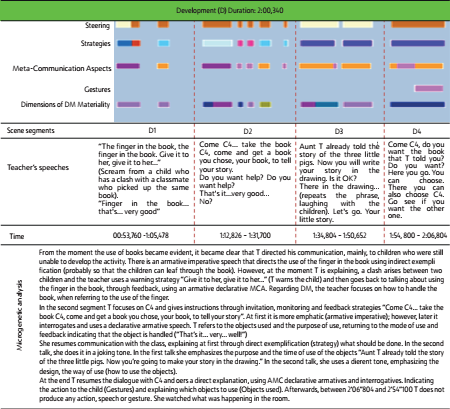
Sections were made of a scene whose gross duration was 4’19”. However, based on the defined analysis criteria, the scene analyzed in ELAN was 3’13”860 long. (I) lasted ’53”760, (D) 2’00” 340 and (E) 0’19”918. Data from the scene segments of the introduction, development and end of the task are presented in the tables.
Contextualization of the Scene Examined
The scene examined corresponds to the time in which the teacher, after having shared the story “The Three Little Pigs”, ask the children to take a book from the shelf “to read” and after “reading” asks them to go to another school location and draw a picture of the story they “read”.

Global data on the actions of teacher and children C1, C2 and C3 during the educational situation
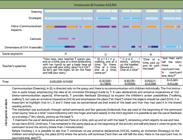

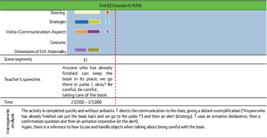
Categories and indicators present in the teacher’s actions at each moment of the activity (I, D and E), together with a microgenetic description.
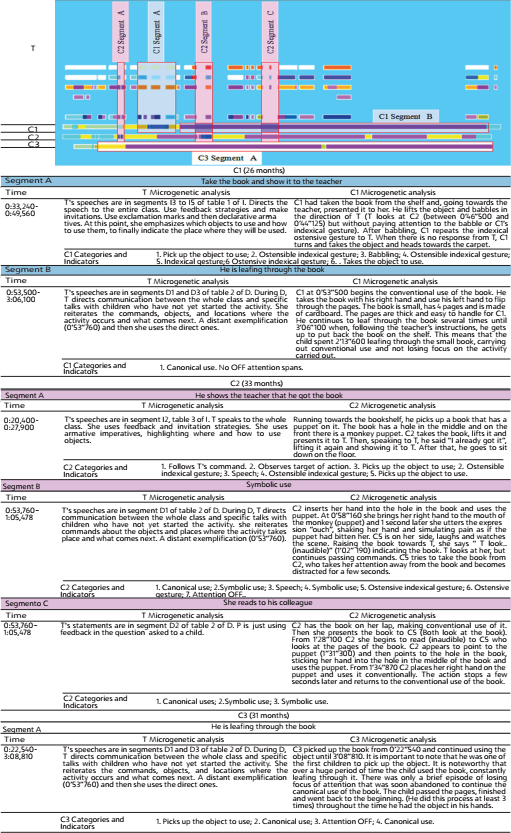
The categories and indicators identified in the three children’s actions throughout the educational situation will be presented below, accompanied by a qualitative description
Discussion
Data analysis was focused on the three questions described at the beginning of the method’s description. The first question concerns the characteristics of T’s actions during the educational situation reviewed. Thus, in Table 1 we can see that in (I) there are 5 segments (I1 − I5); in this case few gestures are recorded and there are no use of objects by T. The prevalent commands are imperative and declarative affirmative related with Metacommunicative Aspects (MCA) and the Dimensions of Materiality (DM) highlight the place of use, modes of use and reference regarding which objects to use. T does not change position or perform specific interventions with the children. The action orientation is functional: to reproduce the command (Tables 1 and 2).
Although there appear to be differences, in (D) the communication pattern is maintained without actions or interactions that would set a common learning and development milestone in children. In general, T passes on commands to perform the “reading” and the children sit and do what they have been told. At the moment (E) T quickly closes the activity, without reflecting on the material used or the implications of the use for children. T does not ask questions that encourage reflection on the children’s own actions throughout the activity.
T’s silence (from 2’06”804), without gestures and remaining in the same place, does not create semiotic dynamics for children about novelties and variations in the different use of the objects. The intentional absence of suggestions about the object does not cause reflections on the different use or on the creation of novelties regarding the use of books. In turn, T’s interventions reduce the possibilities of developing processes associated with executive functioning (attention, memory and inhibitory control). T’s intentional action could transform the condition of use hic et nunc – leafing through the book − and transforming it into a rich process of learning and actions that would break an immediate use and allow access to symbolic uses and to make-believe, for example. Materiality, especially in the case of books, appears as a resource that creates a link between what is known and opens doors to possible worlds that, even in young children, can already be identified as will be seen in the case of C2 (Table 4).
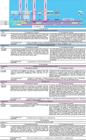
Educational situations must intentionally introduce theoretical/practical elements and materiality (in this case the book) has to be used as a means to promote new semiotic resources, reflection, regulation and cognitive/relational enrichment. This type of interactions and gestures promote reflection, cognitive mobilization and the progressive transfer of control of the object from the teacher to the child. It is worth highlighting that this situation occurs after the time of shared reading, which allowed the possibility of raising questions, inquiries, instigations for children to imagine a reading situation.
The situation lasted just over 4 minutes and seems to indicate that there was little clarity about its purpose and its insertion at that time. T does not seem to recognize the need to use didactic and semiotic strategies that allow the introduction of objects, which create opacity regarding other uses and possibilities based on materiality. All of this restricts them from becoming objects of study, inquiry and knowledge.
The book is a cultural object that, in addition to materiality, offers the opportunity to create semiotically alternative worlds, creating the need to infer new things. However, in solitude, the child only makes functional use and is unable to imagine, flex and recreate what the object itself offers. Objects do not explain anything inherent about their use, which is why it can be said that using the object is not enough, there must be a direction from another that intentionally brings to light the tension between change/permanence of actions and uses of this materiality incorporated into the educational situation.
On the other hand, in the case of children, the data shown in Table 4 allow us to infer several aspects involving attention, EF and what happens in micro-moments during classes with young children. C1 (26) presents indicators of long periods of attention ON during the activity. For more than 2 minutes C1 is able to leaf through the book, similar to C3 (31). The use of the object and attention span indicate the relevance that using objects can have in regulating actions in school settings that have many triggers to take the focus away. The lack of interventions on the part of T means that, in the case of C1 and C3 (Segment B of C1 and Segment A of C3 in Table 4), the activity is restricted to what they already know how to do: leafing through the book during the time of their activity.
In the case of C2, there are two very rich situations worth analysis (Segments B and C of C2 in Table 4). 1. The type of book the child chose (the book that has a puppet attached to the book) and 2. The proximity of C5 participating in the symbolic use that C2 made of the book/puppet.
Both aspects expanded the possibilities for C2 to go beyond what the object presented. She used inhibitory control during the situation, made her use of the book more flexible and planned the action of both being “bitten by the monkey” and pretending that she was reading the book together with C5. These data show that C2 goes further and manages to break the here and now condition of leafing through the book to bring new elements that enrich interactions. It is precisely the rupture that leads C5 to see the book and seek interactions with C2.
The data reviewed in the sections indicate that the use of materiality by children shows indicators of learning and, consequently, of the development of aspects related to executive control and which may be little noticed by adults in the day-to-day life in the classroom. On the other hand, data from this observation also show how EF processes, analyzed in frameworks of high ecological validity, are relevant for further researches, especially in young children, as well as allowing the identification of relevant records about attention, flexibility and inhibitory control. However, it is important to highlight that the data analyzed correspond to a specific section, of a specific case, which limits the possibilities of extending the analyses to greater levels of generalization.
-
Support
Financial Support for Researcher of the Postgraduate Program in Education – Professional Modality at the Universidade de Brasília (Internal Call No. 002/2022).
-
How to cite this article: Rengifo-Herrera, F. J. (2025). When using objects is not enough: microgenetic analysis of an educational situation in early childhood education. Estudos de Psicologia (Campinas), 42, e230120. https://doi.org/10.1590/1982-0275202542e230120en
References
-
1 Barker, J. E., Semenov, A. D., Michaelson, L., Provan, L. S., Snyder, H. R., & Munakata, Y. (2014). Less structured time in children’s daily lives predicts self-directed executive functioning. Frontiers in Psychology, 5, 1-16. https://doi.org/10.3389/fpsyg.2014.00593
» https://doi.org/10.3389/fpsyg.2014.00593 -
2 Bernier, A., Carlson, S. M., & Whipple, N. (2010). From external regulation to self-regulation: early parenting precursors of young children’s executive functioning. Child Development, 81(1), 326-339. https://doi.org/10.1111/j.1467-8624.2009.01397.x
» https://doi.org/10.1111/j.1467-8624.2009.01397.x -
3 Brossard, M. (2001). Situations et formes d’apprentissage. Revue suisse des sciences de l’éducation. Schweizerische Zeitschrift für Bildungswissenschaften, 23(3), 423-439. https://www.pedocs.de/volltexte/2011/3773/pdf/SZBW_2001_H3_S423_Brossard_D_A.pdf
» https://www.pedocs.de/volltexte/2011/3773/pdf/SZBW_2001_H3_S423_Brossard_D_A.pdf - 4 Correa, M., Villalobos, M. E., Cárdenas, K., Moreno-Llanos, I., del Olmo, M., & Moreno-Núñez, A. (2021). Usos rítmico-sonoros de objetos e instrumentos musicales en las aulas 0-1 y 1-2. In C. Rodríguez & J. L. de los Reyes (Eds.), Los objetos si importan: acciones educativas en la escuela infantil (pp. 57-82). Horsori.
-
5 Diamond, A. (2020). Executive functions. In A. Gallagher, C. H. Bulteau, D. Cohen, & J. L. Michaud (Eds.), Handbook of clinical neurology annual review of psychology (pp. 225-240). Elsevier. https://doi.org/10.1016/B978-0-444-64150-2.00020-4
» https://doi.org/10.1016/B978-0-444-64150-2.00020-4 -
6 Estrada, L. F. (2019). Materialidad y prácticas educativas en la escuela infantil con niños/as entre 1 y 2 años. Una aproximación cultural, semiótica y pragmática [Tesis doctoral, Universidad Autónoma de Madrid]. Biblos-e Archivo Repositorio. http://hdl.handle.net/10486/688559
» http://hdl.handle.net/10486/688559 - 7 Estrada, L. F. (2021) Tipos de situaciones educativas en la escuela infantil: el rol mediador de los maestros. In C. Rodríguez & J. L. de los Reyes (Eds.), Los objetos si importan: acciones educativas en la escuela infantil (pp. 159-181). Horsori.
-
8 Guevara, I., Moreno-Llanos, I., & Rodríguez, C. (2020). The emergence of gestures in the first year of life in the Infant School classroom. European Journal of Psychology of Education, 35, 265-287. https://doi.org/10.1007/s10212-019-00444-6
» https://doi.org/10.1007/s10212-019-00444-6 -
9 Guevara, I., & Rodríguez, C. (2023). Developing communication through objects: ostensive gestures as the first gestures in children’s development. Developmental Review, 68, 101076. https://doi.org/10.1016/j.dr.2023.101076
» https://doi.org/10.1016/j.dr.2023.101076 - 10 McClelland, M. M., Cameron, C. E., & Dahlgren, J. (2019). The development of self-regulation in young children. In D. Whitebread (Ed.), The sage handbook of developmental psychology and early childhood education (pp. 471-486). Sage.
-
11 Moreno-Llanos, I., Guevara, I., Palacios, P., & Rodríguez, C. (2023). How to study the early development of executive function? Let’s put control back in the hands of children. New Ideas in Psychology, 72, 101049. https://doi.org/10.1016/j.newideapsych.2023.101049
» https://doi.org/10.1016/j.newideapsych.2023.101049 -
12 Moro, C., & Tapparel, S. (2012). La situation éducative comme lieu de partage, de modification et d’appropriation de significations chez l’enfant. Prisme, 16, 35-36. https://www.hepl.ch/files/live/sites/files-site/files/unite-communication/prismes/numeros-complets/prismes-numero-16-2012-hep-vaud.pdf
» https://www.hepl.ch/files/live/sites/files-site/files/unite-communication/prismes/numeros-complets/prismes-numero-16-2012-hep-vaud.pdf -
13 Moro, C., & Tartas, V. (2013). Introduction. In J. Bernié & M. Brossard (Eds.), Vygotski et l’école: apports et limites d’un modèle théorique pour penser l’éducation et la formation Presses Universitaires de Bordeaux. https://doi.org/ 10.4000/books.pub.47842
» https://doi.org/10.4000/books.pub.47842 -
14 Palacios, P., Rodríguez, C., & Méndez-Sánchez, C. (2018). Communicative mediation by adults in the construction of symbolic uses by infants. Integrative Psychological and Behavioral Science, 52, 209-227. https://doi.org/10.1007/s12124-018-9422-1
» https://doi.org/10.1007/s12124-018-9422-1 - 15 Rengifo-Herrera, F. (2021). Os signos são a “pupila” dos olhos ou como a relação sujeito/cultura emerge na semiosfera. In A. F. A. Madureira & J. Bizerril (Orgs.), Psicologia & cultura: teoria, pesquisa e prática profissional (pp. 87-119). Editora Cortez.
-
16 Rodríguez, C. (2009). The ‘circumstances’ of gestures: proto-interrogatives and private gestures. New Ideas in Psychology, 27, 288-303. https://doi.org/10.1016/j.newideapsych.2008.04.002
» https://doi.org/10.1016/j.newideapsych.2008.04.002 -
17 Rodríguez, C. (2015). The connection between language and the world: a paradox of the linguistic turn? Integrative Psychological and Behavioral Science, 49(1), 89-103. https://doi.org/10.1007/s12124-014-9274-2
» https://doi.org/10.1007/s12124-014-9274-2 -
18 Rodríguez, C. (2022). The Construction of executive function in early development: the pragmatics of action and gestures. Human Development, 66, 239-259. https://doi.org/10.1159/000526340
» https://doi.org/10.1159/000526340 -
19 Rodríguez, C., & Moreno-Llanos, I. (2020) A Pragmatic turn in the study of early executive functions by object use and gestures: a case study from 8 to 17 months of age at a nursery school. Integrative Psychological and Behavioral Science, 57, 607-654. https://doi.org/10.1007/s12124-020-09578-5
» https://doi.org/10.1007/s12124-020-09578-5 - 20 Rodríguez, C., Moreno-Llanos, I., Cerchiario, E., Mietto, G., & Guevara, I. (2021). Origen y desarrollo de las funciones ejecutivas en el aula 0-1 de la escuela infantil. In C. Rodríguez & J. L. de los Reyes (Eds.), Los objetos si importan: acciones educativas en la escuela infantil (pp. 133-157). Horsori.
- 21 Rodríguez, C., & Moro, C. (1999). El mágico número tres Cuando los niños aún no hablan Paidós.
-
22 Taisson, C. P. (2014). La matérialité: une ressource pour l’enseignement-apprentissage de la lecture. Éducation Didactique, 8(2), 125-138. https://doi.org/10.4000/educationdidactique.1984
» https://doi.org/10.4000/educationdidactique.1984 -
23 Taisson, C. P. (2020). Conséquences de la circulation du concept de matérialité entre la recherche et la formation initiale des enseignants du primaire. Formation et Pratiques D’enseignement en Questions, 26(1), 93-112. https://revuedeshep.ch/pdf/26/26-06-Taisson
» https://revuedeshep.ch/pdf/26/26-06-Taisson
Edited by
-
Editor
Raquel Souza Lobo Guzzo

 Note: C1: Child 1; C2: Child 2; C3: Child 3.
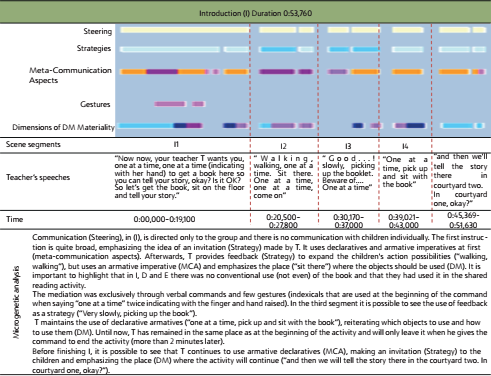 Note: D: Development; DM: Dimensions of materiality; E: End; I: Introduction; MCA: Meta-communication aspects; T: Teacher.
 Note: C4: Child 4; DM: Dimensions of materiality; MCA: Meta-communication aspects; T: Teacher.
 Note: T: Teacher.
 Note:C1: Child 1; C2 :Child 2; C3: Child 3; C5: Child 5; D1: Development segment 1; D3: Development segment 3; DM: Dimensions of materiality; E: End.; I3: Introduction segment 3; MCA: Meta-communication aspects; T: Teacher.