
 Disparities in the assignment of responsibilities in e-waste management: an analysis of the literature and Brazilian legislation
ABSTRACT
The management of Waste Electrical and Electronic Equipment (WEEE), or e-waste, has gained global relevance, especially with the growing volume of waste generated and the need for sustainable practices. This study proposes and applies a methodology to analyze the disparity between Brazilian legislation and the literature regarding the assignment of responsibilities to stakeholders in the Reverse Supply Chain (RSC). The research, which includes a systematic literature review and content analysis of Brazilian Legal Instruments (BLIs) regarding stakeholders’ responsibilities concerning e-waste in the RSC, reveals gaps between theoretical responsibilities and legal approaches. The comparison between the literature and the BLIs highlights the lack of regulations on practices such as prepayment of waste management fees and the roles of consumers, retailers, and governments in the recycling chain. The study proposes a framework for assigning and sharing responsibilities in the RSC that can serve as a basis for more effective public policies and business strategies, aiming for a more robust circular economy. The conclusions reinforce the importance of greater integration between public policies and RSC practices in Brazil, as well as suggesting updates to the BLIs to promote greater collaboration among the different stakeholders, guaranteeing the effectiveness of reverse logistics systems and sustainability in WEEE management.
Keywords:
producer responsibility; reverse logistics; circular economy; Brazilian legal instruments; electronic waste
RESUMO
O gerenciamento de resíduos de equipamentos elétricos e eletrônicos tem ganhado relevância global, especialmente com o crescente volume de resíduos gerados e a necessidade de práticas sustentáveis. Este estudo propõe e aplica uma metodologia para analisar disparidade entre a legislação brasileira e a literatura no que tange à atribuição de responsabilidades aos stakeholders em cadeias de suprimentos reversas. A pesquisa, que inclui revisão sistemática da literatura e análise de conteúdo dos instrumentos legais brasileiros relacionados a responsabilidades de stakeholders em cadeias de suprimentos reversas de resíduos de equipamentos elétricos e eletrônicos, revela lacunas entre as responsabilidades teóricas e as abordagens legais. A comparação entre a literatura e os instrumentos legais brasileiros destaca a falta de regulamentações sobre práticas como o pagamento antecipado de taxas para gestão de resíduos e o papel de consumidores, varejistas e governos na cadeia de reciclagem. O estudo propõe um framework para designação e compartilhamento de responsabilidades em cadeias de suprimentos reversas que pode servir como base para proposição de políticas públicas e estratégias empresariais mais eficazes, visando a uma economia circular mais robusta. As conclusões reforçam a importância de uma maior integração entre políticas públicas e práticas de cadeias de suprimentos reversas no Brasil, além de sugerir atualizações nos instrumentos legais brasileiros para promover uma maior colaboração entre os diferentes stakeholders, garantindo a eficácia de sistemas de logística reversa e a sustentabilidade no gerenciamento de resíduos de equipamentos elétricos e eletrônicos.
Palavras-chave:
responsabilidade estendida ao produtor; logística reversa; economia circular; instrumentos legais brasileiros; resíduos eletroeletrônicos
INTRODUCTION
With technological advances dating back to the Industrial Revolution, manufacturing techniques have developed, resulting in greater production and an incessant search for higher profits, essential for the survival of organizations (Santos, 2016). This quest for profitability comes alongside concerns about the resource crisis, social change, and global consumption patterns, highlighting the need for sustainable business growth (Banguera et al., 2018). With the world population surpassing 8 billion in 2022 and projected to reach 10.2 billion by 2050, socio-environmental impacts are becoming a global concern, especially with regard to waste generation and management (Wcislak, 2022).
One response to this problem has been the structuring of Reverse Supply Chains (RSCs), which consist of a set of facilities that partially or exclusively integrate waste management. Management takes place through the flow of materials and information along these facilities to lead post-consumer products or their components to their final destination (landfills, incineration), or to value recovery channels (repair, recycling, etc.) and subsequent reinsertion into direct supply chains, all coordinated by Reverse Logistics (RL) (Martins et al., 2022; Melo et al., 2022). For RSCs to fulfill their roles effectively and efficiently, they need to perform well in terms of sustainability and operations, among others (Nunes et al., 2023). This commitment must be made by the different stakeholders involved. Recent studies (Johannes et al., 2021; Faibil et al., 2023; Mayanti; Helo, 2023; D’Ávila et al., 2025) point out that sustainable solutions are only viable if all stakeholders in the supply chains, especially the government, share responsibilities and engage in the process.
The literature frequently links the viability of RSCs to the concept of Extended Producer Responsibility (EPR). First introduced in Sweden in 1990 and later formalized by Thomas Lindhqvist in 2000, EPR initially focused on producers but gradually expanded to encompass all stages of the product life cycle, including return, recycling, and final disposal. Europe adopted EPR through specific directives supported by the Organization for Economic Co-operation and Development (OECD), and the concept has since gained traction globally, in countries such as Japan, Canada, and South Korea. While the United States has adopted EPR more gradually, its implementation remains significant. After the 2000s, the definition of RSC responsibilities began to involve the integration of multiple stakeholders through negotiation and collaboration, as noted by Silva and Fontana (2021).
Shared responsibility is no longer limited to manufacturers, but also includes consumers and public authorities, making the task of assigning these responsibilities more complex (Silva; Fontana, 2021). This sharing can improve economic and environmental performance, increasing profits and social welfare (Jacobs; Subramanian, 2012). In this context, the active participation of governments, industries, and other stakeholders favors the effective implementation of RL (Pereira; Oliveira, 2019; Pereira; Ribeiro, 2021).
In Brazil, concern about waste management is acute, with statistics from the Brazilian Association of Public Cleaning and Special Waste Companies (ABRELPE) showing high rates of waste production and its inadequate disposal (Pires; Oliveira, 2021). In response to this, the Brazilian state has created legal instruments such as the National Solid Waste Policy (PNRS) and Decree No. 10.936/2022, which establish shared responsibilities for proper waste management, including all RSC links (Brasil, 2022). Although waste management legislation exists, it remains unclear whether its scope aligns with the recommendations found in the specialized literature. Furthermore, this discussion on responsibilities and RSC is incipient, given the urgency of the issue.
This study aims to investigate the compliance of Brazilian Legal Instruments (BLIs) with responsibility-sharing practices in the management of Waste Electrical and Electronic Equipment (WEEE), or e-waste, as recommended in the literature. The specific objectives include critically analyzing the adequacy of current BLIs in reflecting the responsibilities of stakeholders identified in the literature concerning e-waste in the RSC; and identifying the main gaps between current legal practices in Brazil and academic guidelines for the sustainable management of this type of waste. Thus, this study addresses the following research questions: According to the literature, what responsibilities should be assigned to stakeholders involved in RSCs? (RQ1) Additionally, to what extent do BLIs reflect the set of responsibilities recommended in the literature? (RQ2)
To answer these questions, a systematic literature review (SLR) was carried out, which identified the different responsibilities attributed to RSC stakeholders. Subsequently, a framework listing the responsibilities shared among these stakeholders was created. The proposed framework considers RSC in general. In this specific case, the study examined BLIs related to e-waste to assess the extent to which the country's legal framework aligns with the proposed model (literature), focusing on the sharing of responsibilities among stakeholders concerning e-waste in the RSC. More than just diagnosing the Brazilian context, this study proposes a replicable analytical methodology to assess convergence (or disparity) between the legal framework of any country and the set of responsibilities attributed to stakeholders, as advocated by the international literature. The analysis of the Brazilian case, therefore, serves as an empirical study to validate this methodological approach.
RESEARCH METHOD
To carry out this research, we opted for a SLR followed by documentary research on the Brazilian legislation. Building on these two inputs, the study developed a comparative framework to assess how closely a country's legislation aligns with the stakeholders’ responsibilities defined in the scientific literature. Researchers have increasingly used SLR as a method to gather evidence in studies on sustainability, circular economy, and logistics (Melo et al., 2021; Martins et al., 2022; Nunes et al., 2023). This study follows the SLR approach proposed by Tranfield et al. (2003), which outlines four developmental phases: Pilot review; Proposing the research and creating a protocol; Obtaining and selecting publications; Extracting data and presenting the results.
In the Pilot Review, articles on stakeholder responsibility concerning waste in the RSC were searched in the Scopus databases, considering titles, abstracts, and keywords. After that, inclusion and exclusion criteria were identified. The research proposal and protocol were then created. Based on the information acquired in the previous phase, the research objective was confirmed, as were the search strings and the scientific bases searched. Next, the research protocol was defined (Table 1) with information about the process of searching and selecting articles, as well as information extraction.
Following the research protocol, the study retrieved and selected publications using predefined search strings and databases. The review focused on studies published in English and indexed in three major academic databases: Science Direct, Scopus, and Web of Science. These research databases were selected because they comprehensively cover environmental management, logistics, and sustainability. The search strategy combined terms such as Extended Producer Responsibility, Responsibility Sharing, Reverse Logistics, and Reverse Supply Chain, using Boolean operators ("AND", "OR") applied to titles, abstracts, and keywords. The string applied was ("Joint liability" OR "Stakeholders Collaboration" OR "Extended Producer Responsibility" OR "Responsibility Sharing" OR "Responsibility Allocation" OR "Responsibility Assignment") AND ("Reverse Logistics" OR "Reverse Channels" OR "Reverse Supply Chain"). After removing duplicate articles, the researcher screened titles, abstracts, and keywords to ensure alignment with the study's focus. Full-text readings of the selected articles enabled data extraction according to the protocol. The results were then presented through graphs, tables, figures, and descriptive statistics to support content analysis and assess alignment with the study's objectives.
Result compilation enabled the last phase to be carried out: Result Analysis. The results were discussed by drawing a parallel with the information collected and the results obtained by other authors, with a view to answering the research questions. In addition to the producers, the content analysis identified other stakeholders considered in the research, as well as their assigned responsibilities. These responsibilities were mapped and grouped, and then a set was proposed to represent them concisely and without redundancy. Drawing on the stakeholder-specific results and aligning with the EPR paradigm of shared responsibilities, this study proposes a theoretical framework that groups distinct categories of responsibilities. These groupings, as identified in the research, help structure and enable the effective operation of the RSC. The proposed categories - such as Education, Waste Monitoring, Physical and Technological Infrastructure, Health and Safety, etc., group similar responsibilities and collectively encompass all the responsibilities in the RSC found in the literature.
To characterize the Brazilian context, the study focused on e-waste-related BLIs, given the global rise in e-waste generation and the existence of specific legislation addressing this waste stream in Brazil. The selection was based on documents such as laws, sectoral agreements, and decrees, ensuring adherence to the research questions and prioritizing the most up-to-date information to reflect recent changes in the Brazilian legislation. In line with Patton's (2014) recommendation, the study avoided relying on a single source or type of legislation and, instead, incorporated a diverse range of BLIs to enable comparison of different approaches within the Brazilian context. The selection of these BLIs helped to identify the stakeholders and their responsibilities concerning e-waste in the RSC from the government's perspective. In the final stage, the study analyzed the alignment between the Brazilian legal context and the theoretical framework by comparing stakeholders’ e-waste responsibilities in the RSC outlined in the BLIs with those identified in the literature.
Data were organized and analyzed using Microsoft Excel for data tabulation and descriptive statistics. Two researchers manually validated all coding and classification procedures to ensure replicability and methodological reliability. Additionally, VOSviewer software was employed to support bibliometric mapping and visualization of keyword co-occurrence, authorship networks, and thematic clusters. This enhances transparency and ensures that the SLR used can be replicated by other researchers.
RESULTS AND DISCUSSION
Following the established method, the pilot review stage involved collecting articles from the Science Direct, Web of Science, and Scopus databases using search strings defined in the Research Protocol (Table 1). The aim was to check for signs of convergence with the research proposal. After defining the search string, the study established the extraction parameters and the inclusion and exclusion criteria during phase two, which involved developing the research proposal and protocol. The initial search yielded 167 articles. After removing duplicates and those that did not meet the criteria, 99 articles remained, of which 81 were accessible.
In phase three, the analysis of titles, abstracts, and keywords reduced the number of articles to 77. In phase four, data extraction, the articles were read in full and organized in a spreadsheet. This last process excluded 13 additional articles, yielding a final selection of 64 studies. Figure 1 shows the distribution of articles by type of waste, with 14 of them addressing the RSC in general, without focusing on a specific type of waste.

The results show that 21.87% of the articles analyzed do not specify the type of waste or address the subject broadly, focusing on the general aspects of the RSC legislation and practices. For these studies, this indicates that waste classification is not a relevant factor in their scope, suggesting a broader application. On the other hand, e-waste stood out and was addressed in 45.31% of the articles. This shows special attention to its proper management and disposal. Next, with three occurrences each, were plastic waste, photovoltaic panels, and vehicles. The other waste streams found, such as batteries, paper, tires, glass, and bicycles, were the least addressed in the publications analyzed.
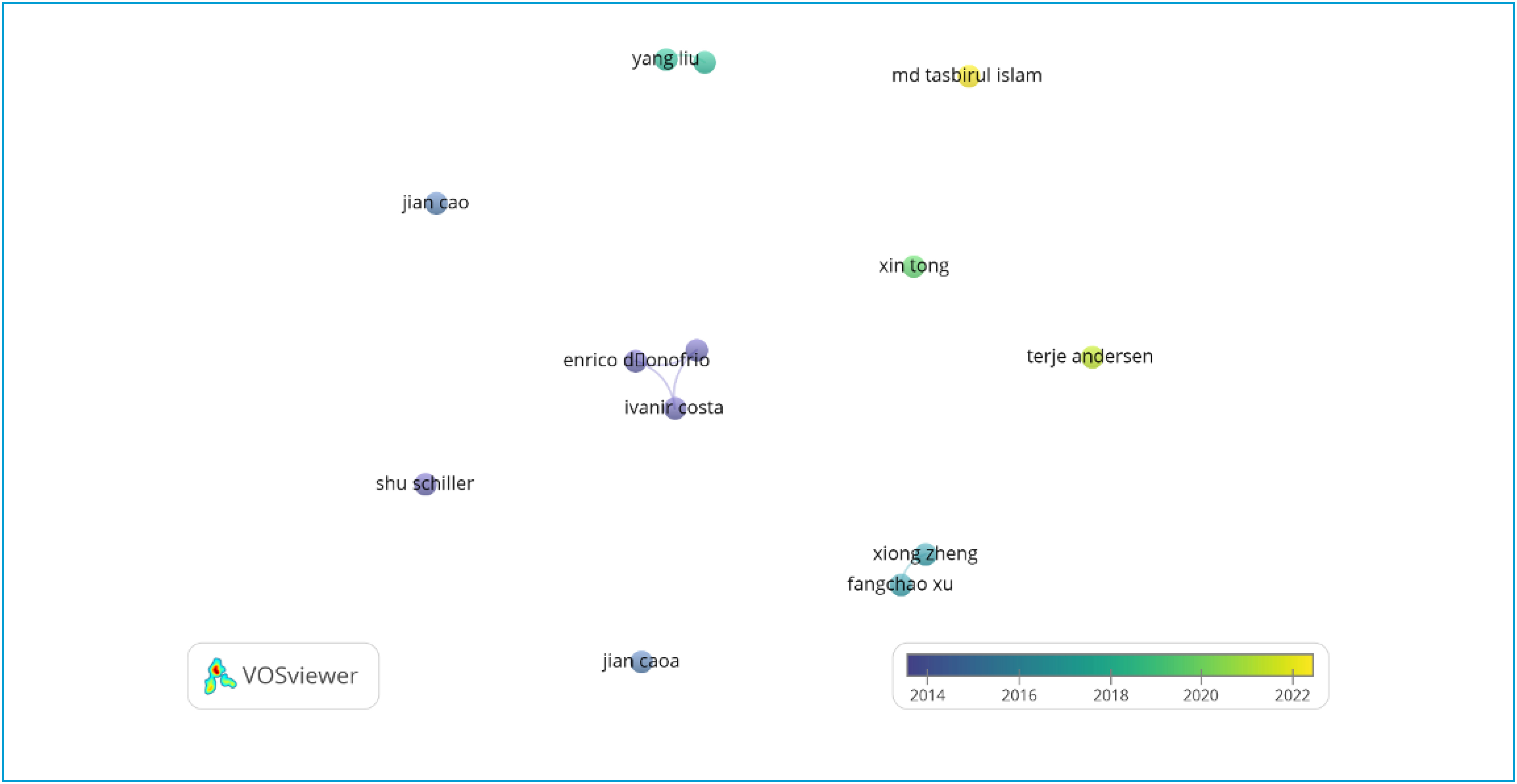
To deepen the understanding of the research structure identified in the systematic review, an author co-occurrence analysis was performed using VOSviewer. This allows the identification of collaboration patterns and the main research groups active in studies addressing responsibility sharing and RSCs (see Figure 2).

The co-authorship network reveals a dispersed collaboration structure among researchers addressing responsibility allocation and RSCs. Most authors appear isolated or grouped in small, locally connected clusters, with limited evidence of broad international cooperation. Notable dyads such as Enrico D’Onofrio and Ivanir Costa, as well as Xiong Zheng and Fangchao Xu, illustrate restricted partnerships, likely linked to specific institutional contexts or regional initiatives.
The color gradient indicates the temporal evolution of contributions, with earlier studies (in blue tones) concentrated between 2014 and 2018, reflecting foundational investigations on RL and EPR frameworks. More recent publications (in green and yellow tones), from authors like Md Tasbirul Islam, Yang Liu, and Terje Andersen, demonstrate the field's growing interest in circular economy perspectives and sustainability-driven responsibility models. Overall, the figure highlights the emerging and still fragmented nature of this research domain.
To complement the bibliometric analysis, a keyword co-occurrence network was developed to identify the main conceptual relationships within the selected studies. This type of visualization helps to map the thematic structure of the field, showing how topics evolve and interconnect around core research areas such as RL and EPR. Figure 3 compiles these results.

The map shows that "reverse logistics" and "extended producer responsibility" are the central nodes in the network, functioning as conceptual anchors that connect to related terms such as recycling, remanufacturing, e-waste, and RSC. The strong linkage among these keywords indicates that research in this area predominantly explores responsibility allocation and recovery mechanisms across the product lifecycle. Peripheral terms like "circular economy" and "reverse supply chain" demonstrate the progressive alignment of this literature with sustainability and circularity frameworks.
The color gradient, representing the average publication year, suggests that early works (in darker tones) were primarily focused on the foundational aspects of RL, while more recent studies (in lighter tones) have addressed broader concepts of producer responsibility and circular economy. This evolution reinforces the growing integration between waste management, product recovery systems, and sustainable policy design in the academic discussion.
Definition of responsibility
The content analysis of the selected articles highlighted that the concept of responsibility in the RSC is strongly associated with EPR, introduced in Sweden in 1990. Initially, EPR aimed to transfer responsibility for waste management from municipalities to producers, making them accountable for managing their products in the post-consumption phase. Formalized by Thomas Lindhqvist in 2000, the concept was expanded to include the entire product life cycle, from design to final disposal, promoting the involvement of producers in environmentally appropriate return, recycling, and disposal practices.
The evolution of EPR over the decades has been remarkable. In the 1990s, its adoption was concentrated in Europe, consolidated by the European Union's Waste Framework Directive and the Packaging and Packaging Waste Directive, with a focus on electronic waste, packaging, and end-of-life vehicles. In the 2000s, EPR expanded to countries such as Japan, Canada, and South Korea, covering a wider range of product categories. Although the United States has adopted EPR policies more slowly, some states have implemented relevant initiatives. The OECD has played a key role in the global dissemination of EPR, providing guidelines to harmonize practices in different regulatory contexts.
In the 2020s, the role of EPR in circular economy strategies has become even more central. The concept has evolved beyond waste minimization and recycling, promoting sustainable product design. The aim has become to not only manage waste but also encourage the creation of products that are easier to dismantle, reuse, or recycle, integrating eco-design practices and sustainable innovation.
Around 48 of the articles analyzed directly refer to the EPR as the basis for defining responsibility in the RSC, while 30% use definitions from other theoretical sources, such as the OECD, the European Commission, and Lindhqvist (2000). Approximately 45% of the articles specify a more traditional definition, centered on attributing responsibility to producers for waste management in the post-consumption phase. However, the current concept of EPR covers all stages of the product life cycle, including design, production, distribution, use, RL, and final disposal.
The definitions analyzed show that EPR aims to promote more sustainable practices, assigning financial and physical responsibilities to producers. Although researchers often focus on economic and environmental aspects, they should place greater emphasis on exploring social value in academic discussions. In addition, the influence of the circular economy is evident, with an emphasis on reducing environmental impacts, protecting natural resources, and improving waste management. This context highlights the growing importance of EPR as an essential regulatory tool for sustainability and environmental innovation on a global scale.
Stakeholders and e-waste management responsibilities
During the full reading and data extraction phase of the SLR, a wide range of stakeholders involved in the RSC was identified, as well as the responsibilities assigned to each of them. The literature analyzed highlights the presence of producers/manufacturers, importers, distributors, retailers, consumers, and the government, as well as collectors, recyclers, and remanufacturers. The latter, although not the main waste generator, plays a key role in waste recovery and final disposal, with responsibilities deriving from specific roles in RL.
On the other hand, stakeholders in the Forward Supply Chain (FSC), including producers/manufacturers, importers, distributors, wholesalers, retailers, consumers, and governments, serve as natural responsible parties, as their production activities, often rooted in linear models, directly contribute to waste generation. This understanding is important for the proper assignment of responsibilities in the RSC, since these stakeholders have a direct impact on waste generation and, therefore, on the environmental challenges regarding the recovery of these materials. In the process of identifying these responsibilities, 165 statements were found in the articles analyzed, distributed among seven main stakeholders, as illustrated in Figure 4.

In 20% of these statements, the government was cited, highlighting its prominent role as a mediator and regulator of RSC activities. Its responsibilities include proposing and enacting laws, monitoring compliance with these rules, and applying sanctions in case of non-compliance. In addition, they must act as promoters of public policies that encourage sustainable practices, facilitating integration among other stakeholders.
The most mentioned stakeholder was "producer/manufacturer", responsible for more than half (53%) of the responsibility statements. This result is in line with the EPR principle, which gives manufacturers a central role in waste management throughout the product life cycle. Producers influence product design and promote eco-design practices that minimize environmental impacts and costs associated with the RSC. In addition, they must implement efficient collection, reuse, and recovery systems, as well as manage environmental fees, such as those related to e-waste. Other stakeholders, such as consumers, importers, retailers, and distributors, had a frequency of mentions ranging from 4% to 8%. Wholesalers, on the other hand, were the least mentioned, with only one mention (approximately 1%). This low representation can be attributed to the lack of clarity in the definitions and classifications of this stakeholder in the literature, which makes it difficult to delimit their specific responsibilities.
Producers/manufacturers, importers, and distributors have important responsibilities in environmental management, as compiled in Table 2. Producers are responsible for implementing EPR, from production to product disposal. They must promote sustainability practices, create circular economy value chains, ensure effective product recycling, and educate consumers about environmental issues. Importers, in addition to managing environmental fees and recycling costs, must implement RL systems that guarantee the efficient return of products, promoting technological innovations to optimize the recovery process. Distributors, meanwhile, in addition to facilitating the disposal of products, play an important role in disseminating information about RL, and can act as collection points and establish partnerships with recycling cooperatives.
Responsibilities attributed to producers/manufacturers, importers, and distributors according to the literature.
Wholesalers and retailers, although less prominent, play important roles in the RSC infrastructure, with their responsibilities detailed in Table 3. Wholesalers provide logistical support and facilitate the implementation of Voluntary Drop-off Points (VDPs), contributing to waste dispersal reduction and the economic viability of RL. Retailers, in turn, hold a broader range of responsibilities, including freely accepting electronic waste, collecting and returning these materials to the RSC, managing recycling fees, and creating partnerships with RL providers (e.g., waste picker cooperatives) to enhance recycling efficiency.
At the end of the FSC are consumers and the government, whose responsibilities are in Table 4. Consumers play a fundamental role in the RSC, since the waste recovery process usually starts with them. Their responsibilities include sorting waste at the source for recycling (gatekeeping), paying environmental fees in some contexts, and adopting more conscious and sustainable behavior, considering sustainability criteria. Environmental awareness and shared responsibility among consumers and other stakeholders are key to the success of RL.
The government, widely cited in the literature, is a crucial player in developing public policies and promoting environmental education. Its responsibilities go beyond regulation, including funding circular initiatives, supporting companies in the recycling sector, strengthening environmental legislation, and creating incentive mechanisms for sustainable practices. The government must also act proactively to raise awareness in society, promoting environmental awareness campaigns and investing in programs that encourage responsible consumption and the active participation of the population in waste management.
Disparity analysis between the literature and Brazilian legal instruments regarding stakeholders’ e-waste responsibilities in the reverse supply chain
This section focuses on analyzing the BLIs found in the Brazilian legislation, with an emphasis on e-waste. The aim was to identify e-waste management responsibilities in Brazil, comparing the Brazilian legal framework and stakeholders’ responsibilities identified in the literature.
The methodology involved a content analysis of the e-waste BLI texts. This approach made it possible to map and understand the responsibilities imposed on the various stakeholders involved in e-waste management, contributing to a comprehensive view of regulatory practices and their compliance with the theoretical premises identified in the literature reviewed. The collection analyzed included Brazilian laws, sectoral agreements, decrees, and resolutions on e-waste, shown in Table 5.
The BLIs listed in Table 5 were divided into two groups. The first group comprises General BLIs, which address various types of waste, including e-waste, for example, Law 12,305/2010 - PNRS and Decree No. 10,936/2022. The second group comprises Specific BLIs that specifically address e-waste (the focus of this research), such as the Sectoral Agreement, Decree 10,240/2020, and Resolution No. 401/2008 - CONAMA.
After thoroughly reviewing the full texts of the BLIs, we identified and extracted citations that assign specific responsibilities to each stakeholder. Adopting a similar strategy to the stakeholder responsibilities extracted from the literature, this stage of the research also observed criteria for excluding stakeholders. Terms such as "traders", "generators", and "everyone" can represent several categories of stakeholders and make responsibility assignment among RSC players uncertain and complex. Thus, to ensure information consistency and enable adherence analysis, we considered only waste generator stakeholders with clear and specific definitions identified in the content analysis of the BLIs. Table 6 shows information from the literature on stakeholder responsibilities in the RSC, evaluating how well e-waste BLIs align with the literature.
One key finding reveals that nearly 50% of the responsibilities identified in the literature do not appear in the BLIs, highlighting a significant lack of alignment between the two sources. This suggests that the literature offers a more comprehensive view of e-waste management, assigning more detailed RSC responsibilities to stakeholders than the BLIs.
Wholesalers appeared least frequently in both the academic literature and the BLIs. This outcome may stem from varying interpretations of stakeholder terminology, as terms like "wholesalers", "distributors", and "importers" are sometimes grouped under broader categories, such as "traders". Consumers and distributors were the most mentioned stakeholders, with most of their RSC responsibilities already reflected in Brazilian legislation. Consumers represented the stakeholder group with the most extensively covered responsibilities in the BLIs, with only a few responsibilities left unaddressed. Distributors also have their RSC responsibilities widely contemplated in Brazilian legislation.
The government, which is responsible for regulation and oversight, has a significant number of RSC responsibilities attributed to it in the literature, but only 60% of these responsibilities are in the BLIs. This gap may reflect the need for greater maturity of the Brazilian government regarding RSC responsibilities, especially for e-waste, and the literature suggests that other countries may be more active in waste management. As for importers, there is no alignment between the literature and the BLIs, with only 55.5% of consolidated RSC responsibilities addressed. The BLIs need to more clearly define responsibilities, such as collecting and managing fees for generated e-waste and collaborating with recycling cooperatives. Producers/manufacturers, despite being considered the stakeholders with the greatest RSC responsibilities, have only 45.4% of their responsibilities identified in the BLIs. This highlights the need for greater attention to these stakeholders, given the volume of responsibilities attributed to them in the literature. Finally, retailers showed the least alignment between the literature and the BLIs, with both sharing only one common responsibility. With 12 RSC responsibilities attributed to these stakeholders in the literature, the need for greater consideration in the BLIs is evident.
Disparity between Brazilian legal instruments and the theoretical framework regarding reverse supply chain responsibilities
Assigning responsibilities within the RSC, as discussed in this research, is strongly tied to the concept of EPR. Analysis of the RSC waste management process reveals a scenario of shared responsibilities between different stakeholders, covering various dimensions of this management. To illustrate this phenomenon, the study defines specific categories of RSC responsibilities that capture key dimensions of effective waste management. The categories defined include Environmental Education, Awareness, Sensitization, and Training, focused on expanding knowledge and awareness of environmentally responsible practices. The Waste Monitoring and Traceability category ensures effective control of waste flows throughout the RSC. Physical and Technological Infrastructure refers to the development of facilities and technological resources necessary for effective RL, recovery, and waste disposal.
The Health and Safety category plays a critical role in protecting individuals involved in the RSC. In turn, Return, Drop-off, and Collection represent the point of entry of waste into the RSC, marking the beginning of the flow of information and materials. Inspection, Sorting, and Classification activities, then prepare the collected waste for recycling or final disposal. The Transportation and Transfer category covers waste handling logistics, guaranteeing the safe and efficient flow of collected materials. Storage deals with appropriate storage practices, considering waste type and level of recovery until the next stage in the chain. The Recovery, Repair, Remanufacturing, Refurbishing, and Recycling category focuses on reintegrating waste into the FSC, realizing the circular economy paradigm.
For the waste that cannot be recovered, the Proper Disposal and Final Destination category ensures that its final treatment minimizes environmental impact as much as possible. Complementing the management structure, the Credit, Subsidy, and Costs category covers financial responsibilities, while Supervision, Punishment, and Sanction emphasize the importance of compliance with environmental legislation and social safety standards. The RSC Integration category promotes circular practices through collaboration among stakeholders, facilitating the exchange of information, the establishment of partnerships and strategic alliances aimed at reducing uncertainties, complexities, errors, risks, waste, and costs of RSC activities. These categories together form a comprehensive and robust system for managing RSC responsibilities, supporting the transition to more circular and sustainable business models.
This set of categories in Table 7 create a framework based on the responsibilities identified in the literature (Tables 2, 3, and 4), demonstrating how the different responsibilities are shared among stakeholders in the RSC. In addition, Table 7 shows the responsibilities covered by BLIs regarding e-waste.
The analysis in Table 7 shows that RSC responsibilities are shared differently among stakeholders, with different categories of responsibility shared by multiple FSC stakeholders, which reflects the interdependence of waste management activities. In the Environmental Education, Awareness, Sensitization, and Training category, there is significant sharing among consumers, distributors, producers/manufacturers, retailers, and the government. This indicates that promoting environmental education is a collective responsibility, involving everything from public authorities to consumers, creating a network of awareness at all levels of the supply chain
Waste Monitoring and Traceability is a category of shared responsibility between importers and the government. The government's role is fundamental in establishing regulations and overseeing compliance with RSC legislation, while importers are responsible for ensuring that their products comply with these requirements. In Physical and Technological Infrastructure, the joint action of distributors, importers, producers/manufacturers, retailers, and the government stands out. This collaboration highlights the need for coordinated efforts to develop facilities and technologies that support RL, recovery, and waste final disposal. The Health and Safety category is the exclusive responsibility of the government, highlighting its central role in creating public policies and regulations to protect the health of workers and society in general.
In the Return, Drop-off, and Collection group, responsibility is broadly shared among consumers, distributors, importers, producers/manufacturers, and retailers. This sharing highlights the importance of the active participation of all stakeholders for efficient return, increased circularity, life-cycle extension, and reintegration of waste into the FSC.
Transport and Transfer involves consumers, distributors, and retailers, showing that waste logistics is not the sole responsibility of specialized companies and requires the collaboration of different FSC stakeholders. Within Inspection, Sorting, and Classification, responsibilities are shared among consumers, producers/manufacturers, retailers, and the government, demonstrating that efficient waste sorting requires consumer awareness, government regulatory support, and infrastructure provided by other FSC stakeholders.
Responsibility for Storage falls exclusively on the government, reflecting its role in providing the necessary infrastructure for the safe storage of waste. Concerning Credit, Subsidy, and Costs, responsibilities are shared between consumers, distributors, importers, producers/manufacturers, and retailers, indicating that the financing of RSC activities should be a shared responsibility, involving both the public and private sectors. Supervision, Punishment, and Sanction is the exclusive responsibility of the government, reinforcing its role as regulator and inspector of environmental practices in the RSC.
In RSC Integration, distributors, producers/manufacturers, retailers, and the government stand out, demonstrating that coordination between these stakeholders is fundamental to RSC efficiency. Responsibility for Value Recovery, Repair, Remanufacturing, Reformulation, and Recycling is shared between consumers, distributors, importers, producers/manufacturers, and retailers, showing that the recovery process depends on the collaboration of everyone involved in the supply chain. Environmentally Appropriate Disposal and Final Destination is the responsibility of consumers, importers, and retailers, highlighting the importance of individual awareness and institutional support for the correct disposal of waste. Finally, Regulation, Licensing, and Legislation is a function assigned to the government and importers, reflecting the importance of legal compliance in national and international contexts. In summary, the framework shown in Table 6 demonstrates, from a literature perspective, that waste management in the RSC is a shared responsibility requiring the active collaboration of all FSC stakeholders to implement e-waste circular practices in the RSC.
Implications of e-waste responsibilities in the reverse supply chain not covered by the Brazilian legal instruments
In Table 7, the BLIs do not fully promote the sharing of responsibilities according to the theoretical framework when it comes to e-waste responsibilities in the RSC. Regarding consumers, we emphasize the absence of a pre-payment system (CON - 1) to support proper e-waste management. Implementing such a system—by charging a fee at the point of purchase for electronic devices—could help finance RL operations, as well as the recovery and/or environmentally sound disposal of this type of waste. Another responsibility not mentioned in the BLIs refers to the responsible exchange of waste (CON - 6), which deals with consumer credibility at the time of treatment and disposal, following current environmental regulations. Concerning active participation in recycling (CON - 8), it is noteworthy that the BLIs do not have provisions that encourage or require the active participation of consumers in the e-waste recovery chain.
Concerning partnerships with recovery cooperatives (DIS - 6, IMP - 7, RET - 11), it is suggested that BLIs are not taking advantage of the full potential of local and community organizations in the management and recovery of e-waste, because waste pickers’ cooperatives can absorb more activities and responsibilities in waste collection, sorting, and recovery. As a result, waste pickers’ cooperatives could promote more social inclusion and job creation. The responsibilities associated with the government are mostly governmental policies and regulations on e-waste management.
The lack of assignment of such responsibilities (as was the case with GOV-6 to GOV-10, and GOV-13 not identified in the BLIs) creates significant gaps in the applicability and feasibility of the RSC for e-waste activities in the Brazilian context. Formulating, developing, strengthening, and establishing policies, (clear and precise) targets, and related legal regulations should be a consolidated basis for implementing the EPR system. In addition, the literature omits several key government responsibilities, such as enacting policies that ensure fair and safe working conditions for e-waste industry workers, protecting communities affected by waste, enforcing inspection and oversight, offering tax incentives or public recognition, and guaranteeing the application of penalties when FSC stakeholders fail to comply with or adapt to relevant legislation.
The responsibilities of electronic equipment importers not addressed by the BLIs mainly concern the financial and operational management of these products. The BLIs also fail to clearly define the collection and management of the e-waste fee (IMP-1), creating a gap in assigning financial responsibility to these stakeholders for covering the costs of e-waste management and recovery. Furthermore, financial or physical responsibility (IMP - 6) and compliance with the duty to contribute to recovery (IMP - 9) are also not clearly attributed to importers in the BLIs. This legal gap could lead to a lack of commitment regarding the recovery or proper disposal of these products at the end of their useful life.
The analysis reveals that some responsibilities of producers/manufacturers remain unaddressed - particularly P/M-1 and P/M-3 - which highlight a gap in their obligation to ensure the proper disposal of products at the end of their useful life. Additionally, the absence of accountability for environmental damage throughout the product life cycle contradicts one of the core principles of EPR.
The concept of responsibility proposed in this research is based on the principle of EPR. Furthermore, failing to consider P/M - 5 responsibility creates uncertainty about the financial contribution of producers/manufacturers to the management and recovery of e-waste. If even the product's designers are not responsible, it is unjustifiable to expect other stakeholders to be involved in this context. Furthermore, the absence of P/M - 8 responsibility does not include the role of producers/manufacturers in promoting the recovery of products at the end of their useful life. Finally, the absence of P/M - 6 and P/M - 10 responsibilities may lead to no incentives for these stakeholders to develop circular products with less environmental impact.
Retailers were the stakeholders with the highest number of responsibilities not addressed by the BLIs, totaling 11 missing responsibilities. Firstly, the absence of RET - 1 shows a gap in ensuring the proper disposal of products at the end of their useful life, as this responsibility should be assigned to all generating stakeholders. In addition, responsibilities RET - 3, and RET - 4 are not specifically assigned to retailers, which may result in a lack of adequate infrastructure for dealing with e-waste. Other responsibilities with an administrative-operational bias not mentioned by the BLIs, such as RET - 5, RET - 6, RET - 7, and RET - 9, which involve recovering, sorting, transporting, and marketing e-waste, were also not assigned to this stakeholder, possibly creating uncertainty about the role of retailers in these processes. The financial or physical responsibility (RET - 8), the need to establish drop-off sites (RET - 10), and shared responsibility with users and local governments (RET - 12) bring uncertainty to the cooperation required from retailers for efficient e-waste management.
The lack of key e-waste responsibilities outlined in the BLIs creates critical gaps in the implementation of RL and the circular economy model. Poor regulations on fee collection, limited consumer engagement, and the absence of incentives for sustainable products lead to a fragmented system. Additionally, the lack of tax incentives, environmental education policies, and support for cooperatives and fair labor conditions for waste pickers undermines shared responsibility and collaboration, reducing the social and environmental effectiveness of e-waste RSC strategies.
CONCLUSION
This study explores how responsibilities in the RSC are distributed among stakeholders, emphasizing the need for collaboration and mutual dependence. It highlights gaps in areas like regulation and health, while proposing a broader application of EPR beyond producers. A key contribution is an analytical framework for comparing the literature and the legislation covering stakeholders’ roles in the RSC.
For Brazil, the study recommends implementing EPR, offering tax incentives, investing in recycling infrastructure, promoting environmental education, and encouraging public–private partnerships. Practically, it provides guidance for assigning and operationalizing responsibilities to enhance sustainability and circularity in e-waste management.
DATA AVAILABILITY STATEMENT
No new data were generated or analyzed in this study.
REFERENCES
-
ANDERSEN, Terje; JÆGER, Bjørn; MISHRA, Alok. Circularity in waste electrical and electronicequipment (WEEE) directive. Comparison of a manufacturer's Danish and Norwegian operations. Sustainability, v. 12, n. 13, 5236, 2020. https://doi.org/10.3390/su12135236
» https://doi.org/10.3390/su12135236 -
BANGUERA, Leonardo A.; SEPÚLVEDA, Juan M.; TERNERO, Rodrigo; VARGAS, Manuel; VÁSQUEZ, Óscar C. Reverse logistics network design under extended producer responsibility: The case of out-of-use tires in the Gran Santiago city of Chile. International Journal of Production Economics, v. 205, p. 193-200, 2018. https://doi.org/10.1016/j.ijpe.2018.09.006
» https://doi.org/10.1016/j.ijpe.2018.09.006 -
BARBOZA, Marinalva R.; D’ONOFRIO, Enrico; GONÇALVES, Rodrigo F.; COSTA, Ivanir. Logística reversa de equipamentos de tecnologia da informação e comunicação: uma avaliação comparativa da legislação e programas. Espacios, v. 34, n. 12, p. 13, 2013. Available at: https://www.revistaespacios.com/a13v34n12/13341214.html?utm_source=chatgpt.com Accessed on: Oct. 24, 2023.
» https://www.revistaespacios.com/a13v34n12/13341214.html?utm_source=chatgpt.com -
BARBOZA, Marinalva R.; GONÇALVES, Rodrigo F.; D’ONOFRIO, Enrico; COSTA, Ivanir. Reverse logistics of information and communication technology equipment: a comparative assessment of laws and programs. In: IFIP INTERNATIONAL FEDERATION FOR INFORMATION PROCESSING, 2014. Annals […]. p. 114-121. https://doi.org/10.1007/978-3-662-44736-9_14
» https://doi.org/10.1007/978-3-662-44736-9_14 - BRASIL. Resolução nº 401, de 4 de novembro de 2008. Estabelece limites máximos de chumbo, cádmio e mercúrio para pilhas e baterias comercializadas no território nacional e critérios para o seu gerenciamento ambientalmente adequado. Diário Oficial da União, Brasília, 5 nov. 2008.
-
BRASIL. Lei nº 12.305, de 2 de agosto de 2010 Brasília: Poder Executivo, 2010. Available at: https://www.planalto.gov.br/ccivil_03/_ato2007-2010/2010/lei/l12305.htm#:∼:text=LEI%20N%C2%BA%2012.305%2C%20DE%202%20DE%20AGOSTO%20DE%202010.&text=Institui%20a%20Pol%C3%ADtica%20Nacional%20de,1998%3B%20e%20d%C3%A1%20outras%20provid%C3%AAncias. Accessed on: May 10, 2023.
» https://www.planalto.gov.br/ccivil_03/_ato2007-2010/2010/lei/l12305.htm#:∼:text=LEI%20N%C2%BA%2012.305%2C%20DE%202%20DE%20AGOSTO%20DE%202010.&text=Institui%20a%20Pol%C3%ADtica%20Nacional%20de,1998%3B%20e%20d%C3%A1%20outras%20provid%C3%AAncias - BRASIL. Decreto nº 10.240, de 12 de fevereiro de 2020. Regulamenta a implementação de sistema de logística reversa de produtos eletroeletrônicos e seus componentes de uso doméstico. Diário Oficial da União, Brasília, Seção 1, 13 fev. 2020.
-
BRASIL. Decreto nº 10.936, de 12 de janeiro de 2022 Brasil, 2022. Available at: https://www.planalto.gov.br/ccivil_03/_ato2019-2022/2022/decreto/d10936.htm Accessed on: June 18, 2023.
» https://www.planalto.gov.br/ccivil_03/_ato2019-2022/2022/decreto/d10936.htm -
CAO, Jian; CHEN, Yangyang; SHI, Bin; LU, Bo; ZHANG, Xuemei; YE, Xuhong; ZHAI, Guangshu; ZHU, Chenbo; ZHOU, Gengui. WEEE recycling in Zhejiang Province, China: generation, treatment, and public awareness. Journal of Cleaner Production, v. 126, p. 311-324, 2016. https://doi.org/10.1016/j.jclepro.2016.03.147
» https://doi.org/10.1016/j.jclepro.2016.03.147 -
CAO, Jian; HU, Liling; YAO, Qingqin. Game analysis of reverse supply chain based on government regulation. Advanced Materials Research, v. 915-916, p. 1528-1531, 2014. https://doi.org/10.4028/www.scientific.net/AMR.915-916.1528
» https://doi.org/10.4028/www.scientific.net/AMR.915-916.1528 -
CAO, Jian; ZHANGA, Xuemei; HU, Liling; XU, Jiayang; ZHAO, Yunwen; ZHOU, Gengui; SCHNOORB, Jerald. EPR regulation and reverse supply chain strategy on remanufacturing. Computers & Industrial Engineering, v. 125, p. 279-297, 2018. https://doi.org/10.1016/j.cie.2018.08.034
» https://doi.org/10.1016/j.cie.2018.08.034 - CHUNG, S.; SUZUKI, Rie. A comparative study of e-waste recycling systems in Japan, South Korea and Taiwan from the EPR perspective: implications for developing countries. In: CONFERENCE PROMOTING 3RS IN DEVELOPING COUNTRIES: LESSONS FROM THE JAPANESE EXPERIENCE, 2008. Proceedings […]. 2008. p. 125-145.
-
D’ÁVILA, Ananda L. M.; NUNES, Denilson R. L.; MARTINS, Vitor W.; BRAGA JUNIOR, Antonio E.; MELO, André C. S. Responsibilities in reverse supply chains of waste electrical and electronic equipment: A literature review. Engenharia Sanitaria e Ambiental, v. 30, e20240093, 2025. https://doi.org/10.1590/S1413-415220240093
» https://doi.org/10.1590/S1413-415220240093 -
FAIBIL, Daniel; ASANTE, Richard; AGYEMANG, Martin; ADDANEY, Michael; BAAH, Charles. Extended producer responsibility in developing economies: assessment of promoting factors through retail electronic firms for sustainable e-waste management. Waste Management & Research, v. 41, n. 1, p. 117-142, 2023. https://doi.org/10.1177/0734242X221105433
» https://doi.org/10.1177/0734242X221105433 -
HOSSAIN, Rumana; ISLAM, Md T.; SHANKER, Riya; KHAN, Debishree; LOCOCK, Katherine E. S.; GHOSE, Anirban; SCHANDL, Heinz; DHODAPKAR, Rita; SAHAJWALLA, Veena. Plastic waste management in India: challenges, opportunities, and roadmap for circular economy. Sustainability, v. 14, n. 8, p. 4425, 2022. https://doi.org/10.3390/su14084425
» https://doi.org/10.3390/su14084425 -
HU, Zuoan; JIA, Yezi. Behavioral game analysis of stakeholders in closed-loop supply chain of electrical and electronic products under the extended producer responsibility system. ASCE, 2019. https://doi.org/10.1061/9780784482742.079
» https://doi.org/10.1061/9780784482742.079 -
HUITING, Huang; TAO, Wang; XIN, Tong. Spatial analysis of reverse logistics for waste mobile phone based on extended producer responsibility. Acta Scientiarum Naturalium Universitatis Pekinensis, v. 54, n. 5, 2018. https://doi.org/10.13209/j.0479-8023.2018.040
» https://doi.org/10.13209/j.0479-8023.2018.040 -
JACOBS, Brian W.; SUBRAMANIAN, Ravi. Sharing responsibility for product recovery across the supply chain. Production and Operations Management, v. 21, n. 1, p. 85-100, 2012. https://doi.org/10.1111/j.1937-5956.2011.01246.x
» https://doi.org/10.1111/j.1937-5956.2011.01246.x -
JOHANNES, Hendro P.; KOJIMA, Michikazu; IWASAKI, Fusanori; EDITA, Ellen P. Applying the extended producer responsibility towards plastic waste in Asian developing countries for reducing marine plastic debris. Waste Management & Research, v. 39, n. 5, p. 690-702, 2021. https://doi.org/10.1177/0734242X211013412
» https://doi.org/10.1177/0734242X211013412 -
KUO, Tsai-Chi; HSU, Ni-Ying; WATTIMENA, Reza; HONG, I-Hsuan; CHAO, Chin-Jung; HERLIANTO, Jonathan. Toward a circular economy: A system dynamic model of recycling framework for aseptic paper packaging waste in Indonesia. Journal of Cleaner Production, v. 301, 126901, 2021. https://doi.org/10.1016/j.jclepro.2021.126901
» https://doi.org/10.1016/j.jclepro.2021.126901 -
LINDHQVIST, Thomas. Extended producer responsibility in cleaner production: policy principle to promote environmental improvements of product systems Thesis (Doctorate) – Lund University, 2000. Available at: https://lucris.lub.lu.se/ws/portalfiles/portal/4433708/1002025.pdf Accessed on: Jan. 21, 2023.
» https://lucris.lub.lu.se/ws/portalfiles/portal/4433708/1002025.pdf -
LIU, Yang; ZHANG, Yang. Closed loop supply chain under power configurations and dual competitions. Sustainability, v. 10, n. 5, p. 1617, 2018. https://doi.org/10.3390/su10051617
» https://doi.org/10.3390/su10051617 -
MARTINS, Vitor W. B.; NUNES, Denilson R. L.; MELO, André C. S.; BRANDÃO, Rayra; BRAGA JÚNIOR, Antônio E.; NAGATA, Verônica M. N.; Analysis of the activities that make up the reverse logistics processes and their importance for the future of logistics networks: an exploratory study using the TOPSIS Technique. Logistics, v. 6, n. 3, p. 60, 2022. https://doi.org/10.3390/logistics6030060
» https://doi.org/10.3390/logistics6030060 -
MAYANTI, Bening; HELO, Petri. Circular economy through waste reverse logistics under extended producer responsibility in Finland. Waste Management & Research, v. 42, n. 1, p. 59-73, 2023. https://doi.org/10.1177/0734242X231168801
» https://doi.org/10.1177/0734242X231168801 -
MELO, André C. S.; BRAGA, Antonio E.; LEITE, Camilla D. P.; BASTOS, Leonardo S. L.; NUNES, Denilson R. L. Frameworks for reverse logistics and sustainable design integration under a sustainability perspective: a systematic literature review. Research in Engineering Design, v. 32, n. 2, p. 225-243, 2021. https://doi.org/10.1007/s00163-020-00351-8
» https://doi.org/10.1007/s00163-020-00351-8 -
MELO, André C. S.; NUNES, Denilson R. L.; BRAGA JÚNIOR, Antônio E.; BRANDÃO, Rayra; NAGATA, Verônica M. N.; MARTINS, Vitor W. B. Analysis of activities that make up reverse logistics processes: Proposition of a conceptual framework. Brazilian Journal of Operations & Production Management, v. 19, n. 2, e20221376, 2022. https://doi.org/10.14488/BJOPM.2022.001
» https://doi.org/10.14488/BJOPM.2022.001 -
MISHRA, Anurag; DUTTA, Pankaj; JAYASANKAR, S.; JAIN, Priya; MATHIYAZHAGAN, Kaliyan. A review of reverse logistics and closed-loop supply chains in the perspective of circular economy. Benchmarking, v. 30, n. 3, p. 975-1020, 2023. https://doi.org/10.1108/BIJ-11-2021-0669
» https://doi.org/10.1108/BIJ-11-2021-0669 -
MWANZA, Bupe G.; MBOHWA, Charles. Reverse logistics barriers: a case of plastic manufacturing industries in Zambia. IEEE, 2019. https://doi.org/10.1109/IEEM44572.2019.8978640
» https://doi.org/10.1109/IEEM44572.2019.8978640 -
NUNES, Denilson R. L.; NASCIMENTO, Danyelle S.; MATOS, Jennifer R.; MELO, André C. S.; MARTINS, Vitor W. B.; BRAGA, Antônio E. Approaches to performance assessment in reverse supply chains: a systematic literature review. Logistics, v. 7, n. 3, p. 36, 2023. https://doi.org/10.3390/logistics7030036
» https://doi.org/10.3390/logistics7030036 -
ORGANISATION FOR ECONOMIC CO-OPERATION AND DEVELOPMENT (OECD). Extended producer responsibility: a guidance manual for governments. OECD, 2001. Available at: https://www.oecd.org/env/tools-evaluation/extendedproducerresponsibility.htm Accessed on: Apr. 20, 2023.
» https://www.oecd.org/env/tools-evaluation/extendedproducerresponsibility.htm -
PEREIRA, Alexandre N. M.; RIBEIRO, Flavio M. Stakeholders’ participation in environmental regulation: A case study of the sectoral agreement of packaging reverse logistics in Brazil. Waste Management & Research, v. 39, n. 10, p. 1256-1263, 2021. https://doi.org/10.1177/0734242X211048128
» https://doi.org/10.1177/0734242X211048128 -
PEREIRA, Maria M. F.; OLIVEIRA, Leonardo T. Responsabilidade compartilhada na política nacional de resíduos sólidos: aplicabilidade da norma tributária ambiental indutora. Direito e Desenvolvimento, João Pessoa, v. 10, n. 2, p. 322-335, jul./dez. 2019. https://doi.org/10.26843/direitoedesenvolvimento.v10i2.1170
» https://doi.org/10.26843/direitoedesenvolvimento.v10i2.1170 -
PIRES, Yolanda; OLIVEIRA Nelson. Aumento da produção de lixo no Brasil requer ação coordenada entre governos e cooperativas de catadores Agência Senado, 2021. Available ay: https://www12.senado.leg.br/noticias/infomaterias/2021/06/aumento-da-producao-de-lixo-no-brasil-requer-acao-coordenada-entre-governos-e-cooperativas-de-catadores#:∼:text=cooperativas%20de%20catadores-,Aumento%20da%20produ%C3%A7%C3%A3o%20de%20lixo%20no%20Brasil%20requer%20a%C3%A7%C3%A3o,governos%20e%20cooperativas%20de%20catadores&text=A%20paraibana%20Maria%20Eneide%20Pereira,pessoas%20que%20lidam%20com%20ele. Accessed on: Apr. 20, 2023.
» https://www12.senado.leg.br/noticias/infomaterias/2021/06/aumento-da-producao-de-lixo-no-brasil-requer-acao-coordenada-entre-governos-e-cooperativas-de-catadores#:∼:text=cooperativas%20de%20catadores-,Aumento%20da%20produ%C3%A7%C3%A3o%20de%20lixo%20no%20Brasil%20requer%20a%C3%A7%C3%A3o,governos%20e%20cooperativas%20de%20catadores&text=A%20paraibana%20Maria%20Eneide%20Pereira,pessoas%20que%20lidam%20com%20ele -
POLZER, Veronica R.; PISANI, Maria A. J.; PERSSON, Kenneth M. The importance of extended producer responsibility and the national policy of solid waste in Brazil. International Journal of Environment and Waste Management, v. 18, n. 2, p. 101-119, 2016. https://doi.org/10.1504/IJEWM.2016.080398
» https://doi.org/10.1504/IJEWM.2016.080398 -
RAHIMIFARD, Shahin; COATES, Gareth; STAIKOS, Theodoros; EDWARDS, Chris; ABU-BAKAR, M. S. Barriers, drivers and challenges for sustainable product recovery and recycling. International Journal of Sustainable Engineering, v. 2, n. 2, p. 80-90, 2009. https://doi.org/10.1080/19397030903019766
» https://doi.org/10.1080/19397030903019766 -
SANTOS, Tássia C. P. Sustentabilidade empresarial: uma análise do conceito de Sustentabilidade aliado ao cenário empresarial atual e sua Aplicação. In: CONGRESSO DO CONPEDI, DIREITO, ECONOMIA E DESENVOLVIMENTO SUSTENTÁVEL II, 25., 2016, Curitiba. Annals […]. 2016. Available at: https://site.conpedi.org.br/publicacoes/02q8agmu/y9agq5n5/PAS72Up0fy364A49.pdf?utm_source=chatgpt.com Accessed on: Jan. 21, 2023.
» https://site.conpedi.org.br/publicacoes/02q8agmu/y9agq5n5/PAS72Up0fy364A49.pdf?utm_source=chatgpt.com -
SILVA, Wesley D. O.; FONTANA, Marcele E. Integrative multi-attribute negotiation model to define stakeholders’ responsibilities in the reverse flow channel. Journal of Cleaner Production, v. 279, 123752, 2021. https://doi.org/10.1016/j.jclepro.2020.123752
» https://doi.org/10.1016/j.jclepro.2020.123752 -
SPICER, A. J.; JOHNSON, Michael R., Third-party demanufacturing as a solution for extended producer responsibility. Journal of Cleaner Production, v. 12, n. 1, p. 37-45, 2004. https://doi.org/10.1016/S0959-6526(02)00182-8
» https://doi.org/10.1016/S0959-6526(02)00182-8 -
TRANFIELD, David; DENYER, David; SMART, Palminder. Towards a methodology for developing evidence-informed management knowledge by means of systematic review. British Journal of Management, v. 14, n. 3, p. 207-222, 2003. https://doi.org/10.1111/1467-8551.00375
» https://doi.org/10.1111/1467-8551.00375 -
VEIGA, Marcelo M. Analyzing reverse logistics in the Brazilian National Waste Management Policy (PNRS). Sustainable Development and Planning, v. 173, p. 649-659, 2013. https://doi.org/10.2495/SDP130541
» https://doi.org/10.2495/SDP130541 -
WANG, Huaidong; GU, Yifan; LI, Liquan; LIU, Tingting; WU, Yufeng; ZUO, Tieyong. Operating models and development trends in the extended producer responsibility system for waste electrical and electronic equipment. Resources, Conservation & Recycling, v. 127, p. 159-167, 2017. https://doi.org/10.1016/j.resconrec.2017.09.002
» https://doi.org/10.1016/j.resconrec.2017.09.002 -
WCISLAK, Monika. População mundial deve crescer em 2,2 bilhões até 2050. ONU News, 2022. Available at: https://news.un.org/pt/story/2022/06/1794212 Accessed on: Dec. 28, 2022.
» https://news.un.org/pt/story/2022/06/1794212 -
XIANG, N.; MEI, F.; YE, W. Collection and treatment management of WEEE in Germany. China Population Resources and Environment, v. 24, n. 2, p. 111-118, 2014. https://doi.org/10.3969/j.issn.1002-2104.2014.02.016
» https://doi.org/10.3969/j.issn.1002-2104.2014.02.016 -
YING, Wang. Research on reverse logistics mode and implementation of EPR. Applied Mechanics and Materials, v. 253-255, p. 1032-1035, 2013. https://doi.org/10.4028/www.scientific.net/AMM.253-255.1032
» https://doi.org/10.4028/www.scientific.net/AMM.253-255.1032 -
YU, Haofan; TONG, Xin. Producer vs. local government: The locational strategy for end-of-life photovoltaic modules recycling in Zhejiang province. Resources, Conservation & Recycling, v. 169, 105484, 2021. https://doi.org/10.1016/j.resconrec.2021.105484
» https://doi.org/10.1016/j.resconrec.2021.105484 -
XU, Liwei; WAN, Fucai; FAN, Yu-e. Research on the double source stock control for a manufacturer based on EPR. Advanced Materials Research, v. 962-965, p. 3071-3075, 2014. https://doi.org/10.4028/www.scientific.net/AMR.962-965.3071
» https://doi.org/10.4028/www.scientific.net/AMR.962-965.3071 -
ZHAO, Yan; WANG, Wenju; NI, Yuan. EPR system based on a reward and punishment mechanism: Producer-led product recycling channels. Waste Management, v. 103, p. 198-207, 2020. https://doi.org/10.1016/j.wasman.2019.12.034
» https://doi.org/10.1016/j.wasman.2019.12.034 -
ZHOU, Wenhui; ZHENG, Yanfang; HUANG, Weixiang. Competitive advantage of qualified WEEE recyclers through EPR legislation. European Journal of Operational Research, v. 257, n. 2, p. 641-655, 2017. https://doi.org/10.1016/j.ejor.2016.07.050
» https://doi.org/10.1016/j.ejor.2016.07.050
Edited by
-
Editor:
Maurício Alves da Motta Sobrinho, Universidade Federal de Pernambuco, Recife, Pernambuco/PE, Brasil. https://orcid.org/0000-0003-2638-9096

 Source: authors (2025).
 Source: Authors (2025), generated with VOSviewer.
 Source: Authors (2025), generated with VOSviewer.
 Source: authors (2025).