
 Traveling reforms: international influences on curriculum policies in Brazil and the consequences for guaranteeing education as a human right
ABSTRACT
This article aimed to understand the context of influence of Brazilian curricular policies, especially the BNCC, by using the policy cycle approach, with bibliographic review and documentary research. Starting from the view that education is a human right, reforms in the field of education seem to be based on the traces of coloniality, contributing to the reproduction of various forms of inequality, privileging solutions transferred from other realities, what we call “traveling reforms”. Anchored in a Eurocentric perspective that defines an idea of humanity, it calls into question human rights as the right of all without distinction. Therefore, this article argues that the simple import of prescriptions from other realities contributes to the fraying of the public education system and a consequent need for new reforms, like an uninterrupted movement of crisis.
Keywords:
Traveling Reforms; Curriculum Policies; BNCC; Human Rights
RESUMO
Este artigo teve como objetivo compreender o contexto de influência das políticas curriculares brasileiras, em especial a Base Nacional Comum Curricular, à luz da abordagem do ciclo de políticas, fazendo uso de revisão bibliográfica e pesquisa documental. Partindo de uma visão de que a educação é um direito humano, as reformas no âmbito da educação parecem estar fundamentadas sob os traços da colonialidade, contribuindo para a reprodução das diversas formas de desigualdade, privilegiando soluções transferidas de outras realidades, o que denominamos de “reformas viajantes”. Ancoradas em uma perspectiva eurocêntrica que define uma ideia de humanidade, colocam em questão os direitos humanos como direito de todos/as indistintamente. Por isso, sustenta-se neste artigo que a simples importação de prescrições de outras realidades contribui para que haja um esgarçamento do sistema de educação pública e uma consequente necessidade de novas reformas, como um movimento ininterrupto de crise.
Palavras-chave:
Reformas Viajantes; Políticas Curriculares; BNCC; Direitos Humanos
Introduction
The idea that Brazil is in crisis is a constant theme in our history. There have always been instabilities of varying proportions, sometimes in specific sectors, sometimes spreading more generally. Concurrently, there is always the notion that we necessarily need reforms to overcome these crises. However, what is often identified in many cases is that the proposed reforms, to a great extent, have failed to resolve the crises they were intended to address. They may have effectively dealt with specific issues, but the feeling of incompleteness is evident. Some of these reforms ended up generating new crises or intensifying those that already existed. In other cases, the reforms produced more positive than negative effects, which creates a sense of optimism in society regarding the idea of reforming the structures of the country.
In the case of education, our history shows that reforms come at a rapid pace and many mark significant eras, shaped by their designers and the contexts in which they are developed. The anthropologist and educator Darcy Ribeiro asserted that the crisis in education in Brazil was not a crisis but rather a project. In this sense, it is essential to consider the form before thinking about reform. A critical and diagnostic analysis of situations that appear to be in crisis is a good way to initiate any project for social change.
This article aimed to analyze the recent reforms in curricular policies that have occurred in the last decade in Brazil and their implications for the realization of the right to education from a human rights perspective. The term “travelling reforms” was coined to denote them, as we understand this to be a process of “policy transfer”, “policy borrowing”, or “migration of reforms” (Cowen, 2006; Steiner-Khamsi; Waldow, 2012; Shiroma, 2020). Thus, through transnational networks and multilateral organizations, policies created in specific countries, within particular contexts, are exported to other realities, almost always occupying a place of redemption as solutions to crises.
The increasing involvement of multilateral organizations in the formulation of national policies prompts reflection on their role as catalysts for reforms. In addition to providing financial support, the phenomenon of policy borrowing encompasses advisory services for implementation, measurement, technological platforms, statistical data and information, benchmarking services, creation of rankings, among other aspects through which these agencies attempt to demonstrate their expertise in reforms, thereby becoming significant actors in the transnational governance of education. [...] The forces that drive the modernization of national economies also compel the adaptation of their systems, institutions, and legislation to international competition (Shiroma, 2020, p. 2, our translation).
We seek to understand the external influences of an important reform that has impacted Brazilian education in recent years: the Base Nacional Comum Curricular (BNCC). We agree with Dourado and Siqueira (2019, p. 295, our translation), who argue that “the movement surrounding the establishment of a Base Nacional Comum Curricular (BNCC) can also be considered a certain type of reform that regards the curriculum and knowledge as objects of social regulation [...]”.
From the perspective of the policy cycle approach proposed by Ball and Bowe (1992), we investigate the actors and the context of influence in the production of the Base, focusing on its international affiliations and the relationships established with the right to education in Brazil, understanding the schooling of children and youth as a fundamental human right.
The right to education as a human right: a questioned obviousness
[...] thinking about human rights has a premise: to recognize that what we consider indispensable for ourselves is also indispensable for others (Candido, 2011, p. 172, our translation).
Human rights constitute a distinct and independent field of inquiry with intense scientific production. The commitment to the consolidation of this field of study grows in tandem with its challenges. We can say that its complexity lies in the obviousness presented by Antonio Candido in the epigraph above. As the result of a historical process of struggle for the recognition and guarantee of the dignity of human lives without exception, its affirmation is embodied in the drafting of a Universal Declaration proclaiming that all human beings are born free and equal in dignity and rights. Nevertheless, more than seventy years later, the world continues to violate these rights. Thus, we understand that what seems obvious to us is not universally accepted.
In Brazil, we know that the importance given to human rights, establishing a perspective intertwined with education, which understands it as a basic and indispensable right, is constituted through different distinct and complementary movements. On one hand, as a response to international demands, and on the other, as a result of the struggle of those whom, in dialogue with Enrique Dussel (2018, p. 133), we call the “rightless”. For the discussion we bring in this text, we adopt the definition of human rights conceived by Benevides (2012), which aligns with the one proposed by the sociologist and literary critic who opens this section.
Human rights are those common to all without any distinction of ethnicity, nationality, sex, social class, level of education, religion, political opinion, sexual orientation or any kind of moral judgment. They are those that derive from the recognition of the intrinsic dignity of every human being (Benevides, 2012, p. 3, our translation).
However, we understand that every obviousness is constructed as such, until another unmasks it. The idea that human rights are rights to protect all human beings is an obviousness that can be unmasked when we seek to understand the difference between being human and having the right to humanity. Krenak (2020, p. 13, our translation) denounces that the humanity we have defended “is at the service of the humanity we think we are”, a constructed and legitimized humanity that has sought to make the different “in its own image and likeness”.
In the same vein, Dussel (1993; 1996), in proposing the Philosophy of Liberation, denounces the constitution of the Other in opposition to the Being of classical ontology, a thought that underpins the project of Modernity. For him, although the beginning of Modernity is generally associated with European events such as the Renaissance, the Enlightenment, and the Industrial Revolution, this historical period can be understood from the perspective of the peripheral world, beginning with the colonization of the Americas in 1492. The expansion of Europe across the globe positioned it as the center of the world system - the world-system - and, in this displacement, European culture came to define itself as superior and, consequently, as a model to be emulated.
We thus find a connection between the thoughts of Dussel and Krenak when we recognize that this “humanity that we think we are” is the humanity of Being - the European, while we, Latin Americans, have been invented as the Other - subjects of a distinct humanity and, therefore, denied (Eckhardt, 2020).
The philosopher, by (re)placing Latin America within world history, aids us in understanding the position of denial that we, Latin Americans, occupy in the modern/colonial world system, given our status as a peripheral region and colonized peoples. Even though colonialism has officially ended, traces of coloniality persist because they are anchored in the “imperial culture” (Dussel, 2006), a model culture, a “travelling” culture. Thus, not only does the coloniality of power endure, but it is also fragmented into the coloniality of being and knowing (Quijano, 2005), and despite the law stating that we are all equal in its presence, the hierarchized difference allows the coloniality of being, knowing, and power to reproduce internally.
As human rights are historical constructs, they are shaped into “existing rights” through the “ethical-political consciousness” of social movements that fight for the recognition that their lives also matter (Dussel, 2018, p. 129). The movement that seeks to establish what we consider basic and fundamental rights - those that are indispensable, as Candido asserts - is guided by the “rights-less” (Dussel, 2018, p. 133). The inclusion of many rights that for a portion of society are inherent rights represents, for many others, a quest for their historically stolen dignity. There is no prior list of fundamental rights; they become recognized as such only when we acknowledge them as denied rights, when the movements of the “rights-less” initiate a struggle for the inclusion of “new” rights in the historical “list” of already accepted and institutionalized rights: the “existing rights”.
The dialectic is not established between: “a priori natural law versus a posteriori positive law”, with natural law being the a priori critical instance of positive law, reformable and changeable; rather, it is established between: “a priori existing rights versus new rights a posteriori”, where new rights serve as the a posteriori (that is, historical) critical instance, and existing rights represent the positive moment, which is reformable and changeable (Dussel, 2018, p. 129, our translation).
It is the “rights-less” who act as the provocateurs of the creation of historical moments that allow for the “reform of the list” of human rights. The new rights included are those demanded by a “political community in a state of its historical evolution and growth” (Dussel, 2018, p. 130). Despite prior anticipations being articulated, the denial of rights prompts their creation when historical conditions materialize, shifting the struggle from a heroic endeavor, undertaken by an individual subject, to one embraced by a community. In this movement, the understanding of the conceptual construction of the term “human rights”; its realization in light of the certainty that all human lives are of equal worth; and the affirmation of education as an indispensable right - especially in ensuring the promotion of human rights - allows us to critically examine education in human rights.
When we set out to discuss education and human rights, we are confronted with an initial denial: that of education as a right. Despite being enshrined in the Constitution (Brasil, 1988) and considered by many to be one of the most relevant social rights, in January 2024, the National Conference on Education (CONAE) included in one of its discussion and debate axes “the guarantee of the right of all people to quality social education, with access, retention, and completion at all levels, stages, and modalities, in different contexts and territories”, highlighting the need for its reaffirmation.
That rights are not guaranteed simply because they are written is another obvious truth that complicates and hinders their fulfillment. The struggle for the realization of a right does not end when it is included in the “list of rights”. However, being on the list seems to contribute to diminishing the contestation. Along the same lines of obviousness is the limitation of education. Constituted in contradiction, education simultaneously presents the possibility of transforming existing reality while being subject to historical, political, ideological, cultural, economic, and social limits. “And it is precisely by not being able to do everything that it can do something, and in this ability to do something lies the effectiveness of education. The question posed to educators is to understand the nature of this power of education, which is historical, social, and political” (Freire, 2021, p. 39).
A powerful path towards decoloniality - that is, against hegemonic power - would be a liberating perspective of education and human rights. This movement involves humanization through praxis, understood as a relationship that establishes itself between a way of interpreting life and the practice that arises from that interpretation, leading to a transformative action, as opposed to a merely reformative action.
Brazilian educational policy: a continuum of crises and reforms
All the reforms we have made to date have been based on references to the past; and I hope, or rather, I am convinced that all the reforms we can make in the future are carefully constructed upon analogous precedents, upon authority, upon experience (Burke, 2012, p. 19-20, our translation).
Since the publication of the Ratio Studiorum in 1599, which unified the teaching rules of the Society of Jesus, through the Pombaline Reforms, which reverberated in Brazilian territory with the expulsion of religious orders and the attempt to establish royal schools, our education has been profoundly influenced by external contexts (Saviani, 2007). Throughout our history - colonial, imperial, and republican - we have experienced abrupt institutional ruptures, masked by slow transitional processes that have had little impact on the establishment.
According to Palma Filho (2010), during the First Republic (1889-1930), five major educational reforms were carried out: the Benjamim Constant Reform, the Epitácio Pessoa Reform, the Rivadávia Corrêa Reform, the Carlos Maximiliano Reform, and the João Luiz Alvez Reform. Each of these reforms, in its own way, sought external inspirations for answers to internal problems. For instance, both the Benjamim Constant Reform (1890-1891) and the Rivadávia Corrêa Reform of 1911 were clearly inspired by the French positivism of Auguste Comte. In Brazil, the positivist movement garnered many supporters within Brazilian politics, including the ministers after whom the reforms are named and the President of the Republic himself, Hermes da Fonseca (1910-1914).
The decree of the Rivadávia Corrêa Reform brought about a significant liberalizing change in education, with the “de-officialization of public education”, eliminating any privileges of public educational institutions compared to private ones. Official examinations and state oversight of schools were abolished, for example. Even the financing of public institutions underwent a thorough reform:
The government continues to cover the salary expenses of the former teachers; however, new teachers will be the responsibility of the financial autonomy of each institution. The public assets of buildings and equipment that constitute the institutions are placed under the management of the respective schools, granting them their own legal personality. It is accepted that, in addition to the expenses for the former teachers covered by the national treasury, there will also be a public subsidy until the complete financial autonomy of the institution is achieved. The transformation that occurs is significant. The de-officialization of public education, contrary to an entire tradition stemming from the Empire, also results in the end of professional regulations (Rocha, 2012, p. 232, our translation).
However, with the same intensity with which it was implemented, the Rivadávia Corrêa Decree was reformed by the Carlos Maximiliano Decree in 1915, leaving only a few contributions from the previous period:
The Maximiliano Decree that followed, although it altered the essential aspect of education as a market product, incorporates dimensions that were proposed in the previous decree. The Superior Council of Education will be maintained, although no longer as a final deliberative body, but as “an advisory body to the Government and its immediate assistant for the oversight of official institutes and those equivalent to them” (Art. 28). Thus, the policy of equivalence is resumed, but now with greater rigor, as seventeen (17) articles of the new law address the conditions for equivalence, clearly demonstrating that there is no intention to return to the situation prior to the Rivadávia Decree. Federal institutions of higher or secondary education will retain the legal personality created previously, allowing them to receive donations and enter into contracts (Art. 4) (Rocha, 2012, p. 235, our translation).
Without judgments about the merits and issues of the proposals, this is simply an example of a reform that promised to modify the foundations of Brazilian education but failed to do so and lasted for a very short period. Cunha (2006), when analyzing the tenure of the Ministry of Education, indicated that the general rule of Brazilian educational administration was zigzagging, meaning the construction and subsequent deconstruction of policies, which could shortly thereafter be resumed and/or replaced again.
With the end of the First Republic and the beginning of the Vargas Era, a maintained characteristic was the reformist profile in education. The creation of the Ministry of Education and Health in 1930 allowed its first head to propose new reforms in the structure and functioning of the education system. The Francisco Campos Reform, approved in 1931, became known for its modernizing tone, as it introduced the concept of grade levels, the division into cycles, and an increase in the number of years of schooling for secondary education.
This new structure aligned Brazil with the more developed Western countries, which, at least since the late 19th century, had modernized secondary education through the creation of two cycles. The division established by the Francisco Campos Reform was rearranged in the Organic Law of Secondary Education of 1942 (Capanema Reform), which established a four-year gymnasium cycle and the three-year college cycle, a division that remained in the structure of Brazilian education until the early 1970s, when the 1st level was created, resulting from the merger of primary education with the gymnasium cycle, and the 2nd level, formed by the college cycle (Dallabrida, 2009, p. 187, our translation).
Once again, it is possible to observe, even in a pre-globalization era, the clear inspiration of the reforms in other contexts. The idea of aligning Brazil with what was considered the most modern in Western countries was a political concern at the time and continues to be today. The Manifesto of the Pioneers of New Education (Azevedo et al., 1932) revealed the need for educational reforms to establish a public education system, and many of the demands were incorporated into the subsequent reforms, especially the Capanema Reforms. One of the major leaders of the Pioneers, Anísio Teixeira, pursued his graduate studies in the United States with John Dewey and brought his ideas back to Brazil, becoming the great representative of the “escola nova” movement (Saviani, 2007).
With the end of the dictatorial regime of Vargas and the approval of the 1946 Constitution, attempts began to construct the first National Education Guidelines Law (Lei de Diretrizes e Bases da Educação Nacional). In 1959, many of the pioneers, along with other intellectuals, launched the “Manifesto of Educators: Once Again Summoned” (Azevedo et al., 1959), seeking to update the first text and allude to a new structuring of the Brazilian education. Regarding the document, Florestan Fernandes states:
When reading the Manifesto of Educators, one can see that the great sociological component of this document lies in the attempt to transfer to Brazil the advanced rhythms of European societies. It was as if the French Revolution had descended upon us in the educational realm, without having unfolded in the economic and political spheres. Therefore, it reflects a utopian consciousness, but an articulated consciousness (Fernandes, 1989, p. 162, our translation).
The National Education Guidelines Law (also known by its Portuguese acronym LDB) was only approved in 1961 (Brasil, 1961), during the government of João Goulart, through the efforts of the then Minister Darcy Ribeiro. This illustrates the difficulty of advancing the matter, with its approval occurring only 15 years after the new Constitution. It also represents a significant reform that sought to restructure national education in a still timid manner, but its progress was interrupted by the 1964 Military Coup.
The American inspiration remained latent during the period of exception, particularly following the agreement between the Ministry of Education and the United States Agency for International Development (MEC/USAID Agreement). During the Civil-Military Dictatorship, both Law 5.540 of 1968 (Brasil, 1968), which established the University Reform, and Law 5.692 of 1971 (Brasil, 1971), which legislated over the LDB, were heavily influenced by the agency, even with funding from the U.S. government. Thus, we once again witnessed reforms of reforms, with policies that were barely implemented and evaluated being replaced by new ones.
With the new redemocratization and the approval of the new Federal Constitution (Brasil, 1988), the second LDB (Brasil, 1996) was approved and, once again, viewed as the structural reform of the Brazilian education, which changed the guidelines and foundations of our system, based on the influence of multilateral organizations such as UNESCO and the World Bank. In the 1990s and 2000s, traveling reforms gained strength. The context of globalization led to a strong exchange of ideas in the field of educational policy, driven by the end of the Cold War and the opening of markets to global capitalism.
The World Bank, which had focused its efforts on financing the reconstruction of European countries in the post-war period, began to target African, Asian, and Latin American countries, presenting packages of measures to improve access, equity, and quality of education. In a document published in 1995, the organization systematized priorities and strategies for education in developing countries, referenced by various studies and previous experiences across different contexts.
This is a new form of colonization, in the cultural and educational spheres, with a strong economic bias. Torres indicates that the proposals of the World Bank for education are primarily crafted by economists. “The cost-benefit relationship and the rate of return constitute the central categories from which the educational task is defined, the investment priorities (educational levels and production factors to consider), the returns, and the quality itself” (Torres, 2000, p. 138, our translation).
The main criticism of the author to the model imposed by these organizations is the absence of pedagogy and educators in their proposals. It is a package shaped by economic factors that imposes generalizations, rooted in insufficient educational knowledge, with a Western and Anglo-Saxon bias, guided by market laws. The proposed educational reforms are presented as universal laws, highly celebrated yet poorly explained, treating content as curriculum without effective didactic proposals and with hidden data.
In the 1990s and 2000s, particularly under the governments of Fernando Collor de Mello (1990-1992), Itamar Franco (1992-1994), and Fernando Henrique Cardoso (1995-2002), Brazil became a signatory to international treaties aligned with documents produced by the United Nations (UN), at events such as the Jomtien Conference (1990) - World Declaration on Education for All - and the World Conference on Special Education (1994) - Salamanca Declaration.
In a movement towards the influx of foreign capital, the country began to import the almost mandatory recommendations from creditor organizations at both macro and micro levels, implementing a series of binding reforms in curriculum policies (National Curriculum Parameters - PCN), assessment (Basic Education Assessment System - Saeb; National High School Exam - ENEM), financing (National Fund for the Development of Basic Education and Valorization of Teaching - FUNDEF), among others.
It is worth noting that the Minister of Education of Fernando Henrique Cardoso, Paulo Renato de Souza, had been the operations manager at the Inter-American Development Bank (IDB), the local arm of the World Bank, in a movement that Santos, Ferreira Neto and Negreiros (2022) classify as “circularity”, meaning that the individuals occupying public management positions are the same ones who have occupied or will occupy roles in international organizations.
The following governments, of Luiz Inácio Lula da Silva (2003-2010) and Dilma Rousseff (2011-2016), both from the Workers’ Party, promoted significant reforms in education, particularly through the expansion of access to all levels and stages of education. Regarding the international guidelines emanating from organizations such as the World Bank and UNESCO, there was a continuity and deepening of the policies related to assessments, curricula, and financing, further opening space for private sector participation in public education. It is important to note that Fernando Haddad, then Minister of Education under Lula, was one of the founding signatories of the Todos pela Educação movement, launched in 2006 at the Museum of Ipiranga.
Nevertheless, the major reformist inflection point came with the impeachment of Dilma Rousseff in 2016, when her vice president, Michel Temer (2016-2018), took office. It was a shortened government, but with a strong advocacy coalition, which according to Simielli (2013), is the gathering of public and private actors from various institutions who share a set of common beliefs and values and seek to manipulate governmental rules, budgets, and human resources to achieve their long-term objectives.
In a little over a year and a half, extremely austere fiscal measures were approved by the National Congress, such as the constitutional amendment of the Spending Cap, which linked the growth of public investment to inflation rates, causing the goals of the National Education Plan (Brasil, 2014) to be set aside. The educational agenda was used as an attempt to create a positive agenda by the government, which sent to Congress, in the form of a Provisional Measure, the proposal for a New High School, no longer based on disciplines, but on areas of knowledge and formative itineraries, which even reoriented the text of the BNCC for this stage.
Popularly - and not coincidentally - known as the High School Reform, this proposal encountered significant opposition from certain social sectors, particularly among educators and students. However, an intense media campaign, which portrayed the reform as bringing new choices to young people (Mocarzel; Pereira, 2020), along with the support of highly powerful actors, referred to by Freitas (2012) as “business reformers”, led to the Provisional Measure being converted into law, altering the LDB. Nevertheless, Brazilian education continues to be in crisis and in need of intense reforms, despite having been subjected to hundreds of them.
The BNCC as a traveling reform
The understanding of the BNCC as a traveling curricular reform derives from the perspective that public policy can no longer be comprehended as an exclusive action of the State. Souza (2006), the first Brazilian author to incorporate studies on public policies - or social policies, according to some authors - provides the following definition:
Public policy can be summarized as the field of knowledge that seeks, at the same time, to “put the government into action” and/or analyze that action (independent variable), and when necessary, propose changes in the direction or course of these actions (dependent variable). The formulation of public policies constitutes the stage at which democratic governments translate their purposes and electoral platforms into programs and actions that will produce results or changes in the real world (Souza, 2006, p. 26, our translation).
In our understanding, the government plays a predominant role in the formulation of policies, but this role is increasingly shared with other entities. The post-structural perspective of Ball and Bowe (1992), Mainardes (2006), and more recently Ball, Maguire, and Braun (2016) leads us toward a new perception. Since the establishment of the policy cycle approach, many researchers have adopted a broader understanding of formulation. The idea of the cycle suggests that policies are not simply implemented but exist within a realm of disputes and interests, from influences and text production to their practical application.
In this case, considering the first three contexts presented by Ball and Bowe (1992), our investigation in this article is based on the context of influence. What are the key international influences that shaped the BNCC in Brazil? Who are the most relevant actors? From which contexts did the main ideas originate? These and other questions led us to this research.
The construction of the BNCC derives from a larger and older process of curricular reforms. As mentioned, since redemocratization, the first curricular reforms occurred after the approval of the LDB in 1996, during the government of Fernando Henrique Cardoso, when the PCN - National Curricular Parameters for Elementary and Secondary Education - and the RCNEI - National Curricular References for Early Childhood Education - were created.
At the time of their launch, Antonio Flavio Moreira criticized the psychologization of curricula stemming from the PCN:
I explore criticisms directed at national curriculum experiences developed in different countries. I propose the establishment of common principles to guide the construction of curricula in schools as an alternative to the detailed definition of content, strategies, and assessment procedures, which I perceive as characterizing the PCN. Finally, I question the “transfer” of inspiring ideas from the Spanish Reform, particularly the thoughts of César Coll, a professor at the University of Barcelona, who was a mentor of the mentioned reform and, in Brazil, served as a consultant for teams responsible for various documents that comprise the PCN (Moreira, 1997, p. 94, our translation).
The author denounced that the PCN were reforms imported from Spain, where the consultant César Coll was from. In other words, once again, a transposition of policies conceived in the cabinet was made, without the participation of society, even though Brazil had this opportunity and had as president a politician and teacher who fought against and was persecuted by the Dictatorship. The foundation of this and other policies was the very process of neoliberalization (Jessop, 2002) that Brazil began to experience, especially from the government of Fernando Collor de Mello and which intensified during the government of Fernando Henrique Cardoso.
However as previously mentioned, the context of influence is an arena. The National Education Council (CNE) understood that the Parameters were valid as guidelines, not as a curriculum, approving the Curricular Guidelines for Elementary and Secondary Education in 1998. It is important to highlight one of the strong advocates of this decision, Professor Menga Lüdke, who served for two years as a councilor in the Chamber of Basic Education of the CNE and mediated the debates between the Ministry of Education and the scientific community.
In the logic of the CNE, the role of a representative body of society did not allow it to ignore that the educational scientific community considered it essential to discuss the general conception of the PCNs and the specific content of the different school subject areas, the process of elaboration and dissemination of the parameters and the characteristics of the schools and teachers who were the target audience of the proposal (Lüdke, 1999). Moreover, the CNE had already turned its attention to the task of establishing the limits and possibilities of its curricular competencies in light of existing constitutional and legal provisions. Faced with the “curricular impulses” of the PCNs and supported by the legal context that delegated to the CNE the competence to decide on the curricular guidelines of MEC, the Basic Education Chamber managed to reach, as Lüdke sees it (1999, p. 244), “a reasonable solution” that reaffirmed the importance of the pedagogical proposal of the school and the non-mandatory nature of the PCNs. Thus, in the political stance of the CNE, the establishment of national curricular guidelines, with a view to a common basic education to be observed in curricular proposals for municipal, state or school-level elementary education, had, as a counterpart, the non-mandatory nature of the PCNs (Bonamino; Martínez, 2002, p. 372).
In the following years, there was intense discussion regarding the curricular guidelines, especially because some significant changes occurred in the structure and functioning of education. First, the expansion of elementary education to 9 years; then, the approval of compulsory schooling for children and young people aged 4 to 17. This led the Federal Government, in 2013, to publish the National Curricular Guidelines for Basic Education (Brasil, 2013), consolidating the opinions and resolutions of the National Education Council regarding the stages and modalities of basic education.
Although localized reforms were undertaken at each stage and modality, this did not seem sufficient for the corporate reformers. And a term present in the LDB, “common national base”, became a target of conceptual and ideological disputes in the educational field. Freitas (2012, p. 389, our translation), when analyzing Todos pela Educação as a great corporate reformer of Brazilian education in that decade, indicates that one of the main concerns is the “narrowing of the curriculum”:
The proposal of the business reformers is the ratification of a basic, minimal curriculum as the reference point. It is assumed that what is valued by the test is good for everyone, since it is considered basic. However, what is not being said is that the “focus on the basics” restricts the curriculum for youth education and leaves out many relevant aspects, precisely those that could be referred to as “good education”. Moreover, it suggests to teachers that if they manage to teach the basics, that is sufficient, particularly for the more disadvantaged students.
In this sense, we understand that curricular reductionism contradicts the perspective of education as a human right, as previously mentioned. The deprivation of knowledge that enables a liberating education (Freire, 2021) both in the form and content of a proposal to narrow the curriculum distances learners from the ideal of ethical-political awareness (Dussel, 2018), as it focuses on the utilitarian technicism of content, often represented by the logic of competencies and skills, anchored in the “coalition between politicians, media, businesspeople, educational companies, private institutes and foundations, and researchers” (Freitas, 2012, p. 380, our translation).
The conception of the BNCC was no different. Gama (2023) conducts research on the origins of the Movement for the Common National Base, which led the advocacy for the approval of the BNCC with the public authorities. According to the author, in March 2013, a group of members of the Federal Chamber of Deputies undertook an official mission at Yale University, United States, participating in the event “Leading Educational Reforms: Strengthening Brazil for the 21st Century”, organized by the Lemann Foundation, which featured national and international speakers, including Priscila Cruz, executive director of Todos Pela Educação. Furthermore, Gama (2023) notes that one of the participating deputies, Alex Canziani1 (PTB-PR), reported to the plenary about the event, stating that they were able to observe at the seminar the experience of a unified curriculum in the United States, something they wished to bring to Brazil.
This is considered, according to this research, the landmark that determined the creation of the Movement for the Common National Base. With the endorsement of the MEC and organized by the Lemann Foundation, in April 2013, a group self-designated as specialists gathered to discuss the adoption of a Common National Base in Brazil. This group was voluntarily composed of researchers, intellectuals, and executives from large companies, along with philanthropic institutions (Gama, 2023, p. 206, our translation).
The research carried out by Gama (2023) supports the idea proposed in this article that the BNCC represents a traveling reform: among the documents presented by the Movement for the Base as inspirations are the Australian Curriculum: Assessment and Reporting Authority (ACARA), the documents from The Curriculum Foundation in the United Kingdom, and the Common Core State Standards Initiative from the United States. Thus, this can be considered the international tripod upon which the proposal approved in Brazil is based.
It is essential to understand this process within the context of the new guidelines and processes of management, evaluation, and regulation of education and the curriculum, expressed through an emphasis on the rhetoric of change and reform of knowledge. The premise guiding this thesis is based on the understanding that we are experiencing a discourse and/or ‘neoliberal’ and ‘reformist’ rhetoric surrounding the proposition and materialization of this policy. Therefore, the topic is addressed here from a dialectical perspective regarding its limits and possibilities, its mistakes and potentialities, its rhetoric and its concreteness (Dourado; Siqueira, 2019, p. 292, our translation).
It is pertinent to note that the approval process was not linear. Aguiar (2018) indicates that the studies for the preparation of the BNCC commenced in 2015, resulting in three preliminary versions of the document prior to the final approved version. The first version, produced in 2015, was drafted following a period of virtual public consultation and involved the contributions of 120 education professionals, receiving critical feedback from prominent academics. The second version was developed by professionals from two universities, UnB and PUC-Rio, and was subjected to rigorous debates led by National Union of Municipal Education Directors (UNDIME) and National Council of Education Secretaries (CONSED). The outcome of this version culminated in the text submitted to the Management Committee of the Ministry of Education.
The reformers not only drew inspiration from models in other contexts but also engaged the consultancy services of foreign experts to validate the Brazilian document. Peroni, Caetano and Arelaro (2019, p. 42) assert that the Movement for the Base, through the Lemann Foundation, “sought experts affiliated with the American Common Core to review the first and second versions of the base”. Moreover, they elucidate that the third version underwent scrutiny by The Curriculum Foundation and ACARA, the Australian institution, and that Phill Daro and Susan Pimentel, who were involved in the American Common Core, contributed to the submission of the final text.
It thus becomes evident that external influence is present in Brazilian curricular policies. However, mere influence is almost a standard in a globalized world and is not necessarily a negative aspect, as we can - and indeed should - learn from other contexts. What has been occurring since the establishment of the PCN and has intensified in the production of the BNCC is the outsourcing of the reform to foreign specialists who are unfamiliar with the Brazilian context, or even to Brazilians who are imbued with a perspective steeped in coloniality.
While we may establish historical parallels between Australia, the United States, and Brazil, for instance, the realities presented are profoundly disparate, especially when considering the factor of social inequality, which is both a cause and a consequence of educational inequality.
Even with caution to avoid hasty conclusions, we cannot ignore the official data. Regarding the right to education, or rather, education as an inalienable human right, the role of the BNCC as a redeemer of educational problems has not been effective. The 2023 Basic Education Census (Brasil, 2024) indicates that, since 2019, there has been no significant increase in access to school; on the contrary, largely due to the covid-19 pandemic, what has been observed is a slight contraction in the numbers.

Number of enrollments in basic education, according to the education network in Brazil (2019-2023)
Our defense of education as a human right is grounded in the understanding that the movements of traveling reforms often ignore the concrete and complex realities of their destination contexts, imposing ready-made and inflexible neoliberal prescriptions. Freitas (2012) denounces that, accompanied by the process of curricular narrowing, such experiences promote competition among teachers and schools, teaching based on preparation for standardized tests, the replacement of public schools with private institutions, increased socioeconomic segregation within schools, the precariousness of teacher training, and a moral attack on the roles of teachers, ultimately posing a threat to the very idea of democracy.
This exemplifies what Adrião (2018) identifies as the various dimensions of the privatization of public education. The author asserts that privatization does not occur solely through the transfer of public assets to private entities; it also manifests through endogenous mechanisms within the public system itself. These mechanisms include the privatization of provision - characterized by a contraction of public offerings or the promotion of private alternatives; management - through the engagement of private consultants to direct policy initiatives; and the curriculum - as exemplified by the BNCC discussed here, which not only regulates what is taught but also stimulates the billion-dollar market for educational publishers.
Concluding Remarks
The idea that the crisis of the Brazilian education is a systematic project is grounded in the understanding that the difficulties encountered in consolidating a cohesive system stem from the normalization of the inequalities that underpin the formation of the Brazilian society, which is structured on the foundations of coloniality. As a society that internally reproduces the exploitation of the colony, it hierarchizes and subalternizes knowledge and subjects, thus denying humanity to those who significantly diverge from the civilizational model, and as a result, also denying them their rights. This perspective compels us to critically examine the reforms, as their failure to alter the structural framework perpetuates established conditions and practices, thereby reinforcing inequalities.
Florestan Fernandes (1989) taught us that educating for a changing world is fundamentally about contributing to the reformist order, which seeks to change merely to preserve. To achieve the status of a human right, education cannot be just any form of education. The denial of education, even when its status as an indispensable right is acknowledged, is a developing process, a crisis project signaled by Darcy Ribeiro. Consequently, even when access is assured, the denial will reemerge in different forms because it is entrenched within the foundational structure of Brazilian society. The act of knowing is an inherent right of all human beings, and the denial of the right to formal education, in its myriad forms, obstructs individuals from exercising their right to deepen their understanding of what they already know and to engage in the creation of knowledge that has yet to be formulated.
Understanding other realities in order to engage in dialogue with them does not imply adopting them as solutions. Historically, education in Brazil has been perceived from an external perspective, conceived from “imperial” foreign cultures. Decolonial studies elucidate that a critical analysis which fails to address the foundational structures merely presents us with superficial remedies that regulate processes, which are inherently distinct in their needs. The transfer of developmental paces derived from other realities contributes only to disqualifying our experiences and reinforcing the subalternization of various collective and individual subjects. Therefore, we understand that traveling reforms, within the field of education, promote the preservation of historical social inequalities, transforming them into educational inequalities and perpetuating the denial of fundamental rights for all individuals indiscriminately.
References
-
ADRIÃO, Theresa. Dimensões e formas da privatização da educação no Brasil: caracterização a partir de mapeamento de produções nacionais e internacionais. Currículo sem Fronteiras, v. 18, n. 1, p. 8-28, 2018. https://www.curriculosemfronteiras.org/vol18iss1articles/adriao.pdf
» https://www.curriculosemfronteiras.org/vol18iss1articles/adriao.pdf - AGUIAR, Marcia Angela da Silva. Relato da resistência à instituição da BNCC pelo Conselho Nacional de Educação mediante pedido de vista e declarações de votos. In: AGUIAR, Marcia Angela da Silva; DOURADO, Luiz Fernandes (Orgs.). A BNCC na contramão do PNE 2014-2024. Recife: ANPAE, 2018. p. 8-22.
-
AZEVEDO, Fernando et al. A reconstrução educacional no Brasil ao povo e ao governo: manifesto dos pioneiros da educação nova. São Paulo: Companhia Editora Nacional, 1932. Edição publicada em 2010 pela Fundação Joaquim Nabuco. http://www.dominiopublico.gov.br/download/texto/me4707.pdf
» http://www.dominiopublico.gov.br/download/texto/me4707.pdf -
AZEVEDO, Fernando et al. Manifesto dos Educadores: mais uma vez convocados. Janeiro de 1959. Revista HISTEDBR On-line, n. especial, p. 205-220, 2006. https://www.fe.unicamp.br/pf-fe/publicacao/4922/doc2_22e.pdf
» https://www.fe.unicamp.br/pf-fe/publicacao/4922/doc2_22e.pdf - BALL, Stephen; BOWE, Richard. Subject departments and the “implementation” of National Curriculum policy: an overview of the issues. Journal of Curriculum Studies, v. 24, n. 2, p. 97-115, 1992.
- BALL, Stephen; MAGUIRE, Meg; BRAUN, Annette. Como as escolas fazem as políticas: atuação em escolas secundárias. Ponta Grossa: Ed. UEPG, 2016.
- BENEVIDES, Maria Victoria. Cidadania e Direitos Humanos. São Paulo: Instituto de Estudos Avançados da USP, 2012.
- BONAMINO, Alicia; MARTÍNEZ, Silvia Alícia. Diretrizes e Parâmetros Curriculares Nacionais para o Ensino Fundamental: a participação das instâncias políticas do Estado. Educação & Sociedade, v. 23, n. 80, p. 371-388, 2002.
- BRASIL. Lei nº 4.024, de 20 de dezembro de 1961. Fixa as Diretrizes e Bases da Educação Nacional. Brasília, DF, 1961.
- BRASIL. Lei nº 5.540, de 28 de novembro de 1968. Fixa normas de organização e funcionamento do ensino superior e sua articulação com a escola média, e dá outras providências. Brasília, DF, 1968.
- BRASIL. Lei nº 5.692, de 11 de agosto de 1971. Fixa Diretrizes e Bases para o ensino de 1º e 2º graus, e dá outras providências. Brasília, DF, 1971.
-
BRASIL. Constituição da República Federativa do Brasil, 1988. https://www.planalto.gov.br/ccivil_03/constituicao/constituicaocompilado.htm
» https://www.planalto.gov.br/ccivil_03/constituicao/constituicaocompilado.htm -
BRASIL. Lei nº 9.394, de 20 de dezembro de 1996. Estabelece diretrizes e bases da educação nacional. https://www.planalto.gov.br/ccivil_03/leis/l9394.htm
» https://www.planalto.gov.br/ccivil_03/leis/l9394.htm -
BRASIL. Diretrizes Curriculares Nacionais Gerais da Educação Básica. Brasília: MEC, SEB, DICEI, 2013. http://portal.mec.gov.br/index.php?option=com_docman&view=download&alias=13448-diretrizes-curiculares-nacionais-2013-pdf&Itemid=30192
» http://portal.mec.gov.br/index.php?option=com_docman&view=download&alias=13448-diretrizes-curiculares-nacionais-2013-pdf&Itemid=30192 - BRASIL. Lei nº 13.005, de 25 de junho de 2014. Aprova o Plano Nacional de Educação - PNE e dá outras providências. Diário Oficial da União, Brasília, DF., 26 jun. 2014.
- BRASIL. Instituto Nacional de Estudos e Pesquisas Educacionais Anísio Teixeira (Inep). Censo da Educação Básica 2023: notas estatísticas. Brasília, DF: INEP, 2024.
- BURKE, Edmund. Reflexões sobre a revolução na França. Campinas: Vide, 2012.
- CANDIDO, Antonio. O direito à literatura. In: CANDIDO, Antonio. Vários escritos. Rio de Janeiro: Ouro sobre Azul, 2011.
-
COWEN, Robert. Acting comparatively upon the educational world: puzzles and possibilities. Oxford Review of Education, v. 32, n. 5, p. 561-573, 2006. https://doi.org/10.1080/03054980600976155
» https://doi.org/10.1080/03054980600976155 -
CUNHA, Luiz Antonio. Zigue-zague no Ministério da Educação: uma visão da educação superior. Revista Contemporânea de Educação, v. 1, n. 1, 2006. https://revistas.ufrj.br/index.php/rce/article/view/1473
» https://revistas.ufrj.br/index.php/rce/article/view/1473 -
DALLABRIDA, Norberto. A reforma Francisco Campos e a modernização nacionalizada do ensino secundário. Educação, v. 32, n. 2, 2009. https://revistaseletronicas.pucrs.br/faced/article/view/5520
» https://revistaseletronicas.pucrs.br/faced/article/view/5520 -
DOURADO, Luiz Fernandes; SIQUEIRA, Romilson Martins. A arte do disfarce: BNCC como gestão e regulação do currículo. Revista Brasileira de Política e Administração da Educação, v. 35, n. 2, p. 291-306, 2019. https://doi.org/10.21573/vol35n22019.95407
» https://doi.org/10.21573/vol35n22019.95407 - DUSSEL, Enrique. 1492: O encobrimento do Outro (A Origem do Mito da Modernidade): Conferências de Frankfurt. Petrópolis: Vozes, 1993.
- DUSSEL, Enrique. Filosofía de la liberación. Bogotá: Nueva América, 1996.
- DUSSEL, Enrique. Filosofía de la cultura y la liberación. México: Universidad Autónoma de la Ciudad de México, 2006.
-
DUSSEL, Enrique. Direitos humanos e ética da libertação: pretensão política de justiça e a luta pelo reconhecimento dos novos direitos. InSURgência: Revista de Direitos e Movimentos Sociais, v. 1, n. 1, p. 121-136, 2018. https://doi.org/10.26512/insurgncia.v1i1.18800
» https://doi.org/10.26512/insurgncia.v1i1.18800 - ECKHARDT, Fabiana. O outro sou eu também: a formação de professores das classes populares em diálogo com Paulo Freire e Enrique Dussel. Curitiba: Appris, 2020.
- FERNANDES, Florestan. O desafio educacional. São Paulo: Cortez, 1989.
- FREIRE, Paulo. Direitos Humanos e Educação Libertadora: gestão democrática da educação pública na cidade de São Paulo. Rio de Janeiro/São Paulo: Paz e Terra, 2021.
-
FREITAS, Luiz Carlos de. Os reformadores empresariais da educação: da desmoralização do magistério à destruição do sistema público de educação. Educação & Sociedade, v. 33, n. 119, p. 379-404, 2012. https://doi.org/10.1590/S0101-73302012000200004
» https://doi.org/10.1590/S0101-73302012000200004 - GAMA, Silvana Malheiro do Nascimento. Disputas hegemônicas contemporâneas na Educação Brasileira: conflitos ideológicos em torno da BNCC. Tese (Doutorado em Educação) - Universidade Federal Fluminense, Niterói, 2023.
-
JESSOP, Bob. Liberalism, neoliberalism, and urban governance: A state-theoretical perspective. Antipode, v. 34, n. 3, p. 452-472, 2002. https://doi.org/10.1111/1467-8330.00250
» https://doi.org/10.1111/1467-8330.00250 - KRENAK, Ailton. Ideias para adiar o fim do mundo. São Paulo: Companhia das Letras, 2020.
-
MAINARDES, Jefferson. Abordagem do Ciclo de Políticas: uma contribuição para a análise de Políticas Educacionais. Educação & Sociedade, v. 27, n. 94, p. 47-69, 2006. https://doi.org/10.1590/S0101-73302006000100003
» https://doi.org/10.1590/S0101-73302006000100003 -
MOCARZEL, Marcelo; PEREIRA, Cláudia. Nada de novo no Novo Ensino Médio: algumas representações das juventudes na propaganda educacional. In: DIAS, Robson; LAUS-GOMES, Victor; CUNHA, Célio da (Orgs.). Políticas de educação e mídia. Brasília: Cátedra UNESCO de Juventude, Educação e Sociedade; Universidade Católica de Brasília, 2020, p. 13-33. https://pedagogiasocial.net/wp-content/uploads/2020/02/politicas-de-educacao-e-midia_web-1.pdf
» https://pedagogiasocial.net/wp-content/uploads/2020/02/politicas-de-educacao-e-midia_web-1.pdf -
MOREIRA, Antonio Flavio Barbosa. A psicologia e o resto: o currículo segundo César Coll. Cadernos de Pesquisa, n. 100, p. 93-107, 1997. http://educa.fcc.org.br/pdf/cp/n100/n100a06.pdf
» http://educa.fcc.org.br/pdf/cp/n100/n100a06.pdf - PALMA FILHO, João Cardoso. A República e a educação no Brasil: Primeira República (1889-1930). Caderno de formação: formação de professores - educação, cultura e desenvolvimento. São Paulo: Cultura Acadêmica, 2010. p. 71-84.
-
PERONI, Vera Maria Vidal; CAETANO, Maria Raquel; ARELARO, Lisete Regina Gomes. BNCC: disputa pela qualidade ou submissão da educação? Revista Brasileira de Política e Administração da Educação, v. 35, n. 1, p. 35-56, 2019. https://doi.org/10.21573/vol1n12019.93094
» https://doi.org/10.21573/vol1n12019.93094 - QUIJANO, Anibal. Colonialidade do poder, eurocentrismo e América Latina. In: LANDER, Edgardo (Org.). A colonialidade do saber: eurocentrismo e ciências sociais. Perspectivas Latino-Americanas. Buenos Aires: CLACSO, 2005.
-
ROCHA, Marlos Bessa Mendes da. A Lei Brasileira de Ensino Rivadávia Corrêa (1911): paradoxo de um certo liberalismo. Educação em Revista, v. 28, n. 03, p. 219-239, 2012. https://www.scielo.br/j/edur/a/Sj9dMKrfMfRGy5PNc64b4NL/?format=pdf⟨=pt
» https://www.scielo.br/j/edur/a/Sj9dMKrfMfRGy5PNc64b4NL/?format=pdf⟨=pt -
SANTOS, Wagner dos; FERREIRA NETO, Amarílio; NEGREIROS, Heitor Lopes. A circularidade da equipe dirigente do Ministério da Educação dos governos de Fernando Henrique Cardoso. Revista Brasileira de Educação, v. 27, e270112, 2022. https://doi.org/10.1590/s1413-24782022270112
» https://doi.org/10.1590/s1413-24782022270112 - SAVIANI, Dermeval. História das ideias pedagógicas no Brasil. Campinas: Autores Associados, 2007.
-
SHIROMA, Eneida Oto. Redes, experts e a internacionalização de políticas educacionais. Revista de Estudios Teóricos y Epistemológicos en Política Educativa, v. 5, e2014425, p. 1-22, 2020. https://doi.org/10.5212/retepe.v.5.14425.003
» https://doi.org/10.5212/retepe.v.5.14425.003 -
SIMIELLI, Lara Elena Ramos. Coalizões em educação no Brasil: relação com o governo e influência sobre o Plano de Desenvolvimento da Educação (PDE). Revista de Administração Pública, v. 47, n. 3, p. 567-586, 2013. https://www.scielo.br/j/rap/a/xTmL6MLcmJHBpjpk6wGw8tf/?lang=pt&format=pdf
» https://www.scielo.br/j/rap/a/xTmL6MLcmJHBpjpk6wGw8tf/?lang=pt&format=pdf -
SOUZA, Celina. Políticas públicas: uma revisão de literatura. Sociologias, n. 16, p. 20-45, 2006. https://www.scielo.br/j/soc/a/6YsWyBWZSdFgfSqDVQhc4jm/?format=pdf⟨=pt
» https://www.scielo.br/j/soc/a/6YsWyBWZSdFgfSqDVQhc4jm/?format=pdf⟨=pt - STEINER-KHAMSI, Gita; WALDOW, Florian. Policy borrowing and lending in education. London: Routledge, 2012.
- TORRES, Rosa Maria. Melhorar a qualidade da educação básica? As estratégias do Banco Mundial. In: DE TOMMASI, Livia; WARDE, Mirian; HADDAD, Sergio. (Orgs.). O Banco Mundial e as políticas educacionais. São Paulo: Cortez, 2000.
-
RESEARCH DATA AVAILABILITY
All data was generated/analyzed in this article.
-
HOW TO CITE THIS ARTICLE
MOCARZEL, Marcelo Siqueira Maia Vinagre; ECKHARDT, Fabiana. Traveling reforms: international influences on curriculum policies in Brazil and the consequences for guaranteeing education as a human right. Educar em Revista, Curitiba, v. 40, e94901, 2024. https://doi.org/10.1590/1984-0411.94901
All data was generated/analyzed in this article.

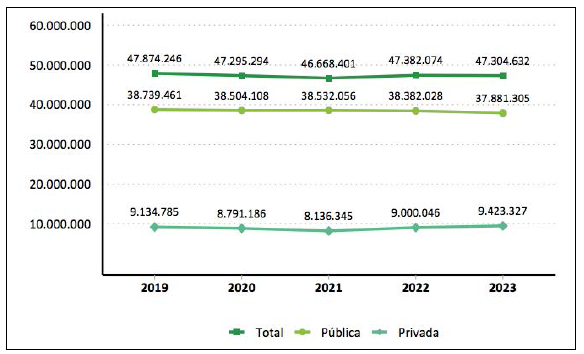 Source: Produced by DEED/INEP based on data from the Basic Education Census (Brasil, 2024).