
 Do you come first? The action of the Bradesco Foundation in education
ABSTRACT
The Brazilian banking sector, among other players linked to philanthrocapitalism, has increased its investments in education. The Bradesco Foundation, one of the main players in this arena of disputes, has invested around R$ 9 billion in education over the last decade, prompting investigations into this process. This article is part of a broader research project funded by the Carlos Chagas Filho Foundation for Research Support in the State of Rio de Janeiro and its objective is to analyze the actions and position of the Bradesco Foundation in education and public debate since 2018. The analyses presented here are the result of bibliographical and documentary research, using the reports and activities available on the home pages of the Bradesco Foundation and its partners between 2018 and 2022. The results indicate that the actions of the BF and its partners minimally reflect the modus operandi of corporate management, based on the centrality of competition and profit.
Keywords:
Privatization of Education; Bradesco Foundation; Private Social Investment; Philanthrocapitalism
RESUMO
O setor bancário brasileiro, dentre outros atores ligados ao filantrocapitalismo, tem ampliado seus investimentos em educação. A Fundação Bradesco, um dos principais players desta arena de disputas, investiu na última década cerca de 9 bilhões de reais em educação, o que enseja investigações sobre esse processo. O presente artigo faz parte de pesquisa mais ampla financiada pela Fundação Carlos Chagas Filho de Amparo à Pesquisa do Estado do Rio de Janeiro e seu objetivo é analisar a ação e posição da Fundação Bradesco na educação e no debate público a partir de 2018. As análises aqui apresentadas resultam de uma pesquisa bibliográfica e documental, contando com os relatórios e atividades disponíveis nas páginas eletrônicas da Fundação Bradesco e dos nós a ela interconectados, no período compreendido entre 2018 e 2022. Como resultados, indicamos que a ação da FB e as relações que ela trava com outros nós trazem no conteúdo das suas posições, minimamente, o modus operandi da gestão empresarial, pautada pela centralidade na competição e no lucro.
Palavras-chave:
Privatização da Educação; Fundação Bradesco; Investimento Social Privado; Filantrocapitalismo
Introduction
The capitalist system historically seeks the expansion of profits on a global scale, and the favoring of its interests is also present in the sphere of education. Although different and new forms have been observed over the years, attempts to develop, disseminate, and consolidate strategies for the privatization, business venture, and financialization of public education in Brazil are enduring.
Although the fluid boundary between the public and private spheres in Brazil is historical, it was in the early 1990s that the business sector, aiming to establish a new social order, more aligned with the economic interests of big capital, systematically organized itself. It actively participated in national and international forums to define guidelines that influenced future educational reforms in Brazil.
According to Neves (2005), during the period of re-democratization in Brazil, following the end of the military regime (1964-1985), there was an economic and politico-ideological complexification of society, driven by increased political participation. In this context, with the rapid emergence of organizations of workers, the bourgeois class also found itself compelled to organize through non-governmental structures to protect its social interests. Thus, the bourgeoisie created an intricate network of mass organizations and collective political actors.
Martins (2019) highlights that this business mobilization is not limited to Brazil and is observed throughout Latin America. The author notes that businesspeople have established themselves as one of the most influential voices in the struggle for control over the content, methods, and objectives of the education of the working class, influencing Latin American educational policy and strengthening their connection with private interests.
A preliminary exploratory inquiry conducted on newspaper and news websites reveals the presence of various collective actors of a private legal nature in shaping the public discourse on education in Brazil. These actors employ a range of strategies, such as giving media interviews, conducting research, developing projects, offering awards, providing financial support to other institutions, producing informational material, organizing training courses, and participating in public hearings in Parliament, among other activities.
One of the prominent actors within this network is the Movimento Todos pela Educação (TPE), which has frequently been solicited to advocate publicly for an informed perspective on educational issues, both in the media and within the National Congress (Martins, 2016).
The TPE, for instance, functions within a network, and its list of supporters for the year 2022 consists of 34 entities, primarily classified as institutes and foundations linked to the business sector. Among these entities, six are affiliated with the banking or financial industry, notably including B3 Social, associated with the Brazilian stock exchange and the Bradesco Foundation (BF), which is the focus of this analysis.
According to the Censo Grupo de Institutos, Fundações e Empresas (GIFE, 2020), its education project holds the largest private social investment (PSI) in the country. In 2022 alone, the Bradesco Foundation invested nearly R$ 800 million in projects and schools that currently serve not only basic education but also technical and vocational education, youth and adult education, and the initial and continuing training of teachers.
Another role played by the Bradesco Foundation is its involvement and active participation in a network with other business groups that exert pressure on the national education agenda both from the grassroots and from the top down.
This article1 investigates the position of the Bradesco Foundation within the relationships and power dynamics surrounding agendas more focused on the Brazilian education issues, specifically since the 2016 Parliamentary-Judicial Coup that removed President Dilma Rousseff and her national project, replacing her with the more right-wing Michel Temer in the conduction of the country.
To this end, the research utilized document analysis of activity reports available on the websites, home pages and social media posts of the Bradesco Foundation, as well as those of its connected network nodes, for the period from 2018 to 2022. This study is divided into four parts, the first being this introduction, followed by a brief history of the emergence and objectives of the Foundation under analysis. The third part investigates and analyzes the actions of the BF based on its Instagram posts and the analysis of documents available on its website, as well as those of other linked network nodes. Finally, the concluding remarks categorize the actions of the BF according to the classification formulated by Fontdevila, Verger and Avelar (2019).
The Bradesco Foundation and its trajectory in Brazil
The Bradesco Foundation began its work as an educational institution in 1956, originally named the São Paulo de Piratininga Foundation, and it only became the Bradesco Foundation in 1967. Its first educational institution was opened six years after its creation, in the Osasco region, and provided the community with meals, uniforms, and dental and medical care, with the goal of offering education and professional training to children, youth, and adults. In 1975, this institution was recognized by the National Council of Social Service as a Philanthropic Entity, and in 1981 it was acknowledged as a Federal Public Utility Entity. The following year, it inaugurated the Training and Professional Development Center (CENTREFOR), which provided training for the professionals of the organization (Fundação Bradesco, 2022a).
In 1997, the Bradesco Foundation partnered with Canal Futura with the aim of promoting educational projects and launched the Virtual School in 2001, which offers training courses in various fields.
In 2003, the Bradesco Foundation inaugurated a school in Boa Vista (RR), thereby achieving the presence of Foundation School Units in every state of the federation. In 2007, it launched the Educa+ação project, providing technological and pedagogical support to public schools with the aim of achieving positive outcomes for the public education system.
In this context, the Bradesco Foundation has solidified its presence over the years and currently operates 40 schools, the locations of which can be seen in Figure 1. According to its Activity Report, in 2022, R$ 795 million were invested to support 41,000 students in the schools and in other activities, such as the Virtual School, which accounted for 1.7 million enrollments that year.

On its website, the Bradesco Foundation states its mission as “To promote humanistic education to develop future leaders in all regions of the country”, highlighting six principles: excellence, equality, respect, honesty, commitment, and the conscious use of resources.
As can be observed in Graph 1, the investment by the Bradesco Foundation is the highest among the three largest social arms of the Brazilian banking sector. In 2022, the amount reached R$ 9 billion. Looking at the last decade, the total investment was nearly R$ 800 million. The percentage increase in investments was approximately 30% over the five-year period from 2018 to 2022.

Paradoxically, studies on the actions of the Bradesco Foundation in the field of education are still scarce. A search in the Capes Catalog of Theses and Dissertations using the descriptor “Fundação Bradesco”, restricted to Education in the Knowledge and Evaluation Area, returned only 5 dissertations and no theses for the entire available period, with the first being defended in 2015 and the last in 2020. Among these, four studies focused on specific programs, while only one examined the actions of the Bradesco Foundation in a broader context.
The Analysis of the Bradesco Foundation: A perspective from its publications
For the analysis of the relationships established by the Bradesco Foundation from the year 2018 onwards, three types of documents were investigated: the activity reports of the BF from 2018 to 2022, posts from a social media platform (Instagram), and the webpages of the BF and directly associated network nodes. In the initial exploratory phase, the aim was to define the corpus of analysis for this study through floating reading approach (Bardin, 1977). After applying temporal and relevance criteria, the material was explored and interpreted, with the impressions being discussed in relation to the theoretical framework.
Instagram Posts
Upon exploring the material, it was noted that the first post dates back to 2019 - one year after the beginning of the temporal range defined for this study - and continues through February 2024. With a total of 350 publications made at intervals of two to three days between them, there is a notable high level of engagement, with over 1.000 likes per post in the majority of the publications.
Regarding the content, the posts on the social media platform follow a consistent theme. The majority of the publications of the Bradesco Foundation on Instagram focus on its schools and their daily activities, featuring colorful images of teachers and students, who are always depicted as happy, engaged in various projects and activities, either outdoors or outside the standards of traditional education.
It is also evident that the achievements of students who excel by gaining admission to higher education are highlighted, showcasing the courses and universities they have been accepted into. The approvals resulting from high scores on the ENEM (National High School Exam) are celebrated, reflected in the manner they are presented, and embody an important pillar for the Bradesco Foundation concerning the principles of education that it advocates: meritocracy, within a liberal perspective of education. In other posts, the idea that equalizing educational conditions ensures a bright and successful future is also present.
There are also, although in smaller numbers, posts about various celebrations - such as Christmas, New Year’s, Festa Junina, Mother’s Day, Father’s Day, Black Consciousness Day and Holidays, among others. The portfolio also includes content about the foundation itself, the infrastructure of the schools, and the history of the Bradesco Foundation (typically close to its anniversaries).
Although direct stances have not been identified regarding specific public policies and/or the discussions they entail, the publications provide clues about the model of education supported by the Foundation: the marketing sector of the Foundation adopts a facet of what we categorize here as “example”, in accordance with the principles established by Fontdevila, Verger and Avelar (2019). The authors identified four strategies employed by the private sector to influence educational policy and consolidate market-oriented educational reforms, one of which is “leading by example” (Fontdevila, Verger e Avelar, 2019, p. 1)
Similar institutions investigated in other studies (Morgan, 2020; Morgan, 2022; Morgan; Mocarzel, 2021) employ the same strategy, and some public policies that initially start as targeted expand through the force of constructing hegemonic thought that subjugates the right to education in favor of “efficiency” (Laval, 2019).
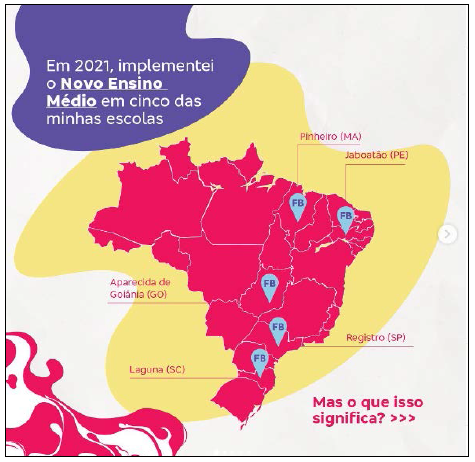
The absence of direct support for proposed public policies after 2016 does not mean that they are not observable in the publications of the Bradesco Foundation. On October 4, 2022, the Bradesco Foundation stated that it had implemented the New High School (NHS) in all of its schools.
The implementation of the New High School in five schools was one of the highlights of my activities in 2021. The Bradesco Foundation schools in Aparecida de Goiânia (GO), Jaboatão (PE), Laguna (SC), Pinheiro (MA), and Registro (SP) joined the Bradesco Foundation in Campinas (SP) in a curriculum that stimulates the development of life projects, encouraging the continuity of studies, with a focus on social inclusion and the job market.
The good news is that in 2022, the New High School was implemented in all of my schools that offer this level. Therefore, I can prepare all of my students to develop competencies and skills useful for their future challenges (Fundação Bradesco, 2022b, emphasis added, our translation).

The New High School, proposed through Provisional Measure No. 746 of 2016 and approved by Law No. 13,415/2017 (Brasil, 2017), is a site of intense debates in society, particularly among researchers and teachers in basic and higher education who assert that this reform represents “the degradation of education and the advancement of privatization” (Beltrão, 2019, p. 8, our translation), in addition to deepening educational inequality.
Contrary to these arguments, the Bradesco Foundation seeks to construct a “Siren’s Song” discourse (Montaño, 2015) by publishing meanings of terms central to the new reform close to important dates or by promoting lectures conducted by the Foundation itself, featuring themes aimed at shaping individuals, such as “Resilience” (November 5, 2022) and “Financial Education” (November 16, 2022) (Fundação Bradesco, 2022c, n.p).
It thus seems to us that, as stated in the caption of the post in Figure 2, the Bradesco Foundation forges “the useful competencies and skills” for the youth of the working class. The question that can be raised here is: whose interests are served by the usefulness that the Bradesco Foundation speaks of?
The actions and partnerships of the Bradesco Foundation (2018 to 2022)
Although the Bradesco Foundation has initiatives directed towards other areas such as health, culture, and social assistance, a significant portion of its resources and efforts has been aimed at education. Over five years, there has been a systematic increase in total investment, which rose from approximately R$ 606 million in 2018 to R$ 794 million in 2022 (Fundação Bradesco - Activity Reports from 2018 to 2022d).
The actions of the Bradesco Foundation are more prominently reflected in the 40 schools created, funded, and managed by the Foundation itself. This is the area that consumes the majority of the resources allocated to education. However, it is interesting to note that since 2018 the number of direct enrollments in the physical schools has been decreasing drastically, with the year 2020 marking a turning point in this decline, as can be seen in Figure 3.

When analyzing the data disaggregated by region, it can be inferred that the decrease in the number of enrollments was an institutional decision, based on the observation that all regions executed the same trend, with declines ranging from 57% in the Northeast Region to 40% in the Southeast Region.
The reason for such a significant reduction was neither explicitly stated in the document nor publicized through other channels, considering that investments continued to grow. Even in 2020, an atypical year due to the covid-19 pandemic, it is not possible to identify a direct relationship between the phenomena.
This decrease in supply, without a justification provided to society, brings to mind the assertion made by Olmedo in 2013 when analyzing the actions of philanthropic entities. The author reflects that such institutions, under the guise of philanthropy, are characterized by a level of accountability to society that is more flexible than that of the government and business sectors: the former being elected and thus accountable to the electorate, and the latter, in some way, needing to be accountable to their shareholders. Furthermore, “philanthropy is capable of operating across the boundaries of the public and private sectors and doing so with little or no accountability to its various publics” (Olmedo, 2013, p. 495, our translation).
The projects developed in partnership with other institutions highlighted in their reports, along with the Virtual School, unlike regular education, showed a small variation in attendance. Nonetheless, it was possible to observe, particularly in the Virtual School, a slight increase in enrollments and the number of people affected overall in the years 2020 and 2021, followed by a decrease in 2022, possibly due to the return to normalcy after the pandemic.
Perhaps one of the most notable activities of the Bradesco Foundation is its involvement and participation in networks with those institutions that engage in the public debate on education. The activity reports from the years analyzed reveal the recurring partners with whom educational policy agendas are discussed and supported. Figure 4 presents the recurring partnerships during the period analyzed.

Considering only 11 collective subjects (nodes) and 18 internal relations (links), these relations and their actual scope do not appear in a first analysis. It is necessary, therefore, to observe the network more broadly, expanding it to the network of affiliates and their relationships.
When examining the relationships of the Bradesco Foundation with other institutions that have a more direct impact on education, it becomes evident that, although it does not assume the responsibility of public debate in a more prominent manner, this engagement occurs in other spheres. In addition to partnerships with public authorities, three collaborations are particularly noteworthy in this context: Todos pela Educação (TPE), Canal Futura, and Parceiros da Educação.
Todos pela Educação is currently one of the most influential Brazilian think tanks2 in the field of education. Its activities are linked to the Latin American Network of Civil Society Organizations for Education (REDUCA), which was conceived by the Inter-American Development Bank (IDB).
The support of the Bradesco Foundation for the agendas advocated by TPE is explicit in its reports. In the 2022 Report, for example, the foundation states that among the partnerships that year, TPE is notably highlighted, characterizing it as a
[...] nonprofit civil society organization that conducts research to support public education policies. The Foundation is a sponsor of this initiative, which celebrated its 16th anniversary in 2022 and continues its commitment to ensuring the quality of Brazilian basic education. Last year, Todos Pela Educação released the document “Educação Já 2022”, aimed at providing the government with diagnostics and proposals for public policies that ensure the advancement of educational quality in Brazil (Fundação Bradesco, 2022, p. 51, emphasis added, our translation).
It is interesting to note the statement that TPE aims to equip the government with information and knowledge. It is important to remember that the entity is composed of businesspeople, companies, and their foundations, and is therefore market-oriented. These are the collective subjects that, according to the statement reproduced above, systematically produce knowledge with the explicit intention of influencing political decision-making.
Canal Futura, another node of significant reach, is an important branch in the field of education of Fundação Roberto Marinho, which is responsible for the Private Social Investment of Rede Globo - the largest telecommunications company in Brazil. In this partnership, as with TPE, BF is “one of the maintainers of the channel and supports educator and student training programs since its inception” (Fundação Bradesco, 2022d, p. 52, our translation).
The potential for reaching and disseminating its principles can be perceived by analyzing the alliances of Canal Futura. Alongside the Bradesco Foundation, it collaborates with institutions connected to large capital and the productive sector, such as the Federation of Industries of the State of São Paulo (FIESP), the Social Service of Industry (SESI), and the National Service for Industrial Training (SENAI), as well as Fundação Itaú and Rede Globo itself.
The subjects analyzed thus far can be inferred to possess the potential to mobilize the knowledge produced and disseminate it at the grassroots level. Their intention is to uphold their principles regarding education and, above all, concerning the quality of education that should be made available to the popular classes.
The last relationship to be analyzed here is that with Parceiros da Educação, a nonprofit organization whose mission stated on its website is “to promote greater involvement of civil society in the improvement of Brazilian public education through partnerships with schools and state and municipal secretariats, with the aim of providing a quality integral education for students, valuing educators in the public network, and contributing to educational public policies” (Parceiros da Educação, s.d.).
The presence of Resilience and Scalability is noteworthy amongst their shared values, as these concepts also appear in the foundations’ documents, Instagram posts, and educational policies supported by other non-profit associations, foundations, and institutes linked to the business sector.
The missing scope for the Bradesco Foundation, direct involvement in public education, is carried out through Parceiros da Educação, whose activities can be observed in Figure 5.

Within this area of action, the Bradesco Foundation comprises the Advisory Council, which is made up of representatives from various companies (industry, construction, communications, shopping centers). However, the absolute majority of the composition of the Council consists of representatives from banks and capital management firms, as can be observed in the following graph.

The individuals representing these companies bring, at a minimum, the modus operandi of business management into the content of their positions, which is centered on competition and profit. This is one of the common issues faced by a significant portion of nonprofit institutions that focus on public education: the attempt to impose private logic on the organization of public matters, without considering that, among many other issues we could mention, a school is not a business (Laval, 2019).
The Bradesco Foundation: some final thoughts
By analyzing the information available both in the posts made by the Bradesco Foundation on its Instagram page and in the documents available on its homepage and on the homepages of the associated network nodes, it was possible to expand the reflection on the actions of the business community when it engages with education.
Caetano and Mendes (2020) assert that the networks of entrepreneurs that form around public policies
[...] must engage in continuous activity in order to maintain their hegemony over society as a whole. The groups and individuals that make up these networks employ strategies to achieve consensus, establish relationships between companies, and seek to gain public support for their political, social, and economic projects, thereby directly interfering in the management of public affairs (Caetano; Mendes, 2020, p. 15, our translation).
It is within this reflection that, when analyzing the powerful and systematic actions of BF, we identify the dimensions indicated by de Fontdevila, Verger and Avelar (2019). The authors identified four strategies employed by the private sector to influence educational policy and consolidate market-oriented educational reforms: 1. Knowledge mobilization; 2. Networking; 3. Engaging with grassroots; and 4. Leading by example.
Regarding the first dimension, mobilization of knowledge, one can primarily identify the financial support for Todos pela Educação, which acts as a producer of knowledge and translator of educational indicators for society. The dissemination of these contents on its platforms also constitutes this dimension.
The network-based approach is quite clear, including a graphical representation of partners and relational links over the years. Beyond that, it is possible to perceive network support for the New High School. The NHS is present in all 40 schools, having been promoted on its Instagram, and having also been a topic of the TPE and the Parceiros da Educação.
Within this network of interrelations, Canal Futura represents the arm that primarily focuses on the third dimension highlighted by the authors. “Supporting grassroots organizations provides the corporate sector with a diffuse and indirect way of leveraging, with the intention of creating a favorable climate of opinion for political reforms” (p. 8, our translation). The inclusion in teacher training can be identified within this strategy.
Lastly, BF has in the dimension of “leading by example” the most significant aspect of its action: this refers to the funding of pilot projects and educational experiences in private educational institutions, exerting pressure for modifications in the education systems and the allocation of public resources.
The 40 schools of BF represent the efficiency, effectiveness, and quality education that TPE, Parceiros da Educação, Globo, and Canal Futura (along with the individual entities that make up these institutions) refer to when speaking about education.
Given the above, it is important to emphasize that it is precisely this conception of education, literally a banking one (Freire, 2011), that studies such as this, which we now present, seek to unveil in order to expand knowledge and, perhaps, answer the question, which is the slogan of Banco Bradesco and the title of this article: Do you come first?
References
- BARDIN, Laurence. Análise de conteúdo. Lisboa: Edições 70, 1977.
- BELTRÃO, José Arlen. Novo ensino médio: o rebaixamento da formação, o avanço da privatização e a necessidade de alternativa pedagógica crítica na educação física. Tese (Doutorado em Educação) - Universidade Federal da Bahia, Salvador, 2019.
-
BRASIL. Lei nº 13.415, de 16 de fevereiro de 2017. Altera as Leis nº 9.394, de 20 de dezembro de 1996, que estabelece as diretrizes e bases da educação nacional, e 11.494, de 20 de junho 2007, que regulamenta o Fundo de Manutenção e Desenvolvimento da Educação Básica e de Valorização dos Profissionais da Educação, a Consolidação das Leis do Trabalho - CLT, aprovada pelo Decreto-Lei nº 5.452, de 1º de maio de 1943, e o Decreto-Lei nº 236, de 28 de fevereiro de 1967; revoga a Lei nº 11.161, de 5 de agosto de 2005; e institui a Política de Fomento à Implementação de Escolas de Ensino Médio em Tempo Integral. Brasília, DF, 2017. https://www.planalto.gov.br/ccivil_03/_ato2015-2018/2017/lei/l13415.htm
» https://www.planalto.gov.br/ccivil_03/_ato2015-2018/2017/lei/l13415.htm -
CAETANO, Maria Raquel; MENDES, Valdelaine da Rosa. Think tanks, redes e a atuação do empresariado na educação. Educar em Revista, v. 36, p. e75939, 2020. https://doi.org/10.1590/0104-4060.75939
» https://doi.org/10.1590/0104-4060.75939 -
FONTDEVILA, Clara; VERGER, Antoni; AVELAR, Marina. The business of policy: a review of the corporate sector’s emerging strategies in the promotion of education reform. Critical Studies in Education, v. 62, n. 2, p. 131-146, 2019. https://doi.org/10.1080/17508487.2019.1573749
» https://doi.org/10.1080/17508487.2019.1573749 - FREIRE, Paulo. Pedagogia do oprimido. Rio de Janeiro: Paz e Terra, 2011. p. 95-101.
-
FUNDAÇÃO BRADESCO. Relatório de atividades 2018. https://fundacao.bradesco/Resultados/#mais-informacoes
» https://fundacao.bradesco/Resultados/#mais-informacoes -
FUNDAÇÃO BRADESCO. Relatório de atividades 2019. https://fundacao.bradesco/Resultados/#mais-informacoes
» https://fundacao.bradesco/Resultados/#mais-informacoes -
FUNDAÇÃO BRADESCO. Relatório de atividades 2020. https://fundacao.bradesco/Resultados/#mais-informacoes
» https://fundacao.bradesco/Resultados/#mais-informacoes -
FUNDAÇÃO BRADESCO. Relatório de atividades 2021. https://fundacao.bradesco/Resultados/#mais-informacoes
» https://fundacao.bradesco/Resultados/#mais-informacoes -
FUNDAÇÃO BRADESCO. A fundação e sua história. 2022a. https://fundacao.bradesco/
» https://fundacao.bradesco -
FUNDAÇÃO BRADESCO. Escolas. 2022b. https://fundacao.bradesco/pt-BR/Escolas
» https://fundacao.bradesco/pt-BR/Escolas -
FUNDAÇÃO BRADESCO. Publicações no Instagram oficial, 2022c. https://www.instagram.com/fundacao.bradesco/
» https://www.instagram.com/fundacao.bradesco -
FUNDAÇÃO BRADESCO. Relatório de atividades 2022d. https://fundacao.bradesco/Resultados/#mais-informacoes
» https://fundacao.bradesco/Resultados/#mais-informacoes -
GIFE. Grupo de Institutos, Fundações e Empresas. Site oficial, 2020. https://gife.org.br/
» https://gife.org.br - LAVAL, Christian. A escola não é uma empresa: o neoliberalismo em ataque ao ensino público. São Paulo: Boitempo, 2019.
- MARTINS, Erika Moreira. Todos pela Educação? Como os empresários estão determinando a política educacional brasileira. Rio de Janeiro: Lamparina. 2016.
- MARTINS, Erika Moreira. Empresariamento da educação básica na América Latina: redes empresariais prol educação. Dissertação (Mestrado em Educação) - Universidade Estadual de Campinas, Campinas, 2019.
- MONTAÑO, Carlos. O canto da Sereia: crítica à ideologia e aos projetos do “terceiro setor”. São Paulo: Cortez, 2015.
-
MORGAN, Karine Vichiett. A Fundação Itaú Social e a produção de conhecimento em educação. Revista Brasileira de Política e Administração da Educação, v. 38, n. 1, e121730, 2022. https://doi.org/10.21573/vol38n002022.12173
» https://doi.org/10.21573/vol38n002022.12173 - MORGAN, Karine Vichiett. Um Itaú de vantagens feito pra você? A ação da Fundação Itaú Social na educação pública brasileira. Tese (Doutorado em Educação) - Universidade Federal Fluminense, Niterói, 2020.
-
MORGAN, Karine Vichiett; MOCARZEL, Marcelo. Formação para a conformação? Uma análise das redes da Fundação Itaú Social na implementação da BNCC. Interfaces da Educação, v. 12, n. 35, p. 1039-1064, 2021. https://doi.org/10.26514/inter.v12i35.5979
» https://doi.org/10.26514/inter.v12i35.5979 - NEVES, Lúcia Maria Wanderley (Org.). A nova Pedagogia da Hegemonia. Estratégias do capital para educar o consenso. São Paulo: Xamã, 2005.
- OLMEDO, Antonio. Heterarquias e “Governança Filantrópica” Global na Inglaterra: implicações e controvérsias para o controle social das políticas públicas. Revista Educação e Políticas em Debate, v. 2, n. 2, 2013.
-
PARCEIROS DA EDUCAÇÃO. [s.d.] https://parceirosdaeducacao.org.br/quem-somos/
» https://parceirosdaeducacao.org.br/quem-somos
-
SUPPORT/FINANCING
Research “The Banks in the School Benches: An analysis of the private social investment of financial capital in public education” financed by the Carlos Chagas Filho Foundation for Research Support of the State of Rio de Janeiro - FAPERJ, Process no. 210.292/2024.
-
RESEARCH DATA AVAILABILITY
All data was generated/analyzed in this article.
-
1
Article resulting from a broader research project entitled: “Banks in the School Banks: an analysis of private social investment of financial capital in public education,” funded by the Carlos Chagas Filho Foundation for Research Support of the State of Rio de Janeiro - FAPERJ, Process No. 210.292/2024.
-
2
In this article, think tanks are understood as “organizations whose purpose is to produce knowledge in various areas to exert influence on the implementation of government policies and the shaping of public opinion” (Caetano, 2020, p. 3).
-
HOW TO CITE THIS ARTICLE
MORGAN, Karine Vichiett; ALVES, Miriam Fábia. Do you come first? The action of the Bradesco Foundation in education. Educar em Revista, Curitiba, v. 40, e94826, 2024. https://doi.org/10.1590/1984-0411.94826
All data was generated/analyzed in this article.

 Source: Fundação Bradesco (2022b).
 Source: Constructed by the authors with primary data.
 Source: https://fundacao.bradesco/pt-BR
 Source: Fundação Bradesco (2022a).
 Source: Constructed by the authors from primary data.
 Source: Activity Report 2022d.
 Source: Constructed by the authors from primary data.