
 The manuals of the “Biblioteca de Cultura Pedagógica” and the consejos on educational renewal from its founder Clotilde Rezzano (1946-1951
ABSTRACT
This work results from a historiographical research about “Biblioteca de Cultura Pedagógica” (BCP), a collection published by the Argentinian publishing house Kapelusz, founded and directed between 1946 and 1951 by Clotilde Guillén de Rezzano, one of the pioneers of the New Education in Argentina. We analyze the training of Latin American teachers by studying the production and circulation of BCP works that form a pedagogical literature for Latin America. Thus, the aim is to present the materiality and narratives in BCP textbooks from a transnational perspective. Methodologically, the analysis focuses on the relationship between the materiality of the object and the text, with characteristics about the publisher, BCP, and its founder, the production and circulation of the works in Brazil and Latin America, as well as the physical aspects of the books, constituting the materiality examination. The analysis of the text, which advised future teachers on the importance of the educational renewal movement, will be presented based on some works from the collection and on the considerations of its founder. The theoretical framework used, such as Chartier (1999), Choppin (2004), and Batista and Galvão (2009), guides our studies and analysis. Through this research, we conclude that the BCP manuals helped to understand different themes, such as the New Education and teaching, breaking down boundaries, and contributing to the memory of the training of Latin American teachers.
Keywords:
Biblioteca de Cultura Pedagógica; Teacher Training; Latin America; Clotilde Guillén de Rezzano; School Manuals
RESUMO
Este trabalho é resultado da pesquisa historiográfica sobre os manuais pertencentes à “Biblioteca de Cultura Pedagógica” (BCP), uma coleção da editora argentina Kapelusz, fundada e dirigida, entre 1946 e 1951, por Clotilde Guillén de Rezzano, uma das precursoras da Escola Nova na Argentina. Propõe-se o exercício de ampliar o olhar para a formação de professoras latino-americanas, analisando a produção e circulação das obras da BCP que compõem uma literatura pedagógica para a América Latina. Destarte, o objetivo é mostrar, em uma perspectiva transnacional, questões da materialidade e das narrativas de manuais da BCP. Metodologicamente, a análise incide na relação entre a materialidade do objeto e o texto, sendo que características sobre a editora, a BCP e sua fundadora, a produção e circulação das obras no Brasil e na América Latina, assim como os aspectos físicos das obras, compõem as análises da materialidade; as análises do texto, que aconselhava as futuras professoras sobre a importância do movimento de renovação educacional, serão apresentadas a partir de algumas obras da coleção e das considerações de sua fundadora. O referencial teórico utilizado, como Chartier (1999), Choppin (2004) e Batista e Galvão (2009), auxilia nos estudos e análises. Por meio desta pesquisa, conclui-se que os manuais da BCP subsidiavam a compreensão de temas como a Escola Nova e docência, rompendo fronteiras e contribuindo para a memória da formação de professoras latino-americanas.
Palavras-chave:
Biblioteca de Cultura Pedagógica; Formação de Professoras; América Latina; Clotilde Guillén de Rezzano; Manuais Escolares
First words
No todos los individuos son aptos para ser maestros, como no todos lo son para médicos, marino, políticos, agricultores, etc. Son necesarias o deseables ciertas condiciones esenciales, naturales unas, y adquiridas otras por medio de la preparación pedagógica y el ejercicio de la profesión (Rezzano, 1941, p. 71)1.
In 1921, the teacher Clotilde Guillén de Rezzano, maestra de maestras [teacher of the teachers]2, who was then the principal of Escola Normal Nº. 5 from Buenos Aires - Argentina, had her speech for the recently-graduated teachers published with the title Consejos a las futuras maestras [Advices for the future teachers]. In this speech, the author asked teachers to be fair, to be mothers, in the sense of being loving and pious with their students. Philosophically, she asks teachers to lead the ethical improvement of humanity and, sociologically, to favor social evolution so that reason can rule and the country can be respected. In the last pages of her speech, Clotilde advises the graduating teachers to study “los libros de los hombres” [the books of men] and religiously refers to the study of the “libro de Dios” [the book of God] (1921, p. 36).
Clotilde Rezzano, considered one of the precursors of the New Education Movement in Argentina, is an important character in the history of books and reading for Latin American teachers (and, particularly, for this work) because she dedicated herself for teacher education and, simultaneously, to the writing of manuals, being part of the first group of authors from the Argentinean publishing house Kapelusz. She was also responsible for founding and directing the collection entitled “Biblioteca de Cultura Pedagógica” (BCP - Pedagogical Culture Library) by the same house between 1946 and 1951, with works that greatly resonated in several Latin American countries.
The publishing house Kapelusz was founded in Buenos Aires in 1905. According to its site3, the aim of transforming the small library into a publishing house was to improve the quality of didactic materials and produce innovations. The decision to transform it into a publisher and, consequently, to create its collections and produce books coincided with the expansion process of the Argentinean education system. Thus, the creation of the house “was not an improvised proposal” (De Luca, 2015, p. 204).
Kapelusz establishes itself in a context marked by legislative changes in Argentina. The Law of Common Education from 1884 established the obligatory, free, and laic school, representing an attempt of the central government to “make popular education the base for a cohesive society around a national project” (De Luca, 2015, p. 204). The approval of laws by Lainez in 1905 and Palacios in 1938 authorized the creation of schools in all provinces in the country. Before that, we should highlight that the University of Buenos Aires was created in 1821, and, between 1825 and 1850, national schools were created, such as those from “Buenos Aires, Catamarca, Tucumán, Mendoza, San Juan, and Salta” (Castro, 2007, p. 10). During Domingos Sarmiento’s (1868-1874) presidency, the professional education of teachers in normal schools started, attached to the national schools.
Together with Lajolo and Zilmerman (1996), we note that the history of the book and school edition is part of a cultural history associated with the constitution of a literate society, with peculiarities in its educational history, as it establishes connections with the school. The production of schoolbooks is connected to the educational systems established by the State:
[…] if a society presupposes that the education of individuals goes through school […] it is also essential to produce books for students and have teachers, the latter also educated by books and professional users of this instrument. The second condition relates to the technological infrastructure: typographies and publishing houses are necessary to print the didactic material that teachers and students need in the classroom. […] However, this development is also the result of a policy, the economic one, managed by the dominant class of a people (Lajolo; Zilberman, 1996, p. 121).
During the expansion of the educational systems and, consequently, the strengthening of the editorial market of schoolbooks and manuals, Kapelusz Publish House consolidates itself, conquering “the largest part of the local didactic book market, and its presence in the Argentinean market and classrooms became a distinction mark” (De Luca, 2015, p. 204). In 1947, the books of this publisher circulated throughout Latin America and Spain. Kapelusz was responsible for publishing several collections/series used in primary and secondary schools, entering the world market of didactic and textbooks. It currently remains with a significant repertoire of publications.
The results presented here are part of an ongoing research project about the history of reading for the education of teachers in Brazil and Latin America between 1930 and 1980, through the analysis of pedagogical materials and collections that go beyond their frontiers, seeking to reflect on reading projects for teacher education engendered in a transnational perspective.
Therefore, our objective in this work is to show, in a transnational perspective, issues regarding materiality and narratives of the manuals that belonged to BCP when it was founded and directed by Clotilde Rezzano, from 1946 to 1951. BCP was a Kapelusz’s editorial project that lasted for decades, grounding teacher education courses. From a methodological point of view, the analysis focuses on the relationship between the object’s materiality and the text. The issues regarding Kapelusz, BCP, and its founder Clotilde Rezzano, the production and circulation of the works in Brazil and Latin America, as well as the physical aspects of the works, compose the materiality analysis. The remarks about the narratives4 that compose the text - which advised future teachers on the importance of the education renovation movement - will be presented based on some works from the collection and the remarks made by its founder in the prologues (prefaces) of the following manuals: Hay que cambiar de educación: reflexiones, responsabilidades, perspectivas (1947) [We have to change education: reflections, responsibilities, perspectives]; La vida afectiva y moral del niño: doce años de practica psicoanalitica (1948) [Children’s affective and moral life: twelve years of psychoanalytical practice]; Inexperiencia: ensayo pedagógico de uma madre maestra (1950) [Inexperience; pedagogical essay from a mother-teacher]; and El Jardín de infantes (1948) [Kindergarten].
The transnational nature of this work is investigated through the analysis of the production and circulation of the manuals, which crossed their original borders and started to be used in other countries/contexts, in a type of entanglement of ideas for teacher education, presupposing several relationships around the education renovation ideals.
The analysis that allows us to observe the book in the merger between materiality and text derives from Roger Chartier’s studies, which show that, in books, a set of elements that are common to every written thing transform it into a physical object. His work ‘The Order of Books: Readers, Authors, and Libraries in Europe Between the 14th and 18th Centuries’ (1999) shows that the book has always aimed to establish an order: “the order of its deciphering, the order within which it should be understood or even the order wished by the authority that asked or allowed its publication” (Chartier, 1999, p. 8). We have also opted for this confluence of analysis to break away from fixed research categories, described by Choppin5 (2004) as those that either conceive the schoolbook as only a historical document, analyzing its contents, or neglect its content, considering it solely as a fabricated, commercialized, and distributed good - a material object.
Together with other materials (blackboard, notebook, furniture, etc.), books are part of the school material culture that became a study object of the History of Education, due to its interlocution with the New Cultural History and, simultaneously, historians’ concern in preserving these artifacts as research sources and educational memory. Schoolbooks also contribute to the history of practices and educational thoughts, as well as to the historiography of education, because they reveal projects of social formation. School manuals, schoolbooks, and didactic materials are terminologies frequently used by researchers when deciphering them, their technical, visual, and physical devices, as well as their narratives and discourses. In this work, we have opted to call them manuals, as their production corresponds to the themes foreseen in the teaching of formative subjects belonging to teacher education curricula.
About the Kapelusz Publishing House, as well as about Clotilde Rezzano and the New Education Movement6, we find meaningful works, such as Sofía Dono Rubio’s dissertation by Sofía Dono Rubio, Experiencias alternativas de formación y prácticas docentes en la Argentina durante las primeras décadas del siglo XX. Las propuestas de Rosario Vera Peñaloza y Clotilde Guillén De Rezzano [Alternative experiences of teacher education and practices in Argentina during the first decades of the 20th century. The proposals of Rosario Vera Peñaloza y Clotilde Guillén De Rezzano] (2022); by Romina De Luca, The Kapelusz publisher proposal for the Argentinian primary school: a quantitative and qualitative analysis of 4th year manuals in the Social Sciences area, 1976-2001 (2015); and by Ignacio Frechtel, Formas de circulación del conocimiento pedagógico renovador en la Argentina: revistas, visitas pedagógicas y exílios [Circulation forms of renovating pedagogical knowledge in Argentina: pedagogical visits and exiles] (2021).
Thus, we propose broadening the gaze over Latin American teacher education, analyzing the reading projects for teacher training, starting from the production and circulation of BCP works that compose a pedagogical literature, having in mind that books not only transcend time but also consent to conquering space (Escarpit, 1976).
The “Biblioteca de Cultura Pedagógica” and its founder Clotilde Rezzano: the production of manuals defending modern pedagogical ideas
The prologue of the book La salud del niño en su relación con la educación [Children’s health and its relation with education], by Gertrude Cromwell, the 29th work published by BCP, in August 1951, pays tribute to Clotilde Rezzano following her death in June that year. The text highlights Clotilde’s importance as the collection’s founder and director, as well as her collaboration for the “pedagogical life of Latin America” (Cromwell, 1951, p. XIII).
Born in Buenos Aires, in 1880, Clotilde Guillén studied at Escola Normal Nº. 1, Dr. Roque Sáenz Peña, graduating in 1899. She completed her studies at Facultad de Filosofía y Letras, from which she graduated in 1906 and would return years later to teach and direct a seminar in Pedagogy (which educated teachers for secondary education). During her years as a university student, she met José Rezzano (1877-1960)7, to whom she would marry (Dono Rubio, 2022).
Clotilde was a primary school teacher from 1900 to 1904. In 1905, in recognition of her formation and talent, the National Education Council granted her the position of Home Economics Inspector (Dono Rubio, 2022, p. 107). In 1909, she assumed the position as the principal of Escuela Normal de Maestras de Barracas al Norte - Nº. 5, created in the same year, and, in 1910, she participated in the Feminist International Congress. From her consonance with the feminist vanguard, Clotilde “weaved a naturalist, pragmatic, and utilitarian reasoning that will coexist with notions from German idealism, spiritualism, liberal nationalism, and Catholicism”, which will impact her practices (Dono Rubio, 2022, p. 109). Clotilde also defended the role of education to maintain freedom and to avoid the advancement of authoritarian regimes in Europe. As a manager, based on the relations established with the National Education Council, she traveled to Europe to learn about the first New Education experiences.
At Escola Normal Nº. 5, besides being the principal, she was a Psychology and Pedagogy teacher until her retirement in 1932. Clotilde sought to implement a pedagogical and institutional reform in this school, based on the New Education principles, implementing a series of actions, such as the “centers of interest” under the influence of Jean Ovide Decroly8, becoming a national and international model.
In her work scenario as a teacher and a principal, she published in 1929 the manual Los centros de interés en la escuela [The interest centers in the school], in the collection “Escuela Activa” [Active School] from Losada Publishing House (another important Argentinean publisher that publishes collections on teacher education). In the introduction of this work, Clotilde highlights the importance of the works by Decroly, Maria Montessori, and Winnetka’s9 projects, explaining to future teachers that the “interest centers” offered undeniable advantages, as it is opposed to the encyclopedic and fragmented education. The “interest centers” were considered by the author as work tools for children to learn by moving in different scenarios/environments, successively, and following their preferences. In her manual, Clotilde explains that the interest centers could be developed in any Argentine school, proposing, from the experiences developed at Escola Normal Nº 5, centers related to children’s food in Year 1 (seven years old) and accommodation for Year 2 children (eight years old). In practice, Clotilde proposes, for example, the “interest center” called la granja [the grange], for Year 1 children to study animals, such as chickens, rabbits, cows, and also legumes, vegetables, and other natural elements (Rezzano, 1946). We should note that in the 1920s - a post-war period - there is an internationalization movement of pedagogy through the postulates of the New Education, with peace as the “primordial objective” for a large part of Western intellectuals, and education should be a way to reach it (Frechtel, 2021, p. 19).
Undoubtedly, one of the most striking aspects of Clotilde’s trajectory was her defense of the New Education, being a “campaign throughout her whole life to introduce in the country modern pedagogical ideas and new teaching methods, adapting them to our environment” (Cromwell, 1951, p. XIII). For this teacher-author, children should be the center of the whole school action, developing their personality through constructive activity. In this perspective, Clotilde recognized herself as a part of the New Education movement that questioned traditional pedagogy and “positivist normalism”, “hegemonizing”10 teacher education (Dono Rubio, 2022, p. 119).
Retired from teaching since 1932, she continued to write books about Education, Pedagogy, and Didactics, authoring works that circulated in the whole Latin America, such as Hacia la escuela activa [Towards active school] (1934); Didáctica general y especial [General and special didactic] (1936); Didáctica especial [Special didactic] (1938); Los jardines de infants [Kindergartens] (1940); and Manual de Pedagogía [Pedagogy manual](1941).
According to Kapelusz’s editorial, BCP was created and guided by Clotilde because she was convinced that new education, at the service of children, demanded much more from the teachers than what the current Pedagogy manuals could offer them. She proposed to guarantee that the profession of the “Hispanic-American teacher followed, together and close to her, all the advancements of the education science” (Cromwell, 1951, p. XIV). She created with this aim the collection as a “dynamic universal encyclopedia of the pedagogical problems and their solutions”:
The BIBLIOTECA DE CULTURA PEDAGÓGICA is the jewel in the crowd of the noble vocation for teaching, and the prolongation and projection towards broader frontiers of the concern with the development and qualification of teachers and parents in our country and all over America, for an educational action increasingly more intelligent and fertile (Cromwell, 1951, p. XV).
Directing BPC and writing the prologues of more than 27 books from this collection, Clotilde signaled in the introduction words of the book La salud del niño en su relación con la educación (1951), that Kapelusz Publishing House created a library under the name Biblioteca de Cultura Pedagógica as it disseminated the best educational works published worldwide, “choosing those in agreement with the American idiosyncrasy and the traditional ideals of our continent” (Cromwell, 1951, p. XV).
Thus, during Clotilde’s direction at BCP, 29 manuals were published, prioritizing themes, such as Kindergarten; exams and tests; educational guidance; conception of education and pedagogy; teaching and learning; psychology in different study fronts; New Education; reading and writing; active school; experimental schools. Among the authors, the Swiss pedagogues Robert Dottrens and Adolphe Ferrière, the Cuban sociologist and psychiatrist Emilio Mira y López, the Swiss psychanalyst Madeleine Rambert, the Brazilian education technician of the Secondary Education Division of Brazil Isabel Junqueira Schimidt, the Equatorian educator Gonzalo Abad Grijalva, and the psychologist and professor at the University of Michigan Harry E. Bake stand out. These names show the diversity of authors and their home countries, and show that the manuals crossed frontiers and offered readers from different countries the complementarity between scientific and curriculum dimensions for teacher education, as well as the synchrony with the principles of education renovation.
All 29 BCP manuals were chosen and revised by Clotilde, in their original writing or version in Spanish. Even after her death, some of the works she had already selected, supervised, and translated were published: La individualidad del niño en la educación [Children’s individuality in education], by Henri Bouchet; Cómo ensenar a leer por el método global [Teaching how to read through the global method], by Charles Hendrix; La escritura infantil: su importancia para comprender al niño [Children’s writing: its importance to understand the child], by Curt Honroth and R. Ribera; La historia, la geografía y la instrucción cívica: nuevas aportaciones para su enseñanza [The history, the geography, and the civic instruction: new appointments for teaching], by Delgado de Carvalho; Historia de la pedagogía: realizaciones y doctrinas [History of pedagogy: achievements and doctrines], by René Hubert.
René Hubert11 had his works published in several countries by different publishing companies. In the BCP of Kapelusz’s publishing house, the manual História da Pedagogia [History of Pedagogy] was first published in 1952. In Brazil, it was published in 1957 in the Collection Pedagogical Updates (CAP), by Companhia Editora Nacional, and, with only three editions (1957, 1967, 1976), had approximately 30,000 copies published, representing a significant number at the time.
At BCP, we also highlight the manual La historia, la geografía y la instrucción cívica: nuevas aportaciones para su enseñanza (1952), by the geographer Carlos Miguel Delgado de Carvalho, son of a Brazilian father, born in Paris but living in Brazil (1884, Paris - 1980, Rio de Janeiro). Regarding the Geography field, the author gained notoriety with the work Metodologia do ensino geográfico [Geography teaching methodology] (1925), considered one of the most important works in the first half of the 20th century, according to Silva (2001). Delgado’s positions about Geography in Brazil, “besides showing an erudition about the topic, can be correlated to the innovative processes experienced by this knowledge field in France, in the turn between the 19th and the 20th centuries” (Silva, 2001, p. 44). Delgado de Carvalho published 49 books in the areas of Geography, Sociology, Statistics, History, and Education; thus, the repercussion of his works in the international scenario, as exemplified by Kapelusz’s work.
In these terms, it is possible to say that the BCP works, aiming to support teacher education courses, and chosen by Clotilde, matched the renovation principles of education, opposed to what Clotilde called the “traditional concept of education” (Dottrens, 1947, p. XI). Authors such as Robert Dottrens and Adolphe Ferrière were part of her choices. Dottrens, as Clotilde refers to him in the prologue of the work Hay que cambiar de educación: reflexiones, responsabilidades, perspectivas (1947), was a follower of Pierre Bovet, Eduardo Claparède, and Adolphe Ferrière, well-known educators who disseminated the broad theoretical and methodological movement of educational reform and renovation - the New Education.
Adolphe Ferrière, one of the most important names of New Education, founded the Bureau International d’Éducation Nouvelle (1899) and is a founder of Institut Jean Jacques Rousseau (1912), together with Pierre Bovet and Edouard Claparède. He collaborated in the creation of Ligue Internacional pour l’Éducation Nouvelle, in 1921. He wrote several works about the Active school and was considered a fascinating philosopher of renewed education by Lourenço Filho, in the presentation of the Brazilian edition of the work A lei biogenetica e a Escola Activa [The biogenetic law and the Active School], by Ferrière, published in 1929. In 1930, he was in Argentina and other Latin American countries, on a trip to observe and learn about the experiences developed in the New Education, as well as give lectures about genetic psychology and active school practices for teachers (Frechtel, 2021, p. 24). Ferrière documented his trip and the texts emerged from this record were published in Spanish in 1936, in the book entitled La escuela activa en América Latina12 [The active school in Latin America] (Ibid.). In Buenos Aires, according to Frechtel (2021, p. 25), Ferrièrre complimented Clotilde’s work, highlighting that the Escola Normal Nº. 5, under her supervision, was the most progressive in Latin America because she worked with the material developed by the teacher herself (inspired by Montessori and Decroly).
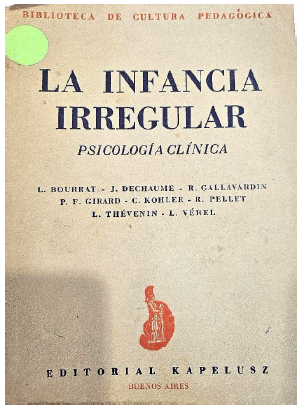
The first volumes published by BCP had similar material characteristics. The covers of the manuals followed the same pattern with the format 14.5 x 19.5 cm, in a yellow tone. The collection title is located in the upper part with a majuscule font in red, the title is highlighted in black, and the name of the author is under the title. The logo of the collection refers, by hypothesis, to the Greek goddess Athena (goddess of wisdom, intelligence, justice, arts, and war) and is centralized in the bottom part in red, followed by the name of the publishing house in black and the city in red, as can be seen in Figure 1.
The covers represent the identity of the collection and its affirmation, considering that the book market was increasingly more competitive in this context. It also calls the target audience’s attention to the editorial project focused on teacher education. In turn, the book flaps from BCP manuals sought to show the qualities of the work and the authors through prescriptions that provided teachers with positive impressions of the manuals for teacher education processes. Most flaps that follow the back covers were used to disseminate other works already published and the collection itself.
The title pages of BCP manuals are a pre-textual element in which we find the books’ essential data of the work, such as the authors’ name and their projection in the educational scenario, title and subtitle (if is the case) of the work, publishing house, publication place, among other information, such as the prologue’s author (work presentation). The authors’ institutional place is fundamental as an editorial strategy because it shows their position in the collection and disseminates their ideas and content about education. Through this game of representations, the collection legitimizes its choices and its condition as a fundamental library for the readers-students in the process of becoming professional teachers and their teachers.
The organization of the first pages follows the same sequence having a page indicating the works of the collection, the title page, a page with data about the original data and edition of the manual, pages for the indexes (summary), followed by a prologue (preface) with reflections and compliments on the work - always signed by Clotilde Rezzano -, the chapters, the bibliography, and the attachments in some works.
In the BCP manuals, the use of majuscule letters in boldface in the titles and subtitles of the indexes and chapters anticipates the contents and makes the texts more accessible to reading. We point out that, when analyzing the “blue books”, Chartier shows that this cut, which organizes the text by chapter titles or line changes, is like an inscription of the book about what the publishing house thought about reading: “ a reading that does not excel or is continuous, by that grabs and drops the book, that only deciphers brief and closed sequences with easiness, demanding explicit demarcations” (2004, p. 272-273).
Concerning the project of each manual, we can suppose that the material characteristics of the manuals “disseminate the ends of the book, its objectives, the work’s author, and the target audience” (Roballo, 2012, p. 202). When exploring its indexes and chapters’ organization, readers were faced with content full of representations and the predominant values in a given period and context, announcing cultural marks that show pedagogical conceptions, knowledge, and symbolic dimensions.
Kapelusz’s editorial would highlight that, despite Clotilde Rezzano’s death, BCP would continue its publication rhythm. And so it was. More than 100 works were published in the collection, and their circulation crossed decades in Latin America. In the 1980s, for example, BCP started to be directed by Juan Carlos Tedesco13, who, possibly led by his actions, developed together with the United Nations Educational, Scientific and Cultural Organization (UNESCO), began producing the BCP collection together with CEPAL (United Nations Economic Commission for Latin America and the Caribbean), with the United Nations Development Programme (UNDP), and UNESCO itself. In the work El sistema educativo en América Latina [The educational system in Latin America] (1984), by Ricardo Nassif, Germán W. Rama, and Juan Carlos Tedesco, we can observe the partnership Kapelusz-Unesco-Cepal-Pnud on the cover and front page. BCP also started to be organized in series, such as: Educación y Sociedad [Education and Society]; Los Nuevos Problemas Educativos [The new educational problems]; Pedagogía Organización [Organization and pedagogy]; and Administración Escolar [School Administration]. In 1994, Kapelusz joined the Colombian group Norma, continuing its strong presence in the Argentinean educational system.
The presence of BCP manuals can be seen for decades (and until now) in the library shelves of universities and secondary-level schools of teacher education in Latin America. In Brazil, for example, when searching the archive of the Humanities Library of Universidade Federal do Paraná, we can find 76 records of BCP works in Spanish. At the Human Sciences Library at Universidade Federal do Rio de Janeiro 51 works are registered. At Biblioteca Federal do Ceará, we found 11 works from the collection. In Montevideo, Uruguay, at the Biblioteca Pedagógica Central Mtro. Sebastián Morey Otero, there are 73 records of BCP works. Moreover, in this same library, in a typed notebook from a Normal School student (1943), we find a reference to Clotilde Rezzano (p. 13) in the part about the syllabus of the subject Pedagogy14.
Their material composition didactically inspires the manuals’ use. In their narratives (as we will see in the next topic), we can find the possible meanings that resonate from their use. Meanings regarding the reading and interpretation of contents about education, change, renovation, as well as pedagogical meanings that the manuals present for teachers’ professionalization and teaching.
“Hay que cambiar de educación”: advices for Latin American teachers at the BCP manuals
Education needs to be changed, renewed. In Clotilde Rezzano’s narratives, we can see this appeal, or better, this advice to future teachers.
In the work Hay que cambiar de educación: reflexiones, responsabilidades, perspectivas (1947), the forth volume of the collection BCP, Clotilde, in her prologue, calls the attention of future teachers for the need to change the direction of education,, highlighting that Robert Dottrens (author of the work and teacher the École des sciences de l’éducation, Genebra,, Switzerland) recognizes that it was not easy to change the tendency from a traditional education to a new one, as well as the change from coercion to autonomy and freedom with responsibility. In this new sense, the new education needs to educate for freedom, demanding a new “didactic architecture” in Clotilde’s eyes, with education allowing individuals to adapt themselves and finding their solutions to the problems in life, restoring “the will and the feeling of being able to determine what is good and what is right: ‘no longer acting because one is forced to act but because one feels the wish to do so’” (1947, p. X). She also defends the formula “learning to learn, learn to behave”, proposed by Dottrens, pointing out that the essential problem of education is the formation of the moral personality and stressing teachers’ importance in this task.
In several BCP works, there are chapters specifically addressing (future) teachers. This occurs in Dottrens’s work, which has a section dedicated to teachers. The original work Èducation et démocratie [Education and democracy] published in Neuchâtel, Switzerland, in 1946, is divided into three parts entitled “reflections”, responsibilities”, and “perspectives”, the later presenting the discussion about teachers’ formation and work. On it, the author questions the “pedagogical teaching” extremely dogmatic of Normal Schools, the incomplete “technical formation”, and the late contact of the students with children (1947, p. 210). It also stresses that Normal Schools ignored teachers’ concrete problems, such as school administration, the relationship with families, and the extra-school services (child protection, medical service, school kitchens, professional guidance, etc.).
Amidst questions and criticisms, Dottrens proposes that future teachers should know the social life, suspending their studies for at least six months to travel and engage in activities outside school. Similarly, it suggests that teachers should inform themselves about salaries, vacations, retirement, and work conditions, among other issues demanded by the professions (1947, p. 211). The author discusses the formation of primary and secondary teachers and the benefits of working in escuelas infantiles e clases primárias [childhood schools and elementary classes], respectively, to implement the achievements of the New Education, finishing with reflections about the importance of the formation of school principals and education inspectors.
In the prologue of the work by Madeleine Rambert (Swiss teacher and psychanalyst), entitled La vida afectiva y moral del niño: doce años de practica psicoanalitica (1948, 12th volume of BCP), Clotilde highlights that its incorporation in the Biblioteca aimed to offer teachers and parents an “appropriate visual angle” that allows to observe and evaluate in their students and children the behavioral flaws, which would allow them to look for a diagnosis and treatment with a psychoanalyst. It warns future teachers that the book should not be used to form childhood psychoanalysts but to detect complex symptoms and act quickly.
In the work Inexperiencia: ensayo pedagógico de una madre maestra (1950) by Amelia Dubouquet, the 20th volume of BCP, Clotilde highlights in the prologue that that was a work of “new education pedagogy” informing about the results of the didactic methods and procedures instead of just defining and explaining them (1950, p. XIV). The title of the work uses the adjective “inexperience” because the author admits her lack of experience in the beginning of her task as a mothers-teachers, thus, she decides to narrate practical activities to be implemented with children, disseminated through didactic procedures in the active school. Clotilde states that the most propagated didactic procedures are presented in the book’s pages:
[…] individualized work, autonomy, freedom limited by self-control, creative activity, self-elaboration, self-criticism of ideas, self-emulation, spontaneity, observation and experimentation related with the environment, cooperation, mutual help, solidarity, respect to psychic idiosyncrasies, respect for the children, the adult in preparation, direct contact with nature; and, in the field of procedures: the interest centers, questionnaires, spreadsheets, team work, global and silent reading, manual work, free drawing, etc. (Dubouquet, 1950, p. XIV).
In the eighth volume of BCP, entitled El Jardín de infantes (1948), from Madeleine Faure (elementary school teacher in France), the director Clotilde suggests that maestras jardineiras [kindergarten teachers] should read the book because it was a new affirmation of the “Frobelian method”, presenting the best procedures to develop three to six-year-old children, such as the interest centers.
These questions presented in the manuals point out the practical role of BCP works, which were chosen because they taught future teachers useful knowledge about the themes involving children’s behavior, psychology, teacher education, New Education, educational practices, among others. The authors of the manuals described here, with their theoretical-methodological choices, evoke several narrative voices that daze through a pedagogical lexicon able to raise feelings in (future) teachers, providing advice and explanations about the importance of renovation and change in school, particularly, school education.
These manuals present lessons describing ideals of change and innovation and education practices for future teachers.
Final remarks
When observing the BCP manuals, we can understand that they establish a “reading protocol”, using the term by Batista and Galvão (2009). This protocol gathered the intentions of the author, the publishing house, and the director of the collection for the readers, guiding them to read the book. From the external to the internal elements, such as the indices, the chapters, the prologues, and the references, the manuals suggest a reading and build meanings. Senses related to a new education “que se orienta hacia el porvenir” [that is guided towards the future] - according to Clotilde Rezzano’s prologue at the work Hay que cambiar de educación: reflexiones, responsabilidades, perspectivas (Dottrens, 1947, p. IX).
From the texts to the printed form - book format -, we observe that the BCP works, first published in Argentina, started to be transported to other countries, breaking the frontiers of their original country, offering readers (future teachers) from different countries the complementarity between the scientific and curriculum dimensions, in a movement that started to legitimize teacher education. Thus, in a book format (object), it was possible to create openings and passages for these works in the collection to circulate in Brazil, Latin America, and the world.
In 1920, among the several aspects and events that contributed to the effervescence prevailing in Brazil, the pedagogical theories considered to be progressive in the educational area, created by Americans and Europeans, started to fascinate Brazilian educators. These new ideas started to permeate the educational reforms promoted all over Brazil. In 1930, the reformulations undertaken in the curricula of teacher education courses would provoke significant changes in the country’s editorial field. Consequently, Brazilian publishing houses started to invest in educational literature to train teachers and expand the editorial market for international works and authors.
Since 1920, editorial companies have emerged and increased, merging commercial and educational objectives in Argentina. In the case of Kapelusz, BCP was created in the 1940s, possibly moved by the wish for educational innovation in its first years of existence, even if under a scenario of more than 50 years of political instability. Figures such as Clotilde Rezzano, among other teachers, inspectors, and national school principals, had transgressive positions and sought to modify the school practice, inspired by the New Education principles.
From the works chosen by Clotilde and her prologues, it is possible to observe narratives, or better, advices for future teachers, which lead to the interpretation that the New Education is the pathway to promote social change through pedagogical actions adjusted to experience: through co-education, music, singing, collective works, drawing, interest centers, among other elements focused on the development of creativity, imagination, and children’s free personality. The canon that would follow these explanations is composed of personalities such as Adolphe Ferrière, Decroly, Maria Montessori, John Dewey, and Édouard Claparède. Hence, a pedagogical lexicon establishes itself in this literature, related to the affirmation of the New Education method as an activity built by the concrete and active experience of each individual (student).
In the production, circulation, translation, and (possible) use, BCP Latin American manual led us to two analytical assumptions: the first grounded on their materiality and circulation, understanding that these works became (physical) supports that circulated in the training institutions of teachers in their origin countries and other places, connecting different types of knowledge; the second, related to aspects of their narratives that defined what to teach, how to teach, and what to learn. Therefore, as a result of the circulation in different places, the manuals sought to strengthen the ideals of valuing education, renovation, instruction, and offer memories of teacher education.
References
- BARTHES, Roland. Introdução à análise estrutural da narrativa. In: BARTHES, Roland et al. Análise estrutural da narrativa. Tradução de: Maria Zélia Barbosa. Petrópolis, Rio de Janeiro: Vozes, 2011. p. 19-62.
- BATISTA, Antônio Augusto Gomes; GALVÃO, Ana Maria de Oliveira. Livros escolares de leitura no Brasil: elementos para uma história. Campinas: Mercado de Letras, 2009.
- BOURRAT, L. et al. La infancia irregular: psicología clínica. Buenos Aires: Editorial Kapelusz, 1948. (Biblioteca de Cultura Pedagógica, v. 14).
- CASTRO, Marcelo L. Ottoni de. Brasil e Argentina: estudo comparativo das respectivas leis gerais sobre educação. Brasília: Senado Federal, Consultoria Legislativa, 2007. (Textos para discussão).
- CHARTIER, Roger. A ordem dos livros: leitores, autores e bibliotecas na Europa entre os séculos XIV e XVIII. Tradução de: Mary del Priori. 2. ed. Brasília: Editora Universidade de Brasília, 1999.
- CHARTIER, Roger. Leituras e leitores na França do Antigo Regime. Tradução: Álvaro Lorencini. São Paulo: Editora UNESP, 2004.
-
CHOPPIN, Alain. História dos livros e das edições didáticas: sobre o estado da arte. Revista Educação e Pesquisa. São Paulo: Universidade de São Paulo, v. 30, n. 3, p. 549-566, set.-dez. 2004. https://doi.org/10.1590/S1517-97022004000300012
» https://doi.org/10.1590/S1517-97022004000300012 - CROMWELL, Gertrude. La salud del niño en su relación con la educación. Buenos Aires: Editorial Kapelusz, 1951. (Biblioteca de Cultura Pedagógica, v. 29).
-
DE LUCA, Romina. La propuesta de la editorial Kapelusz para la escuela primaria argentina: un análisis cualitativo y cuantitativo de sus manuales para 4º grado en el área de Ciencias Sociales, 1976-2001. Práxis Educativa, v. 10, n. 1, p. 201-225, jan.-jun. 2015. https://doi.org/10.5212/PraxEduc.v.10i1.0009
» https://doi.org/10.5212/PraxEduc.v.10i1.0009 -
DONO RUBIO, Sofía. Experiencias alternativas de formación y prácticas docentes en la Argentina durante las primeras décadas del siglo XX: las propuestas de Rosario Vera Peñaloza y Clotilde Guillén De Rezzano. Dissertação (Mestrado em Ciências Sociais com foco em História Social) - Universidade Nacional de Luján, 2022. Disponível em: https://ri.unlu.edu.ar/xmlui/handle/rediunlu/1604 Acesso em: 1º mar. 2025.
» https://ri.unlu.edu.ar/xmlui/handle/rediunlu/1604 - DOTTRENS, Robert. Hay que cambiar de educación: reflexiones, responsabilidades, perspectivas. Buenos Aires: Editorial Kapelusz, 1947. (Biblioteca de Cultura Pedagógica, v. 4).
- DUBOUQUET, Amelia. Inexperiencia: ensayo pedagógico de uma madre maestra. Buenos Aires: Editorial Kapelusz, 1950. (Biblioteca de Cultura Pedagógica, v. 21).
- ESCARPIT, Robert. A revolução do livro. Tradução: Maria Inês Rolim. Rio de Janeiro: Fundação Getúlio Vargas/Instituto Nacional do Livro, 1976.
-
FARIA BORGES, Tatiane Daby de Fatima; OLIVEIRA, Guilherme Saramago; SANTOS, Anderson Oramisio; RIOS, Ana Vitória Santos Furtado. Jean Ovide Decroly: os centros de interesse e a pedagogia da evolução ativa. Revista Valore, n. 8, 2023. Disponível em: https://revistavalore.emnuvens.com.br/valore/article/view/1242 Acesso em: 10 mar. 2025.
» https://revistavalore.emnuvens.com.br/valore/article/view/1242 - FAURE, Madeleine. El jardín de infantes. Buenos Aires: Editorial Kapelusz, 1948. (Biblioteca de Cultura Pedagógica, v. 8).
- FRECHTEL, Ignacio. Formas de circulación del conocimiento pedagógico renovador en la Argentina: revistas, visitas pedagógicas y exílios. In: GALAK, Eduardo; ABRAMOWSKI, Ana; ASSANEO Agustín; FRECHTEL, Ignacio (orgs.). Circulaciones, tránsitos y traducciones en la historia de la educación. Buenos Aires: UNIPE: Editorial Universitaria; Saiehe, 1. ed., 2021. p. 19-34.
- LAJOLO, Marisa; ZILBERMAN, Regina. A formação da leitura no Brasil. São Paulo: Ática, 1996.
- LOURENÇO FILHO, Manoel Bergström. Introdução ao estudo da escola nova. 14. ed. São Paulo: Melhoramentos, 2002.
-
MATTOS, Sérgio Túlio Generoso de. A noção de interesse na Escola Nova: Formulações teóricas e a interpretação de Anísio Teixeira de 1924 a 1932. Dissertação (Mestrado em Educação) - Faculdade de Educação da Universidade Federal de Minas Gerais, 2008. Disponível em: https://repositorio.ufmg.br/bitstream/1843/FAEC-85BPHP/1/disserta__o_s_rgio.pdf Acesso em: 20 maio 2025.
» https://repositorio.ufmg.br/bitstream/1843/FAEC-85BPHP/1/disserta__o_s_rgio.pdf -
OLANO, Ignacio. Los formatos escolares de las propuestas pedagógicas-didácticas del movimiento escolanovista argentino. Análisis de tres casos. Dissertação (Mestrado em Ciências Sociais com foco em Educação) - Facultad Latinoamericana de Ciencias Sociales (FLACSO), 2020. Disponível em: https://repositorio.flacsoandes.edu.ec/bitstream/10469/17052/2/TFLACSO-2020IO.pdf Acesso em: 1º mar. 2025.
» https://repositorio.flacsoandes.edu.ec/bitstream/10469/17052/2/TFLACSO-2020IO.pdf -
PINHEIRO, Nara Vilma Lima. Entre produção e circulação: os estudos de Carleton Washburne via publicações da New Education Fellowship. Revista Brasileira de História da Educação, v. 21, p. 1-24, 2021. https://doi.org/10.4025/rbhe.v21.2021.e147
» https://doi.org/10.4025/rbhe.v21.2021.e147 -
PINHEIRO, Nara Vilma Lima; VALENTE, Wagner Rodrigues. Carleton Washburne e as pesquisas sobre a aritmética nos primeiros anos escolares. Revista Pesquisa Qualitativa, [S. l.], v. 4, n. 4, p. 88-105, 2016. Disponível em: https://editora.sepq.org.br/rpq/article/view/33 Acesso em: 13 out. 2025.
» https://editora.sepq.org.br/rpq/article/view/33 - REZZANO, Clotilde de Guillén de. Consejos a las futuras maestras. Argentina: Imprenta y Casa Editora Coni, 1921.
- REZZANO, Clotilde de Guillén de. Manual de Pedagogía. Buenos Aires: Editorial Kapelusz, 1941.
- REZZANO, Clotilde de Guillén de. Los centros de interés en la escuela. 3. ed. Argentina: Editorial Losada, 1946. (Coleção Escuela Activa).
- RAMBERT, Madeleine. La vida afectiva y moral del niño: doce años de practica psicoanalitica. Buenos Aires: Editorial Kapelusz, 1948. (Biblioteca de Cultura Pedagógica, v. 12).
-
ROBALLO, Roberlayne de Oliveira Borges. Manuais de história da educação da coleção atualidades pedagógicas (1933-1977): verba volant, scripta manent. Tese (Doutorado em Educação) - Universidade Federal do Paraná, 2012. Disponível em: https://acervodigital.ufpr.br/handle/1884/27777 Acesso em: 13 out. 2025.
» https://acervodigital.ufpr.br/handle/1884/27777 -
SILVA, Jorge Luiz Barcellos da. Reflexões sobre o pensamento geográfico de Delgado de Carvalho e o ensino de geografia. Boletim Gaúcho de Geografia, n. 27, p. 40-54, dez. 2001. Disponível em: https://seer.ufrgs.br/index.php/bgg/article/view/38423/24694 Acesso em: 10 mar. 2025.
» https://seer.ufrgs.br/index.php/bgg/article/view/38423/24694
-
Support or Funding:
This article is the result of research conducted during a postdoctoral leave (July 2024-July 2025). No funding was received from a funding agency.
-
Availability of Research Data:
All data were generated/analyzed for this article.
-
How to cite this article:
ROBALLO, Roberlayne de Oliveira Borges. The manuals of the “Pedagogical Culture Library” and the advice on educational renewal from its founder Clotilde Rezzano (1946-1951), Educar em Revista, Curitiba, v. 42, e 99096, 2026. https://doi.org/10.1590/1984-0411.99096-T
-
1
”Not all individuals can become teachers, as not everyone can be physicians, sailors, politicians, farmers, etc. Certain essential conditions are necessary or desirable, some natural, others acquired through pedagogical preparation and the professional work” (Rezzano, 1941, p. 71).
-
2
Phrase used by Sofía Dono Rubio in her master’s dissertation entitled Experiencias alternativas de formación y prácticas docentes en la Argentina durante las primeras décadas del siglo XX: las propuestas de Rosario Vera Peñaloza y Clotilde Guillén De Rezzano (2022), reminding us that Clotilde Rezzano was a female teacher forming other female teachers, as most of the audience was composed of women. Thus, in Portuguese, the author used female pronouns to respect the history of women teachers.
-
3
Site of Kapelusz Publishing House: https://www.editorialkapelusz.com/. Accessed March 1st, 2025.
-
4
We understand, as Roland Barthes (2011, p. 19), that “among the vehicles of narrative are articulated language, whether oral or written, pictures, still or moving, gestures, and an ordered mixture of all those substances; narrative is present in myth, legend, fables, tales, short stories, epics, […] conversation”. In our case, the narratives are present in the composition of the manual texts from “Biblioteca de Cultura Pedagógica” that circulated in different times and spaces aiming to support the processes of teacher education. In this terms, we sought in these manuals to interpret the different narrative voices that cross the texts, from the analysis of segments, observing not only what is said but how it is said to compose a web of meanings that guide and advice (future) teachers about the importance of New Education and, consequently, the movement of educational renovation.
-
5
Choppin, in his article “História dos livros e das edições didáticas: sobre o estado da arte” [History of books and didactic editions: on the state of art] (2004), proposes to encompass the main problems and themes approached by the history research about books and didactic educations, seeking to highlight the “most outstanding tendencies and possible evolution perspectives” (p. 549).
-
6
In this work, we used the term New Education in English and the term “Escola Nova” in Portuguese, as it is the most commonly used in Brazil, noticing that the movement about Escola Nova, since the 1920s, mobilized a significant number of Brazilian intellectuals around a project that, in Lourenço Filho’s words, aimed national organization through culture organization. However, there are several ways to refer to this movement of educational renovation. In Spain, the term is “Escuela Nueva”, in English-speaking countries “New Education” or “Progressive Education”, and in France, “Éducation Nouvelle”.
-
7
José Rezzano was a teacher of Sciences of Education since 1920. Between 1932 and 1936, he was the dean of Facultad de Humanidades y Ciencias de la Educación at Universidad de La Plata. In parallel, in 1922, he became the General Inspector of Secondary Education. In 1926, he began directing the section “Nueva Era” of the magazine La Obra, considered one of the main paths to disseminate New Education and attached to the New Education Fellowship, which will “inaugurate the institutionalization of pedagogical alternatives in Argentina” (Dono Rubio, 2022, p. 109). He represented the Liga Internacional para la Nueva Educación, an official organization of the European movement of active schools, and the editor of the magazine Pour l’ere nouvelle, directed by Ovide Decroly, and the Boletín del Bureau Internacional de Educación, to which Adolphe Ferriere and Raúl Fauconnet participated in the writing commission (Ibid.).
-
8
Jean Ovide Decroly, Belgium(1871-1932), graduated in Medicine with a specialization in Neurology, emerged in Brazil as a pioneer of the New Education movement; “Decroly’s methodology starts from the idea of an education that breaks away with the rigidity of pre-stablished school programs or created from the vision of the I-adult-teacher for an educational model centered in the I-child-world, in the interest of who learns, through the axes that answer the physiological, psychological, social, and education needs of those who learn” (Faria Borges et al, 2023, p. 6). Lourenço Filho’s interpretation, for Decroly, the transformation of schools could be done if some measures were taken, such as the modification of programs and processes to broaden interest centers, which enabled the development of activities depending on students’ interests. Thus, the interest centers are constituted by the transformation of classes (students’ class) that start their studies from a central theme - starting point- triggering other themes. A freedom that “always has teachers’ guidance when implementing the step, which are established by three major phases of thought: observation, association, and expression” (Mattos, 2008, p. 72).
-
9
In Winnetka, a small city in the United States, unlike what happened in other places where the State assumed the responsibility for public education, the business owners assumed this responsibility, “they were responsible for naming the experts in education […]” (Pinheiro, 2021, p. 4). In this perspective, Carleton Washburne was one of the experts named, having the autonomy to experience new pedagogical concepts. For 24 years, Washburne dedicated himself to the education system of Winnetka, “where, together with his team of teachers, reorganized the curriculum, rewrote the self-instruction (made to measure) materials, which enabled children to teach themselves, following their advancements or setbacks in different subjects and levels” (Pinheiro, 2021, p. 5). Pinheiro and Valente (2016) describe that Winnetka’s pedagogical system is based on a method of individualized education, allowing each student to have their own learning rhythm.
-
10
As Olano highlights (2020, p. 11), the 1930s was characterized by an “economic and social crisis, followed by the establishment of a military junta after the fall of Hipólito Yrigoyen and the interruption of the democratic process started in 1916 in an international context of economic and political-military crisis. This scenario provoked the fragmentation of political and social positions in the Argentine new education movement, which confronted the supporters and non-supporters of nationalism in power through a coup d’État that filled the educational discourse with religious, moralizing, and authoritarian declarations”. The official discourse of New Education is legalized in this period through the texts of Clotilde Rezzano and others, making them obligatory in normal schools.
-
11
René Hubert (1885-1954) was a French sociologist, president at the University of Strasbourg, and author of works, such as: Les Sciences Sociales dans L’Encyclopédie (1923), Manuel de Sociologie (1935), and Contribution à l’étude sociologique de la notion de droit naturel (1933).
-
12
A revised and increased work of L’Amérique latine adopte l’école active. Le magnifique effort des peuples ibéro-américains en faveur de l’education nouvelle, de 1931 (Frechtel, 2021, p. 24).
-
13
Juan Carlos Tedesco was an important Argentinian educator. Between 1982 and 1986, he directed the Centro Regional de Educação Superior da América Latina e Caribe (CRESALC) by Unesco, located in Caracas, Venezuela. Between 1986 and 1992, he was the director of Oficina Regional de Educação para América Latina e Caribe (OREALC) by Unesco, in Santiago, Chile. In Geneva, Switzerland, from 1992 to 1997, he directed the Oficina Internacional de Educação. Returning to Argentina, he directed the Regional Headquarters of Instituto Internacional de Planejamento da Educação in Buenos Aires. He was a teacher of History of Education in several Argentinian and Latin American universities, such as Universidad Nacional de La Plata (UNLP), Universidad Nacional de Comahue (UNCo), and Universidad Nacional de La Pampa (UNLPam). Between 1970 and 1975, he directed the Revista de Ciencias de la Educación (RCE). He authored books on the relationships between Education and Society. He was the secretary and minister of education in Argentina between 2007 and 2009.
-
14
In a research conducted on January 15, 2025, at the Biblioteca Pedagógica Central Mtro. Sebastián Morey Otero, in Montevideo, we found a typed notebook (probably by the student herself) with 16 pages, presenting the Pedagogy subject (p. 13). It is divided into six parts and another about the test. It is not clear which Clotilde Rezzano’s work the student is referring to because she made notes in pencil on the page, however the content refers to the part IV of the problem, entitled “El Maestro” [The teacher], about teachers’ conditions, vocation, selection, preparation, rights, obligations, and professional responsibilities.
All data were generated/analyzed for this article.

 Source: Book La infancia irregular: psicología clínica (