 Accessibility as a transdisciplinary field of internship: disruptive and inventive practices in university education
Abstract
Throughout a professional journey focused on fostering the inclusion and belonging of students with disabilities in higher education, it was possible to map out certain guidelines that lead to pedagogical strategies aimed at challenging the ableist culture embedded in these institutions. With this focus, I propose, through this theoretical-practical narrative, a reflection on the work of students undertaking internships in the field of accessibility at Higher Education Institutions. Aiming to problematize issues surrounding this practical-formative activity, I consider that, beyond a mere accessibility procedure, such activity can function as an anti-ableist mechanism due to its impact on promoting institutional accessibility and on the academic and professional development of students. Viewing accessibility as a cross-cutting field of training and practice, and drawing on post-structuralist epistemological frameworks coupled with the conceptual contributions of intellectuals, researchers, and artists with disabilities, I present an analysis of the practical-formative activities that constitute internships in accessibility. Through the records of activities that include internship guidance and supervision, I mapped out some of the reverberations of this work carried out with students both with and without disabilities, from various fields of knowledge. To this end, I share some experiences and reflections, highlighting this mechanism as both a means of eliminating institutional barriers and constructing an ethical, critical, and accessible praxis.
Keywords
Disability; Higher education; Accessibility; University education; Accessibility internship
Resumo
Ao longo de uma jornada profissional voltada à participação com pertencimento de estudantes com deficiência no acesso e permanência à educação superior, foi possível mapear algumas linhas que direcionam para agenciamentos pedagógicos que contribuem para tensionar com a cultura capacitista presente na estrutura dessas instituições. Com esse mote, proponho, por meio dessa narrativa teórico-prática, uma reflexão sobre a atuação de estudantes que realizam estágios na área da acessibilidade nas Instituições de Ensino Superior. Com o intuito de problematizar questões em torno dessa atividade prático-formativa, considero que, para além de um procedimento de acessibilidade, tal atividade pode se configurar como um dispositivo anticapacitista devido ao seu impacto na promoção de acessibilidade institucional e na formação acadêmica e profissional de estudantes. Entendendo a acessibilidade como um campo transversal de formação e atuação, e tendo como arcabouço teórico os referenciais epistemológicos pós-estruturalistas agenciados às contribuições conceituais de intelectuais, pesquisadoras(es) e artistas com deficiência, apresento uma análise acerca das atividades prático-formativas que constituem o estágio em acessibilidade. Por meio dos registros das atividades que compõem as orientações e supervisões de estágio, foram cartografadas algumas das reverberações desse trabalho realizado com estudantes com e sem deficiência, oriundos de diferentes áreas do conhecimento. Para tanto, compartilho algumas experiências e reflexões, destacando esse dispositivo tanto para a eliminação de barreiras institucionais quanto para a construção de uma práxis ética, crítica e acessível.
Palavras-chave
Deficiência; Ensino superior; Acessibilidade; Formação universitária; Estágio em acessibilidade
Introduction
With the aim of sharing reflections on approaches to accessibility in higher education, I present an inventive proposal that has proven to be a powerful tool for anti-ableist academic training when integrated into practical-formative activities, commonly known in the academic realm as internships. I am referring to the accessibility internship2, which, stemming from a contingent issue — namely, the promotion of access to higher education for students with disabilities through educational policies — has emerged as a mechanism for promoting institutional accessibility. This internship modality has led to the creation and experience of alternative ways of thinking about the elimination of barriers encountered by students with disabilities throughout their academic journey.
The purpose of this discussion is to share experiences from the establishment of accessibility internships at the Federal University of Santa Catarina (UFSC) through a cartographic study. There were two phenomena that occurred during the practice between 2013 and 2021 that drive this narrative. As a first point, the accessibility internship demonstrated a transformative effect among students who engaged in various activities within diverse academic environments; as a contrast, some faculty members and technical staff who facilitate and regulate academic internships opposed this transdisciplinary internship proposal, showing resistance. Their argument concerned the incompatibility of the accessibility internship with specific areas of knowledge or even with educational goals.
Through a cartography woven together multiple narratives, the reflective exercise on monitoring these processes was developed by undergraduate and graduate students (with and without disabilities) as well as technical and teaching professionals who developed and implemented the accessibility internship. In Passos and Barros (2009), the idea that knowledge emerges from practice is the basis for this approach. This approach is based on the idea, as articulated by the authors, that knowledge emerges from practice.
For this study, the following materials were used: student records of internship activities submitted to their supervisors, minutes from weekly or biweekly orientation and supervision meetings, complementary training activities during the internship orientation period, and memories of participating in these activities. The memories I refer to are events that affect and continue to resonate in our current practices, as described by the professor and researcher Suely Rolnik (1993, p. 243):
Memory at this level is a memory of marks, ever-present seeds, always potentially generating new timelines. A memory that takes shape in our bodies, not in its visible and organic state, but rather in its invisible state, where the body integrates that texture [...] composed of the mixing of the most varied flows, from which differences arise, engendering the becomings, becomings of the very texture.
Although the experiences shared here are specific to UFSC, I believe they have connections with other universities, as the structure of internship activities is common to these institutions, as is the enrollment of people with disabilities in undergraduate and graduate programs. Therefore, bringing the accessibility internship into the debate as an object of analysis means, in my view, fostering the institutionalization of this formative activity, which presents itself as a fruitful mechanism for breaking with the ableist culture present in Higher Education Institutions (HEIs).
To critically consider the issues raised in this study, I engage with thinkers, researchers, and artists who are motivated to create alternative ways of thinking, distancing themselves from normative thought, and employing inventiveness as an ethical, aesthetic, and political exercise.
How ableism works
With the implementation of educational policies aimed at the inclusion of people with disabilities in higher education, through the Incluir Program3(Brazil, 2013), the creation of actions to fulfill this goal intensified — both for access to and retention in universities. In this context, students with disabilities gained some visibility, acquiring the status of members belonging to the academic community, and the topic of accessibility became a prominent item on the agendas of various sectors within HEIs.
However, these actions often remained disconnected from the mechanisms that drive academic practices. For example, the hiring of Libras/Portuguese translators and interpreters was often limited to ensuring communication for deaf students or faculty in specific courses and activities; the provision of image descriptions and audio descriptions was typically only made available in materials where an identified blind student was enrolled; and the production of accessible digital formats for works was usually requested only after a student with a disability had already joined a course.
These operational practices, which persist within institutional frameworks, follow a logic of addressing extraordinary demands, failing to ensure that accessibility is fully integrated and, at the same time, reinforcing the idea that institutional functioning should remain unchanged. In other words, without structural transformation, these practices reiterate the concept of people with disabilities as an “Intruding Body”, a term coined by the artist DEFs4 Estela Lapponi5 (2023, p. 94).
Everything that is not invited,
That is out of context,
Throws you off balance,
Disrupts the everyday,
We are unaware,
It can cause both attraction and fear,
It is strange,
It is “ugly,”
It is fragile,
Yet it can be:
Joyful, unsettling, and somewhat humorous...
I name it: Intruding Body.
The position of the Intruding Body assigned to students with disabilities, materialized in the way actions are implemented in HEIs, perpetuates an atmosphere of “novelty” regarding the presence of people with disabilities in the institutional daily life. This is one of the most common forms of ableism. The practice of framing an event as something extraordinary, as if it were not part of the academic norm, can become an effective mechanism for maintaining the exclusionary processes that govern university operations.
Accessible practices are not about creating specific events for people with disabilities, but about thinking, planning, developing, and executing actions that are inclusive of different bodies, different existences, and diverse forms of participation in the world. Such practices become multifaceted, leading to developments that go beyond and deviate from normative parameters.
Imagining an accessible environment in HEIs is essential for the planning and implementation of actions that aim for institutional accessibility — and here I deliberately highlight the term to present another starting point. Accessibility is not named here as being for people with disabilities, but for the institution. I am not denying that people with disabilities require accessibility, but I emphasize that this should not be the starting point; the demand is already established, as we know from the Social Model of Disability, which recognizes that disability is an inherent characteristic of the human condition (Diniz, 2012). As Mello (2020, p. 99) reminds us, it is “[...] an issue within the public sphere of the State and society.” Therefore, HEIs, which cater to human beings, must be open to and involved in welcoming the diversity that constitutes them.
In this new cartography, the hiring of Libras/Portuguese translators and interpreters, the provision of image descriptions and audio descriptions, and the acquisition and production of accessible digital formats for works used in academic courses are all included in institutional planning. This ensures that the entire academic community, regardless of their bodily, functional, and sensory profile, can access these resources equitably. Expanding the modes of university operation requires changes that go beyond merely making spaces and institutional services available. The movement toward establishing an accessible culture necessitates a break with normative thinking.
As a potential way to drive this transformative wave, I highlight the internship activities included in accessibility actions (to be undertaken by students with and without disabilities) as a powerful anti-ableist mechanism. These activities provide a practical-reflective experience concerning the condition of disability and the principle of accessibility to students in training, who may become professionals with an accessible perspective from the outset of their careers, contributing to the transformation of HEIs.
This potential is evident in the interactions between students from different areas of knowledge. These experiences, involving the coexistence of diverse bodies and the critical engagement in academic activities, provoke problematizations of the logic that governs normative thinking and ableist practices. The dualistic imperatives of normal versus abnormal and ability versus disability are challenged. In the interactions between these students, alternative ways of thinking, perceiving, and acting are experienced, opening, as Cunha (2022, p. 29) asserts, “the primacy of multiplicity as a counterpoint to structural binarism.”
These activities, supported by a formative approach, pertain both to the development of procedures and to the implementation of these as mechanisms alongside people with disabilities, prompting what I term a transformative effect. This refers to an experience that alters ways of thinking and provokes changes in ways of acting, as proposed by the philosopher Michel Foucault (2010).
Accessibility and transdisciplinarity as a formative practice
Initially, the accessibility internship was perceived by members of the faculty and technical staff as a form of assistive and palliative measure to enable students with disabilities to complete their education. Despite this misguided interpretation of the formative activity, the accessibility internship was institutionalized and incorporated into the normative resolution that regulates curricular internships for undergraduate programs. As published by UFSC (2016, p. 1): “The Office of Undergraduate Studies shall reserve ten percent of the total internship scholarships for students with disabilities and 10 percent for students who work directly in promoting accessibility for students with disabilities [...]”, thus guaranteeing a percentage of internship positions for this practical-formative activity, marking an important shift towards an anti-ableist institutional trajectory.
However, regulatory measures have not been sufficient to bring about a change in the way the presence of people with disabilities is perceived within the university, as the academic structure remains anchored in normative thinking. As a result, this type of internship activity is confined to specific fields of knowledge, namely: health/rehabilitation and education/special/inclusive education — with a few exceptions that have emerged through extension projects and research. In this way, accessibility is not incorporated transversally into curricula, remaining confined to certain areas of study, effectively “releasing” other fields from engaging in the debate and, consequently, from being implicated in anti-ableist practices.
In practice, the resistance of some academic fields to understanding how accessibility pertains to them is noticeable. But why promote a transdisciplinary accessibility internship in HEIs? Because entering a different environment to experience anti-ableist practices is independent of the field of expertise, as accessibility is not the exclusive practice of certain professions and/or specific fields of knowledge.
To support this argument, I draw on Foucault’s understanding of the critical exercise of thought (2010, p. 357):
If there has not been, at the foundation, the work of thought on itself, and if indeed the modes of thought, that is, the modes of action, have not been modified, whatever the reform project may be, we know it will be engulfed, digested by the modes of behavior and institutions that will always remain the same.
Direct involvement in promoting institutional accessibility is typically found within accessibility centers/departments, which are responsible for developing and organizing tools to remove the barriers embedded in institutional structures that hinder the effective participation of students with disabilities. Methodologically, this work arises from the monitoring of these students’ academic trajectories — through a dialogic interaction among students, faculty, and technical staff — aimed at mapping potential architectural, communicational, and/or methodological barriers and creating and providing facilitators6.
Another key factor in ensuring the quality retention of students with disabilities is the role of university libraries, which develop tools based on a networked approach to eliminate informational barriers, ensuring access to the didactic-pedagogical materials essential for knowledge acquisition.
With this brief overview outlining a possible scope of action for promoting institutional accessibility in HEIs, I invite readers to engage in an imaginative-reflective exercise regarding this transdisciplinary field of internships and its contributions to the academic and professional development of students with and without disabilities.
On one side, there is the student with disabilities who, during internship activities, interacts with different structures and areas, legitimating their potential and disrupting the corponormative ideal that perpetuates the belief in the incapacity of dissident bodies (Mello, 2016, 2020). On the other side is the student without disabilities, who engages with the topic of accessibility, incorporating both theoretical and practical knowledge into their daily life. This expands their understanding of the possible bodies that exist, broadening their range of actions as future professionals.
However, even with the intention of presenting the accessibility internship as a powerful anti-ableist mechanism, I would like to emphasize that, in my view, its disruptive effect will depend on how this formative practice is developed — namely, under which approach it is conceived. If HEIs institutionalize this category of internship through a normative lens, the mechanism will lose its potential, becoming just another pro forma tool that grants the institution the title of “accessible” without truly being so. In this sense, maintaining constant vigilance in the ongoing struggle between normative and anti-ableist forces is fundamental.
One possible way to ensure this is to push the accessibility discourse across the boundaries of different fields of knowledge, broadening the debate and introducing critical questions that fracture normative practices that have remained unchallenged, normalizing discriminatory conceptions. Thus, the use of the internship as an anti-ableist mechanism aims to challenge this boundary relationship, delving into various fields of knowledge and putting into question the perspectives that intertwine during the internship. As Kastrup (2001, p. 18) expresses, “learning begins when we do not recognize but, on the contrary, find strangeness, problematizing what we encounter.”
It is in the hybridity of fields of knowledge that robust anti-ableist concepts, techniques, and procedures are created. This potential is built through the various flows that intersect in accessibility internship activities, whether from the desire for knowledge that emerges during academic training or through interactions with diverse students with disabilities who are also part of this flow. It is here that unexpected connections between students occur, and through these experiences, events are created that resonate both inside and outside the internship activities.
Transversality is the key characteristic of accessibility. This means that accessibility does not exist in isolation; rather, it takes shape, develops, and becomes effective through its interaction with specific fields and contexts. Its foundation lies in transdisciplinarity, as it is through dialogue with other theoretical and practical fields that cultural — and consequently structural — changes can be promoted. In a Guattarian sense, transdisciplinarity opposes the hierarchical model of knowledge construction, as it emerges from relationships where there is a genuine interest in listening to the voices of different individuals and groups, respecting specificities, and rejecting the universal representation of a particular body of knowledge (Deleuze, 2010). Thus, there is no field that cannot be intersected by accessibility; all it takes is identifying restrictive and exclusionary narratives and practices to begin thinking about ways to expand.
As Rosenthal (2012, p. 2) states:
Transdisciplinarity is a field of knowledge aimed at integrating different areas of knowledge to foster an education that simultaneously addresses unity and complexity. In terms of education, transdisciplinary thinking directly tackles the challenges faced in contemporary times regarding sustainability, human rights, and holistic education, with an emphasis on the subject’s — citizen’s — propositional and creative capacities.
Therefore, it is in the intersection of fields of knowledge, in the sharing of practices, and in the questioning that arises from the convergence of ways of understanding and acting, that a rupture with systemic problems occurs. In other words, it happens through the collective construction of knowledge within the process itself. Through this exchange of ideas, initiated during the formative journey, practical transformations gradually take shape.
At the beginning of the accessibility process within HEIs, the idea was that involving students in accessibility actions was merely a temporary and palliative strategy due to the lack of professionals to develop these actions. Over the years, however, it has become clear that the impact on students who have participated in the accessibility internship is profound, highlighting a new and significant theoretical-practical field for academic training, which, in turn, facilitates changes in the social structure.
Thus, this practical-formative activity becomes a multidimensional device, challenging rigid models of thought derived from normative knowledge. Transformations arise from the relationships between people with and without disabilities (students, technical staff, and faculty) during activities and through orientation and supervision meetings. In the intertwining of these multiple processes, critical reflections on practices are fostered, prompting inventive learning (Kastrup, 2001) — flexible, open, and situated within new technologies, free from the dominance of hegemonic techniques.
Formative experiences
According to a study conducted by staff members at the institution in question, Pereira et al. (2020) report that the Federal University of Santa Catarina (UFSC) has been developing initiatives to promote the participation of people with disabilities since 1986, involving various departments, teaching centers, and units dedicated to basic education, higher education, and university administration. These initiatives span the university’s various dimensions, including research through graduate groups/centers, the creation of undergraduate programs (such as the bachelor’s and teaching degrees in Brazilian Sign Language — Libras), and support in administrative roles for new staff members with disabilities entering academic and technical careers.
These data are shared not to suggest that the institutional structure is fully accessible, but rather to highlight: a) the movements driving efforts against ableist practices; b) the continuity of the topic across different institutional contexts, and; c) the presence of people with disabilities as a normal aspect of this institution’s daily life.
With the institutionalization of the accessibility internship, various academic units began to host interns and engage with the topic, ranging from basic education7 units, such as the Núcleo de Desenvolvimento Infantil (NDI) and the Colégio de Aplicação (CA), to teaching centers in some undergraduate and graduate programs where students with disabilities were enrolled, and even in research groups, departments, and institutional projects focused on access and retention of these students.
The opening of accessibility internship positions sparked interest from students across different fields of knowledge, which expanded the range of activities that could be developed in various university spaces. In some cases, this enabled transdisciplinarity within the same internship field, where students from different areas of study could share knowledge and practices.
One such space is the Educational Accessibility Coordination (CAE) — a department created in 2013 (UFSC, 2013), linked to the rectorate and closely connected with the Office of Undergraduate Studies due to the intersection of undergraduate courses where most students with disabilities are concentrated. CAE became a major host for accessibility internships. Between 2013 and 2015, students from programs such as Design, Linguistics, Administration, International Relations, Agronomy, Archival Science, Anthropology, Philosophy, Speech Therapy, Pedagogy, and Psychology completed internships in accessibility, performing various tasks and interacting directly with students with disabilities.
During this period, activities were organized based on specific demands and schedule compatibility. In practice, the semester’s needs were identified: assisting with mobility (e.g., pushing a wheelchair), in-class transcription or note-taking, typing academic assignments, or aiding in the use of assistive technologies (such as Braille displays, keyboard honeycombs, adapted mice, etc.), reading academic materials (texts that were not available in accessible formats), and numerous other tasks.
These needs were identified through the interaction8 between CAE staff and students with disabilities, as well as through the work of the interns. These conversations, which took place either upon university entry or during the academic journey, allowed for the mapping of techniques and procedures that would facilitate each student’s participation.
It is important to note that while many techniques and procedures were already known, many others were created as the academic demands and the individual characteristics of the students were observed. This required “attentive listening,” as proposed by Machado (2015), to identify these peculiarities, both during meetings with students receiving accessibility support and in discussions with those providing this support through supervision, orientation, and training sessions.
Here I emphasize the creative potential that emerged from these encounters. The multiplicity of knowledge and physical and sensory characteristics intertwined to give flow to the activities, resulting in personal and professional reflections for everyone involved in the process (both professionals and students, with and without disabilities).
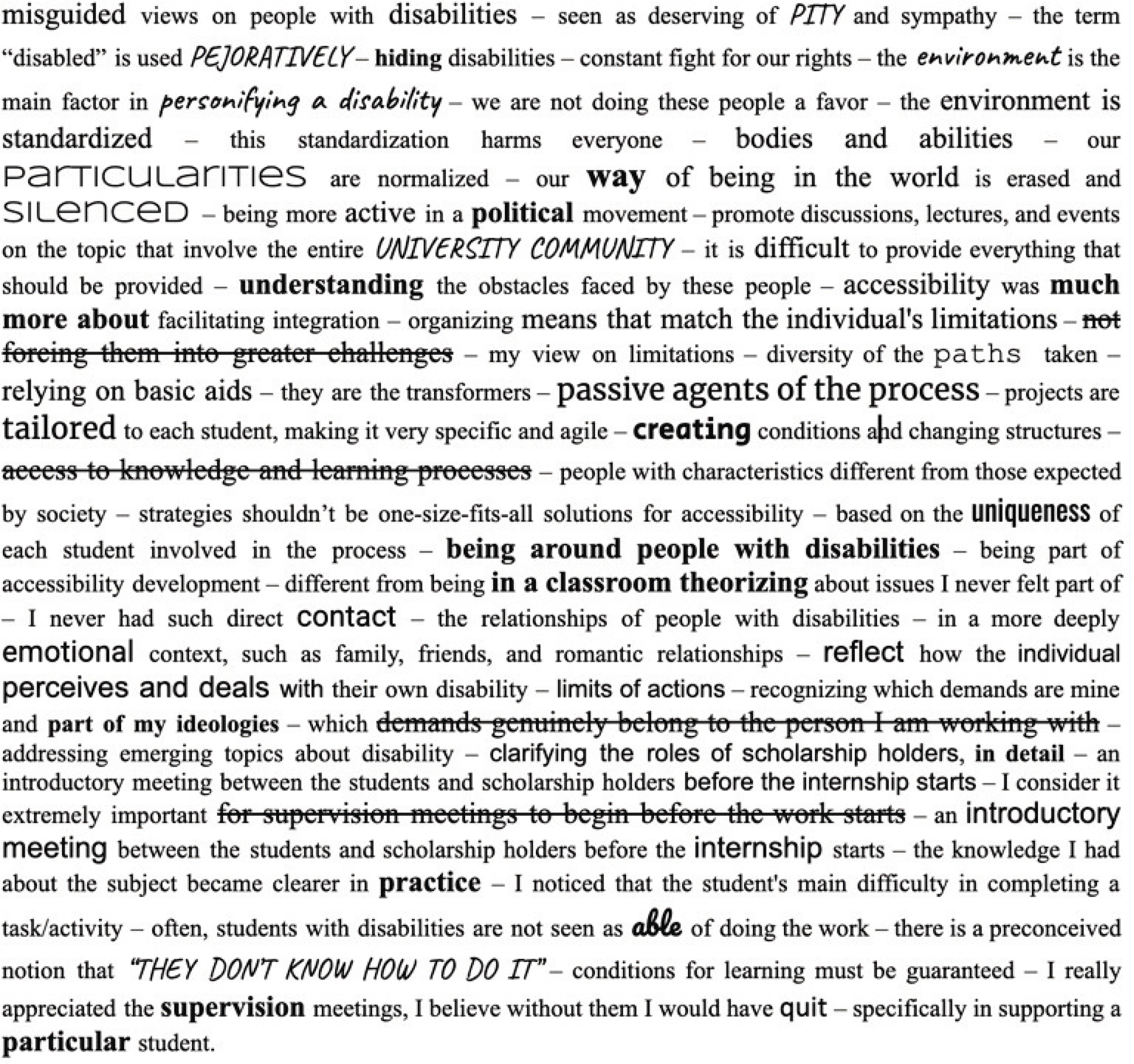
As I read through the numerous documents and records of internship activities, the information became entangled, echoing and emerging in the form of images that I want to share in this essay. I offer a small, respectful aesthetic provocation, with excerpts of dialogues, words, and expressions that arose from conversations during orientation and supervision meetings, and others taken from semester reports and weekly activity logs.
Without intending to explain, but rather to suggest an experience with the reading, I offer an experiment in which I present not only a blending of narratives but also, and above all, a disruption in the linearity of interpretation, proposing discontinuity as a reading technique9. By attempting to disorganize the normalized version of a text, I invite each reader to engage their aesthetic perception, to sensorially approach the power and challenge of this mode of action.
In the midst of this accumulation of unresolved, unanswered, and partially understood issues, both personal and collective anti-ableist movements emerged. A network of discourses formed lines of force, a “multilinearity” (Deleuze, 1996), with varying intensities that arose from the contingencies experienced during the internship.
Another formative experience mapped out took place at the University Library, where students from various undergraduate programs also completed accessibility internships. Since it is an information unit, the internship activities primarily focused on informational accessibility, with the greatest demand, as outlined in Muccini, Kloppel and Andrade (2023), being the production of accessible collections.
From this experience came another layer of the accessibility internship: the creation of the Collective Orientation Project, a participatory learning initiative on accessible practices. This project took place during the second semester of 2021, amid the Covid-19 pandemic, when activities were being conducted remotely. The group of students and staff met biweekly for theoretical-practical discussions on accessibility. In total, there were six meetings that covered the following topics: barriers and facilitators, attitudinal barriers, the logic of overcoming disability, the Social Model of Disability, and ableist culture. To guide the discussions, excerpts from films, documentaries, and other artistic-cultural productions featuring people with disabilities were used. In this first cycle, six meetings were held with the participation of thirteen undergraduate students from various UFSC courses.
To facilitate dialogue in each session, a few guiding questions were raised: Why is disability seen as something to be overcome? How can a body with disabilities be used and its capacities identified? Can disability be a way of life? Why does interaction broaden our perspective and view of bodies with disabilities? How can we break free from a spectacularized gaze and build critical awareness? Where does the idea of exceptionalism in bodies with disabilities come from? Through this experience, students engaged in the internship brought up points from each session’s material, relating them to their work in the internship, experiences in the classroom, or other contexts of their daily lives.
These dialogues led to problematizations and ideas about what happens in their daily work and what could be changed or transformed. The students’ growing engagement with the topic was evident in the way they formulated these problematizations and applied them to their daily tasks, as can be seen in a written testimonial for the internship’s final report:
The experience of working with Informational Accessibility was incredible. In addition to continuing the reflections I had started during another internship on the importance of accessibility in the world and higher education, I was immersed in technical work, self-reflection, hard work, pedagogy, and the production of an accessible collection for people with disabilities. The collective meetings within the department provided a space for significant improvement in both our individual and collective activities, as well as essential theoretical and practical knowledge for the anti-ableist fight. Without a doubt, I leave this internship transformed by the professional experience, enriched by having worked in a library, even if unfortunately in a remote format. I can only be grateful for the opportunity.
Through these formative experiences, a critical approach developed, challenging ableist beliefs and myths about disability. In opening up to experimentation, stemming from the interaction with diverse knowledge and corporealities, inventive processes unfolded, leading to changes in both the students’ and professionals’ practices. This mutational shift10 resonated in the strengthening of the anti-ableist movement within the university, with a key element being the collaboration between the three categories (staff, faculty, and students) that make up the academic community.
Final remarks
Sharing this study is a strategy to continue the anti-ableist movement within Higher Education Institutions (HEIs) and expand the dialogue around accessibility internships for a more in-depth critical analysis, which can bring new contributions to this practical-formative modality
HEIs, with their societal objectives, can contribute to strengthening anti-ableist culture by incorporating accessible practices, such as the accessibility internship. This includes both student participation in the activities discussed in this study and the creation of new ways of engaging that span across different areas of knowledge.
Finally, this text aims to promote the idea that every project, every initiative — regardless of the field of knowledge — thrives when it is accessible. Thinking of human diversity as a strength broadens the reflection on its purpose and form, opening up possibilities for unimagined creations that go beyond normative standards.

References
-
BRASIL. Ministério da Educação. Documento orientador do Programa Incluir: acessibilidade à educação superior. Brasília, DF: SECADI/SESu, 2013. Disponível em: http://portal.mec.gov.br/index.php?option=com_docman&view=download&alias=13292-doc-ori-progincl&category_slug=junho-2013-pdf&Itemid=30192 Acesso em: 30 dez. 2023.
» http://portal.mec.gov.br/index.php?option=com_docman&view=download&alias=13292-doc-ori-progincl&category_slug=junho-2013-pdf&Itemid=30192 -
CUNHA, Claudia Madruga. Cartografia e pesquisa rizoma: especulações e experimentações em arte educação. In: CUNHA, Claudia Madruga (org). Cartografia: insurge^ncias metodolo´gicas e outras este´ticas da pesquisa. Sa~o Paulo: Pimenta Cultural, 2022. p. 23-51. Disponível em: https://www.pimentacultural.com/_files/ugd/9711c4_cb68217ca6fa43a7aaa12023aee8755f.pdf Acesso em: 22 dez. 2023.
» https://www.pimentacultural.com/_files/ugd/9711c4_cb68217ca6fa43a7aaa12023aee8755f.pdf - DELEUZE, Gilles. Conversações. 3. ed. São Paulo: Editora 34, 2010.
-
DELEUZE, Gilles. O que é um dispositivo? In: DELEUZE, Gilles. O mistério de Ariana. Lisboa: Vega, 1996. p. 83-96. Disponível em: https://www.uc.pt/iii/ceis20/conceitos_dispositivos/programa/deleuze_dispositivo Acesso em: 5 jan. 2024.
» https://www.uc.pt/iii/ceis20/conceitos_dispositivos/programa/deleuze_dispositivo - DINIZ, Débora. O que é deficiência. São Paulo: Brasiliense, 2012. (Primeiros passos).
- FOUCAULT, Michel. Ditos e escritos VI: repensar a poli´tica. Rio de Janeiro: Forense Universita´ria, 2010.
-
KASTRUP, Virgínia. Aprendizagem, arte e invenção. Psicologia em Estudo, Maringa, v. 6, n. 1, p. 17-27, jan./jun. 2001. Disponível em: https://www.scielo.br/j/pe/a/NTNFsBzXts5GHp4Zk8sBbyF/abstract/?lang=pt Acesso em: 10 dez. 2023.
» https://www.scielo.br/j/pe/a/NTNFsBzXts5GHp4Zk8sBbyF/abstract/?lang=pt - LAPPONI, Estela. Corpo intruso: uma investigação cênica, visual e conceitual. São Paulo: Casa de Zuleika, 2023.
- MACHADO, Regina. A arte da palavra e da escuta. São Paulo: Reviravolta, 2015.
-
MELLO, Anahi Guedes de. Corpos (in)capazes: a crítica marxista da deficiência. Jacobin Brasil, n. esp., p. 98-102, 2020. Disponível em: https://jacobin.com.br/2021/02/corpos-incapazes/ Acesso em: 9 jan. 2024.
» https://jacobin.com.br/2021/02/corpos-incapazes/ -
MELLO, Anahi Guedes de. Deficiência, incapacidade e vulnerabilidade: do capacitismo ou a preeminência capacitista e biomédica do Comitê de Ética em Pesquisa da UFSC. Ciência & Saúde Coletiva, Rio de Janeiro, v. 21, n. 10, p. 3265-3276, out. 2016. Disponível em: https://www.scielo.br/j/csc/a/J959p5hgv5TYZgWbKvspRtF/abstract/?lang=pt Acesso em: Acesso em: 10 dez. 2023.
» https://www.scielo.br/j/csc/a/J959p5hgv5TYZgWbKvspRtF/abstract/?lang=pt -
MUCCINI, Patrícia; KLOPPEL, Jéssica Vilvert; ANDRADE, Suélen. Da produção de acervo à institucionalização do acesso: preceitos da acessibilidade informacional nas bibliotecas universitárias. In: GRANTS, Andréa Figueiredo Leão; BEM, Roberta Moraes de. (org.). Na esteira das possibilidades: questões e reflexões na Biblioteca Universitária da UFSC. v. 2. 1. ed. Florianópolis: BU/UFSC, 2023. p. 117-136. Disponível em: https://repositorio.ufsc.br/handle/123456789/251701 Acesso em: 9 jan. 2024.
» https://repositorio.ufsc.br/handle/123456789/251701 - PASSOS, Eduardo; BARROS, Regina Benevides de. A cartografia como método de pesquisa-intervenção. In: PASSOS, Eduardo; KASTRUP, Virgínia; ESCÓSSIA, Liliana (org.). Pistas do método da cartografia: pesquisa-intervenção e produção de subjetividade. Porto Alegre: Sulina, 2009. p. 17-31.
-
PEREIRA, Clarissa Agostini et al. Por uma BU acessível: experiências para implementação da acessibilidade em uma biblioteca universitária. Revista Brasileira de Biblioteconomia e Documentação, v. 16, p. 1-22, 2020. Disponível em: https://rbbd.febab.org.br/rbbd/article/view/1446 Acesso em: 4 jan. 2024.
» https://rbbd.febab.org.br/rbbd/article/view/1446 - ROLNIK, Suely. Pensamento, corpo e devir: uma perspectiva ético/estético/política no trabalho acadêmico. Cadernos de Subjetividade PUC-SP, São Paulo, v. 1, n. 2, p. 241-251, 1993.
-
ROSENTHAL, Dália. O ateliê Nossa Casa e a prática transdisciplinar para o ensino da arte: relato de experiências. In: CONGRESSO DA FEDERAÇÃO DE ARTE EDUCADORES DO BRASIL, 22., 2012, São Paulo. Anais.... São Paulo: FAEB, 2012. p. 1-9. Disponível em: https://www.eca.usp.br/acervo/producao-academica/002684373.pdf Acesso em: 23 dez. 2023.
» https://www.eca.usp.br/acervo/producao-academica/002684373.pdf -
UFSC. Universidade Federal de Santa Catarina. Portaria nº 1522/2013/GR, de 08 de agosto de 2013. Resolve criar a coordenadoria de acessibilidade educacional da pró-reitoria de graduação. Florianópolis: UFSC, 2013. Disponível em: https://notes.ufsc.br/aplic/portaria.nsf Acesso em: 6 jan. 2024.
» https://notes.ufsc.br/aplic/portaria.nsf -
UFSC. Universidade Federal de Santa Catarina. Resolução Normativa nº 73/2016/CUn, de 7 de junho de 2016. Regulamenta os estágios curriculares dos alunos dos cursos de graduação da Universidade Federal de Santa Catarina. Resolução normativa. Florianópolis: UFSC, 2016. Disponível em: http://portal.estagios.ufsc.br/files/2016/06/RN-73_CUn_2016.pdf Acesso em: 30 dez. 2023.
» http://portal.estagios.ufsc.br/files/2016/06/RN-73_CUn_2016.pdf
-
2
- I use italics to emphasize the term as a possible category of academic internship.
-
3
- The Accessibility Program in Higher Education, created in 2005 through public calls and, as of 2012, covering all Federal Higher Education Institutions, with the aim of guiding the institutionalization of the Accessibility Policy in these institutions (Brazil, 2013).
-
4
- A slang term created by the artist, researcher and doctor of performing arts Carolina Teixeira and strongly adhered to by several artists with disabilities, in order to counter the acronym PCD (Person with Disabilities).
-
5
- Estela Lapponi is a performer and video artist from São Paulo. She develops her artistic investigations and poetic creations about the disabled body, putting tension between it and the ableist structure.
-
6
- Facilitators, according to the World Health Organization (2003), are environmental factors that, through their absence or presence, improve functionality and reduce a person’s participation impediments.
-
7
- In basic education units, specifically NDI and CA, the majority of accessibility internship activities are focused on accompanying children and young people with disabilities during classes and school activities. In theory, the work is under the guidance of the classroom teachers and/or professionals from the pedagogical services of these units.
-
8
- The diversity of demands arose from the specificities of the activities of each course (lectures, laboratory activities, activities with technological means, reading, field observation, etc.) and the physical and sensory characteristics of each student, ranging from communication — by lip reading, Libras, tactile Libras, enlarged writing — to the use of various prostheses for locomotion and/or reading and writing activities. Each specificity was also intertwined with the preferences of each student, for example: use of a human or technological reader.
-
9
- It’s worth mentioning that the proposed shuffling is only caused by visual reading. Reading this text using screen reader software may not produce the same effect, since it will be done without distinguishing the changes in the characters.
-
10
- I would like to thank each of the students who took part in the accessibility internship for their availability and involvement in the work they did, giving, through their singularities, many of the ethical and aesthetic tones and forms to the anti-capacity institutional actions. To the Defiças/DEF researchers and intellectuals and artists for sharing knowledge that drives disruptive thinking about pedagogical practices that reverberate in transformative experiences.
-
**
Due to technological limitations in text editing software, it was not possible to insert the image’s alternative text in its entirety. However, the description of the image in an accessible format can be made available by contacting the author at patricia.muccini@ufsc.br.
-
Editor:
Dr. Rosana Passos

 Source: The author.