
 Teacher salary policy in El Salvador: An analysis in light of socioeconomic indicators
Abstract
This article presents the results of a study whose objective is to analyze trends in public- sector teacher salaries in El Salvador between 2000 and 2024, taking a historical view and based on various economic indicators. This is a documentary study founded on national official data and statistics, as well as international references. In the first instance, the discussion is initiated on the importance of analyzing teacher salaries in the context of evaluating educational policies. Next, it provides an overview of the legal framework of the country’s current teacher salary policy. Third, a comparative analysis of teacher salary is conducted in relation to five economic indicators: Per capita income, the minimum wage, the cost of the basic food basket, inflation, and the share of teaching salary expenditure in relation to GDP. These indicators are used to conduct a temporal analysis, with the aim of identifying comparative tendencies which help understand their trajectory. The results suggest the valorization and dignification of teachers are not reflected in their salaries, as these have not kept pace with the country’s economic growth and shows a loss of purchasing power over time within the public service. It is hoped that these findings will serve as input for future studies, both nationally and internationally, and contribute to proposals for improvements in policies aimed at the teaching profession in El Salvador and the region.
Keywords:
- Teaching work - Teacher salary - Wage policies - Teaching profession
Resumen
Este artículo presenta los resultados de una investigación cuyo objetivo es analizar las tendencias del salario docente del sector público en El Salvador entre los años 2000 y 2024, con una mirada histórica y con base en diversos indicadores económicos. Se trata de una investigación documental fundamentada en datos y estadísticas oficiales nacionales y en referencias internacionales. En un primer momento, se entabla el diálogo acerca de la importancia de analizar el salario docente en el contexto de la evaluación de las políticas educativas. Enseguida, se ofrece un marco legal de la política salarial docente vigente en el país. En tercer lugar, se realiza un análisis comparativo del salario docente en relación con cinco indicadores económicos: el ingreso per cápita, el salario mínimo, el costo de la canasta básica, la inflación y la proporción del gasto salarial docente respecto al PIB. Con ellos se hace un análisis en el tiempo, intentando identificar tendencias comparativas que ayuden a comprender su trayectoria. Los resultados permiten concluir que la valorización y la dignificación docente no se concretizan en el salario, puesto que los cuales no han acompañado el crecimiento económico del país y muestra pérdida de poder adquisitivo a medida que se permanece en la función pública. Se espera que estos hallazgos sirvan de insumos para estudios posteriores, a nivel nacional e internacional, y contribuyan para fundamentar propuestas de mejoras en las políticas dirigidas al magisterio en El Salvador y en la región.
Palabras clave:
Educación - Trabajo docente - Salario docente - Políticas salariales - Magisterio.
Introduction
The purpose of this study is to analyze trends in teachers’ salaries in the public sector of El Salvador, taking a historical view and based on economic indicators, between 2000 and 2024. This study is part of a research initiative launched in 2018 that aims to map educational policies in El Salvador2. We start from the premise that analyzing teacher salaries allows us to understand a country’s educational policies in terms of professional recognition (Tardif; Leesard, 2005) and the dignification of teachers in the pursuit of what is known as educational quality. There are several reasons for using teacher salaries as a reference point in the analysis of public policies in education.
According to Imbernón, in an effort to ensure the success of their policies, educational administrations should rely on the teaching profession for their implementation, and these administrations, in turn “cannot neglect” teacher’s work relations (Imbernón, 2009, p. 24, own translation, author’s quotation marks), which include salary policy. Similarly, Tardif and Lessard (2005) also highlight the role that working conditions play in the development of teaching as a profession and their impact on instruction. Gatti (2010), in analyzing teacher training, notes that it is not enough to simply make improvements to initial and continuing education programs; it is also necessary to consider professional development, salary and working conditions. International agencies (OECD, World Bank) have recently joined these efforts, adopting some of these proposals to improve teachers’ working and salary conditions in order to recruit and retain the “best candidates” for teaching (World Bank, 2021), but with an emphasis on the efficiency of government spending rather than on recognizing the historic demands of teachers’ unions.
At a local level, the Ministry of Education (MINED) has positioned teachers as a key component of its educational policies and, to that end, has adopted a rhetoric focused on enhancing the dignity of teachers. However, much has already been written (promised) on the issue of teacher dignification, which includes improving their salaries. Considering government plans since the 1992 peace accords, all have recognized the need to value the teaching profession as the cornerstone of educational quality (El Salvador, 2000, 2005, 2009, 2016, 2021, 2022), not to mention the proposals put forward by teachers’ unions, specialists, and parents consulted in those documents.
By considering the analysis of teacher salary policies based on various socioeconomic indicators, in addition to studies by organizations such as the OCDE (2009), the World Bank (2021), and Liang’s study (2003), if we focus on Latin America, we highlight the 2018 study by the Argentinian Center for Educational Studies ((CEA, 2018)), which compared the salaries of Argentinian teachers in 2015 with those of their peers in different economies. The results placed Argentinian teachers’ salaries among the lowest in the OECD; furthermore, the study compared the salary of teachers (in USD PPP) with ten years of experience in relation to GDP per capita with those of different nations, placing Argentina in the middle of the table. Lastly, this study also presents an interesting chart comparing countries based on three indicators that define teacher salaries: teaching career (degree, seniority, administrative position); performance (competency exams and performance evaluations); and others such as student test results or other specific activities ((CEA, 2018), p. 8).
In the case of Colombia, Gaviria and Umaña (2002) chose to compare teacher salary in terms of inflation during the period 1990-2000. By doing so, they were able to compare the real growth in teacher salary over a ten-year period by subtracting the nominal growth in teacher salary from the cumulative inflation rate during that same period, verifying a growth of 1.6%, even though teacher salary had grown nominally by 20.9%. This indicator can give us an idea of how much of a salary’s purchasing power is maintained over a given period.
This same concern regarding the purchasing power of teacher salary is also addressed by Candray Menjívar (2019), who compared Salvadoran teacher salary to the cost of the basic food basket during the 2011-2016 period. The results showed that, during that period, there were both gains and losses in terms of compliance with the salary increases mandated by law and set by the Ministry of Education.
In addition to comparing with the cost of living, Candray Menjívar (2019), as well as Fernandes, Gouveia and Benini (2012), compare teacher salary in terms of minimum wage. Unlike the findings presented in the Basic Family Basket, the data showed that Salvadoran teacher salary remained unchanged during that same period (2011-2018) relative to the minimum wage. In the case of Fernandes, Gouveia y Benini (2012), who conducted a study on the salaries of secondary school teachers in Brazilian state capitals, the data showed that the average teacher’s salary in that sector fell behind in relation to the growth of the minimum wage during the same period (1996-2008).
Lastly, we highlight the study by Días y Ñopo (2016), which, among other things, compared the share of teacher salary in terms of GDP in Peru. This analysis showed that teacher salaries were well below the percentage of GDP allocated to this sector in other economies, such as those in the OECD or Latin America, based on projections for the period 2014-2027. Such comparisons reveal the level of teachers’ share in the distribution of wealth produced in the country.
With all these factors in mind, we believe that examining teacher salary can offer an interesting perspective for analyzing educational policies in a specific country; and, given that this issue has played a central role in the Ministry’s educational proposals over the past decades, a temporal analysis would allow us to assess the extent to which there has been progress or regression in this field. Thus, this study aims to answer the research question: What is the tendency in teachers’ salaries in the Salvadoran public sector between 2000 and 2024?
In the following section, we discuss the methodological approach adopted.
Methodological procedures
Having defined the objective and research question of this study, documentary analysis was selected as the methodological approach, from a historiographical perspective and supported by official documents that record teachers’ salaries, such as the Teacher Salary Laws, the General State Budget Laws, and the budget of the Ministry of Education (MINED). For economic indicators, official data defined by the responsible institutions were used as references.
The details of the information consulted are presented in Table 1 below:
Nevertheless, it is necessary to define certain delimitations derived from the Salvadoran context that help guide the study. First, legal and administrative delimitation. In El Salvador, due to the centralizing nature of public policies reflected in the Constitution of the Republic (El Salvador, 1983), educational policies are the responsibility of the central government and are legally delegated to the Ministry of Education (El Salvador, 1983, 1996a) which grants the Ministry full control over the curriculum, teacher training, and salary determination, subject to the approval of the Legislative Assembly. Historically, teachers’ salaries have not varied according to municipal or departmental location, nor according to the school’s geographical area (urban or rural). However, there were salary differences based on educational level (basic and secondary education) for several years during the 1960s and 1970s.
A second delimitation concerns the teaching sector to be studied. Since there is no regulation governing teachers’ salaries in the private sector, this study focuses exclusively on teachers’ salaries in the public sector. This delimitation was also chosen due to the significant role of the public teaching workforce in the country’s pre-university education system. According to the 2015 School Census, from the 57,163 teachers working at these levels, 44,112 were hired by MINED, which represents 77% of the total number of teachers.
A third delimitation concerns the teachers’ salary used for comparison with economic indicators. Since 1996, two salary scales have existed: Level I (with a bachelor’s degree) and Level II (with a teaching degree). The comparative economic analysis was conducted using the Level II salary, as more than 80% of teachers currently receive this salary, according to the 2015 School Census. In this way, the salary data represent the earnings of six out of every ten teachers working in the country. An explanation of these levels will be provided in Section 3.
Finally, regarding the economic indicators used in the analysis, we relied on those employed in previous research by Candray Menjívar (2019) and Fernandes, Gouveia, and Benini (2012) who compared teachers’ salaries with the minimum wage and the cost of the expanded basic basket (CBA); CEA (2018) used the annual teacher salary in relation to GDP per capita as a reference; Gaviria and Umaña (2002) analyzed teachers’ salaries in terms of inflation; and Días y Ñopo (2016) examined the relative weight of teachers’ salaries in relation to GDP.
In the following section, we present a historical overview of teachers’ salaries in El Salvador:
Teacher salary policy in El Salvador
The current legal framework governing teacher salary policy is based on the Teacher Career Law of 1996 (LCD/1996). Prior to this law, teachers’ salaries were regulated by the Salary Scale Law for Primary Education Teachers of the Republic of El Salvador (LEMEP) and the National Teaching Salary Scale Law (LEMN) of 1940 and 1971, respectively. A fact worthy to mention is that the 1940 salary scale law predates even the enactment of a specialized education law, which was not published until 1941 with the Organic Law of Public Education (Candray Menjívar, 2024a).
Returning to the issue of salaries, the Teacher Career Law (LCD/1996) establishes two criteria for structuring teachers’ salaries: academic degree and years of service (El Salvador, 1996b). Regarding academic degrees, Articles 19 and 20 of the law classify teachers into two levels: Level I includes teachers who hold a bachelor’s degree (five years of study), master’s or doctoral degrees in Education and at the same time the ones who have also passed a proficiency test3; while in Level II are located teachers with an academic degree of professor (three years of study) and those who have not passed the proficiency test. This classification of teachers by rank is a consequence of the elimination of the normal teacher training model that existed in El Salvador from the late 19th century until 1980, with the closure of Ciudad Normal4 and the elimination of the certification of pedagogical high school graduates (equivalent to high school) to teach, transferring teacher education to the university system (Picardo Pacheco; Escobar, 2004). The promotion from Level II to Level I is only possible through obtaining a bachelor’s, master’s, or doctoral degree.
Regarding years of service, Article 21 of the LCD/1996 organized the teaching profession in six categories: category six, for teachers with less than five years of service, and category one for those with more than twenty-five years of service. However, due to teachers’ unions request, the Legislative Assembly issued the Decree 140 in 2006, which amended Article 21 of the LCD/1996 to divide category 1 into three subcategories, creating Subcategories One C, One B, and One A for teachers with more than twenty-five, thirty, and thirty-five years of service, respectively (El Salvador, 2006). The promotion between categories is automatic upon accumulating the required years of service. Table5 2 reflects the current teacher ranking system in El Salvador, with the corresponding salary values6 for each level and category.
Before closing this point, we must remember that, as Candray Menjívar (2024a) notes, the LCD/1996 does not establish any economic or social indicators to guide salary adjustments, leaving the determination of the update amounts to the discretion of the authority. However, the LCD/1996 sets deadlines for reviewing teachers’ salaries, which cannot exceed three years (LCD/1996, art. 33); additionally, it stipulates that any salary increase for the public sector must also be applied to teachers’ salaries, regardless of the provisions of Article 33 of the LCD/1996. Nevertheless, these deadlines for salary review have historically not been met, as was observed during the Flores’7 (1999-2004) and Bukele’s8 (2019-2024 and 2024-present9) administrations. Regarding base salaries across levels, there no specific criteria defined; however, the LCD/1996 does establish percentage increases between categories, ten percent for promotion from Category Six to Five; eight percent for promotion from Category Five to Four and from Four to Three; and six percent for promotion from Three to Two and from Two to One (LCD/1996, art. 35). The LCD/1996 also does not define evaluation mechanisms or any other procedure that involves a salary increase.
Having presented the legal framework for teachers’ salaries in the country, the following section analyzes teacher remuneration considering the established economic indicators.
Teacher Salaries in El Salvador, 2000-2024, considering economic indicators
As established in the methodological section, to perform this analysis we were inspired by the work of Candray Menjívar (2019), CEA (2018), Gaviria and Umaña (2002), and Díaz and Ñopo (2016), who compared teacher salaries with economic and social variables such as the Expanded Basic Basket (CBA) and the Minimum Wage (MW); teacher salary as per capita income; inflation; and salary as a share of Gross Domestic Product (GDP). However, before going deeper into the results, tables 33, 4, and 5 present the economic indicators, investment in education in El Salvador, and monthly and annual teacher salaries, respectively, for the study period.
Some data from the previous tables are highlighted for the next analysis. In terms of growth, the data demonstrates that the government spending has increased more than the annual production, considering that the Fiscal Year Budget (FYB) has increased 282% comparing with the Gross Domestic Product (GDP) (209%) in the same period. The compound annual growth rate (CAGR) also demonstrates this difference, indicating that the Fiscal Year Budget (FYB) increased by 5.75% during the period, about 1% more than the Gross Domestic Product (GDP) (4.82%). The reason for this situation could be linked to the worldwide economic crisis impact that affected the economic growth of the country, but at the same time required considerable government investment, as in the case of the financial crisis in 2008, and the Covid-19 pandemic in 2020 which debt was used and the tax burden was increased. In fact, the Fiscal Year Budget (FYB) with regard to (GDP) rose from 17.67% in 2000 to 21.86% in 2024, with some years exceeding this average, especially in the constitutional five-years term of Bukele. Such an event led the government to agree to a fiscal consolidation with the International Monetary Fund (IMF, 2024).
On the other hand, the average GDP per capita, that distributes the country’s annual wealth in a year term, reflects an increase of 189% between the years 2000 and 2024, with an annual growth rate of 4.53% resulting in an average annual income of $5740.35 for 2024, despite receiving negative feedback about this indicator (as if the inequality income distribution is being ignored), it represents a significant improvement in the purchasing capacity of citizens. Expanding on this argument, if we compare GDP per capita with the cost of living (BFB) and the minimum wage (MW), we can observe that the BFB and the MW went from representing 12.95% and 7.26% of GDP per capita in 2000, respectively, to 8.86% and 6.36% in 2024. Both indicators would reflect, in the first place, a significant upgrade in the cost of living of the citizens, but in salary terms the situation seems static, in other words, salaries were not linked to this increase, which reinforced the idea that economic growth during this period was not distributed equally. This will be strengthened when analyzing teachers’ salaries.
In the educational environment, the data also shows some variations to highlight. Firstly, despite the Ministry of Education budget went from $386.99 millions of dollars in 2000 to $1.470.48 in 2024, in comparison to the government spending and the annual economic production, The Salvadoran State invested 18.58% of PGN and 3.28% of the GDP in 2000, While in 2024 these amounts ended up in 18.46% and 4.03%, respectively. In other words, despite the State having a higher budget available in relation to GDP, around 5% more than 2024 in comparison to 2000, the educational investment was reduced by 0.12% in this period. On the contrary, when comparing the education spending in relation to GDP, the State spent 0.75% more on education in 2024 compared to the year 2000. Nevertheless, despite this may indicate a notable increase of investment in the sector, Candray Menjívar (2024b) shows that since 2021 there is a significant reduction in the education spending in relation to the GDP.
In the second place, regarding the educators’ salaries spending the data reflects that this sector went from 40% of the Minister of Education (MINED) budget in 2000 to 35.4% in 2024 but remaining mostly constant regarding to GDP (+0.08% in this period). Most of the ministry’s budget usually goes to educators’ salaries, nevertheless, despite of the budget increase in the sector, the portion assigned to the educators’ salaries in the Minister of Education (MINED) decreased about 5% in relation to the Fiscal Year Budget (FYB), this inflection point happens in 2019 when it was represented the 45.7% from the ministry budget which dropped by 10 percentages points in 2024 and from 1.7% to 1.43% of FYB. This decline might be associated, among other things, to the failure to update the hierarchical salary table, as mandated by Article 33 from (LCD)/1996, to the prioritization of projects resulting from the pandemic, such as the provision of computers to students (La Prensa Gráfica, 2022); the commitment11 of early childhood with the program Crecer y Aprender Juntos (Grow and Learn Together), and the school infrastructure program Mi Nueva Escuela (My New School) that in 2024 reserved 225 and 175 million, respectively, from the MINED budget (El Salvador, 2024).
For this reason, and as a third and last point, and for all the above, it is not surprising that teacher salaries have been affected if we compare it with the cost of living, the minimum wage, and the GDP per capita. By taking as reference, teacher salaries of the level II professor in four stages of the ladder (the beginning professor, and those who have 10, 20 and 30 years of service), with these indicators the data reflects the following (see table 6).
Teacher salaries divided by these indicators show how much the cost of living, minimum wage increases, and the generation of wealth have been in line with the ladder table, in order that, if this indicator reduces over time, it would mean a decrease in purchasing power, a devaluation of teacher salaries with respect to other economic activities, and an inequality of distribution of the country’s income for the labor union, respectively. Therefore, based on these indicators, in general, two aspects can be noted. First, if the indicators between 2000-2024 are compared, we notice that teacher salaries have resisted the cost of living a little more compared to the minimum wage, and the GDP per capita, and second, in the three cases, teacher salaries deteriorate as the professor develops a professional career. The following section presents the details.
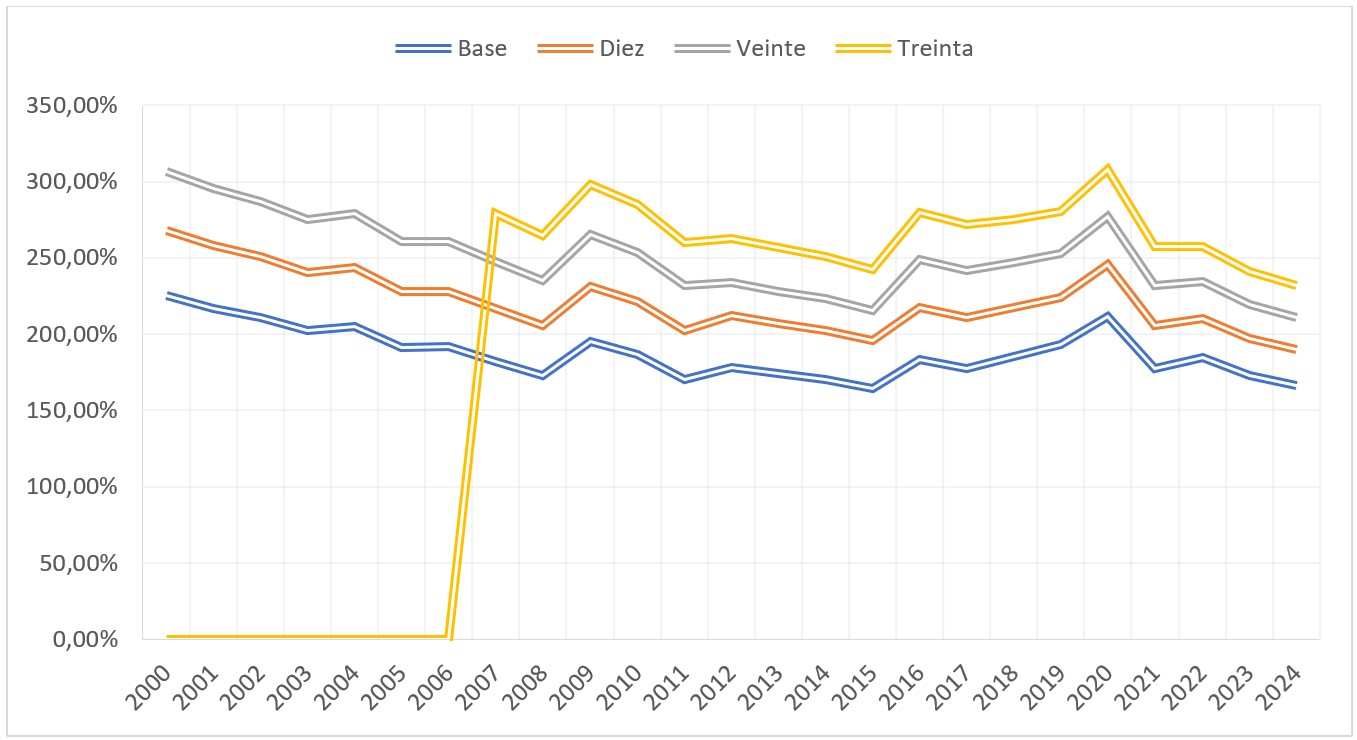
In comparison to the Expanded Basic Basket, teacher salaries show a relative improvement in purchasing power in the first years of career, however, after the twenty years, teacher salaries have decreased considerably, especially in the period 2019 - 2024 as verified in figure 1. This data can be further supported when considering the percentage growth of teacher salaries in that period with the inflation, thus, while teacher salaries of the beginning professor, and those with 10, 20, and 30 years of service showed a growth of 113.85%, 105.18%, 99.47% and 68.79%, respectively, the inflation in the period was 86.31%. Therefore, this supports the argument that teacher salaries lose purchasing power as professors advance in their careers.

Monthly teacher salary (base level, ten, twenty, and thirty years of service) relative to the Expanded Basic Food Basket (Period 2000-2024)
Monthly teacher salary (base level, ten, twenty, and thirty years of service) relative to the Minimum Wage (Period 2000-2024)
Unlike what happens with the Expanded Basic Basket (EBB), the teacher’s salary in relation to the minimum wage shows a very marked decline, and again, the more years of service the teacher has, the lower the ratio to the minimum wage (see figure 2). This situation may be due to the fact that, although both salaries are legally required to be reviewed every three years, in 2024, the minimum wage has been updated ten times, while the teacher’s salary has been updated eight times in that same period. Additionally, if we compare the last two increases in both salaries, it is evident that the minimum wage rose by 20% each time, whereas the last two increases in the teachers’ salary were only 16% and 14%, respectively. In the case of figure 3, it shows a tendency of deterioration in the annual teacher’s salary compared to GDP per capita. This indicates that the distribution of wealth generated during this study period is not reflected equally in the salary of Salvadoran teachers, showing a clear downward trend of at least a 45% loss relative to this indicator. Bringing this data into discussion reinforces the hypothesis that the growth of GDP per capita in the country has generated greater inequality, benefiting the concentration of wealth in some productive sectors.
Annual teacher’s salary (base, ten, twenty, and thirty years of service) in relation to GDP per capita (Period 2000-2024)
Finally, as a reference, Table 7 shows the average salary of different occupational groups in the country, to which the minimum wage and the monthly base salary of the level II public sector teacher are added.
In summary, all data obtained show that teacher salaries have a decline relative to the cost of living (Expanded Basic Basket and inflation), the minimum wage and the and wealth distribution during the studied period, and this impact increases the longer the teacher remains in service. Table 8 below presents a summary of the indicators discussed in this section.
Having completed the stage of presenting and analyzing the results, the following section presents some reflections and future perspectives on the topic.
Final reflections
This study aimed to analyze the tendencies in public-sector teachers’ salaries in El Salvador between the years 2000 and 2024, based on various economic indicators. As noted in the previous section, teachers’ salaries during this period show two characteristics in relation to the selected indicators: they remain stable or decline when compared to the minimum wage, cost of living, and per capita income; and as teachers remain longer within the system, their economic situation worsens despite the fact that the dignification of the teaching profession has been an objective of all administrations during this period. Thus, it is possible to point out that no progress has been made in enhancing the value of the profession in relation to the economic and labor market.
This situation is aggravated because teachers’ salary policy lacks mechanisms to guarantee its enforcement, even though the law requires its update at least every three years. In this scenario, the teaching profession plays a largely testimonial role, without institutions to which it can turn. This limitation becomes more evident in governments with a neoliberal orientation, as was the case during the Flores administration (1999- 2004), and especially in administrations with greater state control such as the Bukele administration (2024-present), where, according to teachers’ unions, some security and violence-prevention measures have been extended as strategies for union containment12.
The data reflects the need to establish economic criteria as a basis for increases in the base salary and mechanisms to ensure their implementation. In addition, the indicators reveal a very serious loss of teachers’ purchasing power, particularly among those with more than fifteen years of service, for whom remaining within the educational system no longer serves as an incentive. It is also necessary for legislation to include, regarding academic qualifications, salary differentiation either for specializations or courses completed, or for the attainment of postgraduate degrees, which under the current legal framework are not taken into consideration.
Having concluded the discussion intended for this article, I consider that other lines of research remain to further deepen this study. One possible direction would be to examine the positions of teachers-whether unionized or not-regarding these policies. It would also be interesting to consider teachers’ salaries in the private sector and to develop an analysis of teachers’ salaries beyond purely economic variables. For this last point, the proposal by Grochoska and Gouveia (2020), who studied professional recognition as a means of guaranteeing teachers’ quality of life, appears particularly appealing. It is hoped that these results will serve as inputs for future studies.
References
- AGUILAR AVILÉS, Gilberto; LINDO-FUENTES, Héctor. Un vistazo al pasado de la educación en El Salvador: el sistema escolar de El Salvador en el siglo XIX. San Salvador: Fundación Empresarial para el Desarrollo Educativo, 1998.
-
BCR. Banco Central de Reserva de El Salvador. Sector real: estadísticas económicas. Banco Central de Reserva de El Salvador, San Salvador, (s.f.-a). Disponível em: Disponível em: https://estadisticas.bcr.gob.sv/clasificacion/sector-real Acesso em: maio 2025.
» https://estadisticas.bcr.gob.sv/clasificacion/sector-real -
BCR. Banco Central de Reserva de El Salvador. Consulta del Índice de Precios al Consumidor (IPC). Banco Central de Reserva de El Salvador, San Salvador, (s.f.-b). Disponível em: Disponível em: https://onec.bcr.gob.sv/ipc_consulta/ Acesso em: maio 2025.
» https://onec.bcr.gob.sv/ipc_consulta/ - BCR. Banco Central de Reserva de El Salvador; DIGESTYC. Dirección General de Estadística y Censos. Encuesta de Hogares de Propósitos Múltiples. San Salvador: BCR, 2005.
- BCR. Banco Central de Reserva de El Salvador; DIGESTYC. Dirección General de Estadística y Censos. Encuesta de Hogares de Propósitos Múltiples. San Salvador: BCR, 2010.
- BCR. Banco Central de Reserva de El Salvador; DIGESTYC. Dirección General de Estadística y Censos. Encuesta de Hogares de Propósitos Múltiples. San Salvador: BCR, 2015.
- BCR. Banco Central de Reserva de El Salvador; DIGESTYC. Dirección General de Estadística y Censos. Encuesta de Hogares de Propósitos Múltiples. San Salvador: BCR, 2020.
-
BANCO MUNDIAL. Docentes exitosos, alumnos exitosos: reclutamiento y apoyo de la profesión más importante para la sociedad. Banco Mundial, San Salvador, 2021. Disponível em: Disponível em: https://documentos.bancomundial.org/es/publication/documents-reports/documentdetail/099112223145527674 Acesso em: maio 2025.
» https://documentos.bancomundial.org/es/publication/documents-reports/documentdetail/099112223145527674 -
BANCO MUNDIAL. Producto Interno Bruto (PIB) - El Salvador. Banco Mundial, San Salvador, (s. f.). Disponível em: Disponível em: https://datos.bancomundial.org/indicator/NY.GDP.MKTP.CD?locations=SV Acesso em: maio 2025.
» https://datos.bancomundial.org/indicator/NY.GDP.MKTP.CD?locations=SV -
CANDRAY MENJÍVAR, Jeser Caleb. El Salvador se aleja de la promesa de invertir el 6 % del PIB en educación. Revista Disruptiva, San Salvador, 9 nov. 2022. Disponível em: Disponível em: https://www.disruptiva.media/el-salvador-se-aleja-de-la-promesa-de-invertir-el-6-del-pib-en-educacion/ Acesso em: 31 mayo 2025.
» https://www.disruptiva.media/el-salvador-se-aleja-de-la-promesa-de-invertir-el-6-del-pib-en-educacion/ - CANDRAY MENJÍVAR, Jeser Caleb. Financiamiento de la educación en El Salvador: un análisis más allá del porcentaje del PIB. Período 2000-2018. Realidad y Reflexión, San Salvador, v. 47, p. 122-146, 2018. https://doi.org/10.5377/ryr.v0i47.6281.
-
CANDRAY MENJÍVAR, Jeser Caleb. Gobierno Bukele retrocede en inversión en educación y salud. Revista Disruptiva, San Salvador, 1 oct. 2024b. Disponível em: Disponível em: https://www.disruptiva.media/gobierno-bukele-retrocede-en-inversion-en-educacion-y-salud/ Acesso em: 31 mayo 2025.
» https://www.disruptiva.media/gobierno-bukele-retrocede-en-inversion-en-educacion-y-salud/ -
CANDRAY MENJÍVAR, Jeser Caleb. História da formação do professor de matemática em El Salvador. Revista de História da Educação Matemática, v. 3, n. 3, 2017. Disponível em: Disponível em: https://histemat.com.br/index.php/HISTEMAT/article/view/128 Acesso em: 31 mayo 2025.
» https://histemat.com.br/index.php/HISTEMAT/article/view/128 - CANDRAY MENJÍVAR, Jeser Caleb. Historia de la legislación educativa en El Salvador: alteraciones y permanencias. Realidad y Reflexión, San Salvador, v. 59, p. 201-229, 2024a. https://doi.org/10.5377/ryr.v1i59.18716.
- CANDRAY MENJÍVAR, Jeser Caleb. Historias del currículo de matemática en El Salvador: reflexiones sobre políticas curriculares, educación matemática y una agenda de investigaciones. 2024c. Tesis (Doctorado en Educación Matemática) - Universidade Estadual Paulista "Júlio de Mesquita Filho", Rio Claro, 2024c. 559 f..
- CANDRAY MENJÍVAR, Jeser Caleb. Trabajo docente en El Salvador: salario, empleo y la crisis de empleabilidad del magisterio salvadoreño. Revista Educación, San José, v. 43, n. 1, p. 271-292, 2019. https://doi.org/10.15517/revedu.v43i1.28913.
-
CEA. Centro de Estudios de la Educación Argentina. Los salarios docentes en el mundo y en Argentina. Centro de Estudios de la Educación Argentina, Buenos Aires, 2018. Disponível em: Disponível em: http://repositorio.ub.edu.ar/handle/123456789/8655 Acesso em: 12 abr. 2025.
» http://repositorio.ub.edu.ar/handle/123456789/8655 - DÍAZ, Juan; ÑOPO, Hugo. La carrera docente en el Perú. In: GRADE. Grupo de Análisis Para el Desarrollo (ed.). Investigación para el desarrollo en el Perú: once balances. 1. ed. Lima: Grade, 2016. p. 353-402.
-
EL FARO. Gobierno ha renovado 424 escuelas de las 5,150 que prometió. El Faro, San Salvador, 7 mayo 2025. Disponível em: Disponível em: https://elfaro.net/es/202501/el_salvador/27703/gobierno-ha-renovado-424-escuelas-de-las-5-150-que-prometio Acesso em: mayo 2025.
» https://elfaro.net/es/202501/el_salvador/27703/gobierno-ha-renovado-424-escuelas-de-las-5-150-que-prometio - EL SALVADOR. Constitución de la República: Decreto Legislativo nº 38, de 15 de diciembre de 1983. Diario Oficial, San Salvador, 16 dic. 1983.
- EL SALVADOR. Ley de la Carrera Docente: Decreto nº 665, de 22 de marzo de 1996. Diario Oficial, San Salvador, tomo 330, n. 58, 22 mar. 1996b.
- EL SALVADOR. Ley de Salarios para el ejercicio financiero fiscal del año 2024: Decreto nº 912, de 27 de diciembre de 2023. Diario Oficial, San Salvador, tomo 441, n. 242, 27 dic. 2023.
- EL SALVADOR. Ley General de Educación: Decreto nº 917, de 21 de diciembre de 1996. Diario Oficial, San Salvador, tomo 333, n. 242, 21 dic. 1996a.
- EL SALVADOR. Reformas a la Ley de la Carrera Docente: Decreto nº 140, de 8 de diciembre de 2006. Diario Oficial, San Salvador, tomo 373, n. 230, 8 dic. 2006.
- EL SALVADOR. Ministerio de Educación. Desafíos de la educación en el nuevo milenio. San Salvador: Ministerio de Educación, 2000.
- EL SALVADOR. Ministerio de Educación. Plan 2021. San Salvador: Ministerio de Educación, 2005.
- EL SALVADOR. Ministerio de Educación. Plan El Salvador Educado: por el derecho a una educación de calidad. San Salvador: Ministerio de Educación, 2016.
- EL SALVADOR. Ministerio de Educación. Plan Sectorial de Educación 2022-2030. San Salvador: Ministerio de Educación, 2022.
- EL SALVADOR. Ministerio de Educación. Plan Social Educativo: vamos a la escuela. San Salvador: Ministerio de Educación, 2009.
- EL SALVADOR. Ministerio de Educación. Plan Torogoz. San Salvador: Ministerio de Educación, 2021.
-
EL SALVADOR. Ministerio de Hacienda. Presupuesto del ramo de educación, ciencia y tecnología. Ministerio de Hacienda, San Salvador, 2024. Disponível em: Disponível em: https://www.transparenciafiscal.gob.sv/ptf/es/PTF2-Gastos.html Acesso em: maio 2025.
» https://www.transparenciafiscal.gob.sv/ptf/es/PTF2-Gastos.html -
EL SALVADOR. Ministerio de Hacienda. Gastos públicos - Portal de Transparencia Fiscal. Ministerio de Hacienda, San Salvador, [s. f.]. Disponível em: Disponível em: https://www.transparenciafiscal.gob.sv/ptf/es/PTF2-Gastos.html Acesso em: maio 2025.
» https://www.transparenciafiscal.gob.sv/ptf/es/PTF2-Gastos.html -
FERNANDES, Maria; GOUVEIA, Andrea; BENINI, Élcio. Remuneração de professores no Brasil: um olhar a partir da Relação Anual de Informações Sociais (RAIS). Educação e Pesquisa, São Paulo, v. 38, n. 2, p. 339-356, abr./jun. 2012. Disponível em: Disponível em: https://www.scielo.br/j/ep/a/qpk5hrrDx5f744TVS44VYSy/ Acesso em: 31 mayo 2025.
» https://www.scielo.br/j/ep/a/qpk5hrrDx5f744TVS44VYSy/ -
FMI. Fondo Monetario Internacional. Comunicado de prensa nº 24/485: El FMI llega a un acuerdo técnico con El Salvador sobre un Servicio Ampliado del Fondo. FMI, dic. 2024. Disponível em: Disponível em: https://www.imf.org/es/News/Articles/2024/12/18/pr-24485-el-salvador-imf-reaches-staff-level-agreement-on-an-eff-arrangement Acesso em: abr. 2025.
» https://www.imf.org/es/News/Articles/2024/12/18/pr-24485-el-salvador-imf-reaches-staff-level-agreement-on-an-eff-arrangement - GATTI, Bernardete. Formação de professores no Brasil: características e problemas. Educação & Sociedade, Campinas, v. 31, n. 113, p. 1355-1379, out./dez. 2010. https://doi.org/10.1590/S0101-73302010000400016.
-
GAVIRIA, Alejandro; UMAÑA, Claudia. Estructura salarial de los docentes públicos en Colombia. Fedesarrollo, Bogotá, 2002. Disponível em: Disponível em: http://hdl.handle.net/11445/1054 Acesso em: abr. 2025.
» http://hdl.handle.net/11445/1054 - GROCHOSKA, Marcia; GOUVEIA, Andrea. Professores e qualidade de vida: reflexões sobre valorização do magistério na educação básica. Educação e Pesquisa, São Paulo, v. 46, p. 1-23, 2020. https://doi.org/10.1590/S1678-4634202046219060.
- IMBERNÓN, Francisco. Formação permanente do professorado: novas tendências. Tradução de: Valenzuela, S. T.. 1. ed. São Paulo: Cortez, 2009. Título Original: Nuevas tendencias en la formación permanente del profesorado.
-
LA PRENSA GRÁFICA. MINED invirtió $120 millones en laptops y tabletas para estudiantes en 2022. La Prensa Gráfica, San Salvador, 20 jun. 2022. Disponível em: Disponível em: https://www.laprensagrafica.com/elsalvador/MINED-invirtio-120-millones-en-laptops-y-tabletas-para-estudiantes-en-2022-20220620-0039.html Acesso em: maio 2025.
» https://www.laprensagrafica.com/elsalvador/MINED-invirtio-120-millones-en-laptops-y-tabletas-para-estudiantes-en-2022-20220620-0039.html - LIANG, Xiaoyan. Remuneración de los docentes en 12 países latinoamericanos: quiénes son los docentes, factores que determinan su remuneración y comparación con otras profesiones. Santiago de Chile: Preal, 2003.
-
OCDE. Organización para la Cooperación y el Desarrollo Económico. Los docentes en cuestión: atraer, formar y retener a los docentes eficaces. OCDE, París, 2009. Disponível em: Disponível em: https://www.oecd.org/content/dam/oecd/es/publications/reports/2005/06/teachers-matter_g1gh5af3/9789264046276-es.pdf Acesso em: 31 mayo 2025.
» https://www.oecd.org/content/dam/oecd/es/publications/reports/2005/06/teachers-matter_g1gh5af3/9789264046276-es.pdf - PICARDO, Oscar; CANDRAY, Jeser. La educación rural en El Salvador. In: JUÁREZ BOLAÑOS, Diego; OLMOS, Alicia Eugenia; RÍOS-OSORIO, Elkin (org.). Educación en territorios rurales en Iberoamérica. Rionegro: Fondo Editorial Universidad Católica de Oriente, 2020. p. 273-295.
- PICARDO, Oscar; PACHECO, Ricardo; ESCOBAR, Jorge. Diccionario enciclopédico de ciencias de la educación. San Salvador: Colegio García Flamenco, 2004.
- TARDIF, Maurice; LESSARD, Claude. O trabalho docente: elementos para uma teoria da docência como profissão de interações humanas. Petrópolis: Vozes, 2005.
-
*
The author take full responsibility for the translation of the text, including title of books/articles and the quotations originally published in Portuguese.
-
1
Disponibilidad de los datos: Todo el conjunto de datos que respalda los resultados de este estudio ha sido publicado en el propio artículo.
-
2
Within this framework, various topics related to Salvadoran education have already been analyzed, such as rural education (Picardo; Candray, 2020), teacher training (Candray Menjívar, 2017, education legislation (Candray Menjívar, 2024a), teacher policies and working conditions (Candray Menjívar, 2019), education financing (Candray Menjívar (2018, 2022, 2024b), and the curriculum (Candray Menjívar, 2024c).
-
3
Proficiency or placement test: This consists of a standardized examination made up of 100 items, of which 60 correspond to the specialization (mathematics, chemistry, social studies, etc.), and 40 to pedagogy, didactics, and other general training.
-
4
We should remember the closure of Ciudad Normal occurred in 1980 due to the military leadership’s belief that it was an institution controlled by subversive agents (Aguilar Avilés; Lindo-Fuentes, 1998).
-
5
The table reflects salaries that include an additional $200 in all categories and levels, granted in the two most recent salary increases. This situation is criticized by teachers because, being presented as a supplement, it may be withdrawn at any time and is not used as a reference for other payments in which the base salary serves as the benchmark.
-
6
In 2001, El Salvador adopted the U.S. dollar as its official currency, making it the country’s legal tender.
-
7
According to: https://www.elfaro.net/es/201601/el_salvador/17938/Fechas-clave-del-gobierno-de-Paco-Flores.htm
-
8
According to: https://www.laprensagrafica.com/elsalvador/Docentes-convocan-a-todos-los-sindicatos-a-marcha-por escalafon-20241007-0081.html
-
9
According to the 1983 Constitution, Nayib Bukele’s constitutional term was set to end on June 1, 2024; however, a ruling by the Constitutional Chamber upheld his candidacy. Consequently, this marks the first time since the dictatorship of Maximiliano Hernández Martínez (1931-1944) that the same person has remained in power.
-
10
Nevertheless, the difficulties of budget execution of the MINED in these projects cannot be ignored. For example, the lack of implementation of the school infrastructure program has been noted, since of the 5,150 schools promised to be repaired by May 2025, only 424 were subject to intervention (El Faro, 2025).
-
11
Since March 2022, the Salvadoran government has implemented a state of exception, suspending constitutional guarantees in its crackdown on gang-related crime. However, civil society sectors note that this measure has been broadly applied to intimidate social groups, including teacher unions. More information can be found at: https://www.amnesty.org/es/latest/news/2024/12/el- salvador-mil-dias-regimen-excepcion-modelo-seguridad-a-costa-derechos-humanos/andathttps://gatoencerrado.news/2024/10/22/gobierno-despide-a-maestra-que-marcho-contra-la-suspension-del-escalafon-en-educacion-y-salud/
-
Editor:
Prof. Dr. Fernando Luiz Cássio
Disponibilidad de los datos: Todo el conjunto de datos que respalda los resultados de este estudio ha sido publicado en el propio artículo.

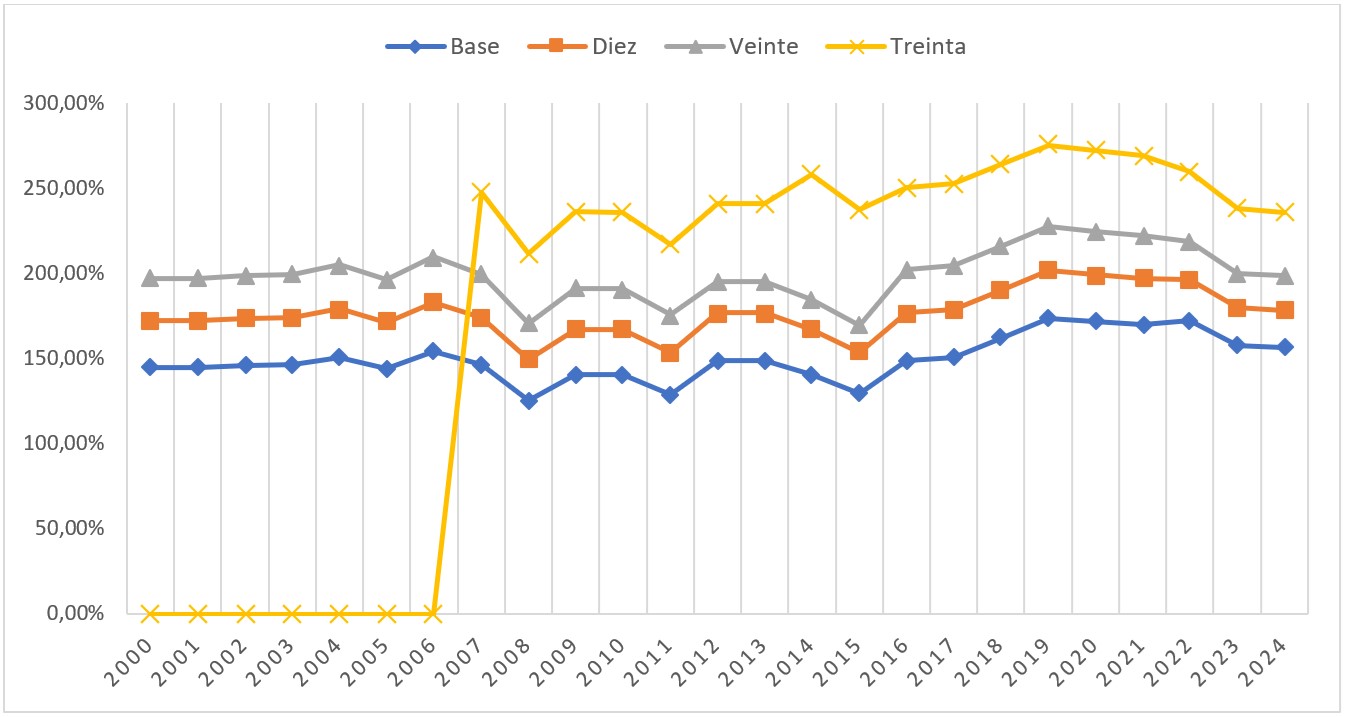 Source: Author’s own elaboration based on tables 3 and 5.
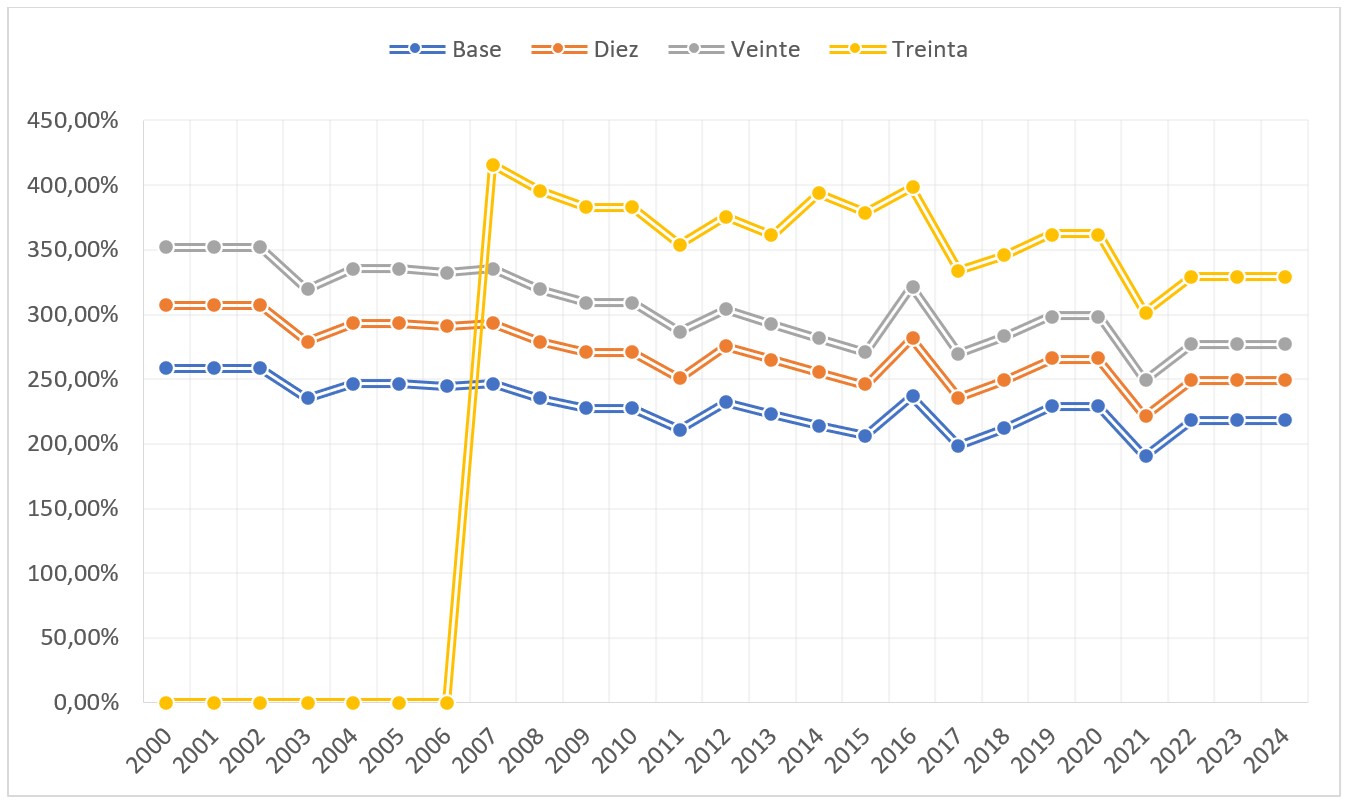 Source: Author’s own elaboration based on tables 3 and 5.
 Source: Author’s own elaboration based on tables 3 and 5