 Continuous Education at the State of Amapá: an analyzes from the National Education Plan (2015-2025)
Abstract
This paper aims to analyze the setting of the Policy of Continuous Education for professionals from educational area in the state of Amapá that is integrated to results from Goals 18 and 20 from the current Educational State Plan (PEE, in Portuguese). It also aims to show how this policy has been developed and how its alignment with national and state plans for education. It’s a documental and qualitative research, which references for analyze were: Decree number 118/2022-SEED, that institutes the policy statewide; Report from the Fourth Cycle for Monitoring the Achievements of National Education Plan (PNE, in Portuguese); and the Monitoring Report of the biennium 2018/2019 for State Plan. Analyzing the document which instituted the Policy for Continuous Education in the State of Amapá highlighted that the text was written under a private ideology. It was also verified that such policy intends to adequate the education to curricular standards nationally established, in special to the guidelines established by the Common Core State Standards (BNCC, in Portuguese). Referring to Achievement 16 from PNE, it can be noted that the State of Amapá had a little advancement. Even more than to highlight the above-mentioned goal will not be achieved, the national overview expressed the scenario of reginal inequalities. The data analyze presented at the PEE’s Biennium Report and at the Report of the Fourth Cycle of PNE verified such divergence. However, it can be deduced that the determined goals will not be achieved, mainly because the term for both plans is to finish. Concerning specifically about the Achievement 18 of PEE 2015/2025, the implementation of the Policy of Continuous Education for education professionals in Amapá in 2022 enabled its partial fulfillment.
Keywords
Continuous Education for education professionals; Policies for Continuous Education; National Education Plan; State of Amapá
Resumo
Este estudo analisa a configuração da Política de Formação Continuada dos profissionais da educação do Amapá integrada aos resultados das Metas 18 e 20 do Plano Estadual de Educação (PEE) vigente. Objetiva, portanto, demonstrar como essa política vem se desenvolvendo, e seu alinhamento aos planos nacional e estadual de educação. Trata-se de pesquisa qualitativa e documental, cujas referências de análise foram: Portaria nº 118/2022-SEED, que instituiu a referida política em âmbito estadual; Relatório do 4º Ciclo de Monitoramento das Metas do Plano Nacional de Educação (PNE); e Relatório de Monitoramento do Biênio 2018/2019 do Plano Estadual. A análise do documento que instituiu a Política de Formação Continuada no estado do Amapá evidenciou que sua tessitura foi alicerçada sob viés ideológico privatista. Verificou-se, ainda, que tal política pretende adequar as formações aos padrões curriculares estabelecidos nacionalmente, especialmente às diretrizes traçadas na Base Nacional Comum Curricular (BNCC). No tocante à Meta 16 do PNE, observou-se que o Amapá obteve pouco avanço. Além de evidenciar que a referida meta não será atingida, o panorama nacional expressou o cenário de desigualdades regionais. Na análise dos dados apresentados no Relatório Bienal do PEE e no Relatório do 4º Ciclo do PNE verificou-se relativa divergência. Entretanto, depreendeu-se que as metas consignadas provavelmente não serão alcançadas, sobretudo pela proximidade do término da vigência de ambos os planos apreciados. No que concerne especificamente à Meta 18 do PEE 2015/2025, a implementação da Política de Formação Continuada dos profissionais da educação do Amapá em 2022 possibilitou seu cumprimento de forma parcial.
Palavras-chave
Formação continuada dos profissionais da educação; Políticas de formação continuada; Plano Nacional de Educação; Estado do Amapá
Introduction
Over time, continuous education is worthing considerable highlight on debates and studies about educational policies, nationally and internationally. For Gatti, Barretto and André (2011), internationally, such studies are usually presented in events and publications with thoughts, especially the ones from European and Latin-American countries, converging to the same adversities lived in Brazil. Among the main problems pointed out, the absence of participation from educational professionals to elaborate applied policies, the lack of structure to maintain initial and continuous education, and the characterization of disconnected formations of practical and contextual necessities.
In general, the guiding principles from Brazilian educational policies reflect the constants influences of neoliberal global policies, mainly the emends from international bodies (OIs, in Portuguese). When recommending measures and orientations directed to the educational area, they strategically aim to insert private logistics into different dimensions. The justification used is focused on the speech of contribution and guarantee of higher quality and efficiency to public education systems.
The national repercussions are pointed out in many studies under human capital logistic (Evangelista; Decker, 2019; Laval, 2018; Shiroma, 2018), which ideal is concretized by competences demands for workforce and in quality standards established by the OIs. For the authors, the educative policies are supported by excellence of results and by expert and flexible development of educational professionals, making them responsible for educational quality.
So much is also being debated about the implication of changes on educative contend and curricular standards reduced into competences and abilities (Diniz-Pereira, 2021; Hypolito, 2019, 2021; Shiroma, 2018). Such amendments on public education are being referred to as several educational decrees regulated nowadays and, among them, the BNCC stands out. This scenario of managemental and neoliberal influences, states and cities adopted measures to insert continuous education of the educational professionals on their educational policies. As primary initiative, it aims to integrate this theme into states and/or cities plans for education from goals and strategies established on PNE 2014/2024.
Talking about the State of Amapá, the PEE 2015/2025, established by Law number 1.907/2015-GEA, contemplates goals and strategies covering continuous education, specifically Goals 18 and 20. Such goals are consequences guided by Goal 16 of the referred PNE that aims to train 50% of basic education for post-graduation level until 2024. It also aims to guarantee continuous education to all basic education professionals in their actuation area.
Before the exhibited, this study tried to think about the following guiding question: how the Policy of Continuous Education of education professionals in the state of Amapá, integrated to the results of Goals 18 and 20 of PEE 2015/2025, is being developed?
Starting from the presuppose that all research requires rigorous epistemological foundation, which clearly demonstrates theoretical positioning of the researcher (Gomide; Jacomeli, 2016). Scientifical logistics to be established must necessarily articulate techniques, methods and theories on a determined focus (Gamboa, 2003).
Thus, considering the central aspects of the research, qualitative research was used, based on documental analysis according to criteria that enables a dynamic of investigation and problematization. It was considered as documental corpus to analyze Decree number 118/2022-SEED that established the Policy of Continuous Education of education professionals at Amapá; the Report of the Fourth Cycle of Monitoring PNE’s Goals; and the Monitoring Report of PEE 2015/2025 (biennium 2018-2019)4 of the State Secretariat of Education of Amapá (SEED/AP, in Portuguese). Such documents were analyzed based on technique of content analysis (Moraes, 1999).
The paper is divided into three sections, beyond Introduction and Final Considerations. Firstly, the connection established between Goals 18 and 20 from PEE and Goal 16 from PNE was approached, as well as its consequences. On the second part, the Policy of Continuous Education of the professionals from educational area of State of Amapá network was analyzed. The document was analyzed according to its involved temporality, interests and subjects, on such way to seize its essence and historical meanings which composed it. In the third section, analyzes from Goals 18 and 20 from PEE 2015/2025 were made, which approaches specifically about the continuous education of professionals from education area in Amapá. Thus, the data presented in the Report from 4thCycle of Monitoring PNE’s Goals and in the Biennial Report 2018/2019 from PEE (SEED/AP) were used as documental reference.
From the analysis of these documents, at the Final Consideration was made a panoramic summary of continuous education of professionals from education area in Amapá in order to highlight the setting from such policy in Amapá’s scenario, especially because the term is near to end.
Interfaces of PNE 2014/2024 Goal 16 at PEE/AP 2015/2025
In the educational context, the production of documents, independently from its origin, form or support, not only express educational guidance and guidelines, as well as articulates institutional, political and economic interests that are hegemonically manifested in the society (Evangelista, 2009). So, “[…] they are not exempt, naive productions; they bring readings and way to interpret what was lived by a group of people on a determined time and place” (Silva et al., 2009, p. 4556).
Thus, the educational laws and norms are also results from a historical process and of social struggle. In spite of the resistance from the category and from entities of representative classes, it can be noted that contemporaneous educational policies are being aligned with the tendences and guidance of OIs. The focus of these organizations has been to attend to new demands from labor world.
Even more, it’s comprehended that there was a recrudescence of neoliberal ideas on educational area, since the educational reforms established on the 90’s in Brazil. This scenario of flexibilization and opening to private sector enabled the businessman to legitimate and amplify its incidence at debates about educational public policies.
So, it’s considered that this scenario of private interference is that the main propositions referent to initial and continuous education of education professions were established and materialized into normative instruments. Among them, it shall be highlighted: Law of Guidelines and Bases of National Education (LDB, in Portuguese), PNE 2014/2024 and CNE Resolution/CP number 01/2020, disposing about National Curricular Guidelines for Continuous Education of Professors from Elementary Education (BNC – Continuous Education).
However, from PNE 2014/2024 the states and cities must adopt even more systematized measures, inserting continuous education on their actions and/or projects, in order to attach it into the scenario of educational policies. This uniformity can be noted mainly on the states/cities plans and on the respective strategic plans as a way to fulfill its goals nationally established.
On this scenario, PEE 2015/2025 of state of Amapá, established by Law number 1,907, from June 25th, 2015, contemplates goals and strategies that approach continuous education for the decade 2015-2025, specifically Goals 18 and 20, explained on the following Chart 1:
Both goals are consequences from Goal 16 of PNE 2014/2024, which is destined to promote education for education professionals, according to the following Figure 1:

On the section reserved for diagnosis from such goals, it will be seen that SEED/AP assigned even more emphasis to Goal 18 of the state plan, especially about programs supporting education and the establishment of the Policy of Continuous Education at Amapá. However, the educative actions are being performed with reduced workload and with thematics directed to BNCC and to Technologies of Information and Communication (TIC, in Portuguese), according to the following Table 1:
It can be noted that courses are directed to develop competences and abilities linked to BNCC, focusing on Portuguese and Math, as well on educational technologies and tools. About this tendence, many writers (Diniz-Pereira, 2021; Hypolito, 2019, 2021; Shiroma, 2018) have critics about this curricular uniformization conferred to professors education on contemporaneous educational legislations. The questionings go through, especially, by adopting curricular model of competences proposal by BNCC, linking professional performance to performance and competitive practices.
This curricular alignment also can be noted in the Policy of Continuous Education for educational professionals from Amapá established in 2022. The first stages of its elaboration began in 2021 and had as consequence the publication of Decree number 118/2022-SEED, from August 22, 2022. This normative will be analyzed in the sequence in a detailed way.
The Policy of Continuous Education of educational professionals from Amapá: context, temporal course and establishment
Regimentally, in SEED/AP scope, the formative actions directed to educational professionals are from liability of the Core of Continuous Education (NUFOC/SEED). However, spite of formally existing an exclusive sector to manage such education, until 2022 there wasn’t a specific educational policy established for this area, and the goals indicated by the state plan were the main document guiding the policy for training professors. This situation favors the performance of specific and dispersed educative actions, without guidelines defined by this state entity.
Only in 2021, after the establishment of BNCC, that the process to create the Policy of Continuous Education from Amapá began, followed by some precedents stages, according to Figure 2:

During the event “I Seminar of Amapá about Professors Continuous Education: Routes to a quality education and learning”, promoted by SEED in 2022, some speeches indicated that the idealization of the Policy of Continuous Education for Amapá’s state network occurred since BNCC establishment. The goal was to align the training of education professionals from Amapá to curricular patterns and guidelines nationally established.
Equally, Resolution number 01, from October 27, 2020, about Curricular Guidelines and BNCC-Continuous Education, keeps the compliance to BNCC pedagogical principles and foundations. On this document, the precepts are also categorized in competences and abilities. Such focus is highlighted in disposals contained in a single paragraph of the referred decree:
These professional competences presuppose, by the professors, the development of General Competences published on CNE/CP Decree number 2/2019 – BNC-Initial Education, essential for the promotion of situations favorable for significant learning by the students and the development of complex competences, to give new meaning to fundamental values for the education of freelance, ethics and competent professionals (Brasil, 2020, p. 02).
The prescriptive nature of the documents guiding educative process is inducing the education of professionals that are adaptable to labor market, endowed with a variety of information and less scientifical knowledge (Diniz-Pereira, 2021; Simionato; Hobold, 2021). Moreover, according to Shiroma (2018), knowledge centrality in determined competences and learning create professional education and development of a practical professor and stimulate its lack of intellectualization.
Continuing the analyze of the Policy of Continuous Education from Amapá, it was verified that an Elaboration Commission for this document was established in 2021. Among various pertinent attribution, the created Labor Group (GT, in Portuguese) was responsible to elaborate the preliminary version of this Policy. Such version subsidized the Public Consultancy performed in the same year, according to disclosure at the institutional site from state government at the time.
According to the information at the institutional disclosure, the participation of professionals would be effective by fulfilling an online form available at the Google Forms. The goal was to receive contributions in order to enhance document’s final version.
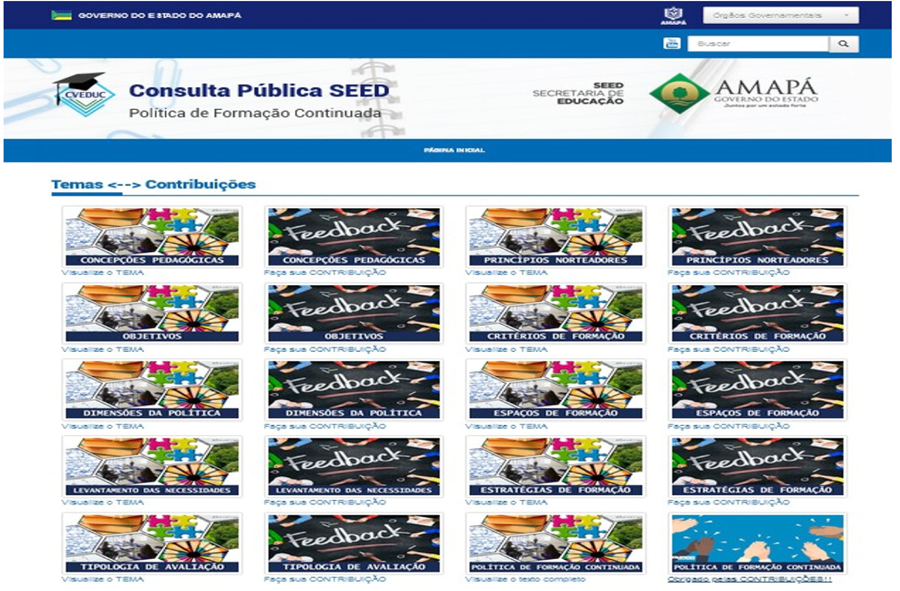
Accessing the institutional page of Public Consultancy, it was verified that this page was categorized on nine thematic axis: Pedagogical Conceptions, Guiding Principles, Goals, Education Criteria, Policy Dimensions, Spaces of Education, Needs Gathering, Education Strategies and Evaluation Typology. On each topic, part of the document created by GT was made available. Besides, the option to access participant’s feedback was also available, according to the following Figure 3:

At the end of the page destined for Public Consultancy, the full final version from the document Policy of Continuous Education was made available for download. On the previous version of this document, it was noted that its creation was motivated by the need for enhancement of the educational quality from Amapá, justifying with the idea of failure of the scholar system, due to unsatisfactory results obtained by students on the Index of Elementary School Development (IDEB, in Portuguese) evaluations, which reference basis was the year 2019.
The training of professionals from education area was indicated as decisive factor for the performance obtained on the evaluations. According to the document “[…] the weak initial or continuous education of the professors has been pointed as one of the main reasons for the bad index from national notes in the systems of measurement of learning, adopted and available in Brazil” (Amapá, 2021c, p. 32, our highlight).
During all the session reserved to justify the policy, it was noted some tendence to attribute to education professionals the liability by educational results and the wished reach of the quality of education on global level. This finding can be noted on some speeches, such as: “The educational professional is, with no doubt, fundamental part for a system compromised with quality of the educative process” (Amapá, 2021c, p. 33); “The professor role is absolutely central to build an education of quality” (Amapá, 2021c, p. 33); “There’s no way to talk about quality’s education, so, without mentioning the process of continuous education for professors” (Amapá, 2021c, p. 34).
It’s also important to highlight the contradiction present on speeches officially reproduced when the investment on an independent Policy of Continuous Education was emphasized but aligned and subordinated to BNCC. On the document was highlighted: “Even more than LDB/1996 and PNE/2014, it’s important to point out the necessity of Policy of Continuous Education (2021) of the State of Amapá be aligned to principles established at Common Core State Standards (BNCC/2018)” (Amapá, 2021c, p. 37, our highlight).
Thus, what would be the independence grade attributed to an educational policy implanted in consonance with other BNCC guidelines and precepts? Moreover, even if BNCC wasn’t directly mentioned in Decree number 118/2022-SEED, the competences and abilities were expressed in its articles 3º and 5º as basis categories for the group of formative actions:
Art. 3º It’s comprehended as Policy of Continuous Education:
I – The group of actions directed to educative processes of the education professionals, intending to provide the build and/or new meanings of knowledges, abilities, attitudes and values by mean of competences, trying to achieve essential learnings to surpass the problems and challenges of scholar routine.
Art. 5º Goals of the Policy of Continuous Education of Education Professionals are:
VI – Benefits the development of the professional from school staff, amplifying cultural, social, and intellectual horizons, trying to update knowledges and learning competences that may modify this policy, qualitatively (Amapá, 2022a, p. 2, our highlight).
There is an agreement among many authors (Shiroma, 2018; Diniz-Pereira, 2021; Hypolito, 2019, 2021) that the education model based on the curricular pattern in competences and abilities aims to a pragmatic and regulatory setting of education and work from educational professionals. This model also stimulates the emphasis on use of evaluation methods and systems to make available the monitoring results and the achievement of goals.
The article. 5º of the decree in analysis presents five goals of the Policy of Continuous Education clearly reflecting such intentions:
VII – Promote the measurement of such educational practices, which target is the quality of professor action, translated in data ensuring the effective progression of the index to be achieved;
IX – Enable the continuous education so holistic as possible, aimed to time, spaces, material and human resources and mainly, results management;
X – Enable the performance of managers and educators to new strategies of learning-teaching be transformed into results;
XVI – Make possible that the continuous education performed by SEED/GEA could stimulates the participant to establish achievements of efficiency that could be translated into a better education quality;
XIX – Use new and diversified strategies of evaluation, not only of the didactic doing itself, but also the student learning, from results achieved or based on what can be deducted from it (Amapá, 2022a, p. 13, our highlights).
On this direction, it’s possible to note that educational actions more and more look for the development of performing, practical professionals who attend to new demands (competences and abilities) imposed by the labor market. Such tendence is predominant at the Policy of Continuous Education of Amapá.
It’s important to highlight that whole process of creation and formalization of the document counted with the institutional partnership of Lemann Foundation, which representant is part of the movement Everybody For Education (TPE, in Portuguese). By means of the Education Program, such organization promoted assistance and capacitation to GT responsible by the creation of the previous version of the normative. This means that the formalized policy was created by a strong private ideological slant and the following Figure 4 shows institutional relations involved in this process:

So, it can be concluded that the Policy of Continuous Education instituted in the state of Amapá be aligned with international patterns established on Brazilian educational legislations. One of the perceptive references is its adequation to curricular patterns nationally established, especially to guidelines established on BNCC. It was also noted that the document brings conceptions and ideology of hegemonic group/institutions such as Lemann Foundation.
Despite the establishment of the Policy of Continuous Education, the actions performed aims to fulfill the PEE 2015/2025 goals, centered especially on offering online courses of short duration and with significant evasion tax (as demonstrated on Table 1, when relating the number of enrolled students to the certifications issued), highlighted a dissonant representation among national and state data. However, both scenarios showed the unfeasibility to fulfill the prescribed goals. About this, more analytical elements will be presented on the following section.
Diagnosis and perspectives about Goals 18 and 20 of the State Plan of Education 2015/2025
According to what was discussed in the first section, Goals 18 and 20 from PEE 2015/2025 are consequences from PNE’s Goal 16, aiming to educate 50% of the professors from elementary school on postgraduate level until 2024 and ensure continuous education to all professionals from elementary school in their areas. On the state plan, Goal 18 is destined to policies and programs supporting continuous education, and Goal 20 aims to educate at least 50% of the professionals from education area from Amapá on postgraduate level.
Analyzing the data about PNE’s Goal 16, it was possible to note that Amapá obtained a little advance, particularly concerning the quantity of postgraduate professors: 22.2% in 2013 to 39.1% in 2021, representing a variation of only 16.9% on 8 years of the plan’s term. Despite of being above the average achieved by region North, the level achieved by Amapá is lower than national average, according to the following Graphic 1:
More than highlighting that such goal will not be achieved, national overview expressed the scenario of regional inequalities. According to Report of the 4th Cycle of Monitoring PNE’s Goals (2022), the percentage of postgraduate professors in region South is 64.0% and in region North is 35.6%, representing a difference of 28.4% between both regions.
Similar situation can be noted relating to Goal’s second achievement – 100% of professionals from elementary school with continuous education courses until 2024 -, being that the national index points the impossibility to fulfill this achievement. This happened because, despite of the Report highlights a tendence for a national increase in the proportion of professors who carried out continuous education on the analyzed term (36.6% in 2013 to 40.0% in 2021), it can be understand that 100% it will be hardly achieved until the term ends.
Concerning to PEE’s Goal 18, which focus is in the creation and in the implementation of policies of initial and continuous education of professionals from elementary school from Amapá, the Report of Biennium Monitoring of the Plan (2018-2019) presents relevant data about this aspect. According to this document, the number of professionals at state elementary school in 2018 was 9,926. In 2019, there was a light decrease in this number, going to 9,800. Before this gathering, the following data about the quantity of professionals from Amapá’s network carried out continuous education courses in 2018 and 2019, presented in Graphic 2:
It can be noted that there was a great increase in the number of participants in educative actions, corresponding to 50.60% of the total of professionals that year, even with a decrease in the number of officials through the years. This sudden increase is mainly consequence of the joining of offers of continuous education on modalities presential, online (EaD, in Portuguese), or even hybrid.
For Gatti (2008, p. 65): “Online education or hybrid (presential/online) has been the way chosen for continuous education of professors by public policies, not only in federal level but also in state and city levels”. Thus, it’s possible to affirm that SEED has been strategically trying to reach the goals established in PEE 2015/2025, focusing on offering and expanding continuous education to professionals in Virtual Environments of Learning (AVA, in Portuguese).
Analyzing the data in the Report of PEE’s Monitoring (biennium 2018/2019), it was verified relative divergence when comparing to Report of the PNE’s 4thCycle, according to the following Table 2:
It can be noted that data presented in the document created by SEED referent to biennium 2018/2019 showed index higher than the ones disclosure on the 4th Cycle of PNE’s Monitoring, having as basis the year of 2021. Concerning the index of professors that carried out education courses, the biennium report shows that 51.60% carried out educative actions in 2019, while the national document shows that the average was 43.5% in 2021, corresponding to a difference of 8.1% more or less. According to the number of professors with postgraduate degrees, the biennium report informs that 47.66% of professors from Amapá had specialization, master or doctorate degree in 2019; PNE’s report highlighted that only 39.1% in 2021.
Concerning the divergence between the data presented in both monitoring reports, it can be understood that the consigned goals probably will not be achieved, not only nationally but also locally, especially because the term of these documents is to end. Especially about Goal 18 of PEE 2015/2025, the implementation of the Policy of Continuous Education of educational professionals from Amapá in 2022, analyzed on the previous section, enabled its partial fulfillment.
It’s possible to note that one of the most difficult obstacles to effectively fulfilling of PNE’s Goal 16 is still in access, permanence and mainly, finishing continuous education courses. Table 3 detailing presents educative actions performed by SEED in 2021:
Among information, it calls attention to the higher number of evasions from courses (57.6%) and the reduced number of concluding students (42.3%). These data may be related to problems pointed out on studies that are been carried out nationally and internationally about continuous education, for example: the absence of education professionals elaborating such policies and the dealignment among educative contents and their practical and pedagogical needs. It’s also pointed out that subjective aspects of each professional, such as lack of time, holding multiple positions, overload and the precariousness of labor relations. These barriers may affect or make unable courses ongoing.
Another factor which affects the fulfillment of Goal 20 from PEE 2015/2025 is related to difficulties and bureaucratization by maintaining part when conceding licenses for studies and enhancement on postgraduate level. This happens because the principle of administrative discretion is applied to this right.
Analyzing SEED’s Management Reports from 2019 to 2021 identified a tiny number of professionals temporally detached by licenses to study and enhancement: four in 2019; two in 2020; and no one in 2021.
Early, it’s pointed out the fact that the normative text ruling Amapá’s public officials (State Law number 0066/1993) itself makes clear the impossibility to grant scholarships for officials who study in institutions on the same place where they work. Another questioning is about the interest and necessity of management (principle of discretion) as motivations for unfavorable manifestations, empirically identified in the analyzed term.
Largely, the justifies were centered on the insufficiency of professionals to be loaded as substitutes. About this theme, it shall be highlighted that Jacomini and Penna (2016) had already pointed out the fact that many education secretariats appealed to different constraints to dismiss the appeal of professionals to study on postgraduate strict sensu level.
Consequently, the liability to continue to study without labor detachment can be attached to professionals themselves. This context points to the necessity of other studies and/or further research about this locally. It also signalizes the importance of a higher mobilization of the educational worker class from Amapá on behalf of ensuring these rights.
Final considerations
The scenario traced on this study showed that the Policy of Continuous Education from educational professionals from Amapá network has been developed interlinked to goals established in national and state governing plans. The actions are ruled on the perspective of better evaluative index and on the scope of educational quality. So, it configures an Educational Policy aimed to results.
Generally, educational actions are performed as speeches, minicourses and workshops, with low workload and themes related to development of competences and abilities, to BNCC, and education technology. Strategically, these topologies enable to contemplate a higher quantity of professionals on a minor interval of time. This explains the fact that PEE 2015/2025 Goal 18 has increasingly progressed when compared to Goal 20 during the term analyzed on the monitoring reports considered.
However, the consigned goals probably will not be achieved, especially because the term of both education plans is to end. Concerning PEE 2015/2025 Goal 18, it was noted that the implementation of Policy of Continuous Education of education professionals from Amapá in 2022 enabled its fulfillment partially. On the other hand, the analysis highlighted that its tessitura was built on contradictory conditions. This happened because its essence is corrupted by hegemonic neoliberal ideologies and it’s aligned to BNCC curricular patterns, despite a Public Consultancy having formally occurred.
The verticality from its planning and materialization, as the distance from its education content offered and the praxis lived by the professionals, there are a sequence of consequences unfavorable to continuous education and professional development, such as disinterest, demotivation and evasion. This means that the reformulation effectuated aiming to attend prompt and market interests differ from the reality of educational working class from Amapá.
It’s necessary to admit that the education neoliberal project aiming to conform the professionals to a dominant world vision is already consolidated and advances by different domination means, particularly on the continuous education promoted nowadays. Consequently, there are significant implications for politic emancipation and autonomy of such professionals. In place of autonomy, there are regulation and control; in place of criticism and scientific knowledge, technique and human capital.
So, it’s urgent the need of a political and institutional view more sensible for educational professionals from Amapá in order to enable the collective elaboration of educational policies. It’s also imperative an active participation of this category in deliberate places on behalf of a continuous education which represents its needs and wishes as fundamental actors in the educative process that historically fight on behalf of a public education system aiming quality, spreading and transforming.


– Quantity of professor from education that concluded courses of continuous education in 2018 and 2019
References
-
AMAPÁ. Secretaria de Estado da Educação. Lei nº 1.907, de 24 de junho de 2015 Dispõe sobre o Plano Estadual de Educação - PEE, para o decênio 2015-2025, e dá outras providências. Macapá: SEED, 2015. Disponível em: https://editor.amapa.gov.br/arquivos_portais/publicacoes/EDUCA%C3%A7%C3%A3O_d29705badb707c38522b2654b2deaeb8.pdf Acesso em: 10 jan. 2022.
» https://editor.amapa.gov.br/arquivos_portais/publicacoes/EDUCA%C3%A7%C3%A3O_d29705badb707c38522b2654b2deaeb8.pdf -
AMAPÁ. Secretaria de Estado da Educação. Política de formação continuada do Estado do Amapá Macapá: SEED, 2021c. Disponível em: https://nte.ap.gov.br/conpfc/arquivos/PFC_2021.pdf Acesso em: 4 nov. 2022.
» https://nte.ap.gov.br/conpfc/arquivos/PFC_2021.pdf -
AMAPÁ. Portaria nº 118, de 22 de agosto de 2022. Estabelece normas e procedimentos a serem adotados para a implementação da política de Formação Continuada para os profissionais da educação do Estado do Amapá. Diário Oficial do Estado do Amapá, Macapá, seção 2: Poder executivo, n. 7.736, p. 11-14, 22 ago. 2022a. Disponível em: https://seadantigo.portal.ap.gov.br Acesso em: 1 set. 2022.
» https://seadantigo.portal.ap.gov.br -
AMAPÁ. Secretaria de Estado da Educação. Relatório de gestão da Secretaria de Estado da Educação do exercício de 2019. Macapá: SEED, 2020. Disponível em: https://editor.amapa.gov.br/arquivos_portais/publicacoes/EDUCA%C3%A7%C3%A3O_46978899bc4ee1b1d2ea46a03a910039.pdf. Acesso em: 5 set. 2021.
» https://editor.amapa.gov.br/arquivos_portais/publicacoes/EDUCA%C3%A7%C3%A3O_46978899bc4ee1b1d2ea46a03a910039.pdf. -
AMAPÁ. Secretaria de Estado da Educação. Relatório de gestão da Secretaria de Estado da Educação do exercício de 2021. Macapá: SEED, 2022b. Disponível em: https://editor.amapa.gov.br/arquivos_portais/publicacoes/EDUCA%C3%A7%C3%A3O_e2fd94145e80e4e35c59afde08ad699b.pdf Acesso em: 25 ago. 2022.
» https://editor.amapa.gov.br/arquivos_portais/publicacoes/EDUCA%C3%A7%C3%A3O_e2fd94145e80e4e35c59afde08ad699b.pdf - AMAPÁ. Secretaria de Estado da Educação. Relatório de gestão SAGEP/SEED 2020. Macapá: SEED, 2021a.
-
AMAPÁ. Secretaria de Estado da Educação. Relatório de monitoramento do Plano Estadual de Educação- Biênio 2018/2019. Macapá: SEED, 2021b. Disponível em: https://editor.amapa.gov.br/arquivos_portais/publicacoes/EDUCA%C3%A7%C3%A3O_a93d45f9e3e4400aa9c4c53cd8d9fc99.pdf Acesso em: 10 jul. 2023.
» https://editor.amapa.gov.br/arquivos_portais/publicacoes/EDUCA%C3%A7%C3%A3O_a93d45f9e3e4400aa9c4c53cd8d9fc99.pdf -
BRASIL. Instituto Nacional de Estudos e Pesquisas Educacionais Anísio Teixeira. Relatório do 4º Ciclo de Monitoramento das Metas do Plano Nacional de Educação - 2022. Brasília, DF: INEP, 2022. Disponível em: https://download.inep.gov.br/publicacoes/institucionais/plano_nacional_de_educacao/relatorio_do_quarto_ciclo_de_monitoramento_das_metas_do_plano_nacional_de_educacao.pdf Acesso em: 10 jul. 2023.
» https://download.inep.gov.br/publicacoes/institucionais/plano_nacional_de_educacao/relatorio_do_quarto_ciclo_de_monitoramento_das_metas_do_plano_nacional_de_educacao.pdf -
BRASIL. Ministério da Educação. Lei nº 13.005, de 25 de junho de 2014. Aprova o Plano Nacional de Educação - PNE e dá outras providências. Brasília, DF: Ministério da Educação, 2014. Disponível em: https://pne.mec.gov.br/18-planos-subnacionais-de-educacao/543-plano-nacional-de-educacao-lei-n-13-005-2014 Acesso em: 10 jan. 2022.
» https://pne.mec.gov.br/18-planos-subnacionais-de-educacao/543-plano-nacional-de-educacao-lei-n-13-005-2014 -
BRASIL. Ministério da Educação. Resolução CNE/CP nº 1, de 27 de outubro de 2020. Dispõe sobre as Diretrizes Curriculares Nacionais para a Formação Continuada de Professores da Educação Básica e institui a Base Nacional Comum para a Formação Continuada de Professores da Educação Básica (BNC-Formação Continuada). Brasília, DF: Ministério da Educação, 2020. Disponível em: http://portal.mec.gov.br/index.php?option=com_docman&view=download&alias=164841-rcp001-20&category_slug=outubro-2020-pdf&Itemid=30192 Acesso em: 20 jan. 2023.
» http://portal.mec.gov.br/index.php?option=com_docman&view=download&alias=164841-rcp001-20&category_slug=outubro-2020-pdf&Itemid=30192 -
DINIZ-PEREIRA, Júlio Emílio. Nova tentativa de padronização dos currículos dos cursos de licenciatura no Brasil: a BNC-Formação. Práxis Educacional, Vitória da Conquista, v. 17, n. 46, p. 53-71, jul. 2021. Disponível em http://educa.fcc.org.br/scielo.php?script=sci_arttext&pid=S2178-26792021000300053&lng=pt&nrm=iso Acesso em: 20 fev. 2023.
» http://educa.fcc.org.br/scielo.php?script=sci_arttext&pid=S2178-26792021000300053&lng=pt&nrm=iso -
EVANGELISTA, Olinda. Apontamentos para o trabalho com documentos de política educacional. In: COLÓQUIO A PESQUISA EM TRABALHO, EDUCAÇÃO E POLÍTICAS EDUCACIONAIS, 1., 2009, Belém. Anais [...]. Belém: UFPA, 2009. n. p. Disponível em: http://pt.scribd.com/doc/211971320/texto-Olinda-PDF Acesso em: 10 set. 2022.
» http://pt.scribd.com/doc/211971320/texto-Olinda-PDF -
EVANGELISTA, Olinda; DECKER, Aline. Educação na lógica do Banco Mundial: formação para a sociabilidade capitalista. Roteiro, Santa Catarina, v. 44, n. 3, p. 1-24, 2019. Disponível em: https://portalperiodicos.unoesc.edu.br/roteiro/issue/view/366 Acesso em: 10 set. 2022.
» https://portalperiodicos.unoesc.edu.br/roteiro/issue/view/366 -
GATTI, Bernadete Angelina. Análise das políticas públicas para formação continuada no Brasil, na última década. Revista Brasileira de Educação, Rio de Janeiro, v. 13, n. 37, 2008. Disponível em: https://www.scielo.br/j/rbedu/a/vBFnySRRBJFSNFQ7gthybkH/ Acesso em: 15 ago. 2023.
» https://www.scielo.br/j/rbedu/a/vBFnySRRBJFSNFQ7gthybkH/ -
GATTI, Bernadete Angelina; BARRETTO, Elba Siqueira de Sá; ANDRÉ, Marli Eliza Dalmazo de Afonso. Políticas docentes no Brasil: um estudo da arte. Brasília, DF: Unesco, 2011. Disponível em: https://unesdoc.unesco.org/ark:/48223/pf0000212183 Acesso em: 5 out. 2021.
» https://unesdoc.unesco.org/ark:/48223/pf0000212183 -
GAMBOA, Sílvio Ancisar Sánches. Pesquisa qualitativa: superando tecnicismos e falsos dualismos. Contrapontos, Itajaí, v. 3, n. 3, p. 393-405, set./dez. 2003. Disponível em: https://periodicos.univali.br/index.php/rc/article/view/735 Acesso em: 4 nov. 2021.
» https://periodicos.univali.br/index.php/rc/article/view/735 -
GOMIDE, Denise Camargo; JACOMELI, Maria Regina Martins. O método de Marx na pesquisa sobre políticas educacionais. Políticas Educativas, Santa Maria, v. 10, n. 1, 2016. Disponível em: https://seer.ufrgs.br/index.php/Poled/article/view/69759 Acesso em: 4 nov. 2021.
» https://seer.ufrgs.br/index.php/Poled/article/view/69759 -
HYPOLITO, Álvaro Moreira. BNCC, agenda global e formação docente. Revista Retratos da Escola, Brasília, DF, v. 13, n. 25, p. 187-201, jan./maio 2019. Disponível em: http://retratosdaescola.emnuvens.com.br/rde/article/view/995/pdf Acesso em: 6 out. 2022.
» http://retratosdaescola.emnuvens.com.br/rde/article/view/995/pdf -
HYPOLITO, Álvaro Moreira. Padronização curricular, padronização da formação docente: desafios da formação pós-BNCC. Práxis Educacional, Vitória da Conquista, v. 17, n. 46, p. 35-52, 2021. Disponível em: https://periodicos2.uesb.br/index.php/praxis/article/view/8915 Acesso em: 12 mar. 2023.
» https://periodicos2.uesb.br/index.php/praxis/article/view/8915 -
JACOMINI, Marcia Aparecida; PENNA, Marieta Gouvêia de Oliveira. Carreira docente e valorização do magistério: condições de trabalho e desenvolvimento profissional. Pro.Posições, Campinas, v. 27, n. 2 (80), p. 177-202, maio/ago. 2016. Disponível em: https://periodicos.sbu.unicamp.br/ojs/index.php/proposic/article/view/8647238 Acesso em: 20 mar. 2021.
» https://periodicos.sbu.unicamp.br/ojs/index.php/proposic/article/view/8647238 - LAVAL, Christian. A escola não é uma empresa. Tradução de Mariana Echalar. São Paulo: Boitempo, 2018.
- MORAES, Roque. Análise de conteúdo. Educação, Porto Alegre, v. 22, n. 37, p. 7-32, mar. 1999.
-
SHIROMA, Eneida Oto. Gerencialismo e formação de professores nas agendas das Organizações Multilaterais. Momento: Diálogos em Educação, Porto Alegre, v. 27, n. 2, p. 88-106, 2018. Disponível em: https://periodicos.furg.br/momento/article/view/8093 Acesso em: 20 out. 2022.
» https://periodicos.furg.br/momento/article/view/8093 -
SILVA, Lidiane Rodrigues Campêlo da et al. Pesquisa documental: alternativa investigativa na formação docente. In: CONGRESSO NACIONAL DE EDUCAÇÃO - EDUCERE, 9., 2009, Curitiba. Anais [...]. v. 1. Curitiba: PUC-PR, 2009. p. 4554-5666. Disponível em: https://proinclusao.ufc.br/wp-content/uploads/2021/08/pesquisa-documental.pdf Acesso em: 10 fev. 2021.
» https://proinclusao.ufc.br/wp-content/uploads/2021/08/pesquisa-documental.pdf -
SIMIONATO, Margareth Fadanelli; HOBOLD, Márcia de Souza. Diretrizes Curriculares Nacionais para a formação inicial de professores: Padronizar para controlar? Práxis Educacional, Vitória da Conquista, v. 17, n. 46, p. 72-78, jul./set. 2021. DOI: https://doi.org/10.22481/praxisedu.v17i46.8917
» https://doi.org/10.22481/praxisedu.v17i46.8917
-
Editor:
PhD Tatiana Hochgreb-Haegele
All data supporting the results of this study were published on this paper.

 Source:
  Source: Own creation, based on the Seminar of Policy of Continuous Education from Amapá (2022).
 Source: Technology Core from Amapá (NTE), 2021. Available at: https://nte.ap.gov.br/conpfc/
 Source: Own elaboration based on theoretical input and on field research performed in 2023.
 Source: Brazil, 2022.
 Source: Amapá, 2021b.