
 The influence of a reflective practice approach on digital faculty training
Abstract
Continuing teacher education is essential to improving educational quality. However, training programs that aimed at improving digital skills often fail to consider teachers’ previous experiences, which limits their effectiveness. The reflective practice approach is a key strategy for overcoming these limitations because it helps teachers identify barriers to integrating technology into their teaching and learning practices. This study analyzes the effects of incorporating reflective practice principles into a training program for higher education faculty emphasizing the use of digital technologies in the classroom. To this end, a training program based on this methodology was designed and implemented with a group of university professors in Santiago, Chile. Then, the data obtained from the reflection guides used by the participants were collected and analyzed. The study uses a qualitative approach based on Strauss and Corbin’s grounded theory. The results indicate that the professors positively rated the program, highlighting its role as a space for innovation and dialogue. The professors emphasized the importance of collaboration and reflection when adopting technology rather than technical mastery of digital tools. The study concluded that the reflective practice approach benefits teacher training by making motivations and resistances explicit and facilitating their integration into teaching practices.
Keywords
Teacher training; Reflective practice; Digital literacy; Continuing education.
Resumen
La formación continua del profesorado constituye un pilar fundamental para la mejora de la calidad educativa. En el ámbito de las habilidades digitales, los programas de capacitación suelen seguir modelos que no siempre consideran las experiencias previas de las y los docentes, lo que puede limitar su impacto. La práctica reflexiva surge como una estrategia clave para superar estas limitaciones, ya que permite identificar barreras en la integración de tecnologías en sus prácticas de enseñanza y aprendizaje. Esta investigación tiene como objetivo analizar los efectos de la incorporación de principios de la práctica reflexiva en un programa de formación dirigido a docentes de educación superior, con especial énfasis en el uso de tecnologías digitales en el aula. Para ello, se diseñó e implementó un programa formativo basado en esta metodología con un grupo de profesores universitarios en Santiago de Chile. Al finalizar la experiencia, se recopilaron y analizaron los datos obtenidos en las guías de reflexión utilizadas por las y los participantes. El estudio adopta un enfoque cualitativo, sustentado en la teoría fundamentada de Strauss y Corbin. Los resultados indican que los docentes valoraron positivamente el programa, destacando su carácter de espacio de innovación y diálogo. Más que el dominio técnico de las herramientas digitales, destacaron la importancia de la colaboración y la reflexión en el proceso de adopción tecnológica. Se concluye que la práctica reflexiva favorece la formación docente al hacer explícitas motivaciones y resistencias, facilitando su integración en la enseñanza cotidiana.
Palabras clave
Formación del profesorado; Práctica reflexiva; Alfabetización digital; Formación permanente.
Introduction
Teacher training is an ongoing process throughout teachers’ professional careers, and it is an essential component of achieving the objectives of educational reforms (Day, 2005; Farías Veloz et al., 2023; Ibermón Muñoz; Canto Herrera, 2013; Pérez Gómez, 2010). The content included in teachers’ update courses varies greatly, with digital skills training being particularly encouraged. This subject transcends training and is often part of broader political initiatives that aim to digitize education systems at different levels in response to today’s societal needs.
There are at least three features that characterize teacher training programs in the field of digitization that have been implemented in recent years (Freixas, 2020). First is their compensatory approach: most of them are based on the teachers’ deficits, or what they do not know and should know, so they usually do not consider participants’ previous experiences and personal, social, and professional backgrounds. The second characteristic is their eclectic nature, as they are initiatives that attempt to reconcile prevailing political, institutional, economic, and pedagogical positions in each context under a single framework. Finally, they are evolutionary, which makes these programs unstable and changeable over time. For example, digital training programs have undergone various phases in recent years that coincide with the progression of technology, such as the shift from centralized digital services to cloud services and from open-license software to commercial projects. These changes have also affected the conceptual approaches that define digital skills training foundations, which have fluctuated depending on when they were formulated.
Currently, there seems to be a consensus on the need to formalize teacher technology training initiatives under the umbrella of digital literacy. Based on this formal model, various competency frameworks have been developed that have served as the basis for organizing teacher training curricula. Examples of these frameworks include the National Educational Technology Standards (NETS) in the United States (ISTE, 2024); the European Framework for the Digital Competence of Educators: DigCompEdu (Redecker, 2017); the ICDL Foundation’s International Certification of Digital Literacy (ICDL Foundation, 2024); and UNESCO’s training proposal derived from the Competency Framework for Teachers (UNESCO, 2023).
Although there is a general agreement on the importance of developing teachers’ digital skills, specific training proposals still pay little attention to the context in which teaching takes place. The focus is on acquiring the qualifications necessary for efficiently using technologies and integrating them into the classroom to transform and improve learning. To this end, teachers must acquire standardized skills corresponding to a predetermined profile without much consideration for knowledge acquired through everyday experience. However, the idea that a set of knowledge, principles, and values can be achieved in all types of teaching contexts conflicts with the autonomy and individual responsibility of those facing unique and unrepeatable situations in complex environments. Ultimately, the practical configuration of the teacher training curriculum appears to include statements containing words such as “appropriate,” “timely,” or “suitable,” as well as descriptions so general that they allow for wide interpretation (Nicoll; Harrison, 2003).
Training plans based on predefined models divorced from teachers’ reality are unlikely to transform teaching practices (Perrenoud, 2004). Homogeneous conceptions of teacher profiles and competencies do not provide the necessary tools for change. When teacher training is viewed as merely transmitting knowledge on specific topics—in this case, the specific skills associated with properly using technology in a particular learning context—a gap emerges between what that knowledge offers and what teachers need to experience, consider, and do in their daily work (Vieira; Baptista; Almeida, 2021).
To overcome these limitations, we propose incorporating reflective practice as a methodological complement to teacher training programs focused on digital literacy. This approach can help contextualize highly prescriptive training programs by assuming that teachers work in changing, complex environments where they must apply strategies and make appropriate decisions, exercising their profession in a unique, unrepeatable way (Freixas et al., 2020).
This research aims to analyze the effects of incorporating reflective practice principles into a training program for higher education teachers that emphasizes the use of digital technologies in the classroom. To this end, two research questions were formulated: (1) How does reflective practice improve teacher training for adopting digital technologies, and (2) which elements of teaching practice supported by digital technologies are of most concern to teachers?
The following sections present the conceptual foundations of the reflective practice approach and the corresponding analysis of the data obtained from our experimental intervention, along with the research results.
Reflective practice and digital technologies in teaching
The literature consistently states that reflection is essential to transforming teaching practice (Day, 2001; Pérez Gómez, 2010; Zeichner, 1993; Recio-Muñoz; Joo, 2021). In recent years, reflexivity has been present in various forms of teacher training (Olmedo, 2023). Reflective practice has mainly been used to enable teachers to reflect on, understand, explain, and intervene in their work to enhance their professional development. Schön (1983; 1992) assumes that transforming educational practices hinges on teachers’ ability to reflect on the practices they seek to improve. Brockbank and McGill (2002), in turn, define reflection as the process of returning to one’s thoughts.
According to Schön (1992), rational and academic knowledge alone are insufficient for dealing with the complexity and diversity of educational situations. Recovering practical reason—experiential knowledge based on dialogue with reality and reflection on action—is also necessary. Teachers acquire tacit knowledge and skills throughout their professional practice that are not recognized in teacher training programs. Transforming this tacit knowledge into explicit knowledge can be achieved through reflective processes, which counteracts the view that teachers are technicians who merely reproduce what others prescribe. Teachers’ knowledge cannot be reduced to what they can declare; there are other implicit types of knowledge that only become evident when activated during classroom practice (Satumbo Martinho; Samuel, 2022).
In teacher training, reflective practice is defined as a methodology based on teachers’ contextualized experiences and reflections on their practices (Domingo, 2022; Nocetti et al., 2020). When applied to training in digital technology, reflective practice involves viewing teachers as individuals situated in a social and school context, each with a unique personal history that influences their relationship with technology and the feelings that arise from it. These feelings are reflected in both training processes and classroom practice. Reflective practice enables teachers to use technology in the classroom instrumentally and to problematize their practice, reorienting teaching strategies and encouraging the creative use of technology.
Such an approach should draw on some of the principles of reflective practice proposed by Nicoll and Harrison (2003): i) Knowledge in action: It is essential to recognize each person’s life history, build on their previous experiences, and draw on their expectations of the training program. This allows for a more personalized and relevant approach to the learning process. ii) Reflection in practice: Encourage the problematization of professional practices by addressing specific issues related to the discipline, pedagogy, or students. This should be done explicitly by verbalizing and sharing with colleagues. The individual design of teaching situations that seek to solve a specific problem using digital tools should be promoted. Additionally, intervention in the classroom should be accompanied by guides that allow for reflection on pedagogical action in real time. iii) Reflection on practice and on reflection: Self-assessment exercises among colleagues that promote reflection through comparison of individual experiences with those of the group should be carried out among colleagues. Interaction is a key aspect not only for socialization but also for facilitating learning, collaboration, and collective construction.
In the case of digital literacy, it is important to consider that reflection should transcend what happens in the classroom and encompass aspects of personal life related to technology, as technology is now and integral part of everyday life. To this end, the literature suggests various continuing education methodologies to encourage teachers to be more analytical in their teaching practice and its context. These methodologies include action research, writing and reading case studies, creating portfolios, documenting the nature and quality of their teaching, participating in mentoring or storytelling programs, sharing best practices, and attending academies and seminars (Nocetti et al., 2020). However, none of these strategies directly address reflection on technology. The specific purposes and how they are implemented are relevant here, as well as pedagogical support as a strategy for reflective practice.
Since the habit of reflection is formed through practice, teacher digital training programs should include guidelines for both individual and group reflection. These programs should also provide alternatives for monitoring and supporting classroom interventions with students based on their progress in the training program. Implementing these guidelines simultaneously with the program will develop the ability to research teaching methods and, fundamentally, evaluate the effectiveness of using technology to address classroom issues.
Methodology
To further explore the influence of reflective practice on teacher training in digital technologies, a training program based on this methodology was implemented for a group of university professors. Afterward, the data collected from the reflection guides prepared by the professors during the final phase of the program were analyzed.
A qualitative approach was used for the research and data analysis. Specifically, we referenced the grounded theory presented by Glaser and Strauss (1995) and Strauss and Corbin (2002). According to Palacios Rodríguez (2021, p. 47), this theory “provides explicit guidelines that facilitate understanding and explanation of behavior and reality in specific areas of interest”. The study is structured around the previously posted research questions, which guided the fieldwork and data analysis. For this study, grounded theory was adapted to fit its conditions, particularly the data collection procedures. While traditional approaches to this methodology emphasize direct observation and data collection in natural settings, this study used an open-ended questionnaire administered to higher education teachers. This adaptation allowed us to capture the teachers’ perceptions and experiences with digital technology in teaching and identify emerging patterns and categories in their responses. Although this approach limits the possibility of observing practice in real time, it provides access to a broader, more diverse sample, enriching the analysis from an interpretive perspective based on the teachers’ discourse.
The study was conducted in accordance with ethical research principles, ensuring the informed consent of participants, who were informed of the study’s objectives and scope prior to their participation. Responses obtained through the questionnaire were kept completely anonymous to ensure data confidentiality. In addition, participants had access to the obtained results, promoting transparency and recognizing their contribution to the research process.
The characteristics of the teacher training program, the profile of the participants, and the approach of the reflection guide or open questionnaire used as a data collection tool are presented bellow.
Context and characterization of participants
The study was conducted at a medium-sized Chilean public university, mainly focused on engineering and computer science programs. The institution has an academic staff of approximately 790 teachers, with diverse backgrounds and employment arrangements, and an enrollment of close to 8,500 students.
The training program “ICT for university teaching” was designed and implemented in 2017 as part of the university’s institutional strategy to promote the intensive use of digital technologies in teaching practice, particularly those developed at the university itself. It is held annually and, as of 2022, 320 faculty members have graduated (Concha et al., 2022).
The program lasts 150 hours and is organized into three stages with specific purposes, dynamics, and activities aimed at achieving the overall objective of supporting the adoption of digital technologies in teaching (Figure 1). The aim is for participants to experiment with new learning strategies using digital technologies, to dare to design their courses based on their own problems, and to reflect on the ways in which students can achieve meaningful learning.

The training program begins with exercises in which participants reflect on their expectations and the individual commitments they undertake. Although there are common objectives, the scope of the training is determined by each participant.
For the program being evaluated, 71 teachers participated, and data from those who successfully completed it were taken into consideration. Consequently, the criteria that participants in the sample had to meet were: i) to have completed the training program, ii) to have completed the design of their course, iii) to have applied the proposal with their students, and iv) to have participated in a face-to-face session with their colleagues, presenting collectively the obtained results. 47 participants met these conditions.
At the end of the classroom intervention process, participants were asked to reflect on their experience in designing the course and applying it with students as a self-assessment exercise. The self-assessment guide or questionnaire presented below, derived from the reflective practice methodology, was the final reflection guide for the course.
Process of developing and applying the guide
A guide with open-ended questions was developed to analyze the content generated by the course instructors. This is one of the essential tools of the program and consists of 10 questions inquiring about the results of the classroom intervention.
The questions were developed based on a combination of institutional requirements and the objectives of those responsible for the course. These questions respond to the characteristics of the process followed in the program and are aimed at promoting participants’ reflection on their experience, both in the design of their course and its application. They are as follows (Freixas, 2020, p. 136):
-
What did you find in terms of student learning when designing strategies based on a problem related to a specific aspect of your course?
-
What did you find when incorporating technologies as tools for accessing information?
-
What did you find when incorporating technologies as tools for recoding information?
-
What did you find when incorporating technologies as tools for socializing information?
-
Which elements contributed most to student learning?
-
Which elements contributed least to student learning, or hindered it?
-
What were the main benefits of working based on problematization and designing strategies with active methodologies and the use of ICT?
-
What were the main difficulties you encountered in transforming your practice based on your proposal and its application?
-
Which aspects would you modify or improve for the next application?
-
Comments.
Of the 47 participants who met the profile for analysis, 45 responded.
Coding process
Methods derived from the grounded theory (Glasser; Strauss, 1995; Strauss; Corbin, 2002) were used to analyze the information. The 45 completed guides were analyzed. An open and inductive process was chosen, based on the grouping of minimal units of meaning (MUM) or “memos” into codes. Based on this grouping, it was determined that some of them could be grouped into categories in terms of their semantic similarity, making it possible to purge those that were of little relevance due to their low frequency. The resulting categories, in turn, could be associated in two dimensions. The inductive process followed is detailed below:

As a result of the process, 46 codes were obtained. They were grouped into 10 categories and finally organized into two dimensions that reflect the participants’ thoughts on the practice:
-
Generic aspects. These refer to cross-cutting issues that apply horizontally to the entire process and integrate the categories Obstacles, Results, and Improvements.
-
Elements of teaching practice. This refers to specific aspects of teaching and groups the categories: Teaching, Students, Digital Technologies, Teachers, Content, Communication, and Infrastructure.
Figures 3 and 4 show the reorganization of the units of meaning into codes and categories based on these two dimensions.


Results
The information collected and organized into codes, categories, and dimensions was systematized in a matrix to carry out a cross-sectional analysis. Table 1 shows the frequencies found for each of the categories and their respective codes.
For generic aspects, 273 MUM were found, representing 25% of the total. Graph 1 shows the frequency of categories in this dimension.

The first category brings together the obstacles identified by participants. The frequency indicates that, despite the positive results reported, there are still many issues to be overcome, notably the time factor. This aspect, which was not previously considered in the design, is mentioned multiple times in relation to its insufficiency for the organization of teaching and even for the proper use of digital technologies in the classroom. Finally, the category of improvements includes those that participating teachers documented as a result of reflection on their practice.
Regarding the second dimension, Elements of Teaching Practice, 833 MUM were found, corresponding to 37 codes grouped into 7 categories, as shown in Graph 2.
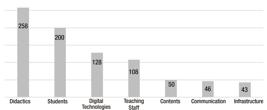
As can be seen, once the program had concluded, the concerns and reflections of the teaching staff focused mainly on teaching strategies and student management. In these first two categories alone, the frequency of the MUMs reached 54% of the total. This suggests that participants were keen to reflect on and experiment with ways of improving their teaching practice and its impact on student learning, motivation, and attitudes.
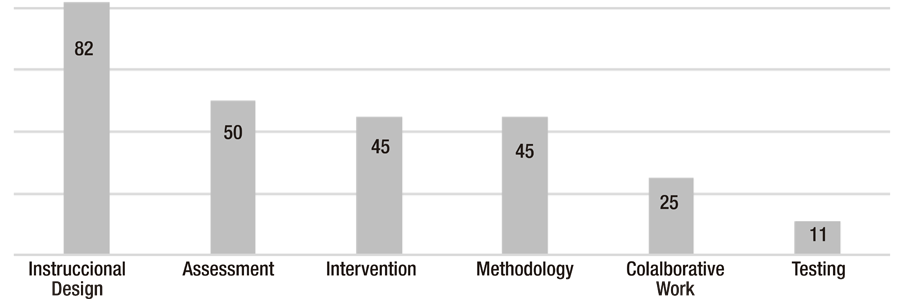
Graphs 3 and 4 show the frequencies of the MUMs sorted by codes in these two categories.


Regarding teaching, instructional design ranks first as a recurring theme in the reflections, revealing concerns about improvement and the importance teachers place on designing their courses prior to intervention as a key element in the adoption of digital technologies.
With regard to students, the most frequently used code is Learning, followed by Cognitive Processes. This result shows a clear interest on reflection focused on promoting learning, the achievements obtained, and investigating the cognitive processes that need to be developed in students.
Discussion
As shown, continuing education for teachers is a decisive factor for the successful integration and adoption of digital technologies in the classroom. According to the research carried out, the literature also points out that teacher training programs related to digital technologies develop skills for the use of computer systems (Wozney; Venkatesh; Abrami, 2006) and influence teachers’ attitudes (Llopis et al., 2021). Along with participation in these programs, reflecting on professional practice is considered an appropriate resource for the objectives of reorienting teaching strategies and promoting a more creative use of technologies.
This research analyzed the impact of introducing the principles of reflective practice (Schön, 1992; De Lella, 1992; Zeichner, 2013; Brookbank, 2002) into the design and implementation of a digital technologies teacher training program. The training proposal integrated various methodological principles: considering the teacher’s life history; starting from experience; recovering expectations; encouraging problematization and addressing specific issues related to the discipline, pedagogy, or students; encouraging the individual design of teaching situations that aim to solve a problem using digital tools; and incorporating a self-assessment process that involves reflection through the confrontation of experiences.
The study data come from a sample of teachers who participated in a training experience where they had the opportunity and space to carry out reflective processes as a basis for innovation in their teaching and based on the introduction and adoption of digital technologies in the classroom. Although changes in their practice resulting from a training event can be observed immediately, confirming that these changes have permeated over time will require further assessment. However, the attitudes expressed by teachers towards professional self-development were high, and it can be hypothesized that their willingness to reflect on classroom practices and improve performance will remain over time (Gheith; Aljaberi, 2018).
The results show that teachers found the training program based on reflective practice stimulating, as a field for innovation and dialogue. They reported, as a way to improve their work, collaboration and dialogue, not technical mastery of the tools which, as they conceive them, are necessary, useful, and part of a gradual adoption process that has not yet crystallized in university spaces.
In line with studies that point to the existence of metacognitive processes based on reflection on reflection (Pacheco-Cortés, 2018), this research showed that reflective methodology enhances teachers’ argumentative skills, leading them to make their tacit knowledge explicit and prompting changes in their perceptions and the importance they attribute to the elements of teaching. As a result, these reflections, derived from a problem in their practice, influenced the way they carried out their instructional design and classroom intervention. As part of this process, the uses attributed to digital technologies in their classrooms were more oriented towards the topics they considered central to their teaching practice and results, mainly in relation to teaching and their students.
One condition already described in the literature that needs to be considered is the socialization of good practices. While it has been shown that teachers need expert guidance in technology to show them the best uses in the classroom, there is also evidence that one of the conditions for the successful integration of technology is access to good practices (Cerda, 2022). These good practices can arise from everyday reality or from experiences among colleagues and can be a determining factor in moving from a level of technology adoption based on substitution to one oriented toward expansion (Freixas et al., 2022).
Likewise, if we consider that teachers develop the ability to respond to a dynamic social context in a variety of ways (Blundell; Lee; Nykvist, 2016), and that over time these responses cease to be intuitions and become tacit knowledge, it would be natural for training programs to address teachers’ epistemic identity, which is fostered and strengthened when shared among peers. In this sense, we maintain that academic change, supported by institutional policies and ongoing support, should occur through interaction with other people (peers, family members, students, authorities, and administrative staff) so that, as a result, teachers become agents of change.
Conclusions
This study aimed to analyze the effects of incorporating reflective practice principles into a higher education teacher training program, as well as its impact on the use of digital technology in the classroom. Based on this approach, two central research questions were formulated to guide the study. The answers to these questions allow us to draw relevant conclusions. First, the findings show that the reflective process during the training enabled participants to articulate their knowledge and thoughts on how reflective practice contributes to improving teacher training for adopting digital technologies. This process encouraged participants to problematize and diagnose their own pedagogical experiences, which can lead to significant, innovative changes in teaching performance.
Second, the study reveals that teachers’ primary concerns about technology-supported teaching practice focus on three dimensions: (i) didactic aspects, including course design, strategy and methodology selection, and collaborative work; (ii) student impact, particularly with regard to learning, motivation, teamwork, and emotional attitudes; and (iii) technological aspects, which, despite being ranked third, were recognized as vital tools for solving specific problems and driving innovation in teaching.
Though inconclusive, this study provides substantial evidence regarding personal reflection and teaching knowledge when implementing digital technologies in the classroom. The study emphasizes the importance of designing training programs that incorporate experience and group collaboration as essential components of learning. Future studies could build on this research by conducting longitudinal analyses to evaluate the medium- and long-term effects of these programs.
References
-
BLUNDELL, Christopher; LEE, Kar-Tin; NYKVIST, Shaun. Digital learning in schools: conceptualizing the challenges and influences on teacher practice. Journal of Information Technology Education Research, Santa Rosa, v. 15, p. 535-560, 2016. Disponible en: http://www.informingscience.org/Publications/3578 Acceso el: 15 mar. 2023.
» http://www.informingscience.org/Publications/3578 - BROCKBANK, Anne; MC GILL, Ian. Aprendizaje reflexivo en la educación superior Madrid: Morata, 2002.
-
CERDA GONZÁLEZ, Christian. Condiciones para adopción de tecnologías digitales de apoyo a la gestión curricular. Educación y Tecnología, Santiago de Chile, v. 15, p. 34-54, 2022. Disponible en: https://revistas.umce.cl/index.php/edytec/article/view/1704 Acceso el: 2 -febr. 2024.
» https://revistas.umce.cl/index.php/edytec/article/view/1704 - CONCHA, Claudia; IRIARTE, Patricio; TORO, Patricia; SAHUENZA, Miguel; ZÚÑIGA, Eugenia. Modelo de inserción de TIC en la UTEM. In: SAHUENZA, Miguel; ESLAVA, Libia (ed.). Innovación docente y tecnologías de la información y la comunicación para la educación superior: experiencia internacionasl UNAM-UTEM. Santiago de Chile: Universidad Tecnológica Metropolitana, 2022. p. 65-87.
- DAY, Christopher. Formar docentes: cómo, cuándo y en qué condiciones aprende el profesorado. Madrid: Narcea, 2005.
- DAY, Christopher. Professional development and reflective practice: purposes, processes and partnerships. The course named "Understanding and Developing Reflective Practice". Nottingham: University of Nottingham, 2001.
- DE LELLA, Cayetano. Modelos y tendencias de la Formación Docente. In: SEMINARIO TALLER SOBRE PERFIL DEL DOCENTE Y ESTRATEGIAS DE FORMACIÓN, 1., 1999, Lima. I Seminario […]. Lima: OEA, 1999. n. p.
-
DOMINGO, Àngels. La práctica reflexiva: un modelo transformador de la praxis docente. Zona Próxima, Barcelona, n. 34, p. 3-21, 2022. https://doi.org/10.14482/zp.34.370.71
» https://doi.org/10.14482/zp.34.370.71 -
DOMINGUEZ-FIGAREDO, Daniel; FREIXAS, Rosario. Influencia de la práctica reflexiva en la formación digital del profesorado de educación superior. Datos, Portal de la Investigación de la Universidad Nacional de Educación a Distancia, Madrid, 2025. https://doi.org/10.5281/ZENODO.15023321ƒ
» https://doi.org/10.5281/ZENODO.15023321ƒ -
FARÍAS-VELOZ, Verónica; SAUCEDO-SILVA, Rene; HERRERA-CHEW, Alejandra; FUENTES-MORALES, María Concepción. El papel del docente en su proceso histórico y su función ante la sociedad en diversos contextos. Revista Docentes 2.0, Lara, v. 13, n. 2, p. 5-15, 2023. https://doi.org/10.37843/rted.v13i2.238
» https://doi.org/10.37843/rted.v13i2.238 - FREIXAS, Rosario. Práctica reflexiva y adopción de tecnologías digitales en educación superior: un estudio de caso. 2020. Tesis (Doctorado en Educación) - Facultad de Educación, Universidad Nacional de Educación a Distancia, Madrid, 2020.
-
FREIXAS, Rosario; DOMÍNGUEZ-FIGAREDO, Daniel; GAMBOA-RODRÍGEZ, Fernando. La paradoja digital: análisis de las diferencias en la adopción tecnológica del profesorado dentro y fuera del aula. Revista Electrónica Educare, Costa Rica, v. 26, n. 2, 2022. https://doi.org/10.15359/ree.26-2.12
» https://doi.org/10.15359/ree.26-2.12 -
FREIXAS, Rosario; DOMÍNGUEZ-FIGAREDO, Daniel; GAMBOA-RODRÍGEZ, Fernando. 2020. Práctica reflexiva y tecnologías digitales: un estudio de caso en educación superior. Revista Espacios, Caracas, v. 41, n. 9, 2020. Disponible en: http://es.revistaespacios.com/a20v41n09/20410925.html Acceso el: 10 ago. 2024.
» http://es.revistaespacios.com/a20v41n09/20410925.html -
GHEITH, Eman; ALJABERI, Nahil. Reflective teaching practices in teachers and their attitudes toward professional self-development. International Journal of Progressive Education, Munich, v. 14, n. 3, p. 160-179, 2018. Disponible en: https://ijpe.inased.org/makale/506 Acceso el: 5 sept. 2024.
» https://ijpe.inased.org/makale/506 - GLASSER, Barney; STRAUSS, Anselm. The discovery of grounded theory: strategies for qualitative research. New Brunswick: Aldine Transaction, 1995.
-
IBERMÓN MUÑOZ, Francesc; CANTO HERRERA, Pedro José. La formación y el desarrollo profesional del profesorado en España y Latinoamérica. Sinéctica, Guadalajara, v. 41, 2013. Disponible en: https://www.scielo.org.mx/scielo.php?script=sci_arttext&pid=S1665-109X2013000200010 Acceso el: 10 sept. 2024.
» https://www.scielo.org.mx/scielo.php?script=sci_arttext&pid=S1665-109X2013000200010 -
ICDL FOUNDATION. ICT in Education, Dublin, 2024. Disponible en: https://icdl.org/professional/ict-in-education/ Acceso el: 2 mar. 2024.
» https://icdl.org/professional/ict-in-education/ -
ISTE. International Society for Technology in Education. ISTE standards: for educators Arlington: ISTE, 2024. Disponible en: https://www.iste.org/standards/for-educators Acceso el: 1mayo 2024.
» https://www.iste.org/standards/for-educators -
LLOPIS NEBOT, María Ángeles; SANTÁGUEDA VILLANUEVA, María; ESTEVE MON, Francesc Marc. Competencia digital, actitudes y expectativas hacia las tecnologías digitales. Perfil de los futuros maestros de primaria. RiiTE: Revista Interuniversitaria de Investigación en Tecnología Educativa, Murcia, v. 11, p. 114-130, 2021. https://doi.org/10.6018/riite.470331
» https://doi.org/10.6018/riite.470331 -
NICOLL, Kathy; HARRISON, Roger. Constructing the good teacher in higher education: the discursive work of standards. Studies in Continuing Education, London, v. 25, n. 1, p. 23-35, 2003. Disponible en: https://www.tandfonline.com/doi/abs/10.1080/01580370309289 Acceso el: 10 dic. 2023.
» https://www.tandfonline.com/doi/abs/10.1080/01580370309289 - NOCETTI, Alejandra; SAEZ, Fabiola; CONTRERAS, Gladys; SOTO, Carmen; ESPINOZA, Carmen. Práctica reflexiva en docentes: una revisión sistemática de aspectos teórico-metodológicos. Revista Espacios, Caracas, v. 41, n. 26, p. 118-131, 2020.
- OLMEDO, Oscar (comp.) Hacia una epistemología del saber pedagógico y de la práctica pedagógica en la formación docente. Pasto: Universidad Mariana, 2023.
-
UNESCO. Organización de las Naciones Unidas para la Educación, la Ciencia y la Cultura. Marco de competencias de los docentes en materia de TIC París: Unesco, 2019. 65 p. Disponible en: https://unesdoc.unesco.org/ark:/48223/pf0000371024 Acceso el: 10 dic. 2023.
» https://unesdoc.unesco.org/ark:/48223/pf0000371024 -
PACHECO-CORTÉS, Adriana Margarita; ALATORRE-ROJO, Elba Patricia. La metacognición en la profesionalización docente: el pensamiento crítico en un entorno mixto. RED: Revista de Educación a Distancia. Murcia, n. 56, 2018. http://dx.doi.org/10.6018/red/56/12
» http://dx.doi.org/10.6018/red/56/12 -
PALACIOS RODRIGUEZ, Oscar Alejandro. La teoría fundamentada: origen, supuestos y perspectivas. Intersticios sociales, Zapopan, n. 22, p. 47-70, 2021. Disponible en: http://www.scielo.org.mx/scielo.php?script=sci_arttext&pid=S2007-49642021000200047&lng=es&nrm=iso Aceso el: 09 mar. 2025.
» http://www.scielo.org.mx/scielo.php?script=sci_arttext&pid=S2007-49642021000200047&lng=es&nrm=iso - PÉREZ GÓMEZ, Ángel. Aprender a educar: nuevos desafíos para la formación de docentes. Revista Interuniversitaria de Formación del Profesorado, Zaragoza, v. 24, n. 2, p. 35-60, 2010.
- PERRENOUD, Pierre. Diez nuevas competencias para enseñar. Madrid: Grao, 2004.
-
RECIO-MUÑOZ, Francisco; JOO NAGATA, Jorge. Integración de la tecnología digital en el aula: diseño de una propuesta formativa online desde una mirada de la práctica reflexiva. RIITE: Revista Interuniversitaria de Investigación en Tecnología Educativa, Murcia, n. 11, p. 98-113, 2021. https://doi.org/10.6018/riite.466501
» https://doi.org/10.6018/riite.466501 -
REDECKER, Christine. European framework for the digital competence of educators: DigCompEdu. Luxembourg: European Union, Joint Research Centre, 2017. 95 p. Disponible en: https://data.europa.eu/doi/10.2760/159770 Acceso el: 10 sept. 2024.
» https://data.europa.eu/doi/10.2760/159770 -
SATUMBO MARTINHO, Pedro; SAMUEL, Antonio. La didáctica en la formación docente, en una mirada emprendedora: el caso del Instituto Politécnico Superior de Caála. UNESUM - Ciencias: Revista Científica Multidisciplinaria, Jipijapa, v. 6, n. 4, p. 112-119, 2022. https://doi.org/10.47230/unesum-ciencias.v6.n4.2022.700
» https://doi.org/10.47230/unesum-ciencias.v6.n4.2022.700 - SCHÖN, Donald. La formación de profesionales reflexivos: hacia un nuevo diseño de la enseñanza y el aprendizaje en las profesiones. Barcelona: Paidós, 1992.
- SCHÖN, Donald. The reflective practitioner. how professionals think in action. New York: Basic Books, 1983.
- STRAUSS, Anselm; CORBIN, Juliet. Bases de la investigación cualitativa: técnicas y procedimientos para desarrollar la teoría fundamentada. Antioquía: Universidad de Antioquia, 2002.
-
VIEIRA MARTINS, Karina; SANTOS BAPTISTA, Gisela Costa; OLIVEIRA DE ALMEIDA, Rosiléia. Etnoecología en el aula de clase: una propuesta para la formación docente contextualizada en comunidades tradicionales. Praxis y Saber, Bocayá, v. 12, n. 28, p. 1-19, 2021. https://doi.org/10.19053/22160159.v12.n28.2021.11532
» https://doi.org/10.19053/22160159.v12.n28.2021.11532 - WOZNEY, Lori; VENKATESH, Vivek; ABRAMI, Philiph. Implementing computer technologies: teachers' perceptions and practices. Journal of Technology and Teacher Education, Thurles, v. 14, n. 1, p. 173-207, 2006.
- ZEICHNER, Kenneth. El maestro como profesional reflexivo. Cuadernos de Pedagogía, Madrid, n. 220, p. 44-49, 1993.
- ZEICHNER, Kenneth; LISTON, Daniel. Reflective teaching. New York: Routledge, 2013.
-
1
- Research data: The entire dataset supporting the results of this study has been made available on the Research Portal of the Universidad Nacional de Educación a Distancia, Spain, and can be accessed at https://doi.org/10.5281/ZENODO.15023321.
-
Editor:
Prof. Dr. Hugo Heredia Ponce
- Research data: The entire dataset supporting the results of this study has been made available on the Research Portal of the Universidad Nacional de Educación a Distancia, Spain, and can be accessed at https://doi.org/10.5281/ZENODO.15023321.

 Source: Own elaboration.
 Source: Own elaboration.
 Source:
  Source:
  Source: Research data.
 Source: Research data.
 Source: Research data.
 Source: Research data.