
 Rural and urban university students and their vulnerability with respect to technology: a systematic review
Abstract
The Covid-19 pandemic forced universities to shift to an online learning modality and to dispense with face-to-face education, highlighting the inequality of opportunities and fewer education options in some sectors of the population. Students from rural areas had the greatest difficulties due to the possible lack of access to technological means and the quality of their internet connections. The present article is a systematic review of the literature about rurality and the use of technology in the university setting during Covid-19, through the analysis of 105 articles extracted from the Web of Science and Scopus, which were screened following the PRISMA guidelines, for a total of 17 valid articles. The results describe the university policies developed, the technologies utilized, the difficulties, and the good practices conceived. It is possible to conclude that the challenges experienced by rural students were greater than urban students, and being aware of this, the university policies worldwide opted for ensuring financial resources that could serve as support to these more vulnerable student sectors, so that they could follow the online classes. There is still much to be done, and it is necessary to adapt higher education to the specificities of rural areas and online education, to achieve a greater equality of opportunities.
Keywords:
Rural area; University; Pandemic; Information and communication technologies; Research on scientific literature
Resumen
La pandemia por Covid-19 obligó a las universidades a desarrollar el aprendizaje en línea y a prescindir de la educación presencial, evidenciándose la desigualdad de oportunidades y menores oportunidades de algunos sectores poblacionales en la educación. Los estudiantes pertenecientes a zonas rurales fueron los que tuvieron mayores dificultades por la posible falta de acceso a medios tecnológicos y la calidad en las conexiones. En este artículo se realiza una revisión sistemática de la literatura sobre ruralidad y uso de la tecnología en el ámbito universitario durante el Covid-19 analizando 105 artículos extraídos de la Web of Science y Scopus, y filtrados siguiendo el método PRISMA, resultando 17 válidos. Los resultados muestran las políticas universitarias desarrolladas, las tecnologías empleadas, las dificultades y buenas prácticas desarrolladas. Es posible concluir que los desafíos de los estudiantes rurales fueron mayores que los de los estudiantes urbanos y, conscientes de ello, las políticas universitarias a nivel mundial optaron por asegurar recursos financieros que sirvieran de apoyo a estos sectores estudiantiles más vulnerables para que pudieran seguir la docencia virtual. Aún queda camino por recorrer y es preciso ajustar la educación superior a las especificidades del territorio rural y de la enseñanza en línea para lograr una mayor igualdad de oportunidades.
Palabras clave:
Zona rural; Universidad; Pandemia; Tecnologías de la información y de la comunicación; Investigación sobre literatura científica
Theoretical framework
The pandemic had many repercussions in every area of life (Balluerka et al., 2020; Bartlett et al., 2020; Roy et al., 2020; Xie; Chen, 2020; Wu; McGoogan, 2020): in health (high death rate and other health alterations), social aspects (low or no physical contact with other people), psychology (appearance of anxiety states, depression, etc.), education (obligation of stopping face-to-face classes to make them virtual), and the economy (high rates of sick leaves due to Covid-19, high number of individuals without work…), etc. All of these had repercussions with respect to the habits and behaviors of people: the performance of physical activity decreased, the use of technological devices increased (mobile phones, computers, TVs,…), and fear of uncertainty increased, having an effect especially on individuals who were excluded or at risk of exclusion, as well as the most vulnerable ones (Apaza et al., 2020; López; Rodó, 2020; Mengin et al., 2020).
In the area of education, this emergency situation led to the massive closure of education centers worldwide, including universities. According to the UNESCO data (2020), by the middle of May, 2020, more than 1.2 billion students at all levels of education were forced to dispense with face-to-face education, in benefit of virtual teaching. The digital space became a fundamental resource for access to information, education, to participate in the economy, leisure, and for any activity that involved social interaction (Bonilla; Muñoz, 2022). This forced, massive, and abrupt transition of face-to-face education to a virtual format posed challenges regarding issues such as the quality of teaching, the participation of students (Del Arco et al., 2021a), and access equality to technological resources, among others. This transition, which was not planned, exposed and amplified inequalities such as the existing divides in terms of access to technology, digital competences, and the learning conditions at home. Likewise, the adaptation to virtual teaching was a significant challenge for teachers, who only had a very scarce preparation on the pedagogic use of technology, and in most of the cases, the structure, strategy, and manners of teaching in face-to-face education were transferred to the virtual modality, ignoring that both environments require a different pedagogical approach. Authors such as Bates (2022) and Cellini (2021) argue that the effectiveness of online learning depends on the capacity of the teacher to create learning experiences that are intrinsically interactive and adapted to the peculiarities of the virtual environment, and this was difficult to achieve during the emergency situation experienced.
The UNESCO (2020) and authors such as Zhao (2020) point out that these issues are particularly critical in contexts of low resources and in rural areas, where the internet infrastructure and the availability of adequate resources is limited, and where we find an isolated population that is not well connected.
Rurality, worldwide, is somewhat ignored due to the attention given to the urban sector, which ultimately prevails, creating endemic deficiencies that affect access to opportunities, manifested as depopulation, isolation, dependence on urban areas for their socioeconomic development, etc. Thus, the pandemic exacerbated the inequality in the access to educational opportunities through digital means, increasing the pre-existing divides (CEPAL, 2020; Barrantes et al., 2020) associated not only to access to equipment or connection to the internet, but also to the mastery of a series of skills for the educational use of technology.
The university context was not unaware of these circumstances. The pandemic provoked a certain level of stress and concern in the university system, particularly in academic administration, professors, and students, as the teaching-learning process is generally designed to be conducted in person (Del Arco et al., 2021a). The university population also needed to use technological tools to take part in the virtual classes. Although most universities have platforms to support learning (virtual campus), it is also true that not all of them give a response to the users and the moment of crisis that had to be faced (Espinel et al., 2021).
Although it may seem that universities would be less affected than the rest of the levels of education, this was not the case. An example of this confusion was the generalized increase in the permanent training offered to teachers, especially on aspects related with technological tools, but also on everything related to virtual teaching methodologies, communication subjects, etc. (Al Terenko; Ogienko, 2020; Suárez Monzón, 2020; Toquero; Talidong, 2020; Del Arco et al., 2021b; Ramos-Pla et al., 2021; Ramos-Pla et al., 2022), to overcome their deficiencies in technological skills.
In the context, one of the most vulnerable collectives was that of university students in rural areas. The rural population, confined and fenced in by perimeter closures, suffered great restrictions with respect to their social interactions, which increased by the deficient internet connections and information networks (Dasinger; Gibson, 2022; Makgahlela et al., 2021; Mhandu et al., 2021; Rotas et al., 2020). In fact, a study conducted with African students in rural areas underlined that they were relatively satisfied with the support received, in first place, from hospitals, followed by banks, and lastly, the government. However, many students were disappointed with the support received from the university (Chinaza; Jogymol, 2021).
Other studies conducted at universities in Latin America provided evidence on the structural contrasts and differences between rural and urban areas. The unequal coverage and the connection costs indicated discrepancies among the university student population. In most of Latin American countries, more than 90% of the rural homes did not have an internet connection, and the rest did not have unlimited access (CEPAL, 2020). Thus, students had to think of different strategies to be able to continue with their virtual education, and for this, a mobile phone with a data plan was an essential resource. However, this did not help with the practical training that is part of most university degrees, which was strongly affected.
In summary, the pandemic served as a catalyst for re-assessing and re-thinking the use of digital technologies in education. The experience highlighted the urgent need for education policies that promote the technological and pedagogical capacitation of teachers, as well as the development of infrastructures that guarantee equal access to digital technologies for all students. Education of the future must be resilient, inclusive, and able to take advantage of digital technologies to overcome physical and socio-economic barriers, instead of amplifying them.
The aim of the present study is to analyze prior studies that combined rurality, technology, university, and the pandemic. Given that many studies have been published on the subject in the last few years, it is important to systematically read them, review them, and analyze them.
It is thus important to ask a series of questions such as: in what countries and university contexts in the world did the studies take place? What specific university policies were developed during the pandemic? Did they involve students in rural areas? What technologies were used? What possibilities and difficulties did the available studies describe? Therefore, a systematic review of the literature is needed to provide answers to these questions.
Methodology
The general objective of the present study was to analyze the international scientific production with respect to four large areas: (1) rural areas, (2) technology, (3) the university, (4) Covid-19. The intention is to obtain a global view of the situation of rural university students during the Covid-19 years, with respect to access and use of technology. Likewise, the intention is to identify good practices developed by universities and to provide guidelines for improvement in similar contexts in the future.
For this, searches were conducted in the Web of Science (WOS) and Scopus databases, as these are currently the most important and complete databases internationally, given the quality and high number of high impact scientific publications stored in them. The method followed was a Systematic Review of the Literature, in line with the PRISMA (Preferred Reporting Items for Systematic Reviews and Meta-Analyses) guidelines (Page et al., 2021). In summary, the aim of this method is to systematically identify, assess, and interpret the works published in a given field, to provide an answer to one or more research questions in a defined period of time (García-Martínez; Martín Romera, 2019; Page et al., 2021). The review process is composed of different actions: a research equation is created based on keywords; inclusion and exclusion criteria of the articles are defined; the analysis variables on which the reading of the selected texts will be focused are defined, and the results are screened.
In the present study, the systematic review began with the design of a search equation that was common for both databases: [TITLE (rural OR town)] AND [TOPIC (universit* OR “high* educat*” OR “tertiary educat*” OR undergraduat* OR bachelor OR master OR college)] AND [TOPIC (internet OR moodle OR blackboard OR sakai OR virtual OR “online educat*” OR “mobile phone” OR computer OR laptop OR tablet OR connect* OR device OR platform OR technology OR videocall* OR “cisco webex” OR zoom OR teams OR skype)] AND [TOPIC (Covid-19 OR pandemic OR lockdown)]. The TOPIC field in WOS is equivalent to TITLE-ABST-KEY.
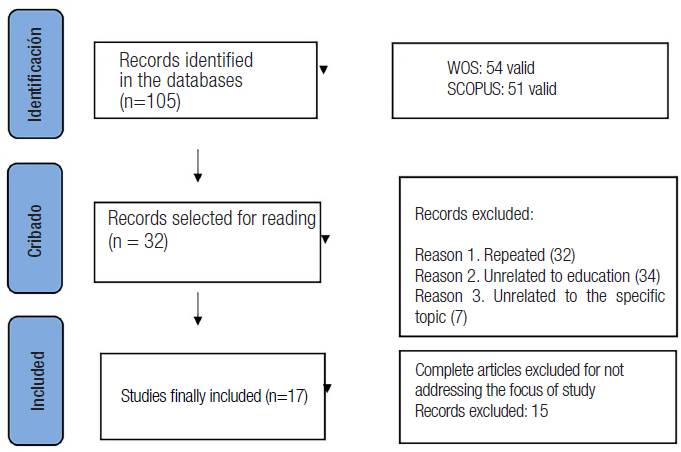
The search yielded a total of 105 articles to begin the study, of which 54 came from the WOS, and 51 from Scopus. After screening, 31 repeated articles were excluded, as well as 34 not related to the area of education, while 7 did not fit the specific topic. The 33 articles that passed the initial screening were analyzed, after which 15 were excluded as they did not fit the aim of the study. Ultimately, 17 articles were used for the final analysis.

From each of the 17 articles, information on the variables object of study was extracted, and a matrix table was created, which was analyzed quantitatively (descriptive analysis) and qualitatively (categorization). The variables object of study were:
-
country where the study took place;
-
university context in which the study was conducted;
-
university policy during the confinement or pandemic due to Covid-19;
-
students involved in the study;
-
technologies used by the universities during the confinement or pandemic due to Covid-19;
-
possibilities from this situation;
-
difficulties from this situation;
-
good practices employed.
All the articles analyzed can be found in the bibliographical references (Aydin; Kose, 2021; Barros de Melo et al., 2022; Blattner et al., 2022; Boulger; Onello, 2020; Browne et al., 2021; D’Amico et al., 2022; Essel et al., 2020; Fengwei; Wang, 2020; Fields et al., 2020; Gocotano et al., 2021; Dadhe and Kuthe, 2021; Melendez Grijalva et al., 2021; Mhandu et al., 2021; Motaung; Dube, 2020; Omodan, 2020; Pattison-Meek, 2021; Siddiqui et al., 2021). From each of these articles, information was extracted related with the variables of analysis. This descriptive work is detailed in the results, summarized in the conclusions, and problematized in the final discussion.
Results
The results are organized based on the variables object of study. The two main variables are analyzed jointly.
Countries and university contexts
The 17 articles analyzed came from different parts of the world, except for Europe, where no studies were conducted: 7 studies were conducted in the Americas, 5 in Asia, 4 in Africa, and 1 in Oceania. With respect to the university contexts in which the studies took place, a great disparity was observed: some were conducted at the level of university, while others at the level of the faculty, academic year, course, etc.
University policies
The university policies were centered on various lines of action:
-
First, on the adoption of measures to preserve the health of the university community and the population in general: closing of installations, informational campaigns, hygiene and use of alcohol-based gels, ventilation, etc. Also, the students in their last academic years of health-related degrees made themselves available to the population.
-
A decision was made to stop face-to-face classes and move onto digitalized education. Most of the universities were partially prepared, although with little experience in combining face-to-face teaching and online teaching. This change from face-to-face teaching to virtual teaching was performed under important challenges of equality created by the unequal universal access to internet and technological infrastructures, the capacity of the broadband connection, and also the lack of competences and pedagogy to perform this digital education. The World Bank (2020) points out that different distance learning formulas were created, from the sending/submitting of tasks via email, to the use of normal mail, the television, the radio, telephones, and mobile applications where a broadband connection was limited. Support for the most vulnerable students with technological resources: lending technological devices.
-
Support to teachers, by expanding the offers of continuous training for the development of digital skills and didactic strategies for development.
The IESALC UNESCO (2020) report concluded by affirming that with respect to university policies, except for the different specificities, the different countries tended to limit themselves to three things:
-
Administrative measures to guarantee education, such as, for example: modifications in the enrollment or exam calendars, re-programming the teaching, and re-organization of university access tests, etc.
-
creation of financial funds to support Higher Education, to be able to tend to the virtualization of teaching or to tend to the most vulnerable students, or to make teaching or administrative work more efficient at home;
-
the promotion of continuous training activities, especially related to the use of digital platforms, the training of teachers in the development of virtual teaching, and the creation of digital resources and materials (Blackman et al., 2020).
Students involved
In the different texts analyzed, the students who participated in the studies were preferably from rural areas, who had to face important challenges for follow the online classes, fundamentally due to the lack of infrastructures to connect with and the isolation of the population.
Technologies used
Of the total articles analyzed, 14 mentioned the technologies used. For the development of teaching activities, the most utilized technological solution was the videoconference, observing that the Zoom tool was the most utilized, as explicitly mentioned in 5 of the studies: on the one hand, Blattner et al. (2022), Boulger; Onello (2020), who only pointed to the use of this tool, and on the other hand, Fields et al. (2020), Pattison-Meek (2021) and Melendez Grijalva et al. (2021), who complemented the use of Zoom with other tools (emails, forums, WhatsApp, Meet, or virtual platforms such as Moodle). In addition, 2 studies indicated the use of solutions that were different from Zoom: Browne et al. (2021), who used Polycom RealPresence Utility Carts, and Essel et al. (2020), who conducted audio teleconferences with smartphones.
It must be stressed that the use of mobile phones was highlighted in many of the articles analyzed, such as Mhandu et al. (2021). In other articles, the use of WhatsApp was specified as the solution for achieving connectivity (Gocotano et al., 2021; Melendez Grijalva et al., 2021; Motaung; Dube, 2020; Omodan, 2020).
Lastly, 3 of the articles referred to learning management tools, such as Moodle (Fengwei; Wang, 2020; Barros de Melo et al., 2022; Mhandu et al., 2021), and only one indicated that to solve the situation, they used channels such as YouTube or MOOC platforms (Dadhe; Kuthe, 2021).
Siddiqui et al. (2021), Aydin and Kose (2021) and D’Amico et al. (2022) did not mention the tools used to deal with the situation of access and use of technologies of university students in rural areas in the Covid-19 years.
Possibilities
The analysis conducted allow us to glimpse many possibilities once the situation had been overcome. In first place, many of the studies mentioned possibilities related with the students (Aydin; Kose, 2021; Boulger; Onello, 2020; Browne et al., 2021; Melendez Grijalva et al., 2021; Motaung; Dube, 2020). Their positive assessment and the satisfaction of being able to follow the courses virtually stood out, as well as their participation, the performance and acquisition of knowledge, which were not affected. In addition, no dropouts was observed despite the problems that occurred.
With respect to the teachers, D’Amico et al. (2022) highlighted the fact of observing a strong commitment by students to overcome the obstacles that emerged. Also, Fields et al. (2020) observed that the situation was interesting for improving teaching. On their part, Blattner et al. (2022) and Pattison-Meek (2021) underlined the fact that teachers positively assessed their ability to continue teaching through virtual classes.
Lastly, possibilities were observed in the university setting itself (Barros de Melo et al., 2022; Blattner et al., 2022; Gocotano et al., 2021; Essel et al., 2020; Fengwei; Wang, 2020; Mhandu et al., 2021; Omodan, 2020). In this case, considering online teaching as a valid and valuable alternative for students in rural or remote areas was highlighted. The institutional challenge was mentioned, which implied developing a technological strategy, and ensuring that the students received the human and technical support needed. The need to have contingency plans to use technologies in case of emergencies was also proposed.
In their work, Dadhe and Kuthe (2021) and Siddiqui et al. (2021) did not discuss the possibilities that emerged when dealing with an unprecedented situation such as the pandemic.
Difficulties
Of the total articles analyzed that referred to the situation of university students in rural areas during the Covid-19 years, with respect to access and use of technology, 16 of them presented research on the difficulties that emerged. In this sense, 7 of the articles underlined limitations related with access to the Internet in a rural context, and the lack of technological devices to follow the classes (Gocotano et al., 2021; Dadhe; Kuthe, 2021; Meléndez Grijalva et al., 2021, Mhandu et al., 2021; Motaung; Dube, 2020; Omadan, 2020; Siddiqui et al., 2020).
Next, the greatest limitation perceived was the lack of training (analyzed in 4 articles), for both students and professors (Blattner et al., 2022; Essel et al., 2020; Meléndez Grijalva et al., 2021; Motaung; Dube, 2020). This is due to the abrupt interruption of the face-to-face classes and the mandatory (without anticipation) transfer of the classes to virtual environments.
On the other hand, 2 articles (Fengwei; Wang, 2020; Boulger; Onello, 2020) underlined that the greatest difficulty was to perform the practical parts of the classes virtually (such as Medicine or Nursing practices, etc.). The lack of forecast of the confinement did not allow for planning laboratory practices, with patients, students, etc. (depending on the degree), so that the virtual setting would be as close to reality. Also, another 2 articles (Blattner et al., 2022; Boulger; Onello, 2020), underlined the lack of human contact as a limiting factor in virtual teaching. However, in two studies (Browne et al., 2021; Fields et al., 2020), contrary to the rest, the students did not perceive any difficulty with respect to online education.
Lastly, and to a lesser degree, other limitations of virtual education in rural environments were underlined, such as:
-
the number of enrollments by students in rural contexts decreased during the confinement (D’Amico et al., 2022);
-
students in rural areas did not finish the academic year during the pandemic (Barros De Melo et al., 2022);
-
a great difficulty emerged in being able to implement and follow safety protocols that would avoid, for example, fake identities or plagiarized works (Essel et al., 2020).
-
the rural students perceived having insufficient digital competencies (Dadhe; Kuthe, 2021);
-
low satisfaction with regard to virtual teaching (Meléndez Grijalva et al., 2021);
-
the students had little motivation to follow the university classes from home (Meléndez Grijalva et al., 2021);
-
little diversification was perceived of teaching strategies in virtual environments (Meléndez Grijalva et al., 2021);
-
one of the studies (Aydin; Kose, 2021) highlighted that the students in rural settings perceived less psychological, social, and economic difficulties than those who lived in cities due to the context where they lived.
Good practices utilized
Of the 17 articles analyzed in the present study, 10 described the good practices used with university students in rural settings during the Covid-19 years, with respect to access and use of technology. In this sense, 3 articles (D’Amico et al., 2022; Mhandu et al., 2021; Motaung; Dube, 2020) mentioned good practices recommendations for the future, which were described starting from the actions performed in the studies. The recommendations cited were:
-
having in mind, in future crisis situations, that students come from different geographical areas within rural settings, so that the cases are different. It is also recommended that new communication channels must be established with the students, considering the needs of the students who live in rural areas, and the performance of innovative actions (D’Amico et al., 2022);
-
provide students (especially those in their first year) training on digital competence, and establishing strategies of action and support from professors to students (Mhandu et al., 2021);
-
encourage professors to carry out effective tutoring with all the students and formulate frameworks of action about the use and abuse of the new technologies (Motaung; Dube, 2020).
Next, two of the articles (Barros de Melo et al., 2022, Browne et al., 2021), indicated that a very effective good practice was to train both students and professors on subjects related with the pandemic (especially about how to avoid infection).
Lastly, the remaining articles showed different reference practices:
-
teaching classes in virtual environments, due to the pandemic, was an effective solution so that rural students could finish the academic year (Fengwei; Wang, 2020);
-
rationalizing the contents that were taught in face-to-face classes, as teaching in virtual environments required different parameters and needs (Blattner et al., 2022);
-
the use of videoconferencing tools for virtual classes was very useful for rural students (Essel et al., 2020);
-
the efforts made by the professors to adapt to the new circumstances were highlighted, considering the students in rural areas (Boulger; Onello, 2020);
-
the learning assistants were very functional to provide support to the virtual classes (Fields et al., 2020);
-
the development of practical communities, where professors and students shared knowledge and experiences due to the pandemic, were significant for the improvement of virtual teaching (Fields et al., 2020).
Discussion and conclusions
Based on the analysis performed, different elements for discussion can be established. In first place, it is notable that no studies were conducted in Europe, with a predominance of studies from America observed (Barros de Melo et al., 2022; Boulger; Onello, 2020; Browne et al., 2021; D’Amico et al., 2022; Fields et al., 2020; Melendez Grijalva et al., 2021; Pattison-Meek, 2021). Likewise, there were no comparative studies between countries. These facts could be due to the perception of rurality significantly varying in different parts of the world, reflecting the complexity and diversity of the rural reality (Basconzuelo, 2019).
With respect to the university policies developed during the confinement, the global alignment towards three key lines of action must be highlighted: in first place, health, ensuring the health of the university community. In second place, education, ensuring the continuity of education processes, by shifting from a face-to-face modality to a virtual one. And lastly, ensuring financial resources that would serve as support for the most vulnerable student sectors, who have difficulties when trying to connect or do not have electronic devices to follow the virtual classes. These financial resources must serve to update, modernize, and incorporate different platforms and compatible technologies with virtual education, at the same time guaranteeing the training of the professors on digital competences (IESALC UNESCO, 2020; Blackman et al., 2020).
The technologies utilized by the universities during the confinement varied, with the predominance, aside from learning management tools, of the use of videoconference solutions. In some cases, through the use of tools for teaching, such as Zoom, which according to Merino Acosta et al. (2023), became indispensable for virtual teaching. In other cases, taking advantage of social networks such as WhatsApp, which was deemed to be useful as a teaching-learning platform during the pandemic (Vidal Ledo et al., 2022).
This new situation brought interesting possibilities for students (such as satisfaction and performance), professors (such as commitment and the possibilities of improvement) and the institution itself (such as the institutional challenge brought on by the development of a technological strategy). In this sense, we are in agreement with studies such as the one by Caguana Baquerizo et al. (2022) and Mayorga et al. (2020), about the value of e-learning and the new possibilities of incorporating technologies in teaching that respond to the demands of present society.
However, the studies also pointed out difficulties that must be mentioned. The most prominent in different studies was the difficulty imposed by the internet connection (or lack thereof) in rural areas and the lack of technological devices for students (Gocotano et al., 2021; Dadhe; Kuthe, 2021; Meléndez Grijalva et al. 2021, Mhandu et al., 2021; Motaung; Dube, 2020; Omadan, 2020; Siddiqui et al., 2020). As Pávez (2023) indicates, The Covid-19 pandemic has been a reminder of the barriers that they must overcome due to the unstable internet signal, lack of devices and digital skills.
Some other difficulties pointed out were the lack of training (Blattner et al., 2022; Essel et al., 2020; Meléndez Grijalva et al., 2021; Motaung; Dube, 2020), the difficulty in extrapolating the practical sessions to virtual environments (Fengwei; Wang, 2020; Boulger; Onello, 2020), and the lack of human contact with the professors and the rest of the students (Blattner et al., 2022; Boulger; Onello, 2020). However, in two studies, the students in rural contexts did not perceive difficulties during the virtual classes (Browne et al., 2021; Fields et al., 2020). Therefore, it can be concluded that although the universities tried to provide a response to the needs of the students, there were many difficulties that they were not able to overcome with the measures implemented. This must be considered as a lesson to be learned when making future decisions on the use of technologies in higher education teaching.
Three articles provided recommendations for the future, in case another contingency situation occurs (D’Amico et al., 2022; Mhandu et al., 2021; Motaung; Dube, 2020). Nevertheless, it is possible to identify some good practices, such as the training of professors and students about the pandemic (Barros de Melo et al., 2022; Browne et al., 2021). And we must also underline the ability to bring the face-to-face classes to a virtual environment (Fengwei; Wang, 2020), the use of videoconferences (Essel et al., 2020), the rationalization of the contents from face-to-face classes to virtual environments (Blattner et al., 2022), the use of learning assistants (Fields et al.,2020), the development of practical communities (Fields et al.,2020), and the effort by the professors to tend to the students, especially those living in a rural environment (Boulger; Onello, 2020).
In agreement with Guiot (2021), the Covid-19 pandemic, in a certain way, also drove some educational transformations. The virtual environments allowed for a more personal contact through diverse tools such as forums, videoconferences, and conversation platforms, facilitating collaborative work. Some universities are already considering the addition of education programs that are completely online, which will broaden the educational offering and institutional enrollment.
Nevertheless, these results must be taken with caution, as the present article has some limitations, such as the small number of existing publications that reviewed the process of tending to vulnerable collectives in universities, and specifically students in rural areas. Rural education in a context of Covid-19 has large gaps, especially when focusing on the university setting. Nevertheless, the present article has contributed to increasing the knowledge on the effects of the pandemic in this sector of the student population.
This is the first article that addresses the problem of Covid-19 within the university context from an international perspective and in the manner of a review. Its contributions are key for understanding the specific difficulties of rural students and how to overcome them starting with the implementation of good practices. In this article, we have tried to offer an up-to-date, complete, international, and deep perspective, starting with the scientific publications found in two of the most important databases, and the results help in the identification of specific guidelines for action.
Universities are true engines of knowledge production, innovation, cultural preservation, research, and social progress. They are based on fundamental values of equal access, academic freedom, institutional autonomy, and social responsibility. It is when some of these values are not guaranteed for different population sectors, when their overseers must focus on these vulnerable students, by applying policies oriented towards keeping these students committed and connected, and supporting their educational process and its results (World Bank, 2020).
References
- APAZA, Panca.; CYNTHIA, Milagros; SEMINARIO, Roberto Simón; SANTA-CRUZ, Johanna Elena. Factores psicosociales durante en confinamiento por el Covid-19 - Perú. Revista Venezolana de Gerencia, Zulia, v. 25, n. 90, p. 402-410, 2020.
- BALLUERKA LASA, Nekane; GÓMEZ BENITO, Juana; HIDALGO MONTESINOS, María Dolores; GOROSTIAGA MANTEROLA, Arantxa; ESPADA SÁNCHEZ, José Pedro; PADILLA GARCÍA, José Luís; SANTED GERMÁN, Miguel Ángel. Las consecuencias psicológicas de la Covid-19 y el confinamiento: informe de investigación. Bilbao: Servicio de Publicaciones de la Universidad del País Vasco, 2020.
- BARRANTES, Roxana; AGÜERO, Aileen; AGUILAR, Diego. Digitalización y desarrollo rural: ¿hasta qué punto van de la mano? Lima: Instituto de Estudios Peruanos, 2020.
- BARTLETT, Jessica Dym; GRIFFIN, Jessica; THOMSON, Dana. Resources for supporting children’s emotional well-being during the Covid-19 pandemic. Child Trends, Rockville, v. 12, n. 1, 2020.
-
BARROS DE MELO, Maria do Cormo; FERRI, Priscila Menezes; ALMEIDA DE VASCONCELOS, Monica M.; NOGUEIRA REIS, Zilma Silveira; BICALHO GODOY, Solange Cervinho; ANDRADE PALMEIRA, Victoria; ROCHA, Gabriel; TORRES, Rosalia Morais; TUPINAMBÁS, Unai; MARTINS-REIS, Vanessa. Covid-19: distance learning to empower educators and health assistants in rural areas. Journal of Education and Health Promotion, Philadelphia v. 21, p. 1-7. 2022. https://doi.org/10.4103/jehp.jehp
» https://doi.org/10.4103/jehp.jehp -
BASCONZUELO, Celia. Pensar la ruralidad en los intersticios entre pasado y presente. Estudios Rurales, Buenos Aires, v. 9, n. 17, p. 94-101, 2019. DOI: 10.48160/22504001er17.418
» https://doi.org/10.48160/22504001er17.418 - BATES, Anthony William. Teaching in a Digital Age: guidelines for designing teaching and learning. Vancouver: Tony Bates Associates, 2022.
- BLACKMAN, Allen; IBÁÑEZ, Ana Maria; IZQUIERDO, Alejandro; KEEFER, Philip; MOREIRA, Mauricio Mesquita; SCHADY, Norbert; SEREBRISKY, Tomas. La política pública frente al Covid-19: recomendaciones para América Latina y el Caribe. Washington, DC: Banco Interamericano de Desarrollo, 2020.
-
BLATTNER, Katharina; MILLER, Rory; SMITH, Mark; LANDER, Janine. Doing without the residential component of a blended postgraduate rural medical programme during the 2020 Covid-19 pandemic in New Zealand: student perspectives. Education for Primary Care, London, v. 33, n. 2, p. 77-84. 2022. https://doi.org/10.1080/14739879.2021.2011626
» https://doi.org/10.1080/14739879.2021.2011626 -
BONILLA MARQUÍNEZ, Olga; MUÑOZ MUÑOZ, Dilsa. Educación rural mediada por tecnología tradicional en tiempos de pandemia 2020-2022. Entre Ciencia e Ingeniería, Pereira, v. 16, n. 31, p. 51-59, 2022. https://doi.org/10.31908/19098367.2778
» https://doi.org/10.31908/19098367.2778 -
BOULGER, James G.; ONELLO, Emily. Transforming Rural Family Medicine Curriculum from Experiential to virtual: a response to Covid-19 limitations. Primer, Bethesda, v. 4, p. 1-4, 2020. https://doi.org/10.22454/primer.2020.343294
» https://doi.org/10.22454/primer.2020.343294 -
BROWNE, Teri; MCKINNEY, Selina H.; DUCK, Lauren; BLAKE, Elisabeth W.; BALIKO, Beverly; ENGLISH, Sara; CHRISTOPHER, Rebecca. Preparing health professions students to serve southern rural communities in the time of Covid-19 and beyond: a model for interprofessional online telehealth education. Southern Medical Journal, Birmingham, v. 114, n. 10, p. 665-667, 2021. https://doi.org/10.14423/SMJ.0000000000001300
» https://doi.org/10.14423/SMJ.0000000000001300 - CAGUANA BAQUERIZO, Jessiva Ivonne; CAGUANA BAQUERIZO, Denisse Roxana; BAQUERIZO CABRERA, Martha Beatriz. Modelo de enseñanza E-learning y su importancia en tiempos de pandemia en la educación superior. Recimundo, Milagro, v. 6, n. 2, p. 366-373, 2022.
- CELLINI, Stephanie Riegg. How does virtual learning impact students in higher education? Brown Center Chalkboard, Brookings, Aug. 13, 2021.
-
CEPAL. Comissión Económica para a América Latina e Caraíbas. La educación en tiempos de la pandemia de Covid-19. Informe Unesco. Santiago de Chile: Cepal, 2020. Disponível em: Disponível em: https://bit.ly/3yVaN5w Acesso em: 10 set. 2023.
» https://bit.ly/3yVaN5w -
CEPAL. Comissión Económica para a América Latina e Caraíbas. Universalizar el acceso a las tecnologías digitales para enfrentar los efectos del Covid-19. Informe especial nº 7. Santiago de Chile: Cepal , 2020. Disponível em: Disponível em: https://bit.ly/3mZv72O Acesso em: 10 set. 2023.
» https://bit.ly/3mZv72O - CHINAZA, Uleanya; JOGYMOL, Alex. Student satisfaction with institutions in dealing with Covid-19 at a South African rural university. Rural Society, London, v. 30, n. 2-3, p. 147-156, 2021. DOI:
-
DASINGER, Timothy M.; GIBSON, Deborah J. Perceptions of mental health and need satisfaction/frustration among rural university students. Journal of American College Health, Philadelphia, p. 1-8, 2022. https://doi.org/10.1080/07448481.2022.2032089
» https://doi.org/10.1080/07448481.2022.2032089 -
D’AMICO, Mark.; ATWELL, Adam; SPRIGGS, Janet; COX, Jeff Are we doing enough? Covid-19 responses from urban and rural community colleges. Community College Journal of Research and Practice, London, v. 46, n. 1-2, p. 12-19, 2022. https://doi.org/10.1080/10668926.2021.1961925
» https://doi.org/10.1080/10668926.2021.1961925 - DADHE, Pooja; KUTHE, Gulshan Damodhar. Assessment of availability and use of technology by students for online education during Covid-19 pandemic in rural India: a case study. Library Philosophy and Practice, Lincon, p. 1-18, 2021.
-
DEL ARCO, Isabel; FLORES-ALARCIA, Òscar; RAMOS-PLA, Anabel. Structural model to determine the factors that affect the quality of emergency teaching, according to the perception of the student of the first university courses. Sustainability, Basilea, v. 13, n. 5, p. 2945, 2021b. https://doi.org/10.3390/su13052945
» https://doi.org/10.3390/su13052945 -
DEL ARCO, Isabel; SILVA, Patricia; FLORES-ALARCIA, Òscar. University teaching in times of confinement: the light and shadows of compulsory online Learning. Sustainability, Basilea, v. 13, n. 1, p. 375, 2021a. https://doi.org/10.3390/su13010375
» https://doi.org/10.3390/su13010375 -
ESPINEL RUBIO, Gladys Adriana; HERNÁNDEZ SUAREZ, César Augusto; PRADA NÚÑEZ, Raúl. WhatsApp vs. campus virtual institucional en tiempos de Covid-19: percepción de los estudiantes de comunicación social. Revista Boletín Redipe, Cali, v. 10, n. 10, p. 519-533, 2021. https://doi.org/10.36260/rbr.v10i10.1510
» https://doi.org/10.36260/rbr.v10i10.1510 -
ESSEL, Harry Barton; VLACHOPOULOS, Dimitrios; ADOM, Dickson; TACHIE-MENSON, Akosua transforming higher education in Ghana in times of disruption: flexible learning in rural communities with high latency internet connectivity. Journal of Enterprising Communities, Leeds, v. 15, n. 2, p. 296-312, 2020. https://doi.org/10.1108/JEC-08-2020-0151
» https://doi.org/10.1108/JEC-08-2020-0151 -
FENGWEI, Ai; WANG, Nan. Integration of urban-rural planning and human geography for online education under the impact of Covid-19. Journal of Intelligent and Fuzzy Systems, Ámsterdam, v. 39, n. 6, p. 8847-8855, 2020. https://doi.org/10.3233/JIFS-189282
» https://doi.org/10.3233/JIFS-189282 -
FIELDS, Melanie; MODIR, Bahar; NEWTON, Willian G.; LOCK, Robynne M.; STANFIELD, J. Clay. The transition to online teaching during the Covid-19 pandemic at a regional, rural university: the experience of learning assistants. In: PHYSICS EDUCATION RESEARCH CONFERENCE, 2020. Proceedings […]. [S. l.: s. n.], 2020. p. 149-154. Disponible en: Disponible en: https://www.compadre.org/Repository/document/ServeFile.cfm?ID=15474&DocID=5322 Acesso em: 23 Oct. 2024.
» https://www.compadre.org/Repository/document/ServeFile.cfm?ID=15474&DocID=5322 -
GARCÍA-MARTÍNEZ, Inmaculada; MARTÍN ROMERA, Ana. La coordinación pedagógica a través del liderazgo de los mandos medios en Educación Secundaria. Bordón. Revista de Pedagogía, Madrid, v. 71, n. 2, p. 55-70, 2019. https://doi.org/10.13042/Bordon.2019.67324
» https://doi.org/10.13042/Bordon.2019.67324 -
GOCOTANO, Thessalou E.; JERODIAZ, Mae Anthoneth L.; BANGGAY, Jenny Claire P.; REY NASIBOG, Harold B.; GO, Marivel B. Higher education students’ challenges on flexible online learning implementation in the rural areas: a Philippine case. International Journal of Learning, Teaching and Educational Research, Puerto Louis, Mauricio, v. 20, n. 7, p. 262-290, 2021. https://doi.org/10.26803/IJLTER.20.7.15
» https://doi.org/10.26803/IJLTER.20.7.15 -
GUIOT, Isaias. Uso de las TICS en la educación superior durante la Pandemia Covid-19: ventajas y desventajas. Interconectando Saberes, Veracruz, v. 12, p. 223-227, 2021. https://doi.org/10.25009/is.v0i12.2724
» https://doi.org/10.25009/is.v0i12.2724 -
IESALC UNESCO. Covid-19 y educación superior: de los efectos inmediatos al día después. 2020. Caracas: Unesco, 2020. Disponível em: Disponível em: https://www.iesalc.unesco.org/wp-content/uploads/2020/05/COVID-19-ES-130520.pdf Acesso em: 23 Oct. 2024.
» https://www.iesalc.unesco.org/wp-content/uploads/2020/05/COVID-19-ES-130520.pdf -
LÓPEZ, Leonardo; RODÓ, Xavier. The end of social confinement and Covid-19 re-emergence risk. Nature Human Behaviour, London, v. 4, p. 746-755, 2020. https://doi.org/10.1038/s41562-020-0908-8
» https://doi.org/10.1038/s41562-020-0908-8 -
MAKGAHLELA, Makgahlela; MOTHIBA, Tebogo M.; MOKWENA, Jabu P.; MPHEKGWANA, Peter. Measures to enhance student learning and well-being during the Covid-19 pandemic: perspectives of students from a historically disadvantaged university. Education Sciences, Basel, v. 11, n. 5, 2021. https://doi.org/10.3390/educsci11050212
» https://doi.org/10.3390/educsci11050212 - MAYORGA, Amalin; HERNÁNDEZ MITE, Kelly Deysi; AVEIGA PAINI, Carlos Enrique; PACHECO MENDOZA, Silvia Rosa. Construcción del conocimiento social mediante e-learning: límites y posibilidades en la enseñanza de cultura física. Podium: Revista de Ciencia y Tecnología en la Cultura Física, Alcorta, v. 15, n. 1, p. 99-110, 2020.
-
MELENDEZ GRIJALVA, Perla; CARRERA HERNANDEZ, Celia; MADRIGAL LUNA, Josefina. Educational challenges in virtual environments: rural and urban schools. Propositos y Representaciones, Lima, v. 9, n. 3, p. 133, 2021. http://dx.doi.org/10.20511/pyr2021.v9n3.1333
» http://dx.doi.org/10.20511/pyr2021.v9n3.1333 -
MENGIN, Amaury; ALLÉ, Melissa, ROLLING, Julie; LIGIER, Fabienne; SCHRODER, Carmen; LALANNE, Laurence; BERNA, Fabrice; JARDRI, Renaud; VAIVA, Guillaume; GEOFFROY, Pierre Alexis; BRUNAULT, Paul; THIBAUT, Florence; CHEVANCE, Astrid; GIERSCH, Anne. Conséquences psychopathologiques du confinement. L’Encéphale, Paris, v. 46, n. 3, p. S43-S52, 2020. https://doi.org/10.1016/j.encep.2020.04.007
» https://doi.org/10.1016/j.encep.2020.04.007 - MERINO ACOSTA, ZoilaNoemí; VARGAS MARÍN, HugoJaime; CRESPO LEÓN, KarlaPamela; NOBOA VITERI, ZoiloWalter. Posibilidades y dificultades del e-learning mediante el uso del Zoom. Ciencia y Educación, Milagro, v. 4, n. 2, p. 6-11. 2023.
-
MHANDU, John; MAHIYA, Innocent Tonderai; MUZVIDZIWA, Evelyne. The exclusionary character of remote teaching and learning during the Covid-19 pandemic: An exploration of the challenges faced by rural-based University of KwaZulu Natal students. Cogent Social Sciences, London, v. 7, n. 1, 2021. https://doi.org/10.1080/23311886.2021.1947568
» https://doi.org/10.1080/23311886.2021.1947568 -
MOTAUNG, Letsela B.; BEKITHEMBA, Dube. WhatsApp Messenger as a mediating tool in times of Covid-19 for enhancing student engagement in e-tutorials at a rural South African university. Journal of Educational and Social Research, London, v. 10, n. 6, p. 214-224, 2020. https://doi.org/10.36941/jesr-2020-0121
» https://doi.org/10.36941/jesr-2020-0121 -
OMODAN, Bunmi Isaiah. The vindication of decoloniality and the reality of Covid-19 as an emergency of unknown in rural universities. International Journal of Sociology of Education, Barcelona, n. spe.e, p. 1-26, 2020. https://doi.org/10.17583/RISE.2020.5495
» https://doi.org/10.17583/RISE.2020.5495 -
ORGANIZACIÓN MUNDIAL DE LA SALUD. Coronavirus disease 2019 (Covid-19). Report 51, 2020. Disponível em: Disponível em: https://bit.ly/3FGdYSl Acesso em: 10 set. 2023.
» https://bit.ly/3FGdYSl -
PAGE, Matthew J. et al. The PRISMA 2020 statement: an updated guideline for reporting systematic reviews. The BMJ, London, v. 372, n. 71, 2021. https://doi.org/10.1136/bmj.n71
» https://doi.org/10.1136/bmj.n71 -
PATTISON-MEEK, Joanne. Supporting Urban-oriented teacher candidates to experience rural schooling: the story of a virtual adapted practicum. Australian Journal of Teacher Education, Joondalup, v. 46, n. 12, p. 92-107, 2021. https://doi.org/10.14221/ajte.2021v46n12.6
» https://doi.org/10.14221/ajte.2021v46n12.6 -
PAVEZ, Isabel ¿Nativos digitales? Percepción de habilidades en niños y niñas de zonas rurales. Cuadernos de Investigación Educativa, Montevideo, v. 14, n. 1, 2023. https://doi.org/10.18861/cied.2023.14.1.3282
» https://doi.org/10.18861/cied.2023.14.1.3282 -
RAMOS-PLA, Anabel; DEL ARCO, Isabel; FLORES-ALARCIA, Òscar. Formación permanente del profesorado universitario en tiempos de Covid-19: entre la necesidad y la obligación. Hachetetepé. Revista científica de Educación y Comunicación, Cádiz, v. 24, p. 1104, 2022. https://doi.org/10.25267/Hachetetepe.2022.i24.1104
» https://doi.org/10.25267/Hachetetepe.2022.i24.1104 -
RAMOS-PLA, Anabel; DEL ARCO, Isabel; FLORES-ALARCIA, Òscar. University professor training in times of Covid-19: analysis of training programs and perception of impact on teaching practices. Education Sciences , Ginebra, v. 11, p. 684, 2021. https://doi.org/10.3390/educsci11110684
» https://doi.org/10.3390/educsci11110684 -
ROTAS, Erwin; CAHAPAY, Michael. Difficulties in remote learning: voices of Philippine university students in the wake of Covid-19 crisis. Asian Journal of Distance Education, Nueva Delhi, v. 93, n. 3, p. 135-141, 2020. Disponível em: Disponível em: http://www.asianjde.com/ojs/index.php/AsianJDE/article/view/504 Acesso em: 12 set. 2023.
» http://www.asianjde.com/ojs/index.php/AsianJDE/article/view/504 -
ROY, Deblina; TRIPATHY, Sarvodaya; KAR, Sujita K.; SHARMA, Nivedita; VERMA, Sudhir K.; KAUSHAL, Vikas. Study of knowledge, attitude, anxiety & perceived mental healthcare need in Indian population during Covid-19 pandemic. Asian Journal of Psychiatry, Michigan, v. 51, p. 102083, 2020. https://doi.org/10.1016/j.ajp.2020.102083
» https://doi.org/10.1016/j.ajp.2020.102083 - SIDDIQUI, Muhammad Ilyas; SHAH, Rafaina; ARISER, Kanwal Naz. Challenges of online learning and attitude of medical student at LUMHS: comparative study among rural and urban students during covid -19 pandemic. Medical Forum Monthly, Lahore, v. 32, n. 5, p. 82-86, 2021.
-
SUÁREZ MONZÓN, Noemí. Formación docente universitaria y crisis sanitaria Covid-19. CienciAmerica, Quito, v. 9, n. 2, p. 1-6, 2020. http://doi.org/10.33210/ca.v9i2.299
» http://doi.org/10.33210/ca.v9i2.299 -
TOQUERO, Cathy; TALIDONG, Karen Joy. Programs for emergency remote teaching amid Covid-19. Interdisciplinary Journal of Virtual Learning in Medical Sciences, Beijing, v. 11, n. 3, p. 200-203, 2020. https://doi.org/10.30476/IJVLMS.2020.86889.1044
» https://doi.org/10.30476/IJVLMS.2020.86889.1044 -
UNESCO. United Nations Educational, Scientific and Cultural Organization. Nuevas publicaciones cubanas para enfrentar efectos de la Covid-19 sobre la educación. Paris: Unesco, 2020. Disponível em: Disponível em: https://bit.ly/42uLTaw Acesso em: 11 set. 2023.
» https://bit.ly/42uLTaw - VIDAL LEDO, Maria J.; GARI CALZADA, Mayra; FERNÁNDEZ OLIVA, Bertha; VIALART VIDA, Maria Niurka. WhatsApp como plataforma de enseñanza-aprendizaje durante la pandemia de Covid-19. Educación Médica Superior, La Habana, v. 36, n. 1, p. 1-18, 2022.
-
XIE, Mingxuan; CHEN, Qiong. Insight into 2019 novel coronavirus: an updated intrim review and lessons from SARS-CoV and MERS-CoV. International Journal of Infectious Diseases, Hong Kong, v. 94, p. 119-124, 2020. https://doi.org/10.1016/j.ijid.2020.03.071
» https://doi.org/10.1016/j.ijid.2020.03.071 -
WORLD BANK. The Covid-19 Crisis Response: supporting tertiary education for continuity, adaptation, and innovation. Cidade: World Bank, 2020. Disponível em: Disponível em: https://bit.ly/3na3vIv Acesso em:12 set. 2023.
» https://bit.ly/3na3vIv -
WU, Zunyou; MCGOOGAN, Jennifer M. Characteristics of and Important Lessons from the Coronavirus Disease 2019 (Covid-19) Outbreak in China: Summary of a Report of 72314 Cases from the Chinese Center for Disease Control and Prevention. Jama, v. 323, p. 1239-1242, 2020. https://doi.org/10.1001/jama.2020.2648
» https://doi.org/10.1001/jama.2020.2648 -
ZHAO, Young. Covid-19 as a catalyst for educational change. Prospects, Ginebra, v. 49, p. 29-33, 2020. https://doi.org/10.1007/s11125-020-09477-y
» https://doi.org/10.1007/s11125-020-09477-y

 Source: Created by the authors.