 The state of the art in body studies and their paradigms in the first decades of the 21st century
Abstract
The body is a recurring subject in several fields of knowledge, including philosophy, history, and education. Conceptions of the body tend to be analyzed in academic literature because they express how authors reflect on the relationship of the human being with themselves, others, and nature. Thus, the problem of this study is to identify the predominant epistemological approaches to the subject from 2001 to 2018. Regarding methodology, a quantitative-qualitative bibliometric study was conducted with education journals from 2001 to 2018, specifically those ranked A-1 by the Qualis CAPES system (2013-2016). The general objective of the study was to examine conceptions of the body in Brazilian education journals, approaching the paradigms of major scientific theories. Its specific objectives include: a) Examining the movement of knowledge production on the subject during the studied period; b) identifying the authors who published the most on body-related topics in education journals; c) analyzing how the epistemological debate on the body developed quantitatively; and d) showing how body conceptions manifest themselves in the different texts analyzed. The results show that among the studied journals, there is a predominance of phenomenological conceptions, followed by the postmodern movement, positivism, and dialectical materialism, respectively. In conclusion, the phenomenological tradition was found to stand out in the studied texts, demonstrating a concern with looking at the human being as a totality.
Epistemology; Knowledge production; Body; Brazilian education bibliography
Resumo
O corpo é um tema recorrente em diversos campos de conhecimento, entre eles a filosofia, a história e a educação. As concepções de corpo tendem a ser analisadas na produção bibliográfica, pois expressam o modo como os autores podem refletir sobre a relação do ser humano consigo, com outros e com a natureza. Desse modo, o problema desta pesquisa é identificar quais são as suas abordagens epistemológicas predominantes entre 2001 a 2018. Como metodologia, realizou-se um estudo com características bibliométricas, de caráter quanti-qualitativo, em periódicos da área da Educação de 2001 a 2018, considerados como presentes no estrato A-1 do Qualis CAPES (2013-2016). Como objetivo geral do estudo, procurou-se examinar as concepções de corpo em periódicos brasileiros do campo da Educação, aproximando-se dos paradigmas de teorias científicas principais. Os objetivos específicos incluem, a) verificar o movimento da produção de conhecimento sobre o tema no período de tempo estudado; b) identificar os autores que mais publicaram temas relacionados ao corpo em revistas da Educação; c) analisar como o debate epistemológico sobre o corpo se desenvolveu quantitativamente e; d) apresentar como as concepções de corpo se manifestam nos diferentes textos analisados. Os resultados demonstram que entre as revistas estudadas há uma predominância de concepções fenomenológicas, seguidas do movimento pós-moderno, do positivismo e do materialismo dialético, respectivamente. Como conclusão, é possível dizer que a tradição fenomenológica se destaca nos textos pesquisados, demonstrando certa preocupação de se olhar para o ser humano como uma totalidade.
Epistemologia; Produção do conhecimento; Corpo; Bibliografia brasileira de educação
Introduction
The debates about the body in knowledge fields such as philosophy, education, the arts, and physical education have a long trajectory, extending from discussions in ancient philosophy to the present. Given that this subject significantly impacts actions within each of these fields, addressing the body through its conceptions, history, ways of existing and resisting, and its relationship with others and itself provides insights into how human beings determine their values and norms in relation to the different characteristics of each period of humanity, according to the capacities, skills, and technologies developed to meet the vital needs of individual and collective organization of production.
The body needs to be examined from various perspectives in today’s world, and these processes are manifested in scientific and philosophical literature, among others, as seen in its links with health (Sauerbronn; Teixeira; Lodi, 2019), body aesthetics (Baptista; Zanolla, 2016; Batista et al., 2015; Roseiro; Rodrigues; Alvim, 2018), media representations and influences (Goldenberg, 2005; Xavier Filha, 2014), gender and sexuality-based analyses (Goldenberg, 2005; Xavier Filha, 2014), and reflections on race and ethnicity (Feffermann et al., 2018; Góis Junior, 2009; Monteiro; Mourão; Votre, 2012), among others.
These subjects and several others are addressed by numerous scholars who focus on the theme of the body and its various impacts. Research on the body is published in books (Gleyse, 2018; Moreno et al., 2022), articles (Carrasco-Segovia; Hernández-Hernández, 2020; Pich, 2023; Pinto et al., 2020), and even conference proceedings (Andrade; Silva, 2017; Martineli; Mileski, 2012; Valgas, 2015), while debates also manifest in other forms of output, such as social media.
Therefore, this study aims to demonstrate that academic and philosophical discussions and reflections on the body manifest in various ways and address a wide range of topics. In the field of education, this debate takes shape through multiple perspectives, characterized by historical analyses (Lima; Góis Junior, 2018; Soares, 2015), religious processes (Santo Agostinho, 2008), philosophical approaches (Lima Neto; Nóbrega, 2018; Nóbrega, 2014; Platão, 2005; Yonezawa; Silva, 2018), among many other evaluations and critiques.
One way to examine the body is by analyzing the paradigms that guide knowledge production in education (Baptista, 2019; Lüdorf, 2003; Sayao, 2015). By exploring this type of production, it is possible to consider bibliometric and scientometric studies. In addition to the paradigmatic aspects of general educational production, as the focus returns to reflections on the body, various approaches and analytical possibilities emerge, offering insights into how the body is perceived and conceptualized by different authors discussing this topic in Brazilian education.
The epistemological paradigms discussed in this text are positivism, phenomenology, dialectical materialism, and the postmodern movement. The key representatives of positivism are Comte (1978) and Durkheim (2007). Both authors are significant in the formation of the humanities and social sciences, with the former establishing a new science (social physics) based on the principles of the hard sciences, and the latter consolidating sociology as a science through his Rules of the Sociological Method. Regarding the body, Comte suggests that it is a living organism sharing the same characteristics as other animal bodies, yet exhibiting the unique differences of human capacities (Comte, 1978).
The second method we present here is phenomenology. Its founder was Edmund Husserl (Husserl, 1990, 2013), who, at the beginning of the 20th century, proposed a research model that went beyond the prevailing approaches of the time. Husserl sought to overcome a naturalistic logic, aiming to capture the nuances of human life and its essence. While this German philosopher and mathematician proposed building a new method with a focus on the body, it was a French philosopher—Maurice Merleau-Ponty—who became most prominent in this debate. His Phenomenology of Perception (Merleau-Ponty, 2011) is likely among the works most cited by scholars who study the body through a phenomenological lens (Nóbrega, 2014; Santin, 2007).
The third paradigm referenced in this study is dialectical materialism, grounded in the works of German philosopher and political economist Karl Marx. His method of analysis is more complex, incorporating economic analyses with criticism present throughout his work. Notably, some of the key elements for explaining Marx’s method can likely be found in Capital (Marx, 2011)—perhaps his most famous work—and also in A Contribution to the Critique of Political Economy (Marx, 2008). However, it is in his Economic and Philosophic Manuscripts, written in Paris in 1844, that Marx presents his conception of the body, asserting that the human body possesses a physical (organic) dimension in constant interaction with nature (its inorganic dimension), in order to survive (Marx, 2010).
From the Marxist perspective, the body is situated within the contradictions inherent in a mode of production founded on class struggle, the central social determination in capitalism, which is the current historical specificity of the social organization of production. Notably, one of the body’s central determinations is work, an essential ontological component (Herold Junior, 2008, 2014; Vilas Boas; Mourão Júnior, 2016).
Finally, the postmodern agenda3 (Wood, 1995) is considered here as a process that began in Europe after the period of the Great War, or the period of total war, as noted by Hobsbawm (Hobsbawm, 1995). The postmodern agenda emerged in artistic movements and gradually extended to the sciences, aiming to present objects of study based on their own characteristics, with scientific knowledge being one of many possible ways of communicating in the world, rather than a singular truth above other types of knowledge. For the postmodern agenda, science is shaped by the internal disputes within each scientific field, governed by its own communication rules (objects are presented in the order of discourses) and competition (Lyotard, 2009).
From the body’s perspective, there are some aspects to consider in this movement. The first is the fact that the body can be subjected to various forms of power—biopower—through which the individual body connects with the social body (Foucault, 1999). A second possible analysis involves the construction of hybrid bodies composed of carbon and silicon, elements of the post-human structure, or a body without organs (Deleuze; Guattari, 2004). A third interpretation suggests that perhaps the body does not exist, as it is people—men and women—who move through the world, not bodies, which are merely objects of study (Le Breton, 2010).
Thus, by examining the conception of the body, it is possible to reflect on how education addresses the human being—how it treats and understands them—since numerous educational practices presuppose the education of people who may be understood as organisms immersed in intersubjective relations, in the totality of one’s own body, within the contradictions of class struggle, or as beings that manifest themselves in the order of discourse.
Therefore, the body is understood as a dimension to be studied within its numerous social relations, and thus the way scientific literature addresses, conceives, and presents it—whether to question or denounce its repression, control, discipline, and the lack of inquiry into living conditions, or to proclaim it as the ultimate expression of humanity, the locus for the constitution of new possibilities, capacities, abilities, and knowledge, pointing toward processes of autonomy and emancipation for humanity—must be better understood.
Based on the rationale of understanding the body in the production of knowledge as manifested in academic education journals, the research problem of this text is to analyze the conceptions of the body in Brazilian education journals to identify the predominant epistemological paradigms from 2001 to 2018. The general objective of the study is to examine the conceptions of the body in Brazilian education journals, focusing on the patterns of major scientific theories during this period. Its specific objectives are: a) examining the movement of knowledge production on the subject during the studied period; b) identifying the authors who published the most on body-related topics in education journals; c) analyzing the quantitative development of the epistemological debate on the body; and d) presenting how conceptions of the body manifest in the different texts analyzed.
Thus, the methodological approaches are presented below, along with the presentation, analysis, and discussion of the data.
Methodology
This study is characterized as bibliometric and scientometric research (Araújo; Alvarenga, 2011; Macias-Chapula, 1998; Urbizagastegui, 2014), as its main objective is to analyze the body-related production in Brazilian education journals between 2001 and 2018. Additionally, its specific objectives focus on the authors who published the most, the regions these publications originate from, the movement of production on the subject from an epistemological perspective, and specific conceptions of the body. This study builds on a previous analysis (Baptista, 2019), as that analysis provided initial data, while the present one offers more conclusive results.
This study is also characterized as a quantitative-qualitative study.
These categories modify, complement, and transform into each other when applied to the same phenomenon. Indeed, the two dimensions are not opposed but interrelated as two stages of reality in a cumulative and transformative process, such that we cannot conceive of one without or separate from the other (Santos Filho; Gamboa, 1997, p. 105).
From the perspective of this text, a quantitative-qualitative study allows for the presentation of reality through both dimensions. On the one hand, the quantitative aspect contributes to analyzing movements, quantities, and identifying the most prevalent aspects of research. From the qualitative perspective, it is essential as it helps reveal how each expression manifests itself—in this case, how the analyzed authors present their conceptions of the body. Moreover, from a perspective aligned with dialectical materialism, one of its principles is the transition from quantity to quality and vice versa (Engels, 2000).
This study adopts fundamentals of integrative literature review.
In turn, an integrative literature review is a review “[…] in which existing research is gathered in a summarized manner, including general conclusions from numerous studies.” Whittemore and Knafl (2005) “[…] emphasize that, when conducted properly, integrative reviews can provide results that contribute to the theoretical development of a field and can be applied practically and in policymaking.” Additionally, the authors highlight that integrative literature review is the broadest type of review, with the potential to integrate both theoretical and empirical studies […]. (Moscardi et al., 2017, p. 1.824).
An integrative review comprises six steps, which are:
[…] identifying the topic and selecting the research hypothesis or question; establishing criteria for including and excluding studies/samples or searching the literature; defining the information to be extracted from the selected studies/categorization of the studies; evaluating the included studies; interpreting the results; and presenting the review/knowledge synthesis. (Ercole; Melo; Alcoforado, 2014, p. 9-10).
Of the six steps presented, the first was to define the problem stated earlier: What are the predominant epistemological paradigms in A-1 education journals between 2001 and 2018? Based on this problem, we established the inclusion criteria, and the data were collected between September and November 2018.
-
Selecting the WebQualis A-1 education journals available for the period from 2013 to 2016,4 totaling 121 scientific journals.
-
From the identified journals, only Brazilian journals were included. This means that all foreign journals, including Portuguese journals published in Portuguese, were excluded. At this point, 66 journals were identified.
-
Various journals were identified with two International Standard Serial Numbers (ISSN – one printed and one digital). In these cases, journals with printed ISSNs were excluded to avoid duplication and to facilitate access to the full texts, leaving 32 journals.
-
For this study, we chose to identify the authors who published the most during the analyzed period, the regions that published the most, and the texts that met the inclusion criteria.
-
In the journals, we selected articles with the word ‘body’ in the title, abstract, or keywords, which were then categorized by their paradigm of reference: positivism, phenomenology, dialectical materialism, or the postmodern agenda.
-
Finally, the data were analyzed, and through thematic analysis (Minayo, 2014), graphs and tables were created, and qualitative excerpts were taken from each paradigmatic category.
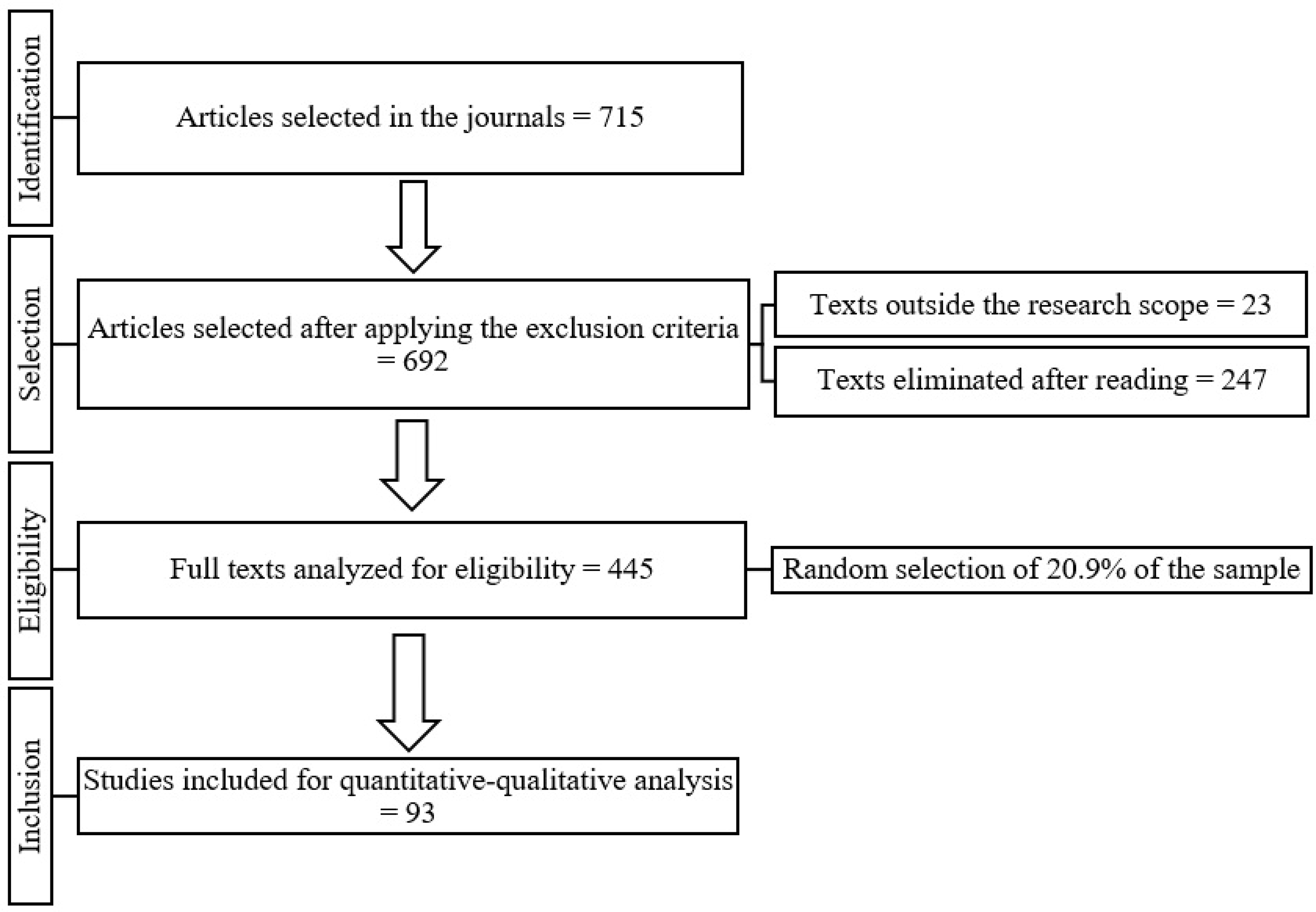
To facilitate understanding of the process, we used the PRISMA (Preferred Reporting Items for Systematic Reviews and Meta-Analyses) process, as shown in Figure 1 below:
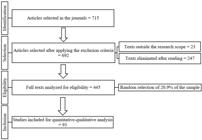
From the random selection process, 93 articles were read, corresponding to 20.9% of the total, with a 95% confidence interval. The study data and their discussion will be presented in the section below.
The research data: presentation, analysis, and discussion
Given the general objective and its specific objectives, the presentation, analysis, and discussion proceed through four central stages: the distribution of studies over the analyzed years, the presentation of the main authors, the quantitative analysis of paradigms, and finally, the qualitative presentation based on the research paradigms.
1. General advancement of knowledge production
The information about the number of texts published over time is presented in Graph 1 below.
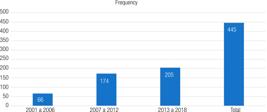
In Chart 1, time was organized into six-year periods. The theme of the body had its debates expanded, with 66 articles published between 2001 and 2006, 174 texts between 2007 and 2012, and 205 studies between 2013 and 2018, with the greatest increase occurring in the second period. While the increase was lower in the last analyzed phase, the total number of papers published was significant (205). According to a study by Brito et al. (2023), in the annals of the Brazilian Congress of Sports Sciences, 255 papers were identified in the Thematic Working Group Body and Culture from 1997 to 2021, indicating that this study found a larger number of publications.
In addition, there is strong evidence that some journals have a close relationship with the subject, such as the Brazilian Journal of Presence Studies, which published 15 articles in 2018 and 68 publications in total.
2. Main authors in all articles
Regarding the authors, there were 720, considering all the texts. Of these, several published more than one text over these 18 years. However, when repetitions are eliminated, 632 different authors are identified. It was also possible to determine that the average was 1.4 ± 0.6 authors per article. We can thus infer a significant number of articles with just one author, while another involved as many as nine researchers.
This demonstrates a characteristic of the field of education, in which authorial work tends to be more valued. In addition, in analyses of a more qualitative nature, it is considered more complex to write a text collaboratively. The people who published the most are shown in Table 1.
Names of the five main authors, number of publications, and field of initial training, according to their Lattes curriculum
In Table 1, it was possible to identify the five authors who published the most in education journals. It is worth noting that, with the exception of Terezinha Petrucia da Nobrega, who also has a degree in philosophy, all the others had their initial training in physical education. A possible justification for this is the relationship that physical education has with the body as an object of study in various intervention contexts.
3. Epistemological analysis of knowledge production from 2001 to 2018
The epistemological analyses of the 93 texts analyzed in full are presented below (Table 2). The epistemological perspective that stood out was phenomenology, followed by postmodernism, positivism, and dialectical materialism.
Regarding epistemological paradigms, Table 2 shows a predominance of phenomenology, the postmodern agenda, positivism, and dialectical materialism, respectively, among the 93 texts. While the difference between phenomenology and the postmodern agenda is not large, this analysis reverses the one performed by Baptista (2019), in which there was a predominance of the postmodern agenda. However, in the study by Brito et al. (2023), a predominance of phenomenology, the postmodern agenda, dialectical materialism, and positivism was also identified, though this study showed that paradigms were not identified in about 28.89% of the cases.
However, there are more interesting points to be presented, such as how these paradigms appear in the texts, as presented below.
4. Body conceptions identified based on the different paradigms
As mentioned earlier, some demonstrations are presented below based on excerpts from the texts in Chart 1.
These conceptions of the body demonstrate the characteristics of each of the paradigms. The passages above consistently approach the characteristics of research and body conception identified in each discussion. Other works have made this comparison, and the studies show a variety of results, also because the way conceptions and paradigms are analyzed within different studies can vary according to the literature used (Ferreira; Baptista, 2013; Lüdorf, 2003; Sayão, 2015; Silva; Silva; Lüdorf, 2011, 2015).
In dialogue with Chart 1, there are some indications of the debate with phenomenology. The relationship with the sensitive body, of one’s own body, engages in debates with perspectives of authors considered as classic (Merleau-Ponty, 2011), or with contemporary authors who also conduct research discussing the link between the body and education (Botelho; Moreira, 2023; Breunig; Nóbrega; Mendes, 2023; Tanabe; Moreira, 2022).
In dialectical materialism, one of the main debate references is the work of Marx (Marx, 2010, 2011), though there are other classical authors linked to Marxism (Adorno, 2009; Adorno; Horkheimer, 1985; Lukács, 2003). From a more current perspective, it is possible to mention authors such as Silva (2017) and Sousa and Hungaro (2021). It is also worth noting that this paradigm has the smallest representation among all paradigms.
In positivism, the selected passage is consistent with the characteristics of the analysis of the body as an organism (Comte, 1978). From the perspective of research procedures, the greatest similarity is with the forms of procedures indicated by Durkheim (2007). This perspective has appeared in the texts quite frequently in relation to biological knowledge, as shown in another study examined here.
According to Professor Olivia Bianco (1921, p. 110), ‘it belongs to the sphere of physical education, today an art of conscious goals and already far from empiricism, to direct the human being to their perfect somatic organization, just as the intellectual and moral spheres prepare the qualities of the spirit and character’. By educating the body, it should be possible to achieve physical and moral levels that would raise humans to an evolved and superior condition; to that end, rational and scientifically systematized gymnastic exercises should be the appropriate means to educate an ideal type of integral and healthy human being. (Honorato; Nery, 2018, p. 37).
Finally, there is the perspective of the postmodern agenda, which has emerged as an important framework in debates on the body. With regard to traditional authors, French thinkers stand out (Deleuze; Guattari, 2004; Foucault, 1999, 2002). On the other hand, the dialogue of other authors with this agenda has been frequent, often considering the body as a hybrid (Zoboli et al., 2016), or in some situations even the nonexistence of the body (Le Breton, 2010, 2011).
Finally, an analysis that can be added is the debate from the perspective of dialectical materialism. The purpose here is not to diminish scientific production, but rather to establish a debate so that knowledge can advance.
To present conceptions about the body is to reflect on people as active participants in the process of knowing, evaluating, and expressing themselves. Thus, the articles published by education researchers demonstrate body conceptions that are linked to distinct epistemological paradigms, whose emphases are presented throughout the text in their search to reorganize the totality.
In the process of ‘reconstructing totality’, we warn that the role [...] of the analytical categories used and derived from philosophical currents, identified in previous studies, such as the empirical-analytical, phenomenological-hermeneutic, dialectical critical, and postmodern, is not to impose schemes that ‘fit reality’ into prefixed forms or classifications, but rather to serve as elements capable of building theories or references that challenge and create a critical tension around the scientific practice under analysis. (Sacardo; Silva; Sanchez Gamboa, 2015, p. 85).
In addition, there are two concerns. The first is regarding the model adopted by Sanchez Gamboa (2012), which pertains to what the author calls an ontological perspective, whose concern is the type of rationality adopted, whether this rationality is based on traditional or communicative theory. However, still considering the format of this rationality, we begin here with traditional and critical theory (Horkheimer, 1983).
Although Horkheimer’s (1983) text is centered on the debate between traditional theory (positivism) and critical theory (Marxist), in some passages the author criticizes phenomenology, as Adorno (2015) does when critiquing Husserl’s phenomenology.
The purpose is to demonstrate that while positivist, phenomenological, and postmodern theories give importance to productions about the body within these paradigms and agendas, they do not consider work as a fundamental ontological component in human constitution, nor do they take social determinations into account in their analyses.
The fact is that positivism tends not to advance beyond the dimension of a human being considered as organic or as a machine, which are frequent analyses in studies such as those related to training and health practices from biological perspectives, even though there is no specific debate about the body (Alves et al., 2024; Maldi et al., 2022; Vieira et al., 2018).
In phenomenology, there are interesting elements of debate, as authors working with this paradigm tend to consider elements such as existence, personal essence, intersubjective nexus, affinity with the world, senses and meanings, esthesia, among others (Eufrásio; Nóbrega, 2017; Ferreira, 2008; Nóbrega et al., 2018).
In the post-modern agenda, the notion of a hybrid body—a bond between carbon and silicon—or of a fluid body is also discussed from what appears, or through a reflection on gender and sexuality relations, among others (Feffermann et al., 2018; Luckmann; Nardi, 2017; Wenetz; Athayde; Lara, 2020). These topics are not irrelevant, but analyses often disregard the determinations of capitalist society on people, as if individual identities were only individual choices regarding bodies and their relations (Massumi, 2016; Tanabe; Moreira, 2022).
As for dialectical materialism, the debate on the body tends to be quantitatively smaller according to data from this study, as well as from others (Brito et al., 2023). Therefore, few education authors have published research from this perspective about the body, whether in school or elsewhere (Alves, 2009; Barros Júnior; Moraes, 2023; Bezerra; Furtado, 2021).
It is necessary to understand that the body, as a socio-historical synthesis, must be understood in its entirety, within its temporality, without forgetting that its metabolic relationship with nature is responsible for human existence; after all, the human being is part of nature itself, which dialogues with itself, mediated by the social organization of production (Marx, 2010, 2011; Marx, Karl; Engels, 2002). Unfortunately, the debate about the body in other paradigms does not always include that revolutionary perspective and understanding.
By way of conclusion
As this text draws to a conclusion, it is first important to provide a response to the research problem, namely: to analyze the conceptions of the body in Brazilian education journals in order to identify the predominant epistemological paradigms from 2001 to 2018. The study showed that while the analyzed texts were organized from different epistemological frames of reference, the one that predominated was phenomenology, with a small difference over the postmodern agenda.
Among the specific objectives are: a) examining the movement of knowledge production on the subject during the studied period; b) identifying the authors who published the most on body-related topics in education journals; c) analyzing how the epistemological debate on the body developed quantitatively; and d) presenting how conceptions of the body manifest in the different texts analyzed. Regarding the first specific objective, it was found that during the first eighteen years of the 21st century there was an increase in production about the body that, if not constant, did show an evolution in each analyzed stage.
Among the main authors are Terezinha Petrucia da Nobrega, from Rio Grande do Norte; Victor Andrade de Melo, from Rio de Janeiro; Alexandre Fernandez Vaz, from Santa Catarina; Carlos Herold Junior, from Paraná; and Carmen Lucia Soares, from São Paulo. While the study did not assess production regions, these authors represent the Southeast, South, and Northeast regions, as recorded in other studies.
The last two objectives are specifically related to the paradigms, which are directly connected to the research problem. However, it is important to mention the small influence of dialectical materialism in this study. Nevertheless, from a theoretical and methodological perspective, as well as from an epistemological and gnoseological one, the lack of an ontological perspective centered on the social determinations of existence leaves a certain gap, though each researcher has the right to their own choices.
References
- ADORNO, Theodor Ludwig Wiesengrund. Indústria cultural e sociedade do espetáculo. 5. ed. São Paulo: Paz e Terra, 2009.
- ADORNO, Theodor Ludwig Wiesengrund. Para a metacrítica da teoria do conhecimento. São Paulo: Unesp, 2015.
- ADORNO, Theodor Ludwig Wiesengrund; HORKHEIMER, Max. Dialética do esclarecimento: fragmentos filosóficos. Rio de Janeiro: Jorge Zahar, 1985.
- ALVES, Giovanni. Trabalho, subjetividade e capitalismo manipulatório: o novo metabolismo social do trabalho e a precarização do homem que trabalha. Rede de Estudos do Trabalho, Marília, v. 5, n. 31, p. 1-19, 2009.
- ALVES, Rafael Ribeiro et al. Comparison of nutritional status and growth curves of children and adolescents in the city of Goiânia, Goiás: cross-sectional study. São Paulo Medical Journal, São Paulo, v. 142, n. 2, 2024.
- ANDRADE, Fernando Cesar Bezerra de; SILVA, Ana Paula dos Santos. "Com o corpo tremendo": expressões corporais de sofrimento psíquico de docentes em contexto de conflitos relacionais na sala de aula. In: REUNIÃO ANUAL DA ASSOCIAÇÃO NACIONAL DE PESQUISA E PÓS-GRADUAÇÃO EM EDUCAÇÃO (ANPED), 38., 2017, São Luís. Anais [...]. São Luís: ANPED, 2017. p. 1-20.
- ARAÚJO, Ronaldo Ferreira de; ALVARENGA, Lidia. A bibliometria na pesquisa científica da pós-graduação brasileira de 1987 a 2007. Encontros Bibli, Florianópolis, v. 16, n. 31, p. 51-70, 2011.
- BAPTISTA, Tadeu João Ribeiro. A produção sobre o corpo em revistas da educação. Filosofia e Educação, Campinas, v. 11, n. 1, p. 86-118, 2019.
- BAPTISTA, Tadeu João Ribeiro; ZANOLLA, Silvia Rosa da Silva. Corpo, estética e ideologia: um diálogo com a ideia de beleza natural. Movimento, Porto Alegre, v. 22, n. 3, p. 999-1010, 2016.
- BARROS JÚNIOR, Bartolomeu Lins de; MORAES, Danielle Batista de. A sociologia do corpo de Le Breton e sua relação com a agenda pós-moderna. Revista Brasileira de Ciências do Esporte, v. 45, 2023.
- BATISTA, Alessandra et al. Dimensão atitudinal da imagem corporal e comportamento alimentar em graduandos de educação física, nutrição e estética da cidade de Juiz de Fora-MG. Revista da Educação Física/UEM, Maringá, v. 26, n. 1, p. 69-77, 2015.
- BEZERRA, Harrison de Souza; FURTADO, Renan Santos. A escola sem corpo: considerações acerca da crise de legitimidade da Educação Física. Motrivivência, Florianópolis, v. 33, n. 64, p. 1-19, 31 ago. 2021.
- BOTELHO, Rafael Guimarães; MOREIRA, Wagner Wey. O abandono do "corpo" nas Atividades Pedagógicas Não Presenciais (APNP) no ensino técnico de nível médio. Revista Triângulo, Uberaba, v. 16, n. 1, p. 44-60, 26 maio 2023.
- BREUNIG, Felipe Freddo; NÓBREGA, Terezinha Petrucia da; MENDES, Maria Isabel Brandão de Souza. Do fechamento às aberturas: uma fenomenologia do corpo nas práticas de cuidado de um Centro de Convivência e Cultura (CECCO). Revista Latinoamericana de Estudios sobre Cuerpos, Emociones y Sociedad, Córdoba, v. 15, n. 42, p. 77-88, 2023.
- BRITO, Jaqueline Cordeiro de et al. A Trajetória do tema "Corpo" no Conbrace de 1997 a 2021. In: MACEDO, Christiane Garcia et al. (ed.). 25 anos dos GTTS do Colégio Brasileiro de Ciências do Esporte: trajetórias e perspectivas. v. 1. Uberlândia: Navegando, 2023. p. 97-103.
- CARRASCO-SEGOVIA, Sara; HERNÁNDEZ-HERNÁNDEZ, Fernando. Cartografiar los afectos y los movimientos en el aprender corporeizado de los docentes. Movimento, Porto Alegre, v. 26, p. 1-13, 2020.
- COMTE, Auguste. Os pensadores: Curso de filosofia positiva; Discurso sobre o espírito positivo; Discurso preliminar sobre o conjunto do positivismo; Catecismo positivista. São Paulo: Abril Cultural, 1978.
- DELEUZE, Gilles; GUATTARI, Félix. O anti-édipo: capitalismo e esquizofrenia 1. Lisboa: Assírio & Alvim, 2004.
- DURKHEIM, Émile. As regras do método sociológico. São Paulo: Martin Claret, 2007.
- ENGELS, Friedrich. Dialética da natureza. 6. ed. Rio de Janeiro: Paz & Terra, 2000.
- ERCOLE, Flávia Falci; MELO, Laís Samara de; ALCOFORADO, Carla Lúcia Goulart Constant. Integrative review versus systematic review. Reme: Revista Mineira de Enfermagem, Belo Horizonte, v. 18, n. 1, p. 9-11, 2014.
- EUFRÁSIO, José Jefferson Gomes; NÓBREGA, Terezinha Petrucia da. Representações do corpo masculino na revista Men's Health. Revista Brasileira de Ciências do Esporte, v. 39, n. 1, p. 31-38, 2017.
- FEFFERMANN, Marisa et al. Interfaces do genocídio no Brasil: raça, gênero e classe. São Paulo: Instituto de Saúde, 2018.
- FERREIRA, Francisco Romão. A produção de sentidos sobre a imagem do corpo. Interface, São Paulo, v. 12, n. 26, p. 471-483, 2008.
- FERREIRA, Terita Michele da Silva; BAPTISTA, Tadeu João Ribeiro. Concepção de corpo de estudantes de 1o e 8o períodos de duas Universidades de Goiás. Educação: Teoria e Prática, Rio Claro, v. 23, n. 44, p. 130, 2013.
- FOUCAULT, Michel. Microfísica do poder. 14. ed. Rio de Janeiro: Graal, 1999.
- FOUCAULT, Michel. Vigiar e punir: nascimento da prisão. 26. ed. Petrópolis: Vozes, 2002.
- GLEYSE, Jacques. A instrumentalização do corpo: uma arqueologia da racionalização instrumental do corpo, da idade clássica à época hipermoderna. São Paulo: LiberArs, 2018.
- GÓIS JUNIOR, Edivaldo. Modernismo, raça e corpo: Fernando de Azevedo e a questão da saúde no Brasil (1920-1930). Revista Brasileira de Ciências do Esporte, v. 30, n. 2, p. 35-56, 2009.
- GOLDENBERG, Miriam. Gênero e corpo na cultura brasileira. Psicologia Clínica, Rio de Janeiro, v. 17, n. 2, p. 65-80, 2005.
- GONÇALVES, Jean Carlos; GONÇALVES, Michelle Bocchi. Teatralidade e performance na pesquisa em educação: do corpo e da escrita em perspectiva discursiva. Educar em Revista, Curitiba, v. 34, n. 67, p. 139-155, 2018.
- HEROLD JUNIOR, Carlos. O corpo no trabalho. Movimento, Porto Alegre, v. 21, n. 1, p. 275-280, 2014.
- HEROLD JUNIOR, Carlos. Os estudos sobre o corpo para além da apologia e da negação: contraposição crítica ao pós-modernimo. Educar, Curitiba, v. 33, p. 221-234, 2009.
- HEROLD JUNIOR, Carlos. Os processos formativos da corporeidade e o marxismo: aproximações pela problemática do trabalho. Revista Brasileira de Educação, Rio de Janeiro, 2008.
- HOBSBAWM, Eric John Ernest. A era dos extremos: o breve século XX 1914-1991. 2. ed. São Paulo: Companhia das Letras, 1995.
- HONORATO, Tony; NERY, Ana Clara Bortoleto. A educação do corpo na formação de professores na escola normal paulista (1890-1931). Cadernos Cedes, Campinas, v. 38, n. 104, p. 33-48, 2018.
- HORKHEIMER, Max. Teoria tradicional e teoria crítica. In: BENJAMIN, Walter et al. (ed.). Os pensadores. 2. ed. São Paulo: Abril Cultural, 1983. p. 117-154.
- HUSSERL, Edmund. A ideia de fenomenologia. Lisboa: Edições 70, 1990.
- HUSSERL, Edmund. Meditações cartesianas e conferências de Paris: de acordo com o texto de Husserliana 1. Rio de Janeiro: Forense, 2013.
- LE BRETON, David. Antropologia do corpo e modernidade. Petrópolis: Vozes, 2011.
- LE BRETON, David. A sociologia do corpo. 4. ed. Petrópolis: Vozes, 2010.
- LIMA, Diego Ferreira; GÓIS JUNIOR, Edivaldo. Educação do corpo, modernidade e os salesianos em escolas Brasileiras no início do século XX. Journal of Physical Education, Maringá, v. 29, n. 1, p. 1-13, 2018.
- LIMA NETO, Avelino Aldo de; NÓBREGA, Terezinha Petrucia da. "Reaprender a ver o mundo": o cinema como educação do olhar. Educação e Pesquisa, São Paulo, v. 44, p. 1-22, 2018.
- LUCKMANN, Felipe; NARDI, Henrique Caetano. Um corpo (des)governado: hierarquias de gênero, governamentalidade e biopolítica. Revista Estudos Feministas, Florianópolis, v. 25, n. 3, p. 1239-1255, 2017.
- LÜDORF, Silvia Maria Agatti. Concepções de corpo na graduação em educação física: um estudo preliminar com professores. Lecturas, Buenos Aires, v. 9, n. 60, 2003.
- LUKÁCS, Georg. História e consciência de classe: estudos sobre a dialética marxista. São Paulo: Martins Fontes, 2003.
- LYOTARD, Jean-François. A condição pós-moderna. 12. ed. Rio de Janeiro: José Olympio, 2009.
- MACHADO, Rosilene Beatriz; FLORES, Cláudia Regina. O corpo despido pelas práticas de desenhar: dos usos à disciplinarização do desenho. Bolema, Rio Claro, v. 27, n. 45, p. 255-279, abr. 2013.
- MACIAS-CHAPULA, César A. O papel da informetria e da cienciometria e sua perspectiva nacional e internacional. Ciência da Informação, Brasília, DF, v. 27, n. 2, p. 134-140, maio/ago. 1998.
- MALDI, Patricia Correa et al. Eleutherococcus senticosus dry extract does not alter the cardiorespiratory fitness of physically active Brazilian young men. Science and Sports, Paris, v. 37, n. 8, p. 804.e1-804.e7, 1 dez. 2022.
- MARTINELI, Telma Adriana Pacífico; MILESKI, Keros Gustavo. Concepções de "corpo" na educação física: apontamentos históricos. In: SEMINÁRIO DE PESQUISA EM EDUCAÇÃO DA REGIÃO SUL DA ASSOCIAÇÃO NACIONAL DE PESQUISA E PÓS-GRADUAÇÃO EM EDUCAÇÃO (ANPED SUL), 9., 2012, Caxias do Sul. Anais [...]. Caxias do Sul: Anped Sul, 2012. p. 1-15.
- MARX, Karl. Contribuição à crítica da economia política. 2. ed. São Paulo: Expressão Popular, 2008.
- MARX, Karl. Manuscritos econômico-filosóficos. São Paulo: Boitempo, 2010.
- MARX, Karl. O capital: o processo de produção do capital. 29. ed. Rio de Janeiro: Civilização Brasileira, 2011.
- MARX, Karl; ENGELS, Friedrich. A ideologia alemã. São Paulo: Martins Fontes, 2002.
- MASSUMI, Brian. A arte do corpo relacional: do espelho-tátil ao corpo virtual. Galáxia, São Paulo, n. 31, p. 5-21, 2016.
- MERLEAU-PONTY, Maurice. Fenomenologia da percepção. 4. ed. São Paulo: Martins Fontes, 2011.
- MINAYO, Maria Cecília de Souza. O desafio do conhecimento: pesquisa qualitativa em saúde. 14. ed. São Paulo: Hucitec, 2014.
- MONTEIRO, Renata; MOURÃO, Ludmila; VOTRE, Sebastião. Produção científica sobre políticas públicas para a educação física: Abordagem sobre gênero e raça. Revista da Educação Física/UEM, Maringá, v. 23, n. 1, p. 141-153, 2012.
- MORENO, Andrea. et al. Corpo e ginástica na história: métodos, sujeitos, instituições e manuais. 1. ed. Campinas: Mercado das Letras, 2022.
- MOSCARDI, Eduardo et al. O uso das revisões bibliométrica, sistemática e integrativa de literatura para compreender o conceito de informação turística. Revista Turismo & Desenvolvimento, Aveiro, v. 1, n. 27/28, p. 1821-1830, 2017.
- MOURA CARVALHO, Isabel Cristina; STEIL, Carlos Alberto. A sacralização da natureza e a "naturalização" do sagrado: aportes teóricos para a compreensão dos entrecruzamentos entre saúde, ecologia e espiritualidade. Ambiente e Sociedade, São Paulo, v. 11, n. 2, p. 289-305, 2008.
- NÓBREGA, Terezinha Petrucia da. Corpo e natureza em Merleau-Ponty. Movimento, Porto Alegre, v. 20, n. 3, p. 1175, 2014.
- NÓBREGA, Terezinha Petrucia da et al. Corpo, expressão e educação na natureza. Cadernos Cedes, Campinas, v. 38, n. 104, p. 115-128, 2018.
- PAGE, Matthew J. et al. The PRISMA 2020 statement: An updated guideline for reporting systematic reviews. International Journal of Surgery, California, v. 88, p. 1-9, 1 abr. 2021.
- PICH, Santiago. Devenir un cuerpo vagueando: la educación y el cuerpo en el pensamiento de Tim Ingold. Educação em Revista, Belo Horizonte, v. 39, p. 1-15, 2023.
- PINTO, Lorena Santos et al. Representações sociais de beleza e de saúde entre mulheres com obesidade. Psicologia Argumento, Curitiba, v. 38, n. 100, p. 290-315, jun. 2020.
- PLATÃO. Fédon, São Paulo: Rideel, 2005.
- ROSEIRO, Steferson Zanone; RODRIGUES, Alexsandro; ALVIM, Davis Moreira. Estéticas da carne: insurreições curriculares do corpo feio. Revista Brasileira de Estudos da Presença, Porto Alegre, v. 8, n. 2, p. 277-300, 2018.
- SACARDO, Michele Silva; SILVA, Regis Henrique dos Reis; SANCHEZ GAMBOA, Silvio Ancízar. As análises epistemológicas na educação física: redescrevendo às redescrições? não! apenas aproveitando o ensejo da crítica. In: CHAVES-GAMBOA, Márcia; SANCHEZ GAMBOA, Silvio Ancízar (ed.). Produção do conhecimento na educação física: balanços, debates e perspectivas. Maceió: UFAL, 2015. p. 79-93.
- SANCHEZ GAMBOA, Silvio Ancízar. Pesquisa em educação: métodos e epistemologias. 2. ed. Chapecó: Argos, 2012.
- SANTIN, Silvino. O corpo simplesmente corpo. Movimento, Porto Alegre, v. 7, n. 15, p. 57-73, 2007.
- SANTO AGOSTINHO. De trinitate: livros IX-XIII. Covilhã: LusoSofia, 2008.
- SANTOS FILHO, José Camilo dos; GAMBOA, Silvio Ancízar Sanchez. Pesquisa educacional: quantidade-qualidade. São Paulo: Cortez, 1997.
- SAUERBRONN, João Felipe Rammeld; TEIXEIRA, Camila dos Santos; LODI, Marluce Dantas de Freitas. Saúde, estética e eficiência: relações entre práticas de consumo de alimentos as mulheres e seus corpos. Cadernos Ebape.BR, Rio de Janeiro, v. 17, n. 2, p. 389-402, 2019.
- SAYÃO, Marcelo Nunes. Concepções sobre o corpo na formação em educação física. In: CONGRESSO BRASILEIRO DE CIÊNCIAS DO ESPORTE, 19., 2015, Vitória. / CONGRESSO INTERNACIONAL DE CIÊNCIAS DO ESPORTE, 6., 2015, Vitória. Anais [...]: Territorialidade e diversidade regional no Brasil e na América Latina: suas conexões com a educação física e ciências do esporte. Vitória: CBCE, 2015. p. 1-15.
- SILVA, Alan Camargo; SILVA, Fernanda Azevedo Gomes da; LÜDORF, Silvia Maria Agatti. Formação em educação física: uma análise comparativa de concepções de corpo de graduandos. Movimento, Porto Alegre, v. 17, n. 2, p. 57-74, 2011.
- SILVA, Fernanda Azevedo Gomes da; SILVA, Luís Aureliano Imbiriba; LÜDORF, Silvia Maria Agatti. Concepções de corpo e a prática pedagógica dos professores de educação física do ensino médio. Pensar a Prática, Goiânia, v. 18, n. 1, p. 165-179, 2015.
- SILVA, Hugo Leonardo Fonseca da. Contribuição à crítica da pedagogia do corpo no trabalho. 309f. 2017. Tese (Doutorado em Educação) - Programa de Pós-Graduação em Educação, Universidade Estadual de Campinas, Campinas, 2017.
- SIQUEIRA, Euler David de; SIQUEIRA, Denise da Costa Oliveira. Corpo, mito e imaginário nos postais das praias cariocas. Intercom: Revista Brasileira de Ciências da Comunicação, São Paulo, v. 34, n. 1, p. 169-187, 2011.
- SOARES, Carmen Lúcia. Uma educação pela natureza: o método de educação física de Georges Hébert. Revista Brasileira de Ciências do Esporte, v. 37, n. 2, p. 151-157, 2015.
- SOUSA, Marcel Farias de; HUNGARO, Edson Marcelo. Natureza e história na filosofia idealista de Hegel: indícios ontológicos para a compreensão do ser e da corporeidade humana. Movimento, Porto Alegre, v. 27, p. e27046, 2021.
- TANABE, Roberta Falcão; MOREIRA, Martha Cristina Nunes. Narratives in the body: scars and tattoos from chronic, rare, and complex illnesses. Cadernos de Saúde Pública, Rio de Janeiro, v. 38, n. 3, p. 1-13, 2022.
- TRIVIÑOS, Augusto Nibaldo SILVA. Introdução à pesquisa em ciências sociais: a pesquisa qualitativa em educação: pesquisa qualitativa em educação - o positivismo, a fenomenologia, o marxismo. São Paulo: Atlas, 1987.
- URBIZAGASTEGUI, Ruben. A bibliometria, informetria, cienciometria e outras "metrias" no Brasil. In: ENCONTRO BRASILEIRO DE BIBLIOMETRIA E CIENTOMETRIA, 4., 2014, Recife. Anais [...]: Recife: [s. n.], 2014. p. 1-11.
- VALGAS, Aline Flávia. Educação do corpo em John Locke: princípios adaptativos para a educação do homem bom e útil. In: CONGRESSO BRASILEIRO DE CIÊNCIAS DO ESPORTE, 19., 2015, Vitória. / CONGRESSO INTERNACIONAL DE CIÊNCIAS DO ESPORTE, 6., 2015, Vitória: Territorialidade e diversidade regional no Brasil e na América Latina: suas conexões com a educação física e ciências do esporte. Anais [...]. Vitória: CBCE, 2015. p. 1-14.
- VIEIRA, Camila Araújo Lopes; BOSI, Maria Lúcia Magalhães. Corpos em confecção: considerações sobre os dispositivos científico e midiático em revistas de beleza feminina. Physis Revista de Saúde Coletiva, Rio de Janeiro, v. 23, n. 3, p. 843-861, 2013.
- VIEIRA, Carlos Alexandre et al. Prevalence of overweight and obesity in a primary healthcare center in Goiania city. Journal of Functional Morphology and Kinesiology, Basel, v. 3, n. 27, p. 1-6, 2018.
- VILAS BOAS, Lucas Guedes; MOURÃO JÚNIOR, Carlos Alberto. Dualidade corpo/alma e a exploração do trabalho no modo de produção capitalista. Revista FSA, Teresina, v. 13, n. 1, p. 236-264, 2016.
- WENETZ, Ileana; ATHAYDE, Pedro; LARA, Larissa Michele. Gênero e sexualidade no esporte e na educação física. v. 6. Natal: UFRN, 2020.
- WOOD, Ellen Meiksins. Em defesa da história: o marxismo e a agenda pós-moderna. Monthly Review, New York, v. 47, n. 3, p. 118-128, 1995.
- XAVIER FILHA, Constantina. Gênero, corpo e sexualidade nos livros para a infância. Educar em Revista, Curitiba, n. spe-1, p. 153-169, 2014.
- YONEZAWA, Fernando; SILVA, Fábio Hebert da. O paralelismo corpo-mente em Spinoza: notações (im)pertinentes para a educação. Educação e Pesquisa, São Paulo, v. 44, p. 1-21, 2018.
- ZOBOLI, Fábio et al. O corpo híbrido: análise midiática da participação do atleta Oscar Pistorius no Mundial de Atletismo de 2011. Revista Brasileira de Ciências do Esporte, v. 38, n. 1, p. 26-33, 2016.
-
1
- English version by F E Mello Consultoria em Comunicação. The author takes full responsibility for the translation of the text, including titles of books/articles and the quotations originally published in Portuguese.
-
3
- This study adopts the term postmodern agenda, which, for the purposes of this analysis, encompasses the various perspectives that describe the formation of a model that sublates the characteristics of modern society, as established from the early 17th century and the creation of modern philosophy. While several authors treat this movement (agenda) differently, and although terms like post-structuralism and linguistic turn are frequently used in the soft sciences, this study considers all these processes to ultimately form what is referred to as the postmodern movement.
-
4
- Available at: https://sucupira.capes.gov.br/sucupira/public/consultas/coleta/veiculoPublicacaoQualis/listaConsultaGeralPeriodicos.jsf. Retrieved on: Sep. 28, 2018, to Nov. 25, 2018.

 Source: Adapted from
  Source: The author.