 Didactic materials within the context of bilingual deaf education in mathematics teaching: sistematic review
Abstract
The formal education for the deaf in Brazil dates to 1857, with predominance of oralist paradigm, centered on lip and speech reading, to the detriment of the Brazilian Sign Language (Libras). The inflexion towards bilingualism started in the 1990s, driven by the deaf movement mobilization, the advances in linguistic sign studies, and the international recommendations for inclusion. Despite these advances in the normative and theoretical fields, it can be noted that educators still face significant difficulties to access and use accessible didactic materials, especially those appropriate to the particularities of the deaf bilingual education. In this sense, this research performed a Systematic Literature Review (SLR) aiming at analyzing academic productions that prepared and applied accessible materials of mathematics for deaf students of bilingual education. Fifteen papers published between 2013-2023 were reviewed, which abstracts were processed by the Iramuteq software, making possible to conduct a lexical and categorical analysis of the data. The results indicate a low production of materials for mathematics teaching to this public, focusing predominantly in the final years of elementary education. In addition, it was found that most of the resources do not introduce Libras directly inserted in the materials as first language, thus limiting its accessibility. Such findings reinforce the need for extending the production of bilingual didactic and accessible materials, which are critical to ensure an inclusive and equitative mathematics education for students of PEBS.
Keywords:
Bilingual deaf education - Mathematics - Libras - Accessible materials - Hearing impairment.
Resumo
A educação formal de pessoas surdas no Brasil remonta a 1857, com a predominância do paradigma oralista, centrado na leitura labial e na fala, em detrimento da Língua Brasileira de Sinais (Libras). A inflexão rumo ao bilinguismo começou na década de 1990, impulsionada pela mobilização do movimento surdo, pelos avanços nos estudos linguísticos das línguas de sinais e pelas recomendações internacionais de inclusão. Apesar desses avanços no campo normativo e teórico, observa-se que os educadores ainda enfrentam dificuldades significativas para acessar e utilizar materiais didáticos acessíveis, especialmente aqueles adequados às especificidades da educação bilíngue de surdos. Nesse sentido, esta pesquisa realizou uma revisão sistemática de literatura (RSL) com o objetivo de analisar produções acadêmicas que elaboraram e aplicaram materiais acessíveis de matemática voltados a educandos da educação bilíngue de surdos. Foram analisados 15 trabalhos publicados entre 2013 e 2023, cujos resumos foram processados por meio do software Iramuteq, possibilitando uma análise lexical e categorial dos dados. Os resultados indicam uma baixa produção de materiais voltados ao ensino de matemática para esse público, com foco predominante nos anos finais do ensino fundamental. Além disso, verificou-se que a maioria dos recursos não apresenta a Libras diretamente inserida nos materiais como primeira língua, limitando sua acessibilidade. Esses achados reforçam a necessidade de ampliar a produção de materiais didáticos bilíngues e acessíveis, fundamentais para garantir uma educação matemática inclusiva e equitativa para os educandos do PEBS.
Palavras-chave:
Educação bilíngue de surdos - Matemática - Libras - Materiais acessíveis - Deficiência auditiva.
Introduction
The education for the deaf in Brazil started in 1857, with the creation of the Imperial Instituto de Surdos-Mudos (Imperial Institute for the Deaf-Mutes) - a denomination that, after one century, gave rise to the current National Institute for Deaf Education (INES), where for decades the oralist paradigm prevailed, to the detriment of the Brazilian Sign Language (Libras). A bilingual education that values the sign languages occurred only around the 1990s (Lacerda, 1998). This new paradigm has been consolidating itself over the years, by legislations such as the Law no. 10,436/2002, which acknowledged Libras as a legal mean of communication and expression, and by the Decree no. 5,626/2005, which regulated its use in education. Therefore, the INES officially adopts the Bilingual Deaf Education since then, in which the Libras language is used as first language of instruction and written Portuguese as the second. With that in mind, the institution offers both basic education and undergraduate and graduate programs for deaf and hearer students free of charges, constituting a national reference for the promotion of bilingual education practices. According to Law no. 14,191, dated of August 3, 2021, the bilingual deaf education is an “independent” teaching modality and transversely runs through the different levels of education in Brazil, and is mainly characterized by the teaching of Libras as first language and written Portuguese Language as second language (Brasil, 2021). As public of bilingual deaf education (PEBS), it is characterized as learners “[...] deaf, deaf- mutes, students who are sign-language user, deaf with high abilities or giftdness, or other associated disabilities [ ...]” (Brasil, 2021, art. 60-A, sic).
According to Rocha, Lacerda, and Prieto (2024) and the Anísio Teixeira National Institute for Educational Studies and Researches (INEP) (2024), between 2016 and 2024, the number of learners of PEBS enrolled in regular and special schools and classes peaked in 2018, with 65,612 enrollments. However, after the peak, the number of learners decreased successively until it reaches the minimum of 61,409 in 2021, during the Covid-19 pandemics (INEP, 2021). On the other hand, in post-pandemic period, there is a stable scenario, with figures varying from 61,500 to 62.200 (INEP, 2024). Even so, it can be observed that the behavior of the enrollments has not been uniform between the major groups that constitute PEBS. During the first of year of the time series analyzed by Rocha, Lacerda, and Prieto (2024), there was 27,527 enrollments of deaf learners, 35,642 enrollments of learners with hearing impairment and 444 enrollments of learners with deafblindness. In the following years, the enrollments of deaf learners declined gradually, reaching 18,561 in 2024. Meanwhile, for the other two groups, it was noted that an opposite movement, with 42,440 enrollments of learners with hearing impairment and 622 enrollments of learners with deafblindness (INEP, 2024). According to the authors, however, “[...] such reduction deserves further investigations, specifically in relation to qualitative matters, including those related to the teaching offered to these subjects” (Rocha; Lacerda; Prieto, 2024, p. 10).
Still regarding the PEBS, for the purposes of this paper, it is highlighted the importance of differentiate the terms “hearing impairment” and “deafness.” In this sense, according to the decree no. 5,626, of December 22, 2005, art. 2: “it is considered as deaf individual a person that, due to hearing loss, understands and interacts with the world through visual experiences, expressing his/her culture mainly by using the Brazilian Sign Language - Libras” (Brasil, 2005). Likewise, according to the Brazilian Ministry of Education (MEC) (2013, p. 22), the term “‘Deafness’, to indicate students who use Sign Language and ‘Hearing Impairment’ to refer to students who, because they retain some hearing ability, use the oral modality of the Portuguese language, even that only to a limited extent.” Moreover, in the census glossary booklet of basic education of 2024, the proposed definition is divided in degrees of hearing loss, thus “it consists of permanent hearing impediments, i.e., partial (hearing impairment) or total (deafness) hearing loss [...]”. Finally, the document emphasizes that “It is important to highlight that the deaf students who are users of the Brazilian Sign Language (Libras) demand prioritization and valuation of this language, as first language, and organization of the whole educational process in the bilingual education context,” (Brasil, 2024, p. 6).
About the Libras language, it is important to note that, according to the Law no. 10,436, of April 24, 2002, the term refers to the Brazilian Sign Language, understood as a “form of communication and expression, in which the visual-motor linguistic system, with a proper grammar structure, constitutes a linguistic system of transmission of ideas and facts, originating from deaf people communities in Brazil” (Brasil, 2002). Therefore, the acronym refers to the language in “Li,” not the speech. According to Quadros (2004, p. 8), speech “is used in a more abstract sense than language, i.e., refers to the internal knowledge of the speakers-hearers of a language.” Still in this respect, Libras is a language, as it has “[...] the specific properties of the natural languages, being, therefore, acknowledged as languages by Linguistics” (Quadros, 2004, p. 8).
In relation to the didactic procedures that guide the bilingual deaf education, it is worth highlight that the didactics of teaching for the deaf is not confused with that directed to people with deafblindness, as such conditions implies educational, communicational, and pedagogical demands. While the education of deaf students, especially in the context of bilingual education, is structured primarily in the view and use of Libras as first language, the education of people with deafblindness requires didactic approaches based on tactile communication, in the use of alternative and expanded systems of communication and in strategies that integrate multiple sensory channels, respecting the degree and the moment of acquisition of sensory losses. Thus, simply transposing materials and methodologies created for deaf learners does not ensure pedagogical accessibility to students with deafblindness, which reinforces the need of specific researches and productions that take the singularities of this public in consideration and substantiate proper didactic practices, in line with its forms of perception, communication and learning (Rocha; Vasconcelos; Costa, 2021).
However, despite the abovementioned legislations and recommendations regarding the bilingual deaf education, Kumada et al. (2022) emphasizes that educators often face difficulties to find bilingual didactic materials in Libras and Portuguese language, a fact that impairs the education of learners of PEBS to the extent that the written Portuguese is not his/her first language. Therefore, the purpose of this research was to analyze academic productions that prepared and applied accessible materials of mathematics for learners of PEBS, in order to assist educators who search for didactic materials appropriate to the needs of the researched public. It was chosen to limit the study to works related to the discipline of mathematics due to the academic background of the authors. The materials found were added to an accessible and free digital platform3, so as to democratize the access to the resources found.
Method
In order to achieve the proposed goals, this research is characterized as qualitative and exploratory and is configured as a Systematic Literature Review (SLR). The qualitative approach is justified by the fact that the analyzed data corresponds to text contents that were extracted from the selected papers, allowing to interpret senses, recurrences, and analytical focuses. The exploratory feature derives from the still incipient academic production related to accessible mathematic materials intended to the bilingual deaf education, which makes the previously formulation of hypotheses difficult (Gil, 2008).
Stages of Systematic Literature Review
SLR was developed in a systematic way, organized in four main stages, in order to ensure transparency, methodological strictness, and possibility of replication of the study.
Stage 1 - Definition of survey strategy
Initially, the review scope was defined, limiting to databases, temporal cut, language, and descriptors used. The survey was conducted in the Scientific Electronic Library Online (SciELO) Brazil and the Brazilian Digital Library of Theses and Dissertations (BDTD), as they are widely recognized repositories and relevant for the national scientific production in the Education and Special Education fields. The temporal cut included the period of 2013 (year preceding the National Plan of Education - PNE) to 2023 (year preceding the start of the research), and the selected language was the Portuguese language, considering the focus of the research on the Brazilian reality and the need of linguistic uniformity to the textual analysis in the software used.
The keywords were selected based on the concepts discussed in the theoretical section, resulting in the following descriptors combined by the Boolean operator AND: mathematics AND Libras; mathematics AND deafness; mathematics AND Brazilian Sign Language; mathematics AND hearing impairment; and mathematics AND Sign Language. The inclusion of the term “Sign Language,” although conceptually inaccurate, was strategic, with the aim of expand the survey reach due to the recurrent and incorrect use of this nomenclature in academic productions.
Stage 2 - Initial screening of the studies
At SciELO Brasil, the surveys were performed in the field “All indexes” and “Abstract,” due to the differences in the results obtained in accordance to the selected field. In BDTD, the field “All fields,” once that surveys in other fields did not produce significant variations. In this stage, the titles and summaries were read, applying the inclusion criteria: (i) focus on Basic Education; and (ii) approach of materials of mathematics teaching for learners of bilingual deaf education.
Stage 3 - Application of the exclusion criteria and final selection
After the initial screening, the exclusion criteria were applied: (i) duplicated studies; (ii) literature reviews; (iii) papers not available in full; and (iv) studies not involving the application of materials with learners of bilingual deaf education in the context of the Brazilian Basic Education. There criteria were defined to ensure the analysis of empirical productions, directly related to the preparation and application of accessible materials, in line with the review purpose.
By the end of this process, 15 papers were selected, composing the research analytical corpus and which results are presented and discussed in the following section.
State 4 - Data analysis and use of Iramuteq software
The data analysis was conducted based on summaries of the selected papers, processed in the Iramuteq software. The option for this methodological resource is grounded in the possibility of performing a detailed textual analysis, allowing to identify regularities, lexical recurrences, and structures of sense present in the texts, as highlighted by Rocha and Oliveira (2022). According to the authors, the use of Iramuteq contributes for systematization and visualization of textual data, thus favoring more precise and less intuitive analyses, especially in documental and textual researches.
In the context of this research, the software was employed as a tool of support to the quantitative analysis, not replacing the theoretical interpretation of the data, but subsidizing the identification of discursive patterns related to the production of accessible materials of mathematics for learners of PEBS. As highlighted by Rocha and Oliveira (2022), the use of Iramuteq contributes for more precise and less intuitive analyses in documental and textual researches by allowing the organization and statistical dealing of corpus. However, using the software also has limitations, especially by operating over lexical units, not replacing the theoretical interpretation and critics of the researcher. In addition, when applied exclusively to abstracts, as in this study, the identification of further methodology and context aspects of the analyzed papers may be restricted. Even so, when used judiciously and articulated to a reflexive qualitative analysis, the Iramuteq is a relevant tool in the formation of researchers, as it provides greater transparency, systematization, and analytical rigor in handling textual data.
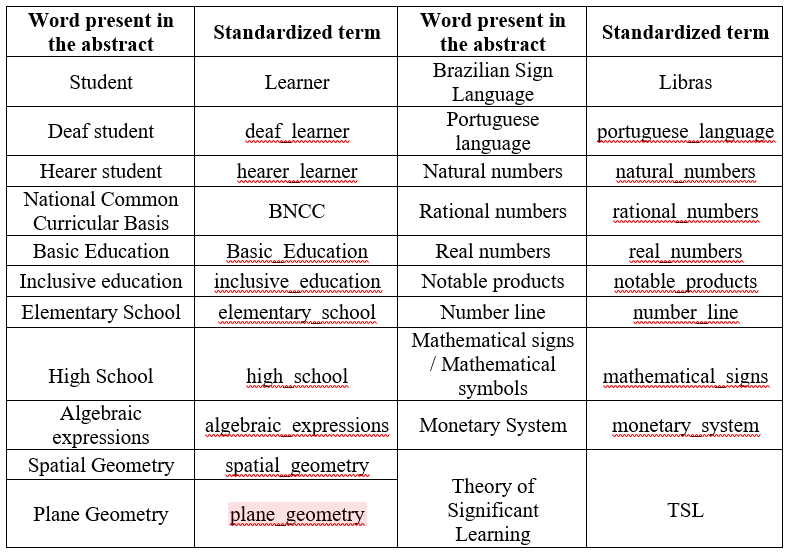
Previously to the processing, the texts of the abstracts were adapted as per the guidelines of Iramuteq handbook, including the lexical standardization, the union of terms composed by underline and numbers written out in words. The Chart 1 presents the main standardization procedures adopted.
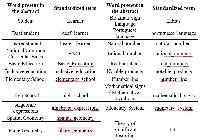
With the standardization of words and following the guidelines of Iramuteq software handbook, lines of command for each abstract were created, which followed the format:
**** *Art_1, followed by the text of the standardized abstract; and so on, until the last abstract selected, generating a .txt document in 8-bit format Unicode Transformation Format (UTF-8), which was used in the processing of information in the software and that the results are presented in the next section.
Results
In this section, the results obtained after survey on the selected databases and the analysis of the abstracts of papers found, performed by the Iramuteq software, are presented.
Overview of database surveys
The first step of SLR was the survey carried out on the selected databases and result in 577 papers (from 2013 to 2023), among articles, theses, and dissertations, being 24 at SciELO Brasil (20 in the survey “All indexes” and 4 in the survey “Abstract”) and 553 at BDTD. The Table 1 shows the number of papers found in each descriptor. It can be observed in this table that the words Libras and Brazilian Sign Language, despite refer to the same concept, present significantly different numbers, showing how important is to use different variations of the same term to expand the survey results.
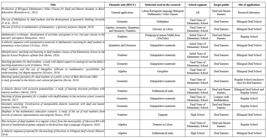
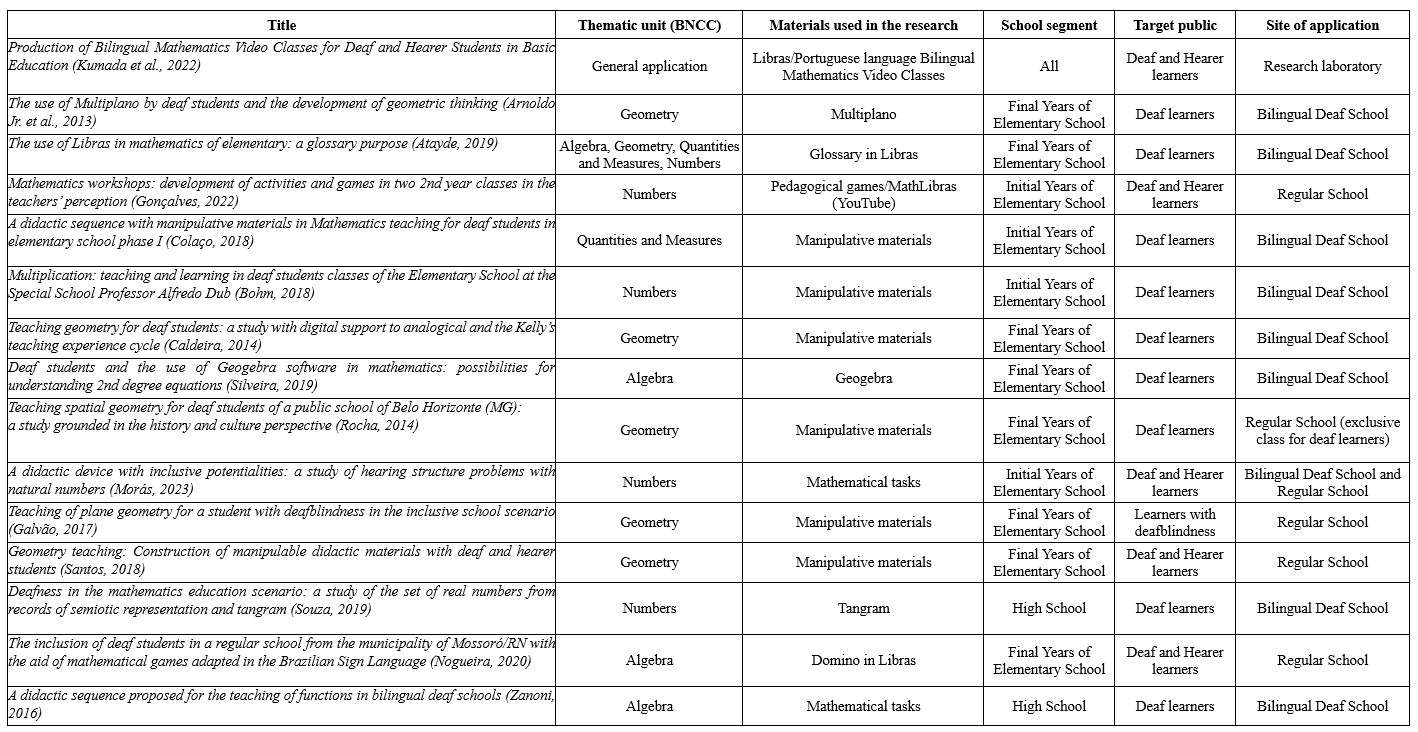
In the second stage of SLR, the titles and abstracts of the 577 papers were analyzed and submitted to the inclusion criteria presented in the previous section. Thus, 49 papers remained, which were fully read and submitted to the exclusion criteria (Method section). Of this total, 24 studies were excluded for being duplicated, i.e., for appearing in more than one survey; one study was excluded for being a review of literature; three were excluded for not being available in full; and six were excluded for not having been applied in Basic Education. Therefore, 15 papers remained, which compose the results of this research and which abstracts were processed and analyzed via Iramuteq software. Of this total, two are articles, 12 are Master’s dissertation, and one is a Doctoral thesis. Chart 2 presents the synthesis of the selected papers, highlighting the thematic units4 approached, the school segment, the target public, and the site of application of the researches.
Overview of the analyses performed by Iramuteq
The abstracts of the 15 papers synthetized in Chart 2 were standardized according to the methods described in the previous section (Method) and analyzed by the Iramuteq software. Therefore, the following data were observed:
-
Text segments: 123
-
Number of distinctive forms: 1170
-
Number of occurrences: 4265
-
Number of words appearing only once: 731
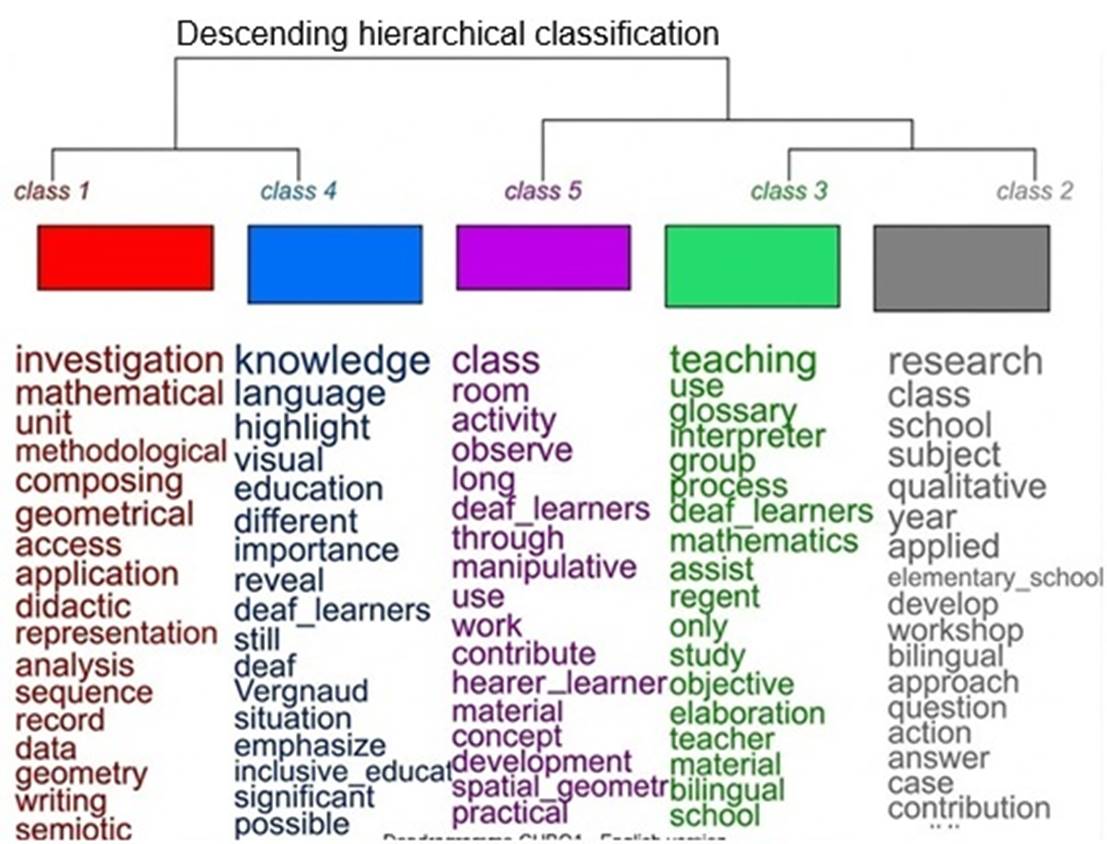
With these results, visual resources of analysis were generated, such as the word cloud (Figure 1), the similitude analysis (Figure 2) and the Reinert Method (Figure 3), which will be presented and discussed in the subsequent sections. In order to prepare the Figures 1 and 2, due to the number of distinct words found in the abstracts (731), we decided to choose words with absolute frequency greater than or equal to 15 (i.e., appearing in average once per abstract analyzed). Table 2 presents the selected words.
However, even with the application of the criteria described (by the frequency in which they appear in the 15 abstracts), we found that some of them did not add value to the analysis, as they had no meaning alone (“how”, “to” and “year”). Thus, we decided to keep only words related to didactic and methodological factors (“research”, “material”, “teaching”, “mathematics”, “didactic”, “learning”, “concept”, “mathematical”, “sequence” and “study”), focused on the target public of the research (“deaf_learners”, “libra” and “deaf”) and on the site of application of the research (“school”), totaling 15 of the 19 words described in Table 2. It was decided to remove the word “teacher” because this group does not compose the research focus.
Discussion
The discussion of the results obtained in both phases described in the previous section (Results) is performed in the following sections, which were separated to facilitate reading and understanding off the main points found.
Discussion of the papers found
Based on the categories indicated in Chart 2, the main points of the selected papers are discussed in this session.
About the school segments and target public
In relation to the school segments in which the papers were applied, it can be noted that, of the 15 papers, four were developed for the initial years of elementary school (Bohm, 2018; Colaço, 2018; Gonçalves, 2022; Morás, 2023), eight for the final years of elementary school (Arnoldo Jr. et al., 2013; Atayde, 2019; Caldeira, 2014; Galvão, 2017; Nogueira, 2020; Rocha, 2014; Santos, 2018; Silveira, 2019), two for the high school (Souza, 2019; Zanoni, 2016) and one can be applied to any segment (Kumada et al., 2022). These results show predominance of papers focused on the final years of elementary school to the detriment of the other school segments. No papers were found to the early childhood education. About the target public, nine papers were applied exclusively with deaf learners (Arnoldo Jr. et al., 2013; Atayde, 2019; Bohm, 2018; Caldeira, 2014; Colaço, 2018; Rocha, 2014; Silveira, 2019; Souza, 2019; Zanoni, 2016), five with deaf learners (Gonçalves, 2022; Kumada et al., 2022; Morás, 2023; Nogueira, 2020; Santos, 2018) and hearer learners and one with deafblindness (Galvão, 2017).
Reflections on the thematic units and types of materials used
The analysis of the thematic units showed that there is a balance in the production of papers for the units “Geometry,” “Numbers” and “Algebra,” with five, four and three productions, respectively. For the thematic unit “Quantities and Measures,” only one work was found, while no work was found for the unit “Probability and Statistics.” In a similar research, with the aim of searching for accessible materials for mathematics teaching to learners with blindness and visual impairment, Minholi and Rocha (2024) identified that the units “Geometry” and “Algebra”, followed by the unit “Numbers”, were the most approached ones in the studies found for the researched publics, which focused, in the case of the first two ones, on the “representation of geometric forms and design of graphs of function, especially with the use of Multiplano,” thus favoring the tactile manipulation of the mathematical goals.
In this regard, in a similar result, the selected words on “Geometry” are focused on topics of Plane and Spatial Geometry, as calculation of areas (Galvão, 2017; Santos, 2018), nomenclature and properties of polygons and polyhedrons (Caldeira, 2014; Rocha, 2014) and geometric thinking (Arnoldo Jr. et al., 2013). In addition, all the papers use manipulative materials, such as Multiplano, tridimensional geometric solids and daily-life materials, such as wooden sticks and paper, which explores visuality of the deaf person and palpable matters.
In “Numbers,” the major focus of the papers is on teaching of basic operations (Bohm, 2018; Gonçalves, 2022) and numerical sets (Morás, 2023; Souza, 2019). Different from the findings in the papers related to geometry, the authors used materials from distinct nature, such as tactile materials (tangram, bottle caps, and buttons), digital materials (videos on YouTube) and mathematical tasks in paper.
In the unit “Algebra,” the approached topics were 2nd degree equations (Silveira, 2019), functions (Zanoni, 2016) and notable products (Nogueira, 2020). Similarly to the unit “Numbers,” the papers focused in algebra used different types of materials, classified as tactile materials (domino in Libras), digital materials (Geogebra), and mathematical tasks in paper.
Finally, in “Quantities and Measures,” Colaço (2018) addresses the Brazilian monetary system by mathematical tasks in paper. We emphasize that the papers of Atayde (2019) and Kumada et al. (2022), as consisting of, respectively, a glossary in Libras and didactic video production (which methods can be applied to any topic), were not allocated to no specific thematic unit, as they apply to all of them.
Therefore, it is noted that the papers use different types of materials to act in the process of teaching and learning of learners of PEBS. A point that stands out refers to the thematic unit “Geometry,” which papers used only materials considered manipulative, differently of what is seen in other units that presented a greater variety of types of materials. However, this fact is possibly related to the tangibility of the contents approached by the authors (Plane and Spatial Geometry), while in the other thematic units the approached contents are more abstract in nature.
Synthesis of sites of application
About the sites of application, two different environments can be highlighted: I) Regular Schools, defined here as educational institutions which language of instruction is the Portuguese language; and II) Bilingual Deaf Schools, defined here as exclusive institutions for learners of PEBS which language of instruction is Libras, being the Portuguese language in the written modality used second language. Therefore, the papers of Arnoldo Jr. et al. (2013), Atayde (2019), Bohm (2018), Caldeira (2014), Colaço (2018), Silveira (2019), Souza (2019) and Zanoni (2016) were applied in Bilingual Deaf Schools. On the other hand, the papers of Galvão (2017), Gonçalves (2022), Nogueira (2020), Rocha (2014) and Santos (2018) were applied in Regular Schools. In the case of Rocha (2014), the research was conducted in an exclusive class for learners of PEBS in a regular school. In turn, the paper of Morás (2023) was applied in both institutions.
Discussion of the analyses performed by Iramuteq
The textual data from the abstracts of the papers selected in the SLR were used in Iramuteq software for the creation of visual elements of analyses, which will be discussed as follows.
Discussion of word cloud
Figure 1 is a word cloud in yellow background, representing the most frequent terms related to the study performed. The words are placed with sizes proportional to its absolute frequency, highlighting:
-
deaf_learners, which appears most frequently (47), is the central term and the largest one of the clouds.
-
research (38), material (34), teaching (31), mathematics (30) are visibly highlighted in medium-large size.
-
Other terms such as school (28), didactics (27), libra (26), learning (25) and concept (23) have intermediary sizes.
-
Less frequent terms, such as mathematical (18) and representation (15), appear smaller.
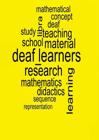
The cloud organizes visually the most recurrent terms of the study, facilitating the identification of main topics related to the theme. In this way, the analysis of the Figure 1, in conjunction with the Table 2, emphasizes the high occurrence of the words “deaf_ learners”, “material”, “teaching” and “mathematics,” allowing us to conclude that the selected papers in SLR converge with the research objectives of finding didactic materials of mathematics elaborated and applied to learners of PEBS. The results show that the focus of the productions, within PEBS group, has been the deaf learners, containing only one paper focused on other learners of PEBS (deafblind learners).
In this sense, Arnoldo Jr. et al. (2013) affirm that “many studies have been demonstrated that, both in bilingual spaces and in situations of school inclusion in hearer classes, the deaf are experiencing communication barriers,” due to the significant differences between Libras and Portuguese language. Specifically on the mathematics, the authors suggest that most of these barriers are made by the existence of mathematical concepts that have no signs. Similarly, Zanoni (2016) affirms that one barrier experienced by deaf learners is in the abstract nature of the discipline, which is expanded by the need of the subject of, during the learning process, having to make the transition between the languages. Thus, the elaboration of glossaries, such as the one presented by Atayde (2019), emerges as a solution for eliminating those linguistic barriers, as Libras is the first language of deaf people and, in addition, “the sense of sight is the most used by it, and its communication occurs by visual elements” (Atayde, 2019, p. 76).
Therefore, the production of materials in a bilingual perspective (in Libras and Portuguese language) through the addition of signs in Libras that assist the deaf learners to identify, in their first language, the exposed mathematical concepts, is a possibility to eliminate the barriers described (Brasil, 2023, p. 6). However, according to Kumada et al. (2022), finding materials in this perspective is still a challenge faced by educators. Moreover, taking advantage of visuality of the deaf learner, the results indicate the use of tactile materials as potentialized in the learning of mathematics. An example of material is that presented by Arnoldo Jr (2013), who used Multiplano to develop the geometric thinking of deaf learners. Likewise, the papers of Bohm (2018), Galvão (2017), Gonçalves (2022) and Nogueira (2020) applied, for deaf learners, tactile materials in specific activities, while Caldeira (2014), Colaço (2018), Rocha (2014) and Santos (2018) used this type of material in didactic sequences. An interesting and relevant point about these materials is in their integrating capacity, to the extent that a same material can be used by learners with different characteristics (Minholi; Rocha, 2024).
Discussion of similitude analysis
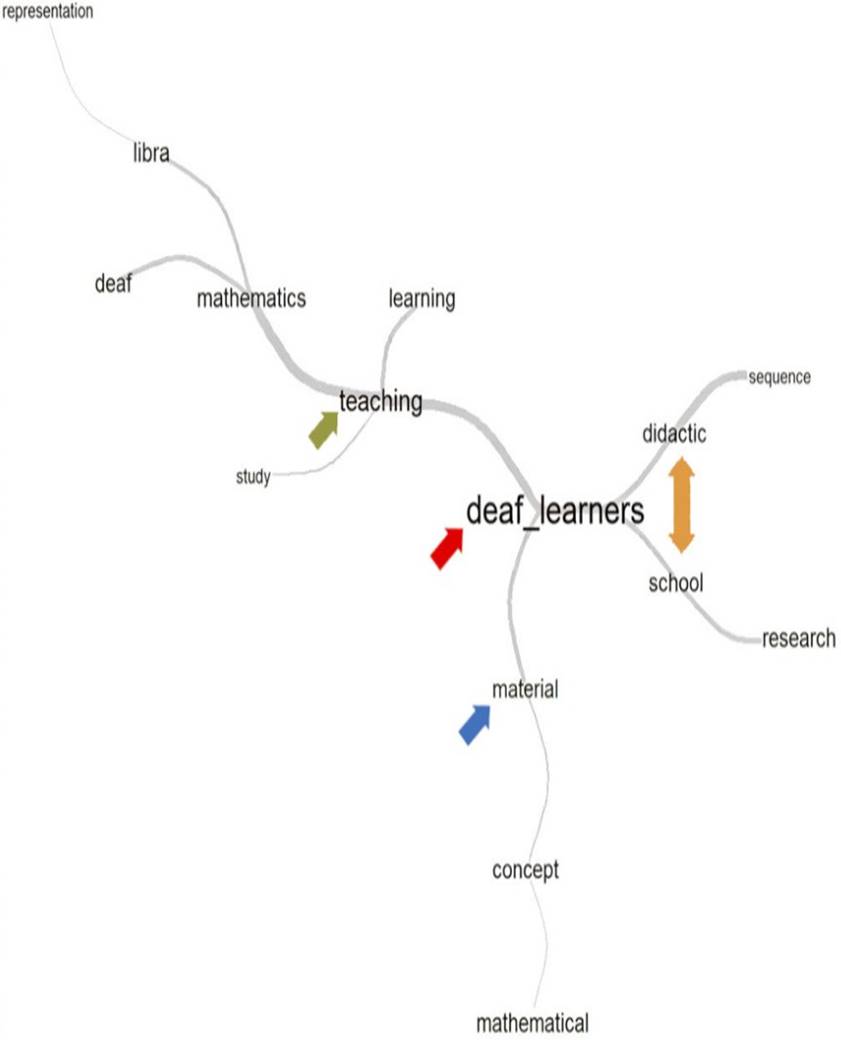
Just as Figure 1, the analysis of Figure 2 allows us to identify similar facts. The central point of the similitude analysis is the “deaf_learners,” as they represent the SLR target public. From this term, the existence of four main branches is found.
The first branch, represented by the word “material,” that relates to the words “concept” and “mathematical,” means that the papers aimed at presenting materials focused on mathematical concepts, such as numerical sets, area, polygons, polyhedrons, and functions (Caldeira, 2014; Galvão, 2017; Morás, 2023; Rocha, 2014; Santos, 2018; Souza, 2019; Zanoni, 2016).
The second and third branches, represented by the words “didactic” and “school,” despite separated, are directly connected to the extent that, in addition to being applied in educational institutions, approximately 50% of the papers present didactic sequences targeted to teaching of mathematical contents (Caldeira, 2014; Colaço, 2018; Galvão, 2017; Morás, 2023; Rocha, 2014; Santos, 2018; Zanoni, 2016).
Finally, the last branch, represented by the word “teaching,” reinforces the objective of the papers of presenting products focused on teaching-learning of mathematics. However, there is an important point in this branch, which is the connection between the words “mathematics,” “libra,” and “representation.” This connection indicates that the papers used representations of the sign language (Arnoldo Jr. et al., 2013; Atayde, 2019; Galvão, 2017; Kumada et al., 2022; Nogueira, 2020), an important and necessary fact, to the extent that this language constitutes as the first language of deaf people (Brasil, 2023, p. 6). Therefore, excluding of the sum the papers repeated in two or more of the four main branches described, the presence of 12 of 15 papers selected is noted, which demonstrate that the divisions performed by the software include most of the studies analyzed.
Discussion of the Reinert Method
Figure 3 presents the Reinert Method, which was the last instrument of visual analysis generated with Iramuteq. The method used the total of words that compose the textual corpus analyzed (the abstracts of the papers).

With the results obtained, the presence of five primary classes is observed. Class 1, containing the words “investigation,” “methodological,” “application,” “didactical,” “sequence,” and “registration,” refers to the methodologies of application of the materials. Of the 15 papers selected, seven propose the application of materials through didactic sequences (Caldeira, 2014; Colaço, 2018; Galvão, 2017; Morás, 2023; Rocha, 2014; Santos, 2018; Zanoni, 2016), four present the application of manipulative materials (such as Multiplano and tangram) though specific activities (Arnoldo Jr. et al., 2013; Bohm, 2018; Galvão, 2017; Nogueira, 2020), three purposes the use of digital resources, such as Geogebra and videos (Gonçalves, 2022; Kumada et al., 2022; Silveira, 2019) and one presents the production of a glossary for mathematical signs in Libras (Atayde, 2019).
Class 2, representing 23% of corpus and contain the words “research,” “school,” “qualitative,” “applied,” “elementary_school”, “bilingual” and “action,” refers to the methodology of the researches and sites of application of the materials (already described previously). All the researches are qualitative. However, they are classified in different categories, such as: I) case study (Arnoldo Jr. et al., 2013; Atayde, 2019; Caldeira, 2014; Colaço, 2018; Galvão, 2017; Gonçalves, 2022; Morás, 2023; Rocha, 2014; Silveira, 2019; Souza, 2019); II) action research (Bohm, 2018; Zanoni, 2016); III) intervention research (Nogueira, 2020); IV) didactic engineering (Santos, 2018); and V) applied research (Kumada et al., 2022).
Class 3, containing the words “teaching,” “interpreter,” “process,” “deaf_learners,” “regent,” and “teacher,”, refers to the subjects involved in the process of application and use of the materials presented, suggesting that the mediation of teachers and interpreters is essential for effectiveness of the materials. During the first stage of SLR, the existence of several papers focused on the formation of teachers and interpreters of Libras to act with learners of PEBS was observed, but not included in the results given to the research objectives.
Class 4, containing the words “language”, “visual”, “vergnaud” and “significant”, refers to the specific characteristics of the materials presented, as well as a few theories of learning used. In fact, the papers of Arnoldo Jr. et al. (2013), Bohm (2018), Caldeira (2014), Colaço (2018), Galvão (2017), Gonçalves (2022), Nogueira (2020), Rocha (2014), Santos (2018) and Souza (2019) presents manipulative materials, allowing the visualization of the mathematical contents through other senses rather than hearing or by reading of texts in Portuguese language, as well as the papers of Gonçalves (2022), Kumada et al. (2022) e Silveira (2019), which use digital resources to facilitate the visualization of mathematical concepts and procedures in a visual way. Regarding the linguistic characteristics of the productions, it is highlighted that the papers of Arnoldo Jr. et al. (2013), Atayde (2019), Galvão (2017), Kumada et al. (2022) and Nogueira (2020) present Libras directly inserted in the materials produced in conjunction with the Portuguese language, thus favoring that the same material can be effectively used by deaf learners (having Libras as first language) and learners having the Portuguese language as first language. On the other hand, the papers of Bohm (2018), Caldeira (2014), Colaço (2018), Gonçalves (2022), Morás (2023),
Rocha (2014), Santos (2018), Silveira (2019), Souza (2019), and Zanoni (2016) use Libras only during the explanation of the proposed contents, with the materials elaborated in Portuguese language. In relation to the learning theories, the authors Gérard Vergnaud e David Ausubel explicitly appears in the papers of Bohm (2018) and Morás (2023), and Bohm (2018), Colaço (2018), and Silveira (2019), respectively.
Class 5, containing the words “class,” “room,” “application,” “activity,” and “manipulable,” refers to the moment of application of the materials. In this sense, the studies of Arnoldo Jr. et al. (2013), Colaço (2018), Gonçalves (2022), Santos (2018), Silveira (2019), and Zanoni (2016) were conducted in classes/workshops in the after-school period. In turn, the papers of Atayde (2019), Bohm (2018), Caldeira (2014), Galvão (2017), Morás (2023), Nogueira (2020), Rocha (2014), and Souza (2019) were performed in the regular periods of classes.
Conclusions
The objective of this paper was to present a SLR on academic productions that elaborated and applied accessible materials of mathematics for learners of bilingual deaf education. In this sense, the research resulted in the analysis of 15 papers, among articles, theses, and dissertations, published from 2013 to 2023, on SciELO Brasil and BDTD databases, which abstracts were analyzed by Iramuteq software and the texts fully read and analyzed by the researches. The results points to a low production and application of papers for the researched public and that, within the PEBS group, the productions have had as major focus the deaf learners, so that only one of the 15 papers was conducted with learners with deafblindness.
Nevertheless, it is highlighted that the materials have potential to meet the demands of learners who are sign-language user (to the extent that they use the sign language as well), even that this group has not been included in the tests of the materials presented. However, the same cannot be affirmed for learners with deafblindness, whose educational demands are different from those presented by deaf learners. Therefore, the results suggest that is necessary to investigate and produce resources suitable to the needs of the other publics that compose PEBS, such as deafblind learners, learners with high abilities or gifted and learners with other associated disabilities. Among the main characteristics of the materials found, it is highlighted the use of manipulative materials (in ten of the 15 papers), given the visuality of the deaf subject. From the point of view of specific contents, the SLR showed to exist a balance between the productions for the thematic units “Numbers,” “Geometry,” and “Algebra.” However, the papers approach little or nothing of the contents referring to the thematic units “Quantities and Measures” and “Probability and Statistics,” being these two equally important for the development of the individual and recurrent topics of the main university entrance exams in the country, in addition that such units are mandatory thematics to be lectured in line with BNCC.
In relation to the school segments, the production of materials has been focused on the final years of elementary school (with ten of 15 papers) and little attention has been given to high school, the initial years of elementary school and early childhood education. A hypothesis for such fact would be that the productions are related to the segments of activity of the researches of each paper, an information that it was not possible to obtain by the analyzes conducted. However, thinking on the final Years of Elementary School as an intermediary stage of the education of any subject, the concentration of productions for this specific segment limits the solid formation of learners of PEBS, especially those inserted in regular classes, as in the start of their formation (early childhood education and initial years) there are difficulties to access materials and didactic sequences suitable to their needs, right in the stage of formation of concepts, techniques, procedures, and types of reasoning that are crucial to build more complex mathematical knowledge. On the other hand, when this very same learner passes through the final Years of Elementary School, difficulty arises in finding resources allowing to deepen in more complex contents, worked during the high School.
Another relevant result refers to the linguist aspect of the materials. From the 15 papers selected, only five have Libras directly inserted in the produced resource. The other ten materials, in turn, were produced exclusively in Portuguese language and requires the presence an interpreter for their applications, if the learner does not master the written modality of the Portuguese language. Therefore, in addition to the low number of materials produced and tested with learners of PEBS, most of them are not focused on Libras, being this language used only by the interpreter/teacher in charge during the teaching of the specific content, which can result in loss of autonomy of the learners when an interpreter is not available.
Another point to be considered refers to the importance of the continuing professional development for teachers of basic education to act in the bilingual deaf education. The development of specific training programs can potentialize the application of existing materials and encourage the creation of new bilingual pedagogical resources, in line with the needs and characteristics of PEBS. In addition, educational policies encouraging research and development of bilingual materials should be a priority, in order to fill the gaps seen in this review.
In summary, the main findings of this systematic review emphasizes: (i) the reduced production of accessible materials of mathematics for bilingual deaf education; (ii) the concentration of productions in the final years of elementary school; (iii) the predominance of manipulative materials, to the detriment of bilingual resources that integrate the Libras as language of instruction; and (iv) expressive gaps in determined thematic units, especially “Quantities and Measures” and “Probability and Statistics.” Such results indicate that is necessary to extend future investigations that include school segments, different profiles of learners of PEBS, and elaboration of materials that incorporate the Libras in a structuring way, as well as studies analyzing implementation processes, pedagogical validation and development of teachers associated to the use of these resources.
With this research, we expect to contribute for new productions for this public to be developed in the future. Moreover, we hope to promote a reflection about the need that new materials to contain both Portuguese language as Libras, so that they can be used in a democratic, autonomous, and complete way by any learner, whether of PEBS or hearer, thus making equitative and accessible teaching of mathematics possible.
References
-
ARNOLDO JR., Henrique; RAMOS, Maurivan Güntzel; THOME, Adriana da S. O uso do multiplano por alunos surdos e o desenvolvimento do pensamento geométrico. Cadernos Cedes, Campinas, v. 33, n. 91, 2013. Disponível em: Disponível em: https://doi.org/10.1590/S0101-32622013000300006 Acesso em: dez. 2024.
» https://doi.org/10.1590/S0101-32622013000300006 - ATAYDE, Suenio Tomáz Spindola de. O uso da Libras na matemática do fundamental: uma proposta de glossário. 2019. Dissertação (Mestrado Profissional em Matemática) - Universidade Federal de Goiás, Catalão, 2019.
- BOHM, Fabiane Carvalho. Multiplicação: ensinar e aprender em turmas de alunos surdos do ensino fundamental na Escola Especial Professor Alfredo Dub. 2018. Dissertação (Mestrado em Educação Matemática) - Universidade Federal de Pelotas, Pelotas, 2018.
-
BRASIL. Base Nacional Comum Curricular: educação é a base. Brasília, DF: MEC, 2018. Disponível em: Disponível em: http://basenacionalcomum.mec.gov.br/images/BNCC_EI_EF_110518_versaofinal_site.pdf Acesso em: maio 2025.
» http://basenacionalcomum.mec.gov.br/images/BNCC_EI_EF_110518_versaofinal_site.pdf -
BRASIL. Decreto nº 5.626, de 22 de dezembro de 2005. Regulamenta a Lei nº 10.436, de 24 de abril de 2002, que dispõe sobre a Língua Brasileira de Sinais - Libras, e o art. 18 da Lei nº 10.098, de 19 de dezembro de 2000. Diário Oficial da União, Brasília, DF, 2005. Disponível em: Disponível em: http://www.planalto.gov.br/ccivil_03/_Ato2004-2006/2005/Decreto/D5626.htm Acesso em: dez. 2024.
» http://www.planalto.gov.br/ccivil_03/_Ato2004-2006/2005/Decreto/D5626.htm -
BRASIL. Lei nº 10.436, de 24 de abril de 2002. Dispõe sobre a Língua Brasileira de Sinais - Libras e dá outras providências. Diário Oficial da União, Brasília, DF, 2002. Disponível em: Disponível em: https://www.planalto.gov.br/ccivil_03/leis/2002/l10436.htm Acesso em: dez. 2024.
» https://www.planalto.gov.br/ccivil_03/leis/2002/l10436.htm -
BRASIL. Lei nº 14.191 de 3 de agosto de 2021. Altera a Lei nº 9.394, de 20 de dezembro de 1996 (Lei de Diretrizes e Bases da Educação Nacional), para dispor sobre a modalidade de educação bilíngue de surdos. Brasília, DF: Casa Civil, 2021. Disponível em: Disponível em: http://www.planalto.gov.br/ccivil_03/_Ato2019-2022/2021/Lei/L14191.htm#art1 Acesso em: dez. 2024.
» http://www.planalto.gov.br/ccivil_03/_Ato2019-2022/2021/Lei/L14191.htm#art1 -
BRASIL. MEC. Ministério da Educação. Referenciais de acessibilidade na educação superior e a avaliação in loco do Sistema Nacional de Avaliação do Ensino Superior (SINAES). Parte I - Avaliação de cursos de graduação. Brasília, DF: MEC, 2013. Ministério da Educação. Instituto Nacional de Estudos e Pesquisas Educacionais Anísio Teixeira (Inep). Diretoria de Avaliação da Educação Superior/Coordenação-Geral de Avaliação de Cursos de Graduação e IES. Jul. 2013. Disponível em: Disponível em: https://www.puc-campinas.edu.br/wp-content/uploads/2016/04/proavi-referenciais-de-acessibilidade-parte-i.pdf Acesso em: dez. 2025.
» https://www.puc-campinas.edu.br/wp-content/uploads/2016/04/proavi-referenciais-de-acessibilidade-parte-i.pdf - CALDEIRA, Verônica Lima de Almeida. Ensino de geometria para alunos surdos: um estudo com apoio digital ao analógico e o ciclo da experiência kellyana. 2014. Dissertação (Mestrado em Ensino de Ciências e Matemática) - Universidade Estadual da Paraíba, Campina Grande, 2014.
- COLAÇO, Gisele Adriana de Mello. Uma sequência didática com materiais manipulativos no ensino da matemática para alunos surdos no ensino fundamental fase I. 2018. Dissertação (Mestrado em Ensino) - Universidade Estadual do Oeste do Paraná, Foz do Iguaçu, 2018.
- GALVÃO, Daiane Leszarinski. O ensino de geometria plana para uma aluna com surdocegueira no contexto escolar inclusivo. 2017. Dissertação (Mestrado Ensino de Ciência e Tecnologia) - Universidade Tecnológica Federal do Paraná, Ponta Grossa, 2017.
- GIL, Antonio Carlos. Como elaborar projetos de pesquisa. 4. ed. São Paulo: Atlas, 2008.
- GONÇALVES, Patrícia Michie Umetsubo. Oficinas de matemática: desenvolvimento de atividades e jogos em duas turmas de 2º ano na percepção das professoras. 2022. Dissertação (Mestrado em Educação Matemática) - Universidade Federal de Pelotas, Pelotas, 2022.
-
INEP. Instituto Nacional de Estudos e Pesquisas Educacionais Anísio Teixeira. Censo escolar 2021: divulgação dos resultados. Brasília, DF: MEC: INEP, 2021. Disponível em: Disponível em: https://download.inep.gov.br/censo_escolar/resultados/2021/apresentacao_coletiva.pdf Acesso em: dez. 2025.
» https://download.inep.gov.br/censo_escolar/resultados/2021/apresentacao_coletiva.pdf -
INEP. Instituto Nacional de Estudos e Pesquisas Educacionais Anísio Teixeira. Censo escolar 2024: divulgação dos resultados. Brasília, DF: MEC: INEP, 2024b. Disponível em: Disponível em: https://download.inep.gov.br/censo_escolar/resultados/2024/apresentacao_coletiva.pdf Acesso em: dez. 2025.
» https://download.inep.gov.br/censo_escolar/resultados/2024/apresentacao_coletiva.pdf -
INEP. Instituto Nacional de Estudos e Pesquisas Educacionais Anísio Teixeira. Glossário da educação especial: censo escolar 2024. Brasília, DF: INEP, 2024a. Disponível em: Disponível em: https://download.inep.gov.br/pesquisas_estatisticas_indicadores_educacionais/censo_escolar/orientacoes/matricula_inicial/glossario_da_educacao_especial_censo_escolar_2024.pdf Acesso em: dez. 2024.
» https://download.inep.gov.br/pesquisas_estatisticas_indicadores_educacionais/censo_escolar/orientacoes/matricula_inicial/glossario_da_educacao_especial_censo_escolar_2024.pdf - KUMADA, Kate Mamhy Oliveira et al.. Produção de videoaulas de matemática bilíngues para alunos surdos e ouvintes na educação básica. Bolema, Rio Claro, v. 36, n. 74, 2022. https://doi.org/10.1590/1980-4415v36n74a03.
- LACERDA, Cristina Broglia Feitosa de. Um pouco da história das diferentes abordagens na educação dos surdos. Cadernos Cedes, Campinas, v. 19, n. 46, p. 68-80, set. 1998.
- MINHOLI, Felipe Siqueira; ROCHA, Luiz Renato Martins da. Materiais acessíveis para o ensino de matemática para educandos com deficiência visual: uma revisão de literatura. Revista Brasileira de Educação Especial, Brasília, n. 30, 2024. https://doi.org/10.1590/1980-54702024v30e0064.
- MORÁS, Nadjanara Ana Basso. Um dispositivo didático com potencialidades inclusivas: um estudo a respeito de problemas de estruturas aditivas com números naturais. 2023. Tese (Doutorado Educação em Ciências e Educação Matemática) - Universidade Estadual do Oeste do Paraná, Cascavel, 2023.
- NOGUEIRA, Silvana da Silva. A inclusão de alunos surdos em uma escola regular do município de Mossoró/RN com auxílio de jogos matemáticos adaptados em língua brasileira de sinais. 2020. Dissertação (Mestrado em Ensino) - Universidade do Estado do Rio Grande do Norte (UERN), Universidade Federal Rural do Semi-Árido (UFERSA) e Instituto Federal de Educação, Ciência e Tecnologia (IFRN), Mossoró, 2020.
-
QUADROS, Ronice Müller de. O tradutor e intérprete de língua brasileira de sinais e língua portuguesa. Brasília, DF: MEC, 2004. Disponível em: Disponível em: https://portal.mec.gov.br/seesp/arquivos/pdf/tradutorlibras.pdf Acesso em: dez. 2024.
» https://portal.mec.gov.br/seesp/arquivos/pdf/tradutorlibras.pdf - ROCHA, Fernanda Bittencourt Menezes. Ensinando geometria espacial para alunas surdas de uma escola pública de Belo Horizonte (MG): um estudo fundamentado na perspectiva histórico cultural. 2014. Dissertação (Mestrado Profissional em Educação Matemática) - Universidade Federal de Ouro Preto, Ouro Preto, 2014.
- ROCHA, Luiz Renato Martins da; LACERDA, Cristina Broglia Feitosa de; PRIETO, Rosângela Gavioli. Um retrato das matrículas de estudantes da educação especial e da educação de surdos, surdocegos e deficiência auditiva: da educação básica à educação superior. Práxis Educativa, Ponta Grossa, v. 19, p. 1-17, 2024. https://doi.org/10.5212/PraxEduc.v.19.22596.022.
- ROCHA, Luiz Renato Martins da; OLIVEIRA, Jáima Pinheiro de. Análise textual pormenorizada da Lei Brasileira de Inclusão: perspectivas e avanços em relação aos direitos das pessoas com deficiência. Práxis Educativa, Ponta Grossa, v. 17, p. 1-16, 2022. https://doi.org/10.5212/PraxEduc.v.17.19961.048.
- ROCHA, Luiz Renato Martins da; VASCONCELOS, Norma Abreu e Lima Maciel de Lemos; COSTA, Maria da Piedade Resende da. A escrita numérica de pessoas com surdocegueira. Práxis Educativa, Ponta Grossa, v. 16, p. 1-11, 2021. https://doi.org/10.5212/PraxEduc.v.16.17435.025.
- SAMPAIO, Rosana Ferreira; MANCINI, Marisa Cotta. Estudos de revisão sistemática: um guia para síntese criteriosa da evidência científica. Brazilian Journal of Physical Therapy, Braga, v. 11, n. 1, 2007. https://doi.org/10.1590/S1413-35552007000100013.
- SANTOS, Lijecson Souza dos. Ensino de geometria: construção de materiais didáticos manipuláveis com alunos surdos e ouvintes. 2018. Dissertação (Mestrado Profissional em Ensino de Ciências e Matemática) - Universidade Estadual da Paraíba, Campina Grande, 2018.
- SILVEIRA, Cléa Furtado da. Alunos surdos e o uso do software Geogebra em matemática: possibilidades para a compreensão das equações de 2º grau. 2019. Dissertação (Mestrado em Educação Matemática) - Universidade Federal de Pelotas, Pelotas, 2019.
- SOUZA, Lucas José de. Surdez no contexto da educação matemática: um estudo sobre o conjunto dos números reais a partir de registros de representação semiótica e o tangram. 2019. Dissertação (Mestrado em Educação Matemática) - Universidade Federal de Santa Maria, Santa Maria, 2019.
- ZANONI, Graziely Grassi. Uma sequência didática proposta para o ensino de funções na escola bilíngue para surdos. 2016. Dissertação (Mestrado em Ensino) - Universidade Estadual do Oeste do Paraná, Foz do Iguaçu, 2016.
-
1
English version by Tikinet. The authors take full responsibility for the translation of the text, including title of books/articles and the quotations originally published in Portuguese.
-
Data availability:
All the dataset supporting the results of this study was made available in Zenodo plataform and can be accessed at: https://doi.org/10.5281/zenodo.18787102
-
3
Digital platform denominated “Acessiteca”, available at: https://lirte.pesquisa.ufabc.edu.br/acessiteca/.
-
4
Didactic segmentations proposed by the National Common Curricular Basis - BNCC in the discipline of Mathematics (Brasil, 2018).
-
Editor:
Prof. Dr. Fabio de Barros Silva.
All the dataset supporting the results of this study was made available in Zenodo plataform and can be accessed at: https://doi.org/10.5281/zenodo.18787102

 Source: own elaboration based on the formatting guidelines of Iramuteq software (2024)
 Source: Research data
 Source: Own elaboration - figure generated by Iramuteq software (2024)
 Source: Own elaboration - figure generated by Iramuteq software (2024)
 Source: Own elaboration - figure generated by Iramuteq software (2024).