
 Institutionalization of ethnomathematics in the Bumi Segandu Dayak Community, West Java, Indonesia as a didactic and pedagogical sources of school mathematics
Abstract
Research on ethnomathematics has been extensively conducted worldwide, yet its integration into didactic design and mathematics pedagogy in schools still needs to be improved. This study aims to explore and assess the effectiveness of didactic design and pedagogy derived from the ethnomathematics of the Bumi Segandu Dayak Community. Employing an exploratory sequential design, the research involved three representatives from the Bumi Segandu Dayak Community and 32 junior high school students in Indramayu Regency (22 females and 10 males). Data collected through interviews, observations, mathematics tests and documentation were analyzed qualitatively and quantitatively. The findings reveal that the institutionalization of ethnomathematics within the Bumi Segandu Dayak Community incorporates mathematical activities in buildings, ceremonial rituals, handicrafts, and children’s games. Moreover, this institutionalization is a valuable source for didactic (planar geometry learning module) and pedagogical (learning syntax) approaches. Furthermore, the study demonstrates the effectiveness of integrating these didactic and pedagogical sources from ethnomathematics into enhancing students’ mathematical comprehension. Consequently, this research underscores the importance of considering the integration of ethnomathematics from specific cultures into mathematics Education within school settings.
Keywords:
Bumi Segandu Dayak Community; Didactic and Pedagogical Resources; Ethnomathematics Indonesia
Resumo
A pesquisa sobre etnomatemática tem sido amplamente realizada em todo o mundo, mas sua integração ao design didático e à pedagogia da matemática nas escolas ainda precisa ser aprimorada. Este estudo tem como objetivo explorar e avaliar a eficácia do design didático e da pedagogia derivados da etnomatemática da Comunidade Bumi Segandu Dayak. Utilizando um desenho sequencial exploratório, a pesquisa envolveu três representantes da Comunidade Bumi Segandu Dayak e 32 alunos do ensino fundamental no Distrito de Indramayu (22 do sexo feminino e 10 do sexo masculino). Os dados coletados por meio de entrevistas, observações, testes de matemática e documentação foram analisados qualitativa e quantitativamente. Os resultados revelam que a institucionalização da etnomatemática dentro da Comunidade Bumi Segandu Dayak incorpora atividades matemáticas em edifícios, rituais cerimoniais, artesanato e jogos infantis. Além disso, essa institucionalização é uma fonte valiosa para abordagens didáticas (módulo de aprendizagem de geometria plana) e pedagógicas (sintaxe de aprendizagem). Além disso, o estudo demonstra a eficácia da integração dessas fontes didáticas e pedagógicas da etnomatemática para melhorar a compreensão matemática dos alunos. Consequentemente, esta pesquisa destaca a importância de considerar a integração da etnomatemática de culturas específicas na Educação matemática no ambiente escolar.
Palavras-chave:
Comunidade Bumi Segandu Dayak; Recursos Didáticos e Pedagógicos; Etnomatemática
Resumen
La investigación sobre etnomatemática se ha llevado a cabo ampliamente en todo el mundo, pero su integración en el diseño didáctico y la pedagogía de las matemáticas en las escuelas aún necesita mejoras. Este estudio tiene como objetivo explorar y evaluar la efectividad del diseño didáctico y la pedagogía derivados de la etnomatemática de la Comunidad Bumi Segandu Dayak. Mediante un diseño secuencial exploratorio, la investigación involucró a tres representantes de la Comunidad Bumi Segandu Dayak y a 32 estudiantes de secundaria en la Regencia de Indramayu (22 mujeres y 10 hombres). Los datos recopilados a través de entrevistas, observaciones, pruebas de matemáticas y documentación fueron analizados cualitativa y cuantitativamente. Los hallazgos revelan que la institucionalización de la etnomatemática dentro de la Comunidad Bumi Segandu Dayak incorpora actividades matemáticas en edificios, rituales ceremoniales, artesanías y juegos infantiles. Además, esta institucionalización representa una fuente valiosa para enfoques didácticos (módulo de aprendizaje de geometría plana) y pedagógicos (sintaxis de aprendizaje). Asimismo, el estudio demuestra la efectividad de la integración de estos recursos didácticos y pedagógicos de la etnomatemática en la mejora de la comprensión matemática de los estudiantes. En consecuencia, esta investigación resalta la importancia de considerar la integración de la etnomatemática de culturas específicas en la Educación matemática en el contexto escolar.
Palabras clave:
Comunidad Bumi Segandu Dayak; Recursos Didácticos y Pedagógicos; Etnomatemática
1 Introduction
Integrating culture into mathematics learning offers a means to cultivate a conducive learning atmosphere. Students from diverse cultural backgrounds often possess unique life experiences, influencing their interactions with numbers, shapes, and patterns in ways shaped by cultural traditions, such as counting methods, visual representations, and pattern recognition in daily life. When mathematical materials acknowledge and reflect students’ experiences, concepts become relatable within familiar contexts (Vos, 2018). Consequently, integrating culture into mathematics learning practices is intricate and demanding, necessitating an in-depth exploration of students’ cultural contexts.
Exploring student culture is essential as mathematics and culture are intertwined (Madusise & Mwakapenda, 2014), evident in daily life (Prahmana et al., 2021; Sari et al., 2022; Umbara et al., 2021), and can serve as a teaching context (Prahmana et al., 2021; Sudirman et al., 2020). This exploration facilitates the connection of mathematical concepts with students’ cultural experiences, enhancing understanding and material relevance. Studies investigating mathematical values within culture are termed ethnomathematics, as delineated by Orey & Rosa (2006) and Burkhardt & D’Ambrosio (2006).
Since Ubiratan D’Ambrosio first introduced it in the 1980s, ethnomathematics research has developed and is widely used by researchers. In Indonesia, the study of ethnomathematics has experienced development, not only exploring ethnomathematics but also linking it to other concepts. For example, Umbara et al. (2023) combine the concepts of mathematical literacy and ethnomathematics of the Sundanese people in Indonesia. Prahmana (2022) designed mathematics learning that combines the concepts of ethnomathematics, and Realistic Mathematics Education (RME) called Etno-RME. Furthermore, Suherman et al. (2024) developed a test evaluation tool based on creative mathematical-ethnomathematics thinking. Nurafifah et al. (2024) connected ethnomathematics to the shape of traditional boats in Indramayu, Indonesia, to produce a framework for mathematical concepts in schools. Hortelano & Lapinid (2024) re-contextualized mathematical concepts through ethnomathematics in Kalinga and matched them as a source of second-generation didactic techniques. The efforts made by researchers, especially in Indonesia, have given it its color. Researchers used the Bumi Segandu Dayak Community (BSDC), West Java, Indonesia context in this study to explore ethnomathematics and produce didactic and pedagogical designs for school mathematics learning.
On the other hand, ethnomathematics research extracted from the culture of specific communities has been widely explored by researchers. For example, Muhtadi et al. (2017) conducted research on the habits of the Sundanese people in Indonesia in calculating mathematical symbols consisting of simple units, length, distance, surface, height, weight, group, and time, as well as measuring, handling, and setting them. Pathuddin & Nawawi (2021) found that the Bugis people in Indonesia, in making Barongko, involved mathematics in the concepts of division, congruence, equality, and triangular and hemispherical prisms. Rubio (2016) found that the Kabihug tribe in the Philippines they are accustomed to simple counting, coding, measuring, classifying, sorting, inferring, and modelling patterns that arise from the environment. Umbara et al. (2021) found that the Cigugur Indigenous People used counting, searching, measuring, designing, and explaining to determine a good day to build a house. Long & Chik (2020) found that the foundation of life for the people of Melanau, Tellian Mukah, Malaysia is based on numbers or mathematics, which can be seen in the community’s belief system, social system, traditional games, architecture, and daily practices and traditions. Ergene et al. (2020) found many geometric elements in Turkish culture. Even though there are many ethnomathematics studies, there are still few sources and discussions regarding ethnomathematics among the BSDC in Indonesia. Therefore, this study aims to explore and assess the effectiveness of didactic design and pedagogy derived from the ethnomathematics of the BSDC.
Ethnomathematics in the culture of the BSDC is an exciting research area to explore because it provides an opportunity to understand how the traditions, beliefs, and cultural practices of the BSDC shape the understanding and application of mathematics in various contexts, from traditional buildings and ceremonial customs to handicrafts and children’s games. Unlike many indigenous communities that have been extensively studied in the ethnomathematics literature, the BSDC represents an underexplored cultural group whose unique mathematical practices have not yet been formally documented or integrated into school mathematics learning. This research gap is particularly significant given that the BSDC is located in Indramayu Regency, West Java — a region with a rich and distinctive cultural heritage that offers a unique context for developing culturally responsive mathematics Education.
To address this gap, this research is structured into three interconnected stages: (1) ethnomathematics exploration of the BSDC’s cultural practices, (2) design of didactic and pedagogical sources derived from the ethnomathematics findings, and (3) implementation and evaluation of the didactic and pedagogical sources in junior high school mathematics learning. The following section describes the research methodology employed across these three stages.
2 Method
This section outlines the research methodology employed in the study, covering the overall research design, the selection of participants, the techniques used for data collection, and the procedures for data analysis. The methodology was developed to address the exploratory and sequential nature of this study, integrating both qualitative and quantitative approaches.
2.1 Research design
This research uses an exploratory sequential design. This design begins with qualitative collection and analysis, followed by quantitative. In this research, the qualitative stage used an ethnographic design, which aims to be a tool for understanding the symbols contained in people’s culture (Hoskins, 2015). Studies that reveal mathematical symbols, ideas, values, and ideas in particular societies or cultures are called ethnomathematics (Rosa & Gavarrete, 2017; Rodríguez-Nieto, 2021). The ethnomathematics study in the research follows the framework of Alangui (2020). Meanwhile, the research framework can be seen in Figure 1.
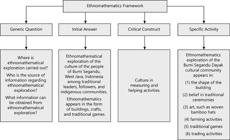
The ethnomathematics exploration framework begins by creating general questions and then compiling initial answers from participants. After the initial answer was obtained, the researcher evaluated, analysed, and constructed the initial answer that the researcher had obtained. As a result of the critical construction, a specific description of ethnomathematics activities is then created. Furthermore, the quantitative process uses a one-group pre-test-post-test design because there are no control variables, and the sample was not chosen randomly.
2.2 Research Participants
In the qualitative stage, participants in this research involved key informants, primary informants, and supporting informants. These three types of informants are used to ensure the validity of the data. In this research, the researcher chose three (3) people, namely the Head of the BSDC, as key informants and two people from the BSDC as the primary informants. Furthermore, in the quantitative stage, the participants were 32 junior high school students from a public junior high school with A accreditation in Indramayu Regency, West Java, Indonesia. The school was selected purposively because it is located in an area with a unique local culture, namely the BSDC, making it contextually relevant for the integration of BSDC’s ethnomathematics into classroom learning. The school serves students from heterogeneous socioeconomic backgrounds, reflecting the diverse socioeconomic conditions of the surrounding community. The student participants consisted of twenty-two female students and ten male students who voluntarily participated in learning activities using culturally integrated didactic and pedagogical resources. All 32 students participated in both the pre-test and post-test assessments.
2.3 Data collection technique
Data collection techniques in this research used observation, interviews, documentation, and tests of understanding of mathematical concepts. Observation is used to directly observe the activities, shape of buildings, and activities of the BSDC, which are related to mathematical values. Furthermore, researchers conducted regular interviews with the BSDC. In the interview process, researchers use subject naming, which aims to make it easier for readers to understand the content of the interview. Apart from that, researchers also used coding of subject names in interviews. The name coding is as follows: D1 (Respondent 1) is used to refer to the tribal chief (chief of the BSDC), D2 (Respondent 2) is used to refer to followers of the BSDC. Researchers also use documentation to photograph, record videos, and record everything related to the activities of the BSDC. Furthermore, this research also uses a mathematical understanding test to analyze the effectiveness of didactic and pedagogical resources in improving junior high school students’ mathematical understanding.
2.4 Data analysis
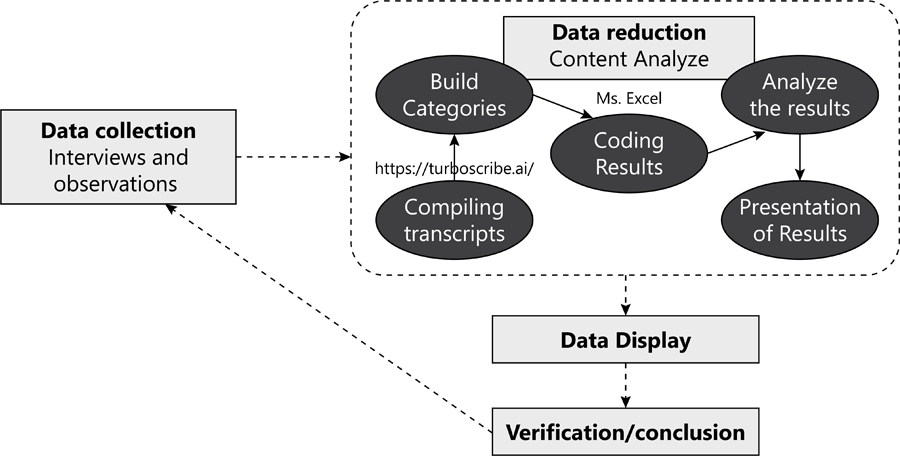
Data analysis in research uses qualitative and quantitative data analysis. Data from interviews and observations were transcribed, reduced, abstracted, coded, presented, and analyzed using the content analysis method. There are five stages in content analysis: (1) compiling transcriptions of interview notes and observations; (2) creating categories; (3) coding interview texts and field notes; (4) analyzing the results; (5) presenting interview results and observation notes (Yaniawati et al., 2023). The stages of content analysis can be seen in Figure 2.

In this research, interview transcripts and observations were compiled using the website https://turboscribe.ai/. After that, the researcher began to build relevant categories, such as “mathematics activities”, and “Building Forms”. The coding process in this research uses manual coding by inputting into Microsoft Excel. Next, the coded data is presented to summarize the research findings. Furthermore, the data obtained from the pre-test and post-test were analyzed statistically using a paired sample t-test.
3 Results
This section presents the findings of the study in three interconnected parts. The first part documents the institutionalization of ethnomathematics within the BSDC as observed through its cultural practices. The second part describes the didactic and pedagogical sources derived from these ethnomathematical findings. The third part reports on the implementation outcomes of the integrated didactic and pedagogical resources in the classroom.
3.1 Institutionalization of Ethnomathematics in BSDC
The ethnomathematics of the BSDC was identified through a series of interviews and direct observations involving key informants from the community. The findings reveal that mathematical activities are embedded in four primary cultural domains: building forms, traditional ceremonies, handicrafts, and children’s games. Each of these domains is described in the following subsections.
3.1.1 Building Shape
Based on the results of an interview with D1 and direct observation of the shape of the building used for traditional belief rituals. The building was designed and built directly by the tribal chief and BSDC. The shape of the building looks like a combination of a tube and a half-ball. This can be seen in Figure 3 below.

The building has four doors and small windows, meaning people cannot consume too much and must give a lot. Apart from that, there are special rules for entering the building, namely that you are only allowed to enter the building on Thursday nights in Kliwon with offerings. Therefore, ethnomathematics appears in the shape of the buildings, representing the geometric shapes of rectangles, squares, circles, tubes, and spheres.
Next, a mathematical model of the building shape’s volume is created, a combination of the volume of a cylinder and a half sphere. If the radius (r), height (h), and area of the circle (LA) are known, the combined volume of the cylinder and sphere (Vgab) can be written as follows.
Therefore, the building form of the BSDC can be used to explain the concepts of tube, sphere, and volume.
3.1.2 Traditional ceremonies
Based on interviews and direct observation, information was obtained that the BSDC has certain traditional ceremonies. This is referred to as “natural singing.” The Bumi Segandu Dayak people enter the ritual building alternately and sequentially. Bumi Segandu Dayak’s parents entered first and were followed by other senior members. Next, all members who have entered the ritual building form a circle position (see Figure 4). Therefore, ethnomathematics in this ceremony appear in the form of circles and semicircles in the ceremony process.

After forming a circle, another member of Bumi Segandu Dayak followed the ritual of forming a new half-circle, followed by three more Bumi Dayak Segandu forming a new half-circle. The ritual process lasts until 4 pm.
Based on the ceremonial procession pattern, a mathematical model can be developed. If the radius (r) and the area of the circle (LA) are known, the area of the full circle and semicircle can be expressed mathematically. The formula for the area of a circle is LA = πr2, while the formula for the area of a half-circle is LA = ½πr2.
3.1.3 Handicrafts
Based on interviews with followers of the BSDC and direct observation, information was obtained that the BSDC is accustomed to making crafts from bamboo called bamboo fences (See Figure 5).

Making bamboo fence crafts begins by making bamboo segments of the same size. Bamboo segments are aligned vertically at specific intervals. Horizontal parallel bamboo segments are also made to unite parallel bamboo segments. Next, diagonal line segments were also made to strengthen the bamboo fish. Furthermore, based on the shape of the bamboo fence, the craft represents the concepts of triangle, trapezium, rectangle, parallelism, and congruence.
3.1.4 Traditional game
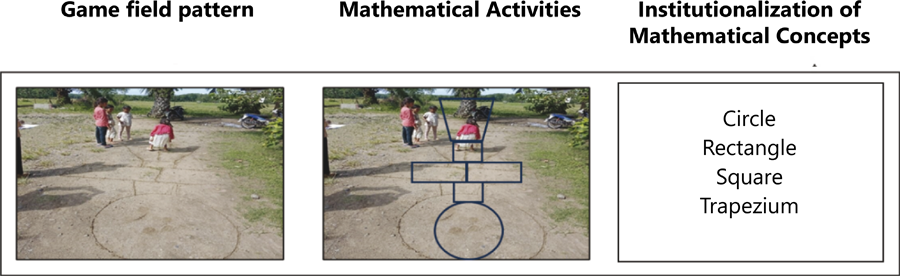
Based on interviews and observations with BSDC information was obtained that the children of the BSDC often play a game called Engklek. To start the Engklek game, children must draw a playing field combining square, rectangular, triangle, circle, and trapezoid shapes. The pattern of the Engklek playing field can be seen in Figure 6.

Based on the shape pattern of the Engklek game, ethnomathematics appears in the combination of game shapes, representing squares, rectangles, triangles, circles, and trapeziums. Furthermore, if we know the side (s), length (l), width (w), height (h), length of parallel sides in the trapezium (a and b), the combined area of the Engklek pattern (Agab) can be written as follows.
Therefore, the shape pattern of the Engklek game from the BSDC can be used to explain the concepts of square, rectangle, triangle, circle, and trapezium.
3.1.5 Didactical and Pedagogical Sources from the BSDC
Based on the ethnomathematical findings from the BSDC, two types of educational resources were developed: didactic resources in the form of a culturally integrated teaching module, and pedagogical resources in the form of a structured learning syntax. The development and structure of each resource are described in the subsections below.
3.1.6 Didactical Resources
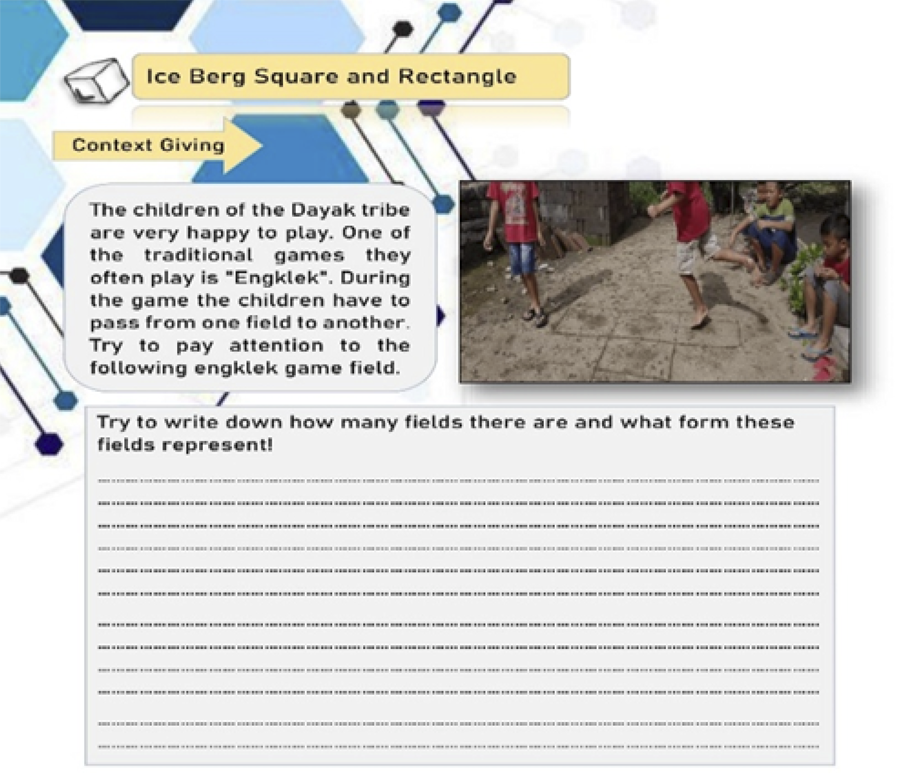
The didactic design produced in the research is a teaching module that integrates the culture of the BSDC. The didactic design is represented in the geometry teaching module. The cover of this teaching module displays an illustration of the building floor of the BSDC and pictures of traditional games by Bumi Segandu Dayak children. Apart from that, the module’s content consists of 8 topics: squares, rectangles, parallelograms, trapezoids, triangles, circles, cylinders, and spheres. The presentation of each material begins by providing context from the Culture of the BSDC, which is related to the material that students will study (See Figure 7).

Providing context in the module is the starting point in building mathematical concepts. Providing cultural context with mathematical values can help students understand mathematics in real life. One of the cultural contexts used in the teaching module is the Engklek game. Many mathematical concepts can be taught in the context of the Engklek game, such as squares, rectangles, trapezoids, and circles. After providing context, students are directed to form a thinking scheme to understand the material (See Figure 8).

In this teaching module, the formation of a scheme aims to bridge the gap between mathematics in everyday life and formal mathematics at school.
After forming the scheme, students are directed to construct knowledge and discover mathematical concepts formally in this teaching module (see Figure 9). For example, after students are asked to represent the context of the problem in the form of an image, students are then directed to construct their knowledge regarding the material. Apart from that, to verify that the mathematical concepts understood by students are valid, the teacher asks students to communicate the results of the answers in the teaching module. In the final phase of each teaching module, problems are given as story questions (See Figure 10).


This phase aims to internalize students’ understanding of mathematical concepts. Internalized knowledge will provide students with a more extended memory. This teaching module presents problems related to the Dayak Bumi Segandu cultural context. One of the problems in this teaching module is associated with the shape of the BSDC house, which has a unique shape. Meanwhile, students’ answers in solving problems from the teaching module can be seen in Figure 11.

3.1.7 Pedagogical Resources
The pedagogical resources integrated with BSDC consist of 4 learning stages. In the first stage, the teacher provides a context that can be used as a starting point for students to understand mathematical concepts. This initial context aims to activate students’ initial knowledge. In the initial stage, students and the teacher discuss the relationship between the initial context and the material that students will later study. Afterward, the teacher explains the importance of the material learned in students’ daily lives.
The teacher enters the scheme formation stage after the first stage is complete. This stage begins with the teacher providing reflective questions or group discussions to help students explore student understanding. Afterward, teachers provide clear and constructive feedback to students about their knowledge and application of the concepts. It allows students to correct mistakes and directs learning in the right direction. The third stage is the formation of knowledge and ideas. This stage begins with the teacher asking students to visually represent the problem, such as diagrams, graphs, or geometric images. Visual representations help students understand relationships between concepts and apply concepts in different contexts. Furthermore, in the final stage, the teacher provides an evaluation to ensure students’ understanding is valid and correct. All these stages can be seen in Figure 12.

3.2 Implementation of Integrated Didactic and Pedagogical Resources with BSDC
The results of implementing the didactic design and integrated pedagogy of Bumi Segandu Dayak culture to 32 students (22 women and 10 men) are presented in Table 1.
The students’ average pre-test score was 76.97 (N = 32), while the average post-test score was 81.78 (N = 32). Descriptively, the difference in the average pre-test and post-test scores is quite significant. This shows an increase in students’ mathematical thinking abilities. Apart from that, based on the test results, the gain value also obtained a score of 0.21. This score shows increased mathematical thinking abilities after using didactic and pedagogical sources with the integration of BSDC.
Next, to test the effectiveness of integrated didactic design and pedagogy for learning the BSDC, testing was carried out using a one-sample t-test. The normality test is carried out first before testing the one-sample t-test. The normality test results are presented in Table 2.
Based on the results of the normality test for the gain value, because the significance value (0.200) is more than 0.05, the increased data results are normally distributed. Because the data is normally distributed, the test is continued using the one-sample t-test. The test results can be seen in Table 3 below.
The Sig value is known based on Table 3 of the paired samples test output above. (2-tailed), namely 0.000 < 0.05, then it was concluded that Ho was rejected, which means that the use of didactic learning design and integrated pedagogy of the BSDC effectively increased junior high school students’ mathematical understanding.
4 Discussion
The results of the research reveal that the culture of the BSDC can be used as an object for students to learn and understand mathematics. The culture of the BSDC, which has values, beliefs, traditions, and norms, can be used as a starting point for students in learning mathematics. Students can study geometric shapes in the context of traditional houses. Students can also learn the concept of field geometry from the context of the conventional game field “Engklek.” Therefore, the findings of this research confirm that students can use the institutionalization of ethnomathematics in the BSDC to understand plane and space geometry material.
These findings are in line with the opinions of Stigler & Baranes (1988) and Triadafillidis (1996), who state that the mathematical concepts that students learn at school are not constructed logically based on an abstract structure of understanding but are forged from a combination of knowledge and skills previously acquired (or inherited) from the culture or daily life of students. Therefore, the culture or environment in which students live does not function as an independent variable that can only encourage or hinder mathematical abilities’ development but as a constitutive part of mathematical knowledge itself (Stigler & Baranes, 1988). In addition, D’Entremont (2015) said that mathematical concepts based on a cultural perspective enable students to reflect and appreciate their own culture and the cultures and traditions of other people. The involvement of community members is an essential part of integrating cultural components into mathematics activities (D’Entremont, 2015).
In other contexts, institutionalizing ethnomathematics extracted from certain cultures can enrich the didactic and pedagogical context in teaching formal mathematical concepts. Educators must be able to expand their way of thinking and see that everything can be used to provide an initial context for teaching mathematics (Samaupan, 2019). Apart from that, educators must also be able to facilitate and provide opportunities for students to interact and gain unique learning experiences while maintaining their identity and culture as part of mathematics learning (Denton et al., 2020; Samaupan, 2019; Bang & Medin, 2010). Based on this, it is necessary to integrate culture with the existing mathematics curriculum (Rosa & Orey, 2011; 2015).
These findings further reveal that the culture of the BSDC can be integrated into teaching modules and mathematics learning processes in the classroom. The implementation results show that the integrated didactic and pedagogical design of the BSDC is effective in increasing mathematical understanding. This is in line with research by Fouze & Amit (2017), which concluded that implementing mathematics learning that integrates elements of community culture can increase students’ motivation to learn mathematics, which in turn increases students’ academic achievement in mathematics subjects. Apart from that, in line with research by Adonis (2020), Samaupan (2019) concluded that integrating cultural elements into teaching has deepened their understanding of mathematical concepts, increased interest in mathematics, and broadened students’ views about their culture by making meaningful connections. In addition, Sudirman et al. (2020, 2020) revealed that cultural integration is a didactic and pedagogical resource and has implications for increasing students’ understanding of geometry. In addition, Cáceres (2018) concluded that cultural integration in mathematics teaching modules can help students increase cultural awareness and appreciation and be used as an initial context when teaching mathematics concepts (Prahmana et al., 2021; Isroi et al., 2022). Furthermore, Lantakay et al. (2023) concluded that geometry teaching materials integrated with cultural contexts can be used in geometry learning to support students’ transition from a basic level of mathematical thinking to an advanced level.
5 Conclusion
This study draws three main conclusions based on the research findings. First, the institutionalization of ethnomathematics within the BSDC — encompassing mathematical activities found in building forms, ceremonial rituals, handicrafts, and traditional games — serves as a meaningful starting point for students’ mathematics learning, particularly in plane and space geometry. Second, the culture of the BSDC can be effectively operationalized as both a didactic source, in the form of a culturally integrated teaching module covering eight geometry topics, and a pedagogical source, implemented through a four-stage learning syntax consisting of providing initial context, forming schemes, constructing knowledge, and validating understanding. Third, the implementation of these culturally integrated didactic and pedagogical resources was effective in improving the mathematical understanding of 32 junior high school students in Indramayu Regency, as evidenced by an increase from a pre-test mean score of 76.97 to a post-test mean score of 81.78, with a normalized gain of 0.21.
The process of cultural integration in mathematics learning is not without challenges, as it requires sustained commitment, cultural sensitivity, and pedagogical readiness from teachers. Based on these conclusions, this study offers the following recommendations. For teachers and schools, it is recommended to design culture-based mathematics learning by systematically integrating local ethnomathematics into syllabi, lesson plans, teaching modules, and learning syntax, particularly in schools located within or near indigenous community areas. For curriculum developers and educational policymakers, this study recommends incorporating ethnomathematics frameworks into the national mathematics curriculum to ensure that cultural contexts are formally recognized as legitimate didactic and pedagogical resources. For future researchers, it is recommended to replicate and extend this approach in other indigenous communities across Indonesia and Southeast Asia, using larger and more diverse samples, to further validate the transferability and generalizability of ethnomathematics-based didactic designs in formal school settings.
Acknowledgements
The author would like to thank Universitas Terbuka and Universitas Wiralodra, teachers and students at one of the secondary schools in Indramayu Regency, as well as other parties who have helped with the research process and preparation of this research publication article.
References
-
ADONIS, A. B. Contextualized Strategic Intervention Materials in Grade 9 Mathematics. PEOPLE: International Journal of Social Sciences, India, v. 5, n. 3, p. 850-868, 2020. Disponível em: https://doi.org/10.20319/pijss.2020.53.850868 Acesso em: 23 fev. 2025.
» https://doi.org/10.20319/pijss.2020.53.850868 -
ALANGUI, W. V. Beyond songs and dances: Ethnomathematics and the challenge of culture. Revista Latinoamericana de Etnomatemática, Colombia, v. 13, n. 3, p. 88-107, 2020. Disponível em: https://doi.org/10.22267/relatem.20133.6 Acesso em: 23 fev. 2025.
» https://doi.org/10.22267/relatem.20133.6 -
BANG, M.; MEDIN, D. Cultural processes in science education: Supporting the navigation of multiple epistemologies. Science Education, United States, v. 94, n. 6, p. 1008-1026, 2010. Disponível em: https://doi.org/10.1002/sce.20392 Acesso em: 23 fev. 2025.
» https://doi.org/10.1002/sce.20392 -
BURKHARDT, H.; D'AMBROSIO, U. Ethnomathematics: Link between traditions and modernity (A. Kepple, Trad.). ZDM Mathematics Education, Germany, v. 40, p. 1033-1034, 2006. Disponível em: https://doi.org/10.1007/s11858-008-0163-3 Acesso em: 23 fev. 2025.
» https://doi.org/10.1007/s11858-008-0163-3 -
CÁCERES, F. T. The use of modules integrating culture in teaching geometry. International Journal of Contemporary Applied Researches, Australia, v. 5, n. 4, p. 69-83, 2018. Disponível em: https://ijcar.net/assets/pdf/Vol5-No4-April2018/06.pdf Acesso em: 23 fev. 2025.
» https://ijcar.net/assets/pdf/Vol5-No4-April2018/06.pdf -
D'ENTREMONT, Y. Linking mathematics, culture and community. Procedia - Social and Behavioral Sciences, Netherlands, v. 174, p. 2818-2824, 2015. Disponível em: https://doi.org/10.1016/j.sbspro.2015.01.973 Acesso em: 23 fev. 2025.
» https://doi.org/10.1016/j.sbspro.2015.01.973 -
DENTON, M.; BORREGO, M.; BOKLAGE, A. Community cultural wealth in science, technology, engineering, and mathematics education: A systematic review. Journal of Engineering Education, United States, v. 109, n. 3, p. 556-580, 2020. Disponível em: https://doi.org/10.1002/jee.20322 Acesso em: 23 fev. 2025.
» https://doi.org/10.1002/jee.20322 -
ERGENE, Ö.; ERGENE, B. Ç.; YAZICI, E. Ethnomathematics activities: reflections from the design and implementation process. Turkish Journal of Computer and Mathematics Education (TURCOMAT), Turkey, v. 11, n. 2, p. 402-437, 2020. Disponível em: https://doi.org/10.16949/turkbilmat.688780 Acesso em: 23 fev. 2025.
» https://doi.org/10.16949/turkbilmat.688780 -
FOUZE, A. Q.; AMIT, M. On the importance of an ethnomathematical curriculum in mathematics education. Eurasia Journal of Mathematics, Science and Technology Education, Turkey, v. 14, n. 2, p. 561-567, 2017. Disponível em: https://doi.org/10.12973/ejmste/76956 Acesso em: 23 fev. 2025.
» https://doi.org/10.12973/ejmste/76956 -
HORTELANO, J. C.; LAPINID, M. R. Recontextualizing Kalinga's batek and laga into an ethnomathematical teaching resource: An application of the second generation of didactical engineering. Journal on Mathematics Education, Indonesia, v. 15, n. 2, p. 385-402, 2024. Disponível em: https://doi.org/10.22342/jme.v15i2.pp385-402 Acesso em: 23 fev. 2025.
» https://doi.org/10.22342/jme.v15i2.pp385-402 -
HOSKINS, J. Symbolism in anthropology. International Encyclopedia of the Social & Behavioral Sciences, United Kingdom, v. 2, n. 23, p. 860-865, 2015. Disponível em: https://doi.org/10.1016/B978-0-08-097086-8.12226-3 Acesso em: 23 fev. 2025.
» https://doi.org/10.1016/B978-0-08-097086-8.12226-3 -
ISROI, A.; SURIPAH, S.; REZEKI, S. Kambuik Kuantan Singing culture for realistic mathematics education approach. Ethnomathematics Journal, Indonesia, v. 3, n. 1, p. 1-10, 2022. Disponível em: https://doi.org/10.21831/ej.v3i1.44988 Acesso em: 23 fev. 2025.
» https://doi.org/10.21831/ej.v3i1.44988 -
LANTAKAY, C. N.; SENID, P. P.; BLEGUR, I. K. S.; SAMO, D. D. Hypothetical learning trajectory: bagaimana perannya dalam pembelajaran matematika di sekolah dasar? Griya Journal of Mathematics Education and Application, Indonesia, v. 3, n. 2, p. 384-393, 2023. Disponível em: https://doi.org/10.29303/griya.v3i2.329 Acesso em: 23 fev. 2025.
» https://doi.org/10.29303/griya.v3i2.329 -
LONG, S.; CHIK, Y. Fundamental applications of mathematics in agriculture and cultural heritage in daily life of Melanau Tellian, Mukah, Sarawak: An ethnomathematics review. Malaysian Journal of Social Sciences and Humanities, Malaysia, v. 5, n. 11, p. 217-227, 2020. Disponível em: https://doi.org/10.47405/mjssh.v5i11.551 Acesso em: 23 fev. 2025.
» https://doi.org/10.47405/mjssh.v5i11.551 -
MADUSISE, S.; MWAKAPENDA, W. Using school mathematics to understand cultural activities: How far can we go? Mediterranean Journal of Social Sciences, Italy, v. 5, n. 3, p. 146-157, 2014. Disponível em: https://doi.org/10.5901/mjss.2014.v5n3p146 Acesso em: 23 fev. 2025.
» https://doi.org/10.5901/mjss.2014.v5n3p146 -
MUHTADI, D.; SUKIRWAN; PRAHMANA, R. C. I. Sundanese Ethnomathematics: Mathematical Activities in Estimating, Measuring, and Making Patterns. Journal on Mathematics Education, Indonesia, v. 8, n. 2, p. 185-198, 2017. Disponível em: https://dx.doi.org/10.22342/jme.8.2.4055.185-198 Acesso em: 23 fev. 2025.
» https://dx.doi.org/10.22342/jme.8.2.4055.185-198 -
NURAFIFAH, L.; GUNADI, F.; SUDIRMAN, S.; WAHYUDIN, W. Ethnomathematical connections of Indramayu traditional boat forms: implications for institutionalization school geometry concept. Mathline: Jurnal Matematika dan Pendidikan Matematika, Indonesia, v. 9, n. 1, p. 159-174, 2024. Disponível em: https://doi.org/10.31943/mathline.v9i1.561 Acesso em: 23 fev. 2025.
» https://doi.org/10.31943/mathline.v9i1.561 -
OREY, D. C.; ROSA, M. Ethnomathematics: Cultural assertions and challenges towards pedagogical action. The Journal of Mathematics and Culture, Brazil, v. 1, n. 1, p. 57-78, 2006. Disponível em: https://flm-journal.org/Articles/7E5EFFA4B24CB97110973C060200F3.pdf Acesso em: 23 fev. 2025.
» https://flm-journal.org/Articles/7E5EFFA4B24CB97110973C060200F3.pdf -
PATHUDDIN, H.; KAMARIAH; NAWAWI, M. I. Buginese Ethnomathematics: Barongko Cake Explorations as Mathematics Learning Resources. Journal on Mathematics Education, Indonesia, v. 12, n. 2, p. 295-312, 2021. Disponível em: https://doi.org/10.22342/jme.12.2.12695.295-312 Acesso em: 23 fev. 2025.
» https://doi.org/10.22342/jme.12.2.12695.295-312 -
PRAHMANA, R. C. I. Ethno-realistic mathematics education: The promising learning approach in the city of culture. SN Social Sciences, United Kingdom, v. 2, n. 12, p. 257, 2022. Disponível em: https://doi.org/10.1007/s43545-022-00571-w Acesso em: 23 fev. 2025.
» https://doi.org/10.1007/s43545-022-00571-w -
PRAHMANA, R. C. I.; YUNIANTO, W.; ROSA, M.; OREY, D. C. Ethnomathematics: Pranatamangsa system and the birth-death ceremonial in Yogyakarta. Journal on Mathematics Education, Indonesia, v. 12, n. 1, p. 93-112, 2021. Disponível em: https://doi.org/10.22342/JME.12.1.11745.93-112 Acesso em: 23 fev. 2025.
» https://doi.org/10.22342/JME.12.1.11745.93-112 -
ROSA, M.; OREY, D. C. Ethnomathematics: the cultural aspects of mathematics Etnomatemática. Revista Latinoamericana de Etnomatemática, Colombia, v. 4, n. 2, p. 32-54, 2011. Disponível em: https://www.revista.etnomatematica.org/index.php/RevLatEm/article/view/32 Acesso em: 23 fev. 2025.
» https://www.revista.etnomatematica.org/index.php/RevLatEm/article/view/32 -
ROSA, M.; OREY, D. C. A trivium curriculum for mathematics based on literacy, matheracy, and technoracy: an ethnomathematics perspective. ZDM Mathematics Education, Germany, v. 47, p. 587-598, 2015. Disponível em: https://doi.org/10.1007/s11858-015-0688-1 Acesso em: 23 fev. 2025.
» https://doi.org/10.1007/s11858-015-0688-1 -
ROSA, M.; GAVARRETE, M. E. An ethnomathematics overview: an introduction. In: ROSA, M.; SHIRLEY, L.; GAVARRETE, M.; ALANGUI, W. (org.). Ethnomathematics and its Diverse Approaches for Mathematics Education. ICME-13 Monographs. Cham: Springer, 2017. Disponível em: https://doi.org/10.1007/978-3-319-59220-6_1 Acesso em: 23 fev. 2025.
» https://doi.org/10.1007/978-3-319-59220-6_1 -
RODRÍGUEZ-NIETO, C. A. Ethnomathematical connections between geometric concepts in the making of tortillas from Chilpancingo, Mexico. Revista de Investigación, Desarrollo e Innovación, Colombia, v. 11, n. 2, p. 273-296, 2021. Disponível em: https://doi.org/10.19053/20278306.v11.n2.2021.12756 Acesso em: 23 fev. 2025.
» https://doi.org/10.19053/20278306.v11.n2.2021.12756 -
RUBIO, J. S. The Ethnomathematics of the Kabihug Tribe in Jose Panganiban, Camarines Norte, Philippines. Malaysian Journal of Mathematical Sciences, Malaysia, v. 10, p. 211-231, 2016. Disponível em: https://einspem.upm.edu.my/journal/fullpaper/vol10saugust/16.%20Jennifer.pdf Acesso em: 23 fev. 2025.
» https://einspem.upm.edu.my/journal/fullpaper/vol10saugust/16.%20Jennifer.pdf -
SAMAUPAN, M. B. Integration of Cultural Practices in Teaching Mathematics. The Asian Conference on Education & International Development 2019 Official Conference Proceedings, 2019. Disponível em: https://papers.iafor.org/wp-content/uploads/papers/aceid2019/ACEID2019_45524.pdf Acesso em: 23 fev. 2025.
» https://papers.iafor.org/wp-content/uploads/papers/aceid2019/ACEID2019_45524.pdf -
SARI, A. K.; BUDIARTO, M. T.; EKAWATI, R. Ethnomathematics study: cultural values and geometric concepts in the traditional "tanean-lanjang" house in Madura - Indonesia. JRAMathEdu (Journal of Research and Advances in Mathematics Education), Indonesia, v. 7, n. 1, p. 46-54, 2022. Disponível em: https://doi.org/10.23917/jramathedu.v7i1.15660 Acesso em: 23 fev. 2025.
» https://doi.org/10.23917/jramathedu.v7i1.15660 -
STIGLER, J. W.; BARANES, R. Chapter 7: Culture and Mathematics Learning. Review of Research in Education, United States, v. 15, n. 1, p. 253-306, 1988. Disponível em: https://doi.org/10.3102/0091732X015001253 Acesso em: 23 fev. 2025.
» https://doi.org/10.3102/0091732X015001253 -
SUDIRMAN; MELLAWATY; YANIWATI, R. P.; INDRAWAN, R. Integrating local wisdom forms in augmented reality application: Impact attitudes, motivations and understanding of geometry of pre-service mathematics teachers. International Journal of Interactive Mobile Technologies, Austria, v. 14, n. 11, p. 91-106, 2020. Disponível em: https://doi.org/10.3991/ijim.v14i11.12183 Acesso em: 23 fev. 2025.
» https://doi.org/10.3991/ijim.v14i11.12183 -
SUDIRMAN, S.; YANIAWATI, R. P.; MELAWATY, M.; INDRAWAN, R. Integrating ethnomathematics into augmented reality technology: Exploration, design, and implementation in geometry learning. Journal of Physics: Conference Series, United Kingdom, v. 1521, n. 3, 2020. Disponível em: https://doi.org/10.1088/1742-6596/1521/3/032006 Acesso em: 23 fev. 2025.
» https://doi.org/10.1088/1742-6596/1521/3/032006 -
SUDIRMAN; RODRÍGUEZ-NIETO, C. A.; BONYAH, E. Integrating ethnomathematics and ethnomodeling in Institutionalization of school mathematics concepts: A study of fishermen community activities. Journal on Mathematics Education, Indonesia, v. 15, n. 3, p. 835-858, 2024. Disponível em: https://doi.org/10.22342/jme.v15i3.pp835-858 Acesso em: 23 fev. 2025.
» https://doi.org/10.22342/jme.v15i3.pp835-858 -
SUHERMAN, S.; VIDÁKOVICH, T. Mathematical creative thinking-ethnomathematics based test: role of attitude toward mathematics, creative style, ethnic identity, and parents' educational level. Revista de Educación a Distancia, Spain, v. 24, n. 77, p. 1-122, 2024. Disponível em: https://doi.org/10.6018/red.581221 Acesso em: 23 fev. 2025.
» https://doi.org/10.6018/red.581221 -
TRIADAFILLIDIS, T. A. The effectiveness of practical work in lower secondary school mathematics: A cultural approach. Journal of Mathematical Behavior, United States, v. 15, n. 2, p. 161-166, 1996. Disponível em: https://doi.org/10.1016/S0732-3123 (96)90014-0 Acesso em: 23 fev. 2025.
» https://doi.org/10.1016/S0732-3123 (96)90014-0 -
UMBARA, U.; PRABAWANTO, S.; JATISUNDA, M. G. Combination of mathematical literacy with ethnomathematics: How to perspective Sundanese culture. Infinity Journal, Indonesia, v. 12, n. 2, p. 393-414, 2023. Disponível em: https://doi.org/10.22460/infinity.v12i2.p393-414 Acesso em: 23 fev. 2025.
» https://doi.org/10.22460/infinity.v12i2.p393-414 -
UMBARA, U.; WAHYUDIN, W.; PRABAWANTO, S. Exploring ethnomathematics with ethnomodeling methodological approach: how does Cigugur Indigenous people using calculations to determine a good day to build houses? Eurasia Journal of Mathematics, Science and Technology Education, Turkey, v. 17, n. 2, p. 1-19, 2021. Disponível em: https://doi.org/10.29333/EJMSTE/9673 Acesso em: 23 fev. 2025.
» https://doi.org/10.29333/EJMSTE/9673 -
VOS, P. "How real people really need mathematics in the real world"-Authenticity in mathematics education. Education Sciences, Switzerland, v. 8, n. 4, p. 195, 2018. Disponível em: https://doi.org/10.3390/educsci8040195 Acesso em: 23 fev. 2025.
» https://doi.org/10.3390/educsci8040195 -
YANIAWATI, P.; SUDIRMAN; MELLAWATY; INDRAWAN, R.; MUBARIKA, M. P. The potential of mobile augmented reality as a didactic and pedagogical source in learning geometry 3D. Journal of Technology and Science Education, Spain, v. 13, n. 1, p. 4-22, 2023. Disponível em: https://doi.org/10.3926/jotse.1661 Acesso em: 23 fev. 2025.
» https://doi.org/10.3926/jotse.1661
-
Data:
The data that support the findings of this study are openly available in Zenodo at https://doi.org/10.5281/zenodo.19145528
-
AI Use Declaration:
The authors declare that artificial intelligence (AI) tools were used solely for grammar and punctuation review during the preparation of the final manuscript. Specifically, Claude (Anthropic) was used to assist in proofreading and improving the linguistic quality of the text. No AI tool was used for data collection, data analysis, interpretation of results, or any intellectual contribution to the research findings. AI tools are not listed as authors and bear no responsibility for the content of this manuscript.
-
Funding:
No funding was received for the manuscript preparation and publishing nor its previous research processes.
Edited by
-
Associate editors:
Cândido GomesAna Ivenicki
The data that support the findings of this study are openly available in Zenodo at https://doi.org/10.5281/zenodo.19145528

 Source: Adapted from
  Source: Adapted from Yaniawati et al. (2023)
 Source: Authors’ fieldwork documentation, 2024
 Source: Authors’ fieldwork documentation, 2024
 Source: Authors’ fieldwork documentation, 2024
 Source: Authors’ fieldwork documentation, 2024
 Source: Authors’ teaching module, 2024
 Source: Authors’ teaching module, 2024
 Source: Authors’ teaching module, 2024
 Source: Authors’ teaching module, 2024
 Source: Authors’ fieldwork documentation, 2024
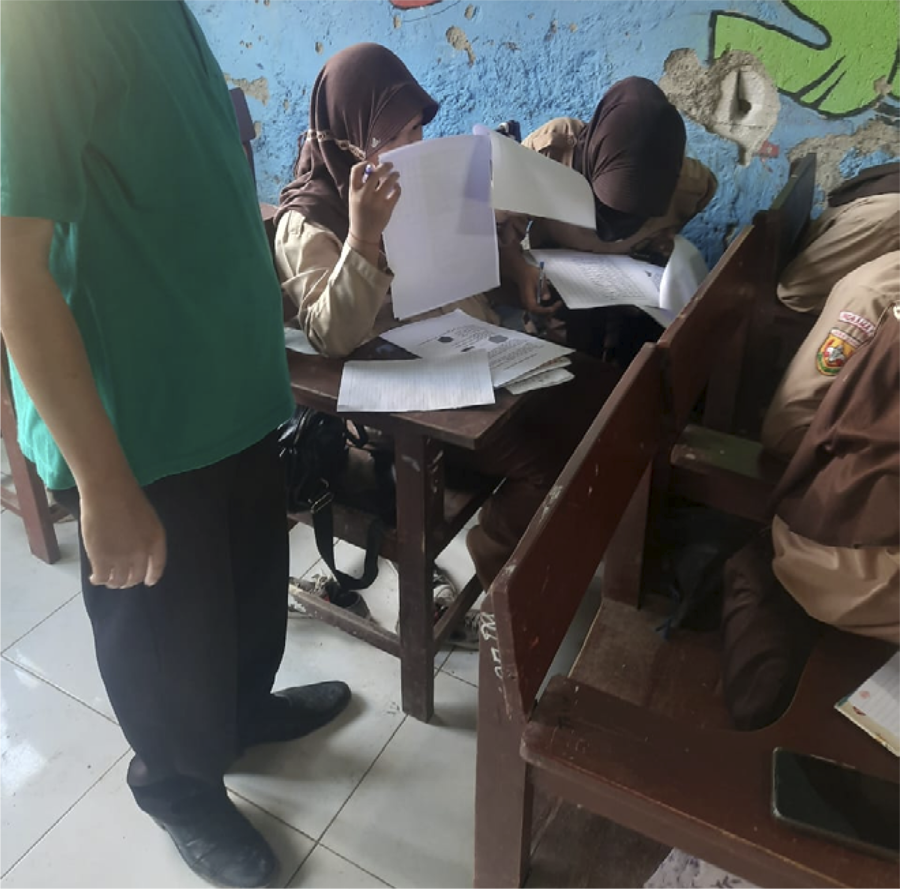 Source: Authors’ fieldwork documentation, 2024