 INFLUENCES OF THE WORLD BANK GROUP GUIDELINES ON TEACHER TRAINING POLICY IN ANGOLA
ABSTRACT:
This text is based on research conducted by authors who focus on educational policies, particularly the influence of educational reforms on educational systems. The analysis proposed here examines the World Bank Group's (WB) activities in the field of education, focusing on the decisions and influences of this organization on teacher training policy in Angola. Based on documentary research, the text demonstrates the relationship between the national policies of this country and the WB's macro-policy guidelines for all its signatories. The results indicate that this international organization, along with others, has influenced the reform of teacher training policy in Angola by financing studies and supporting a set of short-term training programs. Considering this finding, the text concludes with arguments against the neoliberal rationality that has been employed in contemporary teacher training.
Keywords:
Angola; Education; teacher training; World Bank Group.
RESUMO:
Este texto deriva de investigações empreendidas pelos autores que se debruçam sobre as políticas educacionais, em especial, sobre as influências das reformas educacionais nos sistemas de ensino. O recorte aqui proposto analisa a atuação do Grupo Banco Mundial (BM) no campo da Educação, enfocando as determinações e as influências desse organismo para a política de formação de professores em Angola. Ancorado em pesquisa documental, o texto demostra a relação entre as políticas nacionais desse país e as orientações macropolíticas do BM para o conjunto de seus signatários. Os resultados apontam que essa organização internacional, ao lado de outras, assumiu-se como influenciadora da reforma da política de formação de professores em Angola, mediante o financiamento de estudos e de apoio a um conjunto de programas de formação em curta duração. Ante a essa constatação, ao final do texto, são apresentados argumentos contrários à racionalidade neoliberal que vem sendo empregada na formação de docentes na contemporaneidade.
Palavras-chave:
Angola; Educação; formação de professores; Grupo Banco Mundial
RESUMEN:
Este texto se deriva de investigaciones realizadas por los autores que se centran en las políticas educativas, en particular en las influencias de las reformas educativas en los sistemas de enseñanza. El enfoque aquí propuesto analiza la actuación del Grupo Banco Mundial (BM) en el campo de la educación, centrándose en las determinaciones e influencias de este organismo en la política de formación de docentes en Angola. Basado en una investigación documental, el texto demuestra la relación entre las políticas nacionales de este país y las orientaciones macropolíticas del BM para el conjunto de sus signatarios. Los resultados indican que esta organización internacional, junto con otras, ha asumido un papel influyente en la reforma de la política de formación de docentes en Angola, mediante la financiación de estudios y el apoyo a un conjunto de programas de formación de corta duración. Ante esta constatación, al final del texto se presentan argumentos contrarios a la racionalidad neoliberal que se ha venido aplicando en la formación de docentes en la actualidad.
Palabras clave:
Angola; Educación; formación docente; Grupo Banco Mundial
INITIAL THOUGHTS
The operations of International Organizations (IO) have become a central theme in the contemporary debates regarding the scope and limitations of the intervention of different actors in the elaboration, implementation and evaluation of educational policies. In this matter, notable among some of the traditionally known IOs, are the United Nations Educational, Scientific and Cultural Organization (UNESCO), the Organization for Economic Co-operation and Development (OECD) and the World Bank Group (WB).
During the first two decades of the 2000s, the WB’s ideological and financial influence expanded considerably, specially over the development of programs of the said “strengthening of teacher training” in its member-states that are in development of sub developed. With such background, this paper focuses on the problem of the WB’s performance in the field of education, with a special emphasis on Angola’s case, and the relation between its national policies and the WB’s macropolitical guidelines for its signatories.
The definition behind the analysis here presented is that IOs are “[...] State volunteer associations that constitute a society, created by a treaty, aiming to find common interests through a permanent cooperation among its members” (Seitenfus, 2004, p. 225, our translation)1. Such multilateral organizations originate from treaties, conventions of letters (Rosemberg, 2000; Seitenfus, 2004, 2005). A constituent treaty is the most precious for the IO. In it are the rules and the reach of its actions.
In a first moment, it is necessary to point the understanding of the World Bank Group (WB) as made by five complementary agencies: the International Bank for reconstruction and Development (IBRD), the International Development Association (IDA), the International Finance Corporation (IFC), the Multilateral Investment Guarantee Agency (MIGA), and the International Centre for Settlement of Investment Disputes (ICSID). The strongest agencies in the educational field are, majorly, IBRD, IDA, and IFC.
The IBRD is focused on medium income countries, while IDA is targeted to those of low income - therefore, such States that are not serviced by IBRD, are under IDA’s responsibility. The IFC, on the other hand, covers all WB’s member states, focusing on the placement of the private sector in all of its areas of intervention (Education, Health, Engineering, Environment, among others). In this sense, this paper deepens the discussions on the actions of the WB in the field of Education.
Works on the World Bank’s and other international organizations’ influence over Brazilian educational policies aren’t a new trend, as the examples of Fonseca (1998), Tommasi, Warde and Haddad (2000), Altmann (2002), Decker and Evangelista (2019), Santos (2017, 2025), among others. There are more specific works on the theme, focusing on the training of teachers, for example, those of Ludke, Moreira, and Cunha (1999) and Pansardi (2011). Although such novelty can’t be assumed for the Angolan context, as the works with this influence are still recent, such as Ngaba (2012, 2017), Paxe (2017), Bumba (2022), Bortot, Brás and Scaff (2022), Bortot and Brás (2023), António and Kuebo (2024), Brás (2024) and Brás (2025). The limitations of these propositions for the advancement of the right to education for everyone are clear. Fonseca (1998, p. 10, our translation) points that, in such policies turned to poorer nations,
[...] it is recommended that the expansion of secondary education of a more general content should be prudently discussed, with an offer that should be focused on a rural education and in the training of professionals outside the school. This last suggestion would be linked with a need of diminishing the aspiration of jobs in a modern economic sector, directing professional demand to a more traditional sector, such as, informal jobs or by own account, of lower admitted, preferably situated in urban peripheries and rural areas2.
Notably, the WB did not have a fixed position through time, as it has grown the understanding on the teacher’s contribution on the learning process. The first formulations negated the relevance of teacher training to the recognition that the teacher’s knowledge has an effective impact in this process. But teaching training is still seen as secondary in WB’s projects. For it, the teacher’s initial training is not relevant, as such training, generally through processes of E-learning, would be a more efficient formative process (Torres, 2000).
Pansardi (2011) highlights that the WB views the teacher as a “necessary evil”, relevant, but secondary. Pedagogy and the teacher have both to be detached of the center of the educational process. This circumstance is made possible with the use of technological processes and “E-education”, that work not only as a way of cheapening teacher training but also to insert technical means and methodologies in the center of the learning process.
In this work, we present how teacher training in Angola is being influenced by the WB. With an emphasis on the ways through which this multilateral organization conquered territory in this newly democratic country, with a week State3. According to Brás (2025), Angola has a weak culture of strategic sectorial planning, and also of elaborating educational policies, funded on diagnostical and prognostic research, as well as the lack of bureaucrats and State officials with an specialized, differentiated and diverse training, while those who possess it find hardships to affirm their logical reasoning and critical thought in the level of structural management of the Ministry of Education.
THE PERFORMANCE OF THE WORLD BANK GROUP ON THE ANGOLAN EDUCATION CONTEXT
From 1482 to 1975, Angola was under the rule of Portuguese colonial power, becoming a sovereign republic since November the 11th, 1975. It is part of the Community of Portuguese Language Countries (CPLP), located in the Southern cost of sub-Saharan Africa, and the sixth larger country of the continent, with an area of 1.246.700 km², with an estimated population of 33 million, of which 50,5% are female, with a growth rate of 3,29% per year, with an average age of 20.6 years and life expectancy of 60 years for women and 55 for men. Its birth rate is of 5,7 children per person. 90,5% of its population is Christian, unequally distributed throughout its territory, resulting in a population density of 15 inhabitants per km² (Instituto Nacional de Estatística, 2022).
Administratively, the county is divided in 21 provinces (states), with 326 municipalities, subdivided in communes, neighborhoods and villages. Luanda is the country’s political and economic capital, and its city with a larger population density. As a unitary country, it has a presidential government system (Angola, 2010), with a centralized model of public management, with tendencies of deconcentration (with a register of a gradual transference process of the responsibilities of central government to the local municipal administrations), as educational policies and programs are defined by the State central government through a development process, national approval, and local implementation mediated by provincial and municipal offices of education, adopting a bureaucratic and administrative state regulation (Barroso, 2006; Pedro, 2023; Brás, 2024) of its educational system.
In a strategic point of view, Angolan authorities stablished a goal of until 2025 getting to be part of the Group of Countries with a High Human Development (Angola, 2018). WB’s data from 2020 show that Angola has a Human Development Index (HDI) of 0,4, making it part of a group of countries of low human development.
In an economic trend, the country is characterized by high unemployment and poverty rates, as signaled by the 2019-2020 Angolan Economic Report, of Universidade Católica de Anglola’s Centro de Estudos e Investigação Científica (CEIC-UCAN, 2021), while estimating that the unemployment rate was, in 2022, around 32,9%, taking into account the country’s week growth and need of gains in productivity. In the same line of thought, the World Bank Group argues that the high level of poverty is linked with the lack of quality jobs: 90% of the jobs are informal and half of them are of the primary sector (most of times of subsistence). Urban and youth unemployment remains raised, exceeding 38% and 50%, respectively (Grupo Banco Mundial, 2022).
After almost 50 years of independence, Angola remains a late schooling county, what calls for urgent measures and efforts to integrate children in educational networks, as the main challenges of the development of the nation’s human capital have been historically mapped as the hardships of the access to education and the inefficiency of its educational system, since the nationalization of teaching in 1975.
Notwithstanding primary education being seen as a basic task for the Angolan State, it can be noted that it’s access as a basic child right is still lacking. Until 2019 first trimester, Education Ministry (MED)’s data showed that only “11% of the children has access to childcare education in a national level, a main challenge to school infrastructures4”5. Indeed, as pointed by Paxe and Brás (2012), during 2020 school year, of 1.515 childcare centers in the country, only 11,2% were public, what means that 88,7% of the network is under control of private agents. These private institutions charge monthly fees, taxes, and dues that are above the national minimum wage, what goes against the right to education for a considerable number of children that, according to the frameworks stablished by the article number 21. of the Angolan Republic Constitution (CRA) (CRA/2010), it constitutes one of the main responsibilities of the State.
In the Primary School subsystem level, recent data from MED showed that, during the school year of 2022-2023, more than two million children had not been enrolled because of the lack of school rooms. To be clear, these numbers refer only to those schools controlled by MED, and to children that had subscribed for the first time in a primary school and could not be enrolled, as there are those who are still outside MED’s control, whose parents or responsible ones didn’t subscribe them or whose living areas lack a primary school nearby. For this reason, the number of children outside the school network can be even higher than the two million charted children, as alluded by the Secretary of State to Early Childhood and Primary Education, Senhor Pacheco Francisco, during the 2023 school year6.
There remain questions of assurance of the right to education in various Angolan school subsystems. Those include the guarantee of a higher number of classrooms, didactic tools, basic infrastructures, and teachers. They are also related to accessibility as; to match the need of a young population, it is pivotal to eliminate economic, administrative, legal and bureaucratic barriers, as well as the distance between homes and schools.
To invert such reality, more than national efforts, the country had been recurring to international cooperation, above all to obtain financing for the Plan of National Development - that has as its main concerns the basic and tertiary education. In this background, the intervention of countries and international organizations that give assistance, along various donations, gain relevance.
In the matter of technical assistance, the World Bank Group, UN agencies (The United Nations Development Programme - UNDP, the United Nations Children’s Fund - UNICEF, the Food and Agriculture Organization - FAO, World Health Organization - WHO, UNESCO), the European Union, Global Fund, African Development Bank Group (BAD), IMF, all stand out; while China, USA, Brazil and EU countries stand out as donor countries (Agência de Cooperação Internacional do Japão, 2023). António and Kuebo (2024, p. 2) studied the
[...] resulting impacts of the educational model inherited of colonialism and how the multinational organizations, by means of the propagation of its programs of internationalization of educational policies, influencing in the organization of the main regulations that control the Angolan educational system.7
For the authors, “[...] research and reflections that show the most diverse forms of intervention in local public policies, that gain great relevance”8 (António; Kuebo, 2024, p. 10). This relevance is strengthened in the context that the IO “[...] advise and finance, not only education social sector, but also, the National Development Plan, in conformity with 2030 agenda commitments”9 (António; Kuebo, 2024, p. 10, our translation). There is, therefore, a complex process where global policies are translated into local contexts.
For a better understanding of WB’s actions in the context of Angolan education, it is necessary to point that this Global South country became its member in the year of 1989, when the group prepared three documents of strategy, as signaled by the groups document of independent evaluation on the assistance to the country. Notwithstanding the challenges registered to the formulation of assistance to the country, considering its socio-historical and political context - the long period of post-independence war, 1975-2002 and a week economic situation, a first strategy was outlined, with a provisory character for the period 1991-1994, extended until 2003.
According to data from the Independent Evaluation Group of the WB’s assistance to countries, the strategy in this context consisted, above all, to issue feedback on economic policies, technical assistance, and pre-investment studies, financial help to infrastructural rehabilitation and development, as well as a mean to enable a transition to a peace time economy. Nonetheless:
In a medium term, the Bank hoped to transition to an aid program settled in the (i) creation of a capacity of economic management and in the aid to prepare pre-investment studies; (ii) help in transitioning to a peacetime economy; (iii) aid in the rehabilitation of a devastated economic and social infrastructure; and (iv) support to the process of economic reform10 (Grupo Banco Mundial, s.d., p. 2, our translation).
The WB has an intention of making the process of elaborating its loan programs more flexible and of another character, with a quota of its loans attached to the process of economic reforms, of peace restoration and the Government’s capacity to absorb assistance. For example, the program of economic and sectorial studies had as its goal to support the dialogue with Angolan government on policies and to offer the intellectual foundations for loan grants. It is necessary to point that, between 1991 and 2005, the WB “has conceded 16 credits in a total of USD 487 millions, with loans and donations per capita achieving 3 USD per year”11 (Grupo Banco Mundial, s.d., p. 3, our translation).
During this time span, a stronger relation between the WB and Angola’s government was not stablished. In other words, the establishment of a more concrete relation among them was preceded by transitory strategies to aid during the fiscal years of 1994, 2003 e 2005. Such strategies had as its basis:
(i) raise in transparency, efficiency, and credibility in public resources management, with an intensification of capacity development; (ii) expansion of provision of services to the groups affected by the war and to other vulnerable groups (provision of basic services and rehabilitation of emergency infrastructure); and (iii) establishment of the foundation for an economic growth that is favorable to the poor, with an wide base, (specially through a better environment to private sector growth, of the identification of interventions on rural economy and easing a better private financing of infrastructures) (Grupo Banco Mundial, s.d., p. 3, our translation)12.
Afterwards, a more effective relation of Angola with the WB has begun in 2007, with the approvement of the Nota de Estratégia Intercalar, on April 26th. This strategy consisted of three primary points: (i) reinforcement of public management and the government’s institutional capacity; (ii) support the rebuilding of vital infrastructures and the improvement of service provision to lower poverty; and (iii) promotion the growth of non-mineral sectors (Grupo Banco Mundial, 2011). Infrastructures, the public institutional capacity and human development (health and education) are the priority fields targeted by projects and programs supported by the WB.
The dimension and composition of the WB’s financing portfolio to Angola, until the 30th of July 2011, consisted of five active projects of investment, that represents a total net commitment of USD 461,5 millions. “The cumulative outlays number USD 27,3 millions, what equals 5,92% of the total net commitments”13 (Grupo Banco Mundial, 2011, p. 19, our translation).
It is in the context of 2007’s Mid-term Strategic Note that the beginning of the WB’s direct actions on Angolan education was predicted, with the perspective of an investment of around USD 50 millions to 2012 tax year, approved by the project of Quality in Education (Grupo Banco Mundial, 2011). Although, the WB’s management would approve, in September, 2013, a larger project - the Program of Learning for All (PLA), whose first phase (2014-2020) was granted a financing of 75.000.000,00 USD (seventy five million American dollars) by the World Bank, and 5.000.000,00 USD (five million American dollars), by Angola’s government; and the second phase, started in 2021, with an amount of 250.000.000,00 USD (two hundred and fifth million American dollars) (Angola, 2020; Bortot; Brás; Scaff, 2022).
The Program of Learning for All (PLA) has been implemented based on a galloping plan of teacher training, seeking to support the professional skills of school managers, teachers, and diverse educational agents and technicians of central, provincial, municipal, district and communal structures of the Education sector (PAT, 2022). With the end of the first phase in 2022, it reached more than 15 thousand teachers in the whole country (Bortot; Brás, 2023). Beyond the direct beneficiaries, the PLA (PAT, 2021, p. 9) indirectly benefits 500.000 primary students through a “better education in the Portuguese and Mathematics courses, taught by teachers better prepared in an educational point of view”14.
The project’s goal is “to improve the teachers’ knowledge and competences, as well as the school management in areas covered by the Project, and to develop an systematic evaluation system of the students” (PAT, 2021, p. 9, our translation), directed to teacher training to work in the primary education, from the 1st to the sixth school years, especially in the Portuguese and mathematics courses.
Bortot, Brás and Scaff (2022), while studying the PLA, understood that, among its components, the idea of improving teacher training to an effective professional performance stands out, and should mean a better standing of the students in large scale evaluations, to be institutionalized with the realization of a national exam in 2022, what constitutes a new orthodoxy of neoliberal reforms. On the other hand, Bortot and Brás (2023) identified in the project a technical rationality turned to the pedagogy of competences and to the privatization of education, with a strong strand in a regulation of the teaching profession, projected by the WB’s documents since the end of the 1990s, with a special highlight to the document Education for all, which is studied in the next section.
THE DOCUMENT “LEARNING FOR ALL”
Assessment is the process of gathering and evaluating information on what students know, understand, and can do. Assessments enable policy makers and other education stakeholders to make informed decisions about what to do next to support the educational process (World Bank, 2011, p. 63).
The WB’s 2020 strategy to education, that comprises from the primary to the tertiary levels was named Learning for All: Investing in People’s Knowledge and Skills to Promote Development. It was released in English, Arabic, Chinese, French, Portuguese, Russian, and Spanish - but the only complete version was in English, while all the others were executive summaries. At the heart of its 112 pages, the complete version disserts on a changing world, defined as being of “learnings”, beyond “education”. Therefore, it justifies the need to invest in knowledge and in people’s abilities as keys to promoting development.
In the text, the technological advance around all aspects of social life was initially evidenced, especially regarding employability. Consequently, the WB argues that the challenge for many educational systems can’t follow such changes, generating unemployment among the younger population, mostly. Under the allegation that the expansion and the improvement of education would be keys to the resolution of world problems, the WB places in it the responsibility of redemption to the States, without touching in the system that feeds such existing problems: the capitalist system.
Based in the point that there was some improvement in the last decades, specially by the Millenium Development Goals, it argues that there is a mistake in the promotion of education in developing countries, the conclusion of basic education without they “[...] having learned much at all” (World Bank, 2011, p. 5). The idea behind this new strategy would be to guarantee that children and teenagers could more than just go to a school; but they should acquire the necessary knowledges and abilities to have a healthy, productive life, with secured employment. Its target is the “learning”, not the “schooling processes”.
In WB’s 2020 strategy, there is a widening of the concept of “educational system”, defined as a cluster of educational opportunities offered by the public or the private sectors, formal or informally, present in a Member-State. The IO affirms: “this more inclusive concept of the education system allows the Bank Group and its partner countries to seize opportunities and address barriers that lie outside the bounds of the system as it is traditionally defined” (World Bank, 2011, p. 5).
The Learning for All is stablished as a lattice policy to the next 10 years of the WB’s actions, counting from 2011, self-titled as a “post-crisis strategy” - referring to 2008’s economic crisis. More than to offer the access to schools and IES, the new strategy gives more emphasis to non-formal education. Literally, the WB states:
Past education strategies of the World Bank have focused very much on formal schools that are funded and/or operated by governments. The new strategy explicitly recognizes that learning opportunities go beyond those offered by the public sector, as well as beyond traditional formal programs. Critical learning activities are available outside of formal schooling, such as before the “official” age of school entry or after a young person has left school. When young people drop out of school early, many are unlikely ever to return, so other learning opportunities, such as work skills training, are needed to help them prepare for and find employment (World Bank, 2011, p. 34).
Hailing the inefficiency of scholarly systems of non-developed and developing countries, the WB argues that it is necessary to invest early, rightly and for everyone. While keeping its basis in Neurosciences, to preach that people learn through their whole lives, the IO plays down the school, not mentioning its role in the promotion of the encounter of the subjects that form society.
The strategy would be justified because, as claimed by the WB, in basic education levels, the countries opened more vacancies with the building of schools, but what can be learned in them would not be in fact learning at all; therefore, a growing schooling was not followed by a corresponding growth in learning. This next Citation, taken from the document, clarifies the matter: “youth are leaving school and entering the workforce without the knowledge, skills, or competencies necessary to adapt to a competitive and increasingly globalized economy” (World Bank, 2011, p. 17). What, according to the WB, will allow gains in health and quality of life to the students’ families, in the short and long terms.
Another central matter in the document is evaluation, both in basic and tertiary educations (Santos, 2024). Concepts as: accountability, measurement, monitoring, comparative evaluation, student evaluation, system evaluation, feedback, performance and quality indicators, show as never seen before in the WB’s submissions. Specifically for tertiary system, developing countries are seen as lacking an adequate information and management system, what would hinder the existence of adequate policies to the new context. This argumentation is the background to widening of a path to raise the educational offer through the private sector. In the WB’s understanding (2011, p. 6):
This entails reforming relationships of accountability among the various actors and participants in an education system so that these relationships are clear, consistent with functions, measured, monitored, and supported. It also means establishing a clear feedback cycle between financing (including international aid) and results. Because failures of governance and accountability typically have their severest effects on schools serving disadvantaged groups, this system approach promotes educational equity as well as efficiency.
For the decade of 2011-2020, there is an incentive to international comparisons for the identification of fragilities and strong characteristics in the field of teacher training, students’ evaluation and university accreditation. Such scenery evokes Cox’s (1993) argumentation, for whom the WB is an organization specialized in producing and evaluating tertiary education policies, while interfering in the fields of education and politics.
In Dias Sobrinho’s (2008) understanding, actions such as those taken by the WB result from globalization, that is strengthening the creation of political mechanisms through which evaluation becomes a global concept, dissolving national standards to its elaboration and support. It must be remembered that evaluation is not a universal fix for all tertiary education problems, but it is necessary for an improvement of the tertiary education institutions (Lamarra; Centeno, 2016). This results from the fight for the elaboration of tertiary education policies, as they are structured by the relations inside their field and between fields.
Something paradigmatic is that, other than to propose measures to end crises caused by the capital, that are evidenced in the text, the WB presents a standard for educational policies that teach how to deal with such crisis. This model suggested to sign States seeks to enable healthier persons and better ways to escape economic variations (teaching the managers of the educational system to explore “new opportunities”).
The point of start presented by the IO for tertiary education systems of the Member-states from 2011 onwards is not isolated from an economic, demographic and technological redefinition that was affecting the world, through the justification that it would form agile, capable and informed citizens. On technology, the WB notes that, while it has changed the profile of the abilities sought by the labor market, it also offered the possibilities to accelerate learning and management of educational systems.
INFLUENCES OF INTERNATIONAL ORGANIZATION ON ANGOLAN POLICIES OF TEACHER TRAINING
The current study of the influence of international organizations in the context of Angolan education brings us to new dimensions of the building of a global educational system in Angola’s context through the approving of the LBSE/2001, of which categories of analysis were defined by Ngaba (2017). It is relevant to highlight, among those categories, those related to: (i) the extended action of international organizations, (ii) externalization of national systems; and (iii) system of technical scientific communication, in order to avoid repetition. Therefore, regarding a lengthier action of international organizations on teacher training, the main role is taken by UNESCO, UNICEF, the World Bank Group, the IMF, the European Union, and the African Development Bank15.
Those organizations are highlighted in the matter of project fundings, above all, the “National Action Plan of Learning for All”. In a multilateral level, in 2015, the World Bank and the BAD are the main contributors. According to Ngaba (2017, p. 242), since the decade of 90, Angola benefited from BAD credits. Among other matters, it predicted the Building of Institutes of Initial Training for teachers and the construction of labs of distance learning (continuous teacher training).
On the outsourcing of national systems, Ngaba (2017) understood that the processes of rapprochement of educational policies triggered in the recent years When Angola has as the center of its educational policies developed by UNESCO and the Community of Portuguese Language Countries (CPLC). Relating to the conception and implementing of the educational reform stablished by the LBSE/2001, Angola’s government and UNESCO were involved in campaigns targeted to convince the Angolan population of the importance of the « National Action Plan of Learning for All », based on the Dakar Declaration of 2000, constituted in the specific context of Angola.
It was a campaign seeking national legitimacy in the implementation of the new educational reform. As example, “in Luanda, a public consultation was made from April 21st to 24th, regarding the National Action Plan of Learning for All”16 (Ngaba, 2017, p. 243, our translation) that centered on teacher training as its main axis for all commitments made by the Angolan government along with UNESCO.
Regarding the technical-scientific communication system to teacher training, it maintained the domain of Ios methodological guidelines (UNESCO, World Bank) through global education forums (Dakar, 2000), seminars and international conferences, as well as to send experts in technical and advisory assistance in MED training programs, linked to teacher training. It is relevant to point that the experts sent by UNESCO to Angola were, mostly, “Portuguese and Brazilians working for UNESCO in the matter of the cooperation between UNESCO and CPLC”17 (Ngaba, 2017, p. 244, our translation).
It is relevant to highlight that, considering the influences and disputes among diverse national and international players, there began a process of political reform in the training, suggested in diagnostic and prognostic studies (Banco Mundial, 2008; Brás, 2024;), such as the elaboration of a Master Plan in Teacher Training. Onwards, after 2017 general elections, the National Program of Teacher Training and Management was sanctioned (Decreto Presidencial n. º 205/2018, de 3 de setembro de 2018), that stablishes a set of goals looking to adjust teacher training in the supranational regulation mechanism, fundamentally influenced by UNESCO, the World Bank Group and UNICEF.
Among those goals, the strategic A1 goal is highlighted, as it stablished the need to adapt the network of offer initial teacher training (training institution, courses and vacancies) to the future needs of teachers adequately qualified in primary schools and in each course of the I and II cycles of secondary education (general, technic-professional, and pedagogical), with the approval of the Legal Framework for the Initial Training of Early Childhood Educators, Primary School Teachers, and Secondary School Teachers (Decreto Presidencial n.º 273/2020, de 21 de outubro de 2020).
In sum, it can be said that, along the forty years of Angolan teacher training, there were influences of international players, firstly in a perspective of help to managing this training, in a point that, after the conquest of national independence in 1975, the country didn’t have enough professionals to support the education sector, with the need to recur to the cooperation with countries of the former East Block (Russia, Cuba, Vietnam, and Hungary) in the level of the south, the Democratic Republic of the Congo. These countries provided experts to integrate national sectors (trainers of trainers), as well as for the elaboration of curricular programs. On the other hand, scholarship recipients were accepted in Angolan territories to work in medium and superior formation, until them nonexistent in Angola.
Onwards (after 1992), with the end of the one-party model and the adherence to market economy, the cooperation with UN, World Bank, BAD agencies and the European Union got stronger with the sending of experts to consult and train MED’s charts, as well as to the development of studies to reform teacher training, from 2005 onwards.
It can be stated, following Brás (2024; 2025), that the international organizations (UNICEF and the World Bank) have taken the role as influencers of the political reform on teacher training in Angola, through the financing of studies and the support to a set of short-term training programs to Angolan teachers. UNESCO stands out in the period studied as an institution that induces MED’s policies, while acting as a promoter of regulation and government devices, through its reports, technologies and forums.
Therefore, as defended by Maues (2021), the 1990 Education World Conference, set in Jomtien, and the Education World Forum, held in Dakar, 2000, and in Incheon, 2015, were events promoted and supported by the IOs that approved the declarations signed by the participating countries, which translate the worries of the signers and international entities that organized and supported it in relation to the “education for all” (UNESCO, 1990; 2000) and the “inclusive and equalitarian education of quality, through everyone lives” (UNESCO, 2015).
It is relevant to remember that the Incheon Declaration included 2030 Framework for Action, that seeks to implement the Agenda for Sustainable Development (ASD) 4: “secure an inclusive and equalitarian education of quality, to promote learning opportunity through the whole lives of everyone”18 (UNESCO, 2015, p. 1, our translation). Although, the World Bank also acted as the inductor institution for policies, as it elaborated a paper titled “Priorities and strategies for education” (1996), where the main recommendations for countries regarding primary education are made. Also, another document for guidance was written, “Higher Education: The Lessons of Experience (Banco Mundial, 1995). UNESCO (1998) instituted an International Commission on Education for the 21st Century, that made the report named “Learning: the treasure within”, where four pillars supporting education are mentioned: to learn to live together, learn to know, learn to do, and learn to be. The document’s first chapter proclaims the process to happen, departing from local communities to reach global society (Maues, 2021).
In this intervention logic over educational systems, identified in the context of educational policies of teacher training, the global scale is evident as, according to Piovani and Krawczyk (2017), those international organizations, specially the World Bank, seek to legitimize the uniformization of educational agendas in various countries, above all, in the so called Fragile states or in developing countries, as Angola’s example, though a strategy that homogenizes diagnoses of the countries educational systems.
ANGOLA’S TEACHER TRAINING THROUGH THE WARDING OF THE WORLD BANK GROUP
The organization of Angola’s teacher training is guided by the Juridic Regime of the Initial Training of Primary Education, Childcare, and Secondary Education teachers, approved by the Presidential Decree n.º 273/2020, from October 21st, 2020 (henceforth juridical regime), that defines the structuring and functioning logics of the institutions that form Angola’s teachers, in institutions of the Pedagogic Secondary Education and the Tertiary Education.
The first are Escolas de Magistério (EM) and Teacher Training Schools (TTS) that, under the MED’s guidance, train teachers of daycares, of Primary schools and the I Cycle of the Secondary Education (ANGOLA, 2020). The latter are the Superior Institutes of Education Sciences (SIES), Superior Pedagogic Schools (SPS), and other universities or superior polytechnical institutes, both public or private that, under the lead of the Ministry of Tertiary Education, Science, Technology, and Innovation (MTESTI), prepare for the various domains of teaching professional qualification, focusing on secondary and tertiary school teachers.
The remaining universities or tertiary polytechnical institutes, both public and private, cited above, have been training teachers for years to daycare and primary education. But, in legal terms, such practice was consecrated only after the approval of the Law n. º 17/16, from October 7th (LBSEE/2016).
Regarding professional qualification, the Juridical Regime of Initial training of early childhood teachers, of Primary and Secondary Education Teachers defines, in its 6th article, that courses for teacher initial training qualify and enable them to a professional teaching performance as Child teachers - what includes teaching the initial classes - and as Primary Education teachers, whose work is carried until now as a single-teacher model19.
But, after the school year of 2023-2024, the Ministry of Education (MED) intends to experiment a new teaching model in the 5th and 6th Primary Education Levels, named as “co-teaching”20. This model is characterized by the inclusion of a teacher and two auxiliaries in the referred classes.
Such juridical regime equally qualifies and enables a professional teaching performance for secondary education teachers, for a single course of a technical area of the study plan of the I and II Secondary Cycle (Angola, 2020). In the Board I, based on the Presidential Decree n. º 273/2020, from October 21, 2020, and in the Law n. º 32/2020, from August 12th, the domains of professional teaching qualification are described in each institution and initial training courses certification and habilitation.
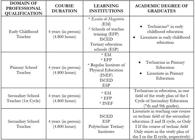
The Angolan educational policy board shows that teaching training has as its main goal to prepare citizens to enact teaching roles in diverse learning levels and subsystems, stablished by the Law of Basis for the Education System - LBSEE (2016). This training can be done either in public as well as private, or also public-private hybrid institutions. So, the training of early-childhood teachers is guaranteed by public, private or hybrid secondary and tertiary institutions, in the secondary and licentiate courses of early childhood teaching, that lasts for 4 years (Angola, 2020; Pedro, 2023).
The teacher that works in the Primary education subsystem is trained in courses of the same duration, offered by the secondary or the Licentiate course in Primary Education, offered by public, private and hybrid institutions. Regarding the training of teachers to work in the I Cycle of the Secondary School, it is secured by Secondary pedagogic institutions, such as teaching schools, and the schools of teacher training (ADPP), and the Regular Institute of Physical Education.
It is noteworthy that the secondary school level comprises the (i) general, (ii) technical-profession, and (iii) pedagogical secondary education. The first two are organized in two cycles (I and II), and the third one presents one cycle, that matches the II cycle. The second and third ones can, also, encompass post-secondary courses (but not of tertiary level). By its own traits, teacher training for this level is conducted in Tertiary Education Institutions, both in pedagogic education as well as in technical and polytechnical ones, through Licentiate courses in teaching of one specific matter of in one technical field of the secondary education (Cycles I and II, or only I or II cycle).
The offer of teaching courses for teachers of early childhood, primary and secondary education in the tertiary education has to have its annual vacancies approved by the MESCTI, along with a favorable permission of the MED, as in the terms stablished by the number 15 of 205/2018, from September 3rd, and number 2 of the article 21st of the 273/2020 from October 21st (Angola, 2018; Angola, 2020).
Regarding teaching training for tertiary education, it is relevant to point that, firstly, the Juridical Regime of the initial training for early childhood, primary school and secondary educational teachers only covers the “Courses of initial teacher training that are acknowledge as licenses to act as teachers in early childhood, primary school and secondary education22 (Artigo 1.º do Decreto Presidencial n.º 273/20, de 21 de outubro, Angola, 2020, our translation). Therefore, it doesn’t regulate the organization of courses for tertiary education, and neither for pedagogical tertiary education.
However, according to the LBSEE/2016 and the specific regulation of the tertiary education subsystem, whose courses qualify and license to teaching profession both in public as in private and other institutions according to the scientific fields of institutional interest. Considering that our research object is defined in the policies of teacher training in a medium level, we opted for not deepening the approach on the organization and functioning of the pedagogic tertiary education.
It is crucial to highlight the coexistence of two levels of teaching training - the medium and the higher -, noting a higher number of medium level institutions, predominantly localized in the countryside. Those institutions are present in almost all cities, distributed through all provinces, as indicated by the data provided by the National Institute of Training of Education Cadre (INFQE), MED’s executive organization. The aforementioned institute points to the existence of 102 institutions of teacher training of medium level in the 18 Angolan provinces, of which at least 42% are found in countryside cities and in the countries most secluded zones (Instituto Nacional de Formação de Quadros da Educação, 2023).
Concerning tertiary teacher training, data from the MESCTI report, from 2018, show that ten tertiary education institutions were operating in the national territory, with also some private, in fewer numbers, that also offered courses that certify and license teachers for the domains of professional teaching qualification already mentioned. Data of the aforementioned report show that those institutions are divided in seven ISCED and three Tertiary Pedagogic Schools. Against what is seen in the secondary pedagogic education, those institutions are located exclusively in the 10 capitals of 18 provinces: Bengo, Benguela, Bié, Cabinda, Cuanza-Norte, Cuanza-Sul, Huambo, Huíla, Luanda e Uíge (Ministério do Ensino Superior, Ciência, Tecnologia e Inovação, 2018).
To clarify, in Angola’s context, there is still a higher offer of training for medium level teachers. According to Pedro (2023), this situation can be influenced by the high employability of medium training teachers in the annual public tenders of the education sector. Furthermore, when the number of enrolled and undergraduates in institution of initial teacher training in the country is studied, the result is that it happens, mostly, in medium level institutions.
For example, INFQE data from the 2022-2023 school year show that 84.148 students were enrolled in the 102 schools of teacher training, while, in the tertiary level, both public and private, in the same school year, 10.603 new students were admitted in the courses of teacher training (Ministério do Ensino Superior, Ciência, Tecnologia e Inovação, 2023). Data on the search and offer of courses of teacher training show that there is equally a higher search for medium level teacher training as, in the tertiary education, the search for courses of education and teacher training represents only 10,5%, while 48% of the new students in this subsystem are “admitted in the areas of social sciences, especially for the Law course”23 (Ministério do Ensino Superior, Ciência, Tecnologia e Inovação, 2023, p. 11, our translation).
On the same trend, it is noticed that medium level teacher training courses are equally the ones that license the most people to teach in Angolan primary education, considering data from 2018 school year graduation, when, according to INFQE, the teacher training schools certified 14.777 finalist students, in the 18 provinces, 6.528 of them are female (Instituto Nacional de Formação de Quadros da Educação, 2023). On the other hand, the statistical yearbook of tertiary school of the same year, 2018, shows that 6.239 finalist students were licensed in teacher training courses and in educational sciences (Ministério do Ensino Superior, Ciência, Tecnologia e Inovação, 2019).
Furthermore, we consider Canhici’s( 2020) alert on the points of dissonance that represent the dual formative offer to teachers training in high school and in tertiary education in Angola relevant, with the need of a reflection on: a) an identical professional qualification, with diverse access, duration and level of graduation; b) the lack of explicit prioritary conditions to the continuation of studies in tertiary pedagogic education for graduates in secondary pedagogic education; c) lack of clarity in the specificities and differences in training in the two levels that offer it (tertiary and secondary pedagogic education); and d) the uncertainty on career and progression to identical functions.
However, it seems that this coexistence has to do with the own institutional, politic and ideational context of the teacher training policy (Jannuzzi, 2022), sticking to the fact that the educational policies are strongly attached in Angola’s historical, sociopolitical and economical context. We must remember that the country went through an extended civil war, that begun in 1975 and only reached peace and national reconciliation on April 4th, 2002.
On continuous training, it must be noted that it occurs in teaching institutions through seminars and other annual training actions, as well as in programs and projects implemented and managed by the National Institute of Education Cadre training, financed by the Angolan government and/or by agencies of international regulation, such as UNESCO, UNICEF and the World Bank Group. To be clear, PAT, among the policies of Angolan teacher. Training is one of the main formative initiatives together with Angola’s government on the continuous training of educators.
The PAT seeks, mainly, to better the pedagogic preparation of teachers that work in Primary schools, as many of them keep active without having done the required pedagogic training to exercise the teaching profession. This problem regarding teachers lacking adequate training has been seen for many years, notwithstanding the efforts to revert it. For example, data from the “Mapping of Angolan Schools”, from MED, made with the support of PAT II (Ministério da Educação, 2023), show that, in 2022 school year, 28% of the teachers working in the countries public schools lacked pedagogic training, be it of secondary or tertiary level.
In the Primary Educational level, Bortot, Brás and Scaff (2022) noted that, of the 66.910 active teachers in the 2019 school year, 23.746 lacked pedagogic training, what represents 35,4 % of the total teaching workforce of this pivotal level of education. This represents a great worry for the national education authorities, above all when almost half of the teachers working in the initial levels (1st to 6th) lack the didactic and pedagogic preparation for their professional practice.
Following the same line of thought, Paxe (2017) affirms that the clogging caused by the lack of teachers, both in matters of quantity and in quality, that are adequately prepared, has always being a concern of MED’s authorities that, in the report on the Statute of the teaching career from 2003, has recognized that most of teachers that worked in the Regular Secondary Education Institutes (IMNE) lacked the adequate profile or a insufficient and/or inadequate training, or by a lack of pedagogic aggregation.
THE PROJECT LEARNING FOR ALL AS THE MAIN AXIS OF THE WORLD BANK GROUP PERFORMANCE IN ANGOLA
In more specific terms, the actions of the World Bank Group in education’s context and, primarily, of Angolan teacher training is materialized in the Learning for All Project, although its investments are also directed to school building and reform and, more recently, to the project Tertiary Education, Science and Technology (TEST)24, a development project directed to tertiary education, science, technology and innovation implemented by the Ministry of Tertiary Education, that seeks to complement Angola’s government efforts in the process of economic diversification and development financed by the World Bank. There is a lack on the information and public data provided on the policies of school building in the country, what prevents us from knowing how much the WB has provided for it in the last years.
The PAT is structured in three components that represent their specific goals: “(i) to improve the knowledges and competences of teachers and school managers in primary schools of the project’s fields; (ii) to stablish an evaluation system for students; and (iii) the Project Management through management, monitoring, audit, and accountability training”25 (PAT, 2021, p. 8, our translation), with its main areas of intervention being the “Abilities of Teachers and School Managers, the Evaluation of learning of the students and the project’s management”26 (PAT, 2021, p. 9, our translation), distributed among strategic goals, as shown in the Board 2.
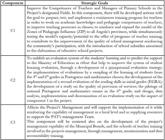
To reinforce teachers’ abilities and to reformulate their initial training (PAT, 2022) are two main shafts behind the reach of the goals stablished in the components. They reassert the idea of improving teacher training for their better professional performance, what should mean a better student classification in large scale evaluations that are being institutionalized through the realization of national exams since the 2022-2023 school year.
On the measure of the quality of training through a large scale evaluation, based in a group of manuals of Portuguese and Mathematics, other than aspects related to management though manuals of pedagogic supervision that seek to develop learning and school work in an efficient and “in a flexible manner, taking into account what seems for them to be more useful to the students’ learning”27 (PAT, 2018, p. 22, our translation).
By directly promoting a teaching project for teachers, searching to raise the number of professionals in the country, the quality of the training is influenced by the Bank and presupposes a large-scale intervention over teaching training mechanisms in the country (World Bank, 2013). Following the Bank’s perspective, the quality engages the training adaptations to the new abilities required of the workers in general, in order to “make schools and teachers more accountable for the results, especially for learning results”28 (World Bank, 2011, p. 141, our translation).
With PAT, the World Bank Group elaborated a software, named TEACH, to measure the components of teaching practices related to the: “Quality of teaching techniques that help to develop the students’ social, emotional and cognitive capacities; [in] Time dedicated to learning”29 (PAT, 2022, our translation), as an observation tool for classes that evaluates teachers efforts to promote students abilities. According to Bortot, Brás and Scaff (2022), it is an observation tool in school classes designed considering the realities of countries of low and medium income, turned to the monitoring of teaching practices and evaluation of strategies seeking to improve teachers teaching techniques (Grupo Banco Mundial, 2019). The measure of teaching competences through applications, by pedagogic practices develop in the Project, is a way to associate to performance, with an emphasis in practice and in the use of tacit knowledges acquired in teaching. Moreover, it contributes to the consolidation of mechanisms capable of measuring this productivity and to exercise a higher control over the work (Silva, 2019).
Bortot and Brás (2023) understand that there is a technic global rationale, taken over by the World Bank Group, and attached to elements of the New Public Management, that announce as policy tendencies, among endogenous and exogenous aspects, the service to the own aligned agenda of developing countries, as stated by the Bank itself: “a base of knowledge of elevated quality on the reform of the educational system”30 (Grupo Banco Mundial, 2011, p. 6, our translation). In this sense, it is understood that, in Angola’s context, it is necessary to think in a model of teacher training that answers to teachers’ real needs, in a way that they step into a proactive role in the implementation of policies and programs, without remaining hostages of the partner institutions and global privatization agenda on education.
FINAL THOUGHTS
Historically, in Brazil, there have been various studies on the WB acting and influence over educational policies, but, little attention has been paid to its workings, and of other international organizations, in the African context. In Angola’s case, the works of Ngaba (2012; 2017), Paxe (2017), Bumba (2022), Bortot, Brás and Scaff (2022) Bortot and Brás (2023), António and Kuebo (2024), Brás (2024) and Brás (2025) denounced that the country has been suffering a great influence of the IO, fundamentally because of its lacking socioeconomic condition and due to other characteristics that situate the country as a fragile State.
Thus, Angola’s teacher training policies manifest the influence of global educational reforms in various aspects. Studies show that those policies were substantially shaped by multiple international players, including UNICEF, World Bank, European Union and UNESCO, that play crucial roles in the formulation and implementing of guidelines to teacher training. Those international organizations seek to legitimize and standardize educational agendas in diverse national contexts, especially in fragile States or those in development, such as Angola. This standardization was promoted though the uniformization of diagnostics of educational systems and of the elaboration of regulatory devices and management mechanisms.
The entailments of teacher training policies in Angola include the tendency to the accountability of teachers, the adoption of the pedagogy of competences, the incorporation of meritocratic values of a neoliberal inspiration, and the creation of a new organizational structure for teacher training. Those tendencies are in consonance with the rhetoric of global educational reforms, promoted by mechanisms of supranational regulation.
We presented here some of the constitutive bases that organized the policies financed by the WB, while studying its general guidelines to education specially regarding teacher training. This is a live debate in the academy that questions the objective conditions of such guidelines and their influence on the educational policies of National States. This debate has as its background the own notion of autonomy of National States in the definition of its educational policies. The data presented deal specifically with Angola’s reality - a reality geographically situated and historically dated. Although, it doesn’t prevent the understanding of those results as parameters to other actions on education in Africa’s context and, by extension, to countries considered underdeveloped and under AID’s umbrella.
To deepen the discussion, it is necessary to understand that the educational policy, in general, or the teacher training policy, specifically, are present in the WB’s guidelines that, do not have an effective jurisdiction on the definition of National States actions. Therefore, only an analysis of the situation and the specific definitions of each locality can aid a comprehension of how much the conceptions disseminated by the WB, or other multilateral institutions, are in fact, implemented as educational policies.
We draw attention to the fact that Angolan education has suffered (and still suffers) from these organizations, precisely because there are local players that doesn’t agree with the suggested logic. It goes through their interests, that do not originate from the capital surplus by the private sector - that what Santos (2017) names as consented intervention. Such situation opens the path to new research on this reality. The need of a critic problematization, therefore, gets renewed.
References
- AGÊNCIA DE COOPERAÇÃO INTERNACIONAL DO JAPÃO. República de Angola: Documento de análise por país da JICA, 2023.
-
ALTMANN, Helena. Influências do Banco Mundial no projeto educacional brasileiro.Educação e Pesquisa, São Paulo, v. 28, n. 1, p. 77-89, jan./jun. 2002. Disponível em: Disponível em: https://www.scielo.br/j/ep/a/gXrrXjGztGfmRqhqLHgKqgt/?format=pdf⟨=pt Acesso em: 08/04/2025.
» https://www.scielo.br/j/ep/a/gXrrXjGztGfmRqhqLHgKqgt/?format=pdf⟨=pt - ANGOLA. Constituição da República de Angola Diário da República, I série, N.º 23. Luanda: Imprensa Nacional, 2010.
- ANGOLA. Decreto Presidencial n.º 273/20, de 21 de outubro. Regime Jurídico da Formação Inicial de Educadores de Infância, de Professores do Ensino Primário e de Professores do Ensino Secundário Diário da República I Série, N.º 168. Luanda: Imprensa Nacional , 2020.
- ANGOLA. Lei n.º 17/16, de 7 de outubro - Lei de Bases do Sistema de Educação e Ensino Diário da República, I Série, n.º 170. Luanda: Imprensa Nacional, 2016.
-
ANTÓNIO, António; KUEBO, Paulino Gregório Armando. A política educativa em Angola e a garantia do direito à educação: articulação entre o contexto de influência e a produção de textos.Educar em Revista,[S. l.], v. 40, n. 1, p. 1-17, 2024. Disponível em: Disponível em: https://revistas.ufpr.br/educar/article/view/94760 Acesso em: 18/07/2025.
» https://revistas.ufpr.br/educar/article/view/94760 - BANCO MUNDIAL. Qualificação e Emprego de Professores em Angola Relatório não publicado elaborado para o Governo de Angola. Consultor BPC, 2008.
- BARROSO, João (org.). A regulação das políticas públicas de educação: espaços, dinâmicas e actores. Lisboa: Educa/Unidade de I&D de Ciências da Educação, 2006.
-
BORTOT, Camila Maria; BRÁS, Chocolate Adão; SCAFF, Elisangela Alves da Silva. Regulación supranacional en la educación en África: un estudio desde la política de formación docente en Angola. Revista Iberoamericana de Educación, Madrid, v. 90, n. 1, p. 151-167, 2022. Disponível em: Disponível em: https://rieoei.org/RIE/article/view/5357 Acesso em: 08/07/2025.
» https://rieoei.org/RIE/article/view/5357 -
BORTOT, Camila Maria; BRÁS, Chocolate Adão. O Programa Aprendizagem para Todos como instrumento de racionalidade técnica na formação de professores em Angola. Jornal de Políticas Educacionais, Curitiba, v. 17, p. 1-22, 2023. Disponível em: Disponível em: https://revistas.ufpr.br/jpe/article/view/89486 Acesso em: 08/07/2025.
» https://revistas.ufpr.br/jpe/article/view/89486 - BRÁS, Chocolate Adão. Política de formação inicial de professores em nível médio em Angola 2010-2022: contexto, atores e implicações. Tese (Doutorado em Educação). Curitiba: Universidade Federal do Paraná, 2024.
-
BRÁS, Chocolate Adão. Implicações da regulação supranacional na conceção e desenvolvimento dos currículos dos cursos de formação inicial de professores em Angola.Journal of Supranational Policies of Education (JOSPOE), v. 21, p. 85-108, 2025. https://doi.org/10.15366/jospoe2025.21.005
» https://doi.org/10.15366/jospoe2025.21.005 - BUMBA, A. M. Estado e ação pública na educação Angolana Tese (Doutorado em Educação). São Paulo: Universidade de São Paulo, 2022.
- CANHICI, M. H. O Trabalho de Fim do Curso no currículo dos cursos de licenciatura dos ISCED de Cabinda e do Huambo. Uma análise focada nas suas razões e nos seus efeitos Tese (Doutorado em Educação). Porto: Universidade do Porto, 2020.
- CEIC-UCAN. Relatório Económico de Angola 2019-2020 Luanda: Texto Editores, 2021.
- COX, Cristián. Políticas de educación superior: categorías para su análisis. In: COURARD, Hernán (ed.). Políticas comparadas de educación en America Latina Santiago-Chi: FLACSO, 1993, p. 87-127.
-
DECKER, Aline; EVANGELISTA, Olinda. Educação na lógica do Banco Mundial: formação para a Sociabilidade Capitalista.Roteiro, Joaçaba, v. 44, n. 3, p. 1-24, set./dez. 2019. Disponível em: Disponível em: https://periodicos.unoesc.edu.br/roteiro/article/view/23206/14025 Acesso em: 08/04/2025.
» https://periodicos.unoesc.edu.br/roteiro/article/view/23206/14025 - DIAS SOBRINHO, José. Calidad, pertinencia y responsabilidad social de la universidad latinoamericana y caribeña. In: GAZZOLA, Ana Lúcia; DIDRIKSSON, Axel (ed.). Tendencias de la educación superior em America Latina y el Caribe Caracas: IESALC-UNESCO, 2008. p. 87-112.
-
FONSECA, Marília. O Banco Mundial como referência para a justiça social no terceiro mundo: evidências do caso brasileiro. Revista da Faculdade de Educação, São Paulo, v. 24, n. 1, jan. 1998. Disponível em: Disponível em: https://www.scielo.br/j/rfe/a/whyhKssdXW7TpgH83VQTfrw/?lang=pt Acesso em: 16/05/2025.
» https://www.scielo.br/j/rfe/a/whyhKssdXW7TpgH83VQTfrw/?lang=pt -
GRUPO BANCO MUNDIAL. Grupo de Avaliação Independente. Angola: Avaliação da Assistência ao País. (Documento sem data). Disponível em: Disponível em: https://ieg.worldbankgroup.org/sites/default/files/Data/reports/angola_cae_ap_portuguese.pdf Acesso em: 04/11/2023.
» https://ieg.worldbankgroup.org/sites/default/files/Data/reports/angola_cae_ap_portuguese.pdf -
GRUPO BANCO MUNDIAL. Relatório Anual Ano Fiscal 2011 - BIRD, IDA, IFC e MIGA Washington, 2011. Disponível em: Disponível em: https://thedocs.worldbank.org/en/doc/418271431526994852-0330022015/original/2011AnnualReportEDS25ConstituencyReportPort.pdf Acesso em: 01/11/2023.
» https://thedocs.worldbank.org/en/doc/418271431526994852-0330022015/original/2011AnnualReportEDS25ConstituencyReportPort.pdf - INSTITUTO NACIONAL DE FORMAÇÃO DE QUADROS DA EDUCAÇÃO. Caracterização das Escolas de Magistério, data de 20/03/2023. Luanda: documento não editado, 2023.
-
JANUZZI, P. M. A importância do contexto institucional, político e ideacional na avaliação de políticas públicas. Revista Brasileira de Avaliação, São Paulo, v. 11, n. 2, p. 1-12, 2022. Disponível em: https://rbaval.org.br/article/doi/10.4322/rbaval202211037. Acesso em: 08/07/2025.
» https://doi.org/10.4322/rbaval202211037 -
LAMARRA, Norberto Rafael Fernández; CENTENO, Cristian Gonzalo Pérez. La educación superior latinoamericana en el inicio del nuevo siglo: situación, principales problemas y perspectivas futuras. Revista Española de Educación Comparada, Madri-Espanha, n. 27, p. 123-148, jan./jun., 2016. Disponível em: Disponível em: http://revistas.uned.es/index.php/REEC/article/view/15044/14414 Acesso em:24/07/2025.
» http://revistas.uned.es/index.php/REEC/article/view/15044/14414 -
LÜDKE, Menga; MOREIRA, Antônio Flávio Barbosa; CUNHA, Maria Isabel da. Repercussões de tendências internacionais sobre a formação de nossos professores. Educação & Sociedade, Campinas, ano XX, n. 68, p. 278-298, dez. 1999. Disponível em: Disponível em: https://www.scielo.br/j/es/a/K8FKNNh9jzdjqzMfbSxBd4H/?format=html⟨=pt Acesso em: 24/07/2025.
» https://www.scielo.br/j/es/a/K8FKNNh9jzdjqzMfbSxBd4H/?format=html⟨=pt - MINISTÉRIO DO ENSINO SUPERIOR, CIÊNCIA, TECNOLOGIA E INOVAÇÃO. Anuário Estatístico do Ensino Superior, Ciência, Tecnologia e Inovação Luanda: Edições MESCTI, 2019.
- MINISTÉRIO DO ENSINO SUPERIOR, CIÊNCIA, TECNOLOGIA E INOVAÇÃO. Relatório de Balanço do Processo de Acesso ao Ensino Superior no ano académico 2022/2023 6.07 2023. Luanda: documento não editado, 2023.
- NGABA, André Vela. Políticas Educativas em Angola (1975-2005): entre o global e o local: o sistema educativo mundial. Mbanza-Kongo: SEDIECA, 2012.
- NGABA, André Vela. Transnacionalismo e políticas educativas: o impacto do sistema educativo mundial nos sistemas educativos nacionais: o caso angolano (1975-2015). Tese (Doutorado em Educação). Lisboa: Universidade Católica Portuguesa, 2017.
-
PANSARDI, Marcos Vinicius. A formação de professores e o Banco Mundial. EccoS Revista Científica, São Paulo, n. 25, p. 127-142, jan./jun. 2011. Disponível em: Disponível em: https://periodicos.uninove.br/eccos/article/view/1661 Acesso em: 10/07/2025.
» https://periodicos.uninove.br/eccos/article/view/1661 - PAT. Projeto Aprendizagem para Todos (PAT): Relatório do segundo trimestre de 2021. Luanda, Ministério da Educação, 2021.
-
PAT. Projeto aprendizagem para todos 2022. Disponível em: Disponível em: https://www.pat- med.org Acesso em: 10/06/2022.
» https://www.pat- med.org - PAXE, Isaac Pedro Vieira. Políticas Educativas em Angola: um desafio do direito à educação. Luanda: Where Angola Publisher, 2017.
- PAXE, Isaac Pedro Vieira; BRÁS, Chocolate Adão. A Educação Infantil em Angola em tempos de Covid-19: makas antigas em outros tempos. In: Maria Aparecida Guedes Monção; Luciane Muniz Ribeiro Barbosa (org.). Políticas Públicas de Educação Infantil: diálogos com o legado de Fúlvia Rosemberg. São Carlos: Pedro & João Editores, 2021, p. 483-514.
- PEDRO, Lando Emanuel Ludi. Implicações das políticas de regulação estatal do ensino superior na conceção e no desenvolvimento dos currículos de formação inicial de professores em Angola: dois estudos de caso. Tese (Doutorado em Educação). Lisboa: Universidade de Lisboa, 2023.
-
RIVERO, José. Reforma y desigualdad educativa en América Latina. Revista Iberoamericana de Educación, Madri, n. 23, p. 103-133, maio/ago. 2000. Disponível em: Disponível em: https://rieoei.org/historico/documentos/rie23a03.PDF Acesso em: 02/06/2025.
» https://rieoei.org/historico/documentos/rie23a03.PDF - ROSEMBERG, Fúlvia. Uma introdução ao estudo das organizações multilaterais no campo educacional. In: KRAWCZYK, Nora; CAMPOS, Maria Malta; HADDAD, Sérgio (org.). O cenário educacional latino-americano no limiar do século XXI: reformas em debate. Campinas-SP: Autores Associados, 2000, p. 63-94.
- SANTOS, Thiago Rodrigo Fernandes da Silva. Análise da atuação do Grupo Banco Mundial na educação superior do Brasil Dissertação (Mestrado em Educação). Recife: Universidade Federal de Pernambuco, 2017.
-
SANTOS, Thiago Rodrigo Fernandes da Silva. O Grupo Banco Mundial no campo da educação superior da América Latina: uma análise das dissertações e das teses publicadas no Brasil sobre o tema.Educar em Revista, Curitiba, v. 40, n. 1, p. 1-17, 2024. Disponível em: Disponível em: https://revistas.ufpr.br/educar/article/view/91490 Acesso em: 08/04/2025.
» https://revistas.ufpr.br/educar/article/view/91490 -
SEITENFUS, Ricardo Antônio Silva. Da esperança à crise: as organizações internacionais frente ao direito e ao poder. In: ORGANIZACIÓN DE LOS ESTADOS AMERICANOS. XXX Curso de Derecho Internacional: El derecho internacional y el mantenimiento de la paz y seguridad internacionales. Washington: Organización de los Estados Americanos, 2004, p. 223-241. Disponível em: Disponível em: http://www.oas.org/es/sla/ddi/docs/publicaciones_digital_XXX_curso_derecho_internacional_2003_Ricardo_Seitenfus.pdf Acesso em: 23/06/2025.
» http://www.oas.org/es/sla/ddi/docs/publicaciones_digital_XXX_curso_derecho_internacional_2003_Ricardo_Seitenfus.pdf -
SILVA, Rui da; OLIVEIRA, Joana. Privatização da educação em 24 países africanos: tendências, pontos comuns e atípicos. Educação & Sociedade, Campinas, v. 41, p. 1-20, 2020. Disponível em: Disponível em: https://www.scielo.br/j/es/a/p9RyKML6HwprLvTZVLwsYzw/?format=pdf⟨=pt Acesso em: 03/08/2025.
» https://www.scielo.br/j/es/a/p9RyKML6HwprLvTZVLwsYzw/?format=pdf⟨=pt - TORRES, Rosa Maria. Melhorar a qualidade da educação básica? As estratégias do Banco Mundial. In: TOMMASI, Lívia de; WARDE, Mirian Jorge; HADDAD, Sérgio (org.). O Banco Mundial e as políticas educacionais São Paulo: Cortez, 2000, p. 125-194.
- WORLD BANK. Learning for All: Investing in People’s Knowledge and Skills to Promote Development. World Bank Group Education Strategy. 2020 World Bank Group: Washington, 2011.
-
1
In the original: “associações voluntárias de Estados constituindo uma sociedade, criada por um tratado, com a finalidade de buscar interesses comuns através de uma permanente cooperação entre seus membros” (Seitenfus, 2004, p. 225).
-
2
In the original: [...] recomendava-se que a expansão do ensino secundário de conteúdo mais geral deveria ser discutida com prudência, sendo desejável que a oferta se concentrasse na educação rural e na formação profissional extraescolar. Esta última sugestão tinha a ver com a necessidade de diminuir a aspiração por empregos no setor moderno da economia, direcionando a demanda profissional para o setor mais tradicional, isto é, para aqueles trabalhos informais ou por conta própria, de mais baixos ingressos, situados preferencialmente em periferias urbanas e zonas rurais.
-
3
As defended by Silva and Oliveira (2020), week State are those countries presenting at least one of the following traits: week government, followed by inefficient policies and institutions still not stablished, due to lack of will of their governments, or by political or economic inefficiency.
-
4
Our translation. In the original: “11% das crianças têm acesso à educação pré-escolar em nível nacional, tendo como principal empecilho às infraestruturas escolares”.
-
5
https://opais.co.ao/index.php/2019/05/23/apenas-11-de-criancas-frequentam-o-pre-escolar-a-nivel-nacional/.
-
6
Informação prestada pelo Secretário de Estado para a Educação Pré-Escolar e Ensino Primário do MED, Senhor Pacheco Francisco, em entrevista à Rádio Mais na província do Huambo, no dia 10 de maio de 2023, no ato de inauguração de uma escola.
-
7
In the original: “[...]impactos resultantes do modelo de educação herdado do colonialismo e como as organizações multinacionais, por meio da difusão de seus programas de internacionalização das políticas educacionais, influenciam na configuração dos principais normativos que regulamentam o Sistema de Educação e Ensino angolano”.
-
8
In the original: “[...] pesquisas e reflexões que põem em tela as mais diversas intervenções das organizações internacionais dentro das políticas públicas locais, ganham grande importância” (António; Kuebo, 2024, p. 10).
-
9
In the original: “[...] assessoram e financiam, não somente o setor social da educação, mas também, o Plano Nacional de Desenvolvimento em conformidade com os compromissos da agenda 2030” (António; Kuebo, 2024, p. 10).
-
10
In the original: “No médio prazo, o Banco esperava fazer a transição para um programa de assistência assente na (i) criação de capacidade na gestão econômica e no auxílio à preparação de estudos de pré investimento; (ii) ajuda na transição para uma economia de tempo de paz; (iii) auxílio na reabilitação da devastada infraestrutura econômica e social; e (iv) apoio ao processo de reforma econômica” (Grupo Banco Mundial, s.d., p. 2).
-
11
In the original: “concedeu 16 créditos no montante de USD 487 milhões e os empréstimos mais doações per capita alcançaram USD 3 por ano” (Grupo Banco Mundial, s.d., p. 3).
-
12
In the original: “(i) aumento da transparência, eficiência e credibilidade da gestão dos recursos públicos e intensificação do desenvolvimento de capacidade; (ii) expansão da prestação de serviços aos grupos afectados pela guerra e a outros grupos vulneráveis (prestação de serviços básicos e reabilitação da infraestrutura de emergência); e (iii) preparação do terreno para um crescimento económico favorável aos pobres, de base ampla, (especialmente através de um melhor ambiente para o crescimento do sector privado, da identificação de intervenções piloto na economia rural e da facilitação de melhor financiamento privado das infraestruturas)” (Grupo Banco Mundial, s.d., p. 3).
-
13
In the original: “Os desembolsos cumulativos situam-se em USD 27,3 milhões, o que equivale a 5,92% dos compromissos líquidos totais” (Grupo Banco Mundial, 2011, p. 19).
-
14
In the original: “um ensino de maior qualidade nas disciplinas de Língua Portuguesa e Matemática e ministrados por professores melhor preparados do ponto de vista didático”.
-
15
A compreensão do que vem a ser “influência das organizações internacionais” é polissêmica. Por isso, toma-se aqui a definição de que ela se refere a toda e qualquer ação que tensione mudanças nos sistemas educacionais dos Estados-nação que advêm de tais organismos.
-
16
In the original: “realizou-se em Luanda, de 21 a 24 de abril de 2004, uma consulta pública sobre o Plano de Acção Nacional de Educação Para Todos” (Ngaba, 2017, p. 243)
-
17
In the original: “Portugueses e Brasileiros a serviço da UNESCO no âmbito da cooperação entre a UNESCO e a CPLP” (Ngaba, 2017, p. 244).
-
18
In the original: “assegurar a educação inclusiva e equitativa de qualidade, e promover oportunidades de aprendizagem ao longo da vida para todos” (UNESCO, 2015, p. 1).
-
19
The single-teacher model is a system of teaching implemented in the group of Angolan educational policies, in 2001, through the first Law of Bases of the Educational System, in which the teacher works in an interdisciplinary system, teaching all courses that make up the basis of the national curriculum of each grade of Primary Education (1st to 6th Grades).
-
20
In the curricular change of 2023-2027, that presupposes co-teaching, MED is implementing, in a first phase, for 144 selected schools in 18 provinces, 8 by province, to predict a reduction of courses, from nine to seven, integrating curricular knowledges, following the model linked to STEM fields (science, technology, mathematics, engineering and arts). The experimental phase will take five Years, with the last one being devoted to the evaluation of the change’s impact. The teacher training act was conducted in the month of October, taking five days, ensured by national and foreign trainers, following the Know More Program, financed by the Institute Camões from Portugal. The data is available in: https://www.facebook.com/Oficial.MED1281 Access: oct. 19th, 2023.
-
22
In the original: “Cursos de Formação Inicial de Professores que sejam reconhecidos como habilitação para o exercício da profissão docente na Educação Pré-escolar, no Ensino primário e no Ensino Secundário” (Artigo 1.º do Decreto Presidencial n.º 273/20, de 21 de outubro, Angola, 2020).
-
23
In the original: “admitidos nas áreas de ciências sociais, com destaque para o curso de graduação em Direito” (Ministério do Ensino Superior, Ciência, Tecnologia e Inovação, 2023, p. 11).
-
24
The TEST project goal is to support the implementation of the Angolan Strategy for the Tertiary Education, Science, Technology and Innovation, focusing on a) access and equity (specially to achieve gender equity); b) quality and relevance (prioritizing skills of climatic adaptation); and c) Governance and financing. The project has four components and/or intervention axis: 1) to improve access, equity and quality of the Tertiary Education; 2) to reform Institutions of teacher training to strengthen teacher preparation; 3) digital change; 4) reinforce the management, monitorization and evaluation capacity.
-
25
In the original: “(i) melhorar os conhecimentos e competências dos professores e a gestão escolar em Escolas Primárias das áreas designadas do projeto; (ii) estabelecer um sistema de avaliação de alunos; e (iii) Gestão do Projeto através de formação em gestão, monitorização, auditoria e prestação de contas” (PAT, 2021, p. 8)
-
26
In the original: “Competências dos Professores e Gestão Escolar, Avaliação das aprendizagens dos Alunos e Gestão do Projecto” (PAT, 2021, p. 9)
-
27
In the original: “de uma forma flexível, tendo em consideração o que lhe parece mais útil para a aprendizagem dos alunos” (PAT, 2018, p. 22).
-
28
In the original: “tornar as escolas e professores mais responsáveis pelos resultados, especialmente pelos resultados da aprendizagem” (World Bank, 2011, p. 141).
-
29
In the original: “Qualidade das técnicas de ensino dos professores que ajudam a desenvolver as capacidades socioemocionais e cognitivas dos alunos; [ao] Tempo dedicado à aprendizagem” (PAT, 2022).
-
30
In the original: “uma base de conhecimento de elevada qualidade sobre a reforma do sistema educacional” (Grupo Banco Mundial, 2011, p. 6).
-
DATA AVAILABILITY DECLARATION
The content underlying the research text is contained in the manuscript
-
CONFLICTS OF INTEREST
The authors declare no conflicts of interest.
The content underlying the research text is contained in the manuscript
History
-
Received
01 May 2025 -
Preprint posted on
30 Apr 2025
10.1590/SciELOPreprints.11809 -
Accepted
05 Aug 2025

 *Instituições com cursos de formação de professores de nível médio.21 As in the point b) of Article 110 from the LBSEE/2020.Fonte:
  Source: made by the authors, with data from the PAT (2020, p. 9-10).