
 THE ROLE OF EXPERIENCE IN LEARNING TEACHING PROFESSION: A SYSTEMATIC LITERATURE REVIEW
ABSTRACT:
Given the relevance of the practicum as a place for professional learning in teacher education, this article aims to identify how experiential learning during the practicum has been approached by specialized studies. For this purpose, a “systematic review of literature” of writings produced in education between 2000 and 2021 was conducted (n = 58). Three thematic categories of experiential learning emerged from a qualitative meta-analysis: frameworks of experiential learning, foundations and organizers of experiential learning, and emerging knowledge of experiential learning. These elements allow a global understanding of the role and limits of experiential learning, but also of the foundations, organizers, and educational arrangements that promote it and, finally, of the knowledge that emanates from the processes as a whole. The paper concludes by identifying possible challenges to enhance experiential learning, highlighting the importance of reflecting on the experience, and thus contributing to teacher training.
Keywords:
experiential learning; experiential knowledge; pre-service teacher education; practicum
RESUMEN:
Dada la relevancia del practicum como espacio de aprendizaje profesional en la formación del profesorado, este artículo se propone identificar cómo ha sido abordado el aprendizaje experiencial durante el practicum por los estudios especializados. Para ello, se realizó una “revisión sistemática de literatura” de escritos producidos en educación entre 2000 y 2021 (n = 58). De un meta-análisis cualitativo surgieron tres categorías temáticas en torno al aprendizaje experiencial: marcos del aprendizaje experiencial, fundamentos y organizadores del aprendizaje experiencial y saberes emanados del aprendizaje experiencial. Dichos elementos permiten una comprensión global del rol y los límites del aprendizaje experiencial, pero también de los fundamentos, organizadores y dispositivos de formación que lo fomentan y, finalmente, de los saberes que emanan del conjunto de los procesos. El trabajo termina identificando posibles desafíos para realzar el aprendizaje experiencial, destacando la importancia de reflexionar sobre la experiencia y, con ello, aportar a la formación del profesorado.
Palabras clave:
aprendizaje experiencial; saber experiencial; formación inicial docente; practicum
RESUMO:
Dada a relevância do estágio como espaço de aprendizado profissional na formação de professores, este artigo tem como objetivo identificar como tem sido abordada a aprendizagem experiencial durante o estágio por estudos especializados. Para isso, foi realizada uma "revisão sistemática da literatura" de textos produzidos em educação entre 2000 e 2021 (n = 58). A partir de uma meta-análise qualitativa, surgiram três categorias temáticas em torno da aprendizagem experiencial: marcos da aprendizagem experiencial, fundamentos e organizadores da aprendizagem experiencial, e saberes provenientes da aprendizagem experiencial. Esses elementos permitem uma compreensão global do papel e dos limites da aprendizagem experiencial, mas também dos fundamentos, organizadores e dispositivos de formação que a promovem e, finalmente, dos saberes que emanam do conjunto dos processos. O trabalho é concluído identificando possíveis desafios para aprimorar a aprendizagem experiencial, destacando a importância de refletir sobre a experiência e, assim, contribuir para a formação de professores.
Palabras chave:
aprendizagem experiencial; conhecimento experiencial; formação inicial de professores; practicum
INTRODUCTION
The role of experience in learning is widely recognized in the professional world, to such an extent that it is often regarded as the primary source of professional learning (Balleux, 2000). In the education field, this idea first took root in John Dewey’s philosophy of experience. In his book “Experience and Education” (Dewey, 1938), the author advances the thesis of a necessary and profound relationship between education and experience, a stance that implies a direct link to a general conception of learning. Since then, the understanding of this phenomenon has been enriched by numerous contributions, such as the model of experiential learning proposed by Kolb (1984) or Schön’s (1983) theories concerning the influence of reflection within the framework of pedagogical action.
For teachers, experience and learning have been central concepts in the study of their practical training. Roger et al. (2014) note that research perspectives addressing this topic are diverse in terms of how they conceptualize the mechanisms and processes that constitute experience. Likewise, there is a scarcity of scientific work devoted to understanding the mechanisms involved in learning in real work contexts, that is, those through which teachers construct skills and knowledge in action within their daily professional practice (Dumoulin, 2014). On the other hand, the mechanisms that foster the emergence of new knowledge among pre-service teachers are not well known (Baconnet & Bucheton, 2011), nor is the nature of the knowledge that emerges from experience clearly identified (Almeyda Hidalgo, 2016).
Over the past few decades, several conceptions regarding experiential learning have succeeded one another, sometimes reflecting opposed views, but often situated within diverse typologies of professional knowledge and derived from different epistemologies (Balleux, 2000). In this context, it seems necessary to systematize the scientific studies that are scattered across the literature and which, through a meta-analysis, could contribute to a better understanding of the ways in which the relationship between experience and learning in the teaching profession has been studied.
To achieve this objective, a “systematic literature review” (Petticrew & Roberts, 2006) is proposed. The purpose is to understand how the role of experience in learning and its connections to the context of teacher education have been studied most recently (since 2000), particularly through practicum. In this context, we raise the following questions: What does experiential learning enable and what does it not enable? What are the necessary conditions for experience to generate learning? What are the foundations and organizing principles involved in experience? What educational arrangements foster experiential learning? How does a formative experience become one that produces knowledge, and how can the resulting knowledge/knowing be characterized?
In an attempt to address these questions, this article is structured into three parts. The first part outlines the methodological choices that guided the selection of a corpus of recent scientific works for the systematic literature review. The second part presents the results of the qualitative meta-analysis conducted, utilizing the following three emergent thematic categories: frameworks of experiential learning, foundations and organizers of experiential learning, and knowledge derived from experiential learning. Finally, the third part offers a discussion/conclusion that critically synthesizes the main findings and identifies avenues for future research and implications for pre-service teacher education.
METHODOLOGY
The methodology aligns with the logic of a “systematic literature review,” understood as “a review that strives to comprehensively identify, appraise, and synthesize all relevant studies on a given topic” (Petticrew & Roberts, 2006, p. 19). From an operational standpoint, six different databases were selected (Cairn.info, Érudit, Web of Science, SCOPUS, Redalyc, and SciELO), as they were relevant and authoritative sources across the three languages chosen for the bibliographic search (French, English, and Spanish). The decision was made to focus on recent literature, comprising articles and book chapters published between 2000 and 2021. To systematize the literature on the topic of interest, a three-stage approach was adopted, based on the guidelines for systematic reviews and meta-analyses set forth by the PRISMA statement (Moher et al., 2009):
- Stage 1 of Search: The following search terms were used: (savoirs d’expérience) AND (apprentissage); (connaissance ouvragée) AND (apprentissage); (experiential knowledge) AND (teacher); (working knowledge) AND (teacher); (saber de la experiencia) AND (docente); (saberes del trabajo) AND (docente). Exclusion criteria were also applied at this stage, ruling out all contributions in which experiential learning takes place online, specifically online internships, online-based analyses of professional practice, and other online training and learning arrangements in a practicum context. This decision stems from a concern for uniformity, given that online environments cannot replicate certain aspects associated with practice in a real-world setting, particularly classroom management, interactions with other members of the educational institution, decision-making within school contexts, etc.
- Stage 2 of First Text Retention Filter: Reading of titles and abstracts to identify and retain relevant articles and book chapters, specifically those that directly address a topic related to learning the teaching profession through experience within a practicum context.
- Stage 3 of Systematization and Second Retention Filter: Full-text reading and content analysis. Importation of data into the bibliographic management software Zotero; importation of bibliographic entries and full texts into the NVivo software; and exclusion of irrelevant articles. The data collected during each of these stages are presented below (see Table 1):
Following these stages, the corpus was consolidated and subsequently coded using NVivo 12 software. Nodes were predetermined to identify the following elements within the selected sources: topic, object(s) of study, country, theoretical frameworks, definition of experience/experiential learning, methodological approach, data collection method, sample characteristics, educational level involved, and main research contributions. For the specific purposes of this article, the definitions proposed by the authors specifically related to experiential learning and the concept of experience, and their research findings were retained. Based on these data, a qualitative-inductive densification meta-analysis was conducted. It was initially carried out individually by each participating researcher (three in total), and then, the results were triangulated through an inter-rater process (Núñez-Moscoso, 2017). This individual and inter-rater exercise was structured around a “conceptualizing category” analysis (Paillé & Mucchielli, 2012), which facilitated the emergence of thematic categories and subthemes associated with studies on experiential learning. In this analysis of the textual corpus of 58 publications, categories took precedence, and consequently, individual articles sometimes contributed to a single subtheme but frequently contributed to several. Details regarding the distribution across references (the number of documents supporting a given category) and occurrences (the number of document excerpts contributing to that category) are presented in the results, alongside the comments in Figure 1.
RESULTS
Three thematic categories and several key subthemes associated with each of them emerged as the result of the qualitative meta-analysis:
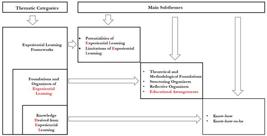
From a descriptive point of view, the thematic category “Experiential Learning Frameworks” emerges from a total of 30 references (44 occurrences), comprising 25 references for the subtheme “Potentialities of Experiential Learning” (36 occurrences) and 5 references for the subtheme “Limitations of Experiential Learning” (8 occurrences). The thematic category “Foundations and Organizers of Experiential Learning” was identified based on a total of 28 unique references (98 occurrences), distributed across the following subthemes: “Theoretical and Methodological Foundations,” with 10 references (54 occurrences); “Structuring Organizers,” with 5 references (16 occurrences); “Reflective Organizers,” with 3 references (10 occurrences); and “Educational Arrangements,” with 6 references (6 occurrences). Finally, the thematic category “Knowledge Derived from Experiential Learning” was identified based on 32 references (38 occurrences). Each element of Figure 1 is explained in detail and characterized through the associated literature in the following subsections.
Experiential Learning Frameworks
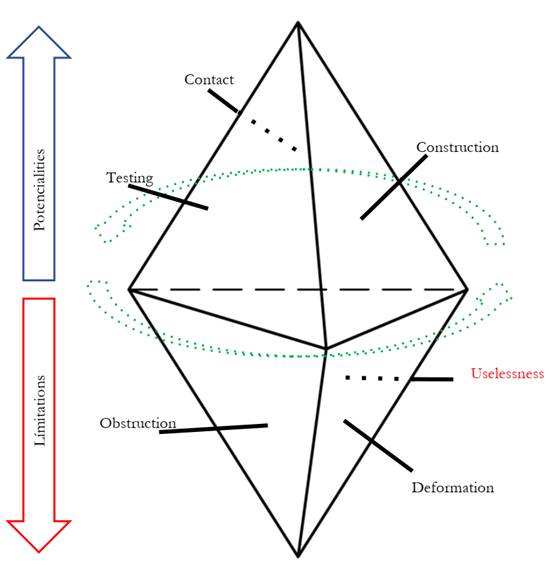
This first emergent thematic category shows the role played by experiential learning within the teaching profession. The notion of a “frame” is employed here in the sense defined by Goffman (1991): every experience, situation, or social activity is lent to various “frames”, understood as orientations, boundaries, and/or regulations. This means identifying, based on the specialized literature, what experiential learning enables, and what it hinders or constrains. Thus, an analysis of studies concerning experiential learning in the teaching profession allows these frames to be characterized through two subthemes: (1) the potentialities of experiential learning, comprising the facets of contact, testing, and construction (shown in blue in Figure 2); and (2) the limitations of experiential learning, comprising the facets of uselessness, obstruction, and distortion (shown in red in Figure 2). Taken together, these subthemes and their respective facets constitute the frames of experiential learning and can be represented as follows:

From a global perspective (see Figure 2) of experiential learning frameworks (the latter represented by a green arrow), their potential and limitations are identified, activating various facets either individually or in combination. We describe below the distinct components identified in the studies:
The Potentialities of Experiential Learning
First, experience holds potential for learning the teaching profession, demonstrating its richness and value (see blue arrow, Figure 2). Based on the literature, three facets or characteristics of experience can be identified:
● It generates contact with professional contexts, that is, it offers an entry point into the reality of teaching work that potentially allows for expanding one's knowledge regarding the characteristics of educational institutions, students, pedagogical teams, etc. This knowledge is grounded in the experience of the school context (Duquesne-Belfais, 2008; Gibson, 2013; Vanhulle et al., 2007; Roger et al., 2014; Tejada Fernández y Ruiz Bueno, 2013) and enables access to and an understanding of the human and “craft-like” nature of the educational process (Muhamad y Sánchez de Varela, 2009);
● It allows for the testing of knowledge and professional competencies, as it serves as a terrain for experimentation, or a “test”, of the learning acquired primarily during initial training (Altet, 2008; Baconnet, 2014; Colén Riau & Castro González, 2017; Vanhulle et al., 2007), as well as of the degree of mastery over professional situations (Daguzon & Goigoux, 2012) and the necessary adaptations required to work within specific contexts (Forget, 2020). Furthermore, experience is a necessary condition for future teachers to successfully internalize and anchor their pedagogical knowledge through trial and error (Tang et al., 2012).
● It enables the construction of professional knowledge and competencies, insofar as it offers the opportunity to rework, translate, and transform this knowledge and these competencies based on the relevance of their mobilization in real-world work situations (Çakmak, 2013; Colén Riau and Castro González, 2017; Duquesne-Belfais, 2008; Forget, 2020; Gibson, 2013; Smitter, 2009; Tejada Fernández and Ruiz Bueno, 2013; Vanhulle et al., 2007). Given its critical function in professional learning, it represents the very foundation of professionalism (Altet, 2008) and a true engine for professional development and learning (Baconnet, 2014; Boutet et al., 2016; Muhamad and Sánchez de Varela, 2009), by facilitating the conceptualization of action and the identification of “rules” generalizable to other similar situations (Beckers, 2009; Daguzon and Goigoux, 2012), or by enabling the updating of transferable action schemas (Deprit and Van Nieuwenhoven, 2018). The situated and social perspective offered by experiential learning (Guevara, 2017; Nkambule and Mukeredzi, 2017) allows for the reworking of professional knowledge based on daily lived experience and through interaction with others (Bobadilla Goldschmidt et al., 2009; Cárdenas Pérez et al., 2012; Frisch, 2014). Reflective work on experience (Rodríguez-Hidalgo et al., 2015) leads the person to engage with the subjective-interpretive process characteristic of the activity of teaching (Roger et al., 2014), wherein verbalization, among other tools, facilitates a reconnection between theory and practice (Sjöberg and Nyberg, 2020).
Limitations of Experiential Learning
In second place, experience is not only the potentialities but also limitations or constraints in terms of professional learning (see the red arrow in Figure 2). The scientific literature examined allows for the identification of three such facets:
●Uselessness as a limit to experiential learning: this is substantiated by several studies, which, while acknowledging the value of experiences provided through practical training, clearly identify that not all experience is useful for learning the profession (Boudreau, 2001; Cortéz & Montecinos, 2016). A greater number of practical hours does not guarantee a better application of theoretical knowledge in professional situations. There appears to be significant difficulty in identifying the necessary conditions for experiential learning (Kulgemeyer et al., 2020);
●Obstruction as a limitation to experiential learning, wherein some studies indicate that experiences within schools possess the potential to generate modes of perception and interpretation that impede learning (Cortéz & Montecinos, 2016). Furthermore, the deep-seated nature of preservice teachers' preconceptions regarding the nature of teaching may constitute a major obstacle to experiential learning, as this process would entail dismantling such preconceptions to make way for new knowledge (Tang et al., 2012);
●Deformation as a limitation to experiential learning: the literature indicates that certain experiences can “unteach” or “deform” the learning of teachers-in-training by halting or distorting their future experience (Colén Riau & Castro González, 2017). In this regard, teachers-in-training may acquire routines that reproduce the practices of their mentor teachers in schools, practices that stand in stark tension with new ways of teaching or working (Schmidt, 2010). In many cases, this may amount to nothing more than the simple repetition by the student teachers, of the “professional gestures” of experienced educators, without necessarily understanding them (Vacher, 2015).
Foundations and Organizers of Experiential Learning
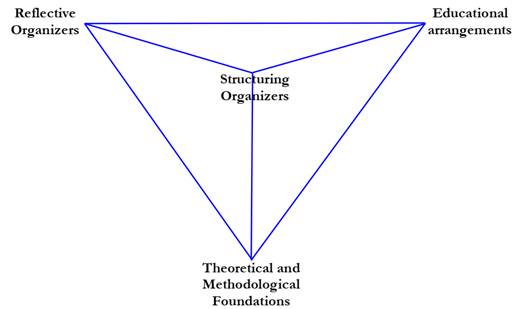
The literature shows a significant challenge when attempting to identify detailed descriptions of how experiential learning processes unfold during future teachers' practicum. However, it is possible to glean and organize the foundational elements and process organizers mentioned in the selected works: theoretical and methodological foundations (the elements upon which the works are based), structural organizers (the proposed dynamics), reflective organizers (the primary objective), and educational arrangements (integration into the training program).

All the elements evoked (see Figure 3) are detailed in the following subsections.
Theoretical and Methodological Foundations
The texts situate experiential learning experiences within a diversity of theoretical and methodological frameworks that facilitate an understanding of the guidelines for the fieldwork of future teachers.
●Theoretical Foundations: Constructivism is cited as one of the key frameworks guiding the work of future teachers in educational institutions (Durand, 2008; Tang et al., 2012), supported by the works of Vygotsky (Cárdenas Pérez et al., 2012; Duquesne-Belfais, 2008; Floro & Lespinat, 2009; Rigelman & Ruben, 2012; Roger et al., 2014; Vanhulle et al., 2007), Kolb (Márquez-García et al., 2020; McCrocklin, 2020; Payá et al., 2018; Rodríguez-Hidalgo et al., 2015), Bruner’s social learning theory (Baconnet, 2014; Garcia, 2012; Tejada Fernández & Ruiz Bueno, 2013), and Schön’s perspective (Baconnet & Bucheton, 2011; Beckers, 2009; Colén Riau & Castro González, 2017; Deprit & Van Nieuwenhoven, 2018; Guevara, 2017). Along similar lines, particular prominence is given to Dewey’s theory of inquiry and experience, with this author standing out as one of the most frequently cited references in the literature on this subject (Almeyda Hidalgo, 2016; Boutet et al., 2016; Durand, 2008; Gremion, 2018; Kuter & Ozer, 2020; Márquez-García et al., 2020; Schmidt, 2010). Although the authors draw upon a plurality of references, some of them are cited with greater frequency than others. Some authors do not cite any reference author or theoretical paradigm in their work to define or anchor experiential learning (n = 18), which explains the limited number of elements detailed in this subsection. Box 1 shows the use of these most frequently cited theoretical frameworks, as well as the authors' justifications for drawing upon them in research on experiential learning.

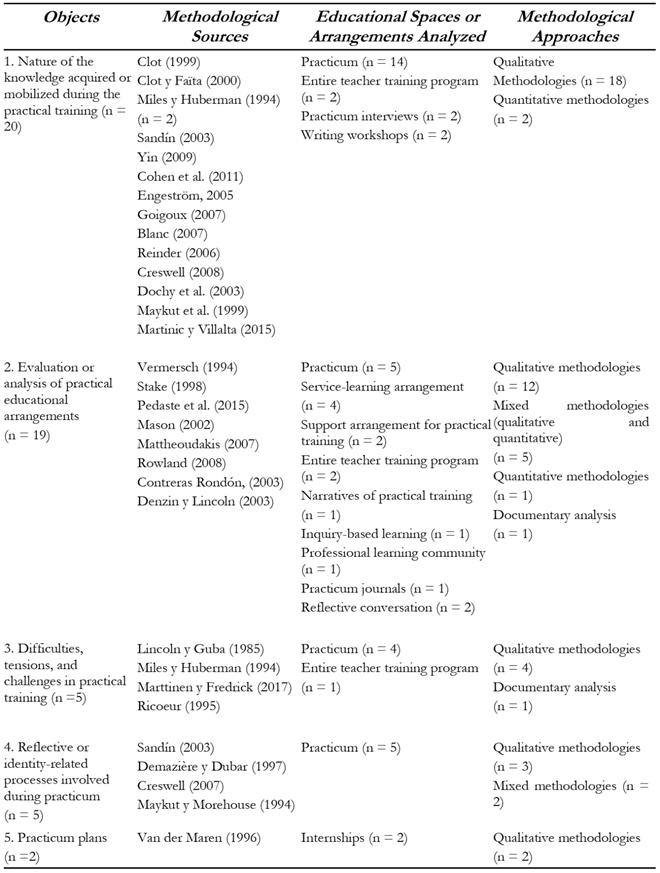
●Methodological Foundations: Of the 58 references, seven are theoretical in nature and do not form part of the elements discussed subsequently that refer to the cited methodological authorities (methodological sources), the educational spaces or arrangements analyzed in the studies, and the methodological approaches selected to shed light on experiential learning. These elements can be grouped according to five main research objects across the 51 empirical studies, as shown in Box 2 .

1. Nature of the knowledge acquired or mobilized during practical training (n = 20): The study of the nature of mobilized knowledge, a subject addressed in twenty research studies, has been conducted using methodologies capable of accessing the cognitive and practical processes that emerge during action. These investigations favor situated approaches that allow for the reconstruction of knowledge at the very moment it is produced, combining observations of activity with in-situ verbalizations, self-confrontations, and critical incident analyses, facilitating the capture of the tacit dimensions of professional knowledge. Concurrently, these studies employ qualitative interviews, reflective journals, and experiential narratives, which aid in interpreting the meanings ascribed to the actions performed and the knowledge brought into play. The recurrence of twenty studies focusing on this topic demonstrates a consolidated methodological trend toward inductive and longitudinal approaches, capable of tracking the transformation of knowledge throughout the formative process.
2. Evaluation or analysis of practical educational arrangements (n = 19). The methodological analysis of practical educational arrangements, addressed in nineteen studies, is characterized by approaches that allow for a simultaneous understanding of the arrangement's structural logic, its actual implementation, and its impact on students and trainers. These investigations combine analyses of institutional documents with interviews, observations, and the reconstruction of training trajectories, thereby making it possible to examine the pedagogical coherence of the arrangements and its alignment with training needs. In numerous cases, mixed-methods designs are adopted that integrate quantitative data, regarding usage, satisfaction, or impact, with qualitative narratives that delve into the subjective experience of the arrangement. The near-numerical equivalence with the first theme demonstrates that methodological studies concerning these educational arrangements also rely on multi-layered strategies capable of articulating structure, practice, and experience.
3. Difficulties, tensions, or challenges in practical training (n = 16); the sixteen studies focusing on the difficulties and tensions of practical training are grounded in qualitative methodologies designed to capture the conflict, uncertainty, and complexity of the training experience. These studies employ in-depth interviews, critical incident analysis, and experiential accounts that allow for the reconstruction of these tensions from the perspective of those experiencing them, paying particular attention to the associated interpretations, contradictions, and emotions. The methodology adopts a hermeneutic approach that interprets how students make sense of their challenges, while also integrating a contextual analysis of the norms, institutional conditions, and relational dynamics that give rise to these conflicts. The significant number of studies on this topic points to a methodological consolidation centered on the notion of tension as a phenomenon accessible through narrative and contextual frameworks.
4. Reflexive or identity-related processes during practicum (n = 5): The five studies dedicated to reflexive and identity-related processes rely on methodologies sensitive to subjectivity and the narrative dimension of experience. These works employ narrative interviews, reflective journals, and annotated portfolios to gain insight into how students construct, reorganize, and project their professional identities. Thematic coding and biographical approaches, inspired by Dubar, enable the analysis of movements involving continuity, rupture, and identity repositioning. Some studies incorporate phenomenological frameworks that focus on the subject's direct lived experience during the practicum, allowing the reflexive experience to be understood in its full emotional and symbolic depth. The relatively low number of studies on this topic shows that, despite being methodologically robust, research on identity requires intensive, long-term tracking education arrangements that not all projects are able to implement.
5. Practicum plans (n = 2): The two studies focusing on practicum plans rely essentially on qualitative document analysis methodologies, as they center on a textual object that reflects anticipated didactic decisions. These studies analyze the internal structure of the plans, examine the coherence among objectives, activities, and assessment, and explore how students articulate pedagogical theory and practical anticipation. The analysis is conducted through segmentation into meaningful units, inductive coding, and cross-document comparison, enabling the identification of patterns in didactic design. The low frequency of studies on this topic suggests that it remains an emerging methodological field, albeit one possessing significant analytical potential for understanding professional anticipation.
In terms of methodological sources, while some references cite various authors to ground their methodological approaches, many do not mention any authors (n = 18). The training contexts analyzed focus primarily on the practicum (n = 30). Also, specific educational arrangements implemented alongside practical experiences were included, such as writing workshops, practicum journals, and professional learning communities (n = 16). Some references have focused on the study of the entire initial teacher training process (n = 5). Most methodological approaches consist of qualitative studies (n = 39); these are followed by a smaller number of mixed-methods (n = 7), quantitative (n = 3), and documentary studies (n = 2).
Beyond what is presented in Box 2, several authors have used case studies (n = 16) involving a small number of participants, and many consider this approach to be limited, emphasizing the importance of extending future research to include a significant number of participants (Baconnet, 2014; Cheng et al., 2012; Chien, 2015; Gibson, 2013). These factors are also observed in qualitative studies, such as descriptive studies or those based on action research, which conclude that there is a need for greater generalizability of results (Deprit & Van Nieuwenhoven, 2018; Kuter & Ozer, 2020).
Structuring Organizers of Experiential Learning
The experience of future teachers regarding experiential learning processes has also been described in terms of two structuring dimensions of the performance instances during professional practicum.
●The temporal dimension: the temporal structure is defined by events that unfold during this professional immersion, events which authors tend to characterize as instances where an action is implemented in the classroom, and other instances where future teachers have the opportunity to reflect upon that action and other elements that may arise from the lived experience. This lends the process an alternating (Baconnet & Bucheton, 2011), cyclical (Beckers, 2009), and continuous (Rodríguez-Hidalgo et al., 2015) nature, tending toward constant iteration (Frisch, 2014). Based on the above, the authors point out that instances of reflection should be present at various stages of the future teachers' immersive process within the classroom: 1) reflective instances occurring after the action, or “reflection-on-action” (Beckers, 2009; Perez-Roux, 2010; Sjöberg & Nyberg, 2020); and 2) reflective instances occurring both during and after the action, that is, “reflection-in-action” and “reflection-on-action” (Deprit & Van Nieuwenhoven, 2018; Tejada Fernández et al., 2017; Villalta Paucar & Martinic Valencia, 2020; Zarzuela Castro & García García, 2020).
●The individual-collective dimension: the social structure of experiential learning is associated with the actors involved during future teachers' professional practicum experiences. Although some authors mention the personal or individual nature of the experience (Candela Soto et al., 2020; Cárdenas Pérez et al., 2012), it is predominantly the collective nature that stands out during the process (Beckers, 2009; Cárdenas Pérez et al., 2012; Garcia, 2012; Hirmas Ready, 2014; Márquez-García et al., 2020; Rigelman and Ruben, 2012; Schmidt, 2010; Sierra Nieto et al., 2017; Sjöberg and Nyberg, 2020; Tang et al., 2012; Tejada Fernández et al., 2017; Vergara and González, 2017). This collective structuring emphasizes the various actors and the interactions they engage in, and two types can be identified: 1) collective spaces of a reflective nature: reflective spaces may occur in the company of others, specifically the future teachers' mentors or trainers (Beckers, 2009; Sierra Nieto et al., 2017; Vergara and González, 2017)—as well as with other members of the educational community and the future teachers' peers (Hirmas Ready, 2014; Sjöberg and Nyberg, 2020). There also appear to be mixed spaces, where collective work simultaneously creates moments for reflection among the participants (Rigelman and Ruben, 2012); 2) collective spaces of a diverse nature: it is highlighted that experiential learning processes during professional practicums constitute spaces where the future teacher is accompanied (Garcia, 2012) and where mentors facilitate the process (Tang et al., 2012). Collective moments serve as sources for the construction of learning (Cárdenas Pérez et al., 2012; Schmidt, 2010), wherein future teachers can share their reflections with the community (Márquez-García et al., 2020), reflections which, at times, may also emerge from spaces where community members share their experiences (Tejada Fernández et al., 2017).
Reflective Organizers of Experiential Learning
Based on the characteristics reviewed in the previous category, it is possible to confirm the presence of reflective organizers as a component upon which many authors agree, based on the systematization of experiential learning processes during the professional practicum of future teachers (Almeyda Hidalgo, 2016; Altet, 2008; Baconnet & Bucheton, 2011; Beckers, 2009; Boutet et al., 2016; Candela Soto et al., 2020; Cárdenas Pérez et al., 2012; Cheng et al., 2012; Colén Riau & Castro González, 2017; Daum et al., 2021; Deprit & Van Nieuwenhoven, 2018; Duquesne-Belfais, 2008; Durand, 2008; Dobrowolska et al., 2016; Fernández et al., 2020; Forget, 2020; Frisch, 2014; Gremion, 2018; Hirmas Ready, 2014; Kuter & Ozer, 2020; Márquez-García et al., 2020; Payá et al., 2018; Perez-Roux, 2010; Rigelman & Ruben, 2012; Rodríguez-Hidalgo et al., 2015; Roger et al., 2014; Schmidt, 2010; Sierra Nieto et al., 2017; Sjöberg & Nyberg, 2020; Tejada Fernández et al., 2017; Vanhulle et al., 2007; Vergara & González, 2017; Zarzuela Castro & García García, 2020). The role of this component has been described as essential within the professional practicum experiences of future teachers, primarily due to its function in fostering the specific learning outcomes characteristic of this field-based stage of teacher training (Almeyda Hidalgo, 2016; Baconnet & Bucheton, 2011; Beckers, 2009; Cheng et al., 2012; Duquesne-Belfais, 2008; Forget, 2020), and in bridging the theory-practice gap that this experience may represent for future educators (Sjöberg & Nyberg, 2020).
Emphasis is placed on the systematic nature that reflective processes should possess during experiential learning to achieve established objectives, as well as the essential role these processes play during this stage of future teachers' professional formation (Hirmas Ready, 2014; Márquez-García et al., 2020).
The focus directed toward these reflective instances addresses various facets of both the practice and the environment in which future teachers are immersed during the practical phases of their training. Thus, these elements can be categorized primarily into two types: external objects, referring to elements within the environment where the professional practice experience takes place, and internal objects, about the teacher themselves and their own experience.
-Socio-professional objects: this category encompasses reflections based on educational and social realities (Candela Soto et al., 2020; Cárdenas Pérez et al., 2012; Márquez-García et al., 2020), socioeconomic factors that influence the teaching-learning process (Nkambule & Mukeredzi, 2017), and the characteristics of the institutional context in which future teachers carry out their practice (Hirmas Ready, 2014). In addition to the environment, the focus of reflection may also center on the practices of peers (Tejada Fernández et al., 2017) and on significant events that may occur during the course of action (Beckers, 2009).
-Subjective-professional objects: One of the most frequently cited elements of reflection in the literature is the experience of future teachers within educational institutions, which is regarded as a significant factor (Candela Soto et al., 2020; Cheng et al., 2012; Fernández et al., 2020; Gremion, 2018; Márquez-García et al., 2020; Payá et al., 2018; Sierra Nieto et al., 2017; Sjöberg & Nyberg, 2020). Within the realm of personal experience, particular prominence is given to reflection on one’s own practices (Colén Riau & Castro González, 2017; Forget, 2020; Hirmas Ready, 2014; Rodríguez-Hidalgo et al., 2015; Sierra Nieto et al., 2017; Vanhulle et al., 2007), as well as the beliefs and preconceptions that future teachers bring to their professional setting (Candela Soto et al., 2020; Colén Riau & Castro González, 2017; Tang et al., 2012). Finally, personal and professional identity is also an element to which future teachers turn during the provided reflective spaces (Cárdenas Pérez et al., 2012; Márquez-García et al., 2020).
These reflections emphasize concrete elements of teaching practice, prioritizing reflection at the contextual and practical levels of professional activity.
The two categories presented constitute the content upon which future teachers focus their reflective endeavors; their elaboration, signification, or resignification serves as the foundational element for the learning acquired during professional practicum—a process that ultimately gives rise to the pedagogical knowledge emerging from formative experiences situated within the professionals' actual field of practice.
Educational Arrangements Leveraging Experiential Learning
Systematized literature shows that teacher-training institutions have responded in diverse ways to the challenge of developing practical competencies in pre-service teachers. In this context, educational arrangements leveraging experiential learning have been developed and integrated. The analysis conducted reveals two central themes in the research literature: classic arrangements for practical training and innovative arrangements or approaches for practical training.
Classic arrangements for practical training represent a first group of studies that explore practical training, and the practicum, within initial teacher education in a traditional manner (characterized by school-based internships or the analysis of situations within school settings), presenting four distinct focal points:
●a specific space for the construction of professional knowledge and competencies, which conveys the idea of practical training as a privileged experience in the development of general professional knowledge (Almeyda Hidalgo, 2016; Chien, 2015; Kulgemeyer et al., 2020; Muhamad & Sánchez de Varela, 2009; Tang, 2003), particularly regarding the social realities of students (Nkambule & Mukeredzi, 2017), the educational settings that must be navigated (Payá et al., 2018), and the rules of the trade (Bruno & Chaliès, 2011);
●a bridging space between theory and practice; in this facet, practical training within initial teacher education (ITE) is understood as a space that narrows the theory-practice gap, bringing the knowledge acquired in university classrooms closer to the reality of teaching work in schools (Kulgemeyer et al., 2020; Muhamad & Sánchez de Varela, 2009; Payá et al., 2018);
●a space for supporting teachers-in-training, which enables teacher educators to identify the needs of future teachers, that is, those who are about to enter the profession (Barrios Espinosa, 2006), and to foster reflection and self-inquiry as professional tools (Sierra Nieto et al., 2017); it represents a protected curricular space for professional induction (Guevara, 2017), “scaffolded” by practicum supervisors through relational, guidance, and intervention functions (Garcia, 2012);
●a space characterized by critical junctures, such as the integration of the subjective and existential dimensions of the experience, which constitutes a process rather than a product (Gremion, 2018); the specific purpose of this space and the pedagogy tailored to working with such experience (Hirmas Ready, 2014); the differentiation between the reflective role of a teacher-in-training and that of a practicing teacher (Hopper et al., 2016); and, finally, the importance of integrating lived events through reflection upon the experience (Roger et al., 2014).
On the other hand, the second axis, called innovative practical arrangements/approaches, reveals that the literature identifies two potential types of innovative initiatives:
●Innovative educational arrangements: These are characterized by introducing new perspectives on professional practice within the context of ITE. Notable among these is the Service-Learning model, which fosters cultural awareness, instruction for diverse student populations, and teaching competencies (Daum et al., 2021; Márquez-García et al., 2020); also included is the “critical service-learning” variant (Zarzuela Castro & García García, 2020), which integrates retrospective and introspective processes articulated within a context situated in a specific local community.
●Innovative pedagogical approaches: These represent practices that generate specific activities or strategies designed to prepare candidates for the realities of teaching within ITE. Such approaches may use Key Learning Experiences, which offer opportunities to think and act professionally (Giralt Romeu et al., 2020); approaches such as Inquiry-Based Learning, which promotes active learning and collaboration through an inductive entry point centered on the student and on real-world problems (Kuter & Ozer, 2020); or, finally, practice-based professional development (Rigelman & Ruben, 2012), understood as a space where teachers and teacher candidates observe student work, collaboratively plan lessons, observe one another in their classrooms, and engage in analysis and reflection regarding teaching practice.
Knowledge Derived from Experiential Learning
“Experiential knowledge” (Fernández et al., 2020; Guevara, 2017; McCrocklin, 2020; Payá et al., 2018; Sierra Nieto et al., 2017), “knowledge derived from experience” (Cheng et al., 2012; Floro & Lespinat, 2009; Forget, 2020; Garcia, 2012; Hirmas Ready, 2014; Perez-Roux, 2010; Vergara & González, 2017), and “working knowledge” (Altet, 2008; Deprit & Van Nieuwenhoven, 2018; Gibson, 2013; Roger et al., 2014; Tejada Fernández & Ruiz Bueno, 2013) are some of the expressions used to describe the forms of knowledge stemming from experiential learning. Based on the scientific literature, it is possible to identify two emergent categories that group them: the “know-how” and the “know-how-to-be” of the teaching profession.
●Know-how: practical experience gives rise to forms of knowledge that are procedural in nature and concern the “how-to”. These forms of knowledge are inextricably linked to the contextual factors (human and material) of the current school environment. We can divide them into two subthemes: 1) procedural knowledge derived from the very execution of the professional gestures of teaching, that is, knowledge that may have been the subject of theoretical inquiry, but only in a fragmentary manner, and which requires being put into action to be fully formalized. The literature identifies, primarily, pedagogical knowledge related to classroom management and pragmatic knowledge tied to the institutional context. We find, for example, knowledge related to how to navigate a classroom or perform administrative duties (Almeyda Hidalgo, 2016); how to address a class (Cárdenas Pérez et al., 2012); how to integrate the actual temporal flow of a lesson (Daguzon & Goigoux, 2012); or how to assume the various roles of a teacher within a school setting (Boudreau, 2001); 2) procedural knowledge derived from a reinterpretation of theoretical knowledge acquired during initial teacher training, which is then put into action—specifically, knowledge so inextricably linked to a particular context that it requires translation and adaptation, or that simply becomes the subject of further deepening within the context of actual practice. Scholarly literature on this subject refers, above all, to didactic and pedagogical knowledge, as well as to knowledge regarding the characteristics of the students. Within the studies, this concept was illustrated in the following ways: generally speaking, knowing how to check for student comprehension, or how to plan and utilize teaching strategies (Boudreau, 2001); or, more specifically, knowing how to establish a pedagogical relationship tailored to specific students (Bobadilla Goldschmidt et al., 2009; Fernández et al., 2020), knowing how to modify one’s practice based on the material conditions of a classroom (Cárdenas Pérez et al., 2012), or knowing how to vary teaching activities to accommodate the diverse skill sets of the students in a class (Daum et al., 2021).
Knowing-how-to-be: practical experience is understood as a process of human transformation (Fernández et al., 2020), and it derives from forms of knowledge linked to oneself and to how one relates to others: 1) knowing how to be can be expressed, first and foremost, through a relationship with oneself as a person, and is linked to one’s individual personality. In particular, practical experiences help foster a teacher’s sense of self-efficacy (Baconnet, 2014; Baconnet & Bucheton, 2011), especially when practitioners achieve success in their practical endeavors (Daum et al., 2021). This may manifest as feeling more self-assured, more autonomous, or more capable of adapting to future situations (Rodríguez-Hidalgo et al., 2015). Also, professional identity develops through engagement with practical experience, and future teachers learn from this process of reconfiguration (Hopper et al., 2016; Perez-Roux, 2010; Vanhulle et al., 2007). These identity-based transformations can serve to deepen a teacher’s personal style (Bobadilla Goldschmidt et al., 2009; Cárdenas Pérez et al., 2012); 2) the knowing how to be that emerges from experiential learning can be grounded in one’s relationships with others. In this context, the teacher-in-training learns how to position and validate themselves within their professional role vis-à-vis their students (Cortéz & Montecinos, 2016; Roger et al., 2014)—including the various roles they are required to assume, such as serving as a role model, an intellectual, or a “class-maker” (Cárdenas Pérez et al., 2012). Thus, practical experience gives rise to forms of knowledge regarding “otherness”, knowledge that is inherent to the so-called “human professions” (Perez-Roux, 2010). Indeed, the experiential allows for the emergence of knowledge related to the optimization of interpersonal relationships within the context of teaching work (Rodríguez-Hidalgo et al., 2015).
DISCUSSION AND CONCLUSION
A systematic review of specialized literature regarding the role of experience in learning the teaching profession reveals various findings. The first of these is that experience not only facilitates professional learning but can potentially hinder or distort it. In this regard, there is broad consensus on the need to transition from a “raw” or “wild” form of experience to an “elaborated” or “worked” form. Consequently, learning by “doing” or through “experience” is not only an absence of scaffolding, guidance, progression, or the explicit articulation of educational objectives; nor does it obviate the need to create specific tools designed to foster the development of professional competencies. Indeed, the concept of the “work of experience” (Barbier & Thievenaz, 2013) underscores the necessity of reflecting upon practical experience within the context of professional training, or, put another way, it highlights the inherent insufficiency of experience in isolation and the need for a guided process of reinterpretation facilitated by that training.
Second, a systemic approach is proposed for understanding the relationship between the theoretical and methodological foundations regarding the experience mobilized by these studies; the structural organizers of that experience (temporal and individual-collective); the reflective organizers (internal and external objects); and the educational arrangements (classic and innovative). However, this logic, linking to the experience, that which structures it, and the mechanisms that foster its development, also serves to highlight certain shortcomings. The first of these is that the concept of reflection on or in practice is not explicitly articulated, but rather merely implicitly asserted. This creates a primary level of opacity, as reflection is sometimes treated as a mechanism, sometimes as an objective, and, in the majority of cases, is translated directly into training activities without the necessary explicit explanation of how reflective capacities are actually developed. Secondly, the educational arrangements tasked with “working through” practical experience fail to explicitly define either the specific competencies they aim to cultivate or the methods by which those competencies are to be developed, thereby introducing a second level of opacity.
Third, the forms of knowledge derived from experiential learning, or experiential knowledge, appear in the literature to fall into two categories: know-how and know-how-to-be. These two broad categories reveal complex, “hybridized” forms of knowledge, that is, they encompass distinct types of knowledge that coexist. The contribution of experience to learning the teaching profession lies in the growth of these forms of knowledge, their mobilization in concrete situations, and, above all, in opening up spaces for their “integrated” deployment. Perhaps the greatest contribution of experience during the process of learning the teaching profession is that it fosters a professional learning experience that is “integrative” rather than “dissociated”: to teach a mathematical operation in a specific course, one requires a strategy, a specific competence to be developed, a concrete activity, a particular level of complexity, a connection to previously acquired knowledge, a strategy for motivating the specific group, the adaptation of modes of action, and the mobilization of appropriate resources within a climate conducive to learning, among other elements that must operate simultaneously. Achieving this complex equilibrium within a complex work context requires the development of complex forms of knowledge.
Furthermore, the literature reveals several potential themes that have received scant attention in recent educational research. For example, the study of how access to experience is gained, as well as the professional contexts in which it unfolds, or the specific activities and tasks that contribute to imbuing it with meaning, emerges as a significant gap in the current body of knowledge. Moreover, when certain pedagogical settings are employed, it becomes evident that teachers-in-training struggle to articulate the knowledge derived from their experiences. Identifying specific experiential moments that held particular significance appears to be a difficult task. In addition, the verbalization of lived professional situations is generally limited to anecdotal accounts (Vanhulle et al., 2007). This observation strongly suggests the need for a deeper understanding of the factors that inhibit the analytical capabilities of future educators. On the other hand, the primacy placed on what is most immediate and essential for a pre-service teacher, namely, the act of teaching itself, often results in the neglect of themes that could bridge the gap between experience and critical reflection. Such reflection would extend beyond mere pedagogical practice to encompass the broader purpose of one’s work within an educational institution, as well as the resilience required to navigate a complex profession, factors that could potentially offer pathways toward mitigating the phenomenon documented as “reality shock” (Veenman, 1984) or professional attrition (Sauvé, 2012). Closely related to this issue, “meaning-based knowledge” (Shulman, 1987) is rarely evoked in this context. This raises a fundamental question regarding the root cause of this omission: Is it attributable to the immediate urgency of teaching, to a general reluctance to address such forms of knowledge during initial teacher training, or to the very nature of the experiential encounters that teachers-in-training undergo within school settings?
Finally, teacher training, particularly regarding instances of practical training, has been a recurring subject of study. Despite various restructurings and modifications, one indirectly observes training components that remain rather traditional (such as final practicums) and are largely implicit regarding the professional competencies to be developed, and, in particular, with respect to the specific modalities for actively engaging with and processing that experience. Undoubtedly, further work is still required regarding how the practicum is supported, how student teachers are encouraged to verbalize their experiences, and how the actual work they perform is analyzed, specifically with the precision necessary to foster the re-signification of experience that professional learning demands. In this sense, the design of support tools remains a relatively unexplored terrain, often resulting in approaches to working with experience that lack significant depth or meaning.
References
-
Almeyda Hidalgo, L. (2016). Arrojados en la acción. Aprender a enseñar en la experiencia de práctica profesional. Estudios Pedagógicos, 42(4), 11-30. https://doi.org/10.4067/s0718-07052016000500002
» https://doi.org/10.4067/s0718-07052016000500002 -
Altet, M. (2008). Rapport à la formation, à la pratique, aux savoirs et reconfiguration des savoirs professionnels par les stagiaires. En P. Perrenoud (Ed.), Conflits de savoirs en formation des enseignants (pp. 91-105). De Boeck Supérieur. https://doi.org/10.3917/dbu.perre.2008.01.0091k
» https://doi.org/10.3917/dbu.perre.2008.01.0091k -
Baconnet, S. y Bucheton, D. (2011). De quelle nature sont les savoirs professionnels développés par une enseignante stagiaire dans le cadre de son stage au cours d’un dispositif innovant? Revue des sciences de l’éducation, 37(2), 257-279. https://doi.org/10.7202/1008986ar
» https://doi.org/10.7202/1008986ar -
Baconnet, S. (2014). Sous quelles conditions construire, capitaliser et mobiliser des savoirs professionnels efficients en situation d’enseignement? L’étude de cas d’un stagiaire. Phronesis, 3(3), 5-12. https://doi.org/10.7202/1026390ar
» https://doi.org/10.7202/1026390ar -
Balleux, A. (2000). Évolution de la notion d’apprentissage expérientiel en éducation des adultes: vingt-cinq ans de recherche. Revue des sciences de l’éducation, 26(2), 263-286. https://doi.org/10.7202/000123ar
» https://doi.org/10.7202/000123ar - Barbier, J.-M. y Thievenaz, J. (2013). Le travail de l’expérience L’Harmattan.
- Barrios Espinosa, M. E. (2006). Dificultades y carencias que experimentan y evidencian futuros maestros de inglés durante su intervención docente autónoma en las prácticas de enseñanza. Revista Electrónica Interuniversitaria de Formación del Profesorado, 9(1), 1-12. https://www.redalyc.org/articulo.oa?id=217017165008
-
Beckers, J. (2009). Compagnonnage réflexif et intervention éducative. Nouveaux cahiers de la recherche en éducation, 12(1), 95-115. https://doi.org/10.7202/1017490ar
» https://doi.org/10.7202/1017490ar - Blanc, J. (2007). Construction et mobilisation de savoirs professionnels. Le cas des pratiques enseignantes d’évaluation à l’école primaire tesis doctoral no publicada. Université de Toulouse.
-
Bobadilla Goldschmidt, M., Cárdenas Pérez, A. V., Dobbs Díaz, E. y Soto Bustamante, A. M. (2009). ‘‘Los rodeos de la práctica”: representaciones sobre el saber docente en el discurso de estudiantes de pedagogía. Estudios Pedagógicos, 35(1), 239-252. https://dx.doi.org/10.4067/S0718-07052009000100014
» https://doi.org/10.4067/S0718-07052009000100014 -
Boudreau, P. (2001). Que se passe-t-il dans un stage réussi? Revue des sciences de l’éducation, 27(1), 65-84. https://doi.org/10.7202/000306ar
» https://doi.org/10.7202/000306ar -
Boutet, M., Arsenault, M., Ferland, L., Francoeur, L. y Gagné, L. (2016). Le pari de l’accompagnement pour la formation de praticiens réflexifs de l’enseignement: Possibilités et limites d’un système de stages. Approches inductives, 3(1), 189-218. https://doi.org/10.7202/1035199ar
» https://doi.org/10.7202/1035199ar -
Bruno, F. y Chaliès, S. (2011). Optimiser les dispositifs de formation des enseignants novices par alternance: Étude de cas. Revue des sciences de l’éducation, 37(3), 465-487. https://doi.org/10.7202/1014754ar
» https://doi.org/10.7202/1014754ar -
Candela Soto, P., Sánchez Pérez, M. C. y Ávila Francés, M. (2020). Aprendizaje-servicio en la enseñanza de la sociología a futuros docentes. Alteridad. Revista de Educación, 16(1), 38-50. https://doi.org/10.17163/alt.v16n1.2021.03
» https://doi.org/10.17163/alt.v16n1.2021.03 -
Çakmak, M. (2013). Learning from Teaching Experiences: Novice Teachers’ Thoughts. H. U. Journal of Education, 55-67. http://www.efdergi.hacettepe.edu.tr/yonetim/icerik/makaleler/279-published.pdf
» http://www.efdergi.hacettepe.edu.tr/yonetim/icerik/makaleler/279-published.pdf -
Cárdenas Pérez, A. V., Soto-Bustamante, A. M., Dobbs-Díaz, E. y Bobadilla-Goldschmidt, M. (2012). El saber pedagógico: Componentes para una reconceptualización. Educación y Educadores, 15(3), 479-496. http://www.scielo.org.co/scielo.php?script=sci_arttext&pid=S012312942012000300008&lng=en&nrm=iso
» http://www.scielo.org.co/scielo.php?script=sci_arttext&pid=S012312942012000300008&lng=en&nrm=iso -
Cheng, M. M. H., Tang, S. Y. F. y Cheng, A. Y. N. (2012). Practicalising theoretical knowledge in student teachers’ professional learning in initial teacher education. Teaching and Teacher Education, 28(6), 781-790. https://doi.org/10.1016/j.tate.2012.02.008
» https://doi.org/10.1016/j.tate.2012.02.008 -
Chien, C.-W. (2015). Pre-service English teachers’ perceptions and practice of field experience and professional learning from expert teachers’ mentoring. Teachers and Teaching, 21(3), 328-345. https://doi.org/10.1080/13540602.2014.953817
» https://doi.org/10.1080/13540602.2014.953817 - Clot, Y. (1999). La fonction psychologique du travail Presses universitaires de France.
- Clot, Y. y Faïta, D. (2000). Genres et styles en analyse du travail. Concepts et méthodes. Revue Travailler, 4, 7-42.
- Cohen, L., Manion, L. y Morrison, K. (2011). Research methods in education Routledge.
-
Colén Riau, M. T. y Castro González, L. (2017). El desarrollo de la relación teoría y práctica en el grado de maestro en educación primaria. Profesorado. Revista de Currículum y Formación de Profesorado, 21(1), 59-79. https://www.redalyc.org/pdf/567/56750681004.pdf
» https://www.redalyc.org/pdf/567/56750681004.pdf - Contreras Rondón, W. A. (2003). Estudio descriptivo del proceso administrativo para la Acreditación del Aprendizaje por Experiencia en el Instituto Pedagógico de Miranda José Manuel Siso Martínez durante el bienio 2001-2002 trabajo de ascenso no publicado. Universidad Pedagógica Experimental Libertador.
-
Córtez, M. y Montecinos, C. (2016). Transitando desde la observación a la acción pedagógica en la práctica inicial: Aprender a enseñar con foco en el aprendizaje del alumnado. Estudios Pedagógicos, 32(4), 49-68. https://dx.doi.org/10.4067/S0718-07052016000500004
» https://doi.org/10.4067/S0718-07052016000500004 - Creswell, J. W. (2007). Qualitative inquiry and research design: Choosing among five approaches Sage Publications.
- Creswell J. W. (2008). Educational research: Planning, conducting, and evaluating quantitative and qualitative research Pearson.
-
Daguzon, M. y Goigoux, R. (2012). Apprendre à faire classe. Les apprentissages professionnels des professeurs des écoles en formation par alternance. Revue française de pédagogie, 181(4), 27-41. https://doi.org/10.4000/rfp.3898
» https://doi.org/10.4000/rfp.3898 -
Daum, D. N., Marttinen, R. y Banville, D. (2021). Service-learning experiences for pre-service teachers: Cultural competency and behavior management challenges when working with a diverse low-income community. Physical Education and Sport Pedagogy, 27(4), 396-408. https://doi.org/10.1080/17408989.2021.1891210
» https://doi.org/10.1080/17408989.2021.1891210 - Demazière, D. y Dubar, C. (1997). Analyser les entretiens biographiques Nathan.
- Denzin, N. y Lincoln, Y. (2003). Collecting and interpreting qualitative materials Sage Publications.
-
Deprit, A. y Van Nieuwenhoven, C. (2018). Comment les étudiants se préparent-ils aux stages? Ressources exploitées et choix stratégiques. Canadian Journal of Education, 41(3), 727-752. https://journals.sfu.ca/cje/index.php/cje-rce/article/view/3284
» https://journals.sfu.ca/cje/index.php/cje-rce/article/view/3284 - Dewey, J. (1938). Experience and Education Touchstone Books.
-
Dobrowolska, D., Balslev, K., Tominska, E., Mosquera, S. y Vanhulle, S. (2016). Discours académiques et discours professionnels: Positionnement et savoirs des enseignants en formation. Phronesis, 5(3-4), 28-41. https://doi.org/10.7202/1039084ar
» https://doi.org/10.7202/1039084ar -
Dochy, F., Segers, M., Van Den Bossche, P., y Gijbels, D. (2003). Effects of problem‐based learning: A meta‐analysis. Learning and Instruction, 13 (5), 533-568. https://doi.org/10.1016/S0959-4752(02)00025-7
» https://doi.org/10.1016/S0959-4752(02)00025-7 -
Dumoulin, M.-J. (2014). La restructuration de l’expérience au cours de la première année d’enseignement : un accès au processus identitaire du débutant. Phronesis, 3(3), 39-51. https://doi.org/10.7202/1026393ar
» https://doi.org/10.7202/1026393ar -
Duquesne-Belfais, F. (2008). Répondre aux exigences de la formation des enseignants de l’ASH. L’analyse de pratiques comme lien entre théorie et pratique. La nouvelle revue de l’adaptation et de la scolarisation, 41(1), 11-24. https://doi.org/10.3917/nras.041.0011
» https://doi.org/10.3917/nras.041.0011 - Durand, M. (2008). Diversité des situations et unité des savoirs en formation des enseignants. En P. Perrenoud (Ed.), Conflits de savoirs en formation des enseignants (pp. 33-42). De Boeck Supérieur.
- Engeström, Y. (2005). Developmental work research: expanding activity theory in practice Lehmanns Media.
-
Fernández, J. H., Sanzan, G. C., Molina, C. A., Briceño, M. O. y Juan, J. E. S. (2020). Experiencias y saberes pedagógicos de docentes en el comienzo del oficio educativo: Una indagación narrativa. Revista Brasileira de Educação, 25 https://doi.org/10.1590/S1413-24782020250053
» https://doi.org/10.1590/S1413-24782020250053 -
Floro, M. y Lespinat, C. (2009). Savoir poser une problématique, un levier du développement professionnel. Savoirs, 19(1), 75-92. https://doi.org/10.3917/savo.019.0075
» https://doi.org/10.3917/savo.019.0075 -
Forget, M.-H. (2020). Sur quels savoirs des stagiaires en enseignement du français au secondaire appuient-ils leurs choix didactiques? Formation et profession, 28(2), 35-50. https://doi.org/10.18162/fp.2020.542
» https://doi.org/10.18162/fp.2020.542 -
Frisch, M. (2014). Les méthodes de regards croisés en formation: L’exemple d’un dispositif intégrant de l’information-documentation et construction collective de savoirs en recherche-action-formation. Recherches en didactiques, 18(2), 57-76. https://doi.org/10.3917/rdid.018.0057
» https://doi.org/10.3917/rdid.018.0057 -
Garcia, A. (2012). L’apprentissage professionnel des enseignants stagiaires de l’enseignement agricole français durant le stage de pratique accompagnée. Phronesis, 1(4), 37-56. https://doi.org/10.7202/1013236ar
» https://doi.org/10.7202/1013236ar -
Gibson, K. (2013). Student teachers of technology and design into industry: a Northern Ireland case study. International Journal of Technology and Design Education, 23(2), 289-311. https://doi.org/10.1007/s10798-011-9179-z
» https://doi.org/10.1007/s10798-011-9179-z -
Giralt Romeu, M., Liesa Hernandez, E., Mayoral Serrat, P. y Becerril Balin, L. (2020). Student teachers’ positioning with regard to their key learning experiences in the first practicum. Quadernos De Psicologia, 22(2). https://doi.org/10.5565/rev/qpsicologia.1570
» https://doi.org/10.5565/rev/qpsicologia.1570 - Goffman, E. (1991). Les cadres de l’expérience Les Éditions de Minuit.
-
Goigoux, R. (2007). Un modèle d’analyse de l’activité des enseignants. Éducation et didactique, 3(1), 47-69. https://doi.org/10.4000/educationdidactique.232
» https://doi.org/10.4000/educationdidactique.232 -
Gremion, C. (2018). Former des enseignants pour favoriser la professionnalisation: Mais selon quelle temporalité? Phronesis, 7(2), 65-74. https://doi.org/10.7202/1051692ar
» https://doi.org/10.7202/1051692ar -
Guevara, J. (2017). La formación en los espacios de práctica docente: Modos de transmisión del oficio. Estudios pedagógicos, 43(2), 127-145. https://dx.doi.org/10.4067/S0718-07052017000200007
» https://doi.org/10.4067/S0718-07052017000200007 -
Hirmas Ready, C. (2014). Tensiones y desafíos para pensar el cambio en la formación práctica de futuros profesores. Estudios pedagógicos, 40, 127-143. https://dx.doi.org/10.4067/S0718-07052014000200008
» https://doi.org/10.4067/S0718-07052014000200008 -
Hopper, T., Sanford, K. y Fu, H. (2016). Finding the Connective Tissue in Teacher Education: Creating New Spaces for Professional Learning to Teach. McGill Journal of Education, 51(3), 1013-1035. https://doi.org/10.7202/1039626ar
» https://doi.org/10.7202/1039626ar - Kolb, D.A. (1984). Experiential learning: Experience as the source of learning and development Prentice-Hall.
-
Kulgemeyer, C., Borowski, A., Buschhüter, D., Enkrott, P., Kempin, M., Reinhold, P., Riese, J., Schecker, H., Schröder, J. y Vogelsang, C. (2020). Professional knowledge affects action-related skills: The development of preservice physics teachers’ explaining skills during a field experience. Journal of Research in Science Teaching, 57(10), 1554-1582. https://doi.org/10.1002/tea.21632
» https://doi.org/10.1002/tea.21632 -
Kuter, S. y Ozer, B. (2020). Student Teachers’ Experiences of Constructivism in a Theoretical Course Built on Inquiry-based Learning. Journal of Qualitative Research in Education, 8(1), 135-155. https://doi.org/10.14689/issn.2148-2624.1.8c.1s.7m
» https://doi.org/10.14689/issn.2148-2624.1.8c.1s.7m - Lincoln, Y. S. y Guba E. G. (1985). Naturalistic inquiry Sage Publications.
-
Márquez-García, M. J., Kirsch, W. y Leite-Mendez, A. (2020). Learning and collaboration in pre-service teacher education: Narrative analysis in a service learning experience at Andalusian public schools. Teaching and Teacher Education, 96 https://doi.org/10.1016/j.tate.2020.103187
» https://doi.org/10.1016/j.tate.2020.103187 -
Marttinen, R. y Fredrick, R. (2017). “R.E.A.C.H: A Case for Afterschool Physical Education.” Strategies, 30(1): 8-14. https://doi.org/10.1080/08924562.2016.1251862
» https://doi.org/10.1080/08924562.2016.1251862 -
Martinic, S. y Villalta, M. (2015). La gestión del tiempo en la sala de clases y los rendimientos escolares en escuelas con Jornada Escolar Completa en Chile. Perfiles Educativos, 37(147), 28-49. https://doi.org/10.22201/iisue.24486167e.2015.147.47260
» https://doi.org/10.22201/iisue.24486167e.2015.147.47260 - Mason, J. (2002). Qualitative researching Sage Publications.
-
Mattheoudakis, M. (2007). Tracking changes in pre-service EFL teacher beliefs in Greece: A longitudinal study. Teaching and Teacher Education, 23, 1272-1288. https://doi.org/10.1016/j.tate.2006.06.001
» https://doi.org/10.1016/j.tate.2006.06.001 - Maykut, P. y Morehouse, R. (1994). Beginning qualitative research: A philosophic and practical guide Falmer Press.
- Maykut, P. S., Morehouse, R. E., Álvarez, R. P. y Roure, C. R. (1999). Investigación cualitativa: una guía práctica y filosófica Hurtado ediciones.
-
McCrocklin, S. (2020). Comparing experiential approaches: Structured language learning experiences versus conversation partners for changing pre-service teacher beliefs. International Journal of Society, Culture and Language, 8(1), 70-81. http://www.ijscl.net/article_38333_92686fca9f0b638cc977ba7cb68787f8.pdf
» http://www.ijscl.net/article_38333_92686fca9f0b638cc977ba7cb68787f8.pdf - Miles, M. B. y Huberman, A. M. (1994). Qualitative data analysis Sage Publications.
-
Moher, D., Liberati, A., Tetzlaff, J., Altman, D. G. y PRISMA Group*. (2009). Preferred reporting items for systematic reviews and meta-analyses: the PRISMA statement. Annals of internal medicine, 151(4), 264-269. https://doi.org/10.7326/0003-4819-151-4-200908180-00135
» https://doi.org/10.7326/0003-4819-151-4-200908180-00135 -
Muhamad, E. y Sánchez de Varela, F. (2009). La formación docente: Un proceso paradojal entre la teoría y la práctica. Laurus, 15(30), 166-186. https://www.redalyc.org/pdf/761/76120651008.pdf
» https://www.redalyc.org/pdf/761/76120651008.pdf -
Nkambule, T. y Mukeredzi, T. G. (2017). Pre-service teachers’ professional learning experiences during rural teaching practice in Acornhoek, Mpumalanga Province. South African Journal of Education, 37(3), 1-9. https://doi.org/10.15700/saje.v37n3a1371
» https://doi.org/10.15700/saje.v37n3a1371 -
Núñez-Moscoso, J. (2017). Los métodos mixtos en la investigación en educación: hacia un uso reflexivo. Cadernos de pesquisa, 47(164), 632-649. https://doi.org/10.1590/198053143763
» https://doi.org/10.1590/198053143763 - Paillé, P. y Mucchielli, A. (2012). L’analyse qualitative en sciences humaines et sociale Aramand Colin.
-
Payá, M., Gros, B., Pirque, B. y Rubio, L. (2018). Co-creación y validación de instrumentos para la integración del conocimiento experiencial en la formación de maestros. Profesorado, 22(1), 441-460. https://revistaseug.ugr.es/index.php/profesorado/article/view/9936/8059
» https://revistaseug.ugr.es/index.php/profesorado/article/view/9936/8059 -
Pedaste, M., Mäeots, M., Siiman, L. A., de Jong, T., van Riesen, S. A. N., Kamp, T. T., Manoli, C. C., Zacharia, Z. C. y Tsourlidaki, E. (2015). Phases of inquiry-based learning: Definitions and the inquiry cycle. Educational Research Review, 14, 47-61. https://doi.org/10.1016/j.edurev.2015.02.003
» https://doi.org/10.1016/j.edurev.2015.02.003 -
Perez-Roux, T. (2010). Processus de professionnalisation et dynamiques identitaires : deux études de cas chez les enseignants de lycée professionnel en France. Nouveaux cahiers de la recherche en éducation, 13(1), 83-101. https://doi.org/10.7202/1017462ar
» https://doi.org/10.7202/1017462ar - Petticrew, M. y Roberts, H. (2006). Systematic Reviews in the Social Sciences. A Practical guide Blackwell Publishing.
-
Reinders, H. (2006). Kausalanalysen in der Längsschnittforschung. Das Crossed-Lagged-Panel Design. Diskurs Kindheits-und Jugendforschung, 1(4), 569-587. https://doi.org/10.25656/01:1001
» https://doi.org/10.25656/01:1001 - Ricoeur, P. (1995). Tiempo y narración Siglo XXI.
-
Rigelman, N. M. y Ruben, B. (2012). Creating foundations for collaboration in schools: Utilizing professional learning communities to support teacher candidate learning and visions of teaching. Teaching and Teacher Education, 28(7), 979-989. https://doi.org/10.1016/j.tate.2012.05.004
» https://doi.org/10.1016/j.tate.2012.05.004 -
Rodríguez-Hidalgo, A. J., Calmaestra Villén, J. y Maestre Espejo, M. (2015). Desarrollo de competencias en el prácticum de maestros: Abp y coaching multidimensional. Profesorado. Revista de Currículum y Formación de Profesorado, 19(1), 414-434. https://www.redalyc.org/articulo.oa?id=56738729025
» https://www.redalyc.org/articulo.oa?id=56738729025 -
Roger, P., Jorro, A. y Maubant, A. (2014). De l’expérience formatrice à l’expérience apprenante : genèse et perspectives pour une mise en récit d’un processus de professionnalisation. Phronesis, 3(1-2), 28-37. https://doi.org/10.7202/1024586ar
» https://doi.org/10.7202/1024586ar -
Rowland, G. (2008). Design and Research: Partners for Educational Innovation. Educational Technology, 48(6), 3-9. https://www.jstor.org/stable/44429618
» https://www.jstor.org/stable/44429618 - Sandín, M. (2003). Investigación cualitativa en educación. Fundamentos y tradiciones Mc Graw Hill.
-
Sauvé, F. (2012). Analyse de l’attrition des enseignants au Québec tesis doctoral, Université de Montréal. https://papyrus.bib.umontreal.ca/xmlui/handle/1866/8532
» https://papyrus.bib.umontreal.ca/xmlui/handle/1866/8532 - Schön, D. A. (1983). The reflective practitioner. How professionals think in action Basic Book.
-
Schmidt, M. (2010). Learning From Teaching Experience: Dewey’s Theory and Preservice Teachers’ Learning. Journal of Research in Music Education, 58(2), 131-146. https://doi.org/10.1177/0022429410368723
» https://doi.org/10.1177/0022429410368723 -
Shulman, L. (1987). Knowledge and teaching: Foundations of the new reform. Harvard educational review, 57(1), 1-23. https://doi.org/10.17763/haer.57.1.j463w79r56455411
» https://doi.org/10.17763/haer.57.1.j463w79r56455411 -
Sierra Nieto, J. E., Caparrós Martín, E., Molina Galvañ, D. y Blanco García, N. (2017). Aprender a través de la escritura. Los diarios de prácticas y el desarrollo de saberes experienciales. Revista Complutense de Educación, 28(3), 673-688. https://doi.org/10.5209/rev_RCED.2017.v28.n3.49708
» https://doi.org/10.5209/rev_RCED.2017.v28.n3.49708 -
Sjöberg, M. y Nyberg, E. (2020). Professional Knowledge for Teaching in Student Teachers’ Conversations about Field Experiences. Journal of Science Teacher Education, 31(2), 226-244. https://doi.org/10.1080/1046560X.2019.1688533
» https://doi.org/10.1080/1046560X.2019.1688533 -
Smitter, Y. (2009). La acreditación del aprendizaje por experiencia en la formación docente: caso Instituto Pedagógico de Miranda. Educere, 13(44), 169-176. http://ve.scielo.org/scielo.php?script=sci_arttext&pid=S1316-49102009000100020
» http://ve.scielo.org/scielo.php?script=sci_arttext&pid=S1316-49102009000100020 - Stake, R. E. (1998). Investigación con estudio de casos Morata.
-
Tang, S. Y. F. (2003). Challenge and support: the dynamics of student teachers’ professional learning in the field experience. Teaching and Teacher Education, 19(5), 483-498. https://doi.org/10.1016/S0742-051X(03)00047-7
» https://doi.org/10.1016/S0742-051X(03)00047-7 -
Tang, Sylvia Y. F., Wong, A. K. Y. y Cheng, M. M. H. (2012). Professional learning in initial teacher education: vision in the constructivist conception of teaching and learning. Journal of Education for Teaching, 38(4), 435-451. https://doi.org/10.1080/02607476.2012.688549
» https://doi.org/10.1080/02607476.2012.688549 -
Tejada Fernández, J. y Ruiz Bueno, C. (2013). Significación del prácticum en la adquisición de competencias profesionales que permiten la transferencia de conocimiento a ámbitos propios de la acción docente. Profesorado. Revista de Currículum y Formación de Profesorado, 17(3), 91-110. https://recyt.fecyt.es/index.php/profesorado/article/view/41974
» https://recyt.fecyt.es/index.php/profesorado/article/view/41974 -
Tejada Fernández, J., Carvalho Dias, M. L. y Ruiz Bueno, C. (2017). El prácticum en la formación de maestros: Percepciones de los protagonistas. Magis, Revista Internacional de Investigación en Educación, 9(19), 91-114. https://doi.org/10.11144/Javeriana.m9-19.pfmp
» https://doi.org/10.11144/Javeriana.m9-19.pfmp -
Vacher, Y. (2015). Professionnalisation, alternance et émergence de nouveaux savoirs dans la formation initiale des enseignants. Recherche & formation, 79(2), 91-102. https://doi.org/10.4000/rechercheformation.2461
» https://doi.org/10.4000/rechercheformation.2461 - Van der Maren, J.-M. (1996). Méthodes de recherche pour l’éducation De Boeck.
-
Vanhulle, S., Mottier Lopez, L. y Deum, M. (2007). La co-construction de soi et de ses savoirs professionnels comme effet de l’alternance : quels indicateurs ? En F. Merhan, C. Ronveaux y S. Vanhulle (Eds.), Alternances en formation (pp. 241-257). De Boeck Supérieur. https://doi.org/10.3917/dbu.merha.2007.01.0241
» https://doi.org/10.3917/dbu.merha.2007.01.0241 -
Veenman, S. (1984). Perceived Problems of Beginning Teachers. Review of Educational Research, 54(2), 143-178. https://doi.org/10.3102/00346543054002143
» https://doi.org/10.3102/00346543054002143 -
Vergara, M. G. y González, J. C. (2017). Vivencias de practicantes de pedagogías en ciencias: prácticas de conocimiento científico y pedagógico. Educação e Pesquisa, 43, 341-356. http://dx.doi.org/10.1590/S1517-9702201609146976
» https://doi.org/10.1590/S1517-9702201609146976 - Vermersch, P. (1994). L’entretien d’explicitation ESF.
-
Villalta Paucar, M. A. y Martinic Valencia, S. (2020). Intercambios comunicativos y práctica pedagógica en el aula de los docentes en formación. Revista electrónica de investigación educativa, 22 https://doi.org/10.24320/redie.2020.22.e21.2513
» https://doi.org/10.24320/redie.2020.22.e21.2513 - Yin, R. K. (2009). Case study research: Design and methods Sage Publications.
-
Zarzuela Castro, A. y García García, M. (2020). ¿Qué aprende el alumnado para su formación como docente en un itinerario curricular de aprendizaje-servicio? Revista Mexicana de Investigación Educativa, 25(86), 657-687. http://www.scielo.org.mx/pdf/rmie/v25n86/1405-6666-rmie-25-86-657.pdf
» http://www.scielo.org.mx/pdf/rmie/v25n86/1405-6666-rmie-25-86-657.pdf
-
1
Article published with funding from theCoordenação de Aperfeiçoamento de Pessoal de Nível Superior- CAPES/Brazil) for editing, layout, and XML conversion services, and funding from theConselho Nacional de Desenvolvimento Científico e Tecnológico- CNPq/Brazil for the translation of the article into English.
-
FUNDING
This work was possible thanks to the Agencia Nacional de Investigación y Desarrollo - ANID, Chile, within the framework of the Fondecyt Regular project 1230386, “Elaboración de juicios profesionales: la contribución de los dispositivos de práctica reflexiva empleados en la formación inicial docente” and the Fondecyt Initiation project 11180585, “El aprendizaje de los saberes profesionales en los futuros profesores: el rol de la experiencia durante las prácticas profesionales”.
-
DATA AVAILABILITY STATEMENT
The underlying content of the research text is contained within the manuscript.
The underlying content of the research text is contained within the manuscript.
History
-
Received
27 Apr 2024 -
Preprint posted on
22 May 2024
10.1590/SciELOPreprints.52764 -
Accepted
19 Apr 2026

 Source: Created by the authors.
 Source: Created by the authors.
 Source: Created by the authors.
 Source: Created by the authors.
 Source: Created by the authors.