
 CONSTRUCTION OF THE TEACHING PRACTICE OF THE ACCOUNTANT WHO BECAME A TEACHER
Abstract:
This study analyzes how analyzed how the teaching practice is constituted in accountants who became teachers at public universities in the state of Rio Grande do Sul, Brazil, in the light of the professional socialization theory. This descriptive field research employs a qualitative approach. It examines 14 interviews with professors who teach career-oriented disciplines in the accounting department using narrative analysis. The findings show that the pedagogical practice of accountants who become teachers emerges when they become aware of the knowledge acquired through their experiences and professional socialization. Reflecting on this knowledge, they employ accurate and planned teaching strategies and evaluation methodologies. Regarding the Theory of Professional Socialization, the results indicate that joining the professional environment facilitates the development of the teaching practice of accountants who become teachers. Additionally, experiences with teaching practices, even after years of teaching experience, provide new insights into their classroom behavior. This study offers considerations for improving teacher training and comprehending the formation of teaching identity.
Keywords:
Teaching knowledge; teaching practice; accountant; theory of professional socialization
RESUMO:
O objetivo deste estudo é analisar como se constitui a prática de ensino de contadores que se fizeram docentes em universidades públicas do estado do Rio Grande do Sul, à luz da teoria da socialização profissional. A pesquisa é descritiva, de campo e com abordagem qualitativa, e examina, por meio de análise narrativa, 14 entrevistas com professores que ministram as disciplinas de conteúdo profissional do núcleo contábil. Os resultados das análises demonstram que a prática pedagógica do contador que se constitui docente ocorre quando este toma consciência de saberes adquiridos por meio de suas vivências e experiências de socialização profissional e, refletindo sobre esses saberes, age utilizando-se de estratégias de ensino e de metodologias de avaliações de forma pensada e planejada. Em relação à teoria da socialização profissional, os resultados apontam para a inserção no ambiente profissional como um facilitador na construção da prática pedagógica do contador que se torna professor e, ainda, que a experiência com o estágio docente, mesmo depois de anos de experiência, traz reflexões no modo de agir em sala de aula. Este estudo traz reflexões para melhorias na referida formação e no entendimento sobre a constituição do ser docente.
Palavras-chave:
Saber ensinar; prática pedagógica; contador; teoria da socialização profissiona
RESUMEN:
El objetivo de este estudio es analizar cómo se constituye la práctica docente de contadores que se convirtieron en profesores de universidades públicas del estado de Rio Grande do Sul, a la luz de la Teoría de la Socialización Profesional. La investigación es descriptiva, de campo y con enfoque cualitativo, analizando 14 entrevistas a profesores que imparten las disciplinas de contenido profesional del núcleo contable a través del análisis narrativo. Los resultados de los análisis demuestran que la práctica pedagógica del contador que se vuelve docente ocurre cuando toma conciencia de sus conocimientos adquiridos a través de sus vivencias y sus experiencias de socialización profesional, y reflexionando sobre estos conocimientos, actúa utilizando estrategias didácticas y metodologías de evaluación, de una manera reflexiva y planificada. En relación a la Teoría de la Socialización Profesional, los resultados apuntan a que la inserción en el ambiente profesional, se convierte en un facilitador en la construcción de la práctica pedagógica del contador que se convierte en docente y, también, que la experiencia con una pasantía docente, aún después de años de la experiencia docente, trae reflexiones sobre la forma de actuar en el aula. El estudio trae reflexiones para la mejora de la formación docente y la comprensión de la constitución del ser docente.
Palabras clave:
Saber enseñar; práctica de enseñanza; práctica pedagógica; contador; teoría de la socialización profesional
INTRODUCTION
The first major challenge in teaching professionally is to understand how one learns to teach (Fávero; Consalér; Tramontina, 2020). This understanding becomes even more challenging for accountants who choose to work as teachers and who did not study subjects related to teaching practice during their initial and postgraduate education, much less subjects regarding pedagogical training.
Although the main objective of the undergraduate degree in Accounting is the formation of the accountant, i.e. granting of the title of Bachelor of Accounting, these professionals can also opt to work in teaching. That is an option considering the accounting professional’s competencies, but it can become a challenging one. As such, how can one perform teaching activities without training, since the courses do not foresee a teaching licensure, but an undergraduate degree? This route becomes even more challenging due to the lack of legal compliance regarding pedagogical training to work in higher education in Brazil (Pagnan; Costa; Silva, 2016).
According to Carvalho (2018), despite all the technical knowledge of accounting, teachers may be unprepared due to a lack of pedagogical training. This makes it difficult for many of them to mediate and interact with the students. The practice of teaching is difficult as a consequence, given the lack of knowledge regarding didactic transposition. This unpreparedness can cause doubts and concerns concerning the pedagogical practice.
Concern with the “pedagogical practice” in accounting is contemporary, especially when it comes to studies focused on teachers of higher education courses. Among the researchers exploring this theme, we highlight: Slomski (2007; 2008); Cunha (2012); Slomski et al. (2013); Moreira and Ribeiro (2016); Anastácio (2017); Carvalho (2017); Silva and Bruni (2017); Fávero, Consaltér and Tramontina (2020); and Santos (2020). From these authors, it appears that the pedagogical practice of the teachers of the undergraduate degree in Accounting Sciences is built daily within the classroom, and through their professional and personal experiences (Anastácio, 2017; Carvalho, 2017; Slomski, 2008; Slomski et al., 2013).
For Dubar (2012), according to the theory of professional socialization, professional life is built both by personal relationships that are immersed in the same work environment, and by the subject's trajectories. Cunha (2012) defines pedagogical practice as the description of the teacher's daily life in the preparation and execution of their act of teaching.
According to Tardif (2014), working time brings about expertise such as working and, in the case of the teacher, teaching, and building. Hence the importance of experience for the construction of knowledge. In this sense, the theory of professional socialization deals with the act of working as a process of building and recognizing oneself (Lima; Araujo, 2019).
Slomski (2008) points out that teachers' knowledge includes a significant temporal dimension and a process of professional socialization. The way of “being a teacher” is related to feeling. That is the manifestation of pleasure, the enthusiasm of being in the classroom, its principles and values (Cunha, 2012). The way of “acting as a teacher” refers to their current moment. For the author, it is necessary to consider the pedagogical practice exercised in this way. Cunha (2012) and Santos (2020) argue for the need to understand what constitutes acting as a teacher in the classroom.
Accounting studies point to the lack of disciplines related to didactics and pedagogical practice in the initial and postgraduate training courses in Accounting (Fávero; Consaltér; Tramontina, 2020; Pagnan; Costa; Silva, 2016; Slomski, 2008), revealing the need for teacher training. In short, existing accounting studies focus on how teaching knowledge is structured in pedagogical practice (Anastácio, 2017; Slomski, 2008) and its characteristics (Slomski et al., 2013), as well as in the pedagogical qualification and professional development (Fávero; Consaltér; Tramontina, 2020).
Based on the studies listed, there is a research gap regarding the construction of pedagogical practice. That are few works focused on “acting as a teacher”, in how the accountant acquired their didactics knowledge, and how they apply it in a conscious and planned manner within the classroom. Overall, investigations focus on the methodologies used in practice and their characteristics, not the construction of this practice throughout these professionals’ trajectories.
Of the works found on the theory of professional socialization in Accounting, the study of Vilela (2004) analyzed how the professional socialization process is established through the partnership between an educational institution and a business organization. Pontes (2017) investigated the development of professional socialization of executive secretaries in organizations in Ceará, northeastern Brazil. Lima and Araujo (2019) identified the process of construction of the teaching identity of teachers of accounting sciences. From these studies, we observe a gap regarding the application of the theory of professional socialization related to teaching practice, pedagogical practice, and educational practice in accounting.
Based on these findings, the discussion on the pedagogical practice of teachers in accounting sciences who teach subjects in these courses becomes unrealized. Thus, the following research problem arises: how is the teaching practice of the accountant who became a teacher from practice built in the light of the theory of professional socialization? To answer the research problem, the study aims to analyze how the teaching practices of accountants who have become teachers in public universities in Rio Grande do Sul, southern Brazil, are constituted in the light of professional socialization theory.
The investigation is justified by the need to understand the process of constitution of the pedagogical practice of accountants who become teachers, aiming to contribute to their pedagogical formation. However, we do not intend to exhaust the theme. Also, regarding the field of accounting, the research is justified by the lack of studies on this theme since those we found concerned separately teaching knowledge (Anastácio, 2017; Slomski, 2008), its characteristics (Slomski et al., 2013), the methodologies used by the accounting science teachers (Moreira; Ribeiro, 2016; Santos, 2020; Silva; Bruni, 2017), and pedagogical qualification (Fávero; Consalér; Tramontina, 2020).
Hughes (1955), in the theory of professional socialization, emphasizes the importance of studies that consider professional life as a whole, mainly emphasizing the initial formation and career early years, since it is in these moments that identification with the profession begins to take shape. The author defends the individual’s socialization in the professional environment in which they will act to belong to that work environment.
In addition to the introduction, this paper presents a theoretical framework section, where topics such as pedagogical practice, teaching knowledge, and professional socialization theory are addressed in depth. Afterward, we present the methodology used for obtaining the data, the results found, and the study’s final considerations.
THEORETICAL FRAMEWORK
Pedagogical practices
After the restructuring of the teaching licensures by the Brazilian Federal Government in 2002, the terminology “pedagogical practice” has caused great controversy among teachers (Machado, 2005). In this sense, defining pedagogical practice became particularly difficult as few researchers had been dedicated to such a pursuit since, for many, practice is not theorized but practiced (Machado, 2005).
Several studies have been carried out to understand and conceptualize the teaching pedagogical practice (Franco, 2016; Machado, 2005; Tozzeto; Gomes, 2009). The results indicate that the term “pedagogical practice” is disagreed regarding its similarity to other terms such as “teaching practice” and “educational practice” concerning its own definition.
For Franco (2016), “teaching practice” is a non-reflective way of knowing unlike “pedagogical practice”, which is remarkably a reflective action. In other words, the first action occurs unconsciously, without planning, and in the second there is a preparation for the action. In turn, “educational practice” is governed by ethical criteria that serve to distinguish a good practice from an indifferent or bad one (Franco, 2016).
From this perspective, pedagogical practice occurs when action is accompanied by intentionality as well as in the construction of practices that give them meaning. It will be a pedagogical practice when incorporating continuous and collective reflection to ensure that the proposed intentionality is made available to all (Franco, 2016; Tozetto; Gomes, 2009). In the same vein, Cunha (2012) points out that pedagogical practice can be understood as objective knowledge that results in an action.
Based on the literature, it is possible to understand that pedagogical practice is a conscious and participatory action that emerges from the multidimensionality surrounding the educational act (Cunha, 2012; Franco, 2016; Tardif, 2014; Tozetto; Gomes, 2009). For Tozetto and Gomes (2009), it is not enough to convey what is known to the one who does not know. Rather, it is a wide relationship where teachers should be based on rationality, technical knowledge, and classroom practice because it is necessary to plan the actions and methods that will be adopted for the teacher to exercise their profession. Based on the above, it is possible to understand the term pedagogical practice as a planned action within the classroom aiming to serve the teaching-learning process between teachers and students.
Previous studies on this issue have been carried out, as is the case of Silva and Bruni (2017), who developed a diagnosis of the pedagogical practices analyzing conditions for either a more active or passive practice. Another one of these studies was carried out by Anastácio (2017), who analyzed the knowledge regarding teaching by the professor of accounting sciences. In addition to these, Gibaut and Bruni (2020) analyzed the association between pedagogical practices in accounting teaching presented as active or passive, academic motivation, and perceived level of learning.
The results found by Silva and Bruni (2017) showed essentially passive teaching, with reduced student participation. Some contradictions were found in the use of practices that characterize active teaching—such as seminars, debates, and discussions—by teachers with significant passive teaching characteristics. This may indicate an incomplete or inappropriate use of these practices that could be used essentially passively, compromising the effectiveness of learning.
Gibaut and Bruni (2020) showed that active pedagogical practices are associated with greater academic motivation of students and a higher perceived level of learning. Anastácio (2017) found that the knowledge identified in the three cases of teachings analyzed comes from the discipline knowledge, classroom practice, of the educational institution where teachers work, spending time with peers and students, as well as the personal, professional, and academic trajectory experienced by teachers.
The analyzed studies’ objective was to identify the most used practice by teachers in the classroom (Gibaut; Bruni, 2020; Silva; Bruni, 2017) and to understand the knowledge that constitutes teacher education (Anastácio, 2017). The objective was not focused on the construction and constitution of pedagogical practice, thus leaving a gap to be explored.
Teaching knowledge
Teaching knowledge has been the subject of study by several researchers, such as Shulman (1986); Nóvoa (1992); Gauthier (1998); Pimenta (1999); and Tardif (2014). Among them, Shulman (1986) and Nóvoa (2012) do not emphasize the knowledge of experience as essential to the teaching practice, unlike other authors. According to Gauthier (1998), Pimenta (1999), and Tardif (2014), the knowledge of experience is defined as a set of updated knowledge acquired and required in the context of professional practice—constituting, as it were, teaching culture in action.
Thus, the knowledge of experience, or practical knowledge, originates in the daily practice of the profession and is validated by it (Cunha, 2007). Tardif (2014), in addition to emphasizing the knowledge of experience, points out that the teacher's knowledge should be understood from the relationship they maintain with their work and the classroom environment. As such, it is possible to plan actions to address daily teaching situations from professional relationships.
We opted for Tardif (2014) among the scholars of teaching knowledge on account of his focus on professional knowledge. For the author, teaching knowledge is plural. That is, built by several factors, such as professional knowledge (from professional practice), disciplinary knowledge (from rules and norms), curriculum knowledge (from content), and experiential knowledge (from experience). This demands from the teacher the ability to master, integrate, and mobilize such knowledge as they build their practice.
For Tardif (2014), knowledge is not exclusive to mental processes whose support is the cognitive activity of individuals, but also to social knowledge that manifests itself in complex relationships between teachers and students. According to Gauthier (1998) and Tardif (2014), the cultural and social context in which students are inserted is necessary to achieve greater interaction as well as to understand the world and transform it.
Tardif and Raymond (2000) state that work experience constitutes the foundation of knowledge because experiential knowledge is the result of everyday experience that underlies practice and professional skills. The authors highlight an appreciation of the plurality of professional teaching knowledge—however, with emphasis on experiential knowledge, constituting the vital core of teaching knowledge.
For Tardif and Lessard (2005), the development of professional knowledge is associated with both its sources and places of acquisition as well as its construction stages. This idea reinforces Tardif (2014) when it defines teaching knowledge as plural because it is not constituted only by technical training, but also by the daily practice that shapes the performance of the education professional. Therefore the relevance of the teacher’s good relationship with the means of executing their work—from the professional environment to the access to information that allows the daily construction of knowledge.
Tardif (2014) seeks to clarify what one should understand by knowing, defining the teacher as a rational actor. In this sense, teachers are integrated into a socio-professional environment that determines in advance certain requirements of rationality within which teaching work is structured and conditioned. Thus, it can be said that there is an irrationality within this rational order that needs to be revised. Thus, the author (2014) warns to revise the teaching performance besides the need for continued pedagogical training of these professionals.
Previous studies have been performed regarding the sources of the knowledge necessary so that the teacher can build their pedagogical practice consciously. Anastácio (2017), already mentioned, analyzed the knowledge present in cases of teaching reported by the professor of accounting sciences. Moreno (2017) sought to understand the controllership knowledge in stricto sensu postgraduate programs in Brazil from the perspective of Foucaultian archeology. Bandeira (2017) analyzed the knowledge and competencies necessary for the accounting professor from the perspective of theories of education. Hillen, Laffin, and Ensslin (2018) identified approaches to teacher training in selected research based on bibliographic, theoretical, and empirical portfolios on the subject. Slomski et al. (2020) analyzed the types of knowledge present in cases of educational practices reported by teachers who work in undergraduate courses in accounting offered by Brazilian public higher education institutions.
Synthesizing the mentioned studies, the results found by Anastácio (2017) were summarized previously. Moreno (2017) found that even teachers with identical academic formations can assume different perspectives and the scattering of these perspectives makes knowledge confused with managerial accounting and open to new insights from distinct areas of accounting. The author highlights the need for the accounting course to conduct the discursive formation aiming to expand the acting possibilities of the future accountant. Bandeira (2017) reveals that theoretical and practical knowledge need to be constantly renewed and reassessed not as a pedagogical recycling, but as a permanent construction of teaching knowledge and formative and methodological transformation. Hillen, Laffin, and Ensslin (2018) emphasize that the focus on teacher education is under teaching fundamentals, characterized by teaching knowledge, based on knowledge for teaching and reflective teaching. The authors point to the instrumentalization of activities related to the objectives and content of teaching, such as pedagogical practice, the learning environment, didactic transposition, and teaching strategies. Finally, Slomski et al. (2020) point out a set of knowledge and beliefs about the act of teaching and learning that seem to influence the way teachers position themselves in teaching. Such knowledge proved plural and originated from various sources: disciplinary, curriculum, pedagogical, experiential, and personal knowledge.
From the mentioned studies it is possible to note they focus on identifying, perceiving, and analyzing teaching knowledge but do not deal with how this knowledge adds to the construction of the pedagogical practice of the accounting professional—more specifically, the accountant who decides to become a teacher. Thus, studies regarding teaching knowledge in the process of building current teaching practices are desirable.
Theory of professional socialization in accounting
The main scholar of this theory, Everett Hughes formulated a general reference scheme to study training for various professions called “the making of a physician” and presented it as a kind of model of professional socialization. It, in turn, is conceived as an initiation to professional culture, a conversion of the individual to a new conception of self and the world, to a new identity (DUBAR, 1997). As such, in Hughes’ perspective (1955) professional socialization has three specific mechanisms: 1) passage through the mirror: insertion in the professional environment; 2) establishment of duality: perception of the profession: theory x practice; and 3) reference group: definition of which professional group one wants to belong to.
In his study on the construction of the physician identity in 1955, Hughes found that students did not become doctors when acquiring theoretical knowledge. Immersion in real work is what produced the “conversion” of students into doctors because they abandoned previous stereotypes about the profession when they came into contact with the real world of medicine (Hughes, 1955; Lima; Araujo, 2019).
For Hughes (1955), the transition from university identity to doctor happened through the sum of the profession’s culture, specific language, practices, and professional projection. Thus emerges the theory of professional socialization, which argues that the processes of socialization of the profession allow the construction of the individual's professional identity from the combination of education, work, and career (Hughes, 1955).
Professional life is built simultaneously of relationships between bosses, colleagues, customers, audiences, etc. inserted in work situations and defined by a division of labor and life paths, marked by unforeseen events, continuities, ruptures, successes, and failures (Dubar, 2012). Thus it can be said that professional socialization is, therefore, a very general process that permanently connects situations and paths, tasks to perform and perspectives to follow, relationships with others and with oneself, conceived as a process under permanent construction.
It is for this and in this social drama of work that professional worlds are structured and that individuals are defined by their activity. For Hughes and the interactionist sociologists, there is, therefore, no break between “professional” and “non -professional”, but work systems founded on continuity, at a given time, among all those who contribute to the same field of activity and who are the subject of chunks and hierarchies between jobs, offices, and professions with specific requirements (Dubar, 2012).
It is noteworthy that the world of work cannot be simply reduced to an economic transaction where it comes down to the use of one’s workforce in exchange for a salary. It is necessary to highlight the individual personality and the social identity of the subject that crystallizes their hopes and their image of the self, compromising their definition and social recognition (Dubar, 1997). Based on these premises, understanding the process of professional socialization and the impacts of an individual's insertion in the professional environment can explain the development of a teacher without the pedagogical formation and over time becomes a teacher.
Previous studies on the subject were analyzed, such as Pontes (2017); Grill et al. (2017); Lima (2018); Kowtha (2018); Moorosi and Grant (2018); and Lima and Araujo (2019).
The results achieved by Pontes (2017) show that contradicting situations occur in professional practice due to ignorance and devaluation of the profession. Overall, the results contribute to filling the empirical literature gap that addresses professional socialization concerning organizational management, as well as promoting the scientific advance of the executive secretariat.
Grill et al. (2017) found that vocational training students at the beginning of their careers seem to alter their beliefs and assumptions regarding the characteristics of effective leaders. The student’s implicit leadership can thus be considered dynamic and receptive, inclined to change as students socialize in professional life.
Lima (2018) found three large dimensions of the teaching identity: professional trajectory, career, and teaching. Regarding the professional trajectory, teachers accumulate professional and academic experiences and carry references from teachers who made an impression in their education. Concerning career, he noted that generally teachers enter teaching without planning or training. Thus they learn to be teachers based on experiential knowledge and teachers they consider as a reference.
Kowtha (2018) shows that previous work related to experience and vocational education moderates the effects of socialization tactics on the clarity of the newcomer's role, role conflict, and organizational commitment.
Moorosi and Grant (2018) highlight that early socialization for leadership occurs during childhood and early school life, during which these traits and values are acquired. They also showed that the initial teacher education is considered important in introducing the conception of the lead role. The leader's identity also develops outside the school context through pre socializing agents long before one assumes teaching and leadership roles.
Finally, Lima and Araujo (2019) claim that the experiences that teachers accumulate and keep are from teachers who left an impression in their trajectory. By analyzing teaching it was observed that teachers experience situations and feelings during the beginning of their careers, but they adapt and learn to deal with various scenarios, developing their knowledge of experiences.
In accounting specifically, the discussion about professional socialization is still in its infancy. There is a movement in the insertion of this theory in international works (Daoust; Malsch, 2019; Farag; Elias, 2016; Fox, 2018) and in a national study on the teaching identity of Brazilian accounting teachers (Lima; Araujo, 2019).
Farag and Elias (2016) analyzed the relationship between skepticism, personality, and socialization level of 293 undergraduate accounting students. The results indicate a positive relationship between personality characteristics and professional skepticism, and between personality and early socialization. There is also a positive relationship between professional skepticism and early socialization. These results are useful for accounting educators who try to socialize students in the profession.
Fox (2018) analyzed the socialization of doctoral students in accounting at a US business school. The study investigates the influence of networks of academic supervisors, colloquium facilitators, and other doctoral students in the socialization of training accounting academics as they learn the research process. It demonstrates that these relationships play a fundamental role in the formation of doctoral students in their respective fields. The study also shows the influence of the particular methodology being learned as part of the socialization process.
Daoust and Malsch (2019) discussed the socialization of former auditors and how such professionals recall and give meaning to past professional experiences. The research imparts three important contributions: (i) the sociotemporal perspective of audit research, highlighting the continuous effects of professional audit identity after they change careers, (ii) past representations provide former auditors with powerful means to promote their professional interests and structure power relations within organizations, and (iii) presents the use of reflective memory as a strict methodological approach in accounting and organizational research.
Lima and Araujo (2019) in their study on the construction of the teaching identity of accounting science teachers investigated how this construction process occurs through the theory of socialization. For this, the authors conducted semistructured interviews with six teachers in the stabilization phase of their careers. The answers were analyzed through the narratives originating two dimensions of the teaching identity: professional trajectory and teaching.
Thus it appears that teachers accumulate professional and academic experiences, keeping references of teachers who impacted their trajectory. In teaching, it was observed that they experience negative situations and feelings during the beginning of their careers but adapt and learn to deal with different scenarios, building their experiential knowledge. The results also demonstrate the need to rethink the professional insertion of new teachers and the uncritical and technical training and reflect on the teacher’s role in the face of new generations and their new challenges. In short, teacher knowledge fits the theory of professional socialization because this theory states that the practice is built through professional socialization.
METHODOLOGICAL PROCEDURES
This research in the context of the social sciences is classified as descriptive regarding the objectives and as field research regarding the technical procedures, following the understanding of Gil (2007), as it seeks to describe how the pedagogical practice of accountants who become teachers. The research problem has a qualitative approach as it focuses on understanding the way accountants become teachers. For Chizzoti (2006), this approach brings a greater understanding of the study object by focusing on the process instead of the result. As such, it identifies the visible and latent meanings that are noticeable to conscious observation.
Bibliographic research based on the systematic literature search was also conducted for the related topics between January and February 2022 based on the Periodical Portal of the Brazilian Coordination of Higher Education Personnel Improvement (CAPES), the Brazilian Digital Library of Theses and Dissertations (BDTD), and the Meeting of Teaching and Research in Administration and Accounting (ENEPq) from the previous five years (2017 to 2021).
The study population is composed of accounting science teachers from Rio Grande do Sul, Brazil, public education institutions. According to the Brazilian Federal Accounting Council (CFC), in August 2021, the state was the 4th with the largest number of active accountants and the 1st in the country’s southern region with the largest number of active accountants (CFC, 2021). Thus, the group selected for this study comes from public education institutions in presence-based undergraduate courses in accounting being taught by teachers who oversee the accounting professional content disciplines and who previously worked for at least five years as an accountant, either stand-alone or concomitant with teaching.
After defining the population, we inspected the electronic addresses of Rio Grande do Sul’s public higher education institutions to verify those that offer undergraduate courses in accounting. With this information, we analyzed the courses’ faculty and later their information on the Brazilian national resumé database. We examined the CV of 45 teachers from three institutions to verify that these professionals had a minimum experience of five years in accounting. 18 teachers were later invited to participate in the research. Three did not respond, and one of them canceled their participation due to personal issues. Thus the sample comprises 14 accepted invitations, seven from the Federal University of Rio Grande (FURG), three from the Federal University of Rio Grande do Sul (UFRGS), and four from the Federal University of Santa Maria (UFSM).
Research data was collected through remote structured interviews through the Zoom software after the approval of the Brazilian Research Ethics Committee nº. 4.976.891. The interviews had an average duration of one hour each and occurred in May 2022.
The interview script was divided into two parts. The first covered 13 questions verifying how teachers develop the knowledge that constitutes their current pedagogical practice. The second concerned three questions investigating the adherence of the theory of professional socialization to teaching practice. The script was pretested with two doctoral teachers who teach in higher education but are not part of the sample—a teacher in accounting sciences and another in the field of education. After corrections from the feedback, we conducted the interviews with the research participants.
We used narrative analysis as it is a technique that reproduces and describes the facts as well as reveals subtleties of the data. Clandinin and Conly (2000) define narrative research as a way of understanding experiences in a process of collaboration between researcher and research participants. People build individual lives through narrative as they preserve more authentic particular perspectives as well as social life. The most common narrative research can be described as consisting of the collection of stories on a particular theme in which the researcher will find information to understand a particular phenomenon.
RESULTS
The following are the narratives that answer the research problem. For respondents, professional experiences in companies, offices, and trade associations were fundamental to the construction of the teacher, as it bears repertoire and confidence for classroom performance, as described by interviewee 11.
In each part of the company I worked on, I learned what I was doing. When I became in charge of the accounting, I understood that each part set up the whole I observed at the end. Where all the information I received in that balance I closed come from. I believe this formed me as an accountant and helped me to explain what accounting is because it has shown me where they come from, where they go, and how they emerge, and because things happen within accounting. Accounting is a structure, a language, it is a way to see the company’s situation, and this situation is built through tiny little things. If we don't understand where these tiny things come from we don't know where they’ll arrive. And I think maybe that's what helped me most, especially early on. We arrive in the classroom at first with a lot of fear of teaching because we don't know what we’ll find. But when I arrived to teach accounting, basic accounting, I had a lot of confidence in what I was explaining because I knew where it came from (E11).
Another point that helped build the pedagogical practice according to the interviewees was the proximity of the discipline with the professional experiences, as it becomes easier to teach content when the teacher has already experienced their application in practice besides having the theoretical knowledge. This can be observed in the excerpts of interviewees 1, 2, and 12.
Everything I learned from payroll in the office, at the company, I would take to the classroom. When I was about to explain the payroll calculation, and the social charges concerning the payroll, I used those examples I had in my company, without mentioning names, to help explain. So it helped me a lot because they are practical examples that I took to the classroom (E1).
When I came to work for a Big Four company I had this audit experience, which is exactly the disciplines I have overseen since the beginning of teaching. So I think the practical experience was essential for me to get into my career (E2).
I started college in 2001, and in 2003 I passed the public tender but not yet to work as an accountant. I passed the public tender as an accounting technician, in the municipal city hall of “X city”. And, yes, it was a great place of learning for my teaching career, because today I teach much more depth and frequency the disciplines regarding the public sector in both undergraduate, specialization, and master's degree levels (E12).
Another relevant information pointed out by the study is family influences and participation in social groups not linked to accounting but which indirectly contribute to teaching practice, as they help in oratory and leadership—essential skills for exercising the role, as can be seen in the narratives of interviewees 4, 7, and 9.
I always wanted to be the teacher. For instance, teaching as a career was a life expectancy. I am from a relatively simple, humble family. My father was a truck driver, and my mother was a housewife. But I had two aunts who were early education teachers. At that time, still in childhood, they worked with counting materials and primary teaching. They used me as a guinea pig to see if the activities were going to work or not, so I was very fond of doing the activities with them (E4).
I became a scout when I was 18 years old. My mother didn't let me join the scouts when I was old enough because of my studies. She thought I would put my studies aside because of scouting. And then I became one when I was 18 years old by invitation of a colleague in the army. I joined and then went on to be a leader. Within this movement, we have other leaders in the group. At a given time we had around 25 leaders. Our meetings were large. So with very old and very young people. At the time I was a 20-something. So I had to deal with these differences. I did well in this group and within the scouts there are also courses. After we take the course, we are also able to pass on this course to other people. So we took a course for the boys [...] in the group, and it was still a sort of teaching. It was not a class per se. Of course, it's different, but we had plans, we had content, we had all these requirements that we use in a classroom, and I carry this as learning. And this learning also helped me in the classroom (E7).
Since the time of college, I participated in campaigns of the catholic church that involved taking courses, retreats, lectures, and music, although I was extremely shy. People who know me know that I’m extremely shy. I can more or less face an audience, albeit very scared, but I can talk, articulate, and communicate with people, I think this too, along with the experience that I had as an undergraduate, but as an external experience, helped me (E9).
The reports show that not only family members had an influence on choosing teaching, but undergraduate teachers were also fundamental. They also show the importance of these teachers in the behavior within the classroom, the relationship with the students, and in the way of presenting content and evaluations, as can be seen in the reports of interviewees 1, 8, and 11:
We highlight some teachers and some professors. It’s not that you idolize them, but you see them as an example. You have those good examples and the bad ones. So, I had an audit teacher that I was very fond of their didactic, how they explained things, and the way she presented lessons. So I could understand the content better, not only in the undergraduate course but in the specialization and the master's degree. While we have no training for teaching, we borrow a perspective from those teachers you like the most, that you most admire as a teacher, as a professional (E1).
I have no experience outside my admiration for fellow teachers. Because of that, during my undergraduate, I’d start thinking about teaching as a professional career after watching my colleagues. In fact, it was more for admiring the masters that I wished to also professionally enter the classroom (E8).
In the courses that I was a student, the experience was what helped me to set up my behavior as a teacher. That's what I’ll tell you, I was always very harsh. I was never much one of those teachers who coddled students and tried to do everything so that their students would get approved. I had an undergraduate teacher who was always very strict about it, he did something around 10 to 12 tests during the semester. And that was something that I, at some point in my teaching life, started to do and found it interesting, and it seemed that it got a lot of results (E11).
Based on the interviewees’ reports it is possible to conclude that their knowledge was constituted throughout their life trajectories, both personal and professional, and that the experiences along with the mastery of content created the teacher. Tardif (2014) and Anastácio (2017) corroborate this understanding by mentioning that teaching is a plural knowledge constituted of several factors such as discipline knowledge, content mastery, professional practice, and experiences. Understanding where this knowledge comes from and how they were created is fundamental for the teacher to command, integrate, and employ it while constructing their practice consciously.
By investigating the adherence of the theory of professional socialization to current teaching practice, we found that this adherence occurs in the insertion of the teacher in the professional environment. Acting in an accounting office and/or a public or private company, according to interviewees 1, 2, and 12, as well as the references of teachers who made an impact on their academic trajectory, according to respondents 1, 8, and 12, are key pieces in transitioning from an accounting professional to teaching.
On professional socialization, we highlight the teaching practice, as many reports present positive experiences during this stage of training. Others reveal behavior changes even though they already had been working in the classroom for years, as can be seen in interviewees 10 and 14, below:
The second aspect of my evolution is that during my master's degree, I underwent teacher practice. I was very lucky in my teacher practice because the person I did it with was in fact, besides being my teacher, my colleague in graduate school, Jane Doe. She was pregnant. So I ended up assuming the introductory accounting or cost accounting disciplines. At a very high of cognition and understanding, I had a very solid formation. So it was very gratifying to have the first opportunity [...] having the first experience with students who give you a very positive answer. These were the main influences I had during my undergraduate and postgraduate in my teacher practice (E10).
When I was undergoing my master's degree, I had the opportunity to be, as we call it, an intern. [...] A teacher asked if I wanted to be one because I had a lot of knowledge in this specific accounting area. He invited me to a more advanced discipline, and I remember the teacher sat there at the end of the room, lowered his head, and didn’t even look at me at any time, he made me very comfortable. It went by very quickly, presenting all the content, talking, and explaining, it was all very fast. So that was something I realized I needed to change, that one’s time is not the same for other people. So the teacher usually believes that what they’re talking about is enough given their knowledge. And the student who is still learning needs more (E14).
The results found through the interviewees' narratives meet the three dimensions of Lima (2018) defined as professional trajectory, career, and teaching. Teachers accumulate professional and academic experiences and keep references from teachers who impacted their careers. Most respondents entered teaching without planning or training. Therefore, they learned to be teachers based on experiential knowledge.
Through the reports, we can highlight other facets of the teaching trajectory, such as the requirements by public institutions in public tenders for teaching since there is little encouragement in the undergraduate accounting degree for research and teaching, as can be seen in interviewee 4’s narrative.
Then you finish the undergraduate degree and you want to follow up with a postgraduate degree, you don’t have the curriculum needed. You don’t have scientific productions. If you don’t have publications, you don’t know how to do a research project. And you end up not being prepared for it, so I say that I had a professional experience. Professional experience in the office and technical teaching. And in my undergraduate degree, I had the luck of having in the last semester [...] a teacher who encouraged me. Because during my undergraduate I didn’t have this incentive to think about future training, think about curriculum, or attend events. Participating in events was required for extracurricular hours (E4).
The lack of incentive for scientific production in the undergraduate and postgraduate degree of accounting science courses makes many professionals not participate in these public tenders as they only come across this demand when looking for work as a teacher. Another issue pointed out in the narratives was the lack of preparation for administrative activities, such as course management and coordination, as mentioned by interviewee 3.
There’s an issue that’s often also ignored, especially for teachers who are admitted into public universities, which are the administrative activities that the teacher has to assume as well. So, it goes beyond teaching and research activities, as some administrative functions need to be performed by teachers, such as course coordination, department leadership, and various types of commissions that are composed by teachers. And oftentimes teachers, depending on their trajectory, have no public management experience in that environment (E3).
Based on the literature cited and the interview analysis, we consider that the construction of pedagogical practice occurs when the teacher becomes aware of their knowledge from their personal and professional experiences. That is, through your professional socialization, before and during teaching, they rationally reflect on these experiences, planning their practice and using teaching strategies and appropriate evaluations to their student profile, as shown in Figure 1.
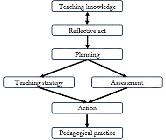
Thus it is possible to understand, from Figure 1, that, for the pedagogical practice to occur, the teacher must understand what teaching knowledge is, appropriate it, reflect on it, and, based on this reflection, can consciously plan which teaching strategies and evaluation methods to use within the classroom. The definition of the concept of pedagogical practice mentioned in Figure 1 is derived from authors such as Slomski (2007); Cunha (2012); Slomski et al. (2013); Vendruscolo and Bercht (2015); Moreira and Ribeiro (2016); Anastácio (2017); Carvalho (2017); Silva and Bruni (2017); Fávero, Consalter and Tramontina (2020); and Santos (2020). These authors reveal in their research that the pedagogical practice of higher education teachers is built daily, within the classroom, through their professional and personal experiences, corroborating the understanding of Dubar (2012), Cunha (2012), and Tardif (2014), indicate that professional life is built in the work environment by the subject's trajectories.
FINAL CONSIDERATIONS
This research analyzed how the teaching practice is constituted in accountants who became teachers at public universities in the state of Rio Grande do Sul, Brazil, in the light of the professional socialization theory understanding the way teachers added their knowledge throughout their trajectories and experiences with professional socialization.
Analyzing the respondents' answers, we identified that most of them entered the teaching career without planning by invitation due to their professional experience. According to their perceptions, these experiences were fundamental in their teacher practice and their current constitution. The interviewees report that participation in a teaching practice even after years of working in the classroom brought about a new perspective to the practice. Participants claim that after training in specialization, Masters and PhD degrees they had a new perspective on the pedagogical practice exercised until that moment, reflecting on how to act within the classroom.
Their participation in social groups such as churches, the army, and scouts was a hallmark of their behavioral constitution. Through these experiences, they became better prepared to act with the students and it assisted them in driving and leading the classroom.
We conclude that the pedagogical practice of the accountants who became teachers occurs when they become aware of their knowledge acquired through professional socialization experiences, and, reflecting on this knowledge, use teaching strategies and evaluation methodologies in a planned way.
In addition to defining pedagogical practice, the study contributes to the formation of the accounting sciences’ teacher. Regarding professional experience in accounting companies and offices, it can help expand the teacher's perspective resulting in a broader view of accounting. This facilitates their performance in the classroom through examples from their experience as well as favoring exchanges with students who already work.
The study can assist in reviewing concepts. It can also contribute to the teaching practice as it instigates the teacher to rethink their pedagogical practice through examples of colleagues, as well as implementing new teaching strategies. In professional terms, it can help in preparing and presenting content within the classroom, expanding the teacher's repertoire to present practical examples, and also establishing a sense of security based on their experience.
The contributions of this research also influence new teachers as it strengthens the understanding of the constitution of the professor, clarifying the type of teacher one wishes to become. It can also influence groups not related to accounting helping teachers prepare to express themselves in public, oratory, teamwork, and leadership roles, considered essential skills for teaching. Finally, it can collaborate in the behavior within classrooms in how the teacher wants to be remembered by their students in the way they present the content and employ evaluations, instigating family members to be inspired by this profession.
The main limitations of the study are the regional aspect and the teaching modality since it was performed only with teachers from public institutions in the state of Rio Grande do Sul, Brazil. Regarding future research suggestions, we recommend new investigations with teachers from other Brazilian to compare whether experiences, facilities, and difficulties are similar. We also suggested merging the analysis method and employing quantitative methodologies to collaborate with the qualitative ones.
Finally, we highlight some reflections that can be interpreted as suggestions for professionals who start teaching or for university management regarding welcoming new teachers. Concerning the integration and ambiance of teachers new to their careers, some said they felt lost at the beginning of their activities, not knowing where to go, what their room was, and who their colleagues were. As such it is important to rethink the integration of new teachers in the academic setting, whether for temporary or effective teachers. Regarding the administrative, management, and coordination activities, narratives indicate that the profession goes beyond the classroom. Thus in addition to the time studying and preparing for the discipline, it is necessary to participate in activities concerning course coordination, commissions, and departmental workgroups, among others. As such, it is challenging for newcomer teachers as they have no preparation to hold these positions. Regarding the requirements for hiring or those for public tenders, the study proves that professional socialization is a differential in the teaching career, but this experience is not significantly recognized in the selection process. On the other hand, scientific publications score highly in the selections, even though there is a scarce incentive by institutions and development bodies to promote research and scientific publications in undergraduate and postgraduate degrees in accounting sciences.
References
- ANASTÁCIO, Jéssica Barros. Formação e desenvolvimento profissional para uma prática pedagógica reflexiva na educação superior: casos de ensino na evidenciação de saberes do professor que atua na graduação em Ciências Contábeis. Dissertação (Mestrado em Ciências Contábeis). São Paulo: FECAP, 2017.
-
BANDEIRA, Leonardo dos Santos. Capacidades necessárias à prática docente em Ciências Contábeis. Revista Desafios, 4(2), p. 194-208, 2017. <10.20873/uft.2359-3652.2017v4n2p194>
» https://doi.org/10.20873/uft.2359-3652.2017v4n2p194 - CARVALHO, Alexandre Farias de. A construção da prática pedagógica dos professores do curso de Ciências Contábeis na educação a distância Dissertação (Mestrado em Educação). Santos: Universidade Católica de Santos, 2017.
- CARVALHO, Alexandre Farias de. A prática pedagógica do professor de contabilidade na educação à distância: a construção da prática. Revista Digital de Gestão e Negócios, 1 (2), p. 54-74, 2018.
- CHIZZOTTI, Antonio. Pesquisa qualitativa Petrópolis: Vozes, 2006.
- CLANDININ, D. Jean; CONNELLY, F. Michael. Narrative inquiry: experience and story in qualitative research. San Francisco: Jossey-Bass, 2000.
-
CONSELHO FEDERAL DE CONTABILIDADE - CFC. Profissionais ativos nos Conselhos Regionais de Contabilidade Coordenadoria de Registro. 01 ago. 2021. Disponível em: <Disponível em: https://www3.cfc.org.br/spw/crcs/ConselhoRegionalAtivo.aspx >. Acesso em: 26/10/2022.
» https://www3.cfc.org.br/spw/crcs/ConselhoRegionalAtivo.aspx - CUNHA, Emmanuel Ribeiro. Os saberes docentes ou saberes dos professores. Revista Cocar, 1 (2), p. 31-39, 2007.
- CUNHA, Maria Isabel. O bom professor e sua prática São Paulo: Papirus, 2012.
- DAOUST, Laurence; MALSCH, Bertrand. How ex-auditors remember their past: the transformation of audit experience into cultural memory. Accounting, Organizations and Society, v. 77, 101050, 2019.
-
DUBAR, Claude. A construção de si pela atividade de trabalho: a socialização profissional. Cadernos de Pesquisa, 42 (146), p. 351-367, 2012. <10.1590/S0100-15742012000200003>
» https://doi.org/10.1590/S0100-15742012000200003 - DUBAR, Claude. A socialização: construção das identidades sociais e profissionais. Portugal: Porto, 1997.
-
FARAG, Magdy S.; ELIAS, Rafik Z. The relationship between accounting students: personality, professional skepticism and anticipatory socialization. Accounting Education, 25 (2), p. 124-138, 2016. <10.1080/09639284.2015.1118639>
» https://doi.org/10.1080/09639284.2015.1118639 -
FÁVERO, Altair Alberto; CONSALTÉR, Evandro; TRAMONTINA, Carla Cristine. A formação docente de professores de cursos de bacharelado: desafios da prática pedagógica. Cadernos de Pesquisa, 27 (2), p. 237-259, 2020. <10.18764/2178-2229.v28n2-2020-10>
» https://doi.org/10.18764/2178-2229.v28n2-2020-10 - FOX, Kenneth A. The manufature of the academic accountant. Critical Perspectives on Accounting, 57 (C), p. 1-20, 2018.
-
FRANCO, Maria Amélia do Rosario Santoro. Prática pedagógica e docência: um olhar a partir da epistemologia do conceito. Revista Brasileira de Estudos Pedagógicos, 97 (247), p. 534-551, 2016. <10.1590/S2176-6681/288236353>
» https://doi.org/10.1590/S2176-6681/288236353 - GAUTHIER, Clermont. Por uma teoria da pedagogia: pesquisas contemporâneas sobre o saber docente. Ijuí: Unijuí, 1998.
- GIBAUT, Emerson Andrade; BRUNI, Adriano Leal. A sua forma de ensinar me motiva e eu percebo que aprendo? Uma análise das práticas pedagógicas e as suas consequências para a motivação acadêmica. Revista de Gestão, Finanças e Contabilidade, 10 (1), p. 65-81, 2020.
- GIL, Antonio Carlos. Didática do ensino superior Atlas: São Paulo, 2007.
-
GRILL, Martin; POUSETTE, Anders; NIELSEN, Kent; GRYTNES, Regine; TÖRNER, Marianne. Supervisors and teachers’ influence on expectations on empowering leadership among students in vocational education and training. Empirical Research in Vocational Education and Training, 9 (2), p. 1-15, 2017. <10.1186/s40461-017-0046-3>
» https://doi.org/10.1186/s40461-017-0046-3 -
HILLEN, Cristina; LAFFIN, Marcos; ENSSLIN, Sandra Rolim. Proposições sobre formação de professores na área contábil. Arquivos Analíticos de Políticas Educativas, v. 26, n. 106, p. 1-15, 2018. <10.14507/epaa.26.3060>
» https://doi.org/10.14507/epaa.26.3060 -
HUGHES, Everett C. The making of a physician: general statement of ideas and problems. Human Organization, 14 (4), p. 21-25, 1955. <10.17730/humo.14.4.52022ku752048813>
» https://doi.org/10.17730/humo.14.4.52022ku752048813 -
KOWTHA, Narasimha Rao. Organizational socialization of newcomers: the role of professional socialization. International Journal of Training and Deveploment, 22 (2), p. 87-106, 2018. <10.1111/ijtd.12120>
» https://doi.org/10.1111/ijtd.12120 - LIMA, João Paulo Resende de. Ser professor: um estudo de identidade docente na área de Ciências Contábeis. Dissertação (Mestrado em Ciências). Ribeirão Preto: Universidade de São Paulo, 2018.
-
LIMA, João Paulo Resende de; ARAUJO, Adriana Maria Procópio de. Tornando-se professor: análise do processo de construção da identidade docente dos professores de Ciências Contábeis. Advances in Scientific and Applied Accounting, 12 (2), p. 1-22, 2019. <10.14392/asaa.2019120204>
» https://doi.org/10.14392/asaa.2019120204 - MACHADO, Virginia M. Definições de prática pedagógica e a didática sistêmica: considerações em espiral. Revista Didática Sistêmica, 1, p. 126-134, 2005.
-
MOOROSI, Pontso; GRANT, Carolyn. The socialisation and leader identity development of school leaders in Southern African countries. Journal of Educational Administration, 56 (6), p. 643-658, 2018. <10.1108/JEA-01-2018-0011>
» https://doi.org/10.1108/JEA-01-2018-0011 - MOREIRA, Jonathan Rosa; RIBEIRO, Jefferson Bruno Pereira. Prática pedagógica baseada em metodologia ativa: aprendizagem sob a perspectiva do letramento informacional para o ensino na educação profissional. Outras palavras, 12 (2), p. 93-114, 2016.
- MORENO, Thiago Cesar Bezerra. O saber em controladoria sob a ótica de Foucault: análise do ensino da controladoria nos programas de pós-graduação em contabilidade do Brasil. Dissertação (Mestrado em Contabilidade). Cascavel: Universidade Estadual do Oeste do Paraná, 2017.
- NÓVOA, Antonio. Formação de professores e profissão docente. In: NÓVOA, Antonio. (Org.). Os professores e sua formação Lisboa: Dom Quixote, p. 77-92, 1992.
-
PAGNAN, Leopoldo Celso; COSTA, José Manuel da; SILVA, Samira Fayez Kfouri da. Profissionais de Ciências Contábeis: competências pedagógicas para o exercício da docência. Revista de Ensino, Educação e Ciências Humanas, 17 (4), p. 362-369, 2016. <10.17921/2447-8733.2016v17n4p362-369>
» https://doi.org/10.17921/2447-8733.2016v17n4p362-369 - PIMENTA, Selma Garrido. Formação de professores: identidade e saberes da docência. In: PIMENTA, Selma Garrido (Org.). Saberes pedagógicos e atividade docente São Paulo: Cortez, 1999, p. 15-34.
- PONTES, Emiliano Sousa. O processo de socialização profissional: estudo com secretários executivos em organizações cearenses. Dissertação de (Mestrado em Administração e Controladoria). Fortaleza: Universidade Federal do Ceará, 2017.
- SANTOS, Tainá dos. Formação docente universitária: um estudo sobre as práticas pedagógicas adotadas no curso de Ciências Contábeis da Universidade Federal da Paraíba. Monografia (Graduação em Ciências Contábeis). João Pessoa: Universidade Federal da Paraíba, 2020.
- SHULMAN, Lee S. Aqueles que entendem: o crescimento do conhecimento no ensino. Pesquisador educacional, 15 (2), p. 4-14, 1986.
-
SILVA, Uilcleides Braga da; BRUNI, Adriano Leal. O que me ensina a ensinar? Um estudo sobre fatores explicativos das práticas pedagógicas no ensino de contabilidade. Revista de Educação e Pesquisa em Contabilidade, 11 (2), p. 214-230, 2017. <10.17524/repec.v11i2.1531>
» https://doi.org/10.17524/repec.v11i2.1531 -
SLOMSKI, Vilma Geni. Saberes e competências do professor universitário: contribuições para o estudo da prática pedagógica do professor de Ciências Contábeis do Brasil. Revista de Contabilidade e Organizações, 1 (1), p. 87-103, 2007. <10.11606/rco.v1i1.34699>
» https://doi.org/10.11606/rco.v1i1.34699 - SLOMSKI, Vilma Geni. Saberes que fundamentam a prática pedagógica do professor de Ciências Contábeis. In: ANAIS DO 8.º CONGRESSO USP DE CONTROLADORIA E CONTABILIDADE, 2008, São Paulo. Anais. São Paulo: USP, 2008.
-
SLOMSKI, Vilma Geni; ANASTÁCIO, Jessica Barros; ARAUJO, Adriana Maria Procópio de; SLOMSKI, Valmor; CARVALHO, Ronaldo Frois de. Casos da prática educativa na aprendizagem da docência universitária. Arquivos Analíticos de Políticas Educativas, 28 (33), p. 1-44, 2020. <10.14507/epaa.28.5041>
» https://doi.org/10.14507/epaa.28.5041 -
SLOMSKI, Vilma Geni; LAMES, Edilei Rodrigues de; MEGLIORINI, Evandir; LAMES, Liliane da Costa Jacobs. Saberes da docência que fundamentam a prática pedagógica do professor que ministra a disciplina de gestão de custos em um curso de Ciências Contábeis. Revista Universo Contábil, 9 (4), p. 71-89, 2013. <10.4270/ruc.20139>
» https://doi.org/10.4270/ruc.20139 - TARDIF, Maurice. Saberes docentes e formação profissional Petrópolis: Vozes, 2014.
- TARDIF, Maurice; LESSARD, Claude. O trabalho docente: elementos para uma teoria da docência como profissão de interações humanas. 2. ed. Petrópolis: Vozes , 2005.
-
TARDIF, Maurice; RAYMOND, Danielle. Saberes, tempo e aprendizagem do trabalho no magistério. Educação e sociedade, 21 (73), p. 209-244, 2000. <10.1590/S0101-73302000000400013>
» https://doi.org/10.1590/S0101-73302000000400013 -
TOZETTO, Susana Soares; GOMES, Thaís de Sá. A prática pedagógica na formação docente. Reflexão e Ação, 17 (2), p. 181-196, 2009. <10.17058/rea.v17i2.1150>
» https://doi.org/10.17058/rea.v17i2.1150 - VENDRUSCOLO, Maria Ivanice; BERCHT, Magda. Prática pedagógica de docentes de Ciências Contábeis da região sul e sudeste do Brasil: um estudo da percepção da afetividade. ConTexto, 15 (29), p. 113-128, 2009.
- VILELA, Guilherme Cabral. A socialização profissional por meio da parceria escola/empresa: um estudo de caso. Dissertação (Mestrado em Gestão e Desenvolvimento Regional). Taubaté: Universidade de Taubaté, 2004.
The content underlying the research text is contained in the manuscript
History
-
Received
29 May 2023 -
Preprint posted on
24 Apr 2023
10.1590/SciELOPreprints.5951 -
Accepted
16 May 2024

 Source: Designed by the authors based on the literature cited (2022).