
 PUBLIC ELEMENTARY SCHOOLING IN MARANHÃO DURING THE EMPIRE (1843-1870): THE RELATION BETWEEN ENROLLED CHILDREN AND "FIRST LETTERS" TEACHING PLACES
This article analyzes the schooling process in the Imperial period in Maranhao, focusing on the tension between the number of public elementary school PLACES and the number of enrolled children, based on government reports and those from the public instruction inspectorate. The aim is to understand the extent to which the discourses of provincial presidents and inspectors resonated with the political and administrative actions taken to spread elementary schooling. This is achieved by cross-referencing official data grounded in the theoretical-methodological premises of cultural history, evaluating political/ideological discourses and distinct school practices through the lens of representations. This approach allows for a critical examination of the reports themselves, the context of their creation, the positions of key agents involved, and the schemes of perception and appreciation that shape how they classify, judge, and act. Representations are considered here as "ways of seeing" that guide actions and practices; as sites of tension and power struggles between groups vying to legitimize their worldviews; and as conduct and behaviors manifested in the differentiation of practices that generate inequalities. It is concluded that, although the province of Maranhão had seen an intensification of debates regarding compulsory public education—mandating, through specific regulations, the attendance of school-age children in the Elementary classes—the province's financial situation, the shortage of teachers, and difficulties in supervising instruction meant that maintaining teaching places and student enrollment numbers—despite improvements during the period—continued to pose a major challenge to the advancement of education.
Keywords:
Elementary schooling; organization of instruction; enrolled children; teaching places offered; Imperial Maranhão
 Thumbnail
 Thumbnail
 Thumbnail
 Thumbnail
 Thumbnail
 Thumbnail
 Source: Elaborated based on
 Source: Elaborated based on
 Source: Elaborated based on
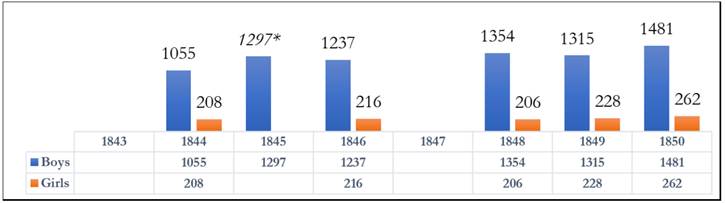 Source: Adapted from
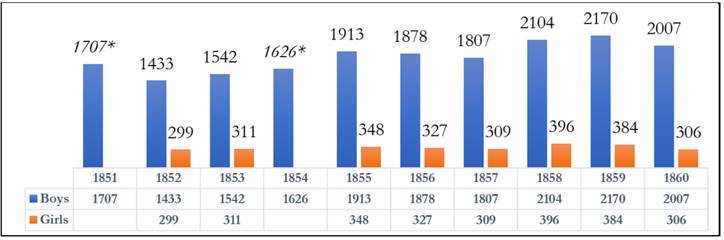 Source: Adapted from
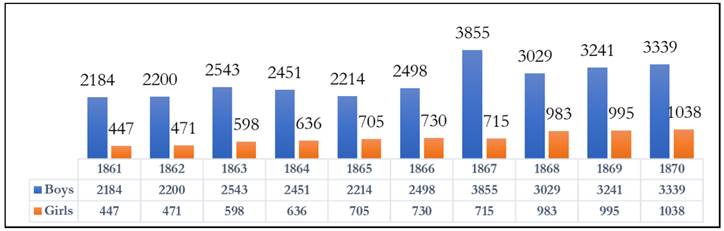 Source: Adapted from