
 CHANGES IN THE TEACHING PRACTICES OF PRE-SERVICE PHYSICAL EDUCATION TEACHERS IN EARLY CHILDHOOD EDUCATON
ABSTRACT:
This study aims to analyze changes in the teaching practices of pre-service Physical Education teachers in Early Childhood Education during a supervised internship course, based on collaborative processes. Two undergraduate students enrolled in Supervised Internship II at a public university in Minas Gerais, Brazil, participated in the research. Data were collected through the simple self-confrontation technique, applied after the first and second half of the intervention. Additionally, a semi-structured interview and classroom observations were used to complement the data. Content Analysis was employed to analyze the material. The results revealed that, at first, the teachers adopted an adult-centered approach that disregarded the children’s interests, leading to conflicts and feelings of frustration. As the internship progressed, collaborative reflection processes supported the development of more effective communication and interaction with children. Nevertheless, the reflections remained at a technical level, where the repertoire developed was used primarily to implement the lesson plan. The study concludes that the teachers experienced meaningful changes in their pedagogical practices, becoming more attentive to children’s expressions. However, it remains necessary to foster critical reflections through collaborative processes to consolidate the changes achieved.
Keywords:
Physical Education; Early Childhood Education; supervised internship; teaching practice; self-confrontation
RESUMO:
Este estudo tem como objetivo analisar mudanças na prática docente de professoras em formação inicial de Educação Física na Educação Infantil ao longo da disciplina de Estágio Supervisionado, mediante a processos colaborativos. Participaram da pesquisa duas professoras em formação do curso de licenciatura em Educação Física, matriculadas na disciplina de Estágio Supervisionado II, de uma universidade pública de Minas Gerais. Para a produção dos dados, utilizou-se a técnica da autoconfrontação simples, aplicada após a primeira e a segunda metade das intervenções. Como instrumentos suplementares, foram utilizados uma entrevista semiestruturada e observações de aula. Para a análise dos dados, recorreu-se à técnica de Análise de Conteúdo. Os resultados revelaram que, inicialmente, as professoras em formação adotaram uma lógica de pensamento adultocêntrica, que desconsiderava o interesse das crianças, gerando conflitos e sentimento de frustração. Com o avanço das experiências na disciplina, e a partir da reflexão conjunta e de processos colaborativos, as professoras demonstraram avanços nas interações e na forma de comunicação com as crianças. Todavia, as reflexões permaneceram em um nível técnico, no qual o repertório construído era mobilizado de forma operacional para a concretização do planejamento. Considera-se que houve mudanças significativas na prática docente das professoras em formação, sensibilizando-as às manifestações das crianças; contudo, faz-se necessário provocar reflexões críticas, por meio dos processos colaborativos, a fim de consolidar as mudanças produzidas.
Palavras-chave:
Educação Física; Educação Infantil; estágio supervisionado; prática docente; autoconfrontação
RESUMEN:
Este estudio tiene como objetivo analizar los cambios en la práctica docente de profesoras en formación inicial en Educación Física en la Educación Infantil, a lo largo de la asignatura de Práctica Docente Supervisada, mediante procesos colaborativos. Participaron dos estudiantes del curso de licenciatura en Educación Física, matriculadas en la asignatura Práctica Docente Supervisada II de una universidad pública de Minas Gerais, Brasil. Los datos se recopilaron mediante la técnica de autoconfrontación simple, aplicada tras la primera y la segunda mitad de las intervenciones. Además, se utilizaron una entrevista semiestructurada y observaciones de clase como herramientas complementarias. El análisis se realizó mediante la técnica de Análisis de Contenido. Los resultados revelaron que, en un principio, las profesoras adoptaron una lógica de pensamiento adultocéntrica que ignoraba los intereses de niñas y niños, lo que genero conflictos y frustración. A medida que avanzó la asignatura, los procesos de reflexión conjunta y colaboración favorecieron el desarrollo de una comunicación y una interacción más eficaces con las niñas y los niños. No obstante, las reflexiones se mantuvieron en un nivel técnico, en el cual el repertorio construido se utilizó principalmente para llevar a cabo la planificación. El estudio concluye que las profesoras en formación experimentaron cambios significativos en sus prácticas pedagógicas, mostrándose más atentas a las expresiones infantiles. Sin embargo, sigue siendo necesario fomentar reflexiones críticas mediante procesos colaborativos, con el fin de consolidar los cambios logrados.
Palabras clave:
Educación Física; Educación Infantil; pasantías supervisadas; práctica docente; autoconfrontación
INTRODUCTION
Teaching practice is a complex activity that occurs through multiple interactions. According to Franco (2016), it involves not only the didactic methods used but also the different perspectives of teachers, students, the school community, and the social and cultural impacts that emerge from educational encounters.
Despite carrying an intentionality, the objectives of teaching practice become imprecise and non-operational, which requires the teachers to constantly transform and adjust their practices. According to Tardif and Lessard (2014), this activity occurs through a dual process, represented by school rigidity and the unpredictability of social relations between different individuals. Furthermore, it takes place in an environment permeated by tensions and dilemmas inherent in teaching activities (Tardif; Lessard, 2014).
In undergraduate degree programs, Supervised Internship (SI) is established as a moment in the curriculum that allows pre-service teachers (PSTs) to experience the complexities of teaching in a real-world setting while being guided. According to Melo and Almeida (2014), it enables prospective teachers to foster dialogue between the curricular components of their training and their professional practice. Through this discipline, PSTs are led to interact with students and participate in their educational process, experiencing the dilemmas of teaching practice (Tardif; Lessard, 2014; Mello et al., 2014).
In Physical Education, authors such as Carvalho and Souza Neto (2019) and Martiny and Gomes-da-Silva (2011) demonstrate that SI allows for the experience of conflicts generated by the school reality. In the specific case of interventions in Early Childhood Education, the experiences with children prompt PSTs to consider childhoods, which, in turn, have their dynamics specific to the age group and demand a mobilization of knowledge beyond the training curriculum (Pereira; Martiny; Gomes-da-Silva, 2018; Martiny; Gomes-da-Silva, 2011).
In addition to the challenges inherent in that level of education, there are also debates about the purposes of Physical Education for young children. Authors such as Farias et al. (2020) and Sayão (1999) argue that the subject should contribute to the development of children's language and their understanding of the world through the body, thereby avoiding fragmentation of their learning. However, Ehrenberg (2014) points to the existence of Physical Education teachers in Early Childhood Education who still base the curriculum on a traditional and sports-oriented view, while Martins, Tostes, and Mello (2018) demonstrate the predominance of a biological and universal view of childhood in teacher training in the area. Therefore, there is a dispersion of purposes related to the subject that impacts the performance of PSTs.
Given that the SI allows pre-service teachers to experience the dilemmas of the school context and confront their initial knowledge in the development of their practice, this study aims to analyze changes in the teaching practice of Physical Education PSTs in Early Childhood Education throughout the SI, through collaborative processes. The goal is to understand the construction of pre-service teachers' teaching practice and the transformations that occur throughout the formative experience.
The collaborative process between PSTs and researchers occurred primarily through the Simple Self-Confrontation (SSC) technique. According to Clot (2006), this technique aims to provide a worker with guided reflections on their profession, using video recordings of their practice and dialogues about their activity as stimuli. The researchers participate as collaborators, instigating the reflections of the research subject. The goal is to explore the work performed and the unrealized internal interests, the elements of the observed and unobserved reality, identifying pathways for transformation (Rezende; Christo, 2018; Clot, 2006).
In school education, the Self-Confrontation technique allows teachers to engage in critical and self-critical reflections on classroom activities to construct their social practice (Carvalho; Aguiar; Alfredo, 2020). Some studies, such as Magalhães and Faïta (2020), Godoi, Benites, and Borges (2019), Stutz and Cristovão (2019), Anjos and Dainez (2017), and Fumes, Santos, and Dounis (2013), have used this methodological technique for the analysis and construction of teachers' pedagogical practice.
In the following section, we explain how the methodological application of the technique was carried out.
METHODOLOGICAL PROCEDURES
This qualitative study used a sample of two PSTs from the Physical Education undergraduate program at a public university located in the state of Minas Gerais. They were duly enrolled in the Supervised Internship in Early Childhood Education course2 and volunteered to participate in the research, respecting the ethical parameters approved by the Ethics Committee of CEP/UFV, under opinion number 3.705.610. Fictitious names were created for the research participants to ensure anonymity.
The research process consisted of the individual application of a semi-structured interview guide during the first week of interventions; the conducting of two collaborative problem-solving sessions with the group; and participant observations, accompanied by notes on the lessons. For this study, the data generated in the two collaborative problem-solving sessions will be used, with the other instruments serving as supplementary to the analysis.
The SI course was organized in two stages: the first involved familiarizing the PSTs with the school environment through a technical visit and four co-participations in classes, and the second stage involved carrying out 14 interventions, distributed over a little more than two months. For the self-reflection process, the 14 interventions were recorded.
Following Clot's (2006) methodological guidelines, a representative lesson from the PSTs was selected, fragments were extracted, and then assembled into a single episode with a beginning, middle, and end. Two self-confrontations (SSC 1 and SSC 2) were conducted. SSC 1 was conducted after the first half of the interventions, and lesson 4 was highlighted for the construction of this episode.3 Já a ACS 2 foi realizada ao fim das intervenções e, para a construção do episódio, foi utilizada a aula 12. SSC 2 was conducted at the end of the interventions, and lesson 12 was used for the construction of this episode. In the construction of both episodes, the focus was on highlighting the mobilization of pedagogical resources, the challenges in conducting the lesson, the teaching strategies employed, and the communication with the children (Chart 1).
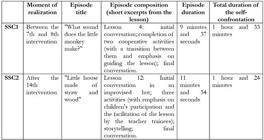
The SSC sessions consisted of an initial phase of observing the episodes - with relevant excerpts and situations from the lessons - followed by a process of reflection and self-reflection on teaching practice - considering their actions, thoughts, and decisions - mediated by two researchers. The mediation was guided by a script of 13 questions that sought to explore perceptions about what was done, what they wanted to do but couldn't, and possibilities for changes in practices.4 This entire process was recorded.
Finally, in the last stage of the research process, all the dialogues established in SSC 1 and SSC 2 were transcribed. The data were analyzed based on Bardin's (2016) thematic content analysis, following the three phases (Pre-analysis; Exploration of the material; Treatment of results and interpretation) and their respective rules, as indicated by the author.
In SSC 1, the categories entitled “Challenges in pedagogical planning: ‘I don't know if they really managed to achieve the objective’,” and “‘Wow, I could have done it a little differently’: inexperience and frustrations in the school environment” were extracted. In SSC 2, the categories “‘I realized that this is how it works’: construction of teaching practice considering the children involved in the process” and “‘We evolved a lot throughout the process’: advances in initial training through collaborative experiences” were established.
RESULTS AND DISCUSSION
The following structure is organized around the two self-confrontations and their respective categories. The first section presents the two categories extracted from SSC 1, in which the construction of practice in the initial experiences in higher education and the SI produced were analyzed. The second section analyzes the modifications that occurred in the pedagogical practice of the PSTs, addressing the advances made and the collaborative processes, through the two categories extracted from SSC 2.
SSC 1 - Frustration by the challenges of school reality
Through SSC 1, the PSTs demonstrated difficulties in overcoming obstacles in conducting the lessons. In the category extracted from this self-confrontation section, entitled “Challenges in pedagogical planning: 'I don't know if they really managed to achieve the objective',” it was revealed that their teaching practice focused on what was planned and disregarded the unforeseen events that arose during the lesson, stemming from the children's behavior.
When analyzing the episode, the PSTs pointed out the children's difficulty in following the rules planned for the lesson. The teacher Isadora stated that:
I think they did it the way they really wanted to. They didn't focus on the rules themselves. The rules we wanted [...] they didn't follow. I think it was like that for all the activities. I think we also lacked - we realized this later - including more visual elements. We created the story, but there wasn't a drawing or a picture to make it clearer for them. [...] So we had to stop, and even though we reinforced the rules and tried to explain them again, they were doing what they wanted, which was the easiest way for them. So, following the rules that day didn't work in any activity (PST ISADORA, emphasis added).
The proposed activities were designed to be engaging and included three cooperative games. However, these activities came with pre-established rules on how to participate, how to handle the objects - balls, paper, and fabric - and specified locations for the children to occupy. This organizational logic was established from the perspective of the PSTs who overlooked the children's preferences, diverse capabilities, and available resources, such as the use of images.
Corsaro (1993) argues that, in the context of early childhood education, children produce a peer culture that ensures their childlike character and enriches their creative processes. Thus, through interaction among children - and between them and the teacher - they appropriate and interpret the adult world, as well as its rules and norms. Especially when playing, where order emerges from practice (Skovbjerg; Sand, 2022), children immerse themselves in their culture, with their skills, imagination, creation, and negotiation, and return to adult culture, the guidelines, in a constant back and forth that allows them an interpretive reproduction of the practices proposed by the adult (Corsaro, 1993).
By disregarding the peer culture of the children in the classroom, the PSTs revealed an adult-centered way of thinking that was in constant conflict with the children's ways of appropriating the activities. In the classroom, the teachers proposed the rules of the activity and expected the children to follow them as planned. Unsuccessfully, they “had to stop” the class to reinforce the rules, while the children appropriated the game, demonstrating a constant attempt to control the activity. Amidst the conflicts, the teachers admitted that the children could do things “their way, but not completely freely and not deviating from the purpose” (PST Evelyn).
This logic of determination imposed by adults denies the completeness and active role of the child, who is understood as a small subject in transition, incomplete and dependent. Thus, the child needs to be taught according to the adults' understanding, because, from this perspective, the child is incapable of producing their knowledge and practice (Sarmento, 2008). For Sarmento (2013; 2008) and Corsaro (1993), children need to be active agents in the construction of their social space and collective will. In Physical Education, this implies that teachers must overcome traditional structures that consider children as mere reproductive5 beings undergoing biopsychological development. To this end, it is necessary to guarantee children the possibility to express themselves through their different forms of communication and gestures, in addition to guiding the construction of teaching through their bodily manifestations (Farias et al., 2020; Mello et al., 2014; Rocha, 2011; Richter; Vaz, 2005).
In an attempt to critically reflect on what was observed, aiming at the production of new possibilities for action (Clot, 2006), the PSTs were invited to reflect on changes in the construction of the teaching proposal. However, the propositions had a more disciplinary and organizational nature, with the implementation of lines, rules, and variations of the same activities. Professor Isadora emphasized that: “I don't really like lines, but it ends up being a little more organized, because they all gather around, and they end up getting distracted more easily, I don't know [...]”.
This difficulty in proposing new ways to implement the lesson reveals the presence of gaps in their training, which, in turn, fostered an adult-centered view of the classroom and the uncritical reproduction of traditional teaching methods. This was evident in the reflections on play - the content proposed for the lessons. According to Skovbjerg and Sand (2022), these practices are imbued with a way of being inherent to human beings that, through interaction, allows an organization to emerge. Thus, they are guided by actions that maintain a playful order, depending above all on the interaction and engagement of the participants. Conversely, when proposing ways to reconstruct the activities, the pre-service teachers emphasized the need to implement lines and more rules, which, in turn, nullified the interactions.
The demand from physical education teachers to propose games with pre-established rules, discouraging new formulations, was identified by Sæther, Borgen, and Leirhaug (2023). According to the authors, this practice reproduces a traditional discourse of establishing formal and mandatory rules in games, which stems from the predominant sports models in Physical Education (Sæther; Borgen; Leirhaug, 2023). Thus, while on the one hand, by establishing rules, teachers seek to define more tangible objectives to evaluate students' competencies (Sæther; Borgen; Leirhaug, 2023), on the other hand, for the PSTs in this study, the non-compliance with the rules, even with the children's engagement in the activities, produced frustrations, leading to self-criticism about their pedagogical practice and questioning whether “the children managed to achieve the objective” (PST Evelyn), disregarding the playful involvement.
Based on an adult-centered logic, the PSTs demonstrated a lack of understanding of children's expressions and failed to engage with the emerging children's culture in the classroom, generating a feeling of frustration. This information contributed to the construction of the second category, which was titled “‘Wow, I could have done it a little differently’: inexperience and frustrations in the school environment.” Through this category, the pre-service teachers demonstrate a feeling of frustration that was largely related to the expectations generated and their inexperience with the school environment, especially in their contact with children. They reported that when starting the SI discipline, they expected understanding and discipline from the children, which was sometimes not met and generated challenges during the lessons. The lack of experience in the school environment hindered the process of conducting and organizing the classes and overcoming challenges, accentuating a negative view of the lessons. The disconnect between the knowledge acquired in initial training and the challenges experienced in the school is evident in the words of Professor Isadora, when she stated:
Because that way, we have a better understanding of movement and movement patterns. More like, “Oh, the child is in this age group, they should be running in a certain way.” Silly things, but we didn't remember that the child couldn't use a pencil; they use crayons. We even thought about bringing some, and so on. We talked to the supervising teacher, and hopefully she said, “No, they use crayons,” and she explained it further. My God, it makes sense! It's something we don't have support for. We're learning, and we're learning through practice. (PST ISADORA, emphasis added).
As she stated, the characterization of childhood apprehended through the curriculum6 did not allow Isadora to observe sociocultural aspects of schooling and childhood habits. This was confirmed when we examined the teacher training curriculum that precedes the SI II. In it, the only discipline that partially addresses socio-anthropological aspects of childhood is the discipline of Games, Toys, and Play, taught in the first semester of the course. In contrast, other disciplines, such as Developmental Psychology of Learning, Human Growth and Development, and Motor Behavior, encompass a conception of childhood in the curriculum reduced to biopsychomotor aspects. Thus, it is noted that the teacher training curriculum corroborates the findings in the literature that point to an inconsistency in the content and disciplines related to the specificities of Early Childhood Education in Physical Education teacher training curricula, sometimes limited to a biopsychological characterization of children (Martins; Tostes; Mello, 2018; Lacerda; Costa, 2012; Cavalaro; Muller, 2009).
According to Martins, Tostes, and Mello (2018, pp. 711-712), knowledge related to biopsychological development contributes to Physical Education in Early Childhood Education, “however, knowledge from this field alone is insufficient to encompass the complexity of child behavior.” This knowledge must be mobilized as part of the guiding theoretical framework, allowing for an understanding of the child in their entirety (Martins; Tostes; Mello, 2018), especially in their social, cultural, and educational processes.
Due to a lack of knowledge that would allow for a broader understanding of childhood, teacher Isadora revealed a perspective more focused on what the child should be, and less on what the child “is”, on their real needs (Farias et al., 2020; Sarmento, 2008). This perspective, consolidated by the teacher training curriculum, immobilized the teachers in the face of the reality of the educational level, generating frustration in them.
This process is evident in the SSC 1 episode, in which the planned play activities were permeated by conflicts between the PSTs and the children. The limited understanding of childhood led the teachers to a conception of discipline that, in favor of greater control over the practice, disregarded a sensitive approach to the children's play, prohibiting their activities. Consequently, supported by the understanding of Skovbjerg and Sand (2022), the playful order of the games was marked by struggles and conflicts, revealing itself, in its constant instability, as something exhausting. Therefore, the teachers' teaching practice came to be seen as ineffective, being frustrating for them and discouraging for the children.
In addition to the gaps in curricular knowledge, experiential knowledge was also scarce, providing them with little understanding of childhood. As Evelyn reported:
We don't have much contact; we've never had contact with children of that age. So, we don't know much about what they know, how far we can go with them, so that was a great difficulty at the beginning, in preparing the lesson, because we had no idea what they could do and what they couldn't. Even after reading and searching for material, it was still difficult (PST Evelyn, emphasis added).
According to Tardif (2014), experiential knowledge is the vital core of teaching practice, forming an amalgam of knowledge that guides teachers in their work. This knowledge is even mobilized in teachers' schooling experiences. However, in the absence of contact with the context of childhood, the PSTs had a limited repertoire of knowledge to guide the development of their first practices in Early Childhood Education. As a result, there was “a very big shock right at the beginning” (PST Evelyn), upon their first contact with the school environment.
The feelings reported by the PSTs resemble those presented by teachers at the beginning of their careers. According to Tardif (2014), these feelings reveal tensions between the knowledge acquired during professional training and the reality of school environments, which can sometimes lead to disillusionment with the profession. In the case of pre-service physical education teachers in early childhood education, Pereira, Matiny, and Gomes-da-Silva (2018) point out that the confrontation with reality, which is out of sync with what was planned, generates discouragement due to low productivity and doubts about their own ability to carry out the activities.
These dilemmas affecting teaching work are present in the accounts, with the lack of experience and difficulty in the practical application of teaching methods for children recurring frequently in the narratives. These events were reflected in an emphasis on the negative aspects of the lesson, preventing the recognition of successful possibilities. Isadora stated:
We always leave saying, “Wow, that was awful.” Then we go and talk to researcher X or researcher Y.7 “No, but I thought the class was good, this and that happened” [the researchers consider]. They say good things, and then we think, “No, but it could have been different.” (PST ISADORA).
Given the negative views expressed by the PSTs, the collaborative reflections with the researchers at the end of each class were treated as a moment of support, followed by reflective dialogues. By understanding their anxieties and dilemmas in the exercise of their pedagogical practice, and subsequently reflecting critically on the construction of the lesson, it was possible to establish a dialectical process for overcoming the challenges in the classroom.
Therefore, we observed in the initial experiences of the SI, through SSC 1, that the knowledge and strategies mobilized in teaching practice were out of sync with the reality encountered, generating a feeling of frustration among the PSTs. The teachers' practice revealed an adult-centered way of thinking, with activity control strategies that deviated from the real interests of the children, fueling existing tensions.
SSC 2 - Changes in teaching practice through collaborative experiences
SSC 2 was characterized by the appropriation, by the PSTs, of different types of knowledge stemming from their experiences in the school setting and from the collaborative processes established in ACS 1, in reflections after classes, and in interactions with school staff. The second self-confrontation session took place at the end of the internship course, following the same reflection process. Through this session, the aim was to clarify the experiences produced, the transformations that occurred, and the construction of new possibilities in their practices.
Through the first category, entitled “‘I realized that this is how it works’: constructing teaching practice considering the children involved in the process,” the participating teachers demonstrated that their pedagogical actions began to consider, in a certain way, the different individuals involved in conducting the lesson.
Through observation and reflection on the practical experiences produced throughout the interventions, the teachers noticed improvements in their interactions with the children. Through the recording of lesson 12, teacher Evelyn highlighted the implementation of a successful strategy. As she stated:
[...] I think this was the first activity we really participated in, where we noticed this difference in involvement. In the next classes [classes 13 and 14], we did more with our own demonstration, and I think it worked much better. (PFI EVELYN, emphasis added).
As the teachers gained experience in their teaching work, they developed pedagogical intervention strategies to maintain student engagement. As teacher Evelyn emphasized, there were improvements in the lessons when they relinquished a position of command to effectively engage in the class alongside the children. This increased interaction with the children was accompanied by the recognition of their individualities, guiding the planning and the mobilization of successful strategies from previous interventions. As she pointed out:
[...] we also tried to anticipate some things, in relation to some students: 'Will this work out? Because there's this student, and that student.' So, we tried to remember the students, the individuality of each one (PST ISADORA).
These reported forms of knowledge encompass what Tardif (2014) calls practical reason, since they are affirmed through justifications built in practice, through experiments and representations produced with the students, and mobilized with a pedagogical intention. This intention aimed less at effective learning for the children and more at engagement in the class; however, contrasting with the initial experiences, the control strategies gave way to others, derived from their immersion in the students' social practices. The bonds formed with and among the children fueled a cumulative repertoire of pedagogical strategies that was mobilized throughout the experiences in the elementary school. Thus, “in all the classes there was something of this: either music, or images, and we participated more towards the end. But, in almost all the classes - or in all of them - we brought images” (PST Evelyn).
The resources and strategies aimed to connect with the world of children, and it was made possible by recognizing the differences between the teachers' and the children's perceptions of the world. As was emphasized:
We have a concept, in terms of discipline and indiscipline, paying attention or not paying attention, understanding or not understanding, that's different from this age group! We don't understand this age group very well because we have little experience with them. So, we always thought that it didn't work, that nothing went right.
[...]
The class improved, but our concept also changed a little, you know? We accept much more than they talk; they say random things... that's just how they are. There's no way I can intervene and change that. (PST Evelyn, emphasis added).
The adult-centered logic, which influenced the definition and control of children's behavior, began to weaken. According to the reports, certain “concepts” that guided issues of discipline, attention, learning, and even forms of interaction among children were progressively modified in favor of an understanding of the other. However, this more sensitive approach emerged amidst initial tensions and conflicts, making it necessary to adopt conceptions “in their way.” Although this approach did not fully recognize the child's individuality, it was necessary for the smooth functioning of the classes, as it allowed teachers to delve into the micro-processes present in the classroom without negating the active role of the children (Corsaro, 1993).
Corsaro (1993) highlights the preponderant role that children play in their relationship with the adult world and in establishing routines among their peers. They appropriate information from the adult world and, enriching it with creative aspects, within interactive networks, build a safe and coherent routine consistent with children's culture (CORSARO, 1993). Therefore, to enter this local universe, the teachers partially relinquish their adult perspective and actively engage with the children in the classroom to better understand them. Armed with a repertoire of resources and strategies focused on childhood development, the teachers sought to reach the entire class collectively and, individually, those children who stood out from the rest.
To deal with distractions in the classroom, the teachers tried to adopt a less rigid approach with the children. Isadora exemplified that:
You ask a question, and she [a particular child] starts to answer; she was distracted, and then she comes back. [...] When they were getting more distracted, then we would switch [activities]. [...] If the children are more disruptive, so to speak, try to call them and have them sit next to me. (PST ISADORA).
The strategies adopted aimed to sustain the children's attention during the activities for greater engagement, shifting the emphasis away from the enforcement of rules and queues. However, the teachers demonstrated remnants of an adult-centered approach by using their authority figure, restricting the behavior of the “more disruptive” children by placing them next to them.
The knowledge gained in planning and communicating with children is derived from practical experiences within the SI. This experiential knowledge is formed through the practical implementation of teaching strategies in the educational environment, gradually leading to adaptations and integrations specific to that setting (Tardif, 2014). Martiny and Gomes-da-Silva (2011, p. 572) state that building this knowledge through SI in Physical Education enables PSTs to “incorporate and accumulate a wealth of knowledge about their own pedagogical practices,” facilitating their entry into the profession.
Thus, the experience in the SI of Physical Education discipline in Early Childhood Education constituted a core element of the teachers' training, allowing them to develop tools for working with children. However, the practical experience in the school context was also accompanied by collaborative reflections, which gave rise to the second category, entitled “‘We evolved a lot throughout the process’: advances in initial training through collaborative experiences”.
Through a systematic review, Azevedo, Araújo, and Mesquita (2022) identified that collaboration is a fundamental aspect in the training of Physical Education teachers, being essential to stimulate their reflective skills. However, for collaborative learning to be effective, intentional engagement and the integration of different cognitive, interactive, and interprofessional skills are necessary (Azevedo; Araújo; Mesquita, 2022). In the case of our study, the collaborative process was organized in different spheres, with the internship carried out in pairs, participant observations, guided reflections after classes, and, as a specific strategy, self-confrontation. Each of these allowed, at different levels, the mobilization of different skills.
Corroborating the findings of Azevedo, Araújo, and Mesquita (2022), the PSTs interviews demonstrated that collaborative processes were essential for the progress achieved. As explored in SSC 1, the teachers experienced numerous challenges; however, conducting the SI in pairs allowed for mutual support and joint reflection. Teacher Isadora pointed out that they both have “very different personalities, but they complement each other, you know?”. Evelyn added: “Because we already worked well together before, I think it made the work much easier.” They emphasized that they had different perspectives on the results of the activities, but during the planning stages, joint reflection allowed them to “reach a consensus,” and during the class, there was an alternation of roles without conflict, as highlighted by Isadora (PST Isadora).
These joint reflections were also facilitated by the researchers who, due to the collaborative nature of the research, led the pre-service teachers to reflect on their practices after each class and through self-confrontation processes when they were able to review excerpts from the video recordings of their lessons. These moments were crucial for sharing perceptions about the events and, especially in SSC 2, identifying changes in teaching practice. Based on her experience in the SI discipline, Teacher Isadora considered that “we evolved a lot throughout the process. I think this is the perfect environment for that. When you're in the internship, you're seeing change, and it's still possible for us to make mistakes.” Evelyn reflected retrospectively on her experience and outlined the following trajectory: “Fear and frustration at the beginning, then there [after the beginning] comes satisfaction and happiness at the end.”
Despite the optimism shown by the teachers, the experience in the discipline can be permeated by insecurities and fears, as identified by Pereira, Martiny, and Gomes-da-Silva (2018) and Martiny, Souza, and Gomes-da-Silva (2013). Even among the PSTs in this study, the emotional impact was highlighted in SSC 1. However, by being supported through active collaborative processes, with spaces dedicated to reflection after and about the practice, along with conversations and exchanges of experiences, the teachers were empowered with a greater capacity to act upon events in the classroom, suppressing negative feelings (Azevedo; Araújo; Mesquita, 2022).
This positive view of their teaching practices stemmed from their increased ability to implement planned activities and, above all, from the improvements in interactions and communication with the children. Teacher Isadora reported that her improvement even extended to her personal life, stating: “Nowadays I can express myself better, not only in relation to the internship, but I think in life in general.” This improvement should not be separated from the collaborative learning environment in which the teachers were immersed, and the school environment played a predominant role.
Whittle, Telford, and Benson (2018) point out that, from the perspective of the supervising teachers, an understanding of the influence of their attitude on pre-service teachers. This influence occurs especially through the observation of those teachers in action who, by demonstrating confidence and involvement in their teaching style, can positively influence the academic performance of the PSTs. Furthermore, demonstrating a broad repertoire of approaches enables PTSs to build an effective teaching style (Whittle; Telford; Benson, 2018). This perception of supervising teachers corresponds with the view shared by the PTSs who evaluated the impacts of the participatory observations and the presence of the supervising teacher in the interventions.
For the teachers in training, classroom observations were one of their main references for building their practice. Isadora emphasized that observing the practice of the supervising teacher was particularly important. She stated:
Observing the classes of the Physical Education teacher W8 was, I think, a very positive experience, in the sense of seeing a teacher who is working consciously and thoughtfully. The way she spoke, the way she explained things. So, I think it was very interesting for us, and I think my perspective changed quite a bit after that, after observing the classes. (PST Isadora, emphasis added)
Isadora highlighted the importance of observing her supervising teacher's performance following certain interventions. What stood out to her was the teacher's confidence in communicating with the children. She noted, “The way she [the supervising teacher] spoke to the children was very different. I saw that her approach really works” (PST Isadora). Consequently, Isadora aimed to “transfer” these communication techniques to her own style, as well as incorporate “the things she tried to explain to the children” and “the resources she used” to adjust her approach in the classroom (PST Isadora). However, it was not only the supervising teacher's successes that inspired Isadora; witnessing the children's “restless” behavior during those classes and observing how the teacher addressed these challenges was a relief for her. Afterward, she expressed, “I was happy because I saw that it wasn't our fault.”
Anjos and Dainez (2018) and Tardif and Lessard (2014) show that the school context includes shared ways of thinking and acting that teachers collectively adopt, which manifest in their teaching practices. Supervising teachers play a crucial role in socializing PSTs within the school environment (Corrêa Junior, Souza Neto, & Iza, 2017), transmitting socially accepted knowledge and skills that they have already internalized. Furthermore, observing the pedagogical residents in action at the beginning of their SI provided them with their first opportunity to understand classroom dynamics. As Professor Evelyn stated, “Before these observations, there was no chance” for them to teach any classes.
Whittle, Telford, and Benson (2018) emphasize the crucial role that supervising teachers play in fostering positive relationships with (PSTs) to enhance their emotional learning. However, the demands of the school environment and time constraints can pose challenges. Despite these limitations, the teachers in training successfully established supportive relationships with their supervising teacher, who highlighted important aspects of early childhood education, such as the children's struggles with using colored pencils. This supervising teacher also helped instill a sense of security in the PSTs, enabling them to conduct their lessons effectively. Additionally, the PSTs reported incidents involving a regular classroom teacher who tended to overprotect the children, leading to distractions. The supervising teacher, who specialized in physical education, provided crucial support in addressing these situations and ensuring a safe learning environment.
In this regard, we can conclude that the PSTs made significant progress in SSC 2, particularly in their interactions and communication with the children. This improvement was facilitated by collaborative processes that occurred in reflective sessions with the researchers, along with observations and discussions with the supervising teacher and the pedagogical residents. These collaborative efforts were further enhanced by the experiences gained throughout the interventions in the school setting. However, it is important to note that the reflections produced by the teachers remained at a technical level. They focused mainly on evaluations of performance based on the correlation between planning and practice, as well as an understanding of childhood that aimed at the operationalization of lessons. This focus may hinder the consolidation and transfer of the changes achieved to future professional contexts (Flores-Lueg; Sánchez-Nova, 2023; Azevedo; Araújo; Mesquita, 2022).
FINAL CONSIDERATIONS
The supervised internship (SI) in Physical Education in Early Childhood Education is a curricular component that enables the construction of teaching practice in training. Experiencing dilemmas characteristic of interactions with children and specific to this educational level are crucial factors for the construction of knowledge, and can be enhanced through the encouragement of reflection and collaborative processes.
Through SSC 1, we can identify that the PSTs sought to establish a teaching process that disregarded the children's contributions in the construction of the lessons. This organization, centered on the teachers' interests, was challenged by the children's desires and produced an emotional impact. The pair tried to overcome these conflicts by proposing lines and more rules, revealing an adult-centered way of thinking.
Through collaborative processes with researchers, reflections after classes, recorded practice reviews during self-confrontation sessions, and interactions with the supervising teacher, as well as exchanges and observations of both the residents' and PSTs' practices, it was possible to reshape their perspectives on the lessons. In SSC 2, the PSTs exhibited a greater understanding of childhood and engaged more actively with the children's world that thrived in the classroom, making it more accessible to the children’s language. As a result, in the context of Early Childhood Education, there was a significant shift away from adult-centered thinking, promoting the children's right to actively participate in their learning environment.
In both self-reflection sessions, the discussions focused more on technical aspects and operational improvements related to the lessons, rather than examining the underlying factors and the impact of the practices proposed. This narrow focus limited the ability to confront the established curricular knowledge and the technical or biological concepts regarding childhood, especially as they relate to the realities of the school environment.
Therefore, the collaborative process must be directed towards a critical reflection on teaching practice, allowing for continuous debate about the factors that affect classes and the appropriation of concepts and knowledge. This can stimulate a holistic understanding of the self-confrontation technique, expanding the capacity for action of future Physical Education teachers in Early Childhood Education. We observed in the process experienced with the PSTs during the internship that the SSC technique favored reflection on teaching practice. By watching and analyzing recordings of their classes (on video), the teachers had the opportunity to see themselves “from the outside,” which allowed them to observe actions, postures, and decisions that might otherwise go unnoticed. This increased their awareness of their own teaching work. Furthermore, it promoted professional self-knowledge, enabled the construction of knowledge from experience, and supported processes of pedagogical change.
Furthermore, it is important to promote reflective spaces during the experiences in higher education, with an emphasis on the interaction of PSTs with other actors in the classroom. Through classroom observation and, specifically, the analysis of recorded teaching practice, it becomes possible to recognize different conflicting interests and assist teachers in reconciling them and becoming aware of the gaps and advancements - both personal and professional - achieved in the training process.
References
- ANJOS, Daniela; DAINEZ, Debora. A construção da prática docente: reflexões sobre a relação entre a ação individual e o contexto social. Revista de Educação Pública, Rio de Janeiro, v. 27, n. 64, p. 91-108, dez. 2018.
- AZEVEDO, E. L.; ARAÚJO, R. F.; MESQUITA, I. R. The development of reflective skills in physical education teacher education: a systematic review. Retos, Porto, n. 46, p. 162-178, jun. 2022.
- BARDIN, Laurence. Análise de Conteúdo. São Paulo: Edições 70, 2016.
- CARVALHO, Maria Vilani Cosme de; AGUIAR, Wanda Maria Junqueira de; ALFREDO, Raquel Antonio. Pesquisa e formação docente: possibilidades da autoconfrontação. Revista Educação em Questão, Natal, v. 58, n. 58, p. 1-22, out. 2020.
- CAVALARO, Adriana Gentilin; MULLER, Verônica Regina. Educação Física na Educação Infantil: uma realidade almejada. Educar em Revista, Curitiba, n. 34, p. 241-250, 2009.
- CARVALHO, Taynara Franco de; SOUZA NETO, Samuel de. Estágio Supervisionado na Educação Física: a mobilização dos saberes docente. Revista da Educação Física/UEM, Maringá, v. 30, p. 1-11, 2019.
- CLOT, Yves. A Função Psicológica do Trabalho. Petrópolis, RJ: Vozes, 2006.
- CORRÊA JUNIOR, José; SOUZA NETO, Samuel; IZA, Dijnane Fernanda Vedovatto. Estágio Curricular Supervisionado: lócus de socialização profissional, habitus e produção de saberes. Revista Brasileira de Educação Física e Esporte, São Paulo, v. 31, n. 1, p. 135, dez. 2017.
- CORSARO, W. A. Interpretive reproduction in children's role play. Childhood, Bloomington, v. 1, p. 64-74, maio 1993.
- EHRENBERG, Mônica Caldas. A linguagem da cultura corporal sob o olhar de professores da Educação Infantil. Pró-posições, Campinas, v. 25, n. 1, p. 181-198, abr. 2014.
- FARIAS, Uirá de Siqueira et al. Educação Física escolar na área de linguagens: diálogos com a educação infantil. Metalinguagens, São Paulo, v. 6, n. 2, p. 49-66, maio 2020.
- FLORES-LUEG, C.; SÁNCHEZ-NOVA, S. Prácticas reflexivas implementadas en el desarrollo del prácticum, en perspectiva de docentes en formación de Educación Básica. Revista de Estudios y Experiencias en Educación, Chillán, v. 22, n. 50, p. 47-64, 2023.
- FRANCO, Maria Amélia do Rosario Santoro. Prática pedagógica e docência: um olhar a partir da epistemologia do conceito. Revista Brasileira de Estudos Pedagógicos, Brasília, v. 97, n. 247, p. 534-551, dez. 2016.
- FUMES, Neiza; SANTOS, Soraya Dayanna Guimarães; DOUNIS, Alessandra Bonourandi. Pesquisa colaborativa e autoconfrontação: contribuições para a formação de professores na perspectiva da inclusão. Revista Educação e Cultura Contemporânea, Rio de Janeiro, v. 10, n. 22, p. 79-107, 2013.
- GODOI, Marcos; BENITES, Larissa Cerignoni; BORGES, Cecilia. O uso da autoconfrontação simples e cruzada para analisar o ensino em Educação Física. Movimento, Porto Alegre, v. 25, p. 1-14, nov. 2019.
- LACERDA, Cristiane Guimarães de; COSTA, Martha Benevides da. Educação Física na Educação Infantil e currículo da formação Inicial. Revista Brasileira de Ciências do Esporte, Florianópolis, v. 34, n. 2, p.327-341, jun. 2012.
- MAGALHÃES, Elisandra Maria; FAÏTA, Daniel. A reconstrução do trabalho docente pela participação ativa e constante do professor no processo de (co)análise da própria atividade. Laboreal, [s.l.], v. 16, n. 2, p. 1-22, nov. 2020.
- MARTINS, Rodrigo Lema del Rio; TOSTES, Luiza Fraga; MELLO, André da Silva. Educação Infantil e formação docente: análise das ementas e bibliografias de disciplinas dos cursos de educação física. Movimento, Porto Alegre, v. 24, n. 3, p. 705-720, jul. 2018.
- MARTINY, Luis Eugênio; GOMES-DA-SILVA, Pierre Normando. “O que eu transformaria? muita coisa!”: os saberes e os não saberes docentes presentes nas práticas de ensino/estágio supervisionado em educação física. Revista da Educação Física/UEM, Maringá, v. 22, n. 4, p. 569-581, dez. 2011.
- MELLO, André da Silva et al. Educação Física na educação infantil: produção de saberes no cotidiano escolar. Revista Brasileira de Ciências do Esporte, Florianópolis, v. 36, n. 2, p. 467-484, abr. 2014.
- MELO, Maria Julia Carvalho de; ALMEIDA, Lucinalva Ataíde Andrade de. Estágio Supervisionado e prática docente: sentidos das produções discursivas da ANPEd, BDTD e EPENN. Revista Eletrônica de Educação, [s.l.], v. 8, n. 3, p. 34-51, 2014.
- PEREIRA, Izabelle do Nascimento; MARTINY, Luis Eugênio; GOMES-DA-SILVA, Pierre Normando. “A expectativa não é muito boa não. É de desespero mesmo!”Motrivivência, Florianópolis, v. 30, n. 54, p. 194-209, jul. 2018.
- REZENDE, Marcello Santos.; CHRISTO, Cirlene de Souza. O princípio da autoconfrontação na abordagem da Clínica da Atividade. Fractal: Revista de Psicologia, Fortaleza, v. 30, n. 2, p. 131-136, jul. 2018.
- RICHTER, Ana Cristina; VAZ, Alexandre Fernandez. Corpos, saberes e infância: um inventário para estudos sobre a educação do corpo em ambientes educacionais de 0 a 6 anos. Revista Brasileira de Ciências do Esporte, São Paulo, v. 26, n. 3, p. 79-93, maio 2005.
- ROCHA, Maria Celeste. Forma Escolar, Educação Física e Educação Infantil: (im)pertinências. 2011. 132 f.Dissertação (Mestrado) - Curso de Educação Física, Universidade Federal do Espírito Santo, Vitória, 2011.
- SÆTHER, S.; BORGEN, J. S.; LEIRHAUG, P. E. Structuring play in physical education. Sport, Education and Society, Oslo, nov. 2023.
- SARMENTO, Manuel Jacinto. Infância contemporânea e educação infantil: uma perspectiva a partir dos direitos da criança. In: SALMAZE, Maria Aparecida; ALMEIDA, Ordália Alves (ed.). Primeira Infância no Século XXI: direito das crianças de viver, brincar, explorar e conhecer o mundo. Campo Grande: Editora Oeste, 2013. p. 131-148.
- SARMENTO, Manuel Jacinto. Sociologia da infância: correntes e confluências. In: SARMENTO, Manuel Jacinto; GOUVEA, Maria Cristina Soares de(org.). Estudos da Infância: educação e práticas sociais. São Paulo: Vozes, 2008. p. 17-39.
- SKOVBJERG, H. M.; SAND, A.-L. Play in School - Toward an Ecosystemic Understanding and Perspective. Frontiers in Psychology, Kolding, v. 12, art. 780681, jan. 2022.
- SAYÃO, Deborah Tomé. Educação Física na Educação Infantil: riscos, conflitos e controvérsias. Motrivivência, Florianópolis, v. 13, p.221-238, nov. 1999.
- STUTZ, Lidia; CRISTOVÃO, Vera Lúcia Lopes. Autoconfrontação na formação inicial de professores: um instrumento para reconfigurar saberes docentes. Fólio: Revista de Letras, Vitória da Conquista, v. 11, n. 1, p. 625-649, jun. 2019.
- TARDIF, Maurice; LESSARD, Claude.O trabalho docente: elementos para uma teoria da docência como profissão de interações humanas. 9. ed. Petrópolis: Vozes, 2014.
- TARDIF, Maurice. Saberes docentes e formação profissional. 17. ed.Petrópolis: Vozes, 2014.
- WHITTLE, R. J.; TELFORD, A.; BENSON, A. C. Teacher’s Perceptions of how they Influence Student Academic Performance in VCE Physical Education. Australian Journal of Teacher Education, Victoria, v. 43, n. 2, p. 1-27, 2018.
-
1
Article published with funding from theConselho Nacional de Desenvolvimento Científico e Tecnológico- CNPq/Brazil for editing, layout and XML conversion services.
-
2
The field experience of the PSTs took place in a Municipal Educational Center dedicated to early childhood education, encompassing preschool and the initial years of elementary school, which serves children from a region of the city composed of different social groups. They taught classes, in pairs, to a class of preschool children aged three to four years old. The structure used by the student teachers was a small area on the second floor of one of the buildings, with four pillars arranged in the center of the space, and intended for physical education classes for the preschool classes.
-
3
In SSC1, two episodes were used (lesson 1 and lesson 4). For this research, the discussions from lesson 4 were selected, in which the PSTs reflect on their first impressions and experiences in contact with the school reality.
-
4
In SSC1, this process was carried out twice, using the same structure. Since the process was conducted in a semi-structured manner, through dialogues, there was no need for modifications between the first and second episodes.
-
5
The concept of interpretive reproduction, as described by Corsaro (1993), and on which this study is based, understands that there is no linear process of reproduction in the socialization of children. According to the author, the child becomes part of adult culture and contributes to its reproduction through negotiations with adults and through creative productions among other children (1993).
-
6
Knowledge derived from curricula and textbooks is transmitted to teachers in training in the form of objectives, methods, and content, which teachers must appropriate and apply in their professional practice (Tardif, 2014).
-
7
In order to maintain the anonymity of the research, the names of the researchers were replaced with the symbols “X” and “Y”.
-
8
In order to maintain the anonymity of the research, the name of the Physical Education teacher, who supervised the internship at the school where the research was conducted, was replaced with the letter W.
-
DECLARATION ON DATA AVAILABILITY
The data will be available upon request from the reviewers.
The data will be available upon request from the reviewers.
History
-
Received
07 Mar 2023 -
Preprint posted on
13 Jan 2023
10.1590/SciELOPreprints.5245 -
Accepted
11 Aug 2025

 Source: Prepared by the authors.