
 DIGITAL TECHNOLOGIES AND ATTENTION PERFORMANCE: A STUDY WITH BRAZILIAN AND PORTUGUESE CHILDREN
ABSTRACT:
This work addresses the attention and the intense interaction with digital technologies of access to information and communication in childhood. The aimed to analyze whether the interaction with digital technologies and games during childhood interferes with the performance of different types of attention. An ex post facto study was conducted with 169 children from one Brazilian and two Portuguese schools, collecting data through the application of a questionnaire with parents or guardians and a battery of psychological tests that measured attention performance. The results indicated that smartphones were the most used devices and that the interaction with digital games and access to videos were the most frequent activities. No association was observed between access time to digital technologies and attention performance. However, Portuguese children had significantly higher attention performance than Brazilian children. It was concluded that various factors and conditions may affect attention performance
Keywords:
cognition; digital technologies; digital games; learning
RESUMO:
Este trabalho aborda a capacidade de atenção e a intensa interação com as tecnologias digitais de acesso à informação e a comunicação na infância. O objetivo é analisar se a interação com as tecnologias e jogos digitais na infância interfere no desempenho dos diferentes tipos de atenção. Realizou-se uma pesquisa ex post facto com 169 crianças de uma escola brasileira e de duas portuguesas, coletando dados por meio da aplicação de um questionário junto aos pais ou responsáveis e aplicação de uma bateria de testes psicológicos que mensuraram o desempenho da atenção. Os resultados indicaram que o smartphone é o dispositivo mais utilizado, a interação com jogos digitais e o acesso a vídeos são as atividades mais frequentes. Não se observou associação entre o tempo de acesso às tecnologias digitais e o desempenho da atenção. Entretanto, as crianças portuguesas tiveram um desempenho da atenção signitivamente superior ao das crianças brasileiras. Conclui-se que vários fatores e condições podem afetar o desempenho da atenção.
Palavras-chave:
cognição; tecnologias digitais; jogos digitais; aprendizagem
RESUMEN:
Este trabajo aborda la capacidad de atención y la intensa interacción con las tecnologías digitales del acceso a la información y la comunicación en la infancia. El objetivo es analizar si la interacción con las tecnologías digitales y los juegos en la infancia interfiere en el desempeño de diferentes tipos de atención. Se realizó una encuesta ex post facto con 169 niños de una escuela brasileña y dos escuelas portuguesas, recogiendo datos mediante la aplicación de un cuestionario con los padres o tutores y la aplicación de una batería de pruebas psicológicas que medían el rendimiento atencional. Los resultados indicaron que el smartphone es el dispositivo más utilizado, la interacción con juegos digitales y el acceso a videos son las actividades más frecuentes. No se observó asociación entre el tiempo de acceso a las tecnologías digitales y el rendimiento de la atención. Sin embargo, los niños portugueses tuvieron un rendimiento atencional significativamente mayor que los niños brasileños. Se concluye que varios factores y condiciones pueden afectar el rendimiento de la atención.
Palabras clave:
cognición; tecnologías digitales; juegos digitales; aprendizaje
INTRODUCTION
This study addressed the attention span and the intense interaction with digital technologies to access information and communication during childhood. It is known that human development, which includes the main cognitive functions fundamental to learning, is the result of biological predispositions defined by our genetic apparatus in interaction with the environment. In this interaction, a wide variety of stimuli may influence development, including places, people, objects, and digital technologies.
There is scientific evidence that interaction with digital technologies affects cognitive development (Cardoso-Leite; Bavelier, 2014, Dye; Bavelier, 2010, Vorvoreanu, 2014, Lewin, 2016, Lisssak, 2018, Small et al, 2022). Therefore, indicators are sought to elucidate whether the interaction with these technologies, including games, affects the development of a child's attention span. This association may reveal damage or possibilities of use for its improvement, which may, in turn, indicate the need for more significant focus on this activity during childhood and reveal possibilities of interventions to improve the attention span.
Technology is a broad concept that includes devices and media content linked to them, so these aspects must be considered to analyze the effects on cognitive development. From this perspective, Kowalski et al. (2020, p. 169) drew attention to the fact that digital technologies "that promote access to information are revolutionizing the way we communicate and live in society, and this reality is increasingly present in everyone's life" (our translation).
Moreover, as Bavelier et al. (2010) pointed out, the use of technology is still associated with both transient changes, such as those related to excitement and mood, and long-term changes related to behaviors and brain functions. It should be noted that the use was intensified due to the need for isolation and confinement resulting from COVID-19, which may have increased these changes and their effects.
Attention is related to the ability of human beings to focus, select, and process specific stimuli from the environment, ignoring or inhibiting the processing of other less relevant and distracting ones (Spence, 2012; Rueda, 2013). Attention related to inhibitory control allows one to voluntarily choose to attend to and ignore specific stimuli based on one's objectives, goals, or intentions (Diamond, 2013).
Among the many classifications of attention, the one that proposes four types systematized by Lezak (1995) stands out. Selective attention is related to the selection of a focus among other existing ones; sustained attention, also known as vigilance, involves the ability to maintain one's attention for more extended periods; divided attention is related to the ability to engage and respond to more than one element/situation at the same time; and alternating attention is when one must distribute attention to respond to more than one stimulus at a given time.
Concerning the development of attention, it should be noted that one's attention span experiences significant advances during childhood and is strongly related to various human activities (Courage; Richards, 2008; Rueda et al, 2012). At birth, babies direct their vision to physical characteristics of the environment and are strongly influenced by the behavioral state; from three to 18 months of age, the development of alert, vigilant, and sustained attention may be observed, with babies starting to focus processing resources related to continuous attention. From 12 months to adolescence, the most voluntary executive control system of one's attention span improves (Courage; Richards, 2008).
When the attention span is associated with interaction with digital technologies, it must be considered that it is fundamental to guide the processing of information and that it has limited resources. Attention may be exogenous when triggered by an external stimulus that captures resources for immediate processing, such as when one is startled by a sudden noise. Alternatively, attention may be endogenous when voluntarily oriented toward a desired objective, such as when reading a text in a noisy classroom (Cardoso-Leite; Bavelier, 2014).
The association between attention and intense interaction with digital devices and content, which present a significant amount of visual, sound, and interactive information and stimuli and invite continuous changes in activity and focus, presumes the use of different types of attention. Digital technologies have exponentially expanded information flows beyond our reach, which leads to a competition for attention since the cognitive abilities of humans are limited (Vorvoreanu, 2014). New technologies involve multiple attention streams (listening, reading, and sending text messages simultaneously), which may modify, for example, how students engage in classroom activities without the use of technologies (Lewin, 2016). Given this, it is worth questioning to what extent this experience may influence the development of different types of attention.
In contemporary times, attention is an intense political, economic, and moral concern, especially its commodification by digital platforms and the supposed loss of attention capacities of children who spend a lot of time with screens (Pedersen; Albris; Seaver, 2021). Because of this, it is worth questioning to what extent this experience can influence the development of different types of attention.
Other studies, such as that by Lissak (2018), have suggested that the duration, content, time of day, media type, and number of devices are factors that may influence the effects of screen time. Interaction time is crucial in analyzing the influences of interaction with technologies on attention. This factor refers to concerns such as excessive time and a lack of parental rules, pointing to the need for education regarding the use of these media both at school and at home (Strasburger et al., 2013).
The striking presence of these technologies during the first years of life and the evidence that they may influence attention, which, in turn, is fundamental for developing various cognitive functions, refers to the need to develop cross-sectional and longitudinal research that helps understand the consequences. This more significant understanding will guide actions and better conditions to ensure healthy development without prejudice to learning, especially at school. Cardoso-Leite and Bavelier (2014), Beaudoin et al. (2024) and Vedechkina and Borgonovi (2021) reinforced the need to go beyond intuitive analyses of the impact of technology use on the brain, suggesting further controlled studies that may draw distinctions between the many uses of technology.
Thus, there is an urgent need to develop research that contributes to a better understanding of the factors and conditions that interfere with the effects of interaction with digital technologies in childhood, especially on cognitive processes that include attention. It is known that several circumstantial and subjective factors influence the effects of exposure to digital technologies. Thus, a comparative study between two countries can contribute to a better understanding of the problem posed: what aspects and factors can be associated with the effects of interaction with digital technologies and games in childhood, especially on attention performance? It is up to us to bring more elements to problematize whether there are differences in the way Brazilian and Portuguese children are exposed to digital technologies, for example, in the type of activities developed and the time of use. In addition, considering the school context, differences are recognized with the organization of the respective educational systems, curricula of subjects or areas, and pedagogical approaches.
Studies investigating relationships between digital technologies and cognitive functions, including the assessment of the performance of such functions associated with the use of these technologies, are developed as ex post facto studies comparing performance in tasks involving attention and whether or not the participants are players, for example (Boot et al., 2008; Dye; Bavelier, 2010; Feng; Spence; Pratt, 2007; Li et al., 2010; Kokoç; Ilgaz; Akçay, 2022). Other studies, in general, have proposed digital training and pre- and post-intervention assessment of participants, including the control group. Part of such studies has revealed contributions and improvement in the performance of cognitive functions by proposing interventions with digital technologies (Bester; Brand, 2013; Diamond; Lee, 2011; Guía et al, 2015; Rueda et al., 2012; Small et al, 2022; Thorell et al., 2009).
From a systematic review that aimed to identify studies that related one's attention span to the use of technologies to map the effects on attention and interventions with the use of technologies to improve attention, Ramos and Vieira (2020) observed, based on the analysis of 257 studies, that interaction with technologies may affect attention performance due to the large flow of information and stimuli, identifying some consequences such as more significant distraction and focus on multitasking. In this context, they pointed to the possibility of using these resources in interventions to improve one's attention span, including children in the early years of schooling, and reinforced the importance of the discussion and research on children's interaction times with these technologies.
Otherwise, based on evidence from studies conducted with children, Cardoso-Leite and Bavelier (2014) stated that the development of attention is being modified by the use of technology, with some types of games, for example, indicating improvements in attention; however, the use of technology has also been associated with worse attention performance coinciding with the increase in cases of attention deficit. In addition, the results obtained in studies are contradictory, i.e., they indicate both positive and negative effects relative to the use of technology (Beaudoin et al., 2024).
In the context of digital games, the specific benefits and harmful effects are likely to be determined by the combination of one's characteristics, their use times, and the nature of the games themselves. According to Vedechkina and Borgonovi (2021), the implications of technology use are influenced by the characteristics of the users, the type of digital technology, and the circumstances in which the use occurs. This set of factors that interfere with the possible associations between digital technologies and attention makes it difficult to reach generalizations. Moreover, despite the various scientific evidence described in scientific studies, there are methodological limitations, such as cross-sectional comparisons of players and non-players, which may reflect fundamental differences in cognitive functions rather than the effects of the games (Bavelier et al., 2011).
Also relative to digital games, the study by Dye and Bavelier (2010), a cross-sectional study to compare the development of abilities related to attention and their association with the environmental factor of using action games, stands out. The participants were 114 children aged seven to 17 years and 47 adults aged 18 to 22. Among the results, the authors observed that participants who played action games had improved performance in all aspects of attention tested compared to non-players. These findings reveal a potential facilitation of the development of attentional skills among children.
In this perspective, Green and Bavelier (2006), when analyzing the effects of interaction with action games on the spatial distribution of attention, conducted experiments with target location tasks and competing stimuli in the field of vision with 16 men divided into two groups: players and non-players of digital action games. The results indicated that players were more accurate and performed better in the proposed tasks than non-players, demonstrating that action games may improve visual-spatial attention.
Other studies have assessed interventions using digital games to improve attention. Greenfield et al. (1994) conducted two experiments with university students to investigate the effects of interaction with games on divided visual attention. Seventy-four male university students participated in the experiments. The participants were organized into groups that included experts with better performance in digital games and novices. The results revealed that the experts had significantly faster response times and better divided attention strategies.
The study by Ramos and Melo (2019) involving 71 children with an average age of 7.64 years organized into an experimental and a control group found that interventions with serious games in the school environment enhanced the cognitive improvement obtained in the regular school routine, creating an enriched environment to stimulate cognitive development and improved attention and cognitive flexibility.
In turn, Maclin et al. (2011) described the digital game Space Fortress developed as a tool for studying learning strategies and the improvement of attention. The game involves overlapping tasks that require a player's attention, simulating many important real-world tasks. The results revealed that the performance in the game improved substantially with training when comparing the pre- and post-assessments. Participants seemed able to allocate additional attentional resources to the secondary task as their skills on the primary task improved.
Few related studies were conducted with children. Nevertheless, there are indications that interaction with technologies influences attention performance. Bavelier et al. (2011) stated that there is evidence that interaction with digital action games results in a wide range of behavioral benefits, including improvements in low-level vision, attention, processing speed, and inferential statistics, among others.
Hence, this study aimed to analyze whether the interaction with digital technologies and games during childhood interferes with the performance of different types of attention. For such, we sought to map the most used technologies and the activities performed when accessing them and identify the daily time dedicated to such technologies to verify later if there was an association between the time devoted to digital technologies and performance in different types of attention, stemming from a data collection carried out with children inserted in the school context in Brazil and Portugal.
METHODOLOGY
This study is characterized as field research (Gil, 2008) of a predominantly quantitative nature. To respond to the previously stated problem under study, a quasi-experimental research design was followed (Ramos & Mattar, 2021), with a non-random selection of the participating individuals. The selection of subjects was made by convenience and consent of the school administration, the teachers of the classes involved and the parents or guardians.
Participants
The convenience sample comprised 12 first and second-grade classes from two public schools in the city of Aveiro, Portugal, and six classes from a federal public school in Florianópolis, Brazil. After receiving the terms of Free and Informed Consent forms, the acceptance and authorization of the parents, the responses to the directed questionnaire sent to the guardians, and the participation of children in the application of the tests, we obtained a sample of 84 Portuguese and 85 Brazilian children.
The Portuguese children were six to eight years old (mean = 7.27 and standard deviation = 0.66), including 39 girls and 45 boys, 50 from one school and 34 from another. Regarding the grade levels attended by children, 32 were first-graders, and 52 were second-graders.
In Brazil, the children were also six to eight years old (mean = 7.21 and standard deviation = 0.72), including 46 girls and 39 boys, all from the same school in three first-grade and three second-grade classes.
The research was approved by the ethics committee under Opinion No. 2308518.
Instruments and procedures
Data collection was carried out by sending a questionnaire to parents. The questionnaire included information about the children, such as name, age, school, and grade level, and eight closed-ended questions that addressed the preferred type of play, how the children played, access to digital technologies, the preferred technology, and the time dedicated to accessing digital technologies and interacting with digital games.
In the classroom, the children responded to a Psychological Battery for Attention Assessment (BPA) composed of three subtests: Concentrated Attention (CA), Divided Attention (DA), and Alternate Attention (AA). Each subtest presented tasks that involved the discrimination of specific stimuli among a set of distracting stimuli at particular times (Rueda, 2013).
The subtests are presented in three answer sheets (CA, DA and AA) that include several abstract stimuli combined with target stimuli and distractor stimuli. Each instrument contains 400 stimuli distributed in 20 lines with 20 stimuli each, 120 of which are target stimuli (maximum possible score) and 280 distractors. The application times are 2 minutes for CA, 4 minutes for DA, and 3 minutes and 30 seconds for AA, during this period the individual needs to discriminate the stimuli as quickly as possible, commenting on fewer errors and omissions. The application can be individual or collective. The result in each subtest considers the correct marking of the target stimuli, subtracting the errors and omissions committed. (Rueda; Monteiro, 2013).
The application was carried out in the classroom during the class period. At first, the research was presented to the children, making it clear that they could feel free not to participate or stop doing the activities at any time. Next, following the order of application, each test was explained, then the test sheet was delivered, and the time was timed by the researcher responsible for the application. The entire application process lasted about an hour.
Data analysis
The data analysis procedures included entering the data into a spreadsheet to build the database. Then, a descriptive and inferential statistical analysis was performed using the Statistical Package for the Social Sciences (SPSS), version 23.0.
Descriptive statistics were used to analyze the preferred activities, as they usually play, the types of technologies accessed, the most used digital technologies, and the activities performed with them. Part of the descriptive analysis was to identify the preferred activities, how they usually played, the types of technologies they had access to, the most used digital technologies, and the activities carried out with them. The chi-square test was also used to verify the association between the country and frequency distribution in digital technology use time.
It was considered that the data, in general, were characterized as nonparametric both by the Shapiro-Wilk normality test and because some conditions were not met, such as the following: some groups related to the analyzed factors had different numbers of participants and because the samples were not randomly constituted. Thus, the Mann-Whitney and Kruskal-Wallis tests were used, considering the time spent using digital technologies and games, the country, and their relationships with performance in the BPA subtests. The analysis considered a 95% confidence interval and a p-value under 0.05 to indicate significant differences.
RESULTS
The collection carried out sought to understand some habits of the children, especially those related to playing and using technology in their routines, starting from the perceptions of the parents, who were invited to respond to the sent questionnaire.
Given this, one of the first results revealed that group play was the preferred type of play of the Brazilian and Portuguese children. For the Portuguese children, this was followed by analog games, riding a bike, and, in fourth place, interacting with digital games. In turn, for the Brazilian children, pretend play and digital games were tied in second place, as shown in Figure 1.
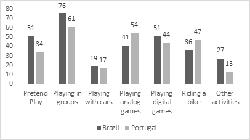
Activities preferred by the Brazilian and Portuguese children according to their guardians.
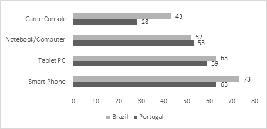
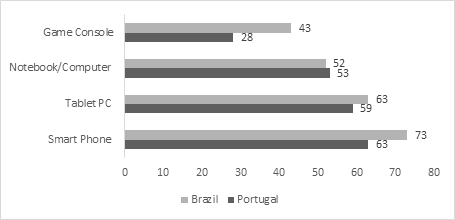
Among the technologies the children had access to, smartphones proved to be the most used both in Brazil and Portugal, corresponding to 31.03% and 31.6%, respectively, of the total records made for each country. One may observe in Figure 2 that the order of frequency of the most accessed technologies was maintained in both countries and that the access to tablets and laptop or desktop computers was very close. Only access to video game consoles was more significant for Brazilian children, corresponding to 18.61% of the total records in Brazil and 13.79% in Portugal.
In general, the analysis of the activities carried out by the children when accessing technologies did not reveal differences between the Brazilian and Portuguese children. When accessing digital technologies, the activities most often performed by Brazilian children were playing games and watching videos, followed by taking pictures. For the Portuguese children, playing games was the most performed activity according to their guardians, followed by watching videos and taking pictures, as shown in Table 1.
Another aspect analyzed relative to the access to the technologies was the time dedicated by the children to this activity. To this end, we sought to have indicators of both overall access to the technologies and time dedicated to digital games. Figure 3 shows there were differences between the time dedicated to technologies by the participating children from the two countries. In Brazil, the most significant portion of the children (n = 37) dedicated one to two hours of their day to interacting with digital technologies. It is also noteworthy that another portion of the Brazilian children (n = 29) dedicated, on average, 15 to 60 minutes per day to access technologies. In contrast, most of the Portuguese children (n = 42) accessed digital technologies for 15 to 60 minutes per day, and the second highest frequency was recorded in the time range of less than 15 minutes per day (n = 23). In the time range of three to four hours per day, 12 children were observed in Brazil and only two in Portugal.
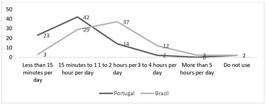
Frequencies of the time spent accessing technologies for the children from Portugal and Brazil.
Table 2 shows the distribution of frequencies and percentages by time range in the two countries, with the last ranges grouped due to the low frequency recorded. The analysis of these frequencies revealed that, in Brazil, children access digital technologies for longer, with the highest incidence being more than one hour per day, unlike in Portugal, where the highest frequency was for 15 to 60 minutes per day. The observed differences confirmed the association between the country and the digital technology access time by calculating the chi-square statistic, which resulted in χ² = 37.76 (df = 2; p = 0.000), revealing a dependence between these variables.
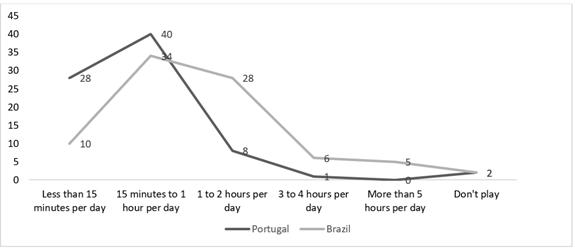
The analysis of time dedicated to accessing digital games also revealed differences when comparing the Brazilian and Portuguese participants, as shown in Figure 4. Most of the participating Brazilian children (n =34) played for 15 to 60 minutes per day, with the same frequency in the ranges of less than 15 minutes and from one to two hours per day (n = 28). In turn, the most significant portion of Portuguese children (n = 40) also played for 15 to 60 minutes per day, yet only eight children played for one to two hours per day, according to their guardians.
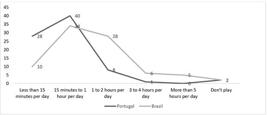
Frequencies of the time spent accessing digital games for the children from Portugal and Brazil.
The attention performance was measured through the collective application of the BPA subtests in the participating classrooms. The results of the performance assessment of the Brazilian and Portuguese children are presented in Table 3, in which one may observe a significant difference in the performance of the different types of attention assessed. The differences between the means were 17.5 points for concentrated attention, 24 for divided attention, and 12.7 for alternate attention, indicating that the participating Portuguese children had a statistically significant superior attention performance than the Brazilian children (p < 0.05).
Considering the performance of the different types of attention and the three main digital technology access time ranges, the possible association between these variables was analyzed. The results presented in Table 4 revealed that the best performances for concentrated and divided attention were obtained by the Brazilian and Portuguese children who accessed technologies from 15 to 60 minutes per day. For alternate attention, the Brazilian children who accessed digital technologies for more than one hour per day had the best mean and median scores, while the Portuguese children who had the best scores accessed them for 15 to 60 minutes per day. However, despite the differences observed, the Kruskal-Wallis test did not indicate significant differences. Also, a high standard deviation stood out, especially relative to the performance of Brazilian children, indicating a considerable difference in the performance of children in the time ranges.
The analysis of the association of the time dedicated to interacting with digital games using the Kruskal-Wallis test also did not reveal significant performance differences in the types of attention relative to the time ranges in the attention performance of the two analyzed samples of children (Brazilian and Portuguese). Table 5 shows the very close performances in the comparison between Portuguese children who played games in the three time ranges, with the most considerable difference being 15.5 points in the comparison with the concentrated attention performance of the children who played for less than 15 minutes and more than one hour per day. The performances of the Brazilian children in the time ranges showed more considerable variations. It should be noted that the best concentrated attention performances for the two samples were obtained in the range of those who played for less than 15 minutes a day. For divided attention, the best mean performances were of the Brazilian children who played for less than 15 minutes per day and the Portuguese children who played for 15 to 60 minutes per day. Finally, the best alternate attention performances for both the Brazilian and Portuguese children were obtained in the range that indicated playing games for more than one hour per day.
DISCUSSION
Nowadays, the development of attention, as an essential component of the being-in-the-world, is related to the development of technologies (Lewin, 2016). This is because the emergence of new technologies has modified, for example, how students engage in multiple attention streams (listening, reading, and sending text messages simultaneously), and they interfere with the organization of routines and activities carried out during childhood. Access to digital technologies and interaction with digital games are combined in the daily lives of children with other activities, such as playing and interacting socially.
From the results, some aspects that merit discussion and imply reflections related to guidance, mediation, and orientation in both the school and family contexts stood out. One of them refers to the favorite types of play of the participants in this study, who did not prioritize digital games over other types of play. It should be noted that the children from both countries preferred group play, which favors social interaction and is fundamental to human development. The importance of diversification of experiences for the healthy development of children is emphasized. The frequency observed in the different types of play of the children revealed a tendency toward this diversification.
Smartphones proved to be the most used devices by both the Brazilian and Portuguese children, with tablets in second place. The results follow the trend pointed out by the 2019 TIC Kids Online Brazil survey, published by the Regional Center for Studies on the Development of the Information Society (Cetic.br), which revealed smartphones as the primary devices used by children and adolescents for accessing the Internet (95%). In Portugal, a similar survey conducted and published by Ponte and Batista (2019) revealed that smartphones were the technology most accessed by Portuguese children and adolescents aged nine to 17 years, with nine out of ten survey participants using them every day, which corresponds to twice the daily use of computers (41%).
The main technology that children have access to could influence the results obtained in this study, as these portable devices allow individuals to engage with digital applications anytime and anywhere, which tends to increase the frequency of use and the total amount of time spent using digital technologies, corresponding to an increase in the number of children involved in overuse from a younger age (Ofcom, 2020; Siibak; Nevski, 2019). However, the comparative results are very similar, both in terms of the most used technology and the activities performed during its use, and it is not possible to establish a link between these factors and the differences observed in the performance of care in the two countries.
Concerning the activities carried out by the children participating in this study, the interaction with digital games stood out as the most frequent activity for Portuguese and Brazilian children, along with access to videos for the latter. These data corroborate the survey by Cetic (2020), which considered that, of the total users aged nine to 17, 83% watched videos, 765 performed searches, and 68% used social networks. The analysis by Palma et al. (2020) on the use of social networks by Brazilian children and adolescents as a space for socialization mediated by digital technologies connected to the Internet indicated that 40.8% played digital games once a week or more as part of the activities carried out in this space. In Portugal, the EU Kids Online survey indicated that the activities most performed by this public with digital technologies were related to entertainment and communication, with 80% using them to listen to music and watch videos and half referring to their use for online games (Ponte & Batista, 2019).
The digital technology access time analyzed in this study revealed that the Brazilian children dedicated more time than the Portuguese children, having a higher frequency of access for the time ranges of more than one hour per day. The main difference was in the range of one to two hours. It is noteworthy that the daily access time of the Brazilian children in this study was similar to that of other research, such as the studies by Konca (2022), which indicated an average daily access time of three hours for children aged three to six, and Kalabina and Progackaya (2021), which revealed that most children aged five to seven accessed digital technologies for one to three hours per day. The main difference was in the range of 1 to 2 hours. It should be noted that the daily access time of Brazilian children is similar to other studies, such as Konca (2022) who indicate an average daily access time for children aged 3 to 6 years is 3 and Kalabina to Progackaya (2021) who reveal that most children aged 5 to 7 years access 1 to 3 hours a day.
Otherwise, no association was identified between the time devoted to digital technologies and games and the performance of the different types of attention measured. These results refer to the need to deepen the investigation, particularly of the time dedicated to interacting with digital technologies and games and their quality. As evidenced by Dye and Bavelier (2010), visual attention, namely that required to search for a target, the time needed to recover attention and direct it to a target, and the number of objects to which attention may be simultaneously allocated, is improved by digital players compared to non-players. Despite the scarcity of studies, these results are encouraging and imply the continuation of research in this field, also considering different ages and digital games.
It is observed that when the preferred activities and the type of activities performed by Brazilian and Portuguese children are analyzed, no substantal differences are identified. However, there is a difference in relation to the times of exposure to digital technologies. Vedechkina and Borgonovi (2021) reinforce that there is no scientific consensus on the effects of children's exposure to digital technologies and consider that many factors such as the characteristics of users, the form and type of content accessed and the circumstances in which use occurs and the interaction between the three factors. In relation to digital games, several scientific evidences indicate that the possible effects on attention performance depend on the type of game content and the cognitive skills/abilities that are recruited (Boot et al., 2008; Green; Bavelier, 2006; Oei; Patterson, 2015).
Digital technologies offer different types of stimuli, which in turn exercise diverse types of attention. In the interaction with a digital game, for example, a child uses concentrated attention on the execution of movements to follow a trajectory, managing to sustain it for long periods while being distracted by other stimuli that capture the focus and cause the flow of the immersion to oscillate. At other times, there is attention that is divided between executing an action and following the feedback and controls presented on the screen.
This factor may also be related to the fact that the time ranges of interaction with digital games are not associated with significant differences in attention performance. The younger they are, the less is the cumulative time of exposure to this technology. Regarding the effects of games on attention, it is necessary to consider the type of task and attention required. When assessing visual attention as the ability to quickly and efficiently filter out visual distractors presented rapidly, there is strong evidence that digital action games significantly improve this ability (Green; Bavelier, 2006; Greenfield, 1994; Feng; Spence; Pratt, 2008). However, if one analyzes the ability to stay focused on a flow of information that evolves slowly, such as attention in class, there are research results that suggest that the total screen time and the interaction time with games, in particular, may have negative effects (Bavelier et al., 2011).
From this perspective, the relevance emerges of attention being researched in its correlation with various competencies, such as critical and creative thinking. Not least because, as previously mentioned by Ramos and Vieira (2020), interaction with technologies may have implications for attention performance, and the identification of the most distracting focuses and multitasking may be enhanced in favor of learning different dimensions of competencies, such as those mentioned. In this sense, authors such as Vorvoreanu (2014) have also highlighted the relevance of becoming aware of the importance of self-regulation of attention and the framework of competencies for different literacies, such as technological and media literacies. The latter even reinforced that attention should be considered a fundamental part of alphabetization and technological literacy.
It should also be emphasized that, nowadays, there is an exponential amount of information in different formats due to the dissemination of digital information and communication technologies. Given this, Citton (2018) emphasized that information consumes the attention span, which is limited. This limitation of the attention span and the number of stimuli that compete for attention makes it something valued. Many digital platforms vie for the attention of users (Pedersen; Albris; Seaver, 2021).
In the research carried out with children, no association was observed between the technology and game access time and attention performance, unlike the mentioned studies conducted with adults. However, the comparison between the performance of Brazilian and Portuguese children showed a statistically significant difference, with the Portuguese children being superior. One difference in the samples was that the Portuguese children studied full-time, while the surveyed Brazilian children only attended school for part of the day. This may be one of many explanations that help understand the difference found. It is known that school has a fundamental role in development and learning during childhood, as it is marked by guided and intentional activities that organize a routine and fundamentally include the exercise of the different types of attention.
At the same time, it is highlighted that the use of digital technologies and games in school favors the orientation and encouragement of reflection on their use and the preparation of children to deal with all possibilities more consciously and critically. According to Vorvoreanu (2014), educational institutions must guide students on how to use digital technologies more responsibly, reflexively, and effectively.
A broader analysis of cultural and social differences could contribute to the discussion of these results. It is known that Brazil has a strong cultural influence from Portugal due to the colonization process that sought to mirror the structure, values and beliefs (Caldas, 1997, Holanda, 1995). However, it is observed that Brazil has greater economic challenges, has a much wider geographical extension that culminates in great social and cultural diversity, as well as problems such as more violence and insecurity. The research carried out did not map the cultural and social aspects present in the sample. It is noted the age group close to the participants and those who attend public educational institutions in which a factor that strongly differentiates the two educational systems is that in Portugal we have a comprehensive education, where children spend 5 to 8 hours daily in schools and in Brazil they are, on average, approximately 4 hours.
The diversified universe of digital technologies imposes significant challenges to research, with Vedechkina and Borgonovi (2021) having warned about the factors and circumstances that must be considered when seeking the implications of using these technologies. The clipping of digital games, for example, involves millions of games, hundreds of distinct genres and subgenres, and they may also be played on different devices such as computers, consoles, tablets, and smartphones. Therefore, according to Bavelier et al. (2011), it is not possible to have a scientific predictive power that points to the benefits and harms of their use. However, scientific evidence may describe and indicate changes in different conditions of use, such as the connection with screen exposure time in the interaction with digital technologies, or reinforce the importance of adult mediation to obtain favorable gains for child development.
Finally, it is reinforced that not all individuals will be equally affected by technology, just as not all technologies affect cognition globally and persistently. These results highlight the limitations of generalization across different screen-based activities when discussing the cognitive implications of digital technologies.
CONSIDERAÇÕES FINAIS
The results revealed that the time spent accessing and interacting with digital technologies and games cannot be associated with the performance of the different types of attention of the participating children. However, a higher performance of Portuguese children was observed, which may be related to access to full-time education, but many other cultural and contextual factors may influence attention performance. In addition, the sample is small and not random, aspects that reinforce the need to be very cautious in interpreting and generalizing the results. Thus, these results reinforce the need for more scientific studies that can analyze in depth the factors that may influence the effects of exposure to digital technologies, highlighting the type of content accessed and activities developed and the circumstances of access, including parental mediation.
Thus, it is necessary to develop cross-sectional and longitudinal studies, including expressive samples, which can offer better contributions to understanding which factors may influence attention performance.
In this context, the results obtained are added to other scientific evidence that reinforces that interaction with technologies does not necessarily hinder the development of attention. However, the sample size and convenience selection are recognized as limitations, as well as the use of questionnaires, which may not reflect the interactions and uses made by children of digital technologies, as it is based on the perception of parents.
This reinforces the need for education and schools to consider the significant presence of technology in children's daily lives and the body of scientific evidence. The evidence is often controversial, but it points to the influence of digital technologies on cognitive development and the learning process. Thus, there is a wide range of technologies and digital games that have educational potential and can improve the different types of attention of children in the early years of schooling.
At the same time, knowing the different factors that influence this relationship may provide subsidies to the organization of curricula and public education policies, as well as prevent learning difficulties and ensure the quality of life and health of children and future adults.
References
-
BAVELIER,D.et al .Brains on video games.Nature reviews neuroscience, v.12, n.12, p.763,2011.Disponível em: https://doi.org/10.1038/nrn3135 Acesso em:09 mar. 2018.
» https://doi.org/10.1038/nrn3135 - BAVELIER,D.; GREEN,C. S. ;DYE,M. W. G .Children, wired: For better and for worse.Neuron, v.67, n.5, p.692-701,2010.
- BEAUDOIN,M. E.et al.Systematic research is needed on the potential effects of lifelong technology experience on cognition: a mini-review and recommendations.Frontiers in Psychology, v.15, p.1335864,2024.
-
BESTER,G.,E BRAND,L.The effect of technology on learner attention and achievement in the classroom.South African Journal of Education, v.33, n.2,2013.Disponível em:<http://dx.doi.org/10.15700/saje.v33n2a405>Acesso em:04 fev. 2018.
» https://doi.org/10.15700/saje.v33n2a405 - BOOT,W. R.;KRAMER,A. F.;SIMONS,D. J.;FABIANI,M.;GRATTON,G.The effects of video game playing on attention, memory, and executive control.Acta Psychologica V.129, (3), Nov.2008, p.387-398.
- CALDAS,M. P.Santo de casa não faz milagre: condicionantes nacionais e implicações organizacionais da fixação brasileira pela figura do "estrangeiro". In:MOTTA,F. C.,CALDAS,M. P. (Orgs.)Cultura organizacional e cultura brasileira(pp.73-93).São Paulo:Atlas,1997.
- CARDOSO-LEITE,P.;BAVELIER,D.Video game play, attention, and learning: how to shape the development of attention and influence learning?.Current opinion in neurology, v.27, n.2, p.185-191,2014.
-
CETIC.Centro Regional de Estudos para o Desenvolvimento da Sociedade da Informação.Pesquisa sobre o uso da Internet por crianças e adolescentes no Brasil - TIC Kids Online Brasil 2019São Paulo:Comitê Gestor da Internet no Brasil,2020.Disponível em:Disponível em:https://cetic.br/pt/publicacao/pesquisa-sobre-o-uso-da-internet-por-criancas-e-adolescentes-no-brasil-tic-kids-online-brasil-2019 >Acesso em:15 jun. 2020.
» https://cetic.br/pt/publicacao/pesquisa-sobre-o-uso-da-internet-por-criancas-e-adolescentes-no-brasil-tic-kids-online-brasil-2019 -
CITTON,Y.Da economia à ecologia da atenção.Ayvu: Revista de Psicologia, v.5, n.1, p.13-41,2018.Disponível em:<https://doi.org/10.22409/ayvu.v5i1.27498>Acesso em:10 jun. 2020.
» https://doi.org/10.22409/ayvu.v5i1.27498 - COURAGE,M L.;RICHARDS,J E.Attention. In:HAITH,M. M.;BENSON,J. B.Encyclopedia of Infant and Early Childhood DevelopmentElsevier,2008, p.106-117.
- DIAMOND,A.Executive Functions.Annual review of psychology64:135-168,2013.Disponível em:<10.1146/annurev-psych-113011-143750>Acesso em:21 ago. 2020.
- DIAMOND,A., LEE,K.Interventions Shown to Aid Executive Function Development in Children 4 to 12 Years Old.Science,333(6045),959-964,2011.DYE, Matthew WG; BAVELIER, Daphne. Differential development of visual attention skills in school-age children. Vision research, v. 50, n. 4, p. 452-459, 2010.
- DYE,M. W. G;BAVELIERD ,.Differential development of visual attention skills in school-age children.Vision research, v.50, n.4, p.452-459,2010.
- FENG,J.; SPENCE,I.;PRATT,J.Playing an action video game reduces gender differences in spatial cognition.Psychological science, v.18, n.10, p.850-855,2007.
- GIL,A. C.Métodos e Técnicas de Pesquisa SocialSão Paulo:Atlas,2008.
-
GREEN,C. S.;BAVELIER,D.Effect of action video games on the spatial distribution of visuospatial attention.Journal of experimental psychology: Human perception and performance, v.32, n.6, p.1465,2006. .Disponível em:<http://dx.doi.org/10.1037/0096-1523.32.6.1465>Acesso em:06 mar. 2017.
» https://doi.org/10.1037/0096-1523.32.6.1465 - GREENFIELD,P. M.et al.Action video games and informal education: Effects on strategies for dividing visual attention.Journal of applied developmental psychology, v.15, n.1, p.105-123,1994.
- GUÍA,E.,LOZANO,M. D.,PENICHET,V. M.Educational games based on distributed and tangible user interfaces to stimulate cognitive abilities in children with ADHD.British Journal of Educational Technology, v.46, n.3, p.664-678,2015.
- HOLANDA,Sérgio B.Raízes do Brasil.26. ed.São Paulo:Companhia das Letras,1995.
- KLIMKEIT,E. I.et al.Examining the development of attention and executive functions in children with a novel paradigm.Child Neuropsychology, v.10, n.3, p.201-211,2004.
- KONCA,Ahmet Sami.Digital technology usage of young children: Screen time and families.Early Childhood Education Journal, v.50, n.7, p.1097-1108,2022.
- KOWALSKI,R. P. G.;TORRES,P. L.;SILVA,L..Tecnologia Imersiva.Revista Communitas, v.4, n.7, p.168-181,2020.
- LEWIN,D.The Pharmakon of Educational Technology: The disruptive power of attention in education.Studies in Philosophy and Education, v.35, n.3,251-265,2016.
- LEZAK,M. D.Neuropsychological Assessment.New York:Oxford University Press,1995.
-
LI,R.et al.Reducing backward masking through action game training.Journal of vision, v.10, n.14, p.33-33,2010.Disponível em:<10.1167/10.14.33>Acesso em09 mar. 2019.
» https://doi.org/10.1167/10.14.33 - LISSAK,G.Adverse physiological and psychological effects of screen time on children and adolescents: Literature review and case study.Environmental research, v.164, p.149-157,2018.
- MACLIN,E. L.et al.Learning to multitask: effects of video game practice on electrophysiological indices of attention and resource allocation.Psychophysiology, v.48, n.9, p.1173-1183,2011.
- MATTAR,J.,RAMOS,D..Metodologia da pesquisa em educação: abordagens qualitativas, quantitativas e mistas.São Paulo:Edições 70,2021.
-
OEI,A. C.;PATTERSON,M. D.Enhancing perceptual and attentional skills requires common demands between the action video games and transfer tasks.Frontiers in psychology, v.6, p.113,2015. doi:10.3389/fpsyg.2015.00113
» https://doi.org/10.3389/fpsyg.2015.00113 - OFCOM.Children and Parents: Media Use and Attitudes Report 2019London:Ofcom,2020.
-
PALMA,A.;ROJAS,F.;TRUCCO,D.O uso de redes sociais por crianças e adolescentes no Brasil, no Chile, na Costa Rica e no Uruguai. In:CETIC.Centro Regional de Estudos para o Desenvolvimento da Sociedade da Informação.Pesquisa sobre o uso da Internet por crianças e adolescentes no Brasil - TIC Kids Online Brasil 2019São Paulo:Comitê Gestor da Internet no Brasil ,2020.Disponível em:<Disponível em:https://cetic.br/pt/publicacao/pesquisa-sobre-o-uso-da-internet-por-criancas-e-adolescentes-no-brasil-tic-kids-online-brasil-2019/ >Acesso em:25 jun. 2020.
» https://cetic.br/pt/publicacao/pesquisa-sobre-o-uso-da-internet-por-criancas-e-adolescentes-no-brasil-tic-kids-online-brasil-2019/ - PEDERSEN,M. A.;ALBRIS,K.;SEAVER,N.The political economy of attention.Annual Review of Anthropology, v.50, p.309-325,2021.
-
PONTE,C.;BATISTA,S.EU Kids Online Portugal Usos, competências, riscos e mediações da internet reportados por crianças e jovens (9-17 anos).EU Kids Online e NOVA FCSH,2019Disponível em:Disponível em:http://fabricadesites.fcsh.unl.pt/eukidsonline/wp-content/uploads/sites/36/2019/03/RELATO%CC%81RIO-FINAL-EU-KIDS-ONLINE.docx.pdf Acesso em:25 jun. 2020.
» http://fabricadesites.fcsh.unl.pt/eukidsonline/wp-content/uploads/sites/36/2019/03/RELATO%CC%81RIO-FINAL-EU-KIDS-ONLINE.docx.pdf - RAMOS,D. K.;VIEIRA,R. M.Repercussões das tecnologias digitais sobre o desempenho de atenção: em busca de evidências científicas.Revista Brasileira de Educação, v.25, p.e250048,2020.
- RUEDA,F. J. M.Bateria psicológica para avaliação da atenção (BPA)São Paulo:Vetor,2013.
- RUEDA,F. J. M.;MONTEIRO,R. de M.Bateria Psicológica para Avaliação da Atenção (BPA): desempenho de diferentes faixas etárias.Psico-USF, v.18, p.99-108,2013.
- RUEDA,M. R.;CHECA,P.;COMBITA,L. M.Enhanced efficiency of the executive attention network after training in preschool children: immediate changes and effects after two months.Developmental Cognitive Neuroscience, v.2, p.S192-S204,2012.
- SIIBAK,A.;NEVSKI,E.Older siblings as mediators of infants’ and toddlers’(digital) media use. In:ERSTAD,O.,FLEWITT,R.,KÜMMERLING-MEIBAUER,B., &PEREIRA,Í. S. P. (Eds.).The routledge handbook of digital literacies in early childhood, p.123-133,2019.
-
SMALL,G. W.et al.Brain health consequences of digital technology use.Dialogues in clinical neuroscience, p.179-187,2022. doi: https://doi.org/10.31887/DCNS.2020.22.2/gsmall
» https://doi.org/10.31887/DCNS.2020.22.2/gsmall - SPENCE,C.Attention. In:RAMACHANDRAN,V. S.Encyclopedia of Human Behavior2ª ed.Academic Press,2012, p.211-217.
-
SPRITZER,D. T.,FORTIM,I.,VASCONCELOS,F.,CARVALHO,E.Atualizando o debate sobre “tempo de tela”: ainda faz sentido tanta preocupação? In:Comitê Gestor da Internet no Brasil. Pesquisa sobre o uso da Internet por crianças e adolescentes no Brasil: TIC Kids Online Brasil 2020:Edição COVID-19 : metodologia adaptada. Núcleo de Informação e Coordenação do Ponto BR. -- 1. ed. --São Paulo:Comitê Gestor da Internet no Brasil ,2021.Disponível em:Disponível em:https://cetic.br/media/docs/publicacoes/2/20211125083634/tic_kids_online_2020_livro_eletronico.pdf Acesso em:12 abr. 2022.
» https://cetic.br/media/docs/publicacoes/2/20211125083634/tic_kids_online_2020_livro_eletronico.pdf - STRASBURGER,V. C.et al.Children, adolescents, and the media.Pediatrics, v.132, n.5, p.958-961,2013.
-
THORELL,L. B.,LINDQVIST,S.,BERGMAN,S.,BOHLIN,N. G., &KLINGBERG,T.Training and transfer effects of executive functions in preschool children.Developmental Science,12,2009, p.106-113.Disponível em: <10.1111/j.1467-7687.2008.00745>Acesso em18 ago. 2018.
» https://doi.org/10.1111/j.1467-7687.2008.00745 - VEDECHKINA,M.;BORGONOVI,F.A review of evidence on the role of digital technology in shaping attention and cognitive control in children.Frontiers in Psychology, v.12, p.611155,2021.
- VORVOREANU,M.Attention Management as a Fundamental Aspect of 21st Century Technology Literacy: A Research Agenda. In 2014 ASEE Annual Conference e Exposition, p.24-218.Indianópolis:American Society for Engineering Education,2014.
-
DATA AVAILABILITY DECLARATION
The entire dataset supporting the results of this study has been made available in the Zenodo repository and can be accessed at https://zenodo.org/records/7331978
The entire dataset supporting the results of this study has been made available in the Zenodo repository and can be accessed at https://zenodo.org/records/7331978
History
-
Received
29 May 2023 -
Preprint posted on
01 Feb 2023
10.1590/SciELOPreprints.5188 -
Accepted
07 July 2025

 Source: Prepared by the authors.
 Source: Prepared by the authors.
 Source: Prepared by the authors.
 Source: Prepared by the authors.