
 DIDACTICS HANDBOOKS AS A SOURCE AND OBJECT OF STUDY: A LITERATURE REVIEW
ABSTRACT:
This article aims to present an overview of studies that examine didactic handbooks as both sources and/or objects of study. Therefore, a literature review was conducted using the following databases: SciELO, the Capes theses and dissertations catalog, Google Scholar, and the proceedings of the Brazilian National Meeting on Didactics and Teaching Practices (ENDIPE). This article represents the initial stage of a broader research project that investigates the historical constitution of the identity of didactics. This was possible through the analysis of books intended for the education of pre-service and in-service teachers, focusing on Didactics handbooks produced in Brazil, Portugal, and Spain, between 1930 and 1970. The first part of this article presents the methodological procedures and quantitative results of the bibliographic survey of Didactics handbooks as both sources and/or objects of study. The second part provides a descriptive and analytical synthesis of the 16 studies found, highlighting their understandings of these handbooks, the objectives of the studies, the time frame, and their main findings. Finally, the article discusses their contributions and identifies research gaps that may be addressed in future investigations.
Keywords:
Didactics handbooks; history of didactics; teacher education; literature review
RESUMO:
Este artigo tem como objetivo apresentar um balanço de pesquisas que tomam os manuais de Didática como fonte e/ou objeto de estudo. Para tanto, buscou-se empreender uma revisão de literatura nas seguintes bases de dados: SciELO, catálogo de teses e dissertações da Capes, Google Acadêmico e anais do Encontro Nacional de Didática e Práticas de Ensino. Trata-se da etapa inicial de uma pesquisa mais ampla, que teve como objeto de investigação a constituição histórica da identidade da Didática. Isso foi possível por meio da análise de livros destinados à formação de aspirantes ao magistério e professores em exercício, com foco em manuais de Didática produzidos no Brasil, em Portugal e na Espanha, entre 1930 e 1970. Na primeira parte, são apresentados os procedimentos metodológicos e os resultados quantitativos do levantamento bibliográfico sobre manuais de Didática como objeto e/ou fonte de estudo. Na segunda parte, realiza-se uma síntese descritivo-analítica dos 16 trabalhos encontrados, destacando-se compreensões sobre os manuais, objetivos dos estudos, recorte temporal e os principais resultados. Por fim, são indicadas contribuições destas pesquisas e lacunas que podem ser objeto de investigação em estudos futuros.
Palavras-chave:
Manuais de didática; história da didática; formação de professores; revisão de literatura
RESUMEN:
Este artículo tiene como objetivo presentar un balance de investigaciones que toman los manuales de Didáctica como fuente y/u objeto de estudio. Para ello, se buscó emprender una revisión de literatura en las siguientes bases de datos: SciELO, Catálogo de tesis y disertaciones de CAPES, Google Académico y anales del Encuentro Nacional de Didáctica y Prácticas de Enseñanza. Se trata de la etapa inicial de una investigación más amplia que tuvo como objeto de investigación la constitución histórica de la identidad de la Didáctica por medio del análisis de libros destinados a la formación de aspirantes al magisterio y profesores en ejercicio, con enfoque en manuales de Didáctica producidos en Brasil, Portugal y España entre 1930 y 1970. En la primera parte, son presentados los procedimientos metodológicos y los resultados cuantitativos del levantamiento bibliográfico sobre manuales de Didáctica como objeto y/o fuente de estudio. En la segunda parte, se realizó una síntesis descriptivo-analítica de los dieciséis trabajos encontrados, destacándose las comprensiones sobre los manuales, objetivos de los estudios, recorte temporal y los principales resultados. Por fin, son indicadas contribuciones de estas investigaciones y huecos que pueden ser objeto de investigación en estudios futuros.
Palabras clave:
Manuales de didáctica; historia de la didáctica; formación de profesores; revisión de literatura
INTRODUCTION
Didactic handbooks are a broader category of books aimed at the pedagogical training of teachers. These works are frequently referred to in the historiography of education as “pedagogical handbooks.” We agree with Catani and Silva (2010) that an understanding of the specific characteristics of these books aims to “expand what is known regarding teacher training and the practice of the teaching profession, as well as the profession and the educational sciences, given that they articulate what is considered, at any given moment, ‘the best’ course of action for teachers” (apud Oliveira; Duarte; Vieira, 2010, p. 4).
Studies on school textbooks, including those intended for teacher training, constitute an already well-established field within the history of education, both in Brazil and abroad. Within the scope of this production, manualística (textbook studies) is highlighted, a term used by Agustín Escolano Benito (2012) to designate a field of study that conceptualizes schoolbooks as a specific class of texts, endowed with their distinct pedagogical and cultural status. Over recent decades, there has been a noticeable increase in research taking textbooks as both a primary source and an object of analysis. In the specific case of books designed for teacher training, the analytical focus tends to center on the reception and circulation of pedagogical ideas, their articulation with the history of the teaching profession, and the use of these textbooks as a source for analyzing specific subjects within the curricula of normal schools, institutes of education, and teacher-preparation programs.
The significant growth of studies concerning teacher training handbooks has led to a constant need for reviews of the existing literature. This synthesizes accumulated knowledge by highlighting what is already known about a given topic and what still requires further investigation. Within the spirit of this type of inquiry, the objective of this study is to conduct a literature review of academic research that used Didactic handbooks as either a primary source or an object of study, presenting a descriptive-analytical synthesis of the identified papers.
Within the broader context of studies on teacher training handbooks, are books on Didactics also receiving attention from education scholars? What aspects have these studies emphasized regarding Didactic handbooks in the context of teacher training? Which specific book titles are being examined? What timeframes are being prioritized in this research? What remains to be better understood? These are the guiding questions that underpin this study.
The article is organized into two parts. The first part presents the methodological procedures and quantitative results of the bibliographic survey. The second part provides a descriptive-analytical synthesis of the identified papers, highlighting insights regarding the handbooks, study objectives, timeframes, and key findings. Finally, the main contributions of these studies are outlined, along with gaps that may be investigated in future research.
This study focuses on the construction of Didactics as a discipline and an epistemological field in Brazil, advocating for the preservation of the history and memory of the teaching profession.
METHODOLOGICAL PROCEDURES AND EVIDENCE DATA
The literature review providing methodological foundation for this study was conducted during the initial phase of a broader research project. The objective was the historical constitution of the identity of Didactics, analyzed through a study of textbooks produced in Brazil, Portugal, and Spain between 1930 and 19702. The survey of existing literature was a fundamental stage in research since “only through a literature review can we better understand what has already been written regarding our initial general idea, and, subsequently, define the perspective through which we intend to study a given phenomenon” (Mattar; Ramos, 2021, p. 40).
The first criterion for including articles in the survey was that they address teacher training handbooks within the Brazilian context. The second criterion concerns articles that featured the search descriptors in their title and/or abstract. Regarding the selection of descriptors, the initial decision was to conduct a review of papers encompassing both pedagogy/pedagogical handbooks in a general sense and Didactic manuals in a specific sense3. The descriptors used were: a) Pedagogy handbooks, pedagogical handbooks, Pedagogy books; b) Didactic handbooks, Didactic books, and Didactic compendiums.
To clarify the specific nature of these works, we briefly outline what is understood by the following terms: a) Pedagogical handbooks: the most comprehensive category including “books for the teaching of professionalizing disciplines within the curricula of teacher training institutions, specifically, those directly related to educational issues such as pedagogy, didactics, methodology, and teaching practice” (Silva, 2003, p. 30); b) Pedagogy handbooks: included within the “pedagogical handbooks” category, but, more specifically, as books for the theoretical exploration of Pedagogy as a scientific field in education, typically recommended for courses in Pedagogy or the History of Pedagogy; and c) Didactic handbooks or handbooks on the teaching of Didactics: also included within the “pedagogical handbooks” category, but, even more specifically, as books recommended for courses in Didactics or General Didactics.
To encompass a broader range of studies, we opted for searches across the following databases: Scientific Electronic Library Online (SciELO), the Theses and Dissertations Catalog of the Coordination for the Improvement of Higher Education Personnel (Capes-Fundação Coordenação de Aperfeiçoamento de Pessoal de Nível Superior), Google Scholar, and the Proceedings of the National Meeting on Didactics and Teaching Practices (ENDIPE-Anais do Encontro Nacional de Didática e Práticas de Ensino). For the SciELO database and the Capes Theses and Dissertations Catalog, we selected papers featuring the aforementioned descriptors in their title and/or abstract. Within the SciELO database, the following search filters were also applied: Collections: Brazil > Journals: All > Publication Years: All > Subject Areas: Humanities > Literature Types: All. For Google Scholar and the ENDIPE Proceedings, we considered only those works featuring the descriptors in their title, without the use of any other search filters, but referring to studies produced in Brazil. ENDIPE is one of the most significant events within the educational landscape and the most emblematic in the field of Didactics. These meetings take place biennially, and the papers presented are published in the event's proceedings. In this study, we considered the editions from 1982, 1983, 1985, 1994, 1996, 1998, 2012, 2016, 2018, 2020, and 2022. The proceedings for the 1987, 1989, 1991, 2002, 2004, 2006, 2010, and 2014 editions could not be located, whether due to technical issues on the websites consulted at the time of the research, or due to a lack of digitization and availability on the website of the National Association for Didactics and Teaching Practices (Andipe-Associação Nacional de Didática e Práticas de Ensino). The survey encompassed works published between 1985, the year of the earliest research located, and 2024, corresponding to the final year in which searches were conducted across the selected databases.
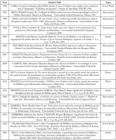
Studies focusing on textbooks for specific curriculum subjects, such as “teaching handbooks for... (mathematics, geography, etc.),” “teaching methodology for... (mathematics, geography, etc.),” or “didactics of... (arithmetic, history, etc.)” were excluded. To avoid duplication, any studies identified in one of the searched databases were also excluded. A quantitative summary of the studies can be found in the table below:
As we observe in the quantitative presentation of the identified papers, there is a predominance of studies utilizing the descriptors Pedagogy handbooks/pedagogical handbooks/Pedagogy books. The vast majority refer to the term “pedagogical handbooks,” as this constitutes a more comprehensive category, as previously explained.
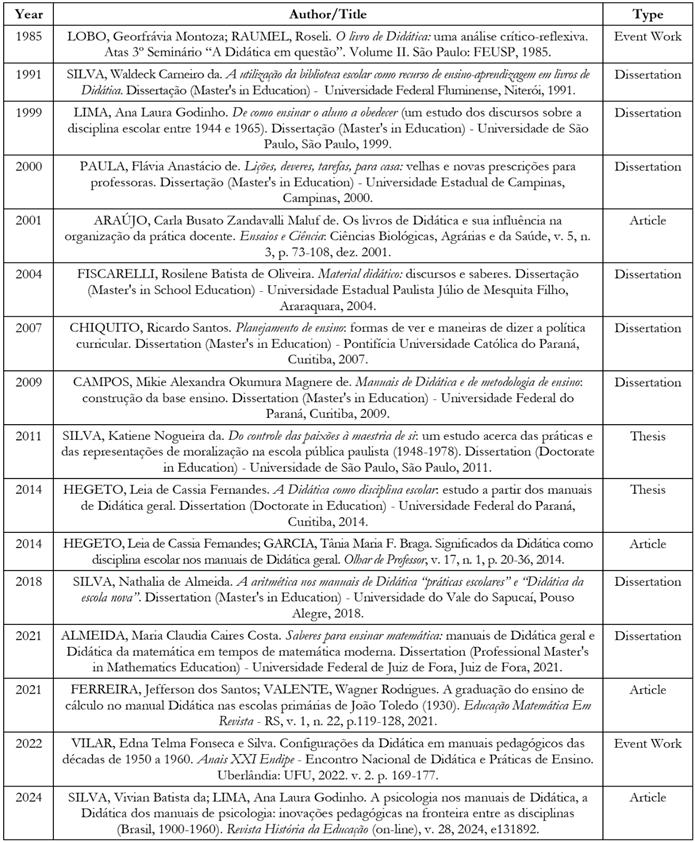
Although the bibliographic survey considered both pedagogical/Pedagogy handbooks and Didactic handbooks, the analytical focus of this study centers on the category of “Didactic Handbooks” or “Didactic Teaching” materials. As shown in Table 1, a total of 16 papers were identified containing the descriptors Didactic handbook/Didactic teaching handbooks/Didactic book in their title and/or abstract: one in the SciELO database; 10 in the CAPES theses and dissertations database; three in Google Scholar (excluding theses and dissertations already identified in the CAPES database); and two in the Endipe Conference Proceedings. Papers with the terms “didactic manuals” or “didactic books” in their title and/or abstract were excluded, even if related to teacher education, as they did not explicitly focus on the specific analysis of Didactic handbooks. The chart below summarizes, in chronological order, the studies identified during the bibliographic survey.
The first finding highlighted by the survey is that, in quantitative terms (totaling 16 studies), the number of research projects that adopt Didactic handbooks as a source or object of study can be considered small, particularly when considering the temporal scope of nearly 40 years spanning the earliest study identified (1985) and the most recent (2024).
A second finding outlined by the survey concerns the titles and abstracts of these studies, specifically the role that Didactic handbooks play within them. Six studies feature Didactic handbooks as the central object of their analysis (Lobo & Raumel, 1985; Araújo, 2001; Campos, 2009; Hegeto, 2014; Hegeto & Garcia, 2014; Vilar, 2022). Temn studies used Didactic handbooks as a source to develop their central research themes: the use of school libraries as a teaching-learning resource (Silva, 1991); discourses regarding school discipline (Lima, 1999); prescriptions concerning lessons, assignments, and homework (Paula, 2000); discourses and knowledge regarding instructional materials (Fiscarelli, 2004); instructional planning (Chiquito, 2007); practices and representations of moralization in public schools in the state of São Paulo (Silva, 2011); arithmetic (Silva, 2018); knowledge for teaching mathematics (Almeida, 2021); the sequencing of Calculus instruction (Ferreira & Valente, 2021); and psychology within Didactics handbooks versus the Didactics of Psychology (Silva & Lima, 2024). Thus, Didactic handbooks appear in the surveyed research both as a central object of study and as a source that helps in constructing analytical interpretations regarding specific aspects of the educational process, particularly from a historical perspective.
A third element is the Brazilian region of the authors' institutional affiliation: São Paulo was the state of affiliation for eight researchers, followed by five authors from Paraná, two from Minas Gerais, one from Rio de Janeiro, one from Mato Grosso do Sul, and one from Bahia.
The survey also shows the typology of studies conducted regarding Didactic handbooks in Brazil. Most research, 11 studies in total, aimed at obtaining an academic degree, comprising eight master's dissertations and three doctoral theses. Some of these works, produced before 2014, are not available in digital format within the CAPES catalog of theses and dissertations and/or in the repositories of their respective universities. To access them, it was necessary to conduct searches via other electronic channels, request digitization services from libraries, and/or contact the authors directly. Two studies could not be located in digital format but were accessible physically, as they had been published as a book. This is the case with the dissertation by Waldeck Carneiro da Silva (1991), titled “A utilização da biblioteca escolar como recurso de ensino-aprendizagem em livros de Didática” (The Use of the School Library as a Teaching-Learning Resource in Didactics Books) in the book titled Miséria da biblioteca escolar (The Misery of the School Library) (1995). The same happened with the dissertation by Rosilene Batista de Oliveira (2004), titled “Material didático: discursos e saberes” (Didactic Material: Discourses and Knowledge), which was published as a book under the same title in 2008. When referring to these studies, the publication dates of the books are adopted (Silva, 1995; Oliveira, 2008), given that the content of the dissertations was accessed exclusively in this format.
Finally, reading the papers allowed for the identification of other relevant references regarding publications on Didactic handbooks. However, they were not included in this bibliographic survey because they could not be located within the databases selected. This is the case with the dissertation by Maria Luisa de Aguiar Amorim, titled “Análise dos conteúdos dos livros textos de Didática: reprodução ou transformação social?” (Analysis of the Contents of Didactics Textbooks: Reproduction or Social Transformation?), defended in 1986 at the Federal University of Ceará, which does not appear in the CAPES catalog of theses and dissertations.
After presenting the methodology and the overview of the initial data, we now proceed to a descriptive-analytical synthesis of the inventoried works.
DIDACTIC HANDBOOKS AS A SOURCE AND/OR OBJECT OF INVESTIGATION
There is a consensus among the articles and dissertations/theses that books intended for teacher education, while objects of mediation between specific pedagogical knowledge and how it is applied in the classroom, constitute powerful sources for research into the history of teacher professionalization, and understanding the teaching contents and methods prioritized during different historical periods. However, there are specificities regarding the research objectives, sources, chronological scope, and main findings, which will be presented throughout this section.
Descriptive-Analytical Synthesis of the Studies
The work published by Lobo and Raumel (1985, p. 25) aimed to “gather data to critically reflect upon the selection and utilization of the textbook within the field of Didactics.” According to the authors, the textbook is “a resource that is difficult to surpass as a medium for the acquisition of information and the development of intellectual skills” (p. 25). In the mid-1980s, the study indicated that educational research was only just beginning to turn its attention to the study of teaching handbooks, despite the widespread presence and use of these objects within the school environment. The authors’ investigation, which involved the analysis of three Didactics handbooks produced between the 1970s and 1980s, revealed “an excessive emphasis on demonstrating ‘how to do it’, based on preconceived models of lesson plans and specific teaching techniques”, and further indicated that the books examined “address solely the technical dimension, emphasizing established plans and, potentially, alienating the teacher from the teaching process and its operations, thereby precluding a rethinking of the role of the Didactics textbook” (p. 32).
In her dissertation, Silva (1995) sought to investigate the form and content through which books on Didactics addressed the use of the library in school education. To this end, she analyzed a set of Didactics textbooks most frequently recommended to undergraduate teacher-training students at universities in Rio de Janeiro during the period from 1988 to 1990. As a result, she found that only one of these books addressed the role of the library in the teaching-learning process. Consequently, she concluded that, “from the standpoint of an explicit approach, the vast majority of the Didactics textbooks most frequently recommended at universities in the state of Rio de Janeiro remain completely silent regarding the possibilities for integrating the school library into that process” (pp. 40-41).
Lima’s (1999) dissertation aimed to examine the recommendations for establishing and maintaining discipline found in the discourse of educational journals and Didactic handbooks produced between 1940 and 1960. In discussing books intended for students in teacher training programs, the author noted that one of the defining characteristics of these works is their accessible, and even inviting, language, serving as “a true guide for the student taking their first steps as a teacher”; another important feature of these books “is the frequent recurrence of examples and detailed rules that were to be followed to ensure success” (p. 35). Upon concluding her research, the author observed that the suggestions presented in these Didactic handbooks were intended not only to assist teachers in maintaining order in the classroom but also to discipline their own professional practice. To combat “poor teaching habits”, which undermined classroom instruction and the maintenance of discipline, “various teaching strategies were proposed that aligned with the tenets of the Escola Nova [New School] movement and were designed to ensure a more productive and enjoyable learning experience for both teachers and students” (p. 195).
Didactic textbooks are also a documentary source in Paula’s (2000) dissertation, which examines the prescriptions directed at teachers regarding duties, tasks, and homework. According to the author, these handbooks are regarded as “a possible interpretation of theories, a translation, a mediation, yet ones that frequently standardized and legitimized a particular way of doing and thinking about school and within the school setting” (p. 2). After analyzing a collection of textbooks produced between the 1960s, 1970s, and 1980s, the author characterized duties, tasks, and homework, among other things, as “a school practice that is debated, contested, and lacking consensus; a struggle over meaning established by various pedagogical currents across different political moments, at times more evident, and at other times less so, as is the case today” (p. 188).
Araújo’s (2001) article highlights the influence of Didactics handbooks on teachers’ pedagogical practice, serving as “means for the objectification and simplification of teaching work, dating back to Comenius (17th century), given their intent to guide instructional action by offering norms and rules for organizing the classroom space [...]” (p. 77). Building upon this understanding, the study examined the content of the Didactics course offered at the secondary level in the city of Campo Grande, MS, through an analysis of Didactic handbooks produced in the late 20th century, specifically during the 1980s and 1990s. Among the results:
The study revealed that the introduction of recent productions (1997-1999) that aligned with a historical-critical theoretical framework occurs primarily in higher education courses. In these settings, standard textbooks are not adopted; instead, a varied bibliography comprising monographs and periodicals is utilized. This approach influences the organization of classes, which are no longer dictated by a didactic handbook. [...] The presence of outdated works and texts from other theoretical currents persists, as does eclecticism. Furthermore, the criteria for selecting bibliographic materials are articulated with greater clarity and coherence by instructors at the higher education level. The extensive body of scholarship produced in this field during the 1990s has not met with the anticipated reception; likewise, the historical-critical perspective underpinning it has not achieved a hegemonic status within our schools (Araújo, 2001, pp. 103-104).
In Fiscarelli’s dissertation (2008, p. 22), Didactic handbooks are regarded as the materialization of systematized knowledge, “whose legitimacy is conferred by the scientific nature of the pedagogical field.” The research seeks to understand how knowledge regarding instructional materials is constituted, and what regimes of truth are created based upon them. Knowledge concerning this field of inquiry, constructed around instructional materials, is explored through an analysis of three modalities of discourse: pedagogical discourse, educational policy discourse, and the discourse of elementary school teachers within the public school system of the state of São Paulo. Among the sources used, three Didactic handbooks produced between the 1950s and 1970s were selected. In her conclusion, the author stated that:
Dialogue with the sources revealed that these three discourses, the pedagogical discourse, that of educational policy, and that of elementary school teachers, view instructional materials as objects that energize teaching practice, foster student learning and creativity, concretize knowledge, modernize school practices, organize the content to be taught, reduce excessive verbalism in the classroom, and facilitate the teaching-learning process (Fiscarelli, 2008, p. 175).
In Chiquito’s (2007) dissertation, Didactics handbooks and the magazine Nova Escola are regarded as both products and producers of power-knowledge relations, and as guides for pedagogical practice. An analysis of the guidelines, approaches, and curricular prescriptions contained within these works allows one to understand the Didactics handbook as “an artifact that names, classifies, orders, and controls both the teacher-subjects and the modes of being a subject—the modes of teaching” (p. 19). Based on this conception, the research aimed to analyze teachers’ narratives regarding instructional planning at the interface with curricular policies. To this end, the author drew upon a corpus of more than 15 Didactics handbooks produced between 1950 and 2000, in addition to various editions of Nova Escola. As a result, the study points to “a close correspondence between the teachers’ statements and those derived from the modern texts, also found in Didactic handbooks, dating up to the 1980s” (p. 117). About planning, “the Didactic handbooks from the period spanning the 1950s through the 1980s of the 20th century insist on crystallizing scripts for defining educational objectives that are duly classified and inscribed within rigid taxonomies” (p. 134).
In Campos (2009, p. 11), textbooks including those on Didactics and Teaching Methodology are understood as “objects of mediation between specific knowledge and the ways of utilizing it in the classroom”. Therefore, they are perceived as “extremely rich objects serving as a source for researching the history of teacher professionalization in normal schools and universities, as well as for identifying the contents and methods that are privileged during different historical periods.” Unlike previous studies, this work does not seek to conduct a content analysis of these works; rather, it aims to “systematize a research instrument composed specifically of handbooks on Didactics, Methodology, and Teaching Practice used for teacher training,” with the objective of “organizing a database, the Base Ensino, parallel to the Manbras project, which enables the retrieval, through targeted searches, of books produced and published on the selected theme” (pp. 11-12). As a result, a collection of 271 works on Methodology, General Didactics, and Specific Didactics produced between 1890 and 2006 was identified and systematized. These works now constitute the Base Ensino within the Manuais Brasileiros (Manbras) project. According to the author, “the organization of knowledge contributed to the realization that there is a genuine need to organize what has already been produced in the field of education, to facilitate the retrieval of valid information and to legitimize that knowledge” (p. 77).
According to Silva (2011, p. 71), the books used in teacher training courses “reinforce what they consider to be the ideal behavior for a teacher,” insofar as they define “the attitudes deemed desirable for teachers and students through what they praised or censured.” The thesis presented by the author aimed to understand from a socio-historical perspective how practices and representations of moralization were configured and mobilized within public schools in the state of São Paulo during a period encompassing the democratization of educational opportunities, a process that altered the school model that had been maintained since the Republican era (1948-1978). Selected as sources for this investigation were handbooks on Didactics and Teaching Methodology, pedagogical journals, and legislation in force between the 1940s and 1970s. In conclusion, the research revealed diverse moralization practices grounded in various discourses that adhered to three main axes: psychological, religious, and civic.
Hegeto (2014, p. 12) shows that the knowledge contained in handbooks “expresses and influences teaching during a specific era, suggesting rules and norms, legitimizing content, ideals, and discourses, and manifests relationships with the disciplines and curricula of teacher education programs.” The thesis aimed to contribute to an understanding of Didactics as a school subject whose trajectory is marked by discussions and controversies surrounding its object and role within teacher education programs. Through the analysis of a set of textbooks produced between the 1980s, 1990s, and 2000s, the author sought to “highlight the aims of the discipline [of Didactics] within the context of the transformations that have occurred in recent decades regarding teacher education” (p. 18).
Similarly, the article by Hegeto and Garcia (2014) addresses the configurations of Didactics as a school subject, drawing upon general Didactics handbooks published in Brazil between the 1980s and 2000s as empirical material. The authors regard these works as “books intended to teach how to teach,” which “express, through varying approaches and based on distinct conceptualizations, elements that constitute Didactics as a discipline focused on teacher education” (p. 21). Consequently, academic debates within the field of Didactics have led to a centering of the discipline's object around teaching and the elements of pedagogical practice, reconfiguring its objectives. The study highlights a movement toward realigning the content and objectives of Didactics with the classroom setting and the act of teaching, but without disregarding other dimensions involved in the work of teaching.
Silva (2018, p. 59) highlights that Didactic handbook “bring together theory and suggestions for methodologies to assist teachers’ work in the classroom, compiling within a single printed volume pedagogical doctrine, legislation, and examples of procedures to be followed.” The author also draws attention to the importance of analyzing the very materiality of these printed materials, asserting that both the written text and the physical characteristics are “aspects of the past that are crucial for understanding a specific event, a reform, or an ideological movement, such as the dissemination of the principles of the New School Movement in Brazil” (p. 59). The dissertation aimed to investigate pedagogical guidelines for the teaching of Arithmetic found in two Didactic handbooks produced between the 1930s and 1940s. The research led to the conclusion that the two analyzed handbooks predominantly present knowledge for teaching Arithmetic that simultaneously encompasses recommendations regarding content, procedures, and methodologies for primary school instruction, modeled after the reformist proposals of the New School Movement.
Almeida’s (2021) dissertation also takes as its object of study the knowledge required for teaching mathematics, based on an analysis of handbooks on general didactics and mathematics didactics. According to the author, through the academic content acquired during teacher training and through classroom practice, “teachers gradually construct the knowledge for teaching, specifically the manner in which the content to be taught will be conveyed to students, and this knowledge shapes their professional identity” (p. 25). The objective of the research was to identify, within works of this nature, how the knowledge for teaching mathematics was represented during the period of the Modern Mathematics Movement. To this end, in addition to specific handbooks on mathematics didactics, the author draws upon three textbooks on general didactics produced in the 1960s. In conclusion, the study identified a predominance of the following forms of knowledge regarding the teaching of mathematics: observation as a didactic resource; comparison as a teaching strategy; the use of everyday situations within the teaching context; the use of everyday objects and artifacts such as rulers, drawings, and handicrafts; and a separation between arithmetic and geometry.
The teaching of mathematics was also the subject of a study authored by Ferreira and Valente (2021). According to these authors, handbooks intended for teacher training are considered “privileged sources for analyzing the gradation of instruction, the step-by-step process a teacher should follow to impart knowledge,” given that they can be interpreted as “important instruments for interpreting the pedagogical discourses circulating during a given era” (p. 120). The article sought to undertake a theoretical analysis of the textbook “Didática nas escolas primárias” (Didactics in Primary Schools) by the São Paulo-based teacher João Toledo, focusing specifically on the gradation of instruction in arithmetic calculation. In other words, the analysis centered on a specific textbook published in the 1930s. As a result, the authors concluded that the analyzed work revealed that João Toledo constructed an instructional sequence that begins with the intuitive method and progresses to exhibit characteristics of a scientific pedagogy.
In the work of Vilar (2022, p. 179), presented at the 21st National Meeting on Didactics and Teaching Practices, Didactics is conceptualized as a curricular component within teacher education programs, encompassing both Pedagogy degrees and other teaching licensure programs. This is because it is “considered a foundational area for the teaching profession in terms of the knowledge required for teaching, that is, it constitutes an integral part of the professionalization of teachers.” Drawing from this perspective, the research undertaken by the author aimed to analyze how the configurations of Didactics were constructed, as well as their reaffirmation and specific role in guiding teachers toward the theory and practice of teaching and learning. This analysis used a collection of Didactic handbooks produced between the 1950s and 1960s as primary sources of investigation. Among the findings, the analysis conducted “enabled to understand how the discipline of Didactics took shape, insofar as these pedagogical textbooks presented not merely what to teach, but rather the specific knowledge required for teaching, contributing to teacher education and the renewal of teaching practices” (p. 175).
Finally, in the last study identified in this research authored by Silva and Lima (2024, p. 3), teaching handbooks are regarded as one of the components of a discipline, given that they “are linked to a series of other texts, whether official or programmatic, to which they are subordinate, to teachers’ lesson plans, which are often developed by consulting these handbooks and to students’ own work.” To understand how ideas regarding pedagogical innovation are presented to teachers, the article analyzes handbooks on Didactics and Psychology used in Escola Normal (Normal Schools) between 1900 and 1960. The study enabled o identify areas of intersection between Didactics and Psychology within the handbooks used in these Normal School courses, as well as educational discourses present in both subjects. Furthermore, the crossing of boundaries between the two disciplines stemmed from a common ground where the broad premises of the Escola Nova (New School) movement were advocated.
In other words, the idea of pedagogical innovation united Didactics and Psychology, and simultaneously, the specificities of each emerged: the scientific legitimation of arguments fell primarily to Psychology, while the prescription of teaching methods was a role more clearly assumed by Didactics (Silva; Lima, 2024, p. 18).
To explain the timeframes in the research, the following chart was created, highlighting the decades of publication of the papers selected by the authors of the studies included in this review.
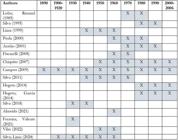
As we can observe, the studies generally span a period ranging from 1890 to 2006. Only one study examined Didactic handbooks from the late 19th century (Campos, 2009). The vast majority focused on works produced in the 20th century; specifically, four studies used handbooks published between the 1900s and the 1930s (Campos, 2009; Silva, 2018; Ferreira & Valente, 2021; Silva & Lima, 2024), and four examined handbooks produced between 2000 and 2006 (Chiquito, 2007; Campos, 2009; Hegeto, 2014; Hegeto & Garcia, 2014). Consequently, a distinct analytical focus is evident in handbooks produced between the 1940s and the 1990s.
The analysis of the studies also identified several strategies for selecting handbooks: surveying books used in teacher training programs based on the syllabi or course plans of universities across different regions of Brazil; conducting interviews or administering questionnaires to faculty members who teach the subject of Didactics to identify the works most recommended to students; identifying works that have undergone a high number of editions within a specific period; conducting bibliographic searches in catalogs or institutional repositories; consulting the collections of higher education institutions; inquiring with major publishing houses regarding Didactic handbooks; conducting literature reviews of studies that feature authors of Didactic handbooks most frequently recommended by instructors in undergraduate teacher licensure programs; and compiling lists of titles found in institutional databases, university libraries, and second-hand bookstores.
In total, the studies cited or found more than one hundred Didactic handbooks. Consequently, it would not be feasible to list the titles of all these works here. However, even though the authors classify them as Didactic books, many of the cited papers do not show the word “Didactics” in their titles, even if they do reference related terms such as methodology, teaching practices, pedagogy, planning, assessment, and the organization of instruction. Also, some of these works have gone through numerous editions, having been recommended for teacher training across several different decades.
FINAL CONSIDERATIONS
The quantitative survey conducted in this research reveals a predominance of studies utilizing the descriptors “pedagogy handbooks,” “pedagogical handbooks,” or “pedagogy books” (84 studies). Most of them show the term “pedagogical handbooks” in their titles, possibly because it is a broader category of books intended for the pedagogical training of teachers. Also, the quantitative survey highlighted that the number of studies adopting the category of “Didactic handbooks” or “Didactic teaching” as their source or object of study is notably low (16 studies), particularly when considering the temporal scope spanning nearly 40 years between the earliest study identified (1985) and the most recent (2024).
The literature review conducted in this study enabled to know, albeit not exhaustively, yet significantly, the Brazilian Didactic handbooks production. Of the 16 studies selected, six focus on these handbooks as the central object of their analysis, while 10 used them as a source for exploring other central themes of investigation. In other words, Didactic handbooks appear in research, particularly from a historical perspective, both as a central object of study (albeit in smaller numbers) and as a source of investigation that aids in constructing analytical interpretations regarding specific aspects of the educational process.
There is a consensus among the articles and dissertations regarding the conceptualization of didactic handbooks intended for teacher education. These texts serve as mediators between specific pedagogical knowledge and its application in the classroom. Most studies highlight these handbooks as significant sources for researching the history of the professionalization of teaching and for understanding the teaching content and methods that have prevailed over time. Additionally, several analyzed studies indicate that these handbooks tend to present Didactics primarily as a discipline focused on “teaching how to teach.” This perspective often prioritizes prescriptions and rules for teaching practice while sidelining the theoretical and methodological principles that underpin effective classroom practices. Most studies examined the content of these handbooks through the lens of discourse, which is seen as both a product and a producer of power-knowledge relations, particularly in relation to curricular policies.
The studies generally cover a period from 1890 to 2006, with a specific focus on handbooks produced between the 1940s and the 1990s. As a result, there is a noticeable gap in the research concerning handbooks from the 19th century and the early 20th century, as well as those recommended for the field of Didactics that have been published in the 21st century. A cross-sectional analysis of these studies highlights historical shifts in the discipline of Didactics. Initially, the focus was on achieving scientific legitimacy and aligning with Psychology, which then transitioned to a period marked by stringent technical standardization in teaching. More recently, discussions have centered on the epistemological identity of Didactics and its role in teacher education. Another important aspect for future research is to examine the identity of Didactics, both as a discipline and as an epistemological field, from a transnational perspective. This could involve using handbooks produced in various countries as sources for investigation.
The data gathered indicate that, while numerous studies are focusing on the history of pedagogy, there is a notable lack of research on the history of didactics, particularly when it comes to using teacher training handbooks as both a source and a subject of investigation. This survey suggests that studies related to pedagogical and didactic handbooks have mainly been produced and shared within the field of the history of education. This highlights the importance of, and the need for, further investigation into the history of didactics within the field. The identified gap not only reveals the necessity to expand such investigations but also emphasizes the urgent need for didactics to be established as the subject of its historical analysis. Thus, teacher training handbooks serve as a privileged space for the production, circulation, and contestation of the meanings that shape their disciplinary identity.
References
-
ALMEIDA, Maria Claudia Caires Costa. Saberes para ensinar matemática: manuais de Didática geral e Didática da matemática em tempos de matemática moderna. Dissertação (Mestrado Profissional em Educação Matemática) - Universidade Federal de Juiz de Fora, Juiz de Fora, 2021. Disponível em: Disponível em: https://repositorio.ufjf.br/jspui/handle/ufjf/12760 Acesso em: 10 out. 2024.
» https://repositorio.ufjf.br/jspui/handle/ufjf/12760 -
ARAÚJO, Carla Busato Zandavalli Maluf de. Os livros de Didática e sua influência na organização da prática docente. Ensaios e Ciência: Ciências Biológicas, Agrárias e da Saúde, Londrina, v. 5, n. 3, p. 73-108, dez. 2001. Disponível em: Disponível em: https://www.redalyc.org/articulo.oa?id=26050305 Acesso em: 10 out. 2024.
» https://www.redalyc.org/articulo.oa?id=26050305 -
CATANI, Denice Bárbara; SILVA, Vivian Batista da. Manuais pedagógicos. In: OLIVEIRA, D. A.; DUARTE, A. M. C.; VIEIRA, L. M. F. Dicionário: trabalho, profissão e condição docente. Belo Horizonte: UFMG/Faculdade de Educação, 2010. Disponível em: Disponível em: https://gestrado.net.br/verbetes/manuais-pedag-gicos Acesso em: 13 jul. 2024.
» https://gestrado.net.br/verbetes/manuais-pedag-gicos -
CHIQUITO, Ricardo Santos. Planejamento de ensino: formas de ver e maneiras de dizer a política curricular. Dissertação (Mestrado em Educação) - Pontifícia Universidade Católica do Paraná, Curitiba, 2007. Disponível em: Disponível em: https://livros01.livrosgratis.com.br/cp039996.pdf Acesso em: 10 out. 2024.
» https://livros01.livrosgratis.com.br/cp039996.pdf -
ESCOLANO BENITO, Agustín. El manual como texto. Pro-Posições, Campinas/São Paulo, v. 23, n. 3, set./dez. 2012. Disponível em: Disponível em: http://www.scielo.br/pdf/pp/v23n3/03.pdf Acesso em: 10 out. 2024.
» http://www.scielo.br/pdf/pp/v23n3/03.pdf -
FERREIRA, Jefferson dos Santos; VALENTE, Wagner Rodrigues. A graduação do ensino de cálculo no manual Didática nas Escolas Primárias de João Toledo (1930). Educação Matemática em Revista - RS, v. 1, n. 22, p. 119-128, 2021. Disponível em: https://doi.org/10.37001/EMR-RS.v.1.n.22.2021.p.119-128. Acesso em: 10 out. 2024.
» https://doi.org/10.37001/EMR-RS.v.1.n.22.2021.p.119-128 - FISCARELLI, Rosilene Batista de. Material didático: discursos e saberes. Dissertação (Mestrado em Educação Escolar) - Universidade Estadual Paulista Júlio de Mesquita Filho, Araraquara, 2004.
- FISCARELLI, Rosilene Batista de. Material didático: discursos e saberes. Araraquara, SP: Junqueira&Marin, 2008.
-
GUEDES, Shirlei Terezinha Roman. Manuais didáticos e a formação de professores nas escolas normais paranaenses (1920-1960) Tese (Doutorado em Educação) - Universidade Estadual de Maringá, 2015. Disponível em: Disponível em: https://sucupira-legado.capes.gov.br/sucupira/public/consultas/coleta/trabalhoConclusao/viewTrabalhoConclusao.jsf?popup=true&id_trabalho=2908107 Acesso em: 10 out. 2024.
» https://sucupira-legado.capes.gov.br/sucupira/public/consultas/coleta/trabalhoConclusao/viewTrabalhoConclusao.jsf?popup=true&id_trabalho=2908107 -
HEGETO, Leia de Cassia Fernandes. A Didática como disciplina escolar: estudo a partir dos manuais de Didática geral. Tese (Doutorado em Educação) - Universidade Federal do Paraná, Curitiba, 2014. Disponível em: Disponível em: https://acervodigital.ufpr.br/xmlui/handle/1884/36997 Acesso em: 10 out. 2024.
» https://acervodigital.ufpr.br/xmlui/handle/1884/36997 -
HEGETO, Leia de Cassia Fernandes; GARCIA, Tânia Maria F. Braga. Significados da Didática como disciplina escolar nos manuais de Didática geral. Olhar de Professor, v. 17, n. 1, p. 20-36, 2014. Disponível em: Disponível em: https://revistas.uepg.br/index.php/olhardeprofessor/article/view/9802/6405 Acesso em: 10 out. 2024.
» https://revistas.uepg.br/index.php/olhardeprofessor/article/view/9802/6405 - LIMA, Ana Laura Godinho. De como ensinar o aluno a obedecer (um estudo dos discursos sobre a disciplina escolar entre 1944 e 1965). Dissertação (Mestrado em Educação) - Universidade de São Paulo, São Paulo, 1999.
-
LOBO, Georfrávia Montoza; RAUMEL, Roseli. O livro de Didática: uma análise crítico-reflexiva. Atas 3º Seminário “A Didática em questão”. A DIDÁTICA EM QUESTÃO. Volume II. São Paulo: FEUSP, 1985. p. 25-34. Disponível em: Disponível em: https://www.andipe.com.br/eventos-anteriores Acesso em: 10 out. 2024.
» https://www.andipe.com.br/eventos-anteriores -
MAGNERE, Mikie Alexandra Okumura. Manuais de Didática e de metodologia de ensino: construção da base ensino. Dissertação (Mestrado em Educação) - Universidade Federal do Paraná, Curitiba, 2009. Disponível em: Disponível em: https://acervodigital.ufpr.br/xmlui/handle/1884/21480 Acesso em: 10 out. 2024.
» https://acervodigital.ufpr.br/xmlui/handle/1884/21480 - MATTAR, João; RAMOS, Daniela Karine. Metodologia da pesquisa em educação: abordagens qualitativas, quantitativas e mistas. São Paulo: Edições 70, 2021.
-
PAULA, Flávia Anastácio de. Lições, deveres, tarefas, para casa: velhas e novas prescrições para professoras. Dissertação (Mestrado em Educação) - Universidade Estadual de Campinas, Campinas, 2000. Disponível em: Disponível em: https://repositorio.unicamp.br/Busca/Download?codigoArquivo=460429 Acesso em: 10 out. 2024.
» https://repositorio.unicamp.br/Busca/Download?codigoArquivo=460429 -
SILVA, Katiene Nogueira da. Do controle das paixões à maestria de si: um estudo acerca das práticas e das representações de moralização na escola pública paulista (1948-1978). Tese (Doutorado em Educação) - Universidade de São Paulo, São Paulo, 2011. Disponível em: Disponível em: https://www.teses.usp.br/teses/disponiveis/48/48134/tde-21122011-134551/publico/KATIENE_NOGUEIRA_DA_SILVA.pdf Acesso em: 10 out. 2024.
» https://www.teses.usp.br/teses/disponiveis/48/48134/tde-21122011-134551/publico/KATIENE_NOGUEIRA_DA_SILVA.pdf -
SILVA, Nathalia de Almeida. A aritmética nos manuais de Didática “práticas escolares” e “Didática da escola nova” Dissertação (Mestrado em Educação) - Universidade do Vale do Sapucaí, Pouso Alegre, 2018. Disponível em: Disponível em: https://www.fuvs.br/repositorio/detalhes/589 Acesso em: 10 out. 2024.
» https://www.fuvs.br/repositorio/detalhes/589 -
SILVA, Vivian Batista da. Uma história das leituras para professores análise da produção e circulação de saberes especializados nos manuais pedagógicos (1930-1971). Revista Brasileira de História da Educação, v. 3, n. 6, jul./dez, 2003. Disponível em: Disponível em: https://periodicos.uem.br/ojs/index.php/rbhe/article/view/38695 Acesso em: 10 out. 2024.
» https://periodicos.uem.br/ojs/index.php/rbhe/article/view/38695 -
SILVA, Vivian Batista da; LIMA, Ana Laura Godinho. A psicologia nos manuais de Didática, a Didática dos manuais de psicologia: inovações pedagógicas na fronteira entre as disciplinas (Brasil, 1900-1960). Revista História da Educação (on-line) 2024, v. 28, e131892. Disponível em: Disponível em: https://seer.ufrgs.br/index.php/asphe/article/view/131892/91452 Acesso em: 09 nov. 2024.
» https://seer.ufrgs.br/index.php/asphe/article/view/131892/91452 - SILVA, Waldeck Carneiro da. A utilização da biblioteca escolar como recurso de ensino-aprendizagem em livros de Didática Dissertação (Mestrado em Educação) - Universidade Federal Fluminense, Niterói, 1991.
- SILVA, Waldeck Carneiro da. Miséria da biblioteca escolar São Paulo: Cortez, 1995. 118 p.
-
VILAR, Edna Telma Fonseca e Silva. Configurações da Didática em manuais pedagógicos das décadas de 1950 a 1960. In: Anais XXI Endipe - Encontro Nacional de Didática e Práticas de Ensino. Uberlândia: UFU, 2022. v. 2. p. 169-177. Disponível em: Disponível em: https://www.andipe.com.br/xxi-endipe-2022 Acesso em: 10 out. 2024.
» https://www.andipe.com.br/xxi-endipe-2022
2
3
DECLARATION ON DATA AVAILABILITY
1
Correspondence
<carolina.r.cardoso@ufsc.br>Section Editor:
CONFLICT OF INTEREST STATEMENT
History
-
Received
09 Apr 2025 -
Preprint posted on
31 Mar 2025
10.1590/SciELOPreprints.58543 -
Accepted
11 Feb 2026

 Source: SciELO, Google Scholar, CAPES Thesis and Dissertation Catalog, Proceedings of ENDIPE (table prepared by the author).
 Source: Studies selected in the literature review (