
 CLOSURE OF YOUTH AND ADULT EDUCATION IN SÃO PAULO AND ITS INTERFACES WITH THE INTEGRAL EDUCATION PROGRAM
ABSTRACT:
The article investigates the decline in Youth and Adult Education (EJA) enrollments in the state education system of São Paulo (Brazil) between 2020 and 2023, highlighting the impact of the expansion of the Integral Education Program (PEI) on this reduction. The research analyzes official data provided by the São Paulo state government and reveals that, although the state shows significant potential demand - with 11.75 million adults lacking complete basic education -, EJA provision has been systematically reduced. Between 2020 and 2023, EJA enrollments fell by 61.9%, and night school enrollments declined by 8.7% in the state network. Furthermore, the semi-presential modality offered by the State Centers for Youth and Adult Education (CEEJAs) also experienced a 35.3% decrease, ruling out the hypothesis of a shift from in-person to semi-presential enrollments. The study argues that the accelerated expansion of PEI in recent years has significantly contributed to the observed dismantling of EJA. Schools incorporated into PEI from 2020 onward lost 84.5% of their EJA enrollments and 50.9% of night school enrollments. The proliferation of distance-learning models for EJA across the country underscores the need to improve official data systems to prevent monitoring gaps, enable effective public control of EJA provision, and support the prioritization of this modality as a strategic instrument for addressing persistent educational inequalities in Brazil.
Keywords:
Youth and Adult Education; Integral Education; Night School; School Exclusion; Educational Inequality
RESUMO:
O artigo investiga a redução das matrículas da Educação de Jovens e Adultos (EJA) na rede estadual de São Paulo entre 2020 e 2023, destacando o impacto da expansão do Programa Ensino Integral (PEI) nessa redução. A pesquisa analisa dados oficiais fornecidos pelo governo desse estado, e indica que, embora São Paulo apresente uma expressiva demanda potencial - com 11,75 milhões de adultos sem educação básica completa - a oferta da EJA vem sendo sistematicamente deprimida. Entre 2020 e 2023, foram perdidas 61,9% das matrículas da EJA e 8,7% das matrículas no ensino noturno na rede estadual. Além disso, a modalidade semipresencial ofertada nos Centros Estaduais de Educação de Jovens e Adultos (CEEJAs) também sofreu redução de 35,3%, descartando-se a hipótese de migração de matrículas da modalidade presencial para os CEEJAs. O estudo aponta que a expansão acelerada do PEI nos últimos anos também contribuiu decisivamente para o quadro de fechamento da EJA observado na rede: as escolas incorporadas ao PEI a partir de 2020 perderam 84,5% das matrículas da EJA e 50,9% das matrículas do ensino noturno. A proliferação de modelos de oferta de EJA a distância no país assinala a necessidade de aprimoramento das bases de dados oficiais com vistas a evitar lacunas de monitoramento, possibilitar o devido controle social sobre a oferta da EJA e ensejar a priorização dessa modalidade como elemento estratégico para o enfrentamento de desigualdades educacionais persistentes no Brasil.
Palavras-chave:
Educação de Jovens e Adultos; Ensino Integral; Ensino Noturno; Exclusão Escolar; Desigualdade Educacional
RESUMEN:
El artículo investiga la reducción de las matrículas en la Educación de Jóvenes y Adultos (EJA) en la red estatal de São Paulo (Brasil) entre los años 2020 y 2023, destacando el impacto de la expansión del Programa de Enseñanza Integral (PEI) en esta reducción. La investigación analiza datos oficiales concedidos por el gobierno del estado de São Paulo y revela que, a pesar de una demanda potencial expresiva - con 11,75 millones de adultos sin educación básica completa -, la oferta de EJA ha sido sistemáticamente disminuida. Entre 2020 y 2023, fueron perdidas 61,9% de las matrículas de EJA y en el turno nocturno estatal un 8,7%. También se identificó una reducción del 35,3% en la modalidad semipresencial ofrecida por los Centros Estatales de Educación de Jóvenes y Adultos (CEEJAs), lo que descarta una hipótesis de migración desde la modalidad presencial para los CEEJAs. El estudio indica que la expansión acelerada del PEI en los últimos años contribuyó decisivamente al cierre de la EJA observado en la red: las escuelas incorporadas al PEI a partir de 2020 perdieron un 84,5% de sus matrículas en la EJA y un 50,9% de las del nocturno. La proliferación de modelos de oferta de EJA a distancia en el país pone de relieve la necesidad de mejorar los sistemas oficiales de datos con el fin de evitar vacíos de monitoreo, posibilitar el debido control social sobre la oferta de la EJA y promover la priorización de esta modalidad como un elemento estratégico para enfrentar las persistentes desigualdades educativas en Brasil.
Palabras clave:
Educación de Jóvenes y Adultos; Enseñanza Integral; Escuela Nocturna; Exclusión Escolar; Desigualdad Educativa
I am only envious… of not knowing how to read. Of the secret, of the subject that is there, trapped underneath, and that we did not know.
(testimony cited in Abramovay; Andrade, 2005, p. 42 apud Di Pierro; Galvão, 2007, p. 26)
The disregard for adult education, the attitude of definitively condemning them to illiteracy […] rests on the sociological error of assuming that the adult is to blame for their own ignorance. It fails to recognize that the adult is not voluntarily illiterate, does not make themselves illiterate, but is made so by society, on the basis of the conditions of their existence.
(Pinto, 1993, p. 82, emphasis in the original)
INTRODUCTION
There is in the country a historical educational backlog - millions of people in older age groups who were unable to study during childhood and adolescence - which continues to grow, as vulnerable segments of newer generations are continuously added to this group, in a process known as the juvenilization of Youth and Adult Education (EJA) (Souza Filho; Cassol; Amorim, 2017; Pereira; Oliveira, 2018). These are low-income individuals living in contexts of social exclusion; the majority are Black and also come from socially vulnerable groups such as the LGBTQIA+ population, people deprived of liberty, immigrants, and refugees (Carreira, 2014; Catelli Jr., 2024). Thus, the target population of the EJA modality comprises a diversity of subjects and groups with highly heterogeneous characteristics and needs. The Continuous National Household Sample Survey (PNAD Contínua) of the Brazilian Institute of Geography and Statistics (IBGE) estimated that, in 2023, there were more than 68 million people aged 18 or older in Brazil who were not attending school and had not completed basic education (Sampaio; Hizim, 2022; Brasil, 2024, p. 34). This is a large mass of working people, voters, and citizens who experience the 21st century and the information and digital society excluded from the basic tools of linguistic, mathematical, and scientific literacy.
Although the Law of Guidelines and Bases of National Education (LDBEN, Law No. 9,394/1996) establishes, in item I of Article 5th, that it is the duty of the State to annually survey young people and adults who have not completed basic education (Brasil, 1996), there is a gap in this process, since educational policies have been limited to counting, through the Brazilian School Census conducted by the National Institute for Educational Studies and Research Anísio Teixeira (Inep), those who are already within education systems, contributing to the crystallization of a conception of “demand for EJA” as merely the number of people effectively enrolled in courses (Longo; Vieira, 2021).
Whereas for children and adolescents, the demand for schooling corresponds practically to the population aged 4 to 17 - the compulsory schooling range (LDBEN, Art. 4th, item I) - the same does not apply to the EJA population. For adults with low levels of schooling, returning to studies does not carry the weight of legal obligation, in addition to clashing with a certain cultural norm according to which school would be a space exclusively for children and adolescents. According to Debert (2010), modernity promoted a chronological structuring of life stages, associating childhood and youth with school life, adulthood with work, and old age with retirement. Added to this cultural component, which treats the adult as a non-schoolable subject, Brazil’s profound economic inequality tends to naturalize the school exclusion of the poorest.
Thus, demand for EJA is typically hidden and depends, for its necessary visibility, on an inducing stance by public authorities. Beyond the annual survey, actions by states and municipalities to convert potential demand for EJA into effective demand should include, at a minimum: 1) flexible educational provision compatible with adult workers and specific EJA populations, with places in schools close to residence or workplace; 2) curricula suited to the conditions of the target population; 3) the presence, in schools, of teaching staff trained to work in this modality; 4) active school search mechanisms through campaigns, local mobilizations, and public calls that encourage the completion of basic education as a strategic factor for national development and for raising the cultural education levels of the Brazilian population.
However, as noted by Graciano and Lugli (2017), this has not been occurring, with a “refusal by public authorities to exercise an inducing action to stimulate demand” (p. 15). Indeed, the recent dissemination of a new indicator of “migration to EJA” by the Ministry of Education (MEC) (Brasil, 2024, p. 38) indicates that the rates of return of students with incomplete schooling to education systems are still far lower than dropout rates in Primary and Secondary Education. Finally, to all these chronic problems of hidden demand and underprovision of EJA in Brazil, another is added: the continuous reduction in the number of enrollments in this modality in public education systems.
The present article results from research focused on the reduction of EJA provision in the São Paulo state school system. Data from the 2020-2023 four-year period were analyzed, drawn from the student registry of the Digital School Secretariat (SED) of the São Paulo State Department of Education (Seduc-SP), with the aim of investigating the movement of EJA enrollments and a possible impact of the expansion of the Integral Education Program (PEI) on the depletion of enrollments of students who were unable to complete schooling at the appropriate age. A preliminary analysis of these data was presented in a Technical Note by the Public School and University Network (REPU), released in July 2024.
The data are part of the Administrative Procedure for Monitoring Public Policy (PAA.PP) No. 0738.0000043/2017, initiated by the Special Education Action Group (Geduc) of the Public Prosecutor’s Office of the State of São Paulo (MP-SP), with the aim of monitoring the public policy of provision of places and the organization of schools and classrooms in the São Paulo state school system. The raw data were provided by Seduc-SP to the MP-SP and processed by the authors using Excel and RStudio software. Additionally, microdata from the 2019 Brazilian School Census (Inep) were used to calculate the movement of EJA enrollments and night Secondary Education enrollments in schools incorporated into the PEI. Throughout the text, for purposes of contextualization and comparison, data extracted from the 2011, 2014, 2020, 2023, and 2025 editions of the School Census are also mentioned.
REDUCTION OF EJA ENROLLMENTS IN SÃO PAULO
In 2022, the state of São Paulo had 830 thousand people aged 15 or older who reported being unable to read or write a simple note, representing 8.6% of total illiteracy in the country (FDE, 2023). Although the overall illiteracy rate in the state is low (2.2%), the number of illiterate people is large, being higher among Black individuals and especially elevated among the population aged 60 or older. These figures reveal that, in the most populous and wealthiest state in the country, the historical exclusion regarding the right to read and write is far from being overcome.
Functional illiteracy, according to the definition adopted by IBGE, comprises people aged 14 or older who are illiterate or have fewer than five years of schooling; that is, who have not completed the 5th year of Primary Education. In 2022, there were 2.771 million functionally illiterate individuals in the state of São Paulo, representing 7.2% of the state population.
Regarding the educational attainment of the population aged 25 or older in São Paulo, 24.8% had not completed Primary Education and 12.4% had not completed Secondary Education (FDE, 2023). Thus, 37.2% of the population of the state of São Paulo aged 25 or older had not completed basic education. These 11.75 million people constitute a vast potential audience for EJA. However, contrary to what would be expected given such a large social demand, what is observed in the São Paulo state school system is a scenario of progressive reduction in enrollments and classes.
The closure of classes and the reduction of enrollments in EJA, phenomena that occur nationwide, are already well documented in the educational literature (Vieira, 2011; Di Pierro, 2015; Pinto, 2021; Cruz; Sales; Almeida, 2023; Silva, 2023). According to Di Pierro (2014), even after the approval of the Fund for the Maintenance and Development of Basic Education and the Valorization of Education Professionals (Fundeb) in 2006, which included EJA enrollments in the main financing mechanism of public education in the country, a progressive decline in the number of enrollments in the modality was observed from 2007 onward.
Carreira (2014) interviewed government managers and civil society activists to understand why, despite advances in the institutionalization of EJA policies between 2003 and 2012 (Lula’s first and second administrations), there was no improvement in EJA provision or reduction in illiteracy in the country. Among the explanatory factors mentioned by interviewees is a cultural one: young people and adults with low levels of schooling are not seen as holders of rights, and are often held responsible for not having studied. In addition, within governmental spheres, a false dilemma is posed between serving the education of children or that of adults.
Competition between EJA and regular education may, in part, have a concrete basis related to the financing of education. The conditions for including EJA in Fundeb were unfavorable, assigning the modality a lower weighting factor compared to regular education and a spending ceiling of up to 15% of the total Fund (Di Pierro, 2014; Cruz; Sales; Almeida, 2023), which would have resulted in a loss of resources for small municipalities that invested in EJA. Law No. 14,113/2020 (Brasil, 2020), which regulated Fundeb, removed the 15% cap for EJA.
Another explanation - widely used by governments - for the reduction in enrollments is the demographic factor. There is a tacit assumption that by concentrating investments on the education of younger generations, the educational problem would be automatically resolved over time, since older individuals, illiterate and without schooling, would naturally reduce their share in the total population through mortality. In this line, Di Pierro and Galvão (2007) cite a statement by José Goldemberg, a renowned physicist and Minister of Education under the Collor administration, who stated:
The illiterate adult has already found his place in society. It may not be a good place, but it is his place. He will be a bricklayer, a building guard, a garbage collector, or pursue other occupations that do not require literacy. Teaching an adult to read will not significantly change their position in society and may even be disruptive. Let us concentrate our resources on educating the young population. By doing this now, illiteracy will disappear in ten years (Goldemberg, 1991apud Di Pierro; Galvão, 2007, p. 3).
Álvaro Vieira Pinto, a philosopher whose ideas inspired the work of Paulo Freire, underscores the error in this line of thinking, which understands education as an exclusively individual process, disregarding the effects of adult schooling on family socialization and on the educational prospects of children:
It is an erroneous and cruel thesis to admit that adults should be condemned to the perpetual condition of illiteracy and that society’s resources should be concentrated on the education of children, which is cheaper and yields greater future returns. Leaving aside the shameful moral disregard for human dignity that this thesis entails, it is: sociologically false, because the adult yields much more after becoming literate; and pedagogically erroneous, because it is not possible to provide proper schooling for children in an environment in which adults, the heads of families, do not understand its importance (Pinto, 1993, p. 81-82, author’s emphasis).
Despite the frequent governmental claim that measures to correct school flow and expand educational coverage at the appropriate age would eliminate the need for EJA over time2, the so-called “demographic argument” is contested by demographers and scholars of educational policy. Longo and Vieira (2021) developed a demographic study estimating the demand for EJA in the state of São Paulo between 1995 and 2015. The results indicated improvement in educational coverage at the appropriate age in comparative terms: in 1995, 62% of the population aged 15 to 64 had not completed basic education; in 2015, this percentage fell to 30%. Although the stock of the population that constitutes demand for Primary Education decreased between 1995 and 2015, the stock demanding Secondary Education increased. In 2015, São Paulo had 9,463,118 people aged 15 to 64 eligible to enter basic education. According to the authors, “it is worth highlighting the heterogeneity of this potential demand for EJA, at least with regard to age. It is not a public concentrated in much older age groups, although the stock increases as age groups advance” (Longo; Vieira, 2021, p. 11). This means that young people constitute an important part of the demand for EJA: in 2015, 25% of 19-year-olds had not completed Secondary Education in the state of São Paulo. Thus, based on the premise that education is a right extendable to people of all ages, Longo and Vieira demonstrated the unsustainability of the argument that there is no demand for EJA, indicating the need to consider demographic models for planning school provision.
In the same direction, Cássio et al. (2016) questioned the position adopted by the State Data Analysis System Foundation (Seade), which attributed the contraction of school demand to declining fertility rates in the state of São Paulo, an argument used by the state government to justify a broad reorganization of the school system in 2015. The authors challenged the notion of school demand derived from this argument, which considers only the 6 to 17 age group as eligible for basic education, whereas the LDBEN also guarantees this right to young people and adults, “which implies computing in the demand both those who attend basic education with age-grade distortion (whether in regular education or in Youth and Adult Education - EJA) and those with incomplete basic schooling who are out of school” (Cássio et al., 2016, p. 1092). The authors also highlighted that enrollment movements do not always follow demographic dynamics, since “while the demographic trend of the population aged 15 to 17 is one of stability between 2009 and 2014, there has been an increase in Secondary Education enrollments since 2009, probably related to the socioeconomic condition of young people and their families” (Cássio et al., 2016, p. 1096).
Parallel to the process of closing EJA classes, there has been a major expansion of certification exams for basic education. The Brazilian Exam for the Certification of Competencies of Youth and Adults (Encceja), created in 2002 during the Fernando Henrique Cardoso administration, followed a trajectory of progressive growth, although marked by intermittency. Catelli Jr. and Serrão (2014) showed that, between 2002 and 2010, Encceja did not have sufficient weight to justify a reduction in EJA enrollments. However, the scenario has changed in recent years, with exponential growth in the number of participants, financial investments, and approval rates (Ação Educativa, 2022; Catelli Jr.; Graciano, 2022). In 2018, for example, investments in Encceja (R$117.6 million) exceeded those allocated to the provision of EJA courses (R$24.6 million). The number of registered candidates increased from 366,000 in 2012 to 2.9 million in 2019. There also appears to have been a facilitation of the exams. In 2019, approval rates were unusually high and diverged significantly from historical series: 93% of candidates registered in Natural Sciences, for example, achieved sufficient scores (Ação Educativa, 2022).
Ventura and Oliveira (2021) comparatively analyzed the actions of governments described as neo-developmentalist (led by the Workers’ Party) and ultraliberal (led by Bolsonaro), observing that both maintained the trend of contraction in EJA provision:
The neo-developmentalists encouraged the private sector to take over the execution of public services considered non-essential, with the aim of strengthening it and, at the same time, relieving the State of responsibility for these services. They promoted partnerships with private and public institutions - with states, the System S, and private universities - financing, through adherence, pre-designed actions that, among others, reached the potential EJA/Secondary Education public. At the same time, they created conditions for the expansion of distance education at this stage of the modality and encouraged, through the Enem, certification of Secondary Education. The ultraliberals, in turn, in the same year they came to power, reformed Secondary Education, and with it EJA at this stage; revitalized Encceja; and, through legislation, strengthened the presence of distance education (Ventura; Oliveira, 2021, p. 18).
Indeed, models of EJA provision through distance education, such as the “Nova EJA” developed by the Social Service of Industry (SESI), have already been implemented through partnerships with education departments in several states and municipalities.3 In 2025, Seduc-SP also attempted to expand the semi-presential model of the State Centers for Youth and Adult Education (CEEJAs) (Resolution SEDUC No. 113/2025) and presented the initiative to the public as a new model of “flexible-attendance Secondary Education,” with mandatory attendance only once per month. This attempt to expand distance EJA - which can be interpreted as a strategy to reduce age-grade distortion in regular Secondary Education, thereby positively impacting results in large-scale assessments, whose target population does not include EJA students - was halted by the São Paulo judiciary through a preliminary injunction, still pending final judgment.4
While the advancement of certification policies via Encceja and the expansion of semi-presential and distance education provision models are national phenomena5 that accompany the decline in the number of EJA classes and enrollments in the São Paulo state school system, the municipalization of EJA provision at the Primary level - which, at the national level, increased the share of enrollments under municipal responsibility from 68.1% to 80.3% between 2014 and 2025 (Brazilian School Census data) - did not occur in the state of São Paulo, where the municipal share of enrollments declined from 70.2% to 64.8% over the same period.
Finally, there is a “local” variable with potentially relevant impacts on EJA provision in São Paulo: the implementation of the Integral Education Program (PEI), which, from 2020 onward, underwent a significant scaling up and has long been considered a priority public policy in state education. Several studies have already demonstrated that PEI negatively affects school provision in the state school system by systematically closing night classes, excluding more vulnerable and working students, and implementing mechanisms of implicit selection favoring students with higher socioeconomic levels in full-time schools (Girotto; Cássio, 2018; REPU, 2021; Girotto; Jorge; Oliveira, 2022; Girotto; Oliveira, 2023).
Considering the findings of all these studies and the multifaceted nature of the phenomenon of declining EJA provision in the country, this study analyzes the variation in EJA enrollments (in-person and semi-presential) in the state of São Paulo between 2020 and 2023, and, specifically, the possible relationships between the sharp decline in enrollments observed during the period and the expansion of the PEI in the state school system.
REDUCTION OF IN-PERSON EJA
By examining the movement of enrollments in the São Paulo state school system for Primary and Secondary Education and for the EJA modality between 2020 and 2023 (Table 1), we identified cumulative absolute losses that were greater in Primary Education (-99,012 enrollments), followed by EJA (-85,515 enrollments) and Secondary Education (-17,234 enrollments). However, EJA stands out when relative losses are considered, registering a reduction of 61.9% in enrollments. Even when the impacts of the Covid-19 pandemic are considered (Ximenes et al., 2022), the reduction of 61.9% in EJA enrollments in the São Paulo state school system is incompatible with the overall movement of enrollments in the system during the same period (in which a total loss of 6.2% was recorded). For comparison, over the entire previous decade (2011-2020), EJA enrollments in the São Paulo state school system declined by 12.6% (Brazilian School Census data). In absolute terms, this corresponds to a variation of -38,081 enrollments between 2011 and 2020, much lower than the depletion of 85,515 enrollments observed in the 2020-2023 four-year period.
The responsibility of federative entities for EJA provision follows the same distribution of provision defined by the Federal Constitution: states and municipalities share responsibility for Primary Education, and states are exclusively responsible for Secondary Education. Despite this, a process of municipalization of Primary Education has, for decades, been reducing the responsibility of states for this stage, which becomes typically concentrated in the Final Years of Primary Education (6th to 9th grade) (Martins, 2003; Souza; Faria, 2004; Goulart; Pinto; Camargo, 2017). Municipalities in São Paulo are responsible for 56.0% of enrollments in regular Primary Education and for 64.8% of enrollments in EJA Primary Education (Brazilian School Census 2025, Inep). By comparison, only 3.7% of EJA Secondary Education enrollments in the state of São Paulo are in municipal systems.
Table 2 shows the concentrated role of the state school system in the provision of EJA Secondary Education (EJA-Secondary), which accounted for 85.6% of enrollments in 2023. Even so, a loss of 73,661 enrollments (-62.1%) in EJA-Secondary was observed in the system, followed by a reduction of 6,751 enrollments (-47.3%) in EJA-Primary (Final Years) in the 2020-2023 period. Given the extremely high potential demand for EJA in the state of São Paulo (estimated at 11.75 million people), such a sharp loss of enrollments as that observed in the 2020-2023 period cannot be simplistically interpreted as absence of demand or as a continuation of a previous downward trend (which, as shown, was substantially smaller between 2011 and 2020 than between 2020 and 2023).
The drastic decrease in in-person EJA enrollments was accompanied by a proportional reduction in the number of classes. Table 3 records a loss of 1,945 classes (-45.8%) of EJA in the São Paulo state school system, 87.7% of which were offered in the night period. The movement of EJA enrollments by shift (Table 4) shows the largest reductions in the shift with the highest demand. Between 2020 and 2023, 84,693 EJA enrollments were lost (-62.0%) in the night period, which accounted for 99% of the total enrollments lost. This suggests that educational policies affecting the provision of places in the night period may also critically affect access to the EJA modality, as will be seen later in the case of the Integral Education Program (PEI).
Despite the predominance of night EJA provision in the state school system, the reduction of 860 enrollments (-68.9%) in the morning shift and the negligible increase of 38 enrollments in the afternoon shift suggest that the system has also been creating barriers to schooling for a portion of students who work at night and could only attend school in the morning or afternoon.
Following the trend in enrollments and classes, the number of schools offering EJA in the São Paulo state school system also declined between 2020 and 2023 (Table 5). EJA-, for example, ceased to be offered in 289 state schools (-30.2%) during the period analyzed. Considering all types of EJA provision, 214 school units (-22.9%) stopped offering in-person classes of the modality, which are now restricted to only 13.7% of the São Paulo state school system.
The figures in Table 5 also contrast with official information. On the Seduc-SP website, it was stated that the population could attend EJA “in more than 800 state schools” (Seduc-SP, 2025b), which would only be accurate for 2020 and 2021 if units of the prison system and socio-educational detention system (Fundação CASA), accessible only to persons deprived of liberty, were included. Considering the consistent downward trend in enrollments and classes in the 2020-2023 period, it is also unlikely that the number of schools offering EJA in-person increased between 2024 and 2025 to the point of exceeding 800 schools in the system.
REDUCTION OF SEMI-PRESENTIAL EJA
The State Centers for Youth and Adult Education (CEEJAs) offer semi-presential EJA courses for the Final Years of Primary Education and for Secondary Education in the São Paulo system. Students receive teaching materials and attend school units only to clarify doubts. Certification occurs through subject-based assessments (a partial progression regime known as “elimination of subjects”) or through Encceja. Unlike other forms of in-person EJA provision, enrollments in CEEJAs are not included in the Fundeb calculation, which is why they must be analyzed separately from in-person enrollments.
Given the closure of places in in-person EJA, it would be expected that part of these enrollments would be transferred to semi-presential EJA. However, the data in Table 6 show that semi-presential provision also declined during the period analyzed, with a loss of 35.3% of enrollments and a reduction of 11.6% in the number of classes. The largest losses occurred in Secondary Education (-18,650 enrollments) and in the Final Years of Primary Education (-10,295 enrollments). The number of CEEJAs, on the other hand, remained stable during the period (39 units).
Some changes in the operation of CEEJAs may explain the observed decline in enrollments. Resolution SEDUC No. 119/2021 (São Paulo, 2021) altered the operating parameters of CEEJAs and introduced measures that may have constituted barriers to access: (1) operation in two fixed shifts, rather than an eight-hour period distributed according to local demand; (2) attendance control through the Digital School Secretariat (SED) using QR Code (in case of failure to verify attendance within 30 days, enrollment becomes inactive); and (3) detailed definition of staff allocation according to the number of enrollments.8 Education professionals working in CEEJAs suggest as reasons for the decrease in enrollments and classes the change in staff allocation in schools, which may have generated shortages of personnel and limited the ability to meet demand, as well as the distancing of the EJA target population in the post-Covid-19 period, which may not yet have fully recovered (REPU, 2024).
EXPANSION OF PEI AND IMPACTS ON EJA
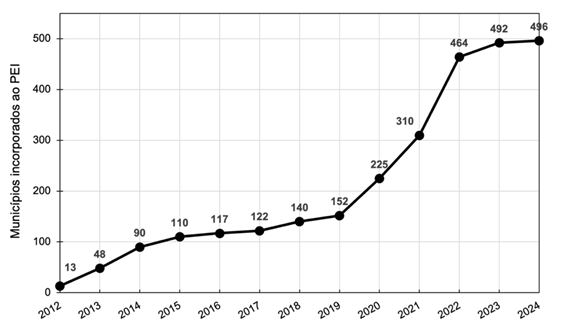
The Integral Education Program (PEI) was implemented in 2012 in the São Paulo state school system, initially focused on Secondary Education and, in the following year, incorporating Primary Education with classes in a single shift of nine hours per day. In 2019, a second PEI model was introduced, with a seven-hour school day, which enabled the operation of two daily shifts in schools: from 7:00 a.m. to 2:00 p.m. and from 2:15 p.m. to 9:15 p.m., with 45-minute classes (Resolution SE No. 44/2019) (São Paulo, 2019). This readjustment gave momentum to the expansion of PEI that began in that year and took the Program to another level of provision. Thus, two cycles of the full-time education policy in the state of São Paulo can be distinguished: one from 2012 to 2019 (slow growth) and another from 2020 onward (accelerated growth, slowed from 20239) (Figures 1 and 2).

Expansion of the Integral Education Program (PEI), São Paulo state school system, 2012-2024.

Expansion of the Integral Education Program (PEI) across municipalities in the state of São Paulo, 2012-2024.
In 2024, PEI schools accounted for 45.6% of the São Paulo state school system. The expansion curve in Figure 1 indicates that 82% of current PEI schools joined the Program after 2019. The expansion of PEI can also be observed through the progressive capillarization of the Program across municipalities in the state (Figure 2).
The 2023 Brazilian School Census (Inep) indicates that in 216 municipalities in the state of São Paulo (34% of the total), all state schools were part of PEI, a situation that did not exist prior to the expansion surge that began in 2020. Of these municipalities, 173 have only one state school, which represents a concerning situation regarding the provision of public education for working students or those with incomplete basic education who rely on the night shift as their only access to schooling. These data highlight the need to assess the impact of PEI expansion on the movement of part-time enrollments in the state school system, particularly night schooling and EJA.
Since 2012, the São Paulo full-time school model has adopted, as its sole expansion strategy, the use of existing part-time school facilities rather than, for example, creating new units through the construction of school buildings. Thus, when a part-time school is converted into a PEI school, it ceases to offer night classes and EJA in order to operate a single daily shift with a seven- or nine-hour school day. By prioritizing a policy of mass expansion of full-time schools without creating new school buildings or public facilities aimed at EJA, the São Paulo state government excludes young and adult workers from the education system.
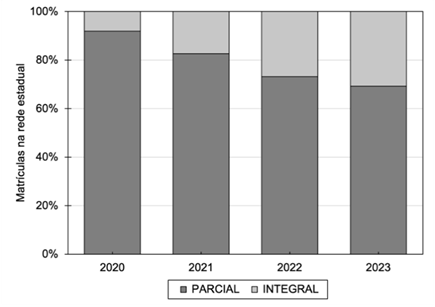
Table 7 presents the movement of enrollments by shift in the state school system between 2020 and 2023, indicating a loss of 201,761 enrollments (-6.2%) - the same overall figure shown in Table 1. In contrast to the declining trend in enrollments in morning, afternoon, and night shifts, the number of full-time enrollments increased by a striking 251.7% in the 2020-2023 period, which clearly affects the proportion between enrollments in PEI schools and in the rest of the state school system (Figure 3), since the only enrollments that grew during the period analyzed were those in full-time schooling.
These data are alarming, given the evidence already accumulated in the literature about what the São Paulo full-time education model has produced over the last decade: 1) closure of night classes, resulting in the school exclusion of the most vulnerable population, composed of working young people and adults; and 2) implicit selection mechanisms favoring students with higher socioeconomic status, even after the installation of PEI schools in more vulnerable territories, following recommendations from the São Paulo State Court of Auditors (TCE-SP, 2016; Girotto; Cássio, 2018). In fact, studies indicate that the intensification of PEI expansion, replacing other forms of part-time provision, has increased school exclusion among those who cannot commit to full-time study, deepening a socioeconomic selection that exacerbates educational inequalities in the state of São Paulo (Girotto; Cássio, 2018; REPU; Lemadi-USP, 2019; REPU, 2021; Girotto; Jorge; Oliveira, 2022; Girotto; Oliveira, 2023).

Ratio between part-time and full-time enrollments, São Paulo state school system, 2020-2023.
Throughout the period analyzed, no systemic expansion of the São Paulo state school system was identified, such as the construction of new school units or the incorporation of schools from other systems. On the contrary, processes of municipalization of state schools continue to occur (Moreno; Vieira; Graziani, 2024). This leads to the understanding that, when a school joins PEI, part of its students is forced to migrate to another part-time unit. However, since the overall number of enrollments has been consistently declining in the state school system (Tables 1 and 7), it is concluded that PEI not only contributes to overcrowding in part-time schools but also leads to school dropout.
The argument that the reduction in enrollments in the state school system is due to demographic reasons (e.g., a decline in the population eligible for public education) is also not supported here, given the disproportion between the overall reduction in enrollments and the expansion of full-time enrollments. A Technical Note on the impacts of the expansion of full-time enrollments across all state school systems in the country over a 12-year period (REPU; Lemadi-USP, 2023) showed that the increase in full-time enrollments occurred precisely at the expense of reductions in part-time and night enrollments - a conclusion that can be extended to the São Paulo case.
We now analyze how EJA and night Secondary Education provision behaved within PEI schools. We selected only schools converted into full-time units from 2020 onward (N = 1,896), comparing the movement of enrollments in the 2020-2023 period with the number of enrollments in these same schools in 2019, when they had not yet joined PEI (Table 8).
Overall, the PEI schools analyzed lost 23.3% of their enrollments between 2019 and 2023, a reduction clearly driven by the closure of EJA and night classes. During the period covered by Table 8, 52,119 EJA enrollments were lost (-89.3% in the night period and -98.1% in other periods). Following the same trend, 90,184 night enrollments were lost (-62.5%), which includes, in addition to EJA enrollments, a depletion of 39,128 night Secondary Education enrollments (-45.0%). These findings are corroborated by previous studies (REPU; Lemadi-USP, 2019, 2023; REPU, 2021).
Table 9 compares enrollment movements in schools incorporated into PEI from 2020 onward (Table 8) with overall movements in the state school system (Table 1) for the 2020-2023 period and shows that PEI expansion exacerbates the loss of both EJA and night enrollments, being the main factor contributing to the closure of night classes in the São Paulo state school system. As in the system as a whole, the trend of reduction in EJA provision is markedly intensified in PEI schools (Figure 4).
Following the trend of declining enrollments, a significant number of PEI schools discontinued the provision of EJA and night Secondary Education classes between 2020 and 2023, corresponding to losses of provision in 312 (-16.5%) and 470 (-24.8%) schools, respectively (Table 10). In fact, the presence of EJA in PEI schools fell from 23.7% of schools in 2019 to only 14.9% in 2023. Even if it is argued that the sharp declines in enrollments in PEI schools are due to the Covid-19 pandemic, the data do not indicate any recovery in EJA and night enrollments from 2022 onward. On the contrary, the downward trend persisted across the system and was even more pronounced in PEI schools (Table 9).

Night enrollments in schools incorporated into the Integral Education Program (PEI) from 2020 onward (N = 1,896), São Paulo state school system, 2019-2023.
CONCLUSIONS E RECOMMENDATIONS
The reduction in the provision of EJA and night schooling in the São Paulo state school system over the four years analyzed in this study intensifies the trends already described of amplifying educational inequalities through the exclusion of young people, adults, and the elderly from access to public schooling. The data analyzed indicate that in-person EJA provision underwent a drastic reduction in the São Paulo state school system, accumulating a negative variation of 61.9% in enrollments between 2020 and 2023, which is almost five times greater than the variation recorded in the previous ten years (-12.6%).
In other words, 85,515 students with incomplete schooling disappeared from the state school system. This reduction is not justified, given the significant potential demand for EJA in the most populous state in the country: 11.75 million people aged 25 or older who have not completed basic education. In this sense, strengthening the provision of the EJA modality would have a strategic function in the post-pandemic period, precisely with a view to attracting the most vulnerable students who dropped out of school.
Severe enrollment losses were also recorded in the semi-presential EJA offered in the 39 state CEEJAs. In these units, 35.3% of semi-presential EJA enrollments disappeared between 2020 and 2023, most of them in Secondary Education (-18,650 enrollments) and in the Final Years of Primary Education (-10,295 enrollments). The hypothesis of migration from in-person to semi-presential EJA is thus ruled out, since reductions in enrollments and classes occurred in both types of provision.
In a trend radically opposed to the decline in EJA enrollments in the São Paulo system, exponential growth of the PEI was observed in the period analyzed, gaining new momentum with the introduction, in 2020, of the seven-hour school day (schools operating in two daily shifts). Although the expansion of PEI produced a 251.7% increase in enrollments in full-time schools, the Program had a particularly negative impact on the provision of EJA and night schooling in the state school system.
During the period analyzed, 312 PEI schools discontinued EJA provision and 470 stopped offering night classes. This resulted in the disappearance of 90,184 enrollments in the night period (Secondary Education + EJA) in schools incorporated into PEI from 2020 onward alone. Between 2020 and 2023, 61.9% of EJA enrollments and 8.7% of night Secondary Education enrollments were lost in the state school system (which lost 6.2% of total enrollments). Furthermore, schools incorporated into PEI from 2020 onward lost 84.5% of EJA enrollments and 50.9% of night enrollments, contributing to an overall loss of 19.9% of enrollments in these schools (Table 9).
Thus, the critical reduction in EJA and night schooling provision in the São Paulo state school system described in this study is associated with - and aggravated by - the expansion of PEI, whose effects already described in the specialized literature include the systematic exclusion of working young people and adults who are unable to meet the requirements of full-time schooling. This is a vulnerable population that cannot afford private school tuition and depends on the state school system to realize their right to education.
In addition, an immediate review of the policy of expanding PEI schools in the state of São Paulo is necessary, given its exclusionary character and its impact on reducing EJA and night schooling provision to unacceptable levels in the education system. A policy of expanding full-time schools requires the construction of new units and/or specific facilities to serve EJA and working students. It is unacceptable for the State to withdraw the right to education from the most vulnerable under the pretext of expanding this right to another group, thereby aggravating inequalities.
At the end of 2024, following the public release of a preliminary analysis of this study (REPU, 2024), the São Paulo government announced its intention to close approximately 150 EJA and night Secondary Education classes across the state, justifying the closures on the basis of an administrative-organizational need to concentrate provision in a smaller number of school units (Cruz; Anastácio, 2024). It is already well established in the educational literature that school nucleation, beyond any potential cost savings claimed by governments, also produces educational exclusion and the uprooting of vulnerable populations (Rodrigues et al., 2017; Catelli Jr.; Di Pierro; Girotto, 2019; Amariz; Pessanha; Campos, 2025).
EJA is an important modality of educational provision in Brazil, given the demonstrated inability of public systems to regularize educational provision for new generations under conditions of equity - which feeds the EJA population with young people who drop out of school and/or who are unable to learn within it. Thus, beyond the historical reparation owed to adults and the elderly who were unable to study at the appropriate age, EJA is a necessary modality to ensure the right to education of vulnerable young people in the country.
There is a cultural component that naturalizes the school exclusion of certain social groups and acts as a legitimizing factor for negligent governments. This component, rooted in history, instead of being confronted by the Brazilian State, has been reinforced by it. The BNCC and the Secondary Education reform ignore EJA, and the progressive transfer of provision in this modality to low-cost virtual environments - which require a level of self-directed learning incompatible with the characteristics of people with low levels of schooling - renews the evidence of public policies’ abdication of responsibility for the citizenship rights of this group.
References
-
AÇÃO EDUCATIVA; CENPEC; INSTITUTO PAULO FREIRE. Em busca de saídas para a crise das políticas públicas de EJA São Paulo: Ação Educativa, 2022. Disponível em: <Disponível em: https://acaoeducativa.org.br/wp-content/uploads/2022/10/Dossie_EJA-versao-03-10-2022.pdf >. Acesso em: 20 mar. 2026.
» https://acaoeducativa.org.br/wp-content/uploads/2022/10/Dossie_EJA-versao-03-10-2022.pdf -
AMARIZ, Sônia Lago; PESSANHA, Gabriel Rodrigo Gomes; CAMPOS, Carla Leila Oliveira. Transporte escolar no Brasil e sua influência no desempenho ou indicadores educacionais dos estudantes: uma revisão sistemática da literatura (2015-2024). Revista Exitus, Santarém/PA, v. 15, e025016, 2025. <https://doi.org/10.24065/re.v15i1.2711>
» https://doi.org/10.24065/re.v15i1.2711 -
BRASIL. Lei nº 9.394, de 20 de dezembro de 1996 Estabelece as diretrizes e bases da educação nacional. Disponível em: <Disponível em: http://www.planalto.gov.br/ccivil_03/leis/l9394.htm >. Acesso em: 20 mar. 2026.
» http://www.planalto.gov.br/ccivil_03/leis/l9394.htm -
BRASIL. Lei nº 13.415, de 16 de fevereiro de 2017 Altera as Leis nº 9.394, de 20 de dezembro de 1996, que estabelece as diretrizes e bases da educação nacional, e 11.494, de 20 de junho 2007, que regulamenta o Fundo de Manutenção e Desenvolvimento da Educação Básica e de Valorização dos Profissionais da Educação, a Consolidação das Leis do Trabalho - CLT, aprovada pelo Decreto-Lei nº 5.452, de 1º de maio de 1943, e o Decreto-Lei nº 236, de 28 de fevereiro de 1967; revoga a Lei nº 11.161, de 5 de agosto de 2005; e institui a Política de Fomento à Implementação de Escolas de Ensino Médio em Tempo Integral. Disponível em: <Disponível em: https://www.planalto.gov.br/ccivil_03/_ato2015-2018/2017/lei/l13415.htm >. Acesso em: 20 mar. 2026.
» https://www.planalto.gov.br/ccivil_03/_ato2015-2018/2017/lei/l13415.htm -
BRASIL. Lei nº 14.113, de 25 de dezembro de 2020 Regulamenta o Fundo de Manutenção e Desenvolvimento da Educação Básica e de Valorização dos Profissionais da Educação (Fundeb), de que trata o Art. 212-A da Constituição Federal; revoga dispositivos da Lei nº 11.494, de 20 de junho de 2007; e dá outras providências. Disponível em: <Disponível em: https://www.planalto.gov.br/ccivil_03/_ato2019-2022/2020/lei/l14113.htm >. Acesso em: 20 mar. 2026.
» https://www.planalto.gov.br/ccivil_03/_ato2019-2022/2020/lei/l14113.htm -
BRASIL. MINISTÉRIO DA EDUCAÇÃO [MEC]. CONSELHO NACIONAL DE EDUCAÇÃO [CNE]. CÂMARA DE EDUCAÇÃO BÁSICA [CEB]. Resolução nº 1, de 28 de maio de 2021 Institui Diretrizes Operacionais para a Educação de Jovens e Adultos nos aspectos relativos ao seu alinhamento à Política Nacional de Alfabetização (PNA) e à Base Nacional Comum Curricular (BNCC), e Educação de Jovens e Adultos a Distância. Disponível em: <Disponível em: https://www.in.gov.br/web/dou/-/resolucao-n-1-de-28-de-maio-de-2021-323283442 >. Acesso em: 20 mar. 2026.
» https://www.in.gov.br/web/dou/-/resolucao-n-1-de-28-de-maio-de-2021-323283442 -
BRASIL. MINISTÉRIO DA EDUCAÇÃO [MEC]. INSTITUTO DE ESTUDOS E PESQUISAS EDUCACIONAIS ANÍSIO TEIXEIRA [INEP]. Censo Escolar 2023: divulgação dos resultados. Brasília: INEP, 22 fev. 2024. Disponível em: <Disponível em: https://download.inep.gov.br/censo_escolar/resultados/2023/apresentacao_coletiva.pdf >. Acesso em: 20 mar. 2026.
» https://download.inep.gov.br/censo_escolar/resultados/2023/apresentacao_coletiva.pdf -
BRASIL. MINISTÉRIO DA EDUCAÇÃO [MEC]. CONSELHO NACIONAL DE EDUCAÇÃO [CNE]. CÂMARA DE EDUCAÇÃO BÁSICA [CEB]. Resolução nº 3, de 8 de abril de 2025 Diretrizes Operacionais Nacionais para a Educação de Jovens e Adultos - EJA. 2025a. Disponível em: <Disponível em: https://www.gov.br/mec/pt-br/cne/2025/janeiro-2025/pceb003_25.pdf >. Acesso em: 20 mar. 2026.
» https://www.gov.br/mec/pt-br/cne/2025/janeiro-2025/pceb003_25.pdf -
BRASIL. MINISTÉRIO DA EDUCAÇÃO [MEC]. CONSELHO NACIONAL DE EDUCAÇÃO [CNE]. CÂMARA DE EDUCAÇÃO BÁSICA [CEB]. Parecer nº 6, de 12 de março de 2025 Reexame do Parecer CNE/CEB nº 2, de 5 de outubro de 2023, que tratou da validação de experiência pedagógica executada pela Rede SESI de Educação, no período de 2016 a 2024, na Educação de Jovens e Adultos - EJA, no Ensino Fundamental e no Ensino Médio, para continuidade da oferta por mais cinco anos, aprovado pelos Departamentos Regionais do SESI e respectivos Conselhos de Educação das Unidades da Federação. 2025b. Disponível em: <Disponível em: https://www.gov.br/mec/pt-br/cne/2025/marco/pceb006_25.pdf >. Acesso em: 20 mar. 2026.
» https://www.gov.br/mec/pt-br/cne/2025/marco/pceb006_25.pdf - CARREIRA, Denise. Gênero e raça: a EJA como política de ação afirmativa. In: CATELLI JR, Roberto; HADDAD, Sérgio; RIBEIRO, Vera Masagão (org.). A EJA em xeque: desafios das políticas de Educação de Jovens e Adultos no século XXI. São Paulo: Global / Ação Educativa, 2014. p. 195-230.
-
CÁSSIO, Fernando. O atalho de Feder e Tarcísio para inflar o desempenho de São Paulo no Ideb. CartaCapital, 20 ago. 2025. Disponível em: <Disponível em: http://www.cartacapital.com.br/opiniao/o-novo-atalho-de-feder-e-tarcisio-para-inflar-o-desempenho-de-sao-paulo-no-ideb >. Acesso em: 20 mar. 2026.
» http://www.cartacapital.com.br/opiniao/o-novo-atalho-de-feder-e-tarcisio-para-inflar-o-desempenho-de-sao-paulo-no-ideb -
CÁSSIO, Fernando. O que explica o sumiço de 420 mil matrículas do Ensino Médio no Censo Escolar? CartaCapital, 03 mar. 2026. Disponível em: <Disponível em: https://www.cartacapital.com.br/opiniao/o-que-explica-o-sumico-de-420-mil-matriculas-do-ensino-medio-no-censo-escolar >. Acesso em: 20 mar. 2026.
» https://www.cartacapital.com.br/opiniao/o-que-explica-o-sumico-de-420-mil-matriculas-do-ensino-medio-no-censo-escolar -
CÁSSIO, Fernando; CROCHIK, Leonardo; DI PIERRO, Maria Clara; STOCO, Sergio. Demanda social, planejamento e direito à educação básica: uma análise da rede estadual de ensino paulista na transição 2015-2016. Educação & Sociedade, Campinas/SP, v. 37, n. 137, p. 1089-1119, 2016. <https://doi.org/10.1590/ES0101-73302016167297>
» https://doi.org/10.1590/ES0101-73302016167297 - CATELLI. JR, Roberto. Educação de Jovens e Adultos: das concepções à sala de aula. São Paulo: Contexto, 2024.
- CATELLI . JR, Roberto; SERRÃO, Luís Felipe Soares. O Encceja no cenário das políticas de Educação de Jovens e Adultos no Brasil. In: CATELLI JR, Roberto; HADDAD, Sérgio ; RIBEIRO, Vera Masagão (org.). A EJA em xeque: desafios das políticas de Educação de Jovens e Adultos no século XXI. São Paulo: Global / Ação Educativa , 2014. p. 77-158.
-
CATELLI . JR, Roberto; DI PIERRO, Maria Clara; GIROTTO, Eduardo Donizeti. A política paulistana de EJA: territórios e desigualdades. Estudos em Avaliação Educacional, São Paulo, v. 30, n. 74, p. 454-484, 2019. <https://doi.org/10.18222/eae.v30i74.5734>
» https://doi.org/10.18222/eae.v30i74.5734 - CATELLI JR, Roberto; GRACIANO, Mariângela. Certificação de jovens e adultos no Brasil fora e dentro do cárcere: ampliação de oportunidades e violação dos direitos educativos. In: ACUÑA-COLLADO, Violeta; CATELLI JR, Roberto (ed.). La Educación de Personas Jóvenes y Adultas como estrategia para enfrentar las desigualdades en América Latina La Serena, Chile: Nueva Mirada Ediciones, 2022. p. 156-196.
-
CRUZ, Felipe; ANASTÁCIO, Vítor. Governo de SP planeja fechar quase 150 turmas do ensino noturno e EJA em 2025; medida é criticada por especialistas. G1, 27 nov. 2024. Disponível em: <Disponível em: https://g1.globo.com/sp/sao-paulo/noticia/2024/11/27/governo-de-sp-planeja-fechar-quase-150-turmas-do-ensino-noturno-e-eja-em-2025-medida-e-criticada-por-especialistas.ghtml >. Acesso em: 20 mar. 2026.
» https://g1.globo.com/sp/sao-paulo/noticia/2024/11/27/governo-de-sp-planeja-fechar-quase-150-turmas-do-ensino-noturno-e-eja-em-2025-medida-e-criticada-por-especialistas.ghtml -
CRUZ, Rosana Evangelista da; SALES, Luís Carlos; ALMEIDA, Lucine Rodrigues Vasconcelos Borges de. O financiamento da EJA no Fundeb: a política que reiterou a negação do direito. Educação em Revista, Belo Horizonte, v. 39, e32398, 2023. <https://doi.org/10.1590/0102-469832398>
» https://doi.org/10.1590/0102-469832398 -
DEBERT, Guita Grin. A dissolução da vida adulta e a juventude como valor. Horizontes Antropológicos, Porto Alegre, v. 16, n. 34, p. 49-70, 2010. <https://doi.org/10.1590/S0104-71832010000200003>
» https://doi.org/10.1590/S0104-71832010000200003 - DI PIERRO, Maria Clara ; GALVÃO, Ana Maria de Oliveira. O preconceito contra o analfabeto São Paulo: Cortez, 2007. (col. Preconceitos, v. 2)
- DI PIERRO, Maria Clara . O impacto da inclusão da Educação de Jovens e Adultos no Fundo de Manutenção e Desenvolvimento da Educação Básica (Fundeb) no estado de São Paulo. In: CATELLI JR, Roberto; HADDAD, Sérgio ; RIBEIRO, Vera Masagão (org.). A EJA em xeque: desafios das políticas de Educação de Jovens e Adultos no século XXI. São Paulo: Global / Ação Educativa , 2014. p. 39-76.
-
DI PIERRO, Maria Clara . O impacto da inclusão da educação de jovens e adultos no Fundo de Manutenção e Desenvolvimento da Educação Básica: um estudo em municípios paulistas. Em Aberto, Brasília, v. 28, n. 93, p. 119-130, 2015. <https://doi.org/10.24109/2176-6673.emaberto.28i93.2461>
» https://doi.org/10.24109/2176-6673.emaberto.28i93.2461 -
FUNDAÇÃO PARA O DESENVOLVIMENTO DA EDUCAÇÃO [FDE] . Escolaridade e escolarização: PNAD Contínua. Ano de referência 2022, n. 4. São Paulo: FDE, 2023. Disponível em: <Disponível em: http://arquivo.fde.sp.gov.br/fde.portal/PermanentFile/File/Escolaridade e Escolarização - Pnad Contínua 2022a.pdf >. Acesso em: 20 mar. 2026.
» http://arquivo.fde.sp.gov.br/fde.portal/PermanentFile/File/Escolaridade e Escolarização - Pnad Contínua 2022a.pdf -
GIROTTO, Eduardo Donizeti ; CÁSSIO, Fernando A desigualdade é a meta: implicações socioespaciais do Programa Ensino Integral na cidade de São Paulo. Arquivos Analíticos de Políticas Educativas, v. 26, n. 109, 2018. <https://doi.org/10.14507/epaa.26.3499>
» https://doi.org/10.14507/epaa.26.3499 -
GIROTTO, Eduardo Donizeti ; JORGE, Isabel Furlan; OLIVEIRA, João Victor Pavesi de. Ensino em tempo integral e segmentação da oferta: análise dos programas ETI e PEI na rede pública estadual de São Paulo. Revista Brasileira de Educação, Rio de Janeiro, v. 27, e270078, 2022. <https://doi.org/10.1590/S1413-24782022270078>
» https://doi.org/10.1590/S1413-24782022270078 -
GIROTTO, Eduardo Donizeti ; OLIVEIRA, João Victor Pavesi de . Política educacional e gentrificação escolar: estudo de caso sobre o Programa Ensino Integral na cidade de São Paulo. Educação Temática Digital, Campinas/SP, v. 25, e023037, 2023. <https://doi.org/10.20396/etd.v25i00.8666691>
» https://doi.org/10.20396/etd.v25i00.8666691 - GRACIANO, Mariângela ; LUGLI, Rosário S. Genta. Educação de Jovens e Adultos na diversidade e inclusão social: algumas reflexões. In: GRACIANO, Mariângela ; LUGLI, Rosário S. Genta (org.). Direitos, diversidade, práticas e experiências educativas na Educação de Jovens e Adultos São Paulo: Alameda, 2017. p. 9-33.
-
GOLDEMBERG, José. Lugar [coluna “Joel Silveira”]. Revista Nacional (Jornal do Commercio), Rio de Janeiro, ano XIII, n. 672, p. 3, 13-19 out. 1991. Disponível em: <Disponível em: http://memoria.bn.gov.br/DocReader/364568_18/18934 >. Acesso em: 20 mar. 2026.
» http://memoria.bn.gov.br/DocReader/364568_18/18934 -
GOULART, Debora Cristina; PINTO, José Marcelino de Rezende; CAMARGO, Rubens Barbosa de. Duas reorganizações (1995 e 2015): do esvaziamento da rede estadual paulista à ocupação das escolas. Educação Temática Digital, Campinas/SP, v. 19, n. 1, p. 109-133, 2017. <https://doi.org/10.20396/etd.v19i0.8647797>
» https://doi.org/10.20396/etd.v19i0.8647797 -
LANÇA, Hélida. A implantação do EJATEC na rede estadual de São Paulo: mais um ataque à educação de jovens e adultos trabalhadores. Trabalho Necessário, Niterói/RJ, v. 19, n. 40, p. 173-194, 2021. <https://doi.org/10.22409/tn.v19i40.50875>
» https://doi.org/10.22409/tn.v19i40.50875 -
LONGO, Flávia Vitor; VIEIRA, Joice Melo. Estimativa do estoque da população apta a demandar por educação de jovens e adultos no Estado de São Paulo em 1995 e 2015. Revista Brasileira de Estudos Populacionais, Rio de Janeiro, v. 38, e0135, 2021. <https://doi.org/10.20947/S0102-3098a0135>
» https://doi.org/10.20947/S0102-3098a0135 -
MARTINS, Angela Maria. Uma análise da municipalização do ensino no Estado de São Paulo. Cadernos de Pesquisa, São Paulo, v. 120, p. 221-238, 2003. <https://doi.org/10.1590/S0100-15742003000300011>
» https://doi.org/10.1590/S0100-15742003000300011 -
MORENO, Ana Carolina; VIEIRA, Bruna; GRAZIANI, Eduardo. Prefeitura de SP vai assumir 50 escolas estaduais de Ensino Fundamental até 2025. G1, 05 jan. 2024. Disponível em: <Disponível em: https://g1.globo.com/sp/sao-paulo/noticia/2024/01/05/prefeitura-de-sp-vai-assumir-50-escolas-estaduais-de-ensino-fundamental-ate-2025.ghtml >. Acesso em: 20 mar. 2026.
» https://g1.globo.com/sp/sao-paulo/noticia/2024/01/05/prefeitura-de-sp-vai-assumir-50-escolas-estaduais-de-ensino-fundamental-ate-2025.ghtml -
NICOLAU, André. Brasil atinge menor taxa de distorção idade-série no ensino médio. CNN Brasil, 26 fev. 2026. Disponível em: <Disponível em: https://www.cnnbrasil.com.br/educacao/brasil-tem-menor-taxa-de-distorcao-idade-serie-no-ensino-medio >. Acesso em: 20 mar. 2026.
» https://www.cnnbrasil.com.br/educacao/brasil-tem-menor-taxa-de-distorcao-idade-serie-no-ensino-medio -
PEREIRA, Talita Vidal; OLIVEIRA, Roberta Avoglio Alves. Juvenilização da EJA como efeito colateral das políticas de responsabilização. Estudos em Avaliação Educacional, São Paulo, v. 29, n. 71, p. 528-553, 2018. <https://doi.org/10.18222/eae.v0ix.5013>
» https://doi.org/10.18222/eae.v0ix.5013 - PINTO, Álvaro Vieira. Sete lições sobre educação de adultos 8ª ed. São Paulo: Cortez , 1993.
-
PINTO, José Marcelino de Rezende. As esperanças perdidas da Educação de Jovens e Adultos com o Fundeb. Fineduca: Revista de Financiamento da Educação, v. 11, n. 14, 2021. <http://dx.doi.org/10.22491/2236-5907111438>
» https://doi.org/10.22491/2236-5907111438 -
REDE ESCOLA PÚBLICA E UNIVERSIDADE [REPU] ; LEMADI-USP. Programa Ensino Integral [Nota Técnica]. São Paulo: REPU, 2019. Disponível em: <Disponível em: https://www.repu.com.br/notas-tecnicas >. Acesso em: 20 mar. 2026.
» https://www.repu.com.br/notas-tecnicas -
REDE ESCOLA PÚBLICA E UNIVERSIDADE [REPU]. Nota Técnica sobre o Programa Ensino Integral (PEI) 2ª ed. São Paulo: REPU , 17 jun. 2021. Disponível em: <Disponível em: http://www.repu.com.br/notas-tecnicas >. Acesso em: 20 mar. 2026.
» http://www.repu.com.br/notas-tecnicas -
REDE ESCOLA PÚBLICA E UNIVERSIDADE [REPU] ; LEMADI-USP. Impacto da expansão do tempo integral sobre as matrículas de Ensino Médio nas redes estaduais no Brasil (2008-2020) [Nota Técnica]. São Paulo: REPU , 14 abr. 2023. Disponível em: <Disponível em: https://www.repu.com.br/notas-tecnicas >. Acesso em: 20 mar. 2026.
» https://www.repu.com.br/notas-tecnicas -
REDE ESCOLA PÚBLICA E UNIVERSIDADE [REPU] . Redução na oferta da Educação de Jovens e Adultos (EJA) e do ensino noturno na rede estadual de São Paulo, 2020-2023 [Nota Técnica]. São Paulo: REPU , 24 jul. 2024. Disponível em: <Disponível em: https://www.repu.com.br/notas-tecnicas >. Acesso em: 20 mar. 2026.
» https://www.repu.com.br/notas-tecnicas -
RODRIGUES, Ana Cláudia da Silva; MARQUES, Dayana Ferreira; RODRIGUES, Adriege Matias; DIAS, Gilvania Lima. Nucleação de escolas no campo: conflitos entre formação e desenraizamento. Educação & Realidade, Porto Alegre, v. 42, n. 2, p. 707-728, 2017. <https://doi.org/10.1590/2175-623657687>
» https://doi.org/10.1590/2175-623657687 -
RODRIGUES, Rodrigo. Justiça suspende projeto de EJA no ensino médio da gestão Tarcísio que previa apenas um encontro presencial por mês. G1, 19 set. 2025. Disponível em: <Disponível em: https://g1.globo.com/sp/sao-paulo/noticia/2025/09/19/justica-suspende-projeto-de-eja-no-ensino-medio-da-gestao-tarcisio-que-previa-apenas-um-encontro-presencial-por-mes.ghtml >. Acesso em: 20 mar. 2026.
» https://g1.globo.com/sp/sao-paulo/noticia/2025/09/19/justica-suspende-projeto-de-eja-no-ensino-medio-da-gestao-tarcisio-que-previa-apenas-um-encontro-presencial-por-mes.ghtml -
SAMPAIO, Carlos Eduardo Moreno; HIZIM, Luciano Abrão. A educação de jovens e adultos e sua imbricação com o ensino regular. Revista Brasileira de Estudos Pedagógicos, Brasília, v. 103, n. 264, p. 271-298, 2022. <https://doi.org/10.24109/2176-6681.rbep.103i264.5135>
» https://doi.org/10.24109/2176-6681.rbep.103i264.5135 -
SÃO PAULO. SECRETARIA DA EDUCAÇÃO DO ESTADO DE SÃO PAULO [SE]. Resolução SE nº 44, de 10 de setembro de 2019 Dispõe sobre a expansão do Programa Ensino Integral - PEI no âmbito da rede estadual de ensino de São Paulo e dá outras providências. Disponível em: <Disponível em: http://siau.edunet.sp.gov.br/ItemLise/arquivos/44_19.HTM >. Acesso em: 20 mar. 2026.
» http://siau.edunet.sp.gov.br/ItemLise/arquivos/44_19.HTM -
SÃO PAULO. SECRETARIA DA EDUCAÇÃO DO ESTADO DE SÃO PAULO [SEDUC]. Resolução SEDUC nº 61, de 14 de julho de 2021 Dispõe sobre a organização curricular de cursos da Educação de Jovens e Adultos, etapa Ensino Médio. 2021a. Disponível em: <Disponível em: https://sedsee.blob.core.windows.net/ficha/Anexo/legislacaoRESOLUÇÃO SEDUC-61, DE 14-7-2021 PG_0018 (1).PDF >. Acesso em: 20 mar. 2026.
» https://sedsee.blob.core.windows.net/ficha/Anexo/legislacaoRESOLUÇÃO SEDUC-61, DE 14-7-2021 PG_0018 (1).PDF -
SÃO PAULO. SECRETARIA DA EDUCAÇÃO DO ESTADO DE SÃO PAULO [SEDUC]. Resolução SEDUC nº 119, de 11 de novembro de 2021 Altera a Resolução SE nº 75, de 7-12-2018, que dispõe sobre a organização e o funcionamento dos cursos de Educação de Jovens e Adultos, nos Centros Estaduais de Educação de Jovens e Adultos - CEEJAs. 2021b. Disponível em: <Disponível em: https://sedsee.blob.core.windows.net/ficha/Anexo/legislacaoRESOLUÇÃO SEDUC Nº 119.PDF >. Acesso em: 20 mar. 2020.
» https://sedsee.blob.core.windows.net/ficha/Anexo/legislacaoRESOLUÇÃO SEDUC Nº 119.PDF -
SÃO PAULO. SECRETARIA DA EDUCAÇÃO DO ESTADO DE SÃO PAULO [SEDUC]. Portaria GSE/COPED/CISE/CITEM nº 1, de 10 de maio de 2024 Dispõe sobre o processo de adesão de escolas, ampliação de matrículas e alteração de carga horária, no âmbito do Programa Ensino Integral (PEI) e dá outras providências. Disponível em: <Disponível em: https://www.doe.sp.gov.br/executivo/secretaria-de-educacao/portaria-gse-coped-cise-citem-n-1-de-10-de-maio-de-2024-2024051011221214303788 >. Acesso em: 20 mar. 2020.
» https://www.doe.sp.gov.br/executivo/secretaria-de-educacao/portaria-gse-coped-cise-citem-n-1-de-10-de-maio-de-2024-2024051011221214303788 -
SÃO PAULO. SECRETARIA DA EDUCAÇÃO DO ESTADO DE SÃO PAULO [SEDUC]. Resolução SEDUC nº 113, de 4 de agosto de 2025 Dispõe sobre a organização e o funcionamento de escola com curso de presença flexível e atendimento individualizado no Ensino Médio, conforme o modelo pedagógico dos CEEJA, vinculada à escola sede e implantada como projeto-piloto a partir do segundo semestre de 2025. Disponível em: <Disponível em: http://www.doe.sp.gov.br/executivo/secretaria-da-educacao/resolucao-seduc-n-113-de-04-de-agosto-de-2025-20250804112312201242678 >. Acesso em: 20 mar. 2026.
» http://www.doe.sp.gov.br/executivo/secretaria-da-educacao/resolucao-seduc-n-113-de-04-de-agosto-de-2025-20250804112312201242678 -
SECRETARIA DA EDUCAÇÃO DO ESTADO DE SÃO PAULO [Seduc-SP] . Escolas na capital, região metropolitana e Campinas abrem vagas para Ensino Médio de presença flexível. Secretaria da Educação do Estado de São Paulo, 04 ago. 2025a. Disponível em: <Disponível em: https://www.educacao.sp.gov.br/escolas-na-capital-regiao-metropolitana-e-campinas-abrem-vagas-para-ensino-medio-de-presenca-flexivel >. Acesso em: 20 mar. 2026.
» https://www.educacao.sp.gov.br/escolas-na-capital-regiao-metropolitana-e-campinas-abrem-vagas-para-ensino-medio-de-presenca-flexivel -
SECRETARIA DA EDUCAÇÃO DO ESTADO DE SÃO PAULO [Seduc-SP]. Conheça as opções de cursos e avaliações para estudos de jovens e adultos [informação fora do ar, disponível apenas pela Wayback Machine do Internet Archive]. Secretaria da Educação do Estado de São Paulo, 10 ago. 2025b. Disponível em: <Disponível em: https://web.archive.org/web/20250810131726/https://www.educacao.sp.gov.br/educacao-jovens-adultos >. Acesso em: 20 mar. 2025.
» https://web.archive.org/web/20250810131726/https://www.educacao.sp.gov.br/educacao-jovens-adultos -
SILVA, Caio Cabral da. Política educacional para Educação de Jovens e Adultos na rede estadual paulista (1995-2018) Tese (Doutorado em Educação). Guarulhos, SP: Universidade Federal de São Paulo, 2023. Disponível em: <Disponível em: https://repositorio.unifesp.br/items/a0ec66a7-de8e-498f-a2dd-f589d6c3fb85 >. Acesso em: 20 mar. 2026.
» https://repositorio.unifesp.br/items/a0ec66a7-de8e-498f-a2dd-f589d6c3fb85 -
SOUZA, Donaldo Bello de; FARIA, Lia Ciomar Macedo de. Reforma do estado, descentralização e municipalização do ensino no Brasil: a gestão política dos sistemas públicos de ensino pós-LDB 9.394/96. Ensaio: Avaliação e Políticas Públicas em Educação, Rio de Janeiro, v. 12, n. 45, p. 718-737, 2017. <https://doi.org/10.1590/S0104-40362021002902293>
» https://doi.org/10.1590/S0104-40362021002902293 -
SOUZA FILHO, Alcides Alves de; CASSOL, Atenuza Pires; AMORIM, Antonio. Juvenilização da EJA e as implicações no processo de escolarização. Ensaio: Avaliação e Políticas Públicas em Educação, Rio de Janeiro, v. 29, n. 112, p. 925-944, 2004. <https://doi.org/10.1590/S0104-40362004000400002>
» https://doi.org/10.1590/S0104-40362004000400002 -
TRIBUNAL DE CONTAS DO ESTADO DE SÃO PAULO [TCE-SP]. DIRETORIA DE CONTAS DO GOVERNADOR. Relatório de fiscalização de natureza operacional sobre os modelos de educação em período integral existentes na rede pública estadual de ensino São Paulo: TCE-SP, 2016. Disponível em: <Disponível em: ttps://www.tce.sp.gov.br/sites/default/files/portal/educacao_tempo_integral.pdf >. Acesso em: 20 mar. 2026.
» ttps://www.tce.sp.gov.br/sites/default/files/portal/educacao_tempo_integral.pdf -
VENTURA, Jaqueline Pereira; OLIVEIRA, Francisco. As matrículas na Educação de Jovens e Adultos no Ensino Médio em meio à crise da ideologia neodesenvolvimentista. Educação, Santa Maria/RS, v. 46, e34, 2021. <https://doi.org/10.5902/1984644461413>
» https://doi.org/10.5902/1984644461413 -
VIEIRA, Rosilene S. As relações federativas e as políticas de EJA no estado de São Paulo no período 2003-2009 Dissertação (Mestrado em Educação). São Paulo: Universidade de São Paulo, 2011. Disponível em: <Disponível em: https://www.teses.usp.br/teses/disponiveis/48/48134/tde-04102011-095459/pt-br.php >. Acesso em: 20 mar. 2026.
» https://www.teses.usp.br/teses/disponiveis/48/48134/tde-04102011-095459/pt-br.php -
XIMENES, Salomão Barros; CÁSSIO, Fernando; CARNEIRO, Silvio Ricardo Gomes; PELLANDA, Andressa; BRAZ, Marina. A discriminação no ensino não-presencial na crise da Covid-19: conceituação e relato de intervenção. In: ROSSINI, Gabriel A. A. (org.). Covid-19: economia, sociedade, política e território. Santo André, SP: Editora UFABC, 2022. p. 311-339. Disponível em: <Disponível em: https://editora.ufabc.edu.br/downloads?task=download.send&id=50&catid=5&m=0 >. Acesso em: 20 mar. 2026.
» https://editora.ufabc.edu.br/downloads?task=download.send&id=50&catid=5&m=0
-
1
Article published with funding from the Coordenação de Aperfeiçoamento de Pessoal de Nível Superior - CAPES/Brasil for editing, layout and XML conversion services.
-
2
See, for example, this recent statement by the Minister of Education, Camilo Santana: “Students are repeating less. Previously, grade retention inflated the system. […] as I reduce age-grade distortion and give opportunities to students who are behind so that they can complete their schooling, I reduce the number of enrollments. […] The goal is to reduce the number of students going to (sic) EJA, because this means that younger students are learning school content at the appropriate age” (Nicolau, 2026).
-
3
The SESI Network model adopts the same percentages authorized in the 2021 national guidelines for EJA (CNE/CEB Resolution No. 1/2021): 80% distance classes and 20% in-person. The pedagogical project of Nova EJA was the subject of CNE/CEB Opinion No. 6/2025, approved by the Ministry of Education despite the adoption of new National Operational Guidelines for the modality (CNE/CEB Resolution No. 3/2025), which reduced the ceiling for distance classes from 80% to 50% of the total instructional hours (Brasil, 2021; 2025b; 2025a).
-
4
The court decision stated that the model “does not ensure the minimum level of in-person instruction established in CNE/CEB Resolution No. 3/2025, violating the normative hierarchy and introducing regulatory innovations beyond its authority” (Rodrigues, 2025).
-
5
Only in 2025 did the School Census begin to include variables that distinguish between in-person and distance enrollments for Secondary Education, EJA, and Vocational and Technological Education (VTE). However, the debate over the objective boundaries that differentiate in-person, semi-presential, and distance provision in basic education remains unresolved in the country, generating uncertainty regarding the reliability of data related to distance education in the coming years (Cássio, 2026).
-
6
EJATEC was offered through a distance “learning pathway,” with 1,200 hours of general education based on the National Common Curricular Base (BNCC) and 300 hours of vocational qualification (SEDUC Resolution No. 61/2021), in line with the model prescribed by the Secondary Education reform (Law No. 13,415/2017) (Brasil, 2017; Lança, 2021; São Paulo, 2021). Given the absence of EJATEC enrollments in 2023, it appears to have been discontinued in the state school system, as were the multi-grade EJA-Secondary and EJA-Primary (Final Years) classes.
-
7
Regarding EJA offered in the prison system and in socio-educational detention units, there was stability in the number of enrollments over the four-year period (point variations of +1.6%, -0.3%, and +1.8% for Secondary Education, the Final Years, and the Initial Years of Primary Education, respectively). Considering the specific conditions of EJA provision for persons deprived of liberty, the tables and figures presented throughout the article do not include this type of education.
-
8
The “module” is the numerical ratio between the number of education professionals (teachers, staff) and students in a school unit.
-
9
Ordinance GSE/COPED/CISE/CITEM No. 1/2024 (São Paulo, 2024) introduced changes to the PEI, directing schools with seven-hour schedules to migrate to the nine-hour model. Those that do not migrate will be prevented from admitting new enrollments for Secondary Education in 2025. Since the seven-hour schedule was created precisely to expand full-time enrollments, the new guideline may lead to a contraction of the PEI, interrupting a 12-year historical series (Figures 1 and 2).
The underlying data supporting the research text are contained in the manuscript.
History
-
Received
11 July 2025 -
Preprint posted on
07 Apr 2025
10.1590/SciELOPreprints.60265 -
Accepted
30 Mar 2026

 Source: authors’ elaboration, based on data from the Digital School Secretariat (SED) - Seduc-SP.
 Source: authors’ elaboration, based on data from the Digital School Secretariat (SED) - Seduc-SP.
 Source: authors’ elaboration, based on data from the Digital School Secretariat (SED) - Seduc-SP.
 Source: authors’ elaboration, based on data from the 2019 Brazilian School Census (Inep) and the Digital School Secretariat (SED) - Seduc-SP.